
Norada Real Estate Investments

  • Home
  • Markets
  • Properties
  • Membership
  • Podcast
  • Learn
  • About
  • Contact

Archives for October 2025

Los Angeles Housing Market Booms With Double-Digit Sales Growth

October 18, 2025 by Marco Santarelli

Los Angeles Housing Market Booms With Double-Digit Sales Growth

The Los Angeles housing market has seen a significant uptick in sales, recording impressive double-digit growth. This isn't just a minor blip; it’s a clear sign that more homes are changing hands and that demand is picking up steam. For anyone involved in buying or selling a home in the City of Angels, understanding these trends is crucial to making smart decisions. This surge indicates a more active market, but importantly, it’s happening while prices are still relatively stable and inventory is slowly increasing, creating a fascinating dynamic.

Los Angeles Housing Market Booms With Double-Digit Sales Growth

Digging into the Numbers: A Closer Look at September's Performance

The California Association of REALTORS® (C.A.R.) recently released its September 2025 resale housing report, and the data for Los Angeles is particularly encouraging. Across the entire state, existing single-family home sales jumped by 6.6% compared to the previous year. But when you zoom in, Southern California, which includes Los Angeles, saw sales climb by an even more robust 11.3%. Individually, Los Angeles County itself experienced a fantastic 13.8% increase in home sales year-over-year, with the Los Angeles Metro Area not far behind at 10.6% growth.

This jump in sales is significant because it follows a period where the market had been a bit sluggish. According to C.A.R., September marked a rebound after five consecutive months of year-over-year sales declines statewide. Seeing such a strong performance in Los Angeles, a key economic driver for the state, is a powerful signal about the market's health and resilience.

LA Home Prices: A Steady Hand in a Busy Market

While sales are soaring, it's interesting to note what's happening with prices. Statewide, the median home price saw a modest 1.8% increase year-over-year, reaching $883,640. In the Los Angeles Metro Area, the median price ticked up by 2.5% to $830,000, and for Los Angeles County, it rose 2.4% to approximately $983,230.

This is a crucial point: the substantial increase in sales isn't being driven by a runaway price surge, which could signal an overheated market. Instead, steady price appreciation combined with higher sales volume suggests a market that is finding its balance. In my experience working with clients, this is the sweet spot. Buyers feel they can make a move without being priced out by exorbitant increases, and sellers are encouraged by the activity and decent sale prices.

Inventory and Days on Market: Signs of a Shifting Balance

Let's talk about supply. The Unsold Inventory Index (UII) for California overall dipped slightly in September to 3.6 months, meaning it would take 3.6 months to sell all the homes on the market at the current pace. While this is down from August, it's flat year-over-year. What’s more, active listings have been rising for 20 consecutive months, though the growth rate is slowing.

For the Los Angeles Metro Area, the UII was 3.8 months, also flat year-over-year. This indicates that while there are more homes available than a year ago, the pace of new listings is moderating.

The time it takes to sell a home is also telling. Statewide, it took 32 days to sell a single-family home in September, up from 24 days in September of the previous year. In the Los Angeles Metro Area, it took 34 days, also an increase from 26 days a year ago.

What this means: We're moving away from a hyper-seller's market where homes flew off the shelves in days. The double-digit sales growth is happening in a market where inventory is growing but not explosively, and homes are sitting on the market a bit longer than last year. This suggests that while sellers still have an advantage in many areas, buyers have a little more breathing room and time to make informed decisions. It's less about immediate bidding wars and more about strategic offers.

Buyer's vs. Seller's Market: A Nuanced Picture

Historically, a sales-to-list-price ratio of 100% or above meant homes were selling at or above asking price, a hallmark of a strong seller's market. Statewide, this ratio in September was 98.2%, down from 100% a year prior. In the Los Angeles Metro Area, the provided data doesn't give a specific ratio, but the trend suggests a slight shift.

My take on this is that while demand is high, indicated by those impressive sales numbers, buyers are not necessarily being forced to overbid. The increase in days on market and the sales-to-list price ratio hint at a market that's becoming more balanced. Sellers need to price their homes realistically and be prepared for more negotiation, while buyers can be more confident that their offers will be considered fairly, even if they aren't over asking. So, while still competitive, it's not the frantic frenzy we've seen in past years.

Factors Influencing the Market

So, why the surge in sales? Several factors are likely at play:

  • Mortgage Rates: C.A.R. noted that mortgage rates are hovering in the low 6% range, their lowest point since last October. Even with slight increases recently, these rates make homeownership more accessible. For buyers, lower rates mean a lower monthly payment, which can significantly impact affordability.
  • Economic Stability (Relative): While there are always economic uncertainties, the job market has remained relatively stable in many parts of California, providing consumer confidence. People who have been on the fence might feel more secure in making a major life decision like buying a home.
  • Pent-Up Demand: After a period of slower sales, there's likely a backlog of buyers who are now ready to enter the market. This accumulated demand, combined with favorable rates, can lead to a sudden increase in transactions.
  • Seasonal Trends: September is often a strong month for real estate as families settle back in after summer and before the holidays. This natural seasonal bounce-back can amplify underlying market strengths.

Looking Ahead: What's Next for Los Angeles Real Estate?

As economists mentioned, steady mortgage rates will likely keep demand boosted heading into the fourth quarter. However, broader economic factors will influence the pace of recovery. The fact that Los Angeles County and the metro area are leading the charge with significant sales growth is a testament to the region's enduring appeal. It suggests a market that is not only recovering but is robust and dynamic. I'm optimistic that this trend, driven by a healthy mix of demand and a more balanced supply, will continue to define the Los Angeles housing market as we move forward.

“Invest in Turnkey Real Estate Outside California for Better Cash Flow”

Turnkey properties let you start earning rental income from day one—no renovations, no tenant hunts, no management headaches.

Work with Norada Real Estate to find vetted, cash-flowing markets tailored to your goals—so you can build steady returns without the stress.

HOT NEW LISTINGS JUST ADDED!

Speak with a seasoned Norada investment counselor today (No Obligation):

(800) 611-3060

Get Started Now 

Recommended Read:

  • Los Angeles Housing Market: Forecast and Trends 2025-2026
  • Los Angeles Housing Market Cools as Buyers Pullback in 2025
  • Impact of Wildfires on the Los Angeles Housing Market in 2025
  • Minimum Qualifying Income to Buy a House in Los Angeles is $219,200
  • Top 5 Richest Cities in the Los Angeles County
  • 20 Wealthy Neighborhoods in Los Angeles
  • Average Home Price in Los Angeles
  • Unveiled: The Top 5 Richest Cities in Los Angeles County You Need to Know About
  • Minimum Qualifying Income to Buy a House in Los Angeles is $219,200

Filed Under: Growth Markets, Housing Market, Real Estate Market Tagged With: Housing Market, Los Angeles

Housing Market Gains Supply But Buyers Hit Pause in 2025

October 18, 2025 by Marco Santarelli

Housing Market Inventory Climbs—Yet Momentum Remains Elusive

It’s a bit of a head-scratcher out there right now. You’d think that with more homes hitting the market, things would be buzzing. But that’s not exactly what’s happening. The housing market gets more supply of homes, but buyers hit pause, creating a bit of a standstill. While there are more choices for potential homeowners, the actual buying and selling isn’t picking up speed as you might expect.

From my perspective, looking at how things are playing out, this slowdown isn't a surprise. We've seen this dance before. Homeowners are hesitant to sell because they might have locking in a low mortgage rate a few years back, and buying a new place means taking on a new loan at a higher rate. Plus, for buyers, even with a bit more inventory, affordability is still a big hurdle. So, while the shelves are getting a little fuller, people are mostly window shopping for now.

Housing Market Gains Supply But Buyers Hit Pause in 2025

More Listings, But Where's the Rush?

Looking at the numbers, especially from Realtor.com®, it’s clear that sellers are starting to come back around. The first week of October actually saw more new homes pop up for sale compared to the weeks right before it. This is a good sign, reversing a short dip we saw. However, the overall energy of the market hasn't really changed much.

Hannah Jones, a senior economic research analyst at Realtor.com®, points out something important: “Homes continue to spend more time on the market than last year, and prices remain flat, signaling higher inventory and lower competition.” This tells me that even though there are more homes available, there aren’t as many folks rushing to grab them. It’s like a store putting more items out, but nobody’s lining up to buy them.

It’s also worth noting this isn't a one-size-fits-all situation. While the national scene is pretty mellow, some spots in the Midwest and Northeast are still pretty hot. These areas often have fewer homes to begin with, and when demand is high, buyers have to be super ready and quick to make an offer.

Inventory is Growing, But Slower Than It Used To Be

The big story is that the total number of homes you can choose from across the country has gone up quite a bit – about 15.1% compared to this time last year. That’s a significant increase, no doubt.

But here’s where it gets interesting: the pace at which this inventory is growing has actually started to slow down. It’s been happening for 17 weeks straight. Think of it like a bathtub filling up. The water level is rising, but the faucet isn't gushing as much as it was. As of October 4th, we had about 1.1 million homes on the market nationwide.

Hannah Jones explains this dynamic: “Active inventory is growing significantly faster than new listings, an indication that more homes are sitting on the market for longer and homeowners aren’t eager to sell.” This is a crucial point. It means the homes that are already listed are just… staying there longer. This isn't because of a flood of new sellers, but because homes aren't selling quickly.

Prices are Stable, But Maybe Not as Strong as They Seem

When we look at prices, the median list price hasn’t budged a whole lot when you compare it to the same week in 2024. It’s flat. However, if you adjust for the size of the home, the price per square foot has actually dipped by about 0.5% year-over-year. This is the fifth week in a row that this has happened.

My take on this is that while sellers might not be slashing prices dramatically, the underlying value of homes might be feeling some pressure. Hannah Jones puts it well: “Price per square foot grew steadily for almost two years, but the weak sales activity has finally caught up and shaken underlying home values despite stable prices.” Essentially, even if the sticker price looks the same, the home’s true worth, based on what buyers are willing to pay now, might be a little less.

Homes are Taking Their Time

Another big signal from the market is how long homes are hanging around before they sell. The typical home is now taking about 63 days on the market. For reference, this is pretty similar to what we saw before the pandemic really kicked into high gear.

This longer time on the market is a double-edged sword for sellers. On one hand, it means they have less pressure to sell immediately. On the other hand, as homes sit longer and longer, sellers often get more motivated to make a deal. Jones notes, “As homes spend longer on the market, sellers are more likely to reduce their asking price, eager to close a sale before the end of the year.” So, while prices might be flat overall, we might see more price reductions as the year winds down and sellers want to get rid of their properties.

What This Means for You

For buyers, this current situation presents a bit of a silver lining. You have:

  • More Choices: With more inventory, you aren't as likely to be in a bidding war.
  • More Time: You can take your time looking at properties without the intense pressure of just a few weeks ago.
  • Potential for Negotiation: Homes staying on the market longer can give you more room to negotiate on price or terms.

However, it's still tough:

  • Affordability Concerns: Higher mortgage rates are still a major barrier for many.
  • Competition in Hot Areas: Don’t forget that some markets are still very competitive.

For sellers, it means:

  • Patience is Key: Your home might take longer to sell than it did a year or two ago.
  • Realistic Pricing: It's crucial to price your home competitively from the start.
  • Be Prepared for Offers: You might need to be open to negotiation.

Ultimately, the housing market gets more supply of homes but buyers hit pause because the economic currents are complex. While more homes are available, the affordability challenges and the lingering uncertainty mean that many are waiting on the sidelines. It will be interesting to see how this plays out as we move into the new year.

Invest in Rental Properties for Reliable Cash Flow

While new listings are up in several key metros, buyer hesitation continues amid higher mortgage rates and economic uncertainty. Sellers, on the other hand, remain cautious about listing as they sit on ultra-low-rate mortgages from prior years.

The result? A market that’s loosening, but not yet moving. Buyers now have more leverage, but deals are still taking time to close as affordability remains a major hurdle.

🏡 Build Wealth Where Renters Stay Long-Term 🏡

Explore high-demand rental markets with Norada Real Estate — turnkey, cash-flowing, and fully managed.

Contact Us Now

Want to Know More?

Explore these related articles for even more insights:

    • Mid-Atlantic Housing Market Heats Up as Mortgage Rates Go Down
    • NAR Chief's Bold Predictions for the 2025 Housing Market
    • Housing Market Update 2025: NAR Report Indicates Sluggish Trends
    • 7 Buyer-Friendly Housing Markets in 2025 With Abundant Homes for Sale
    • The $1 Trillion Club: America's Richest Housing Markets Revealed
    • 4 States Dominate as the Riskiest Housing Markets in 2025
    • Housing Market Predictions 2025 by Norada Real Estate
    • Housing Market Predictions 2026: Will it Crash or Boom?
    • Housing Market Predictions for the Next 4 Years: 2025 to 2029
    • Real Estate Forecast: Will Home Prices Bottom Out in 2025?
    • Real Estate Forecast Next 5 Years: Top 5 Predictions for Future
    • Will Real Estate Rebound in 2025: Top Predictions by Experts

Filed Under: Housing Market, Real Estate Market Tagged With: Housing Market, Housing Market Trends

Mortgage Rates Today: 30-Year Fixed Refinance Rate Drops by 22 Basis Points

October 18, 2025 by Marco Santarelli

Mortgage Rates Drop: Today's 30-Year Fixed Refinance Rate Goes Down by 23 Basis Points

Mortgage rates today are showing some exciting movement, with the 30-year fixed refinance rate taking a significant dip. According to Zillow's latest report, this popular rate has plunged by a notable 22 basis points from last week, falling from an average of 6.94% to 6.72% as of Saturday, October 18, 2025. This is a welcome change for many homeowners looking to refinance and lock in a better deal. In fact, the average 30-year fixed refinance rate is now sitting at 6.72%.

This drop is a big deal, and it’s not happening in a vacuum. It’s largely influenced by the Federal Reserve’s recent actions and signals from the Fed Chair. In simpler terms, it means borrowing money for a mortgage is becoming a bit cheaper right now, which could save you a good chunk of change on your monthly payments. For anyone considering a refinance, this is definitely a moment to pay attention to.

Mortgage Rates Today: 30-Year Fixed Refinance Rate Drops by 22 Basis Points

What a 22 Basis Point Drop Really Means for Your Wallet

Let’s break down what those numbers actually mean for you. A “basis point” is just a tiny unit of measurement, equal to one-hundredth of a percent. So, a 22 basis point drop means the rate went down by 0.22%. While that might sound small, on a mortgage, it can add up.

For example, if you're looking to refinance a $300,000 loan:

  • At 6.94% (last week's rate), your estimated monthly principal and interest payment would be around $1,999.
  • At 6.72% (today's rate), that payment drops to approximately $1,945.

That’s a difference of $54 every month, or $648 over a year! Over the life of a 30-year loan, these savings can be substantial. It’s these kinds of shifts that make watching mortgage rates so important if you’re planning to refinance or buy a home.

Timing Your Refinance: Seizing the Opportunity

With rates moving, you might be wondering if now is the right time to refinance. Based on recent signals from Federal Reserve Chair Jerome Powell, it seems like the Federal Reserve is leaning towards further interest rate reductions in the near future. On October 14, 2025, Powell mentioned that the labor market is showing some weakness, which might lead them to cut rates again.

This is important because the Fed’s actions directly influence mortgage rates. When the Fed cuts its benchmark interest rate, it typically makes borrowing money cheaper across the board, including for mortgages. The Fed already cut its rate once this year, back on September 17, 2025, moving it from 4.25%-4.5% down to 4.0%-4.25%.

If the Fed continues to cut rates, we could see mortgage rates fall even further. Zillow's analysis suggests that future cuts could push mortgage rates towards the 6% range. This outlook suggests that while today's dip is good news, there might be even better opportunities ahead. However, waiting too long could also mean missing out if rates unexpectedly tick back up. It’s a bit of a balancing act.

Comparing Your Refinance Options: 30-Year Fixed vs. 15-Year Fixed

It’s not just the 30-year fixed rate that’s changing. Zillow also tracks other popular options:

  • 15-Year Fixed Refinance Rate: This rate actually increased by 7 basis points, moving to 5.81% from 5.74%.
  • 5-Year ARM Refinance Rate: This type of mortgage also saw an increase, going up by 9 basis points to 7.29% from 7.20%.

This mixed movement highlights why it’s crucial to look at the whole picture.

Mortgage Type Current Rate (Oct 18, 2025) Change from Previous Week What It Means
30-Year Fixed 6.72% -22 bps Plunged, making it cheaper to refinance, ideal for those seeking lower monthly payments.
15-Year Fixed 5.81% +7 bps Increased slightly, still a good option for those wanting to pay off their mortgage faster.
5-Year ARM 7.29% +9 bps Increased slightly, often starts lower but can adjust upwards. Might be less attractive right now.

Why the Fed's Moves Matter to Your Mortgage

The Federal Reserve doesn't set mortgage rates directly, but its decisions have a huge impact. They control a key interest rate – the federal funds rate – which influences borrowing costs throughout the economy.

Think of it like this: When the Fed lowers its rate, it becomes cheaper for banks to borrow money. This often leads banks to offer lower interest rates on things like car loans and, importantly, mortgages.

The Fed's primary goal is to keep the economy healthy, which means trying to balance inflation (rising prices) with job growth. Right now, they're in a tricky spot. Inflation is a bit high (around 2.9%), but the job market is showing signs of slowing down. Chair Powell’s recent comments suggest they're more concerned about jobs. This concern is a big reason why they might cut rates again soon.

The 10-year U.S. Treasury yield is a key benchmark for 30-year fixed mortgage rates. While the 10-year yield has been fairly stable around 4.12%, the gap between this yield and mortgage rates (called the “spread”) has been larger than usual. This spread wider means that even when Treasury yields fall, mortgage rates don’t always drop by as much. However, the Fed's signals are creating optimism that this spread might narrow, allowing more of those cost savings to reach borrowers.

How Your Credit Score Can Still Impact Your Refinance Rate

Even with these favorable rate drops, your personal financial situation still plays a major role. Your credit score is one of the biggest factors lenders consider when deciding on your interest rate.

  • Excellent Credit (740+): If you have a strong credit score, you're likely to qualify for the best advertised rates, like the 6.72% mentioned.
  • Good Credit (670-739): You'll likely still get a competitive rate, though it might be slightly higher than the advertised average.
  • Fair Credit (580-669): You may still qualify for a refinance, but your rate will probably be significantly higher, and you might face stricter lending requirements.
  • Poor Credit (Below 580): Refinancing can be very challenging, and you might need to focus on improving your credit score first.

My advice from years of watching this market? Always check your credit report for errors and work on improving your score as much as possible before applying for a refinance. It can genuinely save you thousands of dollars.

Recommended Read:

30-Year Fixed Refinance Rate Trends – October 17, 2025

Best Time to Refinance Your Mortgage: Expert Insights

Should I Refinance My Mortgage Now or Wait Until 2026? 

What the Future Holds: What to Watch For

The big question on everyone's mind is what happens next. Based on what we're hearing from the Fed:

  • More Rate Cuts Likely: Chair Powell's comments strongly suggest more rate cuts are on the table for November or December, especially if the labor market continues to weaken.
  • Inflation Watch: The Fed will be keeping a close eye on inflation. If it continues to ease, it gives them more room to cut rates.
  • Economic Data: We’ll need clear economic data to confirm the Fed’s path. Any major surprises could change things.
  • Spread Narrowing: As mentioned, if the gap between Treasury yields and mortgage rates shrinks, borrowers will benefit even more from Fed rate cuts.

For homeowners considering a refinance, especially those with rates above 6.5%, now is a good time to get your paperwork in order and monitor the situation closely. This dip is a positive sign, and further easing could make refinancing even more attractive in the coming months.

“Invest Smart — Build Long-Term Wealth Through Real Estate”

Norada's team can guide you through current market dynamics and help you position your investments wisely—whether you're looking to reduce rates, pull out equity, or expand your portfolio.

Work with us to identify proven, cash-flowing markets and diversify your portfolio while borrowing costs remain favorable.

HOT NEW TURNKEY DEALS JUST LISTED!

Speak with a seasoned Norada investment counselor today (No Obligation):

(800) 611-3060

Get Started Now

Recommended Read:

  • When You Refinance a Mortgage Do the 30 Years Start Over?
  • Should You Refinance as Mortgage Rates Reach Lowest Level in Over a Year?
  • NAR Predicts 6% Mortgage Rates in 2025 Will Boost Housing Market
  • Mortgage Rates Predictions for 2025: Expert Forecast
  • Half of Recent Home Buyers Got Mortgage Rates Below 5%
  • Mortgage Rates Need to Drop by 2% Before Buying Spree Begins
  • Will Mortgage Rates Ever Be 3% Again: Future Outlook
  • Mortgage Rates Predictions for Next 2 Years
  • Mortgage Rate Predictions for Next 5 Years
  • Mortgage Rate Predictions for 2025: Expert Forecast

Filed Under: Financing, Mortgage Tagged With: mortgage, mortgage rates, Mortgage Refinance Rates

Mortgage Rates Today: 30-Year Fixed Refinance Rate Plunges by 19 Basis Points

October 17, 2025 by Marco Santarelli

Mortgage Rates Drop: Today's 30-Year Fixed Refinance Rate Goes Down by 23 Basis Points

The exciting news for homeowners and potential buyers is here: Mortgage rates today are showing a significant drop, with the average 30-year fixed refinance rate plunging by a remarkable 19 basis points. This is a real game-changer, and if you’ve been on the fence about refinancing, now might be the perfect time to explore your options. Zillow reported that the national average 30-year fixed refinance rate has fallen to 6.75%, down from 6.94% just last week. This isn't just a small dip; it’s a substantial move that could put more money back into your pocket each month.

Mortgage Rates Today: 30-Yr Fixed Refinance Rate Plunges by 19 Basis Points

What a 19 Basis Point Drop Really Means for Your Wallet

Let's break down what that 19-basis-point drop actually translates to for your monthly payment. While it might sound like a technical term, it means real savings. For example, if you have a $300,000 mortgage, a 0.19% decrease in your interest rate can save you around $30-$40 per month. Over the life of a 30-year loan, that adds up to thousands of dollars!

Think about it this way: When rates go down, a portion of your monthly mortgage payment that used to go towards interest can now be directed towards principal, helping you pay off your home faster. Or, you could simply enjoy that extra cash for other financial goals, like saving for retirement, investing, or even taking a well-deserved vacation. In my experience, homeowners who seize opportunities like this often see a significant improvement in their financial flexibility.

Refinance Timing: Locking in Rates Before Potential Shifts

The big question on everyone’s mind is, “Will rates go down further?” Federal Reserve Chair Jerome Powell’s recent comments are very insightful here. In a speech on October 14, 2025, he hinted that the Fed might be looking at further interest rate reductions. This is largely because of a softening in the labor market, which Powell described as a situation with “no risk-free path.”

The Fed made its first rate cut of 2025 back on September 17, bringing the benchmark interest rate down by a quarter percentage point. This was after a period of holding steady. Powell’s latest comments suggest that the economic data they’re looking at, like job growth slowing and unemployment ticking up to 4.3%, are pushing them towards more easing.

  • Key Takeaway: While the Fed is concerned about inflation (still at 2.9% for the core PCE price index), the weakening labor market seems to be a more pressing concern for them right now. This makes additional rate cuts in November or December more likely.

Why does this matter for mortgage rates? Mortgage rates are closely tied to the yields on U.S. Treasury bonds, particularly the 10-year Treasury yield. When the Fed cuts rates or signals it will, it usually pushes Treasury yields lower. Historically, mortgage rates tend to follow this trend.

The 10-year Treasury yield is currently around 4.12%, which is below its long-term average. The spread between mortgage rates and Treasury yields is still a bit wider than usual, which means not all of the drop in Treasury yields is immediately passed on to borrowers. However, if the Fed continues its easing path, we could see mortgage rates move even lower, potentially pushing towards the 6% range. This is why timing your refinance now, especially with this 19 basis point drop, could be smart. Waiting could mean capturing even better rates, but there's always a risk rates could unexpectedly jump if economic conditions shift.

Comparing 30-Year Fixed vs. 15-Year Refinance Options Today

The news isn’t all positive for every type of mortgage, though. While the 30-year fixed refinance rate has fallen, the 15-year fixed refinance rate has actually increased by 17 basis points to 5.89%. Similarly, the 5-year Adjustable-Rate Mortgage (ARM) refinance rate has also ticked up to 7.41%.

This creates an interesting scenario for homeowners:

  • 30-Year Fixed Refinance: Remains the most attractive option for those seeking lower monthly payments and long-term payment stability. The recent drop makes it even more appealing.
  • 15-Year Fixed Refinance: While offering lower overall interest paid over the life of the loan, its current uptick in average rates makes it less immediately appealing for those looking for the absolute lowest monthly payment right now. However, if you’re looking to pay off your mortgage faster and are comfortable with a higher monthly payment, it’s still a strong contender, especially if rates were to fall again.
  • 5-Year ARM Refinance: The increase here suggests ARMs are becoming less favorable for refinancing at the moment. These loans typically start with a lower interest rate that is fixed for a set period (like 5 years) and then adjust periodically based on market conditions. The current trend indicates that fixed rates are more stable and predictable for refinancers.

Here’s a quick look at the changes:

Mortgage Type Current Average Rate (Oct 17, 2025) Previous Week's Average Rate Change (Basis Points)
30-Yr Fixed Refinance 6.75% 6.94% -19
15-Yr Fixed Refinance 5.89% 5.72% +17
5-Yr ARM Refinance 7.41% 7.31% +10

As you can see, the 19-basis-point plunge in the 30-year fixed rate is the star of the show. This is the kind of movement that gets people excited about refinancing.

How Your Credit Score Impacts Your Refinance Rate Today

It's crucial to remember that these are national averages. The exact rate you qualify for will depend heavily on your personal financial situation, and your credit score is a huge factor. Lenders use your credit score to gauge your risk as a borrower. A higher credit score signals to lenders that you’re reliable in managing debt, making you a safer bet.

  • Excellent Credit (740+): You'll likely qualify for rates at or even below the advertised national average. This is where you have the most negotiating power.
  • Good Credit (670-739): You'll still get competitive rates, though they might be slightly higher than the best ones available.
  • Fair Credit (580-669): You might still be able to refinance, but expect your interest rate to be significantly higher than the national average. In some cases, it might not be financially beneficial.
  • Poor Credit (Below 580): Refinancing can be very challenging. Focus on improving your credit score before applying.

My advice based on years of observing the market: Always check your credit report before you start shopping for a refinance. If you find any errors, get them corrected. Even a small improvement in your credit score can potentially shave off basis points from your interest rate, saving you substantial money over time.

Recommended Read:

30-Year Fixed Refinance Rate Trends – October 16, 2025

Best Time to Refinance Your Mortgage: Expert Insights

Should I Refinance My Mortgage Now or Wait Until 2026? 

The Federal Reserve’s Role in Mortgage Rates: A Late-October 2025 Outlook

The Federal Reserve's actions are the conductor of this economic orchestra, and their recent moves are having a clear impact on mortgage rates. Chair Powell’s signals of potential future rate cuts are based on a complex economic picture:

  • Labor Market: This is the big worry. Job growth is cooling, and unemployment is rising. The Fed wants to prevent a significant downturn.
  • Inflation: While the target is 2%, inflation is still hovering around 2.9%. Tariffs are also contributing to price pressures. The Fed has to balance fighting inflation with supporting jobs.
  • Economic Growth: Despite some headwinds, the economy has shown resilience, with Q2 2025 GDP growth at a strong 3.8%.
  • Data Gaps: Recent government shutdowns have made it difficult to get a clear picture of the economy, adding to the Fed's challenge.

The Federal Reserve's first rate cut in September was a signal to the market that they are shifting their stance. Powell's recent comments solidify this sentiment, suggesting they are leaning towards more cuts if the labor market continues to weaken.

What does this mean for you?

  • For Buyers: This is good news. Lower rates mean mortgages are more affordable, even with high home prices. The anticipation of further rate drops could make it worthwhile to wait a little longer for potentially even better financing.
  • For Sellers: This could encourage more people to list their homes. Some homeowners who have been hesitant due to their current low mortgage rates might feel more confident selling and moving if they see rates drop further, freeing up inventory.
  • For Refinancers: As I’ve highlighted, the 30-year fixed rate is very attractive right now. If your current rate is higher than 6.75%, exploring a refinance makes a lot of sense.

The key factors to watch in the coming months will be employment figures, inflation data, and how smoothly the government can provide reliable economic information. If the trend towards a softer labor market continues, expect the Fed to act, and expect mortgage rates to follow suit.

In conclusion, the recent plunge in the 30-year fixed refinance rate is a significant event for the housing market. It offers a welcome opportunity for homeowners to reduce their monthly payments and potentially save a substantial amount of money over the long term. Keep an eye on the Fed's actions and economic data – your financial future could depend on it!

“Invest Smart — Build Long-Term Wealth Through Real Estate”

Norada's team can guide you through current market dynamics and help you position your investments wisely—whether you're looking to reduce rates, pull out equity, or expand your portfolio.

Work with us to identify proven, cash-flowing markets and diversify your portfolio while borrowing costs remain favorable.

HOT NEW TURNKEY DEALS JUST LISTED!

Speak with a seasoned Norada investment counselor today (No Obligation):

(800) 611-3060

Get Started Now

Recommended Read:

  • When You Refinance a Mortgage Do the 30 Years Start Over?
  • Should You Refinance as Mortgage Rates Reach Lowest Level in Over a Year?
  • NAR Predicts 6% Mortgage Rates in 2025 Will Boost Housing Market
  • Mortgage Rates Predictions for 2025: Expert Forecast
  • Half of Recent Home Buyers Got Mortgage Rates Below 5%
  • Mortgage Rates Need to Drop by 2% Before Buying Spree Begins
  • Will Mortgage Rates Ever Be 3% Again: Future Outlook
  • Mortgage Rates Predictions for Next 2 Years
  • Mortgage Rate Predictions for Next 5 Years
  • Mortgage Rate Predictions for 2025: Expert Forecast

Filed Under: Financing, Mortgage Tagged With: mortgage, mortgage rates, Mortgage Refinance Rates

Today’s Mortgage Rates – October 17, 2025: Rates Decline Boosting Homebuyer Sentiment

October 17, 2025 by Marco Santarelli

Today's Mortgage Rates - October 9, 2025: 30-Year FRM Nudges Up to 6.48%

Today, October 17, 2025, brings a welcome bit of good news for anyone looking to buy a home or refinance their existing mortgage: mortgage rates have continued their gentle descent. According to Freddie Mac's latest report, the national average for a 30-year fixed-rate mortgage has dipped to 6.27%, a full 17 basis points lower than this time last year. This downward tick offers a promising sign for potential homebuyers who have been navigating a challenging market. It's this kind of movement that makes me, as someone who's followed housing finance for years, feel optimistic about the possibilities ahead.

Today's Mortgage Rates – October 17, 2025: Rates Decline Boosting Homebuyer Sentiment

What the Numbers Tell Us Today

It's always important to look at the most up-to-date information to get a clear picture, and Zillow home loans data for today, October 17, 2025, gives us an even more detailed snapshot. We're seeing a national average 30-year fixed rate sitting at 6.20%. For those considering shorter loan terms, the 15-year fixed rate is at 5.50%, and a 20-year fixed rate is currently at 5.91%. For those who might be looking at adjustable-rate mortgages, the 5/1 ARM is averaging 6.28%, and the 7/1 ARM at 6.50%.

Here's a breakdown of today's mortgage rates for purchasing a home:

Loan Type Interest Rate (October 17, 2025)
30-year fixed 6.20%
20-year fixed 5.91%
15-year fixed 5.50%
5/1 ARM 6.28%
7/1 ARM 6.50%
30-year VA 5.60%
15-year VA 5.17%
5/1 VA 5.61%

Remember, these are national averages. Your specific rate will depend on your credit score, loan-to-value ratio, and other personal financial factors.

Refinancing Made Easier? Let's Dive In.

Beyond just buying, the ability to refinance is crucial for many homeowners looking to save money. Zillow's data also sheds light on current refinance rates as of October 17, 2025. We're seeing a national average 30-year fixed refinance rate of 6.30%. This is an encouraging sign, down from an average of 6.75% on Friday. Specifically, the 30-year fixed refinance rate has dropped by a notable 19 basis points from the previous week's average of 6.94%.

However, it's not all going in the same direction. The 15-year fixed refinance rate has seen a slight increase, moving up 17 basis points to 5.89%. Similarly, the 5-year ARM refinance rate is also up, now at 7.41%.

Let's compare these refinance rates:

Loan Type Interest Rate (October 17, 2025 – Refinance)
30-year fixed 6.30%
20-year fixed 6.78%
15-year fixed 5.70%
5/1 ARM 6.59%
7/1 ARM 6.95%
30-year VA 5.75%
15-year VA 5.66%
5/1 VA 5.44%

What a 19 Basis Point Drop Means for Monthly Payments

A 19 basis point drop might sound small, but for homeowners, it can translate into tangible savings over the life of a loan. Let’s consider a hypothetical $300,000 mortgage. A rate of 6.94% would have resulted in a monthly principal and interest payment of roughly $1,993. With the rate dropping to 6.75%, that payment comes down to about $1,951. That's a difference of $42 per month, or over $500 per year in savings. Over a 30-year term, this adds up to a significant amount – savings that can go towards other financial goals or simply improve your monthly budget.

The Federal Reserve’s Role in Mortgage Rates: A Late-October 2025 Outlook

To truly understand what's happening with today's mortgage rates, we need to look at the bigger economic picture, and that means paying close attention to the Federal Reserve. The Fed's recent actions and statements are the driving force behind many of the economic trends we're seeing.

Recent Developments: Powell's Dovish Signals

Federal Reserve Chair Jerome Powell's speech on October 14, 2025, was particularly telling. He signaled a willingness to consider further interest rate reductions if the labor market continues to weaken. He acknowledged the difficult balancing act the Fed faces, describing the economic situation as having “no risk-free path.” Powell pointed to a few key challenges:

  • Data Assessment Difficulties: The recent government shutdown has made it harder to get a clear read on the economy.
  • Ongoing Inflation Pressures: Tariffs are still contributing to price increases.
  • Labor Market Softening: This is a major concern for the Fed, possibly requiring more policy support.

The Decision: First Cut of 2025

This cautious optimism about potential rate cuts is bolstered by the Fed's decision on September 17, 2025, to cut its benchmark interest rate by a quarter percentage point. This brought the target range down to 4.0% to 4.25%, marking the first rate cut of 2025. This followed a pause in rate hikes and three cuts in late 2024.

Economic Context: Navigating Multiple Challenges

The Fed's proactive approach comes at a time when the economy is facing a complex mix of factors. While robust, the economy isn't without its headwinds:

  • Inflation: The core PCE price index, the Fed’s preferred measure, is still hovering at 2.9% year-over-year. While down from previous highs, it’s still above the Fed’s target of 2%.
  • Economic Growth: Real GDP saw a strong 3.8% annualized growth in the second quarter of 2025, showing underlying resilience.
  • Labor Market: We're seeing signs of the job market cooling, with job growth moderating and unemployment rising to 4.3%.

Chair Powell’s recent comments highlight that the Fed is keenly aware of the need to support jobs without reigniting inflation, especially with those lingering tariff-related price pressures.

The Critical Link: Treasury Yields and Mortgage Rates

How does the Fed's action translate directly to your mortgage rate? It's all about the 10-year U.S. Treasury yield. This is the main benchmark that lenders use to price 30-year fixed-rate mortgages.

Current Market Snapshot:

As of mid-October 2025, the 10-year Treasury yield is hovering around 4.12%, which is below its long-term average of 4.25%.

Here’s why this matters:

  • Direct Benchmark: Mortgage lenders use the 10-year Treasury yield as a baseline. It represents the expected return on a comparable duration investment.
  • Investor Competition: When investors can get a good return on safe Treasury bonds, mortgage lenders need to offer competitive returns on mortgage-backed securities to attract capital.
  • The “Spread”: Mortgage rates are typically higher than Treasury yields to account for the additional risks involved. This difference is called the “spread.” Right now, the spread is still a bit wider than ideal, meaning that even if Treasury yields drop, mortgage rates don't always fall by the full amount.

What This Means for Mortgage Rates Now

Chair Powell's hints about labor market weakness significantly increase the likelihood of additional rate cuts by the Fed in November or December. This should help stabilize the 10-year Treasury yield and, in turn, start pressing mortgage rates down further. While rates haven't plummeted from recent highs, they are showing a welcome trend of moderation. The current situation suggests that we might see mortgage rates inching closer to the 6% range in the coming months.

Outlook for the Housing Market

For Buyers: The current rates are certainly more appealing than those seen earlier this year. Powell's comments offer a glimpse of potentially even better financing conditions ahead. However, it’s still important to remember that high home prices remain a significant hurdle, especially for first-time buyers.

For Sellers: The prospect of further rate declines could encourage some homeowners who have been hesitant due to their current low rates to put their homes on the market. This could help increase the supply of homes, which has been a bottleneck in many areas.

Market Dynamics: We're likely to see more transaction activity. However, in many desirable areas, the fundamental issue of supply and demand imbalance is still strong enough to keep price increases sustained.


Related Topics:

Mortgage Rates Trends as of October 16, 2025

Mortgage Rates Predictions for the Next 12 Months: Oct 2025 to Oct 2026

Mortgage Rates Predictions for the Next 6 Months: October 2025 to March 2026

Mortgage Rates Predictions for Next 90 Days: October to December 2025

What's Next? Key Factors to Watch

The Fed's future decisions will be heavily influenced by incoming economic data. Here's what I'll be keeping a close eye on:

  • Labor Market Conditions: Any further cooling will likely trigger the additional cuts Powell discussed.
  • Inflation Trajectory: We need to see how quickly these tariff-related price pressures ease.
  • Economic Data Quality: Clearing up the data gaps caused by the government shutdown will be crucial for the Fed's November meeting.
  • Spread Dynamics: A narrowing of the mortgage-Treasury spread would mean that any drops in Treasury yields are more effectively passed on to borrowers.

Why This Matters for You

Current Buyers: Powell's recent remarks strongly suggest that the Fed's easing cycle is just getting started. It might be worth carefully considering your timing if you're looking to buy, and always keep an eye on future rate movements.

Refinance Candidates: If your current mortgage rate is above 6.5%, you should be actively gathering your financial documents and watching the Fed's November meeting. There’s a real opportunity to potentially lower your monthly payments.

Market Observers: The Fed's evident concern for the labor market points towards a more proactive approach to potential rate cuts, even with inflation still a consideration. This suggests a potentially more favorable environment for borrowers in the months ahead.

Bottom Line: October 17, 2025, finds us in a market where mortgage rate reductions are a tangible reality, driven by the Fed's increasing focus on economic support. While uncertainties remain, the signs point towards continued easing, which is excellent news for anyone looking to enter or re-enter the housing market.

Use Rate Uncertainty to Your Advantage—Invest in Steady Rental Income

Savvy investors are locking in properties that deliver consistent passive rental income and long-term appreciation.

Work with Norada Real Estate to find turnkey, cash-flowing homes in stable markets—helping you grow wealth no matter which way rates move.

HOT NEW INVESTMENT PROPERTIES JUST LISTED!

Speak with a seasoned Norada investment counselor today (No Obligation):

(800) 611-3060

Get Started Now

Also Read:

  • Mortgage Rates Predictions Backed by 7 Leading Experts: 2025–2026
  • Mortgage Rate Predictions for the Next 3 Years: 2026, 2027, 2028
  • 30-Year Fixed Mortgage Rate Forecast for the Next 5 Years
  • 15-Year Fixed Mortgage Rate Predictions for Next 5 Years: 2025-2029
  • Will Mortgage Rates Ever Be 3% Again in the Future?
  • Mortgage Rates Predictions for Next 2 Years
  • Mortgage Rate Predictions for Next 5 Years
  • Mortgage Rate Predictions: Why 2% and 3% Rates are Out of Reach
  • How Lower Mortgage Rates Can Save You Thousands?
  • How to Get a Low Mortgage Interest Rate?
  • Will Mortgage Rates Ever Be 4% Again?

Filed Under: Financing, Mortgage Tagged With: Interest Rate, mortgage, Mortgage Rate Trends, mortgage rates, Mortgage Rates Today

Florida Housing Market Faces Fallout Amid NFIP Freeze and Permit Delays

October 17, 2025 by Marco Santarelli

Florida's Housing Market Feels the Pinch of the Govt. Shutdown as NFIP Stalls

The ongoing federal government shutdown is indeed starting to cause noticeable disruptions in Florida's housing market, and experts are watching closely to see how far these effects will spread. This isn't just a minor inconvenience; it's a significant issue that touches everything from home insurance to new construction and finally, the very confidence buyers and sellers place in the market.

Florida Housing Market Faces Fallout Amid NFIP Freeze and Permit Delays

It feels like whenever I’m discussing the housing market, especially here in Florida, there’s always something to keep us on our toes. We went through the excitement of the pandemic boom, the stabilization, and now, just as things were finding a steady rhythm, we're hit with this – a government shutdown, and it's hitting our real estate sector harder than you might think.

You see, Florida’s housing market isn't just a piece of the economic pie; for us, it is the pie. According to a report from the National Association of Realtors® back in May 2024, real estate makes up a whopping 24.1% of Florida’s entire gross domestic product. To put that in perspective, nationwide, housing contributes about 18% to the GDP, which is still huge, but in Florida, every single home sale has a proportionally larger impact.

Realtor.com® Senior Economist Anthony Smith even pointed out in their reporting that a modest dip in buyer interest here could actually show up in national sales and inventory numbers. So, what happens in Florida’s housing market doesn't just stay in Florida; it’s a bellwether for the whole country.

A Storm Brewing: The Flood Insurance Fiasco

For those of us living in coastal areas or near wetlands, the most immediate and alarming impact is on flood insurance. Florida is incredibly vulnerable to flooding, and a huge number of us rely on the National Flood Insurance Program (NFIP). FEMA data shows that Florida accounts for over a third of all active NFIP policies nationwide – that’s nearly 1.8 million policies!

When the NFIP’s authorization is suspended due to a shutdown, it means renewals are put on hold. Think about it: roughly 150,000 of these policies expire every single month in Florida alone. While there’s a 30-day grace period to get them reinstated even after they lapse, that grace period is shrinking with every day the shutdown continues.

My concern, and the concern of many agents I talk to, is what happens if this drags on past late October. We could be facing hurricane season with tens of thousands of homeowners uninsured. We've been fortunate so far this year to avoid major storm landfalls, but luck doesn't last forever. Imagine the financial chaos if a big storm hits and thousands of people are caught in the gap between their expired policy and a restored NFIP.

Lenders, bless their hearts, usually require flood insurance for homes in high-risk zones. To keep some sales moving, Fannie Mae and Freddie Mac have temporarily eased these requirements. This means some sales that normally would be held up by flood insurance can still proceed. Existing policies can also be transferred to new buyers. But here's the catch: this only works if the policy is still active.

For those buying brand-new homes, this is a bigger hurdle. They aren't taking over an existing policy. So, until Congress gets its act together and reinstates the NFIP, new-home closings in flood-prone areas are on shaky ground. As Anthony Smith from Realtor.com® put it, a prolonged shutdown could lead to a pileup of pending sales in these areas, all waiting for the NFIP to be back online.

Builders Hitting the Brakes

Florida's construction industry had just started to find its groove again. After dealing with material shortages and price adjustments, we were seeing positive signs. For example, PulteGroup, a major homebuilder, announced in late July that their new orders in Florida were actually up compared to the previous year. This was a ray of hope, especially after builders like KB Homes had to trim prices earlier.

Now, this momentum is at risk. The delays in flood insurance renewals aren't just about individual homeowners; they can also affect the broader market. If buyers get spooked and pause their interest in flood-zone properties, it could lead to a backlog of homes for sale. Eventually, like a dam bursting, closings might surge once the NFIP is back, but it creates a short-term bottleneck.

Beyond insurance, there's another critical piece of the puzzle that’s being stalled: federal permits. Builders need permits, especially those required under Section 404 of the Clean Water Act, which deals with wetlands and waterways. Getting these approved involves federal agencies, and with so many Environmental Protection Agency (EPA) workers furloughed – reports suggest almost 90% – there are simply not enough people to review and okay these applications. This could stop new construction projects dead in their tracks before they even break ground.

We're already facing a huge housing shortage in Florida. Back in August, Samuel Staley of the DeVoe L. Moore Center at Florida State University estimated that we needed at least a hundred thousand new housing units to keep up with demand. That’s massive! And nationally, the shortage is even more staggering, estimated at nearly 4 million units, which would take about seven years to fix at our current building pace. If builders lose confidence now, at this crucial moment, it doesn't just hurt Florida's recovery. New construction is one of the main ways we can ease the pressure from high prices and make homes more accessible. If that pipeline gets clogged, the affordability crisis could drag on even longer.

Loans, Closings, and Shaky Confidence

Let's talk about the financial side of things. Federal loan programs have been a lifeline for so many Floridians, especially first-time homebuyers and those looking in more rural areas. Loans like those backed by the FHA (Federal Housing Administration) and USDA (U.S. Department of Agriculture) are crucial. But with federal agency staff furloughed, these loans are either delayed or completely halted.

This isn't just a paper chase; it can completely derail a home closing. Florida receives a significant amount of USDA housing funds – around $327 million this year so far for single and multi-family programs, making us one of the top recipients. That financial stream has now been cut off, leaving both borrowers and lenders in a very uncertain spot.

The FHA is another big player, especially for entry-level buyers. In June alone, FHA loans in Florida added up to about $2.4 billion – the third-highest amount in the country, after California and Texas. Imagine the impact of stopping or delaying that much financing.

In a housing market that’s already dealing with high mortgage rates and a cooling demand, these interruptions are more than just frustrating. They chip away at confidence. Every stalled loan, every delayed closing, sends out ripples. It affects builders, agents, inspectors, appraisers, and especially the hopeful buyers and sellers. It’s adding another layer of uncertainty to a market that honestly, can’t afford any more of it.

Looking Ahead: What’s Next for Florida’s Housing Market?

Honestly, no one knows for sure how long this government shutdown will last. But with each passing day, the impact on our housing market becomes more apparent. The next few weeks in Florida are really going to be a test for the rest of the country.

Anthony Smith from Realtor.com® believes that if Florida’s big markets, especially those prone to flooding, can get through this shutdown with just a minor dip in activity, it might suggest that the national impact will be contained. However, if we see delayed closings snowball into more significant drops in offers or price adjustments, it could be a sign of a deeper slowdown hitting the U.S. housing market in the final quarter of the year.

And remember, housing is a huge part of our economy – practically one-fifth of it. Even a small slowdown can have wide-ranging effects, impacting everything from construction jobs to how confident people feel about spending money.

In a nutshell, Florida is really showing us how uncertainty in government policy can make existing market trends worse. We were already seeing Florida’s market normalize after the crazy, pandemic-fueled boom. A shutdown could just speed up that cooling process before things eventually stabilize again. With our heavy reliance on real estate and our dependence on these federal programs, Florida has become a real-world experiment, showing us what the rest of the nation might face: stalled sales and fading confidence in one of the most important parts of our economy.

Position Yourself for Stable Income Amid Market Uncertainty

As the government shutdown disrupts housing activity nationwide—especially in Florida—smart investors are looking beyond the noise to secure properties that deliver stable, long-term returns.

Work with Norada Real Estate to identify resilient, cash-flowing markets untouched by temporary volatility—so you can build wealth with confidence while others wait on the sidelines.

HOT TURNKEY DEALS JUST ADDED!

Speak with a seasoned Norada investment counselor today (No Obligation):

(800) 611-3060

Get Started Now 

Want to Know More About the Florida Housing Market?

Explore these related articles for even more insights:

  • Florida Housing Market Sees a Major Shift With a Jump in Pending Sales
  • Florida Housing Prices Drop for the Fifth Consecutive Month in 2025
  • Is the Florida Housing Market on the Edge of a Crash or Downturn?
  • 24 Florida Housing Markets Could See Home Prices Drop by Early 2026
  • Is the Florida Housing Market Headed for Another Crash Like 2008?
  • Key Trends Shaping the Florida Housing Market in 2025
  • This Florida Housing Market Bucks National Trend With Declining Prices
  • Florida Housing Market Crash 2.0? Analyst Warns of 2008 Echoes
  • Tax Relief Proposed as Florida Housing Market Faces Deepening Crisis
  • Florida Housing Market: Record Supply Expected to Favor Buyers in 2025
  • Florida Housing Market Forecast for Next 2 Years: 2025-2026
  • Florida Housing Market: Predictions for Next 5 Years (2025-2030)
  • When Will the Housing Market Crash in Florida?
  • South Florida Housing Market: Will it Crash?

Filed Under: Housing Market, Real Estate Market Tagged With: Florida, Housing Market

Today’s Mortgage Rates – October 16, 2025: 30-Year Fixed Rate Stands at 6.23%

October 16, 2025 by Marco Santarelli

Today's Mortgage Rates - October 9, 2025: 30-Year FRM Nudges Up to 6.48%

As of Today, October 16, the average rate for a 30-year fixed mortgage is 6.23% for home purchases, and the refinance rate is 6.33%. We've been seeing this back-and-forth with mortgage rates for a few weeks now, and it's anyone's guess how long it'll last, especially with the government shutdown still hanging in the air. My take? These little bumps aren't enough to throw a wrench in your homeownership plans if you're financially ready.

The good news is that even though rates are nudging up a bit for purchases, they've actually dipped slightly for refinances. So, whether you're looking to buy your dream home or lock in a better rate on your existing mortgage, there's still movement and opportunity.

Today's Mortgage Rates – October 16, 2025: 30-Year Fixed Rate Stands at 6.23%

Mortgage Rates: Looking at the Numbers

To give you a clearer picture, here's a breakdown of the national average mortgage rates as of October 16, according to Zillow. Keep in mind these are averages, and your individual rate will depend on many factors.

Loan Type Interest Rate
30-year fixed 6.23%
20-year fixed 5.87%
15-year fixed 5.47%
5/1 ARM 6.28%
7/1 ARM 6.37%
30-year VA 5.67%
15-year VA 5.32%
5/1 VA 5.58%

What does this mean for you? A 30-year fixed-rate mortgage is still the most popular choice for a reason. It offers predictable monthly payments for the life of the loan, which can be incredibly helpful for budgeting family finances. The 15-year fixed, while having a higher monthly payment, can save you a significant amount in interest over time. And for those who plan to move or refinance within a few years, an Adjustable-Rate Mortgage (ARM) might offer a lower initial rate, but comes with the risk of payments increasing later.

Today's Mortgage Refinance Rates: Catching a Break?

If you're looking to refinance your current home loan, the rates have actually seen a slight dip, which is welcome news for many homeowners. Here’s what Zillow reported for refinance rates:

Loan Type Interest Rate
30-year fixed 6.33%
20-year fixed 6.06%
15-year fixed 5.73%
5/1 ARM 6.50%
7/1 ARM 6.56%
30-year VA 5.81%
15-year VA 5.48%
5/1 VA 5.48%

This small drop in refinance rates is interesting. It suggests lenders are a tiny bit more eager to take on new business through refinancing. If your current rate is higher than these numbers, it's definitely worth exploring if refinancing makes sense for your situation. However, remember to factor in closing costs when deciding if a refinance is financially beneficial. Sometimes, the savings from a lower rate are wiped out by the upfront expenses.

The Federal Reserve's Role: More Than Just the Headlines

We often hear about the Federal Reserve (the Fed) setting interest rates, and it's precisely that action that influences mortgage rates. While the Fed doesn't directly set mortgage rates, their decisions on the federal funds rate have a ripple effect. Think of it like dropping a pebble in a pond – the ripples reach far and wide.

In fact, recent actions and statements from Fed Chair Jerome Powell are painting a picture of what we might expect moving forward. While the data I have is a bit of a look into the past (October 16, 2025), the principles behind these decisions are crucial for understanding today's market. Powell has suggested that persistent labor market weakness could mean more interest rate reductions are on the horizon. This is a significant signal.

Let's break down what has been happening and why it matters for your mortgage:

Recent Developments: Powell's Cues

Back on October 14, 2025, Chair Powell spoke about the economic situation. He mentioned challenges like:

  • Data Difficulties: The government shutdown can make it tough to get a clear picture of what's really going on in the economy.
  • Inflation Pressures: Things like tariffs can keep prices from coming down as much as we'd like.
  • Labor Market Softening: When fewer people are getting hired, it signals the economy might need a boost.

The Decision: A Rate Cut's Impact

Before all this, on September 17, 2025, the Fed did cut its main interest rate. This was the first cut in a while, and it showed the Fed was ready to make a move to try and stimulate things.

Economic Context: A Balancing Act

The Fed is always trying to find that sweet spot. They like inflation to be around 2%, but it's been sitting a bit higher. At the same time, the economy has been growing, but job growth has started to cool down, and unemployment has ticked up slightly. It's a delicate dance for the Fed – they want to keep inflation in check without slowing down the economy too much.

The Critical Link: Treasury Yields and Your Mortgage

This is where things get really interesting for your mortgage. The Fed's actions directly influence the 10-year U.S. Treasury yield. This yield is the main benchmark for mortgage lenders when they set the rates for a 30-year fixed mortgage.

Here's how it generally works:

  1. Direct Benchmark: The 10-year Treasury yield is like a base price. Lenders look at what they can get from safe investments like Treasuries and then price mortgages to be competitive.
  2. Investor Competition: If Treasury yields go down, investors might look for other places to get better returns, like buying mortgage-backed securities. This demand can help keep mortgage rates lower.
  3. The “Spread”: However, mortgages are seen as riskier than Treasuries. So, mortgage rates are usually 1-2 percentage points higher than the 10-year Treasury yield. This difference is called the “spread.” If this spread is wide, it can mean that even if Treasury yields drop, mortgage rates might not fall as much.

Right now, the 10-year Treasury yield is sitting around 4.12%. While this is lower than its average, the spread between that and mortgage rates is still a bit wider than usual. This is one of the reasons why even when the Fed makes a move, we don't always see mortgage rates drop dramatically overnight.

What This Means for Mortgage Rates Today

Chair Powell's comments are a strong signal that more rate cuts could be coming. If the labor market continues to soften, the Fed might feel compelled to lower rates further in November or December. This would likely push Treasury yields down, and could bring mortgage rates closer to the 6% range.

How Your Credit Score Impacts Your Rate

I can't stress this enough: your credit score is a powerhouse when it comes to mortgage rates. Even with all the national trends, your personal financial health plays a huge role. If you have a strong credit score (think 700 and above), you're more likely to get approved for a mortgage and qualify for the best available interest rates. If your credit score isn't quite where you want it, focusing on improving it before you apply can lead to significant savings over the life of your loan.

Looking Ahead: What's Next for Homebuyers and Sellers?

  • For Buyers: The prospect of potentially lower rates in the future is good news. It suggests that the market might be becoming more affordable. However, high home prices are still a hurdle for many, especially first-time buyers.
  • For Sellers: If rates continue to trend downwards, some homeowners who have been holding off on selling because they don't want to lose their current low mortgage rate (this is called being “rate-locked”) might decide it's time to list. This could lead to more homes available for sale, which can help balance the market.


Related Topics:

Mortgage Rates Trends as of October 15, 2025

Mortgage Rates Predictions for the Next 12 Months: Oct 2025 to Oct 2026

Mortgage Rates Predictions for the Next 6 Months: October 2025 to March 2026

Mortgage Rates Predictions for Next 90 Days: October to December 2025

Key Factors to Watch

The Fed's next moves will depend on a few things:

  • Jobs Report: How many new jobs are created and what the unemployment rate does will be a big indicator for the Fed.
  • Inflation Numbers: They'll keep a close eye on whether inflation continues to decrease.
  • Government Shutdown Resolution: Getting clear data will help the Fed make informed decisions.

Why This Matters for You

My ultimate advice is this: stay informed, but don't let minor rate fluctuations be the sole decider of your homeownership journey. Your personal financial situation is paramount.

  • If you're thinking of buying: Keep an eye on rates, but also focus on getting your finances in order. Strengthening your credit, saving for a down payment, and understanding your budget are always smart moves.
  • If you're considering a refinance: Now might be a good time to compare offers, especially if your current rate is higher than the refinance rates listed above.

Ultimately, the trend shows the Fed is keen on supporting the economy, and that usually means lower borrowing costs down the line. It's about finding the right time for you, not just the market.

Use Rate Uncertainty to Your Advantage—Invest in Steady Rental Income

Savvy investors are locking in properties that deliver consistent passive rental income and long-term appreciation.

Work with Norada Real Estate to find turnkey, cash-flowing homes in stable markets—helping you grow wealth no matter which way rates move.

HOT NEW INVESTMENT PROPERTIES JUST LISTED!

Speak with a seasoned Norada investment counselor today (No Obligation):

(800) 611-3060

Get Started Now

Also Read:

  • Mortgage Rates Predictions Backed by 7 Leading Experts: 2025–2026
  • Mortgage Rate Predictions for the Next 3 Years: 2026, 2027, 2028
  • 30-Year Fixed Mortgage Rate Forecast for the Next 5 Years
  • 15-Year Fixed Mortgage Rate Predictions for Next 5 Years: 2025-2029
  • Will Mortgage Rates Ever Be 3% Again in the Future?
  • Mortgage Rates Predictions for Next 2 Years
  • Mortgage Rate Predictions for Next 5 Years
  • Mortgage Rate Predictions: Why 2% and 3% Rates are Out of Reach
  • How Lower Mortgage Rates Can Save You Thousands?
  • How to Get a Low Mortgage Interest Rate?
  • Will Mortgage Rates Ever Be 4% Again?

Filed Under: Financing, Mortgage Tagged With: Interest Rate, mortgage, Mortgage Rate Trends, mortgage rates, Mortgage Rates Today

San Antonio Housing Market: Trends and Forecast 2025-2026

October 16, 2025 by Marco Santarelli

San Antonio Housing Market

Thinking about buying or selling a home in San Antonio in 2025? If so, you'll be interested to know that the San Antonio housing market trends in 2025 are showing a fascinating mix of slowing sales but strong prices – a situation that gives both buyers and sellers something to consider. We've seen a bit of a cool-down in the number of homes changing hands, but don't let that fool you; home values are holding their ground, and in many cases, are still on the rise.

This means that while deals might take a little longer to close, the price you ultimately pay or receive is likely to be a solid reflection of the market's current strength. As someone deeply involved in the real estate world here, I've seen these kinds of shifts before. It’s not necessarily a sign of a struggling market, but rather a sign of a market that’s finding its balance.

We’re not seeing the frantic bidding wars of a few years ago, but we're also not seeing prices plummet. It’s a more measured pace, and understanding these dynamics is key to making smart decisions.

San Antonio Housing Market Trends in 2025

📈
Key Takeaways: August 2025 San Antonio Housing Market

  • 🏘️ Home Sales: 2,952 homes were sold in August 2025, marking a 7% year-over-year (YoY) decrease.
  • 💰 Home Prices: The median price rose to $310,000, a 2% YoY increase, while the average price climbed to $382,419, a 5% YoY increase.
  • 🏠 Inventory: Active listings increased by 15% YoY to 17,043. New listings totaled 4,609, a 3% increase YoY.
  • ⏳ Days on Market: Homes averaged 74 days on the market, a 12% YoY increase.
  • 🤝 Close to Original List Price: 91.4% of homes sold near their original list price.
  • 📉 Pending Sales: Decreased, with a 17% decrease to 2,459, reflecting a more cautious pace among buyers.
  • ⚖️ Months of Inventory: Stood at 6.1, slightly above balanced market conditions.
  • 🏢 Average Residential Rental Price: Stood at $1,877 with 5,033 active residential rental listings, an 18% YoY increase.

Let’s break down what the numbers from the San Antonio Board of REALTORS® (SABOR) are telling us. In August 2025, a total of 2,952 homes were sold. This is a 7% decrease compared to the same time last year. That sounds like a lot, but it's important to look at the full picture. While fewer homes changed hands, the prices stayed resilient.

  • Average Price: The average price of a home in San Antonio climbed to $382,419, marking a 5% increase year-over-year. This is a really positive sign for sellers and indicates that the demand for quality homes is still very much present.
  • Median Price: The median price, which is often a better indicator of the typical home price because it’s not skewed by very expensive or very cheap homes, reached $310,000. This shows a 2% increase from the previous year.
  • Price Per Square Foot: This averaged at $174, showing a very slight 1% decrease. This suggests that while overall values are strong, the cost per square foot is staying relatively stable, indicating good value for the space you get.

Inventory: A Better Selection for Buyers

One of the most significant trends we're seeing is the increase in available homes, often referred to as inventory. This is great news for potential buyers!

  • Months of Inventory: We’re seeing around 6.1 months of inventory. In real estate talk, this means if no new homes were listed, it would take about six months to sell all the homes currently on the market. This is a healthy number, giving buyers more choices and a bit more breathing room. It sits just above what’s considered a truly “balanced” market.
  • Active Listings: The number of homes available for sale—active listings—jumped by 15% year-over-year to a total of 17,043. This is a substantial increase and means you're likely to find a wider variety of properties to choose from.
  • New Listings: The number of new homes hitting the market also saw a small boost, up 3% to 4,609. This indicates a consistent flow of new opportunities for buyers.

What This Means for You

These trends paint a picture of a market that's moving away from the frenzied pace of the past few years and settling into a more sustainable rhythm.

For Buyers: This is a much more comfortable environment. You’re not likely to be in a situation where you have to make an offer on the spot without much thought. You have time to:

  • Compare Properties: With more homes available, you can really shop around and find a place that truly fits your needs and budget.
  • Negotiate: Sellers are more open to negotiation now. This means you might be able to get a better price or have requests for repairs or upgrades met.
  • Secure Financing: The slightly longer time on the market allows for a more thorough mortgage approval process.

For Sellers: Don't despair! While sales might be slower, prices are still strong. The key is to price your home correctly and highlight its best features. SABOR's data shows that 91.4% of homes are selling close to their original list price. This means that homes that are priced competitively are still getting good offers. The increase in days on market, an average of 74 days (a 12% increase year-over-year), just means patience is a virtue.

Homes Staying on the Market Longer

The data also shows that properties are taking a bit longer to sell. Homes are spending an average of 74 days on the market in August 2025. This is a 12% increase compared to the previous year. This aligns with the idea of a more balanced market where buyers aren't rushing into decisions. It also means that sellers need to be prepared for their homes to be on the market for a little longer than they might have been a year or two ago.

Rental Market Activity

It’s not just the sales market that’s buzzing; the rental market is also seeing expansion. There are 5,033 active residential rental listings, which is an 18% increase year-over-year. The average rent is sitting at $1,877. This indicates that even for those not ready to buy, San Antonio remains an attractive place to live, with a growing rental supply.

Price Segments: Where the Action Is

Let's look at how homes are selling across different price points, which gives us a great snapshot of the market's breadth:

  • $199,000 and Below: 16.6% of sales fall into this more affordable category.
  • $200,000 – $499,999: This is the sweet spot, with a significant 64.7% of sales occurring in this range. This is where most of the activity is happening, and it's a great indicator of what the typical buyer can afford.
  • $500,000 – $749,999: About 11.45% of sales are in this mid-to-upper range.
  • $750,000 – $1M+: The luxury market accounts for 7.3% of sales, showing continued demand at the higher end.

Bexar County: Following the Trend

Here in Bexar County, which is the heart of San Antonio, the trends are very much in line with the broader regional picture. The median price here matches the city's overall median at $310,000, showing a 2% increase year-over-year. So, whether you're looking within the city limits of San Antonio or its surrounding Bexar County areas, expect similar market conditions: good inventory, steady prices, and a more balanced pace of sales.

Looking Beyond San Antonio: Texas at Large

To get an even bigger perspective on the San Antonio housing market trends in 2025, it's helpful to see how Texas as a whole is performing. Across the state, August saw 28,921 homes sold, which is a 5% increase year-over-year. The statewide average price saw a slight uptick to $429,095, a 0.7% increase, while the median price remained stable at $339,900. This shows that while San Antonio is experiencing a bit of a slowdown in sales volume compared to the statewide growth, our prices are holding up very well.

My Takeaway:

From where I stand, San Antonio in 2025 is offering a market that’s more user-friendly than it has been in recent years. The increased inventory is a welcome change, providing choicer and more negotiation power for buyers. For sellers, the strong price performance means that your property’s value is likely still appreciated.

San Antonio Housing Market Forecast 2025-2026: What's Next?

You're probably wondering what's going to happen with home prices. Well, here's the scoop: the San Antonio housing market forecast indicates a continued slight downward trend in the next year, but don't expect a crash. The market is expected to correct slowly. It may provide some opportunities for buyers, but sellers might need to adjust their expectations. Let's dig into the details!

Right now, the average home value in the San Antonio-New Braunfels area is around $286,339. That's down about 3.3% over the last year, according to Zillow. Homes are going under contract in about 37 days, which means the market isn't as hot as it was a couple of years ago, but it's still moving.

The Forecast:

Zillow's latest forecast gives us a glimpse into the near future. Here's what they're predicting for the San Antonio area based on their data as of June 30, 2025:

Timeline Predicted Change in Home Values
July 31st, 2025 -0.5%
September 30th, 2025 -1.7%
June 30th, 2026 (One Year) -3.6%

This suggests that San Antonio isn't expected to see a significant drop. Instead, it looks like a gradual correction, and a normalization of inflated prices.

How San Antonio Compares to Other Texas Markets

Let's see how San Antonio stacks up against other major Texas cities:

City Predicted Change by July 2025 Predicted Change by September 2025 Predicted Change by June 2026
Dallas -0.8% -2.2% -2.9%
Houston -0.4% -1.3% -2.4%
Austin -1.1% -3.4% -5.1%
McAllen -0.1% -0.4% 0.5%
El Paso -0.2% -0.6% 0.4%
Killeen -0.4% -1.3% -1.6%
Corpus Christi -0.6% -2% -5%
Brownsville -0.2% -1.1% -0.3%
San Antonio -0.5% -1.7% -3.6%

As we can see, San Antonio's expected dip is somewhere in the middle. Austin, for example, is predicted to see a steeper decline. Cities like McAllen and El Paso are expected to become stable and appreciate a little bit more.

National Outlook and Mortgage Rates

Lawrence Yun, the Chief Economist at the National Association of Realtors (NAR), thinks things are looking up nationally. He believes that “brighter days may be on the horizon”. He projects the following:

  • Existing home sales to increase by 6% in 2025 and 11% in 2026.
  • New home sales to jump by 10% in 2025 and another 5% in 2026.
  • Median home prices to increase modestly, by about 3% in 2025 and 4% in 2026.
  • Average mortgage rates to be around 6.4% in the second half of 2025 and drop to about 6.1% in 2026.

While the national trends are not sharply positive they aren't predicting a sharp crash.

Will Home Prices Drop Significantly in San Antonio?

Based on the available data from reliable sources, a major housing market crash in San Antonio seems unlikely. The forecasts point toward a moderate price correction and then stabilization.

However, there are other factors that can influence price increases or decreases like migration trends, job availability and the economy in general.

Looking Ahead: Possible Forecast for 2026

Predicting beyond a year is tough, but if the national trends hold, we could see the San Antonio market stabilizing sometime in 2026, possibly with a slight increase in home prices.

Final Thoughts: As someone who's been watching the real estate market, I think we're heading towards to a more balanced, dare I say normal, market. This does not mean that the current housing crunch is over, we are only talking about normalization when it comes to prices.

San Antonio Real Estate Investment: Should You Invest Here?

San Antonio is a city located in South Central Texas that has shown steady growth in its real estate market over the years. With its strong economy and affordable cost of living, San Antonio is a great place for real estate investment. Whether you are a first-time investor or an experienced one, San Antonio offers a wide range of real estate opportunities.

Top 7 reasons to invest in San Antonio for the long term:

  • Strong Job Market: San Antonio's economy is diverse and has a low unemployment rate, which makes it an attractive place for job seekers. This means that the demand for housing will continue to grow, making it an ideal place for real estate investment.
  • Affordable Housing: San Antonio's housing market offers affordable options for both investors and homebuyers. With a lower median home price compared to other major cities in Texas, San Antonio offers a chance for investors to buy properties at a lower cost.
  • Population Growth: San Antonio is among the fastest-growing cities in the United States, with a population growth rate of 16.5% from 2010 to 2020. This population growth has resulted in a high demand for housing, which translates to a stable real estate market for investors.
  • Military Presence: San Antonio is home to several military bases, which has a positive impact on the local economy. The presence of military personnel means that there is a consistent demand for housing in the area, making it an ideal place for real estate investment.
  • Pro-Business Climate: San Antonio is known for its pro-business environment, which attracts new businesses and creates job opportunities. This environment helps to keep the local economy stable and supports the growth of the real estate market.
  • Favorable Landlord-Tenant Laws: Texas has some of the most favorable landlord-tenant laws in the country, which can make investing in San Antonio's real estate market less risky for investors. These laws provide landlords with more control over their properties and help ensure that tenants fulfill their lease agreements.
  • Strong Rental Demand: San Antonio has a strong rental market, with a vacancy rate of less than 6%. This means that there is a high demand for rental properties, which can help investors generate a steady stream of rental income.
  • Appreciation Potential: San Antonio's real estate market has been appreciating steadily over the past decade, and this trend is expected to continue in the coming years. This means that investors who purchase property in San Antonio now could see their investments appreciate in value over time
  • Favorable Tax Laws: Texas has favorable tax laws for real estate investors, including no state income tax and low property taxes. This can help investors save money on taxes and increase their net returns on investment.
  • Tourism: San Antonio is a popular tourist destination, attracting millions of visitors each year. The city is home to several famous landmarks, including the Alamo and the River Walk, which contribute to the local economy and provide additional opportunities for real estate investment.
  • Quality of Life: San Antonio offers a high quality of life with excellent schools, affordable cost of living, and a warm climate. This makes it an attractive place for families and retirees, which in turn increases the demand for housing and creates a stable real estate market for investors.
  • Low Cost of Living: San Antonio's low cost of living makes it an attractive destination for residents and investors alike. The city offers affordable housing, transportation, and entertainment options, which can help investors maximize their returns.

Overall, San Antonio's growing population, diverse housing options, strong economy, and favorable landlord-tenant laws make it an attractive destination for real estate investors. With strong rental demand, appreciation potential, and favorable tax laws, San Antonio is a promising market for long-term real estate investment.

Invest in Turnkey Real Estate for Immediate Cash Flow & Long-Term Wealth

Turnkey properties let you start earning rental income from day one—no renovations, no tenant hunts, no management headaches.

Work with Norada Real Estate to find vetted, cash-flowing markets tailored to your goals—so you can build steady returns without the stress.

HOT NEW LISTINGS JUST ADDED!

Speak with a seasoned Norada investment counselor today (No Obligation):

(800) 611-3060

Get Started Now

Want to Know More?

Explore these related articles for even more insights:

  • Texas Housing Market: Prices, Trends, Predictions
  • Austin Housing Market: Prices, Trends, Forecast
  • Dallas Housing Market: Prices, Trends, Forecast 2025-2026
  • Houston Housing Market: Trends and Forecast 2025-2026

Filed Under: Growth Markets, Housing Market, Real Estate Investing

Mortgage Rates Today: 30-Yr Fixed Refinance Rate Plummets by 37 Basis Points

October 16, 2025 by Marco Santarelli

Mortgage Rates Drop: Today's 30-Year Fixed Refinance Rate Goes Down by 23 Basis Points

Today's national average 30-year fixed refinance rate has taken a significant dive, dropping by a remarkable 37 basis points to land at an attractive 6.57% on October 16, 2025. This welcome news, according to Zillow, means that if you’ve been waiting for the right moment to refinance your mortgage or are looking to snag a great rate on a new home, today is definitely a day to pay attention. This substantial drop isn't just a number; it translates to real savings, and I believe it’s signaling a shift that could benefit many of us looking to manage our housing costs more effectively. Let’s break down what this drop truly means, why it’s happening, and what to watch out for.

Mortgage Rates Today: 30-Yr Fixed Refinance Rate Plummets by 37 Basis Points October 16, 2025

What Does a 37 Basis Point Drop Really Mean for Your Monthly Payments?

Alright, let’s get down to brass tacks. When we talk about basis points, it can sound a bit technical, but the impact is very real. A basis point is simply one-hundredth of a percentage point. So, a 37 basis point drop means your rate has decreased by 0.37%.

For context, the average rate just last week was 6.94%. So, going from 6.94% to 6.57% is a significant leap downwards.

Let's look at how this affects a hypothetical mortgage of $300,000:

  • At 6.94%: Your estimated monthly principal and interest payment would be around $1,980.
  • At 6.57%: Your estimated monthly principal and interest payment drops to approximately $1,891.

That's a savings of nearly $90 per month! Over the life of a 30-year loan, that’s over $32,000 in pure savings. If you're looking to refinance an existing mortgage, those savings could either free up cash for other financial goals or allow you to pay down your principal faster. For new homebuyers, this lower rate makes a significant difference in their monthly budget, potentially allowing them to afford more or simply have more breathing room.

The 15-year fixed refinance rate has also seen a healthy decrease, falling 25 basis points from 5.78% to 5.53%. While the 5-year ARM rate saw a smaller dip of 4 basis points, the real story today is the substantial gain for those seeking the stability of a long-term fixed rate.

Refinance Timing: Locking in Rates Before Further Shifts

My personal take? This decrease is a golden opportunity for many homeowners. Federal Reserve Chair Jerome Powell's recent comments, as reported for October 14, 2025, have been signaling a more dovish stance. He’s been talking about labor market weakness and the potential need for further interest rate reductions.

When the Fed signals potential rate cuts, it often means the broader economy, including mortgage rates, will follow suit. While the Treasury yields are what directly dictate mortgage rates, the Fed's policy is the ultimate driver. The Treasury market has clearly reacted to Powell's words, and it seems the mortgage market is now catching up.

If you’ve been on the fence about refinancing, this 37 basis point drop should be your cue to seriously consider it. Rates can be volatile, and while the current trend is encouraging, there’s always a chance they could tick back up if economic data shifts. Locking in a lower rate now could save you a substantial amount of money over the next decade or two.

Comparing 30-Year Fixed vs. 15-Year Refinance Options

The choice between a 30-year and a 15-year mortgage or refinance is always a balancing act.

  • 30-Year Fixed: Offers lower monthly payments but you'll pay more interest over the life of the loan.
    • Current Rate: 6.57% (as of Oct 16, 2025)
    • Best For: Those prioritizing lower monthly cash flow, homeowners needing to free up immediate funds, or those who want more flexibility to invest the difference elsewhere.
  • 15-Year Fixed: Comes with higher monthly payments but you'll pay significantly less interest over time and own your home outright much faster.
    • Current Rate: 5.53% (as of Oct 16, 2025)
    • Best For: Homeowners who can comfortably afford higher payments, those looking to aggressively build equity and save on interest, and individuals nearing retirement who want to be mortgage-free.

With the 15-year fixed rate now at 5.53%, the difference between it and the 30-year fixed rate (6.57%) is about 1.04 percentage points. This smaller spread than usual makes the 15-year fixed option even more attractive if your budget allows. It’s a tangible way to pay down debt faster and save considerably on interest.

How Credit Score Impacts Your Refinance Rate Today

It's crucial to remember that the national averages are just that – averages. Your personal interest rate will depend heavily on your creditworthiness. Here’s a quick rundown:

  • Excellent Credit (740+): You'll likely qualify for rates at or even below the national average. This is where you'll see the biggest benefits of the current rate drop.
  • Good Credit (670-739): You'll still get a good rate, though it might be slightly higher than the average. Refinancing is still very likely to be beneficial.
  • Fair Credit (580-669): You may see rates significantly higher than the average. It might still be worth exploring an initial interest rate quote to see if it offers any savings, but focus on improving your credit score to unlock better rates.
  • Poor Credit (Below 580): Qualifying for a refinance can be challenging, and interest rates will likely be high. It’s usually best to focus on credit repair before attempting to refinance.

I always advise my clients to check their credit reports and scores before applying for a refinance. Understanding where you stand allows you to have realistic expectations and potentially address any issues that might be holding your rate back.

The Federal Reserve’s Role in Mortgage Rates: A Late-October 2025 Outlook

The Federal Reserve’s actions are the silent force behind many of the changes we see in mortgage rates. As you might have heard, the Fed made its first rate cut of 2025 on September 17, trimming its benchmark interest rate by a quarter percentage point. This move brought the target range down from 4.25%-4.5% to 4.0%-4.25%.

Now, with Chair Powell's recent comments, the market is anticipating more cuts. He specifically pointed to labor market softening as a key reason for potential further easing. This recognition of economic challenges, even amidst still elevated inflation (the Fed’s preferred gauge, core PCE, is at 2.9%, above their 2% target), signifies a shift in priorities. The Fed is treading a fine line, managing inflation while also trying to prevent the economy from hitting a rough patch.

The primary way the Fed influences mortgage rates is through its impact on the 10-year U.S. Treasury yield. This yield, currently hovering around 4.12% in mid-October 2025, is the benchmark for 30-year fixed mortgages. When the Fed cuts rates, it generally pushes Treasury yields down, and consequently, mortgage rates follow.

However, it's not always a one-to-one correlation. There's a “spread” – the difference between the 10-year Treasury yield and the average mortgage rate. This spread accounts for various risks associated with mortgage-backed securities. Currently, this spread is a bit wider than historically normal. This means that even when Treasury yields fall, a portion of that benefit might not fully translate to lower mortgage rates. But as the Fed continues to signal easing and economic conditions stabilize, we could see this spread narrow, amplifying the benefits of future rate cuts.

Recommended Read:

30-Year Fixed Refinance Rate Trends – October 15, 2025

Best Time to Refinance Your Mortgage: Expert Insights

Should I Refinance My Mortgage Now or Wait Until 2026? 

Future Scenarios and Why This Matters to You

Given the Fed’s current trajectory and Powell’s remarks, I believe we’re likely to see additional rate cuts in late 2025, possibly in November or December. This could push 10-year Treasury yields even lower, potentially bringing average 30-year mortgage rates towards the 6% range.

What does this mean for you?

  • For Buyers: If you're looking to buy a home, the current rates are a significant improvement from recent peaks. With the possibility of even lower rates on the horizon, you might consider timing your purchase carefully to maximize savings, though don't let the perfect timing trap paralyze you. Securing a home is paramount.
  • For Homeowners Considering Refinancing: My advice is to act. With rates at 6.57%, many homeowners who secured loans at higher rates in previous years stand to save significant amounts of money. Gather your documents, understand your current equity, and talk to lenders. This is an opportune moment.
  • For Market Watchers: The Fed's increasing focus on labor market preservation suggests a proactive approach to economic management. The resolution of data gaps caused by government shutdowns will be critical for the Fed's upcoming decisions.

In my experience, when the Fed signals a move, it's usually for a reason. The current economic signals from the Fed, particularly regarding labor, point towards a period where borrowing costs will likely become even more favorable. This substantial drop in mortgage rates today is an early indicator of that trend, and it’s a development worth capitalizing on if it aligns with your financial goals.

“Invest Smart — Build Long-Term Wealth Through Real Estate”

Norada's team can guide you through current market dynamics and help you position your investments wisely—whether you're looking to reduce rates, pull out equity, or expand your portfolio.

Work with us to identify proven, cash-flowing markets and diversify your portfolio while borrowing costs remain favorable.

HOT NEW TURNKEY DEALS JUST LISTED!

Speak with a seasoned Norada investment counselor today (No Obligation):

(800) 611-3060

Get Started Now

Recommended Read:

  • When You Refinance a Mortgage Do the 30 Years Start Over?
  • Should You Refinance as Mortgage Rates Reach Lowest Level in Over a Year?
  • NAR Predicts 6% Mortgage Rates in 2025 Will Boost Housing Market
  • Mortgage Rates Predictions for 2025: Expert Forecast
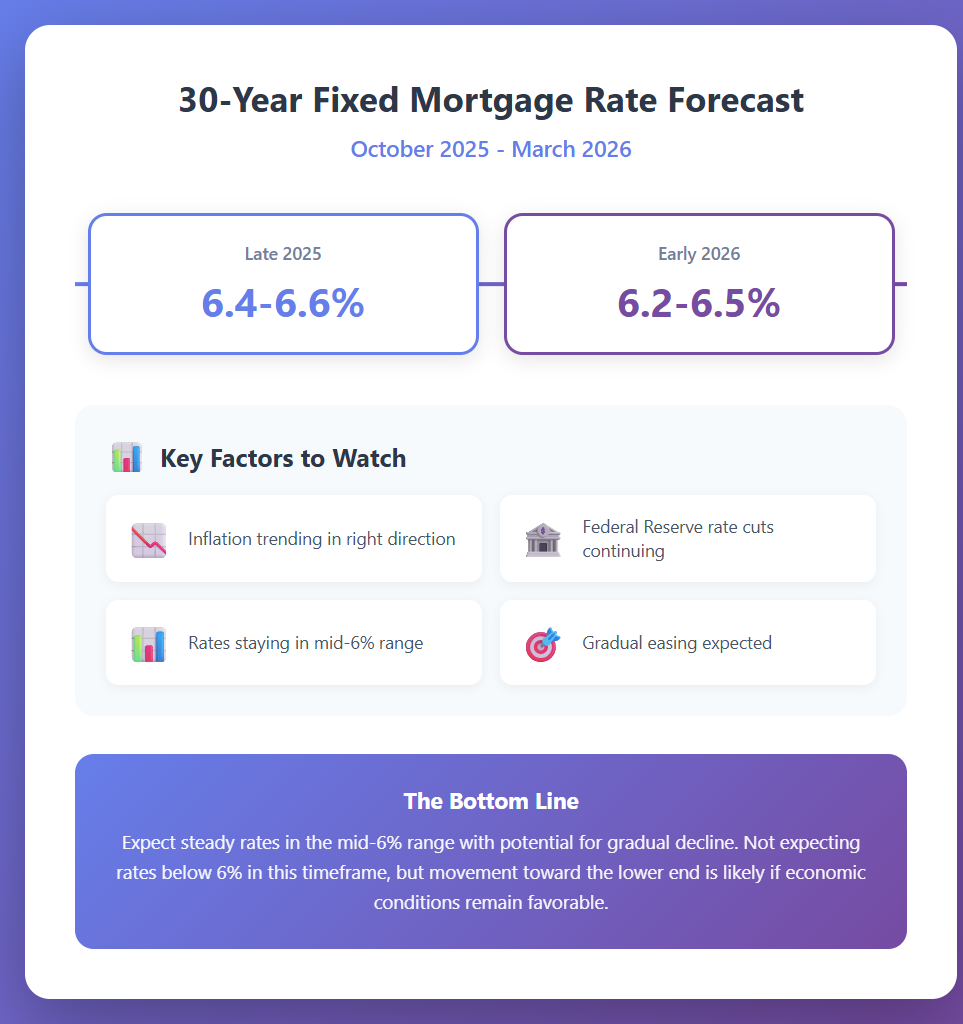
  • Half of Recent Home Buyers Got Mortgage Rates Below 5%
  • Mortgage Rates Need to Drop by 2% Before Buying Spree Begins
  • Will Mortgage Rates Ever Be 3% Again: Future Outlook
  • Mortgage Rates Predictions for Next 2 Years
  • Mortgage Rate Predictions for Next 5 Years
  • Mortgage Rate Predictions for 2025: Expert Forecast

Filed Under: Financing, Mortgage Tagged With: mortgage, mortgage rates, Mortgage Refinance Rates

Today’s Mortgage Rates – October 15: 30-Year FRM Hits Lowest Point in Over a Month

October 15, 2025 by Marco Santarelli

Today's Mortgage Rates - October 9, 2025: 30-Year FRM Nudges Up to 6.48%

Are you eyeing a new home or thinking about refinancing? Today's mortgage rates have seen a bit of a dip, particularly on that ever-popular 30-year fixed-rate mortgage. Zillow is reporting that the average rate for a 30-year fixed mortgage has actually moved down four basis points, landing at a cool 6.20%. This is the lowest we've seen it in over a month, and honestly, it feels like a breath of fresh air after a period of some bumpy movement.

Today's Mortgage Rates – October 15: 30-Year FRM Hits Lowest Point in Over a Month

For context, let's quickly look at the national averages being reported by Zillow today:

Mortgage Type Average Rate
30-Year Fixed 6.20%
20-Year Fixed 5.83%
15-Year Fixed 5.52%
5/1 ARM 6.29%
7/1 ARM 6.36%
30-Year VA 5.65%
15-Year VA 5.21%
5/1 VA 5.60%

Now, these are the rates for new purchases. If you're thinking about refinancing your current home loan, the numbers are just slightly different, generally a hair higher as lenders factor in different considerations. Here's what Zillow is showing for refinance rates today:

Mortgage Type Average Rate
30-Year Fixed 6.38%
20-Year Fixed 5.97%
15-Year Fixed 5.81%
5/1 ARM 6.60%
7/1 ARM 6.84%
30-Year VA 5.97%
15-Year VA 5.97%
5/1 VA 5.40%

So, a modest improvement today, and one that's definitely worth paying attention to. But to truly understand what's going on and where things might be headed, we need to dig a little deeper than just the headline numbers.

The Federal Reserve's Gentle Nudge: Why Today's Rates Are Moving

It’s impossible to talk about mortgage rates without talking about the Federal Reserve. Think of them as the conductor of the economic orchestra, and their decisions send ripples through everything, including the cost of borrowing money for your home.

Just recently, on September 17th of this year, the Fed made its first rate cut of 2025. They lowered their benchmark interest rate by a quarter of a percentage point. This was a big deal because it broke a pause that had lasted for five meetings. Before that, we saw three cuts at the tail end of 2024.

What’s really got people talking right now are the recent comments from Fed Chair Jerome Powell. In a speech on October 14th, he hinted that more easing could be on the horizon. He sounded quite concerned about the job market showing signs of weakness. Powell mentioned that there’s “no risk-free path” forward, and this acknowledges some tricky situations the Fed is up against:

  • Data Headaches: The recent government shutdown has made it tough to get a clear picture of just how the economy is doing.
  • Inflation Hangover: Thanks in part to tariffs, prices are still a bit higher than we’d like, putting some pressure on inflation.
  • Cooling Jobs: The labor market isn't as hot as it used to be, and the Fed might need to step in with more support.

For us on the ground, especially those of us looking to buy or refinance, Powell's words are a signal. They suggest the Fed is leaning towards keeping borrowing costs down to help strengthen the economy, particularly the job market.

Connecting the Dots: Treasury Yields and Your Mortgage

So, how does the Fed’s decision about the federal funds rate actually affect your mortgage rate? The main way is through the 10-year U.S. Treasury yield. This is basically the benchmark that lenders use when setting the price for a 30-year fixed-rate mortgage.

Right now, as of mid-October 2025, the 10-year Treasury yield is hovering around 4.12%. This is actually a bit lower than its long-term average of about 4.25%.

Here’s how it works:

  • The Direct Link: When the 10-year Treasury yield goes down, it generally means lenders can borrow money more cheaply. This, in turn, usually allows them to offer lower mortgage rates.
  • Investor Appetites: Think of it this way: investors have choices. They can invest in safe U.S. Treasury bonds or in something called mortgage-backed securities (which are basically bundles of mortgages). For mortgage-backed securities to be attractive, they need to offer a return that’s competitive with Treasuries.
  • The “Spread”: Mortgage rates don't just track the Treasury yield perfectly. There’s usually a gap, or a “spread,” between the two. This spread accounts for the extra risk lenders take when issuing mortgages compared to just buying a Treasury bond. Right now, this spread is a bit wider than usual, sitting above 2 percentage points. This is why even when Treasury yields drop, mortgage rates don't always fall as dramatically. It's like a buffer that moderates how quickly falling Treasury rates translate into lower mortgage rates for you.

What This All Means for You Today (October 15, 2025)

Given all this information, here’s my take on what today’s mortgage rates and the Fed's signals mean for you:

  • Increased Confidence in Future Cuts: Powell’s leaning towards supporting the labor market really ups the chances of more rate cuts from the Fed, possibly as soon as November or December. This is a significant development that could continue to push borrowing costs lower.
  • Stability and Gradual Improvement: The 10-year Treasury yield has been pretty stable around that 4.12% mark since the Fed's September cut. This suggests the market has absorbed the initial policy change. While mortgage rates have come down from their recent highs, that wider spread means the full benefit of lower Treasury yields isn’t quite reaching borrowers yet. It’s a gradual improvement, not a sudden plunge.
  • A Glimmer of Hope for Buyers: If you're looking to buy, the current rates are definitely more manageable than they were at their peak in 2024. Powell's comments really suggest that better financing conditions could be on the way. However, I can’t ignore that home prices are still a big hurdle for many people trying to get into the market for the first time.

The Housing Market Outlook: What Buyers and Sellers Can Expect

This shift in mortgage rates and Fed sentiment has real implications for both those looking to buy and those looking to sell:

  • For Buyers: With rates showing a downward trend and the Fed likely to continue easing, it’s worth considering the timing of your purchase. You might be able to snag an even better rate in the coming months. However, it’s a delicate balance. If you find a home you love and a rate that works for your budget, don’t wait too long and risk missing out.
  • For Sellers: The prospect of even lower interest rates down the line could encourage more homeowners to finally list their properties. Many homeowners have been “rate-locked” into their current, lower mortgages. As rates dip further, some of them might feel more comfortable selling and moving, which could help ease the tight inventory we’ve seen in many areas.
  • Market Activity: I'm expecting to see more people actively buying and selling. However, in many popular housing markets, the simple fact is that there still aren’t enough homes for sale to meet demand. This imbalance means that, even with more activity, we might not see home prices crash – they could continue to hold their value or inch up in competitive areas.


Related Topics:

Mortgage Rates Trends as of October 14, 2025

Mortgage Rates Predictions for the Next 12 Months: Oct 2025 to Oct 2026

Mortgage Rates Predictions for the Next 6 Months: October 2025 to March 2026

Mortgage Rates Predictions for Next 90 Days: October to December 2025

What to Watch Next

To get a clearer picture of where things are going, I'll be keeping a close eye on these key factors:

  • Labor Market Data: How job growth and unemployment numbers evolve will be critical. If the job market weakens further, it's almost a guarantee the Fed will cut rates again.
  • Inflation Numbers: Will those tariff-related price bumps start to fade? How quickly inflation continues to move towards the Fed's 2% target will influence their pace of rate cuts.
  • Economic Data Clarity: As the government shutdown’s effects on data reporting clear up, we'll get a more solid understanding of the economy’s true health.
  • The Mortgage-Treasury Spread: If that spread starts to narrow, it means that more of the savings from lower Treasury yields will actually make it to your mortgage rate, potentially leading to bigger rate drops.

My Personal Takeaway

As someone who has followed the housing and finance markets for a while, I’m cautiously optimistic about today's October 15, 2025 mortgage rates. The Fed's shift in tone, with a clear focus on the labor market, signals a proactive approach to managing the economy. For potential buyers, this means the opportunity to secure a home with potentially better financing conditions in the near future. For those looking to refinance, if your current rate is substantially higher than today's offerings, it's a good time to start preparing your paperwork and keeping a close watch on those upcoming Fed meetings.

While there are still economic uncertainties, the willingness of the Fed to cut rates to support employment is a significant positive for anyone looking to enter or re-enter the housing market. These slightly lower rates today, combined with the promise of more potential easing, offer a more encouraging outlook for homeownership than we've seen in quite some time.

Use Rate Uncertainty to Your Advantage—Invest in Steady Rental Income

Savvy investors are locking in properties that deliver consistent passive rental income and long-term appreciation.

Work with Norada Real Estate to find turnkey, cash-flowing homes in stable markets—helping you grow wealth no matter which way rates move.

HOT NEW INVESTMENT PROPERTIES JUST LISTED!

Speak with a seasoned Norada investment counselor today (No Obligation):

(800) 611-3060

Get Started Now

Also Read:

  • Mortgage Rates Predictions Backed by 7 Leading Experts: 2025–2026
  • Mortgage Rate Predictions for the Next 3 Years: 2026, 2027, 2028
  • 30-Year Fixed Mortgage Rate Forecast for the Next 5 Years
  • 15-Year Fixed Mortgage Rate Predictions for Next 5 Years: 2025-2029
  • Will Mortgage Rates Ever Be 3% Again in the Future?
  • Mortgage Rates Predictions for Next 2 Years
  • Mortgage Rate Predictions for Next 5 Years
  • Mortgage Rate Predictions: Why 2% and 3% Rates are Out of Reach
  • How Lower Mortgage Rates Can Save You Thousands?
  • How to Get a Low Mortgage Interest Rate?
  • Will Mortgage Rates Ever Be 4% Again?

Filed Under: Financing, Mortgage Tagged With: Interest Rate, mortgage, Mortgage Rate Trends, mortgage rates, Mortgage Rates Today

  • « Previous Page
  • 1
  • …
  • 5
  • 6
  • 7
  • 8
  • 9
  • …
  • 14
  • Next Page »

Real Estate

  • Birmingham
  • Cape Coral
  • Charlotte
  • Chicago

Quick Links

  • Markets
  • Membership
  • Notes
  • Contact Us

Blog Posts

  • 30-Year Fixed Mortgage Rate Drops Sharply by 98 Basis Points
    January 20, 2026Marco Santarelli
  • Why January is the Cheapest Month to Buy a Home in 2026
    January 19, 2026Marco Santarelli
  • Today’s Mortgage Rates, January 19: Rates Go Down, Easing Pressure on Buyers
    January 19, 2026Marco Santarelli

Contact

Norada Real Estate Investments 30251 Golden Lantern, Suite E-261 Laguna Niguel, CA 92677

(949) 218-6668
(800) 611-3060
BBB
  • Terms of Use
  • |
  • Privacy Policy
  • |
  • Testimonials
  • |
  • Suggestions?
  • |
  • Home

Copyright 2018 Norada Real Estate Investments

Loading...