Norada Real Estate Investments

  • Home
  • Markets
  • Properties
  • Membership
  • Podcast
  • Learn
  • About
  • Contact

Dallas Real Estate Investment: Is It Time to Invest or Wait?

August 26, 2025 by Marco Santarelli

Investing in Dallas real estat

So, you're thinking about putting your hard-earned money into Dallas real estate. That's a smart move to be considering. After all, Dallas has consistently been a hub of opportunity, attracting people and businesses from all over. But with the market always shifting, it's natural to ask: Should you invest in Dallas right now?

Dallas Real Estate Investment: Is It Time to Invest or Wait?

My quick answer is a resounding yes, but with an understanding of the current market dynamics and a strategic approach. While there have been some slight cooling-off periods, Dallas remains a fundamentally strong market with a bright future for real estate investors.

As someone who's spent a good chunk of time navigating the Dallas housing scene, I've seen firsthand how it can bounce back and grow stronger. It’s not just about stats; it’s about understanding the pulse of the city. And right now, Dallas is in an interesting spot – not the scorching-hot seller’s market of a few years ago, but definitely not a buyer’s free-for-all. It’s more nuanced, and that’s where the real opportunity lies for those who do their homework.

What's Really Happening in Dallas Real Estate Right Now?

Let’s cut through the noise and look at what the numbers are telling us. As of May 2025, home sales in the Dallas-Fort Worth-Arlington area saw a small dip, about 2.51% less than the year before. We’re talking about 9,195 sales compared to 9,432 in May 2024. Year-to-date, sales are also down a bit, a little over 2%.

Now, before you get worried, this isn't a Dallas-specific problem. Across the nation, home sales also saw a slight decrease, around 0.7% year-over-year. So, the Dallas housing market is pretty much in step with the national trend. It means the market isn’t overheating, which can actually be a good thing for investors.

When it comes to prices, there’s been a bit of a correction. The median close price in May 2025 was $399,000, which is a small drop from $408,000 in May 2024. The average sales price also saw a dip of about 1.75%.

Here's a quick snapshot:

  • Median Close Price: $399,000 (down 2.21% YoY)
  • Average Sales Price: $516,731 (down 1.75% YoY)
  • Median Price Per Square Foot: $195.71
  • Average Price Per Square Foot: $211.52

Now, are home prices dropping drastically? I don't think so. From my perspective, these slight decreases are more a sign of a market cooling down after a period of rapid growth. It's a healthier adjustment, bringing things back to a more sustainable pace. It’s also worth noting that the national median home price is around $422,800, and it’s actually seen a slight increase. Dallas is still more affordable than the national average, which is a big draw.

The Rise of Housing Supply: Good News for Buyers (and Savvy Investors!)

This is where things get really interesting for investors. The amount of housing available in Dallas has gone up significantly. We’re looking at a jump from 3.5 months' supply to 4.7 months' supply. Active listings have also shot up by over 37%.

What does this mean? More homes are on the market, giving buyers more choices and less pressure to race against dozens of other offers. For investors, this means:

  • More Negotiating Power: You can likely negotiate better deals on properties.
  • Less Competition: You’re not going to be in a bidding war for every decent home.
  • Opportunity for Value: You can find properties that might have been out of reach or snapped up instantly a year or two ago.

Is it a buyer's market or a seller's market? Right now, Dallas is definitely moving towards a more balanced market. It’s not the extreme seller’s market where everyone was making cash offers way over asking. But is it a full-blown buyer’s market yet? Not quite. Buyers have more leverage, and sellers still hold a pretty strong hand, but the cards are more evenly distributed.

Key Market Trends Shaping Dallas Real Estate

Let's dive a bit deeper into what’s driving these changes:

  • Increased Inventory: As mentioned, more homes are available, which is a welcome change for many.
  • Slightly Lower Prices: Some price moderation makes properties more accessible.
  • Homes Staying on Market Longer: Homes are taking a bit longer to sell – about 86 days on average now, up from 75. This means less pressure to make hasty decisions.
  • Mortgage Rates: Ah, the big one. Higher mortgage rates are definitely impacting affordability and buyer behavior. The average 30-year fixed rate is hovering around 6.72%, and the 15-year around 5.86%. While these are higher than we've seen in recent years, it's important to remember that rates are showing a downward trend, and home purchase applications are still on the rise. This ebb and flow of rates is a normal part of the market cycle.
  • Job Growth: Dallas’s economy is still humming. The number of jobs in the Dallas-Fort Worth-Arlington MSA increased by over 1.10% year-over-year, adding about 46,800 new jobs. A strong job market is a fundamental pillar of a healthy real estate market. People need places to live, and jobs are what bring them here.

Price Cohort Analysis: Where is the Action?

Looking at different price points can tell us a lot about where demand is strong.

Price Cohort Closed Sales YoY % % Total Sales Median Close Price YoY % Median Price PSF YoY % Active Listings Months Inventory Median Square Feet Median Year Built
$0 < $70k 21 61.54% 0.23% $57,500 -5.74% $61.48 -14.60% 39 3.4 1,263 1983
$70k < $100k 41 46.43% 0.45% $85,000 1.80% $88.94 -16.92% 89 3.5 994 1969
$100k < $150k 106 8.16% 1.15% $130,000 0.00% $121.08 -5.14% 354 4.1 1,082 1965
$150k < $200k 232 6.42% 2.52% $176,000 -2.22% $149.68 -7.66% 928 4.6 1,200 1963
$200k < $250k 637 20.64% 6.93% $230,000 0.00% $168.54 -5.39% 1,528 3.2 1,354 1984
$250k < $300k 1,122 -1.75% 12.21% $276,359 -0.23% $178.35 -3.73% 3,473 3.7 1,554 1997
$300k < $400k 2,483 -0.80% 27.02% $347,000 0.58% $181.19 -3.69% 8,474 4.1 1,890 2007
$400k < $500k 1,486 -8.44% 16.17% $440,000 -1.10% $197.37 -1.13% 6,305 5.0 2,250 2009
$500k < $750k 1,859 -6.77% 20.23% $590,000 0.00% $215.64 -1.54% 8,108 5.3 2,768 2012
$750k < $1 mil 621 -7.31% 6.76% $839,000 -0.12% $246.66 -0.21% 2,901 6.1 3,421 2006
$1 mil + 581 -5.53% 6.32% $1,407,500 -0.90% $344.32 -3.09% 3,356 7.7 4,278 2007

A few things jump out here:

  • The Mid-Range is Strong: The $300,000 to $400,000 and $500,000 to $750,000 price brackets are still seeing the highest volume of sales. This indicates steady demand in these popular price points.
  • Lower Price Points Showing Growth (in sales): The very affordable end ($0-$100k) and the $200k-$250k range are seeing surprisingly strong sales growth. This suggests that affordability is still a key driver, and investors looking for rental properties might find good value here.
  • Higher Price Points Cooling: The luxury market ($750k and above) is experiencing slightly larger dips in sales and price per square foot. This is typical in a market that's balancing out – the ultra-luxury segment is often more sensitive to economic shifts.

Single-Family Homes, Townhomes, and Condos: What's the Difference?

It’s crucial to understand how different property types are performing:

Single-Family Homes

These are the backbone of the Dallas market. Sales are down by a small 0.58% year-over-year, but that’s a very minor shift.

Here is a summary of Single-Family Activity:

Metric May 2025 YoY %
Sales 8,728 -0.58%
Dollar Volume $4,541,925,171 -2.74%
Median Close Price $400,000 -2.44%
New Listings 14,146 8.65%
Active Listings 32,248 35.61%
Months Inventory 4.5 33.32%
Days to Sell 86 14.67%
Average Price PSF $209.64 -2.41%
Median Price PSF $194.21 -2.62%
Median Square Feet 2,129 0.05%
Close to Original List Price 95.53 -1.57%
  • Active Listings Up: This is positive for buyers and investors looking for single-family rentals or flips.
  • Days to Sell: 86 days. Still reasonable, and buyers have a bit more time to consider their options.

I generally see single-family homes as a stable investment in Dallas. They appeal to families, which are a significant demographic here. The slight increase in inventory and longer days on market mean you might be able to snag a property at a more favorable price than before.

Townhomes

The townhome market has seen a more noticeable dip in sales, down 26.65% year-over-year.

Here is a summary of Townhouse Activity:

Metric May 2025 YoY %
Sales 245 -26.65%
Dollar Volume $105,492,529 -28.56%
Median Close Price $397,410 -0.65%
New Listings 585 29.14%
Active Listings 1,515 60.32%
Months Inventory 6.2 67.25%
Days to Sell 93 16.25%
Average Price PSF $223.66 -3.64%
Median Price PSF $216.24 -4.26%
Median Square Feet 1,875 2.74%
Close to Original List Price 94.92 -2.35%

This signifies a weaker demand for townhomes specifically right now. While the median price hasn't dropped much, the significant increase in supply and decrease in sales might mean oversupply in certain areas or a shift in buyer preferences away from townhomes. This could present an opportunity if you find a great deal, but it’s something to watch closely.

Condominiums

Condos have also experienced a substantial decrease in sales, down 32.29% year-over-year.

Here is a summary of Condominium Activity:

Metric May 2025 YoY %
Sales 216 -32.29%
Dollar Volume $101,329,699 -29.08%
Median Close Price $265,000 -7.10%
New Listings 545 7.07%
Active Listings 1,792 50.59%
Months Inventory 8.2 66.08%
Days to Sell 86 8.86%
Average Price PSF $272.23 -5.07%
Median Price PSF $235.02 -6.04%
Median Square Feet 1,141 -0.52%
Close to Original List Price 93.21 -1.92%

The condo market seems to be the softest right now. This could be due to a combination of factors: rising interest rates hitting buyers who might lean towards condos, perhaps an oversupply in certain urban areas, or changing lifestyle preferences. Again, the potential for a bargain exists, but requires careful due diligence.

Dallas Housing Market Forecast: What's Next?

Looking ahead, experts are predicting a slight decrease in home values in Dallas over the next year. Zillow, for instance, projects a gradual decline in home values, with a forecasted change of -2.2% by May 2026.

  • End of June 2025: -0.6%
  • End of August 2025: -1.5%
  • End of May 2026: -2.2%

This isn't a crash; it's a continued stabilization. Compared to other Texas cities, Dallas is in the middle of the pack. Austin and Corpus Christi are predicted to see steeper declines (-3.2% and -4.2% respectively), while McAllen and El Paso are even expected to see modest growth.

This forecast reinforces the idea that this isn't the time to expect rapid appreciation overnight. Instead, it’s a market where you can potentially buy at a more reasonable price, focus on cash flow from rentals, and benefit from long-term appreciation as Dallas continues its growth trajectory.

So, Should You Invest in Dallas? Let's Break It Down.

You’ve seen the numbers, you’ve heard about the trends, and now the big question looms: Should you invest in Dallas right now? After diving deep into the market, talking to people on the ground, and crunching the latest data, my honest answer is still a confident yes. But—and it’s a big but—it’s not a simple “jump in with both feet” kind of yes. It’s more of a “proceed with informed strategic action” yes.

Dallas is a city that’s been on a consistent upward trajectory for years, fueled by job growth, in-migration, and a business-friendly environment. Even with the recent market adjustments, those fundamental strengths haven't vanished. What we're experiencing now is a recalibration, a move back to a more sustainable growth pattern, which, frankly, is a much better environment for long-term investors.

Here’s why I believe Dallas remains a prime spot for real estate investment, and what you need to keep at the forefront of your mind:

Reasons to Invest in Dallas: The Enduring Strengths

  1. The Dallas Economy: Still a Powerhouse. This is, hands down, the biggest driver. Dallas isn’t just growing; it’s diversifying. We’re seeing massive success in sectors like technology, healthcare, financial services, and logistics. Major companies continue to relocate or expand their operations here, bringing with them a steady influx of new residents who need places to live. As an investor, a strong job market is your best friend. It translates directly into consistent demand for housing, whether for rent or for purchase. You’re investing in a city that’s a magnet for opportunity, not just a passing trend.
  2. The Market is Finding its Balance: Opportunity Knocks. Remember those frantic bidding wars and waived contingencies of a year or two ago? They’re largely behind us. The increase in housing inventory means more choices for buyers and investors. This isn't a sign of a failing market; it’s a sign of a maturing market.
    • More Negotiating Power: Sellers are becoming more realistic. This gives you the chance to negotiate better purchase prices, which is crucial for a good investment. You’re not going to overpay in a frenzy.
    • Less Competition: While good deals still go quickly, you're not usually competing with 20 other offers. This allows for more thoughtful decisions.
    • Entry Points Become More Accessible: As prices stabilize and even slightly dip in some areas, your initial investment can be more manageable, especially when factoring in the long-term appreciation potential.
  3. Affordability Still Holds Its Ground (Compared to the Nation). Yes, Dallas prices have gone up over the years, but when you stack it against the national median home price of $422,800, Dallas at $399,000 (median close price in May 2025) still offers relative affordability. This makes Dallas attractive to a wider range of buyers and renters, creating a more robust demand base for your investment properties. It also means your dollar can stretch further here than in many other major metros.
  4. Long-Term Growth Trajectory is Undeniable. While we're talking about a potential slight decrease in home values over the next year, this is a correction, not a collapse. Projections show Dallas as being more resilient than some other major Texas cities in terms of price stability moving forward. Dallas’s continued population growth, its status as a major transportation hub, and its commitment to innovation all point to sustained long-term appreciation. Investing in real estate is often a long game, and Dallas’s fundamentals support that long game very well.
  5. Diverse Investment Avenues. Dallas offers flexibility. You can focus on single-family homes for long-term rentals, which are generally the most stable. Or, if you're strategic, you might find opportunities in multi-family properties for stronger cash flow, or even value-add opportunities through renovations. While townhomes and condos have seen a tougher time recently, this doesn't mean they're bad investments, just that you need to be exceptionally discerning about location, condition, and price.

Potential Challenges and How to Navigate Them Like a Pro

It wouldn’t be honest if I didn’t highlight what to watch out for. Every market has its hurdles, and the current Dallas market is no different.

  1. Higher Mortgage Rates: The Affordability Factor. This is the elephant in the room for many buyers and investors. Rates around 6.58% for a 30-year fixed (as of August 21, 2025) mean higher monthly payments compared to a few years ago.
    • Your Strategy: This is where a laser focus on cash flow becomes non-negotiable. You need to ensure your rental income can comfortably cover those higher mortgage payments, property taxes, insurance, vacancy periods, and maintenance, and still leave you with profit. It’s also a good time to consider if a larger down payment or a different loan product makes sense for your financial situation. For investors who can pay cash or have substantial down payments, this is a golden opportunity to acquire properties without the same financing costs as others.
  2. Slight Price Corrections: Managing Expectations. We’re not seeing widespread price collapses, but the era of rapid, double-digit appreciation is paused.
    • Your Strategy: Adjust your financial models. Don't bank on quick appreciation to make your investment work. Instead, prioritize properties that provide solid rental income and have the potential for steady, long-term value growth. Focus on the intrinsic value of the property and its location, not just the speculative market appreciation.
  3. Increased Inventory (Especially for Townhomes & Condos): The Need for Selective Investing. While increased inventory is good, the more significant jumps in townhomes and condos mean you need to do your homework.
    • Your Strategy: This is where hyper-local market research is critical. Why are these specific property types seeing inventory increases? Is it an oversupply in a particular sub-market? Are newer, more desirable units coming online? Or is it a broader shift away from these types of housing? My advice here is to lean heavily into single-family homes, as they tend to be the most stable. If you are considering townhomes or condos, ensure you are buying them at a price that reflects the current market conditions and demand, and that the property itself has strong appeal (amenities, location, condition).
  4. Days on Market: Taking Your Time, But Not Too Much. Homes are staying on the market longer (around 86 days).
    • Your Strategy: This gives you breathing room for due diligence and negotiation. However, it also means that properties that sit can sometimes indicate underlying issues or overpricing. Use this data to your advantage by targeting well-priced, well-maintained properties and being prepared to act decisively when the right deal appears.

Strategies for Today's Savvy Dallas Investor

To truly capitalize on the Dallas market right now, here are the strategies I’d be focusing on:

  • Mastering Cash Flow: Rents in Dallas are generally strong, and they tend to keep pace with inflation. Your primary goal should be to find properties where the rental income significantly outweighs your expenses, including your mortgage. This creates passive income and builds equity over time, even if property values are only inching up.
    • Think about it: A property that rents for $2,000 per month might have a mortgage payment of $1,500, taxes, insurance, and a buffer for vacancy and repairs. If you’re left with $200-$300 (or more!) of pure profit each month, that’s valuable cash flow.
  • Hyper-Local Neighborhood Analysis: Dallas is composed of dozens of distinct sub-markets, each with its own housing stock, tenant demographics, and growth patterns.
    • My experience says: Don’t just look at Dallas as a whole. Dive into specific zip codes or even neighborhoods. Where are the good schools? Where are the new job centers creating demand? What’s the crime rate like? What are the zoning laws, and are there limitations on building or renovations? Understanding these granular details is what separates a good investment from a great one. Areas like North Dallas, Richardson, Plano, Frisco, and parts of Irving are consistently strong performers due to their excellent schools and proximity to employment.
  • Property Type Selection: Stability First. While opportunities exist everywhere, I would continue to prioritize single-family homes in desirable family-friendly neighborhoods. They have broader appeal to the largest segment of renters and buyers.
    • Why I feel this way: Families typically commit to longer leases, meaning fewer vacancies. They also tend to maintain properties better. The slightly larger inventory of single-family homes now makes them even more attractive than during the frantic seller's market.
  • Consider Multi-Family for Scale: If you have the capital and interest, investing in duplexes, triplexes, or small apartment buildings can be a fantastic way to diversify risk and increase cash flow. Having multiple units means even if one is vacant, you still have income from the others.
  • The Value of Property Management: If you’re not local, or if your portfolio is growing, a professional property manager is an investment, not an expense. They handle the day-to-day headaches of tenant screening, rent collection, maintenance requests, and evictions (if necessary). This preserves your time and often your sanity, while ensuring your investment performs optimally.
  • Don't Skip the Due Diligence: This cannot be stressed enough. A thorough inspection can reveal hidden issues that could cost you dearly down the line. Always review the most recent property taxes, HOA fees (if applicable), and understand the local rental market to set realistic rent expectations.

The Bottom Line for Dallas Real Estate Investment

Dallas is in a transition phase. Home sales and prices have seen minor dips, but the increased housing inventory is creating more opportunities for buyers and investors. High mortgage rates remain a challenge, but the market is adjusting, and job growth continues to be a strong positive indicator.

For potential buyers and investors: This is a time to be strategic. You have more choices, and less competition than before. Take your time to find the right property that fits your investment goals. Negotiation is back on the table, so leverage that.

For sellers: Be realistic about pricing. Your home needs to be in excellent condition, and you might need to be more open to negotiation than you were a year or two ago.

In my opinion, Dallas isn't going anywhere. It's a dynamic city with a growing population and a strong economy. While the market might not be the sprinting pace of a few years ago, it’s a steady jog, and that’s fantastic for building a real estate portfolio. If you do your homework, focus on cash flow, and choose your investments wisely, investing in Dallas real estate today can set you up for significant success in the years to come.

“Invest in the Dallas Real Estate Market”

The Dallas housing market continues to draw attention with strong population growth, job expansion, and steady rental demand. But many investors are asking the big question: Is now the right time to buy, or should you wait?

Norada gives you access to cash-flowing, turnkey rental properties in Dallas and other high-demand markets—helping you lock in opportunities before prices climb further.

Exclusive Dallas Opportunities Available Now!

Talk to a Norada investment counselor today (No Obligation):

(800) 611-3060

Get Started Now 

Want to Know More?

Explore these related articles for even more insights:

  • Dallas Housing Market: Prices, Trends, Forecast 2025-2026
  • Texas Housing Market: Trends and Predictions
  • Will the Texas Housing Market Crash?
  • Is Texas a Good Place to Live: Explore the Cost, Jobs & Lifestyle
  • Are Texas Home Sales Dropping?
  • Should You Invest in the Dallas Real Estate Market?

Filed Under: Real Estate Investing, Real Estate Investments Tagged With: Dallas real estate investment, Real Estate Investing

Mortgage Rates Today: 30-Year Fixed Refinance Rate Goes Down by 2 Basis Points

August 26, 2025 by Marco Santarelli

Mortgage Rates Drop: Today's 30-Year Fixed Refinance Rate Goes Down by 23 Basis Points

Are you thinking about refinancing your mortgage? Today's refinance rates have dropped. The national average 30-year fixed refinance rate is currently 6.86%, as of August 26, 2025, according to Zillow. This is a decrease of 2 basis points compared to last week, but up one basis point from yesterday. So, is now a good time to refinance? Let's dig in.

Mortgage Rates Today: 30-Year Fixed Refinance Rate Goes Down by 2 Basis Points

What's Happening with Mortgage Rates?

Here's a quick snapshot of where refinance rates stand right now:

  • 30-Year Fixed Refinance Rate: 6.86% (Up 1 basis point from yesterday)
  • 15-Year Fixed Refinance Rate: 5.82% (Up 15 basis points from yesterday)
  • 5-Year ARM Refinance Rate: 7.40% (No change from yesterday)

As you can see, the rates are fluctuating, and although the 30-year fixed rate saw a slight dip compared to last week, the increases in other areas indicate that the market is pretty dynamic right now. I always advise keeping a close eye on these movements if you're seriously considering refinancing.

Is it the Right Time to Refinance?

This is the million-dollar question, isn’t it? With the 30-year fixed refinance rate currently hovering around 6.86%, whether it's a good time to refinance really depends on your individual situation. Here are a few things to consider:

  • Your Current Interest Rate: If your existing mortgage rate is significantly higher than the current refinance rate, refinancing could save you money over the long term.
  • Your Financial Goals: Are you looking to lower your monthly payments, shorten your loan term, or tap into your home equity? Refinancing can help you achieve these goals.
  • Closing Costs: Don't forget to factor in closing costs, which can add up. Make sure the potential savings from refinancing outweigh these costs. I have seen many people overlook this and end up not saving too much.

What the Experts are Saying About Future Mortgage Rates

To get a better sense of whether these rates are likely to stay the same, increase, or drop, it's smart to check on the expert outlooks:

  • National Association of REALTORS®: Expects mortgage rates to average 6.4% in the second half of 2025 and potentially fall further to 6.1% in 2026.
  • Realtor.com: Foresees a slow easing of mortgage rates, potentially matching the prior year’s average despite a dip to 6.4% by year-end
  • Fannie Mae (August 2025 Forecast): Projects mortgage rates to end 2025 at 6.5% and 2026 at 6.1%. They also predict mortgage originations to be at $1.85 trillion for 2025 and $2.26 trillion for 2026.
  • Mortgage Bankers Association: Expects 30-year mortgage rates to remain near 6.8% through September 2025. They project rates to be in the mid-6% range (6.4%-6.6%) for the remainder of 2025 and then remain at 6.3% into 2026

I always recommend looking at a variety of forecasts because each institution has its own methodology and perspective.

The Federal Reserve and Mortgage Rate Trends

It's impossible to talk about mortgage rates without mentioning the Federal Reserve. Their monetary policy decisions are a major driver of where rates are headed. Here's a quick recap of what's been happening:

  • 2021-2023: The Fed aggressively raised the federal funds rate to combat inflation, causing mortgage rates to surge.
  • Late 2024: The Fed started cutting rates, offering some relief to borrowers.
  • 2025 (So Far): The Fed has paused rate hikes, holding steady for five consecutive meetings this year through July 30.

Indicators Point to a Potential Rate Cut in September

Market signals currently suggest an 85-95% probability of a rate cut at the September 16-17 meeting of the Federal Reserve

  • Cooling Inflation: Inflation is moderating, getting closer to the Fed's target.
  • Weakening Labor Market: Unemployment is on the rise, and job growth is slowing.
  • Economic Slowdown Predictions: Forecasts suggest the economy is cooling off, which could prompt the Fed to provide some stimulus

Remember to keep an ear out for Fed Chair Jerome Powell's speech at the Jackson Hole Economic Symposium on August 22. His words could offer clues about their next move.

Recommended Read:

Mortgage Rates August 25, 2025: 30-Year Fixed Refinance Rate Goes Down by 23 Basis Points

Best Time to Refinance Your Mortgage: Expert Insights

Should I Refinance My Mortgage Now or Wait Until 2026? 

What a Rate Cut Would Mean

If the Fed decides to cut rates, it could have several effects:

  • Lower Borrowing Costs: Mortgage rates would likely start to decrease.
  • Increased Business Investment: Lower rates encourage businesses to invest and expand.
  • Market Movements: Stock and bond markets could see significant activity.

Key Dates to Watch:

  • September 16-17: The next Federal Reserve meeting.
  • December Meeting: Another potential opportunity for the Fed to cut rates.

My Two Cents

In my opinion, if you're sitting on a mortgage rate above 7%, it's definitely worth keeping a close eye on the September Fed meeting. If the Fed cuts rates as expected, you might find a good opportunity to refinance and save some money. However if you have a loan with a rate around the current market rate or lower than refinancing may not be the best option. Keep an eye on the fees charged by lenders and also compare with multiple lenders.

Keep in mind that this is just my perspective, and everyone's financial situation is unique. I'd always advise consulting with a financial advisor to make sure you are making the best decision for yourself.

Maximize Your Mortgage Decisions in 2025

Thinking about whether to refinance now? Timing is critical, and having the right strategy can save you thousands over the life of your loan.

Norada's team can guide you through current market dynamics and help you position your investments wisely—whether you're looking to reduce rates, pull out equity, or expand your portfolio.

HOT NEW LISTINGS JUST ADDED!

Talk to a Norada investment counselor today (No Obligation):

(800) 611-3060

Get Started Now

Recommended Read:

  • When You Refinance a Mortgage Do the 30 Years Start Over?
  • Should You Refinance as Mortgage Rates Reach Lowest Level in Over a Year?
  • NAR Predicts 6% Mortgage Rates in 2025 Will Boost Housing Market
  • Mortgage Rates Predictions for 2025: Expert Forecast
  • Half of Recent Home Buyers Got Mortgage Rates Below 5%
  • Mortgage Rates Need to Drop by 2% Before Buying Spree Begins
  • Will Mortgage Rates Ever Be 3% Again: Future Outlook
  • Mortgage Rates Predictions for Next 2 Years
  • Mortgage Rate Predictions for Next 5 Years
  • Mortgage Rate Predictions for 2025: Expert Forecast

Filed Under: Financing, Mortgage Tagged With: mortgage, mortgage rates, Mortgage Refinance Rates

Will Trump Succeed in Sacking Federal Reserve Governor Lisa Cook?

August 26, 2025 by Marco Santarelli

Will Trump Succeed in Sacking Federal Reserve Governor Lisa Cook?

Did you ever think you'd see a President try to fire a Federal Reserve Governor? Well, that's exactly what happened when President Donald Trump tried to remove Lisa Cook from her position. The move immediately raised a ton of questions: Can he actually do that? What would that mean for our wallets? Let's dig deep into what happened, why it matters, and what could happen next.

While it's unlikely his attempt will succeed legally, given Fed governors can only be dismissed “for cause,” this action could still erode trust in the Fed's autonomy, potentially leading to higher long-term inflation risks and market volatility, though short-term rate cuts remain data-driven.

Will Trump Succeed in Sacking Federal Reserve Governor Lisa Cook?

What's the Deal With the Federal Reserve Anyway?

Okay, before we dive into the drama, let's refresh our memory on the Federal Reserve. Think of it as the backbone of the US economy. It's in charge of keeping prices stable (so things don't get too expensive too fast) and making sure enough people have jobs. It does this by setting interest rates, which influence how much it costs to borrow money.

The Fed is run by a Board of Governors. These folks are supposed to be independent, meaning they aren't supposed to be swayed by politics when making decisions. This is super important because it keeps the economy stable. If politicians had too much control, they might make decisions that are good for them right now, but bad for the economy later.

Lisa D. Cook is one of these Governors. Appointed by President Biden in 2022, she's an economist whose work has focused on things like racial disparities and how they affect the economy. Her views on the economy are generally in line with the Fed's current approach.

So, What Exactly Did Trump Do?

On August 25, 2025, things got wild. President Trump announced on social media that he was firing Lisa Cook, claiming she had committed mortgage fraud. He said she had falsely claimed two properties as her primary residence to get better loan terms.

Cook responded immediately, saying that Trump didn't have the power to fire her and that she wasn't going anywhere. This set the stage for a legal showdown and sent ripples through the financial world.

But Can he Do That? The Legal Angle

This is where things get interesting. The law says a Fed Governor can only be removed “for cause”. But what does “for cause” even mean? No one really knows! It's never been tested in court before.

According to some legal experts, unproven allegations probably aren't enough to justify firing someone. Cook's lawyers are already preparing to fight this, arguing that she hasn't had any due process and that the allegations are just a pretext to get her out of the Fed. This could end up in the Supreme Court, which would be a huge deal for the future of the Fed.

Here's a breakdown:

  • The Law: Federal Reserve Act allows removal “for cause.”
  • The Debate: What constitutes “for cause”? Are unproven allegations enough?
  • The Fight: Cook vows to fight the removal in court.
  • The Stakes: Could redefine presidential power over the Fed.

Think of it like this: Imagine your boss trying to fire you for something someone said, without giving you a chance to defend yourself. Seems pretty unfair, right? That's the kind of argument Cook's team is making.

Why Did Trump Do This?

Okay, let's be real. This probably isn't just about mortgage applications. Trump has been critical of the Fed for years, especially when he thought they weren't cutting interest rates fast enough. By getting Cook out of the way, he might be hoping to replace her with someone who's more likely to agree with his economic policies.

There were also allegations from Bill Pulte, a Trump ally, which added fuel to the fire. Basically anything negative that could be thrown her way was.

Some folks think that Trump wants to weaken the Fed's independence and make it easier to pump up the economy before the next election. This could lead to short-term gains, but it could also lead to long-term problems like inflation.

What Happened to Wall Street when Trump Announced the Planned Firing?

Believe it or not, the immediate reaction in the financial markets was fairly tame. But honestly that might be because everyone is expecting her to win and nothing will ultimately come of it.

  • The Dollar Dipped: The U.S. dollar index fell a bit – 0.3%
  • Gold Got a Bump: Gold prices rose to $2,520 an ounce
  • Stocks Wobbled: Futures dipped down slightly (SP500 down 0.3%)

Here's why this matters:

  • Dollar down: This may signal reduced confidence in the US economy.
  • Gold up: Investors were looking for safe investments.
  • Stocks down: People were wary of the possible economic consequences

The Treasury bond market also reacted; the trend indicates a steepening curve, where short term prices went down on hopes of rate cuts. But the long term yields went up suggesting higher inflation overall.

What Could Happen Next? The Ripple Effect

Let's break down the possible consequences:

  • Interest Rates: Remember, the Fed sets interest rates. If Trump gets his way and replaces Cook with someone who agrees with him, we could see faster and bigger rate cuts. That might sound good, but it could also fuel inflation and hurt the long-term health of the economy. It's a gamble.
  • The Fed's Credibility: The Fed's power comes from its independence. If people start to think the Fed is just doing what the President wants, they might lose faith in it. That could lead to all sorts of problems, like higher inflation and unstable markets.
  • The Economy as a Whole: This is the big one. A politically influenced Fed could make mistakes that hurt everyone. Imagine prices skyrocketing, your savings losing value, and the economy going into a tailspin. It sounds scary, but it's a real risk if we don't protect the Fed's independence. Nobody wants to see a repeat of the horrible inflation from the 1970s.

Think About It This Way:

The Fed is like a doctor treating a patient. You want the doctor to make decisions based on what's best for the patient's health, not on what the patient (or someone else) wants to hear. If the doctor starts listening to politics instead of science, things could go very wrong!

What Can We Do?

So, what do you and I do with all this information?

  • Stay Informed: Keep track of what's happening. Read news from different sources. Be critical of what you hear.
  • Talk About It: Discuss these issues with your friends, family, and neighbors. The more people understand what's at stake, the better.
  • Hold Our Leaders Accountable: Let your elected officials know that you care about the Fed's independence. Tell them to protect it.

This whole situation with Lisa Cook is a wake-up call. It shows how important it is to have an independent Federal Reserve that can make decisions based on what's best for the economy AS A WHOLE, not on what's best for politics. Keeping the Fed out of politics is vital for long-term economic stability and for ensuring that our money keeps its value now and for the future.

Navigating Political Shifts & Market Uncertainty

With headlines questioning whether Trump could fire Fed Governor Lisa Cook, the housing and mortgage markets are bracing for potential volatility. But as an investor, you don’t have to sit on the sidelines.

Norada helps you build a resilient real estate portfolio designed to weather political moves, policy shifts, and interest rate changes—so your wealth strategy stays on track.

Secure Cash-Flowing Properties Today!

Talk to a Norada investment counselor now (No Obligation):

(800) 611-3060

Get Started Now

Read More:

  • Trump’s Section 8 Housing Cuts: Will Millions Face Homelessness?
  • Top Reasons Behind the End of the Trump-Musk Alliance in 2025
  • What is Trump's Plan for Privatizing Fannie Mae and Freddie Mac?
  • Elon Musk's $10,000 Homes: A Game Changer for the Housing Market?
  • Elon Musk Calls for Major Reforms at the U.S. Federal Reserve
  • Can Elon Musk Revolutionize Affordable Housing for Americans?
  • Emergency Price Relief on Housing: What Does Trump's Order Mean?
  • Trump's Inaugural Speech: Bold Plans on Border, Economy, and More
  • What Happens to Kamala Harris' Proposal of $25,000 Homebuyer Assistance Now?
  • Housing Market Predictions for 2025 if “Trump” Wins Election
  • 10 Housing Market Predictions Under Trump for the Next 4 Years
  • Will Donald Trump's Victory Reshape the Housing Market in 2025?
  • Trump vs Harris: Housing Market Predictions Post-Election
  • 10 Housing Market Predictions Under Trump for the Next 4 Years
  • Will Donald Trump's Victory Reshape the Housing Market in 2025?

Filed Under: Economy, Trending News Tagged With: Fed, Federal Reserve, Federal Reserve Governor

Trump’s Section 8 Housing Cuts: Will Millions Face Homelessness?

August 26, 2025 by Marco Santarelli

Are you worried about losing your home? Many people are, especially those who rely on Section 8 housing. Trump's Section 8 Cuts proposed in his FY 2026 budget are causing serious concern. President Trump's proposal includes a 43% cut to HUD's rental assistance programs, and it introduces a two-year limit for able-bodied adults.

This is likely to impact over 4.4 million households, potentially increasing homelessness, and experts are worried. Let's dive into what these changes mean for you and your community.

The anxiety I'm seeing amongst families relying on rental assistance isn't just abstract fear; it represents the very real possibility of being pushed into the streets. We need to examine this proposal critically to understand its potential ramifications.

Trump’s Section 8 Housing Cuts: Will Millions Face Homelessness?

Why is Section 8 Housing in the News?

It's all thanks to Trump's FY 2026 budget proposal, which suggests big changes to the program officially known as the Housing Choice Voucher Program. This program helps low-income families, the elderly, and people with disabilities afford rent by subsidizing a portion of their rent payments.

It's a crucial safety net, preventing homelessness and providing stability. With Trump's proposal facing scrutiny, people are naturally searching for answers to know about its impacts, leading it to become a trending topic on news and social media platforms.

Proposed Changes: What's on the Table?

Chart showing Trump's proposed 43% cut to section 8 housing funding

Okay, so what exactly is being proposed? The core of the issue lies in the massive budget cuts outlined by Trump. Let’s break it down:

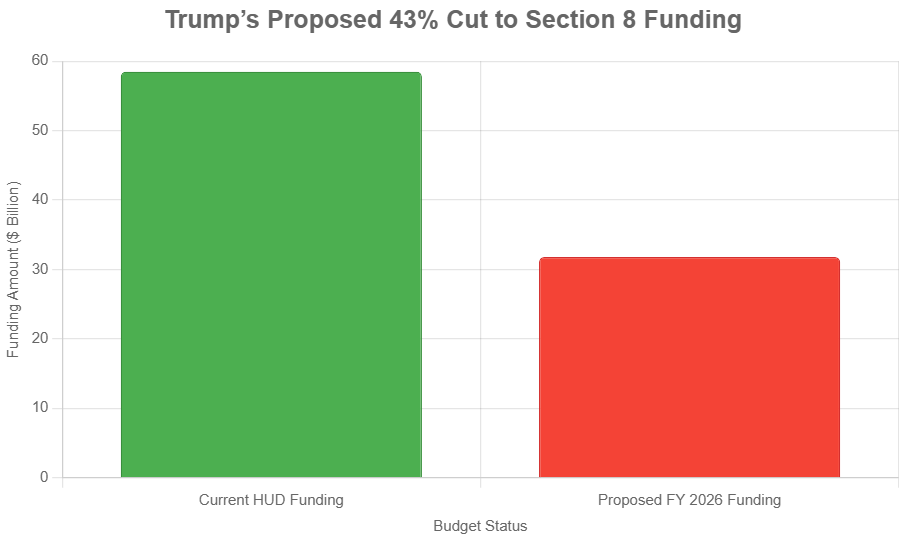
  • 43% Cut to HUD’s Rental Assistance: The budget proposes slashing funding from $58.5 billion to $31.8 billion. This affects not just Section 8, but also public housing, project-based assistance, and programs for retirees and individuals with disabilities. That's almost $27 billion in rental assistance alone going away.
  • Two-Year Limit for Able-Bodied Adults: This is a big one. If you are considered an “able-bodied” adult – meaning no disability preventing work – you will only receive assistance for two years. After that, it’s assumed you can be self-sufficient. Personally, I find this assumption incredibly problematic. The job market isn't always forgiving, and two years might not be enough to gain stable employment in today's economy.
  • State Rental Assistance Block Grant System: The proposal wants to hand over the reins to the states through something called the SRABG. The idea is for states to manage the aid based on their “unique needs”. While in theory, empowering states might sound good, I've seen firsthand discrepancies in how different states handle social programs. The end result could be inequalities in access to, and quality of, assistance, depending on what state you live in. I wonder what kind of accountability and oversight would exist under this system.

The following tables summarize the proposed changes and potential effects:

Aspect Details
Proposed Cut to HUD Funding 43%, reducing from $58.5 billion to $31.8 billion
Programs Affected Section 8, public housing, project-based assistance, programs for disabled
New Policy Two-year limit on aid for able-bodied adults
Funding Mechanism Shift to State Rental Assistance Block Grant (SRABG)
Current Beneficiaries Over 4.4 million households


Potential Impact Details
At Risk Nationwide Over 3.8 million people, including families, veterans, elderly, disabled
New York City Impact Could affect 300,000 Section 8 or public housing residents, potential evictions
Advocate Concerns States may not fill gaps, risk of increased homelessness

The Ripple Effect: Who Gets Hurt?

These changes aren’t just numbers; they’re about real people’s lives. It's important to step back and understand the real-world consequences of these policies. I would say millions of people are at risk.

  • Potentially Affecting Over 4.4 Million Households: This is a staggering number. That's nearly half the cities and towns across America at risk of losing the aid. A substantial cut in rental assistance on top of these households that rely on the aid translates to potential loss of housing for millions of people.
  • Increased Homelessness: The biggest fear is obviously increased homelessness. The National Low Income Housing Coalition warns that if these cuts go through, we could see a drastic rise in the number of people living on the streets.
  • High-Cost Areas Will Suffer More: In cities like New York, where housing costs are already sky-high, 300,000 residents could face eviction. This isn't just about individuals or families; it affects entire communities. A surge in homelessness could overload social services, strain local economies, and lead to increased crime.

Focusing on Veterans and the Disabled

It sounds nice in theory, but is it really beneficial? There’s a lot of debate about the 43% cuts to Section 8 to prioritize veterans, the disabled amongst others. The administration is keen on ensuring the welfare of veterans and disabled individuals. I won't lie, I do appreciate that.

  • National Center for Warrior Independence: An executive order established this center with the aim of housing 6,000 homeless veterans by 2028. The idea is to use Section 8 vouchers to support them. I think that's a great thing.
  • Prioritizing Deserving Cases: The argument is that Section 8 should be a “lifeline” for those who truly need it.

The Great Debate: Self-Sufficiency vs. Safety Net

This is where things get really heated. There’s a huge divide in opinions on this. It's not just about politics but also about different philosophies about how we should care for one another.

Those in favor of the cuts often say things like:

  • “Section 8 shouldn’t be a lifestyle, it should be a lifeline.”
  • “People need to get up, grind, and earn it.”

The opposing side is equally vocal:

  • “We would see homelessness escalate in a way that has been really unprecedented.”
  • “This is not fixing anything; this is making everything so much worse.”

My Two Cents

Well, I believe these proposed cuts are not only misguided but are downright harmful. While I agree that promoting self-sufficiency is important, abruptly cutting off assistance to vulnerable populations is not the answer.

Two years is simply not enough time for many people to get back on their feet. A more sensible approach would be to invest in job training programs and support services that help people transition to independence gradually. We must ensure their security.

Moreover, shifting the burden to the states is risky. States have varying resources and priorities. A federal safety net ensures a basic level of protection for everyone, regardless of where they live.

Let's keep a close eye on this situation. We all have a voice. Contact your representatives, support organizations that advocate for affordable housing, and most importantly, remain engaged.

“Invest in Turnkey Real Estate in 2025”

With proposed Section 8 housing cuts potentially putting millions at risk, stable rental markets with strong demand are more critical than ever.

Norada offers turnkey, professionally managed properties in high-demand areas—helping you support communities while building reliable income.

HOT NEW LISTINGS JUST ADDED!

Speak with a Norada investment counselor today (No Obligation):

(800) 611-3060

Get Started Now

Read More:

  • Top Reasons Behind the End of the Trump-Musk Alliance in 2025
  • What is Trump's Plan for Privatizing Fannie Mae and Freddie Mac?
  • Elon Musk's $10,000 Homes: A Game Changer for the Housing Market?
  • Elon Musk Calls for Major Reforms at the U.S. Federal Reserve
  • Can Elon Musk Revolutionize Affordable Housing for Americans?
  • Emergency Price Relief on Housing: What Does Trump's Order Mean?
  • Trump's Inaugural Speech: Bold Plans on Border, Economy, and More
  • What Happens to Kamala Harris' Proposal of $25,000 Homebuyer Assistance Now?
  • Housing Market Predictions for 2025 if “Trump” Wins Election
  • 10 Housing Market Predictions Under Trump for the Next 4 Years
  • Will Donald Trump's Victory Reshape the Housing Market in 2025?
  • Trump vs Harris: Housing Market Predictions Post-Election
  • 10 Housing Market Predictions Under Trump for the Next 4 Years
  • Will Donald Trump's Victory Reshape the Housing Market in 2025?

Filed Under: Housing Market Tagged With: Housing Choice Voucher Program, Housing Market, HUD, Section 8 Housing

Today’s Mortgage Rates – August 26, 2025: Rates Rise Slightly, 30-Year FRM Ticks Up

August 26, 2025 by Marco Santarelli

Today's Mortgage Rates - August 26, 2025: Rates Rise, 30-Year FRM Increases to 6.69%

On August 26, 2025, mortgage rates today show a slight increase compared to last week, with the 30-year fixed mortgage rate climbing to 6.69%, up 2 basis points from the previous week's 6.67%, according to the latest data from Zillow. Meanwhile, refinance rates have edged up slightly, but experts expect a Federal Reserve interest rate cut in September 2025, which could soon bring mortgage rates downward. This delicate balance of rising rates alongside anticipated cuts is shaping much of the current mortgage and refinance market landscape.

Today's Mortgage Rates – August 26, 2025: Rates Rise Slightly, 30-Year FRM Ticks Up

Key Takeaways

  • 30-year fixed mortgage rate increased to 6.69%, up 2 basis points week-over-week.
  • 15-year fixed mortgage rate rose slightly to 5.74%.
  • 5-year ARM mortgage rate ticked up to 7.01%.
  • Refinance mortgage rates remain elevated with the 30-year fixed refinance rate at 6.86%, down 2 basis points week-over-week.
  • Federal Reserve is highly likely (about 89-91% chance) to cut interest rates in September 2025, potentially pushing mortgage rates lower soon.
  • Experts forecast mortgage rates to stay above 6% through much of 2025 and suggest a drop to near 6% only by Q3 of 2026.
  • Mortgage originations are expected to rise moderately despite current high rates.

Current Mortgage Rates Overview – August 26, 2025

Mortgage rates have been trading within a narrow band for much of 2025 between roughly 6.6% and 6.8%. Recent economic data, including slower job growth and persistent inflation below earlier expectations, have led traders and analysts to predict imminent rate cuts by the Federal Reserve—actions that could ease mortgage borrowing costs soon.

Loan Type Current Rate Weekly Change APR APR Weekly Change
30-Year Fixed 6.69% +0.02% 7.05% -0.06%
20-Year Fixed 6.43% 0.00% 6.94% +0.03%
15-Year Fixed 5.74% -0.03% 5.97% -0.09%
10-Year Fixed 5.79% 0.00% 6.09% 0.00%
7-Year ARM 6.63% -0.57% 7.59% -0.16%
5-Year ARM 7.01% -0.12% 7.57% -0.16%

(Source: Zillow, 8/26/2025)

Government-backed loans show slightly different trends:

Loan Type Current Rate Weekly Change APR APR Weekly Change
FHA 30-Year Fixed 5.98% -0.04% 7.00% -0.04%
VA 30-Year Fixed 6.12% -0.09% 6.33% -0.09%
FHA 15-Year Fixed 5.47% -0.08% 6.44% -0.08%
VA 15-Year Fixed 5.88% +0.04% 6.24% +0.04%

Current Refinance Rates

Refinance rates remain close to the levels of recent weeks, with a small uptick in fixed refinance rates.

Loan Type Current Rate Weekly Change
30-Year Fixed Refi 6.86% +0.01%
15-Year Fixed Refi 5.82% +0.15%
5-Year ARM Refi 7.40% 0.00%

(Source: Zillow, 8/26/2025)

Why Are Mortgage Rates Slightly Higher?

The recent uptick in mortgage rates is a reflection of several intertwined economic factors:

  1. Persistent Inflation: Although inflation has slowed compared to prior months, it remains above the Federal Reserve’s 2% target. Core Personal Consumption Expenditures (PCE) inflation currently hovers near 2.7%, which keeps some upward pressure on rates.
  2. Job Market Weakness: Reports show softer job growth in recent months, which paradoxically signals to the Fed that the economy might be slowing enough to allow rate cuts without fueling inflation.
  3. Federal Reserve Policy: After aggressive rate hikes from 2022 through July 2023, the Fed has paused rate increases in 2025 but is widely expected to initiate cuts starting with the September meeting. This has led to volatile market expectations, sometimes pushing mortgage rates up temporarily even as long-term forecasts trend downward.
  4. Market Sensitivity: Mortgage rates often follow the 10-year Treasury yield, which fluctuates based on Fed communication and economic data. The 10-year yield currently sits near 4.34%, impacting mortgage costs directly.

Federal Reserve’s Influence on Mortgage Rates in 2025

The Fed's decisions drive mortgage rate trends more than any other factor. Here's an overview of how this has unfolded:

  • 2021-2023: The Fed’s pandemic response kept rates historically low through bond purchases, followed by rapid hikes beginning in 2022 to combat inflation.
  • Late 2024: The Fed started cutting rates, easing monetary policy to support slowing growth.
  • 2025: A period of “wait and see,” with five hold meetings noted before August, but market pricing nearly guarantees a rate cut in September.

According to the CME FedWatch tool, the chances of a cut at the September 16-17, 2025 meeting hover around 89-91%. This aligns with economic indicators suggesting cooling inflation and slower job growth. (Source: CME FedWatch Tool data)

Mortgage Rate Forecast and Market Predictions

Industry experts and economic organizations present a consistent picture:

  • Fannie Mae: Projects mortgage rates to average 6.5% at the end of 2025 and down to 6.1% in 2026.
  • National Association of REALTORS®: Anticipates rates averaging 6.4% in the latter half of 2025, dipping to 6.1% in 2026.
  • Mortgage Bankers Association: Expects rates to hover in the 6.4%-6.8% range through 2025 and gradually decline to around 6.3% in 2026.
  • Realtor.com: Foresees a gradual easing with average 30-year rates falling back to approximately 6.4% by year-end.

These forecasts imply that while rates remain elevated compared to recent years, meaningful relief could arrive within the next 6-12 months as economic conditions evolve and Fed cuts materialize.

How to Interpret These Rates? An Example

Suppose you plan to buy a home with a $350,000 mortgage. Here’s a rough comparison of monthly principal and interest payment changes between the current rate and the rate predicted by year-end:

Rate Monthly PI Payment Difference
6.69% (Today) $2,236 —
6.40% (End 2025 Forecast) $2,162 -$74

Calculation based on a 30-year fixed loan using standard amortization formula.

This $74 savings per month over the life of the loan amounts to nearly $27,000 less in interest paid overall, underscoring the financial impact even small rate changes can produce.


Related Topics:

Mortgage Rates Trends as of August 25, 2025

Mortgage Rates Predictions Next 90 Days: August to October 2025

Mortgage Rates Predictions for the Next 60 Days

Mortgage Rates Predictions for Next 90 Days: July-Sept 2025

Refinancing Trends and Considerations

Refinance rates track mortgage rates closely but tend to be slightly higher due to different risk profiles and loan terms.

  • The 30-year fixed refinance rate stands at 6.86% as of Aug 26, 2025.
  • The 15-year refinance rate jumped 15 basis points last week to 5.82%, indicating some variability in shorter-term refinancing products.
  • ARM refinance rates hold steady but at a higher cost than fixed alternatives, with 5-year ARM refinance rates at 7.40%.

For homeowners locked into mortgages above 7%, the impending Fed rate cuts could open lower-cost refinancing opportunities later this year or early next.

How Economic Data Influences Mortgage Rates

Several economic benchmarks are particularly important to watch as they influence investor sentiment and Fed policy:

  • Inflation Data: Core CPI and PCE readings guide Fed decisions on rate adjustments.
  • Employment Reports: Nonfarm payroll numbers and unemployment rates provide insight into economic health.
  • Gross Domestic Product (GDP) Growth: Slower GDP growth signals economic cooling, influencing rate outlooks.
  • Federal Reserve Dot Plots: These internal forecasts by Fed officials show expected rate paths, currently indicating two rate cuts in 2025.

Summary of Current Mortgage and Refinance Rate Environment

  • Mortgage rates today near 6.7% remain close to their 2025 highs but reflect a market balancing ongoing inflation concerns with strong expectations for rate cuts.
  • Refinancing remains a mixed picture, with some rates steady but fixed refinance costs slightly up from last week.
  • The Federal Reserve’s imminent September meeting will likely be a catalyst for future rate direction.
  • Over the next year, moderate declines toward 6.1%-6.4% seem plausible based on expert consensus.
  • Borrowers should monitor these developments closely, as small changes in rates profoundly affect affordability.

Capitalize Amid Rising Mortgage Rates

With mortgage rates expected to remain high in 2025, it’s more important than ever to focus on strategic real estate investments that offer stability and passive income.

Norada delivers turnkey rental properties in resilient markets—helping you build steady cash flow and protect your wealth from borrowing cost volatility.

HOT NEW LISTINGS JUST ADDED!

Speak with a seasoned Norada investment counselor today (No Obligation):

(800) 611‑3060

Get Started Now

Also Read:

  • Will Mortgage Rates Go Down in 2025: Morgan Stanley's Forecast
  • Mortgage Rate Predictions 2025 from 4 Leading Housing Experts
  • Mortgage Rate Predictions for the Next 3 Years: 2026, 2027, 2028
  • 30-Year Fixed Mortgage Rate Forecast for the Next 5 Years
  • 15-Year Fixed Mortgage Rate Predictions for Next 5 Years: 2025-2029
  • Will Mortgage Rates Ever Be 3% Again in the Future?
  • Mortgage Rates Predictions for Next 2 Years
  • Mortgage Rate Predictions for Next 5 Years
  • Mortgage Rate Predictions: Why 2% and 3% Rates are Out of Reach
  • How Lower Mortgage Rates Can Save You Thousands?
  • How to Get a Low Mortgage Interest Rate?
  • Will Mortgage Rates Ever Be 4% Again?

Filed Under: Financing, Mortgage Tagged With: Interest Rate, mortgage, Mortgage Rate Trends, mortgage rates, Mortgage Rates Today

Mortgage Rates Today: 30-Year Fixed Refinance Rate Goes Down by 23 Basis Points

August 25, 2025 by Marco Santarelli

Mortgage Rates Drop: Today's 30-Year Fixed Refinance Rate Goes Down by 23 Basis Points

Are you thinking about refinancing your home? Today's refinance rates offer a reprieve. According to Zillow, the national average for a 30-year fixed refinance rate has decreased by 23 basis points compared to last week, landing at 6.65% as of Monday, August 25, 2025. This dip could provide a much-needed opportunity if you've been waiting to refinance your mortgage to lower your monthly payments. Let's delve deeper into what this means for you and what the future might hold.

Mortgage Rates Today: 30-Year Fixed Refinance Rate Goes Down by 23 Basis Points

Refinance Rate Overview: A Snapshot

Here's a quick look at how different refinance rates are trending right now (Zillow):

  • 30-Year Fixed: Down 18 basis points from 6.83% to 6.65%
  • 15-Year Fixed: Down 8 basis points from 5.69% to 5.61%
  • 5-Year ARM: Down 40 basis points from 7.52% to 7.12%

These changes, especially the significant drop in the 5-year ARM rate, suggest a broader movement towards slightly more favorable borrowing conditions.

Is Now the Right Time to Refinance?

That's the million-dollar question, isn't it? Whether refinancing makes sense for you hinges on several factors:

  • Your Current Interest Rate: What are you paying now? If it's significantly higher than the current rates, refinancing could save you a substantial amount of money over the life of the loan.
  • Closing Costs: Refinancing isn't free. You'll need to factor in appraisal fees, origination fees, and other closing costs. Do the math to ensure the savings outweigh these expenses. A good rule of thumb is to calculate the break-even point, which is how long it will take for your monthly savings to cover the upfront costs.
  • Your Long-Term Plans: How long do you plan to stay in your home? If you're only going to be there for a few years, the costs of refinancing might not be worth it.
  • Your Credit Score: A higher credit score typically translates to a better interest rate.

I always advise people to run the numbers meticulously. Don't just focus on the monthly payment; look at the total cost of the loan over its entire term. Small differences in interest rates can add up to big savings (or losses) over 15 or 30 years.

The Fed's Role: Playing the Waiting Game

What's been really interesting to watch is the Federal Reserve's dance with interest rates. After aggressively hiking rates to combat inflation, they've been holding steady for a while. The market is practically buzzing with anticipation for a rate cut, and the latest whispers suggest a high probability – around 85-95% – of a cut at their September 16-17 meeting.

Why is this important for mortgage rates? Because the Fed's actions significantly influence the direction of borrowing costs. Its bond buying during the pandemic kept mortgage rates at historic lows and the reverse happened when they began raising the federal funds rate. A rate cut in September could be the catalyst that pushes mortgage rates down more consistently, which is what pretty much everyone is looking out for.

The Forecast: What the Experts Are Saying

So, what can we expect in the near future? Here's a look at what the experts are predicting:

  • National Association of REALTORS®: Expects mortgage rates to average 6.4% in the second half of 2025 and drop to 6.1% in 2026.
  • Realtor.com: Foresees a slow easing of mortgage rates with average rates mirroring the previous year, despite a dip to 6.4% by year-end.
  • Fannie Mae: Forecasts mortgage rates to end 2025 and 2026 at 6.5% and 6.1%, respectively. Also, mortgage originations to be around $1.85 trillion and $2.26 trillion for 2025 and 2026 respectively.
  • Mortgage Bankers Association: Projects rates to stay near 6.8% through September 2025, then settle in the mid-6% range (6.4%-6.6%) for the rest of 2025, ending the year near 6.7% and holding around 6.3% into 2026.

While there are slight variations in these forecasts, the general consensus is that mortgage rates are expected to gradually decline in the coming months and years.

Recommended Read:

Mortgage Rates August 23, 2025: 30-Year Fixed Refinance Rate Goes Down by 11 Basis Points

Best Time to Refinance Your Mortgage: Expert Insights

Should I Refinance My Mortgage Now or Wait Until 2026? 

Key Dates and Scenarios to Keep an Eye On

  • September 16-17: The Federal Reserve meeting. A rate cut here could be a game-changer.
  • December Meeting: Another potential opportunity for the Fed to cut rates.
  • Economic Data Releases: Keep an eye on inflation numbers, job growth reports, and GDP figures. These will all influence the Fed's decisions.

A Word of Caution: While the probability of a September rate cut is high, it's not a done deal. Unexpected economic developments could throw a wrench in the works.

What This Means for You: My Experience

If you're a:

  • Current Homebuyer: Hang in there! Rates are still relatively high, but the prospect of a September cut offers hope for more affordable borrowing in the near future. Don't rush into anything unless you absolutely have to.
  • Potential Refinancer: Monitor the September Fed meeting closely. If rates dip significantly, it might be the perfect time to lock in a lower rate.
  • Investor: Be prepared for potential volatility in bond markets. A confirmed rate cut is likely to push yields lower.

Remember, timing the market perfectly is nearly impossible. I always tell people to focus on their individual financial situation and make decisions that are right for them, regardless of what the broader market is doing.

Final Thoughts: Staying Informed is Key

Navigating the world of mortgages can feel overwhelming, but staying informed is your best weapon. Keep an eye on economic news, follow expert forecasts, and, most importantly, do your homework. And don't hesitate to consult with a qualified financial advisor who can provide personalized guidance based on your unique circumstances. It's exciting to look forward to a time when home ownership might become more affordable again!

Maximize Your Mortgage Decisions in 2025

Thinking about whether to refinance now? Timing is critical, and having the right strategy can save you thousands over the life of your loan.

Norada's team can guide you through current market dynamics and help you position your investments wisely—whether you're looking to reduce rates, pull out equity, or expand your portfolio.

HOT NEW LISTINGS JUST ADDED!

Talk to a Norada investment counselor today (No Obligation):

(800) 611-3060

Get Started Now

Recommended Read:

  • When You Refinance a Mortgage Do the 30 Years Start Over?
  • Should You Refinance as Mortgage Rates Reach Lowest Level in Over a Year?
  • NAR Predicts 6% Mortgage Rates in 2025 Will Boost Housing Market
  • Mortgage Rates Predictions for 2025: Expert Forecast
  • Half of Recent Home Buyers Got Mortgage Rates Below 5%
  • Mortgage Rates Need to Drop by 2% Before Buying Spree Begins
  • Will Mortgage Rates Ever Be 3% Again: Future Outlook
  • Mortgage Rates Predictions for Next 2 Years
  • Mortgage Rate Predictions for Next 5 Years
  • Mortgage Rate Predictions for 2025: Expert Forecast

Filed Under: Financing, Mortgage Tagged With: mortgage, mortgage rates, Mortgage Refinance Rates

Housing Market Trends 2025: Buyers Need $200K More Than 10 Years Ago

August 25, 2025 by Marco Santarelli

Housing Market Trends 2025: Buyers Need $200K More Than 10 Years Ago

Are you thinking about buying a home? You've probably heard whispers about a shift in the market. So, are we really heading towards a buyer's market? The short answer is yes, but it's complicated. Data from Cotality shows we're in a weird spot where the conditions should favor buyers, but high costs are keeping many on the sidelines. It's like a sale where everything is 50% off, but you still can't afford it.

In other words, we're seeing a transition from a seller's market to a buyer's market, but high prices and interest rates are keeping many potential buyers on the sidelines.

Okay, that's the headline. Now, let's dive into the nitty-gritty and figure out what's really going on and what it means for you, whether you're looking to buy, sell, or just understand the market.

Housing Market Trends 2025: Buyers Need $200K More Than 10 Years Ago

Home Sales: A Market in Transition

For the past few years, sellers have been sitting pretty. Homes were flying off the market, often with multiple offers above the asking price. But things are changing. We're starting to see signals that the tide is turning, and buyers are gaining more power. The key thing to watch is the relationship between the number of homes available (inventory) and whether home prices are falling. More choices for buyers usually mean they have more room to negotiate.

It is a tricky thing to navigate, though. A lot of people are hesitant and don't know what to do with that shift. It's important to be as informed as possible and to speak with people who are experts.

Housing Supply: More Homes, Fewer Buyers?

One of the biggest shifts we're seeing is in the housing supply. The number of homes for sale is going up in many areas. Check out these eye-popping increases in some cities:

  • Toledo, Ohio: Up a whopping 128%
  • Savannah, Georgia: A significant 108% increase
  • Florida: Many areas are seeing inventories rise by over 50%

Here's a table summarizing these changes in the top markets:

Metro Area Active Inventory Sales Days on Market Median Price Change Sold Above Asking Median Price
Toledo, OH 128% -18% 5% 8% -32% $210,000
Savannah, GA 108% -15% 31% 4% -42% $364,000
Washington-Arlington-Alexandria, DC-VA-MD-WV 58% -14% 29% 5% -35% $630,000
Naples-Immokalee-Marco Island, FL 58% -29% 19% -15% -55% $615,000
Cape Coral-Fort Myers, FL 55% -18% 15% -7% -39% $380,000
Las Vegas-Henderson-Paradise, NV 50% -22% 14% 2% -45% $450,000
Asheville, NC 44% -24% 46% -2% -52% $440,000
Stockton-Lodi, CA 40% -17% 32% 2% -39% $540,000
Silver Spring-Frederick-Rockville, MD 36% -16% 33% -3% -38% $602,000
Charlotte-Concord-Gastonia, NC-SC 31% -11% 54% 3% -35% $421,050
Daphne-Fairhope-Foley, AL 31% -1% 15% -3% -8% $385,000
Sacramento–Roseville–Arden-Arcade, CA 31% -20% 11% 2% -41% $587,500
Fort Smith, AR-OK 31% -24% 8% 11% -18% $224,000
Albany-Schenectady-Troy, NY 30% -25% 0% 3% -21% $325,000
Houston-The Woodlands-Sugar Land, TX 28% -10% 8% 0% -26% $348,300
Virginia Beach-Norfolk-Newport News, VA-NC 27% -19% 7% 6% -30% $367,000
Boise City, ID 26% 4% 4% 2% -15% $507,500
Los Angeles-Long Beach-Glendale, CA 26% 13% 37% 1% -14% $925,000
Salisbury, MD-DE 25% -24% 70% -2% -60% $415,000
Portland-Vancouver-Hillsboro, OR-WA 24% -14% 30% 1% -22% $565,000
Claremont-Lebanon, NH-VT 23% -1% 4% 5% -13% $400,000
Killeen-Temple, TX 22% -14% -3% -4% -27% $267,500
Miami-Miami Beach-Kendall, FL 21% -37% 13% 7% -65% $580,000
Lancaster, PA 20% 4% 0% 6% 11% $339,500
Richmond, VA 20% -12% 2% 2% -22% $408,000

Source: Cotality, 2025

But here's the catch: even with more homes available, they're sitting on the market longer. The number of days a home stays on the market has risen by double digits compared to last year. While this gives buyers more time to consider their options, it also means deals aren't closing as quickly.

Are Home Prices Dropping? The Price Pinch

Now, let's talk about the big question: Are home prices dropping? The answer is a bit complicated. Some sellers are reducing their prices to attract buyers. In May, around 56% of homes sold for below the asking price. This is a much higher percentage than we've seen in the past five years.

However, homebuyers need an extra $200,000 to purchase a median-priced home compared to ten years ago. Ouch! This makes it tough, especially for first-time buyers who are already struggling with rising rents.

Impact of High Mortgage Rates

High mortgage rates have been a major factor in slowing down the market. With rates hovering around 6.58% for a 30-year fixed mortgage (as of 08/21/2025 – Freddie Mac), it's simply more expensive to borrow money. This has a direct impact on affordability and keeps many potential buyers out of the market.

  • 30-year fixed mortgage rate: ~6.58%
  • 15-year fixed mortgage rate: ~5.69%

While rates have come down slightly over the summer, many buyers are still waiting for them to drop further before making a move. Experts predict that the 30-year fixed-rate mortgage will likely end 2025 somewhere between 6.0% and 6.5%.

Is It a Buyer's or Seller's Housing Market?

So, is it a buyer's or seller's housing market? Technically, we're leaning towards a buyer's market, but with an asterisk.

  • Buyer's Market (kind of): More inventory gives buyers more choices and negotiating power. They can ask for price reductions, help with closing costs, or even mortgage rate buydowns.
  • But…: High prices and interest rates are still a significant hurdle. Many people simply can't afford to buy, even with the slight advantage buyers have right now.

Market Trends: A Closer Look at Specific Areas

The market isn't the same everywhere. Some areas are seeing bigger shifts than others. According to Cotality:

  • Texas and Florida: These states have seen the largest year-over-year increases in inventory. Cities like Naples and Cape Coral in Florida have seen active inventories jump by over 50%.
  • Los Angeles and Washington D.C.: More homes in these cities are selling below the asking price, offering a rare opportunity for buyers, even though prices remain high.

Unsticking the Future: What's Next?

For years, the housing market has been stuck in a stalemate. Owners have stayed put thanks to low interest rates, and rising prices have made it difficult for new buyers to enter the market. But things are starting to change.

People are moving for various reasons: new jobs, growing families, retirement, and other life changes. While buyers have a better chance of finding deals, challenges remain.

Cotality experts predict that home prices will increase by 4.2% by June 2026, even if interest rates stay steady. This means that while buyers have some negotiating power now, external factors might continue to limit both buyers and sellers, potentially weakening the market in the future.

Daniel Boswell, Senior Economist at Cotality, points out that this market primarily benefits those with available cash. He notes that, despite the presence of affordable pockets across the country, significant obstacles persist for most families. These include elevated mortgage rates and increasing insurance premiums.

My Take: Patience and Preparedness are Key

In my opinion, the current market requires a lot of patience and preparation. If you're a buyer, don't rush into anything. Take your time to find the right home and negotiate the best possible deal. If you're a seller, be realistic about pricing and be prepared to make concessions.

Ultimately, the housing market is always changing. The key is to stay informed, work with a trusted real estate professional, and make decisions that are right for your individual circumstances. Don't get caught up in the hype or the fear. Do your homework, and you'll be in a much better position to navigate this complex market.

Invest in Real Estate in the Top U.S. Markets

Discover high-quality, ready-to-rent properties designed to deliver consistent returns.

Contact Norada today to expand your real estate portfolio with confidence.

Contact our investment counselors (No Obligation):

(800) 611-3060

Get Started Now 

Also Read:

  • Housing Market Rebounds: Home Sales Tick Up in July 2025
  • Housing Market Shift 2025: Pandemic Boomtowns Lead in Price Drops
  • Housing Market Predictions 2025 by Norada Real Estate
  • Housing Market Predictions 2025 by Warren Buffett's Berkshire Hathaway
  • Will the Housing Market Crash in 2025: What Experts Predict?
  • Housing Market Predictions 2026: Will it Crash or Boom?
  • Housing Market Predictions for the Next 4 Years: 2025 to 2029
  • 12 Housing Markets Set for Double-Digit Price Decline by Early 2026
  • Real Estate Forecast: Will Home Prices Bottom Out in 2025?
  • Real Estate Forecast Next 5 Years: Top 5 Predictions for Future
  • 5 Hottest Real Estate Markets for Buyers & Investors in 2025
  • Will Real Estate Rebound in 2025: Top Predictions by Experts
  • Will the Housing Market Crash Due to Looming Recession in 2025?
  • 4 States Facing the Major Housing Market Crash or Correction
  • New Tariffs Could Trigger Housing Market Slowdown in 2025
  • Real Estate Forecast Next 10 Years: Will Prices Skyrocket?

Filed Under: Housing Market, Real Estate Market Tagged With: Housing Market, Housing Market Trends, Housing Prices

Today’s Mortgage Rates – August 25, 2025: Rates Dip, 30-Year FRM Drops to 6.62%

August 25, 2025 by Marco Santarelli

Today's Mortgage Rates - August 25, 2025: Rates Drop for Both Buyers and Refinancers

As of August 25, 2025, mortgage rates have dropped slightly from last week’s averages, offering some relief to homebuyers and refinancers alike. The national average 30-year fixed mortgage rate stands at 6.62%, down 5 basis points from 6.67% the previous week, while refinance rates experienced bigger declines, with the 30-year fixed refinance rate falling to 6.65%, a notable 23 basis point drop from last week.

This trend follows weak job growth and sticky but moderating inflation, leading markets to price in a high chance (around 90%) of Federal Reserve interest rate cuts in September, which could further lower mortgage rates in the near term.

Today's Mortgage Rates – August 25, 2025: Rates Dip, 30-Year FRM Drops to 6.62%

Key Takeaways

  • 30-year fixed mortgage rate: 6.62%, down 0.05% from last week.
  • 15-year fixed mortgage rate: 5.72%, slightly down.
  • 5-year ARM mortgage rate: 7.01%, slightly up.
  • Refinance 30-year fixed rate: Dropped significantly to 6.65%, down 0.23%.
  • Federal Reserve expected to cut interest rates in September, potentially further reducing mortgage rates.
  • Analysts predict mortgage rates will remain above 6% through 2025, possibly dropping toward 6% in 2026.
  • Buyers and refinancers should monitor upcoming Fed decisions for favorable rate changes.

Current Mortgage Rates Overview – August 25, 2025

Mortgage rates have shown some movement across different loan types, mostly trending downward after a period of relative stability between 6.6% and 6.8% this year. The persistence of inflation below economists’ expectations combined with weak job data has heightened anticipation of Federal Reserve rate cuts. This has impacted mortgage rates, especially refinance rates, which have fallen more sharply.

Conforming Loan Mortgage Rates

Loan Program Rate Change (1 Week) APR APR Change (1 Week)
30-Year Fixed 6.62% -0.05% 7.09% -0.03%
20-Year Fixed 6.43% 0.00% 6.94% +0.03%
15-Year Fixed 5.72% -0.05% 6.03% -0.04%
10-Year Fixed 5.79% 0.00% 6.09% 0.00%
7-Year ARM 6.63% -0.57% 7.59% -0.16%
5-Year ARM 7.01% -0.12% 7.67% -0.06%

Government Loan Mortgage Rates

Loan Program Rate Change (1 Week) APR APR Change (1 Week)
30-Year Fixed FHA 5.78% -0.24% 6.80% -0.23%
30-Year Fixed VA 6.21% 0.00% 6.42% 0.00%
15-Year Fixed FHA 5.35% -0.20% 6.33% -0.19%
15-Year Fixed VA 6.06% +0.22% 6.41% +0.21%

(Source: Zillow Mortgage Rates, August 25, 2025)

Refinance Rates Today: Notable Declines

Refinance mortgage rates have experienced bigger drops than purchase rates. The average 30-year fixed refinance rate fell sharply by 18 basis points just this Monday, reaching 6.65%. This is down 23 basis points compared to last week’s refinance average of 6.88%. Similarly, the 15-year fixed refinance rate declined from 5.69% to 5.61%, and the 5-year ARM refinance rate dropped significantly from 7.52% to 7.12%.

Refinance Rate Comparison

Loan Type Current Rate Change from Last Week
30-Year Fixed 6.65% -0.23%
15-Year Fixed 5.61% -0.08%
5-Year ARM 7.12% -0.40%

(Source: Zillow Refinance Rates, August 25, 2025)

How These Rates Affect Borrowers

At today’s rates, buyers and refinancers face rates well above what was standard a few years ago, but rates have softened recently, which matters a lot for monthly payments and overall affordability. For example, on a conventional 30-year, $300,000 mortgage at 6.62%, the estimated monthly principal and interest payment is about $1,919. If rates drop to 6.4%, that monthly payment drops to roughly $1,896—a difference of $23 per month, which adds up.

Refinancers especially notice the benefit when rates decrease. For someone with a $300,000 mortgage currently at 7%, refinancing at 6.65% would cut monthly payments by more than $100, depending on the loan term.

Mortgage Rate Trends and Federal Reserve Influence

Mortgage rates are closely tied to broader economic conditions and Federal Reserve policies. After steady increases in 2022 and 2023 to battle inflation, rates reached their highest points in decades. But in 2025, these rates have begun to ease slightly, particularly due to recent weak job reports and inflation that, while still elevated, has softened enough to tempt the Fed to cut interest rates.

Why Does the Fed Matter?

The Fed’s benchmark federal funds rate indirectly influences mortgage rates. When the Fed raises rates, borrowing costs rise; when it cuts rates, borrowing costs typically fall. After several aggressive hikes, the Fed has hinted at cuts starting as soon as September 2025 to stimulate slower economic growth and maintain price stability.

According to the CME FedWatch tool, there is now an 89-91% chance of a rate cut in the upcoming September 16-17 meeting (source: CME Group FedWatch), which is a key reason traders and lenders have adjusted mortgage rate expectations downward.

Expert Forecasts for the Coming Months

Fannie Mae, Realtor.com, and the Mortgage Bankers Association all project mortgage rates staying above 6% for the remainder of 2025, with some easing expected:

  • Fannie Mae forecasts rates ending 2025 near 6.5% and dropping to 6.1% in 2026.
  • Realtor.com expects rates to match 2024 averages but decline to about 6.4% by year-end 2025.
  • The Mortgage Bankers Association predicts rates will hold mostly steady near 6.7% through late 2025 with a gradual decline toward 6.3% in 2026.

Mortgage originations are also expected to rise modestly as rates moderate, with Fannie Mae projecting $1.85 trillion in mortgage originations for 2025 and $2.26 trillion for 2026.


Related Topics:

Mortgage Rates Trends as of August 24, 2025

Mortgage Rates Predictions Next 90 Days: August to October 2025

Mortgage Rates Predictions for the Next 60 Days

Mortgage Rates Predictions for Next 90 Days: July-Sept 2025

Understanding Mortgage Rate Types: Fixed vs. ARM

  • Fixed-Rate Mortgages (FRM): Rates stay the same for the life of the loan, providing predictable payments. Currently, fixed rates remain above 6%, with the 15-year fixed mortgage rates slightly below the 30-year fixed rates.
  • Adjustable-Rate Mortgages (ARM): Generally start with lower rates that adjust periodically. The 5-year ARM average rate has risen to 7.01% but has dropped slightly from last week. ARMs can be attractive if you plan to sell or refinance before adjustment periods.

What This Means for Home Financing Decisions

The marginal drops in mortgage and refinance rates highlight a cautious optimism among lenders and economists looking forward to the Fed’s September actions. While rates remain historically high compared to pre-pandemic years, the recent declines offer opportunities for borrowers who have been waiting for rates to come down.

For buyers, even a small decrease in rates can improve affordability, potentially enabling higher loan amounts or lower monthly payments. For refinancers, current refinancing rates that are notably lower than what many have locked in a year ago could save thousands over the life of a loan if the decision is well timed.

Mortgage Rate Table Summary

Type Current Rate (Aug 25) Week Change Expected Range (Late 2025)
30-Year Fixed 6.62% -0.05% Around 6.4% – 6.7%
15-Year Fixed 5.72% -0.05% Around 5.6% – 6.0%
5-Year ARM 7.01% -0.12% Around 6.7% – 7.0%
30-Year Fixed Refinance 6.65% -0.23% Drops toward 6.4% possible

This comprehensive snapshot of mortgage and refinance rates on August 25, 2025, reflects careful adjustments in response to economic signals and anticipation of Federal Reserve actions. While rates remain elevated by historical standards, recent declines and expert forecasts suggest gradual relief on the horizon, with September being a pivotal month for future trends.

Capitalize Amid Rising Mortgage Rates

With mortgage rates expected to remain high in 2025, it’s more important than ever to focus on strategic real estate investments that offer stability and passive income.

Norada delivers turnkey rental properties in resilient markets—helping you build steady cash flow and protect your wealth from borrowing cost volatility.

HOT NEW LISTINGS JUST ADDED!

Speak with a seasoned Norada investment counselor today (No Obligation):

(800) 611‑3060

Get Started Now

Also Read:

  • Will Mortgage Rates Go Down in 2025: Morgan Stanley's Forecast
  • Mortgage Rate Predictions 2025 from 4 Leading Housing Experts
  • Mortgage Rate Predictions for the Next 3 Years: 2026, 2027, 2028
  • 30-Year Fixed Mortgage Rate Forecast for the Next 5 Years
  • 15-Year Fixed Mortgage Rate Predictions for Next 5 Years: 2025-2029
  • Will Mortgage Rates Ever Be 3% Again in the Future?
  • Mortgage Rates Predictions for Next 2 Years
  • Mortgage Rate Predictions for Next 5 Years
  • Mortgage Rate Predictions: Why 2% and 3% Rates are Out of Reach
  • How Lower Mortgage Rates Can Save You Thousands?
  • How to Get a Low Mortgage Interest Rate?
  • Will Mortgage Rates Ever Be 4% Again?

Filed Under: Financing, Mortgage Tagged With: Interest Rate, mortgage, Mortgage Rate Trends, mortgage rates, Mortgage Rates Today

Today’s Mortgage Rates – August 24, 2025: Rates Fall Across the Board for Borrowers

August 24, 2025 by Marco Santarelli

Today's Mortgage Rates - August 24, 2025: Rates Fall Across the Board for Borrowers

As of August 24, 2025, mortgage rates have dropped across the board compared to last week, with the national average 30-year fixed mortgage rate falling slightly to 6.61% from 6.67%, according to Zillow. Refinancing rates also saw a noticeable decline, with the 30-year fixed refinance rate falling to 6.78% from 6.91%.

These decreases come amid economic data showing weak job growth and sticky inflation, leading markets to expect a Federal Reserve interest rate cut in September. This shift signals potential relief for borrowers, although experts generally expect mortgage rates to stay above 6% through the next several quarters.

Today's Mortgage Rates – August 24, 2025: Rates Fall Across the Board for Borrowers

Key Takeaways

  • 30-Year Fixed Mortgage Rate: Dropped to 6.61% from 6.67% in the past week.
  • 15-Year Fixed Mortgage Rate: Slight decrease to 5.72%.
  • 5-Year ARM Rate: Declined to 6.95%.
  • Refinance Rates: 30-year fixed refinance rates fell to 6.78%, down 13 basis points from last week.
  • Market Outlook: 91% chance of Fed cutting interest rates by 25 basis points in September 2025.
  • Experts Predict: Rates likely stay above 6% through 2025 and into 2026 but may ease late in the year.
  • Economic Data: Weak job growth and sticky inflation inform current rate movements.

Current Mortgage Rates Overview

Mortgage rates have been quite steady in a narrow band between 6.6% and 6.8% for most of 2025. Only recently are we seeing a downward trend that corresponds with economic indicators suggesting slower job growth and persistent, yet slowing, inflation. This environment increases market confidence that the Federal Reserve will cut benchmark interest rates soon.

Here’s a detailed look at the rates as of August 24, 2025, broken down by loan type:

Loan Type Rate (%) Weekly Change APR (%) Weekly APR Change
30-Year Fixed 6.61 Down 0.06% 7.04 Down 0.08%
20-Year Fixed 6.43 Down 0.24% 6.94 Down 0.04%
15-Year Fixed 5.72 Down 0.05% 6.01 Down 0.06%
10-Year Fixed 5.79 Up 0.31% 6.09 Up 0.25%
7-Year ARM 6.63 Down 0.91% 7.59 Down 0.41%
5-Year ARM 6.95 Down 0.29% 7.67 Down 0.14%

Government Loan Rates

Loan Type Rate (%) Weekly Change APR (%) Weekly APR Change
30-Year Fixed FHA 6.46 Up 0.42% 7.49 Up 0.43%
30-Year Fixed VA 6.03 Down 0.10% 6.25 Down 0.08%
15-Year Fixed FHA 5.31 Down 0.25% 6.27 Down 0.25%
15-Year Fixed VA 5.73 Down 0.02% 6.09 Up 0.01%

Source: Zillow Mortgage Rates, August 24, 2025.

What Are Today's Mortgage Refinance Rates?

Like purchase mortgage rates, refinance rates have also experienced a decline this week, offering potential savings to homeowners seeking to lower monthly payments or reduce their mortgage terms.

Loan Type Rate (%) Weekly Change APR (%) Weekly APR Change
30-Year Fixed Refinance 6.78 Down 0.04% – –
15-Year Fixed Refinance 5.63 Down 0.05% – –
5-Year ARM Refinance 7.22 Down 0.28% – –

Source: Zillow Refinance Rates, August 24, 2025.

Understanding the Economic Context Behind the Rates

The recent easing in mortgage rates is tightly linked to broader economic signals and Federal Reserve policies:

  • Weak Job Growth: The July jobs report highlighted slower-than-expected employment gains. This positions the Fed toward monetary easing to stimulate growth.
  • Inflation Trends: Inflation remains sticky but is slightly below expectations. Core Personal Consumption Expenditures (PCE) inflation is hovering around 2.7%, closer to the Fed’s target.
  • Fed Rate Cut Probability: Market tools like CME FedWatch show a 91% chance of a 25 basis point rate cut at the Fed’s September 16-17 meeting.
  • Historical Fed Rate Moves: After multiple rate hikes in 2022-2023 to curb inflation, the Fed began cutting rates late in 2024 and has paused so far in 2025.
  • Future Fed Outlook: The Fed is expected to cut rates twice in 2025, possibly resulting in mortgage rates trending towards 6% by early 2026.

What This Means for Home Buyers and Refinancers

The current environment of slowly declining mortgage and refinance rates might not mean a dramatic drop but signals growing affordability on the horizon.

  • 30-Year Fixed-Rate Mortgage Scenario: If you were to take out a $350,000 mortgage today at 6.61%, your principal and interest payment would be about $2,237 monthly (excluding taxes and insurance).
  • Refinance Example: Refinancing a $350,000 loan at the new 6.78% refinance rate compared to an older 7.10% rate can save approximately $87 per month in principal and interest.

These changes may appear modest but compound over time to significant savings and could influence decisions on buying or refinancing.

Forecasts from Leading Organizations

  • National Association of REALTORS® expects mortgage rates averaging 6.4% in the latter half of 2025, dipping to 6.1% in 2026.
  • Fannie Mae’s August 2025 Forecast projects rates ending 2025 and 2026 at approximately 6.5% and 6.1%, respectively.
  • Mortgage Bankers Association predicts rates will hover near 6.8% through September, easing slightly to mid-6% range by year-end 2025.
  • Realtor.com Forecasts suggest a slow easing with rates around 6.4% by the year’s end.

The consensus is a slow but steady decline with rates remaining elevated compared to the historically low levels seen in the past decade.

The Federal Reserve’s Influence: A Detailed Look

The Federal Reserve remains the key player influencing mortgage rates by setting short-term interest rates and guiding market expectations.

  • Since early 2022, the Fed’s tough stance with rate hikes sent mortgage rates up sharply.
  • The recent switch towards rate cuts is fueling investor optimism.
  • The Fed’s outlook depends on multiple factors: inflation control, employment rates, and economic growth.
  • Fed Chair Jerome Powell’s comments at the August 22 Jackson Hole Symposium will be crucial to guiding investor sentiment and mortgage rate trends.


Related Topics:

Mortgage Rates Trends as of August 23, 2025

Mortgage Rates Predictions Next 90 Days: August to October 2025

Mortgage Rates Predictions for the Next 60 Days

Mortgage Rates Predictions for Next 90 Days: July-Sept 2025

Mortgage Rate History and Trends in 2025

The first half of 2025 was marked by relatively stable mortgage rates in a tight 6.6% to 6.8% range. The recent week’s slight decline follows signals of slowing economic growth and persistent but moderating inflation. These factors combine to create an environment where many expect the Fed to act with rate cuts, which historically have led to lower mortgage rates.

Are Mortgage Rates Expected to Rise or Fall?

Most experts are forecasting a gradual decline in mortgage rates for the remainder of 2025 and into 2026, albeit rates will likely remain above 6%. Sudden large drops are unlikely due to ongoing inflation concerns and economic uncertainty. The anticipated Fed rate cuts in September and possibly December are the key catalysts for these decreases.

Borrowers and investors should watch closely upcoming economic data and Fed communications to better gauge rate movements.

Summary Table: Rate Trends and Forecasts (August 2025)

Source Current 30-Year Rate Year-End 2025 Forecast 2026 Forecast
Zillow (Aug 24, 2025) 6.61% – –
National Association of REALTORS® – 6.4% 6.1%
Fannie Mae – 6.5% 6.1%
Mortgage Bankers Association ~6.8% ~6.7% ~6.3%
Realtor.com – 6.4% –

Mortgage rates are important not just for home buyers but for the overall economy. Even small shifts impact affordability, purchasing power, and consumer confidence. Current data shows promise for a downward trend after a long period of elevated rates, making this an important moment for anyone involved in real estate financing.

Capitalize Amid Rising Mortgage Rates

With mortgage rates expected to remain high in 2025, it’s more important than ever to focus on strategic real estate investments that offer stability and passive income.

Norada delivers turnkey rental properties in resilient markets—helping you build steady cash flow and protect your wealth from borrowing cost volatility.

HOT NEW LISTINGS JUST ADDED!

Speak with a seasoned Norada investment counselor today (No Obligation):

(800) 611‑3060

Get Started Now

Also Read:

  • Will Mortgage Rates Go Down in 2025: Morgan Stanley's Forecast
  • Mortgage Rate Predictions 2025 from 4 Leading Housing Experts
  • Mortgage Rate Predictions for the Next 3 Years: 2026, 2027, 2028
  • 30-Year Fixed Mortgage Rate Forecast for the Next 5 Years
  • 15-Year Fixed Mortgage Rate Predictions for Next 5 Years: 2025-2029
  • Will Mortgage Rates Ever Be 3% Again in the Future?
  • Mortgage Rates Predictions for Next 2 Years
  • Mortgage Rate Predictions for Next 5 Years
  • Mortgage Rate Predictions: Why 2% and 3% Rates are Out of Reach
  • How Lower Mortgage Rates Can Save You Thousands?
  • How to Get a Low Mortgage Interest Rate?
  • Will Mortgage Rates Ever Be 4% Again?

Filed Under: Financing, Mortgage Tagged With: Interest Rate, mortgage, Mortgage Rate Trends, mortgage rates, Mortgage Rates Today

Today’s Mortgage Rates – August 23, 2025: Rates Go Down Across the Board

August 23, 2025 by Marco Santarelli

Today's Mortgage Rates - August 23, 2025: Rates Go Down Across the Board

Mortgage rates today on August 23, 2025, have decreased across the board, with the average 30-year fixed mortgage rate falling to 6.60%, down from 6.67% last week, according to Zillow. Refinance rates have also seen declines, with the 30-year fixed refinance rate dropping to 6.81%. This drop is influenced by weaker job growth and expected Federal Reserve interest rate cuts, offering potential relief for buyers and homeowners looking to refinance.

Today's Mortgage Rates – August 23, 2025: Rates Go Down Across the Board

Key Takeaways

  • 30-year fixed mortgage rates fell to 6.60%, down 7 basis points from last week.
  • 15-year fixed mortgage rates dropped slightly to 5.72%.
  • 5-year ARM mortgage rates saw the largest drop to 6.86%.
  • 30-year fixed refinance rates declined to 6.81%, down 10 basis points.
  • Economic data points to a high likelihood of a Fed rate cut in September 2025.
  • Experts predict rates will remain above 6% through 2025, with gradual easing expected by 2026.
  • Fed's monetary policy and economic signals strongly influence mortgage rate trends.

Overview of Today’s Mortgage Rates – August 23, 2025

Mortgage rates have spent much of 2025 fluctuating within a narrow range, roughly between 6.6% and 6.8%. This week, Zillow reports a modest drop in rates across the most common loan options.

Loan Type Current Rate (8/23/25) Change from Last Week APR APR Change
30-Year Fixed Rate 6.60% ↓ 0.07% 7.05% ↓ 0.07%
15-Year Fixed Rate 5.72% ↓ 0.01% 6.02% ↓ 0.01%
5-Year ARM 6.86% ↓ 0.12% 7.62% ↓ 0.19%
30-Year Fixed Refinance 6.81% ↓ 0.10% – –

The downtrend in rates is related primarily to economic data released in early August, showing weaker job growth and inflation easing more than expected. As markets react to this information, traders increasingly anticipate the Federal Reserve will reduce interest rates by 25 basis points in the upcoming September meeting. This near-certainty is pushing mortgage rates downward, though experts caution rates will likely stay above 6% for the foreseeable future.

Mortgage Rate Trends: Causes and Impacts

Economic Influences on Mortgage Rates

Economic reports from July and early August paint a picture of a slowing labor market and persistent but slightly improving inflation. The July jobs report showed weaker employment gains, with the unemployment rate edging up to 4.2%. While inflation remains sticky (Core PCE was about 2.7%), it has softened enough to fuel speculation of a rate cut by the Fed. These economic forces affect mortgage rates directly because:

  • The Federal Reserve’s monetary policy guides short-term interest rates.
  • Mortgage rates are influenced by the bond market, particularly the yield on 10-year Treasury notes.
  • Expectations of Fed rate cuts encourage lower mortgage rates because borrowing costs for lenders are expected to reduce.

The Federal Reserve's Role

The Fed aggressively raised rates from 2022 through mid-2023 to combat inflation, causing mortgage rates to surge to levels unseen in two decades. However, after a pause, the Fed cut rates three times in late 2024 and has held steady in 2025 awaiting more data. The consensus now strongly favors a rate cut in September 2025, signaling a potential turning point for mortgage affordability.

Fed Chair Jerome Powell’s upcoming speech at the Jackson Hole Symposium will be closely watched for confirmation of this outlook

Detailed Mortgage Rate Data by Loan Type

Conforming Loan Rates

Program Rate Change Last Week APR APR Change
30-Year Fixed Rate 6.59% ↓ 0.07% 7.05% ↓ 0.07%
20-Year Fixed Rate 6.43% ↓ 0.24% 6.90% ↓ 0.08%
15-Year Fixed Rate 5.72% ↓ 0.05% 6.02% ↓ 0.05%
10-Year Fixed Rate 5.79% ↑ 0.31% 6.09% ↑ 0.25%
7-Year ARM 7.13% ↓ 0.40% 7.60% ↓ 0.40%
5-Year ARM 6.86% ↓ 0.38% 7.62% ↓ 0.19%
3-Year ARM — 0.00% — 0.00%

Government Loan Rates

Program Rate Change Last Week APR APR Change
30-Year Fixed FHA 5.95% ↓ 0.10% 6.96% ↓ 0.10%
30-Year Fixed VA 6.20% ↑ 0.06% 6.42% ↑ 0.09%
15-Year Fixed FHA 5.53% ↓ 0.03% 6.49% ↓ 0.03%
15-Year Fixed VA 5.83% ↑ 0.08% 6.20% ↑ 0.12%

Refinance Rates Today

Refinance rates have also decreased this week, though movements are mixed depending on the loan product.

Refinance Program Rate Change from Last Week
30-Year Fixed Refinance 6.81% ↓ 0.10%
15-Year Fixed Refinance 5.64% ↓ 0.04%
5-Year ARM Refinance 7.58% ↑ 0.13%

Owners considering refinancing might find it beneficial to watch the Fed’s moves closely. A Federal Reserve rate cut could reduce mortgage interest rates more significantly in the coming weeks, opening up savings opportunities.

Mortgage Rate Forecasts for the Coming Months

Based on current data and expert forecasts:

  • The National Association of REALTORS® forecasts mortgage rates to average about 6.4% in the second half of 2025 and decline to near 6.1% in 2026. Lower rates would improve homebuying affordability and boost market demand.
  • Fannie Mae projects mortgage rates ending 2025 around 6.5%, easing to 6.1% in 2026. They expect mortgage originations to rise reflecting renewed market activity.
  • Mortgage Bankers Association expects rates to hover near 6.8% through September 2025, then gradually dip into the mid-6% range through 2026, signaling a slow but steady decline.
  • Realtor.com predicts rates will ease to about 6.4% by year-end.

These projections hinge particularly on inflation trends and the Fed’s policy actions. Should inflation remain stubborn, rate cuts may slow, sustaining higher borrowing costs longer.


Related Topics:

Mortgage Rates Trends as of August 22, 2025

Mortgage Rates Predictions Next 90 Days: August to October 2025

Mortgage Rates Predictions for the Next 60 Days

Mortgage Rates Predictions for Next 90 Days: July-Sept 2025

Impact on Buyers and Refinancers

Mortgage rates hovering near or above 6% may seem high compared to historical norms of the last decade, but these rates are significantly below the peak mortgage rates experienced in early 2023. Buyers and refinancers face a complex decision environment:

  • Buyers must balance the cost of borrowing with changes in home prices and their personal financial readiness. Waiting for rates to drop below 6% might delay homeownership past a point that is optimal for their situation.
  • Homeowners with adjustable-rate mortgages (ARMs) or with rates above 7% are well-positioned to benefit from refinancing if rates decline further after the Fed's expected cuts.

Mortgage Calculation: Monthly Payment Difference at Current Rates

Let’s consider a $300,000 mortgage loan over 30 years to see how a small drop in rates affects monthly payments:

Rate Monthly Principal & Interest Payment
6.67% $1,934.28
6.60% $1,914.02

A drop of 7 basis points (0.07%) reduces the monthly payment by approximately $20.26. Over a year, that is a savings of $243, which adds up significantly over the life of the loan.

Understanding the Fed’s Next Moves

The Fed's anticipated rate cut in mid-September is a major factor in the recent drop in mortgage rates. The Fed has prioritized balancing inflation control with avoiding a recession. If July and August economic data continue to signal a slowing economy, the Fed’s relief in the form of rate cuts will provide downward pressure on mortgage rates. However:

  • The Fed’s decisions depend heavily on inflation data, employment reports, and broader economic indicators.
  • Unexpected economic strength or new inflation pressures could delay or reduce the size of rate cuts.
  • Financial markets and bond yields will react swiftly to Fed communications, impacting mortgage rates quickly.

Mortgage rates today reflect a cautious but hopeful shift toward lower borrowing costs. Borrowers, buyers, and refinancers who stay informed about economic trends and central bank signals will be best positioned to make savvy financial decisions as the market evolves.

Capitalize Amid Rising Mortgage Rates

With mortgage rates expected to remain high in 2025, it’s more important than ever to focus on strategic real estate investments that offer stability and passive income.

Norada delivers turnkey rental properties in resilient markets—helping you build steady cash flow and protect your wealth from borrowing cost volatility.

HOT NEW LISTINGS JUST ADDED!

Speak with a seasoned Norada investment counselor today (No Obligation):

(800) 611‑3060

Get Started Now

Also Read:

  • Will Mortgage Rates Go Down in 2025: Morgan Stanley's Forecast
  • Mortgage Rate Predictions 2025 from 4 Leading Housing Experts
  • Mortgage Rate Predictions for the Next 3 Years: 2026, 2027, 2028
  • 30-Year Fixed Mortgage Rate Forecast for the Next 5 Years
  • 15-Year Fixed Mortgage Rate Predictions for Next 5 Years: 2025-2029
  • Will Mortgage Rates Ever Be 3% Again in the Future?
  • Mortgage Rates Predictions for Next 2 Years
  • Mortgage Rate Predictions for Next 5 Years
  • Mortgage Rate Predictions: Why 2% and 3% Rates are Out of Reach
  • How Lower Mortgage Rates Can Save You Thousands?
  • How to Get a Low Mortgage Interest Rate?
  • Will Mortgage Rates Ever Be 4% Again?

Filed Under: Financing, Mortgage Tagged With: Interest Rate, mortgage, Mortgage Rate Trends, mortgage rates, Mortgage Rates Today

  • « Previous Page
  • 1
  • …
  • 131
  • 132
  • 133
  • 134
  • 135
  • …
  • 380
  • Next Page »

Real Estate

  • Birmingham
  • Cape Coral
  • Charlotte
  • Chicago

Quick Links

  • Markets
  • Membership
  • Notes
  • Contact Us

Blog Posts

  • Today’s Mortgage Rates, August 2: Fixed and Adjustable Rates Are Now the Same
    August 2, 2026Marco Santarelli
  • Mortgage Rates Today, August 2, 2026: 30-Year Refinance Rate Drops by 16 Basis Points
    August 2, 2026Marco Santarelli
  • Today’s Mortgage Rates, August 1: 30-Year Rises to 6.65% While 15-Year Dips to 6.01%
    August 1, 2026Marco Santarelli

Contact

Norada Real Estate Investments 30251 Golden Lantern, Suite E-261 Laguna Niguel, CA 92677

(949) 218-6668
(800) 611-3060
BBB
  • Terms of Use
  • |
  • Privacy Policy
  • |
  • Testimonials
  • |
  • Suggestions?
  • |
  • Home

Copyright 2018 Norada Real Estate Investments

Loading...