Norada Real Estate Investments

  • Home
  • Markets
  • Properties
  • Membership
  • Podcast
  • Learn
  • About
  • Contact

Seattle’s Housing Market: $178K Income Needed for a Starter Home

November 2, 2024 by Marco Santarelli

Seattle's Housing Market: $178K Income Needed for a Starter Home

If you're considering buying a typical starter home in Seattle, prepare to earn a substantial income—it requires a whopping $178,332 annually. This reflects increased challenges for buyers as the housing market in Seattle becomes more competitive and prices continue to rise.

The latest data reveals that, despite a recent dip in mortgage rates, affordability remains a significant hurdle for many prospective homeowners. In this blog post, we'll dive deeper into the current housing situation in Seattle, analyzing home prices, mortgage rates, and what this all means for first-time buyers.

Seattle's Housing Market: $178K Income Needed for a Starter Home

Key Takeaways

  • High Income Requirement: A minimum annual income of $178,332 is needed to afford a starter home.
  • Rising Home Prices: The typical starter home price has surged to $564,450, up 4.5% from last year.
  • Mortgage Rates: Despite a drop in mortgage rates from 7.07% to 6.08%, affordability challenges persist.
  • Income vs. Home Price: Buyers will spend 42.4% of their income, exceeding the recommended 30% threshold for housing costs.
  • Market Trends: Nationally, the income required for a starter home has slightly decreased, but Seattle's market remains challenging.

The Current Housing Market in Seattle

The Seattle housing market has always been known for its high prices and competitive nature. A recent report from Redfin highlights that the income needed to buy a starter home in Seattle is pegged at $178,332 per year. This figure showcases just how tough it is for new buyers to find affordable housing in the area. Even as mortgage rates fall to their lowest this year, the typical starter home price has risen, making it a daunting task for many.

The report reveals that the average price of a typical starter home in Seattle is now $564,450, which is up by 4.5% from the previous year. Contrast this with the fact that many buyers are only seeing limited income growth, and it's clear why many individuals and families feel locked out of the market. As home prices have increased considerably—up 51.1% since 2019—the earnings required to comfortably afford these homes have followed suit.

A household earning $178,332 would, alarmingly, need to allocate 42.4% of their income solely towards housing, significantly above the advisable 30% of gross income. This situation is not simply a local issue; it reflects a wider trend in housing affordability across the nation where, according to recent data, buyers are contending with similar challenges.

The Mortgage Rate Landscape

Interestingly, mortgage rates have recently declined, offering a glimmer of hope to prospective homebuyers. Currently, mortgage rates are hovering around 6.08%, a reduction from the previous year’s rate of 7.07%. This drop marks the lowest rate this year and is significant as it may potentially increase the number of people who are able to afford a mortgage.

However, despite lower mortgage rates, the general trend of rising home prices has overshadowed any short-term benefits that might come from reduced borrowing costs. While it's true that lower rates can make monthly payments more manageable, the overall price of homes continues to escalate, leaving buyers grappling with affordability concerns.

My Take

The current state of Seattle's housing market is particularly alarming. With such high income requirements, it feels increasingly impossible for average families to achieve homeownership. The gap between income growth and home prices creates a daunting hurdle that needs to be addressed.

Comparison with National Trends

On a broader scale, the challenges faced by Seattle’s homebuyers resonate nationally. As reported, the national income requirement to buy a typical starter home has seen a slight decrease to $76,995, a 0.4% drop compared to last year. This is the first annual decline since 2020, hinting at some potential easing in the market. However, this decline does not alleviate the heavy burdens many markets, including Seattle, are grappling with.

In fact, starter homes in Seattle remain vastly less affordable compared to pre-pandemic levels. In 2019, the typical household in the city earned 57% more than was necessary to afford a starter home, highlighting how drastically the landscape has shifted in just a few years.

Nationally, the affordability situation seems dire; buyers are facing a significant challenge to obtain even the simplest starter homes, with competition pushing prices into unrealistically high territories. Notably, there are metro areas, primarily in Texas and Florida, where the affordability situation has improved, contrasting sharply with Seattle's ongoing struggles.

Housing Market Outlook for Seattle

The prospects for Seattle's housing market are cautious at best. Redfin warns that the typical starter home affordability may not see much improvement soon, as prices tend to trend upwards over time while mortgage rate reductions have likely already been absorbed by the current housing dynamics.

The competition in the housing market isn’t only between first-time buyers but also includes older and wealthier buyers who often have far more capital to spend. This has only added to the squeeze on affordability for those just looking to get their foot in the door of homeownership.

Even with a slight improvement in the overall housing inventory, which recently hit a post-pandemic high, the demand remains strong. Homes in Seattle city limits typically sell within 21 days, compared to 14 days last year, indicating a rapid turnover that keeps prices high. For many, the dream of owning a home in Seattle appears more a distant fantasy than an achievable reality.

Final Thoughts

Navigating the Seattle housing market as a potential buyer can be exceedingly complex, especially for first-time buyers. The stark disparity between income growth and skyrocketing home prices presents a critical challenge. With a required annual income of $178,332 to afford a typical starter home, many potential homeowners find themselves at a crossroads, caught between rising prices and stagnant wage growth.

Lower interest rates on mortgages sound great, but house prices are also way up. This makes it really hard to say what will happen to housing in the future. With so many people trying to buy homes right now, it's important to understand what's going on before you make a big decision like buying a house.

Recommended Read:

  • Seattle Housing Market Predictions for Next 5 Years
  • Seattle Housing Market Forecast 2025: What to Expect
  • Seattle Housing Market: Prices, Trends, Predictions
  • Seattle Housing Market: Prices Sizzle, Ranking Among Nation’s Hottest
  • Seattle Real Estate Investment: Is it a Good Place to Invest?
  • The Hottest Housing Markets in Seattle Area (2024)

Filed Under: Growth Markets, Housing Market, Real Estate Market Tagged With: Housing Market, Housing Market Forecast, housing market predictions, Real Estate Market, Seattle

4 Real Estate Investment Strategies For New Investors

November 2, 2024 by Marco Santarelli

4 Real Estate Investment Strategies For New Investors

What are the best ways for beginner investors to get started in real estate? There is more than one way to invest in real estate. What you choose may depend on your immediate needs, long-term goals, your aptitudes, and resources.

4 Real Estate Investment Strategies for New Investors

1. Lipstick Flips

Lipstick flips involve purchasing a property, making minor cosmetic improvements, and then selling it for a profit. These superficial enhancements could include painting, landscaping, or updating fixtures and fittings. The key to success with lipstick flips is to find undervalued properties that require minimal work, thus maximizing the potential return on investment.

2. Wholesale

Wholesaling in real estate involves contracting a home with a seller and then finding an interested party to buy the contract. Essentially, the wholesaler acts as a middleman and earns a profit from the contract sale without ever actually owning the property. This strategy requires a keen eye for undervalued properties and a strong network of potential buyers.

3. Buy & Hold

The buy and hold strategy is a long-term investment approach where an investor purchases a property and holds onto it for an extended period. The goal is to benefit from rental income and potential appreciation in property value over time. This method is ideal for those who are looking for a steady stream of income and are comfortable with being landlords.

4. Buy, Renovate, Rent, Refinance, and Repeat (BRRRR)

The BRRRR strategy is a more involved process that combines flipping and holding. An investor buys a property, renovates it to increase its value, rents it out to generate income, refinances it to take out equity, and then repeats the process with another property. This strategy can be highly effective but requires a good understanding of renovation costs, property management, and refinancing options.

Each of these strategies has its own set of risks and rewards, and choosing the right one depends on an investor's financial goals, risk tolerance, and level of involvement they wish to have in managing their investments. It's also important for new investors to conduct thorough research, possibly consult with a financial advisor, and understand the local real estate market before committing to any investment strategy.

The following infographic by Offer Climb Houston and Offer Climb Phoenix breaks down these options in an easy-to-analyze way, followed by more in-depth examples, and sources for empowering new property investors to get started.

Remember, real estate investing is not a one-size-fits-all endeavor, and what works for one investor may not work for another. It's about finding the strategy that aligns with your goals and comfort level. With the right approach and due diligence, real estate can be a powerful addition to your investment portfolio. Happy investing!

4 Real Estate Investment Strategies For New Investors


Filed Under: Getting Started, Real Estate Investing

Virginia Housing Market: Trends and Forecast 2024-2025

November 2, 2024 by Marco Santarelli

virginia housing market

The Virginia housing market in 2024 is showing a mixed bag, with relatively flat sales but significantly rising prices. While the number of homes sold hasn't drastically changed compared to 2023, the median sales price has jumped considerably, indicating a strong seller's market in many areas. This trend is creating both opportunities and challenges for buyers and sellers alike. Let's dive into the specifics.

Virginia Housing Market Trends in 2024

The data for September 2024 paints a picture of a market in transition. While Virginia REALTORS® report reveals that closed sales are only slightly higher than last year, the story changes when you consider the price. We are seeing sustained increases in home prices in the state. This is a significant factor driving the overall market dynamics.

Key Indicators from the September 2024 Report

Let's break down the key takeaways from the Virginia REALTORS® September 2024 report:

  • Closed Sales: 8,065 homes sold, a negligible increase of less than 1% compared to September 2023. While seemingly stagnant, this is important context. It shows resilience in a market where many other states are experiencing steeper declines.
  • Median Sales Price: A significant 10.3% increase, reaching $419,200. This represents a substantial $39,200 jump from the previous year, the highest dollar increase since Spring 2022. This shows the market is strong in terms of pricing despite sales remaining relatively stable.
  • Sold Volume: A robust $4.1 billion in total sales volume, a 10.8% increase year-over-year. This signifies the influence of higher home prices, despite flat sales activity.
  • Active Listings: 19,764 active listings, an 18.9% surge compared to last year. This increase is a positive sign, indicating some easing of the tight inventory situation, but the market is still considered tight.

Economic Factors Influencing the Virginia Housing Market

The Virginia housing market doesn't exist in a vacuum. Several economic factors play crucial roles:

1. Job Market: While Virginia’s job market has been strong overall, signs of cooling are emerging. August 2024 saw a net decrease of approximately 5,800 jobs compared to July. This is a noteworthy dip, and job losses were concentrated in sectors such as Professional and Technical Services and Educational Services, although leisure and hospitality showed considerable gains. This change influences buyer confidence and affordability calculations.

2. Unemployment: Virginia's unemployment rate slightly increased to 2.8% in August, the first rise since late 2023. This small increase is important to keep an eye on as it might have a ripple effect on housing demand. The national unemployment rate at 4.2% remains lower.

3. Mortgage Rates: Mortgage rates have been fluctuating. After a period of decline, we've seen a rise in October 2024 (6.44% as of the third week), higher than previous months but still considerably lower than the peak of 7.63% in October 2023. This fluctuation directly impacts affordability and demand.

Regional Variations in the Virginia Housing Market

The Virginia housing market isn't monolithic. Significant variations exist across regions:

  • Northern Virginia: High demand due to its proximity to Washington D.C. continues to drive higher prices and brisk competition even with rising interest rates. While sales may not show a surge, strong prices offset this.
  • Richmond Metro Area: This area typically performs consistently well, reflecting continued growth in the broader region. It shows positive trends in sales prices and comparatively low days on the market.
  • Hampton Roads: Shows moderate growth, however, the job market shows a small decline which may impact future growth.
  • Other Regions: Areas like Southwestern Virginia often demonstrate slower growth, but show consistent increases in the amount of inventory available.

Market Segmentation: Housing Price Ranges

Analyzing the market by price range reveals more insights:

  • Homes priced above $600,000: Sold above asking price on average in September 2024, indicating high demand in the luxury sector.
  • Homes priced between $200,000 and $600,000: Sold at or very near asking price. This segment reflects the competitive nature of the mid-range market.
  • Homes below $400,000: Comprised a smaller percentage of sales (47%) in September 2024 compared to last year (54%). This indicates a shift in the market toward higher price points.

Supply and Demand Dynamics

  • Days on Market: The median days on market in Virginia increased to 14 days, compared to 10 days a year ago. This signifies a slight shift towards a less frenzied market, but it's still considered a relatively fast sales pace.
  • Pending Sales: A substantial increase in pending sales (13.7%) in September 2024 suggests rising buyer interest, possibly spurred by the earlier drop in mortgage rates. This is something to track carefully to gauge the influence of rate changes.
  • New Listings: More new listings are entering the market, demonstrating an improved supply situation, yet it’s still not enough to offset the high demand.

Virginia Housing Market Forecast 2024-2025

Looking Ahead: My Perspective and Predictions for the Remainder of 2024

I believe the Virginia housing market will continue to evolve through the remainder of 2024. Several factors will be key:

  • Mortgage Rate Fluctuations: Rate increases could dampen buyer enthusiasm, potentially slowing down pending sales. However, the situation is still favorable compared to 2023.
  • Inventory Levels: The increasing number of active listings indicates a positive trend, potentially easing some of the competition and allowing more negotiating power for buyers.
  • Economic Conditions: Continued economic stability will be crucial to sustain the market. Any significant downturn could shift the balance towards a buyer's market.
  • Regional Differences: Expect continued regional variations. Areas like Northern Virginia and Richmond will likely remain competitive, while other regions might see more moderate price growth.

Before diving into the expert forecast, it's crucial to understand the current state of the Virginia housing market. The 4.5% year-over-year increase reported by Zillow reflects a state-wide average. However, this average masks significant variations across different regions. Factors influencing this variance include employment rates, population growth, local economic activity, and the availability of homes for sale.

In some areas, strong demand and limited inventory continue to push prices upward, while in others, a cooling market or oversupply is leading to slower growth or even price decreases. The speed at which a property goes “pending” (under contract) is another key metric – currently around 14 days in Virginia.

MSA Forecast: A Regional Breakdown

To get a better understanding of the Virginia housing market forecast, let's examine projections for several Metropolitan Statistical Areas (MSAs) in the state, based on data available. I've used a simplified representation of the Zillow's data, focusing on the key trends and potential outcomes.

Region Projected Home Price Change (%)
Washington, DC October 2024: +0.1%; December 2024: -0.4%; September 2025: -1.3%
Virginia Beach, VA October 2024: +0.2%; December 2024: -0.1%; September 2025: +0.5%
Richmond, VA October 2024: +0.2%; December 2024: 0%; September 2025: +1%
Roanoke, VA October 2024: +0.4%; December 2024: +0.1%; September 2025: +1.8%
Lynchburg, VA October 2024: 0%; December 2024: -0.4%; September 2025: +0.9%
Charlottesville, VA October 2024: +0.2%; December 2024: -0.1%; September 2025: +0.2%
Blacksburg, VA October 2024: -0.2%; December 2024: -0.7%; September 2025: -0.4%
Winchester, VA October 2024: +0.2%; December 2024: +0.1%; September 2025: +0.6%
Harrisonburg, VA October 2024: +0.1%; December 2024: -0.3%; September 2025: +0.2%
Staunton, VA October 2024: +0.1%; December 2024: -0.5%; September 2025: -0.5%
Bluefield, WV (MSA in VA) October 2024: 0%; December 2024: -0.2%; September 2025: +1.8%
Danville, VA October 2024: -0.3%; December 2024: -0.9%; September 2025: +1.2%
Martinsville, VA October 2024: 0%; December 2024: -0.3%; September 2025: +2%
Big Stone Gap, VA October 2024: +0.2%; December 2024: +0.1%; September 2025: +0.9%

Areas Poised for Growth vs. Decline

Several areas show promising signs of continued growth. Roanoke, Richmond, and several smaller MSAs in Southwest Virginia anticipate solid price increases through September 2025. These areas tend to offer more affordable options compared to Northern Virginia, attracting buyers seeking value.

Conversely, areas like Blacksburg and Staunton project modest price decreases. This may be due to factors such as economic slowdown in those specific areas or a shift in buyer preference. The Washington, DC, MSA, while still commanding high prices, shows a more cautious forecast, reflecting concerns about national economic conditions. Remember that these are only projections, and actual market performance may vary.

Will Home Prices Drop in Virginia? Will it Crash?

The question of a significant price drop, or even a crash, is a complex one. A widespread housing market crash in Virginia is unlikely in the near future. While some areas may see price corrections or slower growth, the overall market is relatively stable. Several factors contribute to this relative stability:

  • Limited Inventory: The supply of homes for sale remains low in many parts of Virginia, putting upward pressure on prices, despite fluctuations.
  • Steady Job Growth: Although the national economy faces challenges, Virginia's diverse economy and presence of major employers offer a degree of insulation against major market downturns.
  • Population Growth: Virginia continues to attract residents, contributing to sustained demand for housing.

However, it's crucial to remember that a correction or slowdown in price increases is possible and even probable in some areas. This wouldn't necessarily constitute a “crash” but rather a return to a more balanced market.

A Possible Virginia Housing Forecast for 2026

Predicting the Virginia housing market beyond September 2025 is challenging, as multiple economic and political factors could influence the market. However, a reasonable prediction would be a gradual leveling off or slower growth compared to previous years. Interest rates, inflation, and national economic conditions will play major roles. I anticipate a more moderate pace of price appreciation or even slight corrections in some areas in 2026.

Recommended Read:

  • Virginia Beach Housing Market Trends and Forecast 2024
  • Richmond Housing Market 2024: Trends and Predictions
  • West Virginia is the Cheapest State to Buy a House in 2024
  • Northern Virginia Housing Market: Prices, Trends, Forecast 2024

Filed Under: Growth Markets, Housing Market Tagged With: Virginia Housing Market, Virginia Housing Market Forecast, Virginia Housing Prices, Virginia Real Estate, Virginia Real Estate Market

10 Fastest Growing Housing Markets of the Previous Year

November 2, 2024 by Marco Santarelli

Top 10 Housing Markets 2023: Fastest Growing Markets

The housing market is experiencing fluctuations in home values across various metropolitan areas in the United States. According to Zillow, a prominent real estate marketplace, the overall national home values have witnessed a “marked cooldown” in the rate of increase, largely influenced by interest rates nearing recent highs. This slowdown in price growth was evident from July to August, with prices rising only by 0.2%. This is in part attributed to the impact of interest rates, which have increased borrowing costs for potential buyers.

However, the housing market dynamics vary locally. In 32 out of the nation’s 50 largest markets, home values experienced a rise during the mentioned period, while in 12 markets, values declined. The implications of these trends largely depend on the region where a property is owned or intended to be bought, as well as predictions for future market conditions. For aspiring buyers, there are promising signs in the market.

The National Picture: Price Cuts and Longer Selling Times

The nationwide housing market remains competitive with fewer homes available for sale compared to the previous year. The typical U.S. home value has reached a record high of $351,423, marking a 1.3% increase from the previous year. However, the fall season usually witnesses a slowdown in the housing market, and this year seems to follow that trend. Key points include:

  • Price Cuts: Since June, approximately 23% of listings have experienced price cuts.
  • Homes Selling over Listing Price: The number of homes selling over listing price decreased slightly to 40% according to Zillow research.
  • Pace of Sales: The pace of sales has slowed, providing less competition and more time for home buyers to make informed decisions.
  • New Listings for Sale: Interestingly, the number of homes newly listed for sale increased by 4.0% from July to August.

Top 10 Housing Markets in 2023: Fastest Growing Housing Markets

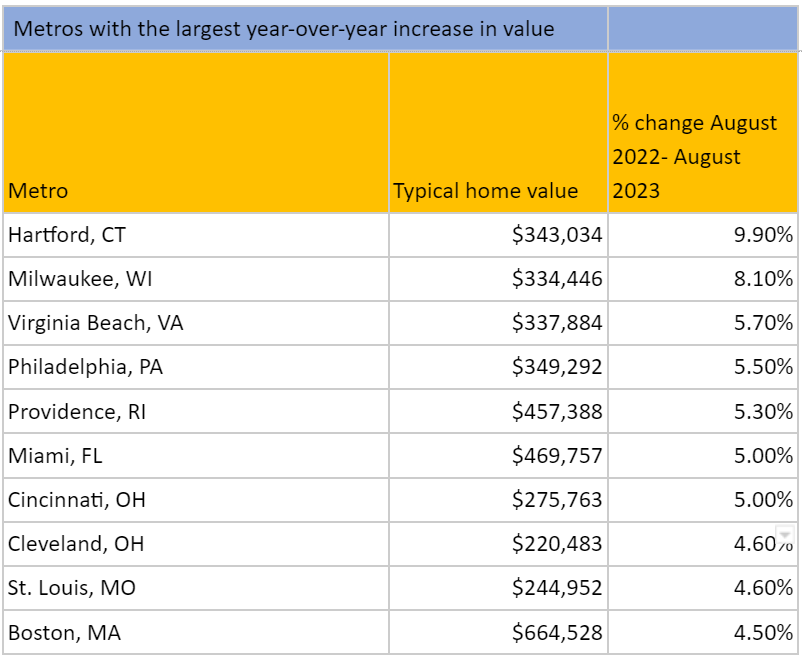
Zillow's analysis has identified the top 10 housing markets in 2023 based on changes in home prices in the nation’s 50 largest metro areas from August 2022 to August 2023. These metros have seen substantial increases in home values, making them attractive markets for both buyers and sellers. The top 10 housing markets and their respective percentage change in home values are as follows:

Fastest Growing Housing Markets
Source: Zillow

1. Hartford, CT: Fastest Growing Housing Market

Hartford, Connecticut, emerges as a standout in the 2023 housing market, showcasing impressive growth and making it a focal point for potential home buyers and sellers. The typical home value in Hartford stands at $343,034, representing a significant 9.90% increase compared to the previous year.

This surge in home value can be attributed to various factors contributing to the flourishing real estate market in Hartford. The city has been witnessing an influx of new residents and an expanding economy, which has had a positive impact on the housing market. People are increasingly drawn to Hartford due to its strategic location, economic opportunities, and overall quality of life.

Economic Growth: Hartford has experienced substantial economic growth, attracting businesses and professionals seeking promising career prospects. A thriving job market often leads to an increased demand for housing, driving up home values. The city's investment in diverse industries has bolstered employment opportunities, influencing individuals and families to settle in the area.

Development and Infrastructure: Hartford has seen significant developments in its infrastructure, making it an appealing choice for potential homebuyers. The availability of well-maintained roads, public transportation, and other essential amenities adds to the overall appeal of the region. The investment in improving the city's infrastructure has elevated the desirability of the housing market in Hartford.

Cultural and Recreational Attractions: Hartford boasts a rich cultural scene and a variety of recreational attractions, providing residents with a high quality of life. The presence of museums, parks, theaters, and vibrant communities fosters an attractive living environment. These cultural offerings, coupled with the city's historical significance, contribute to the increasing demand for homes in Hartford.

The remarkable 9.90% increase in home values indicates a positive trend for homeowners in Hartford. For those considering investing in the Hartford housing market, this rise in home value suggests the potential for favorable returns on investment. As the city continues to grow and evolve, the real estate landscape in Hartford remains dynamic and promising.

2. Milwaukee, WI: An Evolving Real Estate Landscape

Milwaukee, Wisconsin, stands in second postion in the 2023 housing market, showcasing substantial growth and making it an attractive destination for both potential homebuyers and sellers. The typical home value in Milwaukee is $334,446, demonstrating an impressive 8.10% increase compared to the previous year.

The surge in home value can be attributed to several factors that have contributed to the flourishing real estate market in Milwaukee. The city has been experiencing an upward trajectory in terms of economic development, urban revitalization, and a burgeoning job market, all of which have positively impacted the housing sector.

Economic Development: Milwaukee's steady economic growth has been a driving force behind the rise in home values. The city has been attracting new businesses and investments, leading to an increase in job opportunities. A thriving job market often results in higher demand for housing, subsequently driving up home prices.

Urban Revitalization: Milwaukee has seen a revitalization of its urban areas, attracting a younger demographic seeking an urban lifestyle. Renovations, redevelopments, and an increased focus on community development have made various neighborhoods more appealing for potential homebuyers. This urban rejuvenation has contributed to the surge in home values.

Cultural and Lifestyle Appeal: Milwaukee offers a rich cultural scene and a diverse range of recreational activities. The city boasts museums, parks, music festivals, and a vibrant food scene, providing a high quality of life for its residents. The appeal of the city's culture and lifestyle has attracted individuals and families to invest in homes in Milwaukee.

The significant 8.10% increase in home values underscores the positive trend in Milwaukee's real estate market. For those considering investing in the Milwaukee housing market, this rise in home value suggests the potential for promising returns on investment. As the city continues to evolve and attract new residents, the real estate landscape in Milwaukee remains dynamic and promising.

3. Virginia Beach, VA: A Coastal Housing Hub

Virginia Beach, Virginia, has emerged as 3rd, attracting both potential home buyers and sellers. The typical home value in Virginia Beach is $337,884, showcasing a notable 5.70% increase compared to the previous year.

This increase in home value can be attributed to a combination of factors contributing to the growth of the real estate market in Virginia Beach. The city's beautiful coastal location, economic opportunities, and a variety of amenities make it an appealing choice for residents and investors alike.

Coastal Appeal: Virginia Beach's coastal setting is a major draw for home buyers. The allure of living near the beach, enjoying ocean views, and indulging in water-related activities contributes to the increasing demand for homes in this area, subsequently boosting home values.

Economic Opportunities: Virginia Beach offers a diverse and growing economy, providing a range of job opportunities. The availability of employment, coupled with a relatively lower cost of living compared to other coastal cities, attracts individuals and families, leading to increased demand for housing.

Amenities and Lifestyle: The city boasts a rich array of amenities, including parks, recreational facilities, cultural attractions, and a vibrant culinary scene. These offerings enhance the quality of life for residents, making Virginia Beach an attractive destination for potential homebuyers.

The 5.70% increase in home values underlines the positive trajectory of Virginia Beach's real estate market. For those considering investing in the Virginia Beach housing market, this rise in home value suggests the potential for promising returns on investment. As the city continues to flourish and draw in new residents, the real estate landscape in Virginia Beach remains promising and dynamic.

4. Philadelphia, PA: A Thriving Urban Market

Philadelphia, Pennsylvania ranks 4th, showcasing notable growth and making it an attractive choice for both potential home buyers and sellers. The typical home value in Philadelphia is $349,292, representing a significant 5.50% increase compared to the previous year.

This increase in home value can be attributed to various factors contributing to the growth of the real estate market in Philadelphia. The city's historical significance, economic growth, and vibrant urban lifestyle have played pivotal roles in boosting the housing sector.

Historical and Cultural Richness: Philadelphia is known for its rich history and cultural heritage. The presence of iconic landmarks, museums, and a vibrant arts scene makes the city appealing to a diverse range of individuals and families seeking a blend of history and modernity.

Economic Growth: Philadelphia has been experiencing economic growth in various sectors, including healthcare, education, and technology. A flourishing job market attracts professionals and entrepreneurs, leading to increased demand for housing and subsequently higher home values.

Urban Lifestyle: The city offers a dynamic urban lifestyle with diverse neighborhoods, restaurants, shopping districts, and entertainment options. The appeal of city living, combined with a relatively lower cost of living compared to some major cities, makes Philadelphia an attractive destination for potential homebuyers.

The 5.50% increase in home values signifies the positive trajectory of Philadelphia's real estate market. For those considering investing in the Philadelphia housing market, this rise in home value suggests the potential for promising returns on investment. As the city continues to evolve and attract new residents, the real estate landscape in Philadelphia remains dynamic and promising.

5. Providence, RI: A Vibrant Housing Market

Providence, Rhode Island, has positioned itself 5th, capturing the attention of both potential homebuyers and sellers. The typical home value in Providence stands at $457,388, showcasing a commendable 5.30% increase compared to the previous year.

This increase in home value can be attributed to a combination of factors that have contributed to the thriving real estate market in Providence. The city's blend of culture, education, and economic opportunities make it an enticing choice for residents and investors alike.

Cultural Diversity and Appeal: Providence is known for its diverse cultural scene, historical landmarks, and artistic heritage. The presence of renowned universities and a vibrant arts community attract a broad range of residents and visitors, contributing to the demand for homes in the area.

Economic Opportunities: Providence has seen growth in its economy, particularly in the education and healthcare sectors. The city's educational institutions and medical facilities draw professionals and students, generating increased demand for housing and subsequently driving up home values.

Quality of Life: Providence offers a high quality of life with its accessible amenities, parks, and recreational facilities. The city's affordability compared to some nearby urban centers is an additional incentive for potential homebuyers looking for an attractive living environment.

The 5.30% increase in home values signifies a positive trend for homeowners in Providence. For those considering investing in the Providence housing market, this rise in home value suggests the potential for promising returns on investment. As the city continues to thrive and attract new residents, the real estate landscape in Providence remains dynamic and promising.

6. Miami, FL: A Sizzling Real Estate Market

Miami, Florida, has secured its position as a significant contender in the 2023 housing market, drawing the attention of potential home buyers and sellers. The typical home value in Miami stands at $469,757, illustrating a solid 5.00% increase compared to the previous year. This positions Miami at number 6 in the list of top housing markets for 2023.

This increase in home value can be attributed to a variety of factors that have propelled the real estate market in Miami. The city's vibrant culture, attractive climate, and economic opportunities make it a highly sought-after destination for residents and investors alike.

Cultural and Lifestyle Appeal: Miami's dynamic cultural scene, beautiful beaches, and a rich blend of international influences make it a captivating location for residents. The city's lifestyle, which includes arts, entertainment, and diverse culinary experiences, significantly contributes to its desirability and the demand for homes in the area.

Economic Opportunities: Miami offers a robust economy with a focus on finance, trade, tourism, and real estate. The presence of major corporations and a thriving job market attract professionals and entrepreneurs, leading to an increased demand for housing and subsequently higher home values.

Real Estate Investments: Miami is considered a hub for real estate investments, attracting both domestic and international investors. The city's status as a global city with a multicultural environment and a strategic location further enhances its appeal for potential homebuyers.

The 5.00% increase in home values underscores the positive trajectory of Miami's real estate market. For those considering investing in the Miami housing market, this rise in home value suggests the potential for promising returns on investment. As the city continues to evolve and attract new residents, the real estate landscape in Miami remains dynamic and promising.

7. Cincinnati, OH: A Rising Housing Market

Cincinnati, Ohio, is making a mark in the 2023 housing market, attracting both potential home buyers and sellers. The typical home value in Cincinnati stands at $275,763, showcasing a notable 5.00% increase compared to the previous year. This places Cincinnati at number 7 in the list of top housing markets for 2023.

This increase in home value can be attributed to several factors contributing to the flourishing real estate market in Cincinnati. The city's affordable cost of living, strong job market, and appealing quality of life make it an enticing destination for residents and investors alike.

Affordability and Cost of Living: Cincinnati offers a relatively lower cost of living compared to many other metropolitan areas, making it an attractive choice for homebuyers seeking affordability without compromising on amenities and quality of life.

Job Market Growth: Cincinnati has seen growth in various industries, including manufacturing, healthcare, and technology. The availability of jobs and a thriving job market attract professionals and families, leading to an increased demand for housing and subsequently driving up home values.

Quality of Life and Amenities: Cincinnati provides a high quality of life with its numerous parks, cultural attractions, sports events, and a strong sense of community. The presence of these amenities enhances the city's appeal to potential homebuyers.

The 5.00% increase in home values signifies the positive trend in Cincinnati's real estate market. For those considering investing in the Cincinnati housing market, this rise in home value suggests the potential for promising returns on investment. As the city continues to grow and attract new residents, the real estate landscape in Cincinnati remains dynamic and promising.

8. Cleveland, OH: A Steady Housing Market

Cleveland, Ohio, stands as a notable contender in the 2023 housing market, capturing the attention of potential homebuyers and sellers alike. The typical home value in Cleveland is $220,483, reflecting a respectable 4.60% increase compared to the previous year. This positions Cleveland at number 8 in the list of top housing markets for 2023.

This increase in home value can be attributed to various factors contributing to the steady growth of the real estate market in Cleveland. The city's affordability, improving economy, and diverse cultural scene make it an appealing choice for residents and investors.

Affordability: Cleveland offers a lower cost of living and affordable housing options compared to many other metropolitan areas. This affordability attracts first-time homebuyers and individuals looking to invest in real estate without breaking the bank.

Economic Upliftment: Cleveland has been experiencing a steady upliftment in its economy, with growth in healthcare, manufacturing, and technology sectors. The expansion of job opportunities and a gradually improving job market stimulate housing demand and subsequently influence home values.

Cultural Diversity: Cleveland's cultural diversity is reflected in its various neighborhoods, events, and culinary scene. The city's blend of cultures and communities provides a rich and inclusive environment, appealing to a wide range of potential homebuyers.

The 4.60% increase in home values underlines the positive trend in Cleveland's real estate market. For those considering investing in the Cleveland housing market, this rise in home value suggests the potential for favorable returns on investment. As the city continues to evolve and attract new residents, the real estate landscape in Cleveland remains dynamic and promising.

9. St. Louis, MO: A Resilient Housing Market

St. Louis, Missouri, has established itself as a noteworthy contender in the 2023 housing market, drawing the interest of potential home buyers and sellers. The typical home value in St. Louis is $244,952, demonstrating a commendable 4.60% increase compared to the previous year. This positions St. Louis at number 9 in the list of top housing markets for 2023.

This increase in home value can be attributed to several factors contributing to the resilience of the real estate market in St. Louis. The city's affordability, diverse job market, and cultural offerings make it an appealing choice for residents and investors alike.

Affordability: St. Louis is known for its affordable cost of living and housing options, making it an attractive destination for first-time homebuyers and those seeking affordable living without compromising on quality.

Diverse Job Market: St. Louis has a diverse job market with opportunities in healthcare, education, manufacturing, and technology. This variety of employment options attracts professionals and families, stimulating housing demand and contributing to higher home values.

Cultural Attractions: St. Louis offers a range of cultural attractions, including museums, theaters, and parks. The city's cultural richness provides a vibrant and engaging environment for residents, enhancing the overall appeal of the housing market.

The 4.60% increase in home values signifies a positive trend in St. Louis's real estate market. For those considering investing in the St. Louis housing market, this rise in home value suggests the potential for promising returns on investment. As the city continues to evolve and attract new residents, the real estate landscape in St. Louis remains dynamic and promising.

10. Boston, MA: A Flourishing Housing Market

Boston, Massachusetts, stands as a prominent player in the 2023 housing market, attracting both potential homebuyers and sellers. The typical home value in Boston is $664,528, illustrating a commendable 4.50% increase compared to the previous year. This positions Boston at number 10 in the list of top housing markets for 2023.

This increase in home value can be attributed to various factors contributing to the flourishing real estate market in Boston. The city's economic strength, educational institutions, and cultural attractions make it a highly sought-after destination for residents and investors.

Economic Strength: Boston boasts a strong and diverse economy, with key sectors including finance, education, technology, and healthcare. The city's robust job market attracts professionals, entrepreneurs, and students, stimulating housing demand and influencing home values.

Educational Institutions: Boston is renowned for its prestigious universities and educational institutions, making it a hub for students and academics. The presence of world-class universities contributes to a steady demand for housing, particularly in areas surrounding these institutions.

Cultural and Historical Significance: Boston is rich in history and culture, with numerous landmarks and attractions. The city's blend of historic sites, museums, theaters, and cultural events creates a compelling living experience, drawing individuals and families to invest in homes.

The 4.50% increase in home values signifies a positive trend in Boston's real estate market. For those considering investing in the Boston housing market, this rise in home value suggests the potential for promising returns on investment. As the city continues to evolve and attract new residents, the real estate landscape in Boston remains dynamic and promising.

 Top 5 Metros with the Biggest Monthly Increase in Home Prices

Additionally, Zillow's data highlights the top 5 metros that witnessed the largest monthly increase in home values during this period:

  • Hartford, CT: 1.3% increase
  • Buffalo, NY: 1.0% increase
  • San Diego, CA: 0.9% increase
  • Cleveland, OH: 0.7% increase
  • Providence, RI: 0.7% increase

Factors Influencing Home Prices in Local Markets

The variations in home appreciation across local markets are influenced by several factors affecting supply and buyer demand. These factors include:

  1. Economic Conditions and Job Opportunities: Metros with strong economic growth and a thriving job market tend to attract more people, leading to increased demand for housing and subsequently higher home values.
  2. Infrastructure Development and Amenities: Well-developed infrastructure, efficient transportation systems, quality schools, healthcare facilities, and recreational areas contribute to higher demand and willingness to pay a premium for homes in certain metros.
  3. Demographic Trends: Population growth, aging populations, and migration patterns significantly influence housing demand and, consequently, home prices. Metros with significant population growth or younger demographics tend to experience higher rates of home value appreciation.

Sources:

  • https://www.zillow.com/research/data/
  • https://www.zillow.com/learn/september-housing-market-report-2023/

Filed Under: Housing Market Tagged With: Fastest Growing Markets, Top 10 Housing Markets

Republic First Bank Collapse: The First Bank Failure of 2024

November 2, 2024 by Marco Santarelli

Republic First Bank Collapse: The First Bank Failure of 2024

The banking sector is often seen as a barometer for the broader economy, and the closure of a bank can send ripples through the financial community. In 2024, the United States witnessed its first bank failure of the year with the closure of Republic First Bank. This event has not only affected the bank's customers and employees but also sparked discussions in the financial and cryptocurrency communities.

Republic First Bank, a regional lender with branches in Pennsylvania, New Jersey, and New York, was closed by regulators, and its assets and deposits were taken over by Fulton Bank. This move was necessary to protect the depositors and maintain confidence in the banking system. The Federal Deposit Insurance Corporation (FDIC) has assured that all depositors of Republic First Bank will have access to their insured deposits and that the transition to Fulton Bank will be smooth.

The closure of Republic First Bank is expected to cost the deposit insurance fund an estimated $667 million, a significant sum that reflects the challenges faced by the bank. The FDIC has not disclosed specific reasons for the bank's failure, but it is known that rising interest rates and falling commercial real estate values have increased financial risks for regional and community banks. These factors, along with the after-effects of the pandemic, have created a challenging environment for banks that are heavily invested in commercial real estate.

The banking community is closely monitoring the situation, as the closure of Republic First Bank could be an indicator of underlying economic stresses. Moreover, the event has caught the attention of the cryptocurrency world, which often views bank failures as an argument for decentralized financial systems. The debate between traditional banking and emerging financial technologies is likely to continue, with each side presenting its case in light of such events.

For customers of Republic First Bank, the immediate concern will be the continuity of their banking services. Fulton Bank has committed to ensuring that all former Republic First Bank branches will reopen under its name and that customers can continue to use their checks and ATMs without interruption. The FDIC has set up a hotline for customers with questions about the acquisition and has provided assurances that deposits under $250,000 are protected by the FDIC insurance, even in the event of a bank failure.

Why Did First Republic First Bank Fail?

The failure of Republic First Bank, marking the first bank collapse in the United States in 2024, can be attributed to a combination of economic pressures that have been building over recent years. The primary factors leading to the bank's closure include rising interest rates and a downturn in commercial real estate values, particularly in office buildings that have struggled with high vacancy rates post-pandemic.

These economic conditions have heightened financial risks for regional and community banks like Republic First Bank, which had significant exposure to commercial real estate loans. As property values declined, these loans became challenging to refinance, leading to a precarious financial situation for the bank. Additionally, the broader economic impact of the pandemic, which affected various sectors differently, played a role in creating a tough operating environment for the bank.

The FDIC, which stepped in to manage the closure of Republic First Bank, has not released detailed information on the specific internal issues that led to the bank's failure. However, it is clear that the combination of external economic factors and potentially internal mismanagement of assets and loans contributed to the bank's inability to remain solvent.

The closure is expected to cost the deposit insurance fund approximately $667 million, indicating the severity of the bank's financial troubles. In response to the closure, Fulton Bank has agreed to take over all deposits and acquire the assets of Republic First Bank, ensuring that customers will face minimal disruption to their banking services.

The closure of Republic First Bank serves as a reminder of the importance of robust regulatory oversight and the need for banks to manage their risks effectively. It also highlights the evolving landscape of the financial industry, where traditional banking practices are being challenged by new technologies and economic shifts. As the dust settles on this closure, the lessons learned will undoubtedly shape the future of banking in the United States.

For more detailed information and updates on the situation, customers and interested parties are encouraged to refer to the official statements and resources provided by the FDIC and Fulton Bank.

Filed Under: Banking, Economy, Financing Tagged With: Banking

UK Interest Rate Forecast for the Next 5 Years: 2024-2028

November 1, 2024 by Marco Santarelli

U.K. Interest Rate Forecast for the Next 5 Years (2024-2028)

As the economic landscape continues to evolve, the U.K. interest rate forecast for the next 5 years serves as a critical compass for businesses, investors, and everyday consumers. Understanding these dynamics can help in making informed financial decisions and preparing for potential challenges ahead. With a fluctuating economy, fluctuating interest rates can significantly impact everything from mortgage payments to loan affordability.

U.K. Interest Rate Forecast for the Next 5 Years

Key Takeaways

  • Bank of England Rate Trends: Interest rates are expected to begin declining from their current levels by late 2024, following a period of high economic pressure.
  • Inflation Rates: After experiencing high inflation, the forecast indicates a gradual easing of prices, which will positively influence interest rates moving forward.
  • Overall Economic Growth: The U.K. economy is projected to recover, with GDP growth expected to rise as interest rates drop.
  • Impact on Borrowing Costs: As rates decline, borrowing costs will decrease for consumers and businesses, potentially revitalizing sectors that have lagged.
  • Long-Term Stability: By 2028, interest rates may stabilize slightly above pre-pandemic levels, providing a sense of predictability in the financial market.
  • Monitoring Economic Indicators: Key indicators like GDP growth, employment rates, and global economic conditions will heavily influence rate adjustments.

Current Economic Context

The Bank of England (BoE) has been navigating a complex economic environment characterized by high inflation and changing consumer behavior. Over the past year, the BoE has continuously adjusted interest rates in response to rising inflation, which peaked at record highs earlier in the economic recovery phase post-pandemic. According to the Monetary Policy Report published by the Bank of England in November 2023, the interest rates were projected to fluctuate around 5.5% to 5.75% in early 2024 before beginning to decline (source: Bank of England).

Understanding Interest Rates and Their Impact

Interest rates dictate the cost of borrowing and the returns on savings. When rates are high, borrowing costs rise, often slowing down consumer spending and slowing economic growth; conversely, lower rates typically activate spending and investing, boosting the economy. As the BoE sets the base rate, which influences all other rates in the economy, adjusting these rates plays a pivotal role in monetary policy.

What to Expect in the Coming Years

2024: Initial Declines

Expect the BoE to respond to easing inflation with modest rate cuts by mid-2024. Predictions from the Office for Budget Responsibility (OBR) indicated that the average interest rates could fall to about 4.75% by the end of 2024 as the economy begins to stabilize (OBR – March 2024 Economic and Fiscal Outlook). Consumer Confidence is crucial as decreased interest rates translate to lower repayments on mortgages and personal loans, allowing more disposable income for households.

Moreover, experts predict the economy will undergo a resurgence as a result of decreased borrowing costs. This resurgence signals a more optimistic spending environment, which can lead to higher demand for goods and services. Increased consumer spending will likely bolster retail sectors, service industries, and may even trigger a rise in small business growth.

2025: Continued Easing

In 2025, the trend of decreasing interest rates is anticipated to continue, potentially dropping to around 4% to 4.25%. This decline will likely promote consumer spending and business investments, reviving sectors that have been sluggish due to previous high borrowing costs. The OBR forecasted a GDP growth rate of approximately 1.9% for this period, driven by greater access to affordable credit (Spring Budget 2024).

Expect to see increased investments in sectors like housing and construction, which are particularly sensitive to interest rate changes. Lower borrowing costs will encourage home purchases and renovations, which will open job opportunities in construction and related trades. It is vital for the government and businesses alike to monitor how these shifts take place, as they can model policy responses to further support economic recovery.

2026: Mid-Term Stability

Mid-2026 might see interest rates stabilizing around 4%. The economy will have likely adjusted to the lower rates, leading to strengthened consumer confidence and improved business performance. With inflation rates expected to fall closer to the BoE's target of around 2%, monetary policy will focus on ensuring inflation does not resurge unexpectedly (Morningstar).

The stability in interest rates could also lead to improved capital markets, where investors may feel more secure in making longer-term investments. This stability can catalyze innovation in businesses as companies have easier access to capital for expansion. More startups and tech firms may emerge, utilizing this favorable environment to innovate and grow.

2027: Entering a New Normal

By 2027, the U.K. could see interest rates settling at approximately 3.75% to 4%. The economy will likely shift from recovery to full-fledged growth, with the potential for new fiscal policies influencing job creation and further boosting economic activity. Analysts are expecting gradual improvements in productivity, supported by investment in new technologies and sustainable practices (PwC Insights).

As interest rates normalize, businesses will also find it easier to plan for the future. For both small and mid-sized enterprises, clarity in interest rates will help in the formulation of long-term business strategies. Market expansions and international business operations may gain traction as investment climates become more predictable.

2028: Long-Term Outlook

As we look further into 2028, rates may stabilize at about 3.5% to 3.75%. This extended stability would signal a maturing economy that is less reliant on monetary interventions. However, geopolitical events and potential economic shifts could always necessitate further adjustments. Such economic conditions may encourage innovation in low-carbon technologies, e-commerce, and further digital transformation.

Inflation and Its Role in Interest Rate Adjustments

Inflation is one of the most critical factors influencing interest rates. As inflation rises, the cost of living increases for consumers and businesses alike. High inflation rates lead the BoE to raise interest rates to cool down the spending which ultimately balances the economy.

Currently, inflation is forecasted to ease as supply chains stabilize post-pandemic and energy prices potentially moderate. This easing trend will benefit consumers, who may find more affordability in basic goods, travel, and lifestyle expenditures. However, monitoring wage growth will be essential; if wages do not increase in line with cost of living adjustments, consumer purchasing power could decline, hindering economic progress.

The Broader Economic Implications

The trajectory of U.K. interest rates over the coming five years is intertwined with a wider range of economic indicators. Inflation, overall economic growth, and labor market dynamics will play crucial roles. With inflation rates expected to decrease, the overall economic outlook remains cautiously optimistic, suggesting that the U.K. is on track to maintaining a balanced and stable growth path.

Moreover, international economic trends will influence domestic rates. Changes in U.S. Federal Reserve policies or economic challenges in Europe will undoubtedly ripple into the U.K. market. Investors should prepare for potential volatility, driven by external economic scenarios that may affect the BoE's decision-making.

Conclusion

Understanding the U.K. interest rate forecast for the next five years is vital for preparing for future financial landscapes. Borrowing costs, investment strategies, and personal financial decisions will all be affected by these forecasts. Stakeholders from homeowners to large corporations must stay informed and responsive to these changes for effective long-term planning.

Keeping an eye on the evolving economic data, including employment statistics, consumer spending, and inflation trends, will be essential in navigating this financial environment. As the U.K. strives to strike a balance between economic recovery and sustainable growth, awareness of interest rate changes will remain pivotal.

For continuous updates on the U.K. economy and detailed analyses, please refer to credible sources such as the Bank of England and the Office for Budget Responsibility.

Recommended Read:

  • IMF Predicts High Interest Rates for the Long-Term in the US and UK
  • UK House Prices Hit Record Highs: Will They Keep Climbing?
  • UK Housing Market Predictions 2024: Crash or Correction?
  • Interest Rate Predictions for the Next 3 Years: (2024-2026)
  • Interest Rate Predictions for Next 2 Years: Expert Forecast
  • Interest Rate Predictions for Next 10 Years: Long-Term Outlook

Filed Under: Economy, Financing Tagged With: Interest Rate, Interest Rate Predictions

Do Higher Gas Prices Mean Lower Consumer Spending?

November 1, 2024 by Marco Santarelli

Do Higher Gas Prices Mean Lower Consumer Spending?

The short answer is “extremely unlikely”.  The reason is that a small increase in some costs (like gas) only creates a marginal shift towards other costs (not a decrease in those costs). One of the most important commodities in a first world economy such as ours is gas and other energy sources.  If there is a rapid rise in energy costs, it could lead to a significant increase in overall prices – this is known as inflation.

The question now becomes: Is the rise in gasoline prices strong enough to create an inflationary trend that will stall growth in consumer spending? The fluctuation of gas prices is a phenomenon that can have a significant impact on the economy and consumer behavior.

Do Higher Gas Prices Mean Lower Consumer Spending?

When gas prices rise, it often leads to a domino effect that touches various aspects of economic activity. One of the most immediate effects is on consumer spending.

Higher gas prices mean that consumers have to allocate more of their budget to fueling their vehicles, leaving less disposable income for other purchases. This can lead to a reduction in discretionary spending, which is the portion of income that goes towards non-essential items and services. As a result, retailers may see a decrease in sales, especially in sectors that are not considered necessities.

Moreover, the increase in gas prices can also affect consumer behavior in terms of mobility. With higher costs at the pump, individuals may opt to drive less and, consequently, visit physical stores less frequently. This change in consumer habits can negatively impact brick-and-mortar businesses, although it may benefit online retailers as consumers switch to online shopping to save on transportation costs.

The ripple effects of higher gas prices extend beyond just the consumer's wallet. Businesses that rely heavily on transportation and logistics may face increased operational costs, which can lead to higher prices for goods and services across the board. This can further strain consumer budgets and force a cutback in spending in other areas.

In the broader economic landscape, persistent high gas prices can contribute to inflationary pressures, as the cost of goods and services rises. This can lead to a decrease in the real purchasing power of consumers, effectively reducing their ability to spend.

However, it's important to note that the impact of gas prices on consumer spending is complex and can vary based on a range of factors, including the overall economic climate, consumer confidence, and the availability of alternative transportation options. Additionally, the long-term effects may differ, as high gas prices could incentivize consumers and businesses to seek more fuel-efficient solutions and alternative energy sources, potentially leading to innovation and changes in consumption patterns.

Strategies for Consumers to Cope with High Gas Prices

In times of high gas prices, consumers often look for ways to mitigate the impact on their budgets. Here are some strategies that can help:

  1. Vehicle Maintenance: Keeping your car in good shape can improve fuel efficiency. This includes regular checks on tire pressure, oil changes, and air filters.
  2. Fuel Rewards Programs: Many gas stations offer rewards programs that can save you money at the pump. Signing up for these can lead to significant savings over time.
  3. Use of Apps: There are several apps available that help you find the cheapest gas prices in your area. Utilizing these can help you save a few cents per gallon, which adds up.
  4. Alternative Transportation: Whenever possible, consider walking, biking, or using public transportation. Not only does this save on gas, but it's also better for the environment and your health.
  5. Carpooling: Sharing rides with others can cut down on individual fuel costs and reduce the number of cars on the road, which also helps with traffic congestion.
  6. Driving Habits: Adopting more fuel-efficient driving habits, such as accelerating gradually and maintaining a steady speed, can reduce fuel consumption.
  7. Electric Vehicles (EVs): If it's within your means, consider switching to an electric vehicle. EVs can be more economical in the long run and are less affected by gas price fluctuations.
  8. Planning and Consolidation: Plan your errands to minimize trips. By doing multiple errands in one trip, you can save time and gas.
  9. Telecommuting: If your job allows it, working from home can save a significant amount of money on commuting costs.
  10. Budget Adjustment: Review your budget to see where you can cut back on non-essential expenses to accommodate the higher cost of gas.

By implementing these strategies, consumers can alleviate some of the financial pressures caused by high gas prices and adapt to the changing economic landscape.

Bottom Line: While higher gas prices can lead to lower consumer spending in the short term, the long-term effects are less predictable and depend on a multitude of factors. Understanding these dynamics is crucial for policymakers, businesses, and consumers alike as they navigate the challenges and opportunities presented by the ever-changing energy landscape.

Filed Under: Economy

Gas Prices and its Effect on Real Estate

November 1, 2024 by Marco Santarelli

Gas Prices and its Effect on Real Estate

The real estate market is a complex ecosystem, influenced by a myriad of factors ranging from economic policies to consumer behavior. One of the less obvious but significant factors that affect the real estate market is the fluctuation in gas prices. The impact of gas prices on real estate can be multifaceted and profound, influencing everything from the value of properties to the decisions of homebuyers and investors.

Rising Gas Prices: A Ripple Effect on Housing Affordability

As gas prices soar, the immediate effect felt by consumers is the increase in daily living costs. This escalation can lead to a decrease in disposable income, which in turn affects the ability of potential homebuyers to afford new properties. The additional financial burden can also influence the choices of homebuyers, potentially leading to a preference for properties closer to urban centers to minimize commuting costs. This shift in buyer preference can result in a change in demand dynamics, with suburban and rural properties possibly seeing a decrease in demand.

The Commuter's Dilemma: Location vs. Affordability

The increase in gas prices may also alter the perceived value of location when it comes to real estate. Properties that were once considered desirable due to their affordability, despite being located further from city centers, may lose their appeal as higher commuting costs diminish the cost benefits. Conversely, properties closer to major employment hubs may see an uptick in demand, potentially driving up prices in these areas.

Construction Costs and Housing Prices

The cost of construction is another aspect of the real estate market that is indirectly affected by gas prices. As transportation costs for materials rise, so does the overall cost of construction. This increase is often passed on to the consumer, resulting in higher housing prices. For developers, the increased costs could lead to a slowdown in new construction projects, which could exacerbate the issue of housing supply, especially in markets already facing shortages.

Long-Term Market Predictions

The long-term effects of rising gas prices on the real estate market are harder to predict. If high gas prices persist, they could lead to sustained changes in consumer behavior and preferences. This could result in a lasting impact on where people choose to live and the types of properties they desire. Additionally, if remote work continues to be prevalent, the necessity of living close to one's workplace may diminish, potentially leading to a reevaluation of property values based on location.

How to Mitigate the Impact of Gas Prices on Real Estate

The fluctuating nature of gas prices can have a significant impact on real estate investments. Here are some strategies that can be employed:

Energy Efficiency and Sustainability

One of the most effective ways to mitigate the impact of rising gas prices is by investing in energy efficiency. Properties that are energy-efficient tend to have lower operating costs, which can be particularly appealing when gas prices are high. Consider upgrades such as improved insulation, energy-efficient windows, and modern HVAC systems that can reduce energy consumption.

Location and Infrastructure

Investing in properties located in areas with robust public transportation options can be a wise move. These locations are often less affected by gas price fluctuations as residents and tenants have alternative commuting options. Additionally, properties close to amenities and employment centers can be more attractive, reducing the need for long commutes that are affected by gas prices.

Diversification

Diversifying your real estate portfolio can also help mitigate risks associated with gas price fluctuations. By investing in a variety of property types and locations, you can spread out the risk and ensure that your entire portfolio isn't affected by a single market change.

Technology and Innovation

Embracing technology can also play a role in mitigating the impact of gas prices. Smart home technologies and building management systems can optimize energy use and reduce costs. Moreover, investing in properties that support electric vehicle charging stations can be an attractive feature as the world shifts towards electric transportation.

Long-Term Planning

Consider the long-term implications of gas prices on your real estate investments. If high gas prices are here to stay, it may influence the types of properties that are in demand. Properties that cater to a more energy-conscious tenant may become more valuable over time.

Policy and Regulation Awareness

Stay informed about local and national policies related to energy and real estate. Policies that incentivize energy efficiency or renewable energy can provide opportunities for real estate investors to upgrade their properties and make them more competitive and resilient to gas price changes.

Conclusion

The relationship between gas prices and the real estate market is intricate and evolving. While rising gas prices present challenges, they also offer opportunities for innovation in housing solutions and urban planning. Real estate stakeholders, including buyers, sellers, and investors, must stay informed and adaptable to navigate the shifting landscape of the market.

Understanding these dynamics is crucial for anyone involved in the real estate industry or considering entering the housing market. By keeping a close eye on trends and being prepared to adjust strategies accordingly, one can make informed decisions that account for the influence of gas prices on real estate.

Filed Under: Economy, Real Estate

4 Profit Centers That Make Real Estate The Most Powerful Investment

November 1, 2024 by Marco Santarelli

4 Profit Centers That Make Real Estate The Most Powerful Investment

You'll often hear people say that they don't like real estate because if you look at the long-term returns of the stock market, it seems to have a better return over the long-term. Of course, when they say this, they are leaving a few key things out.

First, when people say the stock market, what they really mean is something like the S&P 500 or the Dow Jones Industrial Average. These are not the stock market. Rather, they are indexes filled with some of the leading companies in the US. You'll often hear that the stock marketing returns anywhere from 7%-10% annually. This is really based on index returns rather than the market itself.

Second, while 7%-10% is a good return annually for the average person, it is not a good return for a professional investor. And when people stack up the returns from real estate against the stock market, they often only factor in one profit center in real estate, appreciation.

The reality is that there are four ways you can make money with real estate that, when added up together, make for considerably higher returns than the stock market. These profit centers are the reason that real estate is one of my favorite investment vehicles.

A word of clarification: as you read about these profit centers, realize that I'm talking about investment real estate-that is property bough specifically to be run like a business-rather than your personal residence. As I've said before, your house is not an asset. It takes money out of your pocket. But your investment real estate is, if you invest properly, because it puts money in your pocket.

Now, here are the four profit centers of real estate.

4 Profit Centers That Make Real Estate The Most Powerful Investment

1. Cash flow on operations

If you're holding real estate as an investment, you will have tenants. Each month they will pay you rent. Let's say that you own a rental house and get $1,000 per month in rent. Over a year, that is $12,000 in income.

Now, you subtract out your expenses, which include things like your taxes, insurance, your property management, vacancies, turnover expense, allowances for repairs, etc. (This doesn't include your debt-more on that later).

For purposes of this example, let's assume that your monthly average expenses are $100 a month. Your cash flow on operations then would be $900 per month. That is what is referred to as your Net Operating Income (NOI).

Out of your NOI you pay your debt service. Let's assume for this example that you have a $200,000 property with an $180,000 loan at today's rate of 3.7%. That's a debt payment of about $830 a month.

So, that would be rental income of $1,000 minus $100 in operating expenses minus $830 in debt service, equaling $70 in cash flow. That times 12 equals $840 in cash flow per year. That $840 divided by your $20,000 equity stake would equal a 4.2% cash-on-cash return.

But that's not the end of your return story. Let's move on to the next profit center.

2. Amortization

Amortization is the concept of paying down your debt service. Each month, when you make your debt payment (or rather your tenant makes your debt payment) out of your NOI, a portion of that goes towards paying down your principle on the loan. When you hear somebody talk about a 30-year fixed fully amortized loan, it means that when you make all 360 of those monthly payments at the end, the loan is 100% paid off.

Because your tenant is paying rent, and that rent is covering the debt payment, the principle pay down included in that debt payment is actually profit for you. Let's take a look at how this plays out with our $180,000 loan from above.

In the first year of the loan, you'd be paying $6,604 in interest and $3,338 in principle. As the loan matures, the interest amount goes down each month and the principle amount goes up. But we'll use these numbers for now.

That $3,338 is profit to you. It's true equity in your property.

If we add this $3,338 to the $840 in operating income, we now have $4,178 in income for the year, a 20% return on our $20,000 invested into the property. Plus, your interest payment is often tax-deductible, so added bonus, but check with your tax advisor to be sure for your specific case.

Already, you're crushing average stock market returns and there are still two more profit centers to look at.

3. Depreciation

This is often referred to as a phantom return. The basic concept of depreciation is that your investment property is made up of tow parts, the land and the improvements on the land, i.e., your house.

Appraisers will assign percentage values to your property based on these two parts. For this example, 20% of the value is the land and 80% of the value is the improvement. Over time, the house will deteriorate, so the government in the US (check with your tax advisor to make sure you qualify), let's you write down that 80% value over a certain number of years depending on the type of real estate. For residential homes it's 27.5 years.

So, your $200,000 property has $160,000 that can be depreciated over 27.5 years, which equals $5,818 per year. This amount is listed as a loss of income, even though no money is coming out of your pocket. Now let's see why this is called phantom income.

Let's assume you are in a 30% tax bracket. That means that, applying 30% to your depreciation of $5,818, nets you $1,745 in annual tax savings.

Adding that $1,745 to our existing income of $4,178, we now have $5,923, a 29.6% return on your cash of $20,000.

Let's take a look at the last profit center, appreciation.

4. Appreciation

This is the frosting on your cake. I don't invest in real estate for appreciation. I'm a cash flow investor. But I do appreciate my appreciation.

Let's assume you have a conservative appreciation rate of 3% a year on average for you $200,000 property. That equals $6,000 per year in value added to your house.

Add that to your $5,923 and you have $11,923. That's a 59% return on your $20,000 capital investment in your $200,000 property. And that blows investing in the stock market for the long-term out of the water.

Increase your real estate IQ: These types of returns are achievable by anyone, as long as they understand how to find the right deal and run the numbers correctly. And it takes a high financial IQ.

Filed Under: Getting Started, Real Estate Investing

Chandler Housing Market: Trends and Forecast 2024-2025

November 1, 2024 by Marco Santarelli

Chandler Housing Market

So, you're wondering what's up with the Chandler housing market? It's a pretty interesting mix right now. Houses are still getting more expensive, but not as fast as they were before. We're seeing more houses sell, and they're staying on the market a bit longer, meaning things are leveling out compared to the past few years. A lot of people are moving to Chandler, which is a big reason why houses are still in high demand.

Chandler Housing Market Trends in 2024

Home Sales in Chandler, Arizona

The Chandler housing market shows steady activity. According to Redfin data from September 2024, 185 homes were sold, representing a 6.9% increase compared to the same period last year. This signifies continued demand despite potential economic shifts. The increase in sales suggests a relatively healthy market, with buyers actively searching for homes. This is good news for sellers as increased demand generally translates to better sale prices. However, it's also worth considering the average time it takes to sell a house in Chandler.

While the number of sales has increased, the average days on market (DOM) has also risen to 47 days, a 13-day increase year-over-year. While this still indicates a relatively fast-paced market, the increase is notable. This suggests there might be a slight shift toward a more balanced market compared to previous years when homes sold significantly faster. It could signal a slightly slower pace in the buying frenzy of previous periods, offering opportunities for both buyers and sellers to negotiate terms more thoroughly.

Home Prices: A Look at the Median Sale Price in Chandler

The median sale price of a home in Chandler in September 2024 was $525,000, a 1.9% increase year-over-year. This reflects a modest price appreciation, showing that although prices are increasing, the rate of increase is slightly moderating compared to the substantial jumps witnessed in previous market cycles. However, the median sale price per square foot is $299, showing a slightly higher year-over-year increase of 3.6%. This highlights that while the overall median price change is relatively conservative, the cost per square foot continues to climb indicating an influence of factors like build costs and land availability.

Several factors might be contributing to this trend. Inflation, building material costs, and increased demand can all influence the price. The increasing costs of development in the area likely play a significant role in these price increases. Additionally, Chandler’s desirability as a place to live, due to its job market, schools, and quality of life, is also a factor that can affect housing prices.

Housing Supply and Its Impact on the Chandler Market

Understanding the housing supply is crucial for grasping the overall market dynamic. Unfortunately, Redfin data on the exact number of homes available for sale in Chandler is not explicitly stated. However, the increased Days on Market (DOM) compared to last year could indirectly indicate changes in supply. A rise in DOM suggests that available homes might be taking longer to sell, which could be due to a relatively higher supply of homes compared to the demand. However, this requires further data on inventory levels to be definitively confirmed.

A balanced market usually indicates a comfortable ratio between supply and demand. In a seller’s market, inventory is low, and homes sell quickly. In a buyer’s market, inventory is high, and houses may stay on the market for a longer period. The current increase in DOM suggests a move toward a more balanced market compared to a strong seller’s market seen in previous periods.

Market Trends: A Holistic View of the Chandler Housing Market

Several indicators provide a broader perspective on Chandler's housing market. The Sale-to-List Price ratio is 98.4%, representing a small decrease from last year's figures. This suggests that homes are generally selling close to their listing prices, implying a competitive yet somewhat stable market. Only 17.3% of homes sold above the list price in September 2024; this represents a significant drop of 13.3% year-over-year. The decrease in homes selling above list price compared to the previous year supports the notion of a moderately slowing market.

The data shows 34.8% of homes experienced price drops, indicating some level of price adjustment. While this might seem like a negative, it can actually be a healthy sign, preventing drastic price inflation and potentially creating more opportunities for buyers to find a better deal.

Migration Patterns: Where are People Moving to and from Chandler?

Redfin's data on migration patterns provides valuable insights into Chandler's housing market. A notable trend is the inbound migration from major metropolitan areas such as Seattle, Los Angeles, and Dallas. This influx of people from other cities increases demand, which in turn can elevate prices and contribute to competitiveness. While 70% of Chandler buyers are staying within the metropolitan area, it's the inflow from other significant areas that pushes the market dynamics.

On the outbound side, migration patterns illustrate that many people move to smaller Arizona towns like Prescott Valley, Show Low, and Flagstaff. This might reflect a preference for smaller towns and more affordable housing options or a change in lifestyle and job opportunities. These movements can lead to varying degrees of impact in the Chandler housing market.

Other Factors Affecting the Chandler Housing Market

Several factors, beyond those discussed above, affect the Chandler housing market. The quality of schools is often a major consideration for families. Chandler has several highly-rated schools, attracting homebuyers seeking top-tier education for their children. The employment market also plays a vital role. A thriving job market will naturally boost the population and real estate demand. Finally, the overall lifestyle in Chandler, with its amenities and suburban feel, attracts people from various backgrounds.

Chandler Housing Market Forecast 2024-2025

Predicting the future of any market is inherently challenging, but analyzing the factors mentioned above allows for informed speculation. My personal opinion, based on years of observing the Chandler housing market, is that we'll see continued growth, although likely at a more moderate pace than what was experienced during the peak of the pandemic boom.

  • Price Appreciation: I anticipate a continued, albeit potentially slower, increase in home values in Chandler. While the rapid appreciation of the past few years may not be sustainable, steady growth seems probable, driven by continued population growth and economic strength. However, this growth rate might be influenced by factors such as interest rate changes and national economic conditions. Don't expect double-digit percentage increases, but rather a more moderate and steady appreciation.
  • Sales Volume: I foresee a slight moderation in the number of homes sold compared to the high volumes seen in the past couple of years. The increased interest rates and affordability challenges will likely dampen some demand, although a healthy level of transactions should persist.
  • Inventory Levels: While new construction is underway, overcoming the existing inventory shortage will likely be a gradual process. We might see a slight increase in available homes, but I don't anticipate a dramatic shift that would cause significant price drops.

Table Summarizing Forecast:

Factor Forecast Rationale
Price Appreciation Moderate increase Continued population growth, economic strength, but tempered by interest rates and potential economic slowdown
Sales Volume Slight decrease from peak years, but still healthy Interest rates and affordability impacting demand, but underlying economic fundamentals remain positive
Inventory Levels Gradual increase, but still below historical norms New construction is ongoing, but meeting demand will take time

Should You Invest in the Chandler Real Estate Market?

The Chandler real estate market has shown steady growth over the past few years, making it an attractive option for real estate investors. Here are some top reasons why investing in Chandler real estate may be a good decision, as well as potential drawbacks to consider:

Top reasons to invest in Chandler real estate:

  • Strong appreciation: Chandler real estate appreciated 139.53% over the last ten years, which is an average annual home appreciation rate of 9.13%, putting Chandler in the top 10% nationally for real estate appreciation (Neighborhoodscout).
  • Steady market: The market forecast for Chandler is positive in 2023, indicating a stable market with little fluctuation.
  • High demand: Chandler is a growing city with a population of over 260,000 people. Its strong job market and high-quality schools attract many young professionals and families, creating a high demand for housing.
  • The rental market in Chandler: Chandler also has a strong rental market, making it an attractive option for investors who are interested in purchasing properties to rent out. Chandler has a large population of young professionals and families, who may prefer renting over buying, creating a high demand for rental properties. Investors should consider the potential rental income and rental demand when evaluating investment opportunities in Chandler.
  • Thriving Economy: A good economy can be a reason to invest in Chandler real estate. Chandler has a thriving economy, with a diverse range of industries such as technology, healthcare, and retail. The city has been experiencing steady economic growth, with a low unemployment rate and a high job growth rate, making it an attractive destination for businesses and professionals. This economic growth has also led to an increase in population, which in turn drives demand for housing. The city has also been investing in infrastructure and public amenities, such as parks and recreational facilities, which can make it more attractive for both residents and businesses. Additionally, Chandler has a well-regarded school system, which can make it more appealing for families with children.

All of these factors can contribute to a strong real estate market in Chandler, with high demand for housing and the potential for appreciation in property values. Real estate investors can benefit from this by purchasing properties in areas with high demand and potential for growth and renting or selling them for a profit.

Potential drawbacks to consider:

  • High competition: Due to the high demand for housing in Chandler, investors may face competition when making offers on properties.
  • High home prices: While appreciation is a good sign for investors, it also means that home prices may be higher than in other markets, making it more difficult to find affordable investment opportunities.
  • High-interest rates: It's worth noting that the high-interest rates could potentially impact the Chandler real estate market, as buyers may be deterred from taking out mortgages due to the increased costs. The current average 30-year fixed mortgage interest rate is 6.54%. Hence, borrowers may be less inclined to purchase homes, especially if they have other options available to them. Investors looking to buy in Chandler should carefully consider the impact of high-interest rates on their investment strategy, as they may need to adjust their expectations for return on investment. Additionally, the potential for inflation and rising costs should be factored into any investment decision.
Recommended Read:

  • Arizona Housing Market: Trends and Forecast 2024-2025
  • When Will the Housing Market Crash in Arizona?
  • Phoenix Housing Market: Trends and Forecast for 2024
  • Arizona's Housing Crisis: Young Adults Struggling to Find Home

Filed Under: Growth Markets, Housing Market, Real Estate Investing Tagged With: Chandler Housing Market, Chandler Housing Prices

  • « Previous Page
  • 1
  • …
  • 254
  • 255
  • 256
  • 257
  • 258
  • …
  • 378
  • Next Page »

Real Estate

  • Birmingham
  • Cape Coral
  • Charlotte
  • Chicago

Quick Links

  • Markets
  • Membership
  • Notes
  • Contact Us

Blog Posts

  • Today’s Mortgage Rates, July 26: 30-Year Dips Slightly to 6.46% as 5/1 ARM Falls to 6.22%
    July 26, 2026Marco Santarelli
  • 20 Best U.S. Cities to Invest in Real Estate in 2026
    July 26, 2026Marco Santarelli
  • Interest Rate Predictions for the Next 5 Years: 2026-2030
    July 26, 2026Marco Santarelli

Contact

Norada Real Estate Investments 30251 Golden Lantern, Suite E-261 Laguna Niguel, CA 92677

(949) 218-6668
(800) 611-3060
BBB
  • Terms of Use
  • |
  • Privacy Policy
  • |
  • Testimonials
  • |
  • Suggestions?
  • |
  • Home

Copyright 2018 Norada Real Estate Investments

Loading...