Norada Real Estate Investments

  • Home
  • Markets
  • Properties
  • Membership
  • Podcast
  • Learn
  • About
  • Contact

Home Sales Predicted to Grow by 4.4% Annually in 2026

March 26, 2026 by Marco Santarelli

Home Sales Predicted to Grow by 4.4% Annually in 2026

So, what's the big picture for the housing market in 2026? It looks like we're set for a positive trend, with Zillow forecasting that home sales will climb by a healthy 4.4% in 2026 compared to the year before. This isn't a huge boom, mind you, but it signals a steady, upward movement that could make things a bit easier for everyone involved in buying or selling a home.

After the ups and downs we've seen lately, any sign of stability and growth is welcome news. It suggests that the market is finding its footing, and that's important for individual families looking to make a move, as well as for the broader economy.

Home Sales Predicted to Grow by 4.4% Annually in 2026

What's Driving This Growth?

It's easy to just look at a number, like that 4.4% for sales, and nod along. But what's actually behind it? Zillow's report points to a couple of key factors.

First off, home values are expected to see a slight annual increase of about 0.7% by the end of 2026. Now, this might sound small, and it's a bit of a downward revision from their earlier forecasts, but it's actually a good thing. It means we're likely moving towards a more balanced market. When home values are stable, it gives buyers more confidence to enter the market, and it also means sellers can expect a reasonable return on their investment. This steadiness is crucial after periods of rapid price hikes.

The other big piece of the puzzle is that moderately easing mortgage rates. This is the magic ingredient that's expected to unlock some of that pent-up demand. Think about it – when mortgage rates are high, putting a down payment on a home feels like an insurmountable hurdle for many. As those rates tick down, even just a bit, it makes monthly payments more manageable. This can encourage people who have been waiting on the sidelines to finally make their move. Zillow predicts rates will stay above 6% throughout 2026, which is still significant, but the easing part is key to stimulating sales.

A Market Moving Towards Balance

What I find particularly insightful is how Zillow describes the market moving “toward balance.” This is the sweet spot for a healthy housing market. Right now, it feels like we've been on either extreme – either a seller's market where buyers were scrambling, or a market where prices were soaring too high.

When new listings and sales start to increase at roughly the same pace, it means supply and demand are getting closer. This closer alignment is what helps keep home values relatively stable overall. It prevents the wild swings we've sometimes seen, making it easier for both buyers and sellers to plan and make informed decisions.

The 2026 Forecast: Key Takeaways

Let's break down what this all means for you, whether you're thinking of buying, selling, or just curious about the future:

  • Sales Volume: Expect to see around 4.24 million existing homes change hands in 2026. This is a slight bump up from previous estimates, showing that more transactions are expected to happen.
  • Home Values: The national average home value growth is projected to be between 0.7% and 1.2% annually by the end of 2026. This is modest but steady growth.
  • Mortgage Rates: As mentioned, rates are expected to remain above 6%. While not as low as some might hope, the trend towards easing is what's driving sales.
  • Market Stability: A really positive sign is that the number of major markets experiencing annual price declines is expected to drop significantly, from 24 down to just 12. This means fewer areas will see homes losing value.
  • New Construction: Builders might take a breather in 2026, with single-family home starts predicted to be at their lowest point since 2019. They'll likely be focusing on selling the homes that are already built.

What About Renters?

It's not just about buying and selling; the rental market also has its nuances. Zillow projects that multifamily rents will rise by a modest 0.9% annually. For single-family rentals, the increase is expected to be a bit higher, around 1.8%.

Why the difference? Well, there are still quite a few apartment buildings being built, and more homes are shifting from being for sale to being for rent. This increased supply is keeping rent growth in check, which is good news for renters. It means you'll likely continue to have some negotiating power when signing a lease.

Where are the Hottest Markets (and Where Should Buyers Look)?

Zillow also gives us a peek into specific regions. They've identified some markets as particularly “hot,” meaning a lot of competition and quick sales.

Rank Metro Area Typical Home Value (Oct 2025) 2026 Forecast Growth
1 Hartford, CT $381,760 +3.9%
2 Buffalo, NY $277,499 +2.5%
3 New York, NY $704,284 +1.5%
4 Providence, RI $503,409 +3.0%
5 San Jose, CA $1,558,466 +1.2%
6 Philadelphia, PA $378,054 +1.7%
7 Boston, MA $717,711 +1.5%
8 Los Angeles, CA $941,869 +1.1%
9 Richmond, VA $383,275 +2.1%
10 Milwaukee, WI $369,303 +2.1%

Hartford, CT is called out as the nation's hottest market, largely due to a shortage of homes available for sale. The Northeast as a whole is showing strong competition.

On the flip side, if you're looking for more leverage as a buyer, some markets are shaping up to be more favorable:

Top 10 Best Markets for Buyers in 2026:

  • Indianapolis, IN: Stands out for affordability and less competition.
  • Atlanta, GA: Lots of new homes being built means more choices for buyers.
  • Charlotte, NC: Offers a good starting point with cooling price growth.
  • Jacksonville, FL: More homes are becoming available, easing competition.
  • Oklahoma City, OK: A consistently affordable option.
  • Memphis, TN: Good “buyer leverage” is expected here.
  • Detroit, MI: More homes on the market are improving affordability.
  • Miami, FL: Market conditions are becoming more balanced.
  • Tampa, FL: Expect a slowdown or slight dip in prices.
  • Pittsburgh, PA: This metro has some of the lowest typical home prices in the country.

The Sun Belt and Midwest are generally becoming more buyer-friendly as sticker shock from earlier price surges wears off and more homes come onto the market.

A Note of Caution: Regional Differences Still Matter

While the overall picture is positive, it's crucial to remember that the housing market is highly localized. Zillow does flag a few places where prices might still dip. For instance, places like New Orleans, LA (-4.1%) and Austin, TX (-2.2%) are projected to see price declines. These are often areas that saw massive price increases during the pandemic, and a slight correction isn't entirely unexpected.

My Two Cents

As someone who keeps a close eye on this industry, I find Zillow's 4.4% increase in home sales prediction for 2026 to be a really solid indicator. It's not about a massive, unsustainable boom, but rather a steady, healthy rise fueled by more balanced conditions and slightly more accessible borrowing costs. This gradual improvement is what makes a market truly sustainable. For potential buyers, it means you might not be facing the same level of frantic competition, and for sellers, it suggests you can still expect a fair price for your home.

🏡 Two turnkey Rentals With Strong Investor Potential

Pleasant Grove, AL
🏠 Property: 4th Ave (1549 sqft)
🛏️ Beds/Baths: 3 Bed • 2 Bath • 1549 sqft
💰 Price: $265,000 | Rent: $1,850
📊 Cap Rate: 6.2% | NOI: $1,368
📅 Year Built: 2026
📐 Price/Sq Ft: $172
🏙️ Neighborhood: B+

VS

Pleasant Grove, AL
🏠 Property: 4th Ave (1856 sqft)
🛏️ Beds/Baths: 3 Bed • 2 Bath • 1856 sqft
💰 Price: $410,000 | Rent: $3,200
📊 Cap Rate: 5.8% | NOI: $1,981
📅 Year Built: 2026
📐 Price/Sq Ft: $221
🏙️ Neighborhood: B+

Two Pleasant Grove rentals—one affordable with higher cap rate vs one larger with stronger NOI. Which fits YOUR investment strategy?

We have much more inventory available than what you see on our website – Let us know about your requirement.

📈 Choose Your Winner & Contact Us Today!

Speak to a Norada Investment Counselor (No Obligation):

(800) 611-3060

View All Properties 

Position Yourself Ahead With Smart Real Estate Investments

In 2026, investors who position themselves strategically in real estate are gaining a competitive edge. Turnkey rental properties provide reliable cash flow, appreciation, and stability—making them one of the smartest ways to stay ahead in uncertain markets.

Norada Real Estate helps investors acquire turnkey properties in top U.S. markets—delivering immediate ROI and long‑term wealth growth with expert guidance and proven systems.

🔥 HOT 2026 INVESTMENT LISTINGS JUST ADDED! 🔥
Speak with an Investment Counselor Today (No Obligation):
(800) 611-3060
Or Request a Callback / Fill Out the Form Online

Contact Us

Want to Know More About the Housing Market Trends?

Explore these related articles for even more insights:

  • Top 10 Housing Markets Set to Deliver High ROI in 2026
  • 5 States Where Housing Markets Are Outpacing in Price Appreciation in 2026
  • 5 Housing Markets Poised for Rapid Recovery if Mortgage Rates Fall in 2026
  • 10 Housing Markets With the Biggest Jump in Pending Sales in January 2026
  • Will 2026 Finally Shift the Housing Market to Buyers?
  • Housing Market: Booming vs. Shrinking Inventory Across America
  • Housing Market Gains Supply But Buyers Hit Pause in 2025
  • Mid-Atlantic Housing Market Heats Up as Mortgage Rates Go Down
  • NAR Chief's Bold Predictions for the 2025 Housing Market
  • Housing Market Update 2025: NAR Report Indicates Sluggish Trends
  • 7 Buyer-Friendly Housing Markets in 2025 With Abundant Homes for Sale
  • The $1 Trillion Club: America's Richest Housing Markets Revealed
  • 4 States Dominate as the Riskiest Housing Markets in 2025
  • Housing Market Predictions 2025 by Norada Real Estate
  • Housing Market Predictions 2026: Will it Crash or Boom?
  • Housing Market Predictions for the Next 4 Years: 2025 to 2029
  • Real Estate Forecast: Will Home Prices Bottom Out in 2025?
  • Real Estate Forecast Next 5 Years: Top 5 Predictions for Future
  • Will Real Estate Rebound in 2025: Top Predictions by Experts

Filed Under: Housing Market, Real Estate Market Tagged With: home prices, home sales, Housing Market, Housing Market Trends

Today’s Mortgage Rates, March 26: 30-Year Fixed Rises to 6.35%, Nearing a Six-Month High

March 26, 2026 by Marco Santarelli

Today's Mortgage Rates, July 21: Buyers Catch a Small Break as 30‑Year Fixed Dips to 6.40%

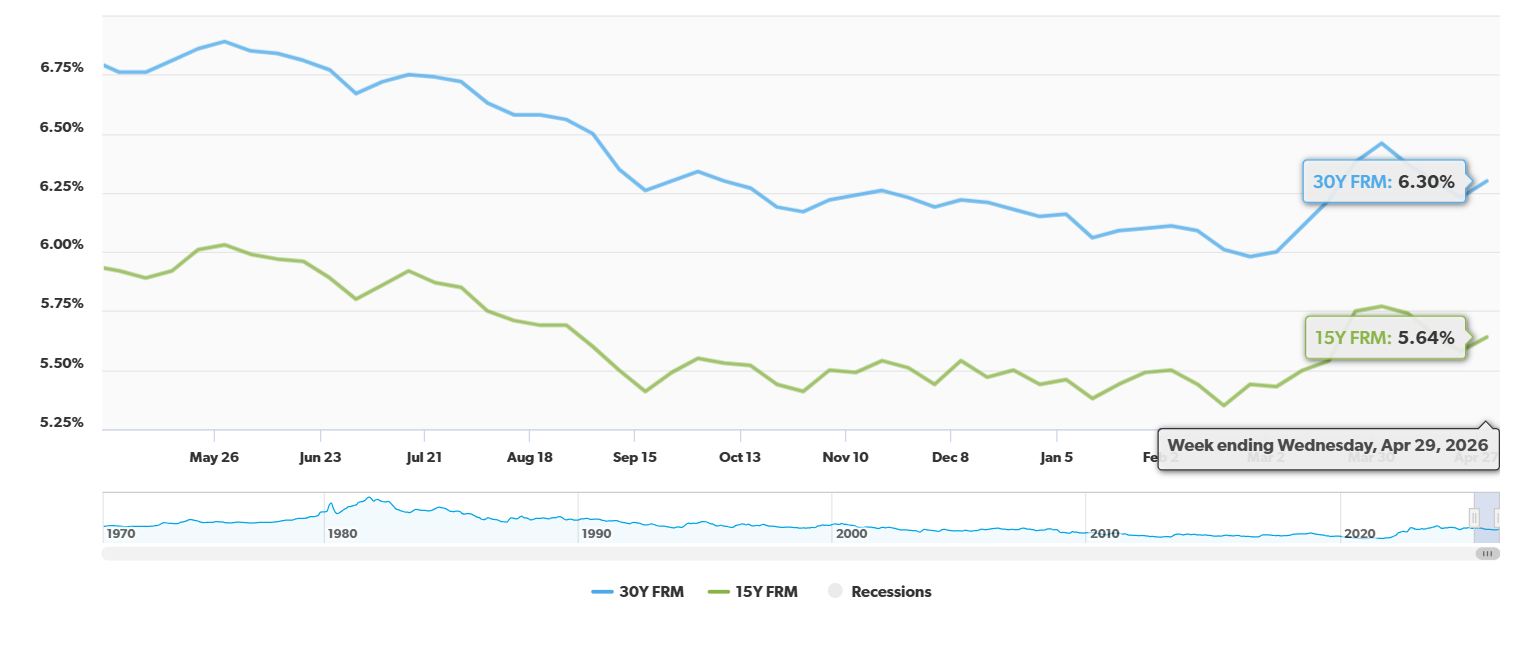
As of today, mortgage and refinance rates are sitting at elevated levels, mostly because of ongoing inflation worries and some global instability. According to Zillow, the average 30-year fixed rate for buying a home has nudged up six basis points to 6.35%, which is the highest we've seen it in about six months. Similarly, the 15-year fixed rate has climbed four basis points to 5.81%. This upward trend is touching most types of home loans, making it a tougher market for many people trying to get into a new home or save money on their existing mortgage.

Today's Mortgage Rates, March 26: 30-Year Fixed Rises to 6.35%, Nearing a Six-Month High

What Are Today’s Mortgage Rates?

Here's a quick snapshot of the average rates we're seeing today, March 26, 2026, courtesy of Zillow. It's helpful to see them all laid out:

Loan Type Average Rate
30-Year Fixed 6.35%
20-Year Fixed 6.11%
15-Year Fixed 5.81%
5/1 ARM 6.62%
7/1 ARM 6.46%
30-Year VA 5.87%
15-Year VA 5.56%
5/1 VA 5.49%

As you can see, these numbers show a general increase across the board, whether it's a standard fixed-rate loan or an adjustable-rate mortgage (ARM). It's worth noting that VA loans are still offering slightly better rates than conventional mortgages, which is a big plus for eligible veterans and service members.

What's Causing Rates to Move Right Now?

It's never just one thing, is it? Several big factors are at play, and they all push and pull on mortgage rates. From my experience, understanding these drivers is key to making smart decisions.

  • Geopolitical Unrest: A major concern right now is the ongoing situation in the Middle East. The conflict in Iran, for example, has caused oil prices to jump by more than 30% since February. When oil prices go up, it often signals higher inflation across the board, and that makes lenders nervous. They expect to get more back on their investment, so they charge more for mortgages. This uncertainty definitely keeps Treasury yields (which mortgage rates tend to follow) high.
  • Federal Reserve's Stance: The Federal Reserve held its benchmark interest rate steady at 3.50%–3.75% at its March 18th meeting. While they did hint at the possibility of at least one rate cut by the end of the year, the big takeaway for me was their caution. They’re very aware that the tensions in the Middle East make it hard to predict inflation accurately. This means they’re not rushing to lower rates, and that keeps mortgage rates elevated.
  • Slightly Less Interest in Mortgages: With these higher rates, it makes sense that fewer people are applying for mortgages. Last week, mortgage applications were down a rather significant 10.5%. This drop tells us that both new homebuyers and people looking to refinance are hesitating. It’s a tough pill to swallow when the cost of borrowing goes up.

What Experts Think for the Rest of 2026

Even with the current ups and downs, there's still a glimmer of hope for the rest of the year. I've been following what different analysts are saying, and here’s a look at their projections. It’s not a crystal ball, but it gives us an idea of what to expect:

  • Bankrate: They're forecasting an average rate of 6.1% for 2026. They also see some wiggle room, mentioning that rates could dip as low as 5.7% or climb to 6.5%, depending on how things unfold globally.
  • Fannie Mae: This is a big one. Fannie Mae is predicting that rates might even come down to 5.7% by the last quarter of 2026. This hopeful outlook hinges on inflation continuing its downward trend.
  • Mortgage Bankers Association (MBA): Their prediction is that the 30-year fixed rate will likely stay around 6.10% through the end of the year. This suggests a balancing act between the ongoing inflation concerns and the Fed’s policy decisions.

My Two Cents on Today's Rates

So, where does that leave us on March 26, 2026? My take is that mortgage rates are definitely high right now, with the 30-year fixed rate at 6.35% and the 15-year fixed at 5.81%. The rising Treasury yields, driven by inflation and global instability, are the main culprits, making buying a home more expensive and reducing the incentive to refinance.

While we should expect continued ups and downs in the short term, the outlook for later in 2026 seems a bit more promising. If inflation starts to cool down and global tensions ease, we might see some relief. For anyone in the market right now, my advice is to be really smart about your budget. Think about what you can truly afford. It might also be worth exploring loan options like VA loans (if you're eligible) or looking into adjustable-rate mortgages (ARMs), which can have lower initial rates. And always, always keep an eye on the news and market shifts – sometimes an opportunity pops up when you least expect it.

🏡 Two Southeastern Rentals With Strong Cash Flow

Rincon, GA
🏠 Property: Founders Dr
🛏️ Beds/Baths: 3 Bed • 2 Bath • 1600 sqft
💰 Price: $275,000 | Rent: $2,200
📊 Cap Rate: 7.0% | NOI: $1,613
📅 Year Built: 2025
📐 Price/Sq Ft: $172
🏙️ Neighborhood: B+

VS

Port Charlotte, FL
🏠 Property: Prineville St
🛏️ Beds/Baths: 4 Bed • 2 Bath • 1914 sqft
💰 Price: $349,900 | Rent: $2,100
📊 Cap Rate: 5.0% | NOI: $1,457
📅 Year Built: 2025
📐 Price/Sq Ft: $183
🏙️ Neighborhood: A

Georgia’s affordable rental with higher cap rate vs Florida’s A‑rated property with stability. Which fits YOUR investment strategy?

We have much more inventory available than what you see on our website – Let us know about your requirement.

📈 Choose Your Winner & Contact Us Today!

Speak to a Norada Investment Counselor (No Obligation):

(800) 611-3060

View All Properties

Build Passive Income & Wealth with Turnkey Rentals in 2026

Mortgage rates remain high in 2026, but rental properties continue to deliver strong cash flow and appreciation. Savvy investors know that turnkey real estate is the path to passive income and long‑term wealth.

Norada Real Estate helps you secure turnkey rental properties designed for immediate cash flow and appreciation—so you can invest smartly regardless of interest rate trends.

🔥 HOT 2026 INVESTMENT LISTINGS JUST ADDED! 🔥
Request a Callback / Fill Out the Form Online

Contact Us

Also Read:

  • Mortgage Rates Predictions Backed by 7 Leading Experts: 2025–2026
  • Mortgage Rate Predictions for the Next 3 Years: 2026, 2027, 2028
  • 30-Year Fixed Mortgage Rate Forecast for the Next 5 Years
  • 15-Year Fixed Mortgage Rate Predictions for Next 5 Years: 2025-2029
  • Will Mortgage Rates Ever Be 3% Again in the Future?
  • Mortgage Rates Predictions for Next 2 Years
  • Mortgage Rate Predictions for Next 5 Years
  • Mortgage Rate Predictions: Why 2% and 3% Rates are Out of Reach
  • How Lower Mortgage Rates Can Save You Thousands?
  • How to Get a Low Mortgage Interest Rate?
  • Will Mortgage Rates Ever Be 4% Again?
Filed Under: Financing, Mortgage Tagged With: mortgage, mortgage rates, Today’s Mortgage Rates

Mortgage Rates Today, March 26, 2026: 30-Year Refinance Rate Rises by 15 Basis Points

March 26, 2026 by Marco Santarelli

Mortgage Rates Today, July 21, 2026: 30-Year Refinance Rate Drops by 2 Basis Points

The mortgage refinance market is facing some headwinds today, March 26, 2026, as the 30-year fixed refinance rate has crept up by 15 basis points, settling at 6.87%. This means that for those looking to refinance their homes, the cost has gone up, and it's making it harder to find a deal that makes financial sense, especially compared to earlier this year.

Mortgage Rates Today – March 26, 2026: 30-Year Refinance Rate Rises by 15 Basis Points

A Quick Look at Today's Refinance Rates

Let's get straight to the numbers. According to Zillow, the national average for a 30-year fixed refinance rate is sitting at 6.87% as of Thursday, March 26, 2026. This is a noticeable jump from last week's average of 6.72%, meaning it's now 15 basis points (or 0.15%) more expensive to refinance a 30-year mortgage.

It's not just the 30-year loans seeing movement. Here’s how some other popular options stack up:

  • 15-Year Fixed Rate: This has also inched up. It was at 5.95% last week and is now at 6.02%, a climb of 7 basis points.
  • 5-Year Adjustable-Rate Mortgage (ARM): These have seen a slight bump too, moving from 7.25% to 7.28%, an increase of 3 basis points.

When rates climb, especially when they cross certain psychological thresholds like the mid-6s or high-6s, it really changes the calculation for homeowners. Suddenly, those savings you might have been hoping for by refinancing shrink, or even disappear.

What's Driving This Shift in the Market?

It’s never just one thing, is it? When we see mortgage rates moving like this, it’s usually a combination of big economic forces and sometimes, even global events. From my perspective, a few major players are really pushing these rates higher right now.

First off, the geopolitical tensions in the Middle East are a huge factor. We've all seen the headlines about the ongoing situation. This kind of instability makes the financial markets nervous, and when markets are nervous, investors tend to move their money into safer places, which often pushes up the yields on government bonds, like U.S. Treasuries. Mortgage rates tend to follow these Treasury yields.

Then there’s inflation, which is still a sticky issue. The numbers we’ve been getting, especially on the wholesale side and concerning energy costs, have been a bit higher than expected. This makes the Federal Reserve hesitant to lower interest rates anytime soon. In fact, at their last meeting on March 18th, they kept rates steady in the 3.50%–3.75% range and signaled that we might only see one rate cut for the rest of 2026. This “higher-for-longer” message from the Fed is definitely putting upward pressure on borrowing costs.

It's also worth noting the impact of higher oil prices, which have been fluctuating in the $89–$92 per barrel range due to the conflict. Higher energy costs ripple through the economy, making things more expensive and contributing to that persistent inflation worry.

How is This Affecting Homeowners and Refinance Activity?

You can bet this rate increase is having a real effect on people trying to refinance. The Mortgage Bankers Association (MBA) recently reported some pretty clear numbers that show this:

  • Refinance Applications Dropped: Last week alone, applications for refinancing fell by a significant 15%. People are seeing the higher rates and deciding to hold off.
  • Overall Mortgage Activity Slowed: It's not just refinancing. The total volume of mortgage applications went down by 10.5% compared to the week before. Both buyers looking for new homes and existing homeowners looking to refinance are pulling back.
  • Refinancing's Share is Shrinking: Refinance applications used to make up a bigger chunk of the total, but now they're down to 49.6%, from 52.3% the previous week. This shows that fewer people are finding it worthwhile to refinance.

When rates start hovering around or above 6.5%, especially for those who already have a mortgage with a much lower rate, it just doesn't make financial sense to pay more for a refinance. I’ve seen this happen many times in my career – people are highly sensitive to these changes.

What Else is Happening in the Market?

Looking back at just the last 24 hours, there have been a few other important developments:

  • A Milestone Rate: The 30-year fixed conforming mortgage rate touched 6.43%. While this might sound low compared to today's refinance rate, it’s the highest it's been in about five months. This level is so high that it’s effectively closed the door on refinancing for nearly 90% of potential borrowers who might have been thinking about it.
  • Support from Agencies: Some analysts are saying that if it weren't for the bond-buying support from giants like Fannie Mae and Freddie Mac, mortgage rates would likely be even higher. With the global uncertainties, their intervention is helping to keep things from getting completely out of hand.
  • Turning to Home Equity: With traditional refinancing becoming less appealing, I'm seeing more homeowners explore alternatives. This means loans like Home Equity Lines of Credit (HELOCs) and traditional home equity loans are becoming more popular. These allow people to tap into the equity they’ve built in their homes to access cash without having to give up the lower interest rate they might currently have on their primary mortgage.

My Takeaway on Today's Mortgage Rates

So, what does all of this mean for us today, on March 26, 2026? The 30-year refinance rate holding at 6.87% is a clear signal that the market is feeling the heat from inflation, the stubbornness of Treasury yields, and those ongoing global concerns. For many homeowners, especially those lucky enough to have locked in rates below 6% in recent years, refinancing right now just doesn't make financial sense.

This kind of spike in rates really forces a quick adjustment in how people think about their finances and their homes. The sharp drop in refinance demand is a direct result of this. We're seeing a shift where alternatives like leveraging home equity are becoming more attractive for those who need access to funds.

🏡 Two TURnkey properties With Strong Cash Flow

Rincon, GA
🏠 Property: Founders Dr
🛏️ Beds/Baths: 3 Bed • 2 Bath • 1600 sqft
💰 Price: $275,000 | Rent: $2,200
📊 Cap Rate: 7.0% | NOI: $1,613
📅 Year Built: 2025
📐 Price/Sq Ft: $172
🏙️ Neighborhood: B+

VS

Port Charlotte, FL
🏠 Property: Prineville St
🛏️ Beds/Baths: 4 Bed • 2 Bath • 1914 sqft
💰 Price: $349,900 | Rent: $2,100
📊 Cap Rate: 5.0% | NOI: $1,457
📅 Year Built: 2025
📐 Price/Sq Ft: $183
🏙️ Neighborhood: A

Georgia’s affordable rental with higher cap rate vs Florida’s A‑rated property with stability. Which fits YOUR investment strategy?

We have much more inventory available than what you see on our website – Let us know about your requirement.

📈 Choose Your Winner & Contact Us Today!

Speak to a Norada Investment Counselor (No Obligation):

(800) 611-3060

View All Properties

Invest Smart — Build Long-Term Wealth Through Turnkey Real Estate in 2026

Market forecasts suggest steady demand, making turnkey real estate one of the most reliable paths to passive income and wealth creation.

Norada Real Estate helps investors capitalize on these trends with turnkey rental properties designed for appreciation and consistent cash flow—so you can grow wealth securely while others wait for clarity in the market.

🔥 HOT 2026 INVESTMENT LISTINGS JUST ADDED! 🔥
Send Us An Email or Request a Call Back

Contact Us

Recommended Read:

  • 30-Year Fixed Refinance Rate Trends – March 22, 2026
  • Best Time to Refinance Your Mortgage: Expert Insights
  • Should You Refinance Your Mortgage Now or Wait Until 2026?
  • When You Refinance a Mortgage Do the 30 Years Start Over?
  • Should You Refinance as Mortgage Rates Reach Lowest Level in Over a Year?
  • Half of Recent Home Buyers Got Mortgage Rates Below 5%
  • Mortgage Rates Need to Drop by 2% Before Buying Spree Begins
  • Will Mortgage Rates Ever Be 3% Again: Future Outlook
  • Mortgage Rates Predictions for Next 2 Years
  • Mortgage Rate Predictions for Next 5 Years

Filed Under: Financing, Mortgage Tagged With: mortgage rates, Mortgage Rates Today, Refinance Rates

Why Treasury Yields Are Driving Mortgage Rates Higher Now?

March 25, 2026 by Marco Santarelli

Why Treasury Yields Are Driving Mortgage Rates Higher Now?

If you've been dreaming of buying a home or thinking about refinancing your existing mortgage, you've probably noticed that the numbers just aren't as friendly as they were a few weeks ago. It's no coincidence; the recent jump in mortgage rates is directly tied to the rise in Treasury yields, particularly that of the 10-year Treasury note. This isn't just financial jargon; it's the engine pushing your potential monthly payments upwards right now.

Looking at the market today, March 24, 2026, we're seeing the 30-year fixed mortgage rate hover around 6.43%. That might not sound like a drastic leap from the roughly 6.2% we saw just a week ago, but trust me, even a quarter-percent difference can add up significantly when you're talking about a 30-year commitment. This climb is a direct reaction to the 10-year Treasury yield reaching its highest point since July of last year, currently sitting at 4.38%. As a borrower, understanding this connection is key to making sense of today's housing market.

Why Treasury Yields Are Driving Mortgage Rates Higher Now?

The Domino Effect: From Oil Prices to Your Home Loan

You might be wondering, “What on earth does the price of oil have to do with my mortgage?” It's a valid question, and the answer boils down to inflation.

The current situation in the Middle East is a major culprit. The conflict has sent crude oil prices soaring, pushing them well over $100 a barrel. When oil prices spike like this, it has a ripple effect throughout the economy. Transportation costs go up for pretty much everything, from the food on your table to the materials used to build houses. This increased cost of doing business often gets passed on to consumers in the form of higher prices – a phenomenon known as inflation.

Why Inflation Makes Bond Investors Nervous (and Yields Jump)

Normally, in uncertain times, people tend to seek safety in government bonds. They figure it's a safer bet than the stock market when things get shaky. But here's where it gets interesting, and a bit counterintuitive.

When investors get worried about inflation, they become less eager to buy bonds, especially long-term ones. Why? Because inflation eats away at the purchasing power of money. If you hold a bond that pays you back a fixed amount of money in 10 years, and inflation has been high during that time, that money you get back won't buy as much as it does today. This thought process leads investors to sell bonds. And when there are more sellers than buyers for bonds, their prices go down.

Now, here's the crucial link: bond prices and bond yields move in opposite directions. When the price of a bond goes down, its yield goes up. This is exactly what we're seeing with the 10-year Treasury. Investors are selling because they fear inflation, pushing the yield higher.

The 10-Year Treasury: Your Mortgage Rate's Compass

So, why is the 10-year Treasury yield so important for mortgage rates? Think of it as the benchmark, the main compass that mortgage lenders use to set their rates.

The reason for this strong connection is that the 30-year fixed-rate mortgage, which is what most people get, is designed to be held for a long time – often around a decade before people refinance or sell their homes. The 10-year Treasury yield is a good indicator of what lenders expect interest rates to do over that medium-term horizon. When the 10-year Treasury yield rises, lenders have to offer higher rates on mortgages to remain competitive and profitable. It's as simple as that.

The gap, or spread, between the 10-year Treasury yield and the average mortgage rate is also something to watch. Right now, that spread is larger than usual, sitting around 205 basis points (or 2.05%). This wider spread reflects lenders factoring in the added geopolitical risk and economic uncertainty. They are essentially building in a larger cushion to protect themselves against potential future volatility.

The Fed's Careful Tread

Even though the Federal Reserve, our nation's central bank, held its key interest rate steady between 3.5% and 3.75% on March 18, 2026, their cautious language about future rate cuts is also playing a role. The Fed tries to manage inflation and keep the economy stable. When they signal that they're not in a rush to lower rates, it sends a message to the market that interest rates might stay higher for longer. This outlook also contributes to keeping those longer-term Treasury yields elevated.

What This Means for You, the Homebuyer or Refinancer

Let's get down to brass tacks. How does this higher yield environment actually impact your wallet?

For Homebuyers:

  • Monthly Payments Jump: As I mentioned, even a small increase in rates makes a difference. Let's look at it this way:
    Home Price Loan Amount (80%) Payment at 6.20% Payment at 6.43% Monthly Increase
    $300,000 $240,000 $1,470 $1,506 +$36
    $450,000 $360,000 $2,205 $2,259 +$54
    $600,000 $480,000 $2,940 $3,012 +$72

    See? For a $600,000 home, that extra few ticks on the rate means paying an extra $72 every single month. Over a year, that's an extra $864 in just principal and interest payments. It's a tangible hit to your budget.

  • Borrowing Power Decreases: When mortgage rates go up, so does the monthly cost of borrowing money. This means that with the same monthly budget, you can afford to borrow less when rates are higher. This can force buyers to adjust their expectations or delay their purchase.

For Refinancers:

  • Refinance Slump: This is why we're seeing a significant drop in refinance applications, down nearly 26% this week. When rates climb, the incentive to refinance an existing mortgage disappears for many homeowners. The “deal” just isn't there anymore compared to the lower rates we saw just a couple of months ago.

Looking Ahead: Spring Market Volatility

The spring buying season is often a busy time in real estate, but current conditions suggest it could be a bit choppier. Experts are predicting that while average rates might hover around 6.1% for the year, they could easily swing as high as 6.5% depending on how inflation data continues to shake out.

For anyone trying to buy a home right now, it really underscores the importance of careful financial planning. Many financial advisors recommend sticking to the “25% Rule,” meaning you ideally shouldn't spend more than 25% of your take-home pay on your total housing costs, including mortgage principal and interest, property taxes, and homeowners insurance. This is especially crucial during periods of rising rates.

It's a challenging time for sure, and the connection between global events and your local mortgage rate can feel distant. But understanding these dynamics can help you navigate the market with more confidence.

🏡 Two Rentals With Strong Investor Potential

Pleasant Grove, AL
🏠 Property: 4th Ave (1549 sqft)
🛏️ Beds/Baths: 3 Bed • 2 Bath • 1549 sqft
💰 Price: $265,000 | Rent: $1,850
📊 Cap Rate: 6.2% | NOI: $1,368
📅 Year Built: 2026
📐 Price/Sq Ft: $172
🏙️ Neighborhood: B+

VS

Pleasant Grove, AL
🏠 Property: 4th Ave (1856 sqft)
🛏️ Beds/Baths: 3 Bed • 2 Bath • 1856 sqft
💰 Price: $410,000 | Rent: $3,200
📊 Cap Rate: 5.8% | NOI: $1,981
📅 Year Built: 2026
📐 Price/Sq Ft: $221
🏙️ Neighborhood: B+

Two Pleasant Grove rentals—one affordable with higher cap rate vs one larger with stronger NOI. Which fits YOUR investment strategy?

We have much more inventory available than what you see on our website – Let us know about your requirement.

📈 Choose Your Winner & Contact Us Today!

Speak to a Norada Investment Counselor (No Obligation):

(800) 611-3060

View All Properties

Build Passive Income & Wealth with Turnkey Rentals in 2026

Mortgage rates remain high in 2026, but rental properties continue to deliver strong cash flow and appreciation. Savvy investors know that turnkey real estate is the path to passive income and long‑term wealth.

Norada Real Estate helps you secure turnkey rental properties designed for immediate cash flow and appreciation—so you can invest smartly regardless of interest rate trends.

🔥 HOT 2026 INVESTMENT LISTINGS JUST ADDED! 🔥
Request a Callback / Fill Out the Form Online

Contact Us

Also Read:

  • Mortgage Rates Predictions Backed by 7 Leading Experts: 2025–2026
  • Mortgage Rate Predictions for the Next 3 Years: 2026, 2027, 2028
  • 30-Year Fixed Mortgage Rate Forecast for the Next 5 Years
  • 15-Year Fixed Mortgage Rate Predictions for Next 5 Years: 2025-2029
  • Will Mortgage Rates Ever Be 3% Again in the Future?
  • Mortgage Rates Predictions for Next 2 Years
  • Mortgage Rate Predictions for Next 5 Years
  • Mortgage Rate Predictions: Why 2% and 3% Rates are Out of Reach
  • How Lower Mortgage Rates Can Save You Thousands?
  • How to Get a Low Mortgage Interest Rate?
  • Will Mortgage Rates Ever Be 4% Again?

Filed Under: Financing, Mortgage Tagged With: mortgage, mortgage rates, Today’s Mortgage Rates, Treasury Yields

Geopolitical Jitters & Sticky Inflation Push Mortgage Rates Higher in 2026

March 25, 2026 by Marco Santarelli

Geopolitical Jitters & Sticky Inflation Push Mortgage Rates Higher in 2026

The dream of snagging a low mortgage rate seems to be fading fast. Geopolitical turmoil, particularly the recent conflict erupting in Iran, coupled with stubbornly high inflation, has sent average 30-year fixed mortgage rates climbing back into the 6.22% to 6.50% range, marking their highest point of the year. This isn't just a blip; it's a trend that's reshaping the housing market and making homeownership a tougher pill to swallow for many.

Geopolitical Jitters & Sticky Inflation Push Mortgage Rates Higher in 2026

It feels like just yesterday we were seeing those sub-6% rates, doesn't it? I remember thinking how much easier that made things for folks looking to buy or refinance. But the world is a complicated place, and right now, it's throwing some serious curveballs at our wallets, especially when it comes to getting a mortgage. From my perspective, this isn't just about numbers on a screen; it's about how global events directly impact the stability and affordability of what many consider the biggest investment of their lives.

The Double Whammy: War and Stubborn Prices

Let's break down what's really going on. Two major players are driving these higher mortgage rates:

  • Geopolitical Conflict: The outbreak of war in Iran in late February 2026 has sent shockwaves through the global energy markets. We're seeing oil prices soar above $100 a barrel, a significant jump that impacts everything from how we get to work to the cost of building a house. When oil gets more expensive, so does transportation, manufacturing, and pretty much anything that relies on fuel. This ripple effect is unavoidable.
  • “Sticky” Inflation: All this energy price chaos naturally fuels inflation fears. It’s not just a temporary spike; economists are worried this is the kind of inflation that likes to stick around. So much so, the Federal Reserve has revised its inflation forecast for 2026 upwards to 2.7%. This “stickiness” is key. It means the central bank might have to keep interest rates higher for longer to get prices back under control.

The Fed's Balancing Act and Treasury Yields

The Federal Reserve is in a tough spot. On March 18th, they decided to hold their benchmark interest rate steady at 3.50%–3.75%. This signals a cautious approach. They're not rushing to cut rates because they're worried about inflation. In fact, they're now projecting only one rate cut for the rest of 2026.

Why does the Fed's rate matter for your mortgage? Well, the Fed's rate influences all sorts of borrowing costs. And a big driver for mortgage rates is the yield on the 10-year Treasury note. Think of this as a key benchmark. With all this uncertainty, investors are demanding a higher return for holding these government bonds, pushing the yield up to around 4.25%–4.35%. When Treasury yields climb, mortgage lenders usually follow suit, repricing their loans to reflect the higher cost of borrowing.

Mortgage Rates Today: A Snapshot

As of late March 2026, here's what we're seeing for some common loan types:

Loan Type Average Rate Range
30-Year Fixed 6.25% – 6.50%
15-Year Fixed 5.75% – 5.78%
30-Year Refinance 6.70% – 6.90%
30-Year VA 5.81% – 5.85%

These figures are a stark reminder of how much things can change. Just a few months ago, rates looked much more favorable.

Expert Opinions: What's Next?

The crystal ball isn't perfectly clear, and different experts have slightly different views on where rates are headed for the rest of 2026.

  • Fannie Mae has a more optimistic outlook, predicting rates will average around 6.0% for the year.
  • The Mortgage Bankers Association (MBA) anticipates a slightly higher average of 6.4%.
  • Redfin is projecting a 2026 average of 6.3%.
  • Morgan Stanley, however, suggests a potential dip to 5.75% by mid-year if inflation eases significantly. But they rightly point out that geopolitical risks are a huge wildcard that could easily change that picture.

From my experience, these forecasts are educated guesses at best. The global situation is so fluid. Any major geopolitical development or an unexpected shift in inflation data can send these projections out the window.

Regional Divide: Some Markets Cool, Others Hold Strong

The impact of these higher mortgage rates isn't felt equally across the country. It's creating a real divide:

Cooling Markets (South and West):

These areas are feeling the pinch the most. With higher-priced homes and tighter affordability, rising rates can quickly push buyers to the sidelines.

  • Price Declines: Cities in Florida and Texas are leading the nation in home price corrections. We're seeing projections for significant drops in places like Cape Coral, FL (-10.2%) and North Port, FL (-8.9%). Even California isn't immune, with Stockton, CA facing a projected 4.1% decline.
  • Inventory Surge: In places like Las Vegas, Seattle, and Phoenix, active home listings have jumped over 20% compared to last year. This is because higher rates are making buyers more hesitant, and new home builders are still bringing properties to market, leading to an oversupply in some spots.

Resilient Markets (Northeast and Midwest):

These regions are proving surprisingly resilient, largely due to a persistent lack of homes for sale.

  • Strong Appreciation: While prices aren't skyrocketing, they're still growing. This is because inventory levels remain critically low. In some cities, like Hartford, CT, listings are up to 74% below pre-pandemic levels.
  • Top Growth Projections: Cities like Toledo, OH (+13.1%), Syracuse, NY (+12.4%), and Scranton, PA (+10.9%) are expected to see the highest price increases this year, fueled by this scarcity.
  • New York Metro: Even here, a more modest 1.5% growth is forecast for home values in 2026.

Buyer Leverage: A Shift in Power?

While national home price growth has slowed to a crawl—just 0.7% to 1.4% year-over-year as of early 2026—it's important to note that the market hasn't completely “crashed.” Instead, this higher-rate environment is subtly shifting power back to buyers in specific ways:

  • Days on Market: Homes are taking longer to sell. In February 2026, the average home sat on the market for 66 days, compared to just 58 days last year. This gives buyers more time to think and negotiate.
  • Price Cuts and Concessions: Sellers are increasingly having to lower their asking prices or offer incentives to get deals done, especially in those markets that have seen significant price run-ups.
  • The “Locked-In” Effect: This is a big one. Many homeowners who locked in ultra-low mortgage rates of 3%–4% in previous years are understandably reluctant to sell. They don't want to trade a super-low rate for a much higher one. This prevents a massive flood of inventory from hitting the market, which is a key reason why national prices aren't plummeting.

Here's a look at how different sources are forecasting national home price growth:

Source 2026 Price Forecast
Realtor.com +2.2%
Fannie Mae +1.3%
Zillow +0.9%
J.P. Morgan 0.0% (Stall)

Looking Ahead

The message from the market is clear: geopolitical stability and inflation control are the primary drivers for what happens to mortgage rates next. Until we see a significant easing in those areas, expect rates to remain elevated. For potential buyers and homeowners, it means more caution, more negotiation, and a continued appreciation for the markets that demonstrate fundamental strength even in challenging times. It's a complex equation, and I'll be watching closely to see how these factors play out.

🏡 Two Southeastern Rentals With Strong Cash Flow

Rincon, GA
🏠 Property: Founders Dr
🛏️ Beds/Baths: 3 Bed • 2 Bath • 1600 sqft
💰 Price: $275,000 | Rent: $2,200
📊 Cap Rate: 7.0% | NOI: $1,613
📅 Year Built: 2025
📐 Price/Sq Ft: $172
🏙️ Neighborhood: B+

VS

Port Charlotte, FL
🏠 Property: Prineville St
🛏️ Beds/Baths: 4 Bed • 2 Bath • 1914 sqft
💰 Price: $349,900 | Rent: $2,100
📊 Cap Rate: 5.0% | NOI: $1,457
📅 Year Built: 2025
📐 Price/Sq Ft: $183
🏙️ Neighborhood: A

Georgia’s affordable rental with higher cap rate vs Florida’s A‑rated property with stability. Which fits YOUR investment strategy?

We have much more inventory available than what you see on our website – Let us know about your requirement.

📈 Choose Your Winner & Contact Us Today!

Speak to a Norada Investment Counselor (No Obligation):

(800) 611-3060

View All Properties

Build Passive Income & Wealth with Turnkey Rentals in 2026

Mortgage rates remain high in 2026, but rental properties continue to deliver strong cash flow and appreciation. Savvy investors know that turnkey real estate is the path to passive income and long‑term wealth.

Norada Real Estate helps you secure turnkey rental properties designed for immediate cash flow and appreciation—so you can invest smartly regardless of interest rate trends.

🔥 HOT 2026 INVESTMENT LISTINGS JUST ADDED! 🔥
Request a Callback / Fill Out the Form Online

Contact Us

Also Read:

  • The Real Reason Mortgage Rates Are Rising Back in 2026
  • Mortgage Rates Predictions Backed by 7 Leading Experts: 2025–2026
  • Mortgage Rate Predictions for the Next 3 Years: 2026, 2027, 2028
  • 30-Year Fixed Mortgage Rate Forecast for the Next 5 Years
  • 15-Year Fixed Mortgage Rate Predictions for Next 5 Years: 2025-2029
  • Will Mortgage Rates Ever Be 3% Again in the Future?
  • Mortgage Rates Predictions for Next 2 Years
  • Mortgage Rate Predictions for Next 5 Years
  • Mortgage Rate Predictions: Why 2% and 3% Rates are Out of Reach
  • How Lower Mortgage Rates Can Save You Thousands?
  • How to Get a Low Mortgage Interest Rate?
  • Will Mortgage Rates Ever Be 4% Again?

Filed Under: Financing, Mortgage Tagged With: mortgage, mortgage rates, Today’s Mortgage Rates, Treasury Yields

The Real Reason Mortgage Rates Are Rising Back in 2026

March 25, 2026 by Marco Santarelli

The Real Reason Mortgage Rates Are Rising Back in 2026

If you've been following the news about housing and loans, you've probably noticed that mortgage rates have been ticking up lately. Many are asking why this is happening now, especially after a period where they seemed to be heading down. The short answer is that a mix of lingering inflation and some serious global tension, particularly the recent conflict in Iran, has put the brakes on anticipated interest rate cuts from the Federal Reserve. This uncertainty makes lenders less willing to offer the lowest rates, pushing them higher to cover their risks.

The Real Reason Mortgage Rates Are Rising Back in 2026

The Inflation Monster Isn't Quite Gone

You know how we've been talking about inflation for a while? Well, it turns out it's been a bit more stubborn than many expected. In February 2026, reports showed that inflation was sitting at 2.4%. Now, the Federal Reserve, which is in charge of keeping prices stable, likes to see inflation around 2%. So, even though it's come down from its highest points, that extra half-percent is enough to make the Fed nervous.

Think of it like this: the Fed was getting ready to lower interest rates to make it cheaper for people and businesses to borrow money. This is usually good for the economy. But if inflation is still too high, lowering rates can pour fuel on the fire, making prices jump even faster. They’ve hit the pause button on those planned rate cuts to make sure they don’t accidentally make things worse.

A Geopolitical Jolt: The War in Iran

On top of the inflation issue, we've had some pretty significant global news. The outbreak of war in Iran has caused a lot of ripple effects. One of the most immediate is its impact on oil prices. When oil prices jump, it makes everything from gasoline to the cost of shipping goods more expensive. This can create a wider inflationary shock across many different parts of the economy.

This kind of global instability makes everyone, including economists and investors, a bit worried. When there's uncertainty, especially about major resources like oil, it can lead to a more volatile market. This is a big reason why the Fed is being extra cautious about changing interest rates.

The Fed's Decision: Hitting the Brakes

This uncertainty led to a key decision on March 18, 2026. The Federal Reserve decided to hold its benchmark interest rate steady. This means the rate that influences many other interest rates, including the ones for mortgages, is still in the range of 3.5% to 3.75%.

This decision signals that they might not be cutting rates as soon as people thought, especially if inflation doesn't calm down quickly. It’s a tough balancing act: they want to support the economy but can’t do it at the expense of letting prices run wild.

Treasury Yields: How They Mirror Mortgage Rates

You might hear about something called the 10-year Treasury yield. This is essentially the return investors get for lending money to the U.S. government for 10 years. Mortgage rates tend to follow this yield quite closely.

Why? Because many of the same investors who buy Treasury bonds also invest in mortgage-backed securities. When there’s global trouble, like the conflict in Iran, investors often flock to safer assets like U.S. Treasury bonds. This demand can drive up the price of these bonds, which in turn lowers their yield. However, in times of conflict and expected inflation, the opposite can happen: investors demand a higher yield to compensate for the increased risk, pushing Treasury yields up. As Treasury yields climb, mortgage lenders also raise their rates.

Where We Stand Now (March 24, 2026)

So, what does this all mean for mortgage rates right now?

  • 30-Year Fixed Mortgages: The average rate has jumped to about 6.31% to 6.43%. This is up from just around 6.11% a few weeks ago.
  • 15-Year Fixed Mortgages: These are a bit lower, sitting between 5.54% and 5.78%.

Honestly, these numbers might seem high to some, but compared to what we saw earlier in 2024 and 2025, they're actually still quite a bit lower.

The Impact on Homebuyers and Sellers

This rapid jump in rates has an immediate effect on the market. We’re seeing a significant drop in people looking to refinance their existing mortgages. In fact, applications for refinancing have fallen by nearly 26% week-over-week. When borrowing costs jump this much, it makes less sense for most people to try and get a new loan on their current home.

For potential homebuyers, this means their monthly payments will be higher. This can push some buyers out of the market altogether or force them to look for less expensive homes.

Looking Ahead: What Could Happen Later in 2026?

Now, the million-dollar question: will rates stay this high? It’s tough to say for sure, but here’s what some experts are thinking.

Morgan Stanley, for instance, suggests that if inflation starts to cool down more consistently, mortgage rates could potentially moderate later in the year, maybe to the 5.50% to 5.75% range. That would be a welcome relief for many.

However, the data from places like the CME Group's FedWatch tool shows that a good chunk, about 70%, of people who follow this closely believe the Fed won't cut interest rates again until at least December 2026. This means those higher borrowing costs might stick around for a while.

A Quick Look Back: How We Got Here

To really understand why rates are up now, it's helpful to remember how much they’ve fluctuated.

  • March 2026: We're seeing about 6.22% to 6.43%.
  • 2025: The average for the year was higher, around 6.66%. In early 2025, rates actually peaked above 7.00% before the Fed’s cuts later in the year brought them down.
  • 2024: On average, mortgage costs were around 6.90%, often hovering between 6.7% and 7%.
  • 2023: We saw some of the highest rates in over two decades, with a peak in October 2023 breaking 8.00%.

The Fed's Long Game and Your Mortgage

The Federal Reserve's actions have a domino effect that lasts a long time.

  • 2024: After keeping rates high for a while at 5.25% to 5.50%, they started cutting rates in September 2024, lowering them by about 1.00% by the end of the year.
  • 2025: They continued with three more cuts late in the year, bringing the rate down to the current 3.50% to 3.75%.
  • 2026: But as we’ve seen, the trend has paused due to sticky inflation and those rising oil prices.

Affordability: A Matter of Perspective

Even with the recent uptick, it’s worth remembering that today's rates, around 6.22%, are still about 0.45% lower than they were exactly one year ago in March 2025 (which was around 6.67%).

However, we're still dealing with something called the “lock-in effect”. This means a huge number of existing homeowners, around 82%, have mortgages with rates below 6.00%. This makes it really unattractive for them to sell their homes and buy new ones, which in turn limits how many homes are available for sale. This supply shortage can also keep prices from falling as much as they might otherwise.

So, while the news about rising mortgage rates can feel discouraging, understanding the bigger picture—the persistent inflation, the global events, and the Fed's careful approach—helps explain why we're in this situation. It’s a complex economic story, and mortgage rates are just one chapter in it.

🏡 Two Rentals With Strong Investor Potential

Pleasant Grove, AL
🏠 Property: 4th Ave (1549 sqft)
🛏️ Beds/Baths: 3 Bed • 2 Bath • 1549 sqft
💰 Price: $265,000 | Rent: $1,850
📊 Cap Rate: 6.2% | NOI: $1,368
📅 Year Built: 2026
📐 Price/Sq Ft: $172
🏙️ Neighborhood: B+

VS

Pleasant Grove, AL
🏠 Property: 4th Ave (1856 sqft)
🛏️ Beds/Baths: 3 Bed • 2 Bath • 1856 sqft
💰 Price: $410,000 | Rent: $3,200
📊 Cap Rate: 5.8% | NOI: $1,981
📅 Year Built: 2026
📐 Price/Sq Ft: $221
🏙️ Neighborhood: B+

Two Pleasant Grove rentals—one affordable with higher cap rate vs one larger with stronger NOI. Which fits YOUR investment strategy?

We have much more inventory available than what you see on our website – Let us know about your requirement.

📈 Choose Your Winner & Contact Us Today!

Speak to a Norada Investment Counselor (No Obligation):

(800) 611-3060

View All Properties

Build Passive Income & Wealth with Turnkey Rentals in 2026

Mortgage rates remain high in 2026, but rental properties continue to deliver strong cash flow and appreciation. Savvy investors know that turnkey real estate is the path to passive income and long‑term wealth.

Norada Real Estate helps you secure turnkey rental properties designed for immediate cash flow and appreciation—so you can invest smartly regardless of interest rate trends.

🔥 HOT 2026 INVESTMENT LISTINGS JUST ADDED! 🔥
Request a Callback / Fill Out the Form Online

Contact Us

Also Read:

  • Mortgage Rates Predictions Backed by 7 Leading Experts: 2025–2026
  • Mortgage Rate Predictions for the Next 3 Years: 2026, 2027, 2028
  • 30-Year Fixed Mortgage Rate Forecast for the Next 5 Years
  • 15-Year Fixed Mortgage Rate Predictions for Next 5 Years: 2025-2029
  • Will Mortgage Rates Ever Be 3% Again in the Future?
  • Mortgage Rates Predictions for Next 2 Years
  • Mortgage Rate Predictions for Next 5 Years
  • Mortgage Rate Predictions: Why 2% and 3% Rates are Out of Reach
  • How Lower Mortgage Rates Can Save You Thousands?
  • How to Get a Low Mortgage Interest Rate?
  • Will Mortgage Rates Ever Be 4% Again?

Filed Under: Financing, Mortgage Tagged With: mortgage, mortgage rates, Today’s Mortgage Rates, Treasury Yields

Today’s Mortgage Rates, March 25: Rates Go Down as 30-Year Fixed Falls to 6.29%

March 25, 2026 by Marco Santarelli

Today's Mortgage Rates, July 21: Buyers Catch a Small Break as 30‑Year Fixed Dips to 6.40%

As of today, March 25, 2026, there's a welcome, albeit small, bit of good news for anyone eyeing a new home or thinking about refinancing: mortgage rates have taken a slight dip. Following a week of climbing prices, we're seeing a little relief, with the 30-year fixed rate dropping to 6.29% and the 15-year fixed hitting 5.77%, according to Zillow. This is the first bit of breathing room in days, offering a sigh of relief to homebuyers and homeowners who’ve watched rates creep up to levels we haven’t seen since late last year.

Right now, the rates are being led by rising Treasury yields and some unsettling developments overseas, particularly in the Middle East. Even though the Federal Reserve made a decision to keep its key interest rate steady, the persistent worry about inflation, amplified by the surge in oil prices, is casting a long shadow over the mortgage market.

Today's Mortgage Rates, March 25: Rates Go Down as 30-Year Fixed Falls to 6.29%

Let’s break down the latest averages Zillow shared with us:

Mortgage Type Rate
30-Year Fixed 6.29%
20-Year Fixed 6.25%
15-Year Fixed 5.77%
5/1 ARM 6.35%
7/1 ARM 6.35%
30-Year VA 5.93%
15-Year VA 5.57%
5/1 VA 5.57%

Looking at these numbers, it’s clear that while today’s drop is a positive sign, we’re still a far cry from the sub-6% days that felt pretty normal earlier this year.

The Forces Shaping Our Mortgage World

It’s never just one thing, is it? A few key players are really influencing where mortgage rates are heading, and I think it's important we look at them together:

  • The Federal Reserve's Stance: The Fed held its ground at their March 17-18 meeting, keeping the federal funds rate between 3.50% and 3.75%. Now, they haven't signaled any immediate rate cuts, and that's a big part of why borrowing costs are staying put at these higher levels. They're watching inflation very closely, and until they feel it's truly under control, they're likely to remain cautious.
  • Oil Prices and Inflation: This is a big one, and frankly, it’s a bit nerve-wracking. The recent events in Iran have pushed oil prices past the $100 per barrel mark. When oil goes up, everything from transportation to manufacturing costs tends to follow, creating what economists call “second-round effects” on inflation. This directly impacts the 10-year Treasury yield, which is a major benchmark that mortgage rates tend to mirror. So, while the Fed might be one piece of the puzzle, global events are having a significant ripple effect.
  • Buyer Hesitation (and its Impact): It makes perfect sense – when rates go up, people tend to step back. We’ve seen mortgage application volume drop by over 10% in the past week. A good portion of that decline, about 15%, comes from homeowners who were thinking about refinancing but are now finding it less attractive with rates outside of that sweet spot we saw not too long ago. This cooling demand can, in theory, take some pressure off rates, but it’s a delicate balance.

My Gut Feeling and the Experts' Views for 2026

When I look ahead, I try to balance the immediate news with the bigger picture.

  • In the Short Term: My feeling, and what many industry watchers are saying, is that rates will likely continue to be a bit unpredictable. We might see them hover in that mid-6% range for a while. This is until we get more clear direction from the Federal Reserve, or until the geopolitical situation in the Middle East calms down. Volatility can be tough for planning.
  • Looking Towards Year-End: Most economists I follow are still predicting a gradual easing of rates by the end of 2026. For instance, folks at Fannie Mae and Bankrate are suggesting that if inflation continues to trend downward, we could see 30-year fixed rates nudging toward 6.1% or possibly even dipping slightly below 6.0%. This is the kind of outlook that makes me tell clients to look at their long-term goals, not just the daily headlines.

The Big Takeaway for Today

So, what’s the bottom line for March 25, 2026? Today’s small drop in mortgage rates is a welcome pause, like catching your breath during a challenging hike. However, the overall picture is still one where borrowing costs are higher than many hoped for at the start of the year, and global events are keeping things a bit uncertain.

If you’re someone who’s been dreaming of owning a home or is considering refinancing an existing mortgage, my advice is to start by looking at your personal financial situation and your long-term plans. While the future might bring lower rates, the current environment really calls for careful consideration. Weighing the costs of refinancing now against the potential savings down the road, or understanding the affordability of a new purchase at today’s rates, is crucial. It's about making a decision that feels right for you, not just reacting to the daily market flutter.

🏡 Two Southeastern Rentals With Strong Cash Flow

Rincon, GA
🏠 Property: Founders Dr
🛏️ Beds/Baths: 3 Bed • 2 Bath • 1600 sqft
💰 Price: $275,000 | Rent: $2,200
📊 Cap Rate: 7.0% | NOI: $1,613
📅 Year Built: 2025
📐 Price/Sq Ft: $172
🏙️ Neighborhood: B+

VS

Port Charlotte, FL
🏠 Property: Prineville St
🛏️ Beds/Baths: 4 Bed • 2 Bath • 1914 sqft
💰 Price: $349,900 | Rent: $2,100
📊 Cap Rate: 5.0% | NOI: $1,457
📅 Year Built: 2025
📐 Price/Sq Ft: $183
🏙️ Neighborhood: A

Georgia’s affordable rental with higher cap rate vs Florida’s A‑rated property with stability. Which fits YOUR investment strategy?

We have much more inventory available than what you see on our website – Let us know about your requirement.

📈 Choose Your Winner & Contact Us Today!

Speak to a Norada Investment Counselor (No Obligation):

(800) 611-3060

View All Properties

Build Passive Income & Wealth with Turnkey Rentals in 2026

Mortgage rates remain high in 2026, but rental properties continue to deliver strong cash flow and appreciation. Savvy investors know that turnkey real estate is the path to passive income and long‑term wealth.

Norada Real Estate helps you secure turnkey rental properties designed for immediate cash flow and appreciation—so you can invest smartly regardless of interest rate trends.

🔥 HOT 2026 INVESTMENT LISTINGS JUST ADDED! 🔥
Request a Callback / Fill Out the Form Online

Contact Us

Also Read:

  • Mortgage Rates Predictions Backed by 7 Leading Experts: 2025–2026
  • Mortgage Rate Predictions for the Next 3 Years: 2026, 2027, 2028
  • 30-Year Fixed Mortgage Rate Forecast for the Next 5 Years
  • 15-Year Fixed Mortgage Rate Predictions for Next 5 Years: 2025-2029
  • Will Mortgage Rates Ever Be 3% Again in the Future?
  • Mortgage Rates Predictions for Next 2 Years
  • Mortgage Rate Predictions for Next 5 Years
  • Mortgage Rate Predictions: Why 2% and 3% Rates are Out of Reach
  • How Lower Mortgage Rates Can Save You Thousands?
  • How to Get a Low Mortgage Interest Rate?
  • Will Mortgage Rates Ever Be 4% Again?
Filed Under: Financing, Mortgage Tagged With: mortgage, mortgage rates, Today’s Mortgage Rates

How to Get a 4.5% Mortgage Rate in 2026?

March 25, 2026 by Marco Santarelli

How to Get a 4.5% Mortgage Rate in 2026?

In 2026, getting a 4.5% mortgage rate seems nearly impossible for most buyers. For anyone hoping to lower their monthly payment this year, that gap between current rates and the dream rate can feel frustrating. Yet some homebuyers are still finding ways to get surprisingly close to 4.5% mortgage rates.

The reason isn’t that mortgage rates suddenly dropped — it’s that certain buyers are taking advantage of builder incentives, rate buydown programs, and lender strategies that can temporarily or permanently reduce borrowing costs.

If you're planning to buy a home in 2026, understanding how these options work could make a meaningful difference in what you pay each month. With the right approach, some borrowers are pushing their mortgage rate much closer to 4.5% than the national average suggests.

Is it Possible to Get a 4.5 Mortgage Rate in 2026? Let's Dive In.

From my vantage point, having navigated these waters for a while, I can tell you that the market in 2026 is a complex beast. Inflation, while perhaps a little less fiery than in previous years, still has a stubborn streak. And the economy, for all its ups and downs, seems to be holding its ground. This resilience is what's keeping those lower rates for traditional loans a bit out of reach. Experts are leaning towards the idea that breaking below the 5% mark for a standard fixed-rate mortgage this year is unlikely. It's a tough pill to swallow for many, I know.

Finding Those Elusive Lower Rates: Your Strategy Guide

So, how do you even begin to chase that 4.5%? It's all about looking at mortgage products that aren't the standard 30-year fixed. Think of it as opting for a specialty coffee over a regular drip – it might cost a little more upfront in effort, but you get a unique flavor.

Here are the main paths I see opening up:

1. Buying Down Your Rate with Mortgage Points

This is probably the most direct way to lower your interest rate. You pay an upfront fee to the lender at closing, and in return, they give you a lower rate for the life of the loan. This is often referred to as paying “discount points.”

  • How it Works: Generally, one point costs about 1% of your loan amount. In turn, each point you buy can shave off around 0.25% from your interest rate.
  • The Math: Let's say you're taking out a $300,000 loan, and the going rate without points is 6.0%. If you pay for, say, 3 points, that's $9,000 upfront. This could potentially bring your rate down to 5.25%.
  • Is it Worth It? This strategy is best if you plan to stay in your home for a long time. You need to calculate your “break-even” point:
    • Upfront Cost of Points / Monthly Savings = Months to Break Even
      If it takes you less than 5-7 years to recoup the cost through lower monthly payments, it's often a good bet.

2. Exploring Specialized Loan Products

Beyond the standard options, there are specific loan types that might offer more favorable rates.

  • VA Loans: If you're a veteran or eligible service member, VA loans are fantastic. While refinancing rates are what I'm seeing most often near the 4.5% mark (or slightly above, like 4.89% in some reports), these government-backed loans can offer some of the best rates available, even for purchases.
  • Adjustable-Rate Mortgages (ARMs): ARMs can be a bit of a gamble, but they often come with lower introductory rates. Think of a 5/1 ARM, where the rate is fixed for the first five years and then adjusts annually. These introductory periods might put you in the 4.5% to 5.0% range, if you're lucky to find a good deal when you're looking.
    • My Cautionary Note: You must be comfortable with the possibility of your rate increasing after the fixed period. This is best for folks who anticipate moving or refinancing before the adjustment period starts, or who are confident they can handle potentially higher payments later.

3. Leveraging New Construction Incentives

If you're eyeing a brand-new home, builders often use “rate buydowns” as a major selling point.

  • How it Works: Some builders might offer to pay a portion of your closing costs to permanently buy down your rate, or they might structure a temporary buydown (like a 2-1 or 3-2-1 buydown).
  • The Impact: These can significantly lower your initial monthly payments, sometimes bringing them much closer to that coveted 4.5% or even below it for the first year or two. It’s smart to ask about these incentives upfront when you’re touring new developments.

The “Wow” Factor: What the Data Shows (February 2026 Snapshot)

Just to give you a clearer picture of where we stand right now, here’s a little table I’ve put together. It’s based on current market reports and what lenders are generally offering:

Mortgage Product Average Interest Rate (Feb 2026) Notes
30-Year Fixed 5.80% – 6.07% The standard, but not the lowest rate here.
15-Year Fixed 5.21% – 5.45% Shorter term means lower rates, but higher monthly payments.
30-Year VA Loan 5.39% – 5.50% Excellent option for eligible borrowers.
5/1 ARM 5.86% – 5.97% Introductory rate might be lower, but it will adjust.

Note: These are national averages and can vary greatly by location, lender, and your personal financial situation.

Boosting Your Chances: How to Qualify for the Best Rates

Even with the best strategies, you need to be a strong candidate in the lender's eyes. They want to see that you're a low risk. Here's what they'll be looking for:

  • Impeccable Credit Score: Aim for 740 or higher. The better your credit, the more favorable the rates you'll be offered. This is non-negotiable for the lowest rates.
  • Low Debt-to-Income (DTI) Ratio: Lenders like to see this below 36%. This ratio compares your monthly debt payments to your gross monthly income. A lower DTI means you have more disposable income and are less likely to struggle with mortgage payments.
  • Generous Down Payment: Putting down more than 20% significantly reduces the lender's risk. If you can manage a larger down payment, it can open the door to better terms and potentially lower rates.

Don't Settle: Shop Around!

This is a universal piece of advice I always give: comparison shopping is crucial. I've seen firsthand how much rates can differ between lenders – sometimes by as much as 0.77%! Don't just go with the first name that pops into your head. Get quotes from at least three different lenders. I recommend using online tools from places like Rocket Mortgage or Bankrate, but also don't hesitate to talk to local credit unions and smaller mortgage brokers. You never know where you might find your best deal.

So, while a 4.5% rate on a traditional 30-year fixed mortgage in 2026 might be as rare as a quiet commute, by understanding the market, being strategic with loan types, and being a financially strong applicant, you absolutely increase your odds of getting as close as possible to that goal. It takes work, yes, but the potential savings on your mortgage over the years can be substantial.

🏡 Two New Construction Rentals With Strong Cash Flow

Fort Wayne, IN
🏠 Property: Cinema Crossing
🛏️ Beds/Baths: 6 Bed • 5 Bath • 3012 sqft
💰 Price: $500,000 | Rent: $4,200
📊 Cap Rate: 7.0% | NOI: $2,920
📅 Year Built: 2026
📐 Price/Sq Ft: $167
🏙️ Neighborhood: B-

VS

Pleasant Grove, AL
🏠 Property: 4th Ave
🛏️ Beds/Baths: 3 Bed • 2 Bath • 1856 sqft
💰 Price: $410,000 | Rent: $3,200
📊 Cap Rate: 5.8% | NOI: $1,981
📅 Year Built: 2026
📐 Price/Sq Ft: $221
🏙️ Neighborhood: B+

Indiana’s large 6‑bed rental with higher NOI vs Alabama’s new build with strong rent yield. Which fits YOUR investment strategy?

We have much more inventory available than what you see on our website – Let us know about your requirement.

📈 Choose Your Winner & Contact Us Today!

Speak to a Norada Investment Counselor (No Obligation):

(800) 611-3060

View All Properties

Unlock Passive Income Through Turnkey Rentals

Mortgage rates remain high in 2026, but rental properties continue to deliver strong cash flow and appreciation. Savvy investors know that turnkey real estate is the path to passive income and long‑term wealth.

Norada Real Estate helps you secure turnkey rental properties designed for immediate cash flow and appreciation—so you can invest smartly regardless of interest rate trends.

🔥 HOT INVESTMENT Properties JUST ADDED! 🔥
Request a Callback / Fill Out the Form Online

Contact Us

Also Read:

  • Will Mortgage Rates Drop to 5% in 2026: Expert Forecast
  • How to Get a 3% Mortgage Rate in 2026 With Assumable Mortgages?
  • How to Get a 4% Interest Rate on a Mortgage in 2026?
  • What Leading Housing Experts Predict for Mortgage Rates in 2026
  • Mortgage Rate Predictions for 2026: What Leading Forecasters Expect
  • Mortgage Rate Predictions for the Next 3 Years: 2026, 2027, 2028
  • 30-Year Fixed Mortgage Rate Forecast for the Next 5 Years
  • 15-Year Fixed Mortgage Rate Predictions for Next 5 Years: 2025-2029
  • Will Mortgage Rates Ever Be 3% Again in the Future?
  • Mortgage Rates Predictions for Next 2 Years
  • Mortgage Rate Predictions for Next 5 Years
  • Mortgage Rate Predictions: Why 2% and 3% Rates are Out of Reach
  • How Lower Mortgage Rates Can Save You Thousands?
  • How to Get a Low Mortgage Interest Rate?
  • Will Mortgage Rates Ever Be 4% Again?

Filed Under: Financing, Mortgage Tagged With: Assumable Mortgage, mortgage, mortgage rates

Should You Invest in the Austin or Raleigh Real Estate Market in 2026?

March 25, 2026 by Marco Santarelli

Should You Invest in the Austin or Raleigh Real Estate Market in 2026?

Real estate investors in 2026 are facing a pivotal choice: whether to channel capital into Austin, Texas, or Raleigh, North Carolina. Both cities have emerged as dynamic growth hubs, offering strong job markets, expanding populations, and resilient housing demand. Yet their investment profiles differ in meaningful ways.

Austin continues to attract tech talent and corporate relocations, driving long‑term appreciation potential, while Raleigh’s affordability and steady rental yields make it a favorite for investors seeking reliable cash flow. Understanding the nuances of each market is essential for investors aiming to maximize returns and build sustainable portfolios in today’s competitive landscape.

Should You Invest in the Austin or Raleigh Real Estate Market in 2026?

We aren't looking for the better place to live—we are looking for the strongest financial returns. So, let’s answer the million-dollar question right upfront: Austin vs. Raleigh: Which Tech Hub Offers Stronger Real Estate Returns?

The short answer, based on current affordability and market maturity, is that Raleigh, NC, currently offers a more sustainable and less volatile path to long-term returns, while Austin, TX, remains the higher-risk, higher-reward play that requires far more precise timing.

I’ve been tracking the incredible shifts in these competitive markets for over a decade, and what I’ve seen recently suggests that the rules have changed. Austin’s massive run-up has created hurdles, while Raleigh’s measured, diversified growth keeps making it an investor darling. Let’s dive deep into the specific dynamics that make these two cities fundamentally different when it comes to stacking up profit.

The Tale of Two Texas Towns (and the Other One in NC)

When we look at both metros, we are analyzing two distinct styles of economic development. Austin is the flashy newcomer; Raleigh is the quiet anchor.

Feature Austin, TX (The Rocket) Raleigh, NC (The Anchor)
Primary Growth Driver Corporate relocations (Tesla, Samsung, Oracle), Venture Capital (VC) funding. Research Triangle Park (RTP), Universities (UNC, Duke, NC State), Biotech/Pharma.
Market Maturity Highly mature, high prices, rapidly compressed yields. Maturing rapidly, but still maintains a significant affordability gap advantage over Austin.
Population Growth Rate Explosive (Historically among the fastest in the US). Very strong and steady.
State Tax Structure No state income tax. High property taxes. State income tax. Lower property taxes (generally).
Investment Profile Appreciation heavy (Capital Gains). Balanced (Appreciation + Cash Flow potential).

The Beast Under the Bridge: The Austin Model

When I think about investing in Austin, I think about momentum. For a long time, Austin couldn't lose. The city became the premier destination for tech workers fleeing California, driving prices up at an absolutely staggering rate.

The Volatility Factor

In real estate, growth often comes with a bill, and for Austin, that bill is volatility. We saw median prices soar by 40% in a single year during the peak pandemic boom. This level of rapid appreciation is thrilling, but it dramatically increases the risk of market correction—which is exactly what we saw when interest rates climbed.

My personal analysis of Austin's growth trajectory is that it mirrors markets that rely heavily on a constant injection of VC money and “big fish” corporate moves. When the tech sector hiccups or national interest rates rise, the brakes slam harder here than almost anywhere else.

The Property Tax Headache

One major fundamental difference that impacts long-term investment returns in Austin is the property tax situation. Texas prides itself on having no state income tax, but they make up for it aggressively at the local level.

If you are a buy-and-hold investor aiming for cash flow, those constantly rising property valuations mean your tax burden rises annually, often eating away at your net operating income (NOI). In markets like Dallas or Houston, you have higher rent-to-value ratios to absorb this, but in prime Austin, yield compression is severe. Many investors are simply betting on massive appreciation, effectively turning their rental property into an asset where the income is just enough to cover the massive operating costs. That is a dangerous, appreciation-only strategy.

The Steady Hand: The Raleigh/Research Triangle Model

Now let’s look east to Raleigh, the anchor of the Research Triangle Park (RTP), which includes Durham and Chapel Hill. Raleigh is not a new contender, but it didn't get the same blinding media spotlight as Austin, and that’s a good thing for investors.

The Power of Diversification

The key to Raleigh’s resilience is its foundation. Where Austin relies heavily on IT and venture-backed startups, Raleigh’s economy is built upon three pillars:

  1. Academia: The triangle is anchored by three major research universities (UNC, Duke, NC State) that generate a constant, highly educated talent pipeline.
  2. Government: As the state capital, Raleigh has a stable base of state and federal jobs that act as a buffer during recessions.
  3. Biotech and Pharma: The RTP is one of the world's leading centers for life sciences. These companies—think major, stable employers like Pfizer and Merck—are less susceptible to the immediate cyclical downturns that plague the pure tech sector.

When the 2022 market slowdown hit, Raleigh felt the cooling effects, but its descent was far more gentle and controlled than Austin’s sharp drop. Why? Because the job market didn't panic. The pharmaceutical companies still needed scientists, and the universities still needed staff. This translates directly into more stable housing demand.

The Affordability Advantage for Investors

This is the big one. Even after years of growth, Raleigh remains significantly more affordable than Austin, particularly when you look at median home price versus median rent.

In my professional opinion, the stronger the rent-to-value ratio, the stronger the long-term investment.

While Austin’s median prices pushed into the mid-six figures long ago, Raleigh has maintained better entry points. This means:

  • Lower initial capital outlay.
  • Better potential for positive cash flow from day one (or at least much sooner).
  • A wider tenant pool, as housing remains accessible to mid-level income earners, not just highly paid tech execs.

The Critical Factors: Where Investors Need to Look Beyond Price

To truly decide which market offers stronger returns, we have to look past the superficial trends and examine the regulatory and construction environment. This is where real expertise comes in.

1. The Inventory Battle (Permitting and Supply)

When a city has incredible demand, the smart response is to build, build, build. But Austin has had a massive supply problem, worsened by local permitting delays that made it difficult for housing supply to catch up with demand. Developers, driven by high prices, eventually rushed in.

Expert Insight: Austin has experienced a significant surge in multi-family and single-family permitting. While this is necessary, rapid, large-scale supply hitting the market during a slowdown leads to oversupply issues and potential pressure on rental rates. It’s a boom-and-bust cycle.

Raleigh, while also experiencing a construction boom, has maintained a more balanced development pace. This slower pace, while sometimes frustrating for renters, is beneficial for property owners because it prevents catastrophic supply gluts that kill rental price growth.

2. Taxation and Regulation: The State Matters

A common mistake new investors make is ignoring the regulatory differences between states.

Factor Texas (Austin) North Carolina (Raleigh) Impact on Returns
Income Tax 0% State Income Tax Progressive State Income Tax TX sounds better, but NC's slightly higher state taxes often fund better infrastructure, lowering city operational costs.
Property Tax High Rates (Often 2%+) Moderate Rates (Generally below 1.2%) NC wins here for cash flow investors. Lower annual operating expenses directly boost NOI.
Landlord/Tenant Law Generally Landlord-friendly Moderate, Moving toward balance Both states are relatively fair, but local ordinances (like short-term rental rules) must be watched closely.

My opinion is clear: for the long-term rental investor prioritizing cash flow stability, North Carolina’s lower property tax burden provides a foundational competitive advantage over Austin’s structure.

3. Demographic Flow and Wage Divergence

Both cities attract highly skilled workers, but Raleigh is becoming increasingly attractive to companies due to wage arbitrage. Tech companies realize they can hire excellent engineers in Raleigh for 15-20% less than they would pay in Austin (or 30-40% less than in Silicon Valley). This allows businesses to expand aggressively without crippling payroll costs, ensuring the job machine keeps churning out new residents needing housing. This constant, slightly less expensive talent flow creates a highly stable rental demand base.

The Rubber Meets the Road: A Cash Flow Comparison

To make this tangible, let’s run a simple side-by-side calculation focusing on the cost of ownership, assuming two similar properties purchased as rentals in desirable sub-markets of each metro area. This example highlights the massive impact of property taxes on your Net Operating Income (NOI).

We will focus purely on the property tax and price differences, which are the main differentiators in annual cash flow for buy-and-hold investors.

Investment Metric Austin, TX (Approximate) Raleigh, NC (Approximate) Key Result for Investors
Purchase Price $550,000 $425,000 Raleigh requires $125k less capital.
Estimated Rent $2,800 / month $2,400 / month Austin rent is higher, but so is the price.
Effective Property Tax Rate 2.1% 1.1% This is the crucial difference.
Annual Property Tax Burden $11,550 $4,675 The silent killer of cash flow in Austin.
Annual Tax Difference N/A Saves $6,875 Raleigh investor pockets nearly $7k more annually before factoring in mortgage.
Monthly Tax Cost $962.50 $389.58 The Raleigh tax is nearly $600/month less.

Note: These figures are approximations used for comparative illustration and do not include mortgage, insurance, or maintenance costs.

What this calculation tells me, as an expert investor, is critical: Even though the Austin property rents for $400 more per month, the Raleigh investor’s annual property tax savings ($6,875) virtually wipes out that rental premium. The Raleigh property starts off with a vastly superior operational cost structure, making positive cash flow much easier to achieve and maintain, especially in the first few years.

The Rental Income Reality Check

The strongest returns are not just about sale price appreciation; they are about the total return—combining cash flow (rental income) and appreciation.

Austin's Compressed Yields

Due to the aggressive price increase, Austin’s cap rates (the ratio of Net Operating Income to property value) have plummeted. If you buy an expensive property but your rent barely covers the mortgage, insurance, and those heavy Texas property taxes, your yield is compressed, maybe even negative. You are effectively betting your entire return on the hope that someone will buy the property for even more money in five years.

Raleigh’s Cash Flow Potential

While Raleigh’s cap rates have also tightened, they are generally healthier than Austin’s, especially in secondary markets around RTP like Cary, Apex, or Durham. An investor in Raleigh has a much higher likelihood of achieving a small but reliable positive cash flow, providing a critical safety net against market dips.

I always advise investors to look for markets where you can be right two ways: through appreciation AND through cash flow. Raleigh provides a better opportunity to execute this dual strategy.

Investment Strategies for Each Market

Because these cities operate on different risk levels, your strategy needs to adapt:

Austin Strategy (High-Risk/High-Reward)

  • Target: Highly specialized niche properties (e.g., luxury rentals near Tesla Giga Factory, short-term rentals near downtown).
  • Focus: Capital preservation and appreciation, not immediate cash flow.
  • Best Play: Land speculation and new development in rapidly expanding submarkets (e.g., Leander, Georgetown) before they fully mature. Requires deep pockets and high risk tolerance.
  • Keywords to Track: Austin luxury housing supply, Central Texas commercial permitting, VC funding rounds.

Raleigh Strategy (Sustainable Growth)

  • Target: Single-family homes in established commuter corridors (e.g., close to I-40 access points) or townhomes near university campuses.
  • Focus: Balanced strategy—steady appreciation supplemented by reliable cash flow.
  • Best Play: Buying properties that appeal to the stable, highly educated workforce employed by RTP. This is the ultimate defensive position for real estate investing.
  • Keywords to Track: Raleigh-Durham biotech job growth, Wake County property tax rates, RTP employee headcount.

My Final Verdict on Returns

When comparing Austin vs. Raleigh: Which Tech Hub Offers Stronger Real Estate Returns, we must recognize that “stronger” doesn't just mean “highest peak.” It means the most consistent, resilient, and repeatable return profile.

Austin is like buying volatile tech stock; the gains can be huge, but the drops are sharp, and your entry point has to be perfect. Raleigh is like a blue-chip stock—steady, reliable, paying a decent dividend (cash flow) while slowly and surely increasing in value.

For the investor who values predictable cash flow, lower operating expenses, and resilient demand driven by diversified institutional anchors, Raleigh, NC, provides the stronger, more secure foundation for long-term real estate returns. Austin still has momentum, but its affordability crisis and tax structure mean the margin for error is razor-thin. Raleigh wins on fundamentals.

The Ultimate Guide to Passive Real Estate Investing

Download Your FREE Guide to Passive Real Estate Wealth

Real estate investing has created more millionaires than any other path—and this guide shows you how to start or scale with turnkey rental properties.

Inside, you’ll learn how to analyze cash flow and returns, choose the best markets, and secure income-generating deals—perfect for building long-term wealth with minimal hassle.

🔥 FREE DOWNLOAD AVAILABLE NOW! 🔥

Download

Want Stronger Returns? Invest Where the Housing Market’s Growing

Turnkey rental properties in fast-growing housing markets offer a powerful way to generate passive income with minimal hassle.

Work with Norada Real Estate to find stable, cash-flowing markets beyond the bubble zones—so you can build wealth without the risks of ultra-competitive areas.

🔥 HOT NEW LISTINGS JUST ADDED! 🔥

Speak to a Norada Investment Counselor today (No Obligation):

(800) 611-3060

Get Started Now

Recommended Read:

  • Dallas vs. Houston: Which City Offers Better Returns for Real Estate Investors
  • Single-Family vs. Townhome: Which is the Real Cash Flow Winner for Investors?
  • 5 Hottest Florida and Texas Markets for Real Estate Investors in 2025
  • Best Places to Invest in Real Estate: November 2024 Hotspots
  • How to Secure Your Retirement With Cash-Flowing Rental Properties
  • Best Places to Invest in Single-Family Rental Properties in 2025
  • 5 Hottest Real Estate Markets for Buyers & Investors in 2025

Filed Under: Housing Market, Real Estate, Real Estate Investing Tagged With: Austin, Housing Market, Raleigh, Real Estate Investing

Why Cleveland is the Hottest City for Real Estate Investors in 2026?

March 25, 2026 by Marco Santarelli

Why Cleveland is the Hottest City for Real Estate Investors in 2026?

For real estate investors squeezed by sky‑high home prices and shrinking returns in coastal and Sun Belt markets, Cleveland, Ohio has emerged as a rare bright spot in 2026. While many metros now demand six‑figure down payments just to break even, Cleveland’s rental market continues to deliver what investors crave most: affordable entry points, reliable tenant demand, and genuine cash‑flow potential.

Unlike overheated markets where yields have compressed, Cleveland offers a compelling mix of low acquisition costs, strong rental yields, and a steadily diversifying economy. This combination positions the city as one of the most attractive destinations for investors seeking consistent passive income and long‑term portfolio stability.

What makes Cleveland stand out isn’t speculation — it’s grounded in tangible market fundamentals. From accessible property prices to resilient demand drivers, the city is increasingly recognized as a top‑tier investment hub where savvy investors can build sustainable wealth in 2026 and beyond.

Why Cleveland is the Hottest City for Real Estate Investors in 2026?

The shift is happening as investors rethink their strategies in a higher-rate environment. With mortgage rates settling into a new normal and appreciation-driven bets becoming riskier, more investors are turning toward markets that prioritize income over speculation. Cleveland checks those boxes. Lower acquisition costs, strong blue-collar and healthcare employment, and consistent rental demand are positioning the city as one of Ohio’s most attractive markets for buy-and-hold real estate investing. So, if you're an investor scouting for your next big opportunity, let me tell you, your compass should be pointing directly at Cleveland.

The Irresistible Pull: Key Drivers for Cleveland's Rental Market

Let's dive into why so many investors, myself included, are turning their attention to this vibrant Ohio city. It boils down to a few core reasons that create a powerful investment environment.

1. Affordable Entry Points – Your Dollar Goes Further Here

One of the biggest concerns for any investor entering a new market is the initial cost. In too many cities, home prices have skyrocketed, making it nearly impossible to buy multiple properties or achieve decent cash flow without a colossal down payment. This isn't the case in Cleveland. The city's median home prices remain significantly lower than the national average. What this means for you, the investor, is a much lower barrier to entry. You can acquire quality properties at a fraction of the cost you'd find in those expensive coastal markets. I've often seen investors diversify their portfolios much faster here, which is a smart move for spreading risk and maximizing potential returns. It’s a market where you don't need millions to start building substantial wealth.

2. Strong Rental Yields and Rock-Solid Cash Flow

For me, as an investor focused on consistent income, Cleveland's rental yields are incredibly attractive. The secret sauce here is the gap between those low property prices and stable, steadily rising rents. This combination means you can often find gross rental yields exceeding 10-12%, with net yields comfortably sitting at 8-10% or even higher. When I analyze a potential investment, cash flow is king, and Cleveland reigns supreme in this regard. This market is a dream for investors who prioritize generating consistent passive income month after month. You're not just hoping for future appreciation; you're getting paid right now.

3. A Robust and Diverse Economic Engine

Any good investment needs a strong foundation, and Cleveland's economy provides just that. It's not reliant on a single industry, which gives me a lot of confidence. The city is anchored by major, recession-resilient institutions like the world-renowned Cleveland Clinic and University Hospitals. These aren't just local businesses; they are global players that attract a steady influx of doctors, researchers, medical staff, and students. Add to that Fortune 500 powerhouses such as Sherwin-Williams, and you have a consistent source of well-paid professionals who need quality housing. This diversified economic base ensures a steady stream of renters, which, for us, means less vacancy risk and more reliable income.

4. Unwavering Rental Demand

I've seen markets where everyone wants to own, leading to declining rental demand. Cleveland is different. The homeownership rate here is lower than the national average (around 40.9% compared to 65.7% nationally). This, coupled with an increasing influx of new residents – including remote workers discovering Cleveland's affordability and quality of life – creates a high and consistent demand for rental housing. When demand is high, occupancy rates stay up, and vacancy risks stay low. It’s simple supply and demand, and in Cleveland, demand for rentals is strong.

5. Landlord-Friendly Environment – Peace of Mind for Investors

This often gets overlooked, but it's a huge deal for anyone managing rental properties. Ohio's legal framework is generally considered favorable for landlords. We don't have to contend with rent caps, which can significantly hinder profitability in other states. Furthermore, the processes for eviction, should they become necessary, are streamlined compared to much more tenant-centric markets. This “landlord-friendly” atmosphere gives me, and many other investors, a greater sense of security and predictability, which is essential for stable operations and accurate financial forecasting.

6. Neighborhood Revitalization – A City on the Rise

What truly excites me about Cleveland are the palpable signs of revitalization everywhere. Areas like Ohio City, Tremont, and Downtown Cleveland are undergoing impressive urban renewal and development projects. These aren't just cosmetic changes; they’re transforming the city into a more vibrant, attractive place to live, work, and play. When neighborhoods improve, property values naturally follow, and tenant demand for housing in those areas goes up. It’s wonderful to invest in a city that’s actively investing in itself.

Cash Flow vs. Appreciation: Why Cleveland Favors Income Investors

When I talk to new investors, I always emphasize understanding their goals. Are they chasing rapid appreciation, or are they focused on consistent monthly income? While some markets offer explosive appreciation (often at the cost of high entry prices and slim cash flow), Cleveland's primary draw, in my experience, is its exceptional cash flow. This makes it an ideal market for what I call income investors.

The beauty of Cleveland is that you don't necessarily have to choose one over the other. You can often secure properties that deliver strong monthly cash flow and still benefit from steady, organic appreciation driven by the city's economic growth and revitalization efforts. It’s a balanced play, but the emphasis is definitely on putting money in your pocket every month, which, for many, is the truest measure of a good investment.

What Types of Rental Properties Perform Best in Cleveland – The Turnkey Advantage

Based on my observations and what my network suggests, the sweet spot for rental properties in Cleveland often lies in turnkey, renovated homes with tenants already in place. Why? Because it solves many of the headaches often associated with real estate investing:

  • Immediate Cash Flow: No waiting for renovations or finding tenants.
  • Reduced Risk: The property is already generating income, and a tenant is established.
  • Less Hassle: Renovations are often completed by the seller, saving you time and stress.

Let's look at some examples, using the kind of properties that truly shine in this market. While these specific listings might be gone, they illustrate the type of opportunity prevalent here:

Property Type Beds Baths Purchase Price Rental Income Cap Rate Cash Flow (NOI monthly) Neighborhood Grade
Single-Family Home 4 2 $169,900 $1,660 8.3% $1,173 B-
Duplex 4 2 $190,000 $2,000 9.8% $1,550 C+
Duplex 5 2 $240,000 $2,050 8.0% $1,609 B-
Single-Family Home 2 1 $125,000 $1,200 9.2% $961 C+

Please note: “Cap rate” is a measure of profitability, indicating the potential rate of return on the investment.

You can see from these examples that properties well under $250,000 are capable of generating strong rental income and impressive cash flow. A duplex, for instance, offers two income streams, which can provide even greater stability and higher overall returns, as seen in the $1,550 and $1,609 cash flow figures above. This is the kind of consistent performance that makes Cleveland so compelling.

🏡 Two Cleveland Rental Properties With Strong Cash Flow

Cleveland, OH
🏠 Property: W 117th St
🛏️ Beds/Baths: 4 Bed • 2 Bath • 4800 sqft
💰 Price: $169,900 | Rent: $1,660
📊 Cap Rate: 8.3% | NOI: $1,173
📅 Year Built: 1952
📐 Price/Sq Ft: $36
🏙️ Neighborhood: B-

VS

Cleveland, OH
🏠 Property: Wetzel Ave
🛏️ Beds/Baths: 3 Bed • 1 Bath • 1131 sqft
💰 Price: $170,000 | Rent: $1,500
📊 Cap Rate: 7.8% | NOI: $1,107
📅 Year Built: 1953
📐 Price/Sq Ft: $151
🏙️ Neighborhood: B

Two Cleveland rentals: one massive property with unbeatable price per sq ft vs a smaller home with solid neighborhood rating. Which fits YOUR investment strategy?

We have much more inventory available than what you see on our website – Let us know about your requirement.

📈 Choose Your Winner & Contact Us Today!

Talk to a Norada investment counselor (No Obligation):

(800) 611-3060

View All Properties


Common Mistakes Out-of-State Investors Make (and How to Avoid Them)

As someone who has guided many investors into new markets, I've seen some common pitfalls, especially for those investing from afar. While Cleveland is a fantastic market, it’s not without its nuances.

  1. Not Building a Local Team: This is, in my opinion, the biggest mistake. You must have trusted eyes and ears on the ground. This means a reliable local real estate agent, a top-notch property manager, and skilled contractors. Don’t try to manage a property from across the country alone; it’s a recipe for disaster.
  2. Skipping Due Diligence: Just because something is “turnkey” doesn't mean you skip your own inspections and financial verification. Always get a professional inspection, and verify all income and expense figures.
  3. Ignoring Neighborhood Specifics: Not all areas of Cleveland are created equal. Some neighborhoods are rapidly appreciating and have high demand, while others might be slower or more challenging. A good local agent can guide you through these nuances. I always tell my clients, do your homework on the street level, not just the city level.
  4. Underestimating Ongoing Costs: Factor in property taxes, insurance, potential repairs, and vacancy rates into your calculations. While Cleveland offers great cash flow, a buffer for unexpected costs is always wise.

By avoiding these missteps and approaching your investment strategically, you'll be well-positioned to take advantage of everything Cleveland has to offer.

Final Thoughts: Cleveland's Bright Future for Rental Investors

As we look towards 2026 and beyond, I firmly believe that Cleveland will continue to be a top-tier city for real estate investors. Its unique combination of affordability, robust economy, strong demand, and a landlord-friendly atmosphere creates an environment ripe for consistent income and long-term growth. If you’re seeking a market where your investment can truly work for you, where you can acquire quality assets without breaking the bank, and where monthly cash flow is not just a hope but a reality, then Cleveland deserves your serious consideration. It's not just a comeback story; it's a future forward investment opportunity.

Want Better Cash Flow? Invest in High-Demand Housing Markets

Turnkey rental properties in fast-growing housing markets, such as Cleveland, offer a powerful way to generate passive income with minimal hassle.

Work with Norada Real Estate to find such stable, cash-flowing markets beyond the bubble zones—so you can build wealth without the risks of ultra-competitive areas.

🔥 HOT NEW LISTINGS JUST ADDED! 🔥

Talk to a Norada investment counselor today (No Obligation):

(800) 611-3060

Get Started Now

Want to Know More?

Explore these related articles for even more insights:

  • Cleveland Housing Market: Trends and Forecast
  • Why Smart Investors Are Buying Cleveland Turnkey Real Estate?
  • 7 Housing Markets Set for Major Correction Over the Next 12 Months
  • 10 Best Cities in Ohio for Real Estate Investment in 2025
  • Jacksonville Housing Market: Trends and Forecast 2025-2026
  • Florida Housing Market Trends: 4 Cities Turn Buyer-Friendly
  • Florida Housing Market: Jacksonville Emerges as a Hotspot for Turnkey Rentals

Filed Under: Real Estate Investing, Real Estate Market Tagged With: Cleveland, Housing Market

  • « Previous Page
  • 1
  • …
  • 35
  • 36
  • 37
  • 38
  • 39
  • …
  • 377
  • Next Page »

Real Estate

  • Birmingham
  • Cape Coral
  • Charlotte
  • Chicago

Quick Links

  • Markets
  • Membership
  • Notes
  • Contact Us

Blog Posts

  • Best Real Estate Markets for First-Time Investors in 2026
    July 21, 2026Marco Santarelli
  • Today’s Mortgage Rates, July 21: Buyers Catch a Small Break as 30‑Year Fixed Dips to 6.40%
    July 21, 2026Marco Santarelli
  • Best Places to Invest in Real Estate for the Next 5 Years (2026-2030)
    July 21, 2026Marco Santarelli

Contact

Norada Real Estate Investments 30251 Golden Lantern, Suite E-261 Laguna Niguel, CA 92677

(949) 218-6668
(800) 611-3060
BBB
  • Terms of Use
  • |
  • Privacy Policy
  • |
  • Testimonials
  • |
  • Suggestions?
  • |
  • Home

Copyright 2018 Norada Real Estate Investments

Loading...