Norada Real Estate Investments

  • Home
  • Markets
  • Properties
  • Membership
  • Podcast
  • Learn
  • About
  • Contact

Fed Interest Rate Forecast Q4 2025: Target Range Could Hit 3.50%–3.75%

October 20, 2025 by Marco Santarelli

Fed Interest Rate Predictions: October to December 2025

Here's the bottom line right away: By the time the ball drops on New Year's Eve 2025, it looks very likely the Federal Reserve will have nudged interest rates down twice, each time by a quarter of a percentage point. This would bring the target federal funds rate to a range of 3.50%-3.75%. While this seems pretty set in stone, there are still some whispers of caution because the economy can be a tricky thing to predict.

Fed Interest Rate Forecast Q4 2025: Target Range Could Hit 3.50%–3.75%

As I see it, the Federal Reserve's interest rate decisions are like the thermostat for our economy. They can make things warmer by cutting rates, encouraging more spending and borrowing, or cooler by raising them, to rein in prices. Right now, looking at October to December 2025, the economic compass seems to be pointing towards a gentle cooling. The Fed has already taken the first step, and the signals suggest they'll continue on this path, albeit carefully.

What’s Happening Right Now: The Current Rate Setting

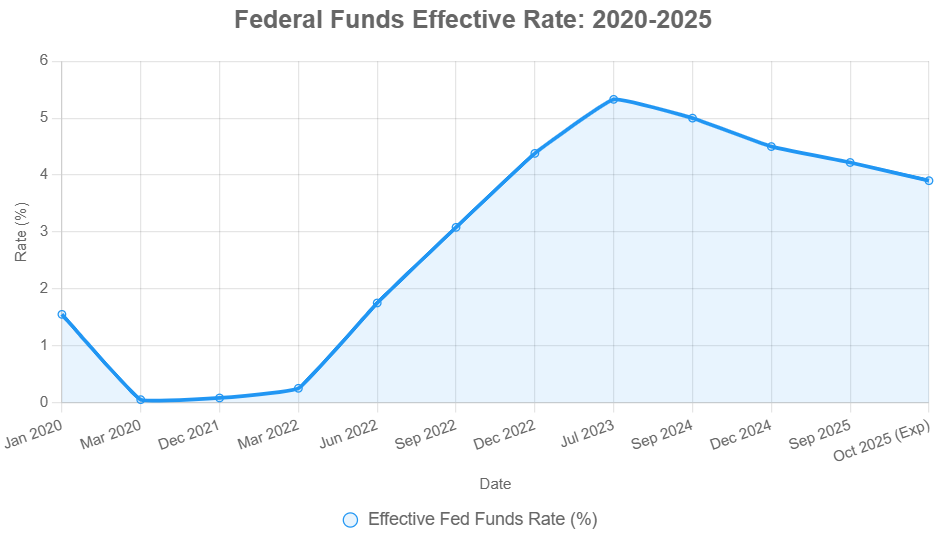
Let's set the scene for where we are. As of October 10, 2025, the federal funds rate is sitting in a target range of 4.00%-4.25%. This isn't where it was for long, though. Just recently, at their September 16-17 meeting, the Fed decided to lower rates by 25 basis points. This was a big deal because it was the first rate cut in nine months.

Why the sudden shift? Well, the job market has been showing signs of cooling down, which is something the Fed watches closely. At the same time, inflation – the general rise in prices we all feel – has been inching closer to their target of 2%. When you put those two things together, it makes sense for the Fed to take a step back and make borrowing a bit cheaper. Fed Chair Jerome Powell himself described this move as a “risk management cut,” meaning they're trying to be proactive and stop the economy from slowing down too much. It’s like putting on a slightly warmer coat before a cold snap, rather than waiting until you're already shivering.

Looking Ahead: The Key Meetings of Q4 2025

The Federal Reserve doesn't just meet whenever they feel like it. They have a set schedule, and the meetings that matter most for the next few months are:

  • October 28-29, 2025: This is the immediate target. Based on how the economy is performing, especially job numbers and price trends, this meeting is crucial.
  • December 9-10, 2025: This meeting wraps up the year. By then, they'll have a good look at the full year's economic data and can make a more informed decision about any further moves.

These are the final two chances for the Fed to adjust interest rates in 2025, and they're both circled in red on the calendar for anyone watching the economy.

The Fed's Own Crystal Ball: Projections and Hopes

The Fed doesn't just make decisions on the fly. They have a group of economists who put together forecasts called the Summary of Economic Projections (SEP). The latest one, from September 2025, gives us a pretty clear picture.

Their median forecast – that’s sort of the middle-of-the-road prediction among all their economists – suggests the federal funds rate will be around 3.6% by the end of 2025. To get to that number from where we are now, it implies they’ll make two more 25-basis-point cuts. Pretty neat, huh?

Think of it like this:

Year Median Fed Funds Rate Projection (%)
2025 3.6
2026 3.4
2027 3.1

What’s interesting is that even within the Fed, there isn’t a single viewpoint. Some economists are more optimistic about the economy and think rates could stay a bit higher. Others see things differently and believe more cuts might be needed. The “dot plot” in the SEP shows this spread – it's like a scatter of dots where each dot represents a Fed official's personal interest rate forecast. For 2025, most of these dots cluster around that 3.6% mark, but there are a few outliers, showing the range of opinions.

What the Markets Believe: The Street's Take

It’s not just the Fed calling the shots; the financial markets are constantly trying to guess what the Fed will do, and their bets often shape what actually happens. Tools like the CME FedWatch Tool are super helpful here. They look at how people are trading futures contracts related to the federal funds rate.

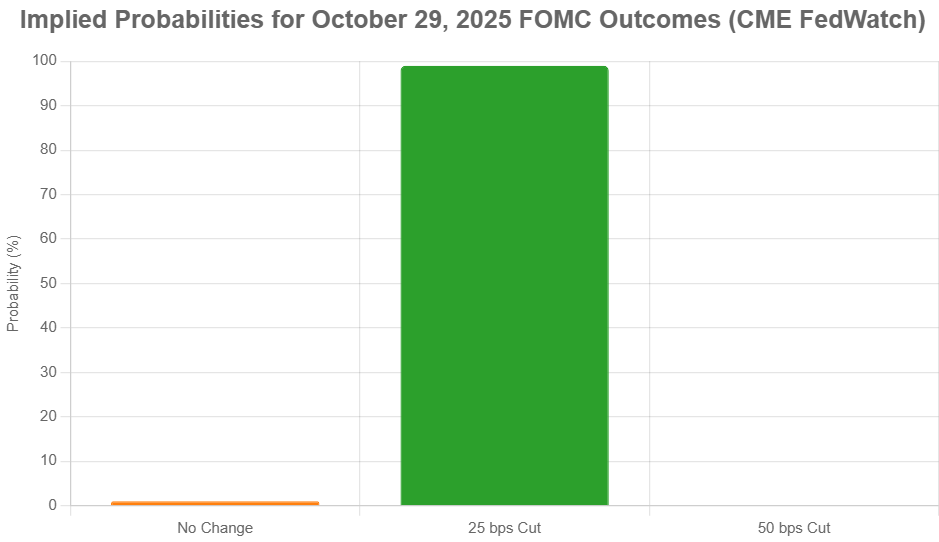
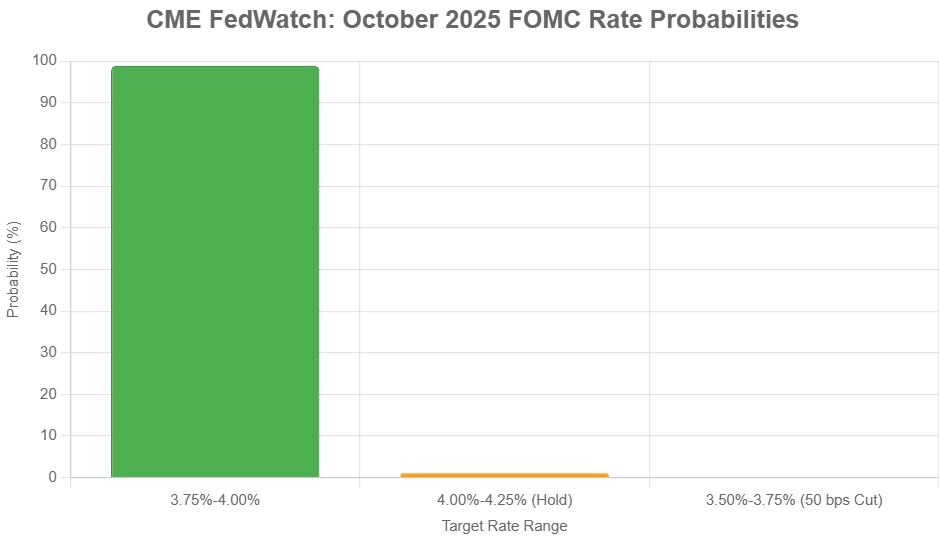
As I'm writing this, the market is almost certain (like, over 97% probability!) that the Fed will cut rates by 25 basis points at the October meeting. This would bring the target range down to 3.75%-4.00%. For the December meeting, the market is giving about a 71%-74.5% chance of another cut. If both these happen, we'd indeed land in that 3.50%-3.75% range by the end of the year.

So, you have the Fed’s official forecast and the market’s strong anticipation both pointing to similar outcomes. This means that while there's always a small chance of surprise, the path seems pretty well-trodden for these rate reductions.

What's Pushing the Fed's Decisions? The Economic Engine Room

Several things are influencing these decisions, and they're all interconnected:

  • Inflation: This has been the big monster the Fed has been trying to tame. Thankfully, it’s been coming down. The latest projections show inflation (measured by the Personal Consumption Expenditures, or PCE, price index) around 3.0% for 2025, with the “core” PCE (which strips out volatile food and energy prices) at 3.1%. This is much closer to the Fed's 2% goal than it has been for a while.
  • Jobs, Jobs, Jobs: The unemployment rate is currently hovering around 4.5%. This is still considered healthy, but if job growth continues to slow, it could give the Fed more reason to cut rates to keep people employed. That “cooling labor market” I mentioned earlier is a key driver.
  • Economic Growth (GDP): The economy is expected to grow at a modest pace, around 1.6% for 2025. This isn’t a booming economy, but it's also not shrinking, which is exactly the kind of steady, sustainable growth the Fed aims for.

Now, it's not all smooth sailing. Fed officials like Michael Barr have been quite vocal about being cautious. They’re worried about economic uncertainties, especially when it comes to the jobs market and inflation data. This means they'll be watching every little bit of data with a fine-tooth comb. Things like geopolitical events or unexpected shifts in government spending could also throw a wrench into the works.

How This Affects You and Me: The Real-World Impact

When the Fed adjusts interest rates, it’s not just an abstract financial concept. It trickles down to our wallets:

  • Mortgages and Loans: Lower interest rates generally mean cheaper borrowing. So, while mortgage rates might not plummet overnight, a 50-basis-point cut over these next few months could indeed make mortgages more affordable, potentially saving homeowners a bit of money or making it easier for new buyers to enter the market.
  • Stock Market: Generally, lower interest rates are good news for stocks. When borrowing is cheaper, companies can invest more, and investors might put their money into stocks instead of safer, lower-yield bonds. We’ve seen markets react positively to past rate cuts.
  • Savings: On the flip side, if you have money in savings accounts or certificates of deposit (CDs), lower interest rates mean you'll earn less on your savings.
  • Consumer Spending: As borrowing becomes cheaper and people feel more confident with a stable job market, they might be more inclined to spend on big-ticket items like cars or even just daily goods and services.

My Two Cents: Putting it All Together

From my perspective, looking at all the data and hearing what the Fed officials are saying, the most likely scenario is indeed a measured easing of monetary policy. The focus on a “risk management cut” in September and the strong market expectations for October and December cuts strongly suggest that the Fed sees more benefit in gently supporting the economy than in risking a slowdown by keeping rates too high.

The key word here is measured. They aren't looking to shock the system with big, rapid cuts. They want to guide the economy toward a soft landing – one where inflation is controlled, but growth doesn't stall out. The fact that inflation is moderating and unemployment is stable around that 4.5% mark gives them room to maneuver.

However, I also appreciate the caution. We've seen how quickly things can change. A sudden spike in oil prices, a fresh geopolitical crisis, or even unexpected strength in the jobs market could force the Fed to rethink its plans. That’s why they’re watching so closely.

Ultimately, the Fed is trying to strike a delicate balance. They need to bring inflation down to their 2% target without causing a recession. The actions they are expected to take in late 2025 appear to be a calculated step towards that goal, aiming to support continued growth while keeping price stability in sight. It’s a complex dance, and I’ll be watching every step.

“Build Wealth Through Turnkey Real Estate”

The Federal Reserve’s decisions on interest rates impact everything—from your mortgage payments to your savings yields. As of October 2025, the Fed’s target range stands at 4.00%–4.25% following a recent 25 basis point cut, with the effective rate hovering near 4.09%.

Market analysts now anticipate additional rate cuts over the coming months—potentially lowering the rate to around 3.50%–3.75% by the end of 2025. This shift could open new opportunities for homebuyers and real estate investors looking to secure better financing terms.

🔥 Lower Rates Mean Smarter Investment Opportunities! 🔥

Talk to a Norada investment counselor today (No Obligation):

(800) 611-3060

Get Started Now

Want to Know More?

Explore these related articles for even more insights:

  • Fed Interest Rate Forecast for the Next 12 Months
  • Federal Reserve Cuts Interest Rate by 0.25%: Two More Cuts Expected in 2025
  • Fed Projects Two Interest Rate Cuts Later in 2025
  • Interest Rate Predictions for the Next 3 Years: 2025, 2026, 2027
  • When is Fed's Next Meeting on Interest Rate Decision in 2025?
  • Interest Rate Predictions for the Next 10 Years: 2025-2035
  • Interest Rate Predictions for 2025 by JP Morgan Strategists
  • Interest Rate Predictions for Next 2 Years: Expert Forecast
  • Fed Funds Rate Forecast 2025-2026: What to Expect?
  • Interest Rate Predictions for 2025 and 2026 by NAR Chief
  • Market Reactions: How Investors Should Prepare for Interest Rate Cut
  • Impact of Interest Rate Cut on Mortgages, Car Loans, and Your Wallet

Filed Under: Economy, Financing Tagged With: Economy, Federal Reserve, interest rates

Jerome Powell Opens Door to More Interest Rate Cuts in His Speech Today

October 15, 2025 by Marco Santarelli

Jerome Powell Opens Door to More Interest Rate Cuts in His Speech Today

Federal Reserve Chair Jerome Powell's recent speech has sent a clear signal: the door is open for more interest rate cuts. This move on October 14, 2025, comes as the central bank sees growing risks to employment, even as inflation appears to be staying in check. For anyone with savings, a mortgage, or plans for big purchases, this news is significant and hints at a shift in the economy's direction.

Jerome Powell Opens Door to More Interest Rate Cuts in His Speech Today

As a seasoned observer of financial markets, I can tell you that when the Fed Chair speaks, people listen. Powell's words aren't just opinions; they are carefully chosen signals that guide the entire economy. In his latest address, he painted a picture of an economy that's holding its own on growth but showing cracks in its labor market. This shift in focus from inflation worries to job market concerns suggests the Fed is preparing to act to prevent a slowdown from becoming a serious problem.

A Closer Look at Powell's Remarks: Leaning Towards Easing

During his speech at the National Association for Business Economics (NABE) conference in Philadelphia, Powell acknowledged that economic activity has been surprisingly strong. He mentioned that consumer spending, particularly among those with higher incomes, has been robust, and that businesses might be seeing productivity boosts, perhaps from the growing use of AI. This all sounds pretty good, right? The Atlanta Fed's GDPNow tracker, for instance, was pointing to a strong 4% growth for the third quarter.

However, beneath this surface of solid growth, Powell highlighted a growing concern: the labor market. He pointed out that while the unemployment rate of 4.3% still looks good on paper, the pace of job creation has slowed down considerably. Private data, like reports from ADP, even suggested job losses in September. He also noted that fewer people are reporting they can find jobs easily, and hiring activity has tapered off. This is a crucial point because a strong job market is the backbone of a healthy economy. When hiring slows, people have less money to spend, and that can ripple through everything from retail sales to housing.

Powell explained that these “rising downside risks to employment” have changed the Fed's assessment. This means the potential problems for people's jobs are starting to look more serious than the potential for inflation to spike. While inflation hasn't been a runaway train—core PCE inflation was around 2.9% in August—the Fed's primary job is to keep both prices stable and employment high. Right now, the balance is tipping towards protecting jobs.

The Shifting Economic Backdrop: Growth Holds, Jobs Wobble

Let's break down the economic picture Powell presented:

  • Economic Growth: Still holding up, with strong consumer spending and signs of productivity gains. Think of it like a sturdy car that's cruising along.
  • Labor Market: Starting to show signs of slowing down. Job gains are shrinking, and surveys indicate people feel it's harder to find work. This is like that sturdy car hitting a patch of bumpy road.
  • Inflation: Not a major worry right now. While tariffs on imported goods have pushed up prices for some items, this isn't seen as a broad, economy-wide inflation problem. The Fed's long-term inflation target of 2% still seems achievable.

This situation is somewhat unusual. Typically, when the economy grows strongly, the labor market booms. But here, we're seeing resilience in growth alongside increasing caution about jobs. This is why the Fed is watching the labor market so closely.

Policy Implications: Rate Cuts on the Horizon and QT's End

So, what does all this mean for monetary policy? Powell's speech was a clear nod to the possibility of further interest rate cuts. Remember, the Fed cut rates by 25 basis points in September, bringing the federal funds rate (the target interest rate for banks) down to 4.00%-4.25%. His comments strongly suggest that another cut could be on the table at their next meetings in late October and December.

He emphasized that policy decisions are made “meeting-by-meeting” and are “data-dependent.” This is standard Fed language, but the emphasis on the risks to employment tells us which data points they are watching most closely. If job growth continues to weaken, expect the Fed to lower rates.

One of the other interesting points Powell made was about the Fed's balance sheet normalization, also known as quantitative tightening (QT). For a while now, the Fed has been letting its holdings of assets shrink, which is a way of tightening financial conditions. Powell indicated that this process could be ending “in coming months.” This is significant because it means the Fed will stop withdrawing liquidity from the financial system, and might even start adding it back over time. This could ease some of the strains in money markets and provide a bit of a boost to the economy, almost like a gentle nudge from the sidelines.

My take on this is that the Fed is trying to be proactive. They saw the labor market softening and the potential for it to worsen, and instead of waiting for a full-blown downturn, they are signaling a willingness to ease policy to keep things on track. This approach, if executed well, can lead to what economists call a “soft landing”—where inflation is controlled, and the economy avoids a recession.

Market Reaction: A Sigh of Relief and Renewed Optimism

The stock market certainly heard what Powell was saying. Following his remarks, U.S. stocks, which had been wavering, closed higher. This is a typical reaction when the Fed signals a more accommodative stance. Investors tend to bet that lower interest rates will boost corporate profits and make equities more attractive compared to safer investments like bonds.

Here's a quick look at how things moved:

  • Dow Jones Industrial Average: Closed higher, showing broad market confidence.
  • S&P 500: Also saw gains, indicating that larger companies were benefiting from this outlook.
  • Nasdaq Composite: Showed some caution, perhaps because tech stocks can sometimes be more sensitive to even minor signs of slowdowns.
  • Bond Yields: Generally fell. This is because as interest rate cut expectations rise, bond prices go up, and their yields (which move inversely) go down. Lower yields make borrowing cheaper.
  • Cryptocurrencies: Experienced a rally. Some see the end of QT as a positive for riskier assets like Bitcoin, as it could lead to more money flowing into the markets.

It's important to remember that market reactions can be a bit jumpy. Geopolitical tensions, like the ongoing U.S.-China trade disputes and tariffs, and even the temporary government shutdown that delayed some economic data, can create volatility. But Powell's speech provided a sense of direction that the market seemed to appreciate.

My Opinion: Balancing Risks is Key

From my perspective, the Fed is walking a very fine line. They've successfully brought inflation down from its highs, but the job isn't entirely done. Now, the focus is shifting to employment. It's a classic Fed balancing act: fight inflation without crushing the job market. Powell's speech suggests they believe the risk of letting employment slide is now greater than the risk of inflation re-accelerating.

I've seen this before. Sometimes, the Fed's biggest challenge isn't inflation itself, but the unintended consequences of their actions. If they keep rates too high for too long, they could trigger a recession. Conversely, cutting rates too aggressively when inflation isn't fully tamed could reignite price pressures. Powell's emphasis on being “meeting-by-meeting” and “data-dependent” is a smart way to navigate this uncertainty. It means they're not locked into a specific path and can adjust as new information comes in.

The end of QT is another piece of this puzzle. It's a subtle form of easing, and its timing is crucial. By signaling its imminent end, the Fed is providing some forward guidance that can help stabilize financial markets and ease liquidity concerns.

What This Means for You

  • Borrowing Costs: With potential rate cuts, we could see lower interest rates on things like car loans and credit cards relatively soon. Mortgages might also become more affordable, though their rates are also influenced by longer-term bond yields.
  • Savings: If rates fall, the interest you earn on savings accounts and certificates of deposit (CDs) will likely decrease. This is the flip side of lower borrowing costs.
  • Investments: Lower interest rates generally make stocks a more attractive investment compared to bonds. This can be good news for your 401(k) or other investment portfolios, but remember that markets can be unpredictable.
  • Job Security: The Fed's focus on employment suggests they are committed to preventing a significant rise in unemployment. This offers some reassurance to individuals and families worried about their jobs.

Looking Ahead: Data Will Tell the Tale

Powell's speech was a significant indicator, but the real story will unfold as new economic data emerges. The delayed September jobs report and other key figures will be crucial in determining the Fed's next move. Will job growth continue to slow? Will inflation remain contained? These are the questions the Fed will be asking, and the answers will shape the economic path forward.

My personal view is that the Fed is on the right track by prioritizing employment risks. The recent history of the U.S. economy shows its resilience, and by being proactive with modest rate cuts and signaling the end of QT, Powell and the FOMC are aiming for a controlled economic trajectory. It's a delicate dance, but one where the steps taken today could shape the economic well-being of millions tomorrow.

“Build Wealth Through Turnkey Real Estate”

The Federal Reserve’s decisions on interest rates impact everything—from your mortgage payments to your savings yields. As of October 2025, the Fed’s target range stands at 4.00%–4.25% following a recent 25 basis point cut, with the effective rate hovering near 4.09%.

Market analysts now anticipate additional rate cuts over the coming months. This shift could open new opportunities for homebuyers and real estate investors looking to secure better financing terms.

🔥 Lower Rates Mean Smarter Investment Opportunities! 🔥

Talk to a Norada investment counselor today (No Obligation):

(800) 611-3060

Get Started Now

Want to Know More About Interest Rates?

Explore these related articles for even more insights:

  • Fed Interest Rate Predictions: October to December 2025
  • Fed Interest Rate Forecast for the Next 12 Months
  • Federal Reserve Cuts Interest Rate by 0.25%: Two More Cuts Expected in 2025
  • Fed Projects Two Interest Rate Cuts Later in 2025
  • Interest Rate Predictions for the Next 3 Years: 2025, 2026, 2027
  • When is Fed's Next Meeting on Interest Rate Decision in 2025?
  • Interest Rate Predictions for the Next 10 Years: 2025-2035
  • Interest Rate Predictions for 2025 by JP Morgan Strategists
  • Interest Rate Predictions for Next 2 Years: Expert Forecast
  • Fed Funds Rate Forecast 2025-2026: What to Expect?
  • Interest Rate Predictions for 2025 and 2026 by NAR Chief
  • Market Reactions: How Investors Should Prepare for Interest Rate Cut
  • Impact of Interest Rate Cut on Mortgages, Car Loans, and Your Wallet
Filed Under: Economy, Financing Tagged With: Economy, Federal Reserve, interest rates

Fed Interest Rate Predictions from JP Morgan for 2025 and 2026

October 13, 2025 by Marco Santarelli

Interest Rate Predictions for 2025 and 2026 by J.P. Morgan Global Research

Well, the big question on everyone's mind lately has been about interest rates. Will they keep going up, down, or just hang out where they are? J.P. Morgan Global Research is weighing in, and their take is pretty significant for anyone trying to make sense of their finances. The big news is that the Federal Reserve just made a move – a 25 basis point cut in interest rates, which is what most folks expected. But what does this mean for the future? According to J.P. Morgan, we're likely to see two more cuts in 2025 and then one more in 2026. This is a big deal because how these cuts unfold could really change how well different investments perform.

It’s easy to get lost in all the economic jargon, but understanding what J.P. Morgan predicts about interest rates is like having a map for your financial journey. As someone who's followed financial markets for a while, I see a lot of commentary, but the analysis from a firm like J.P. Morgan carries a lot of weight. They have the resources and the smart people to really dig deep. So, what exactly are they telling us, and more importantly, what could it mean for you and me?

Fed Interest Rate Predictions from JP Morgan for 2025 and 2026

The Fed's Recent Move and What It Signals

You might remember that the Federal Reserve, often called the Fed, decided to lower its key interest rate by a quarter of a percent in September. This put the target range for the federal funds rate at 4.0% to 4.25%. This was the first time they’d cut rates in about nine months, and it happened after some job reports came in softer than people were expecting.

Now, was this the start of a big trend, or just a little pause? Fed Chair Jerome Powell described this cut as a way to “manage risk” – basically, to stop things from slowing down too much in the job market. He didn't explicitly say it was the beginning of a long string of cuts.

J.P. Morgan's Outlook for 2025 and 2026

This is where J.P. Morgan's prediction gets interesting. They're looking ahead and saying that two more interest rate cuts are likely in 2025, and then one more in 2026. This is a different picture than just a one-off cut.

Michael Feroli, the chief U.S. economist at J.P. Morgan, shed some light on this. He pointed out that the Fed's economists have different ideas about where rates should go. Some think rates should be lower than others. He believes this recent cut was more like an “insurance cut” – a way to play it safe – rather than a fundamental change in how the Fed will react to the economy.

Feroli also said that it would take a pretty big change in the job market for the Fed not to cut rates again in October. They only have one more jobs report to look at before that meeting. However, he also mentioned that if things stay stable in the fourth quarter, especially if the unemployment rate doesn't climb, the Fed might decide to pause after their October or December meetings.

Powell himself mentioned that the economy is in a “curious kind of balance.” He noted that both people looking for jobs (labor supply) and companies looking to hire (labor demand) have seen big, unexpected drops. Yet, he also said the economy is doing pretty well overall. Feroli added that the fact that the Fed's forecast for unemployment in 2025 didn't change much might mean they're not reading too much into the recent job slowdown. Still, everyone agreed to cut rates, showing they are worried about unemployment risks becoming real.

What Could These Fed Rate Cuts Mean for Your Investments?

This is the million-dollar question for many of us! According to J.P. Morgan's research, how your investments perform will really depend on two things: whether there’s a recession, and how much the Fed actually cuts rates overall. They’ve looked at what has happened in the past in similar situations.

Here’s a breakdown of two main scenarios they see:

Scenario 1: Recessionary Easing

If the economy heads into a recession, J.P. Morgan thinks that US Treasuries (government bonds) and gold could do better than riskier investments.

  • Why Treasuries and Gold might shine: Fabio Bassi, who leads Cross-Asset Strategy at J.P. Morgan, explained that gold is a good safe haven when people are worried about the economy. Plus, when interest rates are lower, the “opportunity cost” of holding gold (which doesn't pay interest) goes down. For U.S. Treasuries, they are seen as safe bets in uncertain times.
  • What about riskier assets? In contrast, investments like U.S. high-yield corporate bonds (which are basically loans to companies with lower credit ratings) and the S&P 500 (a blend of the biggest U.S. companies) usually don't do well during recessions. Their returns tend to be negative.

Scenario 2: Non-Recessionary Easing

If the economy doesn't go into a recession while the Fed is cutting rates, the picture looks much brighter for “risk-on” investments – meaning investments that tend to do better when the economy is healthy.

  • Riskier assets could lead the pack: In this scenario, the S&P 500 and U.S. high-yield corporate bonds are expected to lead the returns, meaning they could perform the best.
  • Gold's role: Gold could still offer some diversification and see positive returns, but probably not as much as it would during a recession.

J.P. Morgan also looked at specific timing within non-recessionary easing:

  • Mid-Cycle Easing: This happens when rates are moving from high to lower, but the economy is still in a good phase. Historically, gold and the S&P 500 have seen the biggest average returns here, followed by Treasuries and U.S. high-yield.
  • Late-Cycle Easing: This occurs after a long pause, when the Fed cuts rates to try and boost the economy because it's been growing for a while. In these situations, most investments tend to do well. Gold and U.S. high-yield often lead, but the U.S. Dollar Index can actually see negative returns because lower interest rates make holding dollars less attractive.

Bassi concluded that based on the Fed's “insurance cut” and their main prediction that a recession is not likely, they're anticipating what looks like a typical mid-cycle, non-recessionary easing scenario. This is important because it suggests a more positive outlook for many investments, especially stocks.

From my perspective, this distinction between recessionary and non-recessionary easing is crucial. It highlights that how the economy is doing while rates are falling matters a great deal for where your money might grow best. It's not just about the direction of rates, but the economic story that's playing out alongside it. J.P. Morgan's analysis provides a valuable framework for understanding these complex dynamics.

“Generate Cash Flow Through Turnkey Real Estate”

The Federal Reserve’s decisions on interest rates impact everything—from your mortgage payments to your savings yields. Market analysts now anticipate additional rate cuts over the coming months—potentially lowering the rate to around 3.50%–3.75% by the end of 2025.

This shift could open new opportunities for homebuyers and real estate investors looking to secure better financing terms.

🔥 Lower Rates Mean Smarter Investment Opportunities! 🔥

Talk to a Norada investment counselor today (No Obligation):

(800) 611-3060

Get Started Now

Want to Know More?

Explore these related articles for even more insights:

  • Fed Interest Rate Predictions: October to December 2025
  • Fed Interest Rate Forecast for the Next 12 Months
  • Federal Reserve Cuts Interest Rate by 0.25%: Two More Cuts Expected in 2025
  • Fed Projects Two Interest Rate Cuts Later in 2025
  • Interest Rate Predictions for the Next 3 Years: 2025, 2026, 2027
  • When is Fed's Next Meeting on Interest Rate Decision in 2025?
  • Interest Rate Predictions for the Next 10 Years: 2025-2035
  • Interest Rate Predictions for 2025 by JP Morgan Strategists
  • Interest Rate Predictions for Next 2 Years: Expert Forecast
  • Fed Funds Rate Forecast 2025-2026: What to Expect?
  • Interest Rate Predictions for 2025 and 2026 by NAR Chief
  • Market Reactions: How Investors Should Prepare for Interest Rate Cut
  • Impact of Interest Rate Cut on Mortgages, Car Loans, and Your Wallet
Filed Under: Economy, Financing Tagged With: Economy, Federal Reserve, interest rates

15-Year Mortgage Rate Forecast for the Next 5 Years: 2025-2029

July 25, 2025 by Marco Santarelli

15-Year Fixed Mortgage Rate Predictions for Next 5 Years: 2025-2029

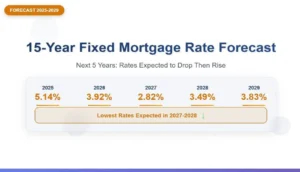
Are you thinking about buying a home or refinancing your mortgage? If so, understanding where interest rates might be headed is crucial. So what's the definitive answer/statement on the 15-Year Mortgage Rate Forecast for the Next 5 Years? According to projections, we can expect a general downward trend in rates through 2028, followed by a gradual increase towards the end of the decade. While no one has a crystal ball, let's dive deep into a year-by-year breakdown based on current forecasts and the economic factors that could influence these rates, while trying to discuss all aspects that might interest you.

15-Year Fixed Mortgage Rate Forecast for the Next 5 Years: 2025-2029

Why the 15-Year Mortgage Matters

Before we jump into the numbers, let's quickly discuss why the 15-year mortgage is such a popular choice. It offers a sweet spot between the shorter 10-year term and the more common 30-year option. Here's a quick rundown:

  • Faster Equity Building: You pay off your home in half the time compared to a 30-year mortgage. Imagine owning your home outright in just 15 years!
  • Lower Interest Paid Over the Life of the Loan: Because you're paying it off faster, you save a significant amount on interest. This can translate to tens of thousands of dollars over the life of the loan.
  • Higher Monthly Payments: The tradeoff? Higher monthly payments. But if you can comfortably afford it, the long-term savings are well worth it.

Now, let's get to the main point of why you are here – Let's analyze the projected 15-year mortgage rates from 2025 to 2029 based on forecasts.

Year-by-Year 15-Year Mortgage Rate Forecast (2025-2029)

Alright, let's get down to the nitty-gritty. I've compiled a breakdown of the projected 15-year mortgage rates for the next five years based on projections from the Economy Forecast Agency (EFA) (Updated on 2025/07/03). Remember, these are forecasts, not guarantees, and unforeseen economic events can definitely throw things off course. Always consult with a financial advisor for personalized advice.

2025 Predictions: A Year of Initial Declines

  • Current (July 2025): 5.8%
  • July: 5.44-5.96% (Close: 5.61%) – A promising start with a drop.
  • August: 5.53-5.87% (Close: 5.70%) – A slight uptick.
  • September: 5.37-5.71% (Close: 5.54%) – Further decline.
  • October: 5.40-5.74% (Close: 5.57%) – Stability around the mid-5% range.
  • November: 5.18-5.57% (Close: 5.34%) – A more significant drop.
  • December: 4.99-5.34% (Close: 5.14%) – Finishing the year on a lower note.

Key Takeaway for 2025: The forecast suggests a consistent downward trend throughout the year, potentially driven by anticipated Federal Reserve actions to combat inflation. If you're looking to buy or refinance, the latter half of 2025 might present some favorable opportunities.

2026 Predictions: Continued Descent

  • January: 5.01-5.31% (Close: 5.16%) – Holding steady.
  • February: 4.98-5.28% (Close: 5.13%) – Minimal change.
  • March: 4.99-5.29% (Close: 5.14%) – Still hovering around 5%.
  • April: 4.76-5.14% (Close: 4.91%) – Breaking below 5%.
  • May: 4.63-4.91% (Close: 4.77%) – Continued decline.
  • June: 4.26-4.77% (Close: 4.39%) – A larger drop, signaling potentially bigger savings.
  • July: 4.17-4.43% (Close: 4.30%)
  • August: 4.10-4.36% (Close: 4.23%)
  • September: 4.07-4.33% (Close: 4.20%)
  • October: 4.04-4.28% (Close: 4.16%)
  • November: 3.95-4.19% (Close: 4.07%)
  • December: 3.80-4.07% (Close: 3.92%) – End year below 4%.

Key Takeaway for 2026: The trend continues downward, with rates potentially dipping below 4% by the end of the year. This could be a prime window for those looking to lock in a low rate.

2027 Predictions: Bottoming Out

  • January: 3.63-3.92% (Close: 3.74%) – Start year just below 4%.
  • February: 3.35-3.74% (Close: 3.45%) – Significant dip.
  • March: 3.30-3.50% (Close: 3.40%)
  • April: 3.39-3.59% (Close: 3.49%)
  • May: 3.48-3.70% (Close: 3.59%)
  • June: 3.41-3.63% (Close: 3.52%)
  • July: 3.42-3.64% (Close: 3.53%)
  • August: 3.33-3.53% (Close: 3.43%)
  • September: 3.24-3.44% (Close: 3.34%)
  • October: 3.07-3.34% (Close: 3.17%) – Lowest rates being seen by now.
  • November: 3.06-3.24% (Close: 3.15%)
  • December: 2.74-3.15% (Close: 2.82%) – Rates below 3%.

Key Takeaway for 2027: Rates continue to decline further to unbelievable lows. These lower rates reflect a potentially slow global economy and the lasting impacts of earlier monetary policies.

2028 Predictions: A Potential Turning Point

  • January: 2.69-2.85% (Close: 2.77%) – Continued lows.
  • February: 2.50-2.77% (Close: 2.58%)
  • March: 2.48-2.64% (Close: 2.56%)
  • April: 2.43-2.59% (Close: 2.51%)
  • May: 2.38-2.52% (Close: 2.45%) – Lowest rates.
  • June: 2.18-2.45% (Close: 2.25%) – Rates at rock bottom now.
  • July: 2.19-2.33% (Close: 2.26%)
  • August: 2.13-2.27% (Close: 2.20%)
  • September: 2.20-2.58% (Close: 2.50%) – Increase in rates.
  • October: 2.50-3.04% (Close: 2.95%) – Sharp rise.
  • November: 2.95-3.28% (Close: 3.18%)
  • December: 3.18-3.59% (Close: 3.49%) – Rates start to increase.

Key Takeaway for 2028: Significant volatility. Watch out for this year, as rates could start rising again as the economy picks up.

2029 Predictions: Gradual Increase

  • January: 3.46-3.68% (Close: 3.57%) – Increasing rates.
  • February: 3.57-3.85% (Close: 3.74%)
  • March: 3.70-3.92% (Close: 3.81%)
  • April: 3.73-3.97% (Close: 3.85%)
  • May: 3.85-4.14% (Close: 4.02%) – Rates at about 4%
  • June: 3.72-4.02% (Close: 3.83%) – Slight dip but still increasing.

Key Takeaway for 2029: Rates gradually increase. This could signify a strengthening economy.

Here's a quick table summarizing the year-end 15-Year Fixed Rate Mortgage forecasts:

Year Forecasted 15-Year Mortgage Rate (Year-End)
2025 5.14%
2026 3.92%
2027 2.82%
2028 3.49%
2029 3.83%

Factors Influencing Mortgage Rates: The Big Picture

It's not enough to just look at the numbers. You need to understand what influences them. Mortgage rates are complex and depend on a variety of factors, I would discuss the main ones here:

  • The U.S. Economy: A strong economy generally leads to higher interest rates because the demand for borrowing increases. Conversely, a weaker economy can lead to lower rates to stimulate borrowing and investment.As per the data available for the economy in July 2025, the US economic growth is expected to slow down in 2025, forecasts from organizations like Morgan Stanley and the IMF point to growth around 1.5% to 1.8%
  • Inflation: Inflation is a major player. When inflation is high, lenders demand higher interest rates to protect their returns.The annual inflation rate in the US stood at 2.4% in May 2025. The inflation is expected to have a downward trend partly due to the new tariffs.
  • Federal Reserve (The Fed): The Fed's monetary policy has a huge impact on interest rates. The Fed influences rates by setting the federal funds rate (the rate at which banks lend to each other overnight). Changes in this rate ripple through the economy, affecting mortgage rates.The Fed has been holding interest rates steady at a target range of 4.25% to 4.50% and is expected to shift in second half of 2025.
  • The Bond Market: Mortgage rates are often tied to the yield on the 10-year Treasury bond. When bond yields rise, mortgage rates tend to follow suit.The 10-year US Treasury yield reached 4.76% in February 2025, its highest level since November 2023.

My Personal Thoughts

Having watched the mortgage market for years, I've learned that predicting the future is tough! Economic cycles are unpredictable, and unexpected events (like global pandemics or geopolitical tensions) can throw even the most sophisticated models off track.

That said, I believe understanding the underlying factors is crucial. If inflation remains in check, and the Fed adopts a more dovish stance (meaning they're more inclined to lower rates to stimulate the economy), we could indeed see the lower rates that are being forecasted.

However, keep a close eye on the bond market. Any signs of rising bond yields could signal an increase in mortgage rates. And remember, the housing market itself plays a role. Strong housing demand can put upward pressure on rates.

Strategies for Homebuyers and Refinancers

So, what should you do with this information? Here are a few strategies:

  • If you're considering buying, don't try to time the market perfectly. Focus on finding a home you love and can afford. If rates do drop, you can always refinance later.
  • If you want to refinance, keep a close watch on the forecasts. If rates are projected to fall, you might want to wait. But don't wait too long, as markets can change quickly.
  • Consider locking in a rate. If you find a rate you're comfortable with, talk to your lender about locking it in. This protects you from potential rate increases.
  • Shop around for the best rates. Don't just settle for the first offer you receive. Get quotes from multiple lenders to ensure you're getting the best deal.
  • Work with a qualified mortgage professional. A good mortgage broker or lender can help you navigate the complexities of the market and find the right loan for your needs.

The Bottom Line

The 15-Year Mortgage Rate Forecast for the Next 5 Years suggests a period of declining rates, followed by a potential gradual increase. While these forecasts are valuable, it is important to remember not to hold any forecast as the ultimate truth and that the economy remains very uncertain and ever-changing. Understanding the factors that influence these rates and developing a sound financial strategy helps you make informed decisions about buying or refinancing your home and setting yourself up for financial success.

“Invest in Rental Income Properties”

With today's mortgage rates on the rise, investing in turnkey real estate can help you secure consistent returns.

Expand your portfolio confidently, even in a shifting interest rate environment.

Speak with our expert investment counselors (No Obligation):

(800) 611-3060

Get Started Now 

Related Articles:

  • 30-Year Fixed Mortgage Rate Forecast for the Next 5 Years
  • Fed Funds Rate Forecast 2025-2026: What to Expect?
  • Will Mortgage Rates Go Down in 2025: Morgan Stanley's Forecast
  • Mortgage Rate Predictions 2025 from 4 Leading Housing Experts
  • Mortgage Rates Forecast for the Next 3 Years: 2025 to 2027
  • Will Mortgage Rates Ever Be 3% Again in the Future?
  • Mortgage Rate Predictions for Next 5 Years
  • Mortgage Rate Predictions: Why 2% and 3% Rates are Out of Reach
  • How Lower Mortgage Rates Can Save You Thousands?
  • How to Get a Low Mortgage Interest Rate?
  • Will Mortgage Rates Ever Be 4% Again?

Filed Under: Economy, Financing, Mortgage Tagged With: 30-Year Mortgage Rates, Economy, Federal Reserve, interest rates, Monetary Policy, mortgage rates

30-Year Fixed Mortgage Rate Forecast for the Next 5 Years

July 25, 2025 by Marco Santarelli

30-Year Fixed Mortgage Rate Forecast for the Next 5 Years

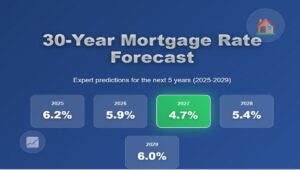
Buying a home already feels overwhelming without mortgage rates throwing curveballs. If you’re eyeing a new place or thinking about refinancing, you’re probably asking, “What’s next?” The 30-year rate forecast for the next 5 years? Think of it as a bit of a rollercoaster: experts guess we might hover around 6.2% next year, dip to ~4.7% by late 2027, then climb back toward 6% by 2029.

These numbers aren’t just abstract figures—they’re about whether that starter home feels doable, or if upgrading makes sense. Let’s unpack what this means for your wallet and how to plan.

30-Year Fixed Mortgage Rate Forecast for the Next 5 Years

To get a clearer picture, let's look at the specific projections from sources like longforecast.com. These numbers give us a roadmap, though remember, they are forecasts, not guarantees. The economy is a complex beast, and many things can influence these predictions.

Key Takeaways:

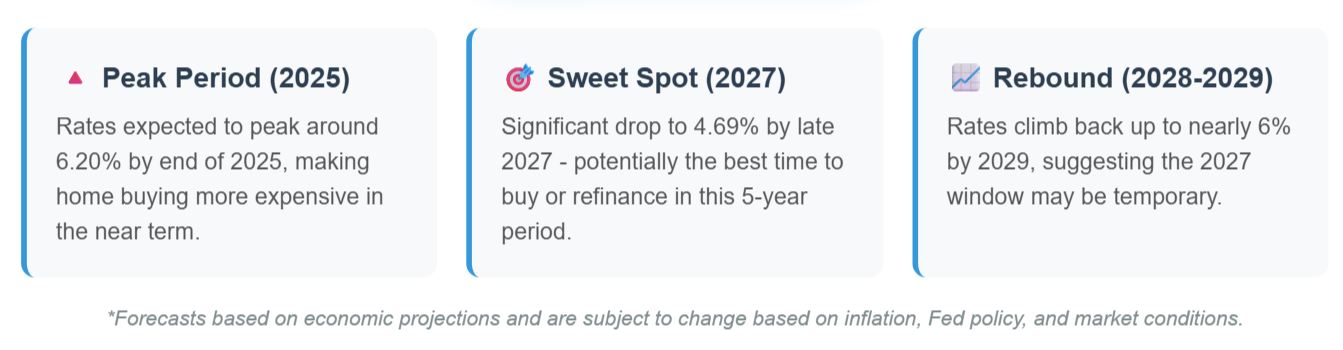
  • Peak Soon? Rates seem to be highest at the start of this forecast period, possibly peaking around the 6.20% mark by the end of 2025.
  • The Dip: The most significant drop appears to happen between the end of 2026 and the end of 2027, potentially reaching lows near 4.7%. This is the “sweet spot” I mentioned. For anyone actively house hunting or planning to buy, keeping an eye on this window is critical.
  • The Rebound: After hitting that low point in 2027, the forecast suggests rates will start climbing again, reaching almost 6% by mid-2029. This indicates that while there might be a buying opportunity, waiting too long could mean facing higher costs again.

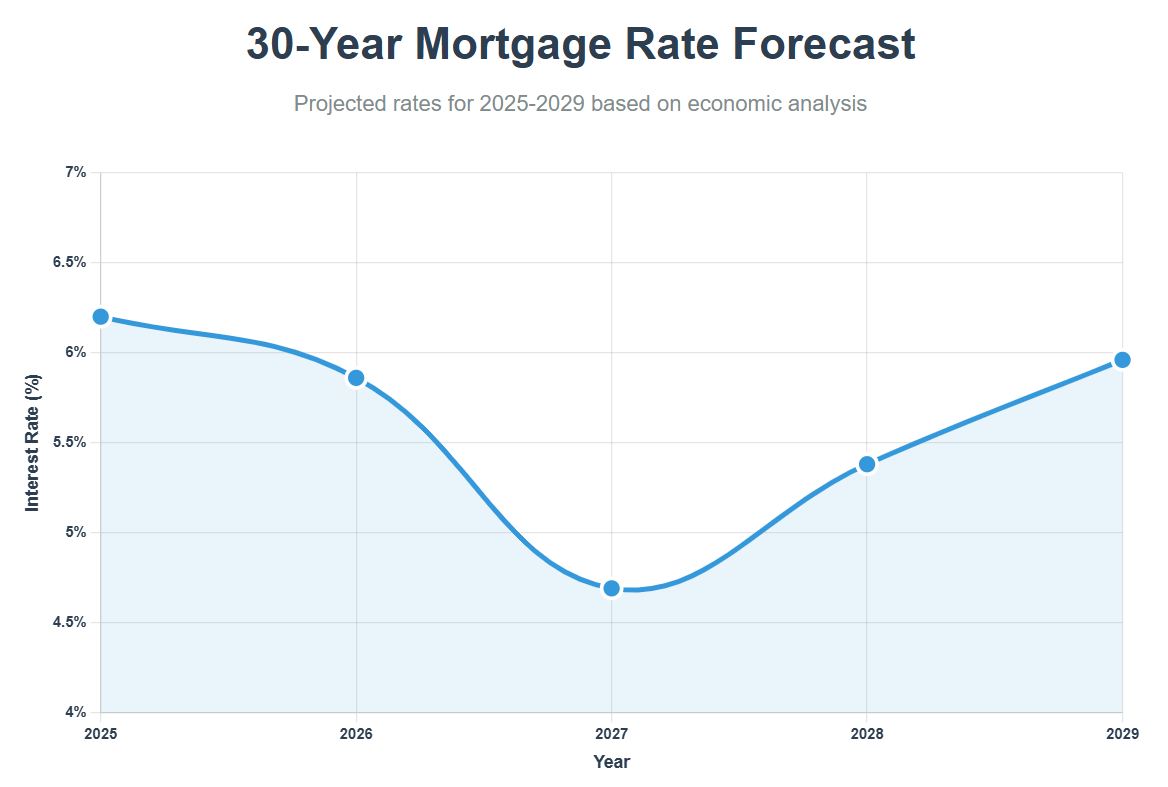
30-Year Mortgage Rate Forecast: Projected rates for 2025-2029

Projected 30-Year Mortgage Rate for 2025-2029 based on economic analysis

Breaking Down the 30-Year Mortgage Rate Forecast from 2025 to 2029

Here's a breakdown of the projected 30-year mortgage rates over the next five years, based on projections from the Economy Forecast Agency (EFA). Keep in mind that these are just forecasts, and actual rates may vary.

2025:

  • The remainder of 2025 is expected to see a gradual decline in mortgage rates.
  • July 2025: Forecasted close at 6.49%
  • December 2025: Forecasted close at 6.20%

2026:

  • The first half of 2026 sees a continuation of the downward trend.
  • June 2026: Rates are expected to dip below 6%, closing at 5.83%.
  • The latter half of 2026 shows a slight uptick.
  • December 2026: Rates are forecasted to close at 5.86%.

2027:

  • 2027 is projected to be a year of significant rate drops.
  • Rates are forecasted to fall below 5% by October.
  • December 2027: Rates are expected to close at 4.69%.

2028:

  • The first half of 2028 continues the downward momentum, with rates bottoming out mid-year.
  • June 2028: Rates are forecasted to reach a low of 3.68%.
  • The second half of 2028 shows a notable rebound.
  • December 2028: Rates are expected to close at 5.38%.

2029:

  • 2029 sees a continuation of the upward trend that started in late 2028.
  • Rates are forecasted to climb back up.
  • June 2029: Rates are expected to close at 5.96%.

To summarize, here's a table that presents the year-end forecasts:

Year Projected 30-Year Mortgage Rate (Year-End)
2025 6.20%
2026 5.86%
2027 4.69%
2028 5.38%
2029 5.96%

Factors That Could Change the Forecast

As I mentioned before, these are just predictions! Plenty of things can throw a wrench in the works. Here are some key factors to keep an eye on:

Unexpected Inflation Spikes: If inflation suddenly surges again, the Fed might have to raise rates more aggressively, sending mortgage rates higher. The current inflation rate is 2.4% for the 12 months ending in May 2025. This rate, based on the Consumer Price Index (CPI), represents a slight increase from the 2.3% rate reported in April 2025.

Geopolitical Instability: Don't forget that what happens globally can ripple back home. Trade tensions, wars, or major economic shifts in other large economies can affect investor confidence, currency values, and ultimately, U.S. interest rates. For instance, global instability might make investors seek the perceived safety of U.S. Treasury bonds, pushing yields down and potentially lowering mortgage rates. Conversely, global supply chain disruptions could worsen inflation here, pushing rates up. These international events add another layer of unpredictability, something Business Insider often covers in its economic analysis.

Changes in Fed Policy: The Fed's decisions about interest rates are crucial. Any unexpected shifts in their policy could significantly alter the forecast. The forecast suggests the Fed might be cautious initially, holding off on rate cuts due to lingering inflation worries. This cautious stance is a big reason why rates are projected to stay relatively high in 2025 and 2026. However, as inflation potentially cools (more on that below), the Fed might start cutting rates. I always watch the Fed’s statements and meeting minutes very closely; they often give clues about their next moves.

Economic Slowdown: If the economy slows down more than expected, the Fed might cut rates to stimulate growth, potentially lowering mortgage rates. The US economy, as measured by Gross Domestic Product (GDP), experienced a contraction of 0.5% in the first quarter of 2025 (January, February, and March) compared to the previous quarter. This marks the first quarterly contraction in three years. Nonfarm payroll employment increased by 147,000 in June, surpassing economists' expectations and remaining in line with the 12-month average. The unemployment rate fell to 4.1%, down from 4.2% in May and reaching its lowest point since February.

Housing Market Dynamics: Changes in housing supply and demand can also influence mortgage rates. For example, a surge in housing construction could put downward pressure on rates.

Bond Yields: The Market's Whisper: This is a technical point, but super important. Mortgage rates, particularly the 30-year fixed, are heavily influenced by the yields on long-term bonds, especially the 10-year Treasury note. Mortgage lenders often bundle mortgages into securities and sell them to investors. These investors want a certain return, and that return is linked to what they can get from safer investments like Treasury bonds.

When demand for Treasury bonds goes up, their prices rise, and their yields (the interest rate they pay) tend to fall. When yields fall, mortgage lenders can offer lower rates. Conversely, if investors get nervous about the economy or inflation, they might sell bonds, pushing yields up, forcing mortgage rates higher. Keep an eye on the 10-year yield; it’s often a leading indicator for mortgage rates. Freddie Mac and other financial institutions frequently highlight this connection.

Implications for You, the Homebuyer

Okay, we have the numbers and the reasons behind them. Now, what does this 30-Year Mortgage Rate Forecast for the Next 5 Years mean for your home-buying plans?

The Opportunities: Timing Your Purchase

  • The 2027 Window: As highlighted, the forecast suggests a potential dip in rates around 2027, possibly falling below 5%. This could be a fantastic time to buy. Lower rates mean lower monthly payments. Let's do a quick example:
    • On a $400,000 loan:
      • At 7% interest, your principal and interest payment is ~$2,661/month.
      • At 5% interest, that payment drops to ~$2,147/month.
    • That’s a difference of over $500 per month! Over 30 years, that’s significant savings ($180,000+). Waiting until 2027 might make a huge difference in what you can afford or simply save you a fortune.
  • Refinancing Power: If you bought a home in the last couple of years when rates were higher (say, 7% or 8%), and you can refinance when rates hit that projected 2027 low, you could potentially lower your monthly payment or switch from an adjustable-rate mortgage (ARM) to a fixed-rate loan, giving you long-term payment stability.

The Challenges: The Near-Term Hurdles

  • 2025-2026 Affordability: With rates predicted to be in the 5.8% to 6.2% range, buying might still feel expensive, especially if home prices don't cool down significantly. High prices combined with these rates can make affordability a real struggle. Many buyers might feel priced out or forced to make compromises on location or home size.
  • The Waiting Game Risk: While waiting for that 2027 low seems appealing, it’s not without risk.
    • Home Prices: What if home prices continue to rise faster than rates fall? You might save on the mortgage rate but pay significantly more for the house itself, potentially canceling out the savings.
    • Economic Shocks: Unexpected economic events could change the forecast entirely. A sudden recession might push rates down faster but could also lead to job instability for buyers. Conversely, a stronger-than-expected economy could keep rates higher for longer.
    • Personal Circumstances: Life happens! Your personal situation (job change, family growth) might necessitate buying sooner rather than later, regardless of the rate forecast.

Final Thoughts: 

Let’s cut to the chase—these next five years? It’s a bit of a rollercoaster ride. Rates might hit their peak soon, then dip enough by 2027 to make house hunting feel less stressful… before edging up again. Why? Blame (or thank) the usual suspects: inflation throwing tantrums, job growth doing its thing, and the Fed playing musical chairs with interest rates.

What does this mean for you? If you’re dreaming of buying a home, think of it like catching waves. Lower rates later sound great for your wallet, but don’t get stuck waiting for “perfect” conditions. Pulling the trigger when you find the right home and rate combo usually beats playing the guessing game. Stay sharp, lean on folks you trust (like your mortgage pro), and remember: homeownership’s not a race against the market—it’s about making moves that work for your life.

“Invest in Rental Income Properties”

With today's mortgage rates on the rise, investing in turnkey real estate can help you secure consistent returns.

Expand your portfolio confidently, even in a shifting interest rate environment.

Speak with our expert investment counselors (No Obligation):

(800) 611-3060

Get Started Now 

Recommended Read:

  • 15-Year Mortgage Rate Forecast for the Next 5 Years
  • Fed Funds Rate Forecast 2025-2026: What to Expect?
  • Will Mortgage Rates Go Down in 2025: Morgan Stanley's Forecast
  • Mortgage Rate Predictions 2025 from 4 Leading Housing Experts
  • Mortgage Rates Forecast for the Next 3 Years: 2025 to 2027
  • Will Mortgage Rates Ever Be 3% Again in the Future?
  • Mortgage Rate Predictions for Next 5 Years
  • Mortgage Rate Predictions: Why 2% and 3% Rates are Out of Reach
  • How Lower Mortgage Rates Can Save You Thousands?
  • How to Get a Low Mortgage Interest Rate?
  • Will Mortgage Rates Ever Be 4% Again?

Filed Under: Financing, Mortgage Tagged With: 30-Year Fixed Mortgage Rate, interest rates, Mortgage Rate Forecast, Mortgage Rate Predictions

Interest Rate Predictions for 2025 and 2026 by Morgan Stanley

July 8, 2025 by Marco Santarelli

Interest Rate Predictions for 2025 and 2026 by Morgan Stanley

If you're wondering what the future holds for interest rates, especially in the next couple of years, you're not alone. According to insights from Morgan Stanley, as discussed in a recent “Thoughts on the Market” podcast, interest rate predictions point towards the Federal Reserve cutting rates, but potentially later and more aggressively than the market currently anticipates.

While the market prices in roughly 100 basis points of cuts by the end of 2026, Morgan Stanley's economists foresee up to 175 basis points, beginning in early 2026. This article will break down their reasoning, explore the key economic factors at play, and discuss the potential implications for investors.

Interest Rate Predictions 2025-2026 by Morgan Stanley: A Deep Dive

The Fed's Tightrope Walk: Inflation vs. Economic Growth

The Federal Reserve's primary job is to manage inflation and promote maximum employment. These two goals often pull in opposite directions. Right now, they're trying to figure out where to strike that balance.

The recent Federal Open Market Committee (FOMC) meeting highlighted this balancing act. While the Fed decided to hold the federal funds rate steady (remaining within its target range of 4.25 to 4.5 percent), their projections suggest two rate cuts by the end of 2025, followed by fewer cuts in 2026 and 2027. Think of it like driving a car – you want to keep it steady, but sometimes you need to tap the brakes or the gas to avoid a crash.

Why Morgan Stanley Expects the Fed to Cut “Late, but More”

Morgan Stanley's perspective, particularly that of U.S. Economist Michael Gapen, is that the Fed will be patient before easing monetary policy, but when they do move, they'll do so with more force than some are anticipating. Here's a breakdown of their reasoning:

  • Tariffs: Tariffs, the taxes on goods imported from other countries, introduce some tricky timing issues. They can initially push inflation higher because businesses often pass those costs onto consumers. This increase in prices can curb consumer spending. Gapen believes the Fed will first observe the inflationary effects before feeling the impact of slowing consumer activity.
  • Immigration: Changes in immigration policy also play a role. Reduced immigration means lower growth in the labor force. So, even if the overall economy slows down, The unemployment rate might not increase as much as expected. This is because there are fewer people entering the job market. The Fed will likely see inflation now, followed by a weaker labor market later, according to Morgan Stanley.
  • Fiscal Policy: Don't expect a huge boost to the economy from government spending. Current fiscal policies are not expected to lead to a big boost to growth, so the Fed can’t rely on that.

Putting it all together, Morgan Stanley believes the Fed will see inflation first and then a weaker economy. Therefore, the Fed will want to be sure that any increase in inflation is under control.

Tariffs: The Elephant in the Room

Tariffs were mentioned almost 30 times during the FOMC press conference, signaling their significant impact on the Fed's thinking. The Fed seems to be operating under the assumption of about a 14 percent effective tariff rate. According to Gapen, you can see the impact of tariffs on the Fed's forecast in three ways:

  • Higher Inflation: The Fed expects inflation to move higher, especially during the summer months. As a result, they've revised their inflation forecasts upward to about 3.0% for headline PCE (Personal Consumption Expenditures) and 3.1% for core PCE.
  • Transitory Inflation: The Fed seems to believe that the inflationary effects of tariffs will be temporary, expecting inflation to fall back toward their 2% target in 2026 and 2027.
  • Slower Economic Growth: The Fed acknowledges that tariffs will likely slow down economic growth, leading them to revise their outlook for real GDP growth downward.

Geopolitics and Oil Prices: Throwing a Wrench into the Works?

The Middle East conflict, while mentioned only a few times in the FOMC press conference, adds another layer of complexity. A spike in oil prices due to geopolitical tensions could further complicate the Fed's job.

Historically, a 10% rise in oil prices (another $10 increase) can lead to a 30 to 40 basis point increase in the year-on-year rate of headline inflation. However, the evidence suggests limited second-round effects and almost no change in core inflation.

In other words, you might see a short-term jump in gas prices, which contributes to overall inflation, but it's unlikely to create a sustained inflationary cycle. Higher gas prices do eat into consumer purchasing power, reinforcing the likelihood of slower economic growth.

Market Pricing vs. Morgan Stanley's Predictions: A Disconnect

It must be remembered that market prices are merely an average across the different paths various investors believe are most likely. The fact that market prices reflect about 100 basis points of cuts by the end of 2026, contrasting with Morgan Stanley's forecast of 175 basis points, highlights a significant difference in expectations. The market is also pricing in some rate cuts for the current year, while Morgan Stanley anticipates the first cuts in early 2026.

This disconnect creates opportunities for investors who align with Morgan Stanley's view.

Yield Curve Implications: Lower Treasury Yields Ahead?

Morgan Stanley projects Treasury yields to move lower, starting in the fourth quarter of this year, aligning with their expected timing of the Fed's first rate cuts in early 2026. They anticipate the 10-year Treasury yield to end this year around 4% and end 2026 closer to 3%.

While the timing of this decline is subject to change, their conviction lies in the direction—lower yields are likely ahead. This suggests investors should start preparing for lower Treasury yields now.

The U.S. Dollar: Heading South?

Morgan Stanley expects the U.S. dollar to depreciate another 10% over the next 12 to 18 months, building on the roughly 10% decline it experienced in the first six months of the current year.

Geopolitical events, particularly those impacting energy prices, could influence this outlook. A significant rise in crude oil prices could benefit countries that are net exporters of oil and hurt those that are net importers. While the U.S. is somewhat neutral in this regard, a surge in energy prices could lead to a temporary pause in the dollar's depreciation.

My Take: Navigating Uncertainty with Informed Decisions

Predicting the future is a fool's errand, especially when it comes to something as complex as interest rates. However, analyzing the viewpoints of economic experts like those at Morgan Stanley can give us a valuable perspective. Here's what I would focus on when investing:

  • Inflation Data: Closely monitor inflation reports, particularly the PCE index, to confirm whether inflation is indeed proving to be transient, as economists are expecting. Any deviation from this path may lead to significant revision in these predictions.
  • Employment Figures: Pay attention to revisions and trends related to employment rates. If there's contraction, the Fed’s hand might be forced to cut rates more than anticipated.
  • Global Factors: Stay informed about potential international developments. Since they impact the dollar, they indirectly also influence rates, inflation, and eventually growth.

Prepare for Interest Rate Shifts with Smart Real Estate Investments

As forecast by experts predict up to 175 basis points in interest rate cuts by 2026, the window for locking in profitable real estate investments is now.

Norada offers turnkey rental properties in stable, cash-flowing markets—helping you capitalize on today’s rates before they potentially drop further.

HOT NEW LISTINGS JUST ADDED!

Speak with a Norada investment counselor today (No Obligation):

(800) 611-3060

Get Started Now 

Recommended Read:

  • Interest Rates Predictions for the Next 3 Years: 2025-2027
  • Fed Projects Two Interest Rate Cuts Later in 2025
  • Market Reactions: How Investors Should Prepare for Interest Rate Cut
  • Interest Rate Predictions for the Next 10 Years: 2025-2035
  • Will Mortgage Rates Go Down in 2025: Morgan Stanley's Forecast
  • Interest Rate Predictions for Next 2 Years: Expert Forecast
  • Interest Rate Predictions for the Next 12 Months
  • Interest Rate Forecast for Next 5 Years: Mortgages and Savings
  • When is the Next Fed Meeting on Interest Rates?
  • Interest Rate Cuts: Citi vs. JP Morgan – Who is Right on Predictions?
  • More Predictions Point Towards Higher for Longer Interest Rates

Filed Under: Economy, Financing Tagged With: Economy, Interest Rate Forecast, Interest Rate Predictions, interest rates

Market Reactions: How Investors Should Prepare for Interest Rate Cut

June 3, 2025 by Marco Santarelli

What to Expect from the Fed's First Rate Cut in 4 Years: Predictions

When investors hear talk about potential rate cuts from the Federal Reserve, they should pay attention—just like you would when storm clouds gather. Market reactions to interest rate changes often shape how assets perform and can determine the momentum of an investment portfolio. Understanding the implications of these decisions and preparing thoughtfully is critical for investors looking to maintain and grow their wealth.

How Investors Should Prepare for Potential Interest Rate Cuts?

Key Takeaways

  • Interest Rates Matter: Rate cuts can stimulate economic growth but may also signal concerns about economic stability.
  • Sector Sensitivity: Some sectors like utilities and real estate tend to gain from lower rates, while financials might face challenges.
  • Historical Context: Analyzing previous market responses helps inform investor strategies in anticipation of new rate cuts.
  • Diversification is Key: Protecting your portfolio from volatility is best achieved through diversification across sectors and asset types.

The Role of the Federal Reserve

The Federal Reserve (Fed) plays a vital role in the economy by managing the nation's monetary policy, primarily through adjustments to interest rates. When the Fed cuts rates, it aims to lower borrowing costs, thereby fueling economic activity by encouraging spending and investment. However, the broader implications of these cuts can vary significantly across sectors.

Impact of Rate Cuts on Various Sectors

  1. Utilities: This sector usually thrives during periods of declining interest rates. Utilities are often seen as stable income generators, often paying dividends that attract investors seeking yield. Lower rates can enhance the appeal of these stocks, driving up their prices as more investors flock to safe-haven investments.
  2. Real Estate: Real estate values tend to rise when interest rates drop. The cost of mortgages typically decreases, making home purchases more affordable. Additionally, Real Estate Investment Trusts (REITs) can benefit from cheaper financing for new acquisitions and developments, potentially leading to an uptick in stock prices in this sector.
  3. Financials: Banks and other financial institutions generally face headwinds when rates are cut. Lower interest margins mean that the difference between what they lend and what they pay savers shrinks, eroding profit margins. However, if a rate cut leads to an economic rebound, the sector may eventually benefit from increased lending activity.
  4. Consumer Discretionary: In a low-rate environment, consumers are likely to spend more because they can borrow at reduced costs. Sectors such as retail, automotive, and travel often see increased activity, as consumers take advantage of cheaper loans for homes and cars.
  5. Technology: Companies in the technology sector, particularly those involved in innovative sectors, tend to flourish in lower interest rate environments. These firms often rely on cheap capital for expansion and development, making them attractive investment options during periods of rate cuts.

Analyzing Historical Trends of Market Reactions

Understanding historical market reactions to rate cuts can reveal valuable insights for investors. For example:

  • Post-2008 Financial Crisis: After the Fed cut rates during the crisis, stock markets initially fell due to widespread fear. However, sectors like technology and consumer discretionary eventually flourished, driven by low borrowing costs and increased consumer spending.
  • COVID-19 Pandemic Response: The Fed's aggressive rate cuts in response to the pandemic caused a rapid growth in technology and e-commerce stocks as businesses pivoted to digital platforms. Conversely, traditional sectors like hospitality and travel faced severe downturns before beginning their recovery.

These historical insights emphasize the importance of strategic thinking when it comes to Market Reactions and potential rate cuts, allowing investors to adjust their portfolios accordingly.

The Importance of Diversification

In light of potential rate cuts, one principle stands out: diversification is vital. Spreading investments across various sectors protects against the volatility commonly triggered by rate changes. Here are a few ways to diversify effectively:

  • Bond Funds: These can offer stability when interest rates are falling, as bond prices generally increase in such environments.
  • Global Investments: Investing in international equities can balance risks associated with U.S. economic fluctuations.
  • Defensive Stocks: Companies in consumer staples, which provide essential goods, tend to be less volatile during economic downturns, making them attractive in uncertain times.

Investment Strategies in a Low-Rate Environment

As interest rates shift, investors may need to revisit their strategies. Here are some considerations:

  1. Review Asset Allocation: Conduct a thorough review of current asset distribution across sectors. Adjust allocations to enhance exposure to potential beneficiaries of lower rates.
  2. Look for Growth Opportunities: Focus on sectors poised for growth in a low-rate environment, such as technology and consumer discretionary, where consumers may increase spending.
  3. Emphasize Quality: Seek out companies with strong fundamentals, such as solid earnings, low debt levels, and consistent cash flow, as they are more likely to thrive regardless of economic conditions.
  4. Engage with Fixed Income: In times of low rates, fixed income investments remain important. Look for opportunities in municipal bonds or high-quality corporate bonds.
  5. Stay Informed: Keep track of economic indicators, Fed announcements, and overall market trends. This will help you anticipate adjustments that might benefit or challenge your investments.

Position Yourself Ahead of the Interest Rate Cut

When interest rates drop, real estate prices often surge. Now is your window to lock in investment properties before competition and prices rise.

Norada provides turnkey, cash-flowing investments in strong-growth markets—ideal for building wealth ahead of monetary shifts.

HOT NEW LISTINGS JUST ADDED!

Speak with a Norada investment counselor (No Obligation):

(800) 611-3060

Get Started Now

Investor Sentiment and Market Behavior

Understanding investor sentiment plays a crucial role in deciphering Market Reactions during rate changes. Emotional responses can lead to sudden shifts in market trends, where panic selling or exuberance can amplify volatility.

Behavioral finance highlights the tendency for investors to react emotionally to news rather than logically. This can create opportunities for disciplined investors who remain grounded in their strategic plans. By resisting the urge to make knee-jerk reactions during economic uncertainty, investors can weather the storm and seize opportunities.

My Opinion

As we look ahead to potential rate cuts, several sectors exhibit promising prospects, especially utilities and real estate. However, financial institutions may continue to face challenges if rates drop. Keeping a close eye on consumer sentiment and sector performance will be essential.

Conclusion

While discussions of potential rate cuts can create uncertainty, they also present opportunities for savvy investors. By understanding the historical context, assessing sector impacts, and revisiting investment strategies, you can better position your portfolio for future success. As you navigate these changes, remember the importance of diversification and informed decision-making in mitigating risks associated with market fluctuations.

Also Read:

  • How Low Will Interest Rates Go?
  • Interest Rate Predictions for the Next 3 Years
  • Interest Rate Predictions for Next 2 Years: Expert Forecast
  • Interest Rate Predictions for Next 10 Years: Long-Term Outlook
  • When is the Next Fed Meeting on Interest Rates?
  • Interest Rate Cuts: Citi vs. JP Morgan – Who is Right on Predictions?
  • More Predictions Point Towards Higher for Longer Interest Rates

Filed Under: Economy, Financing Tagged With: Economy, interest rates

Are Interest Rate Cuts by Federal Reserve Coming Soon?

April 18, 2025 by Marco Santarelli

Are Interest Rate Cuts by Federal Reserve Coming Soon?

Interest rate cuts are likely on the horizon for 2025. The Federal Reserve has already started easing monetary policy in 2024 and is expected to continue down this path in 2025 to further bring the federal funds rate down to a range of 3.75%-4.00% by year-end.

It's like this: the economy has been walking a tightrope for a while now. The Fed has been carefully adjusting the balance, trying to keep inflation under control without causing a stumble that leads to a recession. But, given the state of things, it's probable that they'll ease off the breaks by cutting interest rates in the coming months.

Are Interest Rate Cuts by Federal Reserve Coming Soon?

The Current Economic Situation: A Tricky Balancing Act

Let's be real, things are a bit murky right now. As we move into April 2025, the US economy is showing a mixed bag of signals.

  • GDP Growth: The Fed is projecting a 1.7% GDP growth for this year, which isn't terrible, but it's definitely a step down from earlier predictions. It is a sign that the economy is slowing down a bit.
  • Unemployment: The unemployment rate is expected to creep up to 4.4%. That's still relatively low, but it suggests that the job market is beginning to cool off.
  • Inflation: This is the big one. The Personal Consumption Expenditures (PCE) index, a key measure of inflation, is at 2.7%. The core PCE is at 2.8%. Both of these are above the Fed’s target of 2%. However, the good news is that they are both showing signs of calming down.
Economic Indicator Current (April 2025) Projected (End of 2025) Source
Federal Funds Rate 4.25%-4.5% 3.75%-4.00% FOMC Projections
Real GDP Growth ~2.0% (2024) 1.7% FOMC Projections
Unemployment Rate ~4.0% 4.4% FOMC Projections
PCE Inflation 2.7% 2.7% FOMC Projections
Core PCE Inflation 2.8% 2.8% FOMC Projections

The Trump Tariff Wildcard

Now, here's where things get even more interesting and uncertain. Former President Trump's tariff policies are throwing a wrench into the gears. These tariffs, designed to protect American industries, are actually pushing up prices on imported goods. As a result, trading partners are firing back with their own tariffs. This can lead to a slowdown in economic activity and even more inflation.

The Fed itself has acknowledged this, stating that the economic outlook is increasingly uncertain because of these trade policies.

What the Fed is Saying (and Doing)

So, what's the Fed's game plan? At their meeting back in March, they decided to hold the federal funds rate steady at 4.25%-4.5%. This comes after three rate cuts in 2024. The members of the Federal Open Market Committee (FOMC) are currently expecting two more cuts to happen this year.

The thing about the Fed is that they are trying to balance two things:

  • Maximum employment: They want as many people as possible to have jobs.
  • Price stability: They want to keep inflation under control.

Fed Chair Jerome Powell has emphasized that they're ready to adjust their approach based on what the economic data tells them. If the economy stays strong and inflation doesn't fall to 2%, they'll keep things as is. But if the job market weakens or inflation drops faster than expected, they are going to ease up on policy accordingly.

They've also announced plans to slow down quantitative tightening starting in April, which basically means they're easing up on their efforts to shrink the money supply.

All of this boils down to a wait-and-see approach. The Fed is going to watch the data closely and make decisions based on what they see.

The Market's Bets: A Different Story?

Here's where it gets interesting. While the Fed is projecting two rate cuts, the financial markets are expecting more aggressive action. As of early April, traders in the futures market are betting on the Fed starting to cut rates as soon as June. They're also predicting a total of three 25 basis point cuts by the end of the year.

Why the difference in opinion? Well, the markets are seemingly factoring in a more pessimistic outlook. They are seemingly more concerned about tariffs potentially leading to higher inflation and slower growth, which would force the Fed to cut rates earlier and more aggressively.

What's Going to Determine the Rate Cuts?

So, what are the factors that will ultimately decide when and how much the Fed cuts rates?

  • Inflation: If inflation keeps falling, it gives the Fed room to cut rates. But if tariffs cause prices to rise, it could throw a wrench into the works.
  • Economic Growth: If the economy slows down further, it could push the Fed to cut rates to stimulate demand. However, if the economy stays strong, the Fed might hold off to prevent things from overheating.
  • Tariff Policies: This is a big unknown. Tariffs could drive up inflation while also slowing down economic activity. The Fed's response will depend on how these policies actually play out.
  • Global Economic Conditions: Weakness in other major economies could hurt US exports and slow down growth, potentially leading the Fed to cut rates.

What This Means for You: Borrowing Costs and the Housing Market

Lower interest rates generally mean lower borrowing costs. That could make loans for things like homes, cars, and businesses more affordable. For homeowners, it could translate to lower mortgage rates.

However, it's important to remember that the relationship between the federal funds rate and mortgage rates isn't always direct. Mortgage rates are influenced by a lot of other factors, such as long-term bond yields, investor expectations, and inflation forecasts. So, even if the Fed cuts rates, mortgage rates might not drop significantly.

A lot of the expected rate cuts are already priced into the bond market, so we might not see a huge change in mortgage rates even if the Fed actually does cut rates. Also, if inflation expectations remain high because of tariffs, long-term rates could stay elevated.

In conclusion, lower rates can have a positive effect on the market, but it is only one contributing factor, and the effect can also be mitigated if other things are not in sync.

My Two Cents

Honestly, trying to predict the Fed's next move is like trying to predict the weather. There are so many factors at play, and things can change quickly.

Personally, I think the Fed is going to be very cautious. They don't want to make the mistake of cutting rates too early and then having to reverse course if inflation starts to rise again. This could cause damage to their credibility.

I'd also wager that the markets are too pessimistic in their predictions. While a recession is certainly possible, I don't think it's as likely as the markets seem to be pricing in.

The Bottom Line

So, are interest rate cuts coming soon? Yes, most likely. The Federal Reserve is expected to cut interest rates sometime in 2025. However, the timing and the amount of the cuts is still uncertain because of factors such as inflation, economic growth, and tariff policies. Keep an eye on the economic data and listen to what the Fed is saying. I am confident that we will get more hints in the coming months.

Work With Norada in 2025

Discover high-quality, ready-to-rent properties designed to deliver consistent returns—even in times of economic uncertainty.

With the Federal Reserve holding interest rates steady, now is the time to secure property investments before potential rate cuts shift the market.

Speak to our expert counselors (No Obligation):

(800) 611-3060

Get Started Now

Read More:

  • Goldman Sachs Forecasts 3 Interest Rate Cuts From Fed in 2025
  • 2008 Crash Forecaster Warns of DOGE Triggering Economic Downturn
  • Stock Market Predictions 2025: Will the Bull Run Continue?
  • Goldman Sachs Significantly Raises Recession Probability by 35%
  • Stock Market Crash: Nasdaq 100 Tanks 3.5% Amid AI Concerns
  • Stock Market Crash Prediction With Huge Discounts on Bitcoin, Gold, Houses
  • S&P 500 Forecast for the Next Year: What to Expect in 2025?
  • Stock Market Predictions for the Next 5 Years
  • Billionaire Warns of Stock Market Crash If Harris Wins Elections
  • Stock Market is Predicted to Surge Regardless of the Election Outcome
  • Echoes of 1987: Is Today’s Stock Market Crash Leading to a Recession?
  • Is the Bull Market Over? What History Says About the Stock Market Crash
  • Wall Street Bear Predicts a Historic Stock Market Crash Like 1929
  • Economist Predicts Stock Market Crash Worse Than 2008 Crisis
  • Stock Market Forecast Next 6 Months
  • Next Stock Market Crash Prediction: Is a Crash Coming Soon?
  • Stock Market Crash: 30% Correction Predicted by Top Forecaster

Filed Under: Economy, Stock Market Tagged With: Economic Forecast, Economy, Federal Reserve, inflation, interest rates, Tariffs

Goldman Sachs Forecasts 3 Interest Rate Cuts From Fed in 2025

April 18, 2025 by Marco Santarelli

Goldman Sachs Forecasts 3 Interest Rate Cuts From Fed in 2025

Ever wonder what the smart money on Wall Street is thinking about the future of our economy? Well, here's a headline that's got my attention: Goldman Sachs forecasts three rate cuts from the Federal Reserve in 2025. That's right, one of the biggest names in finance is predicting that the folks in charge of keeping our economy on track will be lowering interest rates not once, not twice, but three times next year.

This move, if it happens, would mean a total reduction of 0.75 percentage points in the federal funds rate. Now, this isn't just a random guess; it's a prediction rooted in some pretty significant economic factors, particularly the expected fallout from President Trump's recently implemented tariffs. While the Fed itself is currently projecting only two rate cuts, this difference in opinion signals a potentially bumpy road ahead and some crucial decisions for our financial future. Let's dig deeper into what this all means for you, me, and the wider economy.

Goldman Sachs Forecasts Three Interest Rate Cuts From Fed in 2025

Understanding the Basics: Why Rate Cuts Matter

Before we get into the specifics of Goldman's forecast and its implications, let's quickly recap why these interest rate adjustments by the Federal Reserve are such a big deal. Think of the Fed's main job as keeping the economy humming along smoothly. They have a couple of key tools to do this, and one of the most powerful is the ability to influence borrowing costs through the federal funds rate.

  • What is the federal funds rate? It's the target rate that banks charge each other for the overnight lending of reserves.
  • How do rate cuts help? When the Fed cuts this rate, it becomes cheaper for banks to borrow money. These lower costs tend to trickle down to us in the form of lower interest rates on things like car loans, mortgages, and business loans. This can encourage people to spend more, and businesses to invest and hire, which can help to boost a slowing economy.
  • Why would the Fed cut rates? Typically, the Fed cuts rates when they are worried about the economy slowing down too much or when inflation (the rate at which prices for goods and services increase) is too low.

So, when a major player like Goldman Sachs predicts multiple rate cuts, it suggests they see potential headwinds for the economy in the coming year.

The Current Economic Picture: A Bit of a Mixed Bag

As we sit here in the early part of 2025, the economic landscape feels a little like a seesaw. On one hand, we've seen some encouraging signs.

  • Solid Growth: The economy actually grew at a decent pace in the last part of 2024, with a 2.4% increase in GDP. That's not bad at all and suggests the economy had some momentum heading into this year.
  • Relatively Controlled Inflation: While inflation at 2.8% is still a bit above the Federal Reserve's ideal target of 2%, it has come down from earlier highs. Core inflation, which takes out some of the more volatile food and energy prices, is around 3.1%. This suggests that while prices are still rising, the pace has slowed somewhat.
  • Low Unemployment: The job market has remained pretty strong, with unemployment rates staying relatively low.

However, there are definitely clouds on the horizon, and these are likely what's fueling Goldman Sachs' more dovish outlook.

  • Trump's Tariffs: A Potential Game Changer: The big wild card right now is the set of tariffs that President Trump has recently put in place. These include significant tariffs on goods coming from some of our biggest trading partners, like 25% on imports from Canada and Mexico and 10% on goods from China. There's also talk of reciprocal tariffs down the line.
  • Weakening Consumer Confidence: I've noticed that people seem a bit more uneasy about the future. The University of Michigan's survey of consumer sentiment, for example, showed a noticeable drop recently, with folks expressing concerns about rising prices. This makes sense, as tariffs often translate to higher costs for consumers.

The Tariff Trouble: Why Goldman Sachs is More Concerned

In my opinion, the tariffs are the key reason why Goldman Sachs is anticipating more aggressive action from the Fed compared to the Fed's own projections. Here's how I see these tariffs potentially shaking things up:

  • Higher Prices for Everyday Goods: Think about it – when a hefty tax (that's essentially what a tariff is) is slapped on imported goods, those costs are often passed on to us, the consumers. This means we could see higher prices for everything from cars and electronics to building materials and even groceries if imported ingredients become more expensive. Goldman Sachs is likely factoring in a significant increase in consumer prices due to these tariffs. For example, the potential 10-20 cent increase per gallon of gas due to tariffs on Canadian crude oil is something that would hit everyone's wallet.
  • Slower Economic Growth: Tariffs can also hurt businesses. They might face higher costs for imported components, making their products more expensive. This can lead to reduced sales, lower profits, and potentially even job losses. Furthermore, other countries might retaliate with their own tariffs on American goods, making it harder for U.S. companies to sell their products overseas. Goldman Sachs likely believes that these tariffs will significantly dampen economic growth in 2025, potentially even increasing the probability of a recession to 35%.
  • Increased Uncertainty: Businesses and consumers don't like uncertainty. When the rules of trade are in flux due to tariffs, it can make it harder for businesses to plan for the future and for individuals to make big purchasing decisions. This can lead to a general slowdown in economic activity.

The Fed's Perspective: A More Cautious Approach

Now, let's look at why the Federal Reserve seems to be taking a more measured approach, currently projecting only two rate cuts in 2025. From what I can gather, they are likely balancing a few key factors:

  • Still-Elevated Inflation: Even though inflation has come down, it's still above their 2% target. The Fed is very careful about letting inflation become entrenched, as it can be difficult to bring back down. They might want to see more concrete evidence that inflation is firmly under control before they start cutting rates aggressively.
  • Current Economic Strength: Despite the concerns about tariffs, the economy has shown some resilience. The Fed might be waiting to see the actual impact of the tariffs on economic data before making significant moves. They might be thinking, “Let's wait and see how bad it really gets before we hit the panic button.”
  • Avoiding Premature Action: The Fed knows that once they start cutting rates, it can be harder to reverse course if inflation suddenly picks up again. They might prefer to be more cautious and see how things play out before making significant policy changes. As Fed Chair Jerome Powell himself said, “It's really hard to know how this is going to work out,” highlighting the uncertainty surrounding the tariff impacts.

According to their March 2025 projections (the “dot plot”), the Fed expects the fed funds rate to come down by 0.50 percentage points in 2025, implying two 0.25 percentage point cuts. They also anticipate that real GDP growth will slow to 1.7% for the year.

The Discrepancy: Who's Right and What Does it Mean?

The difference between Goldman Sachs' prediction of three rate cuts and the Fed's projection of two highlights the significant uncertainty surrounding the economic outlook for 2025. So, who is more likely to be right?

In my opinion, both sides have valid points. Goldman Sachs is likely placing a greater weight on the potential negative impacts of the tariffs on growth and inflation. They might see a scenario where the tariffs lead to a more significant economic slowdown, forcing the Fed to act more aggressively to stimulate the economy. Their forecast of rate cuts in July, September, and November suggests they anticipate a more immediate and pronounced negative impact from the tariffs. They've even downgraded their GDP growth forecast to 1.5% from 2.0% due to these concerns.

The Fed, on the other hand, seems to be taking a more data-dependent approach. They might want to see concrete evidence of a significant economic slowdown or a more pronounced drop in inflation before they deviate from their current plan of two rate cuts. They are likely trying to balance the risks of slowing growth against the risk of allowing inflation to remain too high.

The fact that there's such a notable difference in opinion from a major financial institution like Goldman Sachs underscores the volatility and risks that investors need to be aware of. It suggests that the economic path forward is far from certain.

What This Means for You and Your Money

So, how does all of this potential back-and-forth on interest rates affect your everyday life and your investments? Here are a few things to keep in mind:

  • Borrowing Costs: If the Fed does end up cutting rates more aggressively (closer to Goldman's forecast), you could see lower interest rates on things like mortgages, car loans, and personal loans. This could make it cheaper to borrow money for big purchases. However, it's important to remember that other factors besides the federal funds rate also influence these rates.
  • Savings and Investments: Lower interest rates generally mean lower returns on savings accounts and some fixed-income investments like bonds. On the other hand, lower rates can sometimes boost the stock market as they make borrowing cheaper for businesses and can make bonds less attractive relative to stocks. However, the uncertainty surrounding the reasons for the rate cuts (like a potential economic slowdown due to tariffs) can also create volatility in the stock market. We've already seen some market jitters in response to tariff-related news.
  • Inflation and Purchasing Power: As mentioned earlier, tariffs can lead to higher prices, which erodes your purchasing power. Even if the Fed cuts rates, if prices are rising faster than your wages, you'll still feel the pinch. It's a tricky balancing act.
  • Job Market: A significant economic slowdown, potentially exacerbated by tariffs, could lead to a weaker job market. If Goldman Sachs' more pessimistic outlook proves correct, we could see higher unemployment rates down the line.

Navigating the Uncertainty: My Thoughts and Advice

As someone who keeps a close eye on these economic developments, I think the next year or so is going to be interesting, to say the least. The interplay between the tariffs, inflation, and the Federal Reserve's response is going to be crucial.

My personal take is that Goldman Sachs' concerns about the tariffs are valid. Historically, tariffs have often led to higher prices and disruptions in trade, and there's no reason to believe this time will be significantly different. While the Fed's cautious approach is understandable given the current inflation levels, they might find themselves having to react more forcefully if the economic fallout from the tariffs is more severe than they currently anticipate.

Here's my advice for navigating this uncertain environment:

  • Stay Informed: Keep an eye on economic news and data, particularly reports on inflation, GDP growth, and consumer sentiment. Pay attention to what the Fed and major financial institutions like Goldman Sachs are saying.
  • Review Your Finances: Take a look at your personal financial situation. Are you heavily reliant on borrowing? If so, consider how potential interest rate changes might affect you. Are you concerned about rising prices? Think about ways to budget and potentially reduce your expenses.
  • Diversify Your Investments: If you have investments, make sure your portfolio is well-diversified across different asset classes. This can help to cushion the impact of market volatility.
  • Don't Panic: It's easy to get caught up in the day-to-day market swings, but try to maintain a long-term perspective. Economic cycles are normal, and there will always be periods of uncertainty.

Ultimately, the future is uncertain, and economic forecasts are just that – forecasts. However, the differing views of the Federal Reserve and a major player like Goldman Sachs serve as a reminder that there are significant risks and uncertainties in the current economic environment. Keeping a close eye on developments and being prepared for different scenarios is always a wise approach.

What It Means for Investors?

Three interest rate cuts in 2025—a major shift that could impact real estate and investment opportunities.

Lower rates mean cheaper financing and greater affordability for real estate investors. Take advantage of high-growth markets before demand surges!

Speak with our expert investment counselors (No Obligation):

(800) 611-3060

Get Started Now 

Read More:

  • Goldman Sachs Significantly Raises Recession Probability by 35%
  • 2008 Crash Forecaster Warns of DOGE Triggering Economic Downturn
  • Stock Market Predictions 2025: Will the Bull Run Continue?
  • Stock Market Crash: Nasdaq 100 Tanks 3.5% Amid AI Concerns
  • Stock Market Crash Prediction With Huge Discounts on Bitcoin, Gold, Houses
  • S&P 500 Forecast for the Next Year: What to Expect in 2025?
  • Stock Market Predictions for the Next 5 Years
  • Billionaire Warns of Stock Market Crash If Harris Wins Elections
  • Stock Market is Predicted to Surge Regardless of the Election Outcome
  • Echoes of 1987: Is Today’s Stock Market Crash Leading to a Recession?
  • Is the Bull Market Over? What History Says About the Stock Market Crash
  • Wall Street Bear Predicts a Historic Stock Market Crash Like 1929
  • Economist Predicts Stock Market Crash Worse Than 2008 Crisis
  • Stock Market Forecast Next 6 Months
  • Next Stock Market Crash Prediction: Is a Crash Coming Soon?
  • Stock Market Crash: 30% Correction Predicted by Top Forecaster

Filed Under: Economy, Stock Market Tagged With: Economic Forecast, Economy, Federal Reserve, inflation, interest rates, Tariffs

How to Profit or Get Rich From Rising Interest Rates?

April 2, 2025 by Marco Santarelli

How to Profit From Rising Interest Rates?

Are you looking for ways to make the most out of the current economic climate? With interest rates on the rise, it's important to understand how this shift can impact your investments and financial planning. Whether you're a seasoned investor or just starting, learning how to navigate the changing interest rate environment can help you achieve your financial goals. In this article, we'll explore some strategies you can use to profit from rising interest rates and make the most out of your investments.

Where to Invest When Interest Rates Rise?

When interest rates start to rise, it can be challenging for investors to determine where to put their money to work. But while increasing interest rates can hurt some areas of the economy, they can also create new opportunities for investors to earn higher returns and protect against inflation.

To help you navigate this complex landscape, we've compiled a list of investment strategies that you can use to profit from rising interest rates. From fixed-income securities with short durations to dividend-paying stocks and real estate investment trusts (REITs), there is a range of options to choose from, each with its risks and potential rewards.

By considering these different strategies and evaluating how they fit into your overall investment plan, you can take advantage of rising interest rates and potentially boost your portfolio returns. Here are some strategies that you can implement to profit from rising interest rates:

1. Invest in Fixed-income Securities With a Short Duration

One way to potentially profit from rising interest rates is by investing in fixed-income securities with a short duration. Short-term bonds typically have less exposure to interest rate risk than longer-term bonds because their prices are less sensitive to changes in interest rates. When interest rates rise, the prices of longer-term bonds tend to fall more than the prices of shorter-term bonds. By investing in short-term fixed-income securities, you may be able to reduce your exposure to this risk and protect your portfolio from losses.

However, it's important to keep in mind that short-term fixed-income securities may offer lower yields than longer-term bonds. This means that you may not earn as much income from your investments as you would with longer-term bonds. Additionally, not all short-term fixed-income securities are created equal. You'll want to research and select high-quality bonds with solid credit ratings and low default risks.

2. Consider Dividend-Paying Stocks

Another strategy to consider when interest rates are on the rise is investing in dividend-paying stocks. As interest rates rise, bond yields also tend to rise, making fixed-income investments more attractive. This can cause investors to shift their focus away from stocks and toward bonds, potentially leading to a decline in the stock market.

However, investing in dividend-paying stocks can provide a steady stream of income that can be attractive to investors looking for yield in a rising interest rate environment. Additionally, companies that pay dividends tend to be well-established and financially stable, which can make them more resilient to economic downturns.

When selecting dividend-paying stocks, it's important to consider the company's financial health, dividend history, and dividend yield. You'll want to look for companies with a track record of paying consistent and increasing dividends, as well as a healthy balance sheet and strong earnings growth potential.

However, it's important to keep in mind that dividend-paying stocks may not be appropriate for all investors. They can carry risks, such as fluctuations in stock prices and potential changes to dividend policies. It's important to evaluate your risk tolerance and investment goals before making any investment decisions.

3. Invest in Sectors That Tend to Perform Well in a Rising Interest-rate Environment

Investing in sectors that tend to perform well in a rising interest rate environment can be a smart strategy for maximizing returns during periods of increasing rates. Certain sectors, such as financials, real estate, and consumer staples, have historically performed well in a rising interest rate environment.

Financials, for example, can benefit from higher interest rates because it increases their net interest margins, which is the difference between the interest income earned on loans and the interest expense paid on deposits. Real estate can also be attractive because rising rates can be a sign of a healthy economy, which can lead to increased demand for commercial and residential properties.

Consumer staples, on the other hand, tend to perform well in a rising interest rate environment because they provide essential goods and services that people need regardless of the economic climate. Additionally, companies in this sector typically have strong cash flows and lower levels of debt, making them less sensitive to rising interest rates.

When investing in sectors that tend to perform well in a rising interest rate environment, it's important to select high-quality companies with strong fundamentals and solid growth prospects. It's also important to diversify your investments across multiple sectors to reduce risk and potentially maximize returns.

It's important to remember that historical performance is not a guarantee of future performance. Investing in specific sectors can carry risks, and it's important to carefully evaluate your options and do your research before making any investment decisions.

4. Consider Inflation-protected Securities Like Treasury Inflation-protected Securities (Tips)

When interest rates are rising, inflation can also become a concern. To protect your investments against inflation, you may want to consider inflation-protected securities like Treasury Inflation-Protected Securities (TIPS). TIPS are government-issued bonds that are designed to keep pace with inflation, which can help protect your portfolio from the erosive effects of inflation.

TIPS provides a fixed rate of return, plus a portion that adjusts for inflation. This can be especially attractive during periods of rising inflation because the principal value of the bond is adjusted to reflect changes in the Consumer Price Index (CPI), which measures inflation.

Additionally, TIPS can provide a steady income stream, as they pay interest twice a year. They are also considered to be relatively low-risk investments because they are backed by the U.S. government. It's important to keep in mind that TIPS may not be appropriate for all investors. They can carry risks, such as fluctuations in the bond market and potential changes in inflation rates. Additionally, the yields on TIPS may be lower than yields on traditional bonds.

5. Refinance Your Existing Debt at a Fixed Rate

When interest rates rise, it can be a good time to consider refinancing your existing debt at a fixed rate. This can be especially attractive for those who have variable-rate debt, such as credit card balances, home equity lines of credit (HELOCs), or adjustable-rate mortgages (ARMs).

By refinancing at a fixed rate, you can lock in a lower interest rate and potentially save money on interest payments over the life of the loan. Additionally, fixed-rate loans provide stability and predictability in monthly payments, which can be helpful for budgeting purposes.

When considering refinancing, it's important to evaluate the costs associated with refinancing, such as closing costs and origination fees. You'll also want to compare the interest rates and terms of your existing debt to the rates and terms of the new loan to ensure that refinancing is a cost-effective option.

Additionally, it's important to consider your overall financial situation and whether refinancing makes sense given your long-term financial goals. Refinancing can be a useful tool for reducing debt and saving money on interest, but it may not be appropriate for all individuals.

Overall, refinancing your existing debt at a fixed rate can be a smart strategy for managing debt and saving money on interest during periods of rising interest rates. But as with any financial decision, it's important to carefully evaluate your options and consider the potential costs and benefits before making any decisions.

6. Invest in Real Estate Properties

Investing in real estate properties such as rental properties can be a viable strategy to profit during rising interest rates. When interest rates increase, it can become more difficult for people to obtain mortgages, which can lead to a greater demand for rental properties. Additionally, rental rates may increase as well, leading to higher cash flows for property owners.

When interest rates rise, it becomes more expensive for borrowers to take out loans, including mortgages. This can lead to a drop in home buying demand and lower home prices. However, rental demand may increase as fewer people can afford to buy homes. Therefore, investing in rental properties during rising interest rates can be profitable.

Purchase rental properties at a lower price due to reduced demand for buying homes and rent them out to tenants at a higher rate. This can result in higher rental income and potentially higher property value over time. It's advisable to consider fixed-rate loans to ensure your mortgage payments remain the same, reducing the impact of rising interest rates on your investment.

If interest rates start to decline slowly after obtaining a fixed-rate loan, your mortgage payment will remain the same. While your fixed-rate loan may have a slightly higher interest rate than the prevailing rates at the time, the advantage of a fixed-rate loan is that it offers stability and predictability in your mortgage payment, which can be beneficial for budgeting and cash flow management.

In the case of declining interest rates, you can choose to refinance your mortgage to a lower interest rate. Refinancing a fixed-rate loan can be more challenging than refinancing an adjustable-rate mortgage, as you may need to pay a penalty for breaking the fixed-rate contract. However, if interest rates have declined significantly, refinancing may still be worthwhile, as it could lead to significant savings on your mortgage payments over the long term. It's important to carefully consider the market conditions and potential risks before investing in real estate.

7. Invest in Real Estate Investment Trusts (REITs)

Investing in Real Estate Investment Trusts (REITs) can be a smart strategy for profiting from rising interest rates. REITs are companies that own and operate income-generating real estate properties, such as apartment buildings, office buildings, shopping centers, and hotels. By investing in REITs, you can gain exposure to the real estate market without the hassles of property management.

One advantage of investing in REITs during periods of rising interest rates is that they tend to be less sensitive to interest rate fluctuations than other types of bonds and stocks. This is because REITs typically have long-term leases with their tenants, which can provide a stable income stream regardless of short-term interest rate movements.

Additionally, REITs are required by law to pay out at least 90% of their taxable income to shareholders in the form of dividends, which can provide a steady income stream for investors.

However, it's important to keep in mind that not all REITs are created equal, and some may be more sensitive to interest rate movements than others. It's important to carefully evaluate the underlying real estate assets of the REIT, as well as its management team and financial performance, before investing.

8. Consider Investing in Commodities or Natural Resources

Investing in commodities or natural resources can be a smart strategy for profiting from rising interest rates. Commodities are tangible goods, such as metals, energy, and agricultural products, that are traded on various markets. Natural resources, on the other hand, are the raw materials used to produce goods and services, such as oil, gas, and minerals.

When interest rates rise, the value of the US dollar tends to increase, which can lead to a decrease in commodity prices. However, some commodities and natural resources, such as precious metals and oil, may be less affected by rising interest rates due to their unique properties and market dynamics.

Investing in commodities or natural resources can provide diversification to a portfolio and potentially protect against inflation, as prices for these goods tend to increase during periods of inflation. Additionally, commodities and natural resources can provide a hedge against geopolitical and economic uncertainties, as their prices can be impacted by global events.

However, investing in commodities and natural resources also comes with its own risks, such as volatility and fluctuations in supply and demand. It's important to carefully evaluate the risks and potential rewards before investing and to diversify your investments across various commodities and natural resources.

9. Look for Opportunities to Earn Higher Interest Rates on Your Savings and Cash Reserves

If you're looking to profit from rising interest rates, one simple strategy is to look for opportunities to earn higher interest rates on your savings and cash reserves. With interest rates on the rise, many banks and financial institutions are increasing the rates they offer on savings accounts, certificates of deposit (CDs), and other cash-based investments.

One way to take advantage of these higher rates is to shop around for the best deals. Many online banks and credit unions offer competitive rates on savings accounts and CDs, often with lower fees than traditional brick-and-mortar banks. Additionally, some financial institutions offer promotional rates or bonuses for new account holders, which can provide even higher returns.

Another option is to consider investing in short-term bond funds or money market funds, which can offer higher yields than traditional savings accounts or CDs. However, it's important to keep in mind that these types of investments do carry some risks, such as fluctuations in interest rates and credit risk.

Regardless of the investment vehicle you choose, it's important to carefully evaluate the risks and potential rewards before investing. And while earning a higher interest rate on your savings can be a useful strategy for profiting from rising interest rates, it's important to ensure that your investment strategy aligns with your overall financial goals and risk tolerance.

Sectors That Benefit From Rising Interest Rates?

Rising interest rates can have a significant impact on the stock market and the broader economy. However, while higher interest rates can make borrowing more expensive and reduce consumer spending, they can also create opportunities for investors in certain sectors. By understanding which sectors tend to perform well in a rising interest rate environment, investors can potentially profit from this trend and make informed investment decisions. Here are some sectors that are generally considered to benefit from rising interest rates:

  • Financials: Financial stocks, such as banks, insurance companies, and asset managers, are often seen as beneficiaries of rising interest rates. This is because higher interest rates can boost their net interest margins, which is the difference between the interest earned on loans and the interest paid on deposits. Financial companies can also benefit from increased loan demand, as borrowers rush to lock in lower rates before they rise further.
  • Consumer Discretionary: Although rising interest rates can lead to reduced consumer spending, certain consumer discretionary stocks may still benefit. Companies in this sector that offer high-end or luxury goods may see increased demand during a period of rising rates, as consumers with higher incomes may be less affected by the higher borrowing costs.
  • Materials: Materials companies, such as those in the mining or chemical industries, may also benefit from rising interest rates. This is because rising rates can often signal an improving economy, which can lead to increased demand for raw materials and other commodities.
  • Technology: While the technology sector may not be a traditional beneficiary of rising interest rates, some companies within the sector may still benefit. Tech companies with large cash reserves may benefit from higher interest rates, as they can earn higher returns on their cash holdings. Additionally, some technology companies may benefit from increased business investment, as rising rates can encourage companies to invest in more productive assets.

Conclusion

It's important to remember that no investment strategy is foolproof, and it's always important to carefully evaluate each investment opportunity before making any decisions. By understanding which sectors tend to perform well in a rising interest rate environment, however, investors can potentially profit from this trend and build a more resilient portfolio.

To sum it up, rising interest rates can create both challenges and opportunities for investors. While they can lead to higher borrowing costs and slower economic growth, they can also provide the chance to earn higher returns on investments and protect against inflation. To profit from rising interest rates, there are several strategies that investors can consider.

These include investing in fixed-income securities with short durations, dividend-paying stocks, and sectors that tend to perform well in a rising interest-rate environment. Additionally, investors can explore inflation-protected securities like Treasury Inflation-Protected Securities (TIPS), refinancing existing debt at a fixed rate, investing in Real Estate Investment Trusts (REITs), and looking for opportunities to earn higher interest rates on savings and cash reserves.

However, it's crucial to keep in mind that each investment option comes with its risks and rewards. It's important to carefully evaluate each option and make sure it aligns with your overall financial goals and risk tolerance. In short, profiting from rising interest rates requires a thoughtful and diversified investment approach that takes into account the current economic climate and long-term financial objectives. By carefully weighing your options and staying disciplined in your investment approach, you can potentially reap the benefits of rising interest rates and achieve greater financial security over time.

Filed Under: Economy, Financing Tagged With: How to Profit From Rising Interest Rates, interest rates, Rising Interest Rates, Where to Invest When Interest Rates Rise

  • « Previous Page
  • 1
  • 2
  • 3
  • 4
  • 5
  • 6
  • …
  • 11
  • Next Page »

Real Estate

  • Birmingham
  • Cape Coral
  • Charlotte
  • Chicago

Quick Links

  • Markets
  • Membership
  • Notes
  • Contact Us

Blog Posts

  • Cape Coral Housing Market 2026: Where Investors Are Finding the Best Deals
    June 19, 2026Marco Santarelli
  • Florida Housing Market Maintains Growth Streak Heading Into Summer 2026
    June 19, 2026Marco Santarelli
  • Best Florida Housing Markets Set to Deliver the Highest ROI in 2026
    June 19, 2026Marco Santarelli

Contact

Norada Real Estate Investments 30251 Golden Lantern, Suite E-261 Laguna Niguel, CA 92677

(949) 218-6668
(800) 611-3060
BBB
  • Terms of Use
  • |
  • Privacy Policy
  • |
  • Testimonials
  • |
  • Suggestions?
  • |
  • Home

Copyright 2018 Norada Real Estate Investments

Loading...