Norada Real Estate Investments

  • Home
  • Markets
  • Properties
  • Membership
  • Podcast
  • Learn
  • About
  • Contact

Will Higher Tariffs Lead to Inflation and Higher Interest Rates in 2025?

February 27, 2025 by Marco Santarelli

Will Higher Tariffs Lead to Inflation and Higher Interest Rates in 2025?

Have you ever gone to the grocery store and noticed that your favorite snacks suddenly cost a lot more? Or maybe you're thinking about buying a new TV, but the prices seem to have jumped up? These price increases, what we call inflation, can really hit our wallets hard. And lately, there's been a lot of talk about something called tariffs – taxes on goods coming into our country from other places.

So, the big question everyone's asking is: Will higher tariffs lead to inflation and higher interest rates? The short answer is yes, very likely, higher tariffs can indeed push up prices and potentially lead to higher interest rates. Let's dive into why this happens, and what it all means for you and me.

Will Higher Tariffs Lead to Inflation and Higher Interest Rates? Let's Break it Down

Understanding Tariffs: What Are They and Why Do They Matter?

Imagine you're buying a cool toy car made in another country. To get that toy car into our stores, sometimes our government puts a tax on it – that's a tariff. Think of it like a toll you have to pay to bring something into the country. Tariffs are usually put in place to try and help businesses here at home. The idea is that by making imported goods more expensive, people will buy more stuff made in our own country. Governments might also use tariffs to make money or to put pressure on other countries. But whatever the reason, tariffs change the price of things we buy, and that’s where inflation comes in.

How Tariffs Pump Up Inflation: The Price Hike Effect

So, how exactly do higher tariffs cause prices to go up – inflation? It’s actually pretty straightforward when you break it down. There are a few main ways tariffs can lead to goods inflation, which is when the prices of things we buy in stores go up:

  • Direct Price Increase on Imports: This one's the most obvious. When a tariff is slapped on imported goods, it's like adding an extra cost right away. Companies that bring these goods into the country have to pay that tariff. Guess who ends up paying that extra cost? Yep, you and me. Businesses often pass that extra cost onto us as higher prices. For example, if there's a tariff on imported clothes, your favorite shirt from overseas is going to cost more at the store. According to a February 2025 NPR article, proposed US tariffs could lead to higher prices on all sorts of everyday items we get from places like Canada, Mexico, and China (NPR article on Trump tariffs and higher prices). It's simple math: higher tax = higher price.
  • Domestic Companies Jack Up Prices Too: It’s not just imported stuff that gets more expensive. When tariffs make imported goods pricier, companies that make similar things here can also raise their prices! Why? Because suddenly, their stuff looks cheaper compared to the imported stuff. They know people will be more likely to buy their products now that the imported competition is more expensive. It's like when the gas station across the street raises its prices – the other stations around it might raise theirs a little too. Research from the Centre for Economic Policy Research (CEPR) supports this, suggesting tariffs give domestic producers the wiggle room to increase their prices, which adds to overall inflation (CEPR tariffs and inflation). It’s a bit sneaky, but it's just how businesses work sometimes.
  • Currency Takes a Hit, Prices Go Even Higher: Here's where things get a little more complicated, but stick with me. Sometimes, when a country puts up a lot of tariffs, it can mess with how much its money is worth compared to other countries – what we call currency value. If tariffs lead to us buying less from other countries and maybe them buying less from us (that's called a trade deficit), our currency might become weaker. A weaker currency means it costs more to buy things from other countries. So, even without the tariff itself, imported goods get more expensive. It's like a double whammy! The Bank of Canada has even pointed out that tariffs can mess up supply chains and cause inflation to jump up, especially if we can't easily find things we need here at home (Bank of Canada tariffs impact). It's like everything from overseas just got more expensive across the board.

From Inflation to Interest Rates: Why Your Loans Might Cost More

Okay, so tariffs can cause inflation – prices go up. But what about interest rates? How do they fit into all of this? Well, think of interest rates as the price of borrowing money. When interest rates go up, things like car loans, home mortgages, and even credit card bills can become more expensive. And central banks, like the Federal Reserve in the US, play a big role in setting these rates.

Central banks are like the inflation firefighters of the economy. Their main job is to keep inflation under control. When inflation starts to climb too high, what do they often do? They raise interest rates. Why? Higher interest rates make it more expensive to borrow money. This means people and businesses borrow less, spend less, and save more. Less spending can cool down the economy and help bring inflation back down to a normal level.

So, if higher tariffs cause a significant jump in goods inflation, it's pretty likely that central banks will think about raising interest rates to fight that inflation. The Federal Reserve Bank of Boston, for example, estimated that some proposed tariffs could add almost a whole percentage point to inflation! That's a big jump, and it could definitely push the Fed to consider raising rates to keep things in check (Boston Fed tariffs on inflation).

But here's the tricky part: raising interest rates can also slow down the economy. It can make it harder for businesses to grow and create jobs. So, central banks are in a tough spot. They have to balance fighting inflation with keeping the economy healthy and growing. If tariffs not only cause inflation but also hurt economic growth, central banks have a really complicated decision to make. Do they raise rates to fight inflation, even if it slows down the economy more? Or do they hold off on raising rates to support growth, even if inflation stays a bit higher? Economists at CEPR point out this exact dilemma – it's a balancing act between controlling prices and keeping the economy moving forward (CEPR monetary policy response). It's not as simple as just raising rates whenever prices go up.

Real-World Examples: Tariffs in Action

To see how this all works in real life, we can look back at when the US put tariffs on steel, aluminum, and goods from China in 2018. Studies estimate that these tariffs added a bit to inflation – somewhere between 0.1 and 0.2 percentage points to what's called core inflation (that's inflation without food and energy prices, which can jump around a lot).

At that time, inflation was already around 2.2% to 2.5%. During this period, the Federal Reserve did raise interest rates several times. Now, it's hard to say exactly how much of those rate hikes were because of the tariffs, since there were other things happening in the economy too, like strong economic growth.

But it's definitely something that economists were watching closely, and it shows how tariffs can play into the inflation and interest rate picture. You can even see the inflation data from that time from the Bureau of Labor Statistics (BLS CPI data).

Looking ahead, some experts think that new tariffs being talked about, like those proposed in 2025, could push inflation even higher – maybe up to 3% or 4%! Capital Economics, for instance, suggests tariffs could really complicate things for the Federal Reserve, making it harder for them to lower interest rates in the future because of the added inflation pressure (Capital Economics inflationary impact of tariffs).

And globally, the Bank of Canada in early 2025 even cut interest rates, but warned that a tariff war could be “very damaging” and cause persistent inflation, potentially forcing them to raise rates later on (Bank of Canada rate cuts). These examples show that tariffs aren't just abstract ideas – they have real effects on prices and interest rates in the real world.

When Tariffs Might Not Cause Big Inflation Hikes (The Exceptions)

Now, it's important to remember that the economy is complicated. It’s not always a straight line from tariffs to inflation to higher interest rates. There are times when tariffs might not lead to big jumps in inflation or interest rate hikes. Here are a few situations to keep in mind:

  • If We Don't Rely Heavily on Imports: If a country makes a lot of its own stuff, and doesn't import too much of a certain product, tariffs on those imports might not cause a huge price shock. For example, if the US puts tariffs on imported steel but already makes a lot of steel domestically, the price increase might be smaller because we can just buy more American-made steel instead. CEPR's analysis points out that how much tariffs affect inflation really depends on how much a country relies on trade in the first place (CEPR tariffs and inflation). If we can easily switch to buying local, the tariff impact is less.
  • If Our Money Gets Stronger: Sometimes, other things happen in the world that can make a country's money stronger. If a country's currency becomes more valuable, it can actually offset some of the price increases from tariffs. A stronger currency makes imports cheaper, which can help keep inflation in check, even with tariffs. The Boston Fed mentioned that currency changes can be a factor when looking at the impact of tariffs on inflation (Boston Fed tariffs on inflation). So, currency strength can act as a buffer against tariff-driven inflation.
  • If Central Banks Decide Not To Raise Rates: Even if tariffs cause some inflation, central banks might choose not to raise interest rates if they think the inflation is only temporary or if the economy is already weak. Remember the Bank of Canada example? They actually cut rates even with tariff risks, because they were more worried about economic growth than inflation at that moment (Bank of Canada rate cuts). Central banks have to make tough calls, and sometimes fighting inflation isn't their top priority, especially if the economy is struggling.

Who Feels the Pinch? Sector-by-Sector Impacts

It’s also worth noting that tariffs don't affect every part of the economy equally. If tariffs are placed on a wide range of goods – like a broad-based tariff on everything coming into the country – the impact on inflation can be much bigger. The Budget Lab at Yale University estimates that a 10% tariff on all imports could raise consumer prices quite a bit, anywhere from 1.4% to a whopping 5.1%! (Yale Budget Lab tariffs). That's a significant jump that would be felt by pretty much everyone.

On the other hand, if tariffs are only put on specific goods, like just steel or just certain electronics, the impact might be more limited to those specific industries. For example, tariffs on steel might mainly affect companies that use a lot of steel, like car manufacturers or construction companies. The price of cars and buildings might go up a bit, but the price of other things might not change much. So, the breadth and scope of the tariffs really matter in determining how widespread the inflationary effects will be.

Wrapping It Up: Tariffs, Inflation, and Your Wallet

So, to bring it all together: will higher tariffs lead to inflation and higher interest rates? Based on what we know from economic research and real-world examples, the answer is likely yes. Higher tariffs can definitely contribute to goods inflation by making imported goods more expensive, giving domestic companies room to raise prices, and potentially weakening our currency, which makes imports even pricier. This inflation, in turn, can push central banks to raise interest rates as they try to keep prices under control.

However, it's not a guaranteed outcome every time. The actual effect of tariffs on inflation and interest rates depends on lots of things – how much we rely on imports, how strong our currency is, and how central banks decide to respond. But the general trend is clear: tariffs tend to push prices up, and that can have ripple effects throughout the economy, potentially making borrowing more expensive for all of us.

As someone trying to understand what's happening in the economy, I think it's crucial to see how policies like tariffs, which might seem simple on the surface, can have complex and sometimes unexpected consequences for our everyday lives. It's not just about trade numbers and economic theories – it's about the prices we pay at the store, the interest rates on our loans, and the overall health of our economy. Keeping an eye on these connections helps us all be more informed and make better decisions in our own financial lives.

Navigate Economic Uncertainty with

Norada Real Estate Investments

Whether it's recession or inflation, turnkey real estate offers stability and consistent returns.

Diversify your portfolio with ready-to-rent properties designed to withstand economic fluctuations.

Speak with our expert investment counselors (No Obligation):

(800) 611-3060

Get Started Now 

Read More:

  • Will the Fed Achieve Its 2% Inflation Target in 2025: The Road Ahead
  • Are We in a Recession or Inflation: Forecast for 2025
  • Inflation's Impact on Home Prices & Mortgages: What to Expect in 2025 
  • Interest Rates vs. Inflation: Is the Fed Winning the Fight?
  • Is Fed Taming Inflation or Triggering a Housing Crisis?
  • Will Inflation Go Down Below 2% in 2025: Economic Forecast
  • How To Invest in Real Estate During a Recession?
  • Will There Be a Recession in 2025?
  • When Will This Recession End?
  • Should I Buy a House Now or Wait for Recession?

Filed Under: Economy Tagged With: 2% Inflation, Economy, Federal Reserve, inflation, interest rates, rate of inflation, Recession

Will HELOC Rates Go Down in 2025: Expert Forecast Analysis

February 26, 2025 by Marco Santarelli

Will HELOC Rates Go Down in 2025: Expert Forecast Analysis

Are you keeping a close eye on your Home Equity Line of Credit (HELOC) rates, wondering if you'll finally catch a break in 2025? The short answer is: it's looking promising that HELOC rates will likely go down in 2025, potentially by around 0.50%. But, like with any financial forecast, it's not a sure thing. Let's dive into the details and see what the experts are saying, what's driving these predictions, and what it all means for you as a homeowner.

Will HELOC Rates Go Down in 2025? Here's What You Need to Know

Understanding HELOC Rates and the Fed's Playbook

First off, if you're new to the world of HELOCs, think of them like a credit card, but using your home equity as collateral. It's a flexible way to borrow money for things like home renovations, consolidating debt, or even unexpected expenses. The thing about HELOCs, though, is that most come with variable interest rates. This means your rate can change over time, unlike a fixed-rate mortgage where your rate stays the same for the life of the loan.

So, what makes these HELOC rates tick? Well, they're heavily influenced by something called the prime rate. And the prime rate? That's directly tied to the Federal Reserve's federal funds rate. Think of the Federal Reserve (or “the Fed” as folks often call it) as the central bank of the United States. One of their main jobs is to keep the economy humming along smoothly, and they do this partly by adjusting interest rates.

Currently, as we roll into February 2025, the average HELOC rate is hovering around 8.29%, according to Bankrate. This number isn't just plucked out of thin air. It's built up from the prime rate, which WSJ Money Rates puts at 7.50% as of December 2024. Lenders add a little extra on top of the prime rate – what's called a margin – to account for their costs and risk. In this case, the average margin seems to be around 0.79% (8.29% – 7.50%).

Because HELOC rates are variable and connected to the prime rate, any move the Federal Reserve makes with their rates has a ripple effect on your HELOC. If the Fed decides to lower rates, we can generally expect HELOC rates to follow suit. But the question is, will they, and by how much in 2025?

Looking Ahead: Why 2025 Could Bring Rate Relief

Now, let's get to the exciting part: why there's good reason to believe HELOC rates might actually decrease in 2025. The key here lies in what the Federal Reserve is expected to do. After a period of raising rates to combat inflation, it seems the tide is turning a bit.

According to projections from the Fed themselves in their December 2024 meetings (reported by Investopedia), they are anticipating cutting rates by about 0.50% in 2025. They're likely planning to do this in steps, maybe with two cuts of 0.25% each. Think of it like easing off the gas pedal after driving uphill for a while.

What does this mean for the prime rate? If the Fed cuts their rate by 0.50%, the prime rate, which currently stands at 7.50% (WSJ Money Rates), should also come down by a similar amount. That would bring the prime rate to around 7.00%.

And if the prime rate goes down, guess what? HELOC rates should also go down! If we assume that lender margins stay roughly the same at 0.79%, a prime rate of 7.00% would translate to a new HELOC rate of around 7.79%. That's a noticeable drop from the current 8.29%, and definitely welcome news for anyone with a HELOC or considering getting one.

To put this in perspective, Bankrate also points out that back in 2024, when the Fed made rate cuts, HELOC rates did indeed fall, even dipping below 8.3%. This historical trend gives us further confidence that Fed rate cuts tend to translate into lower HELOC borrowing costs.

Here's a quick look at the potential changes in a table for easy understanding:

Metric Current (Feb 2025) Expected Change Projected (2025)
Average HELOC Rate 8.29% Down ~0.50% ~7.79%
Federal Reserve Rate Cut – -0.50% -0.50%
Prime Rate 7.50% Down -0.50% 7.00%

Please note: These are estimated figures and actual rates may vary.

The “Buts” and “Maybes”: Factors That Could Throw a Wrench in the Works

Now, before you start celebrating and planning how to use your lower HELOC rate, it's crucial to understand that these are projections, not guarantees. The economy is a complex beast, and several factors could influence whether the Fed actually cuts rates as much as predicted, or even at all.

1. Inflation Still Being Stubborn?

Inflation is the big boss that the Federal Reserve is trying to wrestle down. Their target is to get inflation down to 2%. If inflation proves to be “sticky” and doesn't come down as quickly as hoped, the Fed might decide to hold off on rate cuts, or cut rates less aggressively than the projected 0.50%. As Nigel Green from deVere Group mentioned in CCN, persistent inflation could mean we only see one rate cut at most.

2. The Strength of the Job Market

The labor market is another key indicator the Fed watches closely. A strong job market, with low unemployment (currently around 4.2%, according to PBS News), is generally a good thing. However, if the job market is too strong, it could lead to wage pressures and potentially fuel inflation. This could also make the Fed hesitant to cut rates too much.

3. Overall Economic Growth and Global Events

Economic growth plays a role too. Solid GDP growth can give the Fed more room to cut rates. However, we also need to keep an eye on global factors. Things like international trade policies, especially with a new administration potentially in office, as Investopedia points out, can introduce uncertainty and impact the Fed's decisions. Global economic slowdowns could also influence their actions.

4. Lender Margins Can Shift

Remember that margin lenders add on top of the prime rate? While we've assumed it stays constant at 0.79% in our calculations, lenders can adjust these margins based on their own costs, their assessment of risk, and market competition. If lenders become more cautious or their costs increase, they might widen their margins. This could mean that even if the prime rate goes down, the actual decrease in HELOC rates might be smaller than anticipated, or even offset entirely in some cases.

For example, as Forbes Advisor notes, your credit score and debt-to-income ratio play a role in the margin you're offered. Borrowers with excellent credit are more likely to get smaller margins, while those with lower credit scores or higher debt might see larger margins. So, your individual financial situation can influence how much you personally benefit from any rate decreases.

What Lower HELOC Rates Could Mean for You

Okay, so let's assume for a moment that the projections are correct, and HELOC rates do come down in 2025. What would that mean for you, both if you already have a HELOC or are thinking about getting one?

  • For Current HELOC Borrowers: The most immediate impact would be lower interest payments. This is especially beneficial during the draw period of your HELOC, when you might be making interest-only payments. A 0.50% rate reduction on a substantial HELOC balance could save you a significant amount of money each month.
  • For Potential HELOC Borrowers: Lower rates make HELOCs more attractive compared to other borrowing options. Personal loans and credit cards often come with much higher interest rates, sometimes exceeding 12%, as CBS News points out. If HELOC rates drop below 8%, they become a more competitive option for financing home improvements, consolidating higher-interest debt, or tackling other financial needs.
  • Potential Boost to the Housing Market and Home Improvements: Cheaper borrowing costs can encourage homeowners to invest in their properties. Lower HELOC rates could spur more home renovation projects, which in turn can increase property values and inject some energy into the housing market overall. It's a bit of a ripple effect – lower rates make borrowing cheaper, which encourages spending on homes, potentially boosting the housing sector.

Lessons from the Past: HELOC Rate Behavior

Looking back at how HELOC rates have behaved historically, we can see they generally do track the prime rate quite closely. As Bankrate mentioned, the Fed rate cuts in 2024 led to corresponding drops in HELOC rates. This pattern reinforces the idea that if the Fed cuts rates in 2025, we should expect to see HELOC rates follow a similar downward path.

However, it's important to remember that lender behavior isn't always perfectly predictable. While the prime rate is a major driver, individual lenders have some flexibility in setting their HELOC rates and margins. They might adjust rates based on their own funding costs, their appetite for risk, and what their competitors are doing.

My Take and What You Should Do Next

Based on the current economic outlook and Federal Reserve projections, I believe it's quite likely we will see HELOC rates decrease in 2025. The projected 0.50% cut seems reasonable, and would definitely offer some welcome relief to homeowners.

However, the economy is always evolving, and things can change quickly. Therefore, it's wise to stay informed and not take anything for granted.

Here's what I recommend you do:

  1. Keep an eye on Federal Reserve announcements. The Fed's Federal Open Market Committee (FOMC) meetings, which are scheduled throughout 2025 (you can find the schedule on the Forbes website or the Fed's website), are key events to watch. Pay attention to any updates on their rate outlook and economic assessments.
  2. Monitor inflation and jobs data. Economic reports on inflation and employment will give you clues about whether the Fed is likely to stick to its projected rate cut path.
  3. If you're considering a HELOC, or have one, keep an eye on average HELOC rates. Websites like Bankrate, Forbes Advisor, and NerdWallet regularly track HELOC rates and can provide up-to-date information.
  4. If you're concerned about rate volatility, consider talking to your lender about options to lock in a portion of your HELOC rate, if possible. While most HELOCs are variable, some lenders might offer ways to fix the rate on a specific portion of your balance for a period of time.

In Conclusion:

While nothing is set in stone, the evidence points towards a likely decrease in HELOC rates in 2025, potentially around 0.50%. This is driven by anticipated Federal Reserve rate cuts. However, economic conditions and lender behavior can influence the exact amount and timing of any rate reductions. By staying informed and understanding the factors at play, you can be better prepared to manage your HELOC and make smart financial decisions in 2025.

Build Your Investment Strategy with Norada

Whether HELOC Rates drop or rise, real estate investments remain a proven path to financial growth.

Leverage your home equity wisely—invest in turnkey rental properties that generate passive income and long-term wealth.

Speak with our expert investment counselors (No Obligation):

(800) 611-3060

Get Started Now 

Read More:

  • HELOC Rate Trends: What You Need to Know in 2024, Forecasts
  • Mortgage Rates Forecast for the Next 3 Years: 2025 to 2027
  • 30-Year Mortgage Rate Forecast for the Next 5 Years
  • 15-Year Mortgage Rate Forecast for the Next 5 Years
  • Why Are Mortgage Rates Going Up in 2025: Will Rates Drop?
  • Why Are Mortgage Rates So High and Predictions for 2025
  • Will Mortgage Rates Ever Be 3% Again in the Future?
  • Mortgage Rates Predictions for Next 2 Years
  • Mortgage Rate Predictions for Next 5 Years
  • Mortgage Rate Predictions: Why 2% and 3% Rates are Out of Reach
  • How Lower Mortgage Rates Can Save You Thousands?
  • How to Get a Low Mortgage Interest Rate?
  • Will Mortgage Rates Ever Be 4% Again?

Filed Under: Financing, Mortgage Tagged With: Heloc Rates, Housing Market, interest rates, mortgage

Will the Fed Achieve Its 2% Inflation Target in 2025: The Road Ahead

February 25, 2025 by Marco Santarelli

Remember back when a dollar actually felt like it could buy you something? Seems like a distant memory, right? Over the past few years, we've all felt the pinch as prices for pretty much everything – from gas in our tanks to groceries in our carts – have jumped up. The big question on everyone's mind, and especially on the minds of folks at the Federal Reserve (the folks in charge of keeping our money system healthy), is: The Road to 2% Inflation: Are We There Yet?

Well, if you're looking for a straight yes or no, here it is: not quite, but we’ve definitely come a long way. Inflation, which peaked in mid-2022, has thankfully come down quite a bit. But hitting that sweet spot of 2% inflation that the Fed aims for? That’s proving to be a bit trickier than we hoped, and recent data suggests progress might be slowing down. Let's break down what's been happening with prices and see where we actually stand on this bumpy road back to normal.

Is Fed's 2% Inflation Target Possible in 2025: The Road Ahead

The Inflation Rollercoaster: A Look Back

To really understand where we are now, we need to take a quick trip down memory lane. Let’s look at how prices have been behaving since before the pandemic hit. Thanks to the recent data and article published by the Federal Reserve Bank of St. Louis, we can get a clear picture.

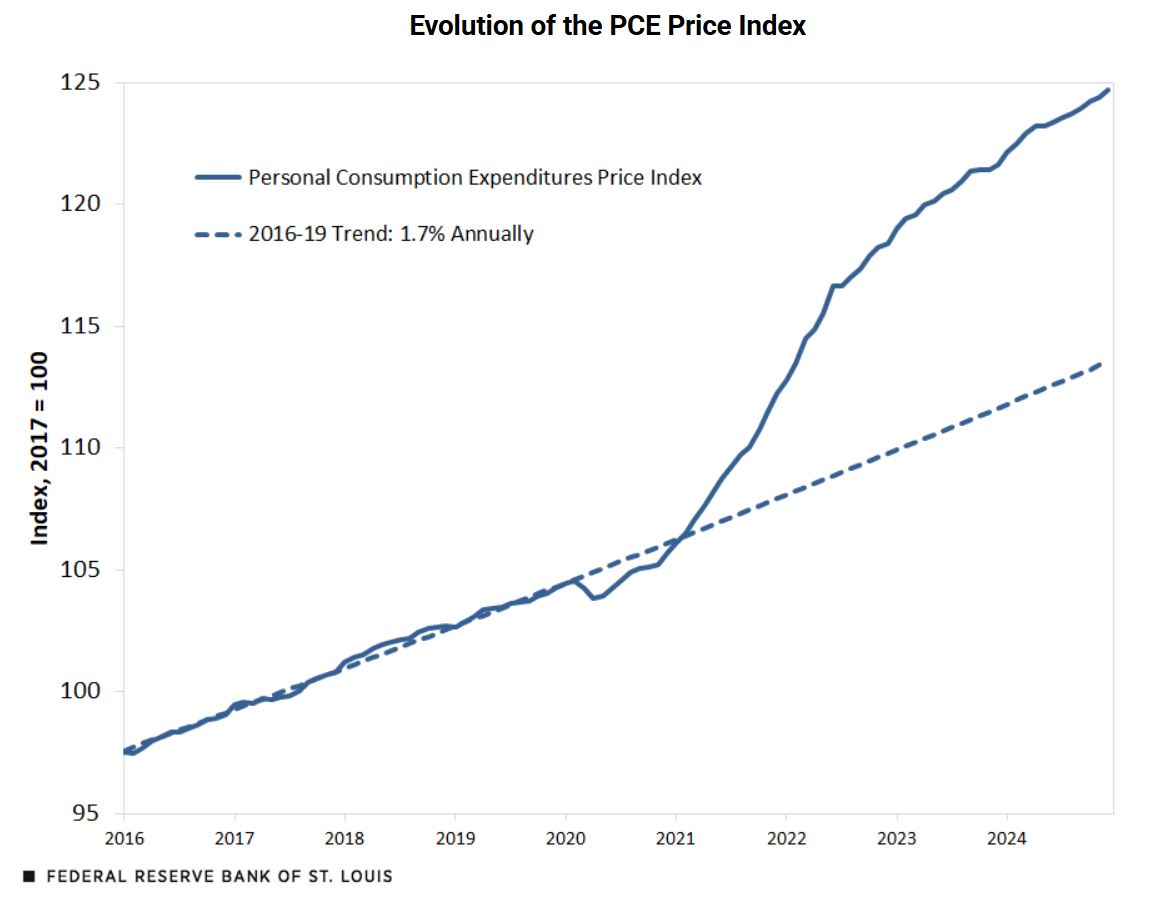
Think back to the years before 2020. From 2016 to 2019, things were pretty stable. Prices were inching up at a rate of about 1.7% each year. This is based on something called the Personal Consumption Expenditures (PCE) price index. Don't let the fancy name scare you; it’s just a way of measuring how much prices are changing for all the stuff we buy as people – from haircuts to TVs.

The Fed really likes to watch this PCE number because it gives a good overall view of inflation. Their target? They want to keep inflation at 2% annually. Close to 2%, but not too much higher or lower, is considered healthy for the economy.

Now, if we look at this PCE price index chart going back to 2016, you’ll see that nice, steady climb before 2020. Then, BAM! The pandemic hits. Suddenly, things went a little haywire.

Evolution of the PCE Price Index
Image Credit: Federal Reserve Bank of St. Louis

As you can see from the chart above, in the very beginning of the pandemic, prices actually dipped below where they were expected to be if they had just kept growing at that pre-pandemic 1.7% pace. This makes sense, right? Everyone was staying home, businesses were closed, and demand for many things dropped.

But then, things flipped. Starting in late 2020 and going all the way to mid-2022, prices took off like a rocket! We saw some of the highest inflation rates in decades. Since mid-2022, thankfully, the rate of price increases has slowed down. However, and this is the key takeaway, even though inflation is slower now, prices are still going up, just not as fast.

By the end of 2024, as the data shows, overall prices were about 10% higher than they would have been if we’d just stuck to that pre-pandemic trend. Think about that – ten extra dollars for every hundred you used to spend on the same basket of goods. That’s a real bite out of our wallets.

The Inflation Peak and the Road Down (…and Maybe a Plateau?)

Let's look at another key chart that shows the rate of inflation – how quickly prices are changing from one year to the next. This is often called headline inflation.

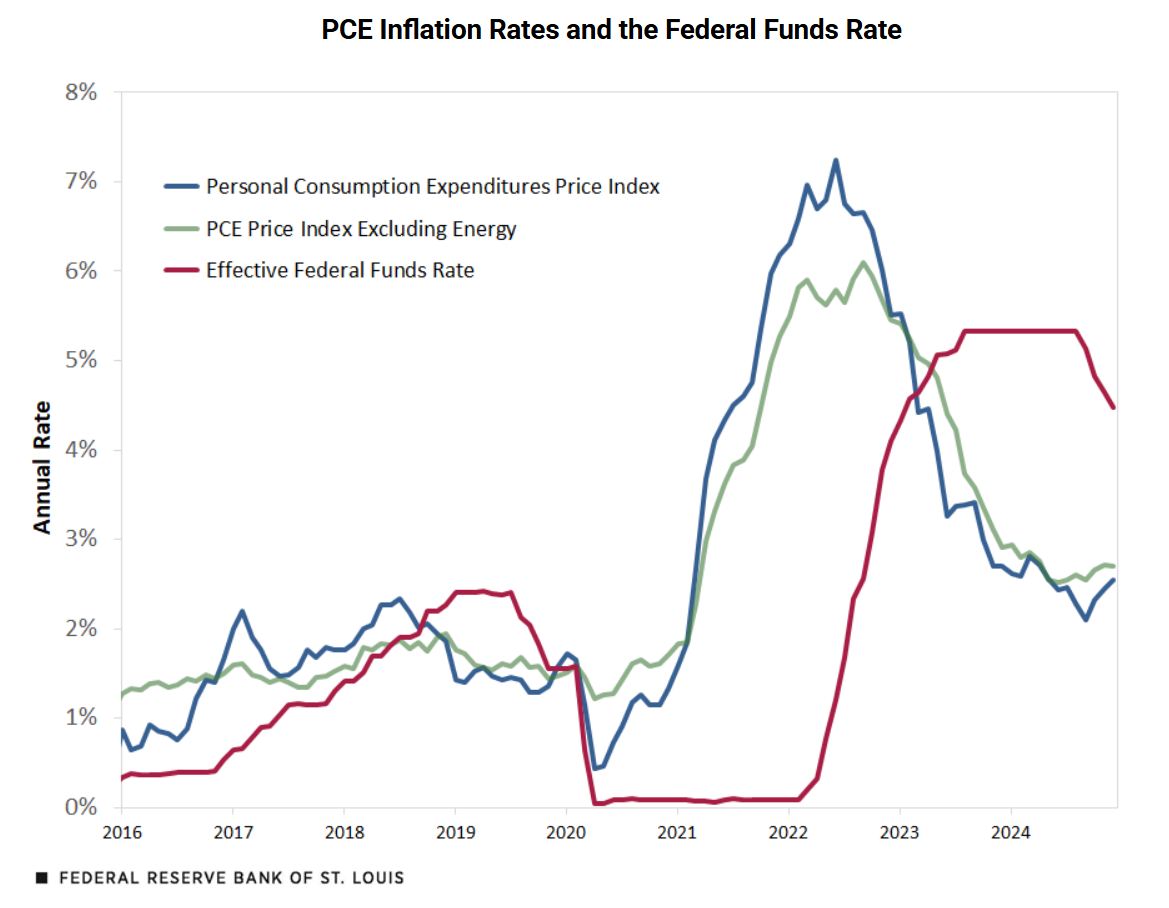
PCE Inflation Rates and the Federal Funds Rate
Image Credit: Federal Reserve Bank of St. Louis

This second chart is really interesting because it shows both the overall inflation rate (the blue line) and the inflation rate when we take out energy prices (the green line). Energy prices, like gas and heating oil, can jump around a lot and sometimes give a misleading picture of what’s really happening with underlying inflation.

You can clearly see that sharp drop in inflation at the start of the pandemic, followed by that massive spike peaking in mid-2022. After that peak, the blue line shows inflation coming down pretty steadily. That's the good news! It means the really rapid price increases we saw are behind us.

However, if you look closely, especially at the green line (inflation excluding energy), something interesting pops out. While headline inflation (blue line) dropped quite a bit in 2024, a lot of that drop was because energy prices actually fell. If you take energy out of the picture, the green line shows that the progress in lowering inflation might have stalled a bit recently. That’s a bit concerning because it suggests that while lower gas prices are helping us feel a little relief, the underlying problem of higher prices across the board might still be stubbornly sticking around.

And look at that red line on the chart – that’s the federal funds rate. This is the interest rate that the Federal Reserve controls, and it's their main tool to fight inflation. Notice how for a long time, even as inflation was starting to rise in 2021, the Fed kept interest rates near zero? They didn't start raising rates until March 2022! In my opinion, that was a bit late. Many of us were wondering why they waited so long as prices were clearly climbing. Once they did start raising rates, though, they did it aggressively. Interest rates shot up and stayed high for a while. In late 2024, they started to bring rates down a little bit, signaling that maybe they felt they were starting to get inflation under control.

Is Inflation Just About a Few Things Going Up? Nope, It’s Broad-Based.

When inflation first started to take off, some people thought it was just because of a few specific things. Maybe it was just used cars getting expensive, or maybe it was just lumber prices going crazy. The idea was that these were temporary problems that would sort themselves out soon. This idea was often called “transitory inflation.”

But as 2021 went on, it became clear that inflation was much broader than just a few items. It wasn't just one or two things getting more expensive – it was lots of things. This is what we mean by broad-based inflation.

The Federal Reserve Bank of St. Louis provided another really helpful chart that shows this:

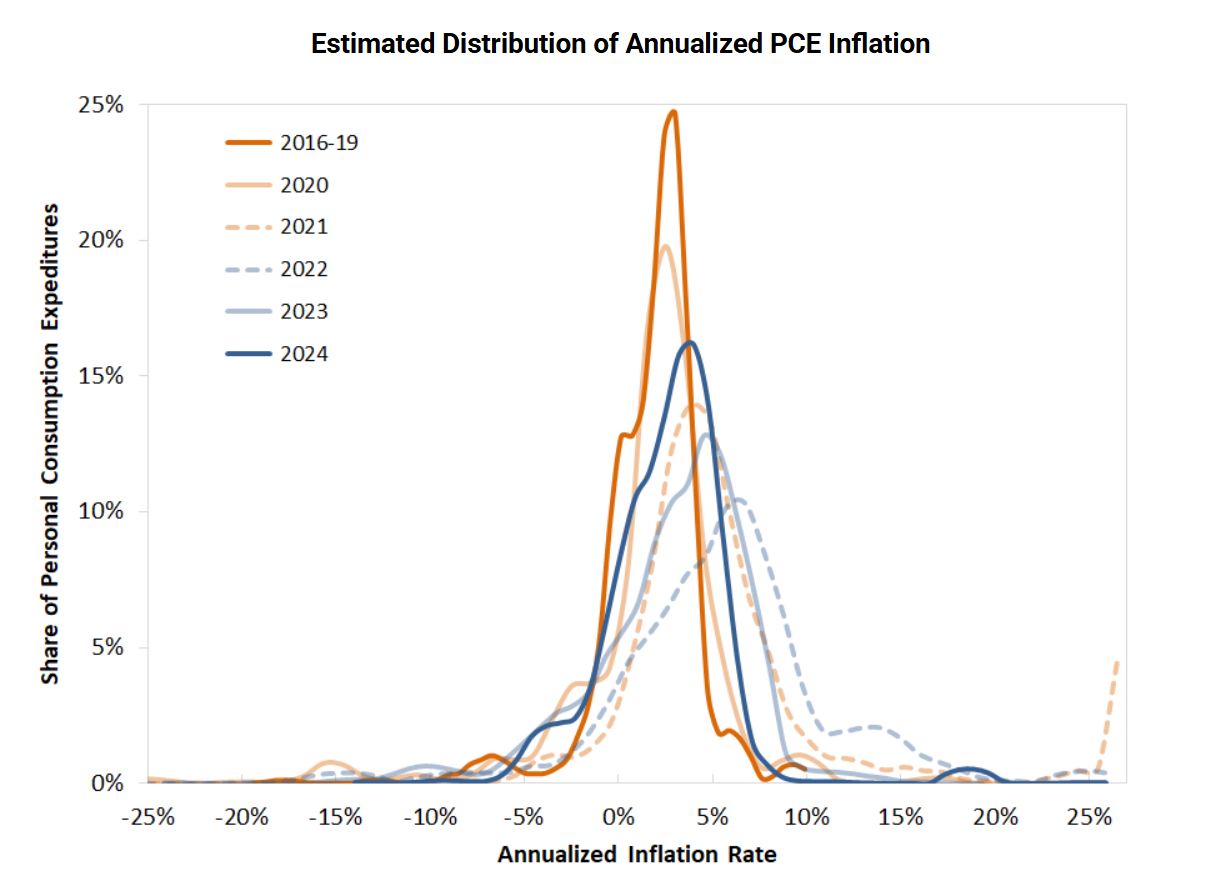
Estimated Distribution of Annualized PCE Inflation
Image Credit: Federal Reserve Bank of St. Louis

This chart might look a little complicated, but it’s actually quite insightful. Imagine each line in this chart as showing a snapshot of all the different things we buy in different years. The horizontal axis shows how much prices changed for each of those things, and the vertical axis shows how much of our spending goes to those items.

The orange line, representing 2016-2019, is our pre-pandemic benchmark. See how it's mostly clustered around the middle, around 0% to 5% inflation? That’s normal.

Now look at the lines for 2021 and 2022. These lines shift way over to the right. This means that in those years, a much larger share of the things we buy saw higher price increases than in the pre-pandemic years. Inflation wasn't just hitting a few categories; it was hitting almost everything.

Even in 2024, while the line has shifted back to the left a bit (good news!), it’s still significantly to the right of that pre-pandemic orange line. This tells us that even now, most of the things we buy are still experiencing higher inflation than they used to. It’s not just a few outliers anymore; it’s widespread. According to the data, about three-quarters of what we spend our money on in 2024 was still experiencing higher inflation than before the pandemic.

This broad-based nature of inflation is a key challenge. It means that getting back to 2% isn't just about fixing a few supply chain bottlenecks or waiting for one specific price to come down. It means we need to see a more general slowing of price increases across the entire economy.

Breaking It Down: Inflation by Product Category

To get even more specific, let's look at how inflation has behaved in different categories of things we buy. The Federal Reserve Bank of St. Louis provided a table that breaks this down:

Annualized Inflation Rates by Product Category Food Energy Core Goods Core Services Excluding Housing Housing All
2016-19 0.2% 4.2% -0.6% 2.2% 3.4% 1.7%
2020 3.9% -7.7% 0.1% 2.0% 2.2% 1.3%
2021 5.6% 30.6% 6.2% 5.3% 3.7% 6.2%
2022 11.1% 6.7% 3.2% 4.9% 7.7% 5.5%
2023 1.5% -2.0% 0.0% 3.4% 6.3% 2.7%
2024 1.6% -1.1% -0.1% 3.5% 4.7% 2.6%

Take a look at this table. Energy is the only major category where inflation was lower in 2024 than it was in the pre-pandemic period. This confirms what we saw in the charts – falling energy prices really helped bring down the overall inflation rate in 2024.

But look at everything else. Food prices are still rising faster than they were before. “Core goods” (things like appliances, furniture, clothes) actually saw deflation (prices going down) before the pandemic, but in 2024, they were essentially flat. “Core services excluding housing” (things like haircuts, transportation, entertainment) and “Housing” are all showing much higher inflation rates than they did before.

What this table really drives home is that inflation isn’t just an energy story. It’s impacting almost every part of our lives. Even though the overall inflation rate in 2024 was 2.6%, which is closer to the Fed’s 2% target, it's still significantly higher than the 1.7% we saw in 2016-2019. And importantly, that 2.6% is still above the Fed’s 2% goal.

So, Are We There Yet? The Verdict.

Let's circle back to our main question: The Road to 2% Inflation: Are We There Yet? Based on all this data, I think it's clear that we're not quite there yet. We've made real progress in bringing inflation down from those scary highs of 2022. Falling energy prices have been a big help. But when you dig deeper, you see that inflation is still pretty widespread across the economy, and in many key areas like housing and services, price increases are still running hotter than before the pandemic.

The Fed wants to see inflation at 2%. In 2024, we ended the year at 2.6%. That’s closer, but still a noticeable gap. And the fact that progress seems to have slowed down when you exclude energy prices is a bit worrying. It suggests that getting that last bit of inflation down to 2% might be the hardest part.

What caused this whole inflation mess in the first place? Well, that’s a whole other discussion, but the author of the data we've been looking at hints that the massive government spending during the pandemic, combined with very low interest rates from the Fed, played a big role. And with government spending still high, there might be more inflationary pressure to come.

For now, the road to 2% inflation feels like it's still under construction. We've traveled a good distance, but there might be more bumps and detours ahead before we reach our destination. We'll have to wait and see what the next set of inflation data tells us, but for now, I'm keeping a close eye on prices and hoping we can finally get back to that 2% target without too much more pain.

Navigate Economic Uncertainty with

Norada Real Estate Investments

Whether it's recession or inflation, turnkey real estate offers stability and consistent returns.

Diversify your portfolio with ready-to-rent properties designed to withstand economic fluctuations.

Speak with our expert investment counselors (No Obligation):

(800) 611-3060

Get Started Now 

Read More:

  • Are We in a Recession or Inflation: Forecast for 2025
  • Inflation's Impact on Home Prices & Mortgages: What to Expect in 2025 
  • Interest Rates vs. Inflation: Is the Fed Winning the Fight?
  • Is Fed Taming Inflation or Triggering a Housing Crisis?
  • Will Inflation Go Down Below 2% in 2025: Economic Forecast
  • How To Invest in Real Estate During a Recession?
  • Will There Be a Recession in 2025?
  • When Will This Recession End?
  • Should I Buy a House Now or Wait for Recession?
Filed Under: Economy Tagged With: 2% Inflation, Economy, Federal Reserve, inflation, interest rates, rate of inflation, Recession

Will Interest Rates Go Down in 2025: Projections and Insights

February 16, 2025 by Marco Santarelli

Will Interest Rates Go Down in 2025?

As we progress into 2025, many are asking, Will Fed interest rates go down in 2025? Current insights suggest that while some modest declines are expected, aggressive cuts are unlikely. Federal Reserve held interest rates steady after their latest policy meeting in January 2025, drawing sharp criticism from President Trump. Predictions indicate that the average federal funds rate may stabilize around 3.00% to 3.25% by the end of 2025, reflecting a cautious yet optimistic approach from the Federal Reserve as it seeks to balance inflation control with economic growth.

Will Fed Interest Rates Go Down in 2025?

Key Takeaways:

  • Stabilization of Rates: Predicted rates are likely to stabilize at around 3.00% to 3.25% by late 2025.
  • Historical Context: The federal funds rate, which has been significantly raised in recent years to combat inflation, peaked at roughly 5.25% to 5.50% in 2023.
  • Gradual Rate Cuts: Analysts expect the Fed to implement gradual cuts, with estimates of a federal funds rate of 2.75% to 3.00% at year-end 2025.
  • Economic Factors: Inflation is anticipated to decrease, affecting overall economic conditions and borrowing costs.
  • Political Dynamics: Future rate changes may be influenced by evolving policy decisions and administrative changes following the upcoming election.

The Federal Reserve: Understanding Its Role

The Federal Reserve, often just called the Fed, serves as the central bank of the United States. Its primary responsibilities include regulating the country’s monetary policy, which primarily entails controlling interest rates to ensure economic stability.

When the economy is overheating—often indicated by high inflation—the Fed increases interest rates to make borrowing more expensive. This action tends to slow down consumer spending and business investments, ultimately cooling the economy. On the contrary, when economic growth is sluggish, the Fed may lower rates to encourage borrowing and stimulate spending.

In recent years, the Fed has been in a tightening cycle, raising rates significantly to combat inflation that rose sharply post-pandemic. For instance, as of late 2023, the federal funds rate was maintained at 5.25% to 5.50%, marking a historic high that reflects the urgent need to control inflation (source).

Current Economic Climate and Interest Rates

To forecast whether Fed interest rates will go down in 2025, it is essential to evaluate key economic indicators:

  1. Inflation Trends: Economic forecasts suggest a moderate decrease in inflation, projected to fall from 3.7% in 2023 to approximately 2.4% in 2024, and average around 1.8% from 2025 to 2028 (source). Sustained low inflation could prompt the Fed to lower rates to maintain economic growth.
  2. Economic Growth: Economic growth was predicted to slow to about 2% in 2025 (source). Slower growth might necessitate lower rates to promote spending and investment, especially if inflation is under control.
  3. Labor Market and Wages: The state of the job market significantly impacts consumer spending and can, in turn, affect inflation. If wages grow steadily without leading to higher inflation, the Fed may find it appropriate to reduce interest rates.
  4. Political Influences: With an upcoming election, shifts in political power can bring about changes in policies that influence the economy. Possible changes under a new administration, particularly concerning fiscal policies, might prompt the Fed to adjust its interest rate strategy (source).

Expert Predictions on Interest Rate Cuts

Recent studies and expert analyses have shed light on the anticipated movements of the Fed's interest rates:

  • Market Expectations: Analysts from Morningstar predict that by the end of 2025, the federal funds rate will hover between 3.00%-3.25%, with industry-wide expectations recommending caution given current inflation dynamics (source).
  • Federal Reserve Projections: According to the Federal Reserve's projections from June 2024, policymakers indicated the likelihood of only one rate cut for 2024 but there have been 2 rate cuts. Policymakers foresee as many as four cuts through 2025, leading to a target rate in the 4.1% area by the end of that timeframe (source).
  • Overall Sentiment: Fitch Ratings also suggests that aggregate rate cuts will remain modest overall through the easing cycle, further highlighting that while some reductions are likely, they will not dramatically shift from current levels (source).

Implications for Borrowers and Consumers

A decrease in interest rates in 2025 can have widespread implications for various sectors of the economy:

  • Mortgage Rates: If rates do drop as predicted, homebuyers could see lower costs for mortgages, making homeownership more attainable for many. Lower rates can lead to higher home purchases, stimulating the housing market.
  • Student Loans: Lower rates often directly affect student loans. If the Fed decreases the funds rate, borrowers could benefit from reduced interest costs, ultimately making education financing more affordable (source).
  • Investment Decisions: Investors also keep a keen eye on interest rates. For instance, with lower borrowing costs, companies might invest more in growth projects, potentially leading to higher stock prices. Conversely, if the rate remains high or reduces minimally, this could dampen market enthusiasm.

The Path Forward: What to Expect in 2025

As we gaze into the crystal ball of economic forecasting, it's clear that while some cuts in interest rates are likely, a complete overhaul of the current rate environment seems improbable. The Fed's cautious approach demonstrates its commitment to balancing various economic factors, seeking not to stifle growth while simultaneously keeping inflation in check.

Communicating the complexities of these decisions to the public is crucial, especially as economic realities evolve. In every financial decision, from setting the household budget to planning long-term investments, understanding how Fed decisions influence personal and corporate finances is vital.

Conclusion

The trajectory of federal interest rates in 2025 may not promise drastic decreases, but gradual reductions might provide needed relief for consumers and borrowers alike. As we move forward, keeping a close eye on economic indicators will be essential to understanding the Fed's evolving strategy in response to the prevailing economic landscape.

Recommended Read:

  • Interest Rate Predictions for 2025 and 2026 by NAR Chief
  • Fed Funds Rate Forecast 2025-2026: What to Expect?
  • How Low Will Interest Rates Go in the Coming Months?
  • Fed Just Made a BIG Move by Slashing Interest Rates to 4.75%-5%
  • Market Reactions: How Investors Should Prepare for Interest Rate Cut
  • How Low Will Interest Rates Go in 2024?
  • Interest Rate Predictions for the Next 3 Years: (2024-2026)
  • Interest Rate Predictions for Next 2 Years: Expert Forecast
  • Impact of Interest Rate Cut on Mortgages, Car Loans, and Your Wallet
  • Interest Rate Predictions for Next 10 Years: Long-Term Outlook
  • When is the Next Fed Meeting on Interest Rates in 2024?
  • Interest Rate Cuts: Citi vs. JP Morgan – Who is Right on Predictions?
  • More Predictions Point Towards Higher for Longer Interest Rates

Filed Under: Financing, Mortgage Tagged With: Fed Interest Rate, Federal Reserve, interest rates, Interest Rates Predictions, Monetary Policy

Interest Rates Over the Last 10 and 20 Years: 2003 to 2025

February 10, 2025 by Marco Santarelli

Interest Rates Over the Last 10 and 20 Years: 2003 to 2025

If you are interested in how the Federal Reserve sets and changes the interest rate that affects the economy, you might want to look at the trends of the federal funds rate over the last 20 years. The federal funds rate is the interest rate at which banks lend their excess reserves to each other overnight.

The Fed influences this rate by buying and selling government securities in the open market, which affects the supply and demand of reserves. The Fed also sets a target range for the federal funds rate, which signals its desired level of monetary policy.

The federal funds rate has gone through several cycles of increases and decreases over the past two decades, reflecting the Fed's response to different economic conditions and inflation pressures.

Interest Rates Over the Last 20 Years

Here is a brief overview of the main phases of the interest rates history over the last 20 years, i.e.; since 2003.

2003-2004:

The Fed kept the federal funds rate at a record low of 1% for a year, as the economy recovered from the 2001 recession and the aftermath of the 9/11 attacks. The Fed started to raise the rate gradually in June 2004, as inflation and growth picked up.

2004-2006:

The Fed continued to raise the federal funds rate by 0.25 percentage points at every meeting, reaching a peak of 5.25% in June 2006. The Fed wanted to prevent the economy from overheating and contain inflation expectations, as the housing market boomed and oil prices rose.

2006-2008:

The Fed kept the federal funds rate steady at 5.25% for more than a year, as the economy slowed down and inflation moderated. The Fed began to cut the rate aggressively in September 2007, as the subprime mortgage crisis erupted and threatened to trigger a financial meltdown.

The Fed lowered the rate by a total of 5 percentage points in 10 months, reaching a range of 0-0.25% in December 2008. This was the lowest level ever and marked the beginning of the zero interest rate policy (ZIRP).

2008-2015:

The Fed maintained the federal funds rate at near zero for seven years, as the economy faced the worst recession since the Great Depression and a slow recovery. The Fed also implemented several unconventional monetary policy tools, such as quantitative easing (QE) and forward guidance, to provide additional stimulus and support to the financial markets.

2015-2018:

The Fed started to normalize its monetary policy in December 2015, after more than six years of ZIRP. The Fed raised the federal funds rate by 0.25 percentage points for the first time since 2006, signaling confidence in the economic outlook and progress toward its inflation and employment goals.

The Fed continued to raise the rate gradually over the next three years, reaching a range of 2.25-2.5% in December 2018. The Fed also began to reduce its balance sheet in October 2017, by allowing some of its holdings of government securities and mortgage-backed securities to mature without reinvesting them.

2018-2020:

The Fed paused its rate hikes in 2019, as the economy faced headwinds from trade tensions, global slowdown, and geopolitical uncertainties. The Fed also announced that it would end its balance sheet reduction in September 2019, earlier than expected.

The Fed cut the federal funds rate three times in 2019, by a total of 0.75 percentage points, to provide insurance against downside risks and support growth and inflation.

The Fed kept the rate unchanged at a range of 1.5-1.75% until March 2020, when it slashed it to near zero again in response to the coronavirus pandemic and its devastating impact on the economy and financial markets. The Fed also resumed its QE program and launched several emergency lending facilities to provide liquidity and credit to various sectors of the economy.

2020-2023:

The Fed has kept the federal funds rate at a range of 0-0.25% since March 2020, as the economy has experienced a sharp contraction followed by a partial recovery amid ongoing health and social challenges. The Fed has also expanded its QE program and extended its lending facilities to support market functioning and economic activity.

In August 2020, the Fed announced a new framework for conducting monetary policy, which emphasizes that it will seek to achieve inflation that averages 2% over time and that it will not raise rates preemptively based on forecasts of inflation or unemployment.

In September 2023, after more than two years of near-zero rates, strong economic growth, and rising inflation pressures, the Fed announced that it would start to taper its QE program in November 2023 and that it expected to begin raising rates in mid-2024, according to its median projection.

2023-2025:

In early 2024, the Federal Reserve held the federal funds rate steady in the range of 4.25% to 4.5%, reflecting its cautious approach amid stabilizing economic conditions. By September 2024, the Fed lowered the rate by 0.5 percentage points to a target range of 4.75% to 5%, responding to moderating inflation and softening demand.

In December 2024, the Fed further cut the interest rate by 25 basis points, bringing it down to a range of 4.25% to 4.5%. This adjustment aimed to support ongoing economic growth while inflation showed signs of a downward trend. Overall, 2024 was characterized by a delicate balancing act, as the Fed navigated economic fluctuations driven by inflation dynamics and labor market stability.

In early 2025, specifically at the January meeting, the Federal Reserve maintained the federal funds rate at a range of 4.25%-4.5%. This decision came after a period of aggressive rate hikes aimed at combating inflation, as the economy stabilized. It reflects a shift in policy as the Fed adapts to strengthening economic conditions, with projections indicating potential further cuts in response to any weakening economic circumstances. The Fed's rate-setting trajectory remains highly data-dependent, signaling flexibility based on evolving economic indicators.

The trends of the federal funds rate over the last 20 years show how the Fed has adapted its monetary policy to changing economic circumstances and inflation dynamics.

The Fed's actions have had significant implications for consumers, businesses, and investors, affecting borrowing costs, saving returns, and asset prices. Understanding the Fed's policy decisions and expectations can help you make better financial decisions and plan for the future.

Filed Under: Economy, Financing Tagged With: Fed Interest Rate, interest rates, Interest Rates Over the Last 20 Years

Fed’s Meeting in January 2025: Impact on Mortgage Rates

January 31, 2025 by Marco Santarelli

Fed's Meeting in January 2025: Impact on Mortgage Rates

The January 2025 Federal Reserve meeting had a significant impact on mortgage rates, though not in the way many might have expected. The Fed decided to hold interest rates steady, which led to a slight increase in mortgage rates due to market uncertainty about the economic outlook.

This decision, while seemingly simple, is actually a result of complex economic factors and signals a cautious approach to monetary policy. If you were watching the market at the time, it may have felt like waiting for a coin to land, unsure whether rates would go up, down, or remain the same. Let’s dive deeper into what led to this decision and what it means for you.

Fed's Meeting in January 2025: Impact on Mortgage Rates

Why This Meeting Mattered

As someone who has spent years tracking the intricacies of the financial world, I can tell you that the Federal Reserve meetings are always something to watch carefully. But this particular meeting in January 2025 had a lot riding on it. The economy at that point was like a ship navigating choppy waters. We had concerns about persistent inflation, mixed signals about economic growth, and, let’s not forget, a new administration coming into power, with a new President. These factors all put pressure on the Fed to make the right move.

Setting the Stage: Pre-January 2025 Economic Indicators

Before the January meeting, the economic situation was a mix of positives and concerns. Inflation, while not as high as in some previous periods, was still a significant worry. The Federal Reserve officials had been walking a tightrope: they wanted to control prices without choking economic growth. The December 2024 meeting revealed a cautious approach, acknowledging the uncertainties of the current situation. You could almost feel the tension in the air as everyone wondered which way they would lean. This backdrop made the January meeting all the more crucial.

The Fed's Decision: A Pause, Not a Pivot

On January 29th, 2025, the Federal Reserve finally announced its decision, and it was neither a rate cut nor a rate hike. Instead, they chose to hold steady. Fed Chair Jerome Powell, in his press conference, highlighted that the Fed was in a ‘wait-and-see' mode. It was as if they were taking a deep breath to assess the full impact of past actions and to see what the future held. This “pause” in interest rate adjustments was taken by many to mean that there is an underlying uncertainty about where the economy is headed. They were neither confident enough to cut rates aggressively, nor did they think it was appropriate to raise rates.

The Direct Link: Fed Rates and Mortgage Rates

Here’s the thing: The Fed's interest rate decisions are not just something that economists talk about. They have a real, tangible impact on our daily lives, especially when it comes to borrowing money. You see, when the Fed changes interest rates, it influences the cost of borrowing across the board.

For you and me, this is especially important when looking at mortgage rates. Generally speaking, when the Fed raises rates, mortgage rates tend to follow suit, making it more expensive to borrow money for a home. Conversely, when rates are cut, mortgage rates typically go down, making it easier to buy a house. The correlation is not always a perfect one-to-one, as other factors play a role as well, but there is definitely a strong connection.

The Immediate Impact on Mortgage Rates

Following the Fed’s January announcement, mortgage rates showed a slight increase. This was not a huge surge but more of a subtle nudge higher. This response can be attributed to market reactions. Investors and lenders interpreted the Fed’s pause as a signal that interest rates weren't going to fall anytime soon, and this uncertainty caused a bit of upward pressure on mortgage rates. If you were trying to lock in a rate around this time, you probably felt like you were caught in a game of chess, trying to predict the next move. This makes a good case for always being well informed.

Beyond the Immediate: Deeper Factors at Play

It’s also important to consider that the relationship between Fed decisions and mortgage rates isn't a simple A-to-B connection. There are so many other factors that can affect how mortgage rates behave.

  • Inflation Expectations: If people expect inflation to rise, lenders will often raise rates to compensate for the loss of purchasing power of the money that they will receive in the future.
  • Economic Growth: Stronger economic growth can lead to higher demand for loans, potentially pushing mortgage rates up.
  • Housing Market Dynamics: Supply and demand in the housing market can also play a big role. For instance, if there are a lot of buyers competing for a limited number of homes, prices will tend to go up, and so might mortgage rates. In early 2025, the housing market was already dealing with low inventory and high demand, leading to inflated prices.
  • Geopolitical Events: Unexpected events can impact the global economic climate, also affecting mortgage rates.
  • Bond Market: The yield on treasury bonds often influences mortgage rates. When yields rise, so does the cost of borrowing.

These factors create a complex web of influences that shape mortgage rates. So, it’s not just about what the Fed does but how the market interprets its decisions within the context of other key economic indicators.

The Housing Market in Early 2025: A Balancing Act

By early 2025, the housing market felt like it was stuck in a unique position. On the one hand, demand was high, and many people were eager to buy. On the other hand, housing prices were elevated, and the cost of borrowing was also increasing. This created a dilemma for potential homebuyers. You may feel that no matter where you are looking, you will be either outbid or priced out.

  • Low Inventory: The shortage of homes available for sale has been pushing prices up, making affordability a major challenge for many.
  • High Demand: Despite higher borrowing costs, there was still a significant demand for homes, keeping prices elevated.
  • Impact of the Fed’s Decision: The Fed’s decision to pause rates, although meant to be stabilizing, may actually worsen the affordability issue, as it kept borrowing costs high for longer.

The Potential Long-Term Effects

The ramifications of the Fed's January 2025 decision extend far beyond the immediate uptick in mortgage rates. We have to consider the longer-term implications for the housing market and the broader economy.

  • Impact on Home Buyers: A prolonged period of steady or high rates could price many potential homebuyers out of the market, especially first-time buyers.
  • Refinancing Challenges: Existing homeowners hoping to refinance their mortgages could face challenges if rates remain high or continue to rise.
  • Market Stability: While the Fed’s intent was to create stability, maintaining higher rates might actually worsen the supply and demand imbalances in the housing sector.
  • Economic Implications: A cooling housing market could have ripple effects on the overall economy, affecting related industries like construction, real estate, and home goods.

What This Means for You

If you're either planning to buy or refinance a home, you should pay close attention to what is happening in the market. Here's what I think are the key things you need to keep in mind:

  • Stay Informed: Keep an eye on economic news and updates from the Federal Reserve and other reliable financial news sources.
  • Be Prepared: Be prepared for the possibility of fluctuating rates. Do not just get carried away by FOMO.
  • Consult Professionals: Talk to a mortgage broker or financial advisor who can provide personalized guidance based on your specific circumstances.
  • Shop Around: Don’t just accept the first rate you're offered. Compare rates from different lenders to ensure that you are getting the best deal.
  • Consider Your Options: Explore different types of mortgages and financing options to find the one that best fits your budget and needs.
  • Plan Ahead: Be flexible and adjust your housing plans as necessary, depending on how the market moves.

The Need for Continued Vigilance

The January 2025 Fed meeting underscored just how interconnected the financial landscape is. The Fed’s decisions are not made in isolation, and their impacts are felt throughout the economy. As I see it, the key takeaway is that we need to remain vigilant, stay informed, and adapt to changing conditions. In this unpredictable world, having reliable information and a well thought-out strategy are essential. I believe that those who are well prepared will always fare better in the long run.

Looking Ahead

As we navigate through 2025, the housing market and mortgage rates will continue to be affected by various factors, not just Fed decisions. So, paying close attention to the economic climate is key to navigating your real estate journey successfully. I will definitely be keeping a close watch on the markets and will be here to provide more insight as things develop. Remember, being informed and adaptable is your greatest asset in this ever-changing financial landscape.

Summary

The January 2025 Fed meeting saw the Federal Reserve maintain its interest rates, leading to a slight uptick in mortgage rates, which are affected by not just Federal Reserve decisions, but also by other factors, such as inflation, economic growth, and market dynamics. Potential home buyers and current homeowners looking to refinance need to stay on top of these indicators and seek expert advice to navigate these challenges. The Fed’s decision was a result of many economic factors and signals caution about the economic recovery.

Secure Your Investments with Norada in 2025

As interest rates hold steady, explore turnkey real estate opportunities

for consistent and reliable returns.

Take advantage of favorable conditions to grow your portfolio with

ready-to-rent properties designed for success.

Speak with our expert investment counselors (No Obligation):

(800) 611-3060

Get Started Now 

Recommended Read:

  • No Interest Rate Cut in Jan 2025: Decoding the Fed's Pause
  • Will Interest Rates Go Down in January 2025: CME FedWatch
  • Fed Cuts Interest Rates by 25 Basis Points: What It Means for You
  • Fed's Powell Hints of Slow Interest Rate Cuts Amid Stubborn Inflation
  • Fed Funds Rate Forecast 2025-2026: What to Expect?
  • Interest Rate Predictions for 2025 and 2026 by NAR Chief
  • Fed Just Made a BIG Move by Slashing Interest Rates to 4.75%-5%
  • Market Reactions: How Investors Should Prepare for Interest Rate Cut
  • Interest Rate Predictions for the Next 3 Years: (2024-2026)
  • Interest Rate Predictions for Next 2 Years: Expert Forecast
  • Impact of Interest Rate Cut on Mortgages, Car Loans, and Your Wallet
  • Interest Rate Predictions for Next 10 Years: Long-Term Outlook
  • When is the Next Fed Meeting on Interest Rates?
  • Interest Rate Cuts: Citi vs. JP Morgan – Who is Right on Predictions?
  • More Predictions Point Towards Higher for Longer Interest Rates

Filed Under: Financing Tagged With: economic policy, Economy, Fed Funds Rate, Federal Reserve, interest rates, Monetary Policy

No Interest Rate Cut in Jan 2025: Decoding the Fed’s Pause

January 29, 2025 by Marco Santarelli

No Interest Rate Cut in Jan 2025: Decoding the Fed's Pause

The Federal Reserve held steady on interest rates at its January 2025 meeting, maintaining the benchmark federal funds rate at 4.25% to 4.50%. This decision means no immediate relief on the borrowing front. While this news might feel a bit disheartening, especially if you're hoping for lower mortgage rates, it's essential to understand the whys and hows behind this move. It's not as simple as the Fed just pressing a button, and the impact on your wallet is more nuanced than you might think.

I've been keeping a close eye on the economy for years, and I can tell you, the Fed's actions are like a chess game – every move has a ripple effect. So, let's dive deeper than the headlines and figure out what this pause really means for your finances.

No Interest Rate Cut by Fed in January 2025: What it Means for You

Why the Fed Held Steady

The Fed's decision to not cut rates in January wasn't some sudden whim. It was a calculated move based on economic data, particularly the stubborn persistence of inflation. We saw the Consumer Price Index (CPI) tick up to 2.9% in December, a jump from 2.7% the previous month. This slight increase signaled to the Fed that inflation isn't quite under control yet.

It's like trying to bake a cake, and your oven is running a little hotter than it should. You can't just stop baking; you need to adjust the temperature to get it right. Similarly, the Fed needs to ensure inflation cools down completely before they start easing up on interest rates.

Here are the main factors at play:

  • Inflation: The primary driver behind the Fed's rate hikes and now its pause, inflation is still hovering above the Fed's target of 2%.
  • Economic Growth: The economy has shown some resilience, which, while good in general, can contribute to inflationary pressures.
  • Labor Market: The job market is still relatively tight, with low unemployment and high job openings. This can lead to increased wages and, potentially, higher prices.

What the Pause Means for Mortgages

Now, this is the question on everyone's mind. Will this no rate cut by the Fed in January translate to mortgage rates staying high? Here's the thing: the relationship between the Fed's rate and mortgage rates isn't as direct as a light switch. It's more like a dance, with the Fed's move being one partner.

  • Indirect Influence: The Fed's benchmark rate influences the 10-year Treasury yield, which is a big driver of mortgage rates. When the Fed signals that rates will remain steady, it can bring more certainty to bond markets. This can help stabilize mortgage rates.
  • Investor Sentiment: The crucial bit here is how investors interpret the Fed's pause. If investors think the Fed has done enough to control inflation, demand for bonds may increase, driving down Treasury yields and ultimately mortgage rates. However, if inflation is perceived as stubborn, investors may keep yields high, thereby pushing mortgage rates upwards.
  • No Immediate Relief: So, will this lead to lower rates? Maybe, but probably not right away. The mortgage rate environment is quite complex. I don't think we should expect any sudden drop in mortgage rates due to this pause.

Factors Beyond the Fed

It’s crucial to remember that the Fed’s rate is just one piece of the puzzle. Here's a look at other factors influencing mortgage rates:

  • The 10-Year Treasury Yield: Mortgage rates often track this yield, so keeping an eye on it is critical.
  • Secondary Mortgage Market: Most mortgages are sold to investors. The demand for mortgage-backed securities directly influences what rates lenders can offer. Higher demand can lead to lower rates.
  • Lender Capacity & Competition: Lenders' own policies and risk assessments, their operational costs, and competition affect the rates they offer. A lender who has too many applications might raise rates to slow demand.
  • Inflation Trends: I cannot overstress this. The most important thing to watch is the trend of inflation. Is it coming down as the Fed hopes? If it is, we could see mortgage rates fall.
  • Economic Conditions: How is the overall economy doing? Strong economic data can push mortgage rates up because it can make the Fed hold steady or even consider more hikes.

What To Expect in the Near Future

Based on expert consensus, the earliest we might see the Fed cut rates could be at the May 7 meeting. Most economists and analysts don’t expect any rate movement at the March meeting either.

Here's my take on what I expect:

  • Continued Volatility: I believe we will continue to see some movement in mortgage rates but not any major drop soon.
  • Watchful Waiting: The market will be closely watching economic data, particularly inflation reports, to gauge the Fed’s future actions.
  • No Quick Fix: If you are planning to buy a home or refinance, don't expect a sudden decrease in rates. This might be a good time to shop around for the best deals.

How to Navigate This Situation

If you're in the market for a home or considering refinancing, here are some tips that I think you can use:

  • Shop Around: Don’t settle for the first lender you find. Compare rates from multiple sources.
  • Be Patient: Don't feel pressured to rush into a decision. The rate environment is fluid, and things can change.
  • Understand Your Finances: Make sure you know your budget and how much you can comfortably afford.
  • Consult Experts: Talk to a financial advisor to create a plan that works for you.
  • Stay Informed: Keep an eye on economic news and the latest information on mortgage rates.

My Personal Take

As someone who has followed the market for years, I find this current situation quite fascinating. The Fed is trying to walk a tightrope – to tame inflation without triggering a recession. It's a delicate balancing act. While no interest rate cut in January 2025 may be frustrating, it is part of a broader strategy that has the goal of bringing long-term economic health. We all might have to weather a bit of a storm before we see the sunny skies of lower interest rates. For now, I believe being prepared, informed and patient will help you in making the best decision for your personal circumstances.

Conclusion

The Fed’s decision to not cut rates in January 2025 was not a surprise and is unlikely to cause any dramatic changes in mortgage rates, at least not immediately. It’s a complex interplay of factors, and while the Fed's actions influence mortgage rates, they aren't the only determinant. By staying informed and being prepared, you can make smart financial decisions that work for you, irrespective of what the Fed decides. Remember, it's about being nimble and knowing that there is no “one-size-fits-all” answer when it comes to finance.

Secure Your Investments with Norada in 2025

As interest rates hold steady, explore turnkey real estate opportunities

for consistent and reliable returns.

Take advantage of favorable conditions to grow your portfolio with

ready-to-rent properties designed for success.

Speak with our expert investment counselors (No Obligation):

(800) 611-3060

Get Started Now 

Recommended Read:

  • Will Interest Rates Go Down in January 2025: CME FedWatch
  • Fed Cuts Interest Rates by 25 Basis Points: What It Means for You
  • Fed's Powell Hints of Slow Interest Rate Cuts Amid Stubborn Inflation
  • Fed Funds Rate Forecast 2025-2026: What to Expect?
  • Interest Rate Predictions for 2025 and 2026 by NAR Chief
  • Fed Just Made a BIG Move by Slashing Interest Rates to 4.75%-5%
  • Market Reactions: How Investors Should Prepare for Interest Rate Cut
  • Interest Rate Predictions for the Next 3 Years: (2024-2026)
  • Interest Rate Predictions for Next 2 Years: Expert Forecast
  • Impact of Interest Rate Cut on Mortgages, Car Loans, and Your Wallet
  • Interest Rate Predictions for Next 10 Years: Long-Term Outlook
  • When is the Next Fed Meeting on Interest Rates?
  • Interest Rate Cuts: Citi vs. JP Morgan – Who is Right on Predictions?
  • More Predictions Point Towards Higher for Longer Interest Rates

Filed Under: Financing Tagged With: economic policy, Economy, Fed Funds Rate, Federal Reserve, interest rates, Monetary Policy

Interest Rate Predictions for 2025 and 2026 by NAR Chief

January 28, 2025 by Marco Santarelli

Interest Rate Predictions for 2025 and 2026 by NAR Chief

The housing market is a complex web of economic factors, and understanding the interest rate predictions for the next year by NAR Chief Economist Lawrence Yun can help unravel some of that complexity. Yun anticipates that the U.S. Federal Reserve will implement six to eight interest rate cuts over the next two years, a significant shift from the current high rates that have restrained housing market growth. This prediction signals a potential turnaround for many homeowners and prospective buyers who have felt the pinch of increasing mortgage rates in recent years.

Interest Rate Predictions for 2025 and 2026 by NAR Chief

💸
Key Takeaways

  • 📉 6-8 Rate Cuts Expected: Lawrence Yun predicts multiple interest rate reductions by the Federal Reserve through 2025.
  • 📈 Challenging Year: 2024 has been difficult for home sales, following a slow recovery from 2023.
  • 💵 Record Home Equity Withdrawals: Homeowners tapped into $48 billion in equity in Q3 2024, the highest in two years.
  • 💰 Wealth Disparity: Average homeowner net worth is $415,000, while renters hold an average of $10,000.
  • 📅 Sales Growth Prediction: A 10% increase in existing-home sales is forecasted for 2025 and 2026.


A Closer Look at the Current Environment During the recent 2024 NAR NXT conference in Boston, Yun shed light on the struggles that the housing market has faced. “2024 has been a very difficult year on many fronts,” he stated, highlighting that the anticipated rebound in home sales hasn’t occurred after the dismal performance in 2023. The Federal Reserve's recent decision to lower the federal funds rate by 25 basis points to a range of 4.50% to 4.75% reflects the ongoing efforts to stimulate the economy while managing inflation pressures.

There are encouraging signs as well. Employment rates have started to improve, and housing inventory is gradually on the rise, making it a critical time for potential buyers who have been holding off due to high rates. The recent data indicates a trend toward easing the high costs associated with home buying, and Yun believes this is a step in the right direction.

A particularly notable statistic is the $48 billion in home equity withdrawn by homeowners in Q3 of 2024. This figure represents the largest quarterly equity withdrawal in two years, signaling that many homeowners are leveraging their investments to improve their financial situations. The Intercontinental Exchange (ICE) projects that this trend toward home equity lending will continue, suggesting that homeowners are becoming more confident about their financial future (source: NAR).

The Wealth Gap: Homeowners vs. Renters Yun also pointed out a significant wealth gap between homeowners and renters, which highlights the long-term importance of homeownership. The net worth for homeowners in 2024 is estimated at approximately $415,000, while renters hold a vastly lower average net worth of $10,000. This stark difference illustrates why entering the housing market is vital for wealth accumulation. Yun emphasized, “If you don’t enter the housing market, you are in the renter class where wealth is not being accumulated.”

The growing number of renter households, which has risen to a record 45.6 million, shows an increase of 2.7% year-over-year. In contrast, homeowner households have seen a much smaller growth of 0.9%, totaling 86.9 million (source: Redfin analysis). This trend of growing renters underscores the urgent need for solutions to make homeownership more accessible, especially for younger generations seeking stability.

Predictions for Future Home Sales and Pricing Trends Looking ahead, Yun reveals a more optimistic picture for the housing market. He predicts a 10% increase in existing-home sales during 2025 and 2026, fueled by a combination of lower interest rates and improved economic conditions. New home sales are projected to increase by 11% in 2025 and 8% in 2026, creating a vibrant environment for both buyers and sellers.

In terms of home values, Yun forecasts a 2% increase in median home prices over the same period. While these projections indicate growth, they also illustrate that the road to recovery will be gradual rather than explosive. However, this consistent growth should provide reassurance to those looking to invest in their future through homeownership.

Recommended Read:

Housing Market Predictions for 2025 and 2026 by NAR Chief

Political Influence: Navigating Uncertainty Another layer to consider is the impact of political contexts on interest rates and the housing market. Yun commented on how the upcoming presidential election might influence economic policies, particularly if a Trump administration returns to power. He noted, “Mortgage rates in his first term (around 4%) were the good old days.” But, he warned, “Are we going to go back to 4%? Unfortunately, we will not. It’s more likely that we’ll stabilize around 6%, with fluctuations typically between 5.5% and 6.5%.” This statement suggests a new normal for mortgage rates, which could shape buyer expectations and market dynamics for years to come (source: NAR).

Yun has also provided advice to the Federal Reserve regarding the timing of future rate cuts. He argues for a January timeline as more favorable than a December cut. With the current state of a substantial budget deficit, Yun sees a strategic need to mitigate the impact of high government borrowing on mortgage availability while fostering economic conditions conducive to growth.

Charting a Course for Future Stability Despite the obstacles that have hindered the housing market over recent years, there remains a strong undercurrent of hope. A stronger job market and the potential for rate cuts could provide the necessary boost for those wishing to enter the housing market. As more buyers become active in the market and inventory continues to improve, the stage is set for a robust recovery.

In closing, interest rate predictions for the next year by NAR Chief Economist Lawrence Yun banish some of the uncertainty clouding the housing market. With the expected interest cuts and signs of economic improvement, homeowners may soon find themselves in a more favorable landscape for buying and investing in property. The potential for a greater number of buyers entering the market, combined with increased inventory, remains a hopeful scenario for those looking to make the leap into homeownership.

Recommended Read:

  • Fed Funds Rate Forecast 2025-2026: What to Expect?
  • How Low Will Interest Rates Go in the Coming Months?
  • Fed Just Made a BIG Move by Slashing Interest Rates to 4.75%-5%
  • Market Reactions: How Investors Should Prepare for Interest Rate Cut
  • How Low Will Interest Rates Go in 2024?
  • Interest Rate Predictions for the Next 3 Years: (2024-2026)
  • Interest Rate Predictions for Next 2 Years: Expert Forecast
  • Impact of Interest Rate Cut on Mortgages, Car Loans, and Your Wallet
  • Interest Rate Predictions for Next 10 Years: Long-Term Outlook
  • When is the Next Fed Meeting on Interest Rates in 2024?
  • Interest Rate Cuts: Citi vs. JP Morgan – Who is Right on Predictions?
  • More Predictions Point Towards Higher for Longer Interest Rates

Filed Under: Economy, Financing Tagged With: economic policy, Economy, Fed Funds Rate, Federal Reserve, interest rates, Monetary Policy

Fed Meeting Tomorrow: Interest Rates Expected to Remain Steady

January 28, 2025 by Marco Santarelli

Federal Reserve is Expected to Hold Interest Rates Steady Tomorrow

It looks like the Federal Reserve is poised to hold interest rates steady tomorrow, even as President Trump continues to publicly push for immediate cuts. This decision is rooted in the Fed's commitment to data-driven policymaking rather than succumbing to political pressure. So, the short answer is yes, they are likely to remain steady despite Trump's request. This careful and measured approach is what I believe is essential for ensuring long-term economic stability. Now, let's dive deeper into why this decision is so crucial and what it means for all of us.

Federal Reserve is Expected to Hold Interest Rates Steady Tomorrow

The Fed's Balancing Act: Data vs. Political Influence

The Federal Reserve, often just called “the Fed,” is like the captain of the economic ship. It’s their job to steer us toward stable economic waters. They do this primarily by controlling interest rates, which are essentially the cost of borrowing money. Think of it like this: when interest rates are low, it's cheaper for people to take out loans for things like cars and houses, and businesses are more likely to invest and expand. When they raise interest rates, that slows things down a bit.

What makes this so tricky is that the Fed needs to remain independent and focus on the data – things like unemployment rates and inflation – instead of just reacting to what politicians might want at any given time. That’s why I always appreciate the Fed's focus on facts rather than political narratives. They have a delicate job, and it's crucial for the long-term health of our economy that they’re able to stick to their data-driven strategy.

Economic Signals Point to a Pause

Looking at the current economic data, it seems clear that the Fed's decision to hold steady is a sound one. Let’s take a peek at some of the key factors influencing their decision:

  • Strong Labor Market: The US economy is showing impressive resilience. In December 2024, the economy added a solid 256,000 jobs, pushing the unemployment rate down to 4.1%. These figures indicate that the job market isn't screaming for immediate stimulus. This is a good thing, and in my opinion, it provides a solid foundation to make more informed decisions based on the other indicators and not just knee jerk reactions.
  • Mixed Inflation: Inflation is a tricky beast. While it slowed down throughout 2024, the numbers at the end of the year were a mixed bag. The Consumer Price Index (CPI) rose 2.9% year-over-year in December, which was a bit higher than the 2.7% we saw in November. The Core CPI, which leaves out the more volatile food and energy prices, also went up a tad, although it did decrease by 0.1% to 3.2%. This mixed picture makes the Fed's job even more complicated, and calls for a balanced and very cautious approach.

Trump's Push for Rate Cuts: A Political Tug-of-War

President Trump has been quite vocal in his calls for the Fed to slash interest rates. He even stated at the World Economic Forum in Davos that rates should “drop immediately” worldwide. I understand his perspective, as he likely sees lower rates as a way to boost the economy. However, I also think it is very important to understand the potential consequences of succumbing to political influence.

The Fed, under the leadership of Chair Jerome Powell, has consistently emphasized its independence. This means their decisions are driven by data and not political agendas. And as an economics observer, I believe this independence is vital for long-term economic health. I believe that the Fed has the best economic experts who can see the bigger picture.

The Wild Card: Trump's Trade Policies

To make things even more interesting, the prospect of Trump’s trade policies, particularly tariffs, adds another layer of uncertainty. These proposed tariffs on countries like China, Mexico, and Canada could potentially lead to higher prices for consumers, creating more inflation that the Fed would need to address.

  • Tariffs and Inflation: The worry is that these tariffs will ultimately increase the cost of goods, forcing businesses to raise prices. The Fed, in this situation, would then need to respond to combat this inflation.
  • Uncertain Impact: Powell has rightly acknowledged that the full effects of these trade policies are hard to predict. This means the Fed has to be extra careful not to make hasty decisions based on incomplete information.

The Fed's Cautious Strategy: Slow and Steady

The Federal Reserve’s strategy can be best described as cautiously optimistic. They've projected a couple of rate cuts for the remainder of 2025 but seem in no rush to pull the trigger right away. Powell himself compared the current economic environment to “driving on a foggy night,” highlighting the need to proceed slowly and deliberately. I think this analogy is spot on. When you're navigating through unclear conditions, it’s better to take your time rather than rush in and potentially make a wrong turn.

How Steady Rates Affect Us All

Now, let's look at what these steady interest rates mean for everyday folks and businesses:

  • Consumer Loans: When interest rates are stable, it provides a sense of predictability. This stability gives consumers confidence in taking on big financial commitments such as mortgages and car loans. When rates are predictable, it helps them budget better.
  • Business Investment: For businesses, steady rates encourage investment and growth. When the cost of borrowing money is predictable, companies are more likely to make investments in new equipment, new technologies, and to hire additional staff. This is all good for the economy as a whole.
  • Stock Market Stability: The stock market generally prefers steady rates. They bring stability amidst market fluctuations, often leading to higher consumer confidence and an increase in investment. This is good for long-term wealth building.

Here’s a quick summary in a table:

Impact Area Effects of Steady Rates
Consumer Loans Predictable borrowing costs; encourages long-term financial planning
Business Investment Promotes company growth and expansion; facilitates new investments
Stock Market Response Stability amid fluctuations; enhanced investor confidence; more market investment

Looking Ahead: The Importance of Sound Decisions

Ultimately, the Federal Reserve's expected decision to hold interest rates steady underscores a commitment to prudent, data-driven policy making. They understand that making the right call today is crucial for tomorrow's economic stability.

The Fed's primary focus is on long-term economic stability, and I believe they are making the right choice by prioritizing a cautious and well-thought-out approach. The Fed is showing that they are not going to be pressured into quick fixes or short-term gains. It seems they're focusing on a sustainable future which is what any good economic driver would do.

In conclusion, I expect the Federal Reserve to remain steadfast in its decision to hold rates steady tomorrow. The Fed is, rightfully so, focused on navigating the present economic environment based on real data and a prudent approach.

I think that in the long run this approach is exactly what is needed for us to have a robust economy.

Secure Your Investments with Norada in 2025

As interest rates hold steady, explore turnkey real estate opportunities

for consistent and reliable returns.

Take advantage of favorable conditions to grow your portfolio with

ready-to-rent properties designed for success.

Speak with our expert investment counselors (No Obligation):

(800) 611-3060

Get Started Now 

Recommended Read:

  • Will Interest Rates Go Down in January 2025: CME FedWatch
  • Fed Cuts Interest Rates by 25 Basis Points: What It Means for You
  • Fed's Powell Hints of Slow Interest Rate Cuts Amid Stubborn Inflation
  • Fed Funds Rate Forecast 2025-2026: What to Expect?
  • Interest Rate Predictions for 2025 and 2026 by NAR Chief
  • Fed Just Made a BIG Move by Slashing Interest Rates to 4.75%-5%
  • Market Reactions: How Investors Should Prepare for Interest Rate Cut
  • Interest Rate Predictions for the Next 3 Years: (2024-2026)
  • Interest Rate Predictions for Next 2 Years: Expert Forecast
  • Impact of Interest Rate Cut on Mortgages, Car Loans, and Your Wallet
  • Interest Rate Predictions for Next 10 Years: Long-Term Outlook
  • When is the Next Fed Meeting on Interest Rates?
  • Interest Rate Cuts: Citi vs. JP Morgan – Who is Right on Predictions?
  • More Predictions Point Towards Higher for Longer Interest Rates

Filed Under: Financing Tagged With: economic policy, Economy, Fed Funds Rate, Federal Reserve, interest rates, Monetary Policy

Trump Demands Interest Rate Cuts: Will the Fed Yield in 2025?

January 25, 2025 by Marco Santarelli

Trump Demands Interest Rate Cuts: Will the Fed Yield in 2025?

As Trump demands interest rate cuts: what will the Fed do? It's highly unlikely the Federal Reserve will cave to President Trump's demands for immediate and aggressive interest rate cuts in 2025.

Trump Demands Rate Cuts: Will the Fed Yield in 2025?

While Trump's policies and pronouncements have certainly introduced a new layer of complexity, the Fed's primary focus will likely remain on data-driven decision-making, particularly regarding inflation, rather than succumbing to political pressure. I believe the Fed's resolve to safeguard economic stability will ultimately prevail, even if it means navigating choppy political waters.

As someone who has followed economic policy closely for years, I can tell you that this isn't your typical situation. We've got a newly inaugurated president advocating for a significant shift in monetary policy, and a Federal Reserve that's fiercely independent. It’s a high-stakes game of economic chess, and the moves made in 2025 could have repercussions for years to come.

The Trump Playbook: Tariffs, Energy, and the Inflation Narrative

President Trump hasn’t wasted any time making his economic preferences known. His approach is a mix of some familiar tactics and some new twists.

  • Tariffs as Inflation Weapons? One of Trump's most debated strategies is his aggressive use of tariffs. He’s talking about implementing tariffs of 25% on imports from Canada and Mexico by February and a staggering 60% on Chinese goods. While he claims this will force other nations to “pay,” the reality is that the costs are likely to be borne by American consumers through higher prices. Experts are saying that this approach could push inflation to anywhere between 6% and 9.3% by 2026, which is way over the Fed’s 2% goal. I find this a particularly risky strategy, as past instances of trade wars have demonstrated their potential to disrupt supply chains and negatively impact the economy.
  • Energy Production as a Quick Fix: Trump has declared a “national energy emergency” and wants to ramp up oil and gas drilling. His logic is that high energy prices are fueling inflation. The thing is, the US is already producing record amounts of energy, and global oil prices, at about $76 per barrel, are not historically high. This seems like more of a distraction than a real solution. There are other, more stubborn inflationary pressures we need to deal with, like housing and services.
  • Immigration Crackdowns and the Labor Market: The push to deport large numbers of undocumented workers could seriously hurt the labor market. We actually saw a post-pandemic surge in immigration which helped add about 8.5 million workers, easing wage pressures. Removing these workers will not only impact them but also make it more likely that inflation spikes even more, possibly by 3.5 percentage points.

The Fed's Tightrope Walk: Data vs. Political Pressure

So where does this leave the Federal Reserve and its chairman, Jerome Powell? In a precarious position.

  • The Sticky Inflation Situation: The Fed's biggest headache is that core inflation remains stubbornly high at 2.8%. This is despite its attempts to lower the rate from its peak of 9.1% in 2022. Services and wages, growing at 4% in many sectors, aren't showing much sign of slowing down. If the Fed doesn't get this right, they might have another “transitory” inflation mistake like they did in 2021. It's important for the Fed to maintain credibility here, and that can only come from being consistently data-driven.
  • Economic Resilience: On the other side of the coin, the US economy has actually been doing better than expected. It’s grown at about 3% annually in the last few quarters, and unemployment remains low, at 4.1%. This shows that there’s no urgent need for stimulus and hence, no real reason to cut rates immediately. It may even indicate that they can remain steady or even increase them further in the future.
  • The Shadow of Political Interference: This is where it gets tricky. Trump has been very clear about wanting a say in the Fed’s rate decisions, which is something a President should never have. He hasn’t been shy about criticizing Powell, whom he has called a “bonehead.” It's crucial for me, and for the economy, that the Fed maintains its independence. We've seen how politicized central banks, like the one in the 1970s under President Nixon, can lead to a disastrous inflationary cycle.

A Global Perspective: Diverging Paths and Market Signals

It's not just the U.S. economy that we need to look at here, what’s going on globally is also critical.

  • Central Bank Rate Cuts Elsewhere: While the Fed is hesitant, other central banks are already easing. The European Central Bank and the Bank of Canada are cutting rates, citing worries about growth and seeing softer inflation in their respective regions. This tells me that while the U.S. economy is doing well, it isn’t the case elsewhere. This also makes the dollar stronger and complicates trade.
  • Market Skepticism: The markets don't really seem to be betting on a Fed rate cut anytime soon. Futures markets are suggesting a 50-50 chance of a June rate cut, and some analysts like Mark Williams at Boston University are even saying we might not see any cuts in 2025 at all. That would be a way to avoid accusations of the Fed being controlled by the president. Nomura predicts just one rate cut in March, but only if inflation falls. I interpret this hesitancy from the market as a sign that they understand the Fed's position and the complex economic pressures at play.
  • Corporate Uncertainty: Businesses are reporting they are happy about deregulation and tax cuts from Trump, but are very worried about tariffs and labor shortages. There’s a feeling that businesses are more inclined to invest, but these trade war concerns are like a dark cloud hanging over the economy.

Under the Surface: The Structural Challenges

Beyond the immediate headlines, I think we need to take a look at the long-term economic issues.

  • Housing Affordability Crisis: Mortgage rates around 6% and a low vacancy rate are keeping people out of the housing market. While there might be more multi-family construction underway, it’s not enough. Housing remains a long-term structural problem.
  • Consumer Debt: Household debt is growing and credit card delinquencies are rising, meaning that a lot of people are stretched financially. The Fed's current rates aim to prevent a debt-fueled economic bubble, which makes me think that lowering them now would only make matters worse.
  • Productivity Gains: Labor productivity is improving, which is allowing businesses to raise wages without also raising inflation. However, the benefits of AI-driven gains aren’t being felt uniformly across the economy.

Historical Echoes and the Long View

Looking back, I believe we can gain a lot of perspective.

  • Echoes of the 1970s: Trump’s approach reminds me of the supply-side experiments of the 1970s. Back then, political pressure on the Fed led to a period of stagflation, which nobody wants to see again.
  • The Fiscal Time Bomb: The tax cuts passed in 2017 are a problem. If we extend them, it will create a budget deficit, which will again lead the Fed to keep rates high for longer. I think this will just add to the inflationary pressures, something no one wants at the moment.
  • Global Fragmentation: Tariffs and restrictions on immigration risk hurting our ties with our allies, and weakening the dollar. This can result in instability in the international markets.

Conclusion: The Fed's Balancing Act

I believe that in 2025, the Federal Reserve’s path will depend on three main things:

  • Inflation Control: The Fed will likely hold steady, at the very least, until the core inflation rate is sustainably near 2%, no matter how much the president pressures it.
  • Preparing for Tariff Shocks: It is quite likely the Fed is preparing for supply-chain issues from tariffs, doing stress tests on banks, and making sure they have enough liquidity if needed.
  • Global Coordination: The Fed will cautiously keep an eye on the other central banks who are easing in case the US economy starts to weaken. They will not want to start any type of competitive devaluation.

I believe Trump’s demands might dominate the headlines, but the Fed’s firm commitment to data is going to be what shapes the economy in this time. A good analysis from Nomura indicates that the Trump administration's policies will have a “modestly negative” effect, with the costs of tariffs outweighing the gains from tax cuts. The key takeaway for investors is that there will be volatility, but the Fed’s independence is still our best defense.

Recommended Read:

  • Will Interest Rates Go Down in January 2025: CME FedWatch
  • Fed Cuts Interest Rates by 25 Basis Points: What It Means for You
  • Fed's Powell Hints of Slow Interest Rate Cuts Amid Stubborn Inflation
  • Fed Funds Rate Forecast 2025-2026: What to Expect?
  • Interest Rate Predictions for 2025 and 2026 by NAR Chief
  • Fed Just Made a BIG Move by Slashing Interest Rates to 4.75%-5%
  • Market Reactions: How Investors Should Prepare for Interest Rate Cut
  • Interest Rate Predictions for the Next 3 Years: (2024-2026)
  • Interest Rate Predictions for Next 2 Years: Expert Forecast
  • Impact of Interest Rate Cut on Mortgages, Car Loans, and Your Wallet
  • Interest Rate Predictions for Next 10 Years: Long-Term Outlook
  • When is the Next Fed Meeting on Interest Rates?
  • Interest Rate Cuts: Citi vs. JP Morgan – Who is Right on Predictions?
  • More Predictions Point Towards Higher for Longer Interest Rates

Filed Under: Financing Tagged With: economic policy, Economy, Fed Funds Rate, Federal Reserve, interest rates, Monetary Policy

  • « Previous Page
  • 1
  • …
  • 3
  • 4
  • 5
  • 6
  • 7
  • …
  • 11
  • Next Page »

Real Estate

  • Birmingham
  • Cape Coral
  • Charlotte
  • Chicago

Quick Links

  • Markets
  • Membership
  • Notes
  • Contact Us

Blog Posts

  • Why Investors Are Buying New-Build Turnkey Rentals Across Multiple Markets
    January 16, 2026Marco Santarelli
  • Today’s Mortgage Rates, Jan 16: Big Drop Means Huge Savings for Homebuyers
    January 16, 2026Marco Santarelli
  • Plumas Leads California’s Housing Market as 22 Counties Post Double-Digit Sales Growth
    January 16, 2026Marco Santarelli

Contact

Norada Real Estate Investments 30251 Golden Lantern, Suite E-261 Laguna Niguel, CA 92677

(949) 218-6668
(800) 611-3060
BBB
  • Terms of Use
  • |
  • Privacy Policy
  • |
  • Testimonials
  • |
  • Suggestions?
  • |
  • Home

Copyright 2018 Norada Real Estate Investments

Loading...