Last week, the Federal Reserve announced a new round of “quantitative easing,” or QE3, meaning the Federal Reserve will fire up the printing presses to buy $40 billion worth of mortgage-backed securities (MBS) every month on an open-ended basis in an effort to further drive down historically low interest rates.
Federal Reserve Chairman Ben Bernanke said QE3 should put downward pressure on mortgage rates, helping the housing market. By lowering borrowing costs and spurring banks to lend more, the Fed hopes to induce more spending and eventually set the stage for more hiring. The Fed tied its bond-purchase program explicitly to jobs, saying it will keep buying bonds until it sees a substantial improvement in the labor market.
Who benefits from QE3?
 Following up to our previous article titled, “
 Consider Minneapolis, Minn. You could’ve bought, out of foreclosure, a three-bedroom, two-bath house of 1,356 square feet on a quarter acre lot for about $29,000. It needed a lot of work, but houses in the neighborhood recently sold for $75,000.
 Investors are buying homes at a more rapid pace than ever before, and this time their investments actually make sense. Most are buying homes below replacement cost, or at prices that allow for a reasonable rental return.
 The Wall Street Journal and The New York Times both published articles in the past six weeks stating that the housing market has reached a bottom. But hold on for just a minute… It seems that not everyone believes it.
 There are many complicated ways to analyze the market conditions in your local area, enough to confuse and boggle the novice investor’s mind. However, you can keep things simple by using our “MAD” method. This means paying attention to three important factors and noting whether they’re going up or down:
 One crisp fall Sunday afternoon under bright blue skies, my wife and I visited five homes up for sale. We remembered them by their street names: Big Acre, Blue Silo, Pontiac, Prairie Rose and Lamont. The lineup has a poetic ring to it, but the real music is the potential rates of return from owning them and renting them out.
 The Federal Reserve was supposed to protect the value of the U.S. dollar – at least that’s how it was originally sold to the public. We still don’t know why the dollar needed “protection”. It was solid for the longest time, except for the time when President Lincoln printed too many of them to pay for the War between the States, but those dollars came and went.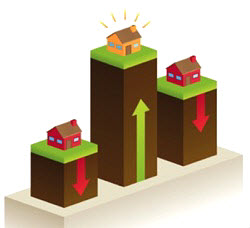
 The constant fluctuations of the housing market can mean many things in terms of property investment, rental rates and the life of a landlord. We know, for instance, that there is a higher percentage of renters in the United States than there has been in quite sometime. But what we haven’t addressed is that there are also more landlords.
