There’s been a lot of fuss on how the “fiscal cliff” will get the U.S. economy into trouble in 2013. For starters, here’s a thorough explanation of how it can impact the economy.
(Video published by the WSJ on Oct. 31, 2012.)
There’s been a lot of fuss on how the “fiscal cliff” will get the U.S. economy into trouble in 2013. For starters, here’s a thorough explanation of how it can impact the economy.
(Video published by the WSJ on Oct. 31, 2012.)
 A tax break that has long been untouchable could soon be in for some serious scrutiny. Many home buyers deduct their mortgage interest when assessing their tax bill, a perk that has helped bolster the income of millions of families – and the broader housing market. But as President Obama and Congress try to hash out a deal to reduce the budget deficit, the mortgage interest deduction will likely be part of the discussion.
Limits on a broad array of deductions could emerge in any budget deal. It is likely that any caps would be structured to aim at high-income households, and would diminish or end the mortgage tax break for many of those taxpayers.
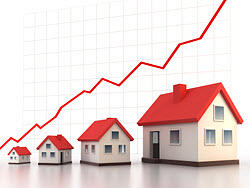 Home prices rose by 0.1% in September from the prior month and by 3.6% from one year ago, the largest gain in six years, according to a report released Monday by Lender Processing Services.
Compared with one year ago, prices are up by 17.7% in Phoenix, the largest gain among the nation’s 40 largest metro areas. Other notable year-over-year increases include Detroit (11.7%), Las Vegas (11.5%), San Jose, Calif. (11.3%), San Francisco (10%), and Sacramento (8.3%).
Among the top 40 metros, only a handful have posted year-over-year declines, led by St. Louis, which was down by 4.1%. Bridgeport, Conn., was down by 2.3%, while Chicago (-0.5%) and Cincinnati (-0.1%) also posted declines.
 I just locked down a 2.875% interest rate, fixed for the 15-year term of the mortgage. No points. With rates like these, I find myself rethinking the idea that I want to pay off my mortgage.
I can do a lot better than 2.875% investing the money. If I just sock it away in gold, I bet I’ll come out way ahead. Finding investments that clear such a low hurdle is not that difficult.
Right now is a great time to do this, if looked at from a historical perspective. The 10-year Treasury rate is 1.64% as I write. That is what investors are willing to accept to lend money to the US Treasury for a 10-year term. It seems absolutely crazy. But the Treasury rate we see is something of a forced smile.
 Wealthy foreigners from around the globe are taking advantage of America's housing bust to snap up U.S. properties at cut-rate prices — helping local markets rebound in the process.
“We've seen foreign investors buy $10 million to $20 million worth of property in a single trip,” says Peter Loewy of Los Angeles-based Teles Properties. “They think this is a good place to park money, and it's less expensive than their real estate back home.”
A recent National Association of Realtors (NAR) study estimated that foreigners and immigrants who've lived here less than two years spent $82.5 billion on U.S. investment property in the 12 months ended March 31, 2012. That's about 9% of the total paid for all U.S. housing purchases during the period.
 A big part of my job is helping our clients project the most likely scenarios for the housing market. Now that we know who will be President, my job just got easier because we have four years of experience with Obama and a divided Congress, so we know what we are getting.
 One way or another, Uncle Sam is going to get his cut. Count on it. And so will your state and local governments. That said, as you file taxes there are certain things you can do as a real estate investor to help manage your tax bill, and maximize your after-tax return on your investment.
In order to do so, however, you need to understand the primary ways in which investment real estate portfolios get taxed. You must also have a general grasp of some abstract concepts like calculating your tax basis, as well as the depreciation of capital investments. Hey, if this stuff were easy, we’d all be CPAs, right?
Warning: This article will only arm you with enough information to be dangerous. You can click on any of the links for more detailed information directly from the Internal Revenue Service. This article won't make you an expert. But you can become conversant with the basic terminology, so you can be better prepared for a meeting with your tax advisor.
 Sixty-five percent of U.S. housing markets are worse off today than they were four years ago according to the California-based real estate research firm RealtyTrac.
The results of the survey arrive the same day as the final presidential debate and just weeks before the general election.
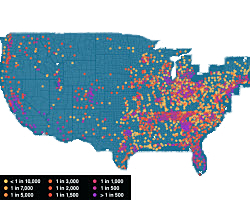 We've all heard that the housing bubble's pop led to thousands of foreclosures, but its interactive maps like this that really show how prevalent the problem was — and still is. Part of a project on 30 election issues, the map below uses data from RealtyTrac to display foreclosure rates by county.
The darker the color is, the higher the rate of foreclosure. You can see what each color represents in the legend on the lower left.
By pressing play, you can see how many more dots show up on the map, indicating a higher prevalence of foreclosures. But perhaps more disturbing, the map displaying the most recent data in July 2012 doesn't look much better than past maps: The crowded dots maintain the visual effect of a foreclosure epidemic.
 After nine consecutive months of appreciation, August was the first month where home values decreased by 0.1% to $152,100, according to Zillow.
2012 has seen a turnaround in the housing market with sustained appreciation that, at times, has been very strong. As we progress through the latter half of this year, we expect home values to see more volatility characterized by months of home value declines mixed with months of appreciation.
Overall, the positive trend will hold as evidenced by home values being up by 1.7% in August 2012 on a year-over-year basis. Rents continued to rise in August, appreciating by 0.2% from July to August. On an annual basis, rents across the nation are up by 5.9%, indicating that demand, fueled by elevated foreclosure levels, is still outpacing investor-driven increases in rental property supply.

