Norada Real Estate Investments

  • Home
  • Markets
  • Properties
  • Membership
  • Podcast
  • Learn
  • About
  • Contact

How Low Mortgage Rates Are Fueling Stronger Real Estate Returns in 2025

November 13, 2025 by Marco Santarelli

How Low Mortgage Rates Are Fueling Stronger Real Estate Returns in 2025

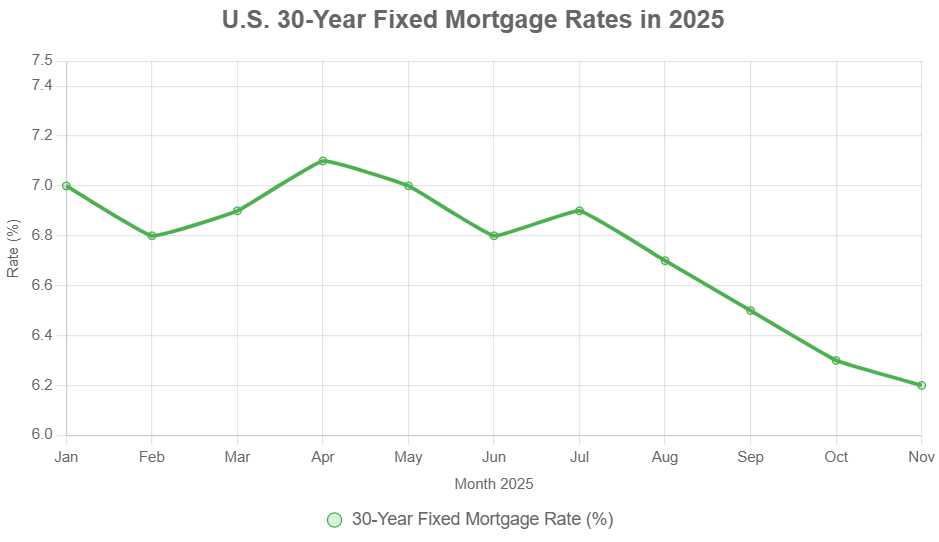
In these ever-changing economic times, owning rental properties has long been a solid way to build wealth, and right now, it's looking particularly appealing. As of late 2025, you'll notice that 30-year fixed mortgage rates have settled back down to hover around 6.2-6.3%, which is about as low as we've seen them all year, especially after they ticked above 7% earlier on.

This dip in rates is a fantastic chance for anyone thinking about becoming a landlord. It means you can lock in a more affordable loan, which leads to better cash flow from your rentals and helps you ride the wave of steady demand from people looking for homes, partly due to ongoing housing shortages and more people working remotely.

How Low Mortgage Rates Are Fueling Stronger Real Estate Returns

So, is this the perfect time to jump in? I'm here to walk you through everything—what's happening in the market, the money benefits, how to get started, where the best places to invest are, how to make sure you're getting a good return, the tax advantages, and what risks to watch out for, so you can make the best decision for yourself.

Here’s the straight-up answer: Yes, with mortgage rates near their yearly lows in late 2025, investing in rental properties presents a significantly attractive opportunity for building long-term wealth.

Why Low Mortgage Rates Are a Big Deal for Rental Property Investors

Think about it: the interest rate on your mortgage is one of the biggest costs of owning a rental property. When rates go down, the cost of borrowing money goes down too, which directly affects how much money you make from your investment. All through 2025, we've seen rates ease up a bit from their higher points, thanks to things like inflation cooling down and signals from the Federal Reserve.

Right now, the average 30-year fixed mortgage rate is sitting pretty around 6.22%, according to Freddie Mac's weekly survey. Even for investment properties, which usually have rates about 0.5% to 1% higher than for your primary home, this is still a huge improvement from the 7%+ you might have seen mid-year. This stability near the year's lows means you're borrowing money at a much cheaper rate.

This is where leverage comes into play. That’s a fancy term for using borrowed money to increase your potential return. When debt is cheaper, you can finance more of the property's cost. This means the money you put in (your down payment) can potentially generate a much bigger return. Let’s look at a quick example: Say you’re buying a $300,000 property and putting down 20% ($60,000).

If your mortgage rate drops from 7% to 6.25%, your monthly payment on that loan will be about $150 less. That extra $150 each month could be used for property upkeep, saved for emergencies, or just add to your profit. Historically, when rates have been this low, we’ve seen a real boom in rental property investments, much like what happened after 2020 when rates dipped below 3%.

To give you a visual, here’s how mortgage rates have been trending in 2025:

chart of approximate monthly averages for the 30-year fixed rate:

This downward trend really suggests that if the economy keeps improving, rates might even soften further, making 2025 an excellent year to start investing in rental properties.

Putting Your Money to Work: Key Benefits of Renting in a Low-Rate Era

Investing in rental properties is more than just collecting rent checks. It’s about building long-term wealth, creating a stream of income that can grow over time, and having an asset that often holds its value, even when other investments get shaky. Low mortgage rates make these benefits even stronger:

  • Better Cash Flow: When your monthly interest payment is lower, more of the rent you collect stays in your pocket as profit. For example, on a $250,000 loan, the difference between a 7% and a 6.25% rate can save you over $1,800 a year. That’s money that directly boosts your Net Operating Income (NOI).
  • Leverage and Growth: Affordable loans allow you to buy more properties sooner. This diversifies your investment (if one property has a problem, others can cover it) and lets you grow your wealth faster through rent and property appreciation.
  • An Inflation Buffer: Rents typically go up over time, often keeping pace with or even beating inflation. If you have a fixed-rate mortgage, your biggest loan payment stays the same. This means your rental income grows faster than your primary expense, a concept known as positive leverage.
  • Long-Term Appreciation: Real estate, especially in growing areas, tends to increase in value over time. We often see annual increases of 3-5%, which can turn your initial investment into a much larger amount of equity over a decade or more.

Compared to something like stocks or bonds, rental properties are a tangible asset. You can see them, touch them, and have more control over them. Plus, there are significant tax breaks. Now, it does take more work than just clicking a buy button on a stock, but for many of us, the rewards are well worth it. In 2025, with many people still working remotely and seeking out different living situations, vacancy rates are generally low, around 6-7% nationally, meaning your properties are likely to be occupied.

First Steps: A Simple Guide to Becoming a Landlord

Getting started in rental property investing might seem daunting, but when mortgage rates are friendly, it makes the initial hurdle feel much lower. Here’s how I usually advise people to begin:

  1. Get Your Finances in Order: For investment properties, lenders usually want to see around a 20-25% down payment, plus you should have enough saved to cover 3-6 months of expenses (like mortgage, taxes, insurance) for each property. A credit score of 700 or higher will help you get the best rates, often closer to 6.75% for non-owner-occupied loans.
  2. Decide on the Type of Property: If you’re new to this, a single-family home is often the easiest to manage. If you want to maximize your income on each dollar invested, look at multifamily properties like duplexes or triplexes.
  3. Line Up Your Financing: Don't just go with the first lender you talk to. Shop around for banks or mortgage brokers that specialize in investment property loans. While FHA loans can be a good option for owner-occupied properties with lower down payments, they usually have limits on units and aren't ideal for pure investment. Conventional loans offer more flexibility.
  4. Do Your Homework: Before buying, hire a professional inspector to check for any hidden problems. Use online tools like Zillow or Redfin to see what similar homes have sold for, and use sites like Rentometer to get a good idea of what you can realistically charge for rent in the area.
  5. Figure Out Management: You can manage the property yourself, which saves money but takes time. Or, you can hire a property management company. They typically charge 8-10% of the monthly rent but handle everything from finding tenants to dealing with repairs.

My advice? Start small. Maybe it's a modest home in a stable neighborhood for around $200,000. That allows you to learn the ropes without betting the farm.

Prime Locations: Where to Invest for the Best Returns in 2025

Location, location, location – it’s the oldest saying in real estate for a reason. But where should you look? Right now, cities in the Sun Belt are really popular because lots of people are moving there for jobs and a lower cost of living. On the flip side, many cities in the Midwest offer fantastic rental yields because property prices are lower, but demand is steady. I'd suggest being a bit cautious about areas that have seen a lot of new construction, as those markets can get crowded. Instead, focus on places with balanced growth.

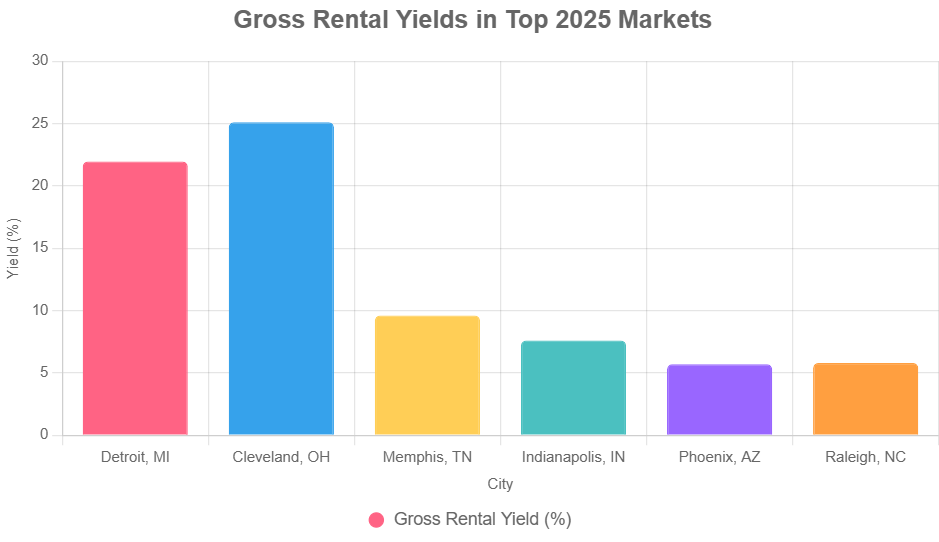
Here's a look at some top U.S. markets that are currently showing strong potential for rental properties in 2025, considering things like how much rent you can earn compared to the property price (gross rental yield), potential for the property's value to go up (appreciation), and how long it typically takes to find a tenant (vacancy rate):

City/State Avg. Home Price Avg. Monthly Rent Gross Yield (%) Annual Appreciation (%) Vacancy Rate (%) Key Driver
Detroit, MI $71,500 $1,308 21.95 4.5 5.2 Industrial revival, low costs
Cleveland, OH $85,000 $1,200 25.1 3.8 6.0 Affordable Midwest entry
Memphis, TN $150,000 $1,200 9.6 5.2 4.8 Logistics boom, cash flow
Indianapolis, IN $220,000 $1,400 7.6 4.0 5.5 Hybrid growth, job market
Phoenix, AZ $380,000 $1,800 5.7 6.1 6.2 Sunbelt migration
Raleigh, NC $350,000 $1,700 5.8 5.5 4.9 Tech hub expansion

Data from various market analyses; gross yield calculated as (annual rent / home price) x 100.

To help you see how these cities stack up on rental income potential

Prime Markets: Where to Buy for Maximum Returns in 2025

If you're after strong monthly cash flow, cities like Detroit and Cleveland are looking very good. If you're more focused on the property value increasing over time, places like Phoenix and Raleigh might be a better fit.

Doing the Math: How to Figure Out Your Rental Property ROI

Before you hand over any money, it’s crucial to understand your potential Return on Investment (ROI). This tells you how profitable your investment is. Here are the key numbers I always look at:

  • Cash-on-Cash Return: This is probably the most important for rental properties. It’s your annual pre-tax cash flow divided by the total cash you invested (down payment, closing costs, initial repairs).
    • Formula: (Annual Pre-Tax Cash Flow / Total Cash Invested) x 100.
    • Example: If you made $15,000 in profit and put down $100,000 total, your cash-on-cash return is 15%.
  • Capitalization Rate (Cap Rate): This helps you compare different properties, regardless of how you finance them. It’s your Net Operating Income (NOI – income after operating expenses but before mortgage payments) divided by the property’s value.
    • Formula: (Net Operating Income / Property Value) x 100.
    • Example: On a $200,000 property with an NOI of $12,000, the cap rate is 6%.
  • Overall ROI: This considers both the cash flow you received and any profit when you sell the property.
    • Formula: (Total Profit from Property – Initial Investment) / Initial Investment x 100.

Let’s crunch some numbers for a hypothetical $250,000 duplex in Indianapolis.

  • Assume a 20% down payment ($50,000) plus $5,000 in closing costs, for a total cash invested of $55,000.
  • Let's say you rent it for $2,000 per month, but after accounting for vacancies, maintenance, property taxes, and insurance, your actual rent collected after expenses (but before mortgage) is closer to $1,400/month, assuming mortgage payments with a 6.5% rate.
  • This gives you an annual cash flow of $1,400 x 12 = $16,800.
  • If the property appreciates by 4% in the first year, that’s an additional $10,000 in value.
  • So, in year one, you've received $16,800 in cash flow and gained $10,000 in equity. Your total return relative to your $55,000 investment is quite high. This calculation shows the power of well-chosen investments.

There are great online calculators, like those on BiggerPockets, that can help you figure this out more precisely. Generally, I look for a cash-on-cash return of at least 8-12% on a rental property, especially in today's market. Those lower mortgage rates really help boost this number by reducing your debt service.

Tax Sweeteners: How Landlords Save Money on Taxes

One of the biggest draws of owning rental properties is the tax advantages. The U.S. tax code is pretty friendly to landlords. Here are some of the best deductions you can take:

  • Mortgage Interest Deduction: You can usually deduct the full amount of interest you pay on your investment property's mortgage. This is often your largest deduction.
  • Depreciation: This is a powerful, non-cash deduction. The IRS allows you to deduct a portion of the property's value (excluding land) over its useful life. For residential properties, this is typically 3.636% per year for 27.5 years. It reduces your taxable income without you having to spend more money.
  • Operating Expenses: Pretty much every cost associated with running your rental property is deductible. Think repairs, maintenance, property insurance, property taxes, property management fees, travel to the property, and even supplies.
  • 1031 Exchanges: This is a strategic way to grow your portfolio. If you sell an investment property, you can defer paying capital gains taxes by reinvesting the profit into a “like-kind” property.
  • No Social Security/Medicare Taxes: Unlike regular wages where you pay these payroll taxes, rental income is generally exempt from them. This can save you a significant amount.

Seriously, talking to a Certified Public Accountant (CPA) who specializes in real estate is one of the smartest moves you can make. These deductions can often lower your effective tax rate by 20-30%.

Watching Out for Pitfalls: Risks and How to Protect Yourself

Like any investment, owning rental properties isn't without its risks. It’s important to be aware of potential problems and have a plan to deal with them.

  • Vacancy and Tenant Problems: The biggest risk is having a property sit empty for too long, meaning no income but still having to pay bills. Another issue is tenants who don't pay rent or damage the property. To guard against this, be very thorough in screening tenants – check credit, background, and references – and price your rent competitively, perhaps 5-10% below market to attract good renters quickly.
  • Rising Expenses: While rents tend to go up, so do costs. Maintenance and repair costs can creep up (a general rule is to budget 1-2% of the property value annually for upkeep). Property taxes and insurance can also increase, sometimes by 10-15% in certain areas. Always budget conservatively; I often advise clients to expect expenses to be around 50% of their gross rental income.
  • Market Changes: Economic downturns or sudden interest rate hikes (though unlikely right now) could slow down property appreciation or even lead to value decreases. New local regulations, like rent control laws, can also impact your profitability.
  • Liquidity Issues: Real estate isn't like stocks; you can't sell it instantly. If you need cash fast, especially during a down market, you might have to sell at a loss. This is why diversification and having cash reserves are so important.

My best advice for weathering any storm? Diversify your investments. Don't put all your eggs in one basket. If possible, aim to own 3-5 properties in different areas or even different types of property. Make sure you have adequate insurance for everything, and always, always maintain a healthy cash reserve – having 6 months of operating expenses set aside is a good target. Even with these risks, the strong demand for rentals, with rents increasing 3-4% year-over-year in many areas, still makes it a favorable market.

The Takeaway: Timing is Everything, But Be Smart About It

Right now, with mortgage rates sitting at their 2025 lows, buying rental properties offers a really compelling mix of generating income, growing your wealth over time, and having a solid, tangible asset. It can be a much more stable option than riding the rollercoaster of the stock market.

The key to success, however, always comes down to doing your research, picking the right location, and being smart and careful with your money. Whether you're drawn to the high yields in places like Detroit or the growth potential in Raleigh, make sure you educate yourself and have a solid plan in place before you make a move. Real estate has always been an investment that rewards those who are prepared, and in this current market window, the prepared investor has a fantastic opportunity to really thrive.

As Mortgage Rates Drop, Investors Are Locking in Long-Term Gains

With rates near their lowest point in a year, investors are seizing the moment to finance rental properties that deliver strong monthly cash flow and long-term appreciation.

Norada Real Estate helps you capitalize on this window with fully managed turnkey rentals in stable, high-demand markets—so you can build wealth while borrowing costs stay favorable.

🔥 HOT NEW LISTINGS JUST ADDED! 🔥

Talk to a Norada investment counselor today (No Obligation):

(800) 611-3060

Get Started Now

Recommended Read:

  • Is Turnkey Real Estate Profitable in a High-Interest Rate Environment?
  • Why Turnkey Real Estate Still Beats Today's High Mortgage Rate Climate
  • Best Places to Invest in Single-Family Rental Properties in 2025
  • Why Real Estate Can Thrive During Tariffs Led Economic Uncertainty
  • Rise of AI-Powered Hyperlocal Real Estate Marketing in 2025
  • Real Estate Forecast Next 5 Years: Top 5 Predictions for Future
  • 5 Hottest Real Estate Markets for Buyers & Investors in 2025
  • Will Real Estate Rebound in 2025: Top Predictions by Experts
  • Recession in Real Estate: Smart Ways to Profit in a Down Market
  • Will There Be a Real Estate Recession in 2025: A Forecast
  • Will the Housing Market Crash Due to Looming Recession in 2025?
  • 4 States Facing the Major Housing Market Crash or Correction
  • New Tariffs Could Trigger Housing Market Slowdown in 2025
  • Real Estate Forecast Next 10 Years: Will Prices Skyrocket?

Filed Under: Real Estate, Real Estate Investing, Real Estate Market Tagged With: mortgage rates, Real Estate Investing, Real Estate Returns, Rental Properties

Is Turnkey Real Estate Profitable in a High-Interest Rate Environment?

October 31, 2025 by Marco Santarelli

Is Turnkey Real Estate Profitable in a High-Interest Rate Environment?

It’s a question I hear almost every day from new and even seasoned investors: With interest rates where they are, does real estate investing even make sense anymore? Specifically, is turnkey real estate investing in high-interest rate environments still profitable or worth it? The short answer is a resounding yes, but the game has changed. The strategies that worked when rates were at 3% are not the same ones that will lead to success today. The days of easy money and guaranteed appreciation are behind us, but for the smart, disciplined investor, this new era presents a unique and powerful opportunity.

Is Turnkey Real Estate Profitable in a High-Interest Rate Environment?

First, What Exactly Is Turnkey Investing? A Quick Refresher

Before we dive into the deep end, let's make sure we're on the same page. Turnkey real estate investing is a strategy where you buy a property that is ready to be rented out from day one. In many cases, it has already been renovated, has a tenant in place, and even comes with a property management company to handle the day-to-day operations.

The appeal is obvious: it's designed to be a relatively hands-off way to generate passive income from real estate without the headaches of swinging a hammer or screening tenants at midnight. You’re essentially buying a cash-flowing machine. But when the cost of the fuel for that machine—the mortgage—goes up, does the machine still run a profit?

The Elephant in the Room: Today's Interest Rate Reality

Let’s not sugarcoat it. Higher interest rates make investing harder. A higher rate means a higher monthly mortgage payment, which directly eats into your potential cash flow. It’s simple math.

To understand where we are, let's look at the real numbers. The data from late October 2025 shows a complex but cautiously optimistic picture.

Freddie Mac Primary Mortgage Market Survey® (as of 10/30/2025)

Loan Type Average Rate 52-Week Range
30-Year Fixed-Rate 6.17% 6.17% – 7.04%
15-Year Fixed-Rate 5.41% 5.41% – 6.27%

As you can see, rates have come down from their peaks of over 7%, which is a relief. However, a rate in the low 6% range is still significantly higher than the sub-3% rates we saw just a few years ago.

Adding to this, the Federal Reserve is sending mixed signals. In their last meeting, they cut the benchmark rate, which is good news for borrowing costs. However, Fed Chair Powell was cautious, suggesting that future cuts aren't guaranteed.

  • What this means for you: Don't expect a sudden crash back to 3% mortgage rates. We are likely in for a period of rate stability, or a slow, bumpy decline. This “new normal” of 5.5% to 6.5% rates is what we need to build our strategy around.

Why Turnkey Investing Shines in This Environment

This might sound counterintuitive, but the current market conditions can actually make turnkey a better strategy than traditional flipping or BRRRR (Buy, Rehab, Rent, Refinance, Repeat). Here’s my take on why.

1. Less Competition and More Negotiating Power High interest rates have scared a lot of people away. The casual, “get-rich-quick” investors have left the market. This is fantastic news for you. With fewer buyers competing for properties, sellers are more willing to negotiate on price. In my experience, a 2-3% price reduction can often completely offset the impact of a 1% increase in interest rates over the life of the loan. You couldn't get those discounts when 20 buyers were bidding on every house.

2. The “Date the Rate, Marry the Property” Mantra This has become a cliché for a reason—it’s true. You are buying a physical asset for the long term. The interest rate you lock in today is temporary. The Federal Reserve's recent actions signal that they are shifting towards an easing cycle. It may not be immediate, but rates are far more likely to be lower in 2-5 years than they are today.

You can buy a great property at a fair price today and then refinance into a lower rate down the road. This move alone can dramatically boost your monthly cash flow in the future.

Let’s look at a simple example on a $200,000 loan:

Interest Rate Monthly P&I Payment Potential Savings
6.25% (Today) $1,231 –
4.75% (Future Refi) $1,043 $188/month

That's an extra $2,256 in your pocket every year, just by refinancing when the time is right.

3. Cash Flow Is Still King, But It's Hiding In a high-rate environment, you can't just throw a dart at a map and expect to find a cash-flowing property. You have to be more selective. This is where a good turnkey provider earns its keep. They operate in markets where the rent-to-price ratio still makes sense. Think solid Midwest or Southern markets where you can buy a home for $180,000 that rents for $1,600/month, not coastal cities where a $700,000 condo rents for $3,000.

While your cash flow might be thinner initially—say $150-$250 a month instead of the $400-$500 you saw in 2021—it's still positive cash flow. And that cash flow is protected from inflation.

4. The Ultimate Inflation Hedge Inflation remains a concern, even as the Fed works to control it. Here's the magic of a fixed-rate mortgage: your largest expense—the principal and interest payment—is locked in for 30 years.

  • Your payment stays the same.
  • Meanwhile, inflation pushes everything else up: rent, wages, and the value of the property itself.

Every year, the rent goes up 3-5%, but your mortgage payment doesn't. Your cash flow grows organically over time, making it a powerful long-term wealth-building tool.

The New Playbook: How to Win with Turnkey Investing Today

To succeed now, you need to adjust your approach. Here’s the playbook I'm using and advising others to follow.

Stress-Test Your Numbers Ruthlessly

Hope is not a strategy. When you analyze a turnkey property, you need to be conservative—even borderline pessimistic.

  • Vacancy: Don't assume the property will be rented 12 months a year. Use an 8% vacancy rate (about one month per year) in your calculations.
  • Repairs & Maintenance: Budget at least 5-8% of the gross monthly rent for this. Things will break.
  • Capital Expenditures (CapEx): This is for the big stuff—roof, HVAC, water heater. Set aside another 5-8% for these future expenses.
  • Property Management: This is typically 8-10% of the gross rent.

If the property still cash flows after all these expenses, you have found a potential winner. If it's barely breaking even on paper, walk away. The margins are too thin.

Focus on Quality Markets and Neighborhoods

Now more than ever, where you invest matters. I'm focusing on markets with three key ingredients:

  1. Job Growth: A diverse and growing economy brings in new tenants.
  2. Population Growth: More people mean more demand for housing.
  3. Landlord-Friendly Laws: You need to be in a state that has a fair and efficient eviction process, just in case.

Within those markets, I look for solid B-class neighborhoods. These are not the fanciest areas, but they are full of well-maintained homes, good schools, and a strong base of working-class and middle-class tenants. They offer the perfect balance of affordability and rental demand.

Vet Your Turnkey Provider Like a Hawk

In a challenging market, your team is your most valuable asset. A great turnkey company is more than just a property seller; they are your long-term partner. Ask them the tough questions:

  • What is your track record? Can I speak to some of your past clients?
  • Who handles the property management? Is it in-house or outsourced?
  • What is your process for tenant screening?
  • Can I see the full scope of work for the renovation?
  • What are your fees and how are they structured?

A transparent, experienced provider will welcome these questions. If they get defensive or vague, that's a major red flag.

Final Thoughts: Is It Still Worth It?

Let's circle back to our main question: Turnkey investing in high-interest rate environments—still profitable or worth it?

Absolutely. But it requires a shift in mindset. This is no longer a market for speculators looking for rapid appreciation. This is a market for investors—people who are focused on buying solid assets in good locations that produce a steady, reliable, and growing stream of income over the long term.

The higher rates have cleared out the noise and created opportunities for those willing to do their homework. You can get better prices, you have more negotiating power, and you're buying an asset that will protect you from inflation and build generational wealth. It takes more work, more diligence, and a bit more courage, but the rewards are as real as they've ever been. Don't let the headlines scare you from building your future.

Build Wealth with Turnkey Real Estate — Even in a High-Rate Market

High interest rates don’t have to hold you back. Turnkey rental properties still deliver steady cash flow and long-term appreciation—especially in markets with strong rental demand and job growth.

Work with Norada Real Estate to identify profitable, cash-flowing markets that thrive even when borrowing costs rise—so your investments stay strong and stress-free.

NEW TURNKEY DEALS JUST ADDED!

Talk to a Norada investment counselor today (No Obligation):

(800) 611-3060

Get Started Now

Recommended Read:

  • Why Turnkey Real Estate Still Beats Today's High Mortgage Rate Climate
  • Best Places to Invest in Single-Family Rental Properties in 2025
  • Why Real Estate Can Thrive During Tariffs Led Economic Uncertainty
  • Rise of AI-Powered Hyperlocal Real Estate Marketing in 2025
  • Real Estate Forecast Next 5 Years: Top 5 Predictions for Future
  • 5 Hottest Real Estate Markets for Buyers & Investors in 2025
  • Will Real Estate Rebound in 2025: Top Predictions by Experts
  • Recession in Real Estate: Smart Ways to Profit in a Down Market
  • Will There Be a Real Estate Recession in 2025: A Forecast
  • Will the Housing Market Crash Due to Looming Recession in 2025?
  • 4 States Facing the Major Housing Market Crash or Correction
  • New Tariffs Could Trigger Housing Market Slowdown in 2025
  • Real Estate Forecast Next 10 Years: Will Prices Skyrocket?
Filed Under: Real Estate, Real Estate Investing, Real Estate Market Tagged With: Real Estate Investing, Rental Properties, Turnkey Real Estate

Single-Family Rentals Predicted to Appreciate 2.5% Annually in 2025

August 17, 2025 by Marco Santarelli

Single-Family Rentals Predicted to Appreciate 2.5% Annually in 2025

If you're thinking about investing in or are currently owning single-family rental homes, you'll want to pay attention to the latest projections from Zillow. My take on it is that single-family rental homes are now expected to appreciate 2.5% annually, according to Zillow's revised forecast. This is a key piece of information for anyone navigating the rental property market, and it tells us that while the rapid rent hikes we've seen might be cooling, rental income is still projected to grow steadily.

Single-Family Rental Homes: A 2.5% Annual Appreciation Forecast

For a while now, it seems like rents have been on a bit of a rollercoaster. We’ve experienced some pretty significant jumps, making it a challenging time for renters and a potentially lucrative one for landlords. However, the market is always shifting, and understanding these shifts is crucial for making smart investment decisions. Zillow's latest outlook suggests a normalization of sorts, with a more predictable, though still positive, rate of appreciation for single-family rentals.

What Does This 2.5% Appreciation Mean for You?

When Zillow talks about appreciation, they're essentially forecasting how much the value of these rental homes is likely to increase over time, driven largely by rental income growth. A healthy rent growth rate translates into higher returns for property owners. This 2.5% annual increase, while not the explosive growth some might have hoped for, is a solid, sustainable rate. It means that if you own a single-family rental home valued at, say, $300,000, you could expect its value to increase by about $7,500 in a year, before accounting for any appreciation in the broader housing market.

It's important to remember that this figure is a forecast, an educated guess based on models and current economic trends. What I find particularly interesting is how Zillow arrives at these numbers. They don't just look at what new tenants are being asked to pay. They factor in how many people move, how many renew their leases, and how landlords adjust rents for those long-term tenants. This is a much more nuanced view than just looking at the “on-market” rent changes.

Deconstructing the CPI and Rent Data

To truly understand the 2.5% figure, it helps to peel back the layers a bit and look at the underlying data, especially concerning the Consumer Price Index (CPI). You might see headlines about inflation, and housing costs are a big part of that. The CPI has two main measures that are relevant here: Owner's Equivalent Rent (OER) and Rent of Primary Residence.

  • Owner’s Equivalent Rent (OER): This is a bit of a theoretical measure. It tries to estimate what homeowners would pay to rent their own homes. Zillow predicted a 0.31% increase in OER for July, and the actual release showed a slight dip to 0.28%. While the July number was a tad lower than expected, the overall trend for OER is forecasted to decelerate. Zillow expects OER to finish the year up 3.4% year-over-year, but then take a significant dive to a 1.9% increase in 2026.
  • Rent of Primary Residence: This is a more direct measure of what people are actually paying in rent. Zillow had anticipated a 0.18% rise for July, but the actual figure came in a little higher at 0.26%. What's crucial here, and what I find more telling, is that since April, the pace of rent growth has actually slowed down by over a full percentage point. Zillow's forecast for this measure to end the year up 2.7% year-over-year, with a sharp fall to just 0.6% in 2026, really points to a softening in the rental market.

While the CPI measures are slightly different from Zillow’s on-market rent growth forecasts, they are linked. The CPI figures often lag a bit because they include rent changes for existing tenants who might not face market rates as frequently as new renters. This is why the 2.5% appreciation forecast for single-family rentals, which is based on Zillow’s Observed Rent Index (ZORI), is so important. It reflects the current rental market dynamics more directly.

Why the Deceleration in Rent Growth?

Several factors contribute to this expected slowdown in rent appreciation. One of the biggest drivers is the significant deceleration in market rents over the past few months. Think about it: when demand for rentals cools down, or when the supply of available rental properties increases, landlords can't just keep raising rents indefinitely.

We've also seen softening growth in market rents, and this will likely continue to put downward pressure on housing prices within the CPI over time. It’s a bit of a balancing act. For a while, housing costs were a major contributor to inflation across the board. Now, it seems like their impact is moderating.

Another element to consider is the broader economic picture. Factors like interest rate changes, or even shifts in consumer spending due to things like tariffs on goods, can influence the overall demand for housing. When people have less disposable income or face higher borrowing costs, they tend to be more price-sensitive when it comes to rent.

My Perspective: A Reality Check and a Strategic Opportunity

From my experience in real estate, these kinds of adjustments are normal. The market doesn't go up in a straight line forever. What Zillow's forecast suggests is a return to a more stable, predictable appreciation rate for single-family rental homes. This is actually a good thing for long-term investors.

  • Stability is Key: While 8-10% annual rent growth might grab headlines, it's often not sustainable. A 2.5% appreciation rate, combined with a solid rental yield, can provide a very healthy passive income stream with less risk.
  • Cash Flow Focus: With moderating rent growth, the focus for investors might shift even more towards ensuring strong cash flow from properties. This means looking at the numbers carefully: mortgage payments, property taxes, insurance, maintenance, and vacancy rates.
  • The Single-Family Advantage: I still see a lot of value in single-family rentals compared to, say, larger apartment buildings. They often attract longer-term tenants, have lower turnover, and can be less susceptible to the massive rent swings sometimes seen in multi-unit properties. The 2.5% forecast for single-family homes versus a projected 1.0% for apartments further highlights this potential advantage.
  • Long-Term Outlook: The forecast of significantly lower rent increases in 2026 (0.6% for Rent of Primary Residence) is a key takeout. This doesn't mean rents will fall, but the rapid acceleration is over, ushering in a period of much slower growth. This is important for cash flow projections and for understanding future profitability.

The Mechanics Behind the Numbers: Zillow's Methodology

It's always good to know how these predictions are made. Zillow's model uses its own Observed Rent Index (ZORI) and looks at the relationship between “on market” rents and the CPI shelter components I mentioned. My understanding of their approach includes:

  • Expected On-Market Rent Growth: This is primarily driven by Zillow's own rental forecast data (ZORF).
  • Lease Renewal Assumptions: They calculate how often landlords increase rents when leases are renewed.
  • Renter Mobility: This factor considers how many tenants move each year, which determines how many are exposed to new, potentially higher, market rents.

This multi-faceted approach gives a more realistic picture than just looking at one data point. It accounts for the fact that not everyone's rent goes up at the same time or by the same amount.

Implications for Investors and Renters

For those looking to acquire single-family rental homes, this forecast signals a market that is stabilizing. It's a time to focus on fundamentals: location, property condition, and conservative financial projections. While the days of astronomical yearly rent increases may be behind us for now, the steadier appreciation of 2.5% annual growth provides a reliable foundation for building wealth through real estate.

For renters, this projected slowdown in rent growth is welcome news. It means the pressure on household budgets might ease, allowing for greater financial stability. However, it's still crucial to budget wisely, as rents are not expected to decrease, merely to grow at a more moderate pace.

Looking Ahead: What to Monitor

The real estate market is dynamic. While Zillow's forecast provides a valuable insight, it's essential to keep an eye on unfolding economic events. We need to watch:

  • Interest Rate Policies: Changes in interest rates can significantly impact the cost of mortgages for both buyers and investors, as well as potentially influence tenant spending power.
  • Housing Supply: An increase in the supply of available rental homes can naturally lead to more modest rent growth.
  • Economic Stability: Overall economic health, job growth, and consumer confidence all play a role in housing demand.
  • Inflation Trends: While housing inflation is expected to moderate, broader inflation trends can still affect the cost of property ownership (taxes, insurance, maintenance) and the overall purchasing power of renters.

The projected deceleration in CPI housing inflation measures through late 2025 and 2026, driven by the softening in market rents, is a significant development. The 2.5% annual appreciation forecast for single-family rental homes from Zillow is a key data point in this evolving picture, suggesting a more predictable and potentially sustainable period ahead for real estate investors.

Real Estate Investment in the Top U.S. Markets

Discover high-quality, ready-to-rent properties designed to deliver consistent returns.

Contact us today to expand your real estate portfolio with confidence.

Contact our investment counselors (No Obligation):

(800) 611-3060

Get Started Now 

Also Read:

  • Best Places to Invest in Single-Family Rental Properties in 2025
  • Why Real Estate Can Thrive During Tariffs Led Economic Uncertainty
  • Rise of AI-Powered Hyperlocal Real Estate Marketing in 2025
  • Real Estate Forecast Next 5 Years: Top 5 Predictions for Future
  • 5 Hottest Real Estate Markets for Buyers & Investors in 2025
  • Will Real Estate Rebound in 2025: Top Predictions by Experts
  • Recession in Real Estate: Smart Ways to Profit in a Down Market
  • Will There Be a Real Estate Recession in 2025: A Forecast
  • Will the Housing Market Crash Due to Looming Recession in 2025?
  • 4 States Facing the Major Housing Market Crash or Correction
  • New Tariffs Could Trigger Housing Market Slowdown in 2025
  • Real Estate Forecast Next 10 Years: Will Prices Skyrocket?

Filed Under: Housing Market, Real Estate Market Tagged With: Rental Properties, Single-Family Homes, Single-Family Rentals

Why are Billionaires Buffett and Trump Bullish on Real Estate Right Now?  (Part 2)

May 21, 2012 by Marco Santarelli

In Why are Billionaires Buffett and Trump Bullish on Real Estate Right Now? part 1, we stated that the Federal Reserve is committed to stable, steady long-term inflation.

But what about all this talk of hyper-inflation?

There are some doom-and-gloomers out there heralding hyper-inflation.  Hyper-inflation means you wake up in the morning and a pound of coffee is $5, but when you go back that afternoon, it’s $7 and by the following morning it’s $10.  In other words, the dollar is in free fall and it takes more and more dollars to buy the same goods and services.  It’s happened many times in other countries in just the last 50 years.  It’s ugly, especially for those who don’t know how to see it coming, how to prepare and what to do when it happens.

Now we understand the argument for hyper-inflation and it’s a good one.  So let’s take a look at why real estate right now makes so much sense.

[Read more…]

Filed Under: Economy, Housing Market, Real Estate Investing Tagged With: Donald Trump, Economy, Foreclosures, Housing Market, Inflation Hedge, Investment Properties, Real Estate Investing, Real Estate Market, Rental Properties, Warren Buffett

Why are Billionaires Buffett and Trump Bullish on Real Estate Right Now?

May 15, 2012 by Marco Santarelli

When we interviewed Donald Trump a couple of weeks ago, he told us that NOW is a great time to get into real estate – and he specifically pointed to houses.

Fellow billionaire, Warren Buffett, appeared on CNBC a couple of months ago and essentially said the same thing.  In fact, he said if there was an efficient way to do it, he'd like to buy 200,000 single family homes!

You may or may not agree with them at first blush, but when two billionaires (neither of whom are trying to sell you houses) both say the same thing, it's probably worth taking a closer look, don't you think?

[Read more…]

Filed Under: Economy, Housing Market, Real Estate Investing Tagged With: Donald Trump, Economy, Foreclosures, Housing Market, Inflation Hedge, Investment Properties, Real Estate Investing, Real Estate Market, Rental Properties, Warren Buffett

Commodity Investing through Residential Real Estate

October 6, 2009 by Marco Santarelli

For most people, it is difficult to read through a financial newspaper or watch late night television without seeing repeated (possibly obnoxious) exhortations to invest in commodities such as gold or silver. The logic of these advertisements is frequently sound, since it is certainly true that government irresponsibility is leading toward a currency collapse and massive inflation.

What frequently gets left out of the analysis are the other options available for investment that offer far greater prospects for return than gold or silver.

We are in absolute agreement over the prospect for commodity price inflation in the future. We are in absolute agreement over the massive deficits, crushing debt, and lax monetary policy of the government being a harbinger of runaway inflation over the coming decades. We are also in agreement over the dimming long-term prospects for the stock market, since there doesn't appear to be a new pool of investment capital to propel the stock market into an upward spiral like the one experienced over the last 25 years.

The strategy that we advocate is to use the attributes of rental real estate to invest in the commodities used for home construction. By following this strategy, we gain ownership of valuable commodities such as wood, concrete, petroleum products, and other building materials with the advantage of leverage from the bank and tax advantages from the government. We affectionately refer to this phenomenon as ‘packaged commodity' investing because the commodity products are packaged into a residential home instead of sitting in a warehouse. The culmination of this strategy lies in the fact that commodities packaged into real estate investments can be rented to tenants. As an investor, this allows you to purchase commodity products while outsourcing the interest payments to a tenant and hedge against inflation with fixed rate debt, while delaying the payment of taxes through a section 1031 exchange.

[Read more…]

Filed Under: Housing Market, Real Estate Investing Tagged With: Commodity Investing, Gold Investing, Income Properties, Real Estate Investing, Rental Properties

  • « Previous Page
  • 1
  • 2
  • 3
  • 4

Real Estate

  • Birmingham
  • Cape Coral
  • Charlotte
  • Chicago

Quick Links

  • Markets
  • Membership
  • Notes
  • Contact Us

Blog Posts

  • Today’s Mortgage Rates, April 21: 30-Year Fixed at 6.05% as Bond Market Holds Steady
    April 21, 2026Marco Santarelli
  • 30-Year Fixed Mortgage Rate Drops Steeply to a Four-Week Low
    April 21, 2026Marco Santarelli
  • Houston Housing Market: Trends and Forecast 2026
    April 21, 2026Marco Santarelli

Contact

Norada Real Estate Investments 30251 Golden Lantern, Suite E-261 Laguna Niguel, CA 92677

(949) 218-6668
(800) 611-3060
BBB
  • Terms of Use
  • |
  • Privacy Policy
  • |
  • Testimonials
  • |
  • Suggestions?
  • |
  • Home

Copyright 2018 Norada Real Estate Investments

Loading...