Norada Real Estate Investments

  • Home
  • Markets
  • Properties
  • Membership
  • Podcast
  • Learn
  • About
  • Contact

How to Boost Your Real Estate Returns With a Self-Directed IRA?

June 1, 2025 by Marco Santarelli

How to Boost Your Real Estate Returns With a Self-Directed IRA?

Robert Kiyosaki coined a timeless piece of wisdom in the form of this quote:

“Most people fail to realize that in life, it’s not how much money you make, it’s how much money you keep.” ~ Robert Kiyosaki

It is quite often the case when people make a lot of money but find it difficult to keep it with them.  Taxes, inflation, market movements, and mismanaged investments are among some of the common culprits.

While discussing wealth preservation, it is hard to overrule real estate as one of the finest methods to pass on wealth through the generations.  Being a real estate investor, you not only get to own a physical asset and receive rental income, but with careful planning/structuring, you can create a stable source of income for your retirement.  It’s a very common practice among realtors and investors to keep some properties to fund their retirement.

How to Boost Your Real Estate Returns With a Self-Directed IRA?

The key to sustainable wealth generation through real estate investing is to start as early as possible. With that being said, it is equally important to finding out ways to preserve your wealth. Self-directed retirement accounts are one of the best options to invest in real estate with tax benefits.

They are often called Real Estate IRAs, primarily because of their ability to invest in real estate and real estate-related assets. Working with real estate investors as our primary clientele, we learn some interesting tax-saving strategies and creative financing stories; but before we get into those discussions, let us first briefly explain the features of a self-directed IRA.

Self-Directed IRA (SD IRA)

A self-directed IRA is a qualified retirement plan that offers complete control over the investment choices available to the retirement account holder. These investment options include real estate, private placements, tax deeds, tax liens, mortgage notes, and similar alternative investment tools.

How does Self-directed IRA benefit a real estate investor?

A self-directed IRA (Individual Retirement Account) can benefit real estate investors in several ways:

Diversification: Self-directed IRAs allow investors to diversify their portfolios by investing in alternative assets such as real estate, which can help reduce overall portfolio risk.

Tax benefits: Investment gains from real estate held in a self-directed IRA are tax-deferred or tax-free, depending on the type of IRA. This can help investors potentially increase their returns and save money on taxes.

Control over investments: With a self-directed IRA, investors have control over their own funds and investment decisions, allowing them to make investments in assets they know and understand best.

Potential for higher returns: Real estate has the potential to generate higher returns compared to traditional investments like stocks and bonds. Self-directed IRAs allow investors to take advantage of this potential.

Access to non-traditional investments: Self-directed IRAs give investors access to non-traditional investments that may not be available through traditional IRAs, such as private real estate deals or hard money loans.

Checkbook control: Some self-directed IRA custodians offer checkbook control, which allows investors to make investments quickly and easily without having to go through a custodian.

Real estate investment options using a self-directed IRA

If you’re a real estate investor, a self-directed IRA can help you buy houses and offer tax-deferred growth of your assets until distribution. Under a regular house flipping transaction, you purchase a house at below-market rates, put in repairs, and then sell it for a profit. Without discussing the overwhelming amount of work involved in that single sentence, your profit will be subjected to taxation.

The IRS terms it as capital gains and for assets held for less than a year, these rates could be as high as 35%, although the maximum taxation subsidies to 15% or less for assets held for a year or longer.

On the contrary, if you purchase real estate through a self-directed IRA, the entire process remains the same except for the fact that you don’t have to pay taxes until distribution. In short, you can engage in multiple house-purchasing transactions and defer your tax bills until retirement. You can fund more purchases from the profit generated by your previous transactions.

These are the real estate investing options using a self-directed IRA:

  • Residential properties
  • Commercial properties
  • Multi-family units
  • Farm/agricultural land
  • Apartment buildings
  • Condominiums
  • Raw land and much more

Add the Roth advantage for tax-free gains

In addition to the benefits offered by a self-directed IRA, it comes with a Roth account option. Under a Roth self-directed IRA, you pay taxes upfront and receive tax-free distributions at the time of retirement. Further, any real estate transaction done within a Roth self-directed IRA account does not attract taxation, allowing you to pocket the returns entirely, although a few exceptions may apply.

Additional legal considerations involved in real estate investing using SD IRA

Investing in real estate IRA comes with a unique set of legal considerations, and some of these are listed below.

  • The plan owner/trustee cannot use the property for personal benefit.
  • You cannot do business with the IRA, which includes using your construction or marketing services for the sale or repair of the property. The same rule holds for your ascendants, descendants, and even spouses. These are often called self-dealing transactions.
  • Your self-directed IRA can only use non-recourse financing for a purchase, which means you cannot offer a personal guarantee, and in case of a default, the lender holds no claim other than the property itself. While UBIT tax will apply for the use of nonrecourse financing in an IRA, this can be a valuable option in certain situations. Any cost involved in the transaction should come out of the IRA account only, and similarly, any income generated from the property should go back to the plan itself.
  • Unlike regular real estate ownership, you will lose depreciation deductions for the properties owned under a self-directed retirement account.

A self-directed retirement account allows investors to use their retirement funds for real estate investing and add alternative assets to their retirement plans.


Also Read:

  • Using IRA for Down Payment on Second Home: Is It Right for You?
  • IRA Investing in Real Estate: What You Need to Know?
  • What is Self-Directed IRA Real Estate?
  • Is Turnkey Real Estate a Smart Investment Choice for Beginners?
  • Why Smart Investors Are Buying Cleveland Turnkey Real Estate

Filed Under: Real Estate Investing, Self-Directed IRA Investing, Taxes Tagged With: self-directed IRA, Self-Directed IRA Real Estate

Can You Invest in Real Estate With Your IRA?

June 1, 2025 by Marco Santarelli

IRA Investing in Real Estate: What You Need to Know?

Investing in real estate as a part of your retirement planning requires you to learn the governing rules and regulations that will affect your decision. Some conventional IRA experts say that it is better to stay away from investing in real estate through IRAs due to the strict government control over them and the hefty penalties imposed on wrongful transactions.

However, if you have a bit of help from a knowledgeable adviser, do your own due diligence, are aware of the rules governing IRAs, and have a keen eye to spot real estate deals, then real estate investing may be the way for you to further diversify your IRA account.

Can You Invest in Real Estate With Your IRA?

In order to make a real estate investment with your IRA, you need to make sure your IRA is with the right type of custodian, one that will allow you to make alternative investments.  However, it is important to keep in mind that the custodian of the IRA, when you choose to go self-directed, only carries out the details of your investment transactions in your specific direction.

Therefore, the custodial firm you select for your account is not responsible for an errant investment, a poor purchase, or a prohibited transaction made on your part because your custodian is essentially a third party to your investment selection.

Investing in real estate through a self-directed IRA can be a viable option for those looking to diversify their retirement portfolio and potentially earn higher returns. However, before making this decision, it is important to thoroughly understand the pros and cons, as well as the rules and regulations that govern self-directed IRA investments.

Pros of Investing in Real Estate with an IRA:

Diversification: Real estate investments can provide portfolio diversification, thereby minimizing total risk. By spreading investing dollars across different asset classes, investors might potentially lessen the impact of market swings in any one area.

Potential for High Returns: Real estate can offer higher returns compared to traditional stocks and bonds. This can be especially true for well-chosen properties that appreciate value over time and generate rental income.

Control: Self-directed IRA account holders have more control over their investments, including the ability to choose properties and make decisions about financing and management. This level of control can be appealing to those who prefer to be hands-on with their investments.

Tangible Asset: Real estate is a tangible asset that can offer stability and a hedge against inflation. Unlike stocks and bonds, which can fluctuate in value, real estate can offer a sense of security, especially if purchased at a reasonable price.

Cons of Investing in Real Estate with an IRA:

Complexity: Real estate investing can be intricate and may necessitate extensive research and due diligence. Among other variables, investors must examine market conditions, property conditions, financing opportunities, and rental demand.

Risk: Investments in real estate are susceptible to property market declines, decreased rental income, and property damage. Although there are measures that may be used to mitigate these risks, it is essential to recognize that real estate investing is not risk-free.

High Costs: Investing in real estate may be a costly endeavor due to the variety of fees that may be incurred, such as those associated with the financing and management of the property. Investors must not only have the financial means to meet these costs but also be prepared to make the kind of long-term commitment that is typically required by real estate investments.

Restrictions: Self-directed IRA investments are subject to stringent rules and restrictions, including prohibited transactions and disqualified individuals. Noncompliance with these rules may result in significant tax penalties. Investors must be aware of these restrictions and understand their legal obligations.

What Real Estate Qualifies For Being Purchased Through an IRA?

A real estate investment made to a self-directed Roth IRA, if you plan on holding it directly in your retirement portfolio, should only be rented out to a non-disqualified person.  It should be purely a business transaction, where the rental or lease income from the property goes back into the IRA account.  The real estate should not serve a primary or secondary use for the IRA owner, and should not be used as a vacation home.

Neither can you use the IRA property as a personal residence or for the benefit of any disqualified family member, even if you or the disqualified family member pays at or above fair market rates to use or rent out the IRA property, since this would also be considered a prohibited transaction?

All the taxes, expenses for property repairs and property maintenance work should be paid directly from your IRA account.  Even if you don’t manage to find a tenant immediately, then you will have to continue with the payment of taxes and mortgage, so your IRA account needs to be flush with funds to finance the continuing expenses a real estate purchase will incur.

Most custodians disallow or disapprove of a mortgage facility to fund the real estate investment and only allow non-recourse mortgages, which are more expensive. Non-recourse mortgages may incur a higher rate of interest and generally require more money down.

Other guidelines to consider when making an investment inside your IRA include:

Your IRA cannot indulge in any property transactions with disqualified persons, including immediate family or a company in which you or a family member hold a specified percentage of shares.

Neither you personally nor other disqualified persons can give a loan to the IRA for making any investment or purchase.

The IRA is the owner of the purchased property, and all legal documents will be executed in the name of the IRA.

All income from investments made through the IRA should go back to the IRA account.

What Kind of Property Is Suitable and Can be Purchased Through the IRA?

You can purchase various types of real estate through your self-directed or Roth IRA, including single-family homes, multi-unit properties, condos, apartment buildings, mobile homes, and commercial and retail spaces.

Since it is not possible to reside in or use the buildings owned by the IRA for personal purposes, they need to have good potential as rental or lease properties.  If you have a property management consultant working for you, they might be able to work out a good deal for you.  Reliable, consistent, and quality tenancy is essential for your rental property to achieve good returns.

A reputable property management company service will help to ensure you need not have to worry about other management problems like leaky pipes or troublesome neighbors.  However, the property management fees should be paid out of your IRA account.

Rental Market Considerations

Buying a property to rent is very different from buying property for self-use. Your rental residential property need not be located in the same suburb or close to where you live. Research the property and rental values in your state or county. You will be able to spot areas where there is a strong and sustained demand for rental homes.

Rental values are also high for areas that boast good connectivity with city centers or commercial and corporate hotspots.  A boom in employment may also trigger a higher rental demand.  Small towns and suburbs are seeing tech giants and start-ups setting up offices, which in turn has resulted in a demand for rental properties from young professionals.

University towns generally have good demand for condos and apartments.

When buying property for investment purposes, it may also be a good option to buy in an upcoming area with good connectivity to urban nerve centers.  Proximity to hotspots may also be a good sign that the next region to go upscale will be yours.

The Bottom Line

In conclusion, investing in real estate with an IRA can offer potential benefits, but it's important to thoroughly understand the risks and restrictions involved. Before making a decision, it's recommended to consult with a financial advisor to ensure that it aligns with your overall financial plan and goals.

Real estate has traditionally given good returns. However, a profitable investment won’t just happen on its own. If you plan to invest in real estate, then you should thoroughly complete your own due diligence, research your target market, speak to experts, hire an advisor, read up on the related news, and understand all the legal regulations before taking the plunge. As with all other forms of investment, it is the educated and well-informed investor who takes calculated risks that makes the most of their dollar.

And one last piece of advice, you may want to consult with a real estate attorney and a real estate tax accountant before you dive into investing in real estate with your IRA.

Use Your IRA to Invest in Real Estate for 2040 and Beyond

With home prices projected to rise significantly by 2040, investing in real estate through a self-directed IRA offers a powerful way to grow tax-advantaged wealth.

Norada can help you navigate IRA-compliant property purchases that generate cash flow, appreciation, and long-term returns.

HOT NEW LISTINGS JUST ADDED!

Talk to a Norada investment counselor today (No Obligation):

(800) 611-3060

Get Started Now 

Also Read:

  • What is Self-Directed IRA Real Estate Investing?
  • How to Boost Your Real Estate Returns With a Self-Directed IRA?
  • Using IRA for Down Payment on Second Home: Is It Right for You?
  • Is Turnkey Real Estate a Smart Investment Choice for Beginners?
  • Why Smart Investors Are Buying Cleveland Turnkey Real Estate

Filed Under: Real Estate Investing, Self-Directed IRA Investing Tagged With: IRA Investing in Real Estate, IRA Real Estate

Using IRA for Down Payment on Second Home: Is It Right for You?

June 1, 2025 by Marco Santarelli

Using IRA for Down Payment on Second Home

Ever dreamed of owning a vacation getaway or a rental property? You're not alone! Many people consider a second home a smart investment and a fantastic way to build wealth. But coming up with that hefty down payment can be a hurdle. Did you know you might be able to tap into your IRA to help make your second home dream a reality?

While using an IRA for a down payment on a second home might sound appealing, it's crucial to weigh the pros and cons carefully. It's not a one-size-fits-all solution and comes with specific rules and potential drawbacks.

Using IRA for Down Payment on Second Home: Is It Right for You?

Let's break down everything you need to know about using your IRA for a second home down payment.

Understanding the Basics: What is an IRA?

An IRA, or Individual Retirement Account, is a special account designed to help you save for retirement. The government provides tax advantages to encourage people to save for their golden years.

There are two main types of IRAs:

  • Traditional IRA: You contribute pre-tax dollars, meaning you get a tax break now. Your money grows tax-deferred, and you pay taxes when you withdraw it in retirement.
  • Roth IRA: You contribute after-tax dollars, meaning no immediate tax break. The significant advantage is that your money grows tax-free, and you don't pay taxes on withdrawals in retirement!

Why are we talking about retirement when you're excited about a second home? Because under certain conditions, you can use money from your IRA for a down payment without the usual penalties.

Can You Really Use Your IRA for a Down Payment on a Second Home?

The short answer is: It depends.

The IRS has strict rules about using retirement funds for anything other than retirement. However, there are exceptions. You can potentially use IRA funds for a down payment on a second home if you follow specific guidelines.

Here's the catch: You can't just withdraw money from any IRA and use it for a second home. The rules differ depending on the type of IRA and your personal circumstances.

Using a Self-Directed IRA for a Second Home

To use IRA funds for a second home, you'll likely need a self-directed IRA (SDIRA). This special type of IRA allows you to invest in a broader range of assets, including real estate.

Here's how it works:

  1. Open a SDIRA: You'll need to open an SDIRA with a custodian specializing in alternative investments like real estate.
  2. Fund Your SDIRA: Transfer funds from your existing IRA or make contributions to your SDIRA.
  3. Find Your Second Home: Locate the property you want to purchase. Remember, you can't buy the property directly. Your SDIRA must purchase it.
  4. Close the Deal: Your SDIRA custodian will handle the purchase transaction using the funds in your account.

Important Considerations with SDIRAs:

  • Complexities: SDIRAs involve more paperwork and administrative tasks than traditional IRAs.
  • Fees: Custodians specializing in SDIRAs usually charge higher fees than traditional IRA custodians.
  • Prohibited Transactions: The IRS has strict rules about what you can and cannot do with a SDIRA. For example, you can't live in the property or use it for personal vacations if it's owned by your SDIRA.
  • Tax Implications: The tax treatment of rental income and capital gains from a property owned by your SDIRA can be complex. Consult with a tax professional to understand the implications fully.

Pros and Cons of Using an IRA for a Second Home Down Payment

Pros:

  • Potential Tax Advantages: Using pre-tax IRA funds for a down payment can reduce your upfront tax burden.
  • Investment Growth: Real estate can be an excellent long-term investment, and your SDIRA can benefit from potential appreciation.
  • Rental Income: You can rent out the property and have the rental income deposited directly into your SDIRA, potentially providing tax-deferred growth.

Cons:

  • Complexity and Fees: SDIRAs involve more paperwork, higher fees, and potential penalties for violating IRS rules.
  • Limited Personal Use: You can't use the property for personal vacations or rent it out to family members at below-market rates.
  • Potential Tax Liability: Depending on the type of IRA and how long you own the property, you may face taxes on rental income and capital gains.
  • Impact on Retirement Savings: Using a significant portion of your IRA for a second home down payment could reduce the funds available for retirement.

Alternatives to Consider

  • Traditional Mortgage: Explore conventional mortgage options and compare interest rates and terms.
  • Home Equity Loan or HELOC: If you have equity in your primary residence, you might qualify for a home equity loan or line of credit (HELOC).
  • Personal Loan: While interest rates may be higher, personal loans offer flexibility and can be used for various purposes, including down payments.

Is Using Your IRA for a Second Home Right for You?

There's no easy answer. It depends on your individual circumstances, financial goals, and risk tolerance.

Here are some questions to ask yourself:

  • How important is maximizing my retirement savings?
  • Am I comfortable with the complexities and risks associated with SDIRAs?
  • Am I prepared to handle the administrative tasks and potential tax implications?
  • Are there alternative financing options that might be more suitable?

Before making any decisions, it's crucial to consult with a qualified financial advisor and tax professional. They can help you assess your options, understand the risks and benefits, and make an informed decision that aligns with your overall financial plan.

Also Read:

  • How to Boost Your Real Estate Returns With a Self-Directed IRA?
  • Can You Invest in Real Estate With Your IRA?
  • What is Self-Directed IRA Real Estate?
  • Is Turnkey Real Estate a Smart Investment Choice for Beginners?
  • Why Smart Investors Are Buying Cleveland Turnkey Real Estate

Filed Under: Real Estate Investing, Real Estate Investments, Self-Directed IRA Investing Tagged With: Investment Strategies, IRA, Real Estate Investing

Average House Price Increase Over Last 30 Years

June 1, 2025 by Marco Santarelli

Average House Price Increase Over Last 30 Years

When it comes to the average house price increase over the last 30 years, one thing is clear: the numbers have skyrocketed. We're not talking about a little jump; they've shot up by hundreds of percentage points, even after you account for inflation making things more expensive overall.

This isn't just some boring statistic. It's a big deal caused by a bunch of different things, like how the economy's doing, what's going on in society, and even political stuff – all of which affect the housing market. So why did this happen, and what does it mean for people who want to buy a house someday?

Let's dive in and uncover the reasons behind these crazy high prices and see how they impact everyone, from the entire economy down to what it means for you and me.

The Evolution of House Prices Over the Last 30 Years

Ask any homeowner or potential buyer about the current state of house prices, and you might hear tales of bidding wars, escalating costs, and heartbreaks over missed opportunities. Over the past three decades, housing prices have taken off, leaving many to wonder what has driven such massive growth. The average house price increase over the last 30 years is not just a statistic; it’s a reflection of numerous economic shifts, demographic changes, and policy decisions that have converged to transform the housing landscape in America.

Historical Context: Tracking the 30-Year Climb

To fully grasp the scope of how house prices have evolved, we must consider historical data. From 1994 to 2024, the U.S. House Price Index has demonstrated a compelling upward trajectory. According to data, the index averaged an impressive annual growth of 4.63% between 1992 and 2024, with an astonishing peak at 19.10% in July 2021 (Trading Economics).

Several pivotal moments marked this climb:

  • Economic Resilience: After the recession of the early 1990s, the U.S. experienced significant economic growth, fueled by technological advancements and globalization. This progress instilled consumer confidence and drove people toward homeownership.
  • Inflation: Inflation is a powerful force that affects purchasing power. Over the last 30 years, inflation has caused shifts in purchasing trends, especially in housing. For example, the Case-Shiller U.S. National Home Price index reported an increase of 18.6% over a singular year in 2021, the highest in recorded history (White House CEA).
  • Interest Rates: Perhaps one of the largest contributions to the increase in house prices was the unprecedented low-interest rates offered in the early 2020s, spurred by the Federal Reserve’s efforts to boost the economy during the COVID-19 pandemic. With cheaper loans, more potential homeowners entered the market, pushing demand—and consequently prices—upwards.

The 2008 Financial Crisis: A Temporary Setback

It’s essential to highlight the 2008 financial crisis, a significant event that momentarily halted the meteoric rise of housing prices. The bubble burst due to irrational lending practices, leading to widespread foreclosures. Home prices plummeted by nearly 30% from their peak before beginning the slow recovery that would eventually drive prices to new heights.

By 2012, home prices began to rebound, initiating a long recovery process driven by low inventory levels and a growing demand for housing. According to Freddie Mac, home price growth began accelerating between 2012 and 2018, setting the foundation for what many would refer to as a housing boom.

Regional Variations: Different Markets, Different Stories

While the national average offers one narrative, local markets tell another. Certain metropolitan areas have experienced greater increases than others over this period. For instance, Denver leads U.S. metropolitan areas, having witnessed substantial increases in property valuations (St. Louis Fed).

Why such disparity?

  • Local Economies: Cities with booming job markets, like San Francisco and Austin, experienced increased housing demand, resulting in surging prices. The average home price in San Francisco has reached nearly nine times the average earnings in the area as of 2022, reflecting a significant affordability crisis.
  • Geographic Limitations: Areas with geographical restrictions, such as coastal cities or mountainous regions, often face supply issues that further exacerbate price increases.
  • Urban vs. Suburban Shifts: The COVID-19 pandemic prompted a significant shift in preferences, with many people seeking homes outside the bustling city centers. This trend spurred a bomb in suburban real estate activity, further complicating the average price increase narrative.

The Impact of Demographics: Buyers vs. Renters

As we observe the average house price increase over the last 30 years, it's crucial to discuss demographic shifts. The Millennial generation, one of the largest cohorts in U.S. history, has started entering the housing market in substantial numbers. Their preferences differ from previous generations, leaning towards smaller, urban living spaces instead of sprawling single-family homes.

However, facing staggering house prices, many Millennials have been pushed into the rental market, creating further pressure on rental prices. According to reports, rental prices have also soared dramatically, increasing by nearly 30% in certain areas. This scenario creates a feedback loop—high prices might prevent buyers from entering the market, sustaining demand for rental properties and subsequently affecting rent prices.

Global Comparison: How Does the U.S. Measure Up?

When reflecting on the average house price increase over the last 30 years, it's insightful to see how the U.S. compares globally. Countries like the UK have seen similar trends in house price inflation, but the pace and magnitude can vary. As of 2022, the average house in the UK costs around nine times the average earnings (Schroders UK).

The factors that influence housing markets across the globe, such as interest rates, local demand, and shifts in consumer behavior, are often interconnected. The U.S. market tends to react quickly to international economic events and trends, which further complicates a clear understanding of housing prices.

Future Outlook: What Lies Ahead?

With this breathtaking growth trajectory in house prices, many wonder whether a slowdown is imminent. Current economic markers and policy interventions may reveal answers.

  • Economic Predictions: Experts predict a tempering of the rapid demand for housing, influenced by rising interest rates and cooling economic conditions. However, the ongoing scarcity of housing inventory could continue to inflate prices, rendering predictions complex.
  • Government Interventions: Potential changes to policy may aim to stabilize the market. Tax incentives or public housing initiatives could reshape dynamics, allowing more individuals to enter homeownership.
  • Sustainability Concerns: The focus on sustainability has begun to change homeowner priorities. Energy-efficient homes or those with lower carbon footprints might attract higher prices in the future, shifting what constitutes a “desirable” home.

Conclusion:

If you're a future buyer watching prices climb, being informed is essential. The housing market is cyclical, marked by periods of feverish growth followed by corrections. While the average house price increase over the last 30 years reveals significant economic insights, ultimately, it’s a reminder of the complicated dynamics that govern real estate. By understanding these patterns, you can navigate through these intriguing times ahead and make educated decisions.

Reflecting on the last three decades, themes of resilience, innovation, and adaptability come to the forefront. The data shows that while past trends will influence the future, emerging patterns in buyer behavior and global economics will continually reshape the real estate landscape.

Related Articles:

  • Average House Price in 1950 (Compared to Today)
  • What Will the Average House Price Be in 2040: Predictions
  • Average Cost of a House in 1970, 1990, and 2000
  • Average Cost of a House in 1980
  • Average Housing Prices by Year in the United States
  • Average Home Value Increase Per Year, 5 Years, 10 Years
  • Average Home Appreciation Over 30 Years: How to Calculate?
  • House Price Graph Last 20 Years USA
  • Housing Market Graph 50 Years: Showing Price Growth

Filed Under: Housing Market Tagged With: Average House Price, Housing Market

Average Housing Prices by Year in the United States

June 1, 2025 by Marco Santarelli

Average Housing Prices by Year in the United States

If you are interested in the history of the US housing market, you might want to know how the average and median prices of houses have changed over time. In this blog post, we will use data from various sources to show you the trends and patterns of house prices in the US from 1953 to 2023.

Defining Terms

The average price of houses sold is the total value of all houses sold divided by the number of houses sold in a given period. The median price of houses sold is the middle point of the distribution of house prices, such that half of the houses are sold for more and half for less than that price. The average price can be influenced by outliers, such as very expensive or very cheap houses, while the median price is more representative of the typical house price.

Average Housing Prices by Year

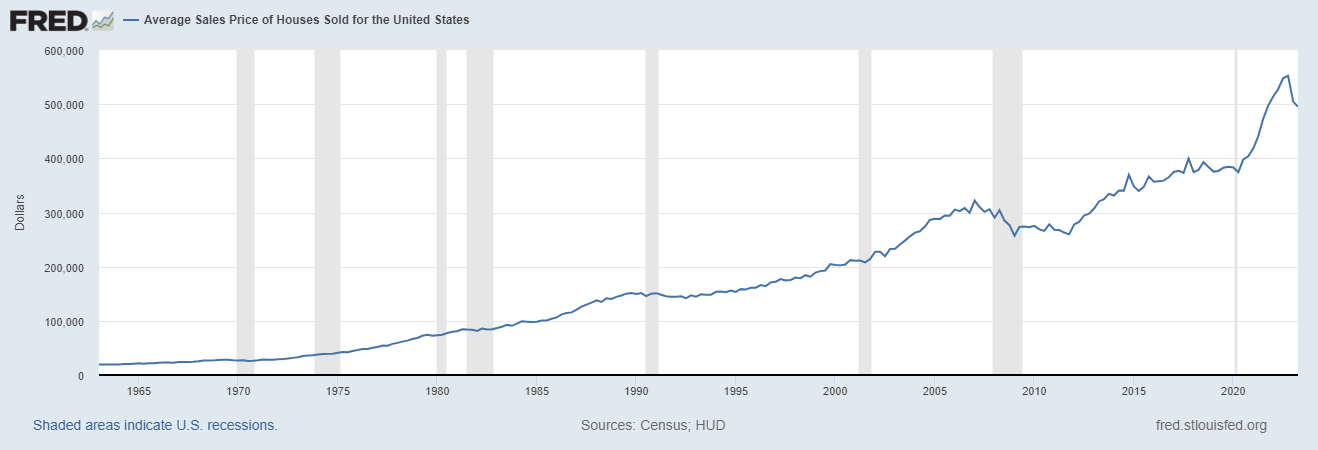
According to data from FRED, a database maintained by the Federal Reserve Bank of St. Louis, the average price of houses sold in the US in the second quarter of 2023 was $495,100, down from $505,300 in the first quarter and $552,600 in the fourth quarter of 2022. The average price peaked at $552,600 in the fourth quarter of 2022, which was the highest level since the series began in 1963. The lowest average price was $17,200 in the first quarter of 1963.

Median Housing Prices by Year

The median price of houses sold in the US in the second quarter of 2023 was $390,500, down from $399,900 in the first quarter and $417,800 in the fourth quarter of 2022. The median price also peaked at $417,800 in the fourth quarter of 2022, which was also the highest level since the series began in 1963. The lowest median price was $17,500 in the first quarter of 1963.

Historical Trends

The chart below shows the historical trends of both the average and median prices of houses sold in the US from 1963 to 2023.

Average Housing Prices by Year in the United States
Source: FRED

As you can see, both prices have increased significantly over time, but with some fluctuations along the way. The most notable periods of rapid growth were from 1975 to 1980, from 1997 to 2006, and from 2012 to 2022. The most notable periods of decline were from 1980 to 1982, from 2006 to 2012, and from 2022 to 2023.

Factors Affecting Housing Prices

  • Supply and demand: When there are more buyers than sellers, or more demand than supply, house prices tend to rise. When there are more sellers than buyers, or more supply than demand, house prices tend to fall.
  • Income and population growth: When people have more income or when there are more people looking for housing, house prices tend to rise. When people have less income or when there are fewer people looking for housing, house prices tend to fall.
  • Inflation and interest rates: When inflation is high or when interest rates are high, house prices tend to fall. When inflation is low or when interest rates are low, house prices tend to rise.
  • Consumer confidence and expectations: When people are optimistic about the economy or when they expect house prices to rise in the future, they are more likely to buy houses. When people are pessimistic about the economy or when they expect house prices to fall in the future, they are less likely to buy houses.
  • Government policies and regulations: When the government provides subsidies or incentives for home buyers or home builders, house prices tend to rise. When the government imposes taxes or restrictions on home buyers or home builders, house prices tend to fall.
  • Regional variations: House prices can vary widely across different regions or markets depending on local factors such as climate, geography, amenities, infrastructure, culture, and preferences.

Historical Median Prices of Existing Homes

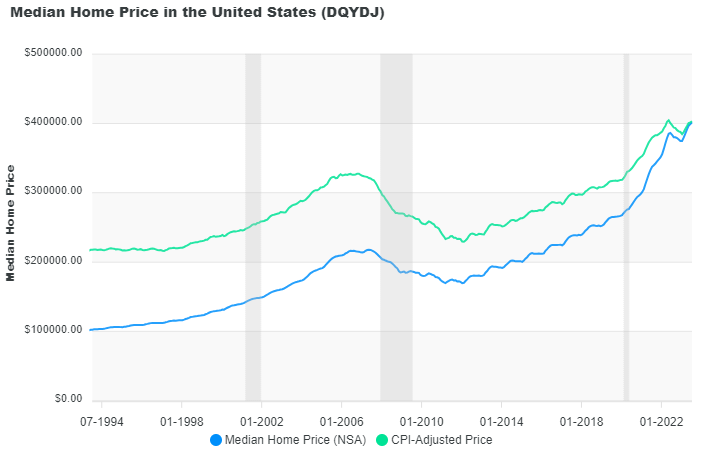
If we go back further in time, we can find data on the median price of existing homes (not new homes) from another source: DQYDJ, a website that provides financial calculators and tools. According to DQYDJ, the median price of existing homes in the US in September 2021 was $363,300 (in nominal terms) or $363,300 (in inflation-adjusted terms). The data goes back to January 1953, when the median price was $18,080 (in nominal terms) or $207,781 (in inflation-adjusted terms).

Historical Trends of Median Prices of Existing Homes

The chart below shows the historical trends of both the nominal and inflation-adjusted median prices of existing homes in the US from 1953 to 2021.

Trends of Median Home Prices by Year
Credits: DQYDJ

As you can see, both prices have also increased significantly over time, but with some differences from the new home prices. The nominal price has increased by almost 20 times since 1953, while the inflation-adjusted price has increased by about 1.7 times. The inflation-adjusted price shows that real home values have not increased as much as nominal home values over time. The nominal price also shows more volatility than the inflation-adjusted price, especially during periods of high inflation or deflation.

To summarize, this blog post has shown you how the average and median prices of houses sold and existing homes have changed over time in the US from 1953 to 2023. You have seen that both prices have increased significantly over time but with some fluctuations and differences along the way. You have also learned some of the main factors that influence house prices in the US. We hope you have found this information useful and interesting. Thank you for reading!

Read More:

  • Average Rent Prices in America: A State-by-State Breakdown
  • Average Home Price in Los Angeles Reaches $953K
  • Average Home Price in San Jose Reaches $1.45 Million
  • Average Home Appreciation Over 30 Years: How to Calculate?
  • What Will the Average House Price Be in 2040: Predictions
  • Average Home Value Increase Per Year, 5 Years, 10 Years
  • Average House Price Increase Over Last 30 Years
  • Average Home Price in San Francisco in 1980
  • Average Cost of a House in 1970, 1990, and 2000
  • Average Cost of a House in 1980
  • Average House Price in 1950 (Compared to Today)

Filed Under: Housing Market, Real Estate, Real Estate Market Tagged With: Average Housing Prices, Average Housing Prices by Year, Housing Prices

Average House Price in 1950 (Compared to Today)

June 1, 2025 by Marco Santarelli

Average House Price in 1950 (Compared to Today)

Ever wondered what your grandparents or even great-grandparents paid for their homes? The average house price in 1950 might shock you! It's a fascinating journey back in time, revealing how much the housing market has changed and how inflation has played a major role.

The Average House Price in 1950: A Blast from the Past

A Glimpse into the 1950s Housing Market

The year is 1950. The post-war boom is in full swing, families are growing, and the American dream of homeownership is within reach for many. But what did that dream cost?

  • In 1950, the average house price in the United States was a mere $7,354.
  • Today, that might sound like a steal, but adjusted for inflation, that's roughly $93,602.08 in 2024 dollars.

To put this into perspective, the average house price in 2024 is about 12.73 times higher than it was in 1950. That's a significant jump!

Why the Drastic Difference in Average House Prices?

Several factors contribute to this incredible difference in average house prices over the decades:

  • Inflation: The value of money changes over time. What you could buy for a dollar in 1950 is significantly different from what you can buy today. Inflation is a major reason why we see such a large difference in housing prices.
  • Economic Growth: The post-war period saw significant economic growth in the U.S., leading to increased demand for housing and driving up prices.
  • Interest Rates: Interest rates on mortgages were much lower in the 1950s, making it easier for people to afford homes.
  • Construction Costs: The cost of building materials and labor has risen significantly over time, contributing to higher home prices.

A Look at the Decades: Average House Prices Then and Now

To understand just how much the housing market has changed, let's take a look at the average house prices for each decade since the 1940s, comparing them to 2024 dollars:

Decade Average House Price (Then) Average House Price (2024 Dollars)
1940s $2,938 $64,372.84
1950s $7,354 $93,602.08
1960s $19,300 $193,470.52
1970s $40,900 $233,195.38
1980s $151,200 $374,032.22
1990s $204,800 $377,080
2000s $322,100 $476,521
2010s $399,700 $488,024
2020s $552,600 $579,205


The Impact on Homeownership

The dramatic increase in average house prices over the decades has significantly impacted homeownership, making it more challenging for subsequent generations to enter the market. Factors like wage stagnation, student loan debt, and stricter lending practices contribute to this challenge.

My Personal Take on the Housing Market

As someone who has closely watched the housing market for years, I'm constantly fascinated by its fluctuations. The average house price in 1950 serves as a stark reminder of how much things have changed. While it's exciting to see progress and growth, it's also crucial to acknowledge the challenges that rising housing costs present to many individuals and families today.

Finding ways to make homeownership more attainable for future generations should be a priority. This might involve exploring innovative housing solutions, addressing student loan debt, and promoting policies that support affordable housing initiatives.

In Conclusion

Looking back at how much houses cost in 1950 is like peeking into a whole different world! It's wild to see how much things have changed in the housing market. Now, buying a house can feel like a wild ride, right? But by understanding how things worked in the past, we can work towards making sure everyone who wants to own a home someday, can.

Related Articles:

  • Housing Market Graph 50 Years: Showing Price Growth
  • Average Housing Prices by Year in the United States
  • Average Home Value Increase Per Year, 5 Years, 10 Years
  • San Diego Housing Market Graph 50 Years: Analysis and Trends
  • How Much Did Housing Prices Drop in 2008?
  • Housing Market Crash 2008 Explained: Causes and Effects
  • Housing Market Predictions for Next 5 Years: 2025 to 2029
  • Housing Market Predictions for Next Year: Prices to Rise by 4.4%
  • Housing Market Predictions for the Next 4 Years: 2024 to 2028

Filed Under: Housing Market Tagged With: Average House Price, Housing Market

What Will the Average House Price Be in 2040: Predictions

June 1, 2025 by Marco Santarelli

What Will the Average House Price Be in 2040: Predictions

For most Americans, their home is their biggest investment. So, naturally, the question of what the future holds for housing prices is a hot topic. Here's a quick look at US house price growth over the years:

  • Average YoY growth rate (Mar 1992 – Mar 2024): 5.5%
  • All-time high YoY growth: 17.8% (September 2021)
  • Record low YoY growth: -12.4% (December 2008)

With homeownership being a priority for many, will you be able to afford a house in 16 years? Let's delve into the factors that might shape the average US house price in 2040.

US House Price Growth Over the Years

Average YoY Growth

5.5%

(Mar 1992 – Mar 2024)

All-time High Growth

17.8%

(September 2021)

Record Low Growth

-12.4%

(December 2008)

Growth Timeline

1992

2008

2021

2024


Predicting the Average US House Price in 2040

The Winds of Change: Factors at Play

Predicting the future is no easy feat, and the housing market is no exception. Here are some key elements that will likely influence the average house price in 2040:

Inflation: This invisible hand steadily pushes prices upwards. Over the past few decades, inflation has averaged around 2-3% annually in the U.S. While the exact rate in the coming years is uncertain, it's a safe bet that inflation will cause a rise in average house price. This doesn't necessarily mean a house will cost twice as much in 2040 compared to today, but it does suggest that steadily increasing prices will erode purchasing power.

Interest Rates: The cost of borrowing to buy a house significantly impacts affordability. If interest rates remain low, it could fuel demand and potentially push prices higher. Conversely, rising interest rates would make monthly mortgage payments more expensive, potentially dampening demand and slowing price growth. The Federal Reserve plays a key role in setting interest rates, but various economic factors also influence them.

Supply and Demand: Basic economics tells us that if there's a shortage of houses compared to the number of buyers, prices will rise. Demographics play a role here – millennials, a large generation, are entering prime home-buying years. This could create high demand, especially in desirable areas where there's already limited inventory. On the other hand, if new construction keeps pace with demand, it could help stabilize prices.

Location, Location, Location: The adage holds true. Prices will likely continue to vary greatly depending on factors like proximity to job centers, amenities, and overall desirability. Coastal areas, vibrant cities, and suburbs with excellent schools tend to command a premium. However, affordability concerns may cause some buyers to look beyond traditional hot spots and consider more geographically diverse locations.

Looking at the Crystal Ball (Through Fuzzy Glasses)

Expert opinions on future house prices diverge. Some, like speakers at recent investment banker conferences, point to historical trends and project a continuation of the current upward trajectory, with the median house price exceeding $1 million by 2040 [source: YouTube video talking about investment bankers conference]. Their reasoning hinges on the assumption that low-interest rates and a growing population will continue to fuel demand, outpacing new construction.

On the other hand, some analysts foresee a more modest increase. They acknowledge the influence of inflation and demographics but also consider potential dampening factors. An economic downturn or a significant rise in interest rates could cool the market. Additionally, a shift towards more affordable housing options, or a rise in remote work opportunities leading to a decline in the importance of location, could also impact average prices.

$1 Million Homes: Can Americans Afford Them in 2040?

  • Wage Growth: If wages keep pace with inflation and rising house prices, then a $1 million median price might not be completely out of reach. However, historically, wage growth hasn't kept up with housing prices, making affordability a challenge.
  • Interest Rates: Low interest rates make monthly payments more manageable. But if rates rise significantly, even a million-dollar house could become unaffordable for many.
  • Shifting Demographics: Millennials, a large cohort, are entering prime home-buying years. This high demand could push prices even higher, especially in desirable locations.
  • Alternative Housing Options: The rise of tiny homes, multi-generational living, and co-op ownership could become more prevalent as affordability concerns mount.

Here's a breakdown of possible scenarios:

  • Scenario 1: Balanced Growth: If wages rise at an average of 3% annually, keeping pace with inflation, and interest rates stay around 4%, a $1 million median price could be achievable for some Americans, particularly those with high incomes or dual earners. For example, a couple with a combined pre-tax income of $150,000 might qualify for a mortgage on a $1 million house, assuming a 20% down payment. However, for many middle-class earners, especially those in single-income households, a $1 million median price would likely still be out of reach.

Overall, a $1 million median price in 2040 would likely create a more segmented housing market:

  • High-cost areas: Prices in desirable locations could significantly exceed the national median, further limiting affordability.
  • More affordable regions: Areas with lower overall living costs might see a surge in popularity as people prioritize affordability over location.

The future remains uncertain, but one thing is clear: affordability will be a key concern in a $1 million housing market.

The Takeaway: Be Prepared, Not Paranoid

It's important to remember that unforeseen events can dramatically impact the housing market. Economic downturns, changes in government policy, or natural disasters can all disrupt trends.

While the average price is interesting, what truly matters is affordability. Even if the average house price doesn't skyrocket, stagnant wages could make homeownership increasingly difficult for many.

While predicting the exact average house price in 2040 is impossible, understanding the influencing factors can help you make informed decisions. Focus on building a solid financial foundation, explore areas with a good balance of affordability and desirability, and consider alternative housing options if needed.

Remember, the path to homeownership isn't always linear. Stay informed, be adaptable, and don't let the uncertainty of the future hold you back from achieving your dream home.

Position Yourself for 2040—Start Investing in Real Estate Now

As average home prices are expected to rise significantly by 2040, investing in income-generating properties today can help you build massive equity and wealth over time.

Norada Real Estate connects investors with turnkey rental properties in growth markets—so you can benefit from appreciation, cash flow, and tax advantages.

HOT NEW LISTINGS JUST ADDED!

Talk to a Norada investment counselor today (No Obligation):

(800) 611-3060

Get Started Now 

Read More:

  • Real Estate Forecast Next 10 Years: Will Prices Skyrocket?
  • Housing Market Predictions for Next 5 Years (2025-2029)
  • Housing Market Predictions for 2027: Experts Differ on Forecast
  • Housing Market Predictions for the Next 2 Years
  • Housing Market Predictions: Will Real Estate Crash?

Filed Under: Housing Market, Real Estate, Real Estate Market Tagged With: Housing Market, Real Estate Market

Average Home Value Increase Per Year, 5 Years, 10 Years

June 1, 2025 by Marco Santarelli

Average Home Value Increase Per Year, 5 Years, 10 Years

Understanding Home Appreciation

Home appreciation is a fundamental concept in the world of real estate and property investment. It refers to the increase in the value of a residential property over time. This increase in value is influenced by various factors and is an essential consideration for both homeowners and real estate investors.

Definition of Home Appreciation

Home appreciation can be defined as the gradual rise in the monetary worth of a residential property. This rise in value typically occurs due to a combination of factors, including changes in the local housing market, economic conditions, and improvements made to the property itself.

It's important to note that home appreciation is not guaranteed and can fluctuate over time. While properties generally tend to appreciate in value over the long term, there can be periods of stagnation or even depreciation in certain market conditions.

How it Relates to the “Average Home Value Increase per Year”

The concept of home appreciation is closely related to the “average home value increase per year.” This metric is a key indicator of how residential property values are changing in a specific area or region. Here's a more detailed explanation of this relationship:

  • Market Trends: Home appreciation is influenced by broader market trends. When the average home value in a particular area increases year after year, it indicates a trend of positive home appreciation. Conversely, if the average home value remains stagnant or decreases, it suggests a lack of appreciation or even depreciation in the market.
  • Economic Factors: Economic conditions, such as job growth, income levels, and interest rates, can significantly impact home appreciation. A robust economy with increasing job opportunities tends to drive up demand for housing, leading to higher property values and annual home value increases.
  • Property-Specific Improvements: Homeowners can also influence home appreciation through property improvements and renovations. Investing in upgrades like kitchen remodels, bathroom renovations or energy-efficient upgrades can boost a property's value and contribute to higher-than-average annual home value increases.

It's important for homeowners and real estate investors to monitor the average home value increase per year in their target markets. This data helps them make informed decisions about buying, selling, or holding onto residential properties. Additionally, understanding the factors that drive home appreciation can guide strategic investments in real estate.

Understanding Average Home Value Increase Per Year

The term Average Home Value Increase Per Year is a crucial metric in the real estate industry that provides valuable insights into the dynamics of the housing market. It refers to the annual rate at which the average value of residential properties in a specific area or region appreciates or increases. This metric serves as a key indicator for homeowners, real estate professionals, and investors to gauge the performance of the housing market.

Explaining the Concept of Average Home Value Increase Per Year

The concept of Average Home Value Increase Per Year can be broken down into the following components:

  1. Average Home Value: This represents the typical monetary worth of residential properties in a particular location. It is determined by factors such as property size, condition, location, and recent sales prices of comparable homes.
  2. Increase Per Year: This part of the metric signifies the annual change in the average home value. It can either be an increase or, in some cases, a decrease. The increase is typically expressed as a percentage, indicating the rate of change over a one-year period.
  3. Area or Region: Average home value increase per year is specific to a geographic area or region, often defined by cities, neighborhoods, or even smaller subdivisions. Different areas may experience varying rates of appreciation due to local factors and market conditions.

Importance of Tracking Average Home Value Increase Per Year

  1. Property Investment: For real estate investors, knowing the average home value increase per year in a particular area helps in making informed investment decisions. Areas with a history of steady appreciation may be attractive for purchasing properties with the expectation of future value growth.
  2. Financial Planning: Homeowners can use this metric to assess the financial health of their primary asset. A strong annual increase can contribute to building home equity, which can be leveraged for various financial purposes, such as home improvements or refinancing.
  3. Selling Strategy: If a homeowner plans to sell their property in the future, understanding the average home value increase per year in their area helps in setting realistic pricing expectations and timing the sale for optimal returns.
  4. Market Conditions: Real estate professionals rely on this metric to advise clients accurately. It provides insights into whether the market is currently favoring buyers or sellers, helping clients make competitive offers or listings.

Historical Data on Average Home Value Increase (United States)

Understanding historical trends in average home value increase in the United States provides valuable insights for homeowners, investors, and anyone interested in the real estate market. Below, we present historical data on average property value increases over different periods, citing credible sources for the information.

Average Property Value Increase Over 10 Years

Over the past decade, the United States has seen fluctuations in property values influenced by economic conditions, housing market dynamics, and regional variations. Historical data on average home value increase over 10 years can help us analyze these trends.

As an example of historical data, the average property value increase over the previous 10 years showed the following trends:

From 2011 to 2021:

  • According to data from the National Association of Realtors (NAR), the national median existing-home price increased from approximately $165,100 in 2011 to around $357,300 in 2021, marking a significant rise over the decade.
  • It's important to note that these figures represent national averages, and specific regions and markets may have experienced different rates of growth or decline.

Average Property Value Increase Over 5 Years

Examining the average property value increase over the past 5 years provides a more recent snapshot of the real estate market's performance. Here is the historical data as of 2021:

From 2016 to 2021:

  • According to the Federal Housing Finance Agency (FHFA), which tracks housing market data, U.S. home prices experienced a steady increase during this period.
  • Specific data may vary by location, but on a national level, the FHFA reported an average annual home price appreciation rate of approximately 5% during this 5-year period.

Please note that real estate markets can be dynamic, and conditions may have evolved since then. For the most current data and trends, it's advisable to consult authoritative sources such as the National Association of Realtors, the FHFA, or local real estate boards and agencies.

Factors Affecting Average Home Value Increase

Several factors play a significant role in determining the rate of Average Home Value Increase Per Year. These factors collectively influence whether a residential property appreciates or depreciates in value over time. Understanding these elements is crucial for homeowners, real estate investors, and industry professionals seeking to make informed decisions in the housing market.

Location and Neighborhood Trends

Location is a fundamental driver of home value appreciation. Properties situated in desirable neighborhoods with excellent schools, low crime rates, and proximity to amenities tend to experience higher rates of appreciation. Neighborhood trends, including the influx of businesses, cultural attractions, and community development, can also impact property values positively.

Economic Conditions

The state of the economy at the local, regional, and national levels is a critical factor affecting home value increase. Economic conditions, such as job growth, wage levels, and unemployment rates, can influence demand for housing. A robust economy often leads to increased demand, which, in turn, drives up property values.

Housing Market Dynamics

The housing market itself plays a vital role in determining home value increase rates. Factors like supply and demand, interest rates, and mortgage availability can fluctuate and impact property values. A seller's market, characterized by high demand and low inventory, tends to result in faster and higher-value appreciation.

Home Improvements and Renovations

Home improvements and renovations made by homeowners can have a direct impact on property value. Investing in upgrades like kitchen remodels, bathroom renovations, or energy-efficient improvements can lead to a higher rate of home value increase. Well-maintained and aesthetically pleasing properties tend to appreciate more quickly.

External Factors (e.g., Infrastructure Development)

External factors, such as infrastructure development, can significantly influence property values. The construction of new highways, public transportation systems, or the expansion of nearby commercial centers can make an area more accessible and attractive to buyers, resulting in increased property values.

It's important to note that these factors often interact with one another. For example, a neighborhood experiencing economic growth may attract more buyers, driving up demand and prices. Similarly, a homeowner who invests in renovations may benefit from both market conditions and the improved state of their property.

How Much Should Your House Increase in Value Each Year?

Many homeowners wonder how much their house should increase in value annually. While there's no one-size-fits-all answer, there are some guidelines and benchmarks to consider when evaluating your property's growth in worth.

Factors Influencing the Ideal Rate

The ideal rate of home value increase can be influenced by various factors. These include the location of your property, the state of the local economy, housing market dynamics, and any home improvements or renovations you undertake.

Regional Variations

It's important to recognize that expected appreciation rates can vary by region. Some areas experience rapid growth in property values, while others may see more modest increases. Understanding the regional trends and conditions is crucial for setting realistic expectations.

Benefits of Increased Property Values

Higher property values offer numerous advantages to homeowners beyond just the satisfaction of seeing their home's worth grow. Understanding these benefits can help homeowners make informed decisions and fully appreciate the financial and lifestyle advantages that come with owning a property that appreciates in value.

Building Wealth and Equity

One of the most significant benefits of increased property values is the building of wealth and equity. As your home's value rises, so does your net worth. Homeownership provides a means of accumulating wealth over time, which can be particularly valuable for long-term financial stability. You can leverage this equity for various purposes, such as home equity loans or lines of credit, to fund other investments or major life expenses.

Access to Better Financing Options

Higher property values can grant homeowners access to better financing options. When you have a property with substantial equity, you may qualify for more favorable mortgage rates and terms, allowing you to save money on your home financing. Additionally, improved creditworthiness stemming from higher property values can open doors to other types of credit, providing you with greater financial flexibility.

Increased Resale Value

For homeowners planning to sell their property in the future, increased property values translate into a higher resale value. This means you can potentially make a more substantial profit when you decide to sell your home. A property with a strong history of appreciation is also more appealing to potential buyers, increasing your chances of selling at a competitive price in a shorter time frame.

Enhanced Quality of Life

Higher property values can lead to an enhanced quality of life for homeowners. As property values rise, local communities often see improvements in infrastructure, schools, and public services. This can create a more attractive and desirable living environment. Additionally, the increased wealth and financial security that come with higher property values can reduce stress and provide a greater sense of stability for homeowners and their families.

Strategies to Improve Home Value

Increasing your home's value is a goal many homeowners aspire to achieve. Here are some actionable strategies to improve home value that can enhance the attractiveness and marketability of your property:

1. Home Maintenance and Repairs

Regular home maintenance and repairs are fundamental to preserving your property's value. Addressing issues like leaky roofs, plumbing problems, or electrical issues promptly can prevent minor problems from turning into major expenses. A well-maintained home is more appealing to buyers and appraisers.

2. Curb Appeal Enhancements

First impressions matter. Boost your home's curb appeal by keeping the exterior well-maintained. This includes painting, landscaping, and maintaining a clean and inviting entryway. A visually appealing home can attract more potential buyers and positively impact its perceived value.

3. Energy-Efficient Upgrades

Investing in energy-efficient upgrades not only reduces utility bills but also adds value to your home. Consider installing energy-efficient windows, LED lighting, a programmable thermostat, or even solar panels. Such upgrades are not only environmentally friendly but also financially appealing to future buyers.

4. Interior Renovations

Well-planned interior renovations can significantly increase your home's value. Focus on high-impact areas like kitchens and bathrooms, which are often top priorities for buyers. Upgrading countertops, cabinets, and fixtures can provide a modern and appealing look that can lead to higher home values.

5. Landscaping and Outdoor Improvements

The landscaping around your home can significantly affect its value. Consider planting trees and shrubs, installing a well-maintained lawn, and creating outdoor living spaces like patios or decks. Outdoor improvements can create an inviting environment and enhance your property's overall appeal.

Remember that the impact of these strategies can vary depending on your location and the current state of your property. It's advisable to assess your specific needs and budget before embarking on improvement projects. Consult with local real estate professionals to get a better understanding of which upgrades are most likely to yield the best returns in your area.

By implementing these strategies, you can not only enjoy a more comfortable and attractive living space but also potentially increase your home's market value when the time comes to sell.

Final Thoughts

The significance of understanding and managing home appreciation cannot be overstated. It impacts your financial well-being and quality of life. By actively working to increase your home's value, you not only build wealth but also create a more comfortable and enjoyable living space. Homeownership is a journey, and wise management of your property's value is a key part of that journey.

Remember, your home is not just a place to live—it's an investment in your future.

Read More:

  • Average Housing Prices by Year in the United States
  • Average Rent Prices in America: A State-by-State Breakdown
  • Average Home Price in Los Angeles Reaches $953K
  • Average Home Price in San Jose Reaches $1.45 Million
  • Average Home Appreciation Over 30 Years: How to Calculate?
  • What Will the Average House Price Be in 2040: Predictions
  • Average House Price Increase Over Last 30 Years
  • Average Home Price in San Francisco in 1980
  • Average Cost of a House in 1970, 1990, and 2000
  • Average Cost of a House in 1980
  • Average House Price in 1950 (Compared to Today)

Filed Under: General Real Estate, Real Estate, Taxes Tagged With: Average Home Value, Average Home Value Increase per Year, Home Appreciation

Average Cost of a House in 1980

June 1, 2025 by Marco Santarelli

Average Cost of a House in 1980

Have you ever found yourself pondering the financial decisions your parents or grandparents made when they purchased their first homes? Picture this: it’s the vibrant 1980s, a decade filled with iconic fashion trends like leg warmers and shoulder pads, and music that defined a generation.

This era, marked by economic fluctuations and cultural shifts, had a profound impact on the housing market. Can you believe the average cost of a house in 1980 was $76,375? It's crazy to think about how much things have changed, especially the price of buying a house! We're going to take a fun trip back to the 80s to see what the houses and apartments looked like back then. Get ready for some serious flashbacks!

What Was the Average Cost of a House in 1980?

Setting the Stage: The Economic Vibe of 1980

Before we delve into the specifics of housing costs, it’s essential to understand the broader economic context of 1980. The U.S. economy was grappling with severe inflation, presenting a unique and challenging environment for homebuyers. Picture this scenario: you stroll through the local grocery store, only to observe prices perpetually on the rise. In fact, by 1980, inflation had reached alarming heights, fundamentally altering consumer behavior and economic stability.

  • Inflation Rates: By the end of the 1970s, inflation had jumped to about 13.5%, significantly affecting everyday expenses, from groceries to housing. This created an atmosphere where costs seemed to soar overnight, leading to a cautious approach in major purchases.

The high inflation rates forced many families to rethink their strategies when it came to buying homes. Housing became a necessity in an environment where financial confidence was shaky, affecting everything from the average house price to mortgage approvals.

The Average Cost of a House in 1980: Hold onto Your Hats!

Now, let’s get to the heart of the matter—how much did a typical house actually cost in 1980? According to the Federal Reserve Bank of St. Louis, which has meticulously documented financial trends (source: Federal Reserve Bank of St. Louis), the average sales price of a house in the United States fluctuated significantly throughout the year:

Date Average Sales Price
1980-01-01 $73,600
1980-04-01 $74,400
1980-07-01 $77,500
1980-10-01 $80,000

Can you believe that the average house price just about breached the $80,000 mark by the end of the year? This figure seems startlingly low when compared to contemporary prices, where the cost of entry into the housing market can often exceed $300,000. However, it’s crucial to remember that incomes were considerably lower during this time period, creating a different dynamic in the housing market.


Why Was the Average House Price in 1980 So Different?

There are several key factors that explain why the average cost of a home in 1980 presents such a stark contrast to today’s averages:

  • Inflation: As mentioned earlier, while prices were rising due to inflation, the increase in home prices during the 1980s didn’t match the rapid uptick seen in later decades. Consequently, homes were deemed more affordable relative to income levels at the time.
  • Interest Rates: Here’s a crucial factor that changed the game entirely—mortgage interest rates in 1980 were incredibly high, peaking at over 18% at points during the decade. Imagine taking out a mortgage with such exorbitant rates! The high interest burden significantly impacted what families could afford, creating a challenging environment for potential buyers even though home prices seemed low at face value.
  • Different Housing Market Dynamics: The housing market in 1980 was characterized by a lack of emphasis on luxury and size. Unlike today’s trends, where mini-mansions and high-end amenities are prioritized, homebuyers often focused on affordability and basic comfort. This cultural shift has led to a drastic change in what is perceived as desirable in real estate, influencing demand and price growth in subsequent decades.

A Blast from the Past: What Else Could You Buy in 1980?

To gain perspective on the value of $80,000 in 1980, let’s take a whimsical ride down memory lane and see what delightful purchases were possible:

  • Arcade Games Galore: The 80s were the golden age of arcade gaming! Back when each play of Pac-Man cost only a quarter, your $80,000 could have afforded you an astounding 320,000 game plays!
  • A Fleet of Quirky Cars: The automotive industry saw a surge of colorful, boxy designs in this decade. With the price of a new car ranging from $7,000 to $8,000, you could have bought yourself an entire fleet of flashy vehicles, giving you plenty of style on the road.
  • Denim Dreams: With 1980 being an era dominated by denim, you could stock up on as much fashion as you desired. A pair of jeans cost approximately $30, so with $80,000, you could flaunt a staggering 2,666 pairs of jeans—a wardrobe reflecting the quintessential style of the 80s!

The 1980s Housing Market: A Lesson in Perspective

Reflecting on the average cost of a house in 1980 can be both shocking and enlightening. It serves as a poignant reminder of how much societal values evolve over time, influencing everything from financial choices to lifestyle preferences. The economic landscape, complementary interest rates, and the less glamorous desires in housing have all shifted dramatically.

As you listen to your parents fondly recall “the good old days” of affordable housing, remember that nostalgia often glosses over the complexities of those times. The landscape of homeownership has transformed, presenting new challenges and opportunities. Understanding the past helps us appreciate the progress made and the obstacles that still lie ahead in the ever-changing world of real estate.

Related Articles:

  • Average House Price in 1950 (Compared to Today)
  • Housing Market Graph 50 Years: Showing Price Growth
  • Average Housing Prices by Year in the United States
  • Average Home Value Increase Per Year, 5 Years, 10 Years
  • San Diego Housing Market Graph 50 Years: Analysis and Trends
  • How Much Did Housing Prices Drop in 2008?
  • Housing Market Crash 2008 Explained: Causes and Effects
  • Housing Market Predictions for Next 5 Years
  • Housing Market Predictions for Next Year: Prices to Rise by 4.4%
  • Housing Market Predictions for the Next 4 Years

Filed Under: Housing Market Tagged With: Average Cost of a House, Housing Market

Is Income Property Investment a Smart Investment?

June 1, 2025 by Marco Santarelli

Is Income Property Investment a Smart Investment?

Investing in income properties can be a smart financial move, offering the potential for regular income and portfolio diversification. However, it’s crucial for investors to carefully assess their financial situation and risk tolerance before diving in.

An income property is a real estate property purchased or developed to earn income through renting or leasing it out to others. It can be both commercial and residential and offers an alternative to standard market investments in stocks and bonds, providing the security of real property with many investment diversification benefits.

Is Income Property Investment a Smart Investment?

The Pros of Income Property Investment:

  • Steady Cash Flow: If managed well, income properties can provide a steady stream of cash through rental income.
  • Appreciation Potential: Over time, real estate typically appreciates in value, potentially increasing your net worth.
  • Tax Benefits: Real estate investors can benefit from various tax deductions related to property ownership and operations.

The Cons of Income Property Investment:

  • Market Risks: Like any investment, income properties are subject to market conditions, interest rates, and housing market fluctuations.
  • Management Responsibilities: Income properties require active management, including dealing with tenants and maintaining the property.
  • Financial Commitment: Investors must have the financial stability to cover maintenance, repairs, and vacancies.

It's important to note that while income properties may generate income, owners should consider the risks, including disruptive tenants and the costs to maintain the property. A financial cushion is advisable to cover unexpected expenses such as property taxes and utilities.

Investing in real estate for income requires a broad range of considerations. Determining a base rate of income to rentals is often important to ensure the desired rate of return. This involves analyzing the current rental rate on similar properties in the area while factoring in the monthly payments required for the mortgage.

The real estate market can be deceptive; low mortgage rates and a buyer's market do not necessarily mean it's the best time to invest. Investors must consider broader economic factors, such as employment rates, which can affect the ability of tenants to pay rent and the overall demand for rental properties.

For those who already own income properties, it can be a landlord's market, with investors potentially faring better than others in the current economic climate. However, the success of such investments heavily depends on the investor's ability to manage the property effectively and navigate the complexities of the real estate market.

Common Mistakes to Avoid in Income Property Investment

1. Lack of Planning: One of the most critical steps in property investment is to have a clear plan. Without a strategy, it's easy to make decisions that don't align with long-term goals, leading to potential financial setbacks.

2. Insufficient Market Research: Understanding the market is paramount. This includes knowing the area where you're investing, the demand for rental properties, and the standard pricing. Skipping this step can lead to overpaying for a property or investing in an area with little growth potential.

3. Chasing Short-Term Gains: Property investment is generally a long-term endeavor. Aiming for quick returns can result in poor decision-making and may not yield the desired financial results.

4. Overpaying: Ensure you pay a fair price for a property. Overpaying can hinder your return on investment and put you at a financial disadvantage from the start.

5. Underestimating Expenses: It's essential to account for all potential expenses, including maintenance, repairs, and vacancies. Failing to do so can lead to cash flow problems.

6. Neglecting Tenant Quality: Securing reliable tenants is crucial for steady rental income. Not screening tenants thoroughly can lead to issues such as late payments or property damage.

7. Ignoring Property Management: Managing a property takes time and effort. Underestimating the work involved can lead to property neglect and dissatisfied tenants.

8. Failing to Diversify: Relying on a single income property or market can be risky. Diversification helps mitigate risk and can provide more stable returns.

9. Not Understanding Financing Options: Different financing methods come with various terms and obligations. Not fully understanding these can lead to unfavorable loan conditions.

10. Emotional Decision Making: Investing in property should be a decision based on facts and figures, not emotions. Emotional attachments can cloud judgment and lead to poor investment choices.

By avoiding these common mistakes, investors can improve their chances of success in the income property market. Thorough research, careful planning, and a clear understanding of the market are the keys to making informed decisions and achieving your investment goals.

Bottom Line: Income property investment can be a smart investment if approached with caution, thorough research, and a clear understanding of the associated risks and responsibilities. It's not a one-size-fits-all solution and should be considered as part of a broader investment strategy tailored to individual financial goals and circumstances. For more detailed insights and guidance, it's advisable to consult with financial and real estate professionals before making any investment decisions.

Why Income Property Is Still One of the Smartest Investments

With market volatility and inflation concerns, income properties offer predictable cash flow and long-term appreciation.

Norada Real Estate Investments specializes in turnkey rental homes in markets poised for growth—helping you build passive income without the guesswork.

HOT NEW LISTINGS JUST ADDED!

Talk to a Norada investment counselor today (No Obligation):

(800) 611-3060

Get Started Now 

Read More:

  • Best Real Estate Markets for New Investors to Watch in 2025
  • Best Places to Invest in Single-Family Rental Properties in 2025
  • How to Find Investment Properties for Sale?
  • 10 Reasons Why Real Estate is a Prudent Investment
  • Cheap Investment Properties: How to Find Them?

Filed Under: Housing Market, Real Estate Investing Tagged With: Housing Market, income property investment, Investment Property, real estate, Real Estate Investing

  • « Previous Page
  • 1
  • …
  • 165
  • 166
  • 167
  • 168
  • 169
  • …
  • 379
  • Next Page »

Real Estate

  • Birmingham
  • Cape Coral
  • Charlotte
  • Chicago

Quick Links

  • Markets
  • Membership
  • Notes
  • Contact Us

Blog Posts

  • Today’s Mortgage Rates, July 29: Rates Climb to 6.69%, But Home Purchase Applications Rise 6%
    July 29, 2026Marco Santarelli
  • Why Buyers Are Rushing to Lock In Before Mortgage Rates Hit 7%
    July 29, 2026Marco Santarelli
  • Best Cities to Buy a Duplex or Triplex for Rental Income in 2026
    July 29, 2026Marco Santarelli

Contact

Norada Real Estate Investments 30251 Golden Lantern, Suite E-261 Laguna Niguel, CA 92677

(949) 218-6668
(800) 611-3060
BBB
  • Terms of Use
  • |
  • Privacy Policy
  • |
  • Testimonials
  • |
  • Suggestions?
  • |
  • Home

Copyright 2018 Norada Real Estate Investments

Loading...