Norada Real Estate Investments

  • Home
  • Markets
  • Properties
  • Membership
  • Podcast
  • Learn
  • About
  • Contact

Housing Crisis in US: 1.5 Million Homes Needed to Breathe Easy

November 28, 2024 by Marco Santarelli

America's Housing Crisis: 1.5 Million Homes Needed to Breathe Easy

Housing crisis alert! If you're looking to buy a house these days, you've probably noticed how competitive the housing market is. The U.S. faces a massive housing shortage. Bidding wars, soaring prices, and houses flying off the shelves – it's a seller's paradise and a potential nightmare for aspiring homeowners.

But why is the market so tight? The answer lies in a simple equation: too few houses, too many people wanting them. According to a recent report by Freddie Mac, the U.S. has a staggering shortage of homes. To achieve a healthy balance in the housing market, we'd need at least 1.5 million additional homes to ease skyrocketing prices and ease the squeeze on renters and buyers – and that's likely an underestimate.

Let's unpack what this means for the current situation.

Housing Shortage Pushes Home Prices to Record Highs

Vacancy Rates at Rock Bottom

Imagine a healthy housing market as a well-stocked grocery store. You should be able to find what you need (a house) without aisles overflowing with options and others completely bare. This healthy balance is reflected in vacancy rates – the percentage of homes that are unoccupied.

Historically, a vacancy rate around 1.6% signifies a stable market, with enough available homes to meet typical demand. Today, however, homeowner vacancy rates have plummeted to a meager 0.8%. That means there are very few houses sitting empty, making competition fierce for available ones.

This situation is similar to walking into a grocery store where essential items like bread or milk are constantly out of stock. It creates a sense of urgency and frustration for shoppers, just like it does for renters and buyers in today's housing market.

Rental markets aren't much better. While vacancy rates haven't dipped quite as dramatically as homeowner vacancy rates, they're still significantly lower than the historical average. This means renters have fewer options to choose from, and those options are often priced higher than in the past.

Imagine you're a college student looking for an apartment near campus. In a healthy market, you might find several options within your budget and walking distance to school. Today, you might find only a handful of overpriced apartments available, forcing you to make tough choices about location, amenities, or affordability. This lack of selection can be stressful and frustrating for renters of all ages and income levels.

Demand Outpaces Supply, Prices Soar

So, why is demand so high? It's a confluence of factors. Millennials, the largest generation in U.S. history, are entering their prime home-buying years. This generation is larger than both Generation X and the Baby Boomers, and they're reaching the stage in life where they're ready to settle down and establish roots.

At the same time, the overall U.S. population is growing steadily. This population growth, fueled by factors like immigration and birth rates, creates a natural increase in the number of households needing a place to live. On the other hand, supply hasn't kept pace with this rising demand.

The housing market hasn't fully recovered from the construction slowdown that followed the 2008 recession. Additionally, factors like zoning regulations and a shortage of skilled labor can make it difficult and expensive to build new homes in some areas.

This imbalance between supply and demand has a predictable consequence: rising prices. Home prices have hit record highs, surging a whopping 47% in just the last four years.

What Does This Mean for You?

Whether you're a renter or hoping to buy, this housing shortage presents a unique set of challenges. As a renter, you may be forced to choose between apartments that don't meet all your needs or exceed your budget.

You might also face greater competition from other renters, leading to bidding wars for desirable units. It's crucial to start your search early, be prepared to move quickly when you find a good option, and understand your rights as a tenant.

If you're a buyer, be prepared for a fast-paced and competitive market. Homes are likely to sell quickly, often above asking price. You'll need to have your finances in order, with a strong down payment and pre-approval for a mortgage.

Work closely with a realtor who can help you navigate the complexities of the market, identify suitable properties, and craft competitive offers. Don't get discouraged if you miss out on a few houses – stay focused on your long-term goals and be prepared to make multiple offers before finding the right fit.

A Light at the End of the Tunnel?

While the situation may seem daunting, there are reasons to be cautiously optimistic. Builders are aware of the shortage and are ramping up construction. Additionally, rising mortgage rates may cool buyer demand somewhat. However, it's clear that significant effort is needed to address this long-term issue.

So, what can you do? If you're looking to buy a house, get pre-approved for a mortgage and work closely with a realtor to navigate the competitive market. As a renter, be proactive in researching available units and understanding your rights. Remember, even in a tight market, with the right preparation and guidance, you can find your dream home.


ALSO READ:

Housing Market Predictions for the Next 2 Years

Housing Market Predictions for Next 5 Years (2024-2028)

Housing Market Predictions 2024: Will Real Estate Crash?

Housing Market Predictions: 8 of Next 10 Years Poised for Gains

Prediction: Interest Rates Falling Below 6% Will Explode the Housing Market

Interest Rate Predictions for Next 2 Years: Expert Forecast
Mortgage Rate Predictions for Next 5 Years

Mortgage Rate Predictions for the Next 2 Years

Filed Under: Housing Market, Real Estate Market, Trending News Tagged With: Housing Market

Arlington, TX Housing Market: Trends and Forecast 2024-2025

November 28, 2024 by Marco Santarelli

Arlington, TX Housing Market Trends and Forecast 2024

The housing market in Arlington, Texas, is a bit competitive in 2024, with home prices slowly going up from last year. Things aren't crazy busy like they were in some other years, but it's still important to understand what's happening in the market. If you're planning to buy or sell a home, knowing about the trends that are affecting prices and how the market is behaving will help you make smart choices.

Arlington, TX Housing Market Trends in 2024

Home Sales

Based on Redfin data for October 2024, the number of homes sold in Arlington experienced a slight decline compared to the same period last year. There were 241 homes sold in October 2024, which represents a 3.6% year-over-year decrease from 250 homes sold in October 2023. While this dip isn't a major red flag, it does indicate that buyer activity might be slowing down, potentially due to factors like rising interest rates or a general economic slowdown.

Personally, I've noticed that some buyers are taking a more cautious approach in the current market. They are carefully considering their finances and are perhaps taking more time to find the perfect home. This can lead to a slightly longer time to sell for some properties.

Home Prices

Despite a slight dip in the number of homes sold, the median sale price of homes in Arlington has remained relatively stable. In October 2024, the median sale price was $325,000, reflecting a 2.4% increase year-over-year. This shows that even though the number of transactions might be slightly down, the value of homes in Arlington is holding its own.

The median sale price per square foot in Arlington is currently $177, which is a 2.2% decrease from the previous year. This could suggest that buyers are becoming more price-conscious and are perhaps gravitating towards homes that offer a better value proposition per square foot.

Housing Supply

I believe that the current housing supply situation in Arlington remains a key factor impacting the market. While we haven't seen a dramatic increase in inventory, the days on market have risen, suggesting that the market might be shifting slightly in favor of buyers.

Homes in Arlington typically spend around 47 days on the market before being sold, which is 12 days longer compared to last year. This extended timeframe gives buyers a bit more leverage to negotiate and explore different options. This increase in the number of days on the market further reinforces my belief that the market is less frenzied than it was in previous years.

Market Trends

Several factors are shaping the Arlington, TX housing market trends in 2024:

  • Interest Rates: The increase in interest rates has impacted affordability, making it more challenging for some buyers to enter the market.
  • Economic Conditions: The broader economic environment, including inflation and job market conditions, can play a role in how quickly homes are selling.
  • Inventory Levels: The availability of homes for sale in Arlington continues to influence competition and sale prices.
  • Buyer Demand: As mentioned earlier, buyer demand seems to be moderating, contributing to a more balanced market.

Is Arlington a Buyer's or Seller's Housing Market?

Based on the data and my own observations, the Arlington housing market is currently leaning towards a more balanced state, with a slight advantage shifting towards buyers.

Here's a breakdown:

  • Buyers have more negotiating power: The increase in days on market and the moderate decrease in the sale-to-list price ratio provides a better environment for buyers to negotiate.
  • Sellers still have a good market: Arlington remains a desirable location for many, and home values are still relatively strong.

However, it's crucial for both buyers and sellers to be informed and prepared. Buyers should understand their budget and be ready to move quickly on properties that meet their criteria. Sellers should price their homes competitively and work with a knowledgeable agent to effectively market their property.

Are Home Prices Dropping?

While there's been a slight dip in the median sale price per square foot, home prices in Arlington are not experiencing a dramatic drop. The overall median sale price is still increasing year-over-year. This means that while buyers might have some more leverage in negotiations, home values in Arlington are generally holding up.

In my experience, it's uncommon to see significant price drops in established markets like Arlington. The housing market tends to move in cycles, with periods of growth and stability. While it's important to monitor the market conditions, a sudden crash in prices is unlikely in the foreseeable future.

Metric October 2024 Year-over-Year Change
Median Sale Price $325,000 +2.4%
Number of Homes Sold 241 -3.6%
Median Days on Market 47 +12 days
Sale-to-List Price Ratio 98.4% -0.37%
Homes Sold Above List Price 19.1% -8.9%
Homes with Price Drops 36.5% +1.0%

Migration and Relocation Trends

Redfin data also provides insights into the migration patterns within and outside the Arlington metropolitan area. The data suggests that:

  • Local Movement: 75% of Arlington homebuyers are looking to stay within the Arlington metropolitan area.
  • Inbound Movement: A significant portion of homebuyers moving to Arlington originate from major metropolitan areas like Los Angeles, San Francisco, and New York. This demonstrates Arlington's appeal as a potential destination for people seeking a more affordable and family-friendly environment.
  • Outbound Movement: Popular destinations for people leaving Arlington include Phoenix, Austin, and Houston, potentially due to factors such as job opportunities or lifestyle preferences.

It's important to note that this data reflects search trends rather than actual moves. However, it can still give us a good idea of the broader migration patterns impacting the Arlington housing market.

Arlington's Appeal: A Look at Factors Driving Market Trends

Arlington's desirable features continue to be a significant driving force behind its relatively robust housing market. I've witnessed firsthand how the city's attractions draw individuals and families from across the country:

  • Strong Job Market: Arlington is home to several major employers, including the University of Texas at Arlington, as well as companies in the healthcare, technology, and logistics sectors. This provides job security and encourages a healthy housing market.
  • Family-Friendly Environment: Arlington boasts excellent schools, a plethora of parks and recreational facilities, and a strong sense of community. It's a great place for families to raise children.
  • Affordable Housing (Compared to Larger Metros): While the market isn't cheap, compared to cities like Dallas or Fort Worth, Arlington generally offers a more affordable housing option, which is attracting more buyers.
  • Entertainment and Sports: The presence of the Texas Rangers and AT&T Stadium brings a vibrant atmosphere and entertainment options, making Arlington a fun place to live.

Arlington, TX Housing Market Forecast 2024-2025

Looking Ahead

Predicting the future of the Arlington, TX housing market requires careful consideration of various factors, including economic conditions, interest rate changes, and local developments.

  • Continued Stability: I expect to see continued stability in the Arlington housing market in the coming months.
  • Balanced Market Conditions: The slight shift towards a more balanced market will likely continue.
  • Moderate Price Growth: We're unlikely to see dramatic price increases, but a moderate growth rate aligns with the historical trends of the area.
  • Attractive Destination: The city's strong economy, diverse attractions, and family-friendly environment will continue to attract new residents.

FAQs

Q: Are house prices dropping in Arlington?

A: The data suggests a correction rather than a dramatic drop. The median sale price is slightly lower than the median list price, and the forecast for the DFW area predicts a gradual price decline. However, a major crash is unlikely due to the strong local economy.

Q: Will the Arlington housing market crash?

A: No, a crash is unlikely. The DFW area's economic strength and ongoing population growth are stabilizing factors. We may see a more balanced market with slower price appreciation or slight price decreases, but not a major crash.

Q: Is it a good time to buy a house in Arlington?

A: It could be a good time for buyers. With potentially more balanced pricing and a wider selection of homes, you may find opportunities for negotiation and good value. However, the market is still evolving, so stay informed and be prepared to adjust your strategy.

Q: Is it a good time to sell a house in Arlington?

A: It's important to be realistic with pricing and consider potential negotiations. However, Arlington remains a desirable location, and any short-term price fluctuations may have a lesser impact for long-term homeowners.

Q: What should I do to prepare for the changing market?

A: Stay informed about market trends by following reliable real estate sources. Partner with a qualified realtor who can guide you through the specific dynamics of the Arlington market and help you make informed decisions based on your goals (buying or selling).

Q: Is Arlington a Good Place to Buy a House?

Whether Arlington is a good place to buy a house depends on your individual priorities and lifestyle. Here are some factors to consider:

  • Affordability: Compared to the national average and other major Texas cities, Arlington offers relatively affordable housing options.
  • Job Market: The DFW metroplex boasts a strong and diverse job market, with opportunities in various sectors.
  • Location: Arlington's central location within the DFW metroplex provides easy access to Dallas and Fort Worth.
  • Lifestyle: Arlington offers a vibrant lifestyle with world-class attractions, entertainment options, and a variety of neighborhoods catering to different preferences.

Recommended Read:

  • Will the Texas Housing Market Crash in 2025?
  • 10 Cheapest Places to Live in Texas
  • Texas Housing Market: Prices, Trends, Predictions 2024-2025
  • Dallas Housing Market: Prices, Trends, Forecast 2024-2025
  • Fort Worth Housing Market: Prices, Trends, Forecast 2024-2025

Filed Under: Housing Market, Real Estate Market Tagged With: Arlington, Housing Market

Elk Grove Housing Market: Trends and Forecast 2024-2025

November 28, 2024 by Marco Santarelli

Elk Grove Housing Market Trends and Predictions 2024

The Elk Grove housing market in 2024 is showing signs of a slight slowdown after a period of rapid growth. While the median home price is still relatively high, it has seen a minor dip compared to last year, and the days on the market have increased. This suggests that the market might be shifting slightly towards a more balanced state, potentially offering opportunities for both buyers and sellers. Let's delve deeper into the specific trends influencing the Elk Grove real estate scene.

Elk Grove Housing Market Trends in 2024: A Comprehensive Look

Home Sales

The number of homes sold in Elk Grove has seen a notable increase year-over-year. According to Redfin, in October 2024, 117 homes were sold, a significant jump from the 95 sold in the same month last year, representing a 23.2% year-over-year growth. This rise in sales signifies a continued demand for housing in the Elk Grove area, even with the slight price adjustments.

In my experience, the local economy and job market in Elk Grove remain strong, attracting new residents and driving demand for properties. The area's excellent school system and family-friendly atmosphere also play a significant role in drawing buyers.

However, it's important to note that the increased sales volume could also be partially attributed to the pent-up demand from the previous few years when inventory was scarce.

Home Prices

The median sale price of a home in Elk Grove in October 2024 was $643,000, reflecting a minor 0.31% year-over-year decrease. This slight drop might appear to signal a cooling trend.

It's interesting to note that despite the dip in median home prices, the median sale price per square foot has actually increased. It sits at **$327, a considerable 8.6% increase from the previous year. This could indicate that buyers are still willing to pay premium prices for desirable homes or those that offer larger square footage.

Personally, I think this increase in price per square foot signifies that buyers are prioritizing factors like space, amenities, and location over just the overall home value. Perhaps they are less concerned about the total price tag when the property offers desirable characteristics within the competitive market.

Housing Supply

The supply of homes in Elk Grove is still a factor impacting the market. While the number of homes sold has risen, it's also important to consider the time it takes to sell a house. The median days on market in October 2024 was 22 days, a 5-day increase compared to the same period last year, when homes were selling in 17 days.

This slight increase in the time it takes to sell a property signals that the market is potentially becoming less competitive for sellers than it has been in the recent past. However, 22 days is still a relatively short timeframe, indicating that properties in Elk Grove remain in demand.

I believe the inventory levels are gradually returning to a more balanced state after being very low for a while. This shift allows for a more level playing field for both buyers and sellers.

Market Trends

The Elk Grove housing market trends in 2024 present a mixed picture. While some indicators point towards a cooling market, such as the slight decline in median prices and increase in days on market, other factors demonstrate continued demand and strength. The growing number of homes sold and the rise in price per square foot confirm that the Elk Grove real estate market still holds strong appeal.

Overall, we're observing a transition from the highly competitive seller's market we witnessed over the past few years. The market appears to be inching towards a more balanced environment, making it potentially more favorable for buyers while still offering opportunities for sellers.

Is Elk Grove a Buyer's or Seller's Housing Market?

Based on the current data, the Elk Grove housing market is inching closer to a more balanced state. It's neither a fully fledged buyer's nor a seller's market. Buyers are finding more options and can negotiate slightly more than they could a year ago. However, the market is still competitive, and properties are selling relatively quickly.

Sellers might need to be slightly more flexible in pricing and consider adjusting their expectations compared to peak market periods. However, the demand for homes in Elk Grove remains strong, giving sellers a good chance of securing a profitable sale within a reasonable timeframe.

Are Home Prices Dropping?

While the Elk Grove home prices have seen a minor dip year-over-year, it's important to keep the decline in perspective. The 0.31% decrease is a small change, and it's not indicative of a major price crash.

It's important to understand that housing markets are cyclical, and slight fluctuations are normal. In my opinion, the current situation is a healthy adjustment rather than a drastic downturn.

Here's a simple table to summarise the current trends:

Factor October 2024 Year-over-Year Change Implications
Median Sale Price $643,000 -0.31% Slight decrease, but still high
Homes Sold 117 +23.2% Increased demand and activity
Median Days on Market 22 days +5 days Slightly less competitive for sellers
Median Sale Price per Square Foot $327 +8.6% Buyers still willing to pay for desirable features

The Role of External Factors

It's also important to consider the broader economic context that impacts the Elk Grove housing market. Factors like interest rates, inflation, and the overall health of the national and regional economy can all play a role in shaping real estate trends.

Currently, the interest rates remain a significant factor for potential buyers. While rates have come down slightly from their peak, they are still higher than they were a few years ago. This can make mortgage payments more expensive for some individuals, potentially impacting purchasing power and moderating demand.

Furthermore, economic uncertainty and inflation can create hesitancy among potential buyers, impacting their willingness to make significant purchases.

Elk Grove Housing Market Forecast 2024-2025

Looking ahead, the Elk Grove housing market is likely to continue to evolve. While the current trends suggest a possible transition to a more balanced market, it's still a desirable area with strong fundamentals.

I believe the market will likely see a continued demand for homes, driven by the area's desirable features like its excellent schools, convenient location, and strong economy. However, the pace of price growth might moderate as the market continues to adjust to the shifting economic landscape.

Buyers might see more negotiation opportunities and a less pressured environment, while sellers should be prepared to adjust to a slightly less competitive environment.

Is Elk Grove Expensive to Live?

Yes, Elk Grove is considered more expensive than the national average.

Here are some key points to consider:

  • Housing: This is the biggest expense for most people. Elk Grove's housing costs are significantly higher (around 80% higher) than the national average. This means you can expect to pay a premium for houses or apartments compared to other parts of the country.
  • Other Expenses: While not as dramatic as housing, other expenses like groceries, utilities, and transportation are also slightly higher (around 6% to 24% higher) than the national average.

However, there are some nuances to consider:

  • Sacramento Metro Comparison: Elk Grove is part of the Sacramento-Roseville-Folsom metropolitan area. While it's more expensive than the national average, it might be a more affordable option compared to trendier areas within the metro area itself.
  • Lifestyle vs. Cost: Elk Grove offers a desirable lifestyle for many – good schools, family-friendly atmosphere, and proximity to Sacramento. For some, the higher cost of living might be justified by these benefits.

Here are some resources to help you delve deeper:

  • Cost of Living Calculators: Websites like Payscale or City-Data.com offer cost-of-living calculators that allow you to compare Elk Grove to your current location based on your specific needs and spending habits.
  • Local Real Estate Websites: These can provide insights into current housing prices and trends in Elk Grove.

Lastly, whether Elk Grove is “expensive” depends on your perspective and priorities. If affordability is your top concern, other locations might be more suitable. However, if the lifestyle perks outweigh the cost of living, Elk Grove could be a great fit.

FAQs:

Q: Is the Elk Grove housing market a buyer's or seller's market?

Currently, the Elk Grove housing market leans towards a buyer's market. This means there's a more balanced inventory with potentially more room for negotiation.

Q: Are house prices dropping in Elk Grove?

While dramatic price hikes are unlikely, forecasts predict a gradual softening in the market. Prices might see a slight decrease in the coming months, but a major crash isn't anticipated.

Q: How long will the buyer's market last in Elk Grove?

A: Predicting the exact duration of a buyer's market is difficult. It depends on various factors like national housing trends and local economic conditions. However, the current market shift suggests it might last for a while, potentially extending into 2025.

Q: Is this a good time to buy a house in Elk Grove?

A: It depends on your individual circumstances. If you're a buyer looking for a wider selection and potentially better deals on houses, then yes, this could be a good time. However, consider factors like rising interest rates that could affect affordability.

Q: Should I wait for prices to drop further before buying?

A: While some price decrease is predicted, it's impossible to say for sure how much or how long it will last. The right decision depends on your individual needs. If you find a house that meets your requirements and you're financially ready, waiting for a potentially small price drop might not be the best strategy, especially if interest rates continue to rise.

Recommended Read:

  • Will Housing Prices Drop in 2025 in California: The Forecast
  • Sacramento Housing Market: Prices, Trends, Forecast 2024-2025
  • California Housing Market: Trends and Forecast 2024-2025
  • Homes Under 50k in California: Where to Find Them?
  • 24 Most Expensive Neighborhoods in California

Filed Under: Housing Market, Real Estate Market Tagged With: Elk Grove, Housing Market

Marietta Housing Market: Trends and Forecast 2024-2025

November 28, 2024 by Marco Santarelli

Marietta Housing Market Trends and Forecast 2024

Are you thinking of buying or selling a home in Marietta, Georgia in 2024? The Marietta housing market is showing interesting trends, with a moderate increase in home prices and a quicker pace of sales compared to last year. Let's explore what's happening in the Marietta real estate scene right now.

Marietta Housing Market Trends in 2024: What You Need to Know

Home Sales

Based on data from Redfin, the number of homes sold in Marietta in October 2024 has increased. We saw a total of 64 homes sold, compared to 59 in October of the previous year. This represents an increase of about 8.5% year-over-year, indicating a more active housing market in Marietta. It's important to consider that this is just one month's snapshot, but it can give us a general idea of the sales velocity.

In my experience, the recent increase in home sales can be attributed to a number of factors, including a strong local economy, low mortgage rates (although those are changing), and a growing desire for homeownership. It's a good time to sell if you're looking to capitalize on this upward trend.

Also, Marietta has always been a desirable location with its excellent schools, vibrant downtown area, and close proximity to Atlanta. This consistent demand helps to drive the sales market, making it a competitive environment, especially for homes in popular neighborhoods and price ranges.

Home Prices

The median sale price of a home in Marietta was about $410,000 in October 2024, up by 1.2% compared to the same time last year. This figure tells us that the price of homes is increasing, though it's not a significant jump.

The median sale price per square foot in Marietta is currently around $216, demonstrating a 7.2% increase year-over-year. This is an important metric because it gives us a better understanding of the price appreciation within the Marietta real estate market, considering the different sizes and types of homes being sold.

Housing Supply

While the number of homes sold has increased, it's essential to consider the availability of homes on the market. The supply of homes in Marietta, while not as tight as it has been in the past, is still somewhat limited. Homes are selling quickly, often within 26 days, compared to 43 days last year. This shorter timeframe can create a competitive environment for buyers.

The reduced days on the market can also indicate that sellers are getting closer to their asking price. This suggests that, in most cases, sellers are having a reasonable amount of success in finding buyers.

The balance between supply and demand is always a key consideration for buyers and sellers. It's something that I monitor closely, and it's a major factor in my advice to clients.

Market Trends

The Marietta housing market trends in 2024 are exhibiting a moderate pace of growth. The market remains somewhat competitive, but it's less frenzied than in previous years. Here's a summary of some of the key trends we're seeing:

  • Increased Home Sales: The number of homes sold is on the rise.
  • Steady Price Appreciation: Home prices are increasing, although at a moderate pace.
  • Reduced Days on Market: Homes are selling faster than before.
  • Shifting towards a balanced market: We're seeing signs that the market is transitioning towards a more balanced state where both buyers and sellers have some leverage.

Is Marietta a Buyer's or Seller's Housing Market?

Given the current trends, I would say that the Marietta housing market is leaning slightly toward a seller's market, but it's evolving toward a more balanced state. Sellers still have an advantage due to the increased demand and shorter sales times, however, buyers are also finding opportunities and can navigate the market effectively with a good real estate agent.

In my opinion, the market is becoming more balanced as we move into 2024. This means that buyers and sellers can negotiate effectively and find agreements that work for both sides. It is not a situation where one side has all the power, which is a welcome change from the extremely competitive seller's market we saw in previous years.

Are Home Prices Dropping?

No, currently, home prices are not dropping in Marietta. In fact, we're seeing a slight increase in the median sale price. While the pace of appreciation has slowed down, it's not indicative of a significant price drop. This trend can be attributed to several factors:

  • Limited Housing Inventory: The supply of available homes is still somewhat constrained, preventing a dramatic price reduction.
  • Steady Demand: Marietta continues to be a popular location for buyers, which supports home prices.
  • Local Economic Factors: The overall economy in the Marietta area remains strong, which impacts people's ability to purchase homes.

However, we must consider that economic conditions can shift rapidly. If there is a major downturn in the economy, or if interest rates rise significantly, we could see some adjustments in home prices. I would be keeping an eye on national and regional economic indicators to see what the future might bring.

Table of Key Marietta Housing Market Statistics (Oct 2024)

Statistic Value Year-over-Year Change
Median Sale Price $410,000 +1.2%
Number of Homes Sold 64 +8.5%
Median Days on Market 26 -17
Sale-to-List Price 97.9% +0.3 pt
Homes Sold Above List Price 9.4% -11.0 pt
Homes with Price Drops 30.6% -8.2 pt

Factors Influencing the Marietta Housing Market

Several factors play a role in shaping the Marietta housing market. Here are a few of the most important ones:

  • Local Economy: Marietta has a diverse economy with a mix of industries. Job growth and stability play a significant role in housing demand.
  • Interest Rates: Fluctuations in mortgage interest rates have a big impact on affordability and buying power.
  • School Systems: Marietta has a highly regarded school system which draws families to the area. This consistently increases demand.
  • Infrastructure and Amenities: The city has a thriving downtown area, ample parks, and access to transportation. These features attract residents.
  • Proximity to Atlanta: Marietta's close proximity to the Atlanta metro area provides convenient access to jobs, entertainment, and cultural attractions.

Marietta Housing Market Forecast 2024-2025

Predictions for 2024 and Beyond

Looking ahead, market analysts predict that Marietta's housing market will continue its upward trajectory for the foreseeable future. Economic stability, coupled with Marietta's appeal as a suburban haven near Atlanta, contributes to this optimistic outlook. The Georgia housing market overall is forecasted to see continued home value appreciation, albeit at a possibly more moderate pace than currently observed.

Notably, the city's close proximity to Atlanta fuels its real estate market, making it a desirable location for those who work in the city but prefer suburban living. Data from various sources suggest that the trend of rising home prices will persist, fueled by consistent demand and the influx of new residents seeking the charm and convenience of Marietta.

What to Consider?

While the market seems to be favoring buyers cautiously optimistic, here are some things to keep in mind:

  • Interest Rates: Federal interest rate hikes can impact mortgage rates. Stay updated on these fluctuations as they can affect affordability.
  • Local Market Nuances: Prices and trends can vary within Marietta's neighborhoods. Research specific areas that interest you.
  • Pre-Approval is Key: Getting pre-approved for a mortgage strengthens your offer and allows you to act quickly in a competitive situation.

In Conclusion

The Marietta housing market is poised for continued growth. We are seeing a slight increase in home prices, a faster pace of sales, and a more balanced state of the market compared to recent years. Whether you're a buyer or a seller, having a solid understanding of the current market trends and working with a trusted real estate professional can help you achieve your real estate goals.

Is Marietta GA Expensive to Live In?

When considering the cost of living in Marietta, it is essential to compare it to both state and national averages. The cost of living in Marietta is somewhat balanced. According to PayScale, Marietta's cost of living is 7% lower than the national average, making it an attractive option for individuals and families looking for affordability. However, it is 4% higher than the state average, indicating that it is costlier compared to other parts of Georgia.

Housing remains the most significant expense, with the average rent for apartments in Marietta ranging from $1,129 to $1,680. Meanwhile, median home prices continue to rise, contributing to the perception that Marietta is becoming an expensive place to live. Despite this, the relatively lower overall living costs and high quality of life make it a worthy consideration.

Best Areas to Live in Marietta

Marietta boasts numerous neighborhoods that appeal to a diverse array of residents. Some of the best areas to live in Marietta include:

  1. East Cobb: Known for its excellent schools, family-friendly atmosphere, and well-maintained public amenities, East Cobb consistently ranks as one of the top neighborhoods in Marietta. Housing here tends to be on the higher end, reflective of the quality of life it offers.
  2. Historic Marietta: This area is perfect for those who appreciate charming, historic homes and a vibrant community atmosphere. The Historic Marietta Square is a draw with its shops, restaurants, and cultural events.
  3. Chestnut Creek and Chimney Springs: These neighborhoods offer a blend of suburban comfort with access to parks and recreational activities, making them ideal for families and outdoor enthusiasts.
  4. Downtown Marietta: For those seeking a more urban environment, Downtown Marietta provides a mix of residential options within walking distance to dining, entertainment, and employment opportunities.
  5. West Cobb: West Cobb offers a mix of rural ambiance and suburban convenience. It is known for its spacious properties and strong community feel.

To summarize, the Marietta housing market in 2024 is thriving, with increasing home values and a promising future outlook. While the cost of living may be higher compared to other parts of Georgia, it remains attractive due to its robust economy, excellent schools, and overall quality of life. Whether you're considering moving to East Cobb for its family-friendly environment or exploring the historic charm of Downtown Marietta, this city offers a variety of appealing options for every lifestyle.

Recommended Read:

  • Atlanta Housing Market Trends and Predictions for 2024
  • Georgia Housing Market: Trends and Predictions 2024-2025
  • 20 Most Affordable Places to Live in Georgia
  • 10 Cheapest Cities to Live in Georgia
  • Savannah Housing Market: Prices, Trends, Forecast 2024-2025

Filed Under: Housing Market, Real Estate Market Tagged With: Housing Market, Marietta

Top Reasons To Buy Atlanta Investment Properties in 2025

November 27, 2024 by Marco Santarelli

Top Reasons To Buy Atlanta Investment Properties in 2025

Are you looking for a thriving city with a robust economy and a promising real estate market? If you're considering Atlanta investment properties in 2025, you're making a smart choice. The region's strong economic foundation, diverse rental market, and numerous emerging neighborhoods are set to provide significant returns for savvy investors looking to build wealth and achieve long-term financial goals.

Let's dive into the details and explore why Atlanta stands out as a prime location for real estate investment in the coming years.

Top Reasons To Buy Atlanta Investment Properties in 2025

Understanding Atlanta's Economic Buzz

Atlanta's economy is absolutely booming! It's a magnet for businesses and industries, attracting top companies from all over. The city's economic diversity is a huge plus, with thriving sectors like technology, logistics, film, and healthcare. As a result, the job market is expanding rapidly, creating a surge in demand for housing. This is a key reason why I believe Atlanta is poised for strong real estate growth. For example, the Justin Landis Group highlights how strong economic conditions are directly driving home prices up, making it a great time to invest.

I've personally seen how the city has transformed over the last few years, and it's exciting! What's even better is that Atlanta offers a relatively affordable cost of living compared to other major cities. Think about places like New York or San Francisco – notoriously expensive! Atlanta is a refreshing change, making it attractive to people from pricier areas looking for a better quality of life and more affordable housing options. This influx of people further fuels the demand for housing and rental units, creating a wonderful opportunity for real estate investors.

A Growing Rental Market – A Strong Foundation For Your Investments

Atlanta's rental market is thriving and expanding at a rapid pace. Young professionals are flocking to the city's vibrant neighborhoods, and many are choosing to rent rather than buy. The growth is fueled by a combination of factors, including population growth and an increasing preference for urban living. People are drawn to the city's cultural richness and the convenience of being close to amenities and attractions.

The presence of prestigious universities like Georgia Tech and Emory University also adds a consistent demand to the rental market. Students and faculty need housing, creating year-round demand for rentals. As an investor, this consistent demand is a huge advantage, ensuring a stable stream of rental income. I've found that in a robust rental market like Atlanta's, you have a much better chance of achieving a strong return on your investment.

Emerging Neighborhoods – Potential for High Returns

Investing in areas that are just starting to grow can offer significant returns compared to already established communities. Atlanta has some exciting emerging neighborhoods gaining popularity among residents, like the Atlanta Beltline, West End, and East Atlanta Village. These areas are known for their cultural vibrancy and community-focused spaces.

The Atlanta Beltline is a prime example of urban redevelopment at its best. It's transforming an old railway corridor into a mixed-use space with parks, shops, and residential properties. I believe these neighborhoods are poised for significant appreciation in the coming years. As transportation infrastructure improves and new amenities are introduced, property values in these areas are expected to skyrocket! If you're looking for a potentially high-return investment, these emerging neighborhoods are definitely worth considering.

Investing in areas designated as “Opportunity Zones” can be another clever move. These zones offer compelling tax benefits while supporting the economic development of lower-income communities. As more public and private investments flow into these communities, you can potentially see significant financial rewards.

Job Creation and Economic Development – Driving Forces of the Housing Market

The creation of new jobs is a major factor influencing Atlanta's housing market. Major corporations like Microsoft, Google, and Amazon have expanded their operations in the city, generating thousands of new, high-paying jobs. This increase in employment is driving up demand for housing, positively impacting both the purchasing and rental markets.

Furthermore, organizations like Invest Atlanta are actively working to enhance economic development and infrastructure. Their efforts include promoting affordable housing initiatives and supporting various real estate projects. This level of proactive engagement from the city government creates a favorable environment for investment. This reassures me that Atlanta is dedicated to fostering a strong real estate market, making it even more appealing to investors like myself.

Predictions for the 2025 Real Estate Market – A Positive Outlook

Predicting market trends is crucial for making informed investment decisions. Reports suggest that property prices in Atlanta are expected to rise gradually over the next few years. The housing market forecast indicates that home prices could increase by approximately 2-3% annually. This makes it an excellent time to invest in Atlanta real estate.

The ongoing development projects are a significant factor in this positive outlook. Both buyers and renters are drawn to new suburban developments and urban infill projects. Emerging trends in the real estate market also suggest that properties near public transportation and desirable urban amenities will continue to be in high demand across various demographic groups.

Major organizations like PwC and the Urban Land Institute have recognized Atlanta as a top real estate investment market for 2025. Their reports emphasize the growing trend of investing in regions that offer strong community engagement and a high quality of life. Atlanta's unique community experiences and attractions make it a standout compared to other major cities.

Investment Stability in Atlanta – A Safe Haven for Your Investments

One of the things that makes Atlanta particularly appealing to investors is its ability to weather economic storms. The city's diverse economy, with industries like technology, logistics, and healthcare, has proven to be resilient in the face of past economic challenges.

Historically, Atlanta has rebounded from economic downturns more quickly than many other markets. This resilience is largely due to the diversity of its job sectors, which provide stability and consistency to the local economy.

During economic downturns, properties in Atlanta tend to hold their value better than properties in more volatile markets. Numerous analyses have highlighted this historical trend, making Atlanta an attractive option for investors seeking long-term growth and stability.

Conclusion – Seize the Opportunity in Atlanta's Real Estate Market

With a combination of factors that point to successful investment outcomes, the top reasons to buy Atlanta investment properties in 2025 are compelling. The city's strong economy, flourishing rental market, growing job opportunities, and exciting emerging neighborhoods collectively create an environment brimming with potential.

I believe that investors should keep a close eye on Atlanta's unique market trends. These trends represent a significant opportunity for capital appreciation and rental income generation. Strategically purchasing properties in Atlanta can lead to substantial long-term value and consistent income flow. The year 2025 presents a pivotal opportunity for investors to position themselves strategically in this exciting real estate market.

I encourage you to do your research, explore the different neighborhoods and investment options, and connect with local real estate professionals to get a better understanding of the specific opportunities that best suit your investment goals.

Recommended Read:

  • Housing Market Trends: Big Investors Buy in Atlanta, Dallas, Charlotte, Houston
  • CoreLogic Flags Atlanta and Spokane as High-Risk Housing Markets
  • Atlanta Housing Market Trends and Predictions for 2024
  • Top 15 Real Estate Markets to Buy Investment Properties in 2025
  • 10 Best Real Estate Markets for Investors in 2025
  • 10 Best Beach Towns for Short-Term Rental Investment

Filed Under: Real Estate Investing

Buying a House in Denver in 2025 – Comprehensive Guide

November 27, 2024 by Marco Santarelli

Buying a House in Denver in 2025 - Comprehensive Guide

Buying a house in Denver in 2025 raises many questions for potential homeowners. With rising property prices and a competitive market, deciding to invest in a home requires extensive thought and analysis of the current housing situation. Denver has always been a desirable location, but is it still the right decision to buy here? This blog post examines key market trends, housing statistics, and personal insights to help you unravel the complexities of purchasing property in the Mile High City.

Buying a House in Denver in 2025 – Is It the Right Decision?

Denver Real Estate Market Insights

🏠 Competitive Market

Homes in Denver receive an average of 2 offers, reflecting a competitive market.

💵 Median Prices

The median sale price of a home has risen to $588,000 on Redfin, marking a 2.2% increase compared to last year.

⏳ Days on Market

Homes are selling in about 34 days, a 15% increase from last year, indicating a slight slowdown.

🌍 Migration Trends

Denver continues to attract residents from other major metros, particularly from Houston, New York, and Los Angeles.

📈 Price Growth vs. National Average

Denver's median sale price is 35% higher than the national average, reflecting strong demand for housing.


Current Denver Housing Market Overview

As of October 2024, the Denver housing market is notably competitive. The median sale price of $588,000 represents not only a consistent increase of 2.2% over the past year but also highlights how Denver has become increasingly attractive despite economic fluctuations. What strikes me as particularly interesting is how quickly homes are transitioning from listings to sales. Homes are, on average, selling in about 34 days, a 15% increase from last year.

Such a shift indicates that buyers are acting swiftly, alluding to a heightened demand in various neighborhoods. A deeper dive into the Denver market reveals crucial details: 831 homes were sold in October 2024, an increase compared to 752 sales from the previous year. This rise could hint at a potential decrease in competition due to growing inventory, causing home seekers to make slower decisions.

Broader Denver MSA House Price Index

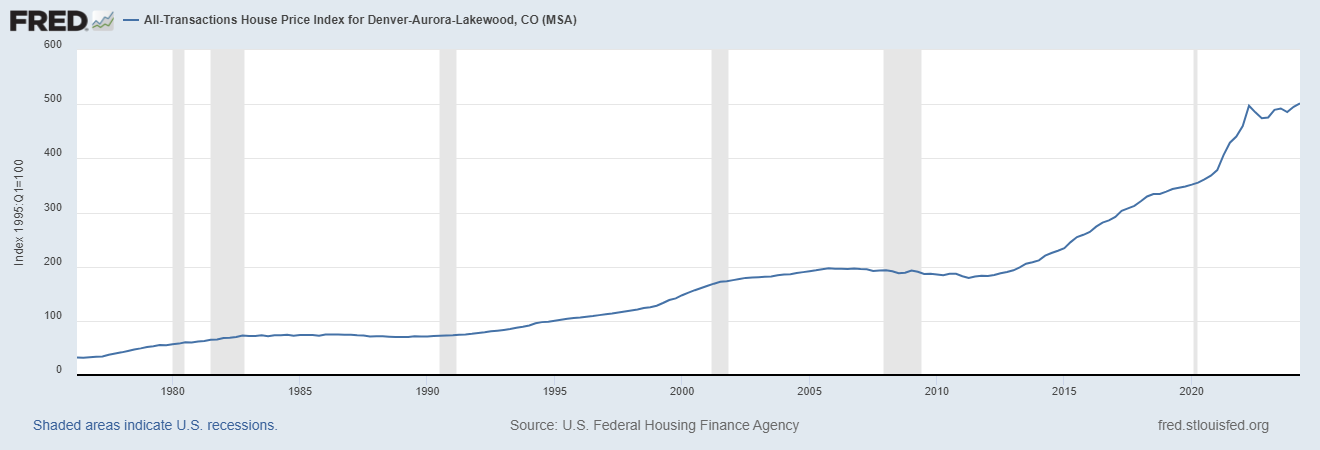
Examining the All-Transactions House Price Index for the Denver-Aurora-Lakewood Metropolitan Statistical Area (MSA) provides insight into the broader price trends impacting the region. The data from the U.S. Federal Housing Finance Agency outlines the following index values:

  • Q2 2024: 501.57
  • Q1 2024: 495.08
  • Q4 2023: 485.31
  • Q3 2023: 492.04
  • Q2 2023: 489.55

This upward trend reflects an increasing demand for housing across the MSA, indicating that home prices are continuing to appreciate. The index rise from 489.55 in Q2 2023 to 501.57 in Q2 2024 underscores a robust market, though it also begs the question of sustainability as buyers weigh their options. As someone who has observed market fluctuations over the years, it’s clear that prospective buyers need to consider both the potential for appreciation and the implications of such rapid price increases.

House Price Index for Denver
Source: U.S. Federal Housing Finance Agency

Pricing Dynamics in Denver's Real Estate Market

When debating the decision of buying a house in Denver in 2024, it's essential to consider pricing dynamics. While the median sale price reflects a rising trend, the median price per square foot has slightly dipped by 4.6%, now standing at $355. This drop could mean potential for savvy buyers willing to explore homes that may require some renovation or repositioning within the market. It’s a mixed signal; while prices may appear high, specific sectors of the market provide opportunities for investment and appreciation.

It's worth emphasizing that Denver's pricing is about 35% higher than the national average. This stark contrast raises questions about long-term affordability and the impacts on future buyers. As someone who has watched the housing sector for years, this considerable premium makes me wonder if these prices reflect sustainable growth or inflated speculation.

Demographic Trends and Migration Patterns

A noteworthy trend is how migration shapes Denver's real estate market. Over the last few months, 70% of prospective buyers have shown a preference to remain within the metropolitan area, while 30% are looking to relocate out. The influx of buyers mainly originates from places like Houston, New York, and Los Angeles. The statistics surrounding migration trends are fascinating:

  • Houston, TX: 588 people relocating to Denver.
  • New York, NY: 139 individuals looking to move.
  • Los Angeles, CA: 532 seeking Denver's appeal.
  • Conversely, major exits were to Breckenridge, Fort Collins, and Phoenix.

This migration is yet another piece of the puzzle when considering whether buying a house in Denver in 2024 is the right decision. The city's reputation for lifestyle, outdoor activities, and career opportunities continues to attract newcomers, feeding into the rising home prices and overall demand.

Housing Market Competitiveness

The competitiveness of the Denver housing market is palpable. A Compete Score™ of 64 indicates a somewhat competitive landscape, where homes are receiving multiple offers. Approximately 21.5% of homes sold are above the list price, albeit a decline compared to previous years, suggesting that while buyers are ready to place offers, the overall demand may be moderating. Nonetheless, it reflects a buyer's willingness to engage when they find a suitable property.

Moreover, recent statistics indicate that 43.7% of homes have experienced price drops compared to last year. This duality of high competition and rising price drops can create challenges for buyers. It becomes increasingly necessary for prospective purchasers to act quickly, weighing the pros and cons of making an offer in a market that could shift on a dime.

Impacts of Climate on Real Estate Decisions

While the economics of buying a house are paramount, the environmental factors can also shape one’s decision. Denver faces various natural hazards such as wildfires and moderate flooding risks. For instance, about 71% of properties are at moderate risk of wildfires over the next three decades. As someone who prioritizes sustainability and safety, this factor is something every potential homeowner should scrutinize carefully.

The upcoming housing decisions cannot solely rest on price points and market competitiveness; buyers need to consider their safety and long-term security in relation to climate factors.

Transportation and Lifestyle in Denver

Lastly, as an attractive city for young professionals and families alike, Denver's transportation options significantly impact its housing market. With a Walk Score of 61 and a Bike Score of 72, Denver is relatively accessible, promoting a healthy lifestyle that many residents cherish. The availability of public transportation, combined with bike lanes and pedestrian-friendly areas, makes it an inviting option for those looking to settle in urban centers without sacrificing environmental concerns.

Frequently Asked Questions

Is it a good time to buy a house in Denver?

Buying in 2024 depends on personal circumstances and readiness, but current trends indicate a competitive market.

Is Denver a buyer or seller market?

Currently, Denver leans more towards a seller's market due to high demand and quick sales.

Is the Denver housing market slowing down?

While there are indications of slight price drops and more homes available, overall demand remains strong, suggesting a slowdown is relative.

Are Denver rents dropping?

Rental prices experienced fluctuations, but overall trends indicate a persistent demand for rentals, sustaining higher rents.

Are housing prices expected to drop in Colorado?

Predictions vary; while some analysts suggest potential stabilization or declines due to economic factors, others foresee continued growth.

What is the cheapest place to live in Colorado?

Areas like Pueblo or Alamosa can offer more affordable living compared to Denver, but they may not provide the same amenities or job opportunities.

Does Denver have a housing shortage?

Yes, Denver is experiencing a housing shortage, driven by high demand and limited inventory.

How much do you need to make to live in Denver?

General estimates suggest that a salary of at least $70,000 to $80,000 may be necessary to afford a comfortable living in Denver.

What is Denver's housing market ranked?

Denver often ranks among the top U.S. cities for housing due to its growth and opportunities, but specific rankings can vary year by year.

What is the average price of a house in Denver in 2024?

As of mid-2024, the average price of a house in Denver is around $590,000.

What salary do you need to buy a house in Denver?

To buy a home at the median price of $590,000, it's generally suggested that a household income of $110,000 or more is needed.

Why is Denver so expensive?

Factors contributing to Denver's high prices include its booming job market, desirable lifestyle amenities, and limited housing supply.

Is it better to rent or buy in Denver, CO?

This decision typically depends on individual circumstances, including financial readiness, job stability, and lifestyle preferences.

In summary, buying a house in Denver in 2024 entails navigating a complex web of factors, including competitive markets, rising prices, and demographic changes. It’s vital for potential homebuyers to weigh personal priorities against the backdrop of ongoing events shaping these market dynamics. Facing these realities requires a reflective approach; it’s about finding a balance between aspirations and reality in the current housing landscape.

Recommended Read:

  • Colorado housing market forecast & trends
  • Denver Housing Market Forecast 2025-2026: What to Expect
  • Denver Housing Market: Prices, Trends, Forecast 2024-2025
  • Denver Housing Market Trends: Sellers Still Have the Upper Hand
  • Denver Housing Market Heats Up Again: Can You Afford?
  • Top 10 Priciest States to Buy a House by 2030: Expert Predictions
  • 10 Best Real Estate Markets for Investors in 2025

Filed Under: Growth Markets, Housing Market Tagged With: Buying a House in Denver, Denver Housing Market, Denver Real Estate Market

Where to Buy Atlanta Investment Properties in 2025?

November 27, 2024 by Marco Santarelli

Where To Invest in Atlanta Real Estate

Are you thinking about investing in real estate, and considering the exciting city of Atlanta? Atlanta real estate investment presents a fantastic opportunity for investors, with a history of strong appreciation and a thriving economy. In my opinion, it's a market worth exploring if you're seeking long-term gains. The city boasts a diverse economy, a growing population, and a desirable lifestyle, making it a hot spot for both residential and commercial investment. Let's delve into the reasons why Atlanta is a prime location for real estate investment.

Atlanta Real Estate Investment: A Growing Market with Strong Returns

Atlanta's Thriving Economy Fuels Real Estate Growth

Atlanta has been a center for business and industry for many years. It's a major hub for transportation, healthcare, technology, and finance. The presence of Fortune 500 companies and a strong job market keep the demand for housing high. This demand, in turn, contributes to a stable and growing Atlanta real estate investment market. As more people and businesses come to Atlanta, the need for housing and commercial spaces increases, resulting in sustained growth in property values.

Historical Appreciation Rates in Atlanta Real Estate

Over the years, Atlanta has shown a consistently positive appreciation rate for real estate. Take a look at these numbers from Neighborhoodscout:

Time Period Total Appreciation Average Annual Rate Compared To GA Compared To America
Latest Quarter 2.20% 9.09% 8 7
Last 12 Months 5.78% 5.78% 3 5
Last 2 Years 10.24% 5.00% 2 4
Last 5 Years 52.11% 8.75% 2 5
Last 10 Years 132.73% 8.81% 7 9
Since 2000 170.87% 4.15% 9 7

Note: 10 is the highest ranking

These figures clearly show that Atlanta has consistently outperformed the national average in terms of appreciation, especially over longer time periods. Personally, I've seen firsthand the growth of certain neighborhoods, and it's pretty remarkable!

Factors Contributing to Atlanta's Real Estate Success

Several key factors contribute to the success of Atlanta real estate investment:

  • Population Growth: The city has experienced steady population growth, driven by job opportunities and a desirable lifestyle. This increase in population fuels demand for housing and drives up property values.
  • Diverse Economy: Atlanta's economy is diverse, with major industries like healthcare, technology, and logistics. This diversification helps to minimize risk and maintain stability, making it an appealing place for investors.
  • Affordable Compared to Other Major Cities: While Atlanta is a major city, the cost of living and property prices remain relatively lower than in other major urban areas in the US. This makes it attractive for both residents and investors.
  • Strong Infrastructure: The city has a well-developed transportation system, including Hartsfield-Jackson Atlanta International Airport, a major transportation hub, and a solid road network. This makes it easy for people and businesses to connect and thrive.

Considerations for Atlanta Real Estate Investors

While Atlanta real estate investment offers great potential, it's important to consider certain aspects before investing:

  • Neighborhood Research: Atlanta is a large city with diverse neighborhoods, each with its own character and investment potential. Researching the specific neighborhood carefully is crucial.
  • Market Trends: Keeping up with the local real estate market trends is important for making informed decisions.
  • Professional Guidance: Working with experienced real estate agents and professionals can help you navigate the market and make sound investment choices.

Is Atlanta Still a Good Investment in 2025?

The answer, like most things in real estate, is “it depends.” Here are some factors to consider:

  • Market Shift: The Atlanta market is likely entering a period of slower, more stable appreciation. While double-digit growth might be a thing of the past, consistent, healthy increases are still a possibility.
  • Inventory Levels: A recent rise in housing inventory could put downward pressure on prices and create more favorable buying opportunities for investors seeking value.
  • Long-Term Growth: Atlanta's economic fundamentals remain strong, with a growing population and a diversified job market. This bodes well for long-term real estate appreciation.

Investing in Atlanta in 2025: A Calculated Approach

While Atlanta's red-hot appreciation might be simmering down, the city remains a compelling investment opportunity. Here are some tips for navigating the 2025 market:

  • Focus on Value: With more inventory available, prioritize properties with strong fundamentals and potential for rental income.
  • Consider Long-Term: If you're looking for a quick flip, Atlanta might not be the ideal market in 2025. However, for investors with a long-term horizon, the city's solid growth potential remains attractive.
  • Do Your Research: Market dynamics can vary by neighborhood. Research specific areas to identify pockets of opportunity.

Forecast for the Atlanta housing market:

Most real estate experts are forecasting that the Atlanta housing market will continue to single-digit appreciation in 2025. According to expert forecasts, the median home price in Atlanta is expected to increase in 2025. However, the forecast also notes that the market is becoming more balanced, with inventory levels increasing slightly. Overall, the Atlanta housing market is expected to remain strong. However, buyers and sellers should be prepared for a more competitive market than in recent years.

Best Places To Buy Atlanta Investment Properties in 2025

If you are dreaming of owning an investment property, what better place to do that than in Atlanta, GA? The city has a thriving real estate market that promises lucrative returns.

Atlanta suburbs offer a diversified population in which a newcomer can easily fit. Most of the Atlanta investment properties in the suburban areas are single-family rental homes.

Now the question is, where to buy investment properties in Atlanta? If you looking to invest in Atlanta, here are some of the best places to buy investment properties in Atlanta.

1. Hanover West, Atlanta

Hanover West is a small, legacy development built in the 1960s. It offers several amenities that attract residents of all ages. Investing in real estate is a significant decision. Hanover West, Atlanta, has shown consistent property appreciation over the years, making it an attractive prospect for potential investors.

Understanding the demand in the rental market is vital. In Hanover West, there has been a steady demand for rental properties, with an increasing number of individuals and families looking for suitable rental homes.

Atlanta, where Hanover West is located, has experienced significant economic growth in recent years, attracting professionals and potential tenants. Hanover West benefits from ongoing and planned infrastructure development, enhancing its overall appeal as a real estate investment destination.

Studying current market trends and forecasts is crucial. Analysts predict positive growth and continued demand for properties in Hanover West, Atlanta, making it a potentially lucrative investment.

2. Midtown Atlanta, Downtown Atlanta

Midtown Atlanta is considered a prime area for real estate investment. With its booming job market, cultural attractions, and ongoing development projects, property values have been steadily appreciating, making it an appealing option for investors. The area is known for its vibrant arts scene, proximity to major employers, and a variety of housing options, attracting a diverse pool of potential tenants.

Investing in Midtown Atlanta offers the potential for solid returns, whether through rental income or property appreciation. The demand for housing in this area remains high, particularly for those seeking an urban lifestyle with convenient access to amenities, entertainment, and public transportation.

3. Buckhead, Atlanta

Buckhead is a great place to buy Atlanta investment properties. The homes are worth a lot because of their proximity to downtown. Then there’s the fact that it is full of mansions and estate homes, though there are a few small cottages that can be rented out as starter homes. Or you could buy an old bungalow and replace it with the four to six-bedroom executive homes becoming the norm for this area.

Known for its upscale neighborhoods, commercial centers, and luxurious living options, Buckhead attracts a discerning demographic and has a robust demand for high-end properties.

Property values in Buckhead have shown consistent appreciation over the years, making it an attractive prospect for investors seeking long-term capital gains. The area offers a blend of residential, retail, and commercial spaces, contributing to its desirability and investment potential.

Investors often find success in both rental properties and property flipping in Buckhead. The high demand for quality housing and the prestige associated with the neighborhood make it an excellent choice for those looking to invest in real estate.

4. Gwinnett County

Gwinnett County is a part of the Atlanta Metropolitan Statistical Area (MSA). Situated in the northeastern part of the state of Georgia, is one of the counties that make up the Atlanta MSA. It is recognized for its diverse population, economic growth, and cultural significance within the Atlanta region.

Gwinnett County is considered a promising area for real estate investment. Its growing population, diverse economy, and proximity to Atlanta make it an attractive location for both seasoned and first-time investors.

Property values in Gwinnett County have been appreciating steadily, reflecting the area's economic stability and development. The county offers a range of housing options, catering to various demographics and preferences.

Investors often find success in rental properties and fix-and-flip opportunities within Gwinnett County. The demand for housing remains strong, especially with the county's appeal to families, professionals, and individuals seeking suburban living with urban amenities.

5. Grant Park, Atlanta

Grand Park is the oldest city park in Atlanta, and the same name applies to the residential district around it. This area is close to downtown, but it is full of older single-family homes that command high rents for the privilege of living here.

Grant Park, Atlanta, is widely regarded as an attractive area for real estate investment. Known for its historic charm, green spaces, and a strong sense of community, Grant Park appeals to a diverse range of residents and investors.

Property values in Grant Park have shown consistent appreciation over the years, making it an enticing prospect for those seeking long-term returns on their investment. The neighborhood offers a mix of housing options, from historic homes to modern developments, attracting various potential buyers or renters.

Investors often find success in buy-and-hold strategies or renovation projects within Grant Park. The demand for housing in this area remains robust, given its proximity to downtown Atlanta, excellent schools, and access to the expansive Grant Park itself.

6. Decatur, Northeast of Atlanta

Decatur, located northeast of Atlanta, is considered a favorable area for real estate investment. Known for its community atmosphere, excellent schools, and cultural amenities, Decatur attracts a diverse population and is a sought-after location for both residents and investors.

Property values in Decatur have shown consistent appreciation over the years, making it an appealing choice for long-term investors. The area offers a variety of housing options, from historic homes to modern condominiums, catering to different preferences and demographics.

Investors often find success in buy-and-hold strategies, as well as renovation projects, in Decatur. The demand for housing remains strong, driven by the area's desirable attributes, including its proximity to Atlanta, a range of dining and shopping options, and a sense of community.

7. Alpharetta, North of Atlanta

Alpharetta, located north of Atlanta, is considered a highly attractive area for real estate investment. Known for its thriving economy, excellent schools, and high quality of life, Alpharetta consistently ranks among the top choices for both residents and investors.

Property values in Alpharetta have exhibited substantial appreciation over the years, making it an enticing prospect for long-term investors. The area provides a range of housing options, from single-family homes to upscale condominiums, catering to various preferences and demographics.

Investors often find success in buy-and-hold strategies, as well as commercial real estate ventures, in Alpharetta. The demand for housing and office spaces remains robust due to the area's economic growth, corporate presence, and desirable amenities.

8. Peachtree Heights West, Atlanta

Peachtree Heights West is located in southwest Atlanta. This upscale neighborhood is one of the hottest in the city due to increasing sales and rental activity. It is a great place to buy an investment property in Atlanta especially an apartment for rental income. It is a short distance south of the already overpriced Buckhead Forest.

Known for its historic charm, tree-lined streets, and proximity to major amenities, Peachtree Heights West attracts residents and investors seeking a blend of urban living and suburban tranquility.

Property values in Peachtree Heights West have shown consistent appreciation over the years, making it an appealing choice for long-term investors. The neighborhood offers a mix of housing styles, including elegant historic homes and modern residences, catering to diverse preferences.

Investors often find success in buy-and-hold strategies, renovation projects, and short-term vacation rentals in Peachtree Heights West. The demand for housing remains strong, given the area's prestigious reputation and its proximity to Atlanta's cultural, dining, and shopping scene.

9. Ormewood Park/Glenwood Park, Atlanta

Ormewood Park/Glenwood Park is located between Grant Park and East Atlanta Village. This area is dotted with 1920s Craftsman-style homes. Redevelopment in the area is replacing affordable single-family homes with multi-family housing and upscale homes. Many move here to be close to its top-notch charter schools.

Ormewood Park and Glenwood Park, located in Atlanta, are highly regarded as attractive areas for real estate investment. Known for their vibrant communities, green spaces, and access to various amenities, these neighborhoods appeal to a diverse range of residents and investors.

Property values in Ormewood Park and Glenwood Park have exhibited consistent appreciation over the years, making them appealing prospects for long-term investors. The neighborhoods offer a mix of housing options, including historic homes and contemporary residences, catering to different preferences and demographics.

Investors often find success in buy-and-hold strategies, renovation projects, and short-term vacation rentals in Ormewood Park and Glenwood Park. The demand for housing remains strong, driven by the area's proximity to downtown Atlanta, excellent schools, and the sense of community.

10. Old Fourth Ward, Atlanta

Old Fourth Ward is a historic industrial district that was, at one point, nearly abandoned. There are significant opportunities for real estate investors to buy investment properties in Old Fourth Ward, Atlanta since there are still properties in the area that need to be renovated to be attractive to renters.

Known for its historic charm, diverse community, and vibrant cultural scene, Old Fourth Ward appeals to a wide range of residents and investors.

Property values in Old Fourth Ward have shown substantial appreciation over the years, making it an enticing prospect for both short-term gains and long-term investment. The neighborhood offers a mix of housing options, including renovated historic homes and modern condominiums, catering to diverse preferences.

Investors often find success in buy-and-hold strategies, renovation projects, and short-term rentals in Old Fourth Ward. The demand for housing remains robust, driven by the area's proximity to downtown Atlanta, the BeltLine, and a thriving arts and dining scene.

Should You Buy Atlanta Investment Properties: Final Thoughts

Investing in Atlanta properties is a decision that requires careful consideration of various factors. Atlanta presents a compelling case for real estate investment, backed by various factors that make it an attractive market for investors. Here are the top reasons to consider investing in real estate in Atlanta:

1. Thriving Economy and Job Growth

Atlanta boasts a diverse and robust economy driven by industries such as finance, technology, logistics, healthcare, and entertainment. The city's economic growth has contributed to increased employment opportunities, attracting a steady influx of residents and bolstering the demand for housing.

2. Population Growth and Demographics

Population growth in Atlanta has been consistently strong, making it one of the fastest-growing metropolitan areas in the United States. A growing population drives demand for housing, both for homeownership and rental properties, providing an excellent opportunity for real estate investors.

3. Diverse Real Estate Market

Atlanta offers a diverse range of real estate options, including single-family homes, condominiums, townhouses, and apartments. Investors can choose from various property types based on their preferences, risk tolerance, and investment goals.

4. Favorable Affordability and Price Appreciation

Compared to many other major cities, real estate in Atlanta is relatively affordable, attracting both first-time homebuyers and investors. Additionally, the city has experienced consistent price appreciation over the years, providing potential for capital gains.

5. Strong Rental Market and Yields

Atlanta has a strong rental market, with a significant portion of its population opting for renting. This demand results in favorable rental yields for property investors, especially in areas with high demand and low vacancy rates.

6. Educational and Healthcare Institutions

Atlanta is home to several prestigious universities and healthcare facilities, attracting students, professionals, and families. Proximity to these institutions can make certain areas appealing for investment due to a consistent demand for housing.

7. Infrastructure Development and Connectivity

Continual infrastructure development and improvements in Atlanta, such as transportation networks, airports, and urban revitalization projects, enhance the overall livability of the city and contribute to the growth of real estate values.

It's important to note that real estate investment decisions should be based on thorough research, market analysis, and consultation with professionals in the field. Always consider your individual circumstances, risk tolerance, and financial goals when making investment decisions.

Tips for Investors in the Atlanta Housing Market

  • Do your research: Before you invest in any property, it's important to do your research and understand the local market. This includes studying market trends, neighborhood demographics, and crime rates. You should also research the specific property you're interested in, including its condition, location, and rental potential.
  • Work with a qualified real estate agent: A good real estate agent can help you find the right investment property and negotiate the best possible price. They can also help you manage your property and find tenants.
  • Focus on cash flow: When investing in a rental property, it's important to focus on cash flow. This means finding a property that will generate enough income to cover your monthly expenses, such as mortgage, taxes, and insurance. You should also factor in vacancy rates and maintenance costs.
  • Consider fixer-uppers: Fixer-uppers can be a great way to get a good deal on an investment property. However, it's important to be realistic about the cost and time required to renovate the property. You should also get a professional inspection to assess the condition of the property and identify any potential problems.
  • Have a long-term investment horizon: Real estate is a long-term investment. Don't expect to get rich quick. Instead, focus on building your portfolio over time and generating consistent cash flow.
  • Look for properties in up-and-coming neighborhoods: Atlanta is a growing city, and there are a number of up-and-coming neighborhoods that are attracting new residents and businesses. These neighborhoods can be a great place to find investment properties with good potential for appreciation.
  • Consider investing in multi-family properties: Multi-family properties, such as duplexes and triplexes, can be a good way to generate more income from a single property. They can also be easier to rent out than single-family homes.
  • Partner with other investors: If you don't have the resources to invest in a property on your own, consider partnering with other investors. This can help you pool your resources and reduce your risk.

Investing in real estate can be a great way to build wealth and generate passive income. However, it's important to do your research and understand the risks involved. By following the tips above, you can increase your chances of success. 

Recommended Read:

  • Housing Market Trends: Big Investors Buy in Atlanta, Dallas, Charlotte, Houston
  • CoreLogic Flags Atlanta and Spokane as High-Risk Housing Markets
  • Atlanta Housing Market Trends and Predictions for 2024
  • Top Reasons To Buy Atlanta Investment Properties in 2025
  • Top 15 Real Estate Markets to Buy Investment Properties in 2025
  • 10 Best Real Estate Markets for Investors in 2025
  • 10 Best Beach Towns for Short-Term Rental Investment

Filed Under: Real Estate Investing, Real Estate Investments Tagged With: Atlanta Investment Properties

Where to Buy Denver Investment Properties in 2025?

November 27, 2024 by Marco Santarelli

Denver investment properties

Denver has been one of the fastest-growing metro areas in the United States for years. It stands out for ranking among the top ten in quality of life, as well. That is reason enough for many potential real estate investors to consider buying Denver investment properties.

Analysis of the Denver Housing Market

The Denver housing market is a hot topic these days, and for good reason. The Mile High City has become a popular destination for people from all over the country, thanks to its booming economy, beautiful scenery, and vibrant culture. This influx of new residents has driven up demand for housing, leading to a competitive market with high prices and fast-moving inventory.

According to Redfin, the median sale price of a home in Denver was $588K in October 2024. This represents an increase of 2.2% from the previous year, and the trend is expected to continue in the foreseeable future. Homes in Denver typically sell after 34 days on the market. The average homes sell for about 2% below the list price and go pending in around 30 days.

The Denver housing market is not for the faint of heart. Buyers can expect to face stiff competition from other interested parties, and many homes receive multiple offers. It is not uncommon for homes to sell above the asking price, as buyers are willing to pay a premium to secure a property in this desirable location.

One of the main factors driving the Denver housing market is inmigration. People are moving to Denver from all over the country, including places like Houston, San Francisco, and Los Angeles. These newcomers are attracted to Denver's job opportunities, affordable cost of living (compared to other major coastal cities), and outdoor lifestyle.

The influx of new residents has put a strain on Denver's housing supply. The city is simply not building new homes fast enough to keep up with demand. This shortage of inventory is a major reason why prices are so high and competition is so fierce.

So, what does this mean for the future of the Denver housing market? It is difficult to say for sure, but experts predict that prices will continue to rise in the near term. However, the market could eventually cool down if the pace of inmigration slows or if more homes are built.

If you are thinking about buying a home in Denver, be prepared for a competitive market. You will need to be a strong buyer with a good financial pre-approval in order to be successful. However, if you are patient and persistent, you may be able to find your dream home in this vibrant city.

Here are some additional factors to consider when analyzing the Denver housing market:

  • Interest rates: Interest rates play a major role in housing affordability. If interest rates rise, it will make it more expensive to buy a home, which could dampen demand and slow down the housing market.
  • Job market: The Denver job market is strong, which is a major factor attracting new residents to the city. If the job market weakens, it could lead to a decrease in demand for housing.
  • Government regulations: The government can influence the housing market through a variety of regulations, such as zoning laws and building codes. These regulations can affect the supply of housing and the cost of construction.
  • The Denver housing market is expected to remain stable in 2025, with prices growing at a slower pace than in recent years.
  • The most popular neighborhoods in Denver are Capitol Hill, LoDo, and Uptown.
  • Denver is a great place to live for young professionals and families alike. The city offers a variety of cultural attractions, outdoor activities, and job opportunities.

The Best Places to Buy Denver Investment Properties

Investing in Denver properties presents a promising opportunity, especially in neighborhoods boasting a strong job market, a growing population, and a limited housing supply. These factors suggest a likelihood of appreciation in property value, making them attractive investments for landlords.

Union Station

Located in downtown Denver, Union Station is a thriving neighborhood offering a blend of residential, commercial, and retail properties. It's a favored spot for both locals and tourists and hosts major employers like Google and Facebook, enhancing its appeal to potential investors.

RiNo (River North Art District)

RiNo is a trendy and vibrant neighborhood in Denver, experiencing substantial development in recent years. Known for its art galleries, boutiques, and diverse culinary scene, it attracts young professionals and families seeking a lively urban environment, making it an enticing choice for real estate investment.

Highland Park

Highland Park is a historic neighborhood renowned for its picturesque homes and charming tree-lined streets. It's a family-friendly area with good schools and parks, making it an attractive prospect for families looking for a peaceful yet accessible community.

Wash Park (Washington Park)

Wash Park is highly desirable due to its proximity to Washington Park, one of Denver's largest and most popular parks. The neighborhood offers not only easy access to recreational opportunities but also boasts good schools and a variety of restaurants, making it appealing to families and professionals alike.

Sloan's Lake

Sloan's Lake is a trendy neighborhood known for its close proximity to the popular Sloan's Lake, a hub for water-based activities and outdoor leisure. Additionally, the area features a range of restaurants and bars, enhancing its appeal for those seeking an active and social lifestyle.

Up-and-Coming Neighborhoods:

These emerging neighborhoods also hold promise for real estate investors:

  • Sunnyside: A diverse neighborhood known for affordable housing options and its convenient location near downtown Denver, making it a potentially lucrative investment.
  • Berkeley: A historic neighborhood characterized by its beautiful homes and proximity to the University of Denver, making it attractive to potential renters.
  • Stapleton: Formerly an airport area, Stapleton has transformed into a mixed-use community with new homes, apartments, and businesses, presenting investment opportunities.
  • Belmar: A mixed-use development in Lakewood, this area offers new homes, apartments, shops, and restaurants, contributing to its appeal for investors seeking a diverse property portfolio.

Investors considering Denver should meticulously evaluate these neighborhoods based on factors such as growth potential, rental demand, amenities, and long-term economic viability to make informed investment decisions.

Top Reasons Why Denver is a Prime Real Estate Investment Hub

  • Strong Job Market: Denver boasts a thriving economy, marked by a low unemployment rate and high job growth. This creates a significant pool of potential tenants actively seeking housing.
  • Population Growth: As one of the fastest-growing cities in the United States, Denver's appeal is bolstered by its strong job market, appealing lifestyle, and pleasant climate.
  • Diverse Economy: Denver's economic base is diversified, encompassing technology, aerospace, healthcare, and tourism. This diversity minimizes the risk of economic downturns affecting the real estate market significantly.
  • High Home Values: Denver has seen consistent appreciation in home values, promising attractive returns on investment for real estate investors.
  • Strong Rental Demand: The demand for rentals in Denver remains high, with vacancy rates consistently below the national average, providing confidence to property investors.
  • Desirable Lifestyle: Denver's alluring lifestyle, characterized by a mild climate, outdoor recreational activities, and a vibrant cultural scene, positions it as a highly sought-after place to live. This demand, in turn, drives the need for rental properties.
  • Limited Supply: The housing supply in Denver is constrained by factors like geographic limitations and zoning restrictions. This scarcity contributes to elevated home values and rental rates, making it an advantageous market for real estate investors.
  • Favorable Tax Climate: Colorado offers a relatively favorable tax environment for investors, such as the absence of state income tax on rental income, enhancing the financial appeal of investing in Denver.

Therefore, Denver, with its strong job market, population growth, diverse economy, appreciating home values, high rental demand, desirable lifestyle, limited housing supply, and favorable tax climate, stands as an optimal locale for real estate investment. However, you should always conduct thorough research and seek advice from financial experts before making any investment decisions, recognizing that all investments carry inherent risks.

Recommended Read:

  • Denver Housing Market Forecast 2025-2026: What to Expect
  • Buying a House in Denver in 2025: Comprehensive Guide
  • Denver Housing Market: Prices, Trends, Forecast 2024-2025
  • Denver Housing Market Trends: Sellers Still Have the Upper Hand
  • Denver Housing Market Heats Up Again: Can You Afford?
  • Top 10 Priciest States to Buy a House by 2030: Expert Predictions
  • 10 Best Real Estate Markets for Investors in 2025

Filed Under: Real Estate Investing, Real Estate Investments

Grant Cardone Bets $1 Billion on Housing Market Prediction

November 27, 2024 by Marco Santarelli

Grant Cardone Bets $1 Billion on Housing Market Prediction

The US rental market is poised for significant changes in the coming decade, according to real estate mogul Grant Cardone. Known for his bold market predictions and strategic real estate investments, Cardone has recently forecasted that the average rent in the United States could nearly double within the next ten years.

Cardone's prediction comes at a time when the American housing market is experiencing a unique set of circumstances. High mortgage rates have led to a situation where, for the first time in decades, renting is more cost-effective than buying in all 50 states. This is based on a report from Realtor.com, which highlighted that it's currently 60% cheaper to rent than to purchase in the country's largest metropolitan areas.

The disparity between the cost of ownership and renting is something Cardone describes as highly unusual and temporary. With the average 20-year fixed mortgage rate standing at 6.99% as of June 2024, the highest since 2001, the gap between owning and renting is wider than it has ever been in recent memory. Cardone argues that if mortgage rates remain elevated, rents will inevitably rise to close this gap.

Cardone's projections estimate the average rent, which is currently around $1,800, to reach nearly $3,000 by 2034. This potential increase in rent is expected to drive property valuations higher, presenting what Cardone believes to be a golden opportunity for investors. He is so confident in this prediction that he is actively investing $1 billion into properties he considers undervalued, particularly large multifamily properties with distressed debt.

This forecast is not without its implications for the broader economy and society. If rents were to increase as predicted, the impact on the average American renter could be substantial. It raises questions about affordability, wage growth, and the potential for increased demand for affordable housing solutions.

What factors might contribute to this increase?

Grant Cardone's prediction of a potential doubling in average rent over the next decade invites a closer look at the elements that could contribute to such a significant increase. Here are some of the key factors that might play a role in this predicted rise:

  • Economic Growth and Demand: As the economy grows, so does the demand for housing. A robust economy can lead to higher wages, which in turn increases people's ability to pay for housing, pushing rents higher.
  • Limited Housing Supply: A critical factor contributing to rising rental rates is the limited supply of housing. When the demand for rental properties outstrips the supply, landlords can charge more for rent.
  • Population Increases and Urbanization: Urban areas, in particular, may see rent increases as more people move to cities in search of employment and better opportunities. This urban migration can lead to a higher concentration of renters competing for a limited number of units.
  • Inflation and Cost of Living: Inflation affects all sectors of the economy, including housing. As the cost of living rises, so does the cost of maintaining and operating rental properties, which can be passed on to tenants in the form of higher rents.
  • Government Policies and Regulations: Legislation and regulations can also impact rental prices. For example, changes in zoning laws, rent control measures, and housing subsidies all have the potential to influence the rental market.
  • Gentrification and Neighborhood Revitalization: As neighborhoods undergo gentrification, property values and, consequently, rents can increase. This often results in the displacement of lower-income residents who can no longer afford the rising costs.
  • Wages Not Keeping Pace with Rent Increases: If wages do not increase at the same rate as rent, tenants may find a larger portion of their income going towards housing costs, leading to a greater number of cost-burdened households.
  • Market Dynamics: The interplay of market demand and supply, property taxes, operating expenses, and capital improvements all significantly shape rental prices. Landlords may increase rent to cover these costs or to align with market comparables.
  • Affordability Crisis: With rents growing faster than incomes, many renters face affordability issues. Other economic factors, such as skyrocketing inflation, further strain household budgets, exacerbating the situation.

These factors, among others, contribute to the dynamic nature of the rental market. While predictions like those made by Grant Cardone provide a glimpse into potential future trends, the actual trajectory of the rental market will depend on how these and other unforeseen factors interact over the coming decade.

For individuals, understanding these factors can aid in making informed decisions about renting and investing in real estate. For policymakers, it underscores the importance of addressing the multifaceted challenges of housing affordability and supply. The conversation around the future of the US rental market is ongoing, and it is one that requires the attention of all stakeholders involved.

Cardone's perspective offers a valuable insight into the potential future of the US rental market. It serves as a reminder of the dynamic nature of real estate and the importance of staying informed about market trends. Whether his predictions will materialize remains to be seen, but they certainly provide food for thought for renters, homeowners, and investors alike.


ALSO READ:

  • Hottest Housing Markets Predicted for 2024
  • Housing Market Predictions for Next 5 Years (2024-2028)
  • Housing Market Predictions for the Next 2 Years
  • Housing Market Predictions: 8 of Next 10 Years Poised for Gains
  • Housing Market Predictions: Top 5 Most Priciest Markets of 2024
  • Real Estate Forecast Next 5 Years: Top 5 Future Predictions
  • Housing Market Predictions for 2027: Experts Differ on Forecast

Filed Under: Housing Market, Real Estate Market Tagged With: Housing Market

Lexington, KY Housing Market: Trends and Forecast 2024-2025

November 27, 2024 by Marco Santarelli

Lexington, KY Housing Market Trends and Forecast 2024

Are you considering buying or selling a home in Lexington, Kentucky, in 2024? Understanding the Lexington housing market trends is crucial for making informed decisions. The Lexington housing market remains competitive, with homes selling quickly and often receiving multiple offers. While the market is still favoring sellers, we're starting to see some signs of a shift towards a more balanced environment. Let's dive into the details to paint a clearer picture of what you can expect.

Lexington Housing Market Trends in 2024: A Comprehensive Overview

Home Sales

The Lexington housing market saw a slight increase in the number of homes sold in October 2024 compared to the same time last year. According to Redfin data, there were 312 homes sold in October 2024, representing a 6.8% year-over-year increase from the 292 homes sold in October 2023. This indicates that despite some cooling in the market, there is still a steady level of buying activity in Lexington. Many buyers remain eager to enter the market, particularly those who are relocating to the area or seeking to upgrade their living situations.

However, it's important to note that this increase in sales is relatively modest. The pace of sales has been slowing down. This suggests that the previous surge in activity has somewhat settled, and we're now experiencing a more typical market, although still slightly competitive.

Home Prices

While the number of homes sold has increased, the pace of home price appreciation has slowed. The median sale price of a home in Lexington in October 2024 was $331,000, a 1.7% increase year-over-year. Although prices are still rising, the rate of increase has definitely slowed down compared to the past few years. I've noticed that sellers are becoming more realistic with their pricing expectations, which has helped to stabilize the market.

Another noteworthy trend is that the median sale price per square foot in Lexington has gone up significantly. In October 2024, it was $187, a 7.5% increase year-over-year. This suggests that buyers are willing to pay more per square foot for homes in desirable neighborhoods and for homes with updated features.

Housing Supply

The inventory of homes for sale in Lexington is still relatively tight, but I've noticed a slight improvement compared to the very low inventory we saw in the past couple of years. Though not back to pre-pandemic levels, it's a positive sign for buyers. While the number of homes for sale hasn't dramatically increased, the combination of a slight slowdown in demand and a slight increase in supply has helped to create a less frenetic market.

Market Trends

Several key trends are shaping the Lexington housing market in 2024.

  • Slowing Home Price Growth: As discussed earlier, home price appreciation has slowed down, offering buyers a little more breathing room in terms of affordability.
  • Increased Days on Market: The median days on market have increased to 35 days, a significant change from the 26 days it took to sell a home the previous year. This means that homes are staying on the market for longer, which is beneficial to buyers.
  • Slight Increase in Inventory: The housing supply is still limited, but it's slowly increasing, giving buyers more options to choose from.
  • Shift towards a More Balanced Market: While the market remains competitive, it is slowly shifting towards a more balanced environment, with less pressure on buyers to make quick offers and waive contingencies.

Is Lexington a Buyer's or Seller's Housing Market?

Currently, the Lexington housing market is transitioning from a seller's market to a more balanced one. While sellers still hold an advantage, buyers have more negotiating power than they did a year ago.

I've observed that buyers are no longer feeling as much pressure to make rushed decisions or waive inspections. They're having more time to consider their options, make informed decisions, and potentially negotiate on price. This is a positive development for buyers who have been facing significant challenges in the past couple of years.

Are Home Prices Dropping?

Home prices are not dropping significantly in Lexington, but the rate of increase has definitely slowed down. The current market shows a more moderate rise in prices, and I expect this trend to continue for the rest of the year. However, it's important to remember that the housing market is dynamic, and economic conditions, interest rates, and other factors can impact prices.

Here's a summary of the Lexington Housing Market in 2024:

Metric October 2024 Year-over-year Change Market Implication
Median Sale Price $331,000 +1.7% Slowing price growth, still favorable for sellers
Homes Sold 312 +6.8% Steady sales activity, but pace is slowing down
Days on Market 35 +9 More time for buyers to consider offers
Sale-to-List Price 97.9% -0.58% Homes selling closer to list price, but still competitive
Housing Supply Tight, but improving More options for buyers
Market Condition Shifting to balanced Buyers have more negotiating power

Lexington Migration and Relocation Trends

I've also noticed that Lexington is attracting people from other parts of the country. The Redfin data shows that, during the period of August to October 2024, 33% of Lexington homebuyers searched to move out of Lexington, while 67% looked to stay within the metropolitan area. This suggests that many people are drawn to Lexington due to its relatively affordable housing market, strong economy, and high quality of life.

From a relocation perspective, Lexington is attracting people primarily from Louisville, Chicago, and Los Angeles. People who are looking to move out of Lexington are primarily choosing Cincinnati, Danville, and London as their destinations.

Is Lexington KY an Expensive Place to Live?

Cost of Living

Compared to other major cities, Lexington remains relatively affordable. However, its cost of living is higher than some other areas in Kentucky. Moving Waldo highlights that utility and overall living costs are comparable to other cities within the state. RentCafe notes that the cost of living in Lexington is about 1% lower than the national average, making it more affordable than many other metropolitan areas.

Comparison with Other Cities

City Cost of Living
Lexington, KY 1% lower than national average
Hebron Estates Higher than Lexington
Louisville, KY Comparable to Lexington

My Thoughts:

As someone who has been involved in the real estate market for many years, I've observed the changes occurring in 2024. The market is clearly not as fast-paced as it was in 2022 and 2023, which is good for both buyers and sellers. I believe that the current trend toward a more balanced market will continue for the foreseeable future. However, I'm also aware that interest rates, economic conditions, and local factors can impact the market unexpectedly.

Lexington Housing Market Forecast 2024-2025

The Lexington-Fayette, KY housing market has been on a steady rise in recent years. But what does the crystal ball hold for the rest of 2024 and beyond? Let's delve into a forecast based on available data and analyze if a crash or a boom is more likely.

The Lexington housing market forecast suggests that we could see moderate growth in the coming months. Zillow's latest forecast indicates a projected 3.1% increase in home values by October 2025. So, the answer is no, it is not expected to crash and the overall outlook is pretty positive. However, it's important to understand the nuances of this prediction and how it relates to the wider Kentucky market.

Forecast for Lexington Home Prices

The data from Zillow provides a valuable snapshot of what we might anticipate. Let's break down their projections for the coming year.

Here's what we see from their Home Value Forecast:

City Forecast Date Projected Home Value Growth
Lexington, KY November 2024 0.1%
Lexington, KY January 2025 0.4%
Lexington, KY October 2025 3.1%

As you can see, the projected home value growth is slow and steady. The 3.1% growth figure by October 2025 is a positive sign but not overly exuberant. This points to a market that's stabilizing after a period of rapid appreciation, and suggests a more balanced environment for both buyers and sellers.

Lexington vs. Other Kentucky Regions

It's interesting to compare Lexington's housing market forecast with other parts of Kentucky. Some regions are projecting even faster growth while others are seeing more modest increases.

For example, Elizabethtown projects the highest growth at 3.7% by October 2025. This suggests that other markets in Kentucky may be heating up more rapidly than Lexington.

Other regions are forecasted to grow at the following rate by October 2025:

  • Louisville: 1.8%
  • Bowling Green: 2.8%
  • London: 1.8%
  • Owensboro: 2.5%
  • Richmond: 3.1%
  • Paducah: 1.8%

Will Lexington Home Prices Drop in 2026? My Perspective

In my opinion, the Lexington housing market will likely continue on a path of gradual growth in 2026. It is unlikely to experience a major price drop or crash. The area is attractive due to its thriving job market, strong economy, and a high quality of life. However, as we see the interest rates rising and cooling off, there may be some slower growth.

It is always difficult to predict the future with absolute certainty, however, based on my expertise and the available data, I expect the Lexington housing market to remain healthy in the near future.

My Conclusion

The Lexington housing market forecast for the coming year suggests a period of stability and moderate growth. While the projected home value increase is not dramatic, it is a positive indicator for a healthy market. The market might cool down slightly, but an outright crash is unlikely. If you are a buyer or seller in the Lexington market, it's vital to keep yourself informed and work with a local real estate professional who can guide you through the process.

Recommended Read:

  • Kentucky Housing Market Forecast 2025-2026: Insights for Buyers
  • 21 Cheapest States to Buy a House: Most Affordable States
  • Louisville Housing Market 2024: Trends and Forecast
  • Average House Prices by State in USA

Filed Under: Housing Market, Real Estate Market Tagged With: Housing Market, Lexington

  • « Previous Page
  • 1
  • …
  • 244
  • 245
  • 246
  • 247
  • 248
  • …
  • 379
  • Next Page »

Real Estate

  • Birmingham
  • Cape Coral
  • Charlotte
  • Chicago

Quick Links

  • Markets
  • Membership
  • Notes
  • Contact Us

Blog Posts

  • 20 Best U.S. Cities to Invest in Real Estate in 2026
    July 27, 2026Marco Santarelli
  • Today’s Mortgage Rates, July 27: 30-Year Fixed Jumps to 6.70%, Even VA Loans Climb
    July 27, 2026Marco Santarelli
  • Interest Rate Predictions for the Next 5 Years: 2026-2030
    July 27, 2026Marco Santarelli

Contact

Norada Real Estate Investments 30251 Golden Lantern, Suite E-261 Laguna Niguel, CA 92677

(949) 218-6668
(800) 611-3060
BBB
  • Terms of Use
  • |
  • Privacy Policy
  • |
  • Testimonials
  • |
  • Suggestions?
  • |
  • Home

Copyright 2018 Norada Real Estate Investments

Loading...