Norada Real Estate Investments

  • Home
  • Markets
  • Properties
  • Membership
  • Podcast
  • Learn
  • About
  • Contact

How Long Does It Take to Get a 700-800 Credit Score?

September 7, 2024 by Marco Santarelli

How Long Does It Take to Get a 700-800 Credit Score?

A credit score of 700-800 is considered very good. It is above the national average credit score, and it will qualify you for the best interest rates and terms on loans and credit cards. An 800 credit score is considered excellent by most lenders, positioning you to qualify for the most favorable interest rates and terms on loans and credit cards. However, achieving an 800 credit score requires a dedicated investment of time and effort.

How long it takes to attain an 800 credit score hinges on various factors, including:

  • Your current credit score
  • Your credit history
  • Your credit utilization ratio
  • Your mix of credit accounts
  • Any negative items on your credit report

If you possess a good credit history and maintain a low credit utilization ratio, reaching an 800 credit score could be achievable within a few years. Conversely, if your credit history is poor or your credit utilization ratio is high, the journey might take longer.

What is a Credit Score?

A credit score is a numerical representation based on an in-depth analysis of an individual's credit files. It serves as a measure of the person's creditworthiness, essential for various financial transactions. The primary foundation for calculating a credit score lies in the credit report, typically sourced from credit bureaus.

Lenders, including banks and credit card companies, heavily rely on these credit scores to evaluate the risk associated with lending money, aiming to mitigate potential losses arising from bad debt. Credit scores guide lenders in determining loan eligibility, interest rates, credit limits, and identifying customers likely to generate substantial revenue.

How is a Credit Score Calculated?

The United States is served by three major credit bureaus: Equifax, Experian, and TransUnion. These bureaus meticulously gather data about your credit history, encompassing payment history, credit utilization ratio, and length of credit history. Utilizing this data, your credit score is computed. The widely adopted credit scoring model is the FICO score, ranging from 300 to 850, where a higher score signifies better creditworthiness. A score of 670 or higher is typically considered good.

Here is a breakdown of credit score ranges:

  • Below 580: Poor
  • 580-669: Fair
  • 670-739: Good
  • 740-799: Very Good
  • 800-850: Excellent

Benefits of a Good Credit Score

The advantages of having a solid credit score are extensive and impactful:

  • You gain eligibility for the best interest rates and terms on loans and credit cards.
  • Higher probability of approval for loans and credit cards.
  • Potential for lower insurance rates.
  • Simplified rental processes for apartments or houses.
  • Enhanced opportunities for securing better employment.

How to Achieve a 700 – 800 Credit Score Quickly:

Your FICO® Score of 800 is exceptional, falling within the range of scores from 800 to 850. This categorization as “Exceptional” places your credit score well above the average, enhancing your ability to receive easy approvals when applying for new credit.

Remarkably, 21% of all consumers currently possess FICO® Scores within this exceptional range, reflecting the significance and rarity of achieving such a high credit score.

Improving your credit score to a level of 800 is a process that requires diligent efforts and an understanding of how credit scores work. Achieving a 700 or 750 credit score is a notable milestone and can be accomplished relatively quickly once you grasp the nuances of credit management.

Check Your Credit Report Regularly

Regularly monitoring your credit report enables you to identify areas for improvement and rectify any errors. You can obtain one free credit report from each of the three major credit bureaus — Equifax, Experian, and TransUnion — annually. Checking for inaccuracies and filing disputes for corrections can lead to swift updates in your credit score.

Make Payments on Time

Timely payments are vital, constituting 35% of your credit score. Missing payments can significantly lower your score. Consistent on-time payments over a few months can help recover your score even after a missed payment, which remains on your report for seven years.

Avoid Closing Old Accounts

Keeping old credit accounts open and active positively impacts your credit score. Closed accounts, especially old ones, can alter your credit utilization ratio, average account age, and credit mix, potentially lowering your score.

Add Rent and Utilities to Your Credit Report

Considering alternative methods to build your credit history, such as reporting rent payments and utility bills, can be beneficial. Utilize services like Experian Boost or similar options provided by TransUnion to include these payments in your credit report, potentially boosting your score.

Increase Your Credit Limit

Efforts to increase your credit card and line-of-credit limits can positively influence your credit score, especially if you already have good credit. A higher credit limit reduces your credit utilization ratio, aiding in overall credit improvement.

Make Small Purchases With Your Credit Cards

Responsible usage of credit cards, including making small, regular purchases and promptly paying them off, demonstrates your creditworthiness and positively impacts your credit score over time.

Pay Off Your Maxed-Out Credit Cards

High levels of debt negatively affect your credit score. Prioritize paying off maxed-out credit cards and follow effective debt repayment methods like the snowball or avalanche method to eliminate debt and improve your credit standing.

Don’t Open Too Many New Accounts at Once

Opening multiple new credit accounts in a short period can have a negative impact on your credit score. It's advisable to space out new account openings and be mindful of the associated hard inquiries to maintain a healthy credit score.

Be Aware of the Rate-Shopping Window

Understanding the rate-shopping window is crucial when applying for credit. Both FICO and VantageScore allow for rate shopping, treating similar inquiries within a specific timeframe as a single inquiry, minimizing any potential negative effects on your credit score.

Monitor Your Credit Regularly

Regularly monitoring your credit and staying informed about changes and updates can help you track your progress towards a higher credit score. It also allows you to identify any suspicious activity or inaccuracies that could affect your score negatively.

Communicate with Creditors

If you're facing financial difficulties, reach out to your creditors and explain your situation. They might be willing to work out a repayment plan or offer some flexibility, helping you avoid a negative impact on your credit score due to late payments.

Seek Professional Credit Counseling

If managing your finances and improving your credit score seems overwhelming, consider seeking help from a professional credit counselor. They can provide personalized advice, help you create a budget, and guide you on how to effectively manage your debts.

Be Patient and Persistent

Improving your credit score takes time and consistent effort. Be patient and stay persistent in your financial efforts. Stick to your plan, make timely payments, and practice good financial habits. Over time, your credit score will gradually rise.

While achieving a 700 or 750 credit score can be a relatively swift process, aiming for the esteemed 800 credit score demands consistent financial discipline and a well-rounded credit management strategy. By incorporating these strategies into your credit improvement plan, you can enhance your creditworthiness and work towards obtaining a credit score that opens doors to favorable financial opportunities.


References:

  • https://www.debt.org/credit/report/scoring-models/how-do-i-get-my-credit-score-up-to-800/
  • https://www.gobankingrates.com/credit/credit-score/how-to-get-credit-score-above-700/
  • https://www.thebalancemoney.com/what-does-an-800-credit-score-mean-4156928

Filed Under: Financing, Mortgage Tagged With: 700 Credit Score, 800 Credit Score, High Credit Score

The Unfolding Crisis of Housing Market Crash in China

September 6, 2024 by Marco Santarelli

The Unfolding Crisis of Housing Market Crash in China

As the world watches closely, China’s housing market crash is still not over, with signs indicating that the worst might not be behind us just yet. The economic repercussions of this ongoing crisis affect not only China's domestic economy but also have far-reaching consequences for global markets. With reports emerging from reputable sources like JPMorgan, the sentiment is clear: stabilization of the housing market is unlikely until at least 2025.

China’s Housing Market Crash Is Still Not Over

Key Takeaways:

  • Continued softness: China’s housing market remains fragile, with weak price performance in both new and resale properties.
  • Government interventions: Current government stimulus efforts have proven unsatisfactory in addressing fundamental issues in the housing sector.
  • Mortgage refinancing complications: Measures to lower borrowing costs may not effectively stimulate demand, particularly for new home purchases.
  • Market outlook: Analysts suggest that without a drastic policy shift, home prices may continue to decline.

The Current State of China’s Housing Market

According to Haibin Zhu, JPMorgan's chief China economist, the effectiveness of government measures to stabilize the market is still under scrutiny. Recent data from the China Index Academy indicates that the average price for new home sales across 100 cities showed a marginal increase of 0.11% from July to August 2024.

However, this modest growth is a significant slowdown compared to June’s 0.13% growth. Notably, resale home prices recorded a more substantial decline, dropping 0.71% from the previous month and down 6.89% year-on-year.

This ongoing decline can be attributed to several intertwined factors. Surging home prices coupled with stagnating wages have pushed many potential buyers out of the market, leading to a fall in overall demand. Additionally, heightened uncertainty regarding the financial health of major real estate developers has fragmented consumer confidence, causing potential homebuyers to delay their purchasing decisions.

Government Responses and Economic Implications

In an attempt to combat the downward pressure on housing prices, the Chinese government is considering a plan that would enable homeowners to refinance their mortgages. This program could potentially impact around $5.4 trillion in mortgages, aiming to alleviate the financial burden on households. However, economic analysts remain skeptical about its effectiveness as a stimulus measure. Winnie Wu, chief equity strategist at BofA Securities, pointed out that while lower mortgage rates might seem beneficial, they could inadvertently lead to banks reducing deposit rates. This, in turn, would negatively affect household savings and further stifle consumption.

Many analysts argue that this widely discussed mortgage refinancing measure lacks the potential to revive the housing market. Zhu echoed this sentiment, asserting that the proposals do not directly address the factors influencing demand for new homes. Instead, they primarily benefit existing homeowners struggling to manage their current mortgages. He emphasized that merely reducing rates may not initiate the required structural changes needed to stimulate new home purchases or restore consumer confidence.

Prolonged Market Challenges Ahead

The prevailing consensus within the investment community points to an extended period of difficulty for China’s housing market. With home prices projected to remain unstable for the foreseeable future, it’s crucial to recognize how this ongoing crisis could adversely affect broader economic growth. The construction sector, a significant driver of employment and GDP growth in China, is directly impacted as developers struggle to sell properties and fund ongoing projects.

Moreover, the falling property values challenge local governments, which rely heavily on funding from land sales to support their budgets. Reduced revenue from land sales can hamper local infrastructure projects and social programs, thereby negatively influencing the overall economic environment. The financial ramifications of the housing market crash extend beyond just metrics and statistics; they touch the day-to-day lives of millions of ordinary citizens who depend on a robust housing sector for their livelihoods.

Global Repercussions: A Broader Concern

Considering China’s position as the world’s second-largest economy, the fallout from its struggling housing market undoubtedly has implications for global markets. A downturn in China’s economy could disrupt trade relationships, affect supply chains, and reduce demand for commodities. Nations heavily reliant on exports to China may feel the effects as Chinese consumers and businesses scale back on purchasing both domestic and foreign goods.

Investors globally are closely monitoring this crisis, as potential shifts in policies aimed at rectifying these issues could lead to both opportunities and vulnerabilities in various markets. Any signs of recovery or continuation of deterioration in China’s housing sector will likely impact everything from currency valuations to commodity prices.

Consumer Confidence and Future Outlook

The ability of the Chinese government to rally consumer confidence will be critical in determining the pace and sustainability of any economic recovery. Currently, many potential homebuyers remain hesitant as they observe continuous price declines and uncertainty surrounding employment and wages. The fears of a protracted economic downturn make it challenging for the government to encourage spending and investment, creating a vicious cycle.

It’s evident that China requires a focused policy redirection to foster a more balanced support system, not just for the real estate market but for the services sector that supports its broader economy. Until consumer confidence is restored and housing transactions increase, the outlook remains grim for those hoping for a rapid resolution to this ongoing crisis.

Conclusion

China’s housing market crash is still not over, and as we gather insights from credible economists and analysts, a clearer picture emerges. The combination of ongoing price declines, ineffective government policies, and rising consumer uncertainty paints a worrying picture for the near future. The situation requires significant monitoring, as any unfolding events will likely shape not only China’s economic recovery but also that of the global economy as a whole.


ALSO READ:

  • Real Estate Forecast Next 5 Years: Top 5 Predictions for Future
  • Is the Housing Market on the Brink in 2024: Crash or Boom?
  • 2008 Forecaster Warns: Housing Market 2024 Needs This to Survive
  • Housing Market Predictions for the Next 2 Years
  • Real Estate Forecast Next 10 Years: Will Prices Skyrocket?
  • Housing Market Predictions for Next 5 Years (2024-2028)
  • Housing Market Predictions 2024: Will Real Estate Crash?
  • Housing Market Predictions: 8 of Next 10 Years Poised for Gains
  • Trump vs Harris: Which Candidate Holds the Key to the Housing Market (Prediction)

Filed Under: Housing Market, Real Estate Market Tagged With: China, Global Housing Market, Home Price Forecast, Housing Market, housing market predictions, Housing Market Trends

Experts Are Predicting How Much Will the Fed Cut Interest Rates

September 6, 2024 by Marco Santarelli

Experts Are Predicting How Much Will the Fed Cut Interest Rates

How much will the Fed cut interest rates in September has become one of the most pressing questions for economists, financial analysts, and the general public alike. With economic indicators shifting and the job market showing potential signs of weakness, the Federal Reserve's upcoming decision could have far-reaching implications. As September approaches, the markets are abuzz with anticipation regarding the Fed's next moves.

How Much Will the Fed Cut Interest Rates in September?

Key Takeaways

  • Interest Rate Decision: The Federal Reserve is likely to lower interest rates based on the August jobs report.
  • Labor Market Impact: Hiring trends and unemployment rates provide critical insight into economic stability.
  • Current Expectations: Economists are divided, predicting either a 0.25% or 0.50% cut in the Fed's benchmark rate.
  • Economic Signals: Consumer spending and inflation trends will influence the Fed's decision.

As we approach the middle of September, every economic report is scrutinized for clues on the Federal Reserve's direction. Among these, the monthly jobs report stands out, often serving as a bellwether for the Fed's policies. The outcome of this report can significantly influence the discussions surrounding interest rates, particularly in light of current economic conditions.

The State of the Economy: A Mixed Bag

The job market is often a reflection of the overall health of the economy, and recent reports indicate fluctuations. In August, economic indicators suggested that hiring might have stagnated, raising concerns about the labor market's stability. Key metrics, such as the unemployment rate, have seen shifts.

Currently resting at 4.3%, this figure represents the highest level in three years, though it remains relatively low compared to historical standards. A dismal jobs report indicating weak hiring could prompt the Fed to consider a more aggressive interest rate cut of up to 0.50% source.

Conversely, if there are signs of recovery or growth—such as a rebound in job creation from July's meager gain of 114,000 jobs—the Fed might opt for a more modest cut of 0.25%. Economists are projecting that approximately 160,000 jobs were added in August, alongside a potential decrease in the unemployment rate to 4.2%. Interestingly, the recent rise in unemployment could primarily stem from an influx of new entrants into the labor market, such as recent graduates and immigrants, rather than job cuts source.

Impact of Consumer Spending & Inflation

Another crucial factor that the Fed considers are trends in consumer spending, which remains the driving force of the U.S. economy. July saw a healthy surge in spending, and overall economic growth accelerated at an annual pace of 3% in the second quarter of 2024. Furthermore, inflation has cooled significantly, moving closer to the Fed's target rate of 2%. Chair Jerome Powell has indicated a keen interest in maintaining robust labor conditions and appears wary of future market slowdowns source.

Should September's job report reveal continued consumer confidence and spending, this could bolster the case for lower rates. Lower borrowing costs would subsequently make loans, including mortgages and credit cards, cheaper, stimulating spending and investment. However, the Fed's inclination towards rate cuts will ultimately depend on whether employment growth provides a sustainable economic foundation.

Political Implications of Interest Rate Cuts

The implications of interest rate cuts extend beyond the economy—politics plays a significant role as well. A weak jobs report could reinforce claims from political figures, like former President Donald Trump, that the current administration's economic policies are failing. In contrast, a stronger jobs report could empower Vice President Kamala Harris to assert that the labor market continues to perform despite recent inflationary pressures.

The Fed's Shifting Strategy

The Federal Reserve's strategy has evolved in recent months. Initially focused primarily on controlling inflation, the Fed is now placing increased emphasis on fostering a stable job market. This shift aligns with Powell's expressed concern that a downturn in employment could have dire economic repercussions.

With much uncertainty, Fed officials, including Governor Christopher Waller, are expected to provide insights into their economic outlook as the federal meeting date approaches. Current speculation suggests that a significant segment of the market is anticipating notable cuts, reflecting a cautious optimism regarding future economic conditions.

Market Reactions and Future Expectations

As September unfolds, financial markets are embodying a cautious approach as they digest the potential ramifications of these impending interest rate cuts. There appears to be a collective holding pattern among businesses, with many waiting for clearer signals from the Fed. Staffing industry experts highlight that significant rate cuts could spur hiring, unnecessary hesitation aside, as businesses look to reinvest in their workforce.

In summary, the upcoming September Federal Reserve meeting stands at a crossroads of opportunity and concern, dictated by employment trends, consumer behavior, and the swirling influences of political dynamics. The action taken this month will profoundly affect the trajectory of the U.S. economy, guiding the decisions of businesses and consumers alike in the coming months.


ALSO READ:

  • How Low Will Interest Rates Go in 2024?
  • Goldman Sachs' 5-Year Housing Forecast from 2024 to 2027
  • US Home Price Forecast by Goldman Sachs Shows 5% Surge in 2024
  • Interest Rate Predictions for the Next 3 Years: (2024-2026)
  • Interest Rate Predictions for Next 2 Years: Expert Forecast
  • Interest Rate Predictions for Next 10 Years: Long-Term Outlook
  • When is the Next Fed Meeting on Interest Rates in 2024?
  • Interest Rate Cuts: Citi vs. JP Morgan – Who is Right on Predictions?
  • More Predictions Point Towards Higher for Longer Interest Rates

Filed Under: Economy, Financing Tagged With: Economy, interest rates

Florida Housing Market Crash: 3 Cities on High Risk of Decline

September 5, 2024 by Marco Santarelli

Florida Housing Market Crash: 3 Cities on High Risk of Decline

Florida's housing market has been a hot topic for years, and with good reason. The state has consistently attracted homebuyers seeking sunny skies and sandy beaches. But what's the current forecast? Is it smooth sailing or are there potential squalls ahead? Let's dive into the data.

Is Florida Headed for a Housing Downturn?

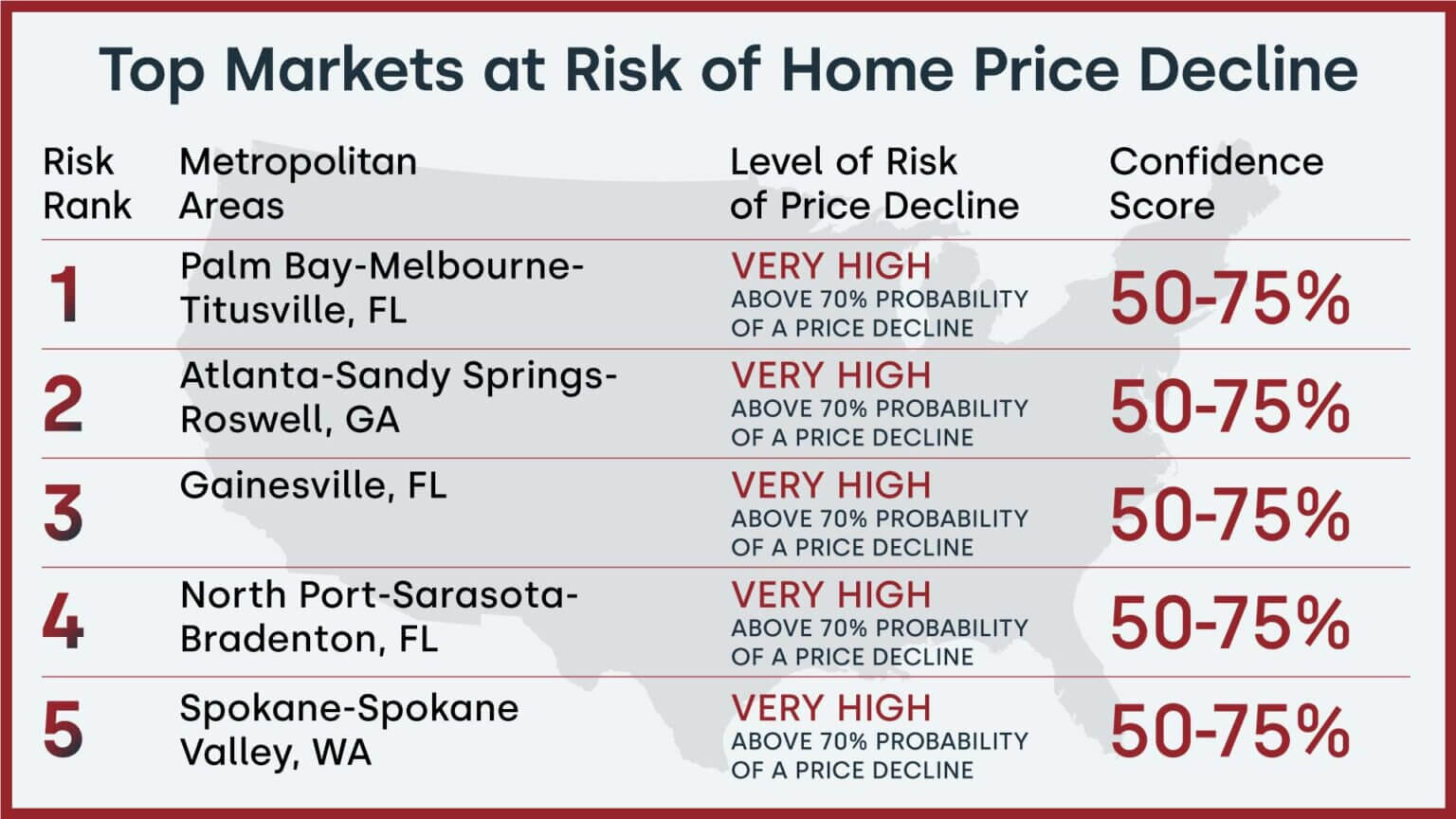
The CoreLogic Market Risk Indicator (MRI) has identified several housing markets across the United States that are at high risk for a decline in home prices over the next year. Among the top five markets mentioned, Florida stands out with multiple entries in the list. This report is critical for both homebuyers and real estate investors looking for potential risks in property value changes.

This means there's a more than 70% chance that home values in these areas could decline. This is a significant concern for potential buyers in these regions and underscores the importance of careful research before investing in any housing market.

Palm Bay-Melbourne-Titusville, FL: A Market to Watch

The Palm Bay-Melbourne-Titusville metro area is recognized as having the highest risk among all U.S. markets. With a probability of over 70% for a home price decline, the area faces significant potential challenges in terms of real estate value. This could impact both current homeowners and those looking to invest in the region.

  • Inventory Imbalance: The influx of new construction in Palm Bay may have outpaced buyer demand. While a healthy market thrives on a balance between supply and demand, an overabundance of available homes can put downward pressure on prices.

  • Affordability Concerns: The national rise in interest rates significantly impacts affordability, especially in markets like Palm Bay, where home values have climbed steadily. With mortgage rates hovering around 7%, some potential buyers might be priced out.

  • Economic Dependence: The economic engine of Palm Bay-Melbourne-Titusville is heavily reliant on aerospace and technology industries. Any fluctuations in these sectors could impact the overall housing market health.

Gainesville, FL and North Port-Sarasota-Bradenton, FL

Other Florida regions to keep a close eye on include Gainesville and North Port-Sarasota-Bradenton. Both markets show similar risk profiles with a very high probability of a price drop. These areas, known for their diverse communities and appeal to both families and retirees, could see major shifts in housing affordability if these projections hold true.

  • Price Reassessment: July data might solidify the trend of slight price adjustments observed in June. Median listing prices could show a continued decline compared to the previous year.
  • Shifting Inventory: The number of homes for sale might remain elevated compared to the seller-driven market of the past. This increased inventory could benefit buyers seeking negotiation leverage.

Broader Implications for the Florida Housing Market

The fact that three Florida markets rank in the top five for high-risk price declines signals a larger trend that investors and homeowners in the state must pay attention to. Rising interest rates, coupled with the national economic outlook, have been key drivers in these predictions. If home prices in these areas do decline, it could present an opportunity for buyers but a challenge for those who currently own property.

What Homeowners and Investors Should Do

  • Monitor market trends: Stay informed about real estate data in your area. CoreLogic's MRI can serve as a reliable source for understanding regional trends.
  • Consider timing: If you're planning to sell, it might be worth evaluating the current market conditions to determine if it's better to sell now or wait.
  • Be cautious with investments: Those looking to invest in the Florida housing market should consider the potential for price declines and carefully assess the risk factors involved.

It's important to remember that these are potential risks, and the housing market is a complex system. Local market dynamics, unforeseen economic shifts, and even national housing trends can all play a role in how these Florida cities fare.

Is Florida Housing Market Facing a Crash
Source: CoreLogic

South Florida: A Tale of Two Markets

The situation gets even more interesting when we zoom in on specific regions. South Florida, in particular, seems to be a tale of two markets. A study by Florida Atlantic and International Universities suggests that South Florida's average home might be overvalued by nearly 35% compared to historical trends.

This raises concerns about a potential housing bubble, particularly for condo buildings that may require expensive repairs to meet current safety codes. However, there's another layer to the story. Despite rising interest rates and a slowdown in rent increases, home prices in Miami and other South Florida cities continue to climb.

This seemingly contradictory trend might be explained by several factors. Firstly, South Florida's desirability as a vacation destination and a retirement haven continues to attract a steady stream of wealthy buyers, many of whom are paying in cash and thus not as affected by rising interest rates.

Secondly, inventory levels in South Florida remain low, which helps to prop up prices. Even with a potential slowdown, there simply aren't enough houses on the market to meet buyer demand.

Is Now the Right Time to Buy in Florida?

So, what does this all mean for you? If you're considering buying a home in Florida, it's important to be aware of the potential risks and rewards. While some areas might see price drops, others could continue to experience growth. Here's what you can do:

  • Do your research: Look beyond statewide data and delve into specific neighborhoods. Consider factors like job growth, local schools, and flood risks.
  • Work with a realtor: A good realtor can provide valuable insights into the local market and help you find the right property at the right price.
  • Consider your budget: Factor in not just the purchase price, but also ongoing costs like property taxes, insurance, and potential maintenance.

FAQs:

Q: Are Palm Bay, North Port, and Gainesville guaranteed to experience a housing price correction?

A: No, a price correction is not guaranteed. The housing market is complex and influenced by many factors. CoreLogic simply identified these areas as having a high risk based on current trends.

Q: If there is a price correction, how much will home prices drop?

A: Predicting the exact dip is difficult. Analysts believe a significant drop is unlikely, but there could be a stagnation or a moderate decline in home values.

Q: Should I be worried if I'm a homeowner in Palm Bay, Gainsville, or North Port?

A: Not necessarily. Existing homeowners likely won't see a dramatic decrease in equity. However, staying informed about market trends and consulting with a financial advisor is recommended.

Q: Is this a good time to buy a house in Palm Bay or Deltona?

A: It depends on your individual circumstances and risk tolerance. If you're looking for a long-term investment and can weather some potential short-term fluctuations, it could be an opportunity. However, careful market research is crucial.

Q: Will a price correction in Palm Bay, Gainesville, and North Port affect the entire Florida housing market?

A: The impact might be localized. However, it could create a ripple effect, influencing buyer sentiment across the state. The overall strength of Florida's market would likely play a role in mitigating any widespread downturn.

The Florida housing market may be complex, but with careful planning and professional guidance, you can navigate it successfully. Remember, knowledge is power, so stay informed and make smart decisions!


RELATED POSTS:

  • Florida Housing Market Predictions for Next 2 Years
  • Florida Housing Market: Will These 2 Metros Crash in 2025?
  • When Will the Housing Market Crash in Florida?
  • South Florida Housing Market: Will it Crash in 2024?
  • South Florida Housing Market: A Crossroads for Homebuyers
  • Florida Housing Market Trends: Rent Growth Falls Behind Nation

Filed Under: Housing Market, Real Estate Market Tagged With: Florida, Housing Market

What Will Interest Rates Be in 2026?

September 4, 2024 by Marco Santarelli

What Will Interest Rates Be in 2026? An In-Depth Analysis

The question on the minds of many who are invested in the economy is, what will interest rates be in 2026? Understanding this not only impacts financial strategy but also shapes decisions across households and industries. As the Federal Reserve navigates the complexities of inflation, employment, and economic growth, its decisions on interest rates become pivotal indicators of future financial landscapes.

What Will Interest Rates Be in 2026? An In-Depth Analysis

📉 Projections suggest that interest rates could decrease to around 2.9% by 2026, influenced by factors such as inflation, economic growth, and global market dynamics.


Key Takeaways

  • Current Fed Rate: The Federal Reserve's interest rate is currently set between 5.25% and 5.50%.
  • Projected Decline: Interest rates are expected to diminish to approximately 2.9% by 2026.
  • Economic Context: A range of factors, including inflation trends, economic growth rates, and global market dynamics, will influence these rates.
  • Fed Dot Plot Insights: The Fed's internal projections (Dot Plot) indicate a significant reduction in rates as inflation stabilizes.

Current Economic Context: A Brief Overview

As of September 2024, the Federal Reserve has maintained a robust stance on interest rates in light of persistent inflationary pressures that peaked above 8% in late 2022. The Fed's primary goal has been to stabilize prices while monitoring economic growth. With current interest rates within the 5.25% to 5.50% range, they aim to curtail excessive spending and inflation.

Nevertheless, indicators suggest that inflationary trends are beginning to plateau. The current inflation rate is projected to ease toward the Fed’s target of 2% as supply chains stabilize and consumer habits adjust. As rates gradually subside, they will create an environment more conducive to borrowing and investment (Source).

Anticipated Federal Reserve Actions: Looking Ahead to 2026

1. Inflation Trends: The Primary Driver

One of the most critical elements influencing future interest rates is the trajectory of inflation. The U.S. economy has felt the shocks of inflation over the past two years, forcing the Fed to react with aggressive rate hikes. However, as inflation rates begin to decrease and stabilize, the central bank may feel less compelled to maintain elevated rates. The latest forecasts suggest inflation will continue to decline significantly, creating room for potential interest rate cuts (Source).

In their projections, analysts foresee that the inflation rate will trend closely towards 2% by 2026, supported by improvements in supply chain logistics and reduced commodity prices. If inflation aligns with these forecasts, the Fed might consider lowering the federal funds rate significantly.

2. Economic Growth: A Balancing Act

Economic growth remains a double-edged sword in the Fed's decision-making. While growth can help facilitate job creation and wage increases, it can also lead to inflation if it outpaces productivity. Presently, the U.S. economy is expected to grow at a modest pace, around 2% annually through 2026. This growth could reduce pressure on the labor market, implying less urgency for rate hikes.

In the event of subdued growth, especially characterized by reduced consumer spending or lower business investments, the Fed is likely to act by lowering interest rates to stimulate demand (Source).

3. Employment Landscape: Will the Job Market Stabilize?

The labor market currently boasts resilience, with unemployment rates hovering around 4.5%. A healthy job market contributes to economic stability, but any indications of rising unemployment could trigger a reevaluation of interest rates. Declining unemployment typically fuels consumer confidence and spending; however, any shifts toward job losses would NOT be taken lightly by the Fed.

The need for ongoing monitoring of job openings and wage growth will be paramount as the Fed considers its strategies moving into 2026. A tightening of the job market could prompt rate cuts, as the Fed seeks to ensure sustainable employment growth (Source).

The Fed Dot Plot: Insights into Future Cuts

The Federal Open Market Committee's (FOMC) dot plot serves as a critical tool for understanding future monetary policy. Most recent data suggests a median expectation for the federal funds rate to drop to approximately 2.9% to 3.0% by 2026, as members of the FOMC weigh the balance needed between encouraging growth and controlling inflation (Source). This anticipated reduction in rates indicates a significant shift from aggressive hikes to a more accommodative monetary policy as the economy stabilizes.

Global Influences: A Wider Economic Perspective

It is essential to contextualize these predictions within a global framework. Factors such as geopolitical tensions, international trade agreements, and foreign economic performance can significantly affect U.S. interest rates. For example, if major economies struggle or enter recession, it could lead to decreased demand for U.S. exports, subsequently slowing down domestic growth and prompting interest rate cuts.

Recent shifts in global economic policy, particularly in response to protective tariffs or trade negotiations, provide another layer of complexity to the Fed's decision-making process. Additionally, fluctuations in the strength of the U.S. dollar may impact inflation rates, as a stronger dollar could lower import costs while a weaker dollar could exacerbate them.

Economic Predictions: Expert Insights and Analysis

In light of the interplay between inflation, growth, and employment, various economists have expressed their outlook for interest rates through 2026. Most forecasts from industry experts suggest the necessity for the Fed to transition toward a more accommodative monetary policy:

  • Morningstar predicts that interest rates may fall to 1.75% to 2.00% by late 2026, emphasizing that declining inflation trends will prompt earlier cuts.
  • J.P. Morgan has also indicated that with the economic stabilization, the Fed may find itself in a position to reduce rates to around 3.0%, reflecting confidence in the overall health of the economy (Source).

Conclusion: A Complex Path Forward

As we journey towards 2026, the question of what will interest rates be in 2026 remains laden with uncertainty, influenced by myriad variables that shape the U.S. economy. From inflation and GDP growth to the global context, each facet plays a crucial role in guiding the Federal Reserve's strategies.

The consensus among economic experts leans towards a managed reduction in rates if current trends continue. The evolving economic landscape necessitates vigilant observation, as the implications of the Fed's decisions resonate far beyond the immediate financial marketplace.


ALSO READ:

  • How Low Will Interest Rates Go in 2024?
  • Goldman Sachs' 5-Year Housing Forecast from 2024 to 2027
  • US Home Price Forecast by Goldman Sachs Shows 5% Surge in 2024
  • Interest Rate Predictions for the Next 3 Years: (2024-2026)
  • Interest Rate Predictions for Next 2 Years: Expert Forecast
  • Interest Rate Predictions for Next 10 Years: Long-Term Outlook
  • When is the Next Fed Meeting on Interest Rates in 2024?
  • Interest Rate Cuts: Citi vs. JP Morgan – Who is Right on Predictions?
  • More Predictions Point Towards Higher for Longer Interest Rates

Filed Under: Economy, Financing Tagged With: Economy, interest rates

Predictions: Will Interest Rate Cuts Ignite the Housing Market?

September 4, 2024 by Marco Santarelli

Predictions: Will Interest Rate Cuts Ignite the Housing Market?

The housing market predictions have been buzzing with anticipation. Will the Federal Reserve's anticipated rate cut finally cool down the red-hot market? The speculation itself is enough to make both buyers and sellers anxious. Could a 0.75% Federal Funds Rate Cut be the catalyst that reignites the housing market? Let's delve into expert opinions and data to understand the potential impact.

Predictions: Will Interest Rate Cuts Ignite the Housing Market?

It's almost certain that the Federal Reserve will cut the federal funds rate in their September meeting. This decision has been eagerly awaited, as many hope it will help moderate the stubbornly high housing prices that have defined the post-pandemic economy. However, the CME FedWatch Tool predicts only a 0.25% drop in September, which may not be enough to create significant waves immediately.

More promising is the prediction of up to a 0.75% interest rate cut by the year's end. This has the potential to push lending rates into the enticing 5% range for the first time since 2022. While the federal funds rate doesn't directly dictate mortgage rates, it wields considerable influence.

The Impact of a “Five-Handle” on Mortgage Rates

As of August 22nd, 2023, the average interest rate for a 30-year fixed-rate mortgage sits at 6.46%, according to the Federal Reserve Bank of St. Louis. A reduction of 0.75% would bring us tantalizingly close to the 5% range—a “five-handle” as it’s known in the industry. This psychological shift could be significant.

The allure of a sub-6% interest rate might entice a wave of new mortgage applications. More importantly, it could tempt those currently enjoying 4% and under interest rates (a substantial 62% of mortgage holders) to consider selling their homes.

Will Lower Rates Translate to Affordable Housing?

If interest rates decrease, homes theoretically become more affordable. However, this assumes that prices remain stable. With increased inventory from potential sellers enticed by lower rates, and an influx of first-time buyers eager to capitalize on the new rates, a price surge is also plausible.

Analyzing Affordability: Interest Rates vs. Home Prices

To illustrate the impact of a potential rate cut, let's examine monthly mortgage payments (principal and interest only) at various interest rates and loan amounts (Source: Motley Fool).

Interest Rate $300,000 Loan $350,000 Loan $400,000 Loan
5.75% $1,750.72 $2,042.50 $2,334.29
6.00% $1,798.65 $2,098.43 $2,398.20
6.25% $1,847.15 $2,155.01 $2,462.87
6.50% $1,896.20 $2,212.24 $2,528.27

As evident, even a quarter-point difference can significantly impact monthly payments. For instance, a $350,000 loan at 5.75% translates to a $60 monthly saving compared to a 6.25% rate.

Now, let’s factor in the Debt-to-Income (DTI) ratio, a crucial aspect of mortgage approval. Assuming a median household income of $74,580 ($6,215/month) and an average first-time homebuyer aiming for the $300,000-$400,000 range, here's how DTI is affected:

Interest Rate $300,000 Loan $350,000 Loan $400,000 Loan
5.75% 28% 33% 38%
6.00% 29% 34% 39%
6.25% 30% 35% 40%
6.50% 31% 36% 41%

With each quarter-point rate reduction, the average borrower gains 1% more wiggle room within their DTI, enhancing their loan approval chances.

2024: A Balancing Act Between Buyers and Sellers

The housing market in 2024 is poised for a fascinating dynamic. Lower rates could trigger a surge in both supply (from current homeowners) and demand (from eager buyers).

For Sellers:

  • Increased Competition: A potential influx of new listings could lead to a more balanced market, potentially ending the frenzy of seller's markets prevalent in recent years.
  • Price Stabilization: While prices might not plummet, the rapid appreciation seen recently could moderate, especially if inventory significantly increases.

For Buyers:

  • More Options: An increase in listings means more choices and potentially less competition for desirable properties.
  • Negotiating Power: Buyers might regain some negotiating power as the market shifts away from extreme seller favor.

Beyond Interest Rates: Factors Influencing the 2024 Housing Market

While interest rates are a major player, several other factors will shape the 2024 housing market predictions:

  • Economic Outlook: The overall health of the economy, including factors like inflation and job growth, will play a role in buyer confidence.
  • Inventory Levels: The pace at which new listings enter the market will be crucial. A surge could temper price growth, while limited inventory could sustain it.
  • Demographic Trends: Millennial demand, the aging population, and migration patterns will continue to influence housing demand.

Navigating the 2024 Housing Market: Expert Tips

  • Buyers: Get pre-approved for a mortgage to understand your budget and be ready to act swiftly when you find the right property.
  • Sellers: Price your home strategically to attract buyers in a potentially more balanced market. Consider professional staging and high-quality photos to make your listing stand out.
  • Both Parties: Consult with experienced real estate agents who understand the local market nuances and can provide valuable guidance.

Conclusion: A Shift in the Air?

The 2024 housing market will likely be defined by a shift in dynamics. While the era of frenzied bidding wars and skyrocketing prices may be fading, predicting the exact trajectory remains complex. The Federal Reserve's actions on interest rates will undoubtedly be influential, but broader economic factors and inventory levels will play equally significant roles. Staying informed, seeking expert advice, and adapting to the evolving market will be crucial for both buyers and sellers navigating the year ahead.


ALSO READ:

  • Housing Market Predictions for the Next 4 Years: 2024 to 2028
  • Real Estate Forecast Next 5 Years: Top 5 Predictions for Future
  • Is the Housing Market on the Brink in 2024: Crash or Boom?
  • 2008 Forecaster Warns: Housing Market 2024 Needs This to Survive
  • Housing Market Predictions for the Next 2 Years
  • Real Estate Forecast Next 10 Years: Will Prices Skyrocket?
  • Housing Market Predictions for Next 5 Years (2024-2028)
  • Housing Market Predictions 2024: Will Real Estate Crash?
  • Housing Market Predictions: 8 of Next 10 Years Poised for Gains
  • Trump vs Harris: Which Candidate Holds the Key to the Housing Market (Prediction)

Filed Under: Housing Market, Real Estate Market Tagged With: Home Price Forecast, Housing Market, housing market predictions, Housing Market Trends

Fed’s Interest Rate Cut Impact on the Housing Market in 2024

September 4, 2024 by Marco Santarelli

Fed's Interest Rate Cut Impact on the Housing Market in 2024

As September 2024 unfolds, the financial world is closely monitoring the Federal Reserve (the Fed) and its expected decision to cut the Federal Funds Rate. This anticipation is largely fueled by compelling economic indicators, such as a slow yet steady cooling of inflation rates and signs of a softening job market.

According to Mark Zandi, Chief Economist at Moody’s Analytics, “They’re ready to cut, just as long as we don’t get an inflation surprise between now and September, which we won’t.”

Such statements highlight the confidence among economists regarding the Fed’s forthcoming actions. But what real implications will this have for the housing market, and more importantly, for you as a potential homebuyer or seller?

The Significance of the Federal Funds Rate Cut

📈
The Federal Funds Rate

The Federal Funds Rate is a critical lever in the complex machinery of the U.S. economy, influencing everything from consumer credit costs to mortgage rates.

💰
Impact of Rate Cut

When the Fed lowers this rate, it typically signals a broader economic shift that impacts mortgage rates both directly and indirectly.

🏠
Housing Market Significance

The significance of a Federal Funds Rate cut on the housing market can be profound, affecting everything from mortgage affordability to overall housing demand.


The Federal Funds Rate is a critical lever in the complex machinery of the U.S. economy, influencing everything from consumer credit costs to mortgage rates. When the Fed lowers this rate, it typically signals a broader economic shift that impacts mortgage rates both directly and indirectly.

As someone who has followed economic trends closely for years, I can attest that these shifts often occur within a delicate balance of market forces and public sentiment. Although a one-time rate cut may not prompt an immediate drop in mortgage prices, it can accelerate a downward trend that has been building over time.

Mike Fratantoni, Chief Economist at the Mortgage Bankers Association (MBA), emphasizes this trend: “Once the Fed kicks off a rate-cutting cycle, we do expect that mortgage rates will move somewhat lower.” This underscores the interconnectedness of Fed policy and housing affordability.

Economists like Lawrence Yun, Chief Economist at the National Association of Realtors (NAR), suggest that we are likely entering a prolonged rate-cutting cycle. He forecasts, “Generally, the rate-cutting cycle is not one-and-done. Six to eight rounds of rate cuts all through 2025 look likely.” This potential for multiple cuts lays the groundwork for sustained changes in housing market dynamics.

Projected Impact on Mortgage Rates and Housing Demand

The impact of the Federal Reserve's anticipated rate cuts on mortgage interest rates is a focal point for both buyers and sellers. The latest forecasts from reputable sources such as Fannie Mae, MBA, NAR, and Wells Fargo indicate that, as inflation stabilizes and economic sentiment improves, we could witness a gradual decline in mortgage rates through 2025.

Key Reasons This is Good News for Buyers and Sellers

  1. Alleviating the Lock-In Effect: One of the most significant barriers to the housing market is the “lock-in effect,” where existing homeowners hesitate to sell their properties for fear of losing favorable mortgage rates. Lower mortgage rates could provide an incentive for these homeowners to consider selling, thus increasing inventory. Although this alone may not lead to a sudden influx of listings, it creates a more favorable environment for movement in the market. However, many homeowners may still exercise caution due to the fear of re-entering the market at higher interest rates.
  2. Boosting Buyer Activity: The prospect of lower mortgage rates makes the housing market more attractive for potential buyers. A reduction in rates decreases the overall cost of borrowing and the total expenses associated with homeownership. For first-time buyers and those looking to upgrade, this represents an opportunity to make a purchase without being burdened by excessive monthly payments. Analysts predict that, as mortgage affordability improves, more buyers will re-enter the market, creating a ripple effect that could further stimulate housing demand.

Considerations for Homebuyers and Sellers

While the Federal Funds Rate cut is expected to gradually lower mortgage rates, it’s essential for both buyers and sellers to consider their individual circumstances. The current economic climate showcases both opportunities and challenges. Jacob Channel, Senior Economist at LendingTree, encapsulates this with a timely reminder: “Timing the market is basically impossible. If you’re always waiting for perfect market conditions, you’re going to be waiting forever. Buy now only if it’s a good idea for you.”

In essence, prospective homebuyers should focus on their financial readiness rather than attempting to time the market perfectly. Meanwhile, sellers should evaluate their current situation and weigh the potential benefits of listing their homes in a gradually improving market against the uncertainty of future price movements.

Bottom Line

The anticipated Federal Funds Rate cut, influenced by a healing economy marked by improving inflation and slower job growth, is likely to create a positive, albeit gradual, impact on mortgage rates. This new environment could unlock significant opportunities for both homebuyers and sellers. As you prepare to navigate the dynamic landscape of the housing market, engaging with a knowledgeable local real estate agent can provide you with invaluable insights and support tailored to your unique situation.


ALSO READ:

  • Real Estate Forecast Next 5 Years: Top 5 Predictions for Future
  • Is the Housing Market on the Brink in 2024: Crash or Boom?
  • 2008 Forecaster Warns: Housing Market 2024 Needs This to Survive
  • Housing Market Predictions for the Next 2 Years
  • Real Estate Forecast Next 10 Years: Will Prices Skyrocket?
  • Housing Market Predictions for Next 5 Years (2024-2028)
  • Housing Market Predictions 2024: Will Real Estate Crash?
  • Housing Market Predictions: 8 of Next 10 Years Poised for Gains
  • Trump vs Harris: Which Candidate Holds the Key to the Housing Market (Prediction)

Filed Under: Housing Market, Real Estate Market Tagged With: Home Price Forecast, Housing Market, housing market predictions, Housing Market Trends

Mortgage Refinance Demand Soars Due to Falling Interest Rates

September 4, 2024 by Marco Santarelli

Mortgage Refinance Demand Soars Due to Falling Interest Rates

The mortgage refinance demand soars as homeowners scramble to take advantage of falling interest rates, which have plummeted for the fifth straight week. Recent statistics reveal a staggering 94 percent increase in refinancing applications compared to the same time last year—an indication that many are looking to lower their monthly payments amid rising economic stressors. Significant shifts in the mortgage market have created a fertile ground for refinancing, marking a potential turning point for countless homeowners seeking relief.

Mortgage Refinance Demand Soars

Key Takeaways

  • 94% Increase: Mortgage refinance demand is 94% higher than a year ago (CNBC).
  • Falling Rates: The average interest rate for 30-year fixed-rate mortgages is down to 6.43%, a slight decline from previous weeks.
  • Strong Demand: Total mortgage application volume has seen a modest rise of 1.6% over the previous week.
  • Refinancing Dominance: The refinance share of applications averaged 46% in August, the highest since March 2022, indicating a strong trend towards refinancing.
  • Market Constraints: Despite rising applications for home purchases, overall mortgage demand remains significantly focused on refinancing.

Understanding the Current Market Dynamics

A closer examination reveals that the recent surge in mortgage refinance demand is largely attributed to easing interest rates. According to data from the Mortgage Bankers Association, the average contract interest rate for a 30-year fixed-rate mortgage with conforming loan balances has decreased to 6.43%, down from 6.44% the previous week. Notably, this figure is still 78 basis points higher than it was a year ago, signifying a complex interplay of factors that continue to influence homeowner decisions.

This drop in interest rates comes as both buyers and sellers face challenges. Applications for mortgages to purchase homes rose by 3% week-over-week; however, this is still 4% lower than the same week a year ago. The sluggish nature of home sales this summer, exacerbated by elevated home prices, has led many to choose refinancing over purchasing new properties.

As Joel Kan, an economist at the MBA, noted, while refinance applications were slightly down, the overall annual gains indicate that many borrowers are taking advantage of the opportunity to reduce their monthly payment burdens. For additional insight, read more about when refinancing makes sense.

Refinance Applications: The Bright Spot in a Weak Market

As homeowners assess their financial positions, refinance applications have emerged as a significant sector within the mortgage market. Application numbers indicate a shift towards refinancing as interest rates decline, making it an attractive option. While overall mortgage application volume rose just 1.6% last week, the staggering 94% increase in refinance applications from a year ago illustrates the urgency felt by homeowners.

In August, nearly 46% of all mortgage applications were for refinancing, illustrating that many homeowners are motivated to lower their monthly payments due to the burden of previous higher-rate loans. Although applications saw a slight weekly drop of 0.3%, the annual figures paint a contrasting picture, underscoring a robust interest in refinancing as part of a broader strategy to enhance financial stability. As the mortgage market trends indicate, the increasing demand for refinancing serves as a beacon of hope amid the more sluggish segments focused on home purchases.

Current Economic Pressures and Future Implications

While the recent movements in interest rates present opportunities in the short term, the broader economic landscape suggests a cautious outlook. Factors such as inflation, economic recovery, and potential Federal Reserve policy changes loom over the current housing market.

Homeowners seeking to capitalize on these lower rates should also be aware of potential pitfalls, including fees, closing costs, and the length of time they expect to stay in their current home.

As economic indicators are projected to fluctuate in the coming months, experts remain divided on the implications for the housing market and mortgage refinance demand. However, should the Federal Reserve undertake further cuts, as many anticipate, this could generate additional momentum in refinancing activity.

The Path Forward for Homeowners

Mortgages are a financial cornerstone for millions of Americans, and the decision to refinance is not one that should be taken lightly. Every homeowner's circumstances vary; thus, it’s essential to consider the options available. For those contemplating refinancing, it’s crucial to understand both the advantages and potential disadvantages involved. A detailed exploration of these topics can be found in articles examining the advantages of refinancing your mortgage and what happens when refinancing decisions are made.

As the mortgage industry adapts to the present economic climate, monitoring mortgage refinance demand will be crucial for homeowners, real estate professionals, and lenders alike. Keeping an eye on market trends and interest rate fluctuations will empower savvy homeowners to make informed decisions regarding their mortgage strategies.


ALSO READ:

  • Mortgage Interest Rate Predictions After Powell's Jackson Hole Speech
  • Will Mortgage Rates Ever Be 3% Again: Future Outlook
  • Mortgage Rates Predictions for Next 2 Years
  • Mortgage Rate Predictions for Next 5 Years
  • Mortgage Rate Predictions for 2025: Expert Forecast
  • Prediction: Interest Rates Falling Below 6% Will Explode the Housing Market
  • Mortgage Rate Predictions: Why 2% and 3% Rates are Out of Reach
  • How Lower Mortgage Rates Can Save You Thousands?
  • How to Get a Low Mortgage Interest Rate?
  • Will Mortgage Rates Ever Be 4% Again?

Filed Under: Economy, Financing Tagged With: Interest Rate, mortgage rates, Mortgage Refinance Rates

What Will Mortgage Rates Be in 2026?

September 4, 2024 by Marco Santarelli

What Will Mortgage Rates Be in 2026: Expert Predictions

Mortgage rates are a crucial element of the housing market and have significant implications for homebuyers and homeowners alike. As we look toward 2026, many are left wondering: what trends will shape mortgage rates moving forward? This article delves into possible predictions for mortgage rates in 2026, exploring the various factors that could influence their trajectory and the current state of the market.

What Will Mortgage Rates Be in 2026?

Current State of Mortgage Rates

In 2024, mortgage rates are witnessing fluctuations influenced by economic conditions. The current rates for popular mortgage products like the 30-year fixed mortgage hover around levels not seen since the early 2000s, prompting established and prospective homeowners to evaluate the best time to secure favorable financing.

As of August 30, 2024, the current average interest rate for a 30-year fixed mortgage is 6.38%, decreasing 11 basis points from a week ago. For homeowners looking to refinance, the average 30-year fixed refinance interest rate is 6.35%, down 10 basis points over the last seven days. In addition, today's national 15-year refinance interest rate is 5.76%, down 8 basis points over the last week (Bankrate).

For now, the consensus is that mortgage rates will ease down in 2024. Historically, these rates have trended lower in the past decade, with a significant spike observed in response to economic recovery efforts post-pandemic. Understanding this landscape is vital to making informed decisions as we plan for the future.

Projections for Mortgage Rates in 2026

Expert Forecasts

Leading industry experts from organizations such as Fannie Mae, Freddie Mac, and the Mortgage Bankers Association provide insights into where they foresee the 30-year fixed mortgage rates heading by 2026. Many predict a gradual decrease in rates as the economy stabilizes, with average rates projected to fall within the range of 4.0% to 5.0% by the end of 2026.

It's important to analyze how these expectations compare to predictions made for 2025. Many analysts had anticipated that the rates would hover closer to 5.5% before gradually decreasing. The revisions in outlook reflect an evolving understanding of the economic landscape and the long-term recovery trajectory.

Algorithmic projections from Longforecast, suggest a notable decrease in mortgage rates by 2026. The following outlines their expected trends for 30-year fixed mortgage rates throughout the year 2026:

  • January 2026: Rates are expected to range from 5.15% to 5.47%, closing at 5.31%.
  • February 2026: The average could fall to 4.90% to 5.31%, with a close of 5.05%.
  • March 2026: Continued descent to 4.86% to 5.16%, closing at 5.01%.
  • April 2026: Projected rates between 4.61% and 5.01%, closing lower at 4.75%.
  • May 2026: Expectations drop further to 4.43% to 4.75%, with a closing rate of 4.57%.
  • June 2026: Rates could see a low of 4.22% and a high of 4.57%, settling at 4.35%.
  • July 2026: Projections suggest a further drop, closing at 4.21%.
  • August 2026: Anticipated rates reach 3.99% to 4.23%, with the average closing at 4.11%.
  • September 2026: Rates may dip slightly to 3.94% to 4.18%, closing at 4.06%.
  • October 2026: Predictions place rates as low as 3.56%, closing at 3.67%.
  • November 2026: Rates are expected to slightly increase, closing at 3.90%.
  • December 2026: The year may end with rates averaging 3.89%.
30-Year Fixed Mortgage Rates in 2026
Month Rate
January 5.31%
February 5.05%
March 5.01%
April 4.75%
May 4.57%
June 4.35%
July 4.21%
August 4.11%
September 4.06%
October 3.67%
November 3.90%
December 3.89%

Factors Influencing Mortgage Rates in 2026

Federal Reserve Policies

The Federal Reserve plays a pivotal role in determining interest rates by adjusting the federal funds rate. Expectations for rate changes in the near future could have direct implications on mortgage rates, particularly if inflation pressures persist or diminish. Analysts suspect that prudent monetary policy will facilitate lower mortgage rates as economic conditions become more favorable.

Economic Indicators

Mortgage rates are sensitive to various economic indicators, including inflation, employment rates, and GDP growth. Sustained inflation could compel the Fed to adjust rates, whereas increasing employment and positive GDP growth may support lower rates as the economy strengthens.

Market Demand

Another significant factor affecting mortgage rates is market demand. If growth in homebuyer sentiment occurs, it could lead to increased demand for homes, potentially pushing rates up. Conversely, a stabilizing demand might result in lower rates as lenders become more competitive.

Geopolitical and Global Events

Geopolitical uncertainties and global economic conditions also play a crucial role. Events such as trade negotiations, natural disasters, or global health crises can impact investor confidence and, consequently, interest rates.

Regional Variations in Mortgage Rates

Mortgage rates aren’t uniform across the country and can vary significantly based on local economic conditions. Factors such as regional demand, state regulations, and even local economic performance can influence how rates are set, underscoring the importance of localized analysis for potential homebuyers.

Long-Term Economic Outlook

Looking forward, the broader economic environment leading into 2026 appears cautiously optimistic, with trends indicating recovery and stabilization. If this trajectory holds, it could correlate favorably with mortgage rates, making borrowing more attractive.

In summary, while predicting mortgage rates for 2026 involves navigating a minefield of economic variables and expert opinions, the general consensus points to a trend of gradual improvement. Staying informed about market trends and understanding the factors influencing these rates will be essential for consumers and investors alike.


ALSO READ:

  • Mortgage Interest Rate Predictions After Powell's Jackson Hole Speech
  • Will Mortgage Rates Ever Be 3% Again: Future Outlook
  • Mortgage Rates Predictions for Next 2 Years
  • Mortgage Rate Predictions for Next 5 Years
  • Mortgage Rate Predictions for 2025: Expert Forecast
  • Prediction: Interest Rates Falling Below 6% Will Explode the Housing Market
  • Mortgage Rate Predictions: Why 2% and 3% Rates are Out of Reach
  • How Lower Mortgage Rates Can Save You Thousands?
  • How to Get a Low Mortgage Interest Rate?
  • Will Mortgage Rates Ever Be 4% Again?

Filed Under: Financing, Mortgage Tagged With: Interest Rate, mortgage rates, Mortgage Refinance Rates

Canada Housing Market Outlook: A Shift Toward Healthier Territory

September 4, 2024 by Marco Santarelli

Canada Housing Market Outlook: A Shift Toward Healthier Territory

Canada's housing market is experiencing a crucial transformation that suggests a brighter future for homebuyers and investors alike. As interest rates show signs of easing, the market is moving toward what industry experts describe as “healthier territory.” This shift provides a glimmer of optimism amid ongoing concerns regarding affordability and accessibility.

Canada's Housing Market: A Shift Toward Healthier Territory

Key Takeaways

  • Optimistic Forecast: Average home prices are predicted to increase between 1% and 6% by the end of the year.
  • First-Time Buyers: A significant number of Millennials and Gen Z (25%) are actively saving for a home.
  • Affordability Challenges: Despite borrowing costs falling, housing affordability remains a critical issue.
  • Regional Variation: Price trends are expected to differ across regions, with some areas like Toronto facing potential declines.

With these unfolding trends, it is essential to delve deeper into what the latest housing market report from RE/MAX reveals about current conditions, consumer sentiments, and regional dynamics.

Current State of Canada's Housing Market

Canada's housing market has been under pressure for the past few years, characterized by fluctuating interest rates and economic uncertainty. However, recent reports indicate a turning tide. According to a comprehensive housing market outlook by RE/MAX, the average home prices across the country are expected to rise as the fall market gets underway.

Christopher Alexander, the President of RE/MAX Canada, emphasized the significance of early indicators, stating, “The fall market is usually a good early indicator for activity as we look ahead to early 2025, and we're headed toward more healthy territory.”

The easing of interest rates is a primary factor contributing to this optimistic outlook. With interest rates starting to decrease, buyers are increasingly feeling confident and are coming back into the market. As reported, nearly one-quarter (25%) of Canadians actively saving for a home indicates a renewed willingness to engage in real estate transactions.

This sentiment is particularly pronounced among younger demographics, including Millennials and Gen Z, who are collectively more optimistic about homeownership compared to their predecessors.

Consumer Sentiment Amidst Affordability Concerns

While confidence is returning for some, especially new buyers, the housing market continues to face challenges, particularly regarding affordability. The increasing cost of living has forced many individuals to prioritize daily expenses, with 58% of Canadians prioritizing utilities and food over potential home purchases. A striking 28% of respondents expressed consideration of moving abroad due to high housing costs, while 25% are re-evaluating plans to start families.

Despite the positive changes in borrowing conditions, many Canadians still confront a daunting housing affordability crisis. A survey conducted alongside the RE/MAX report revealed that nearly 77% of Canadians believe governmental efforts to address the affordability crisis are insufficient. This sentiment highlights the pressing need for comprehensive national housing solutions.

Market Dynamics and Regional Highlights

The changes in the housing landscape are not uniform across the country. Real estate dynamics can vary significantly by region. According to RE/MAX, while regions like Vancouver, Calgary, Halifax, and Winnipeg anticipate mild increases in average home prices—ranging from 1% to 6%—cities such as Toronto, Hamilton, and Burlington might experience slight declines of 2% to 3%.

The overall number of listings has notably increased, with approximately 82% of surveyed markets recording a surge ranging from 2.3% to 34.7% in new property listings. This increase in inventory is critical, as it provides potential buyers with more options and helps mitigate the severe supply constraints that have historically plagued the Canadian housing market.

Moreover, transaction volumes have followed a similar upward trajectory, particularly in regions like Atlantic Canada and Western Canada, where the number of sales has increased significantly compared to last year. Conversely, larger markets in Ontario, particularly Toronto and Brampton, have seen a decline in sales activity, suggesting that the dynamics in these busy urban centers may be shifting.

The Future of Canada's Housing Market

As we look ahead to the fall market and into 2025, the outlook remains cautiously optimistic. The anticipated ongoing competition in various markets suggests that while some buyers may find opportunity in increased listings, the portions of the market marked by heightened demand will continue to challenge prospective homebuyers.

RE/MAX's findings indicate that around 33% of housing markets are expected to remain seller’s markets through the fall. This suggests that despite recent shifts in buyer attitudes, there will be persistent competition among buyers, which could lead to upward pressure on prices. Alexander notes that the overall long-term health of Canada's housing market will depend on well-coordinated strategies among federal, provincial, and municipal governments to effectively increase housing supply.

Conclusion: A Complicated Yet Encouraging Landscape

Canada's housing market is undoubtedly in a state of transition. While optimism brews among new buyers and gradual increases in average home prices are expected, significant hurdles remain. Affordability continues to plague many Canadians, leading them to reconsider their future plans. As the market evolves, the actions taken by government entities will be pivotal in shaping viable pathways forward.

The interplay between interest rate adjustments, consumer sentiment, and regional variations will define the market's landscape in the coming months. With careful monitoring of these facets, stakeholders in the real estate sector—from buyers to policymakers—can adapt and respond strategically to this shifting environment.


ALSO READ:

  • Canada Interest Rate Forecast for Next 10 Years
  • Canada Real Estate Predictions for Next 5 Years
  • Canada Housing Market 2024: Trends and Predictions
  • Will the Canada Housing Market Crash in 2024?
  • Interest Rates Drop in Canada! Predictions: Will the US Follow Suit?
  • Canada Housing Market Forecast Revised for 2024 and 2025
  • Canada Housing Market 2024: A Look Ahead; Forecast & Expert Insights

Filed Under: Housing Market, Real Estate Market Tagged With: Canada, Housing Market

  • « Previous Page
  • 1
  • …
  • 279
  • 280
  • 281
  • 282
  • 283
  • …
  • 379
  • Next Page »

Real Estate

  • Birmingham
  • Cape Coral
  • Charlotte
  • Chicago

Quick Links

  • Markets
  • Membership
  • Notes
  • Contact Us

Blog Posts

  • Today’s Mortgage Rates, July 27: 30-Year Fixed Jumps to 6.70%, Even VA Loans Climb
    July 27, 2026Marco Santarelli
  • Interest Rate Predictions for the Next 5 Years: 2026-2030
    July 27, 2026Marco Santarelli
  • Mortgage Rates Today, July 27, 2026: 30-Year Refinance Rate Rises by 14 Basis Points
    July 27, 2026Marco Santarelli

Contact

Norada Real Estate Investments 30251 Golden Lantern, Suite E-261 Laguna Niguel, CA 92677

(949) 218-6668
(800) 611-3060
BBB
  • Terms of Use
  • |
  • Privacy Policy
  • |
  • Testimonials
  • |
  • Suggestions?
  • |
  • Home

Copyright 2018 Norada Real Estate Investments

Loading...