Norada Real Estate Investments

  • Home
  • Markets
  • Properties
  • Membership
  • Podcast
  • Learn
  • About
  • Contact

Mortgage Rates Drop to Lowest in 3 Years Boosting Purchasing Power

October 24, 2025 by Marco Santarelli

Mortgage Rates Drop to Lowest in 3 Years Boosting Purchasing Power

It's an exciting time for anyone dreaming of homeownership, folks. After what felt like an eternity of steadily climbing interest rates, we're finally seeing mortgage rates drop to near 3-year lows. This is fantastic news because it immediately translates into more purchasing power for potential buyers. Right now, a homebuyer with a fixed budget of $3,000 per month can now snag a home worth about $26,000 more than they could just a year ago, all thanks to these lower rates. This is the real answer we've all been waiting for: yes, rates are down, and yes, your money now stretches further in the housing market.

Mortgage Rates Drop to Near 3-Year Lows, Boosting Purchasing Power

For years, the conversation around mortgages has been dominated by rising numbers. It felt like the dream of owning a home was slipping further out of reach for many. But this recent shift, with daily average mortgage rates dipping to around 6.17% (as reported by Mortgage News Daily), is a breath of fresh air. This isn't just a small blip; it's a significant move that directly impacts your monthly payments. The typical monthly mortgage payment in the U.S. has inched up a mere 0.6% year-over-year, which is the smallest increase we've seen in quite some time. This is crucial because it means that while home prices haven't exactly plummeted, the cost of borrowing has decreased, giving buyers crucial breathing room.

A Deeper Dive into Your Dollar's Newfound Strength

Let's break down what this really means for your wallet. If you're aiming for a monthly mortgage payment of around $3,000, today's rates mean you could comfortably afford a home valued at approximately $473,750. Now, compare that to just one year ago. Back then, when rates hovered closer to 6.85%, that same $3,000 budget would have only allowed you to purchase a home worth around $447,750. That's a difference of over $26,000 in what you can now afford without stretching your budget thinner.

Even looking back over the last month, the change is noticeable. With rates near 6.4% just a month prior, that $3,000 budget would have limited you to a home around $464,250. Now, you've gained an additional $9,500 in buying power. These numbers might seem abstract, but think of them as opportunities. That extra $26,000 could mean a bigger yard, a home in a more desirable neighborhood, or simply a bit more peace of mind knowing you're not overextended.

Why Aren't More Buyers Rushing In? The Mystery of the Hesitant Homeowner

Now, here's where things get a bit counterintuitive, and as someone who's been following this market for a while, it's something I find quite interesting. Despite this surge in purchasing power and the allure of lower rates, pending home sales are actually seeing a slight slip. Redfin data shows a 0.7% year-over-year decline in pending sales over the four weeks ending October 19th, marking the third consecutive week of decreases.

So, if the door is swinging open, why aren't more people walking through it? It's a valid question, and the answer isn't a simple one. I believe there are a few key factors at play here, and they’re not solely related to mortgage rates.

  • Economic Uncertainty and Geopolitical Jitters: The very forces that are pushing mortgage rates down – economic uncertainty and global political tensions – are also making some people nervous about making the biggest purchase of their lives. When the future feels a bit shaky, big financial commitments can feel risky. People want stability before they tie themselves to a 30-year mortgage.
  • Stubbornly High Home Prices: While borrowing costs are down, the price of homes themselves remains a significant hurdle. The median home-sale price has climbed by 2% year-over-year, which is the largest jump we've seen in six months. So, while your dollar buys more loan, it's still facing a steep price tag on the property itself. It's a bit like getting a discount on a very expensive item – the discount is welcome, but the original price is still a lot to swallow.
  • The Lingering “Wait-and-See” Mentality: Many potential buyers might still be holding onto the hope that prices and rates will drop even further. This “wait-and-see” approach is understandable, especially after a period of rapid increases. They might be looking for that perfect combination of rock-bottom prices and ultra-low rates before they commit.

The Seller's Side: A Different Picture Emerges

Interestingly, the selling side of the market is showing a more positive trend. New listings are on the rise, up by 4.6% year-over-year, marking the biggest increase in nearly five months. This suggests that sellers are recognizing the opportunity presented by the lower rates. Their hope, and it's a well-placed one, is that buyers will finally jump off the fence and take advantage of these more favorable borrowing conditions.

What’s fascinating is the current gap between the number of sellers and buyers. Nationally, there are half a million more home sellers than buyers actively looking. This imbalance, coupled with the improved purchasing power I mentioned earlier, really does make it a compelling time for those buyers who can still afford today's housing costs to make a move.

What This Means for You: A Buyer's Market in the Making?

As a housing market observer, I'm seeing reports from agents across the country indicating that in many areas, it's starting to feel like a buyer's market. Sellers are becoming more open to negotiating on price and offering concessions. This is a significant shift from the intense seller's market we've experienced for so long.

“Buyers are scoring deals, especially those who can pay all cash and/or those who are open to new construction,” said Amanda Peterson, a Redfin Premier agent in Dallas. She mentioned how buyers, especially those who can pay with all cash or are open to new construction, are scoring some incredible deals. She told me about one buyer who paid $500,000 for a condo that appraised for $685,000. To sweeten the deal even further, the seller agreed to cover the expensive HOA dues for six months upfront!

New home builders are also getting very creative. In areas where they have a lot of inventory, they're offering substantial discounts, concessions of up to $20,000, throwing in free appliances, and even buying down mortgage rates for buyers, sometimes to below an astonishing 4%. This is where you can really leverage the current market conditions if you're flexible.

Key Indicators: A Snapshot of the Market

Let's look at some of the numbers to get a clearer picture of what's happening:

Leading Indicators of Homebuying Demand and Activity:

Indicator Latest Value (as of Oct. 22, 2025) Recent Change Year-over-Year Change Source
Daily Average 30-Year Fixed Mortgage Rate 6.17% Near 3-year low Down from 6.82% Redfin (via Mortgage News Daily)
Weekly Average 30-Year Fixed Mortgage Rate 6.27% (week ending Oct. 16) Near lowest in a year Down from 6.44% Redfin (via Freddie Mac)
Mortgage-Purchase Applications Down 5% from a week earlier N/A Up 20% Redfin (via MBA)
Redfin Homebuyer Demand Index Up ~2% from a month earlier N/A Down 12% Redfin
Google Searches for “Homes for Sale” Unchanged from a month earlier N/A Up 20% Redfin (via Google Trends)
Touring Activity Up 12% from start of the year N/A Up 2% from start of 2024 Redfin (via ShowingTime)

Key Housing Market Data (U.S. Highlights: Four Weeks Ending Oct. 19, 2025):

Metric Median Value / Active Listings Year-over-Year Change Notes
Median Sale Price $391,250 2% Biggest increase in 6 months
Median Asking Price $399,675 2.9% Biggest increase in 5 months
Median Monthly Mortgage Payment $2,556 (at 6.27% rate) 0.6% Nearly $300 below May's record high
Pending Sales 77,167 -0.7% Biggest decline in 4 months
New Listings 88,195 4.6% Biggest increase in nearly 5 months
Active Listings 1,206,191 7.1% Smallest increase since Feb. 2024
Months of Supply 4.6 +0.4 pts. 4-5 months is considered balanced
Share of Homes Off Market in 2 Weeks 30.3% Down from 32%
Median Days on Market 48 +6 days
Share of Homes Sold Above List Price 23% Down from 26%
Average Sale-to-List Price Ratio 98.4% Down from 98.7%

What We're Seeing in Specific Metro Areas

The national picture is one thing, but the housing market is always local. Here's a quick look at some of the action in various cities:

Metros with Biggest Year-over-Year Increases:

  • Median Sale Price: Cleveland (12%), Detroit (8.3%), Newark, NJ (7.7%), San Francisco (6.7%), Providence, RI (6%)
  • Pending Sales: Tampa, FL (32.9%), West Palm Beach, FL (18.5%), San Francisco (12.9%), Pittsburgh (10.5%), Fort Lauderdale, FL (8.8%)
  • New Listings: Tampa, FL (34.6%), Providence, RI (11.2%), West Palm Beach, FL (11.1%), Pittsburgh (10.2%), Phoenix (9.6%)

Metros with Biggest Year-over-Year Decreases:

  • Median Sale Price: Dallas (-5.4%), Jacksonville, FL (-3.7%), Fort Lauderdale, FL (-1.9%), Miami (-1.8%), Denver (-1.7%)
  • Pending Sales: Seattle (-17.3%), San Antonio (-17%), Denver (-13.5%), Minneapolis (-8.8%), New York (-8.7%)
  • New Listings: Denver (-12.8%), San Francisco (-9.4%), Anaheim, CA (-7.8%), San Jose, CA (-7.8%), San Diego (-7.2%)

It's important to note that in areas like coastal Florida, the significant increases in pending sales and new listings are partly due to the fact that major hurricanes stalled the market last year. So, some year-over-year comparisons might look dramatic due to recovering from unusual circumstances.


Related Topics:

Mortgage Rate Predictions for the Next 12 Months: Oct 2025 to Oct 2026

Mortgage Rates Predictions for the Next 6 Months: October 2025 to March 2026

Mortgage Rates Predictions for Next 90 Days: October to December 2025

My Two Cents: Navigating the Market Now

From my perspective, this is a moment of opportunity, but it requires a strategic approach. The days of bidding wars on every single home might be fading in some areas, but that doesn't mean you can slack off.

  • Get Pre-Approved: If you're even thinking about buying, get your mortgage pre-approval squared away now. Knowing exactly what you can afford is the first and most critical step.
  • Stay Informed: Keep an eye on local market trends. What's happening in your target city or neighborhood might be different from the national headlines.
  • Consider New Construction: Builders are hungry for sales, and their incentives can be incredibly attractive, especially when combined with lower mortgage rates.
  • Don't Be Afraid to Negotiate: With more inventory and slightly less frantic demand, sellers are more likely to be open to reasonable offers and concessions.
  • Think Long-Term: The housing market always has its ups and downs. If you're buying with the intention of staying in your home for a good number of years, short-term market fluctuations become less of a concern.

The fact that mortgage rates have fallen to these 3-year lows is undeniably good news for buyers. It’s boosting your purchasing power, making that dream home feel a little closer. While economic uncertainties might be keeping some on the sidelines, for those who are ready and financially prepared, this could be the window they’ve been waiting for to enter the market and secure a property at more favorable borrowing costs.

Volatile Rates, Steady Returns—Why Rentals Still Win

Savvy investors are locking in properties that deliver consistent passive rental income and long-term appreciation.

Work with Norada Real Estate to find turnkey, cash-flowing homes in stable markets—helping you grow wealth no matter which way rates move.

HOT NEW INVESTMENT PROPERTIES JUST LISTED!

Speak with a seasoned Norada investment counselor today (No Obligation):

(800) 611-3060

Get Started Now

Also Read:

  • Mortgage Rates Predictions Backed by 7 Leading Experts: 2025–2026
  • Mortgage Rate Predictions for the Next 3 Years: 2026, 2027, 2028
  • 30-Year Fixed Mortgage Rate Forecast for the Next 5 Years
  • 15-Year Fixed Mortgage Rate Predictions for Next 5 Years: 2025-2029
  • Will Mortgage Rates Ever Be 3% Again in the Future?
  • Mortgage Rates Predictions for Next 2 Years
  • Mortgage Rate Predictions for Next 5 Years
  • Mortgage Rate Predictions: Why 2% and 3% Rates are Out of Reach
  • How Lower Mortgage Rates Can Save You Thousands?
  • How to Get a Low Mortgage Interest Rate?
  • Will Mortgage Rates Ever Be 4% Again?

Filed Under: Financing, Mortgage Tagged With: Interest Rate, mortgage, Mortgage Rate Trends, mortgage rates, Mortgage Rates Today

Next Federal Reserve Meeting Just 4 Days Away: What to Expect?

October 24, 2025 by Marco Santarelli

The Next Federal Reserve Meeting Preview: October 28-29, 2025

The Federal Reserve's next pivotal meeting, scheduled for October 28-29, 2025, is almost certainly going to result in a quarter-point interest rate cut, lowering the federal funds rate target to between 3.75% and 4.00%. After a period of aggressive tightening, the central bank is now signaling a shift towards easing, driven by cooling inflation and a softening job market.

While the market is largely anticipating this move, I'll be watching the Fed's official statement very closely for any nuances that might hint at their future plans or signal concerns about lingering economic uncertainties.

This upcoming October meeting feels particularly significant because the Fed is trying to thread a very fine needle: slowing down an economy that was overheating without pushing it into a recession. It's a delicate dance, and the music they play in their policy statement will be listened to by everyone from Wall Street traders to everyday families planning their finances.

Next Federal Reserve Meeting Just 4 Days Away: What to Expect?

Understanding the FOMC Meeting: What's on the Docket?

For those who don't follow the Fed's every move, the Federal Open Market Committee (FOMC) is the group within the Federal Reserve system that actually decides on interest rates and other monetary policy tools. They get together eight times a year to hash things out. The October meeting is one of the “standard” ones, meaning it won't involve the release of their fancy economic projections (like the “dot plot”) or a press conference with Chair Jerome Powell. Those are usually reserved for the March, June, September, and December meetings.

This means the real substance will be in the policy statement released on October 29th at 2:00 p.m. Eastern Time. This statement is where they’ll lay out their reasoning for any decision and give us clues about what they’re thinking for the future. The minutes from this meeting, which will offer a more detailed look at the discussions, won't come out until November 19th, about three weeks later. So, for immediate takeaways, the statement is our primary source.

The Economic Picture: Why the Fed is Leaning Towards Easing

Several key economic indicators are painting a picture that supports a move to lower interest rates. For starters, inflation, which was a major worry for the Fed in the past couple of years, has been coming down. The latest readings show it hovering around 2.9% year-over-year. While this is still above the Fed's target of 2%, it's a significant improvement from the peaks we saw.

On the employment front, the job market is showing signs of cooling. The unemployment rate has nudged up to 4.3%, and more importantly, the pace of job creation has slowed considerably. In September, we saw only about 22,000 new jobs added, which is well below what was expected. This suggests that the labor market is no longer as red-hot as it was, which is exactly what the Fed wants to see to help control inflation.

However, it’s not all smooth sailing. Gross Domestic Product (GDP), which measures the overall health of the economy, is still showing solid growth. The most recent figures indicated an annualized growth rate of 3.8% in the second quarter. This “soft landing” scenario, where inflation cools without a major economic downturn, is what the Fed aims for, but it's a tough balancing act. Fed officials, including Chair Powell and Governor Waller, have been vocal about the need to carefully weigh the risks. They’re concerned about a potential rebound in inflation due to things like new tariffs or supply chain disruptions, but also about pushing the job market too far.

Here's a quick look at some of the key numbers:

Indicator Latest Value (Sept/Oct 2025) Trend vs. Prior Month Fed Target/Context
Inflation (YoY) 2.9% Down from 2.7% 2% long-run goal
Unemployment Rate 4.3% Up from 4.2% Maximum employment
Nonfarm Payrolls +22K Significantly Lower Sustainable growth
GDP Growth (Annual) 2.1% Steady Avoid recession

This dashboard of economic data is what the FOMC members will be poring over. The progression of inflation downwards, coupled with a cooling labor market, provides a strong justification for a measured rate cut.

What the Market Thinks: A Near-Certainty

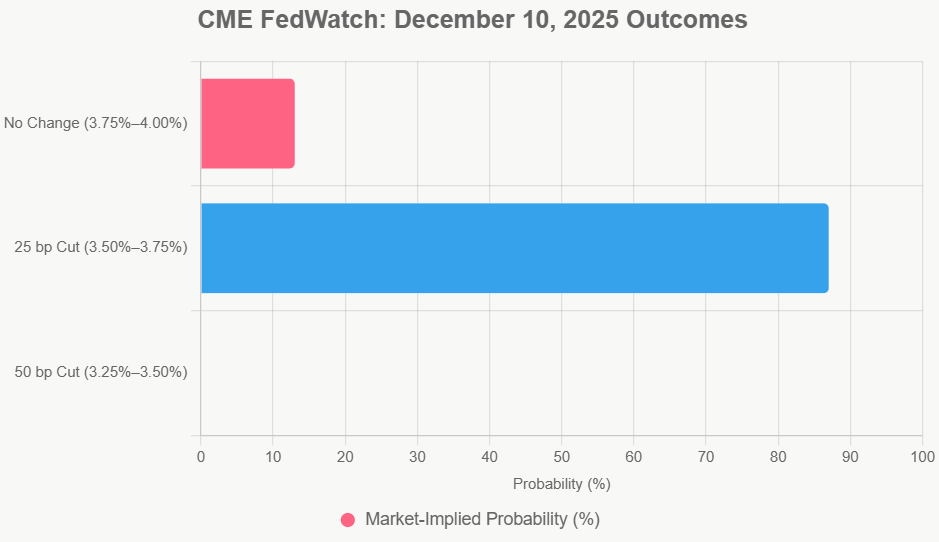
When it comes to what the financial markets expect, there’s very little guesswork. The CME FedWatch Tool, which tracks futures contracts related to the federal funds rate, shows an overwhelming probability – around 98.9% – of a 25 basis point (bps) cut. This means the market is virtually certain that the Fed will lower its target rate from the current 4.00%-4.25% range to 3.75%-4.00%. The odds of no change are barely 1.1%, and a larger 50 bps cut is, for all intents and purposes, off the table.

fed rate cut possibilty in october 2025 by cme fedwatch tool

This high level of certainty reflects the consensus among economists and investors that the Fed is in an easing cycle. This would be the second consecutive quarterly cut, following the reduction made in September. It’s important to remember that markets are forward-looking, so much of this expected move has already been “priced in” to asset values. This means the actual announcement might not cause huge immediate market swings unless the Fed says something unexpected in its statement.

A Look Back: The Fed's Rate Journey

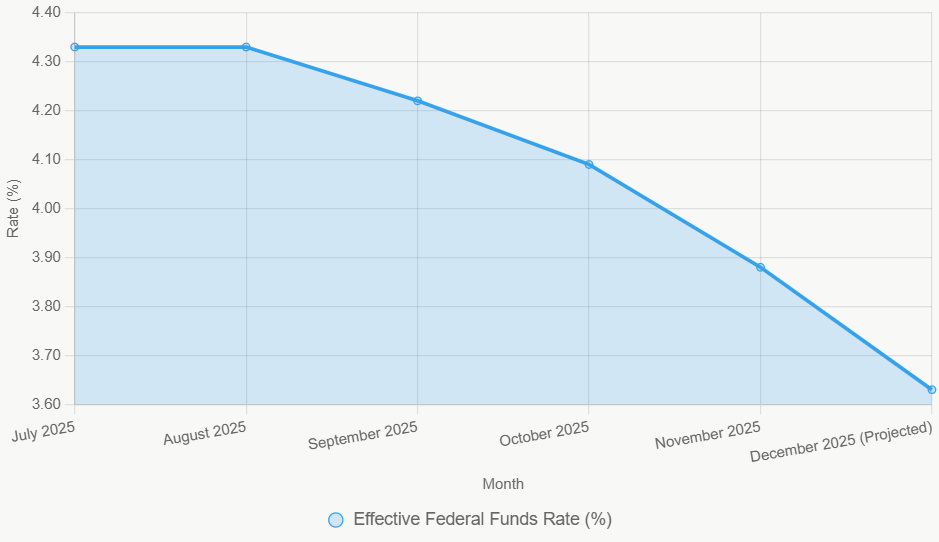
To understand the current situation, it’s helpful to recall the Fed’s recent actions. After keeping rates near zero for a long time, the Fed embarked on an aggressive hiking campaign starting in early 2022 to combat soaring inflation. Rates climbed rapidly, reaching a peak of 5.33% in mid-2023. Since then, we’ve seen a reversal, with the Fed starting to cut rates in 2024 and continuing into 2025.

This trajectory shows how the Fed has been reactive to economic conditions. First, it fought inflation with higher rates, and now, as inflation recedes and the economy shows signs of slowing, it’s shifting to support growth. The proposed cut in October continues this easing trend.

Here's how the effective federal funds rate has evolved:

Here's how the effective federal funds rate has evolved

This historical context is crucial. It shows that the Fed’s actions are part of a process, and the October meeting is another step in that ongoing journey.

What to Watch For in the Statement

Since there won't be a press conference or new projections, the policy statement issued on October 29th will be the main guide. I'll be looking for several things:

  • The specific language used to describe inflation and employment: Does it suggest they are truly comfortable with current trends, or are there lingering concerns about upside inflation risks or deeper labor market weakening?
  • Forward-looking guidance: Even without the dot plot, the statement might offer clues about the pace and extent of future rate cuts. Phrases like “gradual” or “measured” will be important to note.
  • Any mentions of specific risks: Will they highlight potential issues like geopolitical events, trade policy changes, or financial stability concerns? These could provide insight into potential future actions.
  • The balance between the dual mandate: How are they weighing the need to keep prices stable against ensuring maximum employment?

The difference between a hawkish statement (suggesting a more cautious, slowing approach to cuts) and a dovish statement (indicating a quicker pace of easing) can significantly influence market sentiment.

Potential Impacts: Who Benefits and Who Worries?

A 25 bps rate cut could have several effects:

  • Stock Markets: Historically, rate cuts, especially when initiated during a period of economic expansion, can be positive for stocks. The thinking is that lower borrowing costs can boost corporate profits and consumer spending. However, the reaction can depend on the reason for the cut. If it's seen as purely precautionary to stave off a recession, it might be met with more caution.
  • Borrowing Costs: Consumers and businesses could see slightly lower interest rates on things like mortgages, car loans, and business loans. This can stimulate demand and investment. However, the impact on mortgages might be muted if rates have already fallen in anticipation.
  • Cryptocurrency Markets: These markets tend to be sensitive to liquidity and the cost of capital. A dovish Fed generally supports higher prices for assets like Bitcoin, as investors seek higher returns and liquidity increases. Analysts suggest that a cut could see Bitcoin testing new highs.
  • Businesses: For companies with significant debt, lower interest rates mean lower borrowing costs, which is a positive for their bottom line. However, they'll also be watching consumer demand, which is influenced by the overall health of the economy.
  • Households: Those with variable-rate debt will see their payments decrease. However, if inflation begins to tick back up, the benefit from lower rates could be eroded.

It’s a mixed bag, and the actual outcome depends on how the Fed's actions are interpreted and how the economic data continues to unfold in the coming weeks and months.

Expert Opinions and The Road Ahead

Economists and analysts I follow are largely in agreement with the market’s expectation of a rate cut. However, many also echo the Fed’s caution. The uncertainty surrounding government data releases due to potential disruptions adds a layer of complexity. This means the Fed might be relying on older data points or alternative indicators, which could lead to surprises.

The discussions among Fed officials themselves highlight this balancing act. Governor Waller has indicated support for a 25 bps cut due to job market concerns, but has also flagged potential inflationary pressures from tariffs. Chair Powell’s recent remarks have emphasized a “no risk-free path,” underscoring the difficult choices the Fed faces.

Looking beyond October, the big question is: what’s next? Will this be the start of a steady path of rate cuts, or a pause before potentially more aggressive action? The economic forecast for 2026 by institutions like the IMF suggests continued growth, but with potential headwinds. How the Fed navigates these challenges in the coming months will shape not just the economy but also influence broader trends like trade policies and even the upcoming elections.

Ultimately, this October FOMC meeting is about the Fed’s assessment of whether its aggressive fight against inflation has succeeded enough to begin supporting growth without reigniting price pressures. It’s a critical juncture, and while the rate cut itself might be largely predictable, the nuances within the Fed’s statement will be key to understanding the path forward.

“Build Wealth Through Turnkey Real Estate”

The Federal Reserve’s decisions on interest rates impact everything—from your mortgage payments to your savings yields. As of October 2025, the Fed’s target range stands at 4.00%–4.25% following a recent 25 basis point cut, with the effective rate hovering near 4.09%.

Market analysts now anticipate additional rate cuts over the coming months—potentially lowering the rate to around 3.50%–3.75% by the end of 2025. This shift could open new opportunities for homebuyers and real estate investors looking to secure better financing terms.

🔥 Lower Rates Mean Smarter Investment Opportunities! 🔥

Talk to a Norada investment counselor today (No Obligation):

(800) 611-3060

Get Started Now

Want to Know More?

Explore these related articles for even more insights:

  • Fed Interest Rate Forecast Q4 2025: Target Range Could Hit 3.50%–3.75%
  • Fed Interest Rate Forecast for the Next 12 Months
  • Federal Reserve Cuts Interest Rate by 0.25%: Two More Cuts Expected in 2025
  • Fed Projects Two Interest Rate Cuts Later in 2025
  • Interest Rate Predictions for the Next 3 Years: 2025, 2026, 2027
  • When is Fed's Next Meeting on Interest Rate Decision in 2025?
  • Interest Rate Predictions for the Next 10 Years: 2025-2035
  • Interest Rate Predictions for 2025 by JP Morgan Strategists
  • Interest Rate Predictions for Next 2 Years: Expert Forecast
  • Fed Funds Rate Forecast 2025-2026: What to Expect?
  • Interest Rate Predictions for 2025 and 2026 by NAR Chief
  • Market Reactions: How Investors Should Prepare for Interest Rate Cut
  • Impact of Interest Rate Cut on Mortgages, Car Loans, and Your Wallet

Filed Under: Economy, Financing Tagged With: Economy, Fed, Federal Reserve, FOMC Meeting, interest rates

Mortgage Rates Today: Rates Go Down to Lowest Level in 2025

October 24, 2025 by Marco Santarelli

Mortgage Rates Drop to Lowest in 3 Years Boosting Purchasing Power

It’s fantastic news for anyone thinking about buying a home or refinancing their current mortgage: Mortgage rates have dropped to their lowest level in over a year. This is a significant shift, and if you've been on the fence about making a move in the housing market, now might be the perfect time to seriously consider it. For those looking to purchase a new home, this translates into a more affordable monthly payment. For existing homeowners, it’s a golden opportunity to potentially lower their current housing expenses through refinancing.

Seeing rates fall this much is a welcome relief. For a long time, rates have been hovering at levels that made homeownership a stretch for many. We saw the 30-year fixed-rate mortgage climb above 7% at the beginning of 2025. Now, to see it drop to where it is today, nearly a full percentage point lower, is a substantial change. This kind of movement can make a real difference in what people can afford.

Mortgage Rates Today: Rates Go Down to Lowest Level in 2025

What's Driving These Lower Rates?

While the exact reasons for interest rate fluctuations can be complex, generally speaking, lower mortgage rates are often a sign of a maturing economy or a response to certain economic policies. When the economy is stable or showing signs of slowing down, lenders might lower their rates to encourage borrowing and keep economic activity moving. Additionally, inflation plays a huge role; when inflation is under control or decreasing, the Federal Reserve might signal a less aggressive stance on interest rates, which in turn influences mortgage rates.

It’s also helpful to remember that mortgage rates aren’t set in stone by some single entity. They are influenced by a mix of factors, including the bond market, the overall health of the economy, and even global events. The fact that rates have been trending down for a bit now suggests a more consistent downward pressure, rather than a fleeting blip.

A Closer Look at the Numbers (Thanks, Freddie Mac!)

Let’s break down what these impressive numbers mean, drawing from the latest data from Freddie Mac's Primary Mortgage Market Survey®:

Mortgage Type Current Rate (10/23/2025) 1-Week Change 1-Year Change Monthly Average 52-Week Average 52-Week Range
30-Year Fixed-Rate Mortgage (FRM) 6.19% -0.08% -0.35% 6.28% 6.7% 6.19% – 7.04%
15-Year Fixed-Rate Mortgage (FRM) 5.44% -0.08% -0.27% 5.51% 5.87% 5.41% – 6.27%

I find it particularly interesting to see the 52-week range for the 30-year fixed-rate mortgage. It tells us that the current rate of 6.19% is not only the lowest in over a year, but it’s also at the very bottom of the range we’ve seen over the past twelve months. This indicates a significant drop from the peak we experienced earlier in the year. The 15-year fixed-rate mortgage is also showing some very attractive numbers, often a great choice for borrowers who can manage a slightly higher monthly payment in exchange for paying off their mortgage faster and saving on overall interest.

Why Refinancing is Booming

The data also highlights a crucial trend: refinancing is accounting for more than half of all mortgage activity. This makes complete sense given the current rate environment. When mortgage rates drop significantly from when you first took out your loan, it’s like leaving money on the table if you don’t explore refinancing.

Here’s a simple way to think about it:

  • Lower Monthly Payments: By refinancing to a lower interest rate, your monthly mortgage payment can decrease. This frees up cash that can go towards other financial goals, like saving, investing, or paying down other debts.
  • Reduced Total Interest Paid: Over the life of your loan, a lower interest rate can save you tens of thousands of dollars. Even a small drop in the rate can add up significantly.
  • Shorter Loan Term: Some people choose to refinance into a shorter loan term (like a 15-year mortgage instead of a 30-year) even at a slightly higher rate to pay off their home faster. However, with rates as low as they are now, you might even be able to get a lower payment and shorten your term.

It’s not just about saving money, though. Refinancing can also allow you to:

  • Cash Out Equity: If you’ve built up significant equity in your home, you might be able to take out some of that cash through a cash-out refinance to fund renovations, investments, or manage other financial needs.
  • Convertfrom ARM to Fixed: If you have an Adjustable-Rate Mortgage (ARM) and are concerned about future rate increases, now could be a prime time to refinance into a stable fixed-rate mortgage.


Related Topics:

Mortgage Rate Predictions for the Next 12 Months: Oct 2025 to Oct 2026

Mortgage Rates Predictions for the Next 6 Months: October 2025 to March 2026

Mortgage Rates Predictions for Next 90 Days: October to December 2025

What Does This Mean for Homebuyers?

For aspiring homeowners, this is incredibly encouraging news.

  • Increased Buying Power: With lower rates, a portion of your budget that would have gone towards interest payments can now go towards the principal. This means you might be able to afford a slightly more expensive home, or at least make a larger down payment, which can sometimes help you avoid Private Mortgage Insurance (PMI).
  • More Manageable Monthly Costs: The overall cost of homeownership, from your monthly mortgage to potentially lower property taxes (if assessed on a lower value), becomes more approachable.
  • Greater Negotiation Power: In some markets, a more favorable rate environment can lead to increased buyer demand, which can sometimes translate into more options and a better negotiating position.

From my perspective, this marks a significant positive shift. I’ve spoken with many people who have been sidelined from the housing market due to high rates. This drop could be the catalyst they need to finally make their dream of homeownership a reality. It also provides breathing room for those looking to upgrade or relocate.

Looking Ahead: What to Consider

While these lower rates are fantastic, it’s crucial to approach the decision thoughtfully. Markets can change, and while current trends are positive, it’s always wise to:

  • Shop Around: Different lenders offer different rates and fees. Get quotes from multiple mortgage lenders to find the best deal for you.
  • Understand Your Credit Score: Your credit score heavily influences the rate you'll be offered. Work on improving it if necessary.
  • Factor in Closing Costs: Refinancing and purchasing a home both come with closing costs. Make sure you calculate if the savings from the lower rate will outweigh these expenses within a reasonable timeframe.
  • Consult a Professional: A mortgage broker or financial advisor can help you assess your personal financial situation and determine the best course of action.

It’s a promising time for the mortgage market, and I’m genuinely excited to see how this benefits so many people.

Volatile Rates, Steady Returns—Why Rentals Still Win

Savvy investors are locking in properties that deliver consistent passive rental income and long-term appreciation.

Work with Norada Real Estate to find turnkey, cash-flowing homes in stable markets—helping you grow wealth no matter which way rates move.

HOT NEW INVESTMENT PROPERTIES JUST LISTED!

Speak with a seasoned Norada investment counselor today (No Obligation):

(800) 611-3060

Get Started Now

Also Read:

  • Mortgage Rates Drop to Lowest in 3 Years Boosting Purchasing Power
  • Mortgage Rates Predictions Backed by 7 Leading Experts: 2025–2026
  • Mortgage Rate Predictions for the Next 3 Years: 2026, 2027, 2028
  • 30-Year Fixed Mortgage Rate Forecast for the Next 5 Years
  • 15-Year Fixed Mortgage Rate Predictions for Next 5 Years: 2025-2029
  • Will Mortgage Rates Ever Be 3% Again in the Future?
  • Mortgage Rates Predictions for Next 2 Years
  • Mortgage Rate Predictions for Next 5 Years
  • Mortgage Rate Predictions: Why 2% and 3% Rates are Out of Reach
  • How Lower Mortgage Rates Can Save You Thousands?
  • How to Get a Low Mortgage Interest Rate?
  • Will Mortgage Rates Ever Be 4% Again?

Filed Under: Financing, Mortgage Tagged With: Interest Rate, mortgage, Mortgage Rate Trends, mortgage rates, Mortgage Rates Today

Housing Market Update: Home Sales Rise Fueled by Lower Mortgage Rates

October 23, 2025 by Marco Santarelli

Housing Market Update: Home Sales Rise Fueled by Lower Mortgage Rates

It’s been a pretty solid September for the housing market, and I'm feeling optimistic. The latest report from the National Association of REALTORS® (NAR) shows that existing-home sales jumped by 1.5% last month, hitting a seasonally adjusted annual rate of 4.06 million. This is exactly what we’ve been hoping for: as mortgage rates started to dip, more buyers felt comfortable making a move. So, yes, lower mortgage rates are indeed lifting home sales.

Housing Market Update: Home Sales Rise Fueled by Lower Mortgage Rates

This uptick is a welcome sign, especially after a period where affordability has been a major hurdle for many. For those of us who live and breathe real estate, seeing more transactions happen means a healthier market overall. It signals that buyers are back, and sellers are finding their homes moving faster. It's a complex dance, but right now, the music is playing a bit more cheerfully.

What's Driving This Positive Shift?

Honestly, it boils down to a few key factors, and the biggest one is definitely mortgage rates. In September, the average 30-year fixed-rate mortgage dipped to 6.35%, down from 6.59% in August. Even a small decrease like this can make a big difference in monthly payments, making homeownership feel achievable again for a lot of people. It's like finally seeing a clear path after a period of foggy uncertainty.

Dr. Lawrence Yun, NAR's Chief Economist, put it perfectly: “As anticipated, falling mortgage rates are lifting home sales. Improving housing affordability is also contributing to the increase in sales.” I couldn't agree more. When the cost of borrowing money for a home goes down, it directly impacts how much house people can afford. This affordability boost is a crucial piece of the puzzle.

Inventory Levels: A Mixed Bag, But Still Improving

One of the big concerns in recent years has been the lack of homes on the market. While we're not quite back to pre-pandemic levels, the inventory situation saw a slight improvement in September. Total housing inventory rose by 1.3% month-over-month to 1.55 million units. This gives us a supply of 4.6 months of unsold inventory.

This increase, while not massive, is significant. It means buyers have a bit more choice, and competition, while still present, might not be as cutthroat as it was. Dr. Yun also pointed out that inventory is matching a five-year high, which is encouraging. However, he also made a really insightful point: “Many homeowners are financially comfortable, resulting in very few distressed properties and forced sales.” This is important because it means the homes hitting the market are generally well-maintained and not part of a fire sale, which helps keep prices stable.

Home Prices: Still Climbing, But at a Slower Pace

Despite the increase in sales and inventory, home prices are still on the rise. The median existing-home price for all housing types reached $415,200 in September. This marks the 27th consecutive month of year-over-year price increases.

It's important to note that while prices are up, the rate of increase is more moderate than we've seen in some of the hotter periods. Personally, I see this as a good thing. When prices climb too quickly, it can price out a whole generation of buyers. A more steady, sustainable increase is healthier for the long-term market.

Breakdown by Housing Type and Region:

Let's dive a bit deeper into what's happening:

Single-Family Homes:

  • Sales of single-family homes increased by 1.7% month-over-month to an annual rate of 3.69 million.
  • Year-over-year, single-family home sales are up 4.5%.
  • The median price for single-family homes climbed to $420,700, a 2.3% increase from the previous year.

Condominiums and Co-ops:

  • For condos and co-ops, the sales picture was a bit different. There was no change month-over-month or year-over-year, with sales holding steady at 370,000 units annually.
  • The median price for these properties saw a slight dip of 0.6% year-over-year, landing at $360,300. This could be due to a variety of factors, including buyer preferences or specific market conditions in cities where these types of homes are more prevalent.

Regional Trends:

The housing market is never a one-size-fits-all story, and the regional data for September really highlights this:

Region Month-over-Month Sales Change Year-over-Year Sales Change Median Price (September) Year-over-Year Price Change
Northeast +2.1% +4.3% $500,300 +4.1%
Midwest -2.1% +2.2% $320,800 +4.7%
South +1.6% +6.9% $364,500 +1.2%
West +5.5% 0% $619,100 +0.4%
  • The West saw a significant 5.5% surge in sales month-over-month, indicating strong demand in that region, even though year-over-year sales were flat. The median price here is the highest at $619,100.
  • The South showed consistent growth with a 1.6% increase in sales month-over-month and a healthy 6.9% jump year-over-year.
  • The Northeast also experienced positive growth, with a 2.1% rise in sales month-over-month and a 4.3% increase year-over-year, along with the second-highest median price at $500,300.
  • The Midwest was the only region to see a slight decrease in sales month-over-month (-2.1%), but still managed to achieve a 2.2% year-over-year increase. Interestingly, it has the lowest median price at $320,800, making it potentially a more affordable option for many buyers.

Who's Buying and How Are They Doing It?

Some interesting insights come from the REALTORS® Confidence Index for September:

  • Homes are taking a little longer to sell: The median time on market was 33 days, up from 31 days last month and 28 days a year ago. This isn't necessarily a bad thing; it could mean buyers are taking their time to find the right home and aren't feeling pressured by frantic bidding wars.
  • First-time homebuyers are making a comeback: 30% of sales were to first-time homebuyers, which is up from 28% in July and 26% in September 2024. This is fantastic news for the future of homeownership.
  • Cash is still king for some: 30% of transactions were cash sales, showing that some buyers have the financial flexibility to bypass mortgages entirely.
  • Investors are stepping back a bit: 15% of transactions were by individual investors or second-home buyers, down from 21% last month. This suggests that perhaps individual buyers, with less investment capital, are re-entering the market now that rates have softened.
  • Distressed sales remain very low: Only 2% of sales were distressed properties (foreclosures and short sales), which is a testament to the generally healthy financial state of homeowners and the market.

As a real estate professional, I see these numbers as a sign of a maturing market. We're moving away from the extreme frenzy and into a more balanced environment where both buyers and sellers can find success. The decrease in mortgage rates has unlocked a lot of pent-up demand, and it’s particularly encouraging to see more first-time buyers getting a foot in the door.

My Takeaway: A Path Towards Stability

The September housing market update paints a picture of progress. The return of slightly lower mortgage rates has clearly energized the market, leading to increased sales. While prices are still climbing, the pace seems more sustainable, and the growing inventory, though still needing more volume, offers buyers more choices.

For anyone looking to buy or sell, this is a crucial time to pay attention. The market is dynamic, and understanding these trends can give you a real advantage. I believe we're on a path towards greater stability, which is good for everyone involved. It’s about finding that sweet spot where affordability meets opportunity.

Capitalize on Rising Home Sales and Lower Mortgage Rates

As mortgage rates ease and home sales climb, now is an ideal time for smart investors to lock in strong real estate deals. Lower borrowing costs mean better cash flow and long-term returns.

Work with Norada Real Estate to identify turnkey rental properties in high-demand markets—so you can build wealth through stable, income-producing investments that thrive even as the market shifts.

NEW TURNKEY OPPORTUNITIES JUST LISTED!

Speak with a seasoned Norada investment counselor today (No Obligation):

(800) 611-3060

Get Started Now 

Want to Know More About the Housing Market Trends?

Explore these related articles for even more insights:

  • Housing Market Trends: Nearly 1 in 3 Buyers Still Opt for All-Cash Deals in 2025
  • Will the Housing Market Shift to a Buyer’s Market in 2026?
  • Housing Market 2025: Booming vs. Shrinking Inventory Across America
  • Housing Market Gains Supply But Buyers Hit Pause in 2025
  • Mid-Atlantic Housing Market Heats Up as Mortgage Rates Go Down
  • NAR Chief's Bold Predictions for the 2025 Housing Market
  • Housing Market Update 2025: NAR Report Indicates Sluggish Trends
  • 7 Buyer-Friendly Housing Markets in 2025 With Abundant Homes for Sale
  • The $1 Trillion Club: America's Richest Housing Markets Revealed
  • 4 States Dominate as the Riskiest Housing Markets in 2025
  • Housing Market Predictions 2025 by Norada Real Estate
  • Housing Market Predictions 2026: Will it Crash or Boom?
  • Housing Market Predictions for the Next 4 Years: 2025 to 2029
  • Real Estate Forecast: Will Home Prices Bottom Out in 2025?
  • Real Estate Forecast Next 5 Years: Top 5 Predictions for Future
  • Will Real Estate Rebound in 2025: Top Predictions by Experts

Filed Under: Housing Market, Real Estate Market Tagged With: Housing Market, Housing Market Trends

Today’s Mortgage Rates – October 23: Rates Hit Lowest, 30-Year FRM Falls to 6.06%

October 23, 2025 by Marco Santarelli

Today's Mortgage Rates - October 9, 2025: 30-Year FRM Nudges Up to 6.48%

As of today, October 23, 2025, mortgage rates are showing a welcome downward trend, with the average 30-year fixed mortgage rate nudging down to 6.06% and the 15-year fixed rate sitting at 5.37%, according to the latest data from Zillow. This movement offers a glimmer of hope for potential homebuyers and those looking to refinance. Seeing mortgage rates ease, even just a bit, is a breath of fresh air.

Today's Mortgage Rates – October 23: Rates Slip Lower, 30-Year FRM Falls to 6.06%

The Latest Numbers: A Snapshot of Current Mortgage Rates

Let's break down what these rates actually mean for you. Zillow provides a great benchmark for national averages, and it's useful to see how different loan types are stacking up. Keep in mind, these are averages, and your individual rate can vary based on your credit score, down payment, and the specifics of the loan you choose.

Here’s a look at the national averages for purchase mortgages, as of October 23rd:

Loan Type Interest Rate
30-year fixed 6.06%
20-year fixed 5.51%
15-year fixed 5.37%
5/1 ARM 6.30%
7/1 ARM 6.20%
30-year VA 5.59%
15-year VA 5.13%
5/1 VA 5.49%

And if you're thinking about refinancing your current home loan, here's how the rates are looking for that:

Refinance Loan Type Interest Rate
30-year fixed 6.21%
20-year fixed 5.69%
15-year fixed 5.49%
5/1 ARM 6.52%
7/1 ARM 6.73%
30-year VA 5.68%
15-year VA 5.55%
5/1 VA 5.43%

What does this tell me? The 30-year fixed rate, which is what most people are familiar with, is sitting just above the coveted 6% mark. The 15-year fixed rate continues to be significantly lower, making it a great option for those who can afford the higher monthly payments. For those considering an Adjustable-Rate Mortgage (ARM), the initial rates are attractive, but it's crucial to understand the risks involved as they can increase over time. VA loans, for our veteran community, are also showing very competitive rates, which is fantastic to see.

What's Driving Today's Mortgage Rates? Key Economic Influences

Seeing those rates tick down is great, but it's important to understand why this is happening. The big headlines for the week ending October 23rd point to a significant factor: expectations that the Federal Reserve will cut interest rates before the year is out.

When the Fed signals or hints that it might lower its benchmark interest rate, it often has a ripple effect across the economy, including influencing mortgage rates. Lowering the Fed rate can make it cheaper for banks to borrow money, and ideally, that cost saving gets passed on to consumers in the form of lower interest rates on things like mortgages. It's a bit like a domino effect, and right now, the dominos are falling in a favorable direction for borrowers.

My take on this: While the Fed's actions are a major driver, it's not the only one. We're also seeing hints of a cooling job market and efforts to ease inflation. When inflation is high, the Fed typically raises rates to slow spending. If inflation starts to calm down, they have more room to consider lowering them. So, it's a delicate balancing act, and the news this week suggests they might be seeing some positive signs.

The Great Waiting Game: Will Rates Dip Below 6%?

This is the question on everyone's mind: will mortgage rates finally break the 6% barrier for the 30-year fixed? Many homebuyers are holding their breath, believing that once rates dip below that psychological threshold, the market will truly open up. However, the outlook from housing experts is a bit mixed, and for many, the wait might be longer than anticipated.

Some forecasts suggest that we might not see rates consistently below 6% until late 2026. This is a significant timeframe, and it highlights the uncertainty that many economists are facing.

What does this mean for you? If you're a buyer who can comfortably afford a mortgage at current rates, waiting for a magical sub-6% might mean missing out on a home you love or finding that home prices have adjusted upwards by the time rates do fall. On the flip side, if you're very price-sensitive, the wait might still be worth it, but it requires patience and a realistic understanding of market projections.

Diverging Forecasts and the Persistence of Market Uncertainty

As I mentioned, the economic crystal ball is a little cloudy right now. Some experts foresee continued, although modest, decreases in mortgage rates, particularly if inflation keeps cooling and the job market shows signs of weakening. This scenario paints a picture of gradual improvement.

However, others remain cautious. The fear of lingering inflation and market volatility could keep rates stubbornly higher, potentially within the 6% to 7% range. This divergence in expert opinions is a healthy reminder that no one has a perfect prediction.

My personal experience tells me: Economic forecasting is an art as much as a science. Unexpected global events, shifts in consumer confidence, or changes in government policy can all throw a wrench into the most carefully laid plans. Right now, we're seeing a few lingering concerns that could keep lenders and investors a bit more hesitant, leading to those higher rate possibilities.

The “Golden Handcuffs” Effect: Why Supply Remains Tight

One of the most fascinating, and often frustrating, aspects of today's housing market is the concept of “golden handcuffs.” Many homeowners who secured incredibly low mortgage rates during the pandemic boom years (around 2020 and 2021) are now finding themselves unwilling to sell. Why? Because if they sell their current home and buy a new one, they'll have to take out a new mortgage at a significantly higher interest rate.

This reluctance to move means that the supply of homes on the market remains limited. When there are fewer homes available, it can create more competition among buyers, even if rates are starting to ease.

My thoughts on this: It's a real head-scratcher for the market. We have people who might want to move for lifestyle reasons, career changes, or growing families, but their current mortgage rate acts like an anchor. This “golden handcuffs” scenario is a key reason why the housing market hasn't seen the kind of price corrections some might have expected, even with higher rates.

Global Puzzles and Market Volatility

Adding to the symphony of economic influences are a few more discordant notes like recent federal government shutdowns and ongoing global trade disputes. These aren't just abstract headlines; they contribute to a general sense of economic uncertainty.

When there's uncertainty, markets tend to react. Investors might become more cautious, demanding higher returns for their investments, which can translate into higher interest rates. This volatility is precisely why those expert forecasts can differ so much, and it's a factor that could cause mortgage rates to swing back and forth rather than follow a steady downward path.


Related Topics:

Mortgage Rates Trends as of October 22, 2025

Mortgage Rate Predictions for the Next 12 Months: Oct 2025 to Oct 2026

Mortgage Rates Predictions for the Next 6 Months: October 2025 to March 2026

Mortgage Rates Predictions for Next 90 Days: October to December 2025

The Slowdown in Refinancing Activity

Despite the fact that today's mortgage rates are lower than they were in 2023, we're not seeing a refinance boom. The primary reason is that many homeowners are still benefiting from those once-in-a-lifetime, ultra-low rates they locked in a few years ago. For them, refinancing now wouldn't make financial sense.

This means that while some new buyers might be re-entering the market thanks to the slightly lower purchase rates, the overall refinance market is experiencing a slowdown. It's a bit of an odd situation where rates are better than last year, but not low enough to entice everyone to refinance.

What This Means for You Today, October 23rd

So, what should you do with this information?

  • For Buyers: If you're in the market for a home, the slight dip in rates is a positive. Calculate what you can afford at today's rates. Don't necessarily put your plans on hold indefinitely waiting for a magic number, but be realistic about projections for when those very low rates might return. Explore all loan options, including ARMs if you're comfortable with the risk and understand the terms.
  • For Refinancers: If you have a mortgage from 2023 or later, it might be worth exploring a refinance. If you have an older mortgage with a rate significantly higher than what's available today, even if it's above 6%, it could still be a smart financial move. Get quotes and compare carefully.
  • Stay Informed: The market is dynamic. Keep an eye on economic news, Federal Reserve statements, and updated rate reports.

Today's mortgage rates offer a moment of respite, but the road ahead is still paved with economic considerations. Understanding these nuances will help you navigate the market with confidence.

Make Rate Swings Work for You—Invest in Consistent Rental Returns

Savvy investors are locking in properties that deliver consistent passive rental income and long-term appreciation.

Work with Norada Real Estate to find turnkey, cash-flowing homes in stable markets—helping you grow wealth no matter which way rates move.

HOT NEW INVESTMENT PROPERTIES JUST LISTED!

Speak with a seasoned Norada investment counselor today (No Obligation):

(800) 611-3060

Get Started Now

Also Read:

  • Mortgage Rates Predictions Backed by 7 Leading Experts: 2025–2026
  • Mortgage Rate Predictions for the Next 3 Years: 2026, 2027, 2028
  • 30-Year Fixed Mortgage Rate Forecast for the Next 5 Years
  • 15-Year Fixed Mortgage Rate Predictions for Next 5 Years: 2025-2029
  • Will Mortgage Rates Ever Be 3% Again in the Future?
  • Mortgage Rates Predictions for Next 2 Years
  • Mortgage Rate Predictions for Next 5 Years
  • Mortgage Rate Predictions: Why 2% and 3% Rates are Out of Reach
  • How Lower Mortgage Rates Can Save You Thousands?
  • How to Get a Low Mortgage Interest Rate?
  • Will Mortgage Rates Ever Be 4% Again?

Filed Under: Financing, Mortgage Tagged With: Interest Rate, mortgage, Mortgage Rate Trends, mortgage rates, Mortgage Rates Today

Mortgage Rates Today: 30-Year Refinance Rate Goes Down by 15 Basis Points

October 23, 2025 by Marco Santarelli

Mortgage Rates Drop: Today's 30-Year Fixed Refinance Rate Goes Down by 23 Basis Points

Mortgage rates today are showing a positive trend, with the popular 30-year fixed refinance rate dropping by 15 basis points. This means that if you’ve been on the fence about refinancing your home, now might be a particularly opportune time to explore your options and potentially lower your monthly payments.

It’s always a bit exciting when you see these numbers tick down. This drop signals a potentially beneficial moment for those looking to adjust their home loan. So, what exactly does this 15 basis point dip mean for you, and what other factors should you consider when thinking about a refinance? Let's dive in.

Mortgage Rates Today: 30-Year Refinance Rate Goes Down by 15 Basis Points

What Does a 15 Basis Point Drop Really Mean?

A “basis point” might sound like a small, technical detail, but when it comes to mortgages, it can translate into real savings. To put it simply, one basis point (bp) is equal to 0.01%. So, a 15 basis point decrease means the average rate has fallen by 0.15%.

According to Zillow’s data, the national average for a 30-year fixed refinance rate has moved from 6.85% last week down to 6.70% today, Thursday, October 23, 2025. While that might seem like a tiny change, let’s imagine you have a $300,000 mortgage.

  • At 6.85%: Your estimated monthly principal and interest payment would be around $1,973.
  • At 6.70%: Your estimated monthly principal and interest payment drops to approximately $1,942.

That’s a saving of about $31 per month. Now, $31 might not sound like life-changing money on its own, but over the life of a 30-year mortgage, that savings really adds up. In this example, you’d save nearly $11,160 over 30 years. And remember, this is just for a $300,000 loan; if your loan is larger, the savings will be even more substantial. This is why paying attention to these seemingly small drops is so important when it comes to your finances.

Refinance Timing: Locking in Before Potential Shifts

The financial world is always in motion, and interest rates are no exception. While we’re seeing a positive dip now, it's wise to consider that this trend might not last forever. Economic factors, inflation, and decisions by the Federal Reserve can all influence mortgage rates. My take on this is that a decrease like the one we're seeing is a good cue to act if refinancing makes sense for your financial situation.

Sometimes, if rates drop significantly, lenders might expect them to rise again soon. This can lead to a push to “lock in” your rate. When you lock in a rate, you secure that specific interest rate for a certain period (usually 30, 45, or 60 days) while your refinance application is processed. This protects you from seeing your rate go up if market conditions change between when you apply and when your loan closes.

If I were in the market to refinance, seeing this downward trend would certainly make me start the process of getting quotes and understanding my options. It’s like catching a good sale – you want to take advantage of it before it’s gone.

Comparing 30-Year Fixed vs. 15-Year Refinance Options

It’s not just the 30-year fixed rate that’s moving; Zillow also reported a decrease in the 15-year fixed refinance rate, falling by 19 basis points from 5.67% to 5.48%. Additionally, the 5-year Adjustable-Rate Mortgage (ARM) refinance rate saw a smaller drop of 11 basis points, moving from 7.29% to 7.18%.

This is a good reminder that you have choices when refinancing.

  • 30-Year Fixed: This is what most people are familiar with. It’s popular because it offers lower monthly payments, making it more manageable for household budgets. You’ll pay interest for a longer period, meaning the total interest paid over the life of the loan will be higher.
  • 15-Year Fixed: This option typically comes with a lower interest rate than a 30-year loan (as we see here, with 5.48% being significantly lower than 6.70%). This means your monthly payments will be higher, but you’ll pay off your mortgage much faster and save a substantial amount on interest over the life of the loan. For many, it's a way to build equity much quicker and become mortgage-free sooner.
  • 5-Year ARM: An ARM starts with a fixed interest rate for an initial period (in this case, 5 years) and then the rate adjusts periodically based on market conditions. While the initial rate might be attractive, there's a risk that rates, and therefore your payments, could go up significantly after the fixed period. This can be a good option if you plan to move or refinance again before the fixed period ends, or if you believe interest rates will fall in the future.

The choice between these depends on your personal financial goals and risk tolerance. If your priority is the lowest possible monthly payment, the 30-year is likely your best bet. If you can afford a higher payment and want to pay off your home faster and save on interest, the 15-year is a strong contender.

How Your Credit Score Impacts Your Refinance Rate Today

It’s crucial to understand that the national averages I've mentioned are just that – averages. The rate you will be offered will depend on several personal factors, and your credit score is one of the most significant. Think of your credit score as your financial report card. Lenders use it to assess how risky it is to lend you money.

  • Excellent Credit (740+): If you have a high credit score, you’ll likely qualify for the lowest available interest rates. This means you’ll get the best possible deal.
  • Good Credit (670-739): You'll still likely get a competitive rate, though perhaps not the absolute lowest.
  • Fair Credit (580-669): You might still be able to refinance, but your interest rates will be higher, and your options might be more limited.
  • Poor Credit (below 580): Refinancing can be very challenging, and you may need to focus on improving your credit score before revisiting mortgage options.

My advice? Before you even start shopping for refinance rates, pull your credit report. Check for any errors and see where you stand. If your score isn't where you want it, spending the time to improve it can easily save you thousands of dollars on a mortgage.

The Role of Debt-to-Income Ratio in Refinancing

Another key factor lenders look at is your debt-to-income ratio (DTI). This ratio compares your total monthly debt payments (including your new potential mortgage payment, car loans, student loans, credit card minimums, etc.) to your gross monthly income.

  • Lower DTI (generally 43% or less): This indicates you have more income available to handle your debts, making you a less risky borrower. Lenders prefer to see a lower DTI.
  • Higher DTI: A higher DTI might raise a red flag for lenders, suggesting you might be overextended financially.

Different lenders have different DTI thresholds, but generally speaking, a DTI below 36% is considered good, and one below 43% is often the maximum for many conventional loans. If your DTI is a bit high, refinancing might be a good opportunity to see if you can reduce your overall debt burden. For instance, consolidating high-interest credit card debt into a lower-interest mortgage (if your lender allows and it makes sense financially) could potentially improve your DTI in the long run.

Recommended Read:

30-Year Fixed Refinance Rate Trends – October 22, 2025

Best Time to Refinance Your Mortgage: Expert Insights

Should I Refinance My Mortgage Now or Wait Until 2026? 

The Impact of Inflation on Mortgage Rates

Finally, it’s worth touching on the broader economic picture. Inflation plays a significant role in shaping interest rates, including mortgage rates. When inflation is high, the purchasing power of money decreases. To combat this, central banks often raise interest rates. Higher interest rates make borrowing more expensive, which can slow down the economy and help to curb inflation.

Currently, we've seen periods of elevated inflation. While recent trends might suggest some cooling, the Federal Reserve (and other central banks) are keenly watching these numbers. If inflation remains stubbornly high, it could put upward pressure on mortgage rates in the future, even if we see short-term dips like this 15 basis point drop. Conversely, if inflation continues to moderate, it could pave the way for even lower rates. This ongoing dance between inflation and interest rates is why staying informed about economic headlines is a good idea for homeowners.

In conclusion, this 15 basis point drop in the 30-year fixed refinance rate is a welcome development for many. It highlights the ongoing fluctuations in the market and underscores the importance of understanding your personal financial standing – your credit score, DTI, and overall financial goals – when considering a refinance. Taking advantage of a dip like this, if it aligns with your circumstances, can lead to significant long-term savings.

“Invest Smart — Build Long-Term Wealth Through Real Estate”

Norada's team can guide you through current market dynamics and help you position your investments wisely—whether you're looking to reduce rates, pull out equity, or expand your portfolio.

Work with us to identify proven, cash-flowing markets and diversify your portfolio while borrowing costs remain favorable.

HOT NEW TURNKEY DEALS JUST LISTED!

Speak with a seasoned Norada investment counselor today (No Obligation):

(800) 611-3060

Get Started Now

Recommended Read:

  • When You Refinance a Mortgage Do the 30 Years Start Over?
  • Should You Refinance as Mortgage Rates Reach Lowest Level in Over a Year?
  • NAR Predicts 6% Mortgage Rates in 2025 Will Boost Housing Market
  • Mortgage Rates Predictions for 2025: Expert Forecast
  • Half of Recent Home Buyers Got Mortgage Rates Below 5%
  • Mortgage Rates Need to Drop by 2% Before Buying Spree Begins
  • Will Mortgage Rates Ever Be 3% Again: Future Outlook
  • Mortgage Rates Predictions for Next 2 Years
  • Mortgage Rate Predictions for Next 5 Years
  • Mortgage Rate Predictions for 2025: Expert Forecast

Filed Under: Financing, Mortgage Tagged With: mortgage, mortgage rates, Mortgage Refinance Rates

Today’s Mortgage Rates – October 22: 30-Year FRM Drops 5 Basis Points to 6.10%

October 22, 2025 by Marco Santarelli

Today's Mortgage Rates - October 9, 2025: 30-Year FRM Nudges Up to 6.48%

It's October 22nd, and if you're thinking about buying a home or refinancing, you'll be happy to hear that today’s mortgage rates are showing a welcome dip. According to Zillow's latest figures, the average 30-year fixed mortgage rate has edged down by five basis points to 6.10%. Similarly, the popular 15-year fixed loan saw a six-basis point drop, now sitting at 5.42%.

This small shift, while not dramatic, signals a potential turning point and offers a breath of fresh air for many in the housing market. Today's numbers are a gentle nudge in the right direction, and I believe this modest decline is worth paying attention to, especially when we consider the broader economic picture and future forecasts.

Today's Mortgage Rates – October 22: 30-Year FRM Drops 5 Basis Points to 6.10%

A Quick Look at Today's Numbers (October 22, 2025)

Let's break down the current averages from Zillow:

  • 30-year fixed: 6.10% (down 5 basis points)
  • 20-year fixed: 5.56%
  • 15-year fixed: 5.42% (down 6 basis points)
  • 5/1 ARM: 6.28%
  • 7/1 ARM: 6.44%
  • 30-year VA: 5.53%
  • 15-year VA: 5.20%
  • 5/1 VA: 5.64%

It's important to remember that these are national averages, and the rate you secure will likely depend on your credit score, down payment, loan type, and lender.

What Does a 5 Basis Point Drop Really Mean?

A basis point might sound tiny, but when it comes to mortgages, every fraction counts. For a 30-year fixed mortgage of, say, $300,000, a five-basis point drop from 6.15% to 6.10% might not seem like much. However, over the life of the loan, this can translate to savings of several hundred dollars in interest. It's not about a sudden drastic change, but a gradual improvement in borrowing costs that can make a tangible difference for homebuyers.

The 15-Year Fixed: A Smart Choice for Some

The 15-year fixed mortgage rate dropping to 5.42% is particularly interesting. While the monthly payments are higher than a 30-year loan, borrowers who can manage this usually build equity much faster and pay significantly less interest overall. If you have the financial flexibility, a 15-year loan at this rate can be a financially savvy move, allowing you to own your home free and clear sooner.

How Falling Rates Impact Refinancing Decisions

For homeowners who might be considering refinancing, today's slight dip is a good sign. While rates haven't fallen enough to make a massive rush to refinance for everyone, it narrows the gap for those with higher rates. If your current mortgage rate is significantly above 6.10%, it’s a good time to start crunching the numbers. I always advise homeowners to look at their original loan terms, their current rate, and how much time is left on their loan. If you can secure a rate that's at least 0.5% to 1% lower, refinancing can definitely be worth exploring to reduce your monthly payments or overall interest paid.

Strategies for Locking in Lower Mortgage Rates

With rates showing this gentle downward trend, here are a few strategies I often share with clients:

  • Get Pre-Approved Early: Knowing your budget and having a pre-approval letter in hand gives you serious negotiating power and allows you to act quickly when you find the right home.
  • Shop Around: Don't just go with the first lender you talk to. Compare offers from multiple banks, credit unions, and mortgage brokers. Even a quarter-point difference can add up.
  • Understand Rate Locks: When you find a rate you're comfortable with, ask about a rate lock. This guarantees a specific rate for a set period (usually 30-60 days), protecting you if rates go up before you close. Be aware of any fees associated with rate locks.
  • Consider Discount Points: Sometimes, you can pay an upfront fee (called points) to lower your interest rate. This is a personal finance decision based on how long you plan to stay in the home and your cash-on-hand.
  • Improve Your Credit Score: A higher credit score generally translates to a lower interest rate. Focus on paying down debt and ensuring timely payments before applying.

How Today's Falling Mortgage Rates Impact Homebuyers in 2025

Looking ahead to 2025, these falling rates, even small ones, are crucial for buyer affordability. The National Association of REALTORS® anticipates mortgage rates to average around 6.4% in the latter half of 2025 and dip to 6.1% in 2026. Realtor.com echoes this, seeing rates matching last year's levels despite a dip by year-end. Fannie Mae also forecasts rates ending 2025 at 6.4% and 2026 at 5.9%. These predictions are significant because they suggest a continued softening of borrowing costs, which is often referred to by experts like Yun as a “magic bullet” for the market. It means more buyers could potentially qualify for loans and afford homes, boosting demand.


Related Topics:

Mortgage Rates Trends as of October 21, 2025

Mortgage Rate Predictions for the Next 12 Months: Oct 2025 to Oct 2026

Mortgage Rates Predictions for the Next 6 Months: October 2025 to March 2026

Mortgage Rates Predictions for Next 90 Days: October to December 2025

The Federal Reserve's Role: A Clearer Picture Evolving

To truly understand where mortgage rates are headed, you need to look at the Federal Reserve. As of late October 2025, the Fed has already made its first rate cut of the year. Fed Chair Jerome Powell's recent comments on October 14th, 2025, indicated a willingness to cut rates further if the labor market continues to show weakness. This dovish signal is crucial.

Why? Because the Federal Reserve's actions directly influence the 10-year U.S. Treasury yield, which is the primary benchmark for 30-year fixed-rate mortgages. When the Fed cuts its benchmark rate, it generally pushes Treasury yields lower. Currently, the 10-year Treasury yield is hovering around 4.12%. While this is significantly lower than its long-term average, the connection to mortgage rates isn't always a direct 1:1 correlation.

There's what's known as the “spread” – the difference between mortgage rates and Treasury yields. This spread has been wider than usual, meaning not all the benefit of lower Treasury yields is immediately passed on to mortgage borrowers. However, the Fed's increasing emphasis on supporting the labor market suggests they are primed for more easing.

What This Means for You: A Forward-Looking Perspective

  • For Buyers: Powell's statements indicate that the easing cycle is likely to continue. This means conditions for financing could improve further in the coming months. While home prices remain a hurdle in many areas, lower rates can help offset some of that cost.
  • For Refinancers: If your rate is above 6.5%, keep a close eye on the Fed's upcoming meetings. As the spread potentially narrows and Treasury yields continue to be influenced by Fed cuts, opportunities for beneficial refinancing could arise.
  • For Market Observers: The Fed appears to be prioritizing economic stability and employment. This suggests they will be proactive in using monetary policy to steer the economy, which can translate into more predictable and potentially lower borrowing costs for consumers.

The forecast from various sources like Fannie Mae and the Mortgage Bankers Association suggests a trend towards lower rates, especially as we move through 2025. While volatility is expected, the overall direction points towards improving affordability.

Today’s mortgage rates on October 22nd provide a gentle reprieve. While we're not seeing drastic shifts, the downward trend, coupled with signals from the Federal Reserve, offers a positive outlook. My advice is to stay informed, do your homework on what you qualify for, and be ready to act when the time is right for you.

Make Rate Swings Work for You—Invest in Consistent Rental Returns

Savvy investors are locking in properties that deliver consistent passive rental income and long-term appreciation.

Work with Norada Real Estate to find turnkey, cash-flowing homes in stable markets—helping you grow wealth no matter which way rates move.

HOT NEW INVESTMENT PROPERTIES JUST LISTED!

Speak with a seasoned Norada investment counselor today (No Obligation):

(800) 611-3060

Get Started Now

Also Read:

  • Mortgage Rates Predictions Backed by 7 Leading Experts: 2025–2026
  • Mortgage Rate Predictions for the Next 3 Years: 2026, 2027, 2028
  • 30-Year Fixed Mortgage Rate Forecast for the Next 5 Years
  • 15-Year Fixed Mortgage Rate Predictions for Next 5 Years: 2025-2029
  • Will Mortgage Rates Ever Be 3% Again in the Future?
  • Mortgage Rates Predictions for Next 2 Years
  • Mortgage Rate Predictions for Next 5 Years
  • Mortgage Rate Predictions: Why 2% and 3% Rates are Out of Reach
  • How Lower Mortgage Rates Can Save You Thousands?
  • How to Get a Low Mortgage Interest Rate?
  • Will Mortgage Rates Ever Be 4% Again?

Filed Under: Financing, Mortgage Tagged With: Interest Rate, mortgage, Mortgage Rate Trends, mortgage rates, Mortgage Rates Today

Housing Market Trends: Nearly 1 in 3 Buyers Still Opt for All-Cash Deals in 2025

October 22, 2025 by Marco Santarelli

Housing Market Trends: Nearly 1 in 3 Buyers Still Opt for All-Cash Deals in 2025

The housing market can feel like a constantly shifting puzzle, and understanding the current housing market trends is crucial whether you're dreaming of buying your first home, selling your place, or just curious about your neighborhood's value. Right now, nearly 29% of U.S. homebuyers are still opting to pay with cash, a figure that has remained remarkably steady compared to last year, suggesting a resilient segment of the market even as other factors begin to shift.

This might sound like a lot of cash, and honestly, it is. But digging a little deeper reveals a more nuanced picture. I've spent years immersed in the world of real estate, watching cycles ebb and flow, and I can tell you that while cash is still king for a significant portion of buyers, it's not the whole story. In fact, if you're someone who relies on a mortgage, there's actually some encouraging news brewing.

Housing Market Trends: Nearly 1 in 3 Buyers Still Opt for All-Cash Deals in 2025

Why is Cash Still So Prevalent?

Before I dive into the reasons, let me share a thought. For a long time, we saw a surge in cash purchases. This was largely because mortgage rates skyrocketed, making borrowing money incredibly expensive. When you can avoid those hefty monthly interest payments, especially on the kind of money buying a home takes, paying cash just makes sense if you have it. Redfin's data from October 2025 shows that the peak for all-cash offers was in late 2023 and early 2024 when mortgage rates were hovering in the high 7% range.

Think about it: if you have the funds, why wouldn't you skip the interest and potentially secure a deal faster in a competitive market? It's a strategic move for many. However, as mortgage rates have started to dip – currently averaging around 6.27% – the allure of paying cash has lessened for some. Lower rates mean lower borrowing costs, which can make taking out a mortgage more attractive again.

Furthermore, the market has become a bit less frantic. We saw a significant cooling from its “red hot” phase. When there are fewer bidding wars and less pressure to “win” at all costs, buyers who need mortgages don't feel as compelled to fork over cash just to beat out someone else.

The Rising Tide of Down Payments

While the share of all-cash buyers is holding steady, another significant trend is the record-breaking median down payment. In August 2025, the typical U.S. homebuyer put down a whopping $70,000. That's a 6.1% increase from the previous year. In percentage terms, the median down payment now sits at 18.6% of the purchase price, the highest it's been in August since 2013.

Why the jump? Well, home prices have been climbing, so naturally, you need to put down more money when the overall cost is higher. However, Redfin's analysis shows that down-payment growth has actually outpaced home-price growth. This tells me something interesting is happening.

One key reason, in my experience, is that affluent buyers are playing a bigger role in the market. When housing costs are high, those with substantial financial resources are more likely to enter the market and make larger down payments. They can absorb a higher price point and still make a significant down payment. It's also possible some wealthier individuals are choosing to make large down payments rather than paying cash as mortgage rates have eased slightly.

Beyond the wealthy, I'm seeing a trend with “move-up” buyers. These are homeowners who are selling their current property and leveraging the equity they've built up to put a substantial down payment on their next home. This strategy can significantly lower their mortgage amount and monthly payments. Also, lenders themselves might be encouraging larger down payments to mitigate their risk in a market that still has some uncertainties.

A Welcome Shift for First-Time Buyers

This rise in larger down payments, combined with slightly lower mortgage rates and a less competitive market, is actually a breath of fresh air for many first-time homebuyers. Kathy Scott, a Redfin Premier agent in Phoenix, shared something I hear often: “First-time buyers have more opportunities than they did when the market was hot; they’re no longer competing against 10 other offers from people who are either paying in cash or shelling out a 50% down payment.”

This means buyers who are stretching to afford a home can breathe a little easier. They're not necessarily facing instant rejection if they can't compete with all-cash offers or massive down payments. They can take their time, find a home that truly fits their needs, and potentially even negotiate on price. Kathy's advice is spot-on: “Now is a great time to start building equity if you’re planning to stay in your new home for five to 10 years.”

However, I need to acknowledge that not everyone has significant cash reserves. Andrew Vallejo, another Redfin Premier agent in Austin, TX, highlights the other side of the coin: “the people who are buying are those who are financially comfortable, secure in their jobs, and have money ready and waiting in the bank for a down payment.” He shared an example of a buyer who liquidated stocks to make a $400,000 down payment on an $800,000 home. That's certainly a different reality for many.

But even with this trend, the flip side is also true. For some first-time buyers with more modest savings, perhaps $10,000 or $15,000, finding a home with a small down payment used to be nearly impossible. Now, in some areas, with less competition, these buyers are finding that their smaller down payments are more feasible.

Where the Trends Play Out: Metro-Level Snapshot

It's important to remember that the housing market isn't a one-size-fits-all phenomenon. Trends can vary wildly from city to city. Here’s a quick glimpse from the August 2025 data covering 40 major metro areas:

All-Cash Purchases:

  • Highest Prevalence: West Palm Beach, FL (43.4%), Cleveland, OH (42.1%), Miami, FL (39.2%). These areas often see a strong presence of investors and buyers with significant liquid assets.
  • Lowest Prevalence: Oakland, CA (18.8%), San Jose, CA (19.1%), Seattle, WA (20.5%). These are typically high-cost-of-living areas where even buyers with strong finances might opt for mortgages to spread the cost.
  • Biggest Increases in Share: Baltimore, MD; Riverside, CA; Providence, RI. This suggests a growing segment of cash buyers in these particular metros.
  • Biggest Declines in Share: Milwaukee, WI; New York, NY; Cincinnati, OH. This implies a shift towards more mortgage-dependent buyers in these locations.

Down Payments (in Dollars):

  • Largest: San Jose, CA ($408,000), San Francisco, CA ($400,000), Anaheim, CA ($300,000). These are some of the priciest housing markets in the nation, demonstrating the sheer scale of investment required.
  • Smallest: Virginia Beach, VA ($9,000), Pittsburgh, PA ($23,000), Cleveland, OH ($27,000). These areas represent more affordable markets where a smaller down payment can go a long way.
  • Biggest Increases: Providence, RI; Chicago, IL; Washington, D.C. Markets where demand is strong and home prices are rising could be seeing larger down payments.
  • Biggest Declines: Riverside, CA; Seattle, WA; Denver, CO. This could indicate a cooling market in these areas, or perhaps a shift towards smaller homes or first-time buyers.

Down Payments (in Percentage):

  • Highest: Anaheim, CA (25%), San Francisco, CA (25%), San Jose, CA (25%). Again, in very expensive areas, buyers often need to put down a larger percentage to make the numbers work.
  • Lowest: Virginia Beach, VA (3%), Las Vegas, NV (9.4%), Tampa, FL (9.8%). These markets often have more lenient down payment requirements for certain loan types.
  • Biggest Increases in Percentage: Providence, RI; Orlando, FL; Columbus, OH. This points to buyers actively trying to reduce their loan principal, perhaps due to higher interest rates or a desire for lower monthly payments.
  • Biggest Declines in Percentage: Miami, FL; Denver, CO; Warren, MI. This reversal could suggest a relaxation of down payment requirements or a shift in buyer demographics.

My Take: Navigating the Current Climate

From where I stand, the current housing market trends present a fascinating duality. On one hand, the persistence of cash purchases shows a deep pool of financially secure buyers still actively participating. On the other, the slight easing of mortgage rates and a less cutthroat environment offer renewed hope and opportunity for those who rely on financing.

For potential buyers, my advice has always been to get pre-approved for a mortgage and understand your budget thoroughly. Don't get discouraged by headlines. Focus on your local market. Talk to an experienced real estate agent who understands the nuances of your area. They can offer invaluable insights and guide you through the process, whether you're bringing cash to the table or seeking a mortgage.

For sellers, understanding these trends is equally important. If you're in a market where cash offers are common and robust, you might be able to expect a quicker sale. If your market is seeing more mortgage-dependent buyers, presentation, price, and flexibility might be key to attracting offers.

Invest Strategically in Real Estate Markets Dominated by Cash Buyers

With nearly 1 in 3 buyers purchasing homes with all cash in 2025, the housing market is showing clear signs of investor confidence. These all-cash trends highlight the stability and profit potential of well-chosen rental markets.

Work with Norada Real Estate to discover turnkey rental opportunities in markets where investor activity remains strong—helping you generate consistent monthly cash flow and long-term wealth without the hassle.

NEW TURNKEY DEALS AVAILABLE NOW!

Speak with a seasoned Norada investment counselor today (No Obligation):

(800) 611-3060

Get Started Now

Want to Know More About the Housing Market Trends?

Explore these related articles for even more insights:

  • Will the Housing Market Shift to a Buyer’s Market in 2026?
  • Housing Market 2025: Booming vs. Shrinking Inventory Across America
  • Housing Market Gains Supply But Buyers Hit Pause in 2025
  • Mid-Atlantic Housing Market Heats Up as Mortgage Rates Go Down
  • NAR Chief's Bold Predictions for the 2025 Housing Market
  • Housing Market Update 2025: NAR Report Indicates Sluggish Trends
  • 7 Buyer-Friendly Housing Markets in 2025 With Abundant Homes for Sale
  • The $1 Trillion Club: America's Richest Housing Markets Revealed
  • 4 States Dominate as the Riskiest Housing Markets in 2025
  • Housing Market Predictions 2025 by Norada Real Estate
  • Housing Market Predictions 2026: Will it Crash or Boom?
  • Housing Market Predictions for the Next 4 Years: 2025 to 2029
  • Real Estate Forecast: Will Home Prices Bottom Out in 2025?
  • Real Estate Forecast Next 5 Years: Top 5 Predictions for Future
  • Will Real Estate Rebound in 2025: Top Predictions by Experts

Filed Under: Housing Market, Real Estate Market Tagged With: Housing Market, Housing Market Trends

Mortgage Rates Today: 30-Year Refinance Rate Moves Higher by 58 Basis Points

October 22, 2025 by Marco Santarelli

Mortgage Rates Drop: Today's 30-Year Fixed Refinance Rate Goes Down by 23 Basis Points

If you've been thinking about refinancing your mortgage, take note: Mortgage rates today are showing a significant upward tick, with the 30-year fixed refinance rate climbing by a notable 58 basis points. This jump, detailed by Zillow, brings the average rate to 7.43%, up from 6.85% just last week. For homeowners looking to leverage current rates, this increase signals a need to pay close attention to the fine print and understand what's driving these changes and how they might impact your financial plans. Let’s break down what this means for you.

Mortgage Rates Today: 30-Year Refinance Rate Moves Higher by 58 Basis Points

Understanding the 58 Basis Point Jump

So, what exactly is a “basis point” and why does a 58-basis point increase matter? Think of a basis point as one-hundredth of a percent. So, a 58-basis point increase means the interest rate has gone up by 0.58%. While it might sound small, when you're talking about home loans that stretch for decades, even small percentage changes can add up to significant amounts of money over the life of the loan.

For a 30-year mortgage, this increase can mean a noticeable bump in your monthly payment. Let's say you were looking to refinance a $300,000 loan. At 6.85%, your principal and interest payment would be around $1,958. At the new rate of 7.43%, that same payment jumps to about $2,095 per month. That’s an extra $137 each month, or over $1,600 per year. Over 30 years, this difference can amount to tens of thousands of dollars more paid in interest. This is precisely why keeping an eye on these figures, as reported by reputable sources like Zillow, is crucial for any homeowner.

What's Cooking in the Economy? The Fed's Influence

To understand why mortgage rates are moving, we have to look at the bigger economic picture, and right now, the Federal Reserve (the Fed) is front and center. Federal Reserve Chair Jerome Powell recently made some comments that are really shaping the market. Back on September 17, 2025, the Fed actually cut its benchmark interest rate for the first time in 2025, bringing it down a quarter percentage point. This was a big deal because it followed a period where they had held rates steady.

Powell’s recent remarks suggest they might be open to more rate cuts. He mentioned that if the job market continues to show weakness, they might need to ease up on interest rates further. This is a delicate balancing act for the Fed. They want to keep the economy humming without letting inflation get too high. Right now, inflation, while maybe not as high as it was, is still a concern, and the job market is showing some signs of slowing down. Adding to the complexity, recent government shutdowns have made it a bit harder to get clear economic data, and ongoing tariff situations can also push prices up.

The Treasury Yield Connection: Why It Matters for Your Mortgage

You might hear a lot about Treasury yields when people talk about mortgage rates, and for good reason. The 10-year U.S. Treasury yield is essentially the benchmark that mortgage lenders look to when they’re setting rates for 30-year fixed mortgages. Think of it this way: when investors buy Treasury bonds, they’re looking for a certain return. To convince them to invest in mortgage-backed securities (which are a bit riskier than Treasury bonds), lenders have to offer a slightly higher return, which is where the spread comes in.

Currently, the 10-year Treasury yield is hovering around 4.12%. Historically, mortgage rates tend to be about 1% to 2% higher than this yield. However, what we're seeing now is that the spread is wider than usual, more than 2 percentage points above the Treasury yield. This is one of the main reasons why even though Treasury yields have come down a bit, mortgage rates haven't fallen as much as you might expect. It’s like the extra cost of doing business for lenders is keeping rates higher for borrowers.

Refinancing Options: 30-Year vs. 15-Year and ARMs

With these rate movements, it's a good time to remember that not all mortgages are created equal, and neither are refinancing options.

  • 30-Year Fixed Refinance: This is what we're primarily discussing, with rates now at 7.43%. It offers the lowest monthly payment, spreading the cost over a longer period. This can be great for cash flow but means you'll pay more interest over time.
  • 15-Year Fixed Refinance: Zillow also reports that the average 15-year mortgage rate has seen a similar jump, increasing by 57 basis points to 6.25%. While the monthly payment will be higher than a 30-year loan, you'll build equity faster and pay significantly less interest over the life of the loan. If your budget allows, this can be a fantastic way to save money in the long run.
  • 5-Year Adjustable-Rate Mortgage (ARM) Refinance: Currently, the national average for a 5-year ARM refinance stands at 7.17%. ARMs typically start with a lower interest rate than fixed-rate mortgages. The rate is fixed for the initial period (in this case, 5 years), and then it adjusts periodically based on market conditions. This can be attractive if you plan to sell or refinance before the adjustment period, or if you anticipate rates falling in the future. However, there’s a risk that your payments could go up significantly if rates rise.

Your Credit and Debt-to-Income: Still Key Players

It’s also worth remembering that these national averages are just that – averages. Your personal refinance rate will depend heavily on your individual financial situation.

  • Credit Score: Lenders see a good credit score as a sign that you're a reliable borrower. If you have excellent credit (think 740 and above), you'll likely qualify for rates that are lower than the national average. Conversely, a lower credit score might mean you're offered higher rates, or you might have a harder time getting approved. If refinancing is on your radar, and your credit score isn't stellar, consider if there's time to improve it before you lock in a rate.
  • Debt-to-Income Ratio (DTI): This ratio compares your total monthly debt payments (including your potential new mortgage payment) to your gross monthly income. Lenders like to see a DTI that is not too high, generally below 43%. A lower DTI shows you have more disposable income to handle your mortgage payments, making you a less risky borrower.

The Inflation Picture and Your Refinance Decision

The ongoing concerns about inflation, even with the Fed working to control it, play a significant role. When inflation is stubbornly high, it typically puts upward pressure on interest rates across the board, including mortgage rates. The Fed is trying to encourage borrowing and spending, but not so much that prices go through the roof. This push and pull can make rate movements feel unpredictable.

For borrowers, this means it's always a good idea to have a plan. If you're thinking about refinancing, and your current rate is significantly higher than the new refinance rates, it might still be worth it, even with this recent uptick. However, if you were on the fence, this upward movement might prompt you to re-evaluate if now is the right time, or if it’s better to wait and see if rates adjust again, perhaps after next month's Fed meeting.

Recommended Read:

30-Year Fixed Refinance Rate Trends – October 21, 2025

Best Time to Refinance Your Mortgage: Expert Insights

Should I Refinance My Mortgage Now or Wait Until 2026? 

Refinance Timing: Don't Get Locked Out

Given the recent rise and the Fed's signals about potential future cuts, the idea of “timing the market” for mortgage rates can be tricky. While Chair Powell’s comments suggest more easing might be on the horizon, which could eventually lead to lower rates, nobody has a crystal ball.

My advice, based on years of seeing these cycles, is this: if you have a concrete reason to refinance – like significantly lowering your monthly payment, switching from an ARM to a fixed rate, or pulling cash out for a major expense – and you find a rate that meets your goals, it might be wise to lock it in. The market can be fickle, and waiting for the absolute lowest rate can sometimes mean missing out on good opportunities. On the other hand, if your situation is more flexible, keeping an eye on upcoming economic data and Fed meetings is a smart move.

My Take: What This Means for You and Me

This recent jump in 30-year refinance rates isn't a surprise, but it’s a definite signal. The Fed's actions and statements are painting a picture of eventual easing, but the path isn't always straight. The widening spread between Treasury yields and mortgage rates is a technical factor that’s definitely keeping a lid on how much borrowers benefit from falling benchmark rates.

For homeowners, this means:

  • Stay Informed: Keep up with mortgage rate reports and economic news.
  • Analyze Your Numbers: What does a 0.58% increase really mean for your wallet? Run the numbers with your specific loan amount.
  • Know Your Financials: Make sure your credit score and DTI are in the best possible shape before you apply.
  • Consult a Professional: Talk to a trusted mortgage broker or lender. They can help you understand your specific options and the current market.

“Invest Smart — Build Long-Term Wealth Through Real Estate”

Norada's team can guide you through current market dynamics and help you position your investments wisely—whether you're looking to reduce rates, pull out equity, or expand your portfolio.

Work with us to identify proven, cash-flowing markets and diversify your portfolio while borrowing costs remain favorable.

HOT NEW TURNKEY DEALS JUST LISTED!

Speak with a seasoned Norada investment counselor today (No Obligation):

(800) 611-3060

Get Started Now

Recommended Read:

  • When You Refinance a Mortgage Do the 30 Years Start Over?
  • Should You Refinance as Mortgage Rates Reach Lowest Level in Over a Year?
  • NAR Predicts 6% Mortgage Rates in 2025 Will Boost Housing Market
  • Mortgage Rates Predictions for 2025: Expert Forecast

  • Half of Recent Home Buyers Got Mortgage Rates Below 5%
  • Mortgage Rates Need to Drop by 2% Before Buying Spree Begins
  • Will Mortgage Rates Ever Be 3% Again: Future Outlook
  • Mortgage Rates Predictions for Next 2 Years
  • Mortgage Rate Predictions for Next 5 Years
  • Mortgage Rate Predictions for 2025: Expert Forecast

Filed Under: Financing, Mortgage Tagged With: mortgage, mortgage rates, Mortgage Refinance Rates

Today’s Mortgage Rates – October 21: Relief for Buyers, 30-Year FRM Drops to 6.15%

October 21, 2025 by Marco Santarelli

Today's Mortgage Rates - October 9, 2025: 30-Year FRM Nudges Up to 6.48%

As of today, October 21st, it looks like mortgage rates are offering a bit of breathing room for potential homebuyers and those considering a refinance. The good news is that mortgage rates have continued to ease lower. According to the latest data from Zillow, the 30-year fixed mortgage rate has decreased by three basis points to 6.15%, while the 15-year fixed rate has followed suit, settling at 5.48%. This is a trend we've been watching, and any move downwards, however small, is generally welcomed in the housing market.

It's easy to get caught up in the day-to-day fluctuations, but understanding why these rates are moving and what the experts are saying provides a much clearer picture. The Federal Reserve's recent actions and forward-looking statements are particularly influential, and they seem to be pointing towards continued easing, which could mean even better news down the road.

Today's Mortgage Rates – October 21: A Welcome Dip and What It Means for You

Where Do Today's Mortgage Rates Stand?

Let's break down the current numbers for major mortgage types, based on Zillow’s national averages. Remember, these are averages, and your personal rate might differ based on your credit score, down payment, and the specific lender.

Mortgage Type Current Rate
30-year fixed 6.15%
20-year fixed 5.75%
15-year fixed 5.48%
5/1 ARM 6.30%
7/1 ARM 6.35%
30-year VA 5.54%
15-year VA 5.15%
5/1 VA 5.47%

These figures represent the average rates across the country, rounded to the nearest hundredth.

Considering a Refinance? Here are the Rates

For those of you looking to refinance your existing mortgage, it's also helpful to see how these trends are affecting those options.

Mortgage Type Current Refinance Rate
30-year fixed 6.24%
20-year fixed 5.78%
15-year fixed 5.73%
5/1 ARM 6.47%
7/1 ARM 6.49%
30-year VA 5.78%
15-year VA 5.72%
5/1 VA 5.40%

It’s interesting to note the small differences between purchase rates and refinance rates. Lenders often price these slightly differently due to varying levels of risk and processing involved.

How Lower Mortgage Rates Can Impact Homebuyers in 2025

We’re seeing a shift, and I believe this downward trend is a positive sign for the housing market moving forward, especially as we look into 2025. When mortgage rates decrease, it directly translates to lower monthly payments for homebuyers. This can significantly boost affordability, making homeownership more accessible for a wider range of people. Even a small drop can save someone thousands of dollars over the life of a loan.

For instance, with the 30-year fixed rate at 6.15% versus, say, 6.50%, a buyer on a $300,000 loan could see their monthly principal and interest payment decrease by roughly $80. Over 30 years, that adds up! This improved affordability can also reduce some of the pressure on home prices, which have been a major hurdle for many aspiring homeowners.

Understanding the Latest Trends in 30-Year Fixed Mortgage Rates

The 30-year fixed mortgage rate remains the most popular choice for homebuyers, and its movement is closely watched. The recent dip to 6.15% is encouraging. It’s a signal that the market is responding to broader economic adjustments. My own sense is that lenders are becoming more confident in the direction of interest rates, which allows them to be more competitive with their pricing. This has been a gradual process, and it’s great to see this particular rate inching closer to more comfortable territory for borrowers.

Comparing 15-Year vs. 30-Year Fixed Mortgage Rates: What’s Best Now?

The age-old question: 15-year or 30-year fixed? Today, the numbers present a clear trade-off. The 15-year fixed rate is at a much lower 5.48%. While this means a smaller loan term and paying less interest overall, your monthly payments will be higher than with a 30-year loan.

  • 15-Year Fixed: Higher monthly payment, but you pay off your home faster and save significantly on total interest.
  • 30-Year Fixed: Lower monthly payment, offering more budget flexibility, but you'll pay more interest over the life of the loan.

The “best” option truly depends on your financial situation and goals. If you can comfortably afford the higher payments of a 15-year loan, it's often the more financially astute choice. However, the 30-year offers much-needed flexibility, especially in uncertain economic times.

Economic Factors Driving Mortgage Rates Lower in 2025

So, what’s behind these falling rates? A significant driver is the Federal Reserve’s recent actions:

  • The Federal Reserve's First Rate Cut: On September 17, 2025, the Fed cut its benchmark interest rate by a quarter percentage point, bringing the target range down. This was the first cut after a pause, and it signals a shift in their monetary policy approach.
  • Powell's Dovish Signals: Federal Reserve Chair Jerome Powell recently indicated a willingness to cut rates further if needed, particularly to address labor market weakness. He described the economic situation as having “no risk-free path,” suggesting a proactive approach to managing potential downturns.
  • Inflation and Growth Data: While inflation remains a concern (at 2.9% year-over-year for the core PCE price index), economic growth (3.8% annualized in Q2 2025) and a cooling labor market (unemployment rising to 4.3%) are giving the Fed room to ease monetary policy.

These factors combined create an environment where borrowing becomes less expensive.

The Federal Reserve’s Role in Mortgage Rates: A Late-October 2025 Outlook

The Fed's policy is the conductor of this economic orchestra, and their recent moves and statements are particularly insightful. Chair Powell’s comments about the labor market softening are a key takeaway. He’s making it clear that the Fed is closely watching for signs of economic slowdown, and is prepared to act.

The Fed doesn't directly set mortgage rates, but their benchmark rate heavily influences the yield on 10-year U.S. Treasury notes. This yield is the primary benchmark for pricing 30-year fixed-rate mortgages. When the Fed cuts rates, it generally pushes Treasury yields down, and consequently, mortgage rates follow suit.

Currently, the 10-year Treasury yield hovers around 4.12%. While this is below its long-term average, the spread between the Treasury yield and mortgage rates has been a bit wider than usual. This means that not all the benefit of falling Treasury yields has been passed on to borrowers in the form of lower mortgage rates. However, with Powell’s increasingly dovish stance, I expect this spread to narrow over time, amplifying the impact of any future Fed cuts.


Related Topics:

Mortgage Rates Trends as of October 20, 2025

Mortgage Rate Predictions for the Next 12 Months: Oct 2025 to Oct 2026

Mortgage Rates Predictions for the Next 6 Months: October 2025 to March 2026

Mortgage Rates Predictions for Next 90 Days: October to December 2025

Predictions for Mortgage Rates: What to Expect Next Quarter

Based on Chair Powell's recent remarks, the probability of additional rate cuts from the Fed in November or December is higher. This suggests that Treasury yields could continue to trend downwards. If this happens, it’s reasonable to expect mortgage rates to also soften, potentially pushing the 30-year fixed rate closer to the 6% range in the coming months.

Of course, economic forecasting is never an exact science. Key factors to watch include:

  • Labor Market Conditions: Any further signs of weakness will likely trigger additional Fed action.
  • Inflation Data: How quickly inflation moderates, especially with potential tariff impacts, will be crucial.
  • Government Shutdown Data Gaps: The Fed needs reliable data to make informed decisions, and resolving these gaps will be important.
  • Mortgage-Treasury Spread: A narrowing of this gap would directly translate to lower mortgage rates for consumers.

Why This Matters for You

For me, these developments are more than just numbers; they are indicators of opportunity.

  • For Current Buyers: Powell's comments indicate that the easing cycle is likely to continue. This could mean better financing conditions ahead. While this doesn't negate the challenge of high home prices, it does make the borrowing aspect more manageable. It might be worth carefully considering the timing of your purchase if you can hold off for potential rate drops.
  • For Refinance Candidates: If your current mortgage rate is significantly above 6.5%, now is a good time to start preparing your refinance application. Keep a close eye on the November Fed meeting. A further drop in rates could make refinancing a very attractive option.
  • For Market Observers: The Fed seems increasingly focused on supporting the labor market. This suggests a proactive stance on rate cuts, even if inflation isn't fully tamed to their liking. This is a significant signal for anyone trying to understand the future direction of the economy and housing market.

The Bottom Line: Today's mortgage rates have seen a welcome dip, and the Federal Reserve's recent communications suggest this trend of easing may continue. While economic uncertainties are always present, the Fed's clear concern for the labor market points towards a potentially more aggressive path of rate cuts, which bodes well for borrowers in the months to come. It’s an exciting time to be watching the housing market.

Make Rate Swings Work for You—Invest in Consistent Rental Returns

Savvy investors are locking in properties that deliver consistent passive rental income and long-term appreciation.

Work with Norada Real Estate to find turnkey, cash-flowing homes in stable markets—helping you grow wealth no matter which way rates move.

HOT NEW INVESTMENT PROPERTIES JUST LISTED!

Speak with a seasoned Norada investment counselor today (No Obligation):

(800) 611-3060

Get Started Now

Also Read:

  • Mortgage Rates Predictions Backed by 7 Leading Experts: 2025–2026
  • Mortgage Rate Predictions for the Next 3 Years: 2026, 2027, 2028
  • 30-Year Fixed Mortgage Rate Forecast for the Next 5 Years
  • 15-Year Fixed Mortgage Rate Predictions for Next 5 Years: 2025-2029
  • Will Mortgage Rates Ever Be 3% Again in the Future?
  • Mortgage Rates Predictions for Next 2 Years
  • Mortgage Rate Predictions for Next 5 Years
  • Mortgage Rate Predictions: Why 2% and 3% Rates are Out of Reach
  • How Lower Mortgage Rates Can Save You Thousands?
  • How to Get a Low Mortgage Interest Rate?
  • Will Mortgage Rates Ever Be 4% Again?

Filed Under: Financing, Mortgage Tagged With: Interest Rate, mortgage, Mortgage Rate Trends, mortgage rates, Mortgage Rates Today

  • « Previous Page
  • 1
  • …
  • 95
  • 96
  • 97
  • 98
  • 99
  • …
  • 367
  • Next Page »

Real Estate

  • Birmingham
  • Cape Coral
  • Charlotte
  • Chicago

Quick Links

  • Markets
  • Membership
  • Notes
  • Contact Us

Blog Posts

  • How to Find Off-Market Properties for Sale in 2026?
    June 15, 2026Marco Santarelli
  • Today’s Mortgage Rates, June 15: Rates Dip Easing Monthly Housing Costs for Buyers
    June 15, 2026Marco Santarelli
  • Best Cities to Buy a House in 2026 Where Affordability Meets Growth
    June 15, 2026Marco Santarelli

Contact

Norada Real Estate Investments 30251 Golden Lantern, Suite E-261 Laguna Niguel, CA 92677

(949) 218-6668
(800) 611-3060
BBB
  • Terms of Use
  • |
  • Privacy Policy
  • |
  • Testimonials
  • |
  • Suggestions?
  • |
  • Home

Copyright 2018 Norada Real Estate Investments

Loading...