Norada Real Estate Investments

  • Home
  • Markets
  • Properties
  • Membership
  • Podcast
  • Learn
  • About
  • Contact

Seattle Housing Market Predictions for the Next 5 Years

December 29, 2024 by Marco Santarelli

Seattle Housing Market Predictions for Next 5 Years

Thinking about the Seattle housing market predictions for the next 5 years? You're smart to be planning ahead. This city's real estate scene is a rollercoaster, and knowing where it might be headed can save you some serious stress – and maybe even some money. Let's dive in!

Seattle Housing Market Predictions

Short-Term (1-2 Years)

  • Moderate Price Growth
  • Possible Increased Inventory

Medium-Term (3-4 Years)

  • Market Stabilization
  • Continued Competition

Long-Term (5 Years)

  • Gradual Price Appreciation
  • Market Adjustment

Predictions based on current trends and market analysis. Subject to change. 


Current Market Snapshot: A Rollercoaster Ride Continues

Is it the right time to buy or sell? Are prices going up or down? The current Seattle housing market trends, as indicated by both Zillow and Redfin data, shows a very competitive market with prices remaining relatively stable year-over-year. While Redfin shows a slight median price of $850,000, Zillow's broader Seattle-Tacoma-Bellevue data shows an average home value of $735,683. Let’s dive deeper and explore the specifics to make sense of it all.

Home Sales

Let's start with the number of homes changing hands. Redfin reports that there were 633 homes sold in Seattle during November 2024. This is a significant increase of 15.1% compared to the 550 homes sold in November the previous year. It indicates there’s activity happening. More homes are being bought and sold, so the market isn't stagnant.

While Zillow's data focuses on the broader Seattle-Tacoma-Bellevue area, it does point to a total inventory of 9,107 homes for sale, and 3,014 new listings in November. This suggests a healthy flow of properties entering the market, providing buyers with more options than we might have seen earlier.

Home Prices

Home prices are often the first thing people think about when discussing real estate. According to Redfin, the median sale price of a home in Seattle is $850,000 as of November 2024. What's interesting is that this represents a 0.0% change since the same time last year. That means prices have pretty much remained flat. Zillow's data, which looks at the Seattle-Tacoma-Bellevue region, shows a slightly different picture, with an average home value of $735,683, up 4.9% over the past year.

It's important to note the difference in the geographical data; Redfin focuses on the city of Seattle, whereas Zillow includes the surrounding areas. This difference in data scope can explain the variance in average home values reported. The median sale price per square foot in Seattle is $557, down 0.54% since last year according to Redfin.

Here’s a look at some key data points in a table format:

Metric Redfin (Seattle) Zillow (Seattle-Tacoma-Bellevue)
Median Sale Price $850,000 N/A
Average Home Value N/A $735,683
YoY Change in Price 0.0% +4.9%
Median Sale Price per sq ft $557 N/A
YoY Change in Price/sq ft -0.54% N/A

Housing Supply

Supply is an important factor that influences prices. Zillow notes that there is an inventory of 9,107 homes for sale in the Seattle-Tacoma-Bellevue area. There are also 3,014 new listings in November. This is good because new properties coming onto the market provide buyers with fresh choices. Even though Redfin's data focuses only on Seattle, the overall picture indicates a relatively healthy supply of available homes, but still competitive. The “days on the market” data also gives us a sense of supply.

Market Trends

One way to gauge market trends is to look at how quickly homes are selling. Redfin reports that, on average, homes in Seattle sell after 26 days on the market. This is a significant jump from 15 days last year, which shows the market has cooled slightly. Zillow's data, again for the larger Seattle-Tacoma-Bellevue area, shows a median of 18 days to pending – indicating the typical time between a home being listed and an offer being accepted.

What's interesting is how this impacts sales-to-list price ratios. Redfin points out that the average home sells for around the list price, and it notes that in some cases, homes can sell for about 1% above list price and go pending in around 6 days. Also, homes are seeing slightly more price drops. Redfin states that 26.5% of homes have seen a price drop, though that’s down 3.4 points year-over-year. Zillow also reports that 34.0% of sales are over list price and 41.2% are under the list price.

Is It a Buyer's or Seller's Housing Market?

Based on all this data, it's safe to say that Seattle’s housing market is still pretty competitive. Even though some metrics might suggest a slight cooling, it's not necessarily a clear-cut buyer's market just yet. The fact that Redfin gives Seattle a “Very Competitive” Redfin Compete Score shows a competitive scenario.

Homes sell quickly, and while some are going below the list price, many still receive multiple offers, with some having contingencies waived. So if you're a buyer, you need to be prepared to act fast and be competitive. As a seller, you need to price the property correctly and make the property attractive to get the maximum potential of your home.

Are Home Prices Dropping?

While the Redfin data shows a 0.0% year-over-year change in median price, Zillow’s data for the broader Seattle-Tacoma-Bellevue area shows a 4.9% increase in average home values. So it can be said that price has increased but at a much slower pace than before. While the market may be less frenzied than it was a year ago, prices haven't dropped in the city of Seattle in terms of median sale price.

However, one key factor to consider is the median price per square foot; Redfin states this has dropped by 0.54%. This suggests some price adjustments within the market overall. The increase in percentage of homes with price drops according to Redfin also signifies a cooling market. It's also important to note that Zillow projects 1.9% one-year market forecast.

Seattle Housing Market Trends: More Than Just Prices

Understanding Seattle housing market predictions requires looking beyond just the price tag. Several factors are at play:

1. Interest Rates: Interest rates significantly impact affordability. If rates rise, fewer people can afford to buy, potentially slowing price growth or even causing a slight dip. Conversely, lower rates could fuel demand and further increase prices.

2. Economic Conditions: A strong economy generally boosts the housing market, while economic uncertainty can lead to caution and decreased demand. Seattle's economy is heavily tied to tech. The recent layoffs in the tech sector could cause uncertainty in the housing market. As of October 2nd, 2024, the unemployment rate in the Seattle-Tacoma-Bellevue area is 4.80%, which is lower than the long-term average of 5.26%. While the unemployment rate is lower than the long term average, the recent increase in unemployment due to layoffs could negatively affect the housing market in the coming years.

3. Migration Patterns: Seattle continues to attract people from other parts of the country, but Redfin's data (July-September 2024) revealed that 20% of Seattle homebuyers were looking to move out of the city, while 80% wanted to stay within the metro area. Top inbound migration cities included San Francisco, New York, and Los Angeles. Top outbound migration cities included Portland, Bellingham, and Phoenix. The significant number of outbound migrants to the Portland area may affect the housing market in the coming years. This pattern suggests that while Seattle still has draw, the intensity of that draw might be lessening.

4. Population Growth: Seattle's population growth has fluctuated in recent years. Although it experienced strong growth in 2021-2022, it slowed in 2022-2023, before picking back up again in 2023-2024. The current metro area population is 3,549,000. The population increase will certainly influence the housing market, but the effect depends on the rate of home construction.

Seattle Housing Market Predictions for the Next 5 Years: A Balanced View

Predicting the future is never easy, and especially not the fluctuating Seattle housing market! I am basing my forecast on the current data and trends discussed above:

Short-Term (Next 1-2 Years):

  • Moderate Price Growth: I anticipate continued price growth, but at a more moderate pace than what we've seen in recent years. The increased days on the market and slightly decreased number of homes sold suggests that the market will begin to slow down and price growth will be more moderate. The current economic conditions, higher interest rates and recent increase in unemployment also indicate more moderate growth.
  • Increased Inventory (Possibly): It's possible we'll see a slow increase in the number of homes available, reducing some of the intense competition.

Medium-Term (3-4 Years):

  • Stabilization: After the initial slowdown, I predict a period of relative market stabilization, where price growth will slow down to a rate similar to inflation or even slightly lower. This means that the market is not likely to experience the same rapid increase in prices that has been experienced in previous years.
  • Continued Competition: While less intense, competition will likely still exist, especially in desirable neighborhoods.

Long-Term (5 Years):

  • Gradual Price Appreciation: Over the long haul, Seattle's fundamental strength — a desirable location, strong job market (though subject to tech sector fluctuations), and limited land — suggests that prices will continue to increase gradually. This increase is not likely to be anywhere near as significant as in the past few years, but it is important to be aware of the future potential increase.
  • Market Adjustment: The market will likely find a balance between supply and demand, leading to a more sustainable price trajectory.

Factors That Could Change the Forecast:

Several things could disrupt my predictions, so we need to keep this in mind. These factors include:

  • Major shifts in interest rates
  • Significant economic downturns (either nationally or locally)
  • Unexpected changes to city regulations and policies impacting housing supply
  • Significant changes in migration patterns

What This Means For You:

Whether you're a buyer or seller, understanding these Seattle housing market predictions can help you make informed decisions.

  • Buyers: Don't expect a huge price crash, but be prepared for a more balanced market. Be patient, do your research, and have a realistic budget.
  • Sellers: Prices are still high, but the market isn't as seller-friendly as it once was. Prepare your home well, work with a knowledgeable agent, and be prepared for negotiations.

My Thoughts and Insights

As someone who has followed the Seattle housing market, I can say that the market has become more stable than it was just a year ago. It's no longer the wild west with prices soaring each month. I think this stability is a good thing, though it means buyers will still need to be prepared. For sellers, it's important to price the home based on the data, not the hype, and focus on making your home stand out.

I think the slight price corrections and increased inventory could create opportunities for buyers, but it still requires careful planning.

In conclusion, the current Seattle housing market trends reveal a competitive market that is not as crazy as it was before. Prices remain relatively stable, sales are up, and homes are selling at a decent pace but slower than in the past. While it might not be a clear-cut buyer's or seller's market, it offers opportunities for both sides.

Recommended Read:

  • Seattle Housing Market Forecast 2025: What to Expect
  • Seattle Housing Market: Prices, Trends, Predictions
  • Seattle Housing Market: Prices Sizzle, Ranking Among Nation’s Hottest
  • Seattle Real Estate Investment: Is it a Good Place to Invest?
  • The Hottest Housing Markets in Seattle Area (2024)
  • Real Estate Forecast Next 10 Years: Will Prices Skyrocket?
  • Housing Market Predictions for Next 5 Years (2024-2028)
  • Housing Market Predictions for the Next 2 Years

Filed Under: Growth Markets, Housing Market, Real Estate Market Tagged With: Housing Market, Housing Market Forecast, housing market predictions, Real Estate Market, Seattle

Most Popular Housing Markets: Unveiling Hotspots of 2024

December 20, 2024 by Marco Santarelli

Most Popular Housing Markets: Unveiling Hotspots of 2024

If you're anything like me, you've probably been glued to real estate websites, dreaming about your next move. Well, I've got some exciting news for you! According to Zillow's analysis of 2024, Manchester, New Hampshire is the most popular housing market right now. But it doesn't stop there. This year's trends point towards a fascinating shift, with smaller cities and exurbs grabbing the spotlight, alongside surprising regional winners. So, let's dive in and explore where everyone seems to be looking to call home!

The Rise of the Exurbs: A New Trend in Housing

Forget the hustle and bustle of big cities, many of us are looking for something different. What's interesting this year is that exurbs are really taking the lead. These are smaller towns located outside of the main suburbs but still close enough for an easy commute. I've always found the idea of living in a place that balances peaceful living with the option to easily get to the city very appealing.

The increase in hybrid work setups seems to be a major factor in this trend. People aren’t tied to offices as much anymore and that opens up a whole new world of possibilities. We're realizing that we can have a lower cost of living, more space and still be able to head into the city when we need to. It’s like finding a hidden gem that was always there, but we never had a reason to explore it fully.

Zillow's Top 10 Most Popular Housing Markets of 2024

Zillow, a major name in real estate, analyzes user data like page views, home value growth, and how quickly properties sell, to figure out where people are most interested in buying. The results give a great snapshot of the current housing market. Based on their analysis, here are the top 10 most popular markets this year:

  • Manchester, New Hampshire
  • Rockford, Illinois
  • Stamford, Connecticut
  • Columbia, Maryland
  • Bridgeport, Connecticut
  • Allentown, Pennsylvania
  • Peoria, Illinois
  • New Haven, Connecticut
  • Waterbury, Connecticut
  • Sunnyvale, California

As you can see, the Northeast continues to be quite popular, taking up a majority of the top spots, which is fascinating. The Midwest also shows a lot of interest and it's notable that only one West Coast market made the list. It shows that people are looking for alternatives. The West Coast is beautiful, I agree but for a while it has been notoriously expensive.

Manchester, New Hampshire: The Most Popular Overall

Let's talk about the overall winner – Manchester, New Hampshire. I'm not surprised it’s so popular! It's the largest city in the state and has been attracting the interest of many home shoppers. What's even more interesting is that this city has seen a 7.3% jump in typical home values within the last year, now sitting at $415,000. For all its growing appeal, it's still more affordable than other cities such as Boston. Many buyers from outside of Manchester have been looking to relocate there. This tells me that it's not just locals driving the market, it's people from all over seeking a change of scenery.

Diving Deeper: Regional Favorites and Specialized Markets

Okay, so we know the most popular overall spots but what about the types of markets? Let's check out how things are trending in different categories.

Most Popular Large City: Toledo, Ohio

Toledo, Ohio, has won the top spot for most popular large city! With a typical home valued at around $121,000, it is clear that affordability is a major attraction. Located near Lake Erie, it has an appealing mix of nature and cultural attractions, such as a thriving art scene. It seems like this city has a lot of potential. San Jose, California, and Wichita, Kansas, also secured spots in the top three in this category. I can totally understand why people are finding these cities interesting, they all offer something different.

Most Popular Small Town: Elizabethtown, Pennsylvania

Elizabethtown, Pennsylvania, is the most popular small town. It is a lovely town with only 12,000 residents, featuring charming streets, shops and parks. If you are looking to buy here, you have to be quick because houses are selling within five days! Small towns in the Midwest are also quite popular including Vermilion, Ohio; Roscoe, Illinois; and Twinsburg, Ohio. For someone like me who likes a smaller and quieter setting these towns sound really attractive.

Most Popular Coastal City: Milford, Connecticut

Milford, Connecticut, takes the title of most popular coastal city with its 17 miles of coastline along Long Island Sound. It has all the attractions for people who like beaches and boating. West Haven, Connecticut, and South Portland, Maine, are also popular coastal cities. It’s definitely clear that there is an enduring appeal to coastal living.

Most Popular Vacation Town: Portland, Maine

Portland, Maine is the most popular vacation town. It is located on a peninsula extending into Casco Bay and known for its art, architecture, and seafood. It is not really surprising that it’s such a hit with people who want to get away to the coast. Other East Coast towns like East Haven, Connecticut, and Newport, Rhode Island, also made it on the list, showing that the East Coast dominates the most popular vacation towns.

Most Popular Retirement City: Pahrump, Nevada

Pahrump, Nevada, 50 miles away from Las Vegas, has made it to the top as the most popular retirement city. I can see why. It has a warm climate and a significant population of people aged 65 and older. It seems to be a really good fit for retirees. Last year's number 1 retirement city, Pinehurst, North Carolina, is now in the second position.

Most Popular College Town: Normal, Illinois

Normal, Illinois, is the most popular college town. It is home to the Illinois State University Redbirds. Kent, Ohio, is in second place for the second year in a row. Other popular college towns include San Luis Obispo, California, Charlottesville, Virginia, and La Crosse, Wisconsin. It is great to see how these different types of towns attract different types of people!

Most Popular Cities by Geographic Region

Zillow's analysis also looked at the most popular cities by geographic regions. This is very interesting because it can show us what's trending in a wider geographical sense. Here are the regional winners:

  • Northeast: Manchester, New Hampshire
  • West: Sunnyvale, California
  • Midwest: Rockford, Illinois
  • Southwest: Rio Rancho, New Mexico
  • Southeast: Cary, North Carolina
  • Mountain Region: Fort Collins, Colorado

It's nice to see how popularity is spread out, and it's not all concentrated in one area.

Recommended Read:

Top 10 Most Popular Housing Markets of 2023

What Does This Mean for You? Some Final Thoughts

So, what does all this data mean for you and me? Well, it's clear that the housing market is changing, and so are people's preferences. The rise of exurbs is a signal that the work-from-home shift has had a lasting effect on where people are choosing to live. It's also interesting to see that people are looking for affordability, different types of lifestyles and experiences whether that's in coastal towns, vacation towns, retirement or college towns. I personally find this trend very encouraging. It shows that we’re more flexible, and are choosing to live in places that suit our needs rather than just being tied to major city hubs.

If you're thinking about making a move, this data can give you an idea of what's trending and some locations that are worth checking out. However, remember that the “most popular” isn't necessarily the “best” for you, so be sure to do your own research and pick a place that is suitable for your own unique preferences and circumstances! I also recommend talking to local real estate experts who know the areas very well.

In Conclusion

The most popular housing markets of 2024 are showing a clear shift towards smaller cities and exurbs. Manchester, New Hampshire is leading the charge, but there is also popularity spread across various other cities, showcasing diverse lifestyle preferences. These changing trends are driven by factors such as increased hybrid work models and a growing interest in affordability. Keep this information in mind if you're planning on making a move soon, and happy house hunting!

Work with Norada, Your Trusted Source for Turnkey Investment Properties

Discover high-quality, ready-to-rent properties designed to deliver consistent returns.

Contact us today to expand your real estate portfolio with confidence.

Contact our investment counselors (No Obligation):

(800) 611-3060
Get Started Now


Recommended Read:

  • Existing Home Sales Predicted to Remain at 30-year Low in 2025
  • Lower Mortgage Rates Will Reignite the Housing Demand in 2025
  • NAR Predicts 6% Mortgage Rates in 2025 Will Boost Housing Market
  • Housing Market Forecast for the Next 2 Years: 2024-2026
  • Housing Market Predictions for the Next 4 Years: 2025 to 2028
  • Housing Market Predictions for Next Year: Prices to Rise by 4.4%
  • Housing Market Predictions for 2025 and 2026 by NAR Chief
  • Real Estate Forecast Next 5 Years: Top 5 Predictions for Future
  • 2008 Forecaster Warns: Housing Market 2024 Needs This to Survive
  • Real Estate Forecast Next 10 Years: Will Prices Skyrocket?

Filed Under: Housing Market, Mortgage, Real Estate Market Tagged With: Home Price, home sales, Housing Market, Housing Market Forecast, housing market predictions, Housing Market Trends, Real Estate Market

Home Sales Soar in November 2024 With Highest Jump Since Mid-2021

December 20, 2024 by Marco Santarelli

Home Sales Soar in November 2024 With Highest Jump Since Mid-2021

Yes, you heard it right! Existing-home sales surged 4.8% in November, marking the most significant year-over-year increase since June 2021. This is a pretty big deal if you've been keeping an eye on the housing market, and it could indicate some exciting shifts are underway. I know I've been watching these numbers closely, and I'm here to break down exactly what this means for you, whether you're a buyer, seller, or just curious about the real estate world.

Home Sales Soar in November 2024 With Highest Jump Since Mid-2021

The Numbers Behind the Headlines

Let's get down to the nitty-gritty. According to the National Association of Realtors® (NAR), existing-home sales, which include single-family homes, townhomes, condos, and co-ops, jumped up to a seasonally adjusted annual rate of 4.15 million in November. This 4.8% rise from October is a welcome change but more importantly, it's a 6.1% climb compared to November of the previous year. That's the biggest jump we've seen in a while!

To put it into perspective, back in June 2021, we saw a whopping 23% year-over-year increase, but lately things have been much more subdued. So, this recent jump is definitely something to pay attention to.

  • November 2024 Existing Home Sales: 4.15 million (seasonally adjusted annual rate)
  • Month-over-Month Change: Increased 4.8% from October
  • Year-over-Year Change: Increased 6.1% from November 2023

Key Takeaway: Home sales are not just bouncing back, they are showing some real upward momentum.

What's Driving This Increase?

So, what’s fueling this resurgence? According to NAR’s Chief Economist, Lawrence Yun, a few factors are in play:

  • Job Growth: A growing economy means more people are employed, and with a steady paycheck, the dream of homeownership becomes a reality.
  • Increased Housing Inventory: The number of homes for sale is slowly ticking up, which gives buyers more options and a bit more negotiating power.
  • Mortgage Rates Stabilizing: While mortgage rates are still higher than we saw a few years back, they’ve settled into a new range between 6% and 7%, which people seem to be adjusting to.

I think it’s that “new normal” idea that's really crucial here. After the wild ride of the past few years, buyers and sellers are getting a better grasp on what's realistic in this market. We’re seeing more people jumping in because they are ready and have adjusted their expectations.

Inventory & Prices: What You Need to Know

Now let's talk about the homes themselves. While sales are up, the available inventory of homes is a bit of a mixed bag.

  • Inventory Levels: At the end of November, there were 1.33 million homes on the market. That’s a 2.9% dip from October, but a 17.7% jump compared to the same time last year. So, while there are still more choices for buyers compared to last year, the month-over-month drop could suggest that things are moving pretty quickly, and buyers may still need to act decisively.
  • Months' Supply: Currently, the market has about a 3.8-month supply of homes at the current sales pace. This is down from 4.2 months in October but up from 3.5 months in November 2023. A balanced market usually sits around a 6-month supply, so we're still leaning towards a sellers' market, but the situation is less skewed now than last year.

Median Home Prices: It is hard to miss the fact that prices are up. The median existing-home price in November was $406,100, which is a 4.7% increase compared to November 2023. And get this: this marks the 17th consecutive month of year-over-year price increases. That means home values have been steadily climbing, making it a good time for some homeowners who might want to sell.

Regional Price Differences: It is also interesting to note that all four major regions in the US saw price increases. However, the Northeast experienced the highest median price jump of 9.9%, reaching $475,500, while the West’s median price was the highest at $628,200. The Midwest stood at $302,000 and the South at $361,300.

Who's Buying and How Are They Paying?

It is not just the total sales numbers that are important; we must also see who is participating in this market. Let's take a closer look:

  • First-Time Buyers: They made up 30% of sales in November, up from 27% in October. However, this is slightly down from the 31% we saw in November 2023. The real kicker is that the annual share of first-time buyers in 2024 hit a historic low of 24%. This suggests that first-time buyers might still be struggling to enter the market despite some improvements.
  • Cash Buyers: Cash sales accounted for 25% of transactions, which is a slight decrease compared to 27% in both October 2024 and November 2023. This could indicate that more people are relying on mortgages again as rates have slightly stabilized.
  • Investors and Second-Home Buyers: This group made up only 13% of sales, which is down from 17% in October and 18% in November 2023. I think this indicates that the focus is shifting back to primary homeowners rather than investors looking to scoop up properties.
  • Distressed Sales: Foreclosures and short sales accounted for a very small portion of the market, just 2%. This remains consistent with last month and the previous year.

Mortgage Rates: A Key Piece of the Puzzle

Mortgage rates play a massive role in all of this. As of December 12, the average 30-year fixed mortgage rate was at 6.6%, according to Freddie Mac. It was 6.95% a year ago, so we are seeing rates trending down slightly, which makes buying more affordable for some.

  • Current 30-Year Fixed Rate (as of Dec 12): 6.6%
  • One Week Prior: 6.69%
  • One Year Prior: 6.95%

I feel that even the slightest dips in interest rates can give potential buyers that extra bit of confidence to take the plunge.

Regional Trends: Where Are Sales Booming?

The growth in sales wasn't uniform across the country. Here's how each region performed:

  • Northeast: Existing-home sales in the Northeast saw a big jump of 8.5% from October, reaching an annual rate of 510,000, and they're up 6.3% from November 2023.
  • Midwest: In the Midwest, sales increased by 5.3% from October to an annual rate of 1 million, and they are also up 5.3% compared to last year.
  • South: The South saw a 5.6% increase in sales from October, hitting an annual rate of 1.87 million, which is a 3.3% increase from a year ago.
  • West: The West saw no change in sales from October, remaining at an annual rate of 770,000, but they are up a whopping 14.9% from November 2023, the largest Y-o-Y jump.

Regional Sales Comparison

Region November Sales (Annual Rate) MoM Change YoY Change Median Price YoY Median Price Change
Northeast 510,000 8.5% 6.3% $475,500 9.9%
Midwest 1,000,000 5.3% 5.3% $302,000 7.3%
South 1,870,000 5.6% 3.3% $361,300 2.8%
West 770,000 0.0% 14.9% $628,200 4.0%

It is clear from these numbers that the West is experiencing the highest Y-o-Y sales growth, but the Northeast is seeing the biggest price appreciation.

What Does This Mean for You?

If you are thinking about buying or selling, all this can be a lot to take in. Here is my quick summary, based on my understanding:

  • For Buyers: While inventory is a bit tight in some places, there are definitely more homes available than there were last year, and prices are still going up. It's time to weigh your options carefully, get pre-approved for a mortgage, and be ready to move quickly when you find a place you love. Don't get discouraged by a high interest rate. If you're going to live in the home long term, you can always refinance when the rates go down.
  • For Sellers: It’s still a good time to sell, as prices continue to climb. If you have been waiting, now might be a good time to consider listing your property, especially in regions like the Northeast where prices are spiking.
  • Overall: The market is showing signs of stability and growth, but it's still a very dynamic environment. I think it's critical to stay informed and work with a qualified real estate professional who knows the market.

My Final Thoughts

Personally, I'm finding these recent housing market trends quite intriguing. The increased sales, combined with the steady price growth, suggests we're moving into a more stable phase after the turbulence of the past couple of years. The market is showing signs of balance, which could lead to a healthier and more sustainable housing environment in the long run. The slightly reduced interest rates, along with growing employment numbers, have started to play their part.

I hope this in-depth look at the latest housing market data has been insightful for you. It is so important to stay updated and to understand what these numbers mean for your personal goals.

Work with Norada, Your Trusted Source for Turnkey Investment Properties

Discover high-quality, ready-to-rent properties designed to deliver consistent returns.

Contact us today to expand your real estate portfolio with confidence.

Contact our investment counselors (No Obligation):

(800) 611-3060

Get Started Now


Recommended Read:

  • Existing Home Sales Predicted to Remain at 30-year Low in 2025
  • Lower Mortgage Rates Will Reignite the Housing Demand in 2025
  • NAR Predicts 6% Mortgage Rates in 2025 Will Boost Housing Market
  • Housing Market Forecast for the Next 2 Years: 2024-2026
  • Housing Market Predictions for the Next 4 Years: 2025 to 2028
  • Housing Market Predictions for Next Year: Prices to Rise by 4.4%
  • Housing Market Predictions for 2025 and 2026 by NAR Chief
  • Real Estate Forecast Next 5 Years: Top 5 Predictions for Future
  • 2008 Forecaster Warns: Housing Market 2024 Needs This to Survive
  • Real Estate Forecast Next 10 Years: Will Prices Skyrocket?

Filed Under: Housing Market, Mortgage, Real Estate Market Tagged With: Home Price, home sales, Housing Market, Housing Market Forecast, housing market predictions, Housing Market Trends, Real Estate Market

Existing Home Sales Predicted to Remain at 30-year Low in 2025

December 20, 2024 by Marco Santarelli

Existing Home Sales Predicted to Remain at 30-year Low in 2025

If you've been following the housing market, you know it’s been a bit of a rollercoaster lately. It feels like we’re all holding our breath, waiting for things to change, especially if you're hoping to buy or sell a house soon. I’ve been watching these trends closely, and honestly, the latest news is a bit sobering. According to Fannie Mae's Economic and Strategic Research Group, existing home sales are expected to stay near their 30-year lows throughout 2025. Yep, you read that right.

Now, before you panic, let’s break down what this actually means, why it’s happening, and what you can expect if you're navigating this tricky market. I'll also throw in my two cents based on what I'm seeing out there.

Existing Home Sales Predicted to Remain at 30-year Low in 2025

What Does “Near 30-Year Lows” Really Mean?

First off, let's put this into perspective. Thirty years ago, in the early to mid-1990s, the housing market was a completely different beast. Mortgage rates were higher, and home prices were considerably lower than they are today. When we say “near 30-year lows,” we’re talking about a significant slowdown in the number of existing homes being sold compared to the last three decades. Basically, fewer people are selling their homes, and fewer people are buying them.

This means less movement in the market overall. Fewer opportunities for sellers to make a quick move and fewer options for buyers looking for their dream home. It paints a picture of a housing market that's, well, stuck.

Why Are We Stuck?

So, what's causing this standstill? Well, there are a few key factors at play, and they’re all interconnected like a messy ball of yarn.

  • The “Lock-In” Effect: This is a big one. A lot of current homeowners have low mortgage rates – think 3% or even lower – from when the rates were at rock bottom. The thought of trading that in for a 6% or higher interest rate is a tough pill to swallow. This keeps people put. It’s like they are “locked-in” to their current homes, and they’re not eager to give up that low rate. This results in fewer homes hitting the market.
  • High Mortgage Rates: Even though rates are predicted to decline modestly, the fact that they are expected to stay above 6% is a major hurdle. The cost of borrowing money is still high, which means higher monthly payments for homebuyers. This immediately pushes many buyers out of the market altogether, especially first-time buyers. In my experience, I've seen many families postpone their home buying plans because of this.
  • Affordability Issues: It's not just the mortgage rates. Even if rates dipped a bit, home prices are still elevated in many areas. This combination of higher prices and high interest rates makes buying a home incredibly challenging. As Fannie Mae also notes, supply is still below pre-pandemic levels. It's a perfect storm of factors making it hard for many folks to get their foot in the door of homeownership.

Fannie Mae's 2025 Housing Market Predictions in Detail

Let's dig a little deeper into what Fannie Mae is predicting. They've laid out a few key trends to watch in 2025. Here’s a breakdown of their predictions and my take on each:

  • Modest Decline in Mortgage Rates: They predict that mortgage rates will decrease slightly, but they will stay above 6%, with periods of volatility. This volatility is key to watch. Even with average higher rates, temporary drops might offer brief windows for buyers to jump in. As a real estate watcher, I think it’s crucial for those in the market to stay vigilant and be ready to move when those dips occur.
  • Existing Home Sales Remain Near 30-Year Lows: This is the big one we’ve been talking about. The “lock-in” effect and affordability issues, they are all converging to keep activity subdued. We’re not expecting some massive wave of homes hitting the market anytime soon.
  • New Home Sales as a Bright Spot: Here's a bit of good news. New home sales are expected to be stronger. Builders are actively targeting first-time homebuyers with new offerings. If you are open to new construction, that's something you can explore. But keep in mind this is limited to areas where building is possible and affordable.
  • Decelerating National Home Price Growth: Fannie Mae predicts that national home price growth will slow down. While this doesn't mean a massive price drop, it could offer a bit of relief to buyers. I think this slow down is more of a return to normalcy and should be welcomed. It gives a bit of breathing room to the market.
  • Multifamily Housing in a Holding Pattern: The multifamily housing sector, like apartments and rentals, is expected to remain stable. This is an area I think needs more attention because with fewer options to buy, rental becomes the only choice for many.

A Closer Look at Regional Differences

It's critical to understand that the housing market is not uniform. What’s happening in one area might be totally different in another. Fannie Mae points out some big regional differences:

  • The Sun Belt: This is where construction has been active, and builders are focusing on first-time homebuyers. I've noticed more activity here with more development being built that’s creating an option to purchase new construction. You might see a little more movement in this market compared to other areas.
  • The Northeast: This area is expected to remain constrained. Supply is already low and there is less room for new construction. This means prices might be stickier and competition for existing homes will likely remain high. This is a common experience for those of us who've been watching the northeast closely.

A Glimmer of Hope: Wage Growth

One encouraging thing I am seeing is Fannie Mae's mention that nominal wage growth is expected to surpass home price growth in 2025. This hasn't happened in over a decade. This means that, slowly but surely, people might see their income finally catch up to the price of housing. This could offer some much-needed relief to potential homebuyers, but it won't be an overnight fix.

What This Means For You

So, how should you interpret this data? Here's my take on it:

If you're a potential buyer:

  • Be Patient and Vigilant: Don’t expect a drastic market change overnight. Keep an eye out for those temporary dips in mortgage rates and be prepared to act fast.
  • Consider New Construction: If your area has new construction happening, explore these options. Builders are trying to lure in first time buyers with incentives, so you could find a good deal.
  • Be Flexible on Location: If you can be flexible with your location, you might find more opportunities in areas that have more supply.
  • Budget Carefully: It's even more critical than ever to budget realistically and understand your long-term financial obligations.

If you're a potential seller:

  • Realize It's a Slower Market: Don’t expect your home to fly off the shelves immediately. You may need to be more patient.
  • Price Competitively: With a constrained market, pricing accurately is key. Don't overprice your home, or it may sit for months.
  • Consider Timing: If you can, timing your sale to coincide with periods of lower mortgage rates could help attract buyers.

For everyone else:

  • Stay Informed: It’s crucial to stay updated on the latest market trends, especially if you’re thinking about a move in the near future. Things can change quickly, and staying informed can help you make better decisions.
  • Prepare: Whether you’re a buyer or a seller, preparation is vital. Look at all your financial details and get pre-approved if you are thinking of purchasing.

My Final Thoughts

As someone who follows the housing market closely, I can tell you that these are challenging times. But, knowledge is power. Knowing what to expect can help you navigate these challenges more effectively. The housing market is complex, and it's important to look at data, consider your own local situations, and adjust your expectations. I believe that the market will eventually turn around, but it may be a while before we see a big shift.

Here’s a summary of the data we discussed:

Prediction Detail My Take
Mortgage Rates Modest decline, but above 6%, with volatility Watch for temporary dips for opportunities
Existing Home Sales Near 30-year lows Don't expect a rapid market rebound
New Home Sales Stronger than existing homes Explore new construction if possible
National Home Price Growth Decelerating A welcome return to normal
Multifamily Housing Remains in a holding pattern More attention is needed to alleviate stress for those who can't buy
Regional Differences Sun Belt stronger, Northeast constrained Understand your local market conditions
Wage Growth Expected to outpace home price growth A positive sign for potential buyers, but gradual relief

The data from Fannie Mae paints a picture of a market that's sluggish and will likely remain so through 2025. The combination of high mortgage rates, affordability issues, and the lock-in effect are all contributing to a constrained housing market. While things may change slowly over time, it's clear that we're in for more of the same for now. I hope this in-depth view of the market will help you in making a decision with your home buying and selling needs.

Partner with Norada, Your Trusted Source for Turnkey Investment Properties

Discover high-quality, ready-to-rent properties designed to deliver consistent returns. Contact us today to expand your real estate portfolio with confidence.

Reach out to our investment counselors:

(949) 218-6668 | (800) 611-3060

Contact Us Today


Recommended Read:

  • Lower Mortgage Rates Will Reignite the Housing Demand in 2025
  • NAR Predicts 6% Mortgage Rates in 2025 Will Boost Housing Market
  • Housing Market Forecast for the Next 2 Years: 2024-2026
  • Housing Market Predictions for the Next 4 Years: 2025 to 2028
  • Housing Market Predictions for Next Year: Prices to Rise by 4.4%
  • Housing Market Predictions for 2025 and 2026 by NAR Chief
  • Real Estate Forecast Next 5 Years: Top 5 Predictions for Future
  • 2008 Forecaster Warns: Housing Market 2024 Needs This to Survive
  • Real Estate Forecast Next 10 Years: Will Prices Skyrocket?

Filed Under: Housing Market, Mortgage, Real Estate Market Tagged With: Home Price, home sales, Housing Market, Housing Market Forecast, housing market predictions, Housing Market Trends, Real Estate Market

Why a 2008-Style Housing Market Crash is Unlikely in 2025?

December 20, 2024 by Marco Santarelli

Why a 2008-Style Housing Market Crash is Unlikely in 2025?

While headlines might paint a picture of a looming crash, a closer look at the data reveals a housing market more likely to experience a slowdown than a dramatic collapse. Let's delve into the key factors that suggest stability rather than a freefall in 2025.

Why a 2008-Style Housing Market Crash is Unlikely in 2025?

The most critical factor mitigating a crash is the stark contrast in inventory levels between 2008 and today. In the lead-up to the 2008 crisis, a glut of foreclosed properties flooded the market, creating a buyer's paradise and driving prices down. The National Association of Realtors (NAR) reports a national inventory of 3.8 months of supply in November 2024 [NAR], a far cry from the excessive supply that fueled the previous crash.

Imagine a scenario with ten eager homebuyers chasing only two available houses. Bidding wars naturally erupt, pushing prices upwards. This simple principle of supply and demand is precisely why a crash, fueled by an abundance of for-sale homes, is unlikely in 2025.

Data Spotlight: Inventory Levels

  • March 2024: 4.3 months of national housing supply (NAR)
  • Pre-2008 Crash: A significant surplus of foreclosed homes flooded the market

Guarding the Gates: Stricter Mortgage Lending

Another crucial safeguard against a crash is the significant tightening of mortgage lending standards since 2008. Reckless subprime lending practices, where unqualified borrowers received mortgages they couldn't afford, were a major catalyst for the previous crisis. Today, lenders have significantly stricter credit score requirements and often demand larger down payments.

The Federal Housing Finance Agency (FHFA) reports that the average credit score for a conventional mortgage in 2023 was 740, a substantial increase from the pre-crash era [FHFA]. This stricter vetting process ensures that homebuyers are financially prepared for homeownership, reducing the risk of mass defaults that could trigger a market collapse.

Data Spotlight: Mortgage Lending Standards

  • Pre-2008 Crash: Subprime lending practices were widespread.
  • 2023: The average credit score for a conventional mortgage is 740 (FHFA).

The Demographic Engine: Millennials Fuel Demand

Millennials, the largest generation in American history, are now entering their prime homebuying years. According to a report by Freddie Mac, 41% of millennials expect to buy a home in the next two years [Freddie Mac]. This surge in demand, coupled with the limited housing supply, will continue to exert upward pressure on prices. Even with rising interest rates, the sheer number of millennials seeking homeownership will act as a buffer against a significant price decline.

Data Spotlight: Millennial Homeownership

  • 41% of Millennials: Expect to buy a home in the next two years (Freddie Mac)

Location, Location, Location: A Market of Many Markets

It's important to remember that the national housing market is an umbrella term encompassing numerous regional markets, each with its own dynamics. While some areas, particularly those with stagnant job growth or overinflated housing bubbles, might experience a cooling-off period, a nationwide crash is highly improbable.

Regions with robust job markets, limited housing stock, and desirable locations are likely to see continued price stability, if not growth. For instance, Austin, Texas, with its booming tech industry and limited housing development, is expected to see continued price appreciation despite a national slowdown [MarketWatch]. So, while the national narrative might be one of caution, a closer look at your specific local market can provide a more accurate picture.

Navigating the 2025 Housing Market: Tips for Homebuyers

While the chances of a 2008-style crash are low, the current market does require a more cautious and informed approach from potential homeowners. Here are some key tips to navigate the 2024 housing market:

  • Embrace Patience: With low inventory and high competition, finding your dream home might take longer than expected. Be prepared to be flexible on your timeline and open to considering different neighborhoods or property types.
  • Get Pre-Approved: Don't waste time house hunting without a pre-approval letter from a lender. Knowing your budget upfront strengthens your offer and demonstrates seriousness to sellers.
  • Work with a Local Realtor: A knowledgeable realtor can provide invaluable insights into your specific market, including price trends, negotiation strategies, and local considerations.
  • Focus on Long-Term Value: Don't get caught up in bidding wars over every available property. prioritize homes with strong long-term value, such as good school districts or desirable locations that will retain their worth.
  • Consider All Costs: Factor in not just the mortgage payment, but also property taxes, homeowners insurance, and potential maintenance costs when determining affordability.

Beyond the Headlines: A Time for Opportunity

While some may view the current market with trepidation, it's important to acknowledge the potential opportunities. Here are a few reasons why buying in 2024 might still be a wise decision:

  • Historically Low Interest Rates (Compared to Past Decades): While interest rates have risen from recent lows, they are still historically low compared to past decades. This translates to lower monthly mortgage payments compared to what buyers faced in previous eras.
  • Long-Term Investment: Historically, real estate has proven to be a sound long-term investment. Owning a home allows you to build equity and provides a hedge against inflation.
  • Stability in a Volatile World: In an era of economic uncertainty, homeownership can provide a sense of stability and security.

The Bottom Line: Knowledge is Power

The housing market is likely to be a period of adjustment, not a crash. By understanding the key factors at play, conducting thorough research, and working with qualified professionals, prospective homebuyers can navigate the current environment and make informed decisions. Remember, buying a home is a significant financial commitment, but with the right approach, it can be a rewarding investment in your future.

Recommended Read:

  • Housing Market Crash: 5 Risky Markets to Avoid in 2025 
  • 3 BIG Cities Facing High Housing BUBBLE Risk: Crash Alert?
  • Will Fed's Policy Lead to a Crash in the Housing Market?
  • Will Housing Be Cheaper if the Market Crashes in 2025?
  • Will the Next HOUSING CRASH Be WORSE Than 2008?
  • Housing Market Crash 2008 Explained: Causes and Effects
  • 2008 Forecaster Warns: Housing Market 2024 Needs This to Survive

Filed Under: Housing Market, Real Estate Market Tagged With: Home Price Decline, Housing Market, housing market crash, Housing Market Forecast, housing market predictions, Housing Market Trends

5 High Risk Housing Markets for 2025 Buyers Should Avoid

December 18, 2024 by Marco Santarelli

5 High Risk Housing Markets Facing Crash: Avoid These Markets

Are you thinking about buying a home in 2025, or maybe you're looking to invest in real estate? If so, you're probably aware that the housing market has been going through a period of change. Some experts believe a housing market crash is looming in certain areas of the country.

This article aims to help you navigate these uncertain times by providing you with information about the 5 riskiest markets that could potentially face a major drop in home prices in 2025. Being prepared and understanding the potential risks associated with the housing market, even in specific areas can help you make sound decisions and protect your financial well-being. So, let's dive in and examine these markets in greater detail.

Housing Market Crash: 5 Riskiest Markets to Avoid in 2025

Understanding the Current Housing Market

As of November 2024, the national housing market has shown signs of slowing down. Home prices increased by 3.4% year-over-year in September 2024. However, month-over-month growth has been rather flat since late summer. In fact, home price growth is projected to decline slightly from September 2024 to October 2024 before seeing a modest year-over-year increase by 2.3% from September 2024 to September 2025. Several factors contribute to this relatively flat market.

  • Mortgage Rate Volatility: Mortgage rates have been fluctuating, causing some buyers to hesitate before making a purchase. The potential impact of the upcoming election is adding uncertainty to the overall market.
  • Economic Uncertainty: The U.S. economy showed a weak job growth number of just 12,000 jobs in October 2024, the fewest in nearly four years. This kind of news can make people nervous about the economy's future and their ability to afford a home.
  • Buyer Hesitation: Many homebuyers have decided to wait and see what happens with mortgage rates and the overall economy before they commit to buying a home. They believe that there might be a better opportunity in the future.

These factors are contributing to a cautious outlook on the housing market. Now, let's see which areas are most vulnerable to a housing market crash in 2025.

CoreLogic's Market Risk Indicator (MRI)

I always like to use the resources that provide the most reliable and up-to-date information on the housing market crash. CoreLogic is a leading provider of property information and analytics. They have a very useful tool called the Market Risk Indicator (MRI). This tool provides insights into the overall health of the housing market across the country and, in my opinion, it is one of the best resources to utilize for assessing potential housing market crash risk in various locations.

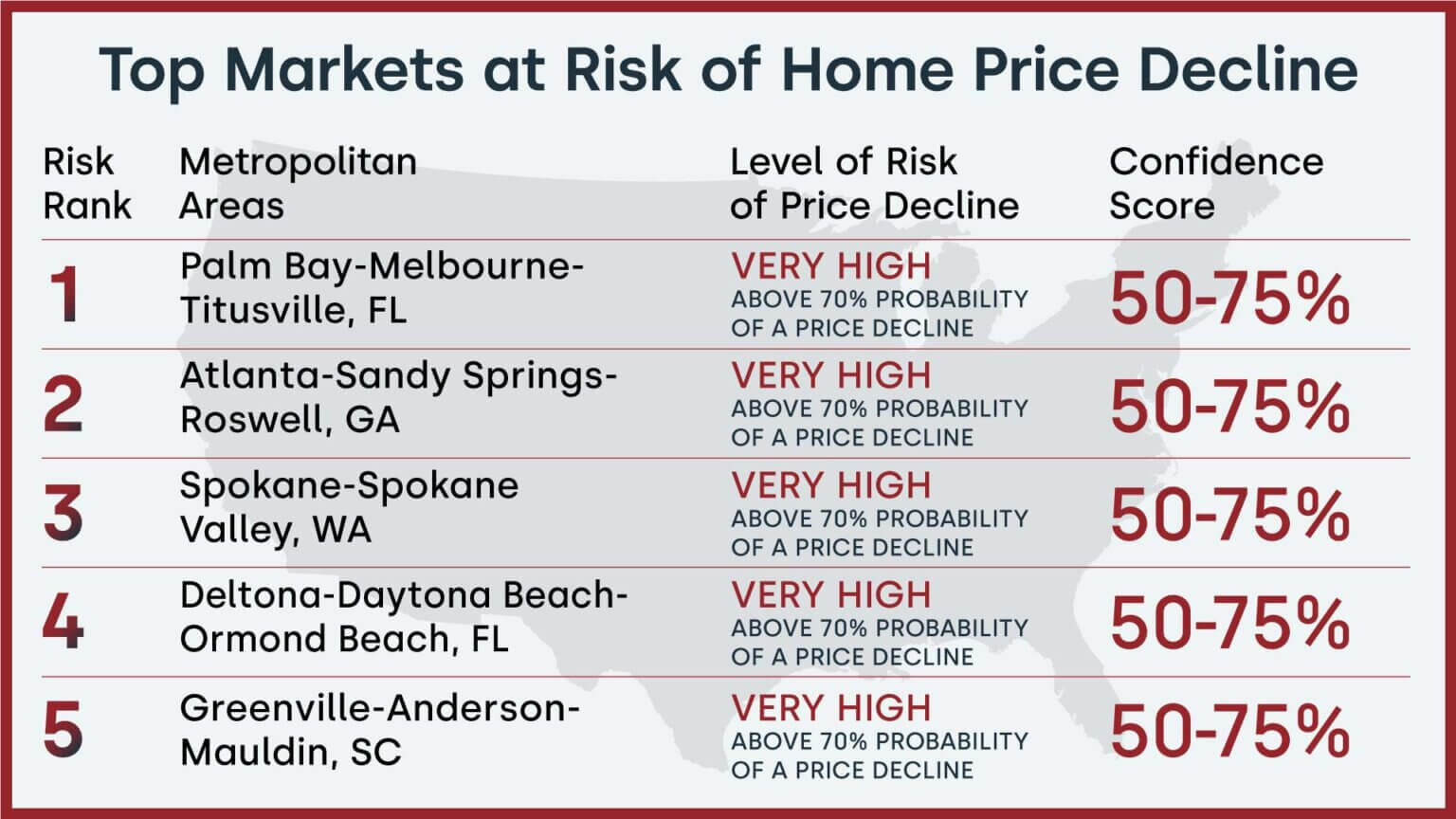
The MRI considers various factors to determine the probability of a home price decline in a particular area. This includes things like job growth, affordability, inventory levels, and the overall state of the local economy. Based on the CoreLogic MRI, five metropolitan areas are at a very high risk of a home price decline over the next 12 months.

5 Riskiest Housing Markets to Avoid in

5 Riskiest Housing Markets to Avoid in
Source: CoreLogic

Now let's dive deeper into the five metropolitan areas that are facing the highest risk of a home price decline based on CoreLogic's MRI. It's important to remember that these are predictions, and actual results may vary.

1. Provo-Orem, UT

  • Risk Level: Very High
  • Probability of Price Decline: Above 70%
  • Confidence Score: 50-75%

Provo-Orem, located in the heart of Utah, experienced explosive growth during the pandemic and it is still a very popular location. This growth fueled a surge in home prices, but now the market appears to be cooling down, potentially leading to a price decline.

My thoughts: I believe that the market in Provo-Orem was simply too hot too fast. The prices were out of sync with fundamentals like local wages, which were not keeping up with price appreciation. Now, with interest rate uncertainty and the cooling economy, this market is becoming vulnerable.

2. Atlanta-Sandy Springs-Roswell, GA

  • Risk Level: Very High
  • Probability of Price Decline: Above 70%
  • Confidence Score: 50-75%

Atlanta, like many other Southern metropolitan areas, has experienced a strong housing market in recent years. However, it has become more vulnerable to a downturn due to rising interest rates, supply chain disruptions, and overall economic uncertainty.

My thoughts: Atlanta has a strong history as a major business hub. While the metro area might experience a pullback, I think a decline in prices would be relatively short-lived. The economy will eventually rebound, and homebuyers will return to the market. But in the short-term, I would be cautious about buying a home in Atlanta.

3. Salt Lake City, UT

  • Risk Level: Very High
  • Probability of Price Decline: Above 70%
  • Confidence Score: 50-75%

Salt Lake City was one of the fastest-growing housing markets in the United States, and during that time the median home price increased by a significant amount. However, like Provo-Orem, a rapid rise in prices and cooling economy could lead to a price correction.

My thoughts: The Salt Lake City metro area has lots of economic drivers and is a beautiful location. The concerns here are very similar to those of Provo-Orem. The market heated up too quickly and might be in for a decline over the next year.

4. Gainesville, FL

  • Risk Level: Very High
  • Probability of Price Decline: Above 70%
  • Confidence Score: 50-75%

Gainesville is a college town with a large student population. This can sometimes make housing markets more volatile. The Gainesville market is at risk due to several factors like affordability concerns and a potential slowdown in student enrollment.

My thoughts: Gainesville has historically been a reliable housing market, and the presence of the University of Florida adds stability. But, the market is still vulnerable to interest rate hikes and economic uncertainty.

5. Palm Bay-Melbourne-Titusville, FL

  • Risk Level: Very High
  • Probability of Price Decline: Above 70%
  • Confidence Score: 50-75%

Palm Bay-Melbourne-Titusville is a region that is reliant on the aerospace and defense industries. While the local economy is strong, it also makes the area subject to changes in federal spending. With a large supply of homes and a cooling economy, the market is vulnerable to price declines.

My thoughts: Palm Bay-Melbourne-Titusville has a strong economy, but the high concentration of employment within a few industries means that it's vulnerable to changes in defense spending and other factors. The risks are certainly present in this area.

Understanding the Risks and Mitigating Them

While these five areas are identified as high-risk, it's crucial to remember that not all homes in these markets will necessarily experience the same level of price decline. Homes that are in excellent condition, well-located, and offer desirable features will likely hold their value better during a downturn.

Here are some tips to consider if you're looking to buy a home in these high-risk markets:

  • Do your homework: Research the local market and understand the factors that contribute to the risk of a housing market crash. Look at recent sales data, inventory levels, and economic indicators.
  • Don't overpay: Avoid getting caught up in bidding wars or paying top dollar for a home. Try to negotiate the best price possible to protect your investment.
  • Get pre-approved for a mortgage: Knowing how much you can afford will help you avoid overspending on a home.
  • Consider your personal financial situation: Make sure you can afford your mortgage payments even if home prices decline.
  • Be prepared for a possible price drop: If you are in the high-risk areas, have a strategy for how you will deal with a potential decrease in home value.
  • Be realistic about your expectations: Don't expect to get rich quick by investing in real estate, especially in a potentially volatile market.

Factors to Consider Beyond the MRI

While the CoreLogic MRI is a valuable tool, it is important to consider other factors that could influence the housing market in these areas. For example:

  • Local job market: Strong local job growth can help support home values.
  • New construction: An increase in new homes can put downward pressure on prices.
  • Interest rates: Rising interest rates will likely reduce affordability and slow down the market.
  • Inventory levels: If the number of homes for sale increases, it could lead to a price decline.

The Bottom Line

The housing market is dynamic, and prices can fluctuate based on various economic and local factors. The five markets highlighted above are at a high risk of experiencing home price declines in the next 12 months, according to CoreLogic's MRI.

It is my belief that you should proceed with caution in these markets. If you are considering buying a home, it is essential to do your research, understand the risks, and make informed decisions.

I hope this article has helped you better understand the potential risks and provided valuable information to help you make informed decisions about your real estate goals in 2025.

Recommended Read:

  • 3 BIG Cities Facing High Housing BUBBLE Risk: Crash Alert?
  • Is the Housing Market on the Brink in 2024: Crash or Boom?
  • Will Fed's Policy Lead to a Crash in the Housing Market?
  • San Francisco Housing Market Crash 2025: Will it Happen?
  • 3 Florida Housing Markets Are Again on the Brink of a Crash
  • Will Housing Be Cheaper if the Market Crashes in 2025?
  • UK Housing Market Forecast 2025: Crash or Correction?
  • When Will the Housing Market Crash Again in California?
  • AZ Housing Market Forecast 2025-2026: Will it Crash?

Filed Under: Housing Market, Trending News Tagged With: Home Price Crash, Housing Decline, Housing Market, housing market crash, Housing Market Forecast, housing market predictions, Housing Market Slowdown

Wyoming Housing Market Forecast for the Next 2 Years: 2025-2026

December 9, 2024 by Marco Santarelli

Wyoming Housing Market: Trends and Forecast 2025-2026

The Wyoming housing market in 2024 is showing strong signs of competitiveness, with home prices up 31.0% compared to last year and a median sale price of $275K. This trend suggests that the market remains robust despite potential economic headwinds. However, it's also important to acknowledge that this is a snapshot of the market in September, and conditions can change rapidly.

In this article, I will explore the key trends influencing the Wyoming housing market, delve into home sales, prices, and supply, and provide you with a better understanding of what to expect in the coming months.

Current Wyoming Housing Market Trends 2024

Home Sales

The latest data by Redfin reveals that home sales in Wyoming are brisk. The average time a home spends on the market before going pending is just 22 days, indicating a high demand and low inventory. This is a sign of a competitive market where buyers often need to act quickly to secure a property.

In September 2024, only 3 homes were sold, but it's worth noting that this data may be incomplete or not a representative sample of the entire state. I often find that local MLS data can provide more granular details about sales activity in specific regions and can be more useful for getting a realistic view of sales volume.

It's also crucial to consider that the “average” can be misleading. The real estate market in Wyoming is diverse, with smaller towns and cities experiencing different dynamics compared to larger urban centers. While some areas might experience brisk sales, others might be more balanced, with homes staying on the market a bit longer.

Home Prices

One of the most notable trends in the Wyoming housing market is the significant increase in home prices. As mentioned earlier, the median home price in September 2024 was $275K, which represents a 31% increase compared to the same period last year. This surge in prices is driven by several factors, which I will explore below.

The average price per square foot is $198 (although the data isn't clear whether this is for the same 3 home sales as in the previous section), which gives an idea of the value buyers are placing on housing in the state. While a 31% increase may seem dramatic, I've personally seen even steeper price escalations in certain localized areas due to factors like desirable locations, stunning views, or proximity to outdoor recreation.

Factors Driving Price Increases

  • Low Inventory: The number of available homes for sale in Wyoming remains low, creating a supply-demand imbalance that pushes prices upward. This shortage of inventory is a widespread issue across many parts of the country, and Wyoming is no exception.
  • Increased Demand: Wyoming continues to attract buyers from out of state. The appeal of wide-open spaces, stunning scenery, and a strong sense of community continues to draw individuals and families seeking a different pace of life.
  • Remote Work Trends: The shift to remote work has provided more flexibility for people to relocate to areas like Wyoming. Many individuals now have the option to work from anywhere with a reliable internet connection, making Wyoming a more appealing option.
  • Tourism and Recreation: Wyoming's stunning natural beauty and abundance of outdoor recreation opportunities, including skiing, hiking, fishing, and camping, draw visitors and potential residents.

Housing Supply

The housing supply in Wyoming continues to be a significant challenge, playing a pivotal role in the current market conditions.

As I mentioned earlier, the low inventory is one of the primary reasons behind the surging home prices. Limited housing supply means fewer choices for buyers, leading to bidding wars and escalating prices.

There are a few factors contributing to this scarcity:

  • Limited New Construction: The pace of new home construction hasn't kept up with the growing demand. While some developments are underway, the construction process can be slow due to various factors, including permitting, labor shortages, and material costs.
  • Existing Homes Staying on the Market for Shorter Periods: With high demand and limited inventory, homeowners who decide to sell find that their homes are often snapped up quickly, reducing the overall availability of homes in the market.
  • Population Growth: Wyoming's population is growing, further exacerbating the housing shortage. The increased demand from both in-state and out-of-state buyers puts a strain on the available housing stock.

Market Trends

The Wyoming housing market is dynamic and ever-changing, and it's essential to understand the underlying trends that are shaping its future.

Migration Trends:

The data on migration trends reveals some interesting insights.

  • Relocation within Wyoming: A significant majority (73%) of Wyoming homebuyers in the recent period searched to stay within the Wyoming metro area. This suggests a strong local market and a desire to remain in the state.
  • Inflow from Outside Metros: While the majority of homebuyers intend to stay within the state, there is a noticeable inflow of buyers from outside major metropolitan areas. New York leads the list of cities from which people are moving to Wyoming, followed by St. Louis and Los Angeles. This influx is likely influenced by the factors mentioned earlier, including the desire for a different lifestyle and the rise of remote work.
  • Outflow to Other States: While the state experiences an inflow of people from larger metropolitan areas, some Wyoming residents are also moving out. The most popular destinations for Wyoming residents are Washington DC, Salisbury, MD, and Harrisburg, PA. This outflow is likely driven by factors such as job opportunities and a desire to be closer to family and friends.

Overall Trend:

Based on the available data and my personal insights, the Wyoming housing market is expected to remain competitive for the foreseeable future. The low inventory and high demand are likely to continue influencing prices, although the pace of price increases might slow down if interest rates rise or the economy experiences a downturn.

Table Summarizing Key Trends

Trend Description Impact on Housing Market
Home Prices Increased 31% year-over-year Higher purchase costs for buyers
Home Sales Brisk sales with homes selling quickly (22 days) Competitive environment for buyers
Housing Supply Low inventory due to limited new construction and population growth Increased competition and upward pressure on prices
Migration Inflow of buyers from large metropolitan areas, particularly New York, St. Louis, and Los Angeles Increased demand for housing, pushing up prices
Interest Rates Likely to have an impact on affordability Could slow down price appreciation if rates rise significantly

The Impact of Interest Rates

Interest rates are a crucial factor that can impact housing affordability. If interest rates continue to rise, the cost of borrowing money to purchase a home will increase, potentially cooling down the market and slowing down the rate of price increases. While rates haven't yet had a dramatic effect on Wyoming, it's something I'm monitoring closely.

Wyoming Housing Market Forecast for the Next 2 Years: 2025-2026

Looking ahead, I expect the Wyoming housing market to remain relatively strong. The state's appeal as a place to live and work is unlikely to diminish, and this continued appeal will continue to create demand for housing. However, it's also important to be realistic. The market is likely to experience some fluctuations, and certain areas might see price corrections or slower growth.

Wyoming Housing Market Forecast by Region

I have analyzed the data from Zillow, a reputable source for real estate information, and created a table summarizing the forecasted changes in home values in different regions of Wyoming.

The Wyoming housing market is expected to experience mixed growth in the coming year. Some areas are expected to see price increases, while others are poised for a decline. The average Wyoming home value is currently $353,250, which is up 3.0% over the past year. Homes typically go pending in around 29 days. Let's take a closer look at the forecast for different regions of Wyoming.

Region October 2024 Forecast December 2024 Forecast September 2025 Forecast
Cheyenne, WY 0.2% -0.5% -2.3%
Casper, WY 0.2% -0.1% 0%
Gillette, WY 1% 0.8% 0.1%
Rock Springs, WY 0.6% 0.3% -1.3%
Riverton, WY 0.5% -0.1% 1%
Laramie, WY 0.6% 0.4% 0.8%
Jackson, WY 0% 0% 4.1%
Sheridan, WY 0.5% 0.2% 0.4%
Evanston, WY 0.8% 1% 2.8%

Regions Poised for Growth

Based on the data, Jackson, Evanston, and Gillette are the regions in Wyoming that are expected to see the highest growth in home prices through September 2025.

  • Jackson is projected to have a remarkable 4.1% increase by September 2025.
  • Evanston is expected to see a 2.8% increase.
  • Gillette is anticipated to see a 0.1% growth.

Regions Poised for Decline

Cheyenne and Rock Springs are the regions expected to see the biggest drops in home prices by September 2025.

  • Cheyenne is projected to see a -2.3% decline.
  • Rock Springs may experience a -1.3% decline.

Will Home Prices Drop in Wyoming? Will the Market Crash?

While some regions are predicted to experience a decline in home prices, it's important to note that these are just forecasts. A “crash” is typically characterized by a rapid and significant decline in home values, often exceeding 10%. The current forecast does not suggest a crash in the Wyoming housing market. The declines are relatively small and do not indicate a widespread or dramatic downturn.

Possible Wyoming Housing Market Forecast for 2026

Forecasting beyond a year or two becomes increasingly speculative. However, several factors could influence the Wyoming housing market in 2026. These include:

  • Interest rates: If interest rates rise significantly, it could dampen demand for housing and lead to price declines.
  • Economic conditions: A strong economy and job growth tend to support a healthy housing market.
  • Population growth: Wyoming has seen modest population growth in recent years, which could continue to support demand for housing.
  • Housing Inventory: A shortage of available homes for sale could put upward pressure on prices, while an oversupply could lead to price declines.

Based on these factors, it's possible that the Wyoming housing market could experience a period of slower growth or even modest declines in some areas in 2026. However, a major crash is unlikely unless there is a significant economic downturn or a major shift in market fundamentals.

Recommended Read:

  • Housing Market Forecast for the Next 2 Years: 2024-2026
  • Will the Housing Market Crash in 2025?
  • Will Housing Be Cheaper if the Market Crashes in 2025?
  • Housing Market Predictions for Next Year: Prices to Rise by 4.4%
  • Housing Market Predictions for Next 5 Years: 2025 to 2029
  • Housing Market Predictions for 2025 if Trump Wins Election
  • Housing Market Predictions for the Next 4 Years: 2024 to 2028

Filed Under: Growth Markets, Housing Market, Real Estate Market Tagged With: Home Price Forecast, Housing Market Forecast, housing market predictions, Housing Market Trends, Wyoming

Housing Market Predictions for 2025 if “Trump” Wins Election

November 9, 2024 by Marco Santarelli

Housing Market Predictions for a Second Trump Presidency

Will a Trump victory reshape the 2025 housing market? As speculation swirls about the potential for a second term for Donald Trump in the 2024 presidential election, one of the most crucial sectors observing these developments is the housing market. For Millennials and the emerging Generation Z, who are on the brink of homeownership, understanding the implications of a Trump administration is vital.

Housing Market Predictions for 2025 if “Trump” Wins Election

The housing market is a really complicated thing, affected by lots of stuff like the government's rules about money, interest rates on loans, how many houses are for sale compared to how many people want to buy them, and even what's going on in the country in general. If Trump wins again, things in the housing market could change a lot. This would affect how easy it is for younger people to buy a house and how much houses cost.

Economic Policies and Their Impact on Housing

Trump's potential economic growth strategy may prioritize classic approaches, such as deregulation and tax cuts, aimed at stimulating the economy. These policies could lead to increased investments in housing development, ultimately boosting the supply of new homes. For potential buyers, this could initially signal a decrease in housing prices. However, if demand remains robust and outpaces supply, the long-term effect could see escalating home prices, making homeownership even more elusive for Millennials and Gen Z.

Housing Affordability: A Generation’s Challenge

One of the most pressing concerns for Millennials and Gen Z is housing affordability. Many are currently grappling with the challenge of saving for down payments due to a widening wealth gap. Changes to tax policy, especially those stemming from the Tax Cuts and Jobs Act, may significantly impact homeownership decisions. For example, any reconsideration of the cap on mortgage interest deductions could alter the financial landscape for potential buyers and influence their purchasing power.

Deregulation and Lending Practices

An element of Trump’s agenda could include further deregulation of the housing market, leading to softer lending standards. While this might reduce mortgage costs and boost demand, it poses a risk reminiscent of the lax borrowing standards that contributed to the 2008 financial crisis. Striking a balance between stimulating the market and ensuring responsible lending practices will be crucial for sustainable growth.

Recommended Read:

How the Housing Market Fared During Donald Trump’s Previous Term? 

The Federal Reserve’s Influence

The Federal Reserve plays a pivotal role in determining interest rates, which directly impacts mortgage rates and housing affordability. If Trump’s policies lead to a reduction in interest rates, potential homebuyers could benefit in the short term, making homeownership more accessible. However, sustained low rates could also lead to an overheated housing market, potentially resulting in another bubble.

The Generational Divide in Homeownership

As Millennials venture further into their home buying journeys, the market dynamics present unique challenges for Generation Z. Unlike Millennials, who are experiencing historically low mortgage rates, Gen Z faces limited supply and escalating prices, complicating their entry into the housing market. This generational divide adds another layer of complexity to the future of homeownership.

Potential Future Trends

  1. Increased Construction: If Trump prioritizes deregulation, it may lead to an uptick in new housing projects, particularly in urban areas where supply is notably low. This could favor both generations looking for affordable housing options.
  2. Investment Opportunities: With tax policies potentially favoring real estate investments, Millennials and Gen Z may find new opportunities for investment in rental properties or real estate funds, diversifying their financial portfolios.
  3. Remote Work and Housing Preferences: As remote work becomes more entrenched, younger buyers may seek homes in suburban or rural areas where prices are lower, further influencing market trends.
  4. Green Housing Initiatives: Should environmental concerns become a focus under a potential Trump administration, we might see increased investment in sustainable building practices, appealing to younger generations concerned about climate change.

Preparing for Various Scenarios

With the stakes high heading into the 2024 election, the potential implications of a Trump presidency on housing cannot be overstated. For Millennials and Gen Z, staying informed and prepared for various scenarios is essential to navigate the unpredictable nature of the market. Understanding the potential effects of economic policies, interest rates, and lending practices will empower them to make informed buying decisions.

Okay, so the next presidential election is a big deal for young people, especially Millennials and Gen Z, when it comes to buying a house. How things go in the election could really change the housing market. Since buying a home is already tough for these groups, it's super important to be informed about what might happen.

Frequently Asked Questions (FAQs)

1. How does a Trump presidency affect housing prices?

A Trump administration could influence housing prices through policies that affect economic growth and interest rates. For example, deregulation and tax cuts could stimulate housing supply initially, but if demand continues to rise, prices may increase in the long term.

2. What should first-time home buyers consider under potential Trump policies?

First-time home buyers should monitor changes in interest rates, lending standards, and any tax reforms that could affect their purchasing power. Understanding how these factors interplay will be crucial for making informed decisions.

3. Are Millennials at a disadvantage in the housing market?

Yes, Millennials face increased challenges such as rising home prices, a higher cost of living, and student loan debt that may hinder their ability to save for down payments compared to prior generations.

4. What impact could deregulation have on the housing market?

Deregulation could lower lending standards, making it easier for new buyers to obtain mortgages. However, this approach carries risks, including the possibility of creating another housing bubble if lending becomes too lenient.

5. How can Gen Z adapt to the current housing market?

Gen Z can explore alternative paths to homeownership, such as co-buying properties with friends, investing in real estate crowdfunding, or renting in areas where they can save more money to eventually purchase a home.

6. What trends should we expect in the housing market if Trump is re-elected?

If Trump is re-elected, we may see increased construction in urban and suburban areas, potential investment incentives for younger buyers, and a focus on affordable housing initiatives, depending on the administration's priorities.

Recommended Read:

  • Housing Market Predictions for Next Year: Prices to Rise by 4.4%
  • Housing Market Forecast for the Next 2 Years: 2024-2026
  • Housing Market Predictions for Next 5 Years (2024-2028)
  • Housing Market Predictions: 8 of Next 10 Years Poised for Gains
  • Housing Market Predictions: Top 5 Most Priciest Markets of 2024
  • Real Estate Forecast Next 5 Years: Top 5 Future Predictions
  • Housing Market Predictions for 2027: Experts Differ on Forecast

Filed Under: Housing Market, Real Estate Market Tagged With: Home Price Forecast, Housing Market, Housing Market Forecast, housing market predictions, Housing Market Trends

Will Donald Trump’s Victory Reshape the Housing Market in 2025?

November 9, 2024 by Marco Santarelli

Bold Predictions for the Housing Market If Trump Wins the 2024 Election

An article published at GoBankingRates delved into potential shifts in the housing market if former President Donald Trump secures a second term. With significant changes since his first term, particularly in interest rates and economic policies, Trump's return could bring notable impacts to the housing sector. Here's an in-depth look at what we might expect.

Will Donald Trump's Victory Reshape the Housing Market in 2025?

Here are 6 predictions for the housing market if Trump wins again:

Potentially Lower Interest Rates

The Federal Reserve has raised interest rates in recent years to combat inflation, leading to higher mortgage rates. Under a Trump administration, fiscal policies could aim to support economic growth, potentially pressuring the Federal Reserve to keep interest rates low. During his first term, Trump favored lower rates to boost the economy. However, interest rates also depend on broader economic conditions and the Federal Reserve’s independent decisions. While Trump might push for lower rates, achieving them isn't guaranteed.

Lower interest rates could make mortgages more affordable, stimulating the housing market by enabling more people to buy homes. This could lead to a surge in home sales, benefiting both buyers and sellers. Homeowners with variable-rate mortgages might also see reduced payments, improving their financial stability and potentially increasing consumer spending in other areas. However, there's a delicate balance, as too much pressure on the Federal Reserve might undermine its independence, leading to unintended economic consequences.

Recommended Read:

Housing Market Predictions for 2025 if “Trump” Wins Election 

Less Regulation: A Double-Edged Sword

Trump's stance against “excessive” government regulations could result in more relaxed lending standards and potentially lower mortgage costs, increasing housing demand. Dennis Shirshikov, head of growth at GoSummer.com, noted that Trump's administration historically favored deregulation, easing restrictions on construction and development. This could lead to a rise in housing supply, especially in suburban and rural areas, as builders face fewer regulatory hurdles. However, excessive deregulation risks approving loans that borrowers cannot afford, reminiscent of the 2008 financial crisis.

Relaxed regulations might encourage more developers to enter the market, leading to increased competition and potentially lower home prices. This could be particularly beneficial in high-demand areas where housing affordability is a significant issue. On the flip side, too much deregulation could result in lower-quality construction and financial instability, as seen in the past. Homebuyers might face higher risks of purchasing properties that don't meet safety or quality standards, leading to long-term issues for the housing market.

Tax Policy Changes

During his first term, Trump worked with Congress to pass the Tax Cuts and Jobs Act, introducing significant changes to the tax code. Some key provisions are set to expire in 2025, and Trump plans to make some permanent if reelected. These tax changes could affect the real estate market, including interest deduction caps on mortgages and capital gains tax modifications. Amanda Orsen, founder and CEO of Galleon, highlighted that Trump’s pro-business approach might lead to more single-family homes being purchased by investors rather than individuals.

Recommended Read:

Trump vs Harris Predictions: Housing Market Post Election 

Tax policy changes could have far-reaching effects on the housing market. For example, making mortgage interest deductions permanent could encourage more people to buy homes, increasing demand and driving up prices. Conversely, changes to capital gains taxes might discourage property flipping, potentially stabilizing some housing markets. Investors might find the market more attractive, leading to a higher proportion of rental properties, which could impact homeownership rates and community dynamics.

Trade Policies and Housing Prices

Trump's previous trade policies, particularly the trade war with China, could resurface in a second term. Renewed tariffs and trade negotiations might increase the cost of home construction materials, making new builds and renovations more expensive or causing delays. These broader economic effects indirectly impact the housing market, influencing housing prices and availability.

Higher construction costs could lead to a slowdown in new home developments, exacerbating the housing shortage in many areas. Homebuilders might pass these costs onto buyers, resulting in higher home prices and reduced affordability. Additionally, supply chain disruptions from trade conflicts could delay construction projects, affecting timelines and market dynamics. On the other hand, a focus on domestic manufacturing could eventually stabilize prices and reduce dependency on foreign materials, but this would take time and significant investment.

Infrastructure and Development

Trump's campaign promises included extensive infrastructure projects, such as rebuilding highways, bridges, tunnels, airports, schools, and hospitals. If these projects come to fruition, they could increase housing supply, boost property values, and attract buyers and investors to revitalized areas. The focus on infrastructure could stimulate economic activity and enhance the overall housing market.

Improved infrastructure can make previously less desirable areas more attractive, leading to increased development and higher property values. Enhanced transportation networks could shorten commute times, making suburban and rural areas more viable for homebuyers. This could alleviate some pressure on urban housing markets and distribute demand more evenly across regions. Moreover, infrastructure investments could create jobs and boost local economies, further supporting housing market growth.

Affordable Housing Challenges

According to Freddie Mac, the U.S. housing shortage increased by 52% from 2018 to 2020, reaching a shortfall of 3.8 million units. Trump's previous policies emphasized existing homeowners but did not focus on creating or preserving affordable housing. A second term might see the affordable housing shortfall continue to widen, posing challenges for low- and middle-income families seeking homeownership.

The lack of affordable housing could lead to increased homelessness and housing instability, particularly in high-cost urban areas. Renters might face rising rents, making it harder to save for home purchases. Policymakers and developers would need to collaborate on solutions to address the affordability crisis, such as incentives for affordable housing construction and policies to protect existing affordable units. Without a focused effort on affordability, the housing market could become increasingly inaccessible to many Americans.

Other Influential Factors

Several factors beyond the president’s control could affect the housing market. For instance, changes in the unemployment rate or geopolitical events could have significant impacts. Higher unemployment might drive the Fed to cut interest rates to stimulate the economy, potentially lowering mortgage rates. Conversely, lower unemployment could lead to rising housing prices, with existing homeowners less motivated to sell and new buyers facing limited inventory. Additionally, foreign conflicts could disrupt the trade of materials necessary for home construction and renovation.

Economic stability and consumer confidence play crucial roles in the housing market. If the economy performs well under Trump, with low unemployment and steady growth, housing demand could rise, pushing prices higher. However, economic downturns or geopolitical instability could reduce demand, lower prices, and increase foreclosures. The housing market's resilience will depend on broader economic policies and global events, requiring vigilance from stakeholders.

Conclusion

A second term for Donald Trump could bring various changes to the housing market, including potentially lower interest rates, less regulation, and tax policies favoring property owners and investors. However, it could also introduce risks like deregulation, increased construction costs due to trade tariffs, and a continued affordable housing shortfall. The housing market's future under a Trump presidency would be shaped by a complex interplay of policies and economic conditions, requiring close attention from potential homeowners, investors, and industry experts.

Partner with Norada, Your Trusted Source for Turnkey Investment Properties

Discover high-quality, ready-to-rent properties designed to deliver consistent returns. Contact us today to expand your real estate portfolio with confidence.

Reach out to our investment counselors:

(949) 218-6668 | (800) 611-3060

Contact Us Today

Ultimately, while some of Trump's proposed policies might stimulate certain aspects of the housing market, they could also introduce new challenges. Stakeholders must stay informed and prepared to navigate these potential changes, balancing opportunities and risks to ensure a stable and prosperous housing market.

Recommended Read:

  • Housing Market Forecast for the Next 2 Years: 2024-2026
  • How the Housing Market Fared During Donald Trump's Presidency?
  • Trump Claims Explosive Housing Crisis Under Biden: Is It Exaggeration?
  • Donald Trump Warns US Fed Chair to Hold Off Rate Cuts Before Election
  • Housing Market Predictions for Next 5 Years (2024-2028)
  • Housing Market Predictions for the Next 2 Years
  • Housing Market Predictions: 8 of Next 10 Years Poised for Gains
  • Housing Market Predictions: Top 5 Most Priciest Markets of 2024
  • Real Estate Forecast Next 5 Years: Top 5 Future Predictions
  • Housing Market Predictions for 2027: Experts Differ on Forecast

Filed Under: Housing Market, Real Estate Market Tagged With: Housing Market, Housing Market Forecast, housing market predictions, Housing Market Trends

Alaska Housing Market: Trends and Forecast 2025-2026

November 7, 2024 by Marco Santarelli

Alaska Housing Market: Trends and Forecast 2025-2026

Are you curious about the Alaska housing market trends in 2024? Well, the news is mixed. While home prices have continued to climb, increasing by a notable 6.6% year-over-year, the number of homes sold has dipped, and the supply of homes for sale has actually increased. This suggests that while the market is still relatively strong, the rapid growth seen in previous years has slowed down a bit, creating a more balanced environment for both buyers and sellers. Let's explore the various aspects of the Alaska housing market and what it all means for you.

Alaska Housing Market Trends in 2024: A Deep Dive

Home Sales

According to Redfin, in September 2024, the number of homes sold in Alaska experienced a decline of 11.0% compared to the same period last year. This decrease can be attributed to a variety of factors. One factor is the rising interest rates which has made it more expensive for many people to buy a home. Also, many potential buyers may be holding back due to the economic uncertainty. However, even though the number of homes sold decreased, the median sale price has gone up.

From my perspective, this dip in sales can be viewed as a natural correction after a period of rapid growth in the housing market. The market is finding a new equilibrium, where the pace of sales is slowing down and giving more time to buyers and sellers to make informed decisions.

Key Data Point:

  • Number of Homes Sold: 697 (down 11.0% year-over-year)

Home Prices

Despite the decrease in home sales, the median home price in Alaska has continued to climb. In September 2024, the median home price was $387,600, representing a 6.6% increase compared to the previous year. This suggests that even though the market is cooling down a bit, demand for homes remains relatively strong in Alaska.

While the 6.6% increase might seem high, it's important to remember that Alaska has been experiencing a period of consistent price increases over the last few years. When compared to the nationwide trend, Alaska's price growth is relatively in line with the national average.

Key Data Point:

  • Median Sale Price: $387,600 (up 6.6% year-over-year)

Housing Supply

The number of homes for sale in Alaska increased in September 2024, climbing 12.6% year-over-year. This signifies a change in the market dynamics, with more options becoming available for buyers. The increase in the number of homes for sale can be attributed to various reasons, including an increase in new construction and more sellers coming to the market due to the slowing demand.

This is a positive sign for buyers who have been feeling the pressure of a tight housing market in the past few years. They now have more choices, which allows them to negotiate better deals with sellers.

Key Data Point:

  • Number of Homes for Sale: 2,646 (up 12.6% year-over-year)
  • Months of Supply: 3 months

Market Trends

The Alaska housing market trends in 2024 are indicating a shift towards a more balanced market. While home prices continue to rise, the pace of growth has slowed down. The number of homes sold is dipping and the supply of homes for sale is increasing, offering buyers more options and potentially more leverage in negotiations.

Here's a summary of the most prominent trends:

  • Increased Housing Supply: The rise in the number of homes for sale is giving buyers more options.
  • Slowing Home Sales: The rate of home sales has dipped which provides a more balanced environment for buyers and sellers.
  • Continued Home Price Appreciation: Although the pace is slower, the prices are still going up.
  • Less Competition: The percentage of homes selling above list price has decreased, suggesting that bidding wars are less frequent.
  • Shift in Buyer and Seller Power: The balance is starting to shift a bit in favor of buyers with more choices and less competition.

Table: Key Housing Market Indicators

Indicator September 2024 Year-over-Year Change
Median Sale Price $387,600 +6.6%
Number of Homes Sold 697 -11.0%
Number of Homes for Sale 2,646 +12.6%
Homes Sold Above List Price 24.0% -3.2%
Median Days on Market 21 +4

Understanding the Impact of Housing Market Trends

These Alaska housing market trends in 2024 have a significant impact on both buyers and sellers.

Impact on Buyers:

  • More Choices: With a larger selection of homes available, buyers have more opportunities to find the right property.
  • Less Pressure to Make Quick Decisions: With fewer bidding wars, buyers have more time to inspect homes, get financing, and make informed decisions.
  • Potential for Negotiation: In a more balanced market, buyers can negotiate the sale price and terms of the deal, which could lead to better results.

Impact on Sellers:

  • Increased Competition: With more homes for sale, sellers face increased competition from other sellers.
  • Need to Price Strategically: Sellers need to be realistic about pricing their homes competitively to attract buyers in the current environment.
  • Longer Time on Market: It might take longer to sell a home in a slower market, requiring sellers to be prepared for a longer marketing process.

Migration Trends

Moving to and from Alaska is another aspect that influences the state's housing market. As per the data from Redfin, nationwide, 25% of homebuyers searched to move to a different metro area between Aug '24 – Oct '24.

Based on the data, Alaska is not among the top 5 states that homebuyers searched to move to or from, suggesting that the state's overall migration trends are not significantly contributing to the current changes in the housing market.

However, the trend of people migrating from major cities on the west coast like Los Angeles and San Francisco could also affect Alaska in a subtle way.

While the overall migration trends are not directly impacting the housing market as much, it is something to keep in mind as these shifts in the national housing market can eventually impact Alaska as well.

Alaska Housing Finance Corporation's Perspective

In July 2024, the Alaska Housing Finance Corporation (AHFC) published a survey that provided insights into the state's housing market. The survey concluded that the average cost of homeownership in Alaska had increased by 52% between 2018 and 2024, while the cost to rent had increased by 24% during the same time period. This data supports the evidence of increasing prices in the Alaska housing market.

The AHFC also highlighted that the rental vacancy rate remains low across the state. This emphasizes the existing housing shortage in many parts of Alaska, which continues to drive home price appreciation.

The AHFC's mission is to provide safe and affordable housing to Alaskans, and the organization plays a crucial role in this area. In a challenging market with rising costs, AHFC's efforts are even more important. The corporation develops and provides funding for affordable housing options, including housing vouchers and housing development grants for low- to moderate-income families and seniors.

Factors Contributing to Alaska's Housing Market Trends

The Alaska housing market trends in 2024 are a result of a combination of factors, both local and national.

  • Interest Rate Hikes: The Federal Reserve has been raising interest rates to combat inflation, which has made mortgage financing more expensive. This has affected demand for housing, leading to the slowdown in sales.
  • Economic Uncertainty: The global economy is experiencing some uncertainty, and that is making some buyers hesitant to make major financial commitments like purchasing a home.
  • Limited Inventory in Some Areas: While there has been an overall increase in supply, inventory remains limited in certain areas, leading to continued price appreciation.
  • Strong Local Economy: Despite some national headwinds, Alaska's economy is relatively strong, providing a base for continued demand for housing.
  • Population Growth: Alaska continues to experience population growth, which creates demand for housing, but the growth rate is slowing down in recent years.
  • Tourism and Vacation Rentals: In some areas, the growth of tourism and the popularity of vacation rentals have put pressure on the availability of long-term rentals and housing for locals.

Nebraska Housing Market Forecast 2025-2026

Predictions for the Future

Looking ahead, it seems that the Alaska housing market will continue to be a dynamic and evolving market. Based on the trends we're seeing in 2024, here are some of my predictions for 2025:

  • Continued Price Growth, But at a Slower Pace: I believe that home prices will continue to appreciate, but at a more moderate rate compared to the past few years. The increase in supply and slowdown in demand will help stabilize prices.
  • More Balanced Market Conditions: I expect that the market will become even more balanced as we progress through 2024 and into 2025. This means that buyers and sellers will have more leverage and negotiation power.
  • Increased Importance of Affordable Housing: The AHFC and other organizations will play a more crucial role in providing solutions to address affordable housing needs.
  • New Construction Will Play a Bigger Role: We will likely see more new housing construction in the coming years, which will help to increase supply and address the demand in some areas.
  • Focus on Sustainability and Energy Efficiency: As the importance of sustainable housing grows, I expect to see more homes being built with eco-friendly materials and energy-efficient features.

Alaska Housing Market Forecast by Region

The following table shows the Zillow Home Value Forecast for the four major metropolitan statistical areas (MSAs) in Alaska. As you can see, home prices are expected to decline in all four regions over the next year.

Region October 2024 Forecast (%) December 2024 Forecast (%) September 2025 Forecast (%)
Anchorage, AK 0 -1 -3.3
Fairbanks, AK -0.1 -1 -4.3
Juneau, AK 0.1 -0.9 -3.1
Ketchikan, AK 0.3 -0.3 -2.7

Will Home Prices Drop in Alaska? Will the Market Crash?

I believe it's unlikely that the Alaska housing market will crash. The factors that led to the housing market crash in 2008 are not present today. In particular, lending standards are much stricter now than they were then. This means that people are less likely to get a mortgage that they cannot afford. Additionally, the Alaska economy is relatively strong, and there is still a high demand for housing in the state, particularly in certain regions like Juneau.

Alaska Housing Market Forecast 2026

It is difficult to say for certain what the Alaska housing market will look like in 2026. However, I expect that home prices will continue to decline in the short term, but at a slower rate than in 2024 and 2025. The Alaska economy is expected to continue to grow, which should eventually lead to an increase in demand for housing. However, the ongoing uncertainty surrounding interest rates and the global economy could continue to weigh on the housing market. I think that the market will begin to stabilize in 2026 and then potentially start to recover in the years after that.

Regions Poised for Growth in Home Prices and Regions Poised for Decline in Prices

Based on current trends and the forecast data, here's my take on the regions in Alaska that might see growth or decline in home prices:

Regions Poised for Growth:

  • Juneau: Juneau is the capital of Alaska and is home to a large government workforce. The city's economy is relatively stable, and there is a high demand for housing. While the forecast shows a slight decline in home prices through 2025, Juneau's strong economy could lead to a quicker recovery and potential growth in the longer term.
  • Ketchikan: Ketchikan is a popular tourist destination and is also a major hub for the fishing industry. The city's economy is expected to continue to grow in the coming years, which could lead to an increase in demand for housing. While the forecast indicates a decline, it's the smallest among the listed regions, suggesting a potential for a quicker rebound.

Regions Poised for Decline:

  • Anchorage: Anchorage is the largest city in Alaska and is home to a diverse economy. However, the city has been hit hard by the decline in oil prices in recent years. This has led to a decrease in demand for housing, which is putting downward pressure on prices. The forecast also predicts the largest decline in home prices among the listed regions.
  • Fairbanks: Fairbanks is a major hub for the military and the tourism industry. However, the city's economy is also heavily reliant on the oil and gas industry. The decline in oil prices has had a negative impact on the city's economy, which has led to a decrease in demand for housing. The forecast also projects a significant decline in home prices for Fairbanks.

Conclusion

The Alaska housing market is at a turning point. After years of strong growth, home prices are now starting to decline. This could be a good opportunity for buyers who have been waiting for prices to come down. However, it is important to remember that the housing market is cyclical. Prices are likely to start to increase again at some point in the future.

As we move forward, it's crucial to stay informed about the changing market conditions. I hope that this comprehensive overview of the Alaska housing market trends in 2024 has given you a clearer picture of what to expect. Whether you are a buyer or a seller, understanding these trends can help you navigate the market effectively and make wise decisions.

Recommended Read:

  • Housing Market Forecast for the Next 2 Years: 2024-2026
  • Will the Housing Market Crash in 2025?
  • Will Housing Be Cheaper if the Market Crashes in 2025?
  • Housing Market Predictions for Next Year: Prices to Rise by 4.4%
  • Housing Market Predictions for Next 5 Years: 2025 to 2029
  • Housing Market Predictions for 2025 if Trump Wins Election
  • Housing Market Predictions for the Next 4 Years: 2024 to 2028

Filed Under: Growth Markets, Housing Market, Real Estate Market Tagged With: Alaska, Home Price Forecast, Housing Market Forecast, housing market predictions, Housing Market Trends

  • « Previous Page
  • 1
  • …
  • 6
  • 7
  • 8
  • 9
  • 10
  • 11
  • Next Page »

Real Estate

  • Birmingham
  • Cape Coral
  • Charlotte
  • Chicago

Quick Links

  • Markets
  • Membership
  • Notes
  • Contact Us

Blog Posts

  • Today’s Mortgage Rates, Feb 8: Rate Rise Slightly But Remain Near Long-Term Lows
    February 8, 2026Marco Santarelli
  • Does the 1% Rule Say It’s Time to Refinance Your Mortgage in 2026?
    February 8, 2026Marco Santarelli
  • 5 Hottest Real Estate Markets for Buyers and Investors in 2026
    February 8, 2026Marco Santarelli

Contact

Norada Real Estate Investments 30251 Golden Lantern, Suite E-261 Laguna Niguel, CA 92677

(949) 218-6668
(800) 611-3060
BBB
  • Terms of Use
  • |
  • Privacy Policy
  • |
  • Testimonials
  • |
  • Suggestions?
  • |
  • Home

Copyright 2018 Norada Real Estate Investments

Loading...