Norada Real Estate Investments

  • Home
  • Markets
  • Properties
  • Membership
  • Podcast
  • Learn
  • About
  • Contact

Today’s Mortgage Rates – June 13, 2025: A Big Drop in Rates From Last Week

June 13, 2025 by Marco Santarelli

Today’s Mortgage Rates - June 13, 2025: A Big Drop in Rates From Last Week

As of June 13, 2025, mortgage rates have shown fluctuations, with the average 30-year fixed mortgage rate currently remaining at 6.88%, which marks a substantial decrease of 11 basis points from last week's average of 6.99%. The national average for the 15-year fixed mortgage has risen slightly to 5.96%, while the 5-year adjustable-rate mortgage (ARM) rate has decreased to 7.17%. Here are more details about the current mortgage rate trends across various loan types.

Today’s Mortgage Rates – June 13, 2025: A Big Drop in Rates From Last Week

Key Takeaways

  • 30-Year Fixed Mortgage Rate: 6.88%, down from 6.99%
  • 15-Year Fixed Mortgage Rate: 5.96%, up from 5.94%
  • 5-Year ARM Rate: 7.17%, down from 7.21%
  • Current Refinance Rates: 30-Year fixed refinance at 7.08%, down from 7.09%
  • Market Outlook: Rates expected to remain stable or slightly decrease through 2025

Current Mortgage Rates

Mortgage Rates fluctuate regularly based on various economic indicators, market conditions, and lender strategies. The following table outlines the average rates for various types of home loans as of June 13, 2025:

Loan Type Rate (%) 1W Change (%) APR (%) 1W Change (%)
30-Year Fixed Rate 6.88 -0.11 7.32 -0.13
20-Year Fixed Rate 6.55 -0.27 6.79 -0.45
15-Year Fixed Rate 5.96 +0.02 6.25 -0.11
10-Year Fixed Rate 6.03 +0.10 6.13 -0.04
7-Year ARM 6.64 -1.17 7.51 -0.72
5-Year ARM 7.17 -0.45 7.84 -0.16

Source: Zillow

A fixed-rate means your interest rate remains constant throughout the loan's duration, making it simpler to plan payments. On the other hand, ARMs might start lower, but they can increase after an introductory period, leading to unexpected fluctuations in monthly payments.

What Are Current Refinance Rates?

For those looking to refinance, the rates have also seen some changes. The current refinance rates are as follows:

Refinance Loan Type Rate (%) 1W Change (%) APR (%) 1W Change (%)
30-Year Fixed Refinance 7.08 -0.01 7.32 -0.13
15-Year Fixed Refinance 5.99 +0.07 6.25 -0.11
5-Year ARM Refinance 7.69 0.00 – –

Source: Zillow

The 30-year fixed refinance rate has decreased by 1 basis point, now resting at 7.08%, down from last week's 7.09%. This decline can be beneficial for homeowners wishing to reduce their current mortgage payments, tap into equity for home improvements, or consolidate debt.

Understanding Mortgage Refinancing Costs

When refinancing, it’s essential to consider not only the rate change but also the costs involved. Refinancing entails several expenses which may offset any potential savings from a lower rate:

  • Origination Fees: This is a fee charged by the lender for evaluating and preparing your mortgage. It can range from 0.5% to 1% of the total loan amount.
  • Appraisal Fees: Typically costing between $300 to $700, these fees assess the property's value to ensure it meets the loan amount criteria.
  • Closing Costs: Generally ranging from 2% to 5% of the loan amount, closing costs include various fees, such as title insurance and attorney fees.
  • Prepayment Penalties: If your original mortgage has a prepayment penalty for paying off the loan early, this could significantly impact your refinancing decision.

For example, if you're refinancing a $300,000 loan, the closing costs could range from $6,000 to $15,000, which you need to weigh against the savings of a lower interest rate. An astute borrower would aim to evaluate the break-even point, which is the time it takes for the savings from lower monthly payments to surpass the costs associated with refinancing.

How to Find the Best Mortgage Rates in 2025?

Finding the ideal mortgage rate requires diligence. Here are several strategies to ensure you secure the best possible rate in 2025:

  1. Research Multiple Lenders: Different lenders offer various rates and terms, so it’s necessary to shop around. Websites like Bankrate and Zillow provide comprehensive comparisons of rates from various lenders.
  2. Check Your Credit Score: Your credit score plays an essential role in determining your mortgage rate. A higher credit score typically translates to lower rates. Before applying, check your credit report and work to enhance your score as needed.
  3. Stay Informed on Market Trends: Pay attention to economic news and market trends, as these factors can influence mortgage rates. Understanding cycles in inflation, employment rates, and economic growth can gauge when to lock in a favorable rate.
  4. Consider Loan Types: Review different loan types such as FHA, VA, conventional, and ARMs. Each loan type has its requirements, benefits, and potential risks.
  5. Consult a Mortgage Broker: Mortgage brokers have access to a wide array of lenders and can often negotiate better rates on your behalf. They can filter through numerous options to find a mortgage that aligns with your financial situation.

Read More:

Mortgage Rates Trends as of June 12, 2025

Will Mortgage Rates Go Down in June 2025: Expert Forecast

Mortgage Rate Forecast 2025: When Will Rates Go Below 6%?

Mortgage Rates Outlook for the Rest of 2025

Looking ahead, mortgage rates are expected to remain steady with varying forecasts predicting slight fluctuations. According to the National Association of REALTORS®:

  • Forecast for 2025:
    • Existing Home Sales: Expected to see an increase of 6%
    • New Home Sales: Anticipated to rise by 10%
    • Median Home Prices: Projected to increase by 3%
    • Expected Mortgage Rate: Anticipated to settle at around 6.4%

Fannie Mae’s forecast also supports a softening of rates, predicting an end-of-year rate of 6.1%, down from 6.2% previously. Meanwhile, the Mortgage Bankers Association projects 30-year rates to stabilize near 6.7% through the summer months.

Freddie Mac, on the other hand, notes that while buyers may hope for a decrease in rates, it is more probable that they will remain elevated throughout 2025. High rates might deter some potential buyers, yet they might prompt others to act earlier due to the ongoing uncertainty in the market.

This current high-rate environment could encourage homeowners wishing to sell to enter the housing market sooner rather than later, leading to increased activity in home sales despite the overall level of sales still remaining below historical averages. According to Freddie Mac, the “rate lock-in” phenomenon—where homeowners feel stuck with their low-rate mortgages—may gradually decrease, allowing more inventory to hit the market.

Prices are also anticipated to appreciate, although at a more moderate pace compared to recent years. The home price growth, coupled with a projected increase in home sales, is likely to drive purchase volumes higher than in 2024. Slightly lower rates in 2025 should translate to increased refinancing activity as well, which is good news for lenders and potential borrowers alike.

In summary, today's mortgage rates reflect a complex web of economic factors and market strategies. Understanding these dynamics is crucial for anyone considering buying or refinancing a home in June 2025, as small changes in rates can have significant long-term financial impacts.

Invest Smarter in a High-Rate Environment

With mortgage rates remaining elevated this year, it's more important than ever to focus on cash-flowing investment properties in strong rental markets.

Norada helps investors like you identify turnkey real estate deals that deliver predictable returns—even when borrowing costs are high.

HOT NEW LISTINGS JUST ADDED!

Connect with a Norada investment counselor today (No Obligation):

(800) 611-3060

Get Started Now 

Also Read:

  • Will Mortgage Rates Go Down in 2025: Morgan Stanley's Forecast
  • Expect High Mortgage Rates Until 2026: Fannie Mae's 2-Year Forecast
  • Mortgage Rate Predictions 2025 from 4 Leading Housing Experts
  • Mortgage Rates Forecast for the Next 3 Years: 2025 to 2027
  • 30-Year Mortgage Rate Forecast for the Next 5 Years
  • 15-Year Mortgage Rate Forecast for the Next 5 Years
  • Why Are Mortgage Rates Going Up in 2025: Will Rates Drop?
  • Why Are Mortgage Rates So High and Predictions for 2025
  • Will Mortgage Rates Ever Be 3% Again in the Future?
  • Mortgage Rates Predictions for Next 2 Years
  • Mortgage Rate Predictions for Next 5 Years
  • Mortgage Rate Predictions: Why 2% and 3% Rates are Out of Reach
  • How Lower Mortgage Rates Can Save You Thousands?
  • How to Get a Low Mortgage Interest Rate?
  • Will Mortgage Rates Ever Be 4% Again?
Filed Under: Financing, Mortgage Tagged With: Interest Rate, mortgage, Mortgage Rate Trends, mortgage rates, Mortgage Rates Predictions, Mortgage Rates Today

Mortgage Interest Rates Graph Over the Past One Year

June 12, 2025 by Marco Santarelli

Mortgage Interest Rates Graph Over the Past One Year

Have you ever wondered how much the cost of borrowing money to buy a house has changed over the last year? It's a big question, and if you're thinking about buying a home – or even just keeping an eye on the economy – understanding the trends in mortgage interest rates is super important. Over the past year, as shown in the mortgage interest rates graph over the past year, we've seen some interesting movements that can really impact what you pay each month for your mortgage.

Let's dive into what the data tells us and what it might mean for you.

Mortgage Interest Rates Graph Over the Past One Year

What the Latest Data Shows

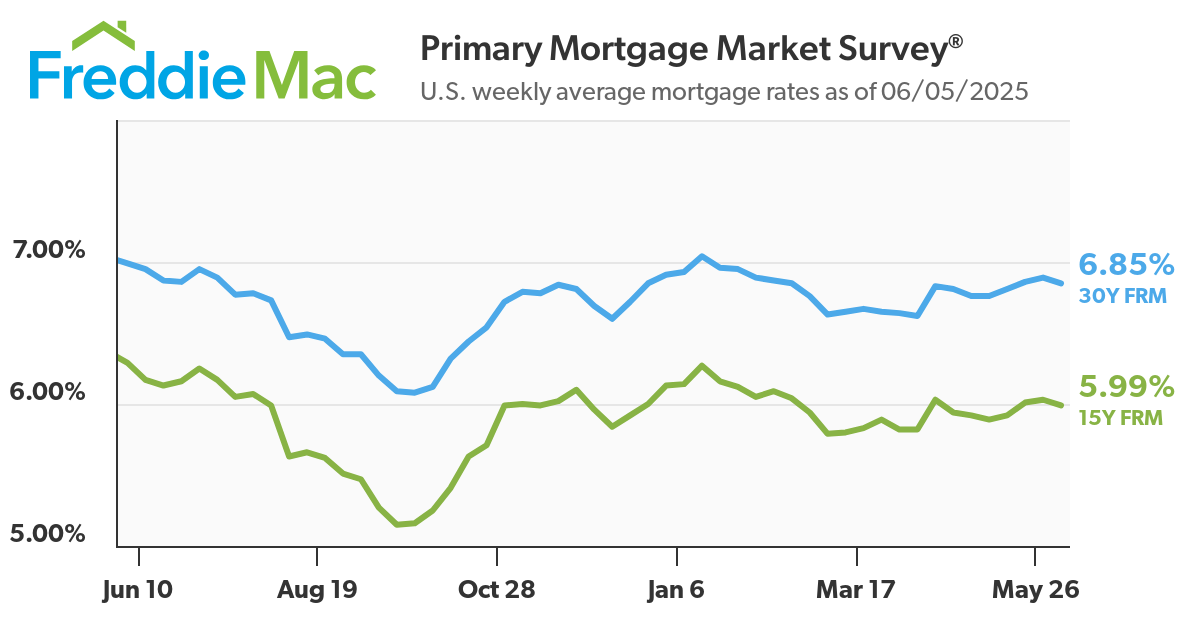
As of June 5, 2025, the average interest rate for a 30-year fixed-rate mortgage (also known as a 30-Yr FRM) stood at 6.85%. Looking back, according to Freddie Mac's data, this is a slight decrease from the previous week (-0.04%) and also a bit lower than where we were a year ago (-0.14%).

mortgage interest rates graph
Source: Freddie Mac

For those considering a shorter loan term, the 15-year fixed-rate mortgage (15-Yr FRM) averaged 5.99%. This also saw a decrease of 0.04% from the week before and a more significant drop of 0.3% compared to this time last year.

Here's a quick summary:

Loan Type Current Rate (06/05/2025) Weekly Change Yearly Change
30-Yr FRM 6.85% -0.04% -0.14%
15-Yr FRM 5.99% -0.04% -0.30%

It's encouraging to see that rates have come down a little recently. For anyone looking to buy a home, this can make a real difference in their monthly payments and overall affordability. The fact that inventory is reportedly improving and house price growth is slowing down adds to this positive news for potential homebuyers.

A Deeper Dive into the Past Year's Trends

Looking at the mortgage interest rates graph since past one year (from June 5, 2024, to June 5, 2025), we can see the journey these rates have taken. The blue line represents the 30-year fixed rate, and the green line shows the 15-year fixed rate.

  • Fluctuations are Normal: What stands out immediately is that mortgage rates don't stay still. They go up and down based on a whole bunch of economic factors. You can see periods where both the 30-year and 15-year rates were climbing, and other times where they were on a downward trend.
  • Peak and Valley: The 30-year fixed rate touched a high of 7.04% within the past 52 weeks and a low of 6.08%. For the 15-year fixed rate, the range was between 6.27% and 5.15%. These are significant swings that could change your mortgage payment by a noticeable amount.
  • Impact of Economic Events: While the graph itself doesn't tell us why the rates moved the way they did, I know from my experience in following the market that things like inflation reports, decisions by the Federal Reserve (the Fed) about interest rates, and the overall health of the economy play a big role. When the economy is strong, and inflation is a concern, mortgage rates tend to rise. When the economy slows down, or there are worries about a recession, rates often fall.

Thinking About the Bigger Picture

It's easy to get caught up in the week-to-week changes, but it's important to think about the broader context. Over the past year, the housing market has been navigating a period of adjustment. After the very low interest rates we saw a few years ago, rates climbed quite sharply. This naturally had an impact on home affordability and the number of people looking to buy.

Now that rates seem to be stabilizing and even coming down a bit, it could signal a more balanced market. Sellers might need to be more realistic with their prices, and buyers might find more opportunities.

My Thoughts

Having followed the housing market for a while, I can tell you that trying to perfectly time when to buy based solely on interest rates is incredibly difficult – almost like trying to catch a falling knife! There are so many factors at play.

However, understanding the trends, like the ones we see in Freddie Mac's mortgage interest rates chart, can help you make more informed decisions. For example:

  • If rates are trending downward and you're in a stable financial position, it might be a good time to consider locking in a rate. Even a small decrease in the interest rate can save you thousands of dollars over the life of a 30-year loan.
  • If rates are high, it might be worth exploring adjustable-rate mortgages (ARMs) or focusing on improving your credit score to qualify for a better rate. Of course, ARMs come with their own set of risks, so it's crucial to understand how they work.

It's also worth remembering that your personal financial situation – your income, debts, and credit score – will significantly influence the mortgage rate you actually qualify for.

Read More:

Dave Ramsey Predicts Mortgage Rates Will Probably Drop Soon in 2025

Mortgage Rates Rise Back to 7% Once Again in June 2025

Mortgage Rate Forecast 2025: When Will Rates Go Below 6%?

Looking Ahead

Predicting where mortgage rates will go next is always a challenge. Economic forecasts can change, and unexpected events can happen. However, by keeping an eye on the mortgage interest rates graph since past one year and staying informed about economic news, you can get a sense of the general direction things might be heading.

The recent decrease in rates, combined with potentially improving inventory, could create a more favorable environment for homebuyers in the coming months. Of course, this is just my take based on the current data and my understanding of the market. It's always a good idea to talk to a financial advisor or a mortgage professional for personalized advice.

Summary:

The mortgage interest rates graph over the past year provides a valuable snapshot of how the cost of borrowing for a home has fluctuated. While we've seen some decreases recently, it's a reminder that rates are dynamic and influenced by a variety of economic factors. For anyone involved in the housing market, whether as a buyer, seller, or homeowner, staying informed about these trends is key to making sound financial decisions.

Invest Smarter in a High-Rate Environment

With mortgage rates remaining elevated this year, it's more important than ever to focus on cash-flowing investment properties in strong rental markets.

Norada helps investors like you identify turnkey real estate deals that deliver predictable returns—even when borrowing costs are high.

HOT NEW LISTINGS JUST ADDED!

Connect with a Norada investment counselor today (No Obligation):

(800) 611-3060

Get Started Now 

Also Read:

  • Will Mortgage Rates Go Down in 2025: Morgan Stanley's Forecast
  • Expect High Mortgage Rates Until 2026: Fannie Mae's 2-Year Forecast
  • Mortgage Rate Predictions 2025 from 4 Leading Housing Experts
  • Mortgage Rates Forecast for the Next 3 Years: 2025 to 2027
  • 30-Year Mortgage Rate Forecast for the Next 5 Years
  • 15-Year Mortgage Rate Forecast for the Next 5 Years
  • Why Are Mortgage Rates Going Up in 2025: Will Rates Drop?
  • Why Are Mortgage Rates So High and Predictions for 2025
  • Will Mortgage Rates Ever Be 3% Again in the Future?
  • Mortgage Rates Predictions for Next 2 Years
  • Mortgage Rate Predictions for Next 5 Years
  • Mortgage Rate Predictions: Why 2% and 3% Rates are Out of Reach
  • How Lower Mortgage Rates Can Save You Thousands?
  • How to Get a Low Mortgage Interest Rate?
  • Will Mortgage Rates Ever Be 4% Again?
Filed Under: Financing, Mortgage Tagged With: Interest Rate, mortgage, Mortgage Interest Rates Graph, Mortgage Rate Trends, mortgage rates

States With Lowest Mortgage Rates Today – June 12, 2025

June 12, 2025 by Marco Santarelli

States With Lowest Mortgage Rates Today – June 12, 2025

Looking for the best mortgage rates? As of today, June 12, 2025, the states boasting the lowest 30-year new purchase mortgage rates are New York, Massachusetts, Colorado, California, New Jersey, Washington, Texas, Florida, and Virginia. These states currently register average rates between 6.79% and 6.89%. Figuring out where to buy a home is tough enough; finding the lowest mortgage rate shouldn't be!

States With Lowest Mortgage Rates Today – June 12, 2025

I know what you're thinking: “Why do rates even change from state to state?” Well, let's dive in and see what impacts the mortgage rates and which states have the best deals right now.

Why Mortgage Rates Differ by State

Mortgage rates aren't uniform across the United States. Several factors play a role in these geographic variations. Here are a couple of main reasons that could affect the rate:

  • Lender Presence: Not all lenders operate in every state. The competitive landscape can change based on which lenders are actively trying to gain market share in a specific region. More competition often leads to lower rates.
  • State-Level Regulations: Mortgage regulations can vary significantly from state to state. These regulations can affect the cost of doing business for lenders and, consequently, the rates they offer.
  • Credit Score Averages: States with higher average credit scores might see slightly better rates, as lenders perceive borrowers as less risky.*
  • Average Loan Size: The average size of mortgages can impact rates since bigger the amount more the risk involved. If a state has a trend for taking bigger loans, there could be a rise in rate of interest.
  • Risk Management Strategies: Different lenders have varying approaches to risk. Some might be more aggressive in offering lower rates to attract borrowers, while others might be more conservative.

These variations can significantly impact what you will ultimately pay for your mortgage. It always pays to be informed!

The Best Bang for Your Buck: States With the Lowest Mortgage Rates

Alright, let's get down to brass tacks. According to Investopedia, as of today, here's the breakdown of the states offering the most attractive 30-year new purchase mortgage rates:

  • New York: The Empire State is starting to look enticing.
  • Massachusetts: Chowda' and low rates? Sounds like a good deal.
  • Colorado: The Rocky Mountain High is in Mortgage rate here
  • California: Surprisingly, the Golden State makes the cut.
  • New Jersey: The Garden State is home to big savings on mortgages.
  • Washington: Escape to the great Northwest.. and save some money doing so.
  • Texas: Everything's bigger in Texas. Including savings, apparently.
  • Florida: The Sunshine State continues to get brighter.
  • Virginia: The Old Dominion lives up to its nickname.

These states are currently offering average rates between 6.79% and 6.89%. Now, keep in mind this is just a snapshot in time and factors such as market volatility impact on rate of interest, but it gives you a solid starting point for your research.

The Other Side of the Coin: States With Higher Mortgage Rates

On the flip side, some states are seeing less favorable mortgage rates today. These states might have a combination of the factors mentioned above, leading to higher borrowing costs. For June 12, 2025, the states with the highest 30-year new purchase mortgage rates include:

  • Alaska: Maybe the cost of living up north is just higher in general.
  • West Virginia: Rates are among the highest in the nation.
  • Mississippi: Buyers should be aware of these high rates.
  • North Dakota: High rates are hitting this wheat-growing region.
  • Maine: Rates are less than ideal in this coastal state.
  • Kansas: Mortgage rates are pretty expensive here.
  • New Mexico: Rates are not favorable for new home purchases.
  • South Dakota: Home buyers may want to think twice.
  • Wyoming: Rates are sky high during this period.

These states are registering refinance averages between 6.99% and 7.08%. If you're in one of these states, don't despair! Shopping around and improving your credit score can still help you secure a better rate.

Decoding National Mortgage Rate Trends

It's not just about state-specific rates. The national mortgage rate scene plays a big role. As of today, June 12, 2025, the national average for a 30-year new purchase mortgage is around 6.91%.

We've seen some movement in recent months. 30-year rates had dropped every day this week, fully erasing last week's two-day surge. The rates also witnessed an all time high mid-May, when the flagship average climbed to a one-year high of 7.15%. However, things can change quickly!

Here's a quick look at how rates have fluctuated this year:

  • March: 30-year rates hit their lowest average of 2025 at 6.50%.
  • September (Previous Year): Rates plunged to a two-year low of 5.89%.

Understanding these trends can help you time your mortgage application strategically, but remember that trying to time the market perfectly is almost impossible.

To get a better picture, here are the national averages for different loan types, as provided by the Zillow:

Loan Type New Purchase Rate
30-Year Fixed 6.91%
FHA 30-Year Fixed 7.03%
15-Year Fixed 5.98%
Jumbo 30-Year Fixed 6.90%
5/6 ARM 7.15%

What's Driving These Fluctuations?

So, what's behind these ups and downs in mortgage rates? It's a complex mix of factors, including:

  • Bond Market: Mortgage rates often follow the trajectory of the bond market, especially the 10-year Treasury yield.
  • Federal Reserve (The Fed): The Fed's monetary policy, particularly its bond-buying programs and decisions about the federal funds rate, can significantly impact mortgage rates.
  • Lender Competition: Competition among lenders can drive rates down as they try to attract borrowers and stay more competitive.

Remember the period between November 2021 and July 2023 and the aggressive measure taken by the Fed to combat the inflation? The Fed decided to raise the interest rate upto 5.25 percentage points over the period of sixteen months.

Read More:

States With the Lowest Mortgage Rates on June 11, 2025

Are Mortgage Rates Expected to Go Down Soon: A Realistic Outlook

Calculating Your Potential Mortgage Payment

Okay, enough with the macroeconomics. Let's get practical. How do you figure out what your monthly mortgage payment might look like? Check out this example:

  • Home Price: $440,000
  • Down Payment: $88,000 (20%)
  • Loan Term: 30 years
  • APR (Interest Rate): 6.67%

Based on these figures, your estimated monthly payment would be around $2,649.04. Keep in mind this includes principal, interest, property taxes, and homeowners insurance. You will also need to consider things like Private Mortgage Insurance (PMI) if your down payment is less than 20%.

Don't forget that rates, insurance, and taxes are subject to change. Make sure you get the most updated information before making any decisions.

Shopping Around is Key

No matter what state you're in, shopping around for the best mortgage rate is an absolute must. Don't just take the first offer you get. Get quotes from multiple lenders and compare them carefully.

Here are a few tips for getting the best mortgage rate:

  • Improve Your Credit Score: A higher credit score can qualify you for a lower rate.
  • Save for a Larger Down Payment: Putting more money down can reduce the lender's risk and potentially lower your rate.
  • Consider Different Loan Types: Explore options like adjustable-rate mortgages (ARMs) or government-backed loans (FHA, VA) to see if they offer better terms.
  • Negotiate Fees: Don't be afraid to negotiate with lenders on fees like origination fees or points.

The Bottom Line

Mortgage rates are a moving target. While certain states currently offer lower rates, the overall market is constantly changing. By understanding the factors that influence rates and shopping around for the best deal, you can position yourself to save money on your home purchase. Staying informed is the key tool to crack the best mortgage options.

Invest in Real Estate in the Top U.S. Markets

Investing in turnkey real estate can help you secure consistent returns with fluctuating mortgage rates.

Expand your portfolio confidently, even in a shifting interest rate environment.

Speak with our expert investment counselors (No Obligation):

(800) 611-3060

Get Started Now

Also Read:

  • Will Mortgage Rates Go Down in 2025: Morgan Stanley's Forecast
  • Expect High Mortgage Rates Until 2026: Fannie Mae's 2-Year Forecast
  • Mortgage Rate Predictions 2025 from 4 Leading Housing Experts
  • Mortgage Rates Forecast for the Next 3 Years: 2025 to 2027
  • 30-Year Mortgage Rate Forecast for the Next 5 Years
  • 15-Year Mortgage Rate Forecast for the Next 5 Years
  • Why Are Mortgage Rates Going Up in 2025: Will Rates Drop?
  • Why Are Mortgage Rates So High and Predictions for 2025
  • Will Mortgage Rates Ever Be 3% Again in the Future?
  • Mortgage Rates Predictions for Next 2 Years
  • Mortgage Rate Predictions for Next 5 Years
  • Mortgage Rate Predictions: Why 2% and 3% Rates are Out of Reach
  • How Lower Mortgage Rates Can Save You Thousands?
  • How to Get a Low Mortgage Interest Rate?
  • Will Mortgage Rates Ever Be 4% Again?

Filed Under: Financing, Mortgage Tagged With: Interest Rate, mortgage, Mortgage Rate Trends, mortgage rates, Mortgage Rates Predictions, Mortgage Rates Today

Is It a Smart Decision to Buy a House in 2025: Pros and Cons

June 12, 2025 by Marco Santarelli

Is It a Smart Decision to Buy a House in 2025: Pros and Cons

The question on many minds, especially for those dreaming of their own slice of homeownership, is this: Is it a smart decision to buy a house in 2025? As we move into the latter half of the year, the housing market presents a complex picture, a mix of opportunities and challenges.

My honest assessment, considering the data and the current feel of the market, is that for those who are financially stable, plan to stay put for the long haul, and have done their homework, buying a house in 2025 can indeed be a smart decision, but it’s not a slam dunk for everyone.

The elevated prices and mortgage rates demand a cautious and informed approach. Let's dive deep into the factors you need to consider to make the right call for your personal situation.

Is It a Smart Decision to Buy a House in 2025?

To get a clear picture of whether buying a home in 2025 is right for you, we first need to dissect the current state of the housing market. It's not as simple as “prices are up” or “rates are high.” There are nuances and underlying trends that paint a more complete picture.

Home Prices: Cooling Down, But Still High

We've seen a significant surge in home prices over the past few years, and while the fever pitch might be subsiding, prices are still at historically high levels. According to the S&P CoreLogic Case-Shiller Home Price Index, while the year-over-year price increase in March 2025 (3.4%) was lower than February's 4%, we're still looking at hefty price tags. The median existing home sale price hit $414,000 in April 2025, marking a long streak of yearly increases.

Here's a quick snapshot:

  • Median Home Sale Price (April 2025): $414,000 (+1.8% year-over-year)
  • Home Price Growth (March 2025): 3.4% (down from 4% in Feb 2025)
  • Typical Home Cost: $367,700 (based on Zillow data)

Interestingly, the market isn't uniform across the country. Some areas, particularly those with a lot of new construction, are seeing builders reduce prices. On the other hand, the South and Midwest continue to show strength, with some cities like Detroit, Cleveland, and St. Louis offering homes under $300,000. This regional variation is a crucial factor to consider.

Looking ahead, experts anticipate home price appreciation to slow down to around 2% in 2025, compared to a higher rate in 2024. This suggests a potential stabilization, but don't expect prices to plummet. Over the next five years, a roughly 17% increase from 2024 levels is still forecasted.

Mortgage Rates: The Affordability Hurdle

If high home prices weren't enough, mortgage rates have added another layer of complexity to the affordability equation. As of late May 2025, the average 30-year fixed mortgage rate hovered around 6.94% (according to Bankrate). We saw a dip in rates in September 2024, but they climbed back up in early 2025 and are expected to remain in the 6-7% range for most of the year.

Key points on mortgage rates:

  • September 2024: 6.2% (lowest in 2024)
  • Early 2025: >7% (spike due to economic factors)
  • May 28, 2025: 6.94% (current average)

The Federal Reserve is projected to make a couple of rate cuts in 2025, but the immediate impact on mortgage rates might not be dramatic. A more significant decrease could potentially occur if the economy enters a recession, but that's far from a certainty. To put this in perspective, with an April 2025 rate of 6.81%, a typical home purchase would mean a substantial monthly mortgage payment, putting a strain on many potential buyers' budgets.

Housing Inventory: Slowly but Surely Improving

One piece of potentially good news for buyers is the improvement in housing inventory. By April 2025, the supply reached 4.4 months, a notable 20.8% increase compared to the previous year. While still below the 5-6 months considered a balanced market, it's a step in the right direction. In fact, inventory is up by over 33% from 2024 and is on track to reach pre-pandemic levels by the end of the year, according to some forecasts.

Important inventory trends:

  • Housing Supply (April 2025): 4.4 months (+20.8% year-over-year)
  • Inventory Growth (2025): +33% from 2024 (on track for pre-pandemic levels)

However, like home prices, inventory levels vary regionally. Areas with historically low inventory, such as the Northeast, are still largely seller's markets. Conversely, some Southern markets experiencing an increase in inventory are starting to lean towards being buyer's markets. More inventory generally means more choices for buyers and potentially less intense bidding wars, which is a positive development.

Home Sales: A Reflection of Affordability Challenges

The number of home sales provides another indicator of market health. Existing home sales saw a 2.0% year-over-year decrease in April 2025. A significant factor contributing to this is the “lock-in effect.” Many current homeowners have mortgages with significantly lower interest rates (a staggering 86% have rates below 6%). They are understandably reluctant to sell and take on a new mortgage at a higher rate, thus limiting the supply of existing homes.

Key data on home sales:

  • Existing Home Sales (April 2025): -0.5% month-over-month, -2.0% year-over-year
  • New Home Sales (April 2025): +10.9% month-over-month, +3.3% year-over-year (median price: $407,200)
  • Pending Home Sales (April 2025): -6.3% month-over-month, -2.5% year-over-year

Interestingly, new home sales showed a positive trend in April 2025. This could be due to builders offering incentives or a reflection of the limited inventory of existing homes. Overall, the sales figures suggest a market constrained by affordability issues and the lock-in effect. While sales are projected to gradually increase in the coming years, 2025 is likely to remain a challenging environment for buyers facing these constraints.

The Affordability Crunch: A Historical Perspective

Let's be blunt: housing affordability is at a low point. Economist Robert Frick aptly noted that we're in historically challenging times for potential homebuyers. Consider this: in 2024, the median rent price was around $2,050. Compare that to the monthly cost of homeownership, which averages a hefty $3,800 (including those often-overlooked variable costs). That's a significant difference.

A quick affordability comparison (2024 data):

  • Total Homeownership Cost (Monthly): $3,800 (includes ~$1,510 in variable costs)
  • Median Rent Price (Monthly): $2,236 (roughly 30% less than owning)
  • Typical Mortgage Payment (at 6.81%): $1,919 (for a $367,700 home with 20% down)

These numbers highlight the financial hurdle many face when considering homeownership in the current market. While the stability of the economy, with inflation at a manageable (though still above target) 2.3% in April 2025, is reassuring in terms of avoiding a market crash, it doesn't alleviate the day-to-day affordability pressures. It's also worth noting that while foreclosure starts have seen a year-over-year increase, they remain at relatively low levels overall, indicating that most homeowners are still in a stable financial position. Additionally, homeowner equity has seen significant growth, providing a financial cushion for many.

Policy and Politics: Unseen Hands Shaping the Market

We can't discuss the housing market without acknowledging the influence of political and policy decisions. For instance, policies from previous administrations, such as tax cuts and tariffs, can have lasting effects on the economy and, consequently, on mortgage rates. Tariffs, in particular, can increase the cost of building materials, adding thousands to the price of a new home. This uncertainty in material costs also presents challenges for builders. These are factors that are largely beyond individual control but contribute to the overall market dynamics.

Regional and Demographic Winds: Where and Who is Buying?

The housing market isn't a monolith. Regional trends play a significant role. As mentioned earlier, the South and Midwest are currently among the more active markets, offering relatively affordable options in various cities. Interestingly, suburban and rural areas have gained popularity, driven by the desire for more space and affordability – a trend that many experts believe will continue.

Demographic shifts are also shaping the market. The average age of first-time homebuyers has risen, now standing at 34 compared to 29 just two decades ago. This reflects the challenges younger generations face in saving for a down payment and navigating the high costs. It's also becoming increasingly common for first-time buyers to rely on financial assistance from family, particularly in high-cost areas. Finally, the ongoing housing shortage, estimated to be in the millions of homes, is a fundamental factor influencing prices and competition. Efforts to address this shortage through increased construction and adjustments in immigration policies will have long-term impacts.

Weighing the Scales: Pros and Cons of Buying in 2025

Now, let's get down to brass tacks. What are the potential benefits and drawbacks of making a home purchase in 2025?

The “Pros” Side of the Coin:

  • Potential for Long-Term Appreciation: Despite the current slowdown, home prices are still projected to rise over the next five years. If you're planning to stay in your home for a significant period (5-7 years or more), buying now could lead to substantial equity gains down the road.
  • Opportunity in Lower Inventory Markets: In some areas with limited housing supply, there might be less competition, potentially giving you more leverage to negotiate price or terms.
  • A Relatively Stable Economic Foundation: While affordability is a concern, the overall economic stability, with low foreclosure rates and strong homeowner equity, reduces the risk of a major housing market downturn.
  • Leveraging Existing Equity: Current homeowners who have built up equity can use it to their advantage when moving to a new home, whether upsizing or downsizing.

The “Cons” Side of the Equation:

  • High Mortgage Rates Eating Into Affordability: The current mortgage rates in the 6-7% range significantly increase the cost of borrowing, making monthly payments a substantial burden for many.
  • Record-High Home Prices Presenting a Barrier: The median sale price remains high, particularly challenging for first-time buyers trying to enter the market.
  • Uncertainties in the Economic and Policy Landscape: Factors like ongoing tariffs, potential policy changes, and persistent inflation could keep mortgage rates elevated or introduce further volatility into the market.
  • Regional Market Risks: Overheated markets might not offer good long-term value, while markets experiencing a cooling trend could see short-term price dips.

Personal Considerations: The Most Important Piece of the Puzzle

Ultimately, the decision to buy a house in 2025 hinges on your individual circumstances and long-term goals. Here are some crucial personal factors to consider:

  • Financial Stability is Paramount: Do you have a stable income, a healthy credit score, and sufficient savings for a down payment (ideally 20% to avoid private mortgage insurance) and closing costs? In this high-cost environment, a solid financial foundation is non-negotiable.
  • Long-Term Commitment to the Area: If you plan to live in the area for at least the next 5-7 years, buying is generally considered a better long-term investment, allowing you to ride out any short-term market fluctuations.
  • The Rent vs. Buy Dilemma: In many areas, renting is currently more affordable than owning on a monthly basis. If you're unsure about your long-term plans or need more time to save, renting might be a more prudent option. Carefully compare local rent and mortgage costs.
  • Thorough Local Market Research: Don't just look at national averages. Dive deep into the specific market you're interested in. Are prices rising or stabilizing? Is inventory increasing? Affordable markets or suburban areas might offer better value than expensive urban centers.

Looking Ahead: Market Outlook and My Recommendations

Based on the current trends and expert opinions, here's my take on the short-term and long-term outlook, along with some recommendations:

Short-Term (Rest of 2025): Stable but Challenging

I don't anticipate a major housing market crash in 2025. The fundamental factors of relatively low supply and solid homeowner equity provide a degree of stability. However, I also don't foresee a significant improvement in affordability this year. Mortgage rates are likely to remain in the 6-7% range, and while inventory is improving, prices are expected to stay elevated. Competition will likely persist in desirable locations.

Long-Term (2025-2029): Gradual Growth

Over the next few years, I expect home prices and sales to experience moderate growth, with rents also on an upward trajectory. The housing shortage will likely ease gradually as more new construction comes online. However, factors like tariffs, immigration policies, and the increasing costs associated with climate change could all have an influence on the market.

My Recommendations for Potential Buyers:

  • If You're Truly Ready: Don't wait for some mythical “perfect” market condition. If your finances are in order, you've found a home that meets your needs and budget, and you plan to stay for the long term, then buying now could be a sound decision that allows you to benefit from future appreciation. In markets with rising inventory, don't hesitate to work closely with a real estate agent to negotiate effectively.
  • If You're Feeling Uncertain: There's no shame in hitting the pause button. Consider renting to give yourself more time to save, improve your financial situation, or see if mortgage rates potentially decline. However, be aware that delaying too long could mean facing higher home prices down the line.
  • Explore Beyond the Obvious: Be open to exploring more affordable markets, even if they're a bit outside your initial target area. Cities like Cleveland or up-and-coming suburban regions might offer significantly better value.
  • Seek Professional Guidance: This is a big decision, so don't go it alone. Consult with a trusted financial advisor and an experienced real estate professional who knows your local market inside and out. They can provide personalized advice based on your unique circumstances.

In Conclusion: An Informed Decision is a Smart Decision

So, coming back to the original question: Is it a smart decision to buy a house in 2025? The answer, as you can see, isn't a simple yes or no. For those who are financially secure, committed to staying in the area for the long term, and prepared for the current market realities of higher prices and mortgage rates, purchasing a home in 2025 can indeed be a smart move with the potential for long-term financial benefits and the personal satisfaction of homeownership. However, it demands careful consideration, thorough research, and a realistic understanding of the current market conditions. Take your time, do your due diligence, and make an informed decision that aligns with your individual circumstances and aspirations.

Invest in Real Estate in the Top U.S. Markets

Discover high-quality, ready-to-rent properties designed to deliver consistent returns.

Contact us today to expand your real estate portfolio with confidence.

Contact our investment counselors (No Obligation):

(800) 611-3060

Get Started Now 

Also Read:

  • 5 Best Places to Buy and Sell a House in Spring 2025
  • Housing Market: 2025 is the Best Time for Homebuyers in Years
  • Month of May is the Best Time to Sell Your House in 2025
  • Is It a Good Time to Sell a House in 2025?
  • Should I Sell My House Now or Wait Until 2026?
  • Should I Buy a House Now or Wait Until 2025?
  • Best Time to Buy a House in the US: Timing Your Purchase
  • Is Now a Good Time to Buy a House? Should You Wait?
  • The 2025 Housing Market Forecast for Buyers & Sellers
  • Why Did More People Decide To Sell Their Homes in Fall?
  • When is the Best Time to Sell a House?
  • Is It a Buyers or Sellers Market?
  • Don't Panic Sell! Homeowners Hold Strong in Housing Market

Filed Under: General Real Estate, Housing Market, Selling Real Estate Tagged With: Buy a Home, Housing Market, Real Estate Market, Sell a Home

Today’s Mortgage Rates – June 12, 2025: Rates Are Notably Down Amid Economic Shifts

June 12, 2025 by Marco Santarelli

Today’s Mortgage Rates - June 12, 2025: Rates Are Down Amid Economic Shifts

Mortgage rates are a vital indicator of the health of the housing market and have a profound impact on consumer purchasing power, refinancing decisions, and overall economic confidence. As of June 12, 2025, mortgage rates have shown signs of slight decline, sparking cautious optimism among prospective homebuyers and current homeowners.

Today’s Mortgage Rates – June 12, 2025: Rates Are Notably Down Amid Economic Shifts

The latest data from Zillow shows a subtle but noteworthy dip in mortgage rates compared to prior weeks. After months of relatively elevated rates, even small decreases can make a substantial difference in affordability for many homebuyers.

National Average Mortgage Rates

Loan Type Current Rate Change from Last Week APR APR Change
30-Year Fixed 6.91% -0.08% 7.34% -0.11%
15-Year Fixed 5.97% -0.03% 6.25% -0.11%
5-Year ARM 7.30% No change 7.83% -0.17%

Key Observations:

  • The national average for 30-year fixed-rate mortgages fell slightly from 6.99% last week to 6.91%.
  • The 15-year fixed mortgage rate slipped below 6% for the first time in weeks.
  • The 5-year ARM rate remains steady, but its APR slightly improved, reflecting marginally better borrowing costs.

This slight decline could stem from a mix of market reactions to economic data releases, inflation trends, and investor expectations for Federal Reserve monetary policy.

Detailed Mortgage Rates by Loan Type

Mortgage rates are not uniform; they differ by loan program, loan term, and borrower qualifications. Below is a breakdown of rates across the major loan categories:

Conforming Loan Rates

Program Rate Weekly Change APR Weekly APR Change
30-Year Fixed 6.91% -0.08% 7.34% -0.11%
20-Year Fixed 6.31% -0.51% 6.73% -0.51%
15-Year Fixed 5.97% -0.09% 6.25% -0.11%
10-Year Fixed 5.93% No Change 6.26% +0.09%
7-Year ARM 6.64% -1.17% 7.51% -0.72%
5-Year ARM 7.30% -0.32% 7.83% -0.17%

The 7-year ARM and 20-year fixed loans show the steepest weekly decline, signaling lender competition in these niches.

Government-Backed Loans

Program Rate Weekly Change APR Weekly APR Change
30-Year Fixed FHA 6.81% -0.11% 7.83% -0.11%
30-Year Fixed VA 6.36% -0.09% 6.57% -0.09%
15-Year Fixed FHA 5.70% +0.01% 6.67% 0.00%
15-Year Fixed VA 5.89% -0.08% 6.24% -0.09%

Government loans consistently offer slightly better rates for qualified borrowers due to backing by federal agencies, which reduces lender risk.

Jumbo Loans

Program Rate Weekly Change APR Weekly APR Change
30-Year Fixed Jumbo 7.30% -0.12% 7.76% -0.04%
15-Year Fixed Jumbo 6.54% -0.23% 6.82% -0.19%
7-Year ARM Jumbo 7.53% No Change 8.06% No Change
5-Year ARM Jumbo 7.16% -0.51% 7.77% -0.28%

Insights:

  • Jumbo loan rates remain higher than conforming loans, reflecting greater lender risk due to larger loan amounts.
  • Adjustable-rate jumbo loans have also shown downward movement, which could appeal to high-income borrowers seeking smaller payments in early years.

Factors Influencing Current Mortgage Rates

Understanding what drives mortgage rates helps borrowers anticipate trends and make better decisions.

Federal Reserve Monetary Policy

While mortgage rates do not directly track the Fed’s federal funds target rate, Fed policy heavily influences long-term interest rates through bond markets. Currently, the Federal Reserve is in a holding pattern, waiting on further economic data to determine if rate cuts are warranted. If the Fed cuts rates later this year, mortgage rates could fall in response.

Inflation and Economic Data

Mortgage rates generally rise with inflation since lenders demand higher yields to offset declining purchasing power. Recent inflation trends showing moderating price increases have contributed to downward pressure on mortgage rates.

Bond Market Movements

Mortgage rates closely correlate to yields on 10-year Treasury notes. Increased demand for safe-haven Treasuries can drive yields lower, leading to better mortgage rate offers.

Housing Market Conditions

A slowdown in home sales and price appreciation can indirectly influence rates by altering lender risk appetite and competition.

How To Get The Best Mortgage Rates Today

Securing the lowest possible rate requires more than timing the market. Here are actionable tips to optimize your mortgage application:

1. Strengthen Your Credit Profile

Your credit score is one of the most significant factors affecting your mortgage rate. Steps include:

  • Paying down credit card balances.
  • Avoiding new credit inquiries.
  • Correcting errors on your credit report.
    Lenders reward higher credit scores with lower interest rates because those borrowers are statistically less risky.

2. Maintain Stable Income and Employment

Verifiable and steady income reassures lenders, sometimes resulting in better loan offers.

3. Save for a Larger Down Payment

Higher down payments reduce loan-to-value ratios, decreasing lender risk and unlocking better rates and loan programs.

4. Shop and Negotiate with Multiple Lenders

Don’t settle for the first offer — get rate quotes from banks, credit unions, mortgage brokers, and online lenders. Compare not only interest rates but also APRs and closing costs to understand the total cost.

5. Consider Points and Loan Terms

Paying mortgage points upfront can reduce the interest rate. Additionally, choosing a shorter loan term (e.g., 15 years) usually yields lower rates, though monthly payments increase.

6. Lock Your Rate at the Right Time

Once you find a favorable rate, lock it to protect against upward volatility during the underwriting process. Rate lock durations vary, so ask your lender about options.

Will Mortgage Rates Go Down?

Predicting future mortgage rates remains inherently uncertain but analysis from expert organizations provides insight:

Expert Forecasts for 2025 and Beyond

  • Fannie Mae expects the 30-year fixed mortgage rate to average near 6.1% by the end of 2025.
  • Freddie Mac reports rates have ranged from 6.08% to 7.04% during early 2025.
  • The National Association of Realtors projects an average 6.4% in 2025, gradually falling to 6.1% in 2026.
  • Realtor.com anticipates rates dropping slightly to 6.2% toward year-end.

Factors That Could Lower Rates:

  • Federal Reserve rate cuts if economic growth slows.
  • Continued moderation in inflation, easing bond yields.
  • Increased demand for mortgage-backed securities (MBS) supporting loan pricing.

Risks That Could Keep Rates Elevated:

  • Persistent inflation pressures.
  • Robust economic growth driving bond yields higher.
  • Global economic instability increasing market volatility.

Read More:

Mortgage Rates Trends as of June 11, 2025

Will Mortgage Rates Go Down in June 2025: Expert Forecast

Mortgage Rate Forecast 2025: When Will Rates Go Below 6%?

Understanding Current Refinance Rates

Refinancing remains an important strategy for many homeowners seeking to capitalize on falling rates or adjust loan terms.

Refinance Rates Snapshot as of June 12, 2025

Loan Type Refinance Rate Weekly Change APR Weekly APR Change
30-Year Fixed 7.09% -0.06% 7.40% -0.10%
15-Year Fixed 6.00% -0.01% 6.26% -0.03%
5-Year ARM 7.81% +0.87% 8.10% +0.15%
30-Year Fixed FHA 6.53% -0.16% 7.55% -0.17%
30-Year Fixed VA 6.71% +0.13% 6.93% +0.16%

Refinance rates tend to be slightly higher than purchase mortgage rates due to underwriting risk and fees. The 5-year ARM refinance rate saw a notable increase, reflecting possible changes in adjustable rate market demand.

Should You Refinance Your Mortgage in 2025?

Refinancing is not a one-size-fits-all solution. Consider your individual financial situation:

When to Refinance:

  • Lower Interest Rates: Refinancing makes sense when current rates are at least 0.5% to 1% lower than your original mortgage. This gap helps offset closing costs and makes monthly payments more affordable.
  • Shortening Loan Term: Refinancing to a shorter-term loan can save thousands in interest over the life of the mortgage, though monthly payments increase.
  • Switching from ARM to Fixed: Homeowners concerned about future rate hikes may refinance from an adjustable-rate mortgage to a fixed-rate loan for payment stability.
  • Cash-Out Refinancing: Accessing equity through refinancing can fund home improvements, college tuition, or debt consolidation but increases loan balance and monthly payments.

Important Considerations:

  • Calculate the break-even point to determine how long it will take for the savings to cover refinancing costs.
  • Evaluate the impact on your credit score, which may dip temporarily after refinancing.
  • Assess your plans for staying in the home; refinancing is more beneficial if you plan to keep the property long term.

Meeting with a mortgage advisor for a personalized analysis is highly recommended.

Key Takeaways

  • Mortgage rates across the board are trending slightly downward as of June 12, 2025, providing opportunities for buyers and refinancers.
  • Rates vary considerably by loan type, with government-backed loans generally offering more favorable terms.
  • Economic factors, Federal Reserve policy, and inflation continue to be primary drivers of mortgage rate fluctuations.
  • Borrowers can secure better rates through strong credit, diligent lender shopping, and prudent financial planning.
  • Expert forecasts suggest modest rate declines in the latter half of 2025 but expect some ongoing volatility.
  • Refinancing remains a powerful tool if rates are favorable and long-term savings surpass refinancing costs.

Summary

As of mid-2025, mortgage rates demonstrate a modest easing, with the 30-year fixed rate averaging 6.91%. This environment offers a cautiously optimistic outlook for homebuyers and homeowners seeking to refinance. Understanding the numerous factors that influence rates, from Federal Reserve decisions to inflation data, empowers consumers to navigate the housing finance landscape more effectively.

Securing the best mortgage rate requires preparation, credit strength, and market insight, while the decision to refinance hinges on individual financial goals and current rate comparisons. Although uncertainty remains regarding the pace of future rate declines, staying informed and proactive will enable borrowers to capitalize on opportunities as the year progresses.

Invest Smarter in a High-Rate Environment

With mortgage rates remaining elevated this year, it's more important than ever to focus on cash-flowing investment properties in strong rental markets.

Norada helps investors like you identify turnkey real estate deals that deliver predictable returns—even when borrowing costs are high.

HOT NEW LISTINGS JUST ADDED!

Connect with a Norada investment counselor today (No Obligation):

(800) 611-3060

Get Started Now 

Also Read:

  • Will Mortgage Rates Go Down in 2025: Morgan Stanley's Forecast
  • Expect High Mortgage Rates Until 2026: Fannie Mae's 2-Year Forecast
  • Mortgage Rate Predictions 2025 from 4 Leading Housing Experts
  • Mortgage Rates Forecast for the Next 3 Years: 2025 to 2027
  • 30-Year Mortgage Rate Forecast for the Next 5 Years
  • 15-Year Mortgage Rate Forecast for the Next 5 Years
  • Why Are Mortgage Rates Going Up in 2025: Will Rates Drop?
  • Why Are Mortgage Rates So High and Predictions for 2025
  • Will Mortgage Rates Ever Be 3% Again in the Future?
  • Mortgage Rates Predictions for Next 2 Years
  • Mortgage Rate Predictions for Next 5 Years
  • Mortgage Rate Predictions: Why 2% and 3% Rates are Out of Reach
  • How Lower Mortgage Rates Can Save You Thousands?
  • How to Get a Low Mortgage Interest Rate?
  • Will Mortgage Rates Ever Be 4% Again?
Filed Under: Financing, Mortgage Tagged With: Interest Rate, mortgage, Mortgage Rate Trends, mortgage rates, Mortgage Rates Predictions, Mortgage Rates Today

Housing Market is Shifting to Become Buyer-Friendly in Mid-2025

June 12, 2025 by Marco Santarelli

Major Housing Market Shift in 2025 as it Becomes Buyer-Friendly

Remember those crazy days, just a few years ago, when trying to buy a house felt like competing in the Olympics? Bidding wars, sky-high prices, and barely any time to even think before making a huge offer. Well, things are changing, and as we move through 2025, it's becoming clear that the housing market is becoming buyer-friendly. For the first time in what feels like ages, the scales are starting to tip in favor of those looking to purchase a home, and there are several key reasons why.

Housing Market is Shifting to Become Buyer-Friendly in Mid-2025

As someone who's been watching the real estate scene for quite some time now, I can tell you this shift is significant. It's not just a minor adjustment; it's a noticeable easing of the intense pressure buyers have been under. Let's dig into the data and understand why this change is happening and what it means for you if you're in the market to buy a home.

More Choices Than Ever: Inventory on the Rise

One of the most significant indicators of a buyer-friendly market is the number of homes available for sale. For what seems like an eternity, the supply of houses couldn't keep up with the demand. This scarcity drove prices up and left buyers with very few options. However, I'm seeing a welcome change in this regard. Recent data from Realtor.com in June 2025 highlights a crucial milestone: for the first time since late 2019, there are over a million active listings on the market.

Think about that for a moment. More than a million homes across the country available for buyers to consider. This surge in inventory is a game-changer. It means buyers have more power to negotiate, more time to make decisions, and a wider range of properties to choose from. I believe this increase is partly due to more homeowners feeling comfortable listing their properties as the frantic pace of the pandemic-era market has cooled down, and also due to the efforts of homebuilders finally catching up with some of the pent-up demand.

Mortgage Rates Take a Breath: A Sigh of Relief for Buyers

Another crucial factor influencing the housing market is mortgage rates. We all know how sensitive the housing market is to these rates. Even small fluctuations can significantly impact a buyer's purchasing power and monthly payments. While rates in June 2025, hovering in the upper 6% range for a 30-year fixed loan, are still higher than the rock-bottom rates we saw a few years ago, the fact that they dipped for the first time in a month is noteworthy. Furthermore, these rates are lower than they were at the same time last year.

This slight easing in mortgage rates can provide some much-needed breathing room for potential homebuyers. It can translate to slightly lower monthly payments, making homeownership more accessible for some. While I don't expect rates to plummet overnight, this downward trend, even if modest, is a positive sign for buyers. It suggests that the intense upward pressure on borrowing costs might be starting to subside.

Prices Stabilize: The End of Runaway Appreciation?

For years, it felt like home prices were on an unstoppable upward trajectory. It was a constant worry for aspiring homeowners wondering if they'd ever be able to afford a place of their own. But the data from May 2025 indicates a significant shift: home prices were roughly flat. This doesn't necessarily mean prices are falling dramatically across the board, but it does signal a cooling off of the rapid price appreciation we've witnessed.

This price stabilization is a direct consequence of the increased inventory. With more homes on the market, sellers are finding it harder to command exorbitant prices. Buyers now have more leverage to negotiate, and we're even seeing a growing number of price cuts. In fact, in May 2025, 19.1% of listings reported price cuts, the highest share for any May since at least July 2016. This trend of increasing price reductions for five consecutive months further solidifies the shift towards a more buyer-friendly environment.

Time is on Your Side: Homes Taking Longer to Sell

Remember when homes would get multiple offers within hours of being listed? Those days seem to be fading, at least for now. The data shows that in May 2025, homes spent a median of 51 days on the market, which is six more days than a year ago. While still relatively fast compared to historical norms, this increase in the time homes stay on the market indicates a significant power shift.

Buyers now have more time to consider their options, conduct thorough inspections, and negotiate terms without the intense pressure of immediate competition. This extra time can be invaluable in making such a significant financial decision. It allows for more thoughtful consideration and reduces the risk of buyers feeling rushed into a purchase they might later regret.

Pending Home Sales Reflect Shifting Dynamics

While the overall picture points towards a buyer-friendly market, the dip in pending home sales (homes under contract), which fell by 2.5% compared with last year, is worth noting. This suggests that despite the increased inventory and stabilizing prices, the earlier rise in mortgage rates might have still had a lingering effect on buyer demand. It's a reminder that the housing market is complex and influenced by various factors.

However, I interpret this not as a sign that the market is swinging back towards sellers, but rather as a natural recalibration. Buyers are being more cautious and deliberate in their decisions, which is understandable given the recent volatility in interest rates.

Regional Differences Matter: Not All Markets Are Created Equal

It's crucial to remember that the national housing market is an aggregate of many local markets, and conditions can vary significantly from one region to another. As the Realtor.com report points out, not every housing market is equally well-supplied. Factors like recent construction trends play a significant role in the availability of homes in different areas.

For instance, areas that have seen significant new construction are likely to have a more pronounced increase in inventory compared to areas with limited new building activity. Therefore, if you're looking to buy, it's essential to focus on the specific conditions in your target location. Talk to local real estate agents and do your research to understand the dynamics at play in your desired area.

International Interest: A Subtle Influence

The Realtor.com International Demand Report offers another interesting perspective, showing a slight growth in the share of international shoppers in the first quarter of 2025. While this might not be a primary driver of the overall market shift, it does indicate continued interest in the U.S. housing market from overseas buyers, particularly in coastal magnets and increasingly in Texas markets.

However, the report also noted a drop in interest from potential Canadian homebuyers, likely due to recent trade and other policies. This highlights how global economic and political factors can also have a subtle impact on the U.S. housing market.

The Future Looks Brighter for Buyers

Based on the data and my observations, the trend towards a housing market becoming buyer friendly in 2025 seems firmly in place. The combination of increased inventory, stabilizing prices, slightly easing mortgage rates, and more time for buyers to make decisions creates a more balanced and favorable environment for those looking to purchase a home.

While the market is still dynamic and subject to change, the current conditions offer a welcome respite from the intense competition and affordability challenges of recent years. If you've been on the sidelines, waiting for the right time to buy, now might be the moment to seriously consider your options.

In conclusion, the housing market in 2025 has indeed become more buyer friendly due to a rise in available homes, a slight dip in mortgage rates, flattening prices, and houses taking longer to sell, offering buyers more choices and negotiating power.

Capitalize on Buyer-Friendly Conditions

The real estate market is shifting in favor of buyers this year, offering more choices, price flexibility, and less competition.

Norada helps you take full advantage of these buyer-friendly conditions by connecting you with high-potential properties in stable, growth-oriented markets.

HOT NEW LISTINGS JUST ADDED!

Talk to a Norada investment counselor today (No Obligation):

(800) 611-3060

Get Started Now

Recommended Read:

  • Is the U.S. Heading Toward a Real Estate Crash and Debt Bubble?
  • 5 Riskiest Housing Markets to Avoid in 2025 That May Crash
  • Housing Market Predictions for the Next 4 Years: 2025-2029
  • Top 22 Housing Markets Where Prices Are Predicted to Rise the Most by 2026
  • Housing Market Predictions 2026: Will it Crash or Boom?
  • 12 Housing Markets Set for Double-Digit Price Decline by Early 2026
  • 4 States Facing the Major Housing Market Crash or Correction
  • Housing Prices Are Set to Rise by 4.1% by the End of 2025
  • Housing Market Predictions for the Next 4 Years: 2025 to 2029
  • Real Estate Forecast: Will Home Prices Bottom Out in 2025?
  • Housing Markets With the Biggest Decline in Home Prices Since 2024
  • Why Real Estate Can Thrive During Tariffs Led Economic Uncertainty
  • 5 Hottest Real Estate Markets for Buyers & Investors in 2025
  • Will Real Estate Rebound in 2025: Top Predictions by Experts
  • Will the Housing Market Crash Due to Looming Recession in 2025?

Filed Under: Housing Market, Real Estate Market Tagged With: Buyer's Market, Housing Market, real estate

Real Estate Forecast Next 5 Years: Top 5 Predictions for Future

June 12, 2025 by Marco Santarelli

Curious if it's a buyer's or seller's market on the horizon? What to expect in the next 5 years? This deep dive explores the real estate forecast for the next 5 years. We'll dissect predictions on home prices, mortgage rates, and home sales. Plus, we'll address the burning question: is a housing market crash coming?

Whether you're planning to buy your dream home or strategically sell an existing property, this article equips you with the insights you need to navigate the housing market with confidence in the coming five years.

Let's get started with the top five real estate predictions for the future.

1. Home Price Forecast Next 5 Years

The scorching hot housing market of recent years, fueled by ultra-low mortgage rates and fierce competition among buyers, has left many wondering: what's next for home prices? Data from the National Association of Realtors (NAR) as of February 2025 paints a clear picture – median existing home sales prices remain near record highs, at $ 398,400 for existing homes and $402,600 for new constructions (January 2025).

However, as the Federal Reserve keeps tightening its belt on interest rates, a shift in the price trajectory is expected. Expert forecasts lean towards a moderation in home price growth over the next five years. This translates to a slower and more sustainable pace of appreciation compared to the breakneck speed witnessed in recent years, rather than a freefall in prices. Several key factors contribute to this outlook.

I. Home Price Forecast

The most immediate factor is the rise in mortgage rates. As discussed earlier, higher rates translate to lower borrowing power for buyers, dampening the bidding wars that previously pushed prices ever skyward. Cotality, a leading provider of property data and analytics, predicts that home prices will grow by 0.8% month-over-month and increase by 4.3% on a year-over-year basis from April 2025 to April 2026. This indicates a potential stability but not a significant price rise.

Year-over-year price growth slowed to 2.0% in April 2025, with single-family detached homes still growing at a 2.46% annual rate while single-family attached homes posted a 0.08% decline — the first annual decline since 2012. Wyoming entered the top 5 states with the highest year-over-year home price growth.

Regional Variations and Inventory Levels

It's important to remember that the housing market is a complex ecosystem with regional variations. Markets characterized by limited inventory and high demand, particularly those experiencing robust job growth, could still witness pockets of price appreciation. Think of trendy coastal towns like Malibu, California, or booming tech hubs like Austin, Texas, with a constant influx of new residents. These areas might see continued competition among buyers, potentially leading to price increases exceeding the national average.

Conversely, areas with an oversupply of homes on the market, particularly those facing economic stagnation, might experience a more stagnant price environment. Rust Belt cities like Detroit, Michigan, or economically depressed rural communities could see inventory linger on the market for longer, putting downward pressure on prices.

Location, local economic conditions, and inventory levels will continue to play a significant role in shaping price trends across different regions. While moderation in price growth is the most likely scenario, some harbor concerns about a dramatic price correction or even a housing market crash.

2. A 5-year Forecast on Mortgage Rates

Mortgage Rate Forecast

The dream of securing an ultra-low mortgage rate has faded for homebuyers. The Federal Reserve's aggressive stance on raising interest rates to combat inflation has pushed current mortgage rates into the mid-to-high single digits, a significant increase from the historic lows that fueled the housing market frenzy in recent years.

Expert opinions on the future trajectory diverge slightly, but most agree on a gradual upward trend in mortgage rates for the next two years. This forecast, aligned with projections from Freddie Mac, the Federal Home Loan Mortgage Corporation, suggests that prospective buyers can expect rates to hover in the mid-to-high single digits through 2026.

Beyond that timeframe, forecasts become less certain. Some analysts, citing data from the Federal Housing Finance Agency (FHFA) predict a potential stabilization or even a slight decrease in rates by 2028. This hinges heavily on the broader economic climate. A robust economy with persistent inflation might necessitate continued rate increases to keep prices in check. Conversely, a sluggish economic performance could prompt the Federal Reserve to ease back on the brakes, potentially leading to lower mortgage rates.

The impact of rising mortgage rates on affordability is undeniable. Data from the National Association of Realtors (NAR) shows that with higher rates, buyers are qualified for smaller loan amounts for the same property price. This translates to a cooling effect on the housing market, particularly in regions where affordability was already strained.

3. Housing Market Crash Forecast: Boom or Bust?

Housing Market Crash Forecast

With memories of the 2008 housing market crash still lingering, many are understandably concerned about a similar scenario unfolding in the coming years. However, experts largely agree that a full-blown crash is unlikely, for several key reasons.

Strong Underlying Demand: Unlike the lead-up to the 2008 crash, the current housing market is supported by robust underlying demand. Recent data for July 2024 from the Mortgage Bankers Association (MBA) showed that purchase applications for newly built homes increased 9 percent in July helped by sustained demand for new homes and declining mortgage rates.

The FHA share of applications was at 29 percent, the highest share in MBA’s survey dating back to 2013, as first-time buyers continue to account for a significant share of purchase activity, given the limited availability of starter homes around the country, said Joel Kan, MBA’s Vice President, and Deputy Chief Economist.

Millennials, the largest generation in US history, are entering their prime homebuying years, fueling a steady demand for homes. Additionally, demographics like low inventory and a growing population continue to put upward pressure on housing needs. While rising mortgage rates might cool buyer enthusiasm, it's unlikely to completely extinguish demand.

Sturdy Lending Standards: Another crucial difference from the 2008 crisis lies in lending practices. In the lead-up to that crash, subprime mortgages with loose lending standards were readily available, allowing many unqualified buyers to enter the market. This created a bubble that eventually burst. Today, stricter lending regulations implemented after the 2008 crisis ensure that borrowers have a solid financial footing and can afford their mortgages. This significantly reduces the risk of widespread defaults, a key factor in the previous crash.

Limited Inventory: As mentioned earlier, a persistent issue in the housing market is the lack of available homes. Data from Realtor.com as of April 2024 shows a historically low national inventory level. This scarcity, while posing challenges for buyers, acts as a buffer against a dramatic price decline. Even with a slowdown in price growth, a shortage of homes is unlikely to lead to a glut of properties on the market, preventing a fire sale-like situation.

Government Intervention: While not a guarantee, the possibility of government intervention in the event of a significant downturn cannot be entirely discounted. During the 2008 crisis, the government implemented various measures to stabilize the market, including mortgage loan modifications and programs to help struggling homeowners. The Federal Housing Finance Agency (FHFA) and other agencies continue to monitor market health and may take steps to prevent a severe market correction.

Of course, the housing market is not immune to unforeseen circumstances. A significant economic downturn or a major financial crisis could potentially trigger a more severe market correction. However, based on current data and trends, a housing market crash similar to 2008 appears unlikely.

4. Housing Supply Forecast: Filling the Gap

While the demand for housing remains strong, a persistent issue continues to plague the market – a shortage of available homes. Data from Realtor.com as of April 2024 shows a historically low national inventory level. This scarcity has contributed to the rapid price appreciation witnessed in recent years and poses a challenge for aspiring homeowners.

Experts offer mixed forecasts on the future of housing supply. Some anticipate a gradual increase in new construction as builders ramp up production to meet the persistent demand. Low interest rates for construction loans and a growing population could incentivize developers to add more units to the market. Additionally, a slowdown in home price growth could entice some existing homeowners who previously held off on selling due to the hot market to list their properties, further boosting inventory.

However, other analysts foresee continued constraints on housing supply. The rising cost of building materials and labor could discourage some developers from undertaking new construction projects. Additionally, zoning regulations and lengthy permitting processes in some areas can impede the development of new housing units.

The ultimate trajectory of housing supply will hinge on a complex interplay of factors. Government policies aimed at streamlining development procedures, incentives for builders, and a growing workforce in the construction industry could all contribute to a more robust supply pipeline. However, overcoming long-standing regulatory hurdles and navigating economic uncertainties could pose challenges.

What does this mean for the market?

A significant increase in housing supply would alleviate some of the upward pressure on prices, making homes more accessible for buyers. However, a persistently tight supply environment, coupled with robust demand, could continue to favor sellers and limit the buying power of prospective homeowners.

Monitoring trends in new construction permits and inventory levels will be crucial in understanding how the supply side evolves and impacts the overall market dynamics. The next section will wrap up the overall outlook for the US real estate market in the next five years.

5. Overall Housing Market Outlook: A Balancing Act

The next five years in the US real estate market are likely to be characterized by a balancing act between various factors. Here's a summary of what we can expect:

  • Mortgage Rates: A gradual drop in mortgage rates is anticipated depending on the broader economic climate.
  • Home Prices: A moderation in home price growth is the most likely scenario, with a slower pace of appreciation compared to recent years. Regional variations will persist, with areas experiencing high demand potentially seeing some price increases, while others might face a more stagnant price environment. Markets with robust job growth and limited inventory, particularly trendy coastal towns or tech hubs, could still see pockets of price appreciation exceeding the national average. Conversely, areas facing economic stagnation and an oversupply of homes might experience a more stagnant price environment, with properties potentially lingering on the market for longer periods.
  • Market Activity: The housing market is expected to cool down from the frenetic pace of recent years. However, with robust underlying demand and limited inventory, a significant slowdown in sales activity is unlikely. The market might shift towards a more balanced environment where neither buyers nor sellers have an outsized advantage.

Looking ahead, the key question is: will buyers or sellers have the upper hand?

The answer will depend on the interplay of various factors, including the trajectory of mortgage rates, the pace of home price appreciation, and the overall strength of the economy. If mortgage rates stabilize and home price growth moderates, the market could find a sweet spot where both buyers and sellers can find opportunities. However, if mortgage rates continue to climb significantly or affordability becomes a major concern, buyer enthusiasm could wane, giving sellers less leverage.

For potential buyers, staying informed about market trends and local inventory levels is crucial. Consulting with a qualified real estate agent can help navigate a potentially shifting landscape. Conversely, sellers may need to adjust their pricing strategies to adapt to a more balanced market.

Overall, the US real estate market in the next five years appears to be headed towards a period of normalization after the recent surge in prices and activity. While some uncertainties remain, a healthy dose of caution and informed decision-making can help both buyers and sellers navigate this evolving market.

Work with Norada in 2025, Your Trusted Source for

Real Estate Investment in the Country

Discover high-quality, ready-to-rent properties designed to deliver consistent returns.

Contact us today to expand your real estate portfolio with confidence.

Contact our investment counselors (No Obligation):

(800) 611-3060

Get Started Now

Filed Under: Housing Market, Real Estate, Real Estate Market Tagged With: Housing Market, Real Estate Market

Top 10 Housing Markets Seeing Incredible Double-Digit Growth in 2025

June 12, 2025 by Marco Santarelli

10 Housing Markets Seeing Incredible Double-Digit Growth in 2025

Most of the housing markets aren't scorching hot anymore. Yet, tucked away in certain corners of the country, there are still spots where prices are not just warming up, they're practically on fire, seeing incredible double-digit growth. Yes, while the overall U.S. housing market has seen a notable slowdown in price appreciation leading into Spring 2025, certain metro areas have defied this trend, becoming the Top 10 hottest housing markets in 2025, according to recent data.

Let's dive into this fascinating shift and understand what's really happening with home prices across the country, and specifically in these unexpected hot spots, based on the latest insights from Cotality.

Top 10 Housing Markets Seeing Incredible Double-Digit Growth in 2025

The Big Picture: A Cooler National Market in Early 2025

If you've been following the news, you've probably heard the housing market isn't quite as frenzied as it was a year or two ago. And the numbers from Cotality for April 2025 certainly back that up. The big takeaway nationally? Home price growth has slowed down significantly.

According to Cotality's U.S. Home Price Insights from June 2025 (which uses April 2025 data), the year-over-year national home price growth was just 2.0%. Let that sink in for a moment. Compare that to the booming years we've seen recently. Cotality's Chief Economist, Dr. Selma Hepp, points out that this 2.0% rate is actually the lowest home price growth in over a decade, specifically the slowest since Spring 2012.

This slowdown isn't happening uniformly. Single-family detached homes, the traditional picture of a suburban home, are still seeing a bit more growth at 2.46% annually. But guess what? Single-family attached homes (think townhouses or condos) actually saw a slight decline of 0.08% year-over-year. This is the first time attached homes have posted an annual decline since way back in 2012. That tells me something important: buyer demand might be shifting, or perhaps the higher price point of detached homes is holding up better, while the potentially more affordable attached market is feeling the pinch of economic headwinds more directly.

So, what's causing this nationwide cool-down? Dr. Hepp and the data point to several factors:

  • Economic Worries: People are still concerned about their personal finances and job security. When folks feel uncertain about the future, big purchases like buying a house often get put on hold.
  • Interest Rates: While not explicitly detailed in the text provided, higher borrowing costs tied to interest rate changes are a major “headwind” for buying power, plain and simple. It costs more each month to pay off the same amount of mortgage.
  • Improved Supply: This is a bright spot for buyers! More homes are available for sale than in the super-tight market of a few years ago. More choices mean less intense bidding wars, which naturally helps keep prices from skyrocketing. Dr. Hepp notes that this increased supply is “providing buyers with more options and helping keep softer price pressures.”

Despite these challenges, Dr. Hepp also offers a touch of cautious optimism. She notes that home prices this spring (early 2025) have “held up” and growth trends “mostly mirrored trends seen pre-pandemic.” This suggests the market isn't collapsing, just returning to a more historically normal pace of appreciation, which is actually encouraging news given the economic worries.

The data also paints a picture of affordability (or lack thereof). The national median home price in April 2025 stood at $395,000. To afford that median-priced home, Cotality estimates you need an annual income of $87,800. For many families, that income requirement is a significant hurdle, adding another layer of pressure on the market.

Regions are also experiencing different fates. While the Northeast and Midwest are showing resilience (more on that in a moment), other areas that saw massive booms are now reversing course. States like Florida, Texas, Hawaii, and Washington D.C. all reported negative year-over-year home price growth in April 2025. This highlights how localized real estate is – what's happening in Miami is very different from what's happening in, say, Indianapolis.

Why Some Markets Are Cooling Off (Florida, Texas, etc.)

It’s worth pausing to look at the markets that are losing value. Cotality provides a list of the “coolest” markets, and it's heavily concentrated in a state that was previously one of the hottest: Florida.

The Top 10 Coolest Housing Markets (Year-over-Year Decline as of April 2025):

  • -6.5% Cape Coral, FL
  • -6.2% Punta Gorda, FL
  • -5.4% Logan, UT
  • -5.1% McAllen, TX
  • -4.5% Victoria, TX
  • -4.3% North Port, FL
  • -3.7% Naples, FL
  • -3.1% Waco, TX
  • -2.7% Lake Charles, LA
  • -2.7% Eagle Pass, TX

Dr. Hepp specifically mentions that Florida is “course correct[ing] after years of explosive growth.” This makes a lot of sense to me. Markets that experience massive, unsustainable price surges due to factors like migration influx or speculative investing are often the first to see significant pullbacks when the tide turns. The sheer concentration of declining markets in Florida suggests a statewide adjustment is underway. Cape Coral, Florida, stands out with the largest annual decline at a sharp 7% year-over-year, with prices back to where they were in Spring 2022. This is a clear sign of a market resetting after a very rapid run-up.

Cotality also highlights five markets with a “very high risk of price decline” among the top 100 metro areas, and all five are in Florida: Cape Coral, Lakeland, North Port, St. Petersburg, and West Palm Beach. The graphs showing these markets' price trends reveal rapid increases followed by stagnation or declines in the last year or so, especially evident in Cape Coral and North Port. This reinforces that the Florida slowdown isn't just a minor dip; it's a significant shift for many areas in the state.

Texas also shows up repeatedly on the “coolest” list. While Texas still sees population growth, factors like local supply increases or specific economic conditions in certain metros might be contributing to price declines there.

Top 10 Hottest Housing Markets (Based on Recent 2025 Data)

Now, for the exciting part! Despite the national cooling and regional declines, some areas are bucking the trend with impressive price growth. Cotality's data reveals the markets with the largest year-over-year price gains leading up to April 2025.

Here are the Top 10 Hottest Housing Markets based on their recent performance, according to Cotality:

Rank Market Year-over-Year Price Growth (April 2025)
1 Kokomo, IN +13.4%
2 Decatur, IL +12.5%
3 Syracuse, NY +11.1%
4 Weirton, WV +11.1%
5 New Haven, CT +10.8%
6 Vineland, NJ +10.7%
7 Muskegon, MI +10.2%
8 Lima, OH +9.8%
9 Evansville, IN +9.6%
10 Battle Creek, MI +9.6%

Now, a crucial point based on the prompt's title: while this is the “Top 10 Hottest” list provided by Cotality based on their growth ranking, only the top seven markets on this specific list—Kokomo, IN; Decatur, IL; Syracuse, NY; Weirton, WV; New Haven, CT; Vineland, NJ; and Muskegon, MI—actually achieved double-digit year-over-year price gains as of April 2025 in this report. Lima, Evansville, and Battle Creek are incredibly close and certainly part of the hottest group, just slightly under the 10% mark in this particular data snapshot.

What immediately jumps out at me when looking at this list? It’s heavily concentrated in the Midwest and the Northeast. This aligns perfectly with Cotality's observation that the markets with the largest gains this spring remain in these regions, particularly in “more affordable areas surrounding large expensive metros.”

What Makes These Markets Sizzle? My Take

Why these specific markets? Based on the data and my understanding of real estate dynamics, I believe it boils down to a few key factors:

  1. Relative Affordability: Look at these locations: Indiana, Illinois, upstate New York, West Virginia, Connecticut, New Jersey, Michigan, Ohio. Compared to the astronomical prices in major coastal hubs like New York City, Boston, or even Chicago, these areas offer a much lower entry point for homebuyers. My sense is that even with slightly higher interest rates, the absolute cost of a home in Kokomo or Decatur is still within reach for more people than in, say, San Francisco or even parts of Florida that haven't corrected as much.
  2. Migration for Value: I suspect we're still seeing a ripple effect from shifts in work patterns (hybrid or remote options) and people seeking better value for their housing dollar. Someone might be able to sell a smaller home in a pricey city and buy a larger one, or one with more land, in one of these more affordable metros, even if they still need to commute occasionally or access a major hub. Syracuse, NY, and New Haven, CT, are classic examples of mid-sized cities in relatively expensive states that offer a more palatable price point than the major metropolitan cores. Vineland, NJ, could be appealing to those priced out of parts of the Philly or even South Jersey markets.
  3. Local Economic Stability (or Niche Strength): While I don't have specific economic data for each of these towns from the report, sustained price growth often requires some level of local economic activity. Perhaps some of these areas have stable industries, universities, or are seeing renewed investment that supports demand. Muskegon and Battle Creek in Michigan might be benefiting from manufacturing or logistics sectors.
  4. Limited Supply Locally: Even if national supply is improving, these specific smaller markets might still have tight inventories relative to local demand, pushing prices up. New construction might not be keeping pace in these areas.
  5. Investor Interest: More affordable markets can also attract investors looking for rental income or potential long-term appreciation without the massive upfront capital required in bigger cities.

It's not just one thing; it's likely a combination. These aren't necessarily booming economic powerhouses (like some cities that saw huge tech-driven growth), but they offer a compelling blend of affordability and perhaps relative stability that is attracting buyers and driving demand even as the national market slows. Dr. Hepp's comment about these being “more affordable areas surrounding large expensive metros” really hits the nail on the head for many of these locations.

Looking Ahead: The Forecast and My Perspective

What does this all mean for the rest of 2025 and beyond? Cotality's forecast offers a peek into the near future. They predict a U.S. home price increase of 4.3% from April 2025 to April 2026.

This forecast suggests that the national market isn't expected to see significant declines overall, but rather a return to more moderate, single-digit growth. This aligns with Dr. Hepp's sentiment that the “solid home price trend” is expected to continue.

Dr. Hepp also notes that “more visibility around tariffs, diminishing concerns about an economic recession, and more homes for sale” could lead to “improved optimism and more activity going forward.” This tells me that if some of the major economic uncertainties ease, the market could see a bit more life, but likely not a return to the rapid double-digit national growth we saw previously. A 4.3% annual increase is still healthy appreciation by historical standards, just not the dizzying pace of the recent past.

From my perspective as someone watching this market closely, here's what I take away:

  • National numbers can be deceiving: The 2.0% national growth figure hides massive variations. You must look at local market data to understand what's happening where you live or want to buy/sell.
  • Affordability is a driving force: These hottest markets reinforce that buyers are chasing affordability. As long as prices remain high in major metros, nearby or accessible areas with lower costs are likely to see continued interest.
  • The Florida/Texas correction is real: The data is clear – after huge booms, some markets in these states are undergoing a significant correction. This isn't necessarily a bad thing long-term, as it can bring prices back in line with fundamentals, but it's painful for recent buyers in those areas.
  • Supply is improving, but slowly: While supply is better than it was, it's not like there are suddenly tons of houses everywhere. The increase in options is just enough to take some pressure off, not eliminate it entirely.
  • Cautious optimism feels right: The forecast for moderate positive growth seems reasonable. Unless we see a major recession or unexpected shock, widespread price crashes don't appear imminent nationally, but the days of easy double-digit gains are over for most places.

The Bottom Line

The U.S. housing market in early 2025 is a story of two halves: a national picture of significantly slowed growth, returning closer to pre-pandemic norms, alongside specific regional hotspots that continue to sizzle. The Top 10 hottest housing markets in 2025, according to this recent data (specifically the top 7 achieving double digits), are concentrated in the Midwest and Northeast. They appear to be thriving primarily due to their relative affordability compared to larger, more expensive neighbors, attracting buyers seeking value. Meanwhile, markets in Florida and Texas are seeing corrections after periods of explosive growth.

Looking ahead, the forecast suggests continued positive but modest national price growth. For anyone involved in the housing market – whether buying, selling, or investing – understanding these localized trends is absolutely essential. The days of a rising tide lifting all ships equally are behind us, at least for now.

Turnkey Real Estate Investing With Norada

Looking to tap into the top real estate markets of 2025? Norada connects you with the best investment properties in the most promising cities across the U.S.

Secure high-demand, cash-flowing rental properties in the hottest growth markets before competition heats up even more!

HOT NEW LISTINGS JUST ADDED!

Speak with our expert investment counselors today (No Obligation):

(800) 611-3060

Get Started Now 

Read More:

  • Top 10 Housing Markets Attracting Foreign Homebuyers in 2025
  • Top 15 Real Estate Markets to Buy Investment Properties in 2025
  • 20 Best Places to Buy a House in the US
  • Best Places to Invest in Single-Family Rental Properties
  • 5 Best Places to Buy and Sell a House in Spring 2025
  • 10 Best States to Buy a House in 2025
  • Top 10 Least Expensive Places to Buy a House in 2025
  • Top 10 Housing Markets Where Gen Zs Are Buying Homes
  • Top 20 Hottest Housing Markets Predicted for 2025
  • 10 Hottest Housing Markets Predicted for 2025: Sun Belt Boom
  • 5 Hottest Real Estate Markets for Buyers & Investors in 2025

Filed Under: Real Estate Investing, Real Estate Market Tagged With: Hottest Housing Markets, Housing Market

Real Estate Forecast: Will Home Prices Bottom Out in 2025?

June 12, 2025 by Marco Santarelli

Real Estate Forecast: Will Home Prices Bottom Out in 2025?

Will home prices bottom out in 2025? No, while the wild price increases of the pandemic years have cooled down, experts predict continued, albeit slower, growth. We're talking about increases in the range of 1.3% to 3.5%, according to various forecasts. This means the market is stabilizing, not crashing, and we're unlikely to see a massive drop in home values.

Let's dive into why this is the case and explore what's really happening in the housing market.

Real Estate Forecast: Will Home Prices Bottom Out in 2025?

The Housing Market Today: A Look at the Numbers

As we move through 2025, it's important to look at the most recent data to get a clear picture. It's easy to get caught up in headlines, but numbers tell a more grounded story. Here's a snapshot of what's happening:

  • Price Growth: The S&P CoreLogic Case-Shiller Home Price Index showed a 4.1% annual gain in January 2025. While not the explosive growth of previous years, it's still positive.
  • Median Home Price: The median existing home sale price hit $398,400 in February 2025, marking 20 straight months of year-over-year increases, says the National Association of Realtors.
  • Expert Predictions: Experts are forecasting continued increases. J.P. Morgan Research anticipates a 3% rise, while Fannie Mae estimates a 3.5% increase. The Mortgage Bankers Association is a bit more conservative, projecting a 1.3% rise.

Here's a quick look at those expert forecasts:

Source Prediction for 2025 Home Price Growth
J.P. Morgan Research 3%
Fannie Mae 3.5%
Mortgage Bankers Association 1.3%

Personally, I see these figures as a sign of a market that's finding its footing after a period of intense activity. The days of bidding wars and houses selling for way over asking price seem to be behind us, but that doesn't mean the market is about to collapse.

Why a 2025 Bottom Out is Unlikely

A lot of people are nervous about the housing market because they remember the crash of 2008. But the situation today is very different. Here's why:

  • Low Inventory: There simply aren't enough homes for sale. The housing supply is only around 3.5 months' worth, which is far below the 5–6 months needed for a balanced market. This lack of homes keeps prices from falling too much.
  • Mortgage Rates: While mortgage rates have been up, they aren't so high that they're completely stopping people from buying homes. Plus, with potential rate cuts on the horizon, this could ease things a bit.
  • Economic Stability: The economy, while not perfect, is generally stable. Inflation has cooled down, which means the Federal Reserve is less likely to raise interest rates aggressively.
  • Strong Demand: There's still a lot of demand for homes, especially from Millennials and Gen Z, many of whom are entering their prime home-buying years.
  • Stricter Lending Standards: Banks are much more careful about who they lend money to than they were in the years leading up to the 2008 crash. This means fewer people are taking out loans they can't afford, which reduces the risk of foreclosures.

Learning from the Past: The 2008 Exception

It's important to remember that the 2008 housing crisis was an exception, not the rule. The crisis was caused by:

  • Subprime Lending: Banks were giving mortgages to people who couldn't afford them.
  • Overbuilding: There were too many homes being built.
  • Speculative Buying: People were buying homes hoping to quickly flip them for a profit.

These factors aren't as prevalent today. Foreclosures are down, indicating that people are generally able to keep up with their mortgage payments. This is a huge difference from 2008.

Factors Influencing Home Prices in 2025 (and Beyond)

Let's dig into some of the key factors that will continue to shape the housing market:

  1. Persistent Low Inventory:
    • The housing shortage is a big deal. Builders haven't been able to keep up with demand, especially after the pandemic.
    • There are several reasons for this shortage:
      • Labor shortages in the construction industry.
      • Rising material costs.
      • Zoning regulations that limit the construction of new homes.
    • The lack of homes means that when a good property comes on the market, it tends to attract a lot of interest, which helps to support prices.
  2. Mortgage Rates and Affordability:
    • Mortgage rates have a direct impact on how much people can afford to spend on a home. When rates go up, affordability goes down.
    • In 2025, rates are expected to hover in the mid-to-high 6% range.
    • This has definitely made it harder for some people to buy homes, but it hasn't completely stopped them.
    • The Federal Reserve's decisions about interest rates will continue to play a big role in the housing market. Any rate cuts could provide a boost to demand.
  3. Economic Stability:
    • A healthy economy is good for the housing market. When people have jobs and feel confident about the future, they're more likely to buy homes.
    • Inflation is a key factor to watch. If inflation stays under control, the Federal Reserve won't need to raise interest rates aggressively.
    • The labor market is also important. A strong job market means more people can afford to buy homes.
  4. Regional Variations:
    • The housing market isn't the same everywhere. Some cities and regions are doing better than others.
    • For example, some areas that are prone to natural disasters, like hurricanes or wildfires, may see price pressures due to rising insurance costs.
    • On the other hand, some Midwest markets are seeing strong demand and limited supply, which is driving up prices.
    • It's important to look at what's happening in your local market to get a sense of what's likely to happen to home prices.
  5. High Construction Costs:
    • The high cost of building new homes is making it harder to increase the housing supply.
    • Builders are facing challenges like:
      • High material costs (lumber, steel, etc.).
      • Labor shortages.
      • Rising land costs.
    • This is limiting the number of new homes being built, which is helping to support prices for existing homes.

What About a Recession?

Many people worry about the impact of a potential recession on the housing market. Historically, home prices haven't always fallen during recessions. In fact, in many cases, they've remained relatively stable.

The 2008 crash was an exception because it was caused by problems within the housing market itself (subprime lending, overbuilding, etc.). If we were to enter a recession now, it would likely have less of an impact on home prices because the underlying issues that caused the 2008 crisis aren't present today.

My Take: A Balanced Perspective

As someone who's followed the housing market for a long time, I think it's important to have a balanced perspective. It's easy to get caught up in the headlines and make decisions based on fear or greed. But the reality is that the housing market is complex, and there are many factors that can influence prices.

I believe that the most likely scenario for 2025 is continued, moderate price growth. I don't see a crash coming, but I also don't expect to see the same kind of rapid price increases that we saw during the pandemic.

What This Means for You

  • For Buyers: If you're thinking about buying a home, don't try to time the market. Focus on finding a home that you can afford and that meets your needs. Waiting for prices to bottom out might mean missing out on the opportunity to buy a home that you love.
  • For Sellers: If you're thinking about selling your home, now is still a good time to do it. Prices are still relatively high, and there's still demand from buyers. Just be realistic about your expectations and don't overprice your home.
  • For Investors: If you're an investor, the housing market can still offer opportunities, but it's important to do your research and understand the risks. Focus on areas with strong fundamentals, like job growth and population growth.

In Conclusion

The data suggests that home prices are unlikely to bottom out in 2025. Instead, we can expect a more stable market with modest price increases. While there are always risks and uncertainties, the fundamentals of the housing market remain solid.

Remember, it's crucial to stay informed, consult with experts, and make decisions that align with your personal circumstances and financial goals. The housing market is a big investment, and it pays to be prepared.

Work with Norada, Your Trusted Source for

Real Estate Investment in the Top U.S. Markets

Discover high-quality, ready-to-rent properties designed to deliver consistent returns.

Contact us today to expand your real estate portfolio with confidence.

Contact our investment counselors (No Obligation):

(800) 611-3060

Get Started Now 

Also Read:

  • Housing Markets With the Biggest Decline in Home Prices Since 2024
  • Why Real Estate Can Thrive During Tariffs Led Economic Uncertainty
  • Rise of AI-Powered Hyperlocal Real Estate Marketing in 2025
  • Real Estate Forecast Next 5 Years: Top 5 Predictions for Future
  • 5 Hottest Real Estate Markets for Buyers & Investors in 2025
  • Will Real Estate Rebound in 2025: Top Predictions by Experts
  • Recession in Real Estate: Smart Ways to Profit in a Down Market
  • Will There Be a Real Estate Recession in 2025: A Forecast
  • Will the Housing Market Crash Due to Looming Recession in 2025?
  • 4 States Facing the Major Housing Market Crash or Correction
  • New Tariffs Could Trigger Housing Market Slowdown in 2025
  • Real Estate Forecast Next 10 Years: Will Prices Skyrocket?

Filed Under: Housing Market, Real Estate Market Tagged With: Home Price Drop, home prices, Housing Market, real estate, Real Estate Market

States With Lowest Mortgage Rates Today – June 11, 2025

June 11, 2025 by Marco Santarelli

States With Lowest Mortgage Rates Today – June 11, 2025

Looking for the best deal on a mortgage? As of today, June 11, 2025, the states with the lowest 30-year new purchase mortgage rates are New York, Colorado, California, Virginia, Connecticut, and New Jersey, closely followed by Florida and Texas. These states boast average rates ranging from 6.82% to 6.93%. Let's dive into why this is the case and what it means for you.

States With Lowest Mortgage Rates Today – June 11, 2025

Why Do Mortgage Rates Vary By State?

This isn't just some random occurrence – several factors contribute to these differences. As someone who's followed the mortgage market for years, I can tell you that it's rarely simple. Here's a breakdown of the key influences:

  • Lender Presence: Not every bank or mortgage company operates in every state. The level of competition among lenders can significantly impact rates. If there are more lenders vying for your business, you're more likely to get a better deal.
  • Credit Scores: Average credit scores vary state by state. States with higher average credit scores tend to see slightly better rates overall. It's all about perceived risk for the lender.
  • Average Loan Size: The size of the average mortgage loan can also play a role. States with higher property values might see lenders adjusting rates accordingly.
  • State Regulations: Each state has its own set of regulations governing the mortgage industry. These regulations can influence how lenders operate and, consequently, the rates they offer.
  • Lender Risk Management: Ultimately, it boils down to how lenders manage risk. Some lenders might be more aggressive in certain markets, offering lower rates to attract more business.

The Cheapest Vs. The Most Expensive: A Tale of Two Economies

While some states are enjoying rates below 7%, others aren't so lucky. According to Investopedia's report, the states with the highest 30-year new purchase mortgage rates today are Alaska, West Virginia, Mississippi, Kansas, North Dakota, Arkansas, South Dakota, and Wyoming, averaging between 7.02% and 7.10%. That's a pretty significant difference, and it could impact your ability to afford a home in those states.

It's important to note that these are just averages. Your individual rate will depend on your unique financial situation.

National Mortgage Rate Trends: A Bird's Eye View

Let's take a step back and look at the bigger picture. According to Zillow, the national average for a 30-year new purchase mortgage currently sits at 6.96%. This is lower than the mid-May high of 7.15%, which is encouraging. Here's a quick summary of recent trends:

  • Current Average (June 11, 2025): 6.96%
  • Mid-May 2025 High: 7.15%
  • March 2025 Low: 6.50%
  • September (Two-Year) Low: 5.89%

As you can see, rates have been fluctuating quite a bit. It's a good reminder that the mortgage market is dynamic and influenced by many external forces. Staying informed is key!

A Quick Look at National Averages for Different Loan Types

Here's a table showing the current national averages for various loan types:

Loan Type New Purchase Rate
30-Year Fixed 6.96%
FHA 30-Year Fixed 7.10%
15-Year Fixed 6.01%
Jumbo 30-Year Fixed 6.94%
5/6 ARM 7.15%

Understanding Teaser Rates

You've probably seen those incredibly low mortgage rates advertised online. Be careful! Those are often “teaser rates” designed to grab your attention. They might require you to:

  • Pay points upfront (effectively pre-paying interest)
  • Have an exceptionally high credit score
  • Qualify for a smaller-than-typical loan

In reality, the rate you actually get will depend on your individual circumstances, including your credit score, income, debt-to-income ratio, and down payment. So, it's essential to compare real offers, not just be swayed by advertised rates.

How to Shop Around for the Best Mortgage Rate

  • Check with local banks and credit unions: They sometimes have better deals than larger, national lenders.
  • Obtain quotes from 3-5 different lenders: Don't settle for the first offer you get. Comparisons can save you money.
  • Negotiate aggressively: Let lenders know that you are shopping around and are very willing to move on to the next competitive lender if they can't compete.
  • Understand all the fees involved: Don't just focus on the interest rate. Look at the total cost of the mortgage, including origination fees, appraisal fees, and other closing costs.

Read More:

States With the Lowest Mortgage Rates on June 10, 2025

Are Mortgage Rates Expected to Go Down Soon: A Realistic Outlook

Decoding the Mortgage Payment Puzzle

A mortgage payment is more than just principal and interest. It also includes:

  • Principal: The amount you borrow
  • Interest: The cost of borrowing the money
  • Property Taxes: Taxes levied by your local government
  • Homeowners Insurance: Covers damage to your home

Use a mortgage calculator to estimate your monthly payment based on different loan scenarios.

Mortgage Calculator Example

  • Home Price: $440,000
  • Down Payment: $88,000 (20%)
  • Loan Term: 30 years
  • APR: 6.67%

Estimated Monthly Payment: $2,649.04/month

Breakdown:

  • Principal & Interest: $2,264.38
  • Property Taxes: $256.67
  • Homeowners Insurance: $128.00
  • Mortgage Interest*: $463,176.16
  • Total Mortgage Paid*: $815,176.16

The Forces Behind Mortgage Rate Fluctuations

Understanding what causes mortgage rates to rise or fall can help you make informed decisions about when to buy or refinance. Here are the main factors:

  • The Bond Market: Mortgage rates tend to follow the movement of 10-year Treasury yields. Basically, if bond yields rise, mortgage rates often follow suit, and vice versa.
  • The Federal Reserve (The Fed): The Federal Reserve's monetary policy plays a significant role. Actions like buying bonds or adjusting the federal funds rate can indirectly influence mortgage rates.
  • Competition Among Lenders: When lenders are competing fiercely for business, they might lower rates to attract borrowers.
  • Inflation: High inflation can push rates higher as lenders demand a greater return to offset potential losses in purchasing power.

The Bottom Line

Navigating the mortgage market can feel overwhelming, but knowledge is power. By understanding the factors that influence mortgage rates and shopping around for the best deal, you can increase your chances of securing an affordable home loan. Keep an eye on the states with the lowest mortgage rates and be prepared to act when the time is right.

Invest in Real Estate in the Top U.S. Markets

Investing in turnkey real estate can help you secure consistent returns with fluctuating mortgage rates.

Expand your portfolio confidently, even in a shifting interest rate environment.

Speak with our expert investment counselors (No Obligation):

(800) 611-3060

Get Started Now

Also Read:

  • Will Mortgage Rates Go Down in 2025: Morgan Stanley's Forecast
  • Expect High Mortgage Rates Until 2026: Fannie Mae's 2-Year Forecast
  • Mortgage Rate Predictions 2025 from 4 Leading Housing Experts
  • Mortgage Rates Forecast for the Next 3 Years: 2025 to 2027
  • 30-Year Mortgage Rate Forecast for the Next 5 Years
  • 15-Year Mortgage Rate Forecast for the Next 5 Years
  • Why Are Mortgage Rates Going Up in 2025: Will Rates Drop?
  • Why Are Mortgage Rates So High and Predictions for 2025
  • Will Mortgage Rates Ever Be 3% Again in the Future?
  • Mortgage Rates Predictions for Next 2 Years
  • Mortgage Rate Predictions for Next 5 Years
  • Mortgage Rate Predictions: Why 2% and 3% Rates are Out of Reach
  • How Lower Mortgage Rates Can Save You Thousands?
  • How to Get a Low Mortgage Interest Rate?
  • Will Mortgage Rates Ever Be 4% Again?

Filed Under: Financing, Mortgage Tagged With: Interest Rate, mortgage, Mortgage Rate Trends, mortgage rates, Mortgage Rates Predictions, Mortgage Rates Today

  • « Previous Page
  • 1
  • …
  • 161
  • 162
  • 163
  • 164
  • 165
  • …
  • 379
  • Next Page »

Real Estate

  • Birmingham
  • Cape Coral
  • Charlotte
  • Chicago

Quick Links

  • Markets
  • Membership
  • Notes
  • Contact Us

Blog Posts

  • Should You Buy Down Your Interest Rate in 2026?
    July 30, 2026Marco Santarelli
  • Interest Rate Predictions for the Next 5 Years: 2026-2030
    July 30, 2026Marco Santarelli
  • Today’s Mortgage Rates, July 30: 30-Year Dips to 6.65%, 5/1 ARM Falls 41 Basis Points
    July 30, 2026Marco Santarelli

Contact

Norada Real Estate Investments 30251 Golden Lantern, Suite E-261 Laguna Niguel, CA 92677

(949) 218-6668
(800) 611-3060
BBB
  • Terms of Use
  • |
  • Privacy Policy
  • |
  • Testimonials
  • |
  • Suggestions?
  • |
  • Home

Copyright 2018 Norada Real Estate Investments

Loading...