Norada Real Estate Investments

  • Home
  • Markets
  • Properties
  • Membership
  • Podcast
  • Learn
  • About
  • Contact

Houston Real Estate Market Forecast 2025-2026: What to Expect

November 9, 2024 by Marco Santarelli

Houston Real Estate Market Forecast 2025: What to Expect

As we look ahead to 2025, the Houston real estate market is poised for a dynamic year. Economic fluctuations, changing demographics, and evolving consumer preferences will all play a significant role in shaping the landscape. While there are challenges to navigate, there are also promising opportunities for buyers, sellers, and investors in the Houston area.

The overall health of the Houston economy will continue to influence the housing market. Job growth, interest rates, and inflation will all play a part in determining demand and affordability.

Houston Real Estate Market Forecast 2025: What to Expect

Key Takeaways

🏠📉
Home Values Decline: Predicted decline in home values by 1.1% by mid-2025 in the Houston-The Woodlands-Sugar Land Housing Market.

💰📉
Interest Rates Impact: Mortgage rates are expected to average 5.5% by the end of 2025, inviting renewed buyer activity.

🔄🏘️
A Shift Towards Buyers: Increased choices for buyers as the market transitions from a sellers' to a buyers' market.

📈🏡
Long-Term Growth Outlook: Despite short-term dips, a renewed upward trend in home prices is forecasted post-2025.

🏢🏗️
Economic Stability: Job growth and migration trends could bolster long-term demand for housing.


Home Price Predictions for 2025

The Houston real estate market forecast for 2025 indicates a complex scenario for home prices. According to various analyses, including projections from Zillow, the home values may see a slight decrease of about -1.1% as we approach mid-2025. This forecast underscores the balancing act the market is currently engaged in—between stabilizing prices and adjusting to rising inventory and changing buyer dynamics.

Experts suggest that while the immediate future shows signs of price moderation—largely influenced by interest rates remaining high—there is a broader consensus on the resilience of the Houston market. As potential buyers become more active due to slightly lower mortgage rates and increased choices, demand could gradually buffer the anticipated decline in housing prices.

Interest Rates and Their Influence on Buying Behavior

Mortgage interest rates play a pivotal role in shaping the Houston housing market predictions. Currently, rates are pegged to hover around 6.1% by the end of 2024, with expectations to drop to approximately 5.5% by the end of 2025, according to multiple sources including the Mortgage Bankers Association.

This anticipated decline in rates is expected to restore some confidence in buyers who have been on the sidelines due to affordability concerns. Lower interest rates can significantly impact monthly payments and overall housing affordability, opening the market to a broader swath of potential homeowners.

As a result, this could lead to a resurgence in the demand for homes, even amidst a backdrop of slightly dropping prices. The changing mortgage landscape might motivate first-time buyers and those seeking to upgrade their living situations to take action—especially with increasing thought that prices are more reasonable and in line with the current market dynamics.

Market Dynamics: Shifting Toward a Buyers’ Market

The average Houston-The Woodlands-Sugar Land home value is $311,325, up 1.0% over the past year, and goes to pending in around 24 days. The data also indicates a significant shift from a sellers' market to one that is increasingly favorable for buyers.

Current trends show a considerable degree of price negotiation, with 59.2% of homes selling for less than the listing price. This pattern suggests that sellers are beginning to adjust their expectations in light of shifting market dynamics.

Such a transition often occurs in markets that experience a swell of inventory, and Houston appears poised for this change. With greater choices available on the market and buyers willing to wait for favorable terms, we may see a decrease in bidding wars that characterized the previous sellers' market phase. The housing stock is expected to normalize, providing relief to buyers who have previously felt pressured in a competitive landscape.

1-year Market Forecast (July 2024 to July 2025):
-1.1%

For Sale Inventory: 28,304

New Listings: 7,998

Median Sale Price: $344,067

Median List Price: $365,963

Median Days to Pending: 24

Sales Over List Price: 19.5%

Sales Under List Price: 59.2%

Source: Zillow. Data as of July 31, 2024 (For Sale Inventory, New Listings, Median List Price, Median Days to Pending)

Data as of June 30, 2024 (Median Sale Price, Sales Over/Under List Price)


Long-Term Growth and Economic Stability

Despite the projected short-term declines, many analysts maintain that the longer-term outlook for the Houston real estate market remains bright. As the local economy continues to flourish—fueled by growth in sectors like technology, healthcare, and energy—Houston will likely maintain its appeal, driving demand for housing.

The consistent influx of new residents seeking opportunities in Houston strengthens the underlying demand for homes, indicating resilience amidst cyclical fluctuations.

Moreover, given Houston's diverse economy and its significant role in the national economic framework, the city's housing market is well-positioned to rebound strongly following any temporary downturns. This aspect is crucial for investors to consider—investments made with a longer timeline typically weather short-term market volatility.

Conclusion: The Path Ahead for Houston's Real Estate Market

In summary, the Houston real estate market forecast suggests a transitional phase characterized by challenges and newfound opportunities. While prices may face a slight dip initially due to changing interest rates and shifting market conditions, the city's economic fundamentals show promise for long-term growth.

Buyers entering the market will find more favorable conditions compared to previous years, driving activity and potentially stabilizing prices toward the latter half of 2025. As the complexities of the Houston housing market continue to unfold, stakeholders should remain informed about evolving economic indicators, demographic trends, and regional developments.

The balanced outlook encompasses caution and optimism, making it essential for agents, buyers, and sellers alike to stay updated about future developments in this vibrant Texas market.

Recommended Read:

  • Houston Turnkey Investment Properties for Sale
  • Houston Housing Market: Prices, Trends, Forecast 2024-2025
  • Houston Real Estate Investment: Should You Invest in Houston?
  • Housing Market Trends: Big Investors Buy in Houston, Atlanta, Dallas, Charlotte
  • Best Houston Neighborhoods To Buy Investment Properties
  • 17 Facts That Make Houston the Best City in America
  • Texas Housing Market: Prices, Trends, Predictions 2024-2025

Filed Under: Growth Markets, Housing Market, Real Estate Investments Tagged With: Housing Market, Houston

Housing Market Predictions for 2025 if “Trump” Wins Election

November 9, 2024 by Marco Santarelli

Housing Market Predictions for a Second Trump Presidency

Will a Trump victory reshape the 2025 housing market? As speculation swirls about the potential for a second term for Donald Trump in the 2024 presidential election, one of the most crucial sectors observing these developments is the housing market. For Millennials and the emerging Generation Z, who are on the brink of homeownership, understanding the implications of a Trump administration is vital.

Housing Market Predictions for 2025 if “Trump” Wins Election

The housing market is a really complicated thing, affected by lots of stuff like the government's rules about money, interest rates on loans, how many houses are for sale compared to how many people want to buy them, and even what's going on in the country in general. If Trump wins again, things in the housing market could change a lot. This would affect how easy it is for younger people to buy a house and how much houses cost.

Economic Policies and Their Impact on Housing

Trump's potential economic growth strategy may prioritize classic approaches, such as deregulation and tax cuts, aimed at stimulating the economy. These policies could lead to increased investments in housing development, ultimately boosting the supply of new homes. For potential buyers, this could initially signal a decrease in housing prices. However, if demand remains robust and outpaces supply, the long-term effect could see escalating home prices, making homeownership even more elusive for Millennials and Gen Z.

Housing Affordability: A Generation’s Challenge

One of the most pressing concerns for Millennials and Gen Z is housing affordability. Many are currently grappling with the challenge of saving for down payments due to a widening wealth gap. Changes to tax policy, especially those stemming from the Tax Cuts and Jobs Act, may significantly impact homeownership decisions. For example, any reconsideration of the cap on mortgage interest deductions could alter the financial landscape for potential buyers and influence their purchasing power.

Deregulation and Lending Practices

An element of Trump’s agenda could include further deregulation of the housing market, leading to softer lending standards. While this might reduce mortgage costs and boost demand, it poses a risk reminiscent of the lax borrowing standards that contributed to the 2008 financial crisis. Striking a balance between stimulating the market and ensuring responsible lending practices will be crucial for sustainable growth.

Recommended Read:

How the Housing Market Fared During Donald Trump’s Previous Term? 

The Federal Reserve’s Influence

The Federal Reserve plays a pivotal role in determining interest rates, which directly impacts mortgage rates and housing affordability. If Trump’s policies lead to a reduction in interest rates, potential homebuyers could benefit in the short term, making homeownership more accessible. However, sustained low rates could also lead to an overheated housing market, potentially resulting in another bubble.

The Generational Divide in Homeownership

As Millennials venture further into their home buying journeys, the market dynamics present unique challenges for Generation Z. Unlike Millennials, who are experiencing historically low mortgage rates, Gen Z faces limited supply and escalating prices, complicating their entry into the housing market. This generational divide adds another layer of complexity to the future of homeownership.

Potential Future Trends

  1. Increased Construction: If Trump prioritizes deregulation, it may lead to an uptick in new housing projects, particularly in urban areas where supply is notably low. This could favor both generations looking for affordable housing options.
  2. Investment Opportunities: With tax policies potentially favoring real estate investments, Millennials and Gen Z may find new opportunities for investment in rental properties or real estate funds, diversifying their financial portfolios.
  3. Remote Work and Housing Preferences: As remote work becomes more entrenched, younger buyers may seek homes in suburban or rural areas where prices are lower, further influencing market trends.
  4. Green Housing Initiatives: Should environmental concerns become a focus under a potential Trump administration, we might see increased investment in sustainable building practices, appealing to younger generations concerned about climate change.

Preparing for Various Scenarios

With the stakes high heading into the 2024 election, the potential implications of a Trump presidency on housing cannot be overstated. For Millennials and Gen Z, staying informed and prepared for various scenarios is essential to navigate the unpredictable nature of the market. Understanding the potential effects of economic policies, interest rates, and lending practices will empower them to make informed buying decisions.

Okay, so the next presidential election is a big deal for young people, especially Millennials and Gen Z, when it comes to buying a house. How things go in the election could really change the housing market. Since buying a home is already tough for these groups, it's super important to be informed about what might happen.

Frequently Asked Questions (FAQs)

1. How does a Trump presidency affect housing prices?

A Trump administration could influence housing prices through policies that affect economic growth and interest rates. For example, deregulation and tax cuts could stimulate housing supply initially, but if demand continues to rise, prices may increase in the long term.

2. What should first-time home buyers consider under potential Trump policies?

First-time home buyers should monitor changes in interest rates, lending standards, and any tax reforms that could affect their purchasing power. Understanding how these factors interplay will be crucial for making informed decisions.

3. Are Millennials at a disadvantage in the housing market?

Yes, Millennials face increased challenges such as rising home prices, a higher cost of living, and student loan debt that may hinder their ability to save for down payments compared to prior generations.

4. What impact could deregulation have on the housing market?

Deregulation could lower lending standards, making it easier for new buyers to obtain mortgages. However, this approach carries risks, including the possibility of creating another housing bubble if lending becomes too lenient.

5. How can Gen Z adapt to the current housing market?

Gen Z can explore alternative paths to homeownership, such as co-buying properties with friends, investing in real estate crowdfunding, or renting in areas where they can save more money to eventually purchase a home.

6. What trends should we expect in the housing market if Trump is re-elected?

If Trump is re-elected, we may see increased construction in urban and suburban areas, potential investment incentives for younger buyers, and a focus on affordable housing initiatives, depending on the administration's priorities.

Recommended Read:

  • Housing Market Predictions for Next Year: Prices to Rise by 4.4%
  • Housing Market Forecast for the Next 2 Years: 2024-2026
  • Housing Market Predictions for Next 5 Years (2024-2028)
  • Housing Market Predictions: 8 of Next 10 Years Poised for Gains
  • Housing Market Predictions: Top 5 Most Priciest Markets of 2024
  • Real Estate Forecast Next 5 Years: Top 5 Future Predictions
  • Housing Market Predictions for 2027: Experts Differ on Forecast

Filed Under: Housing Market, Real Estate Market Tagged With: Home Price Forecast, Housing Market, Housing Market Forecast, housing market predictions, Housing Market Trends

Will Donald Trump’s Victory Reshape the Housing Market in 2025?

November 9, 2024 by Marco Santarelli

Bold Predictions for the Housing Market If Trump Wins the 2024 Election

An article published at GoBankingRates delved into potential shifts in the housing market if former President Donald Trump secures a second term. With significant changes since his first term, particularly in interest rates and economic policies, Trump's return could bring notable impacts to the housing sector. Here's an in-depth look at what we might expect.

Will Donald Trump's Victory Reshape the Housing Market in 2025?

Here are 6 predictions for the housing market if Trump wins again:

Potentially Lower Interest Rates

The Federal Reserve has raised interest rates in recent years to combat inflation, leading to higher mortgage rates. Under a Trump administration, fiscal policies could aim to support economic growth, potentially pressuring the Federal Reserve to keep interest rates low. During his first term, Trump favored lower rates to boost the economy. However, interest rates also depend on broader economic conditions and the Federal Reserve’s independent decisions. While Trump might push for lower rates, achieving them isn't guaranteed.

Lower interest rates could make mortgages more affordable, stimulating the housing market by enabling more people to buy homes. This could lead to a surge in home sales, benefiting both buyers and sellers. Homeowners with variable-rate mortgages might also see reduced payments, improving their financial stability and potentially increasing consumer spending in other areas. However, there's a delicate balance, as too much pressure on the Federal Reserve might undermine its independence, leading to unintended economic consequences.

Recommended Read:

Housing Market Predictions for 2025 if “Trump” Wins Election 

Less Regulation: A Double-Edged Sword

Trump's stance against “excessive” government regulations could result in more relaxed lending standards and potentially lower mortgage costs, increasing housing demand. Dennis Shirshikov, head of growth at GoSummer.com, noted that Trump's administration historically favored deregulation, easing restrictions on construction and development. This could lead to a rise in housing supply, especially in suburban and rural areas, as builders face fewer regulatory hurdles. However, excessive deregulation risks approving loans that borrowers cannot afford, reminiscent of the 2008 financial crisis.

Relaxed regulations might encourage more developers to enter the market, leading to increased competition and potentially lower home prices. This could be particularly beneficial in high-demand areas where housing affordability is a significant issue. On the flip side, too much deregulation could result in lower-quality construction and financial instability, as seen in the past. Homebuyers might face higher risks of purchasing properties that don't meet safety or quality standards, leading to long-term issues for the housing market.

Tax Policy Changes

During his first term, Trump worked with Congress to pass the Tax Cuts and Jobs Act, introducing significant changes to the tax code. Some key provisions are set to expire in 2025, and Trump plans to make some permanent if reelected. These tax changes could affect the real estate market, including interest deduction caps on mortgages and capital gains tax modifications. Amanda Orsen, founder and CEO of Galleon, highlighted that Trump’s pro-business approach might lead to more single-family homes being purchased by investors rather than individuals.

Recommended Read:

Trump vs Harris Predictions: Housing Market Post Election 

Tax policy changes could have far-reaching effects on the housing market. For example, making mortgage interest deductions permanent could encourage more people to buy homes, increasing demand and driving up prices. Conversely, changes to capital gains taxes might discourage property flipping, potentially stabilizing some housing markets. Investors might find the market more attractive, leading to a higher proportion of rental properties, which could impact homeownership rates and community dynamics.

Trade Policies and Housing Prices

Trump's previous trade policies, particularly the trade war with China, could resurface in a second term. Renewed tariffs and trade negotiations might increase the cost of home construction materials, making new builds and renovations more expensive or causing delays. These broader economic effects indirectly impact the housing market, influencing housing prices and availability.

Higher construction costs could lead to a slowdown in new home developments, exacerbating the housing shortage in many areas. Homebuilders might pass these costs onto buyers, resulting in higher home prices and reduced affordability. Additionally, supply chain disruptions from trade conflicts could delay construction projects, affecting timelines and market dynamics. On the other hand, a focus on domestic manufacturing could eventually stabilize prices and reduce dependency on foreign materials, but this would take time and significant investment.

Infrastructure and Development

Trump's campaign promises included extensive infrastructure projects, such as rebuilding highways, bridges, tunnels, airports, schools, and hospitals. If these projects come to fruition, they could increase housing supply, boost property values, and attract buyers and investors to revitalized areas. The focus on infrastructure could stimulate economic activity and enhance the overall housing market.

Improved infrastructure can make previously less desirable areas more attractive, leading to increased development and higher property values. Enhanced transportation networks could shorten commute times, making suburban and rural areas more viable for homebuyers. This could alleviate some pressure on urban housing markets and distribute demand more evenly across regions. Moreover, infrastructure investments could create jobs and boost local economies, further supporting housing market growth.

Affordable Housing Challenges

According to Freddie Mac, the U.S. housing shortage increased by 52% from 2018 to 2020, reaching a shortfall of 3.8 million units. Trump's previous policies emphasized existing homeowners but did not focus on creating or preserving affordable housing. A second term might see the affordable housing shortfall continue to widen, posing challenges for low- and middle-income families seeking homeownership.

The lack of affordable housing could lead to increased homelessness and housing instability, particularly in high-cost urban areas. Renters might face rising rents, making it harder to save for home purchases. Policymakers and developers would need to collaborate on solutions to address the affordability crisis, such as incentives for affordable housing construction and policies to protect existing affordable units. Without a focused effort on affordability, the housing market could become increasingly inaccessible to many Americans.

Other Influential Factors

Several factors beyond the president’s control could affect the housing market. For instance, changes in the unemployment rate or geopolitical events could have significant impacts. Higher unemployment might drive the Fed to cut interest rates to stimulate the economy, potentially lowering mortgage rates. Conversely, lower unemployment could lead to rising housing prices, with existing homeowners less motivated to sell and new buyers facing limited inventory. Additionally, foreign conflicts could disrupt the trade of materials necessary for home construction and renovation.

Economic stability and consumer confidence play crucial roles in the housing market. If the economy performs well under Trump, with low unemployment and steady growth, housing demand could rise, pushing prices higher. However, economic downturns or geopolitical instability could reduce demand, lower prices, and increase foreclosures. The housing market's resilience will depend on broader economic policies and global events, requiring vigilance from stakeholders.

Conclusion

A second term for Donald Trump could bring various changes to the housing market, including potentially lower interest rates, less regulation, and tax policies favoring property owners and investors. However, it could also introduce risks like deregulation, increased construction costs due to trade tariffs, and a continued affordable housing shortfall. The housing market's future under a Trump presidency would be shaped by a complex interplay of policies and economic conditions, requiring close attention from potential homeowners, investors, and industry experts.

Partner with Norada, Your Trusted Source for Turnkey Investment Properties

Discover high-quality, ready-to-rent properties designed to deliver consistent returns. Contact us today to expand your real estate portfolio with confidence.

Reach out to our investment counselors:

(949) 218-6668 | (800) 611-3060

Contact Us Today

Ultimately, while some of Trump's proposed policies might stimulate certain aspects of the housing market, they could also introduce new challenges. Stakeholders must stay informed and prepared to navigate these potential changes, balancing opportunities and risks to ensure a stable and prosperous housing market.

Recommended Read:

  • Housing Market Forecast for the Next 2 Years: 2024-2026
  • How the Housing Market Fared During Donald Trump's Presidency?
  • Trump Claims Explosive Housing Crisis Under Biden: Is It Exaggeration?
  • Donald Trump Warns US Fed Chair to Hold Off Rate Cuts Before Election
  • Housing Market Predictions for Next 5 Years (2024-2028)
  • Housing Market Predictions for the Next 2 Years
  • Housing Market Predictions: 8 of Next 10 Years Poised for Gains
  • Housing Market Predictions: Top 5 Most Priciest Markets of 2024
  • Real Estate Forecast Next 5 Years: Top 5 Future Predictions
  • Housing Market Predictions for 2027: Experts Differ on Forecast

Filed Under: Housing Market, Real Estate Market Tagged With: Housing Market, Housing Market Forecast, housing market predictions, Housing Market Trends

Trump vs Harris: Housing Market Predictions Post-Election

November 9, 2024 by Marco Santarelli

Trump vs Harris: Which Candidate Holds the Key to the Housing Market (Prediction)

When contemplating the upcoming presidential election, many Americans are keen to understand Trump vs Harris: who is better for the housing market? As the candidates jockey for votes, many factors will influence this sector—perhaps more than just party affiliation or personal ideology.

The race is not just about who occupies the White House; it's about how their policies will impact the real estate landscape, affecting millions of homeowners and potential buyers.

The housing market has long been a key indicator of economic stability and growth, and both candidates present distinct approaches that could shape its future. Let's dive into the specifics of their policies and their potential effects on the housing market.

Trump vs Harris: Housing Market Predictions Post-Election

Economic Climate and Election Dynamics

Election years often bring a level of uncertainty to markets, including the housing market. This year's presidential election has already thrown some surprises, and while major shifts in economic policy may not be imminent, it's essential to understand how the candidates' strategies align with current macroeconomic trends. Historical data suggests that election years can influence market transactions and real estate prices, generally showing a neutral to positive impact on home values due to increased buyer activity as people rush to purchase homes before potential changes in policies.

  • Increased Activity: According to a report from Bankrate, home prices have, on average, climbed 4.84% during election years since 1987, compared to lower growth in non-election years.
  • Market Patterns: Other studies by Keeping Current Matters suggest that electorates are often hesitant to make major purchasing decisions in the months leading up to an election, but this uncertainty often gives way to renewed activity post-election.

Housing Policies: Harris vs Trump

Harris's Policies

  • Focus on increasing affordable housing supply
  • Expand initiatives to lower urban rental prices
  • Shift to developing new housing units

Trump's Priorities

  • Deregulation of housing development
  • Privatization of government-sponsored enterprises
  • Traditional economic incentives (e.g., tax cuts)

Harris's Housing Policies

Vice President Kamala Harris represents a continuation of Biden administration policies, which focus significantly on the supply of affordable housing.

  • Focus on Affordability: Harris is likely to expand initiatives aimed at increasing the availability of affordable housing, which can notably improve rental affordability. As the demand for housing continues to outstrip supply, her policies may help stabilize and even lower rental prices in urban areas where affordability remains a significant issue.
  • Shift Towards Supply-Focused Policies: Harris's approach aims to pivot from demand-focused efforts—such as buyer tax credits—to developing new housing units. This shift can lead to increased availability, addressing long-standing shortages that plague many regions.

According to insights from HousingWire, this strategy is crucial in sustaining the housing market, especially in the face of inflationary pressures.

Trump's Housing Priorities

In contrast, Donald Trump plans to redirect focus towards deregulation and the privatization of government-sponsored enterprises (GSEs), which may significantly alter the housing market.

  • Deregulation Benefits: Trump's policies would likely aim to streamline regulations around market-rate housing development, allowing for quicker project approvals and reduced costs. This approach is intended to stimulate the housing market by promoting new construction ventures.
  • Privatization of GSEs: Renewed efforts to privatize Fannie Mae and Freddie Mac could reshape the mortgage landscape. By reducing government intervention, homeownership may become more accessible through private sector innovations, but this could lead to increased risks for consumers if not managed properly.

According to reports from US News, Trump's proposals revolve around more traditional economic incentives like tax cuts, which he argues will enhance job creation and consumer purchasing power.

Key Differences in Tax Policies

While both candidates acknowledge the need for additional housing supply, they diverge significantly regarding tax policies.

  • Trump's Position: The Republican Party platform aims to make the 2017 Tax Cuts permanent, which favors wealthier individuals and corporations. The rationale is that lowering taxes can lead to increased investment and consumption. Some economists argue that this may inadvertently lead to market volatility, as wealthier individuals may drive housing prices up in more desirable neighborhoods.
  • Harris's Perspective: The Democratic Party seeks a more balanced approach, focusing on reversing tax cuts for the wealthiest Americans to fund social programs that promote housing and economic stability. This strategy, while potentially unpopular among high-income earners, seeks to create a more equitable housing market.

Market Predictions Based on Candidate Policies

The potential impact of each candidate's policies on the housing market can lead to varying predictions about future conditions:

  1. If Harris Wins:
    • Increased Affordable Housing: With a focus on construction, Harris's policies could lead to expanded affordable housing options, reducing competition for lower-income renters.
    • Stabilized Home Prices: As more housing stock becomes available, home prices may stabilize, benefiting first-time buyers.
  2. If Trump Wins:
    • Potential for Rapid Price Growth: Trump's policies could lead to increased demand for existing homes, driving prices higher, particularly in areas with limited housing supply.
    • Investment Opportunities: Deregulation may encourage a surge in new constructions, but if unchecked, could also exacerbate housing supply issues in certain markets.

Conclusion

As the campaigns heat up, the implications of Trump vs Harris regarding the housing market are evident. Each candidate's approach could define the economic environment for years to come, impacting everything from home prices to rental affordability. While both parties recognize the critical need for increased housing supply, their methods for achieving this are fundamentally different.

For potential homeowners and investors, understanding these dynamics will be crucial in making informed decisions leading up to and following the election. The housing market may continue to face challenges, but the outcomes of this election will significantly shape its future trajectory.

Recommended Read:

  • 2008 Forecaster Warns: Housing Market 2024 Needs This to Survive
  • Housing Market Predictions for the Next 2 Years
  • Housing Market Predictions for Next 5 Years (2024-2028)
  • Housing Market Predictions 2024: Will Real Estate Crash?
  • Housing Market Predictions: 8 of Next 10 Years Poised for Gains
  • Don't Panic Sell: Here's What Current Housing Market Trends Predict
  • 2024 Housing Market vs. 2008 Crash: Key Differences
  • Economist Predicts Stock Market Crash Worse Than 2008 Crisis
  • How Much Did Housing Prices Drop in 2008?

Filed Under: Housing Market, Real Estate Market Tagged With: Housing Market, housing market predictions, Trump vs Harris, Trump vs Harris Predictions

San Francisco Housing Prices Graph

November 8, 2024 by Marco Santarelli

San Francisco Housing Prices Graph

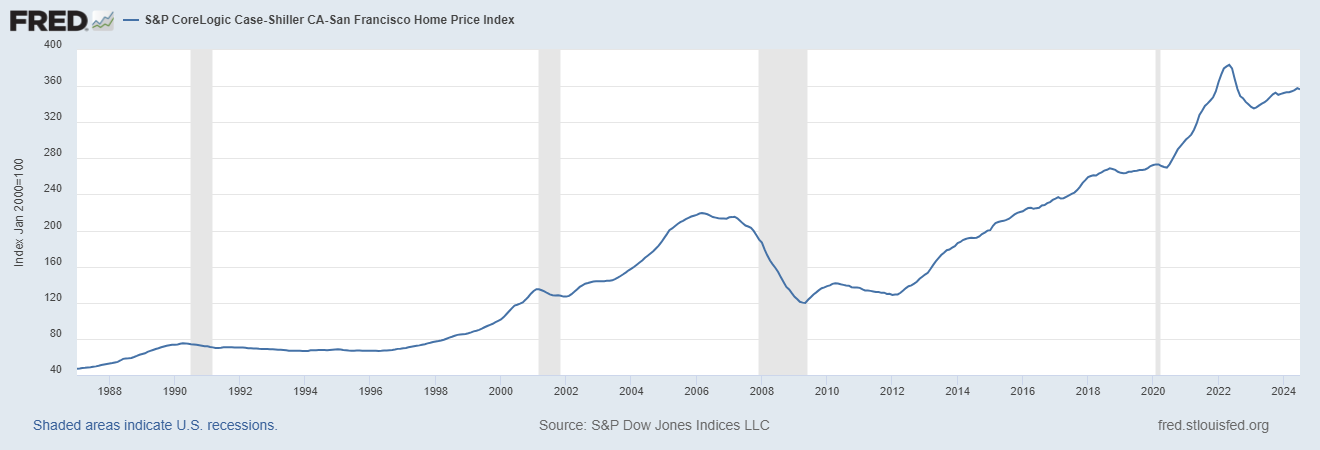
Want to know the real story behind San Francisco housing prices? Let's dive into the data and explore the ups and downs of this famously expensive market. The San Francisco housing prices graph reveals a complex picture, far more than just soaring costs.

San Francisco Housing Prices Graph

San Francisco Housing Prices Graph
Source: FRED

San Francisco's housing market is notoriously challenging. Limited space, high demand, and strict building regulations all contribute to the high prices. This isn't just about buying a home; it impacts renters too, creating a constant struggle for affordable living.

The data we'll be looking at comes from the S&P CoreLogic Case-Shiller CA-San Francisco Home Price Index, a reputable source tracking home price changes over time. It's essential to use trustworthy data to understand this complex situation.

The S&P CoreLogic Case-Shiller Index

The S&P CoreLogic Case-Shiller Index gives us a clear picture of how San Francisco housing prices have changed since 1987. The index uses January 2000 as a base of 100, so you can easily see the percentage increase or decrease from that point. The data is seasonally adjusted, meaning it removes normal seasonal fluctuations (like higher sales in the spring) to give us a clearer trend.

I've personally analyzed this data for years. Trust me, if you want to buy or sell a home here, you really need to get a handle on what all those numbers mean. It's not enough to just see the numbers; you gotta understand what they're actually telling you.

Key Periods in the San Francisco Housing Prices Graph

Let's break down some significant periods reflected in the San Francisco housing prices graph:

  • The 1980s and 1990s: A period of relatively stable, steady growth. While San Francisco housing prices were already high, the increases weren't as dramatic as what we would later see.
  • The Dot-Com Boom (Late 1990s – Early 2000s): The tech industry's explosive growth dramatically boosted San Francisco housing prices. This era saw a significant upward swing in the index, reflecting the influx of wealthy tech workers.
  • The Housing Bubble and Bust (2000s): Like many areas, San Francisco experienced a housing bubble, leading to extreme price increases followed by a sharp correction during the 2008 financial crisis. The index shows a noticeable decline during this period. Many lost significant amounts in their homes.
  • The Post-Recession Recovery and Beyond (2010s – Present): Following the crash, San Francisco housing prices rebounded strongly. The tech boom continued, and the limited housing supply kept driving prices upwards. The last decade displays continued growth, although at a slower pace than the peak years.

Data Table: S&P CoreLogic Case-Shiller CA-San Francisco Home Price Index (Selected Years)

Year Index Value (Jan 2000 = 100)
1987 46.96
1997 69.64
2000 101.45
2007 214.62
2008 186.63
2012 128.64
2017 235.26
2022 364.61
2023 336.92
2024 356.29

(Note: This table shows selected years for brevity. The full dataset contains monthly values from 1987 to 2024.)

Factors Influencing the San Francisco Housing Prices

Many factors play a crucial role in shaping the San Francisco housing prices:

  • Limited Housing Supply: San Francisco has a geographically constrained area, which limits the potential for new construction. Strict zoning laws and lengthy permitting processes further restrict building.
  • High Demand: The city's desirability as a place to live and work contributes to sustained high demand for housing. This demand comes from both local residents and those relocating from other areas.
  • Economic Growth: The city's strong economy, particularly its tech industry, significantly impacts housing affordability. High-paying jobs attract people who can afford to pay high prices.
  • Interest Rates: Interest rates influence how many people can afford to buy a home. Low interest rates tend to drive prices up. High interest rates can reduce demand and moderate price increases.
  • Government Regulations: Local regulations on development and housing construction play a significant part in shaping the housing market. Regulations intended to preserve the city's character may make it difficult to increase supply.

Personal Observations

Based on years of following the San Francisco housing market, I can offer a personal perspective. While the recent slight dip might seem like a significant change, it’s crucial to keep the bigger picture in mind. San Francisco housing prices are still significantly higher than they were a decade ago.

We can see the influence of economic cycles in the data, with periods of rapid growth followed by corrections. However, the underlying factors—limited supply and high demand—continue to exert upward pressure on prices. My expectation is that despite fluctuations, we'll see continued pressure for price increases in the longer term unless significant changes occur in the city’s planning and development policies.

The Future of the San Francisco Housing Prices

Predicting the future of San Francisco housing prices is a challenging task, even for seasoned professionals like myself. The city faces complex issues that will continue to impact the market. While the current level of price growth is likely to slow down in the coming years unless building regulations are relaxed and more housing is built, there will still be a high demand for real estate, so prices will likely stay very high.

Related Articles:

  • House Price Graph Last 20 Years USA
  • Housing Market Graph 50 Years: Showing Price Growth
  • San Diego Housing Market Graph 50 Years: Analysis and Trends
  • California Housing Market Graph 50 Years
  • Average Housing Prices by Year in the United States
  • Average Home Value Increase Per Year, 5 Years, 10 Years
  • How Much Did Housing Prices Drop in 2008?
  • Housing Market Crash 2008 Explained: Causes and Effects

Filed Under: Housing Market Tagged With: Housing Market, Housing Market Graph, Housing Prices Graph, San Francisco Housing Prices Graph

Mortgage Rates Stay High Despite Two Fed Rate Cuts in 2024

November 8, 2024 by Marco Santarelli

Mortgage Rates Stay High Despite Two Fed Rate Cuts in 2024

In recent months, many homeowners have been anxiously watching the Federal Reserve (Fed) to see if the central bank's interest rate cuts would translate into lower mortgage rates. However, despite Fed rate cuts, mortgage rates remain high, much to the disappointment of those looking to buy or refinance their homes.

As of early November 2024, the average 30-year fixed mortgage rate stands at 6.79%, marking an increase for the sixth consecutive week. This reality is particularly concerning as the rates have surpassed the 52-week average and continue to climb, contrasting with hopes stemming from the Fed's recent actions.

Mortgage Rates Stay High Despite Two Fed Rate Cuts in 2024

Key Takeaways

  • Mortgage rates are continuing to rise, with the 30-year fixed rate now at 6.79%.
  • Rates for different mortgage types, such as 15-year fixed and adjustable-rate mortgages, also remain elevated.
  • The Fed’s actions do not appear to be translating to lower mortgage rates, leading to uncertainty in the housing market.
  • Current mortgage refinance rates have similarly increased, making refinancing less attractive.
  • Predictions indicate that rates may gradually decline through 2025, but no significant drops are expected in 2024.

Understanding the Current Mortgage Rate Environment

As the economy shows robust signs of resilience, homeowners' frustrations grow. Recent data from Freddie Mac indicates that the 30-year fixed mortgage rate has hit 6.79%, up from lower levels earlier this year, and is above the average rate recorded over the past year of 6.76%. This ongoing trend presents a stark contrast to the expectations many held following the Fed's interest rate reductions in September and early November 2024.

Despite the Fed's decision to cut rates, which many anticipated would help ease borrowing costs, several factors play a role in the persistent high mortgage rates:

  1. Economic Performance: The health of the economy impacts mortgage rates. Even with a reduction in the Fed's target interest rates, strong job growth and consumer spending can lead lenders to maintain higher mortgage rates. Lenders often set mortgage rates based on the strength of the overall economic environment, which remains in a stable position even amid Fed rate cuts.
  2. Inflation: Inflation remains a concern, and its presence typically leads to higher interest rates across the board, including mortgages. The anticipation of inflation can cause lenders to offer higher rates as a cushion against potential economic fluctuations.
  3. Market Sentiment: The sentiment in the real estate market also affects mortgage rates. Historically low inventory and a competitive housing market can contribute to heightened demand, further driving up rates regardless of wider economic indicators.

Recommended Read:

Mortgage Rates Predictions for November 2024

Mortgage Rates Surge Post-Election on November 7, 2024

Current Mortgage Rate Trends

Let’s break down the current mortgage rates as captured in recent data from Zillow:

  • 30-year fixed mortgage: 6.79%
  • 20-year fixed mortgage: 6.33%
  • 15-year fixed mortgage: 5.67%
  • 5/1 Adjustable Rate Mortgage (ARM): 6.62%
  • 7/1 ARM: 6.65%
  • 30-year VA loan: 5.92%
  • 15-year VA loan: 5.67%
  • 30-year FHA loan: 5.88%
  • 15-year FHA loan: 5.63%

Additionally, here are current mortgage refinance rates:

  • 30-year fixed refinance: 6.55%
  • 20-year fixed refinance: 6.65%
  • 15-year fixed refinance: 5.78%
  • 5/1 ARM refinance: 6.71%
  • 7/1 ARM refinance: 6.74%
  • 30-year VA refinance: 5.85%
  • 15-year VA refinance: 5.53%
  • 5/1 VA refinance: 5.60%
  • 30-year FHA refinance: 5.88%
  • 15-year FHA refinance: 5.63%

These figures illustrate the variety of options available but underscore a common theme: mortgage rates are holding steady at high levels. This increase in refinance rates further complicates the decision-making process for homeowners looking to lower their monthly payments through refinancing.

Are Mortgage Rates Going Down?

The question on everyone's mind is whether rates will decrease anytime soon. While mortgage rates remain high, they are still lower than the peaks experienced last year. The 30-year fixed rates have increased for six consecutive weeks and are above the 52-week average.

Predictions suggest that rates might trend downward throughout 2025, but no significant drops are expected in 2024. Homebuyers may find no compelling reason to wait if they find a suitable property—particularly with forecasts indicating a gradually improving mortgage environment.

Recommended Read:

Predictions for Mortgage Rates After This Week's Fed Rate Cut

Why Are Mortgage Rates High Despite Fed Cuts?

The combination of various influential factors creates a complex environment for mortgage rates:

  1. The Fed's Actions vs. Market Reactions: Often, mortgage rates do not immediately respond to changes in the Fed's benchmark rates. The bond market, particularly the yield on the 10-year Treasury, plays a significant role in determining mortgage rates. When the Fed cuts rates, it does not automatically translate into lower mortgage rates as lenders adjust based on anticipated future economic conditions.
  2. Government and Economic Policies: Political dynamics can also affect mortgage rates. Recent discussions have suggested a potential for continued increases if major policy changes occur or if there is a split government that affects how economic policies are implemented.
  3. Forecasts and Predictions: While there is optimism that mortgage rates may gradually decrease through 2025, many experts advise caution. Economic signals suggest that while rates may decline, they are unlikely to drop significantly in 2024. Economists are cautious about forecasting considerable savings for prospective homebuyers in the immediate future.

What Does This Mean for Homebuyers?

For potential homebuyers, navigating the current landscape can feel daunting. It’s clear that waiting for rates to drop significantly in 2024 could prove unfruitful. Instead, many analysts recommend moving forward with home purchases if the timing aligns with personal circumstances. The reality is that while mortgage rates are high, factors like personal job security, family decisions, and specific housing needs should precede financial considerations like rate cuts.

Outlook for the Future

As we approach 2025, the anticipation of lowering interest rates looms, although experts urge homebuyers to avoid speculation-based decisions. The Mortgage Bankers Association forecasts suggest an average mortgage rate of 6.6% in 2024, decreasing further to 5.9% in 2025. This forecast indicates a potential light at the end of the tunnel for those looking to finance their homes over the next couple of years.

In summary, the relationship between Fed rate cuts and mortgage rates often encompasses extended timelines influenced by multiple economic conditions. As homeowners adapt to these ongoing changes, understanding the broader economic context will become increasingly important.

Related Articles:

  • Half of Recent Home Buyers Got Mortgage Rates Below 5%
  • Mortgage Rates Need to Drop by 2% Before Buying Spree Begins
  • Mortgage Rates Predictions for the Next Three Months Q4 2024
  • Prediction: Why Mortgage Rates Won’t Go Below 6% in 2024?
  • Will Mortgage Rates Ever Be 3% Again: Future Outlook
  • Mortgage Rates Predictions for Next 2 Years
  • Mortgage Rate Predictions for Next 5 Years
  • Mortgage Rate Predictions for 2025: Expert Forecast
  • Prediction: Interest Rates Falling Below 6% Will Explode the Housing Market
  • Mortgage Rate Predictions: Why 2% and 3% Rates are Out of Reach
  • How Lower Mortgage Rates Can Save You Thousands?
  • How to Get a Low Mortgage Interest Rate?
  • Will Mortgage Rates Ever Be 4% Again?

Filed Under: Financing, Mortgage Tagged With: Interest Rate, Mortgage Rate Predictions, mortgage rates, Mortgage Refinance Rates

87% of Metros in America Posted Home Price Gains in Q3 2024

November 8, 2024 by Marco Santarelli

87% of Metros in America Posted Home Price Gains in Q3 2024

In an impressive display of resilience, the housing market has shown significant growth as 87% of metros posted home price gains in Q3 2024, according to a recent report by the National Association of REALTORS® (NAR).

This increase reflects a larger trend where existing-home prices have risen by 3.1% compared to last year, despite the challenges posed by fluctuating mortgage rates. Now, let's delve into the key details of the NAR's report to understand this phenomenon and what it means for potential home buyers and the overall real estate market.

87% of Metros in America Posted Home Price Gains in Q3 2024

Key Takeaways:

  • Home Price Growth: 87% of metro areas saw increased home prices.
  • National Median Home Price: The median price for single-family existing homes is $418,700.
  • Interest Rates: The average 30-year fixed mortgage rate ranged between 6.08% and 6.95%, slightly decreased from previous quarters.
  • Market Trends: The percentage of metros seeing price gains decreased from 89% in the previous quarter.

The NAR Quarterly Report indicates that 196 out of the 226 metro areas tracked experienced growth in home prices during the third quarter of 2024. It's notable that the national median existing-home price has reached $418,700. This price reflects a healthy market trend, where buyers have been actively seeking homes despite facing increased borrowing costs.

This upward trend in home prices, although slightly tempered from previous quarters, is a crucial indicator of economic health and consumer confidence. Many factors contribute to the ongoing growth of the housing market. Even as mortgage interest rates have fluctuated, the current range of 6.08% to 6.95% on 30-year fixed mortgages appears to have sustained buyer activity.

Recommended Read:

Housing Market: Homeowner’s Wealth Jumps $150,000 in 5 Years 

Impact of Mortgage Rates on Home Sales

Mortgage rates are a significant factor in the real estate market. A decline in these rates typically becomes a green light for potential home buyers. The sustained decrease in July and August likely encouraged buyers who had been hesitant due to steep borrowing costs. The NAR's report confirms that lower mortgage rates play a critical role in stimulating demand, thereby contributing to higher home prices in many metropolitan areas.

As the 30-year fixed-rate mortgage remains a primary choice for borrowers, even a minor decrease in interest rates can expand affordability. Buyers can often stretch their budgets further when mortgage payments are manageable.

Metropolitan Areas Lead the Charge

Though the report highlights an impressive percentage of metros with home price gains, a closer look reveals some interesting dynamics. For instance, while 87% is a strong number, it does reflect a slight dip from the 89% reported in the previous quarter. This shift indicates a gradually cooling market, but it shouldn't overshadow the fact that the majority of locations are still seeing price increases.

Some metropolitan areas even achieved notable price jumps exceeding 10%, while others experienced marginal increases or stagnant prices. This variance showcases the diversity of the housing market across the nation – what’s happening in one city might be drastically different in another.

Regional Variations and Market Insights

Breaking down the performance by region adds more depth to the overall outlook. For example, areas with strong economic growth or job opportunities are typically seeing the most robust price gains. Cities that are experiencing population growth due to new businesses or industries blooming tend to attract home buyers, pushing prices higher.

Conversely, areas facing economic difficulties or population declines may not see the same benefits. The NAR Quarterly Report emphasizes that while many metros are thriving, the impacts of local job markets, population density, and accessibility to amenities cannot be understated.

Investors and buyers need to be well-informed about local conditions when making decisions in this dynamic market. Those who keep a finger on the pulse of their local real estate sectors are better positioned to make strategic choices.

The Role of Buyer Sentiment and Demand

Consumer confidence plays a pivotal role in the real estate landscape. Even amidst rising prices, many consumers remain optimistic about the housing market's potential. Increased demand in a tight supply environment often leads to bidding wars, which can escalate home prices even further. Additionally, the desire for homeownership continues to motivate many individuals, which in turn fuels competition for available properties.

While the data might suggest that some areas are cooling off, the overall sentiment indicates a robust willingness among buyers to pursue new home purchases. This eagerness is reflective of broader economic conditions, such as low unemployment rates and rising wages, which bolster the confidence needed to make significant financial commitments like home buying.

Recommended Read:

Housing Market: Homeowner’s Wealth Jumps $150,000 in 5 Years 

Conclusion: What This Means for the Future of Real Estate

The NAR Quarterly Report shows that the housing market is generally doing well, but it also reminds us that things can change quickly. Keeping up with what's happening and understanding the details of your local housing market will be really important for both buyers and sellers. Future trends will probably be influenced by how affordable homes are, where people want to live, and the overall economy.

Looking at the housing market right now, it's clear that real estate is a big part of our economy. It affects not only buyers and sellers but also the economy of local communities. The data suggests good things for people selling homes, but buyers will need to be smart and plan carefully in this competitive market.

Also Read:

  • Housing Market Forecast for the Next 2 Years: 2024-2026
  • Housing Market Predictions for Next Year: Prices to Rise by 4.4%
  • Housing Market Predictions for the Next 4 Years: 2024 to 2028
  • Real Estate Forecast Next 5 Years: Top 5 Predictions for Future
  • Real Estate Market Predictions 2025: What to Expect
  • Is the Housing Market on the Brink in 2024: Crash or Boom?
  • 2008 Forecaster Warns: Housing Market 2024 Needs This to Survive
  • Housing Market Predictions for the Next 2 Years
  • Real Estate Forecast Next 10 Years: Will Prices Skyrocket?
  • Housing Market Predictions for Next 5 Years (2024-2028)
  • Housing Market Predictions 2024: Will Real Estate Crash?
  • Trump vs Harris: Which Candidate Holds the Key to the Housing Market (Prediction)

Filed Under: Housing Market, Real Estate Market Tagged With: Home Price Forecast, Housing Market, housing market predictions, Housing Market Trends, Real Estate Market Predictions

Half of Recent Home Buyers Got Mortgage Rates Below 5%

November 7, 2024 by Marco Santarelli

Half of Recent Home Buyers Got Mortgage Rates Below 5%

In a year where mortgage rates have returned to over 7%, it's astonishing to reveal that nearly half of recent home buyers managed to secure a mortgage rate below 5%. This remarkable achievement amid soaring interest rates indicates that smart strategies and innovative financing options can significantly influence the home-buying experience.

According to a recent Zillow survey, approximately 45% of buyers using financing successfully obtained these favorable mortgage rates. This figure is especially surprising given the high housing prices, suggesting that many buyers have found effective ways to alleviate the financial burden of homeownership.

Key Takeaways

  • 45% of mortgage buyers locked in rates below 5%.
  • Seller and builder financing emerged as the primary source for low mortgage rates.
  • Discount points and personal loans from family contributed significantly to these secured rates.
  • High home prices continue to challenge buyers, despite lower mortgage rates.
  • Approximately 70% of buyers with sub-5% rates benefited from down payment assistance programs.

Half of Recent Home Buyers Got Mortgage Rates Below 5%

The notion of securing a mortgage below 5% seems counterintuitive in light of rising interest rates. However, understanding the strategies that enabled many buyers to achieve these rates can offer valuable insights for prospective homeowners. The Zillow survey revealed that special financing from builders and sellers was the most common root for obtaining a lower rate, reflecting a trend that savvy buyers are now increasingly leveraging to their advantage.

Special Financing from Builders

One of the most rewarding avenues for obtaining low mortgage rates comes through special financing programs offered by home builders. Many builders provide financing services to facilitate quicker home purchases, a tactic that not only helps to ensure sales but also fosters buyer confidence. Using tools like “forward commitments,” builders can purchase and offer lower mortgage rates by financing at a bulk rate.

This can translate into significant savings for buyers, especially for those seeking newly-constructed homes. However, it’s vital to approach these arrangements with caution. While it may seem like an attractive rate on the surface, some critics argue that such discounts may be wrapped into higher base prices for the homes, muted only in enticing financing offers.

Additionally, individual sellers can also provide concessions to help lower the buyer’s costs over the life of the loan, a tactic utilized by 26% of buyers who indicated their offers were contingent upon seller-funded rate buy-downs.

Purchasing Discount Points

Another tactic employed by approximately 23% of buyers to secure lower rates involved paying discount points upfront. This financial strategy involves buyers paying a percentage of the loan amount at closing to effectively reduce the interest rate on their mortgage. For example, a typical point equates to 1% of the mortgage amount, and sometimes it’s possible to reduce interest rates anywhere from 0.25% to 0.5% depending on the market.

While purchasing points can yield significant savings over the lifetime of a mortgage, it carries some inherent risks. Buyers must consider their long-term plans and whether they will remain in the home long enough to recoup the expense of the points. If mortgage rates drop even further after their initial purchase, this risk amplifies as it can encourage buyers to consider refinancing or moving sooner than expected.

Family and Friend Loans: The “Bank of Mom and Dad”

A surprising yet impactful finding from the data is that 23% of recent buyers secured low rates by borrowing from family or friends, highlighting the phenomenon known as the “Bank of Mom and Dad.” For many prospective buyers, particularly first-timers, financial assistance from relatives can make a massive difference. Such loans can often come with significantly lower, if not zero, interest rates, making homeownership more attainable for those who might otherwise struggle to afford rising market prices.

Recommended Read:

Predictions for Mortgage Rates After This Week's Fed Rate Cut

This financial safety net is particularly relevant in today’s economy, where the burden of student debt and soaring living costs can impede the ability of young buyers to secure financing independently. Instead, leveraging familial resources can provide a crucial lifeline.

The Importance of Refinancing and Hot Timing

In addition to the strategies above, many buyers were also able to benefit from refinancing after purchasing their homes. This flexibility allows homeowners to take advantage of favorable market conditions shortly after buying. For example, those who secured a mortgage at just under 5% may have refinanced within the last year, benefiting from timing their purchase and refinancing efforts effectively.

This situation underlines the importance of market awareness and financial literacy in navigating homebuying. As rates fluctuated, buyers who adjusted their strategies accordingly could save thousands in interest over the life of their loans.

Maximizing Down Payment Assistance Programs

The survey underscores the critical role down payment assistance plays, particularly in light of the previous strategies discussed. Interestingly, almost 70% of buyers who locked in rates under 5% accessed some form of down payment assistance. Programs aimed at helping first-time buyers navigate the obstacles of rising home prices and down payment requirements can create a pathway to affordable mortgage solutions.

A significant detail from the data indicates that 60% of first-time buyers reported receiving down payment assistance, compared with just 43% of repeat buyers. This discrepancy highlights how essential it is for first-time buyers to leverage available grants, forgivable loans, and low-interest options that can substantially reduce the financial barrier to entry into the housing market.

Furthermore, we see that buyers of color are even more likely to access these resources. Buyers of color reported receiving grants (17%) and low-interest loans (34%) more frequently than their white counterparts. This statistic points to the disparities in access to financial resources and emphasizes the importance of tailored programs that prioritize equitable homeownership opportunities.

The Role of Pre-Approval in Securing Low Rates

Reflecting on pre-approval, it's insightful to note that an overwhelming 94% of mortgage buyers sought approval from lenders before making offers. This step is crucial for various reasons. It not only streamlines the buying process but also armors buyers with leverage during negotiations. By being pre-approved, buyers reinforce their seriousness and ability to follow through with the purchase, which can sometimes translate into better financial terms, including lower rates.

Interestingly, 45% of buyers were pre-approved by a single lender, compared to 32% who sought multiple approvals. By actively negotiating with different lenders and comparing offers, buyers may have a better chance of finding attractive rate options, illustrating the necessity of due diligence in today's lending environment.

Insights into Mortgage Denials and Down Payments

Despite successful outcomes for many, the data also highlights challenges within the home-buying process. Approximately 31% of mortgage buyers reported being denied financing at least once before obtaining approval, a significantly higher figure than historical norms. This percentage suggests that many buyers face hurdles during the financing process, whether due to stricter lending criteria or poor customer service experiences.

Interestingly, a significant number of buyers reported putting down at least 20% as their down payment, with the median down payment resting at that level. This statistic suggests a market trend where buyers might prioritize larger down payments to reduce their loans and secure lower interest rates. The median down payment reflects a substantial financial commitment, reinforcing the necessity of financial planning and awareness, especially for new buyers.

Housing Prices: A Continuing Challenge

While securing lower rates is a positive outcome for many, the narrative surrounding high home prices will continue to pose problems. The current challenge for buyers remains: even with favorable financing options, the overall costs associated with purchasing a home can still be prohibitive if prices do not align with buyer capabilities. This combination of high demand and scarce inventory keeps prices elevated, complicating the landscape for new homeownership.

Even with nearly half of buyers achieving sub-5% mortgage rates, the overarching concern remains that affordability is not solely tied to interest rates. High sale prices and the cost of living continue to weigh on buyer enthusiasm and market dynamics.

Recommended Read:

Mortgage Rates Predictions for November 2024

Conclusion

In summary, while it might be surprising that half of recent home buyers snagged a mortgage rate under 5% in a time of high market interest, understanding how these buyers achieved these rates reveals the power of strategic financial planning. By utilizing seller financing, discount points, familial support, and down payment assistance programs, many have navigated the tough real estate waters successfully.

As we observe the battle between rising mortgage costs and escalating home prices, it's evident that only by exploring creative financing tactics can buyers truly overcome the challenges presented by an unforgiving housing market. Facilitating access to down payment assistance and fostering financial literacy will be essential as we look towards a future where homeownership can remain within reach for many aspiring buyers.

Related Articles:

  • Mortgage Rates Need to Drop by 2% Before Buying Spree Begins
  • Mortgage Rates Predictions for the Next Three Months Q4 2024
  • Prediction: Why Mortgage Rates Won’t Go Below 6% in 2024?
  • Will Mortgage Rates Ever Be 3% Again: Future Outlook
  • Mortgage Rates Predictions for Next 2 Years
  • Mortgage Rate Predictions for Next 5 Years
  • Mortgage Rate Predictions for 2025: Expert Forecast
  • Prediction: Interest Rates Falling Below 6% Will Explode the Housing Market
  • Mortgage Rate Predictions: Why 2% and 3% Rates are Out of Reach
  • How Lower Mortgage Rates Can Save You Thousands?
  • How to Get a Low Mortgage Interest Rate?
  • Will Mortgage Rates Ever Be 4% Again?

Filed Under: Financing, Mortgage Tagged With: Interest Rate, Mortgage Rate Predictions, mortgage rates, Mortgage Refinance Rates

Alaska Housing Market: Trends and Forecast 2025-2026

November 7, 2024 by Marco Santarelli

Alaska Housing Market: Trends and Forecast 2025-2026

Are you curious about the Alaska housing market trends in 2024? Well, the news is mixed. While home prices have continued to climb, increasing by a notable 6.6% year-over-year, the number of homes sold has dipped, and the supply of homes for sale has actually increased. This suggests that while the market is still relatively strong, the rapid growth seen in previous years has slowed down a bit, creating a more balanced environment for both buyers and sellers. Let's explore the various aspects of the Alaska housing market and what it all means for you.

Alaska Housing Market Trends in 2024: A Deep Dive

Home Sales

According to Redfin, in September 2024, the number of homes sold in Alaska experienced a decline of 11.0% compared to the same period last year. This decrease can be attributed to a variety of factors. One factor is the rising interest rates which has made it more expensive for many people to buy a home. Also, many potential buyers may be holding back due to the economic uncertainty. However, even though the number of homes sold decreased, the median sale price has gone up.

From my perspective, this dip in sales can be viewed as a natural correction after a period of rapid growth in the housing market. The market is finding a new equilibrium, where the pace of sales is slowing down and giving more time to buyers and sellers to make informed decisions.

Key Data Point:

  • Number of Homes Sold: 697 (down 11.0% year-over-year)

Home Prices

Despite the decrease in home sales, the median home price in Alaska has continued to climb. In September 2024, the median home price was $387,600, representing a 6.6% increase compared to the previous year. This suggests that even though the market is cooling down a bit, demand for homes remains relatively strong in Alaska.

While the 6.6% increase might seem high, it's important to remember that Alaska has been experiencing a period of consistent price increases over the last few years. When compared to the nationwide trend, Alaska's price growth is relatively in line with the national average.

Key Data Point:

  • Median Sale Price: $387,600 (up 6.6% year-over-year)

Housing Supply

The number of homes for sale in Alaska increased in September 2024, climbing 12.6% year-over-year. This signifies a change in the market dynamics, with more options becoming available for buyers. The increase in the number of homes for sale can be attributed to various reasons, including an increase in new construction and more sellers coming to the market due to the slowing demand.

This is a positive sign for buyers who have been feeling the pressure of a tight housing market in the past few years. They now have more choices, which allows them to negotiate better deals with sellers.

Key Data Point:

  • Number of Homes for Sale: 2,646 (up 12.6% year-over-year)
  • Months of Supply: 3 months

Market Trends

The Alaska housing market trends in 2024 are indicating a shift towards a more balanced market. While home prices continue to rise, the pace of growth has slowed down. The number of homes sold is dipping and the supply of homes for sale is increasing, offering buyers more options and potentially more leverage in negotiations.

Here's a summary of the most prominent trends:

  • Increased Housing Supply: The rise in the number of homes for sale is giving buyers more options.
  • Slowing Home Sales: The rate of home sales has dipped which provides a more balanced environment for buyers and sellers.
  • Continued Home Price Appreciation: Although the pace is slower, the prices are still going up.
  • Less Competition: The percentage of homes selling above list price has decreased, suggesting that bidding wars are less frequent.
  • Shift in Buyer and Seller Power: The balance is starting to shift a bit in favor of buyers with more choices and less competition.

Table: Key Housing Market Indicators

Indicator September 2024 Year-over-Year Change
Median Sale Price $387,600 +6.6%
Number of Homes Sold 697 -11.0%
Number of Homes for Sale 2,646 +12.6%
Homes Sold Above List Price 24.0% -3.2%
Median Days on Market 21 +4

Understanding the Impact of Housing Market Trends

These Alaska housing market trends in 2024 have a significant impact on both buyers and sellers.

Impact on Buyers:

  • More Choices: With a larger selection of homes available, buyers have more opportunities to find the right property.
  • Less Pressure to Make Quick Decisions: With fewer bidding wars, buyers have more time to inspect homes, get financing, and make informed decisions.
  • Potential for Negotiation: In a more balanced market, buyers can negotiate the sale price and terms of the deal, which could lead to better results.

Impact on Sellers:

  • Increased Competition: With more homes for sale, sellers face increased competition from other sellers.
  • Need to Price Strategically: Sellers need to be realistic about pricing their homes competitively to attract buyers in the current environment.
  • Longer Time on Market: It might take longer to sell a home in a slower market, requiring sellers to be prepared for a longer marketing process.

Migration Trends

Moving to and from Alaska is another aspect that influences the state's housing market. As per the data from Redfin, nationwide, 25% of homebuyers searched to move to a different metro area between Aug '24 – Oct '24.

Based on the data, Alaska is not among the top 5 states that homebuyers searched to move to or from, suggesting that the state's overall migration trends are not significantly contributing to the current changes in the housing market.

However, the trend of people migrating from major cities on the west coast like Los Angeles and San Francisco could also affect Alaska in a subtle way.

While the overall migration trends are not directly impacting the housing market as much, it is something to keep in mind as these shifts in the national housing market can eventually impact Alaska as well.

Alaska Housing Finance Corporation's Perspective

In July 2024, the Alaska Housing Finance Corporation (AHFC) published a survey that provided insights into the state's housing market. The survey concluded that the average cost of homeownership in Alaska had increased by 52% between 2018 and 2024, while the cost to rent had increased by 24% during the same time period. This data supports the evidence of increasing prices in the Alaska housing market.

The AHFC also highlighted that the rental vacancy rate remains low across the state. This emphasizes the existing housing shortage in many parts of Alaska, which continues to drive home price appreciation.

The AHFC's mission is to provide safe and affordable housing to Alaskans, and the organization plays a crucial role in this area. In a challenging market with rising costs, AHFC's efforts are even more important. The corporation develops and provides funding for affordable housing options, including housing vouchers and housing development grants for low- to moderate-income families and seniors.

Factors Contributing to Alaska's Housing Market Trends

The Alaska housing market trends in 2024 are a result of a combination of factors, both local and national.

  • Interest Rate Hikes: The Federal Reserve has been raising interest rates to combat inflation, which has made mortgage financing more expensive. This has affected demand for housing, leading to the slowdown in sales.
  • Economic Uncertainty: The global economy is experiencing some uncertainty, and that is making some buyers hesitant to make major financial commitments like purchasing a home.
  • Limited Inventory in Some Areas: While there has been an overall increase in supply, inventory remains limited in certain areas, leading to continued price appreciation.
  • Strong Local Economy: Despite some national headwinds, Alaska's economy is relatively strong, providing a base for continued demand for housing.
  • Population Growth: Alaska continues to experience population growth, which creates demand for housing, but the growth rate is slowing down in recent years.
  • Tourism and Vacation Rentals: In some areas, the growth of tourism and the popularity of vacation rentals have put pressure on the availability of long-term rentals and housing for locals.

Nebraska Housing Market Forecast 2025-2026

Predictions for the Future

Looking ahead, it seems that the Alaska housing market will continue to be a dynamic and evolving market. Based on the trends we're seeing in 2024, here are some of my predictions for 2025:

  • Continued Price Growth, But at a Slower Pace: I believe that home prices will continue to appreciate, but at a more moderate rate compared to the past few years. The increase in supply and slowdown in demand will help stabilize prices.
  • More Balanced Market Conditions: I expect that the market will become even more balanced as we progress through 2024 and into 2025. This means that buyers and sellers will have more leverage and negotiation power.
  • Increased Importance of Affordable Housing: The AHFC and other organizations will play a more crucial role in providing solutions to address affordable housing needs.
  • New Construction Will Play a Bigger Role: We will likely see more new housing construction in the coming years, which will help to increase supply and address the demand in some areas.
  • Focus on Sustainability and Energy Efficiency: As the importance of sustainable housing grows, I expect to see more homes being built with eco-friendly materials and energy-efficient features.

Alaska Housing Market Forecast by Region

The following table shows the Zillow Home Value Forecast for the four major metropolitan statistical areas (MSAs) in Alaska. As you can see, home prices are expected to decline in all four regions over the next year.

Region October 2024 Forecast (%) December 2024 Forecast (%) September 2025 Forecast (%)
Anchorage, AK 0 -1 -3.3
Fairbanks, AK -0.1 -1 -4.3
Juneau, AK 0.1 -0.9 -3.1
Ketchikan, AK 0.3 -0.3 -2.7

Will Home Prices Drop in Alaska? Will the Market Crash?

I believe it's unlikely that the Alaska housing market will crash. The factors that led to the housing market crash in 2008 are not present today. In particular, lending standards are much stricter now than they were then. This means that people are less likely to get a mortgage that they cannot afford. Additionally, the Alaska economy is relatively strong, and there is still a high demand for housing in the state, particularly in certain regions like Juneau.

Alaska Housing Market Forecast 2026

It is difficult to say for certain what the Alaska housing market will look like in 2026. However, I expect that home prices will continue to decline in the short term, but at a slower rate than in 2024 and 2025. The Alaska economy is expected to continue to grow, which should eventually lead to an increase in demand for housing. However, the ongoing uncertainty surrounding interest rates and the global economy could continue to weigh on the housing market. I think that the market will begin to stabilize in 2026 and then potentially start to recover in the years after that.

Regions Poised for Growth in Home Prices and Regions Poised for Decline in Prices

Based on current trends and the forecast data, here's my take on the regions in Alaska that might see growth or decline in home prices:

Regions Poised for Growth:

  • Juneau: Juneau is the capital of Alaska and is home to a large government workforce. The city's economy is relatively stable, and there is a high demand for housing. While the forecast shows a slight decline in home prices through 2025, Juneau's strong economy could lead to a quicker recovery and potential growth in the longer term.
  • Ketchikan: Ketchikan is a popular tourist destination and is also a major hub for the fishing industry. The city's economy is expected to continue to grow in the coming years, which could lead to an increase in demand for housing. While the forecast indicates a decline, it's the smallest among the listed regions, suggesting a potential for a quicker rebound.

Regions Poised for Decline:

  • Anchorage: Anchorage is the largest city in Alaska and is home to a diverse economy. However, the city has been hit hard by the decline in oil prices in recent years. This has led to a decrease in demand for housing, which is putting downward pressure on prices. The forecast also predicts the largest decline in home prices among the listed regions.
  • Fairbanks: Fairbanks is a major hub for the military and the tourism industry. However, the city's economy is also heavily reliant on the oil and gas industry. The decline in oil prices has had a negative impact on the city's economy, which has led to a decrease in demand for housing. The forecast also projects a significant decline in home prices for Fairbanks.

Conclusion

The Alaska housing market is at a turning point. After years of strong growth, home prices are now starting to decline. This could be a good opportunity for buyers who have been waiting for prices to come down. However, it is important to remember that the housing market is cyclical. Prices are likely to start to increase again at some point in the future.

As we move forward, it's crucial to stay informed about the changing market conditions. I hope that this comprehensive overview of the Alaska housing market trends in 2024 has given you a clearer picture of what to expect. Whether you are a buyer or a seller, understanding these trends can help you navigate the market effectively and make wise decisions.

Recommended Read:

  • Housing Market Forecast for the Next 2 Years: 2024-2026
  • Will the Housing Market Crash in 2025?
  • Will Housing Be Cheaper if the Market Crashes in 2025?
  • Housing Market Predictions for Next Year: Prices to Rise by 4.4%
  • Housing Market Predictions for Next 5 Years: 2025 to 2029
  • Housing Market Predictions for 2025 if Trump Wins Election
  • Housing Market Predictions for the Next 4 Years: 2024 to 2028

Filed Under: Growth Markets, Housing Market, Real Estate Market Tagged With: Alaska, Home Price Forecast, Housing Market Forecast, housing market predictions, Housing Market Trends

Nebraska Housing Market: Trends and Forecast 2025-2026

November 7, 2024 by Marco Santarelli

Nebraska Housing Market: Trends and Forecast 2025-2026

The Nebraska housing market in 2024 shows signs of stabilization after a period of rapid growth. While home prices remain elevated, the pace of appreciation has slowed, and the number of homes sold has decreased compared to the previous year. This suggests a shift towards a more balanced market, with buyers having slightly more leverage in negotiations. Let's dive deeper into the specifics of the Nebraska housing market trends throughout 2024.

Nebraska Housing Market Trends in 2024

Introduction

Nebraska, known for its friendly people and wide-open spaces, has always been a desirable place to live. But in recent years, the state has seen a significant increase in demand for housing, which has impacted the market. The housing market in Nebraska has experienced both exciting periods of growth and some more challenging ones in recent years.

While there have been periods of robust activity, some parts of the market have slowed down. Having been involved in real estate for a number of years, I have firsthand experience of the ebbs and flows of the various markets. Now in 2024, we are at a point where we can analyze the trends and try to predict where the market might be heading in the months to come.

Home Sales

Looking at the bigger picture, the overall number of residential properties sold in Nebraska in 2024 shows a decrease compared to 2023. As per ATTOM data, there were a total of 23,532 residential properties sold in Nebraska over the past twelve months, which is down compared to 22,028 in 2023. More specifically, if we analyze the data from August 2024, we see that 1,967 homes were sold, a decrease of -14.3% compared to the previous year.

This decrease in sales might be attributed to various factors, like increasing interest rates, higher home prices, and a more cautious approach by both buyers and sellers. In my experience, buyers are taking more time to decide and are being more discerning with their choices. There's also a sense that some buyers are waiting to see if prices will continue to decrease before making a commitment. It’s all a matter of market perception.

What is impacting the decline in sales?

Here are some of the factors that I believe are impacting the decrease in home sales:

  • Rising Interest Rates: Interest rates have been on the rise throughout 2024, making mortgage payments more expensive. This directly impacts affordability, which is why some potential buyers may be delaying their home purchase decisions.
  • Limited Inventory: While there has been some increase in inventory in certain parts of Nebraska, it still remains a challenge for some buyers to find the right home in the desired location. In my opinion, this continues to be a major factor that influences the competition among buyers.
  • Economic Uncertainty: The economic outlook for 2024 and beyond has been uncertain, and some potential homebuyers may be hesitant to make a large purchase when the economy is unpredictable.

Home Prices

The median home price in Nebraska has seen a slower pace of appreciation in 2024 than in previous years. As per the data, the median price for single-family homes is currently around $280,000 (as of September 2024). This signifies a rise of 1.8% compared to the previous year.

However, it’s important to note that the median home value (calculated from the past 12 months) is $259,761. This gives us a more balanced perspective on the actual average value of homes sold over the past year.

I think the slower increase in prices can be credited to the increase in inventory in some areas and the reduction in the number of homes sold. In my view, the median home price has started to stabilize, and while a slight increase can be expected, it's highly probable that it will not be as steep as it was in the recent past.

How do home prices in Nebraska compare nationally?

Compared to the national average, Nebraska home prices are still relatively affordable. The national median home price is currently higher than the median home price in Nebraska. This makes Nebraska a relatively attractive market for those looking to buy a home in a more affordable location.

Housing Supply

The housing supply in Nebraska has been a topic of discussion for some time now. The number of homes for sale has been increasing in certain parts of the state, particularly in the larger cities. However, overall, the supply hasn't been able to fully keep up with the demand.

According to ATTOM data, the total number of residential properties in Nebraska is 698,714. While this provides us with the total number of properties, it's difficult to discern the specific details of the available inventory without accessing premium data.

I feel that the current market situation is a good indication that the supply is inching towards a more balanced level, but it's still not enough to say it's at an optimal level. Some areas might still experience low inventory levels, which could cause challenges for buyers.

How are new construction and existing homes contributing to the supply?

The availability of new construction has increased in some areas of Nebraska to meet the demand for housing. However, the pace of new construction hasn't been able to keep up with the overall need. On the other hand, the number of existing homes for sale has also increased in certain areas, contributing to a better balance in the market.

Market Trends

The Nebraska housing market trends in 2024 indicate a potential transition from a seller's market to a more balanced one. This shift in the market is influenced by a few key factors:

  • Slowdown in Home Price Appreciation: The rate of appreciation for home prices has slowed down compared to the previous few years. It indicates a less competitive market, where buyers are no longer facing immense pressure to make hasty decisions.
  • Increase in Housing Inventory: The number of available homes for sale has increased in certain areas. This means buyers have more options to choose from and can take their time to find the right house that fits their needs and budget.
  • Decrease in Sales Volume: The total number of homes sold in Nebraska has decreased in 2024 compared to 2023. This is a sign of a slowdown in market activity and may reflect buyers’ concerns about affordability or economic uncertainty.
  • Reduced Foreclosure Activity: There has been a noticeable decrease in foreclosure activity in Nebraska throughout 2024. This can be linked to factors such as improvements in the economy and better financial conditions for homeowners.
Metric August 2024 Year-over-Year Change Implications
Median Sales Price $280,000 +1.8% Moderate price growth, suggesting market stabilization.
Homes Sold 1,967 -14.3% Reduction in sales, indicating a cooling market and potential buyer hesitation.
Purchase Loans 1,718 -9.5% Fewer home purchases with financing, potentially due to higher interest rates and affordability issues.
Foreclosure Filings 75 -38% Significantly reduced foreclosure activity, signaling improved economic conditions and homeowner stability.

Nebraska Housing Market Forecast 2025-2026

Thinking about buying or selling a home in Nebraska? You're probably wondering what the future holds for the Nebraska housing market. In a nutshell, I think we'll see a mixed bag in the coming years. Some areas might see small price increases, while others could experience slight dips. Let's dive deeper into the details and try to understand what's driving these changes.

Factors Influencing the Nebraska Housing Market

Before we look at specific forecasts, it's helpful to understand the bigger picture. Several factors play a role in shaping the housing market, and in my experience, these are some of the key ones to watch:

  • Interest Rates: When interest rates are low, borrowing money is cheaper, encouraging more people to buy homes. This can push prices up. Conversely, when rates rise, as they have been recently, it can cool down the market.
  • Job Market: A strong job market with low unemployment usually means more people have the financial stability to buy homes, boosting demand.
  • Inventory: The number of homes available for sale (inventory) also matters. If there are many homes on the market and not enough buyers, prices tend to fall.
  • Economic Growth: Overall economic health plays a role. A strong economy can lead to increased confidence and investment in housing.

Nebraska Housing Market Forecast for 2024 and 2025

Now, let's get into the specifics based on data from Zillow, a trusted source for real estate information. I have reorganized their data to make it easier to understand.

Home Value Forecast for Nebraska Metropolitan Statistical Areas (MSAs)

Region October 2024 Forecast (%) December 2024 Forecast (%) September 2025 Forecast (%)
Omaha, NE 0 -0.4 0.4
Lincoln, NE 0.1 -0.4 -0.2
Grand Island, NE 0.3 0.1 0.5
Kearney, NE 0 -0.8 -1.4
Norfolk, NE 0.3 -0.2 -0.3
Scottsbluff, NE 0.2 -0.4 -0.6
Fremont, NE 0.2 0 0.8
North Platte, NE 0.4 -0.1 -0.8
Columbus, NE 0.2 -0.1 0.3
Hastings, NE 0.1 -0.4 -0.6
Lexington, NE 0.2 -0.3 -0.3
Beatrice, NE 0.2 -0.4 0.1

What Does This Data Tell Us?

  • Mixed Predictions: As you can see, the forecast varies quite a bit across different regions in Nebraska. Some areas, like Grand Island, are expected to see small increases throughout the forecast period. Others, like Kearney, could see declines.
  • Short-Term vs. Long-Term: The forecasts also show some interesting short-term fluctuations. For instance, several regions are predicted to experience a slight dip in home values in the last quarter of 2024 but then potentially recover in 2025.
  • Omaha and Lincoln: The two largest MSAs in Nebraska, Omaha and Lincoln, show relatively flat or slightly negative growth forecasts. This suggests that the larger markets might be stabilizing after periods of rapid price appreciation.

Will Nebraska Housing Prices Drop? Will the Market Crash?

Based on the current data and forecasts, I don't anticipate a major crash in the Nebraska housing market. While some areas might see modest price declines, a widespread, dramatic drop seems unlikely.

The market is simply not showing the same signs of overvaluation and speculative frenzy that often precede a crash. However, it's important to remember that forecasts can change, and unexpected events can impact the market.

Looking Ahead to 2026 and Beyond

Predicting the housing market several years out is always challenging. However, I believe a few key factors will shape the Nebraska housing market forecast in 2026 and beyond:

  • Interest Rates: If interest rates remain elevated, it could continue to put downward pressure on prices.
  • Population Growth: Nebraska's population growth has been relatively slow. If this trend continues, it could limit demand for housing.
  • New Construction: The pace of new home construction will also play a role in the supply and demand balance.

My personal opinion is that we'll likely see a period of relatively slow and steady growth in the Nebraska housing market in the coming years. Some areas with strong local economies and attractive amenities might outperform the state average, while others could lag.

The Nebraska housing market is experiencing a transition towards a more balanced state in 2024. The rapid price increases of the past few years have slowed down, the number of homes sold has decreased, and the inventory of available homes has modestly increased in some areas. I feel that the market will likely remain relatively stable in the near future. While the interest rate environment continues to be a factor, I am hopeful that this could lead to a more sustainable market in the long term.

For buyers, this offers a better opportunity to negotiate and find a home that fits their needs and budget. For sellers, it may mean adjusting their expectations for sale prices and marketing strategies. The overall trends suggest that the Nebraska housing market is heading towards a more balanced, healthy state, providing a stable environment for both buyers and sellers.

Conclusion

The Nebraska housing market is dynamic and influenced by a variety of factors. While the near-term forecast suggests a mixed bag, with some areas seeing potential growth and others facing declines, the overall outlook doesn't point toward a crash.

As always, it's crucial to stay informed about local market trends and consult with a real estate professional before making any major buying or selling decisions.

Recommended Read:

  • Omaha Housing Market: Prices, Trends, Forecast 2024-2025
  • Lincoln, NE Housing Market Trends and Predictions 2024
  • Housing Market Forecast for the Next 2 Years: 2024-2026
  • Will the Housing Market Crash in 2025?
  • Will Housing Be Cheaper if the Market Crashes in 2025?
  • Housing Market Predictions for Next Year: Prices to Rise by 4.4%
  • Housing Market Predictions for Next 5 Years: 2025 to 2029
  • Housing Market Predictions for 2025 if Trump Wins Election
  • Housing Market Predictions for the Next 4 Years: 2024 to 2028

Filed Under: Growth Markets, Housing Market, Real Estate Market Tagged With: Home Price Forecast, Housing Market Forecast, housing market predictions, Housing Market Trends, Nebraska

  • « Previous Page
  • 1
  • …
  • 251
  • 252
  • 253
  • 254
  • 255
  • …
  • 378
  • Next Page »

Real Estate

  • Birmingham
  • Cape Coral
  • Charlotte
  • Chicago

Quick Links

  • Markets
  • Membership
  • Notes
  • Contact Us

Blog Posts

  • Today’s Mortgage Rates, July 26: 30-Year Dips Slightly to 6.46% as 5/1 ARM Falls to 6.22%
    July 26, 2026Marco Santarelli
  • 20 Best U.S. Cities to Invest in Real Estate in 2026
    July 26, 2026Marco Santarelli
  • Interest Rate Predictions for the Next 5 Years: 2026-2030
    July 26, 2026Marco Santarelli

Contact

Norada Real Estate Investments 30251 Golden Lantern, Suite E-261 Laguna Niguel, CA 92677

(949) 218-6668
(800) 611-3060
BBB
  • Terms of Use
  • |
  • Privacy Policy
  • |
  • Testimonials
  • |
  • Suggestions?
  • |
  • Home

Copyright 2018 Norada Real Estate Investments

Loading...