
Norada Real Estate Investments

  • Home
  • Markets
  • Properties
  • Membership
  • Podcast
  • Learn
  • About
  • Contact

Housing Market Forecast: CoreLogic Sees 4.1% Jump in Home Prices in 2025

February 7, 2025 by Marco Santarelli

Housing Market Forecast: CoreLogic Sees 4.1% Jump in Home Prices in 2025

Are you trying to figure out what's going on with housing market prices in early 2025? You're not alone! The housing market can feel like a rollercoaster, and keeping up with the latest trends is crucial, whether you're buying, selling, or just keeping an eye on your investment. Here's the good news: Experts are predicting a 4.1% increase in home prices nationally by the end of 2025, compared to December 2024. Let’s take a deeper dive and see what's shaping the market right now and what we can expect in the months ahead.

Housing Market Forecast: CoreLogic Sees 4.1% Jump in Home Prices in 2025

A Look Back at 2024: Steady but Not Spectacular

2024 was a year of moderation in the housing market. We saw a bit more inventory than in the previous couple of years, which meant buyers had a few more options. However, demand remained somewhat soft due to factors like higher mortgage rates. As a result, home price growth was steady, but not as explosive as we saw during the peak of the pandemic.

According to CoreLogic, home prices nationwide, including distressed sales, increased by 3.4% year-over-year in December 2024. While that's a decent gain, it's a far cry from the double-digit appreciation we experienced just a few years ago. On a month-over-month basis, prices barely budged, increasing by only 0.03% in December.
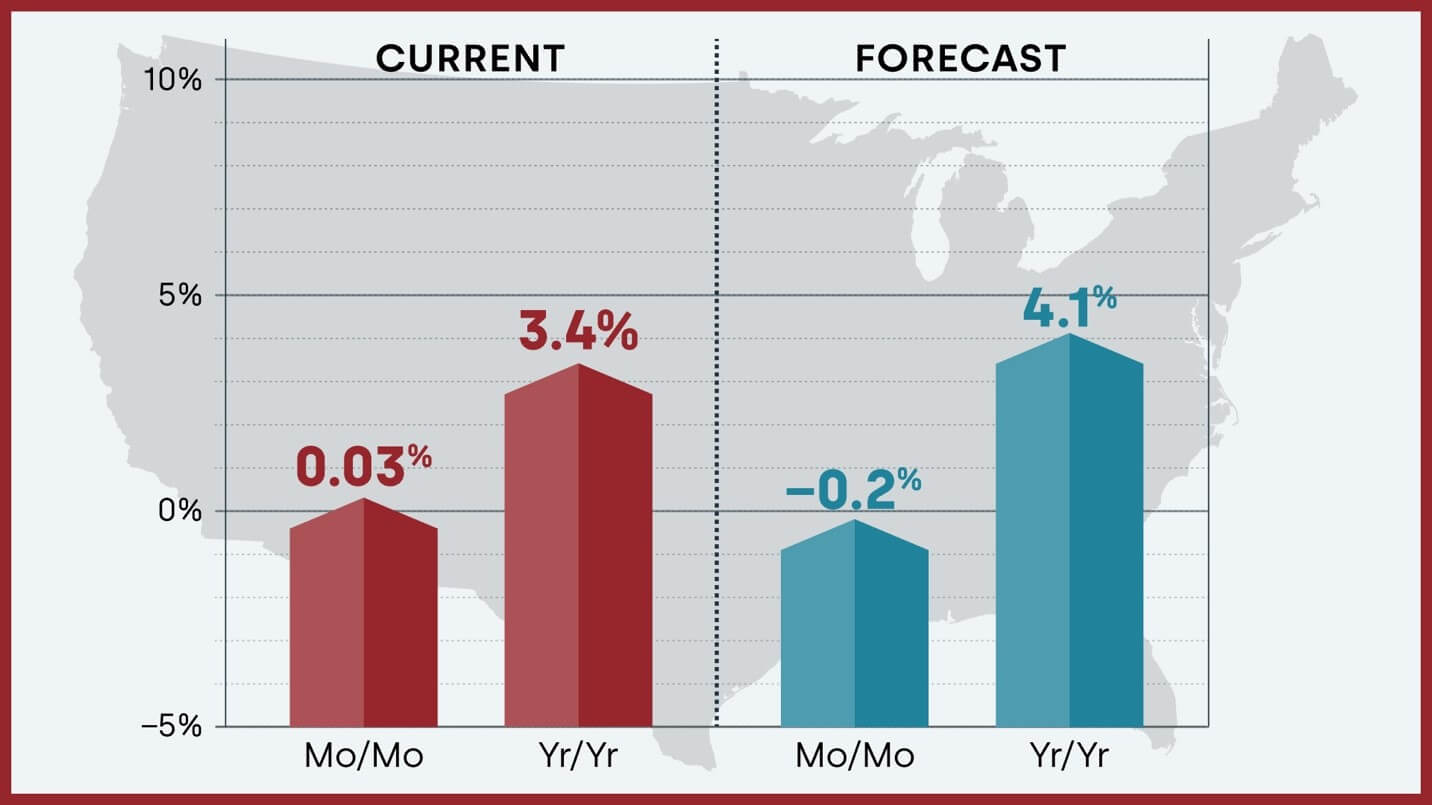
Housing Market Forecast
Source: CoreLogic

Key Takeaways from 2024:

  • Moderate Growth: Home price appreciation slowed compared to previous years.
  • Inventory Improvement: Buyers had slightly more options available.
  • Regional Differences: Some areas experienced stronger growth than others.

What's Fueling the Forecast for 2025?

So, what's behind the projection of a 4.1% increase in home prices by the end of 2025? Several factors are at play:

  • The Spring Buying Season: The housing market tends to heat up in the spring, as families look to move before the new school year starts. This increased demand could put upward pressure on prices.
  • Limited Inventory: While inventory improved in 2024, it's still below historical averages in many markets. A shortage of homes for sale can drive prices higher.
  • Economic Factors: The overall health of the economy plays a role. If the economy remains stable or improves, it could boost consumer confidence and lead to more homebuying activity.

However, it's important to remember that these are just forecasts. Unforeseen events, like a sudden spike in interest rates or a major economic downturn, could certainly change the outlook.

Regional Variations: Where are Prices Headed?

The housing market is rarely uniform across the country. What's happening in one city or state can be very different from what's happening in another. In December 2024, we saw significant regional variations in home price growth:

  • Northeast Strong: States like Connecticut (up 7.8%) and New Jersey (up 7.7%) experienced some of the strongest year-over-year gains. This is largely due to limited inventory in these areas.
  • Hawaii and D.C. Lagging: On the other end of the spectrum, Hawaii and the District of Columbia saw home price declines of -1.1% and -0.7%, respectively.
  • Southern Markets Adjusting: Some Southern markets are readjusting to higher inventories and increased variable mortgage costs.
  • Mountain West Stabilizing: The Mountain West is trying to find stability after experiencing significant price swings in recent years.

Year-Over-Year Home Price Changes by State (December 2024)

State Change (%)
Connecticut 7.8
New Jersey 7.7
Hawaii -1.1
District of Columbia -0.7

Major Metro Areas: Winners and Losers

Looking at specific metro areas, we also see a mixed bag of results.

  • Chicago Leads the Pack: In December 2024, Chicago posted the highest year-over-year gain among the top 10 metros, at 5.6%.
  • Other Strong Performers: Boston, Washington, and Miami also saw solid price appreciation.
  • Phoenix Cooling Down: In contrast, Phoenix experienced more modest growth, reflecting the market's attempt to stabilize.

Year-Over-Year Home Price Changes by Select Metro Areas (December 2024)

Metro Area Change (%)
Chicago 5.6
Boston 4.8
Washington 4.4
Miami 4.0
Los Angeles 4.1
San Diego 3.2
Phoenix 2.5
Denver 1.7
Houston 3.4
Las Vegas 5.0

Markets at Risk: Where Prices Could Fall

While most areas are expected to see price appreciation in 2025, some markets are considered to be at higher risk of a decline. CoreLogic's Market Risk Indicator (MRI) identifies areas where the housing market may be overheated or vulnerable to economic shocks.

According to the MRI, the following metro areas are at very high risk of home price declines over the next 12 months:

  • Provo-Orem, UT: This area has a 70%-plus probability of a price decline.
  • Tucson, AZ: Also at very high risk.
  • Albuquerque, NM: Another market to watch carefully.
  • Phoenix-Mesa-Scottsdale, AZ: Continuing its cooling trend.
  • West Palm Beach-Boca Raton-Delray Beach, FL: A surprise entry on this list.

Top Five U.S. Markets at Risk of Annual Price Declines (December 2024)

Rank Metropolitan Area Level of Risk of Price Decline Confidence Score
1 Provo-Orem, UT Very High (70%+) 50-75%
2 Tucson, AZ Very High (70%+) 50-75%
3 Albuquerque, NM Very High (70%+) 50-75%
4 Phoenix-Mesa-Scottsdale, AZ Very High (70%+) 50-75%
5 West Palm Beach-Boca Raton-Delray Beach, FL Very High (70%+) 50-75%

If you're considering buying or selling in one of these areas, it's especially important to do your research and consult with a local real estate professional.
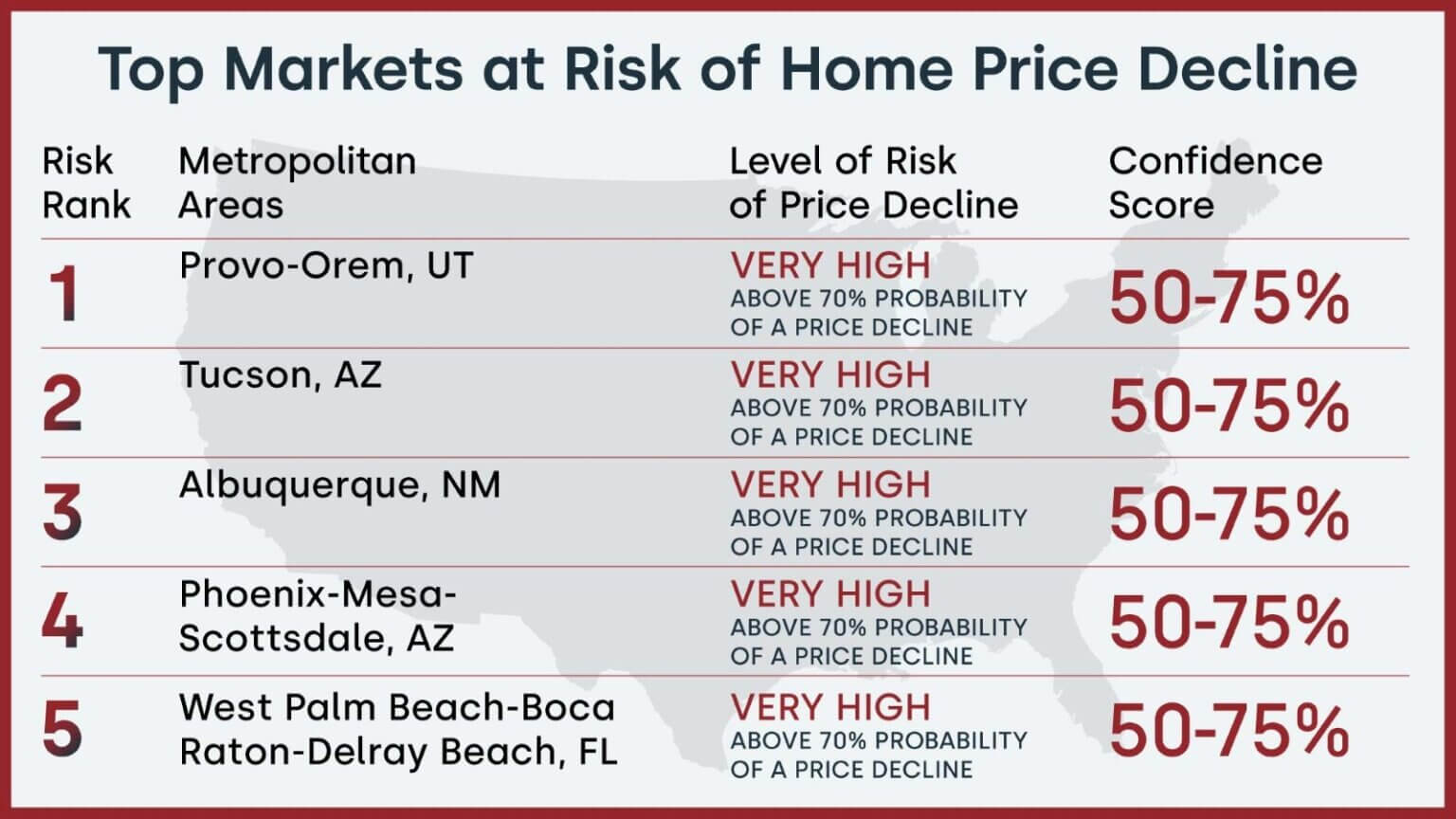
housing market decline
Source: CoreLogic

Factors Beyond the Numbers: Wildfires and Tariffs

The numbers paint a general picture, but it's crucial to understand the real-world events that can influence the housing market. As CoreLogic's Chief Economist, Dr. Selma Hepp, points out, factors like proposed tariffs and natural disasters can have a significant impact.

  • Tariffs: The possibility of new tariffs on imported building materials could drive up construction costs, which would inevitably be passed on to homebuyers.
  • Wildfires: Events like the devastating wildfires in Los Angeles County in January 2025 can disrupt the supply chain, increase building material costs, and delay construction times.

These types of events highlight the interconnectedness of the housing market and the broader economy.

Recommended Read:

Weekly Housing Market Trends: What's Happening in 2025?

Will Trump Lower Mortgage Interest Rates in 2025?

US Housing Market Sees Worst Year for Sales Since 1995

Expert Opinion and My Own Thoughts

Dr. Selma Hepp's analysis offers valuable context to the data. She emphasizes the ongoing bifurcation across markets, with the Northeast experiencing strong growth due to low inventory, while Southern markets adjust to higher inventory and rising mortgage costs. I agree with her assessment that the housing market is likely to see a smaller overall increase in prices in 2025 compared to previous years.

In my opinion, while the forecast of a 4.1% increase is reasonable, it's crucial to remain cautious. The housing market is sensitive to changes in interest rates, economic conditions, and consumer sentiment. It would be smart to keep a close eye on these factors in the coming months.

What Does This Mean for You?

Whether you're a buyer, seller, or homeowner, here's what the February 2025 housing market insights suggest:

  • For Buyers: Be prepared for a potentially competitive spring buying season. Get pre-approved for a mortgage, work with a knowledgeable real estate agent, and be ready to act quickly when you find the right property.
  • For Sellers: If you're considering selling, now might be a good time to list your home. Prices are expected to continue rising in most areas, but don't overprice your property.
  • For Homeowners: Stay informed about local market conditions and be prepared to adjust your plans if necessary. Consider refinancing your mortgage if interest rates fall.

Final Thoughts

The housing market prices are complex, and it's vital to stay informed. While forecasts suggest a moderate increase in prices in 2025, it's essential to consider regional variations and potential risks. By understanding the factors that influence the market, you can make informed decisions about your real estate investments.

Work with Norada in 2025, Your Trusted Source for Investment

in the Top Housing Markets of the U.S.

Discover high-quality, ready-to-rent properties designed to deliver consistent returns.

Contact us today to expand your real estate portfolio with confidence.

Contact our investment counselors (No Obligation):

(800) 611-3060

Get Started Now 

Recommended Read:

  • New Tariffs Could Trigger Housing Market Slowdown in 2025
  • Housing Market Forecast 2025: Affordability Crisis Will Continue
  • Lower Mortgage Rates Will Reignite the Housing Demand in 2025
  • NAR Predicts 6% Mortgage Rates in 2025 Will Boost Housing Market
  • Housing Market Forecast for the Next 2 Years: 2024-2026
  • Housing Market Predictions for the Next 4 Years: 2025 to 2028
  • Housing Market Predictions for Next Year: Prices to Rise by 4.4%
  • Housing Market Predictions for 2025 and 2026 by NAR Chief
  • Real Estate Forecast Next 5 Years: Top 5 Predictions for Future
  • 2008 Forecaster Warns: Housing Market 2024 Needs This to Survive
  • Real Estate Forecast Next 10 Years: Will Prices Skyrocket?

Filed Under: Housing Market, Real Estate Market Tagged With: Housing Market, Housing Market 2025, housing market crash, Housing Market Forecast, housing market predictions, Housing Market Trends, Real Estate Market

Weekly Housing Market Trends: What’s Happening in 2025?

February 6, 2025 by Marco Santarelli

Weekly Housing Market Trends: What's Happening in 2025?

Are you trying to figure out what's happening with home prices, how many houses are up for sale, and how quickly they're selling? Well, you're in the right place. This Weekly Housing Market Trends and Forecast offers a concise update: as of late January 2025, median listing prices have generally declined by -0.5% year-over-year, new listings are up significantly by 9.3%, active inventory has increased by 26.1%, and homes are spending 3 days longer on the market compared to last year. Overall, it's a mixed bag, but there are definitely opportunities for both buyers and sellers to navigate this changing market.

Weekly Housing Market Trends: What's Happening in 2025?

Navigating the housing market can feel like trying to predict the weather – one minute it's sunny, and the next it's raining (mortgage rates!). But don't worry, I am here to break down the latest trends in the housing market with data released by Realtor.com. I'll cover what these trends mean for you, whether you're looking to buy your first home, sell your current one, or just keep an eye on the real estate world.

What's Been Happening Lately? An Overview

Let's start with a quick summary of the key trends I am seeing in the housing market right now:

  • Home prices: Generally flat or declining compared to last year.
  • New listings: Significantly up, giving buyers more choices.
  • Inventory: Much higher than last year, meaning more homes are available.
  • Time on market: Homes are sitting on the market a bit longer, but the gap is narrowing.

These are the highlights, but let's dig a little deeper to see what's really going on.

Breaking Down the Numbers: Key Trends in Detail

Let's dive into the four key areas that are shaping the housing market right now.

1. Home Prices: Are They Finally Coming Down?

One of the biggest questions on everyone's mind is: are home prices finally dropping? For the past 35 weeks, the national median home listing price has been either flat or decreasing compared to the same time last year. That's a pretty long stretch! As of the week ending January 25, 2025, the median listing price fell by -0.5% year-over-year.

But here's where it gets interesting. A lot of the decline we're seeing is because there are more smaller, less expensive homes on the market. When you look at the median listing price per square foot (which takes the size of the home into account), it's actually up 1.3% compared to last year.

Even though prices per square foot are still up, the rate of increase has slowed down since May 2024. This could mean that even though smaller homes are available, softening price growth means that when mortgage rates do decline below current levels, homes become more affordable relative to last year. It’s a signal that the market might be stabilizing.

What does this mean for you?

  • Buyers: There are more affordable homes available, especially smaller ones. If you're willing to downsize or consider a smaller property, you might find a good deal. And softening price growth means that when mortgage rates do decline below current levels, homes become more affordable relative to last year.
  • Sellers: You need to be realistic about pricing. Don't expect to get the same prices that homes were fetching a year or two ago. Consider making your home more attractive to buyers by making necessary repairs and upgrades.

2. New Listings: A Breath of Fresh Air for Buyers?

For months, one of the biggest problems in the housing market has been a lack of homes for sale. But that's starting to change! New listings – the number of sellers putting their homes on the market – increased by 9.3% compared to last year for the week ending January 25, 2025. In fact, the final three weeks of January saw double-digit increases in new listings.

Why is this happening? There are a couple of possibilities:

  • Sellers who were waiting for lower mortgage rates: When mortgage rates dipped slightly in the fall of 2024, some sellers may have decided it was time to list their homes.
  • The “lock-in effect” is easing: Many homeowners have been hesitant to sell because they're locked into low mortgage rates. But life happens, and sometimes people need to move regardless of interest rates.
  • People adapting to life changes: Some buyers are needing to finally adapt to life changes.

What does this mean for you?

  • Buyers: You have more choices than you did a few months ago. Take advantage of this by carefully researching different neighborhoods and homes to find the best fit for your needs and budget.
  • Sellers: You'll face more competition. To stand out, make sure your home is in tip-top shape and priced competitively.

3. Inventory: More Homes on the Market Than Last Year

Not only are more homes being listed, but the overall inventory of homes for sale is also up significantly. For the 64th week in a row, there are more homes for sale than there were at the same time last year. As of January 25, 2025, active listings were up a whopping 26.1% compared to last year. This is a good sign that the market may be starting to cool down.

What does this mean for you?

  • Buyers: You have more leverage. With more homes to choose from, you're in a better position to negotiate price and terms.
  • Sellers: It's more important than ever to make your home stand out. Pay attention to curb appeal, make necessary repairs, and stage your home to appeal to the broadest range of buyers.

4. Time on Market: Are Homes Selling Faster or Slower?

For months, homes have been sitting on the market longer than they were last year. As of January 25, 2025, homes were spending 3 days longer on the market compared to the same time last year. This is the 40th consecutive week that homes have taken longer to sell.

However, there's a glimmer of hope. The gap in time on market has been shrinking since November. This suggests that while inventory is up, buyer demand is also holding steady.

What does this mean for you?

  • Buyers: You have a little more time to make a decision, but don't wait too long. If you find a home you love, it's still important to act quickly.
  • Sellers: Be patient. It might take a little longer to sell your home than it would have a year or two ago. Don't be afraid to adjust your price if you're not getting offers.

Data Summary: A Quick Look at the Numbers

Here's a table summarizing the key data points as of January 2025:

Metric Year-over-Year Change
Median Listing Prices -0.5%
New Listings +9.3%
Active Listings +26.1%
Time on Market +3 days

Recommended Read:

Will Trump Lower Mortgage Interest Rates in 2025?

US Housing Market Sees Worst Year for Sales Since 1995

My Thoughts and Predictions

Based on these trends, here's what I think we can expect to see in the housing market in the coming weeks and months:

  • Prices will likely remain relatively stable: I don't expect to see huge price drops, but I also don't think prices will start rising dramatically anytime soon.
  • Inventory will continue to increase: As more sellers enter the market, buyers will have even more choices.
  • Mortgage rates will be a key factor: If mortgage rates stay high, the market will likely remain sluggish. But if rates start to come down, we could see a surge in buyer demand.
  • The market will vary by location: Some areas will be hotter than others. It's important to pay attention to what's happening in your local market.

Overall, I think the housing market is in a period of transition. It's not as crazy as it was a year or two ago, but it's not a buyer's market either. It's a more balanced market, where both buyers and sellers need to be smart and strategic.

Tips for Buyers and Sellers

No matter which side of the transaction you're on, here are some tips to help you navigate the current housing market:

For Buyers:

  • Get pre-approved for a mortgage: This will show sellers that you're a serious buyer.
  • Work with a good real estate agent: A knowledgeable agent can help you find the right home and negotiate a fair price.
  • Be patient: Don't feel pressured to buy the first home you see. Take your time and find the right fit.
  • Don't be afraid to negotiate: With more homes on the market, you have more leverage to negotiate price and terms.

For Sellers:

  • Price your home competitively: Don't overprice your home. Work with your agent to determine a fair market value.
  • Make necessary repairs: Fix any obvious problems before you list your home.
  • Stage your home: Make your home look as attractive as possible to potential buyers.
  • Be flexible: Be willing to negotiate with buyers.

The Bottom Line

The housing market is always changing, and it can be tough to keep up with the latest trends. But by staying informed and working with experienced professionals, you can successfully navigate the market, whether you're buying or selling.

I hope this article has been helpful. Happy house hunting (or selling)!

Work with Norada in 2025, Your Trusted Source for Investment

in the Top Housing Markets of the U.S.

Discover high-quality, ready-to-rent properties designed to deliver consistent returns.

Contact us today to expand your real estate portfolio with confidence.

Contact our investment counselors (No Obligation):

(800) 611-3060

Get Started Now 

Recommended Read:

  • New Tariffs Could Trigger Housing Market Slowdown in 2025
  • Housing Market Forecast 2025: Affordability Crisis Will Continue
  • Lower Mortgage Rates Will Reignite the Housing Demand in 2025
  • NAR Predicts 6% Mortgage Rates in 2025 Will Boost Housing Market
  • Housing Market Forecast for the Next 2 Years: 2024-2026
  • Housing Market Predictions for the Next 4 Years: 2025 to 2028
  • Housing Market Predictions for Next Year: Prices to Rise by 4.4%
  • Housing Market Predictions for 2025 and 2026 by NAR Chief
  • Real Estate Forecast Next 5 Years: Top 5 Predictions for Future
  • 2008 Forecaster Warns: Housing Market 2024 Needs This to Survive
  • Real Estate Forecast Next 10 Years: Will Prices Skyrocket?

Filed Under: Housing Market, Real Estate Market Tagged With: Housing Market, Housing Market 2025, housing market crash, Housing Market Forecast, housing market predictions, Housing Market Trends, Real Estate Market

Housing Market and Mortgage Outlook January 2025: A Positive Trajectory

January 27, 2025 by Marco Santarelli

Housing Market and Mortgage Outlook January 2025: A Positive Trajectory

The housing market and mortgage outlook for January 2025 points towards a positive, albeit moderate growth trajectory. While it's not going to be a repeat of the crazy boom we saw a couple of years back, it's also not doom and gloom.

We're looking at a market that's finding its balance, with some key shifts in buyer and seller behavior, and a gradual easing of the pressures that have defined the past couple of years. I think this means we're moving into a more stable and predictable phase for the housing market.

This detailed analysis, from the Economic & Housing Research group at Freddie Mac, helps us better understand where we stand and what might be coming down the line.

Housing Market and Mortgage Outlook January 2025: A Moderate but Positive Trajectory

The Economy: A Tale of Resilience and Moderation

Before we get into the nitty-gritty of the housing market, let's zoom out and look at the big picture – the economy. I've been watching economic indicators like a hawk, and here's what I'm seeing.

  • GDP Growth: The U.S. economy actually grew faster than initially estimated in the third quarter of 2024, with a 3.1% jump in real GDP. This is great news, showing the economy's resilience. Consumer spending, the engine of our economy, is still chugging along strongly, with a 3.7% increase – the fastest pace since early 2023. However, it’s important to note that housing investment actually declined by 4.3%, showing a slight slowdown in that particular sector.
  • Labor Market: The job market also shows signs of strength, with solid gains of 256,000 new jobs in December 2024. Healthcare and leisure/hospitality sectors led the way. Overall job growth for 2024 was 2.2 million, averaging 186,000 jobs added per month. The unemployment rate is still low, at 4.1%. This tells me that while some sectors may be struggling, overall, people are working, and that’s key for a healthy economy.
  • Inflation: The inflation monster, which had us all worried for a while, seems to be showing some signs of slowing down. Core inflation, which takes out food and energy prices, rose a modest 0.1% in November. While it’s still above the Federal Reserve’s target of 2%, the fact that price increases for services are slowing is encouraging. This could mean a less aggressive approach from the Fed on interest rates in the future.

Here's a quick recap of key economic indicators:

Indicator Q3 2024 Data Notes
Real GDP Growth 3.1% Stronger than initial estimate of 2.8%
Consumer Spending Growth 3.7% Fastest since Q1 2023
Residential Fixed Investment -4.3% Second consecutive decline
December Job Growth 256,000 Led by healthcare and leisure/hospitality
Average Monthly Job Growth 2024 186,000 Total of 2.2 Million for the whole year
Unemployment Rate (Dec) 4.1%
Core Inflation (PCE) 0.1% MoM, 2.8% YoY Services sector inflation is slowing

The Housing Market: A Look at Home Sales, Construction, and Prices

Now, let's switch our focus to the housing market. I know a lot of people have been on edge about what's going to happen with home values and mortgages, so I'll break it down as clearly as I can.

  • Home Sales: Despite the roller coaster of mortgage rates, we've actually seen an uptick in home sales. Total home sales (both new and existing) increased by 4.9% in November 2024. Existing home sales, in particular, are booming, with a 6.1% jump from the previous year – the fastest pace since June 2021. New home sales have also increased, which is a good sign for overall market health. This signals to me that people are finally getting over the initial shock of higher mortgage rates and are ready to make a move.
  • Housing Construction: The construction side of things is showing a bit of a mixed picture. Total housing starts actually decreased by 1.8% in November, driven primarily by a sharp 28.8% decline in multifamily construction. This suggests that builders are getting cautious about adding too much inventory, especially when it comes to apartments and condos. Homebuilder confidence remains weak, indicating that building conditions are expected to remain weak in the near term. The index remains below 50, indicating a negative outlook.
  • Home Prices: House price growth is slowing down compared to the crazy run-up we saw in 2022, but prices are still going up. The FHFA House Price Index showed a 0.4% increase month-over-month in October, with a 4.5% year-over-year gain. There are some regional variations, with three divisions actually seeing price decreases, which I see as a sign of a more localized market dynamic coming in to play.
    • Limited housing inventory is still a big factor driving prices higher.
    • High mortgage rates are also impacting affordability, which is dampening demand to some extent.

Here's a table showing the key data for the housing market:

Indicator November 2024 Data Notes
Total Home Sales Increase 4.9% New and existing homes
Existing Home Sales YoY Increase 6.1% Fastest pace since June 2021.
Housing Starts Decline 1.8% Primarily driven by a drop in multifamily starts
House Price Increase (FHFA) 0.4% MoM, 4.5% YoY Some regional variations, and a general slowdown from 2022 highs

Mortgage Rates: Staying Elevated but Perhaps Not Forever

The big question on everyone's mind is, of course, what's happening with mortgage rates? Well, unfortunately, they’ve remained higher than many hoped.

  • Current Rates: Mortgage rates stayed elevated in December 2024, with the 30-year fixed-rate mortgage averaging 6.72%, according to Freddie Mac's survey. This is considerably higher than the rates we saw just a couple of years ago, which has had a major impact on affordability.
  • Refinance Activity: With rates this high, it’s no surprise that refinance activity has dropped off. The appeal of refinancing for lower rates is pretty much gone, at least for now.
  • Purchase Activity: While purchase activity did increase overall due to pent-up demand, it's also been affected by higher rates. I've seen people hesitant to commit to a higher monthly payment, even if they're ready to buy. In fact, purchase activity decreased 15.4% in the last week of December compared to the last week of November.
  • Mortgage Delinquencies: On the mortgage performance front, 3.92% of outstanding mortgage debt was in some stage of delinquency as of Q3 2024. While this is down slightly from the previous quarter, it's up year-over-year. Seriously delinquent loans are also up. There are also increases in delinquencies across VA, FHA, and Conventional loans. This isn't a sign of a market collapse, but I believe it's worth keeping an eye on.

Key points about mortgage rates and activity:

  • 30-year fixed rate averaged 6.72% in December 2024.
  • Refinance activity has decreased significantly.
  • Purchase activity decreased 15.4% in the last week of December.
  • 3.92% of outstanding mortgage debt was in some stage of delinquency as of Q3 2024.

Looking Ahead to 2025: A More Balanced Year

So, where does all of this leave us for the housing market and mortgage outlook January 2025? Here's my take on what we might expect:

  • Moderate Economic Growth: I expect the U.S. economy to keep growing in 2025, but at a more moderate pace. The labor market is likely to cool down a bit, with slightly higher unemployment and slower job growth. This should help ease some of the pressure on inflation. I think that would be a good development in the long term, despite some pain in the short run.
  • Mortgage Rates to Remain Elevated: Unlike the optimism we saw at the start of 2024, the general feeling is that mortgage rates will stay elevated for longer in 2025. The good news is that they may not rise as much as we had anticipated. This means that both buyers and sellers may have to adjust to the new reality and make their move without a drastic rate change in sight.
  • Increased Home Sales: With that in mind, I believe that we’ll see more home sales in 2025 compared to 2024. The “rate lock-in effect,” where homeowners are reluctant to sell because they have low mortgage rates, is also expected to cool off gradually. This should increase the number of homes for sale, making the market more active. My gut feeling is that people will feel more confident moving on with their lives, and this will result in more real estate transactions.
  • Moderate House Price Appreciation: While home prices are still expected to rise, I'm not expecting anything dramatic. The pace of price increases is likely to slow down. This is, in my view, a healthy sign that we're moving towards a more balanced market.
  • Higher Origination Volumes: Both purchase and refinance volumes are expected to increase in 2025. This should boost total mortgage origination volumes, and is something I’m keeping an eye on as a sign of overall market improvement.

Recommended Read:

Will Trump Lower Mortgage Interest Rates in 2025?

US Housing Market Sees Worst Year for Sales Since 1995

My Personal Take:

From my perspective, the housing market in 2025 is not going to be boring, but it will be far less volatile than the past couple of years. I've seen a lot of uncertainty in the past, but now it feels like we're entering a period of more predictability. It's a market where careful planning and realistic expectations are going to be essential for both buyers and sellers. The “wait-and-see” approach may no longer be the best strategy, as we settle into a new normal.

Here's what I think both buyers and sellers should consider:

  • Buyers: Don't expect a sudden drop in mortgage rates. Focus on what you can afford, and be ready to shop around for the best deal. Be patient, and be prepared to compromise.
  • Sellers: While home prices are still appreciating, don't get too greedy. Price your home competitively to attract buyers and consider working with a real estate professional to understand the local market. Also, be aware that the market might be becoming more price sensitive.

Final Thoughts

The housing market and mortgage outlook for January 2025 presents a picture of moderate growth, stability and the market finding a new equilibrium. While the high mortgage rates remain a challenge, the market is showing signs of resilience and adaptation. For all involved, it’s going to be important to keep a close eye on the market and adjust strategies accordingly. But, for now, the overall outlook seems positive.

Work with Norada in 2025, Your Trusted Source for Investment

in the Top Housing Markets of the U.S.

Discover high-quality, ready-to-rent properties designed to deliver consistent returns.

Contact us today to expand your real estate portfolio with confidence.

Contact our investment counselors (No Obligation):

(800) 611-3060

Get Started Now 

Recommended Read:

  • Housing Market Forecast 2025: Affordability Crisis Will Continue
  • Lower Mortgage Rates Will Reignite the Housing Demand in 2025
  • NAR Predicts 6% Mortgage Rates in 2025 Will Boost Housing Market
  • Housing Market Forecast for the Next 2 Years: 2024-2026
  • Housing Market Predictions for the Next 4 Years: 2025 to 2028
  • Housing Market Predictions for Next Year: Prices to Rise by 4.4%
  • Housing Market Predictions for 2025 and 2026 by NAR Chief
  • Real Estate Forecast Next 5 Years: Top 5 Predictions for Future
  • 2008 Forecaster Warns: Housing Market 2024 Needs This to Survive
  • Real Estate Forecast Next 10 Years: Will Prices Skyrocket?

Filed Under: Housing Market, Mortgage, Real Estate Market Tagged With: Housing Market, Housing Market 2025, Housing Market Forecast, housing market predictions, Housing Market Trends, Real Estate Market

US Housing Market Sees Worst Year for Sales Since 1995

January 24, 2025 by Marco Santarelli

Housing Market and Mortgage Outlook January 2025: A Positive Trajectory

The US housing market has just weathered its most sluggish year for existing home sales since 1995, with a total of 4.06 million homes sold. This stark reality isn't just a statistic; it reflects a complex interplay of high mortgage rates, soaring home prices, and a stubborn lack of inventory that’s left both buyers and sellers in a state of uncertainty and frustration. Believe me, as someone who's been keeping a close eye on the housing market for years, this slowdown feels significant, and it’s impacting a lot of people’s lives.

US Housing Market Sees Worst Year for Sales Since 1995

The Perfect Storm: Why Home Sales Plummeted

So, what exactly led to this dramatic drop in home sales? Well, it's not a single culprit, but rather a combination of factors that created a perfect storm. Let's break them down:

  • Elevated Mortgage Rates: The most significant factor, without a doubt, has been the sharp rise in mortgage rates. We saw rates spend much of 2024 above 6.5%, which is a massive increase compared to the rock-bottom rates of just a couple of years ago. This surge dramatically increased the cost of borrowing, making homeownership far less attainable for many potential buyers. To put it simply, when borrowing money is this expensive, a lot of people just have to sit on the sidelines.
  • High Home Prices: Even as sales slowed, home prices remained stubbornly high. The median home price reached a record $407,500 in 2024. This high-price environment was primarily driven by sales of higher-end properties pushing the overall median price up. The combination of high prices and high interest rates made monthly payments incredibly expensive for many would-be homebuyers.
  • Low Inventory: This was another major problem. A lack of available homes for sale further constricted the market. This low inventory gave sellers the upper hand, allowing them to maintain high prices, while buyers had fewer options to choose from. It’s a vicious cycle where the lack of houses for sale keeps the price of the existing ones very high.

The Rate Rollercoaster: A Deep Dive into Mortgage Rates

The mortgage rate story is particularly interesting because it wasn't a steady climb, but a bit of a rollercoaster. We saw a slight dip to 6.08% in late September, after the Federal Reserve cut interest rates for the first time since 2020. It felt like a glimmer of hope for some. But that drop was short-lived. The rates quickly began to climb again, even surpassing the 7% mark recently, before slightly retreating to around 6.96%.

This volatility made it hard for buyers to plan and left many wondering if they should jump in or wait it out. And let’s be honest, these rates are not exactly low. Experts are suggesting that rates in the 6-7% range could be the “new normal.” I think we need to brace ourselves for this scenario and get used to it.

Recommended Read:

Will Trump Lower Mortgage Interest Rates in 2025? 

The Golden Handcuffs: The Low-Rate Lock-In Effect

Here's a twist that I think many people don't fully understand: It's not just that rates are high now, it's also that so many homeowners are locked into historically low rates from 2021 and 2022. Think about it. Why would you want to give up a 2-3% mortgage rate to move into a new home that would cost significantly more and have a 7% mortgage?

This “golden handcuffs” effect is what many potential sellers are facing. They're reluctant to give up those super low rates, even if they'd otherwise consider moving. This has contributed to the lack of inventory, as people are not selling their houses at the rates they would have normally. This reluctance to move is a very strong factor in the slowdown of the housing market that cannot be underestimated.

Is There Any Good News? Some Potential Bright Spots

Okay, so it's not all doom and gloom. There are some signs that the market might be shifting, albeit slowly:

  • Increased December Sales: The number of existing home sales in December was actually 9.3% higher compared to the previous year. This is a good indicator that things are not all bad and there is some demand.
  • Rising New Home Supply: Here is some more good news: The number of new housing units completed in 2024 reached an estimated 1.63 million, 12.4% above the 2023 numbers. New home sales now account for a larger share of the market, making about 30% of total sales. This is interesting because there is significantly more inventory of new homes than of existing ones.
  • Momentum Building: The fact that sales are climbing year-over-year for three straight months indicates that there is some momentum building in the market. This signals that there is still demand for houses, which can potentially increase in the future.
  • Job and Wage Growth: Job and wage gains, combined with the increased supply, is impacting the market positively. With more people having secure and better-paying jobs, the demand for houses has the possibility to increase.

A Balancing Act: The Challenges of Building New Homes

While the rise in new construction is encouraging, it's important to recognize the challenges builders face. They are navigating:

  • High Borrowing Costs: Like prospective buyers, builders are also facing increased costs due to the high-interest rates on loans for development and construction projects.
  • Tight Labor Market: Finding skilled workers has also become very difficult and expensive, with more demand for workers in the construction sector.
  • Rising Material Costs: The prices for building materials have also been on the rise, squeezing the builder’s margins and forcing them to build at a higher price point.

These challenges make it difficult for builders to meet the high demand, especially for affordable housing, and they need innovative solutions such as using more townhomes, multifamily projects and “built-for-rent” models.

Here's A Quick Recap of Key Numbers

Metric 2024 Notes
Total Existing Home Sales 4.06 million Lowest annual total since 1995
Median Home Price $407,500 Record high
Average 30-Year Mortgage Rate Above 6.5% most of the year Peaked above 7%, then dropped below
New Housing Units Completed 1.63 million 12.4% increase over 2023
December Existing Home Sales Increase 9.3% year-over-year A sign of market recovery and momentum building

My Personal Thoughts on the Market

As someone who follows the housing market closely, I believe that we are in a period of adjustment. We are moving away from the low-interest-rate era that made housing so accessible for a while. The current market demands patience and a realistic understanding of the landscape, but there are definitely some opportunities.

I think it is essential for both buyers and sellers to:

  • Do their Homework: Understanding the market dynamics, interest rate trends, and the inventory situation will be extremely important.
  • Be Prepared to Negotiate: While prices are still high, there are still some chances for price negotiations, and it's not a totally one sided market.
  • Take the Long View: Buying a home should be considered a long-term investment and not a quick way to make money. So, if you are planning to move, it will be very important to have a long-term perspective.

I honestly believe the housing market will eventually stabilize. However, it's unlikely we’ll see a return to the rock-bottom interest rates of the past few years anytime soon. The key to success, whether you're a buyer or a seller, will be to stay informed, flexible, and realistic.

What’s Next for the US Housing Market?

The US housing market, after a very slow 2024, may slowly start to recover over time. The pace of recovery will mostly depend on factors such as the change in mortgage rates, the growth in new housing supply, and the overall economic conditions in the US. It is important to keep an eye on these indicators to understand where the market is headed and take informed decisions.

Work with Norada in 2025, Your Trusted Source for

Investing in the Growing U.S. Housing Markets

Discover high-quality, ready-to-rent properties designed to deliver consistent returns.

Contact us today to expand your real estate portfolio with confidence.

Contact our investment counselors (No Obligation):

(800) 611-3060

Get Started Now 

Recommended Read:

  • Housing Market Forecast 2025: Affordability Crisis Will Continue
  • Lower Mortgage Rates Will Reignite the Housing Demand in 2025
  • NAR Predicts 6% Mortgage Rates in 2025 Will Boost Housing Market
  • Housing Market Forecast for the Next 2 Years: 2024-2026
  • Housing Market Predictions for the Next 4 Years: 2025 to 2028
  • Housing Market Predictions for Next Year: Prices to Rise by 4.4%
  • Housing Market Predictions for 2025 and 2026 by NAR Chief
  • Real Estate Forecast Next 5 Years: Top 5 Predictions for Future
  • 2008 Forecaster Warns: Housing Market 2024 Needs This to Survive
  • Real Estate Forecast Next 10 Years: Will Prices Skyrocket?

Filed Under: Housing Market, Mortgage, Real Estate Market Tagged With: Housing Market, Housing Market 2025, Housing Market Forecast, housing market predictions, Housing Market Trends, Real Estate Market

Is the Housing Market on the Brink of a Crash or Boom in 2025?

January 24, 2025 by Marco Santarelli

Is the Housing Market on the Brink of a Crash or Boom in 2025?

The housing market is a hot topic right now, and for good reason. If you're like me, you're probably wondering whether we're about to see a major crash or if the market will keep booming. The short answer is: neither a dramatic crash nor a huge boom is likely in the immediate future. Data suggests a more moderate path, with some areas seeing price increases while others might experience minor dips. Now, let's dive deeper into what’s really going on and what you might expect.

Is the Housing Market on the Brink of a Crash or Boom in 2025?

It feels like just yesterday we were in the middle of a frantic buying frenzy, with prices soaring and homes flying off the market in days. Now, things are a bit different. I've been watching the market closely, and it's clear that the rapid growth we saw a couple of years back is cooling down. But is cooling down the same as a crash? I don't think so, and here is why.

What the Numbers Say

Let’s look at the latest data from credible sources. It is important to understand how the market is performing based on facts and not just speculations.

  • Federal Housing Finance Agency (FHFA) House Price Index: According to their report, U.S. house prices increased by 4.3 percent between the third quarter of 2023 and the third quarter of 2024. That might sound like a lot, but when you compare it to the huge jumps of previous years, it’s a definite slowdown. Also, they noted that house prices were up 0.7 percent compared to the second quarter of 2024, indicating that the growth is not uniform throughout the year and has significantly slowed down.
    Time Period Price Change
    Q3 2023 – Q3 2024 4.3%
    Q2 2024 – Q3 2024 0.7%
  • National Association of Realtors (NAR): In November 2024, existing-home sales climbed 4.8% compared to October and a significant 6.1% from a year earlier. The median existing-home price was $406,100, which is a 4.7% increase from November 2023. This means that while prices are still going up, the pace of the increase is not as fast as before, and sales are picking up.
    Metric Nov 2024 Change from Oct 2024 Change from Nov 2023
    Existing-Home Sales (Annualized Rate) 4.15 million +4.8% +6.1%
    Median Existing-Home Price $406,100 – +4.7%
    Unsold Inventory (Months' Supply) 3.8 -2.9% +8.6%
  • CoreLogic: They report that, through October 2024, national home prices increased by 3.4% compared to October 2023. They also anticipate a 2.4% year-over-year increase from October 2024 to October 2025. This again indicates a moderate growth, and they predict that prices will reach a new peak by April 2025.
    Time Period Price Change
    Oct 2023 – Oct 2024 3.4%
    Oct 2024 (Forecast) – Oct 2025 (Forecast) 2.4%
    Oct 2024 – Nov 2024 (Forecast) -0.03%

The Housing Market “Boom” Argument

So, why would some people think we're headed for a boom? Here are a few factors that could support that idea:

  • Low Inventory: Even though inventory is up from last year, the overall supply of homes for sale is still relatively low in many areas. This keeps upward pressure on prices.
  • Consistent Demand: Despite higher mortgage rates, there are still plenty of people looking to buy. Factors like job growth and changing life circumstances keep demand going. The National Association of Realtors notes that sales are picking up, with a 4.8% increase in November 2024 compared to the previous month, and a 6.1% increase compared to a year ago.
  • Regional Differences: The housing market isn't monolithic. Areas in the Northeast are still seeing strong price growth. For example, New Jersey, Rhode Island, and New Hampshire had some of the highest year-over-year price gains. The FHFA also reports that the East North Central division had the strongest appreciation with a 6.8% increase from the third quarter of 2023 to the third quarter of 2024.

The Housing Market “Crash” Argument

Now, let's look at the possibility of a crash:

  • Affordability Issues: Rising home prices coupled with higher mortgage rates are making it harder for many people to afford a home. This can put a limit on future price growth.
  • Cooling Demand: While demand is still there, it’s not as frenzied as it once was. We can see this in the CoreLogic report where month-over-month home prices only increased by 0.02% in October 2024 compared with September 2024.
  • Areas at Risk: CoreLogic has identified some metro areas that have a high probability of price decline over the next 12 months including: Provo-Orem, UT, Salt Lake City, UT; Atlanta-Sandy Springs-Rowsell, GA; Tucson, AZ; and Palm Bay-Titusville-Melbourne, FL.

Why I Think It's Neither

After analyzing the data and observing the current market trends, here’s why I believe we're not heading for a crash or boom:

  • Moderate Growth: The data consistently points to a slowing pace of price increases. Prices are still going up, but at a much more sustainable rate than before. CoreLogic’s forecast predicts a 2.4% year-over-year increase from Oct 2024 to Oct 2025 which is a quite moderate number.
  • No Bubble Indicators: A major crash is usually preceded by a speculative bubble. While the market was overheated a couple of years back, that heat is steadily dissipating. Lending standards are also stricter than they were before the 2008 crash.
  • Gradual Shift: I see a gradual shift towards a more balanced market. Sellers aren’t having the same level of power that they had before, and buyers are regaining some leverage.
  • Regional Variations : The fact that some areas are still doing well while others are showing signs of slowdown, confirms that it won't be a uniform boom or crash, but a more localized trend.

My Thoughts on the Future

Personally, I think we’re entering a new phase of the housing market. It's not going to be as crazy as it was a couple of years back, but it won't be a dramatic fall either. Here are some key takeaways:

  • Don’t Expect Big Jumps: If you're hoping for another year of double-digit price increases, you're likely to be disappointed. We’re going to see more moderate, single-digit growth in most areas. The data from FHFA, NAR and CoreLogic corroborates this.
  • Be Smart If You're Buying: This is a good time to buy a home if you are prepared and financially secure. Take your time to compare and find the right property and neighborhood and do your due diligence.
  • Location Matters: The market is not uniform. What's happening in New Jersey may be very different from what's happening in Florida. Pay attention to your local market trends.
  • Consider Long-Term: Housing is generally a good long-term investment. If you're planning to stay put for a while, the current market offers reasonable options.

The Bottom Line

The housing market is definitely changing, but it's not in a state of collapse or explosive growth. Instead, we are seeing a gradual shift towards a more stable and balanced environment. Prices are still rising but at a slower pace, and while demand remains, it is less frantic. It’s essential to stay informed, do your research, and make decisions that align with your individual circumstances and goals. I am optimistic that the housing market will find a stable and sustainable ground for the coming times.

Work with Norada in 2025, Your Trusted Source for

Turnkey Investment Properties

Discover high-quality, ready-to-rent properties designed to deliver consistent returns.

Contact us today to expand your real estate portfolio with confidence.

Contact our investment counselors (No Obligation):

(800) 611-3060

Get Started Now 

Recommended Read:

  • 10 Housing Market Predictions for the Next 4 Years Under Trump
  • 2008 Forecaster Warns: Housing Market 2024 Needs This to Survive
  • Housing Market Forecast for the Next 2 Years: 2024-2026
  • Housing Market Predictions 2025: Will Real Estate Boom?
  • Housing Market Predictions for 2025 by Bank of America
  • Housing Market Predictions for the Next 4 Years: 2025 to 2028
  • Housing Market Predictions for Next 5 Years (2024-2028)
  • 2024 Housing Market vs. 2008 Crash: Key Differences
  • Economist Predicts Stock Market Crash Worse Than 2008 Crisis
  • How Much Did Housing Prices Drop in 2008?

Filed Under: Housing Market, Real Estate Market Tagged With: Housing Market, housing market crash, housing market predictions, Housing Market Trends

Top Housing Markets for Buyers in 2025: NAR’s Expert Forecast

January 23, 2025 by Marco Santarelli

Top 10 Housing Market Hotspots for Buyers in 2025: NAR's Forecast

If you're dreaming of owning a home in 2025, you're in luck! The National Association of Realtors (NAR) has just released its list of 10 housing market hotspots poised to outshine the rest of the country in sales next year. These aren't just random locations; they've been carefully selected based on strong economic, demographic, and housing factors that signal future market strength. So, if you're looking to buy, keep reading – these are the places to watch!

I've been tracking housing trends for a while now, and it's clear the market can be tricky. The past few years have been a rollercoaster, but the good news is that things seem to be stabilizing. Based on NAR's analysis and my own observations, 2025 is shaping up to be a better year for buyers. The key is to know where to look.

What Makes These Housing Markets Hot?

The NAR didn't just pick these 10 cities out of a hat. They looked at a variety of factors, including:

  • Affordable Home Prices: Areas with a good mix of starter homes and generally lower prices are always attractive.
  • Stable or Declining Mortgage Rates: As rates potentially settle around 6% next year, buyers will get a bit of breathing room.
  • Strong Job Growth: A thriving local economy means more people can afford to buy and are also looking to settle down in the area.
  • Net Migration: If an area is attracting new residents, the housing market tends to stay active.
  • Fewer “Locked-In” Homeowners: This refers to people with older, lower-rate mortgages who are unlikely to sell. Fewer locked-in homeowners mean more homes for sale (more inventory).

NAR's Chief Economist, Lawrence Yun, put it well: “Important factors common among the top-performing markets in 2025 include available inventory at affordable price points, a better chance of unlocking low mortgage rates, higher income growth for young adults and net migration into specific metro areas.” He also believes that the “worst of the affordability challenges are over” as more inventory, stable mortgage rates and continued job and income growth pave the way for more Americans to achieve homeownership.

Top Housing Markets for Buyers in 2025: NAR's Expert Forecast

Here are NAR's 10 top housing hot spots for 2025 in alphabetical order. I'll share some insights based on my understanding of these areas, along with the data provided by NAR.

1. Boston-Cambridge-Newton, Massachusetts-New Hampshire

  • Average Home Price: $694,494
  • Why it's Hot: While Boston is pricey, there are a few key things that make it a hotspot for the coming year. NAR expects mortgage rates here to stabilize, which will likely reduce the number of locked-in homeowners, leading to more inventory. The area also features a good number of starter homes and mortgage rates that tend to be lower than the national average.
  • My Thoughts: Boston is a great city with a vibrant economy. Although the prices are above the national average, the potential for job growth and the presence of starter homes makes it an interesting place for buyers. If you are considering buying here, make sure you have your finances in order.

2. Charlotte-Concord-Gastonia, North Carolina-South Carolina

  • Average Home Price: Data not available, but 43% of homes are priced below $324,000
  • Why it's Hot: Charlotte has seen 10% job growth in the past five years and a large share of affordable homes, with 43% priced below $324,000. The interest rate in the area is 6.85%, which is a little below the national average.
  • My Thoughts: Charlotte's a rapidly growing city. Its combination of job growth and affordable housing makes it a very attractive option, particularly for families and young professionals. This is a market I would keep a close eye on!

3. Grand Rapids-Kentwood, Michigan

  • Average Home Price: $271,960
  • Why it's Hot: Grand Rapids offers affordable home prices, averaging around $271,960. While the mortgage rates are slightly higher than the national average, the area has fewer homeowners locked into lower mortgage rates, so more homes are likely to come on the market.
  • My Thoughts: Grand Rapids has a lot going for it: lower cost of living, nice communities, and an opportunity to enter the housing market. If you're priced out of larger markets, it’s definitely worth considering.

4. Greenville-Anderson, South Carolina

  • Average Home Price: $307,315
  • Why it's Hot: Greenville boasts affordable average home prices at $307,315, coupled with homes selling quickly – about 17 days on the market. 42% of homes are starter homes, and despite slightly higher mortgage rates, the market continues to attract new residents.
  • My Thoughts: Greenville's a good option for young families and professionals. The relatively affordable prices, and strong demand signal an opportunity for home buyers. Keep an eye on mortgage rate trends here, though.

5. Hartford-East Hartford-Middletown, Connecticut

  • Average Home Price: $178,696
  • Why it's Hot: The average home price is hard to beat at $178,696. The city had one of the lowest mortgage rates in 2023, at 6.5%, and the highest proportion of homeowners exceeding the average tenure of 17 years, which could lead to a rise in inventory.
  • My Thoughts: Hartford's affordability is a big draw. It's a great choice if you are on a tighter budget and looking for value. The fact that many homeowners have been there for a while could mean good opportunities in 2025, with homes potentially coming on the market.

6. Indianapolis-Carmel-Anderson, Indiana

  • Average Home Price: $223,261
  • Why it's Hot: Indianapolis is another market with a good amount of affordable housing, with nearly 42% of homes priced under $236,000. The area has strong job growth and fewer locked-in homeowners.
  • My Thoughts: Indianapolis is definitely one of the more affordable metros on this list. The strong job growth and ample supply of homes makes it a good choice for those looking to get into the housing market.

7. Kansas City, Missouri-Kansas

  • Average Home Price: $233,826
  • Why it's Hot: Kansas City has a favorable market due to a generally lower average mortgage rate, lower share of locked-in homeowners and affordable prices, with an average price of $233,826. About 30% of the millennial population can afford to buy in the area.
  • My Thoughts: Kansas City has a good mix of affordability and economic opportunity. It's definitely worth considering, as the city is attracting many young people looking to get into the housing market for the first time.

8. Knoxville, Tennessee

  • Average Home Price: $350,614
  • Why it's Hot: Knoxville is a hot market, where approximately 50% of those moving in buy homes. The average home value of $350,614 makes it a comparatively affordable option, especially when you consider its location at the foothills of the Great Smoky Mountains.
  • My Thoughts: Knoxville has a desirable lifestyle along with growing demand for housing. If you want to buy a home in an area with an outdoor lifestyle and affordable home prices then Knoxville will be on your radar.

9. Phoenix-Mesa-Chandler, Arizona

  • Average Home Price: $414,977
  • Why it's Hot: With an average home value of $414,977, the Phoenix area offers relatively affordable housing, lower cost of living, and strong job growth. Phoenix has become a popular place for people, particularly from California, to move to.
  • My Thoughts: Phoenix continues to grow and attracts many new residents from expensive coastal areas. If you're looking for an area with a warm climate, affordability, and a lot of job opportunities, Phoenix may be the place for you.

10. San Antonio-New Braunfels, Texas

  • Average Home Price: $250,834
  • Why it's Hot: San Antonio has a growing job market and the average home price of $250,834 is below the national average. The cost of homes has decreased over the past year and the city continues to see a steady stream of new residents.
  • My Thoughts: San Antonio is one of the fastest growing cities in the U.S. and the data suggests that the housing market is booming there. This is another market I'd be keeping an eye on due to its job growth and reasonable prices.

Key Takeaways & My Final Thoughts

As a homeowner and someone who's followed these markets for years, here are my main takeaways:

  • Affordability is Key: The markets NAR has highlighted all have one thing in common – relative affordability, either in terms of overall price or in terms of a good share of starter homes.
  • Don't Expect Dramatic Price Drops: While we may see prices stabilize, don’t expect home prices to fall through the floor.
  • Mortgage Rates Will Likely Stabilize: The Federal Reserve is expected to continue cutting borrowing costs next year, and most experts expect the mortgage rates to settle around 6%. While it's not as low as some people are hoping, it's still better than what we've seen recently.
  • Do Your Research: Even within these hot markets, it's essential to research specific neighborhoods, school districts, and local amenities to find the perfect fit for you and your family.
  • Be Prepared to Move Quickly: In most of these areas, houses are moving fast, so be sure to have your financing in order and be ready to make an offer when you find the right place.

These are exciting markets, and I'm curious to see how they develop in 2025. Remember, the housing market is dynamic, so it's important to do your own research and not just follow general predictions blindly. Use these hotspots as a starting point and find the place that best suits your individual needs and preferences.

Work with Norada in 2025, Your Trusted Source for

Turnkey Investment Properties

Discover high-quality, ready-to-rent properties designed to deliver consistent returns.

Contact us today to expand your real estate portfolio with confidence.

Contact our investment counselors (No Obligation):

(800) 611-3060

Get Started Now


Recommended Read:

  • Most Popular Housing Markets: Unveiling Hotspots of 2024
  • Existing Home Sales Predicted to Remain at 30-year Low in 2025
  • Lower Mortgage Rates Will Reignite the Housing Demand in 2025
  • NAR Predicts 6% Mortgage Rates in 2025 Will Boost Housing Market
  • Housing Market Forecast for the Next 2 Years: 2024-2026
  • Housing Market Predictions for the Next 4 Years: 2025 to 2028
  • Housing Market Predictions for Next Year: Prices to Rise by 4.4%
  • Housing Market Predictions for 2025 and 2026 by NAR Chief
  • Real Estate Forecast Next 5 Years: Top 5 Predictions for Future
  • Real Estate Forecast Next 10 Years: Will Prices Skyrocket?

Filed Under: Housing Market, Real Estate Market Tagged With: Home Price, home sales, Housing Market, Housing Market Forecast, housing market predictions, Housing Market Trends, Real Estate Market

Housing Market Forecast Shows Affordability Crisis to Continue in 2025

January 23, 2025 by Marco Santarelli

Housing Market Forecast 2025: 'Lock-in Effect' and Affordability Key Factors

As we look toward the future of the housing market, one fact stands out: the housing market is unlikely to thaw in 2025 due to affordability challenges and the persistent “lock-in effect.” In a recent December 2024 commentary by the Fannie Mae Economic and Strategic Research (ESR) Group, it was made clear that the ongoing challenges faced by potential homebuyers will continue to suppress housing activity. With existing home sales hovering near multi-decade lows and affordability remaining a key issue, many are left wondering what the future holds.

Housing Market Forecast 2025: ‘Lock-in Effect' and Affordability Key Factors

Key Takeaways

  • Affordability Challenges: Continuous high mortgage rates and elevated home prices are outpacing wage growth.
  • Lock-in Effect: Current homeowners with low mortgage rates are reluctant to sell, limiting inventory.
  • Sales Predictions: Existing home sales are expected to remain stagnant, with slight increases projected.
  • Regional Variations: Different areas will experience varying levels of market activity, particularly favored are regions like the Sun Belt.
  • Future Outlook: While the overall market appears sluggish, some segments may show resilience, particularly in new home sales.

Understanding the Current Housing Market Climate

The U.S. housing market has been rocked by various challenges over the past few years, many of which are projected to continue well into 2025. Affordable housing is becoming a significant concern as potential buyers grapple with the reality of rising home prices and high mortgage rates that have lingered around 6%.

According to Fannie Mae, this trend is not just temporary; it represents a deeper systematic issue within the market. Homebuyers are increasingly pressured by the dual threats of high prices and interest rates, which are likely to stay elevated, significantly dampening the overall demand for homes (Fannie Mae Commentary, December 2024).

Among the most pressing challenges is the phenomenon known as the “lock-in effect.” Essentially, this term describes the reluctance of current homeowners to sell their homes and give up their low mortgage rates for higher ones currently in the market. This voluntary stasis means fewer available homes for potential buyers, creating an ongoing imbalance between supply and demand, which pushes prices higher (New York Times, 2023).

Affordability: A Lingering Crisis in Housing

One of the major takeaways from the Fannie Mae report is the persistent challenge of affordability. Even though nominal wage growth is expected to slowly start to outpace home price increases for the first time in over a decade, this will likely not be enough to overhaul the situation. According to Fannie Mae's chief economist, Mark Palim, buyers face an uphill battle as prices remain constrained (Fannie Mae Research and Insights).

The locked-in homeowners are experiencing a drastic divide between their favorable mortgage rates and the rising costs that new buyers face. This disparity deters many potential sellers from entering the market and exacerbates the already strained availability of homes. The report states, “From an affordability perspective, we think 2025 will look a lot like 2024,” indicating that little change is expected on the horizon (Fannie Mae Commentary, December 2024).

Economic Outlook for 2025: A Cautiously Optimistic Perspective

Despite these challenges, there is a sense of cautious optimism regarding the broader economic landscape. The economy is forecasted to expand at a pace above historical trends, which could lead to some relief in housing challenges. Still, fundamental issues surrounding housing affordability are expected to overshadow this positive growth.

Fannie Mae forecasts a modest decline in average mortgage rates; however, these rates are expected to remain above the 6% mark. This forecast indicates that while rates may occasionally dip, they will not create a substantial shift that would revive the housing market significantly in 2025 (Fannie Mae Economic Forecast).

National Home Price Trends and Predictions

In terms of home prices, the overall trajectory indicates a deceleration in growth. During 2025, home prices are expected to rise at a slower pace, which represents a cooling period compared to the fluctuations witnessed in earlier years. This slowdown could be beneficial for buyers who have been priced out thanks to dynamic increases in market prices.

However, the existing inventory will still remain below pre-pandemic levels. The lack of inventory plays a critical role in maintaining historically high prices in certain markets, especially where housing demand continues to outstrip supply (Fannie Mae Newsroom).

Regional Market Insights

It's essential to understand that the housing market doesn't function uniformly across the country. Regions like the Sun Belt are likely to experience different dynamics than the Northeast, which tends to have stricter supply constraints. In areas where new constructions are flourishing, such as parts of the Sun Belt, housing activity might see a relative boost compared to other regions (Fannie Mae Commentary, December 2024).

The Sun Belt states, which have seen robust construction in recent years, are focusing on providing options for first-time homebuyers. These trends highlight how localized conditions can significantly impact market performance. While prospective homebuyers in regions like the Northeast may continue to feel squeezed, those in the Sun Belt could feel the benefits of greater availability and targeted construction for their demographic needs.

The Multifamily Market: A Stable Sector Amidst Uncertainty

Another significant aspect of the housing market forecast is the performance of multifamily housing. While the single-family market remains constrained by affordability and inventory challenges, many economists expect the multifamily sector to maintain a level of stability. Understanding that more individuals are opting for rental options rather than homeownership could indicate a shift in how Americans view housing security in 2025.

The multifamily market typically benefits from the difficulty many face in purchasing homes, thereby creating a stable demand for rental properties. This segment could allow for lower income and credit-challenged demographics to find housing solutions despite a sluggish overall market (Fannie Mae Research Insights).

What Lies Ahead for Homebuyers and Sellers?

While 2025 may not present a robust recovery for the housing market, potential homebuyers and sellers must adapt to the current conditions. For sellers, the lock-in effect will likely continue to stifle inventory and keep prices firm. On the other hand, homebuyers will need relevant strategies and financial literacy to navigate a constantly shifting market.

Despite these hurdles, there may be light at the end of the tunnel. As mortgage rates may occasionally decrease, temporary reprieves may energize segments of the market. Economists predict that uncertainty around interest rates will occasionally benefit those who can capitalize during brief periods of lower lending (Fannie Mae Newsroom).

Reflecting on the Housing Market Situation

In my opinion, understanding the key factors contributing to the housing market's performance is crucial for both buyers and sellers. The persistent affordability challenges and lock-in effect are not merely seasonal phenomena; they represent a deeper, structural issue that many aspects of our economy will need to address. The disparities across regions illustrate how localized knowledge will be paramount for anyone looking to buy or sell in the coming year.

We are witnessing a housing market at a crossroads. The current conditions demand flexibility, adaptability, and thorough awareness of external economic factors. As 2025 approaches, both existing homeowners and potential buyers will need to stay informed about market trends and forecasts to make the best financial decisions possible.

Partner with Norada, Your Trusted Source for Turnkey Investment Properties

Discover high-quality, ready-to-rent properties designed to deliver consistent returns. Contact us today to expand your real estate portfolio with confidence.

Reach out to our investment counselors:

(949) 218-6668 | (800) 611-3060

Contact Us Today


Recommended Read:

  • Lower Mortgage Rates Will Reignite the Housing Demand in 2025
  • NAR Predicts 6% Mortgage Rates in 2025 Will Boost Housing Market
  • Housing Market Forecast for the Next 2 Years: 2024-2026
  • Housing Market Predictions for the Next 4 Years: 2025 to 2028
  • Housing Market Predictions for Next Year: Prices to Rise by 4.4%
  • Housing Market Predictions for 2025 and 2026 by NAR Chief
  • Real Estate Forecast Next 5 Years: Top 5 Predictions for Future
  • 2008 Forecaster Warns: Housing Market 2024 Needs This to Survive
  • Real Estate Forecast Next 10 Years: Will Prices Skyrocket?
Filed Under: Housing Market, Mortgage, Real Estate Market Tagged With: Housing Market, Housing Market 2025, Housing Market Forecast, housing market predictions, Housing Market Trends, Real Estate Market

Housing Market Predictions for Biggest Winners & Losers in 2025

January 11, 2025 by Marco Santarelli

Housing Market Predictions for Biggest Winners & Losers in 2025

What's going to happen to housing prices in 2025? Well, good news! Zillow recently updated their prediction for home prices in 2025, and they're expecting a small increase across the whole country. They think that home prices will go up about 2.9% between October 2024 and October 2025.

That's a little bit more than they thought before, which suggests that home prices might keep going up, but not as quickly as they have been. It's important to remember that this forecast is based on a bunch of different things, and housing prices can vary a lot from one part of the country to another.

In this blog post, I'm going to break down this housing market forecast in detail. I'll explain what's driving these predictions and show you which areas are expected to see the biggest and smallest price increases. I'll also share my own thoughts on what all of this means for people buying and selling homes in the next year. Let's dive in!

Understanding the Drivers of the Housing Market Forecast

The housing market is a complicated thing, affected by many different economic factors. Zillow's economists have figured out some of the most important things that are influencing their predictions about the future of housing.

  • Low Inventory: Historically, the number of homes for sale has been quite low. This limited supply continues to be a crucial factor in supporting home values. When there aren't enough homes to meet buyer demand, prices tend to rise.
  • Declining Mortgage Rates: The expectation of potentially lower mortgage rates is providing a boost to the market. As mortgage rates decrease, more people can afford to purchase a home, increasing demand and potentially pushing prices upward.
  • Modest Improvements in Home Sales: Leading indicators of home sales are showing modest signs of improvement. This is another signal that the housing market might be gradually stabilizing and recovering from recent slowdowns.

However, there are some counterbalancing forces that are limiting how much home prices can appreciate:

  • Increase in New Listings: While inventory remains historically low, we are starting to see a modest increase in the number of new homes being listed for sale. This increased supply could put downward pressure on home prices.
  • High Mortgage Rates: Though mortgage rates are expected to decrease, they remain historically high compared to the past. This continues to make it challenging for some buyers to afford a home, hindering demand and price appreciation.

My Take: These opposing forces are creating a scenario where the housing market is experiencing a period of relative stability. We're not likely to see the dramatic price increases we experienced during the pandemic, but we're also unlikely to experience a significant downturn in the near future. The market seems to be finding a new equilibrium, with a slow and steady upward trend.

Housing Market Predictions: Biggest Winners and Losers in 2025

While the national forecast suggests a 2.9% increase in home prices, it's important to remember that the housing market is not uniform across the country. Some regions are projected to experience stronger price appreciation than others.

Regions With Strongest Home Price Appreciation:

Zillow anticipates the strongest home price appreciation between October 2024 and October 2025 in the following 10 markets:

Housing Market Projected Price Appreciation
Atlantic City, NJ +6.5%
Kingston, NY +6.1%
Augusta, ME +6.1%
Pottsville, PA +5.9%
Knoxville, TN +5.8%
Vineland, NJ +5.7%
Lewiston, ME +5.7%
Concord, NH +5.6%
Bangor, ME +5.3%
Muncie, IN +5.3%

These markets are experiencing a combination of factors that are driving price growth, such as strong local economies, limited inventory, and growing population.

Regions With Strongest Home Price Declines:

On the other hand, Zillow forecasts the strongest home price drops in the following 10 markets:

Housing Market Projected Price Appreciation
Lake Charles, LA -7.8%
Houma, LA -5.8%
Lafayette, LA -4.0%
Johnstown, PA -3.9%
New Orleans, LA -3.8%
Eureka, CA -3.4%
Beaumont, TX -3.1%
Odessa, TX -3.0%
Shreveport, LA -2.9%
Hammond, LA -2.9%

These markets are facing headwinds such as oversupply, economic challenges, and a decline in demand. It's important to note that several of these markets are located in Louisiana, which has been experiencing some economic difficulties in recent years.

These regional differences highlight the importance of focusing on local market conditions when making decisions about buying or selling a home. The national average doesn't necessarily reflect the specific circumstances in your area. It's always wise to consult with a local real estate professional to gain a deeper understanding of the market dynamics where you live.

Recommended Read:

Housing Market: Homeowner’s Wealth Jumps $150,000 in 5 Years 

The 2025 Housing Market Forecast for Buyers & Sellers

Is the Housing Market Shifting Towards Buyers in November 2024?

Will 2025 Be a Buyer's Housing Market? Zillow's Bold Predictions

Florida's Housing Market: A Case Study

Florida has been a hotbed of activity in the housing market in recent years, but the forecast for the coming year is a bit more uncertain. While Zillow anticipates that home prices will continue to rise, there are some concerning signs that the market might be cooling off.

  • Increased Inventory: The state has seen a significant increase in the number of homes available for sale, which has led to a rise in the months of supply. This means that it's taking longer for homes to sell, which could put downward pressure on prices.
  • Declining Condo Prices: Condo prices are currently declining in most Florida markets. This is a strong indicator that the market is starting to soften.
  • Single-Family Home Price Declines: Some Southwest Florida markets, such as Punta Gorda and Cape Coral, are experiencing outright declines in single-family home prices. This further supports the notion that the market is losing some of its momentum.

My Take: Florida's housing market is facing a unique set of circumstances. The state's rapid growth in recent years has led to a surge in housing demand, but this demand might be starting to wane. The increase in inventory and the decline in condo prices are clear signs that the market is becoming more balanced. While I don't expect a major crash in Florida, it's likely that the rapid pace of price appreciation will slow down.

Existing Home Sales Forecast

In addition to the home price forecast, Zillow has also provided an outlook for existing home sales. They expect a gradual increase in sales in the coming year, with an estimated 4.3 million transactions in 2025. This would be a slight improvement over the 4.1 million recorded in 2023 and the projected 4 million in 2024.

This modest increase in sales is consistent with the overall forecast of a stable but slowly growing housing market. It suggests that while demand might not be surging, buyers are still interested in purchasing homes, leading to a slow but steady flow of transactions.

Implications for Homebuyers and Sellers

The housing market forecast has important implications for both homebuyers and sellers.

Homebuyers:

  • Expect Moderate Price Growth: The forecast suggests that home prices will continue to rise, but at a moderate pace. This might provide a good opportunity for those looking to buy a home.
  • Interest Rates are Key: Keep a close eye on interest rates. Lower mortgage rates could make buying a home more affordable.
  • Be Prepared to Negotiate: The increased inventory and slower pace of price appreciation might give you more leverage during negotiations. You might be able to get a better deal than you would have a few years ago.

Home Sellers:

  • Moderate Price Growth: While prices are still expected to rise, the pace of appreciation will be slower than in recent years. You might need to adjust your expectations.
  • Competition is Less Intense: The increased inventory might mean that you'll face less competition from other sellers.
  • Focus on Presentation: Given that the market is becoming more balanced, it's crucial to present your home in the best possible light. This can help it stand out from the competition.

Final Thoughts

The housing market forecast for 2025 suggests a period of relative stability and gradual growth. While we're unlikely to see a major boom or bust, home prices are expected to continue their upward trajectory, albeit at a slower pace. Regional variations will be significant, so it's important to consider local market conditions when making decisions about buying or selling a home.

I believe that the coming year presents a good opportunity for both buyers and sellers to participate in the market. Buyers can potentially find good deals in a less frenzied market, while sellers can still achieve a healthy return on their investment with a little bit of patience and a smart approach to marketing their homes.

As with any forecast, these predictions are subject to change. Unexpected economic events can impact the housing market, so it's important to stay informed about current conditions and consult with professionals in the field.

Partner with Norada, Your Trusted Source for Turnkey Investment Properties

Discover high-quality, ready-to-rent properties designed to deliver consistent returns. Contact us today to expand your real estate portfolio with confidence.

Reach out to our investment counselors:

(949) 218-6668 | (800) 611-3060

Contact Us Today


Also Read:

  • Housing Market Predictions for 2025 and 2026 by NAR Chief
  • Housing Market Forecast for the Next 2 Years: 2024-2026
  • 87% of Metros in America Posted Home Price Gains in Q3 2024
  • Housing Market Predictions for Next Year: Prices to Rise by 4.4%
  • Housing Market Predictions for the Next 4 Years: 2024 to 2028
  • Real Estate Forecast Next 5 Years: Top 5 Predictions for Future
  • Real Estate Market Predictions 2025: What to Expect
  • Is the Housing Market on the Brink in 2024: Crash or Boom?
  • 2008 Forecaster Warns: Housing Market 2024 Needs This to Survive
  • Real Estate Forecast Next 10 Years: Will Prices Skyrocket?
  • Housing Market Predictions for Next 5 Years (2024-2028)

Filed Under: Housing Market, Real Estate Market Tagged With: Home Price Forecast, Housing Market, housing market predictions, Housing Market Trends, Real Estate Market Predictions

The 2025 Housing Market Forecast for Buyers & Sellers

January 5, 2025 by Marco Santarelli

The 2025 Housing Market Forecast for Buyers & Sellers

Are you curious about the future of the housing market? What’s predicted for the housing market in 2025? Well, based on current trends and expert predictions, it seems that the housing market in 2025 will see a moderate rise in home sales, a stabilization of mortgage rates, and a slower increase in home prices compared to recent years.

While the market faced challenges in the previous couple of years, signs point to a more stable and potentially prosperous future for buyers and sellers alike.

I've been keeping a close eye on the housing market for a long time, and I find it fascinating how it ebbs and flows. It's a complex interplay of economic factors, demographics, and policy decisions. Let's dive into the specifics of what experts are saying about the housing market outlook for 2025 and beyond.

What’s Predicted for the Housing Market in 2025?

Home Sales on the Rise

The National Association of REALTORS® (NAR) predicts a notable increase in home sales in the coming years. Their economists believe the job market's improvement and the stock market's recent growth could motivate more people to enter the housing market.

According to NAR Chief Economist Lawrence Yun, the job market is expected to add close to 2 million new jobs in both 2025 and 2026. This job growth could translate to a stronger housing market. He believes that the worst of the recent housing market downturn might be over, as evidenced by the 3% year-over-year gain in pending home sales in September 2024, a good sign indeed.

Here’s a more detailed look at the sales projections:

Year Existing Home Sales (Year-over-Year Change) New Home Sales (Year-over-Year Change)
2025 9% increase 11% increase
2026 13% increase 8% increase

These figures suggest that demand for housing will continue to grow, although it's worth noting that these are just predictions, and unforeseen circumstances could alter the path. I personally believe that these projections are realistic, especially considering the pent-up demand we've seen in recent years. We have a huge population increase since 1995, and home sales have remained mostly flat, so it makes sense that there is a lot of demand waiting in the wings.

Mortgage Rates: A Look at Stability

The direction of mortgage rates significantly impacts the housing market. Over the past year, the average 30-year fixed-rate mortgage has fluctuated between 6.08% and 7.44% according to Freddie Mac.

However, Yun anticipates that mortgage rates will settle at the lower end of this range in 2025 and 2026. He expects that the Federal Reserve will continue to lower interest rates, but he cautions that mortgage rates might not follow the same trajectory.

One of the key factors limiting mortgage rate reductions is the large budget deficit. When the government borrows a lot of money, it reduces the amount of money available for mortgages, keeping rates from falling as quickly as some may hope.

Factors that could potentially lead to quicker declines in mortgage rates include:

  • A reduction in the federal budget deficit.
  • Easing of housing regulations that are currently hindering home builders.
  • A substantial increase in the labor force to counter inflationary pressures.

If any of these factors were to gain more traction, we could potentially see a rapid decrease in mortgage rates. It's important to monitor these factors closely as they could impact the housing market in a significant way.

Home Price Appreciation: A Slower Pace

Homeowners have experienced remarkable gains in home equity over the past several years. These increases have been extraordinary and have resulted in a substantial widening of the wealth gap between homeowners and renters.

The median net worth for homeowners has increased by $147,000 in the past five years, while renters have seen a much smaller increase of only $10,000. This disparity is significant, and the trend cannot continue forever without causing serious economic and social divisions.

To keep the housing market more accessible, NAR predicts a slower pace of home price appreciation in the coming years. Yun believes that increased housing supply will play a crucial role in moderating price growth and making homeownership more attainable for a wider range of people.

Here's a look at the NAR's price forecasts:

Year Median Home Price Year-over-Year Change
2025 $410,700 2% increase
2026 $420,000 2% increase

These figures suggest that while home prices will continue to rise, it will be at a more manageable pace compared to recent years, which I think is a good thing. It will help make the market more inclusive and less volatile. I believe that a healthier and more sustainable housing market is one that has moderate price increases that keep pace with income growth.

The Changing Face of Homebuyers

NAR's 2024 Profile of Home Buyers and Sellers has shed light on some interesting shifts in the demographic makeup of homebuyers.

Here are some of the key takeaways:

  • More All-Cash Buyers: All-cash buyers are making up a bigger portion of the housing market, reaching 26% of sales in the past year. This is driven by the considerable housing equity that many homeowners have gained over the past several years.
  • Older First-Time Buyers: The median age of a first-time home buyer is now 38, a record high. This means that more people are waiting longer to purchase their first home, likely due to factors like rising home prices and a longer time frame needed to save for a down payment. This also shows that the “bank of mom and dad” is playing a larger role. Twenty-five percent of first-time buyers used a gift or loan from a family member or friend to purchase their home.
  • The Allure of City Centers: While the pandemic caused a shift towards the suburbs, there's been a noticeable resurgence in interest in urban living, with the largest increase in a decade. I think this is interesting as it goes against the grain of what we saw during the pandemic.
  • Multigenerational Households on the Rise: Multigenerational households—those with multiple generations living under one roof—have surged to an all-time high of 17%. The main reason for this trend is the desire to reduce housing costs by combining incomes. There has also been an increase in adult children moving back home, and an increase in the need to care for aging parents. It makes sense that with the cost of living going up and fewer people being able to afford housing on their own, they would want to pool resources.
  • Single Women Leading the Charge: Single women continue to be a driving force in the housing market, representing 24% of home purchases in the past year, compared to only 11% for single men. The decline in marriage rates has pushed more people to enter the housing market independently.

These shifts in buyer demographics suggest that the housing market is becoming increasingly diverse, which could have a lasting impact on the overall housing landscape and future needs.

Recommended Read:

Housing Market: Homeowner’s Wealth Jumps $150,000 in 5 Years 

Challenges and Opportunities in the 2025 Housing Market

While the predictions for the housing market in 2025 appear to be positive overall, it's essential to acknowledge some of the challenges and opportunities that lie ahead:

  • Affordability: Housing affordability remains a major hurdle for many Americans, particularly first-time homebuyers. The combination of rising home prices and mortgage rates makes it difficult for some people to purchase a home.
  • Inventory Shortages: While inventory levels have been steadily increasing, there are still shortages in certain areas, particularly those with strong job markets and desirable amenities.
  • Interest Rate Volatility: The path of interest rates remains uncertain. If rates rise unexpectedly, it could put a damper on buyer activity and potentially lead to a cooling-off period in the market.
  • Economic Uncertainty: The overall economic climate remains a cause for concern. A potential recession or other economic downturn could significantly impact the housing market.
  • Regulatory Environment: Changes in local, state, and federal regulations regarding housing construction and development could influence the availability and affordability of homes.

Despite these challenges, the housing market also presents some opportunities:

  • Rising Demand: The underlying demand for housing is expected to remain strong in the coming years, fueled by demographic trends and continued job growth.
  • Investment Potential: Housing has historically been a solid investment, and many believe that it will continue to provide a good return in the future. I agree with this assessment, especially considering the rising demand we're seeing and the relative stability of the market.
  • Innovation: Technological advancements are creating new opportunities in the housing industry, from virtual tours and online marketplaces to smart home technology and 3D printing.
  • Adaptability: The housing industry has proven its ability to adapt to changing circumstances. I've seen this firsthand in my experience, and I anticipate that the sector will continue to evolve and find creative solutions to address the challenges and opportunities ahead.

Recommended Read:

87% of Metros in America Posted Home Price Gains in Q3 2024 

In conclusion, the outlook for the housing market in 2025 is mixed. We anticipate a moderate increase in home sales, a stabilization of mortgage rates, and a slower pace of price appreciation. However, challenges like affordability, inventory shortages, and economic uncertainty still need to be addressed.

I hope this overview provides some insights into the potential trajectory of the housing market in 2025. As always, it's important to do your research, consult with professionals, and carefully consider your own circumstances before making any real estate decisions.

Partner with Norada, Your Trusted Source for Turnkey Investment Properties

Discover high-quality, ready-to-rent properties designed to deliver consistent returns. Contact us today to expand your real estate portfolio with confidence.

Reach out to our investment counselors:

(949) 218-6668 | (800) 611-3060

Contact Us Today


Also Read:

  • Housing Market Forecast for the Next 2 Years: 2024-2026
  • 87% of Metros in America Posted Home Price Gains in Q3 2024
  • Housing Market Predictions for Next Year: Prices to Rise by 4.4%
  • Housing Market Predictions for the Next 4 Years: 2024 to 2028
  • Real Estate Forecast Next 5 Years: Top 5 Predictions for Future
  • Real Estate Market Predictions 2025: What to Expect
  • Is the Housing Market on the Brink in 2024: Crash or Boom?
  • 2008 Forecaster Warns: Housing Market 2024 Needs This to Survive
  • Real Estate Forecast Next 10 Years: Will Prices Skyrocket?
  • Housing Market Predictions for Next 5 Years (2024-2028)

Filed Under: Housing Market, Real Estate Market Tagged With: Home Price Forecast, Housing Market, housing market predictions, Housing Market Trends, Real Estate Market Predictions

Will it Be a Buyer’s Housing Market in 2025?

January 5, 2025 by Marco Santarelli

Will 2025 Be a Buyer's Housing Market? Zillow's Bold Predictions

Are you curious about what the housing market might look like in 2025? Housing Market Predictions 2025 by Zillow suggest a more balanced market with a potential shift in favor of buyers, especially in certain regions. While mortgage rates remain a wild card, Zillow forecasts a modest increase in home sales and a slower pace of home value growth, creating opportunities for those looking to enter the market.

In this blog post, I'll delve into Zillow's insights on the housing market for 2025. We'll discuss the predicted trends, including the potential for buyers' markets to expand, mortgage rate fluctuations, and the changing preferences in home sizes. I'll share my own experience and thoughts on these predictions to help you understand what might lie ahead in the real estate world. Let's dive in!

Will it Be a Buyer's Housing Market in 2025?

A More Balanced Market on the Horizon

Zillow anticipates a more active housing market in 2025, which is a welcome change after the recent volatility. They predict a slight rise in existing home sales, from a projected 4 million in 2024 to about 4.3 million in 2025. While this signifies a gradual improvement, it's important to note that this is still a slower pace compared to previous years.

Home Value Growth:

Zillow forecasts a modest 2.6% home value growth in 2025. This growth rate is expected to be similar to what we saw in 2024. While home prices won't be skyrocketing, this slow but steady growth indicates a stabilizing market.

As a person who's been following the housing market trends for several years now, it's good to see a potential move away from the rapid price increases of the past couple of years. While some might feel disappointed by slower appreciation, it signifies a more sustainable and potentially healthier market for both buyers and sellers.

Mortgage Rates: A Rollercoaster Ride?

Mortgage rates have been all over the place lately, and Zillow expects this volatility to continue into 2025. While there's a chance rates might ease in some periods, it's not going to be a smooth ride.

In 2024, we saw a brief drop in rates, briefly increasing the affordability of homes. However, this was short-lived, with rates climbing back up to almost 7%. Zillow anticipates similar fluctuations in 2025.

What does this mean for buyers and sellers?

  • Buyers: Need to be prepared to act quickly when mortgage rates dip and refinance during those opportunities.
  • Sellers: May face uncertainty as buyers might hold back due to mortgage rate concerns.

This constant uncertainty in mortgage rates is something I think buyers need to be prepared for. Having a clear understanding of your own financial situation and comfort level with fluctuating rates is crucial. Staying informed and being flexible will be key for buyers to successfully navigate this market.

Buyers' Markets Expanding to the Southwest

Currently, several major metro areas, mostly in the Southeast, are considered buyers' markets, meaning buyers have more leverage in negotiations. Zillow expects this trend to extend to the Southwest in 2025 as inventory in more affordable areas gradually increases.

What does this mean for buyers?

  • Greater selection of homes.
  • More time to consider different options.
  • Stronger negotiating power.

What does this mean for sellers?

  • More competition from other sellers.
  • Need to be more competitive in pricing and presenting their homes.

From my perspective, the shift towards buyers' markets in more regions is positive news for those looking to buy a home. It can create a more level playing field and reduce the intense competition that has characterized the market for some time. However, sellers also need to adjust their expectations and strategize to stand out from the crowd.

The Rise of “Cozy” Living

The pandemic sparked a trend toward larger homes with more space. However, Zillow predicts a shift back towards smaller, more sustainable, and affordable homes in 2025. The term “cozy” has become more prevalent in listing descriptions — a 35% increase in 2024 compared to 2023!

This shift is being fueled by a few factors:

  • Affordability: Smaller homes are generally more affordable, especially in today's market.
  • Sustainability: Smaller homes are often more environmentally friendly.
  • Changing Preferences: Homebuyers are finding value in comfortable, functional, and stylish spaces rather than just huge open floor plans.

I find this change interesting. After the pandemic, people were focused on having more space. It makes sense that we're now seeing a shift toward more manageable living spaces that are easier on the wallet and the environment. It’s a reminder that housing trends are cyclical, responding to broader societal shifts.

Renters: Less Room to Negotiate

Renters experienced a slightly more favorable market in 2024, with a record-high share of rental listings offering concessions like free rent weeks or free parking. However, Zillow expects this trend to fade in 2025, especially in the latter half of the year.

The surge in multifamily construction is a major contributor to this recent renter-friendly environment. More units are hitting the market than in the past 50 years, leading property managers to offer incentives to attract tenants.

Why the shift?

  • Slowing Construction: The pace of new multifamily construction is expected to slow down.
  • Increased Competition: As the construction boom subsides, landlords may feel less pressure to offer concessions.

I believe this shift is understandable. As the supply of new rental units slows down, the balance of power might start to shift back toward landlords. Renters who have enjoyed the benefits of concessions might need to adjust their expectations in the future.

Recommended Read:

Housing Market: Homeowner’s Wealth Jumps $150,000 in 5 Years 

The 2025 Housing Market Forecast for Buyers & Sellers

Is the Housing Market Shifting Towards Buyers in November 2024?

Pet-Friendly Properties Become a Must-Have

The average age of a renter is increasing, reaching 42. Many renters are settling into long-term rentals and embracing “adulting” milestones like pets and shared living. It's no surprise that a significant portion of renters — nearly 58% — now have pets.

The Takeaway:

Properties that are not pet-friendly could struggle to find tenants in a more competitive market.

I've always believed that allowing pets in rental properties is a smart move. It opens the door to a larger pool of potential tenants. Plus, many renters view pet-friendliness as a significant factor when choosing where to live. If you are a property manager, considering embracing this trend could be a beneficial move to secure tenants and achieve higher occupancy rates.

Summary:

Zillow's housing market predictions for 2025 paint a picture of a more balanced market with potential opportunities for buyers, especially in the Southwest. While mortgage rates might remain unpredictable, the forecasts suggest a shift towards a more sustainable and stable environment.

We can expect to see:

  • Modest home value growth.
  • Increased home sales.
  • Expanding buyers' markets.
  • Increased emphasis on “cozy” and smaller living spaces.
  • A potential decline in rental concessions.
  • Pet-friendly properties becoming a necessity.

I think these predictions give us a good idea of what's coming. Keeping up with these trends and knowing your own finances is really important for making good choices about your home in the next few years. Now's a great time to think about what you need and want in a house so you can be prepared to take advantage of whatever the market offers.

Read More:

  • Housing Market Predictions for 2025 and 2026 by NAR Chief
  • Housing Market Forecast for the Next 2 Years: 2024-2026
  • 87% of Metros in America Posted Home Price Gains in Q3 2024
  • Housing Market Predictions for Next Year: Prices to Rise by 4.4%
  • Housing Market Predictions for the Next 4 Years: 2024 to 2028
  • Real Estate Forecast Next 5 Years: Top 5 Predictions for Future
  • Real Estate Market Predictions 2025: What to Expect
  • Is the Housing Market on the Brink in 2024: Crash or Boom?
  • 2008 Forecaster Warns: Housing Market 2024 Needs This to Survive
  • Real Estate Forecast Next 10 Years: Will Prices Skyrocket?

  • Housing Market Predictions for Next 5 Years (2024-2028)

Filed Under: Housing Market, Real Estate Market Tagged With: Home Price Forecast, Housing Market, housing market predictions, Housing Market Trends, Real Estate Market Predictions

  • « Previous Page
  • 1
  • …
  • 9
  • 10
  • 11
  • 12
  • 13
  • …
  • 20
  • Next Page »

Real Estate

  • Birmingham
  • Cape Coral
  • Charlotte
  • Chicago

Quick Links

  • Markets
  • Membership
  • Notes
  • Contact Us

Blog Posts

  • Mortgage Rate Predictions for Next 30 Days: July 1 to July 31, 2026
    July 1, 2026Marco Santarelli
  • Today’s Mortgage Rates, July 1: 15‑Year Fixed Holds at 5.71% With ARMs Rising
    July 1, 2026Marco Santarelli
  • How to Get a 4% Mortgage Rate in 2026?
    July 1, 2026Marco Santarelli

Contact

Norada Real Estate Investments 30251 Golden Lantern, Suite E-261 Laguna Niguel, CA 92677

(949) 218-6668
(800) 611-3060
BBB
  • Terms of Use
  • |
  • Privacy Policy
  • |
  • Testimonials
  • |
  • Suggestions?
  • |
  • Home

Copyright 2018 Norada Real Estate Investments

Loading...

