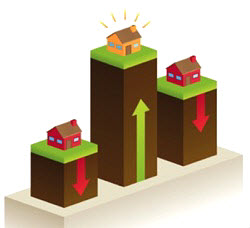
Real estate prices, as with most financial markets, tend to follow a pattern. For the purpose of this article, we'll call this pattern “The Real Estate Cycle.” There are many theories out there about The Real Estate Cycle, but the one I like best is called “The Great 18-Year Real Estate Cycle.”
Back in the 1930's a real estate economist named Homer Hoyt discovered that real estate prices seemed to ebb and flow on an almost perfect 18 year schedule. Hoyt's theory was later used and refined by now famed economist Fred E. Foldvary to predict the real estate crash of 2008. I'll get into more depth about “The Great 18-Year Real Estate Cycle” shortly, but to me the important part isn't necessarily the 18 year time frame, it is understanding that the real estate market operates in a fairly predictable cycle that can be seen and taken advantage of by smart investors.


 I've spoken many times on my radio show about how fear is used to move us. Well, recently I spotted a great example. Just last week I wrote about how a mortgage “expert” was predicting a “
 While homes prices continue to be on the decline, rent prices are actually on the rise and showed a 3 percent increase from January 2011 to January 2012, as opposed to home values, which dropped 4.6 percent during that same period, according to a recent Zillow Real Estate Market Report.
 One of the most exciting things about being a real estate investor is knowing what markets will produce the greatest long-term returns – especially while in the middle of a challenging housing market.
![flags_globe[1]](https://www.noradarealestate.com/wp-content/uploads/2012/01/flags_globe1-250x250.jpg) For many individuals, the single largest “investment” of their lives will usually be their home, as opposed to investing stock, bonds, mutual funds or certificates of deposits (CD’s). This is because purchasing real estate is less risky than investing in the stock market and can be more rewarding than changing CD interest rates.
For many individuals, the single largest “investment” of their lives will usually be their home, as opposed to investing stock, bonds, mutual funds or certificates of deposits (CD’s). This is because purchasing real estate is less risky than investing in the stock market and can be more rewarding than changing CD interest rates. “The bursting of the global housing bubble is only halfway through,”
  If there’s one thing that
