
Home construction rarely matches the actual demand for new homes, which can change quickly – there's often too much or too little. Because the US population grows one percent per year about 1.5 million new homes are needed every year. During the boom of the mid-2000s, two million homes were built per year; at the bottom of the bust, that number was 600,000.
In 2012, construction was up to 800,000 homes. This is a clear indicator that demand is even higher and will continue higher for years. Home prices will be rising even when more construction takes place. The economic effect is self-reinforcing because most of the cost of building a new home is in the wages paid to the workers, who in turn can afford a better home for themselves or spend money on cars and other stuff.
 A tax break that has long been untouchable could soon be in for some serious scrutiny. Many home buyers deduct their mortgage interest when assessing their tax bill, a perk that has helped bolster the income of millions of families – and the broader housing market. But as President Obama and Congress try to hash out a deal to reduce the budget deficit, the mortgage interest deduction will likely be part of the discussion.
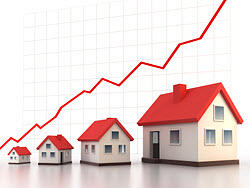 Home prices rose by 0.1% in September from the prior month and by 3.6% from one year ago, the largest gain in six years, according to a report released Monday by Lender Processing Services.
 I just locked down a 2.875% interest rate, fixed for the 15-year term of the mortgage. No points. With rates like these, I find myself rethinking the idea that I want to pay off my mortgage.
 Wealthy foreigners from around the globe are taking advantage of America's housing bust to snap up U.S. properties at cut-rate prices — helping local markets rebound in the process.
 A big part of my job is helping our clients project the most likely scenarios for the housing market. Now that we know who will be President, my job just got easier because we have four years of experience with Obama and a divided Congress, so we know what we are getting.
 Sixty-five percent of U.S. housing markets are worse off today than they were four years ago according to the California-based real estate research firm RealtyTrac.
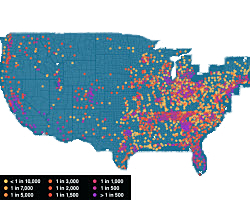 We've all heard that the housing bubble's pop led to thousands of foreclosures, but its interactive maps like this that really show how prevalent the problem was — and still is. Part of a project on 30 election issues, the map below uses data from RealtyTrac to display foreclosure rates by county.
