Norada Real Estate Investments

  • Home
  • Markets
  • Properties
  • Membership
  • Podcast
  • Learn
  • About
  • Contact

Fed Interest Rate Predictions by Goldman Sachs: 2026 Forecast

December 1, 2025 by Marco Santarelli

Fed Interest Rate Predictions by Goldman Sachs: 2026 Forecast

Many folks are wondering what's on the horizon for interest rates in the coming years, and there's a lot of buzz surrounding the predictions from big financial players. One of the most closely watched is Goldman Sachs, and their outlook for 2025 and 2026 offers some intriguing insights. Based on my read of their analysis, Goldman Sachs anticipates the Federal Reserve will likely cut interest rates by the end of 2025, and continue with further adjustments in 2026, aiming for a more sustainable economic balance.

Fed Interest Rate Predictions by Goldman Sachs: 2026 Forecast

It's no secret that the Federal Reserve (often called “the Fed”) has been in a delicate balancing act. After a period of raising rates to combat inflation, the talk has shifted towards when and how much they might start to ease them back. Fed Chair Jerome Powell has been careful with his words, emphasizing that decisions aren't set in stone and that different opinions exist within the Federal Open Market Committee (FOMC). Yet, despite some hawkish undertones, Goldman Sachs Research maintains its forecast. They believe the data points towards a December 2025 rate cut, even if Powell himself suggested it's “far from” a done deal.

Understanding the Fed's Thinking: Inflation Close, Jobs Cooling

So, what's driving Goldman Sachs' prediction? It boils down to two key areas: inflation and the job market. Powell himself has hinted that inflation, when you strip out certain effects like tariffs, is getting pretty close to the Fed's 2% target. This is crucial because keeping inflation in check is the Fed’s primary mission.

On the flip side, the labor market, which has been super tight for a while, is finally showing signs of gradual cooling. This cooling is precisely what the Fed wants to see. As the chart below illustrates, various measures of labor market tightness have fallen below their pre-pandemic levels. This suggests that the intense competition for workers is easing, which can help put less upward pressure on wages and, by extension, inflation.

Measures of Labor Market Tightness (2002-2024)
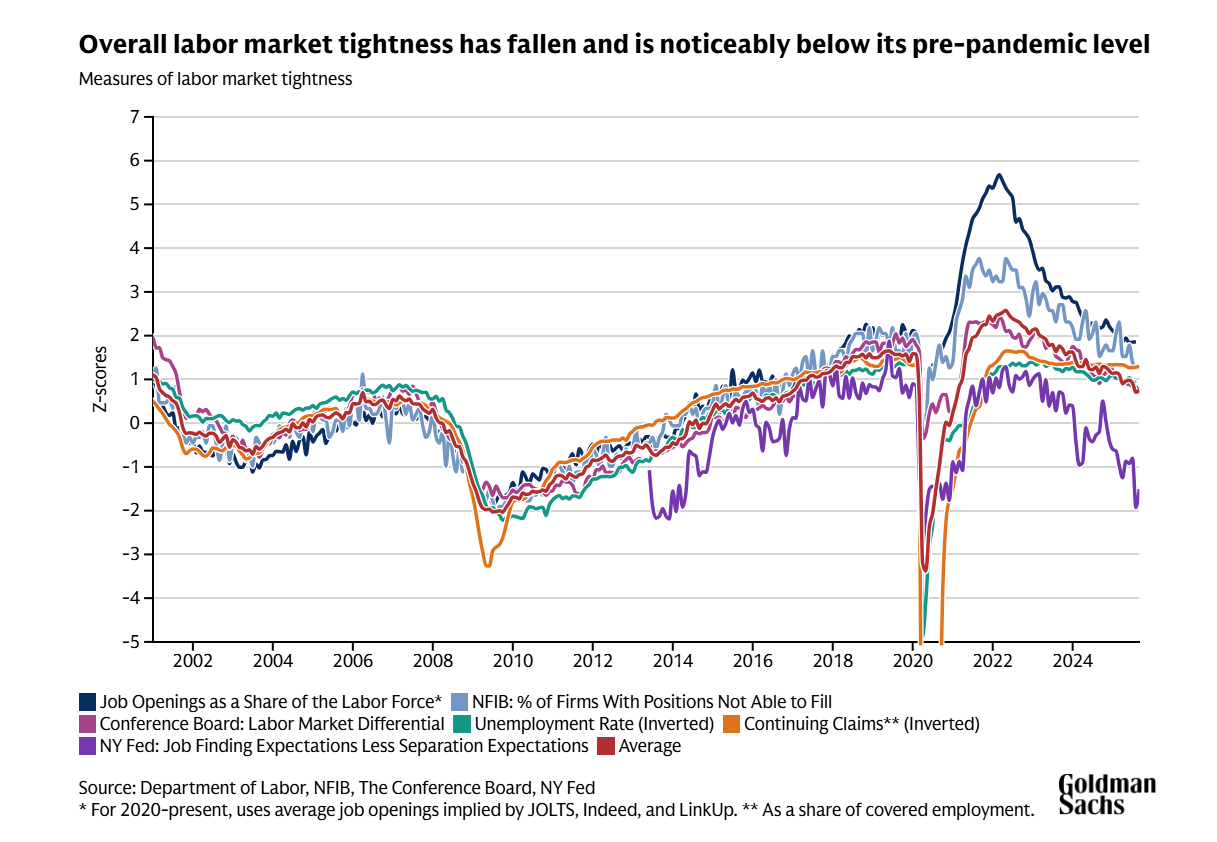
Goldman Sachs Research forecasts that the Fed will cut interest rates again in December
Source: Goldman Sachs

(This chart shows several indicators all trending downwards, indicating a less strained job market compared to recent years.)

  • Job Openings as a Share of the Labor Force: Decreasing.
  • NFIB: % of Firms With Positions Not Able to Fill: Falling.
  • Conference Board: Labor Market Differential: Lower.
  • Unemployment Rate (Inverted): While inverted charts can be tricky, the trend indicates a normalization. The actual unemployment rate has been rising slightly.
  • NY Fed: Job Finding Expectations Less Separation Expectations: Narrowing.
  • Continuing Claims (Inverted): Similar to the unemployment rate, the trend suggests a return to more normal levels.

Goldman Sachs Research looks at this data and sees that the weakness in the job market isn't just a temporary blip; they believe it's genuine. They don't expect the employment picture to change dramatically enough by the December 2025 meeting to make the FOMC decide against cutting rates.

Why a December 2025 Cut is Still On the Table

Even though Fed Chair Powell's recent press conference had a slightly more cautious tone than some expected, Goldman Sachs Chief US Economist David Mericle stands firm. He acknowledges that the conference played out a bit differently than their team anticipated, but their core forecast hasn't wavered. They still see that December rate cut as quite likely.

Mericle points out something interesting: there seems to be significant opposition within the FOMC to what they call “risk management cuts.” These are essentially proactive rate cuts meant to stave off potential economic trouble. Mericle suggests that Powell might have felt it was important to voice these internal concerns during his press conference, perhaps to manage expectations or show that the committee is considering all viewpoints.

Here's my take on it: Powell's careful wording is typical. He's like a skilled chess player, thinking several moves ahead and aware of all the different player strategies (or committee member opinions). While he might acknowledge the “wait-a-cycle” crowd, the underlying economic data—especially the cooling job market and inflation nearing the target—still supports a move to ease policy. Goldman Sachs seems to be reading the tea leaves, focusing on the data trends that point towards an easing cycle.

Looking Ahead: 2026 and Beyond

But what about 2026? Goldman Sachs isn't stopping at just one cut. They're projecting two more quarter-percentage-point (25-basis-point) cuts in March and June of 2026. This would bring their estimated terminal rate—the peak or trough of the interest rate cycle—down to a range of 3% to 3.25%.

This projection suggests that the Fed, in Goldman Sachs' view, won't just cut rates once and then pause indefinitely. They foresee a continued, albeit measured, easing path throughout the first half of 2026. This implies that the economic forces guiding the Fed's hand will likely continue to push towards lower rates for a sustained period.

Key Factors for Future Rate Decisions:

  • Inflation Trajectory: Will it stay near the 2% target, or are there risks of it ticking up again?
  • Labor Market Health: Will the cooling continue steadily, or will there be unexpected shifts?
  • Global Economic Conditions: International events can always influence the Fed's decisions.
  • Fiscal Policy: Government spending and tax policies can also impact the economy and interest rates.

The Role of Data (and Lack Thereof)

It's worth noting that the economic data landscape can be choppy. Government shutdowns, for example, can temporarily halt the release of official statistics. Powell acknowledged that some FOMC participants might see this lack of data and increased uncertainty as a reason to pause. It's a valid point: making significant policy changes without the clearest picture can be risky. However, Goldman Sachs believes the existing trends are strong enough. They expect that labor market data by December 2025 simply won't provide a “convincingly reassuring message” for those who want to hold off on cuts.

Furthermore, Mericle highlights that the Fed's own monetary policy is currently considered modestly restrictive. This restriction is helping to cool the labor market. Since the FOMC doesn't necessarily want further significant cooling to the point of widespread job losses, maintaining or even slightly reducing that restrictive stance via a rate cut makes logical sense. It's a way to achieve their goal of a balanced economy without tipping it into a downturn.

My Perspective: A Calculated Approach

From where I stand, Goldman Sachs' predictions paint a picture of a deliberate and data-driven Federal Reserve, guided by the strong desire to achieve its dual mandate (maximum employment and stable prices). While Fed officials like Powell will always hedge their bets and acknowledge dissenting views, the underlying economic momentum often dictates the path.

The cooling labor market is a significant signal. It means the Fed has more room to maneuver on interest rates without risking overheating the economy or causing a sharp rise in unemployment. The gradual approach to cuts—first in late 2025 and then into 2026—suggests they are not looking for a dramatic policy reversal, but rather a careful recalibration of monetary policy.

For anyone trying to make sense of financial markets, keeping an eye on Goldman Sachs' interest rate predictions for 2025 and 2026 is a smart move. They are known for their in-depth research and analytical prowess. While no one has a crystal ball, their forecasts provide a valuable framework for understanding the potential direction of interest rates and the economic forces at play.

Plan Smart Around Rate Forecasts – 2025 & 2026

With Goldman Sachs projecting interest rate shifts through 2025–2026, now is the time to lock in investment-grade real estate.

Norada offers high-yield turnkey properties designed to deliver stable cash flow and long-term equity growth—regardless of rate movements.

HOT NEW LISTINGS JUST ADDED!

Talk to a Norada investment counselor today (No Obligation):

(800) 611-3060

Get Started Now 

Recommended Read:

  • Interest Rate Predictions for the Next 2 Years Ending 2027
  • Interest Rate Predictions for 2025 and 2026 by Morgan Stanley
  • Interest Rates Predictions for the Next 3 Years
  • Market Reactions: How Investors Should Prepare for Interest Rate Cut
  • Interest Rate Predictions for the Next 10 Years: 2025-2035
  • Interest Rate Predictions for the Next 12 Months
  • Interest Rate Forecast for Next 5 Years: Mortgages and Savings
  • When is the Next Fed Meeting on Interest Rates?
  • Interest Rate Cuts: Citi vs. JP Morgan – Who is Right on Predictions?
  • More Predictions Point Towards Higher for Longer Interest Rates

Filed Under: Economy, Financing Tagged With: Economy, Interest Rate Forecast, Interest Rate Predictions, interest rates

5 Most Expensive Housing Markets Are Now Seeing the Biggest Price Cuts

December 1, 2025 by Marco Santarelli

5 Most Expensive Housing Markets Are Now Seeing the Biggest Price Cuts

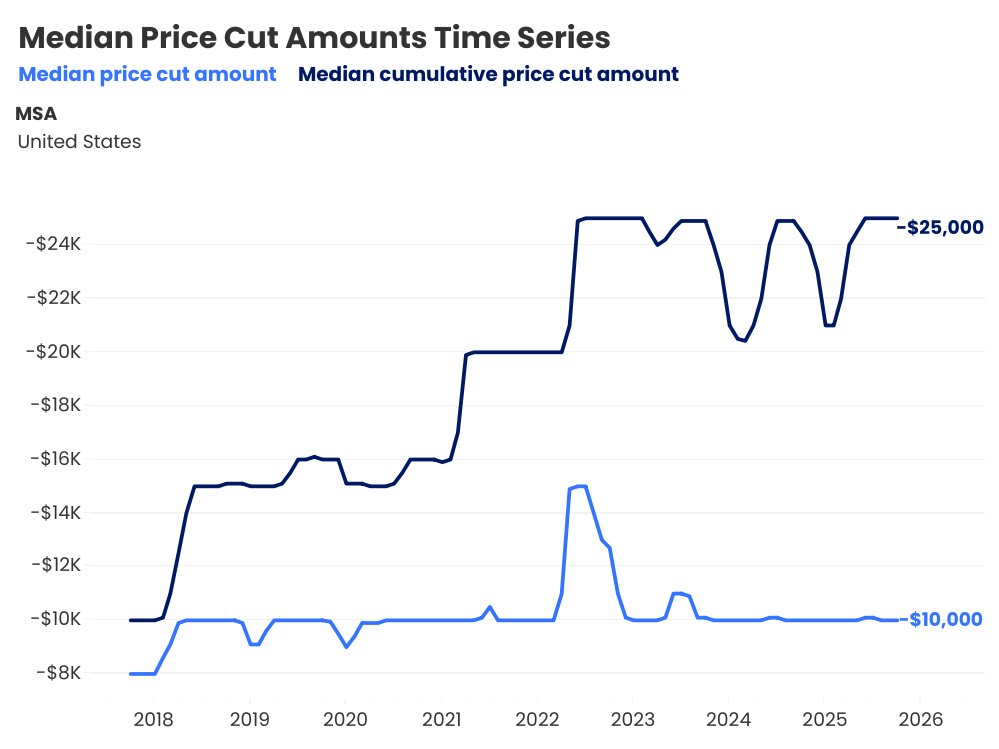
If you've been keeping an eye on the housing market, you've likely felt the pinch of high prices. For quite some time, it seemed like the dream of homeownership was slipping further away for many. But I've got some encouraging news: some of the priciest housing markets in the country are starting to offer more significant price cuts, making them more accessible than they've been in a while. As of October, the typical home listing saw a record-high discount of $25,000, a clear sign that sellers are adjusting their expectations.

I've been following real estate trends for a while now, and what I'm seeing is a market that's slowly but surely finding its footing. For years, we've dealt with soaring prices and incredibly stiff competition. But now, a combination of factors is creating a more balanced environment, and believe it or not, this is good news for buyers.

5 Most Expensive Housing Markets Are Now Seeing the Biggest Price Cuts

What's Driving These Bigger Discounts?

Several things are coming together to create this situation. First, affordability has seen its best improvement in three years. This simply means that, relative to incomes, buying a home isn't as much of a stretch as it was recently. Think about it: with mortgage rates still elevated compared to a few years ago, people just can't afford to pay top dollar for homes. Sellers are starting to realize this, and they're making adjustments.

us housing market seeing some of the steepest price cuts in years
Source: Zillow

Secondly, homes are staying on the market longer. We're not seeing the frantic bidding wars and homes flying off the shelves as we did at the height of the market frenzy. When a house sits for a bit, sellers become more motivated to negotiate. This often leads to multiple price reductions rather than just one big drop.

A seller might initially list their home for, say, $600,000. If it doesn't sell quickly, they might initially cut it by $10,000, then another $10,000 a few weeks later, and so on. Zillow’s data shows that the typical price cut is still hovering around $10,000, but the frequency of these cuts is what's making a difference.

It's also important to remember that most homeowners have built up significant equity over the past few years. Their homes have appreciated so much that they can afford to reduce their asking price and still walk away with a very healthy profit. This gives them the flexibility to be more realistic in today's market.

Where Are the Biggest Price Cuts Happening?

The most striking trend, according to Zillow's latest data, is that the largest median discounts are appearing in some of the nation's most expensive housing markets. This makes a lot of sense when you think about it. In areas where homes are already extremely costly, even a $50,000 or $70,000 price chop might still leave the home in a high price bracket. But for buyers, it represents a significant opportunity to get into a market that was previously out of reach.

Here are the top markets seeing the biggest median discounts (from their initial list price):

  • San Jose, California: A massive $70,900 in discounts.
  • Los Angeles, California: Buyers are seeing discounts around $61,000.
  • San Francisco, California: Coming in at $59,001 in typical price reductions.
  • New York, New York: An average of $50,000 in discounts.
  • San Diego, California: Also seeing discounts of $50,000.

These aren't small numbers. For someone eyeing a home in these generally unaffordable areas, these price cuts can be a game-changer. It signals a shift, even if subtle, towards a more buyer-friendly scenario in these usually seller-dominated regions.

It's Not Just About the Dollar Amount: Relative Discounts Matter

While the absolute dollar figures are eye-catching, I always like to consider the relative discount as well. In more affordable markets, a smaller dollar amount might actually represent a larger percentage off the home's value. This is a crucial point because it tells us where buyers might be getting the “best bang for their buck” in terms of negotiation power.

  • Pittsburgh, Pennsylvania: A typical markdown of $20,000 here can represent about 9% of the metro's typical home value. This is the largest relative discount I've seen among major markets.
  • New Orleans, Louisiana: Similar to Pittsburgh, homes here are typically discounted by around 9% of their value.
  • Austin, Texas: Buyers are finding deals with discounts around 8.4%.
  • Houston, Texas: Discounts are in the 8.2% range.
  • San Antonio, Texas: Tightly following with 7.9%.

These markets, while not always the absolute cheapest, are offering buyers a significant opportunity to negotiate, given how much their housing costs have risen in recent years.

Markets Where Sellers Are Still Holding Firm

On the flip side, there are markets where sellers have had less pressure to cut prices. These are typically areas with strong demand, faster sales, and often, more affordable home prices to begin with. This means sellers don't need to offer big discounts to attract buyers.

According to Zillow, markets with the smallest cumulative discounts in October included:

  • Oklahoma City, Oklahoma: With discounts around $15,000.
  • Louisville, Kentucky: Also seeing $15,000 in cuts.
  • St. Louis, Missouri: Around $15,100.
  • Indianapolis, Indiana: With discounts of $16,000.
  • Detroit, Michigan: At $17,100.

In cities like St. Louis, Louisville, and Indianapolis, homes are selling faster than the national average, and the listings are often newer. This indicates consistent demand, meaning sellers don't have to be as aggressive with their pricing to secure a sale.

What This Means for You (The Buyer)

If you've been waiting on the sidelines, hoping for a more favorable market, now might be the time to start seriously looking. The fact that discounts are increasing, especially in those high-priced markets, gives you more leverage. It means sellers are more open to negotiation, and you have a better chance of getting a property for less than its initial asking price.

However, my advice is always to be patient and prepared. Even with discounts, homes in desirable areas will still command high prices. Get pre-approved for a mortgage, understand your budget, and work with a good real estate agent who can help you navigate these opportunities.

The housing market is constantly evolving, and while these price cuts are a welcome sign for buyers, it's crucial to look at the data in context. Keep an eye on local market conditions, interest rates, and your personal financial situation. But for now, for those dreaming of homeownership, the doors are slowly beginning to creak open a little wider.

Small Investors Are Winning Big in Today’s Housing Market

Turnkey rental properties in affordable, high-demand metros are helping everyday investors build passive income, equity, and long-term wealth—without the headaches of active management.

Norada Real Estate makes it easy to scale your portfolio in the markets where small investors are outpacing institutional buyers and locking in strong returns.

🔥 HOT NEW LISTINGS JUST ADDED! 🔥

Talk to a Norada investment counselor today (No Obligation):

(800) 611-3060

Get Started Now

Want to Know More About the Housing Market Trends?

Explore these related articles for even more insights:

  • Housing Market Predicted to See Strong Growth in 2026: Expert Forecast
  • Housing Market Predictions for the Next 12 Months by Zillow
  • Housing Market Regains Ground as Falling Mortgage Rates Unlock Buyer Savings
  • Hidden Costs of Homeownership Now Add Up to Nearly $16,000 a Year
  • Small Investors Dominate the Housing Market From Detroit to Vegas
  • Housing Market Predictions for the Next 4 Years: 2025 to 2029
  • Housing Market 2025 Splits Between Wealthy Buyers and First-Timers
  • Housing Markets at Risk of Double-Digit Price Decline Over the Next 12 Months
  • Housing Market Trends: Nearly 1 in 3 Buyers Still Opt for All-Cash Deals in 2025
  • Will the Housing Market Shift to a Buyer’s Market in 2026?
  • Mid-Atlantic Housing Market Heats Up as Mortgage Rates Go Down
  • NAR Chief's Bold Predictions for the 2025 Housing Market
  • The $1 Trillion Club: America's Richest Housing Markets Revealed
  • 4 States Dominate as the Riskiest Housing Markets in 2025
  • Housing Market Predictions 2025 by Norada Real Estate

Filed Under: Housing Market, Real Estate Market Tagged With: Housing Market, Housing Market Trends, Price Cuts

Housing Market Predicted to See Strong Growth in 2026: Expert Forecast

December 1, 2025 by Marco Santarelli

Housing Market Poised for a Strong Comeback in 2026: NAR’s Forecast

It feels like we’ve been talking about the housing market and its ups and downs for years now. But what does the future hold? If you’re thinking about buying, selling, or just curious about where things are headed, you’re in the right place. I’ve been digging into the latest forecasts, and the buzz is that the housing market predictions for 2026 are looking a lot brighter, with experts pointing towards a potential comeback after a period of slower activity.

To cut straight to the chase, the National Association of REALTORS® (NAR) is forecasting a significant jump in home sales for 2026, potentially seeing a double-digit increase. This is welcome news for many who have felt the squeeze of higher prices and tougher buying conditions. While it’s not a crystal ball, understanding these predictions can help us make smarter decisions.

Housing Market Predicted to See Strong Growth in 2026: Expert Forecast

What’s Driving the Expected Comeback?

So, what’s behind this optimistic outlook for 2026? It boils down to a few key factors that are starting to come together. Think of it like ingredients for a good meal – each one is important, but together they create something substantial.

One of the biggest drivers is expected to be steady job growth. When people have stable jobs and feel confident about their future, they’re more likely to make big decisions like buying a home. We’ve seen job gains holding up pretty well, and this is a fundamental strength that supports the housing market.

Another crucial piece of the puzzle is mortgage rates. For a while now, higher mortgage rates have been a big hurdle for many potential buyers. They’ve made monthly payments significantly more expensive, pushing some people out of the market altogether. However, experts like Lawrence Yun, the chief economist at NAR, are forecasting a modest decline in mortgage rates for 2026. He expects the average 30-year fixed rate to hover around 6% in 2026, down from an estimated 6.7% this year.

“It’s not going to be a big decline, but it will be a modest decline that will improve affordability,” Yun explained at a recent NAR event. This might not sound like huge news, but even small drops in rates can make a big difference in what people can afford each month.

Furthermore, homebuilder activity is also contributing to the supply side. While we’ve heard a lot about housing shortages, builders are continuing to add new homes to the market. This increase in supply, even if it's slow, helps balance things out.

The Big Numbers: What Sales and Prices Might Look Like

This is where things get really interesting. The NAR forecast suggests that 2026 could be the year we see a noticeable uptick in home sales.

  • Overall Home Sales: NAR is predicting a 14% nationwide increase in home sales for 2026. This is a pretty significant jump compared to what we've seen recently.
  • New-Home Sales: For those interested in new construction, the prediction is a 5% rise in new-home sales.

Now, what about prices? A common worry is that a surge in sales could lead to another rapid increase in home prices. However, the outlook for 2026 is different. NAR expects home prices nationwide to climb by about 4%.

This suggests a more balanced market where sales increase, but prices grow at a more sustainable rate. This is a good sign because it means affordability might improve without causing another affordability crisis. It’s important to remember that these are national averages, and local markets will always have their own unique trends.

Understanding the Nuances: A Market of “Haves” and “Have-Nots”

While the overall picture for 2026 looks positive, it’s not a one-size-fits-all story. The housing market today is quite uneven, and this likely will continue to some extent. Jessica Lautz, NAR’s Deputy Chief Economist, highlighted the concept of a market with “haves” and “have-nots.”

The “Haves”:

  • These are often individuals who already own homes and have built up significant equity over the years.
  • They are frequently repeat buyers, especially baby boomers, who can leverage their existing home equity, sometimes buying with cash.
  • The upper end of the market has been doing better, with strong inventory and robust financial markets supporting sales in the $750,000 to $1 million price range.

The “Have-Nots”:

  • These are primarily first-time homebuyers who are facing significant challenges.
  • The share of first-time buyers has dropped to an all-time low of 21%, far below their historical average of 40%.
  • Their average age has also increased, with a median age of 40. This means people are waiting longer to buy.

Why are first-time buyers struggling so much? Lautz pointed to several reasons:

  • High rent costs: Rent payments eat into savings that could otherwise go towards a down payment.
  • Student loan debt: Many young adults are burdened by student loans, making it harder to qualify for mortgages or save extra money.
  • Childcare costs: Raising a family adds significant financial pressure.

To help these aspiring homeowners, Lautz suggests focusing on better financial education about down payment assistance programs and special loan types like FHA loans.

When Homes Sit, Prices Get a Push

We’ve also seen a trend where homes that stay on the market longer than expected often need price adjustments. This isn't necessarily a sign of a collapsing market but rather sellers adapting to buyer demand and market conditions. Yun shared some data on how price reductions tend to increase with how long a home has been listed:

  • 0–14 days on market: Typically a 4.9% price cut if needed.
  • 15–30 days on market: Might see a 6.1% cut.
  • 31–60 days on market: A larger adjustment, around 7.3%.
  • 61–90 days on market: Sellers might consider a 9% reduction.
  • 91–120 days on market: Further adjustments could be around 10.6%.
  • Over 120 days on market: For homes that have been listed for a long time, a 13.8% reduction might be necessary to attract buyers.

These price dips are often temporary or localized when inventory quickly grows. Nationally, the 4% median home-price gain expected for 2026 still points to overall price appreciation.

Looking Ahead: Fundamentals Remain Strong

Despite some of the challenges we’ve discussed, the underlying fundamentals of the housing market remain quite strong, according to Yun.

  • Low Mortgage Delinquencies: The number of homeowners falling behind on their mortgage payments or facing foreclosure is at historically low rates. This is a critical indicator of market health.
  • Homeowner Equity: Homeowners have built up substantial equity in their homes, providing a financial cushion.
  • Steady Job Growth: As mentioned before, consistent job creation is a robust sign for the economy and housing demand.

So, while 2025 might be remembered as a slower year, the pieces for a more active and vibrant housing market in 2026 appear to be falling into place.

My Take on the Forecast

As someone who follows the housing market closely, I find NAR's prediction for 2026 to be cautiously optimistic and realistic. The emphasis on job growth and improving mortgage rates as key drivers makes sense. The forecast for a 14% sales increase is exciting, and the projected 4% price appreciation suggests a market that is growing, but not overheating.

The distinction between the “haves” and “have-nots” is particularly insightful. It reminds us that market conditions can vary wildly depending on your financial situation and where you are in your homeownership journey. For first-time buyers, the path will likely still involve significant planning and resourcefulness, making programs that help with down payments and offer lower interest rates crucial.

For sellers, especially those who might have overshot their pricing or are in a less in-demand area, adapting to market realities with realistic pricing or potential reductions will be key to a successful sale.

Ultimately, the housing market predictions for 2026 from NAR offer a hopeful outlook. It suggests a market that is becoming more accessible as rates ease and demand remains, while also appreciating in value at a more sustainable pace. It’s a forecast that encourages continued interest and readiness for those looking to enter or move within the housing market.

Small Investors Are Winning Big in Today’s Housing Market

Turnkey rental properties in affordable, high-demand metros are helping everyday investors build passive income, equity, and long-term wealth—without the headaches of active management.

Norada Real Estate makes it easy to scale your portfolio in the markets where small investors are outpacing institutional buyers and locking in strong returns.

🔥 HOT NEW LISTINGS JUST ADDED! 🔥

Talk to a Norada investment counselor today (No Obligation):

(800) 611-3060

Get Started Now

Want to Know More About the Housing Market Trends?

Explore these related articles for even more insights:

  • Housing Market Predictions for the Next 12 Months by Zillow
  • Housing Market Regains Ground as Falling Mortgage Rates Unlock Buyer Savings
  • Hidden Costs of Homeownership Now Add Up to Nearly $16,000 a Year
  • Small Investors Dominate the Housing Market From Detroit to Vegas
  • Housing Market Predictions for the Next 4 Years: 2025 to 2029
  • Housing Market 2025 Splits Between Wealthy Buyers and First-Timers
  • Housing Markets at Risk of Double-Digit Price Decline Over the Next 12 Months
  • Housing Market Trends: Nearly 1 in 3 Buyers Still Opt for All-Cash Deals in 2025
  • Will the Housing Market Shift to a Buyer’s Market in 2026?
  • Mid-Atlantic Housing Market Heats Up as Mortgage Rates Go Down
  • NAR Chief's Bold Predictions for the 2025 Housing Market
  • The $1 Trillion Club: America's Richest Housing Markets Revealed
  • 4 States Dominate as the Riskiest Housing Markets in 2025
  • Housing Market Predictions 2025 by Norada Real Estate

Filed Under: Housing Market, Real Estate Market Tagged With: Housing Market, housing market predictions, Housing Market Trends

Mortgage Rates Today: 30-Year Fixed Refinance Rate Rises by 12 Basis Points

December 1, 2025 by Marco Santarelli

Mortgage Rates Today, Jan 1, 2026: 30-Year Refinance Rate Rises by 48 Basis Points

Today, December 1st, 2025, the national average 30-year fixed refinance rate has nudged up by 12 basis points, landing at 6.78%. While this might seem like a small shift, it's important to understand what it means for your wallet and for the bigger picture of the housing market. So, if you're thinking about refinancing your mortgage today, know that rates have seen a slight uptick.

Mortgage Rates Today Dec 1: 30-Year Fixed Refinance Rate Rises by 12 Basis Points

What Does This 12 Basis Point Boost Actually Mean?

Let's break down this seemingly small number. A “basis point” is just one-hundredth of a percent. So, 12 basis points is equal to 0.12%. When the average rate for a 30-year fixed refinance goes from 6.66% to 6.78%, it means that for every $100,000 you borrow, your monthly principal and interest payment will increase by roughly $10 to $12.

  • For a $300,000 mortgage: This 0.12% increase could add about $30 to $36 to your monthly payment.

While that might not sound like a fortune for a single month, over the life of a 30-year loan, those small increases can really add up. It’s these incremental changes that make staying informed about current mortgage rates so crucial.

Is Refinancing Your Mortgage Worth It Right Now?

This is the million-dollar question, and honestly, there's no single “yes” or “no” answer that fits everyone. My own experience and what I'm seeing in the market right now tell me that the decision to refinance is deeply personal and depends on your specific financial situation and goals.

The good news is that rates are still historically quite low. Even at 6.78%, they are nowhere near the levels we saw in previous decades. However, the slight upward trend from the previous week (6.69%) and the previous day (6.66%) suggests a bit more caution might be warranted.

Consider these points when weighing your options:

  • Your Current Rate: If you have a mortgage with a rate significantly higher than today's refinance rate (say, 7.5% or 8%), then refinancing could absolutely save you money each month and over the life of the loan.
  • Break-Even Point: Refinancing isn't free. There are closing costs involved, similar to when you first got your mortgage. You need to calculate how long it will take for the monthly savings from your new, lower rate to offset these upfront costs. If you plan to sell your home or pay off your mortgage before reaching that break-even point, it might not be the best move.
  • Your Financial Goals: Are you looking to lower your monthly payments to free up cash flow? Or are you trying to pay off your mortgage faster by switching to a shorter loan term (like a 15-year instead of a 30-year)? Your goals will dictate whether refinancing makes sense.
  • The Federal Reserve's Signal: As I'll discuss more, the Federal Reserve's actions and statements are a huge influence. While the trend has been towards lower rates, today's small uptick suggests we're in a period of watchful waiting.

Other Refinance Rates at a Glance

It's not just the 30-year fixed rate that matters. Zillow's data for December 1, 2025, also shows movement in other popular mortgage products:

  • 15-Year Fixed Refinance Rate: This has decreased by 2 basis points to 5.62%. For homeowners looking to pay off their mortgage faster and willing to accept higher monthly payments, this is a positive sign.
  • 5-Year Adjustable-Rate Mortgage (ARM) Refinance Rate: This has decreased by 5 basis points to 7.30%. ARMs start with a fixed rate for a period and then adjust periodically. They can offer lower initial rates, but come with the risk of future payment increases.

Table: Refinance Rate Snapshot (December 1, 2025 – via Zillow)

Loan Type Current Average Rate Change from Previous Day Change from Previous Week
30-Year Fixed 6.78% +12 basis points +9 basis points
15-Year Fixed 5.62% -2 basis points -2 basis points
5-Year ARM 7.30% -5 basis points -5 basis points

What Factors Are Pushing and Pulling Mortgage Rates?

Understanding why rates move is as important as knowing what they are. It's a complex dance, but a few key players consistently influence mortgage rates:

The Federal Reserve's December Outlook

The Federal Reserve (often called “the Fed”) is the central bank of the United States, and its decisions have a massive impact on the economy, including mortgage rates. After cutting its benchmark interest rate twice recently, the Fed is at a critical juncture.

  • The Big December Meeting: All eyes are on the upcoming Federal Open Market Committee (FOMC) meeting on December 9-10, 2025. The market is buzzing with the expectation of another rate cut. As of December 1st, traders believe there’s an 88% chance of a quarter-point cut. This is a huge jump in confidence from just a week prior, largely due to comments from New York Fed President John Williams. He suggested that the job market is showing signs of weakness, which gives the Fed room to adjust policy.
  • Why This Matters for Mortgages: When the Fed lowers its target interest rate, it generally makes borrowing money cheaper for banks. This can then trickle down to consumers in the form of lower interest rates on loans, including mortgages.
  • Economic Data is King: The Fed is watching economic data very closely. Recent reports have shown a slowdown in job growth and less spending by consumers than expected. This softer data is making the Fed lean towards action to support the economy, which further fuels the expectation of a rate cut.

Treasury Yields: The Mortgage Rate's Shadow

A crucial indicator that often moves in tandem with mortgage rates is the 10-year U.S. Treasury yield. Think of this as a benchmark. While not a direct determinant, changes in Treasury yields signal the broader market's expectations for interest rates and economic growth.

  • Current Yield: As of early this morning, December 1st, the 10-year Treasury yield was sitting around 4.044%.
  • The Trend: This yield is still below its longer-term average, which suggests that the market is anticipating easier monetary policy and potentially lower rates in the future. However, there can be day-to-day fluctuations based on new economic news.

Recommended Read:

30-Year Fixed Refinance Rate Trends – November 30, 2025

Best Time to Refinance Your Mortgage: Expert Insights

Should You Refinance Your Mortgage Now or Wait Until 2026? 

What Precautions Should You Take When Refinancing?

Given the slight upward tick today and the anticipation of big news from the Fed, it’s a smart time to be cautious and prepared. Here's what I always advise people to do:

  1. Shop Around Actively: Don't take the first offer you get. Different lenders will have different rates, fees, and closing costs. Contact at least 3-5 lenders (including your current one, but don't assume they have the best deal) to compare offers. Focus on the annual percentage rate (APR), which includes fees and gives a more accurate picture of the total cost.
  2. Understand All Fees: Beyond the interest rate, there are origination fees, appraisal fees, title insurance, recording fees, and more. Know what you're paying for. Sometimes a slightly higher interest rate with lower fees can be more beneficial.
  3. Check Your Credit Score: Your credit score is one of the biggest factors determining the interest rate you'll qualify for. Make sure it's as high as possible before applying.
  4. Have Your Financial Documents Ready: Lenders will want to see W-2s, pay stubs, bank statements, tax returns, and proof of assets. Being organized can speed up the process.
  5. Consider Your Time Horizon: How long do you plan to stay in your home? If it's less than the break-even point, refinancing might not be financially sound.
  6. Lock Your Rate Wisely: Once you find a rate you're happy with, you'll usually have the option to “lock” it for a certain period (often 30-60 days) while your loan is processed. Be aware of the terms and potential fees if rates change while you wait.

Looking Ahead: The December 9-10 Decision

The Fed's meeting is the next major event to watch. While a 25 basis point cut seems very likely, the real insight will come from their official statement and their “dot plot” (which shows individual Fed members' projections for future interest rates). This will give us a clearer picture of the Fed's plans for 2026.

For homeowners and potential buyers, this period of anticipation means:

  • Buyers: The environment supports favorable financing, but be ready for potential rate swings based on incoming data. Locking in a rate when you find a good one is a sound strategy.
  • Refinancers: If your rate is above 6.5%, you likely still have good reason to explore refinancing. Prepare your paperwork and keep a close eye on the Fed's announcement.

Ultimately, while today's slight rise in the 30-year refinance rate is a noteworthy data point, it's part of a larger, evolving economic picture. Staying informed, understanding your personal financial situation, and being prepared are your best tools in navigating these times.

“Invest Smart — Build Long-Term Wealth Through Real Estate”

Norada's team can guide you through current market dynamics and help you position your investments wisely—whether you're looking to reduce rates, pull out equity, or expand your portfolio.

Work with us to identify proven, cash-flowing markets and diversify your portfolio while borrowing costs remain favorable.

HOT NEW TURNKEY DEALS JUST LISTED!

Speak with a seasoned Norada investment counselor today (No Obligation):

(800) 611-3060

Get Started Now

Recommended Read:

  • When You Refinance a Mortgage Do the 30 Years Start Over?
  • Should You Refinance as Mortgage Rates Reach Lowest Level in Over a Year?
  • NAR Predicts 6% Mortgage Rates in 2025 Will Boost Housing Market
  • Mortgage Rates Predictions for 2025: Expert Forecast
  • Half of Recent Home Buyers Got Mortgage Rates Below 5%
  • Mortgage Rates Need to Drop by 2% Before Buying Spree Begins
  • Will Mortgage Rates Ever Be 3% Again: Future Outlook
  • Mortgage Rates Predictions for Next 2 Years
  • Mortgage Rate Predictions for Next 5 Years
  • Mortgage Rate Predictions for 2025: Expert Forecast

Filed Under: Financing, Mortgage Tagged With: mortgage, mortgage rates, Mortgage Refinance Rates

Today’s Mortgage Rates: 30-Year Fixed Rate Poised to Break Into the 5% Range

November 30, 2025 by Marco Santarelli

Today's Mortgage Rates December 1: 30-Year Fixed Rate is Hovering Right at the 6% Mark

Well, it’s November 30th, and guess what? The 30-year fixed mortgage rate remains stable around 6.00%. This is the first time we’ve seen this benchmark in a while, and honestly, it brings a sigh of relief to many. It’s definitely sparking conversations about whether a dip into the 5% range might be closer than we think. While rates are always a bit of a moving target across the country, a lot of people are finally looking at the lowest mortgage rates they’ve seen in months.

Today’s Mortgage Rates, Nov 30: 30-Year Fixed Rate Poised to Break Into the 5% Range

It feels like just yesterday we were talking about rates being higher. According to the latest numbers from Zillow, the average for that popular 30-year fixed mortgage is now holding steady at a solid 6.00%. For those considering a shorter commitment, the 15-year fixed is looking good at 5.50%. To give you some perspective, just last Wednesday, Freddie Mac had reported the 30-year fixed rate averaging a higher 6.23%. This really goes to show how fast things can change in the mortgage world, and why, no matter what the numbers say, you absolutely must shop around with different lenders. It's the simplest way to make sure you're getting the best deal possible.

Current Mortgage Rates for November 30, 2025

Here’s a quick peek at the average rates as of today, according to Zillow. Remember these are national averages, so your personal rate might be a little different based on your unique situation.

Loan Type Average Rate
30-year fixed 6.00%
20-year fixed 5.86%
15-year fixed 5.50%
5/1 ARM 6.11%
7/1 ARM 6.15%
30-year VA 5.44%
15-year VA 5.10%
5/1 VA 5.11%

Current Mortgage Refinance Rates: Are You Ready to Save?

If you’ve been thinking about refinancing your current home loan, now might be an opportune time to investigate. The rates for refinancing are a little different than buying, but still showing some attractive numbers.

Loan Type Average Rate
30-year fixed 6.14%
20-year fixed 6.05%
15-year fixed 5.60%
5/1 ARM 6.55%
7/1 ARM 6.72%
30-year VA 5.57%
15-year VA 5.18%
5/1 VA 5.04%

👉 The Big Picture: Seeing that 6% mark again is a significant sign that the market is continuing to shift. If these rates keep inching lower, that psychological barrier of 5% could really encourage more people to jump into the market as buyers or to refinance their existing homes. The main takeaway for everyone right now is simple: compare, compare, compare! Even a fraction of a percent difference in your interest rate can add up to thousands of dollars saved over the life of your loan.

What Today’s Rates Mean for Homebuyers and Homeowners

Let's break down what this news means for you, whether you're looking to buy your first home or you're a seasoned homeowner thinking about your next move.

  • For Buyers: With the 30-year fixed rate dipping back to 6.00%, affordability just got a bit better compared to last week’s 6.23%. Even a small drop like this can mean hundreds of dollars saved each month on your mortgage payment. For anyone who’s been waiting on the sidelines, watching and hoping for the right moment, this could be the signal you’ve been looking for. It's a real window of opportunity.
  • For Refinancers: If you’re looking to refinance, the current averages for a 30-year fixed at 6.14% are still a tad higher than purchase rates. However, if you locked in a rate much higher than that, say at 7% or more, earlier this year or last, refinancing now could still lead to a significant reduction in your monthly payments. It’s definitely worth checking out your options.
  • Market Sentiment: This easing of rates toward the 5% mark is important. If it continues, we could see buyer demand really pick up steam. This might lead to more competition in the housing market as we move into early 2026.

My Two Cents: As someone who’s followed the housing market for a while, this return to 6% feels like a much-needed stabilization. It's not the rock-bottom rates of a few years ago, but it's certainly a more manageable environment than we've seen recently. The key takeaway for buyers and refinancers is to be proactive. Don't assume your current lender is offering the best deal. Get quotes from several different lenders – online lenders, local banks, credit unions. You might be surprised by the difference.

How to Get the Best Possible Mortgage Rate

Beyond just the national averages, there are concrete steps you can take to increase your chances of snagging a lower mortgage rate. It’s not all about luck or the whims of the market; your personal financial health plays a huge role.

  • Polish Your Financial Profile:
    • Boost Your Credit Score: This is arguably the most impactful step. A higher credit score tells lenders you're a lower risk, and that translates directly into a lower interest rate. Most lenders offer their best rates to those with scores of 740 or higher. While some conventional loans might start accepting scores as low as 620, the rate you’ll get will be significantly higher. To improve your score, make it a habit to pay all your bills on time, keep your credit card balances as low as possible (ideally below 30% of your credit limit), and steer clear of opening new credit accounts right before you apply for a mortgage.
    • Increase Your Down Payment: The more you can put down upfront, the less the lender has to finance, and the less risk they take on. A larger down payment can lead to a lower interest rate, a smaller loan amount overall, and consequently, smaller monthly payments. Plus, putting down at least 20% is crucial if you want to avoid paying for Private Mortgage Insurance (PMI), which is an added monthly cost.
    • Lower Your Debt-to-Income (DTI) Ratio: Lenders absolutely scrutinize your DTI to gauge your ability to handle loan payments. The general aim is to keep your DTI at 36% or less, though some lenders might be flexible if you have substantial savings. You can tackle this by paying down existing debts (like car loans or credit cards) or by increasing your income.
  • Adjust Your Loan Terms Wisely:
    • Consider a Shorter Loan Term: While the 30-year fixed is incredibly popular for its lower monthly payments, a 15-year mortgage almost always comes with a lower interest rate because it’s less risky for the lender. The trade-off, of course, is that your monthly payments will be higher. You need to weigh affordability now versus potential long-term savings.
    • Buy Mortgage Discount Points: This is an option you can discuss with your lender at closing. You can pay an upfront fee, typically 1% of the loan amount per point, to “buy down” your interest rate. One point can usually shave about 0.25% off your rate. The trick here is to do the math and figure out how many years it will take for the monthly savings to cover the upfront cost.
    • Explore Different Mortgage Types: Don’t just default to a fixed-rate loan. Look into options like FHA loans (if you qualify), VA loans (for eligible veterans), or Adjustable-Rate Mortgages (ARMs). ARMs often have a lower initial interest rate compared to fixed-rate loans for the first few years, which can be appealing, but you need to understand how those rates will adjust later on.

Expert Forecasts and Market Factors: What's Driving Rates?

So, what’s behind these movements and what do the experts predict? It’s a complex puzzle with a few key pieces.

  • The Federal Reserve's Role: The Fed has been making moves to influence the economy, including cutting its benchmark rate. While another cut might be on the horizon later this year, it's important to remember that the Fed's actions don't always translate directly or immediately to lower mortgage rates. The market's reaction is a mix of the Fed’s commentary, broader economic signals, and other global factors.
  • Economic Uncertainty Looms: We've been experiencing a period of market volatility. This general uncertainty can make mortgage rates behave in ways that seem unpredictable. Lenders are always trying to price in risk, and when the economic future feels fuzzy, rates can be more sensitive.
  • The “Lock-In Effect” and Housing Inventory: A significant factor limiting housing inventory is the “lock-in effect.” Many homeowners secured mortgages at historically low rates years ago. Now, with current rates much higher, they're understandably reluctant to sell and give up those low rates. This keeps the supply of homes down. However, some sellers might be getting tired of waiting for rates to drop significantly, which could lead to a slight improvement in inventory.
  • Expert Predictions for the Future: Looking ahead, expert forecasts for the 30-year fixed rate at the end of 2025 and into 2026 generally hover in the 6% range. However, it’s critical to understand that these are just predictions, and the housing market is notoriously tricky to forecast accurately. Things can change rapidly based on economic news and Fed policy.

My personal take? It’s a good sign that rates are easing, but I don't expect a sudden plunge back into the 4% or 5% range anytime soon unless there's a significant economic downturn. The 6% average is likely to be the new normal for a while, with dips and rises around it. For those who managed to miss the peak rates of 7% or more, that refinance opportunity is definitely one to explore right now.

Final Thoughts

Today, November 30th, presents a more favorable picture for mortgage rates, with the 30-year fixed at 6.00%. This is a welcome change and offers a glimmer of hope for buyers and refinancers alike. While a move into the 5% range is still a topic of much speculation, the current rates provide a more accessible entry point into the housing market than we've seen in recent months. Remember to do your homework, compare lenders, and work on improving your financial health to secure the best possible rate.

Invest Smartly in Turnkey Rental Properties

With rates dipping to their lowest levels, investors are locking in financing to maximize cash flow and long-term returns.

Norada Real Estate helps you seize this rare opportunity with turnkey rental properties in strong markets—so you can build passive income while borrowing costs remain historically low.

🔥 HOT NEW LISTINGS JUST ADDED! 🔥

Talk to a Norada investment counselor today (No Obligation):

(800) 611-3060

Get Started Now

Also Read:

  • Mortgage Rates Predictions Backed by 7 Leading Experts: 2025–2026
  • Mortgage Rate Predictions for the Next 3 Years: 2026, 2027, 2028
  • 30-Year Fixed Mortgage Rate Forecast for the Next 5 Years
  • 15-Year Fixed Mortgage Rate Predictions for Next 5 Years: 2025-2029
  • Will Mortgage Rates Ever Be 3% Again in the Future?
  • Mortgage Rates Predictions for Next 2 Years
  • Mortgage Rate Predictions for Next 5 Years
  • Mortgage Rate Predictions: Why 2% and 3% Rates are Out of Reach
  • How Lower Mortgage Rates Can Save You Thousands?
  • How to Get a Low Mortgage Interest Rate?
  • Will Mortgage Rates Ever Be 4% Again?

Filed Under: Financing, Mortgage Tagged With: Interest Rate, mortgage, Mortgage Rate Trends, mortgage rates, Mortgage Rates Today

Mortgage Rates Today: 30-Year Refinance Rate Drops Significantly by 22 Basis Points

November 30, 2025 by Marco Santarelli

Mortgage Rates Today, Jan 1, 2026: 30-Year Refinance Rate Rises by 48 Basis Points

If you've been watching mortgage rates, today, November 30th, brought some welcome news. The national 30-year fixed refinance rate has dropped significantly, falling by 22 basis points from the previous week. This is a definite signal that the market is shifting, and for many homeowners, refinancing might become a more attractive option sooner than anticipated.

It’s easy to get lost in the numbers, but this drop is actually quite meaningful. A 22 basis point decrease can translate into real savings on your monthly payments. For those of us who have been sitting on the sidelines, hoping for a better deal, this movement is definitely worth paying attention to. Personally, I've seen how even small shifts in interest rates can make a big difference over the life of a loan, and this particular dip is a step in the right direction.

Mortgage Rates Today, Nov. 30: 30-Year Refinance Rate Drops by 22 Basis Points, Offering Hope

What Does This Drop Really Mean for Your Wallet?

Let's break down what this 22 basis point drop actually means. A basis point, for those who might not be familiar, is one-hundredth of a percent. So, a 22 basis point drop means the average rate has decreased by 0.22%.

When we talk about refinancing, even a fraction of a percent can add up. For example, if you have a mortgage balance of $300,000, a decrease from, say, 6.78% to 6.56% can save you money each month. While the exact savings depend on your specific loan amount and remaining term, this kind of movement suggests that the cost of borrowing is becoming more favorable. I’ve always advised homeowners to look at their individual situations, and this rate drop makes that review even more prudent.

The Nuances of Refinance Rates: Not All Rates Move Together

While the big headline is about the 30-year fixed rate falling, it's important to note that other loan types are seeing different movements. According to Zillow's data, the 15-year fixed refinance rate has actually inched up by 1 basis point to 5.65%. This might seem counterintuitive, but it highlights how different segments of the mortgage market can react independently to various economic factors.

Furthermore, the 5-year adjustable-rate mortgage (ARM) refinance rate has seen a decrease of 9 basis points, settling at 7.33%. ARMs can be appealing for those who plan to move or refinance again before the fixed period ends, but they also carry the risk of future rate increases. Understanding these differences is key to choosing the right refinance option for your specific needs and risk tolerance.

Here’s a quick look at the changes as announced by Zillow:

Loan Type Previous Rate (Approx. Last Week) Current Rate (Nov. 30) Change (Basis Points)
30-Year Fixed Refinance ~6.78% 6.56% -22
15-Year Fixed Refinance ~5.64% 5.65% +1
5-Year ARM Refinance 7.42% 7.33% -9

Why Are Rates Moving? A Look at the Factors at Play

So, what’s behind this drop in the 30-year fixed refinance rate? It’s a complex dance of economic forces, and as an observer of this market, I can tell you it's rarely driven by just one thing.

  • Federal Reserve's Influence (and Market Skepticism): The Federal Reserve has been making moves, cutting its benchmark rate in 2025. This is generally a good sign for borrowers. However, as we've seen, mortgage rates don't always follow suit immediately or predictably. The market is constantly digesting Fed announcements, economic data, and forward-looking commentary. Sometimes, the market anticipates moves, and other times, it reacts differently based on other signals. Another Fed cut could be on the horizon in December, but we’ll have to wait and see how that plays out for mortgage rates.
  • The Ever-Present Economic Uncertainty: We're still living in a time of economic shifts. Inflation, job numbers, and global events can all contribute to market volatility. When there’s uncertainty, interest rates can become unpredictable. Lenders price in risk, and when that risk is higher, rates tend to reflect that. The recent drop suggests that some of that immediate uncertainty might be easing in the eyes of the market, at least concerning longer-term mortgages.
  • The “Lock-In Effect” Persists, But With a Twist: Many homeowners who secured mortgages at historically low rates a few years ago are understandably hesitant to move or refinance because they’d be giving up those super-low rates. This is known as the “lock-in effect,” and it continues to keep the supply of homes on the market relatively low. However, I’ve noticed some sellers who have been holding out might be starting to feel a bit more pressure. A marginal improvement in housing inventory could, in theory, help stabilize or even slightly lower prices, and influence refinance decisions.

Expert Forecasts: A Crystal Ball, But Use With Caution

When I look at expert predictions for mortgage rates, I always approach them with a healthy dose of skepticism. The best economists in the world can’t predict the future with absolute certainty, especially in a dynamic economy.

Current forecasts for the 30-year fixed rate at the end of 2025 and into 2026 generally hover in the 6% range. This suggests that while we might not see rates plunge back to the truly historic lows of a couple of years ago, they are expected to remain significantly more manageable than the peaks we saw in 2023 and 2024.

The key takeaway from these experts is the high degree of uncertainty. I agree entirely. My experience has taught me that it’s far more productive to focus on what you can control – your financial health – and to react to market conditions as they unfold, rather than betting the farm on a forecast.

Is Refinancing Right for You NOW?

With rates down from their recent highs, if you currently have a mortgage with a rate hovering around 7% or higher, this 22 basis point drop certainly warrants a closer look. It could be your opportunity to:

  • Lower Your Monthly Payment: This is the most obvious benefit. Even a modest reduction can free up cash flow.
  • Reduce the Total Amount of Interest Paid: By refinancing into a lower rate, you’ll pay less interest over the life of your loan.
  • Shorten Your Loan Term: You could opt for a shorter loan term (like a 15-year fixed) and pay off your home faster, though your monthly payments will likely increase.
  • Tap into Home Equity: Through a cash-out refinance, you can borrow against your home’s equity for renovations, debt consolidation, or other significant expenses.

Strategies to Make Your Refinance Dream a Reality

Before you even start shopping for rates, there are several steps you should take to ensure you get the best possible terms. My advice, honed over years of looking at these transactions, is to be prepared:

  • Check Your Credit Score: This is paramount. A higher credit score means you'll qualify for lower interest rates. If your score isn't where you want it, focus on paying down debt and ensuring all your bills are paid on time.
  • Understand Your Debt-to-Income Ratio (DTI): Lenders look closely at your DTI, which compares your monthly debt payments to your gross monthly income. A lower DTI generally makes you a more attractive borrower. If your DTI is high, consider reducing your debt before applying.
  • Gather Your Financial Documents: Have pay stubs, tax returns, bank statements, and proof of other assets ready. The more organized you are, the smoother the process will be.
  • Shop Around: Don’t just go with the first lender you talk to. Get quotes from multiple lenders – banks, credit unions, and online mortgage companies – to compare rates and fees.

Recommended Read:

30-Year Fixed Refinance Rate Trends – November 29, 2025

Best Time to Refinance Your Mortgage: Expert Insights

Should You Refinance Your Mortgage Now or Wait Until 2026? 

Exploring Government Programs

It's also worth remembering that government-backed programs can sometimes offer pathways to refinancing, especially for those who might not qualify for conventional loans. Programs like FHA Streamline Refinance or VA Interest Rate Reduction Refinance Loans (IRRRL) have specific criteria and can offer benefits for eligible homeowners. These programs are designed to make refinancing more accessible and can be a lifesaver for some.

Fixed-Rate vs. Adjustable-Rate: The Eternal Debate

As I mentioned earlier, the choice between a fixed-rate mortgage and an adjustable-rate mortgage is critical.

  • Fixed-Rate: Offers predictability. Your interest rate and monthly principal and interest payment will never change. This is ideal if you plan to stay in your home for a long time and value stability. The current drop in the 30-year fixed rate makes this a very appealing option for many right now.
  • Adjustable-Rate (ARM): Typically starts with a lower introductory interest rate than fixed-rate mortgages. However, that rate will adjust periodically (usually annually) based on market conditions after the initial fixed period. ARMs can be a good choice if you plan to sell your home or refinance again before the rate starts adjusting, or if you can comfortably afford potentially higher payments in the future.

The decision here depends entirely on your financial situation, your risk tolerance, and your future plans for the home.

Looking Ahead

This drop in the 30-year fixed refinance rate on November 30th is a positive development. It signals that the mortgage market is responding to economic shifts and offering potential savings for homeowners. While forecasts remain uncertain, taking proactive steps now to improve your financial standing and explore your refinancing options is a smart move. It’s a good time to get informed and see if this rate movement can work to your financial advantage.

“Invest Smart — Build Long-Term Wealth Through Real Estate”

Norada's team can guide you through current market dynamics and help you position your investments wisely—whether you're looking to reduce rates, pull out equity, or expand your portfolio.

Work with us to identify proven, cash-flowing markets and diversify your portfolio while borrowing costs remain favorable.

HOT NEW TURNKEY DEALS JUST LISTED!

Speak with a seasoned Norada investment counselor today (No Obligation):

(800) 611-3060

Get Started Now

Recommended Read:

  • When You Refinance a Mortgage Do the 30 Years Start Over?
  • Should You Refinance as Mortgage Rates Reach Lowest Level in Over a Year?
  • NAR Predicts 6% Mortgage Rates in 2025 Will Boost Housing Market
  • Mortgage Rates Predictions for 2025: Expert Forecast
  • Half of Recent Home Buyers Got Mortgage Rates Below 5%
  • Mortgage Rates Need to Drop by 2% Before Buying Spree Begins
  • Will Mortgage Rates Ever Be 3% Again: Future Outlook
  • Mortgage Rates Predictions for Next 2 Years
  • Mortgage Rate Predictions for Next 5 Years
  • Mortgage Rate Predictions for 2025: Expert Forecast

Filed Under: Financing, Mortgage Tagged With: mortgage, mortgage rates, Mortgage Refinance Rates

30-Year Fixed Mortgage Rate Drops to New Lows as November 2025 Wraps Up

November 30, 2025 by Marco Santarelli

30-Year Fixed Mortgage Rate Drops to New Lows as November 2025 Wraps Up

As we approach the end of November, 30-year fixed mortgage rates are hovering around or even dipping slightly below the 6% mark, a welcome development that’s been absent for a while. According to the latest data from Zillow, the national average for a 30-year fixed mortgage is sitting right at 6.00%.

This brings us to some of the most encouraging financing terms we’ve seen in months and presents a compelling reason for prospective buyers to consider making a move sooner rather than later. While these rates are still a far cry from the rock-bottom figures of the pandemic era, this dip offers a crucial bit of encouragement as we head into the final stretch of 2025.

30-Year Fixed Mortgage Rate Drops to New Lows as November 2025 Wraps Up

This recent downward trend is largely a response to the market anticipating potential rate cuts from the Federal Reserve, which could happen as early as December. This speculation has been steadily nudging mortgage rates lower, and the 6% barrier for a 30-year fixed loan feels like a significant psychological and practical milestone. For anyone looking to buy a home, this could be the incentive you've been waiting for – a chance to lock in a more affordable monthly payment and potentially a lower overall cost of borrowing.

The Power of the 6% Threshold for 30-Year Fixed Mortgages

The magic of a 30-year fixed mortgage is that it provides payment stability for decades. When the rate dips below 6%, the impact on your monthly payment can be substantial, especially on a larger loan amount. Let's look at the numbers again from Zillow, focusing on what this means for you:

  • 30-year fixed rates are at a national average of 6.00%. This is a key figure to watch.
  • For comparison, the 15-year fixed rate stands at 5.50%. While lower fixed, the monthly payment will be higher.
  • The 20-year fixed rate is at 5.86%. This offers a middle ground for some buyers.

My experience tells me that breaking below 6% on a 30-year fixed is a significant psychological win for the market. It makes the prospect of buying a home feel more attainable for a broader range of people. While rates were in the 7% range earlier, a drop to 6% can save hundreds of dollars per month on a typical mortgage, making a real difference in affordability. And remember, these are national averages. Many lenders are now actively competing to offer rates just below 6%, so diligent shopping is key to capturing the best possible deal.

Why It's a ‘Buy Now' Incentive, But With Caveats

This dip in rates acts as a clear ‘buy now' incentive for those who have been on the fence. Housing affordability, while challenging due to sustained high home prices, becomes more manageable with lower borrowing costs.

  • Reduced Monthly Payments: As illustrated before, a difference between 7% and 6% can save you thousands over the life of the loan. This improved affordability can either help you buy a more desirable home or simply reduce your monthly financial burden.
  • Overcoming Buyer Hesitancy: After a period of rapidly rising rates, seeing them trend downward can restore confidence in the market. It signals that lenders are eager to do business, and buyers might face less competition than at the peak of demand.

However, it’s crucial to temper expectations. As I mentioned, rates remain significantly higher than the ultra-low pandemic-era lows. The 2-3% rates are a relic of a unique economic period and are not expected to return.

Refinancing Opportunities Emerge from Lower Rates

This shift is also creating potential refinancing opportunities. If you secured a mortgage earlier in the year when rates were higher, it might be time to check if you can benefit from a lower rate now.

Here's a look at the refinance rates from Zillow:

  • 30-year fixed refinance: 6.14%
  • 15-year fixed refinance: 5.60%

Even though these refinance rates are slightly higher than the purchase rates, the gap has narrowed considerably. For homeowners who borrowed at, say, 7% or 7.5%, refinancing to a 6.14% rate could still lead to substantial savings. I always advise homeowners to:

  • Check your current rate: Know what you're paying now.
  • Get quotes: Don't assume refinancing isn't worthwhile. Contact a few lenders to see what offers you can get.
  • Consider loan recasting: Sometimes, a lender can adjust your payment schedule without a full refinance if you've made a significant lump-sum payment.

Stability Expected, But Watch for Builder Incentives

Looking ahead, analysts seem to agree that we can expect a degree of stability for the remainder of December. A sharp, continued drop in mortgage rates is considered unlikely in the immediate future. However, the market is dynamic.

What is interesting, though, is the response from homebuilders. In many areas, builders are actively trying to move inventory. This can translate into:

  • Price Reductions: Some builders are directly cutting the asking price of their homes.
  • Rate Buydowns: A common incentive is offering to “buy down” your interest rate for a period, meaning you pay a lower rate for the first few years of your mortgage. This can significantly reduce your initial payments.

These builder incentives, coupled with the slightly lower national rates, create a more favorable environment for buyers looking for new construction. It's a sign that the market is adjusting to this higher-rate era.

Long-Term Forecasts: A Stable, Higher Rate Environment?

When I look at the longer-term forecasts, the picture is one of cautious optimism and relative stability, albeit at a higher level than the pandemic years.

  • Early November Forecasts (2025): These suggested that 30-year fixed rates would likely settle between 6.1% and 6.3% by the end of November. The fact that we’re now seeing averages at 6.00% indicates slightly better conditions than predicted.
  • End of 2025/2026 Forecasts (October Predictions): Projections from October indicated that 30-year rates might hover around 6% or even higher through 2026. Fannie Mae, for instance, projects a dip to 5.9% by the fourth quarter of 2026, which aligns with a potential continued easing, but still above current pandemic lows. The Mortgage Bankers Association has a more conservative outlook, anticipating an average rate of 6.4% throughout 2026.

This suggests that while we might see some fluctuations, the era of consistently sub-5% rates is likely behind us for the foreseeable future. Therefore, capitalizing on the current dip below 6% for a 30-year fixed mortgage could be a sound strategy for long-term financial planning.

Invest Smartly in Turnkey Rental Properties

With rates dipping to their lowest levels, investors are locking in financing to maximize cash flow and long-term returns.

Norada Real Estate helps you seize this rare opportunity with turnkey rental properties in strong markets—so you can build passive income while borrowing costs remain historically low.

🔥 HOT NEW LISTINGS JUST ADDED! 🔥

Talk to a Norada investment counselor today (No Obligation):

(800) 611-3060

Get Started Now

Also Read:

  • Mortgage Rates Predictions Backed by 7 Leading Experts: 2025–2026
  • Mortgage Rate Predictions for the Next 3 Years: 2026, 2027, 2028
  • 30-Year Fixed Mortgage Rate Forecast for the Next 5 Years
  • 15-Year Fixed Mortgage Rate Predictions for Next 5 Years: 2025-2029
  • Will Mortgage Rates Ever Be 3% Again in the Future?
  • Mortgage Rates Predictions for Next 2 Years
  • Mortgage Rate Predictions for Next 5 Years
  • Mortgage Rate Predictions: Why 2% and 3% Rates are Out of Reach
  • How Lower Mortgage Rates Can Save You Thousands?
  • How to Get a Low Mortgage Interest Rate?
  • Will Mortgage Rates Ever Be 4% Again?

Filed Under: Financing, Mortgage Tagged With: Interest Rate, mortgage, Mortgage Rate Trends, mortgage rates, Mortgage Rates Today

Texas Housing Market: Trends and Forecast 2025-2026

November 29, 2025 by Marco Santarelli

Texas Housing Market

Have you felt dizzy watching the Texas real estate market lately? For years, it seemed like prices were going nowhere but up, fueled by massive job growth and people moving here from all over the country. If you’re like me, you’ve been wondering: is the frenzy finally done? And, more importantly, what does the future hold for potential buyers and sellers?

I’ve spent some time reviewing the data and speaking with local experts. Here’s the straight answer: The current Texas housing market trends in 2025 show we are officially in a period of intense correction and transition. While home prices are dipping, home sales are proving resilient.

If you are looking for the overall picture for 2025, brace yourself: we are firmly operating in a buyer's housing market driven by elevated supply, meaning competition is low, but affordability is still tightly tied to fluctuations in mortgage rates. We anticipate this buyer-friendly period will continue through the end of 2025, with prices stabilizing but not significantly rebounding until mid-2026.

Now, let's roll up our sleeves and look at the hard facts defining the current state of Texas real estate.

Current Texas Housing Market Trends

The standard rule in real estate is that prices and sales go up and down together. When demand is high, prices soar, and lots of houses sell. When demand falls, sales slow down, and prices drop. But right now in Texas, we are seeing a fascinating “divergence”—a fancy word for things moving in opposite directions.

The Great Divergence: Sales are Up, Prices are Down

Recent market indicators from the Texas Real Estate Research Center show that while average home prices have continued to decline, sales activity is actually holding strong. For September 2025, the data paints an unexpected picture:

  • September Home Sales surged ***7.3% Year-over-Year (YoY)***.
  • The Home Price Index dropped 0.8% YoY.
  • Active Inventory shot up a staggering 20.2% YoY.

Think about that for a second. We sold way more houses than we did last year, yet prices decreased. Why? Because we have way too many houses sitting on the market. That persistent supply glut is making sellers nervous, and buyers are taking advantage of the leverage they now hold.

This resilience in home sales is being fueled partly by falling mortgage rates (which make monthly payments more manageable) and partly by sellers finally accepting the new reality and lowering their prices. In fact, pending home sales—a strong indicator of future activity—were up 2.8% YoY, suggesting this sales momentum will continue through October and into the fall.

High Inventory is Driving the Transition (The Buyer’s Edge)

The biggest factor tilting the market toward buyers is the sheer volume of available housing. You can’t negotiate hard if the house across the street just sold for $50,000 over asking, but you can if that house has been sitting empty for 90 days.

We measure supply in “Months’ Supply.” A balanced market—one that doesn't favor the buyer or the seller—is typically considered 3 to 4 months of supply in Texas. Guess where we are now?

  • As of September 2025, the housing inventory is at a 5.5-month supply. That’s a significant jump from 4.7 months just a year prior.

This excessive supply pressure is forcing sellers to make serious concessions. Look at the numbers on how much sellers are cutting prices:

Trend Sep-2025 Sep-2024 Sep-2019 (Pre-Pandemic Norm)
Median Seller Price Cuts $17,000 $14,500 $7,500
Average Days on Market (Sold Homes) 67 days 60 days 56 days
Average Days on Market (Unsold Listings) 96 days 87 days 90 days

That median price cut of $17,000 means buyers are negotiating harder, and sellers are accepting it. In percentage terms, sellers are taking roughly 5 percent off the asking price just to close a deal. That’s a massive win for buyers who are ready to move. Also, note that unsold homes are sitting on the market for an average of 96 days—that’s over three months! The quick sales of the pandemic era are truly a distant memory.

Where is the Demand? The Mortgage Rate Lock-In Problem

While overall sales look strong, a closer inspection reveals a major weakness: the middle of the market. This is where the famous “lock-in” effect is wreaking havoc.

Here is the inconvenient truth: Over 80 percent of existing mortgaged homeowners are locked into shockingly low mortgage rates (below 6 percent). If they sell their current home to upgrade—the “move-up” segment—they would have to trade their 4% mortgage for a 6% or 7% mortgage on a new, more expensive house. Financially, it often doesn't make sense.

This reluctance is creating skewed demand:

Price Segment YoY Sales Change (September 2025) Market Behavior
$250,000 and Below (Starter Homes) +13.9% Strongest performance. Buyers can make these payments work.
$350,000 to $600,000 (The Middle Tier/Move-Up) -8.1% (Decline) Weakest segment. Hit hardest by the affordability crisis and rate lock-in issue.
$800,000 and Above (Luxury) +13.7% Strong performance. These buyers are cash-rich and less sensitive to interest rates.

My take? Until those pesky mortgage rates drop significantly, the middle-tier market, which historically represents the largest share of buyer activity, will remain constrained. Everyone is either looking for the cheapest affordables or they are wealthy enough that rates don’t matter.

Texas Home Prices Fell Again in September

As expected, high supply leads to falling prices. September recorded the third straight month of negative year-over-year price change across the state. The statewide median price was $330,000.

This correction is not hitting every city equally. Some major metropolitan areas that saw huge growth during the pandemic are now correcting the fastest:

Metro Area September 2025 Median Price YoY Price/Market Behavior
Austin-Round Rock-San Marcos $415,000 Continues to lead the state in price declines, though the pace has eased slightly.
Dallas-Fort Worth-Arlington $386,700 Overall recorded a 1% annual decline, led by the Dallas-Plano-Irving division.
San Antonio-New Braunfels $310,000 Experienced the most pressure recently, with a 1.9% YoY drop in September.
Houston-Pasadena-The Woodlands $325,000 Price declines here are accelerating due to elevated inventory.

The fact that cities like Austin and San Antonio are seeing steeper drops makes sense; they experienced the most rapid price escalation previously. This is the market hitting the reset button.

Texas Housing Market Forecast 2025 and 2026

So, we know the current reality: Inventory is high, sellers are negotiating hard, and sales volume is surprisingly strong. But what happens over the next 12 to 24 months? Will prices keep tumbling?

Will Texas Home Prices Crash? (My Professional Opinion)

This is the question everyone asks me. Based on the data, the simple and firm answer is: No, Texas home prices are highly unlikely to crash.

The reason we won't see a 2008-style collapse is that this is not a crisis of bad borrowing or faulty loans; it is a crisis of affordability caused by high mortgage rates and elevated inventory levels, especially new construction.

When I look at Texas specifically, I see underlying factors that prevent a prolonged downturn:

  1. Massive Population Growth: Texas still added more people than any other state last year. Demand for housing isn't gone; it’s just delayed until rates drop.
  2. Job Market Strength: Our major metro areas (DFW, Houston, Austin) boast diversified job markets that continue to attract companies and workers.
  3. Inventory Normalization: Although inventory is high right now (5.5 months), once rates drop and demand picks up, that inventory will be absorbed quickly, especially since new listings have slowed down (new listings fell 23.4% from their May peak).

My prediction: Instead of a crash, we will see continued price deterioration (small monthly drops) through the remainder of 2025, possibly resulting in an overall average decline of 2% to 4% for the full year 2025. After that, stabilization begins.

Comparing Texas to the National Picture

It’s helpful to see how our situation stacks up against the rest of the country. Lawrence Yun, Chief Economist for the National Association of Realtors (NAR), recently provided an optimistic outlook for the US market nationwide:

US Market Metric (NAR Forecast) Projected 2025 Growth Projected 2026 Growth
Existing Home Sales Growth +6% +11%
Median Home Price Appreciation +3% +4%
Average Mortgage Rate (2nd Half) 6.4% 6.1%

The national forecast expects prices to start appreciating again in 2025. However, Texas has to work off its current 5.5 months of supply first. Because our housing inventory is so much higher than the national average, Texas is likely to trail the nation on price appreciation but lead the nation in sales volume recovery. High inventory means sellers have to wait longer for prices to rise again.

2026 and 2027 Projections: The Path to Balance

Based on our current trajectory—high sales volume absorbing excess supply, coupled with the national expectation of lower rates—here is how I see the Texas market evolving:

Remaining 2025 Forecast (Q4 2025)

The pressure cooker stays on. This is still a strong Buyer's Housing Market.

  • Prices: Prices will continue to cool, experiencing slow but steady month-over-month declines, especially in areas with very high inventory like Austin and San Antonio. The median seller concession ($17,000+) will remain high.
  • Sales: Sales volume will surprise favorably, bolstered by buyers drawn in by lower prices and slightly better-off mortgage rates.
  • Inventory: Inventory levels will likely begin to plateau and slowly shrink, setting the stage for 2026.

2026 Forecast (Year-End Projection)

The market hits an equilibrium. The high inventory is mostly absorbed thanks to resilient sales and slowing new construction starts.

  • Mortgage Rates: Aligning with the NAR forecast, if rates drop closer to the 6.1% average by the end of 2026, the mid-tier housing segment ($350k-$600k) will finally wake up.
  • Prices: Prices will stabilize fully by mid-2026, ending the year with modest appreciation somewhere between 1% and 2%. This is much slower than the NAR projection for the US, reflecting the time needed to digest the current housing supply.
  • Market Status: The market will transition towards a Balanced Market (3.5 to 4 months’ supply) in many major metros.

Early 2027 Forecast

Normalization and sustainable growth resume.

  • Prices: Appreciation will return to historically normal levels, around 3% to 4%. The Texas Housing Market will feel much calmer and more predictable, having flushed out the excesses of the post-pandemic boom.
  • Sales: We will see a slight uptick in existing homeowners selling, as the rate gap between their current mortgage and a new one becomes less painful.

In conclusion, the Texas housing market data shows that the turbulence is far from over in 2025, but the market is moving through this correction in a healthy way. Buyers currently hold the power, but anyone waiting for a massive economic crash will likely be waiting too long. This is the perfect window to buy before rates—the “magic bullet” that Lawrence Yun mentioned—reignite overwhelming buyer demand across the state.

Invest in Turnkey Real Estate for Immediate Cash Flow & Long-Term Wealth

Turnkey properties let you start earning rental income from day one—no renovations, no tenant hunts, no management headaches.

Work with Norada Real Estate to find vetted, cash-flowing markets tailored to your goals—so you can build steady returns without the stress.

HOT NEW LISTINGS JUST ADDED!

Speak with a seasoned Norada investment counselor today (No Obligation):

(800) 611-3060

Get Started Now

Read More:

  • Will the Texas Housing Market Crash as Prices Drop Across the State?
  • Texas Housing Market Predictions for the Next 2 Years: 2025-2026
  • Average Down Payment on a House in Texas
  • 10 Texas Cities Where Home Prices Are Expected to Fall in 2025
  • Will the Texas Housing Market Crash in 2025?
  • This Texas Housing Market is the Best in the U.S. [2024 Rankings]
  • Are Texas Home Sales Dropping?
  • How Much Do Real Estate Agents Make in Texas?
  • 10 Cheapest Places to Live in Texas
  • Is Texas a Good Place to Live: Explore the Cost, Jobs and Lifestyle

Filed Under: Growth Markets, Housing Market, Real Estate Market Tagged With: Texas housing market, Texas real estate

Today’s Mortgage Rates, Nov 29: 30-Year FRM Maintains Firm Stability at 6.00%

November 29, 2025 by Marco Santarelli

Today’s Mortgage Rates, Nov 30: 30-Year Fixed Rate Poised to Break Into the 5% Range

As of today, November 29th, today's mortgage rates are tantalizingly close to a significant psychological barrier. According to Zillow's data, the average 30-year fixed mortgage rate stands firm at 6.00%. This means we're just a hair's breadth away from seeing rates dip into the 5% range, a move that could very well send a jolt of excitement through the housing market. For many potential buyers and homeowners looking to refinance, this 5% threshold has been a waiting game, and we might be on the cusp of seeing that signal to jump in.

Today's Mortgage Rates, Nov 29: 30-Year FRM Maintains Firm Stability at 6.00%

It's been a bit of an emotional rollercoaster watching mortgage rates. They've danced around this 6% mark for a while now, making potential buyers pause and homeowners consider if now is the time to lock in a better deal. But this shift we're seeing, this slow and steady creep downwards, feels different. It’s like watching a tide slowly pull back, revealing more of the shoreline than we’ve seen in a while.

The 15-year fixed mortgage rate is also holding steady, currently at 5.50%. This shorter-term option has always been a popular choice for those who want to pay off their homes faster and save on overall interest, and it’s good to see it offering even more attractive terms as rates generally trend lower. This steady movement on both fronts really underscores just how close we are to a more favorable borrowing environment.

What’s Actually on the Table Today: Today's Mortgage Rates

Let’s break down what these numbers mean in practical terms. Here’s a look at the average rates you might see, according to Zillow’s latest figures:

Loan Type Average Rate
30-year fixed 6.00%
20-year fixed 5.86%
15-year fixed 5.50%
5/1 ARM 6.11%
7/1 ARM 6.15%
30-year VA 5.44%
15-year VA 5.10%
5/1 VA 5.11%

I've been following these numbers for years, and seeing rates hover around are generally good indicators. The 30-year fixed is the workhorse for most homebuyers, and 6.00% isn't a bad place to be, especially when you consider how much higher they were not too long ago. The 15-year fixed at 5.50% is a fantastic deal for those who can comfortably manage higher monthly payments for a decade less.

VA loans, designed for our veterans, continue to offer some of the most competitive rates, which is always heartening to see. The 30-year VA rate at 5.44% is a significant advantage for eligible borrowers.

Thinking About a Refinance? Today’s Mortgage Refinance Rates

For those of you already owning a home, the refinance market is also showing some promising movements. Refinancing at a lower rate can significantly reduce your monthly payments and the total interest paid over the life of your loan. Here’s how refinance rates are looking today:

Loan Type Average Rate
30-year fixed 6.14%
20-year fixed 6.05%
15-year fixed 5.60%
5/1 ARM 6.55%
7/1 ARM 6.72%
30-year VA 5.57%
15-year VA 5.18%
5/1 VA 5.04%

It’s important to note that refinance rates are often a fraction of a percent higher than purchase rates. This difference accounts for the lender’s perspective on the risk involved. However, even a small drop can make a big difference when you're looking at a 15- or 30-year loan. If you bought your home a few years ago when rates were higher, it's definitely worth exploring if a refinance makes sense for you. My personal opinion? If you can shave off even half a percent or more, and your closing costs are manageable, it's often a win.

Fixed vs. ARM: Navigating Your Choices Near 6%

As rates hover around the 6% mark, the age-old question of fixed-rate mortgages versus Adjustable-Rate Mortgages (ARMs) comes to the forefront.

  • Fixed-Rate Mortgages: These offer stability. Your interest rate and monthly principal and interest payment remain the same for the entire loan term. This is ideal if you value predictability and plan to stay in your home for a long time, or if you anticipate rates rising in the future. The 30-year fixed is the most common, offering lower monthly payments but more interest over time. The 15-year fixed has higher monthly payments but less interest overall.
  • Adjustable-Rate Mortgages (ARMs): ARMs typically start with a lower introductory interest rate than fixed-rate loans. This initial rate is usually fixed for a set period (like 5 or 7 years), after which the rate adjusts periodically based on market conditions.
    • Pros: Lower initial payments, which can help you qualify for a larger loan or save money in the short term.
    • Cons: Payments can increase significantly after the introductory period if interest rates rise. This makes them riskier if you aren't prepared for potential payment hikes.

Looking at today's mortgage rates, the 5/1 ARM and 7/1 ARM are only slightly higher than the 30-year fixed. This is a bit unusual. Typically, ARMs are significantly lower to entice borrowers. This narrow gap might suggest a market environment where lenders are less aggressive with ARM pricing, possibly anticipating future rate stability or even declines. For someone who plans to move or refinance before the adjustment period kicks in, an ARM could still offer a good initial savings. However, the risk of future payment increases means I always advise caution with ARMs, especially if your financial situation isn't rock-solid.

Refinance Opportunities: Who Stands to Gain Most?

The prospect of rates dipping below 6% truly opens up refinancing doors for a wider group of homeowners.

  • Recent Buyers: If you purchased a home in the last couple of years when rates were higher, even a small decrease can translate into significant savings. If your rate is, say, 7% or higher, moving down to 6% or even into the 5% range could easily save you hundreds of dollars a month.
  • Those with Jumbo Loans: Sometimes, jumbo loans (loans exceeding conforming limits) can have slightly different rate movements. If you have a jumbo mortgage and your current rate is above 6%, explore refinancing options.
  • Cash-Out Refinancers: If you need funds for home improvements, debt consolidation, or other major expenses, a cash-out refinance could be an option. With lower rates, the cost of borrowing that extra cash might be more manageable than it was previously.
  • Homeowners Who Initially Waited: Many people held off on buying or refinancing, waiting for rates to become more favorable. The current movement towards the 5% range could be their cue to act.

I always encourage people to get a personalized quote. Zillow's data is a great snapshot, but your individual credit score, down payment, loan type, and lender will all play a big role in the actual rate you're offered.

What’s Pushing the Rates Around?

Several economic factors are influencing where mortgage rates are today. Understanding these can help give you a clearer picture of what might come next.

  1. Federal Reserve Actions (and Anticipation): The Federal Reserve has been actively adjusting its key interest rate. They've cut it twice this year, and there's a strong possibility of another cut in December. While the Fed doesn't directly set mortgage rates, their actions send ripples through the financial markets. Lowering the Fed's rate generally makes borrowing cheaper for banks, and they can pass some of those savings along to consumers in the form of lower mortgage rates.
  2. The Job Market's Temperature: Recent signals suggesting a softening in the job market have played a role in pushing mortgage rates down. When the economy shows signs of slowing, investors often seek safer assets, and bonds (which influence mortgage rates) become more attractive.
  3. The 10-Year Treasury Yield: This is perhaps the most direct influence on mortgage rates. The 10-year Treasury yield has seen a recent dip, and this has directly contributed to the downward trend in mortgage rates we're observing. Think of it as a close cousin to mortgage rates – when one goes down, the other usually follows.
  4. Housing Market Vibes: It’s a bit of a feedback loop. As rates decline and housing inventory (the number of homes for sale) sees a slight increase, it makes buying a home more accessible and attractive. We saw pending home sales pick up in October, which is a good sign that buyers are responding to these more favorable conditions.

Looking Ahead: What Experts Are Saying

Forecasting interest rates is notoriously tricky, and even the experts have differing opinions.

  • Fannie Mae predicts that mortgage rates will likely stick around the low 6% range through 2026. This suggests a period of relative stability rather than dramatic drops.
  • The Mortgage Bankers Association offers a slightly different outlook, suggesting rates might trend a bit higher than that prediction.
  • However, a consensus seems to be forming: a return to the ultra-low rates we saw during the height of the pandemic is highly unlikely in the foreseeable future. The economic conditions are simply too different now.

From my vantage point, I believe we're in a period of normalization. The extreme lows of the pandemic era were an anomaly. The current rates, while higher than those peaks, are more reflective of long-term economic trends and a healthier housing market balance. It's a more sustainable environment, even if it means buyers and refinancers need to adjust their expectations compared to a couple of years ago.

Ultimately, today's mortgage rates, sitting right at the cusp of the 5% range, are a significant development. Whether you're looking to buy your first home, move up, or refinance your current mortgage, now is definitely a time to pay close attention and potentially explore your options.

Invest Smartly in Turnkey Rental Properties

With rates dipping to their lowest levels, investors are locking in financing to maximize cash flow and long-term returns.

Norada Real Estate helps you seize this rare opportunity with turnkey rental properties in strong markets—so you can build passive income while borrowing costs remain historically low.

🔥 HOT NEW LISTINGS JUST ADDED! 🔥

Talk to a Norada investment counselor today (No Obligation):

(800) 611-3060

Get Started Now

Also Read:

  • Mortgage Rates Predictions Backed by 7 Leading Experts: 2025–2026
  • Mortgage Rate Predictions for the Next 3 Years: 2026, 2027, 2028
  • 30-Year Fixed Mortgage Rate Forecast for the Next 5 Years
  • 15-Year Fixed Mortgage Rate Predictions for Next 5 Years: 2025-2029
  • Will Mortgage Rates Ever Be 3% Again in the Future?
  • Mortgage Rates Predictions for Next 2 Years
  • Mortgage Rate Predictions for Next 5 Years
  • Mortgage Rate Predictions: Why 2% and 3% Rates are Out of Reach
  • How Lower Mortgage Rates Can Save You Thousands?
  • How to Get a Low Mortgage Interest Rate?
  • Will Mortgage Rates Ever Be 4% Again?

Filed Under: Financing, Mortgage Tagged With: Interest Rate, mortgage, Mortgage Rate Trends, mortgage rates, Mortgage Rates Today

Mortgage Rates Today, Nov 29: 30-Year Refinance Rate Rises by 19 Basis Points

November 29, 2025 by Marco Santarelli

Mortgage Rates Today, Jan 1, 2026: 30-Year Refinance Rate Rises by 48 Basis Points

If you've been keeping an eye on your mail or your email inbox, you've probably seen offers for refinancing your mortgage. But with mortgage rates today, Nov 29, seeing the 30-year refinance rate climb by 19 basis points to 6.88%, it’s a good time to pause and understand what’s happening in the housing market. This increase, as reported by Zillow, suggests that the window for snagging the absolute best refinance rates might be narrowing, at least for this particular loan type.

Mortgage Rates Today, Nov 29: 30-Year Refinance Rate Rises by 19 Basis Points

Breaking Down Today's Mortgage Rate Movement

Let’s get into the nitty-gritty of what Zillow reported for today, November 29, 2025, and what it means for you.

  • 30-Year Fixed Refinance Rate: This is the one making waves. It jumped from 6.69% to 6.88%, a notable increase of 19 basis points. This is the rate most people think of when they discuss mortgages, and this upward tick could certainly make homeowners think twice about refinancing right now.
  • Comparison to Last Week: It’s also worth noting that today's 6.88% is 10 basis points higher than the average rate of 6.78% we saw last week. This suggests a consistent upward trend.
  • 15-Year Fixed Refinance Rate: Here's where we see a different story. This rate actually dipped slightly, from 5.68% to 5.67%, a decrease of 1 basis point. For those looking to pay off their mortgage faster and who qualify, this might still be an attractive option.
  • 5-Year Adjustable-Rate Mortgage (ARM) Refinance Rate: This one saw a significant jump, climbing 29 basis points from 7.33% to 7.62%. ARMs often start with lower rates but can increase over time, and this sharp rise indicates a shift in how lenders are pricing this riskier loan product.

Visualizing the Trends

To make it clearer, let’s look at these figures side-by-side:

Loan Term Current Rate (Nov 29, 2025) Previous Rate (Approx.) Change
30-Year Fixed 6.88% 6.69% +19 bps
15-Year Fixed 5.67% 5.68% -1 bps
5-Year ARM 7.62% 7.33% +29 bps
  • Note: Rates are national averages reported by Zillow and can vary based on individual creditworthiness, loan terms, and lender.

Why Are Rates Moving? Unpacking the Factors

When I see mortgage rates change, my first thought is always: why? It’s rarely just one thing. Several interconnected forces are at play, and understanding them gives us a much better perspective than just looking at the daily numbers.

1. The Federal Reserve’s Influence:
The Federal Reserve’s monetary policy plays a big role, even if it doesn't directly set mortgage rates. The Fed has been cutting its key interest rate, aiming to stimulate the economy. We've seen two cuts already in 2025, and there's a good chance of a third in December. Generally, when the Fed cuts rates, it signals a move towards looser credit, which can lead to lower borrowing costs for consumers, including mortgages. However, the market's reaction can be complex, and other factors can override this influence.

2. A Hint of Weakness in the Job Market:
Recent data suggests the job market might be cooling down a bit. When the labor market shows signs of slowing, it can make investors a little nervous about the overall economic picture. This nervousness often leads them to seek safer investments, which can indirectly push down the yields on government bonds, and as we'll see next, that affects mortgages.

3. The 10-Year Treasury Yield – A Stronger Indicator:
For those in the know, the 10-year Treasury yield is a much more direct influencer of mortgage rates than the Fed's short-term rates. Think of it as a benchmark for longer-term borrowing costs. When this yield goes down, mortgage rates tend to follow suit, and vice versa. The recent decrease in the 10-year yield has indeed been a factor in keeping some mortgage rates from climbing even higher. However, the recent uptick in the 30-year fixed rate suggests that other pressures are at play, perhaps outweighing the recent bond market movements.

4. Housing Market Dynamics:
The housing market itself is a dynamic beast. We've seen a slight dip in mortgage rates recently (before today's jump for the 30-year), coupled with an increase in available homes. This combination has actually spurred more activity, with pending home sales showing growth in October. When more people are buying homes, it can, in turn, influence lender behavior and rate offerings. It’s a bit of a feedback loop.

Navigating a Rising Rate Environment

This is where my experience comes in handy. When rates are on the move, especially upwards for popular loan terms like the 30-year fixed, timing becomes everything.

  • Don't Panic, But Be Prepared: Seeing a rate jump isn't a sign to immediately give up on refinancing. However, it does mean you should act with a bit more urgency if you have a specific goal in mind. What I’ve found is that having your ducks in a row – pre-approved, clear on your financial documents – allows you to jump on a good rate when it appears.
  • Consider Different Loan Terms: As our table showed, the 15-year fixed rate actually went down a smidgen. This highlights the importance of not fixating on just one loan type. If you can comfortably afford higher monthly payments, a 15-year mortgage could save you a lot of money in interest over the life of the loan, even with today’s rates.
  • ARM Strategy: The surge in the 5-year ARM rate is a stark reminder of their nature. They can be great for those who plan to move or refinance again before the fixed period ends, but the recent jump signals increased risk. It’s crucial to do the math and understand your potential payment increases. I always tell people to run the worst-case scenario in their heads.

Recommended Read:

30-Year Fixed Refinance Rate Trends – November 28, 2025

Best Time to Refinance Your Mortgage: Expert Insights

Should You Refinance Your Mortgage Now or Wait Until 2026? 

What’s Next for Mortgage Rates?

Predicting mortgage rates is notoriously tricky, and even the experts have different ideas.

  • Fannie Mae's View: One widely cited forecast from Fannie Mae suggests that rates will likely stay in the low-6% range through 2026. This implies a period of relative stability after the recent fluctuations.
  • Mortgage Bankers Association's Outlook: On the other hand, the Mortgage Bankers Association predicts slightly higher rates than Fannie Mae. This suggests a more cautious or slightly pessimistic view on the future trajectory.
  • The Unspoken Truth: What most experts do agree on is that returning to the super-low rates we saw during the heart of the pandemic (think 3% or even lower for a 30-year fixed) is highly unlikely in the foreseeable future. The economic conditions that fueled those rates are simply not present anymore.

As I see it, we're in a new normal for mortgage rates. They might fluctuate, but the era of historically unprecedented lows is likely behind us. This means borrowers need to be more strategic than ever. It’s about finding a sustainable rate that fits your budget and your long-term financial goals, rather than waiting for a return to a past that’s probably gone.

“Invest Smart — Build Long-Term Wealth Through Real Estate”

Norada's team can guide you through current market dynamics and help you position your investments wisely—whether you're looking to reduce rates, pull out equity, or expand your portfolio.

Work with us to identify proven, cash-flowing markets and diversify your portfolio while borrowing costs remain favorable.

HOT NEW TURNKEY DEALS JUST LISTED!

Speak with a seasoned Norada investment counselor today (No Obligation):

(800) 611-3060

Get Started Now

Recommended Read:

  • When You Refinance a Mortgage Do the 30 Years Start Over?
  • Should You Refinance as Mortgage Rates Reach Lowest Level in Over a Year?
  • NAR Predicts 6% Mortgage Rates in 2025 Will Boost Housing Market
  • Mortgage Rates Predictions for 2025: Expert Forecast
  • Half of Recent Home Buyers Got Mortgage Rates Below 5%
  • Mortgage Rates Need to Drop by 2% Before Buying Spree Begins
  • Will Mortgage Rates Ever Be 3% Again: Future Outlook
  • Mortgage Rates Predictions for Next 2 Years
  • Mortgage Rate Predictions for Next 5 Years
  • Mortgage Rate Predictions for 2025: Expert Forecast

Filed Under: Financing, Mortgage Tagged With: mortgage, mortgage rates, Mortgage Refinance Rates

  • « Previous Page
  • 1
  • …
  • 98
  • 99
  • 100
  • 101
  • 102
  • …
  • 389
  • Next Page »

Real Estate

  • Birmingham
  • Cape Coral
  • Charlotte
  • Chicago

Quick Links

  • Markets
  • Membership
  • Notes
  • Contact Us

Blog Posts

  • Mortgage Rates Today, Sept 9, 2026: 30-Year Refinance Rate Rises by 5 Basis Points
    September 9, 2026Marco Santarelli
  • Today’s Mortgage Rates, Sept 8: Oil Tops $93 a Barrel, Adding Pressure to Mortgage Rates
    September 8, 2026Marco Santarelli
  • Mortgage Rates Today, Sept 8, 2026: 30-Year Refinance Rate Rises by 19 Basis Points
    September 8, 2026Marco Santarelli

Contact

Norada Real Estate Investments 30251 Golden Lantern, Suite E-261 Laguna Niguel, CA 92677

(949) 218-6668
(800) 611-3060
BBB
  • Terms of Use
  • |
  • Privacy Policy
  • |
  • Testimonials
  • |
  • Suggestions?
  • |
  • Home

Copyright 2018 Norada Real Estate Investments

Loading...