Norada Real Estate Investments

  • Home
  • Markets
  • Properties
  • Membership
  • Podcast
  • Learn
  • About
  • Contact

When Was the Last Fed Rate Hike?

February 9, 2025 by Marco Santarelli

When Was the Last Fed Rate Hike?

Inflation and interest rates are top of mind in 2025. The last Fed rate hike was in July 2023. This adjustment saw an increase of 0.25%, bringing the federal funds rate to a range of 5.25-5.50%. This marked the culmination of a series of rate hikes initiated by the Federal Reserve to control inflation and stabilize the economy.

This article explores the Federal Reserve's recent rate hikes, their motivations, and potential impacts on the economy. We'll break down the timeline of adjustments, focusing on the latest one, to give you a clearer picture of the current financial landscape.

Understanding the Latest Fed Rate Hikes

The Timeline of Recent Fed Rate Hikes

The 2022-2023 Rate Hike Period

In response to escalating inflation rates and an overheating economy, the Fed initiated a series of rate hikes starting in 2022. Here's a breakdown of the key rate changes during this period:

Date Rate Hike New Rate (%)
March 2022 0.25% 0.25-0.50
June 2022 0.75% 1.50-1.75
July 2022 0.75% 2.25-2.50
September 2022 0.75% 3.00-3.25
December 2022 0.50% 4.00-4.25
February 2023 0.25% 4.50-4.75
March 2023 0.25% 4.75-5.00
June 2023 0.25% 5.00-5.25

The Final Adjustment in July 2023

The Fed's last rate hike was executed in July 2023, which saw an increase of 0.25%. This adjustment brought the federal funds rate to a range of 5.25-5.50%. This marked the culmination of a rigorous campaign to control inflation and stabilize the economy post-pandemic.

Reasons Behind the Fed's Decisions

Inflation Concerns

  • Rising Prices: The main driver behind the Fed's decision to raise rates was inflation peaking at a historic 9.1% in June 2022.
  • Economic Overheat: An overheated economy, where demand significantly outstripped supply, necessitated tightening monetary policy.

Federal Reserve's Objectives

  • Price Stability: By increasing interest rates, the Fed aimed to curb excessive spending and borrowing, thereby cooling down the economy.
  • Maximum Employment: Balancing inflation control while striving for maximum employment was a dual aspect of the Fed's mandate during these decisions.

Implications of the Last Fed Rate Hike

Economic Impact

  • Borrowing Costs: Higher interest rates mean increased borrowing costs for consumers and businesses. Mortgages, car loans, and business loans became more expensive.
  • Investment: A higher rate environment generally discourages excessive risk-taking in investments, potentially leading to a shift from equities to fixed-income securities.

Rate Cuts by Fed

In 2024, the Federal Reserve made three consecutive interest rate cuts. Here are the details of the cuts and their dates:

  1. September 18, 2024: The Federal Reserve lowered the federal funds rate by 50 basis points.
  2. November 7, 2024: The Federal Reserve further lowered its benchmark interest rate to a range between 4.5% and 4.75% by reducing it by another 25 basis points.
  3. December 18, 2024: A third consecutive cut by 25 basis points was made, bringing the target interest rate range down to 4.25% to 4.5%.

These cuts were aimed at easing monetary policy in response to economic conditions such as inflation and other risks.

Future Outlook

  • Rate Cuts: There hasn't been any rate hike since the last adjustment in July 2023. Market speculation suggests that further rate hikes are improbable in the near future, barring any significant economic disruptions.
  • Macroeconomic Stability: The continuous high-interest rate regime aims to maintain macroeconomic stability, however, close monitoring of economic indicators like employment rates and inflation trends is essential.

Conclusion

Federal interest rate hikes are a key indicator of the overall health of the economy. In July 2023, the Fed raised rates to combat inflation, but this can also slow economic growth. As of 2025, understanding this balance is crucial for businesses and investors. Following the Fed's actions is essential, as they heavily influence economic stability and future growth.

Stay informed, stay prepared, and keep a close watch on the Federal Reserve's actions, as they significantly influence economic stability and growth prospects.

Read More:

  • When is the Next Fed Rate Hike Expected?
  • Interest Rate Predictions for the Next 3 Years: (2024-2026)
  • Interest Rate Predictions for Next 2 Years: Expert Forecast
  • Interest Rate Predictions for Next 10 Years: Long-Term Outlook
  • When is the Next Fed Meeting on Interest Rates in 2025?
  • Interest Rate Cuts: Citi vs. JP Morgan – Who is Right on Predictions?
  • More Predictions Point Towards Higher for Longer Interest Rates
Filed Under: Economy, Financing Tagged With: Fed, Interest Rate

Today’s Mortgage Rates February 9, 2025: Rates Remain Stable

February 9, 2025 by Marco Santarelli

Mortgage Rates Today February 9, 2025: Rates Remain Stable

As of February 9, 2025, mortgage rates have experienced minimal change, with the average 30-year fixed interest rate currently at 6.57%. This slight increase of two basis points from last week indicates that the market is stabilizing, making it a reasonable time for homebuyers and those considering refinancing to act. Let’s dive deeper into the current mortgage landscape, providing insights and calculations that clarify your options as you navigate your home financing journey.

Today's Mortgage Rates February 9, 2025: Rates Remain Stable

Key Takeaways

  • Current 30-Year Fixed Rate: 6.57% (slight increase from last week)
  • Current 15-Year Fixed Rate: 5.88% (remains unchanged)
  • Adjustable Rate Mortgages (ARMs): Starting rates around 6.81% to 7.11%
  • Stable Environment: Rates unlikely to decrease significantly in the near future
  • Importance of Personal Finances: Higher down payments and better credit scores can yield lower rates

Understanding Mortgage Rates

Mortgage rates are influenced by various economic factors, including Treasury yields and market sentiments. Although the recent drop in Treasury yields could suggest lower mortgage rates, they have remained surprisingly stable. Several analysts attribute this stability to uncertain market conditions and the ongoing impacts of national policies.

According to Zillow, we see the following averages for mortgage rates as of February 9, 2025:

  • 30-Year Fixed: 6.57%
  • 20-Year Fixed: 6.34%
  • 15-Year Fixed: 5.88%
  • 5/1 ARM: 6.87%
  • 7/1 ARM: 6.81%
  • 30-Year VA: 5.98%
  • 15-Year VA: 5.40%

These numbers are essential for anyone looking to buy or refinance a home. Knowing whether rates are stable or trending upward can help you make informed decisions.

Current Mortgage Rates Breakdown

The table below summarizes the current national averages for various mortgage types as reported on February 9, 2025:

Mortgage Type Interest Rate (%)
30-Year Fixed 6.57
20-Year Fixed 6.34
15-Year Fixed 5.88
5/1 Adjustable 6.87
7/1 Adjustable 6.81
30-Year VA 5.98
15-Year VA 5.40

This snapshot indicates that while traditional fixed-rate mortgages have seen slight variations, ARMs are also relevant to consider for those comfortable with potential rate adjustments.

Impact of Market Conditions on Rates

Mortgage rates closely follow the activity in the bond market, especially the yield on the 10-year Treasury notes. Even though the Treasury yields have seen a recent drop due to market uncertainty—partly related to ongoing economic policies—this has not directly translated into substantial changes in mortgage pricing. Experts, such as those consulted by MarketWatch, suggest that the conditions currently in play are indicative of a stabilizing period. Although predictions do suggest a modest decrease in rates over the coming months, as noted with forecasts estimating that the 30-year fixed rate may fall to around 6.5% to 6.75% by the end of February.

Monthly Payments for Different Mortgage Scenarios

When evaluating how much a mortgage will cost you monthly, several factors come into play: the principal, interest rate, and term length. Below, I’ll explain the monthly payments for various loan amounts at the current fixed mortgage rates.

Monthly Payment on a $150,000 Mortgage

  • Loan Amount: $150,000
  • Interest Rate: 6.57%
  • Monthly Payment: Approximately $950.00

Using this average rate, a $150,000 mortgage would yield a monthly payment of about $950 for the principal and interest.

Monthly Payment on a $200,000 Mortgage

  • Loan Amount: $200,000
  • Interest Rate: 6.57%
  • Monthly Payment: Approximately $1,267.00

For a $200,000 mortgage, borrowers will see their monthly payment rise to about $1,267 at the same rate.

Monthly Payment on a $300,000 Mortgage

  • Loan Amount: $300,000
  • Interest Rate: 6.57%
  • Monthly Payment: Approximately $1,910.00

Stretching to a $300,000 loan increases the monthly payments to around $1,910.

Monthly Payment on a $400,000 Mortgage

  • Loan Amount: $400,000
  • Interest Rate: 6.57%
  • Monthly Payment: Approximately $2,553.00

When you consider a $400,000 mortgage, the monthly payments would be around $2,553.

Monthly Payment on a $500,000 Mortgage

  • Loan Amount: $500,000
  • Interest Rate: 6.57%
  • Monthly Payment: Approximately $3,196.00

Finally, for a substantial $500,000 mortgage, the monthly payment climbs to approximately $3,196.

Recommended Read:

Mortgage Rates Trends on February 8, 2025

Mortgage Rates Expected to Rise Further Due to Strong Jobs Data

Will Trump Lower Mortgage Interest Rates in 2025?

30-Year Mortgage Rate Falls Below 7% to Close January 2025

Understanding Your Options

When choosing a mortgage, it’s crucial to weigh the advantages and disadvantages of fixed-rate versus adjustable-rate mortgages. A fixed-rate mortgage provides consistent payments throughout the loan term, thereby offering predictability. Conversely, an adjustable-rate mortgage might have a lower initial rate but can fluctuate over time.

Adjustable mortgages like the 5/1 ARM and the 7/1 ARM come into play, providing lower starting rates compared to fixed ones. However, these rates can increase after the initial period, impacting long-term affordability. According to Yahoo Finance, adjustable rates can often lead to lower payments initially but require careful consideration of future rate changes.

Comparative Insights: Short-Term vs. Long-Term

Homebuyers are consistently faced with the choice of term length: should they choose a 15-year or a 30-year mortgage? The decision heavily depends on individual financial circumstances and future planning.

  • Short-Term Mortgages (15-Year): They usually come at lower interest rates, allowing borrowers to save on total interest payments over the life of the loan. For instance, while a $300,000 mortgage at 5.88% for 15 years may result in monthly payments around $2,512 and only about $152,189 in interest paid over the life of the loan, it does require more significant monthly payments compared to a 30-year term.
  • Long-Term Mortgages (30-Year): These are more popular due to the lower monthly financial burden. Savvy financial planning can balance these expenses against other investments, enabling borrowers to invest the difference while still owning their homes.

Predicting Trends in Mortgage Rates

Experts continue to speculate on the future of mortgage rates. With inflation having reduced from its 2023 peak, the hope is that rates may retreat. For 2025, the Mortgage Bankers Association suggests rates will stabilize between 6% to 7% throughout the year. This stability is seen as a favorable condition for potential buyers, especially first-time homebuyers, who might find the current rates more manageable than prices could escalate.

Additionally, as consumer sentiment improves and inflation appears more under control, we can expect a gradual decrease in rates. Indeed, HousingWire highlights that predictions for the upcoming months range between 5.75% and 7.25% by year-end. This fluctuation calls for potential homebuyers to act sooner rather than later to secure favorable financing options.

Utilizing Tools for Mortgage Planning

Before committing to a mortgage, it is wise to utilize various online mortgage calculators. These tools allow potential buyers to input their specific loan amounts and interest rates to understand their potential monthly payments. Yahoo Finance offers such a calculator, which also considers factors such as property taxes and homeowners insurance to provide a more comprehensive view of monthly costs.

Summary:

Monitoring mortgage rates adequately can lead to significant financial savings for both potential homebuyers and current homeowners looking to refinance. While the rise or drop in rates happens gradually, having a firm understanding of where they stand today allows for more informed decision-making.

Work with Norada in 2025, Your Trusted Source for

Real Estate Investing

With mortgage rates fluctuating, investing in turnkey real estate

can help you secure consistent returns.

Expand your portfolio confidently, even in a shifting interest rate environment.

Speak with our expert investment counselors (No Obligation):

(800) 611-3060

Get Started Now

Recommended Read:

  • Mortgage Rates Forecast for the Next 3 Years: 2025 to 2027
  • 30-Year Mortgage Rate Forecast for the Next 5 Years
  • 15-Year Mortgage Rate Forecast for the Next 5 Years
  • Why Are Mortgage Rates Going Up in 2025: Will Rates Drop?
  • Why Are Mortgage Rates So High and Predictions for 2025
  • NAR Predicts 6% Mortgage Rates in 2025 Will Boost Housing Market
  • Mortgage Rates Predictions for 2025: Expert Forecast
  • Will Mortgage Rates Ever Be 3% Again: Future Outlook
  • Mortgage Rates Predictions for Next 2 Years
  • Mortgage Rate Predictions for Next 5 Years
  • Mortgage Rate Predictions for 2025: Expert Forecast
  • Mortgage Rate Predictions: Why 2% and 3% Rates are Out of Reach
  • How Lower Mortgage Rates Can Save You Thousands?
  • How to Get a Low Mortgage Interest Rate?
  • Will Mortgage Rates Ever Be 4% Again?

Filed Under: Financing, Mortgage Tagged With: Interest Rate, mortgage, Mortgage Rate Trends, mortgage rates, Mortgage Rates Predictions, Mortgage Rates Today

Mortgage Rates Expected to Rise Further Due to Strong Jobs Data

February 8, 2025 by Marco Santarelli

Mortgage Rates Expected to Rise Ahead Due to Strong Jobs Data

Are you dreaming of buying a home and eagerly awaiting lower mortgage rates? Well, the latest January jobs report might have thrown a bit of a wrench into those plans. While the report isn't all bad news, it suggests that the Federal Reserve is less likely to cut interest rates soon, which means mortgage rates are likely to remain elevated in the near term.

Mortgage Rates Expected to Rise Further Due to Strong Jobs Data

A Mixed Bag of Economic Signals

Every month, the Bureau of Labor Statistics (BLS) releases the jobs report, and it's a big deal because it gives us a snapshot of the health of the U.S. economy. This report influences everything from stock prices to what the Fed decides to do with interest rates. And interest rates, as you know, directly affect mortgage rates.

The January report showed that the U.S. economy added 143,000 nonfarm payroll jobs. Now, that sounds like a decent number, and it is a sign of continued growth. However, it was slightly below what economists were expecting. Some experts believe that the slower growth could be attributed to winter storms in the East and South, as well as the wildfires in Los Angeles. It's hard to say for sure, but weather events definitely can throw a curveball into economic data.

What the Experts Are Saying

I've been following this stuff for a while now, and one thing I've learned is that no single piece of data tells the whole story. You have to look at the bigger picture and listen to what the experts are saying.

Mike Fratantoni, the Senior Vice President and Chief Economist at the Mortgage Bankers Association (MBA), put it pretty well. He said that the job market remains “reasonably strong,” noting that job growth over the past three months has averaged a gain of 237,000, which is likely above what can be sustained for the whole year.

Lisa Sturtevant, the chief economist at Bright MLS, highlighted the “mixed bag” aspect of the report. She pointed out that while more jobs are being added in relatively high-wage sectors, which boosts homebuyers' confidence, the healthy pace of job growth combined with inflation above the Fed’s 2% target means the central bank is likely to keep interest rates unchanged in March. This could lead to mortgage rates remaining in the high 6% range heading into spring.

Unemployment Numbers: A Closer Look

While job growth was a bit softer than expected, the unemployment rate actually fell slightly to 4.0%, with 6.8 million people unemployed. This is definitely a positive sign. A low unemployment rate generally indicates a strong labor market, which can fuel consumer spending and economic growth.

Sector-Specific Job Growth: Who's Hiring?

The January jobs report also breaks down job growth by industry sector. This can give us insights into which parts of the economy are doing well and which are struggling.

Here’s a breakdown of the key sectors:

  • Health Care: Added 44,000 jobs. This sector has been a consistent source of job growth for a while now, driven by an aging population and increasing demand for healthcare services.
  • Retail Trade: Added 34,000 jobs. This is an interesting one, as retail has been facing challenges from online shopping. However, it seems like brick-and-mortar stores are still holding their own, especially as the holiday shopping season extends its influence.
  • Social Assistance: Added 22,000 jobs. This sector provides services like childcare, elderly care, and support for people with disabilities. The demand for these services is growing, leading to job creation.
  • Mining, Quarrying, and Oil and Gas Extraction: Lost 8,000 jobs. This sector is highly sensitive to changes in energy prices and government regulations. The job losses could be related to lower oil prices or increased environmental regulations.
  • Construction: Added 4,000 jobs, with residential construction adding 1,900 jobs. However, the number of residential specialty trade contractors fell by 2,100. This suggests that while overall construction is growing, there might be some challenges in the residential sector, possibly due to labor shortages or rising material costs.
  • Real Estate: Rose by 3,600 jobs. The real estate industry has been facing headwinds due to higher interest rates and affordability challenges. But, it is showing signs of resilience and moderate recovery.

The Fed's Dilemma: Inflation vs. Economic Growth

The Federal Reserve has a tough job. They have to balance two competing goals: keeping inflation under control and promoting economic growth. Right now, inflation is still above the Fed's 2% target. The latest CPI (Consumer Price Index) data showed that inflation is proving to be stickier than initially anticipated.

If the Fed cuts interest rates too soon, it could risk reigniting inflation. But if they keep rates too high for too long, it could slow down economic growth and even lead to a recession. It’s a tightrope walk.

What Does This Mean for Mortgage Rates?

So, how does all of this translate to mortgage rates? As I said at the beginning, the January jobs report dampens hope for lower mortgage rates, at least in the short term. With the economy still showing signs of strength, the Fed is likely to remain cautious about cutting interest rates.

Fratantoni and the MBA are anticipating that the Fed will make, at most, one more rate cut this cycle. This suggests that mortgage rates are likely to remain elevated for the foreseeable future, probably hovering in the high 6% range.

Is There Any Hope for Lower Rates?

Don't despair just yet! There are still a few things that could lead to lower mortgage rates down the road.

  • A Slowdown in Economic Growth: If the economy starts to weaken significantly, the Fed might be forced to cut interest rates to stimulate growth.
  • A Sharp Drop in Inflation: If inflation starts to fall rapidly and consistently, the Fed would have more room to cut rates without risking a resurgence of inflation.
  • Geopolitical Events: Unexpected events like a major global recession or a significant drop in oil prices could also lead to lower interest rates.

Recommended Read:

Mortgage Rates Trends on February 8, 2025

Will Trump Lower Mortgage Interest Rates in 2025?

30-Year Mortgage Rate Falls Below 7% to Close January 2025

Mortgage Rates Drop This Week After Reversal of Tariffs

What Should Homebuyers Do?

If you're planning to buy a home in the near future, here are a few things to keep in mind:

  • Get Pre-Approved: Getting pre-approved for a mortgage will give you a better idea of how much you can afford and will make you a more attractive buyer to sellers.
  • Shop Around for the Best Rates: Don't just go with the first lender you find. Compare rates and fees from multiple lenders to make sure you're getting the best deal.
  • Consider an Adjustable-Rate Mortgage (ARM): If you're comfortable with the risk, an ARM might offer a lower initial interest rate than a fixed-rate mortgage. However, be aware that the rate could increase in the future.
  • Be Patient: If you're not in a hurry to buy, you might want to wait and see if mortgage rates come down later in the year.
  • Focus on Affordability: Don't stretch yourself too thin to buy a home. Make sure you can comfortably afford the monthly payments, property taxes, and insurance.

The Bottom Line

The January jobs report dampens hope for lower mortgage rates in the short term. The economy is still relatively strong, which means the Fed is likely to remain cautious about cutting interest rates. Mortgage rates are likely to remain elevated for the foreseeable future.

If you're planning to buy a home, be prepared for higher rates. Shop around for the best deal, focus on affordability, and be patient. Remember, buying a home is a long-term investment, so don't let short-term fluctuations in interest rates deter you from pursuing your dreams.

Table: Key Takeaways from January Jobs Report

Metric January Data Significance
Nonfarm Payroll Jobs Added 143,000 Slightly below expectations; indicates continued job growth but may not prompt Fed rate cuts soon
Unemployment Rate 4.0% Low unemployment supports a strong labor market; reduces pressure on the Fed to cut rates
Key Sectors Growth Health Care, Retail Trade, and Social Assistance added jobs; Mining, Quarrying, and Oil and Gas Extraction lost jobs
Mortgage Rates Outlook High 6% range Expected to remain elevated due to strong job market and inflation above Fed's target; limited possibility of substantial rate cuts in the near term

I know it's frustrating when you're hoping for something like lower mortgage rates and the data doesn't cooperate. But remember, the market is always changing, and it's important to stay informed and make the best decisions you can with the information you have.

Work with Norada in 2025, Your Trusted Source for

Real Estate Investing

With mortgage rates fluctuating, investing in turnkey real estate

can help you secure consistent returns.

Expand your portfolio confidently, even in a shifting interest rate environment.

Speak with our expert investment counselors (No Obligation):

(800) 611-3060

Get Started Now

Recommended Read:

  • Mortgage Rates Forecast for the Next 3 Years: 2025 to 2027
  • 30-Year Mortgage Rate Forecast for the Next 5 Years
  • 15-Year Mortgage Rate Forecast for the Next 5 Years
  • Why Are Mortgage Rates Going Up in 2025: Will Rates Drop?
  • Why Are Mortgage Rates So High and Predictions for 2025
  • NAR Predicts 6% Mortgage Rates in 2025 Will Boost Housing Market
  • Mortgage Rates Predictions for 2025: Expert Forecast
  • Will Mortgage Rates Ever Be 3% Again: Future Outlook
  • Mortgage Rates Predictions for Next 2 Years
  • Mortgage Rate Predictions for Next 5 Years
  • Mortgage Rate Predictions for 2025: Expert Forecast
  • Mortgage Rate Predictions: Why 2% and 3% Rates are Out of Reach
  • How Lower Mortgage Rates Can Save You Thousands?
  • How to Get a Low Mortgage Interest Rate?
  • Will Mortgage Rates Ever Be 4% Again?

Filed Under: Financing, Mortgage Tagged With: Interest Rate, mortgage, Mortgage Rate Trends, mortgage rates, Mortgage Rates Predictions, Mortgage Rates Today

Mortgage Rates Drop This Week After Reversal of Tariffs

February 8, 2025 by Marco Santarelli

Mortgage Rates Drop to 6.89%: Trump's Tariff Reversal Impact

Mortgage rates have experienced a slight dip, falling to an average of 6.89%. This positive shift is largely attributed to the financial markets' sigh of relief following former President Trump's swift turnaround on imposing significant new tariffs on Canada and Mexico.

I know, I know, keeping up with the housing market can feel like trying to predict the weather. One minute it's sunny, the next it's raining interest rates. But let's break down what this recent drop means for you and what factors are still at play in the current real estate climate.

Mortgage Rates Drop This Week After Reversal of Tariffs

A Sigh of Relief for the Market

Remember when there was talk of big new tariffs on goods from Canada and Mexico? Well, the market definitely noticed. Tariffs often lead to inflation, which can then drive up interest rates, including mortgage rates. When those tariffs were quickly put on hold, it was like a pressure valve released for the financial world.

According to Freddie Mac, the average rate on a 30-year fixed-rate mortgage dipped to 6.89% for the week ending January 30th. This is a welcome decrease from the previous week's 6.95%. To give you some context, rates averaged 6.64% during the same week last year.

  • Current Rate: 6.89% (as of Jan 30th)
  • Previous Week: 6.95%
  • Same Week Last Year: 6.64%

“The recent announcement of, then pause in, tariffs had the potential to jostle the market confidence, which could have negatively impacted mortgage rates, but the timing managed to keep things rather uneventful,” says Realtor.com® senior economic research analyst Hannah Jones.

More Than Just Tariffs: Understanding the Bigger Picture

While the tariff reversal played a significant role, it's important to remember that mortgage rates don't exist in a vacuum. They're influenced by a cocktail of economic factors, including:

  • Inflation: As I mentioned before, tariffs can fuel inflation, but so can other things like increased consumer spending or supply chain issues.
  • Economic Growth: A strong economy typically leads to higher interest rates as lenders try to manage potential inflation.
  • Government Policies: Decisions made by the Federal Reserve (like raising or lowering interest rates) have a direct impact on mortgage rates.
  • Bond Market: Mortgage rates often follow the trends of long-term bond yields.

Mortgage rates tend to move in tandem with the yields on long-term bonds, which change as investors adjust their expectations about the economy’s future, inflation, and government deficits.

What Does This Mean for Homebuyers?

Even though the drop to 6.89% is a move in the right direction, it is a bit of a relief. I can tell you from experience that keeping rates around 7% can be frustrating.

“Even though rates are higher compared to last year, the last two weeks of purchase applications are modestly above what we saw a year ago, indicating some latent demand in the market,” says Freddie Mac Chief Economist Sam Khater.

If you're considering buying a home, this slight decrease could translate to:

  • Lower Monthly Payments: Even a small reduction in your interest rate can save you money each month, adding up to a significant amount over the life of your loan.
  • Increased Affordability: A lower rate may allow you to qualify for a larger loan, opening up more housing options.
  • Less Competition: The market is slightly cooling down, meaning you might face less competition from other buyers, giving you more negotiating power.

However, don't get too excited just yet. As Hannah Jones wisely points out, “However, for the time being, high mortgage rates, stubborn home prices, and general economic uncertainty mean that many would-be home shoppers are staying on the sidelines.”

Home Prices: A Mixed Bag

Let's talk about home prices. The Realtor.com economic research team's weekly housing market update reveals some interesting trends for the week ending February 6th:

  • Median List Price: Down 1% from the same week last year.
  • Consecutive Weeks of Decline: This marks the 36th week in a row where the national median home list price has either remained flat or decreased compared to the previous year, a trend that began in June 2024.
  • Price Reductions: The number of listings with price reductions is up 29% compared to the same period last year, with the overall share of listings with price cuts increasing by 0.5%.

Here is a breakdown in tabular format:

Metric Change
Median List Price Down 1% from last year
Weeks of Price Decline 36 weeks (since June 2024)
Listings with Price Reductions Up 29% from last year

This suggests that sellers are becoming more willing to negotiate as homes sit on the market longer.

But here's the catch: even with these price reductions, home prices are still close to record highs. This, combined with the still-elevated mortgage rates, continues to be a challenge for many buyers.

Recommended Read:

Mortgage Rates Trends on February 7, 2025

Mortgage Rates Drop Ahead of Upcoming Labor Report on Friday

Will Trump Lower Mortgage Interest Rates in 2025?

30-Year Mortgage Rate Falls Below 7% to Close January 2025

Supply and Demand: Finding a Balance

One of the biggest factors influencing the housing market is the balance between supply and demand. For the past few years, we've seen a significant shortage of homes for sale, which has driven prices up.

However, there are signs that this is starting to change:

  • New Listings: New listings hitting the market are up 4.2% compared to a year ago. This is the fourth consecutive week of year-over-year increases, and new listings are up 7.1% so far this year compared to the same period in 2024.
  • Total Supply: The total supply of homes listed for sale is up 26.7% compared to last year.

Here is the data in tabular format:

Metric Change
New Listings Up 4.2% year-over-year
Total Home Supply Up 26.7% year-over-year

This increased supply is giving buyers more options and contributing to the slowdown in price growth.

  • Days on Market: Median days on the market have increased significantly, with the typical home spending seven more days on the market compared to last year.

“Though housing costs remain eye-wateringly high, for-sale inventory continues to build, offering home buyers more options. Climbing inventory levels have created a bit more slack in the housing market, which is important for market balance,” says Jones.

My Take on the Market: Cautious Optimism

So, what's my overall assessment of the current housing market? I'd say it's a situation of cautious optimism.

  • The Good: Mortgage rates have dipped slightly, and the supply of homes for sale is increasing, giving buyers more choices.
  • The Not-So-Good: Mortgage rates are still relatively high, and home prices remain stubbornly close to record levels.

For buyers, this means it's still a challenging market, but there are potential opportunities to find deals, especially if you're willing to be patient and negotiate.

For sellers, it means it's crucial to price your home competitively and be prepared for it to stay on the market longer than it would have a year or two ago.

In conclusion, while the drop to 6.89% is a welcome sign, it's just one piece of the puzzle. Keep a close eye on the economy, inflation, and inventory levels as you navigate the housing market.

“Easing mortgage rates and climbing housing supply will both be important in improving housing affordability in the U.S.,” adds Jones. Let's hope these trends continue in the right direction.

Work with Norada in 2025, Your Trusted Source for

Real Estate Investing

With mortgage rates fluctuating, investing in turnkey real estate

can help you secure consistent returns.

Expand your portfolio confidently, even in a shifting interest rate environment.

Speak with our expert investment counselors (No Obligation):

(800) 611-3060

Get Started Now

Recommended Read:

  • Mortgage Rates Forecast for the Next 3 Years: 2025 to 2027
  • 30-Year Mortgage Rate Forecast for the Next 5 Years
  • 15-Year Mortgage Rate Forecast for the Next 5 Years
  • Why Are Mortgage Rates Going Up in 2025: Will Rates Drop?
  • Why Are Mortgage Rates So High and Predictions for 2025
  • NAR Predicts 6% Mortgage Rates in 2025 Will Boost Housing Market
  • Mortgage Rates Predictions for 2025: Expert Forecast
  • Will Mortgage Rates Ever Be 3% Again: Future Outlook
  • Mortgage Rates Predictions for Next 2 Years
  • Mortgage Rate Predictions for Next 5 Years
  • Mortgage Rate Predictions for 2025: Expert Forecast
  • Mortgage Rate Predictions: Why 2% and 3% Rates are Out of Reach
  • How Lower Mortgage Rates Can Save You Thousands?
  • How to Get a Low Mortgage Interest Rate?
  • Will Mortgage Rates Ever Be 4% Again?

Filed Under: Financing, Mortgage Tagged With: Interest Rate, mortgage, Mortgage Rate Trends, mortgage rates, Mortgage Rates Predictions, Mortgage Rates Today

When Will the Housing Market Crash Again: A 2025 Perspective

February 8, 2025 by Marco Santarelli

When Will the Housing Market Crash Again?

So, will the housing market crash again? Probably not. While it's always on our minds after the 2008 debacle, the current situation is different. It's unlikely we'll see a repeat of that kind of dramatic collapse. The market is expected to see moderate adjustments rather than a total meltdown.

The scars of the 2008 financial crisis run deep. I remember the fear and uncertainty. Many people lost their homes and their savings. It's natural to be worried about a repeat performance. But things have changed. Let's dive into why.

When Will the Housing Market Crash Again? A 2025 Perspective

The Housing Market Today: A Snapshot

To figure out where we're going, we need to understand where we are right now. As we look at the start of 2025, here's the picture I see:

  • Interest Rates: They're higher than they've been in recent years. The Mortgage Bankers Association thinks they'll settle around 6.6% for the start of the year. This means buying a home costs more each month, which definitely affects what people can afford.
  • Housing Supply: We still don't have enough houses. It's been a problem for a while. Some experts say we're short by millions of homes. This shortage keeps prices from falling too far.
  • Home Prices: Prices shot up during the pandemic. They've cooled off a bit as interest rates rose, but they're still pretty high in many areas.

Let's break down these factors a bit more:

Factor Current Situation Impact on Market
Interest Rates Higher than recent years (around 6.6%) Decreased affordability, slower sales
Housing Supply Significant shortage of homes Price stability, limited choices
Home Prices High, but some cooling in certain markets Buyer hesitation, market resilience

What's Driving the Housing Market Right Now?

It's never just one thing that makes the housing market tick. Several things are always at play:

1. The Economy's Health

The overall economy is a big deal. If the economy is doing well, people are more likely to buy houses.

  • Employment Rates: If people have jobs, they feel more secure and are more likely to buy a home. If unemployment rises, people get nervous, and home sales tend to drop.
  • Inflation: High inflation eats into your paycheck. If everything costs more, people have less money for a down payment and monthly mortgage payments.
  • Wage Growth: If wages are going up, people can handle those higher costs. It makes homeownership more attainable.

2. Who's Buying Homes? (Demographics)

The population plays a huge role.

  • Millennials and Gen Z: These generations are getting older and starting families. Many are ready to buy their first home.
  • Remote Work: More people are working from home. This means they might want a bigger house, or a house in a different location.
  • Changing Preferences: People are looking for different things in a home. Maybe they want a smaller, more sustainable house, or a “smart home” with all the latest technology.

I have seen firsthand, in my circle of friends, how remote work has changed the game. Several of them moved out of expensive city centers to find more space for their home offices.

3. Investors

Investors are always in the mix. They buy houses to rent them out, or hoping to sell them for a profit later.

  • Investor Activity: Investors see real estate as a good investment. They often compete with regular homebuyers, which can drive up prices.
  • Changes in Investor Sentiment: If investors get nervous and start selling, it can put downward pressure on prices.

What Could Go Wrong? Potential Risks

Even though I don't think we're headed for a crash, there are still things that could cause problems:

  1. Lending Standards: After 2008, lenders got much stricter about who they gave loans to. If they start loosening those standards again to make more money, we could see more risky loans, which could lead to trouble.
  2. Market Speculation: If prices rise too fast, people might start buying homes just because they think prices will keep going up. This kind of speculation can create a bubble that eventually bursts.
  3. Geopolitical Events: Things like wars, trade disputes, or even another pandemic can shake up the economy and affect the housing market.

Remember, nobody has a crystal ball. It's impossible to predict the future with certainty. We have to be aware of the risks.

What the Experts Are Saying

I always pay attention to what the experts are saying. Here's a general overview:

  • Moderate Adjustments, Not a Crash: Most experts think we'll see some price corrections in the coming months. This means prices might go down a bit in some areas, but it won't be a huge, widespread crash.
  • Location, Location, Location: The housing market is always local. What's happening in New York City might be completely different from what's happening in Boise, Idaho.
  • Interest Rate Impact: If the Federal Reserve starts to lower interest rates, that could boost the housing market. Lower rates make it cheaper to borrow money, which encourages people to buy homes.

One thing I've learned over the years is that the housing market is always changing. It's not a static thing. You have to stay informed and be ready to adapt.

Why This Isn't 2008 All Over Again

It's easy to get scared when you hear talk of a housing market downturn, especially if you remember the last one. But there are some key differences:

  • Stricter Lending: Lenders aren't giving out loans to just anyone anymore. They're doing a much better job of making sure borrowers can actually afford to repay their loans. This reduces the risk of widespread foreclosures.
  • More Equity: Homeowners have more equity in their homes now than they did back in 2008. This means they're less likely to end up underwater on their mortgage (owing more than the house is worth).

These factors make the housing market more resilient than it was before the last crash.

My Take: Cautiously Optimistic

If you have been following until here, you would have understood one thing – there are so many factors that play a crucial role in defining the outcome.

Personally, I'm cautiously optimistic about the housing market. I don't see a crash on the horizon, but I do think we'll see some adjustments.

  • Be Informed: If you're thinking about buying or selling a home, do your research. Talk to a real estate agent, a mortgage lender, and a financial advisor.
  • Don't Panic: Don't make any rash decisions based on fear. The housing market is always going to have its ups and downs.
  • Think Long-Term: Buying a home is a long-term investment. Don't focus too much on short-term fluctuations.

The Bottom Line

While the US housing market is unlikely to crash in 2025, understanding its complexities and potential risks is essential for buyers and investors. The market is expected to see moderate adjustments rather than a total meltdown.

I believe that by staying informed and making smart decisions, you can navigate the housing market successfully, no matter what the future holds.

Read More:

  • Housing Market Crash: When Will it Crash Again?
  • Housing Market Predictions for Next 5 Years (202-2029)
  • Housing Market Predictions for the Next 2 Years
  • Housing Market Predictions: 8 of Next 10 Years Poised for Gains
  • Housing Market Predictions: Top 5 Most Priciest Markets
  • Real Estate Forecast Next 5 Years: Top 5 Future Predictions

Filed Under: Housing Market, Real Estate Market Tagged With: Housing Market, housing market crash, Real Estate Market

Today’s Mortgage Rates February 8, 2025: Rates Rise After Jobs Report

February 8, 2025 by Marco Santarelli

Today's Mortgage Rates February 8, 2025: Rates Rise After Jobs Report

Mortgage rates today, on February 8, 2025, have experienced a slight increase, averaging around 6.60% for a 30-year fixed mortgage. This uptick comes on the heels of a strong employment report indicating that the economy remains robust. Such economic indicators have driven investors to reassess their expectations for future rate cuts by the Federal Reserve. With the current high-rate environment, it’s crucial for potential homebuyers and current homeowners to stay informed and evaluate their financing options carefully.

Today's Mortgage Rates February 8, 2025: Rates Increase But Remain Manageable

Key Takeaways

  • Current Mortgage Rates: 30-year fixed at 6.60%.
  • Economic Impact: Strong job growth contributes to rising rates.
  • Future Expectations: Rates may stabilize but won't drop significantly soon.
  • Comparison Shopping: Essential to find the best rates from various lenders.

Mortgages are often one of the largest financial commitments many will make in their lives, so understanding the nature of mortgage rates is essential in making informed decisions. Mortgage rates are the costs associated with borrowing money to purchase a home, expressed as a percentage of the loan amount. These rates can fluctuate based on a variety of factors, making it important for potential homeowners to understand what influences these rates.

Current Rates Overview

According to data from Zillow as of today:

Mortgage Type Average Rate
30-Year Fixed 6.60%
15-Year Fixed 5.87%
7/1 ARM 6.87%
5/1 ARM 6.85%
30-Year FHA 6.29%
30-Year VA 5.95%

These average rates reflect the current lending environment and are crucial for any buyer or refinancing homeowner to consider.

What Factors Influence Mortgage Rates?

Several key factors influence mortgage rates:

  1. Economic Indicators: Strong job reports and low unemployment rates often lead to increased consumer confidence, which can spur demand for home purchases and thus raise mortgage rates.
  2. Inflation: Higher inflation typically leads to escalating mortgage rates. When inflation rates are high, borrowers need to expect paying higher rates as lenders adjust their costs to remain profitable.
  3. The Federal Reserve's Actions: The Federal Reserve indirectly influences mortgage rates through its federal funds rate. Changes to this rate can affect lenders’ costs, which they then pass on to consumers.
  4. Market Demand: Investor demand for mortgage-backed securities affects rates. A high demand for these securities generally leads to lower mortgage interest rates.
  5. Your Financial Profile: Personal factors such as credit score, debt-to-income ratio, and down payment size all play a significant role in determining what mortgage rate you’ll qualify for.

Monthly Payment Calculations

Understanding how different mortgage amounts affect monthly payments is key for budgeting. Let’s look at what typical payments might be based on the current rate of 6.60% for different mortgage amounts.

Monthly Payment on $150,000 Mortgage

For a $150,000 mortgage at 6.60%:

  • Monthly Payment: Approximately $1,185.

Monthly Payment on $200,000 Mortgage

For a $200,000 mortgage at 6.60%:

  • Monthly Payment: Approximately $1,580.

Monthly Payment on $300,000 Mortgage

For a $300,000 mortgage at 6.60%:

  • Monthly Payment: Approximately $2,370.

Monthly Payment on $400,000 Mortgage

For a $400,000 mortgage at 6.60%:

  • Monthly Payment: Approximately $3,160.

Monthly Payment on $500,000 Mortgage

For a $500,000 mortgage at 6.60%:

  • Monthly Payment: Approximately $3,950.

Note: These estimates are based on the principal and interest payments only and do not include property taxes, homeowner's insurance, or mortgage insurance, which can significantly alter the total monthly payment.

Here's a breakdown in a table for quick reference of the monthly payments at various loan amounts:

Mortgage Amount Monthly Payment
$150,000 $1,185
$200,000 $1,580
$300,000 $2,370
$400,000 $3,160
$500,000 $3,950

What’s Happening in the Economy?

As of today, the economic context is crucial for understanding the mortgage landscape. The recent jobs report indicated that 143,000 jobs were added in January. Although this figure is lower than expectations, it demonstrates that the job market remains strong. The unemployment rate has dropped unexpectedly, and wages have risen by 4.1% year-over-year. These economic indicators contribute to a perception of stability and growth, pushing mortgage rates up.

Recommended Read:

Mortgage Rates Trends on February 7, 2025

Mortgage Rates Drop Ahead of Upcoming Labor Report on Friday

Will Trump Lower Mortgage Interest Rates in 2025?

30-Year Mortgage Rate Falls Below 7% to Close January 2025

The Federal Reserve’s Role

The Federal Reserve's decisions have a profound impact on overall economic interest rates. In recent years, the Fed has responded to inflationary pressures by adjusting the federal funds rate, which is the rate at which banks lend to one another. While mortgage rates do not move in tandem with the federal funds rate, they generally reflect the broader expectations of economic performance. As inflation remains above the Fed’s target, it shapes expectations that the Fed will not rush to cut rates in the short term. Consequently, the average mortgage rates are likely to remain elevated.

The Importance of Rate Comparison

In today’s mortgage climate, it’s more important than ever to compare rates from multiple lenders. Different lenders offer varying rates, terms, and conditions; shopping around for the best rates can significantly affect your overall financial investment in your home. Here are some strategies for effectively comparing mortgage rates:

  • Request Quotes: Obtain quotes from at least three different lenders. It's essential to compare not only the interest rates but also the fee structure.
  • Assess Total Costs: Look beyond the rate and assess the continued costs associated with each lender, including origination fees, closing costs, and any additional charges.
  • Preapproval Process: If interested in pursuing a mortgage, you may begin the preapproval process with lenders. Preapproval gives you a clearer idea of what rates you might expect based on your unique financial profile.
  • Consider Overall Experience: Customer service can play a crucial role in your home buying experience. Research lenders online for reviews and feedback from past clients.

Future Expectations for Mortgage Rates in 2025

In the coming months, the trends indicate that while mortgage rates may experience slight periods of decline, they may not revert to the historically low levels seen in prior years. Many analysts suggest that rates could hover between 6.0% and 6.5% throughout much of 2025, reflecting a more stabilized economic environment.

Market predictions suggest that the Federal Reserve might consider rate cuts towards mid to late 2025, depending on inflation trends and overall economic growth. However, for homebuyers and homeowners not venturing into the market immediately, it’s a good time to remain vigilant and prepared to seize opportunities as they arise.

Navigating the Mortgage Landscape

In summary, as we analyze today's mortgage rates, it becomes evident that while rates have increased, they are relatively manageable for many buyers. The economic backdrop points to strong job growth and the potential for stabilization in the short term, which are essential factors to consider as you engage with the mortgage process.

With rates fluctuating and the economic landscape always shifting, knowledge remains power. Staying informed and prepared to act is essential for those looking to buy or refinance in this current climate.

Proactively monitoring mortgage rates, understanding monthly payment implications, and comparing offers are key steps in navigating this crucial financial decision.

Work with Norada in 2025, Your Trusted Source for

Real Estate Investing

With mortgage rates fluctuating, investing in turnkey real estate

can help you secure consistent returns.

Expand your portfolio confidently, even in a shifting interest rate environment.

Speak with our expert investment counselors (No Obligation):

(800) 611-3060

Get Started Now

Recommended Read:

  • Mortgage Rates Forecast for the Next 3 Years: 2025 to 2027
  • 30-Year Mortgage Rate Forecast for the Next 5 Years
  • 15-Year Mortgage Rate Forecast for the Next 5 Years
  • Why Are Mortgage Rates Going Up in 2025: Will Rates Drop?
  • Why Are Mortgage Rates So High and Predictions for 2025
  • NAR Predicts 6% Mortgage Rates in 2025 Will Boost Housing Market
  • Mortgage Rates Predictions for 2025: Expert Forecast
  • Will Mortgage Rates Ever Be 3% Again: Future Outlook
  • Mortgage Rates Predictions for Next 2 Years
  • Mortgage Rate Predictions for Next 5 Years
  • Mortgage Rate Predictions for 2025: Expert Forecast
  • Mortgage Rate Predictions: Why 2% and 3% Rates are Out of Reach
  • How Lower Mortgage Rates Can Save You Thousands?
  • How to Get a Low Mortgage Interest Rate?
  • Will Mortgage Rates Ever Be 4% Again?

Filed Under: Financing, Mortgage Tagged With: Interest Rate, mortgage, Mortgage Rate Trends, mortgage rates, Mortgage Rates Predictions, Mortgage Rates Today

Edmond OK Housing Market: Prices and Forecast 2025-2026

February 7, 2025 by Marco Santarelli

Edmond OK Housing Market

The Edmond housing market is showing signs of being somewhat competitive in January 2025. While homes are selling faster than they were a year ago, the overall picture suggests a market that's adjusting to changes in interest rates and buyer demand. Read on to find a more comprehensive breakdown of what these trends mean for you if you're looking to buy or sell a home in Edmond, Oklahoma.

It's no secret that navigating the real estate world can feel like trying to solve a complicated puzzle. As someone who keeps a close eye on the local housing market, I'm here to break down the latest Edmond housing market trends and help you understand what's really happening. We'll look at everything from home prices and sales to housing supply and the impact of mortgage rates. Let's dive in!

Current Edmond Housing Market Trends

According to Redfin, here's a summary of the Edmond housing market:

Home Sales

  • In December 2024, there were 146 homes sold in Edmond, which is a 28.1% increase compared to the 114 homes sold in December of the previous year. That's quite a jump! It indicates there's still activity in the Edmond market, even with higher interest rates.

Home Prices

  • The median sale price of a home in Edmond in December 2024 was $389,220.
  • This is a significant 17.5% increase compared to the median sale price last year.
  • The median sale price per square foot in Edmond is $168, up 3.1% since last year.

Are Home Prices Dropping?

From the data we see, home prices in Edmond are not currently dropping. In fact, they're up considerably compared to last year. However, it's important to remember that real estate is local. What's happening nationally or even in Oklahoma City may not be exactly what's happening in your desired Edmond neighborhood. It's crucial to work with a local real estate agent who can give you hyper-local insights.

Comparison with Current National Median Price

How does Edmond stack up against the rest of the country?

  • The national median home price is $407,500 (December 2024)
  • Edmond's median sale price is 10% lower than the national average.

This suggests that Edmond continues to offer a relatively affordable housing option compared to many other parts of the United States. While Edmond's prices are up 17.5% year-over-year, the national median price only saw a 6% rise year-over-year.

Housing Supply

Redfin data doesn't explicitly state the current housing supply in Edmond. However, the fact that homes are selling faster than last year suggests that the inventory is still relatively tight. It's also crucial to consider the type of homes available. Are they mostly new construction, or are there plenty of existing homes on the market? A real estate agent can provide the best insights into the specific types of properties available in Edmond right now.

Is It a Buyer's or Seller's Housing Market?

  • Homes in Edmond are receiving 2 offers on average.
  • Homes sell in approximately 52 days.
  • Homes sell for about 2% below list price.

Based on these factors, I'd say Edmond is leaning towards being a slightly competitive market overall. It's not a screaming seller's market where homes are flying off the shelves for over asking price, but it's also not a buyer's market where buyers have all the negotiating power. It seems like a balanced market where both buyers and sellers need to be strategic.

To further illustrate, consider this breakdown:

Metric Edmond, OK (Dec 2024) Change YoY
Median Sale Price $389,220 +17.5%
Number of Homes Sold 146 +28.1%
Median Days on Market 52 +27 days
Sale-to-List Price 98.0% -0.33 pt
Homes Sold Above List Price 14.4% -8.4 pt
Homes With Price Drops 16.6% -2.0 pt

Market Trends

Several key trends are shaping the Edmond housing market right now:

  • Rising Home Prices: As the data clearly shows, home prices in Edmond have been on the rise. This is likely due to a combination of factors, including strong local economy, population growth, and relatively limited housing supply.
  • Increased Sales Volume: The number of homes sold is up significantly compared to last year, indicating sustained buyer interest.
  • Slightly Longer Time on Market: While homes are still selling, they're taking a bit longer to do so compared to the rapid pace of the past few years. This suggests that the market is cooling down slightly.
  • Sellers Negotiating More: The sale-to-list price ratio being below 100% indicates that buyers are having slightly more success negotiating prices down from the original list price.

Impact of High Mortgage Rates

There's no getting around it: mortgage rates play a huge role in the housing market. Currently, with rates hovering around 7%, it's impacting affordability for many potential buyers. Here's how:

  • Reduced Buyer Demand: Higher rates mean higher monthly payments, which can price some buyers out of the market or cause them to scale back their budget.
  • Slower Price Appreciation: While prices are still rising in Edmond, the pace of growth may be tempered by higher mortgage rates.
  • Increased Importance of Negotiation: With less competition, buyers have more room to negotiate on price and terms.

Impact of Migration

Migration also has a significant impact on housing trends.

  • 18% of Edmond homebuyers searched to move out of Edmond, while 82% looked to stay within the metropolitan area.
  • Across the nation, 0.31% of homebuyers searched to move into Edmond from outside metros.
  • Dallas homebuyers searched to move into Edmond more than any other metro followed by Los Angeles and Miami.
  • McAlester was the most popular destination among Edmond homebuyers followed by Nashville and Pensacola.

This information indicates that migration out of Edmond is very low, which should translate into continued demand in Edmond.

What This Means for Buyers

If you're a buyer in the Edmond housing market, here's what you should keep in mind:

  • Get Pre-Approved: Knowing your budget is more important than ever with rising interest rates. Get pre-approved for a mortgage so you know exactly how much you can afford.
  • Be Patient and Strategic: The market is competitive, but not as frantic as it was a year or two ago. Take your time, do your research, and don't feel pressured to overpay.
  • Find a Great Real Estate Agent: A local agent who knows Edmond inside and out can be your greatest asset. They can help you find the right property, negotiate effectively, and navigate the complexities of the market.

What This Means for Sellers

If you're thinking of selling your home in Edmond, here's what you need to know:

  • Price Strategically: Don't overprice your home based on past market conditions. Work with your agent to determine a competitive list price that will attract buyers in today's market.
  • Make Your Home Show Ready: Presentation matters. Make sure your home is clean, well-maintained, and decluttered before listing it.
  • Be Prepared to Negotiate: Buyers have more leverage than they did a year ago, so be prepared to negotiate on price and terms.

Edmond OK Housing Market Forecast 2025-2026

Predicting the housing market can feel like peering into a crystal ball. For Edmond, OK, several factors and trends can provide insight into whether the market will crash or boom in the coming years.

Will Edmond Housing Market Boom?

  1. Economic Stability:
    • Edmond's economy is relatively stable, driven by sectors like education, health care, and technology. A stable economy can foster confidence and spending in the housing market.
  2. Population Growth:
    • As of recent reports, Edmond continues to witness steady population growth. More people looking to settle in Edmond can drive demand for housing, potentially pushing prices up.
  3. Low Housing Supply:
    • Over the past year, the market has been heavily tilted in favor of sellers due to low inventory levels. If this trend continues, combined with sustained demand, property values may see a rise.
  4. Quality of Living:
    • Edmond is renowned for its high quality of life, excellent schools, safe neighborhoods, and abundant amenities. These factors are continually attracting new residents, fueling housing demand.

Will The Edmond Housing Market Crash?

  1. Interest Rates:
    • The Federal Reserve's interest rate adjustments can influence mortgage rates. Significant rate hikes could make borrowing more expensive, potentially cooling down the housing market.
  2. Economic Uncertainty:
    • Broader economic challenges, such as inflation or market instability, can reduce consumer confidence and spending power, including in the housing sector. Any economic downturn would likely impact housing demand.
  3. Increased Housing Supply:
    • Should there be a significant increase in housing construction and inventory, the balance could shift from a seller’s to a buyer’s market. This shift might temper ongoing price increases.
  4. Affordability Issues:
    • If home prices continue rising faster than incomes, affordability could become a significant barrier for many potential buyers. This issue could dampen demand and result in a market correction.

In summary, the Edmond, OK housing market is poised for moderate, sustained growth rather than dramatic booms or busts. Several factors, ranging from economic stability and population growth to evolving interest rates, will influence the market's trajectory. While the immediate future may not herald a significant increase in prices, nor is a dramatic downturn likely. Buyers and sellers can expect a relatively balanced market with stable growth prospects.

Investing in the Edmond OK Real Estate Market?

1. Population Growth and Trends

Edmond, OK, has experienced consistent population growth in recent years, contributing to a robust real estate market. The city's appeal has led to an influx of residents, creating a positive environment for real estate investment.

2. Economy and Jobs

  • Thriving Economy: Edmond boasts a thriving economy, supported by diverse industries and a strong job market.
  • Employment Opportunities: The presence of major employers, including educational institutions and healthcare facilities, provides stability and attracts a steady workforce.

3. Livability and Other Factors

  • Livability: Edmond is renowned for its excellent schools, safe neighborhoods, and quality of life, making it an attractive location for residents and investors alike.
  • Community Amenities: The city offers a range of amenities, including parks, restaurants, and shopping, enhancing its overall appeal.

4. Rental Property Market Size and Growth

The rental property market in Edmond is substantial, and its growth potential is notable for investors seeking consistent returns. Factors contributing to this include:

  • High Demand: The city's growing population and employment opportunities contribute to a high demand for rental properties.
  • Rental Yield: Favorable rental yield trends make Edmond an attractive destination for investors seeking income-generating properties.

5. Other Factors Related to Real Estate Investing

  • Market Stability: Edmond's stable real estate market, coupled with positive growth indicators, provides a sense of security for investors.
  • Future Projections: Ongoing developments and city initiatives point towards a promising future, enhancing the long-term viability of real estate investments.

Considering these factors, investing in the Edmond OK real estate market presents a compelling opportunity for those seeking a thriving and stable investment environment.

Read More:

  • Oklahoma Housing Market: Trends and Forecast 2025-2026
  • Oklahoma City Housing Market: Trends and Forecast 2025
  • Average Rent Prices in America: A State-by-State Breakdown
  • Housing Predictions 2025 by Warren Buffett's Berkshire Hathaway

Filed Under: Housing Market, Real Estate Market Tagged With: Edmond, Housing Market

Housing Market Forecast: CoreLogic Sees 4.1% Jump in Home Prices in 2025

February 7, 2025 by Marco Santarelli

Housing Market Forecast: CoreLogic Sees 4.1% Jump in Home Prices in 2025

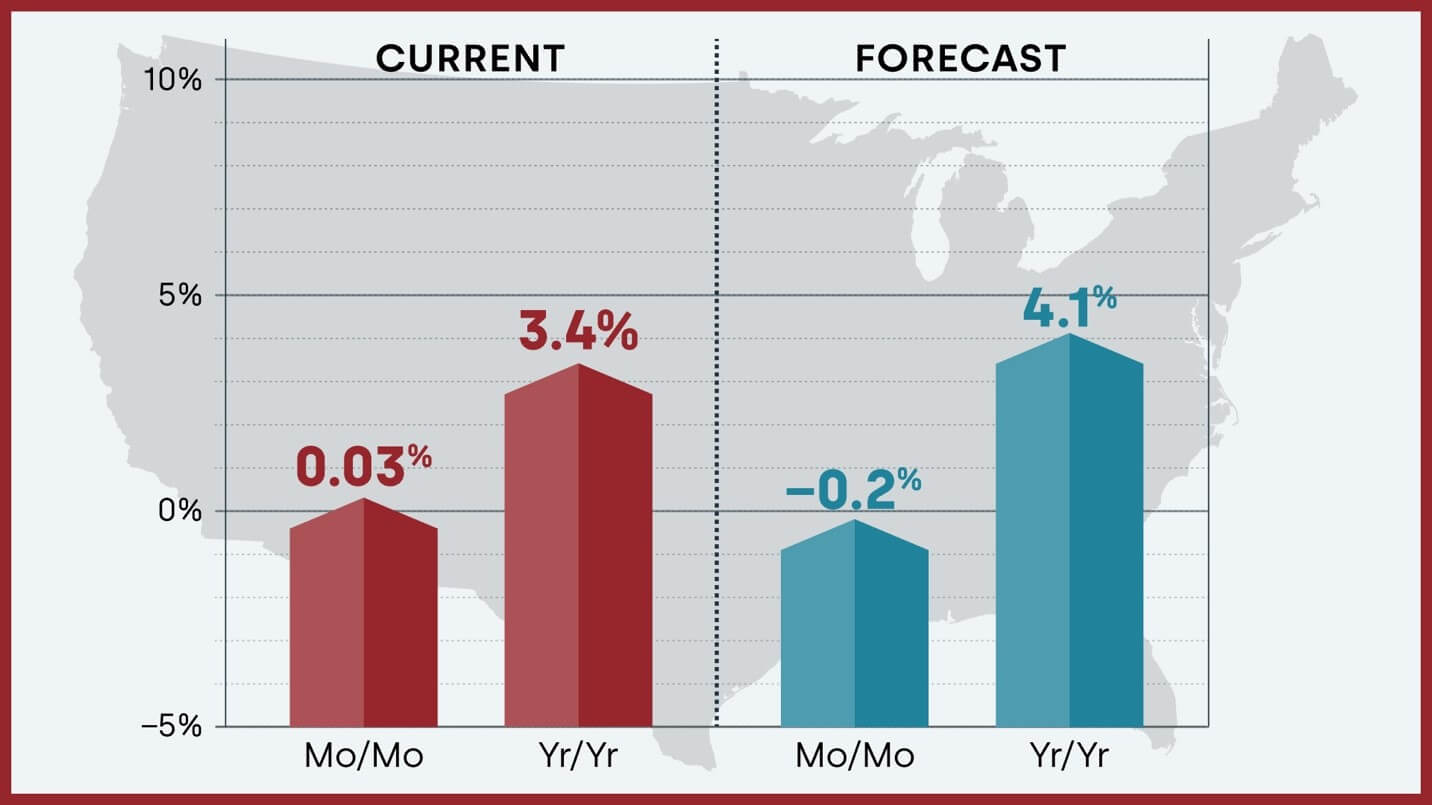
Are you trying to figure out what's going on with housing market prices in early 2025? You're not alone! The housing market can feel like a rollercoaster, and keeping up with the latest trends is crucial, whether you're buying, selling, or just keeping an eye on your investment. Here's the good news: Experts are predicting a 4.1% increase in home prices nationally by the end of 2025, compared to December 2024. Let’s take a deeper dive and see what's shaping the market right now and what we can expect in the months ahead.

Housing Market Forecast: CoreLogic Sees 4.1% Jump in Home Prices in 2025

A Look Back at 2024: Steady but Not Spectacular

2024 was a year of moderation in the housing market. We saw a bit more inventory than in the previous couple of years, which meant buyers had a few more options. However, demand remained somewhat soft due to factors like higher mortgage rates. As a result, home price growth was steady, but not as explosive as we saw during the peak of the pandemic.

According to CoreLogic, home prices nationwide, including distressed sales, increased by 3.4% year-over-year in December 2024. While that's a decent gain, it's a far cry from the double-digit appreciation we experienced just a few years ago. On a month-over-month basis, prices barely budged, increasing by only 0.03% in December.

Housing Market Forecast
Source: CoreLogic

Key Takeaways from 2024:

  • Moderate Growth: Home price appreciation slowed compared to previous years.
  • Inventory Improvement: Buyers had slightly more options available.
  • Regional Differences: Some areas experienced stronger growth than others.

What's Fueling the Forecast for 2025?

So, what's behind the projection of a 4.1% increase in home prices by the end of 2025? Several factors are at play:

  • The Spring Buying Season: The housing market tends to heat up in the spring, as families look to move before the new school year starts. This increased demand could put upward pressure on prices.
  • Limited Inventory: While inventory improved in 2024, it's still below historical averages in many markets. A shortage of homes for sale can drive prices higher.
  • Economic Factors: The overall health of the economy plays a role. If the economy remains stable or improves, it could boost consumer confidence and lead to more homebuying activity.

However, it's important to remember that these are just forecasts. Unforeseen events, like a sudden spike in interest rates or a major economic downturn, could certainly change the outlook.

Regional Variations: Where are Prices Headed?

The housing market is rarely uniform across the country. What's happening in one city or state can be very different from what's happening in another. In December 2024, we saw significant regional variations in home price growth:

  • Northeast Strong: States like Connecticut (up 7.8%) and New Jersey (up 7.7%) experienced some of the strongest year-over-year gains. This is largely due to limited inventory in these areas.
  • Hawaii and D.C. Lagging: On the other end of the spectrum, Hawaii and the District of Columbia saw home price declines of -1.1% and -0.7%, respectively.
  • Southern Markets Adjusting: Some Southern markets are readjusting to higher inventories and increased variable mortgage costs.
  • Mountain West Stabilizing: The Mountain West is trying to find stability after experiencing significant price swings in recent years.

Year-Over-Year Home Price Changes by State (December 2024)

State Change (%)
Connecticut 7.8
New Jersey 7.7
Hawaii -1.1
District of Columbia -0.7

Major Metro Areas: Winners and Losers

Looking at specific metro areas, we also see a mixed bag of results.

  • Chicago Leads the Pack: In December 2024, Chicago posted the highest year-over-year gain among the top 10 metros, at 5.6%.
  • Other Strong Performers: Boston, Washington, and Miami also saw solid price appreciation.
  • Phoenix Cooling Down: In contrast, Phoenix experienced more modest growth, reflecting the market's attempt to stabilize.

Year-Over-Year Home Price Changes by Select Metro Areas (December 2024)

Metro Area Change (%)
Chicago 5.6
Boston 4.8
Washington 4.4
Miami 4.0
Los Angeles 4.1
San Diego 3.2
Phoenix 2.5
Denver 1.7
Houston 3.4
Las Vegas 5.0

Markets at Risk: Where Prices Could Fall

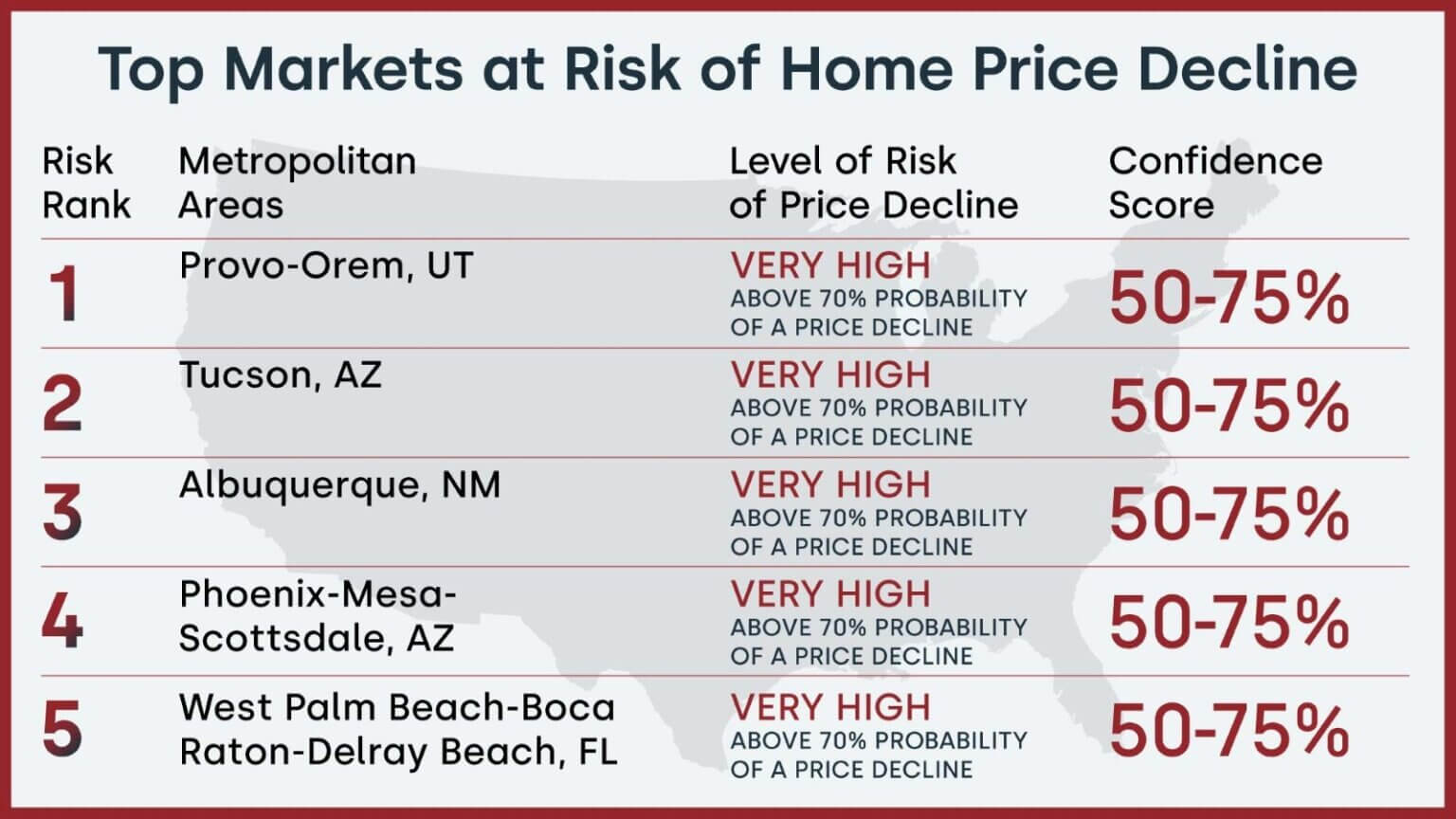
While most areas are expected to see price appreciation in 2025, some markets are considered to be at higher risk of a decline. CoreLogic's Market Risk Indicator (MRI) identifies areas where the housing market may be overheated or vulnerable to economic shocks.

According to the MRI, the following metro areas are at very high risk of home price declines over the next 12 months:

  • Provo-Orem, UT: This area has a 70%-plus probability of a price decline.
  • Tucson, AZ: Also at very high risk.
  • Albuquerque, NM: Another market to watch carefully.
  • Phoenix-Mesa-Scottsdale, AZ: Continuing its cooling trend.
  • West Palm Beach-Boca Raton-Delray Beach, FL: A surprise entry on this list.

Top Five U.S. Markets at Risk of Annual Price Declines (December 2024)

Rank Metropolitan Area Level of Risk of Price Decline Confidence Score
1 Provo-Orem, UT Very High (70%+) 50-75%
2 Tucson, AZ Very High (70%+) 50-75%
3 Albuquerque, NM Very High (70%+) 50-75%
4 Phoenix-Mesa-Scottsdale, AZ Very High (70%+) 50-75%
5 West Palm Beach-Boca Raton-Delray Beach, FL Very High (70%+) 50-75%

If you're considering buying or selling in one of these areas, it's especially important to do your research and consult with a local real estate professional.

housing market decline
Source: CoreLogic

Factors Beyond the Numbers: Wildfires and Tariffs

The numbers paint a general picture, but it's crucial to understand the real-world events that can influence the housing market. As CoreLogic's Chief Economist, Dr. Selma Hepp, points out, factors like proposed tariffs and natural disasters can have a significant impact.

  • Tariffs: The possibility of new tariffs on imported building materials could drive up construction costs, which would inevitably be passed on to homebuyers.
  • Wildfires: Events like the devastating wildfires in Los Angeles County in January 2025 can disrupt the supply chain, increase building material costs, and delay construction times.

These types of events highlight the interconnectedness of the housing market and the broader economy.

Recommended Read:

Weekly Housing Market Trends: What's Happening in 2025?

Will Trump Lower Mortgage Interest Rates in 2025?

US Housing Market Sees Worst Year for Sales Since 1995

Expert Opinion and My Own Thoughts

Dr. Selma Hepp's analysis offers valuable context to the data. She emphasizes the ongoing bifurcation across markets, with the Northeast experiencing strong growth due to low inventory, while Southern markets adjust to higher inventory and rising mortgage costs. I agree with her assessment that the housing market is likely to see a smaller overall increase in prices in 2025 compared to previous years.

In my opinion, while the forecast of a 4.1% increase is reasonable, it's crucial to remain cautious. The housing market is sensitive to changes in interest rates, economic conditions, and consumer sentiment. It would be smart to keep a close eye on these factors in the coming months.

What Does This Mean for You?

Whether you're a buyer, seller, or homeowner, here's what the February 2025 housing market insights suggest:

  • For Buyers: Be prepared for a potentially competitive spring buying season. Get pre-approved for a mortgage, work with a knowledgeable real estate agent, and be ready to act quickly when you find the right property.
  • For Sellers: If you're considering selling, now might be a good time to list your home. Prices are expected to continue rising in most areas, but don't overprice your property.
  • For Homeowners: Stay informed about local market conditions and be prepared to adjust your plans if necessary. Consider refinancing your mortgage if interest rates fall.

Final Thoughts

The housing market prices are complex, and it's vital to stay informed. While forecasts suggest a moderate increase in prices in 2025, it's essential to consider regional variations and potential risks. By understanding the factors that influence the market, you can make informed decisions about your real estate investments.

Work with Norada in 2025, Your Trusted Source for Investment

in the Top Housing Markets of the U.S.

Discover high-quality, ready-to-rent properties designed to deliver consistent returns.

Contact us today to expand your real estate portfolio with confidence.

Contact our investment counselors (No Obligation):

(800) 611-3060

Get Started Now 

Recommended Read:

  • New Tariffs Could Trigger Housing Market Slowdown in 2025
  • Housing Market Forecast 2025: Affordability Crisis Will Continue
  • Lower Mortgage Rates Will Reignite the Housing Demand in 2025
  • NAR Predicts 6% Mortgage Rates in 2025 Will Boost Housing Market
  • Housing Market Forecast for the Next 2 Years: 2024-2026
  • Housing Market Predictions for the Next 4 Years: 2025 to 2028
  • Housing Market Predictions for Next Year: Prices to Rise by 4.4%
  • Housing Market Predictions for 2025 and 2026 by NAR Chief
  • Real Estate Forecast Next 5 Years: Top 5 Predictions for Future
  • 2008 Forecaster Warns: Housing Market 2024 Needs This to Survive
  • Real Estate Forecast Next 10 Years: Will Prices Skyrocket?

Filed Under: Housing Market, Real Estate Market Tagged With: Housing Market, Housing Market 2025, housing market crash, Housing Market Forecast, housing market predictions, Housing Market Trends, Real Estate Market

Today’s Mortgage Rates February 7, 2025: Rates Are Dropping

February 7, 2025 by Marco Santarelli

Today's Mortgage Rates February 7, 2025: Rates Are Dropping

Good news for anyone thinking about buying a home or refinancing! As of today, February 7, 2025, mortgage rates are trending downward, currently sitting at approximately 6.50%. This dip offers a potential opportunity for homebuyers to save some money, but it's important to understand what's driving this change and what it means for you. Let's dive in!

Today's Mortgage Rates: February 7, 2025 – Rates Are Dropping!

Okay, so rates dropped. That's great, but what does that really mean? Mortgage rates aren't pulled out of thin air. They're influenced by a whole bunch of factors, kind of like how the weather is affected by everything from sunshine to wind speed. Here's the breakdown:

  • Current Average Rate: We're talking about an average of 6.50% for a 30-year fixed mortgage (Zillow). This is the benchmark most people use.
  • The Downward Trend: This is key! Last month, we were looking at around 6.71%. That little difference adds up over the life of a loan.
  • It's Not Just One Rate: There are different rates for different types of mortgages, which we'll get into later (FHA, VA, etc.).
  • Future Uncertainty: Even though rates are down now, it's impossible to predict the future. Factors like inflation and what the Federal Reserve decides to do could cause rates to change again.

Mortgage Rates Today (Accurate as of February 7, 2025)

Mortgage Type Average Rate Today
30-Year Fixed 6.57%
20-Year Fixed 6.32%
15-Year Fixed 5.86%
7/1 ARM 6.86%
5/1 ARM 6.91%
30-Year FHA 6.29%
30-Year VA 5.96%

Source: Zillow

The “Why” Behind the Rates: Factors at Play

So, what's making the rates do what they're doing? Here are the main culprits:

  1. Economic Indicators – The Big Picture: Things like inflation (how much prices are going up), job growth (are people getting jobs?), and the overall health of the economy have a HUGE impact on mortgage rates. A strong economy usually means higher rates, as the Federal Reserve tries to keep inflation under control.
  2. The Federal Reserve – The Puppet Master: The Fed, as it's often called, controls monetary policy. While they don't directly set mortgage rates, their actions heavily influence them. Remember those interest rate cuts we saw in 2024? That's the Fed trying to stimulate the economy. We are now in the stabilization phase for 2025 which could mean little volatility.
  3. Market Demand for Mortgage-Backed Securities – The Crowd's Opinion: This is a bit more complicated. Basically, investors buy bonds tied to mortgages. If lots of people want these bonds, it drives the price up, which can lead to lower interest rates. If demand is low, rates tend to go up.
  4. Your Personal Finances – The Final Say: Your credit score, how much debt you have, and your income all play a role in the mortgage rate you'll personally qualify for. The better your financial picture, the better rate you'll get.

My Take: I think the current dip in rates is a welcome sign, but it's important to be cautious. The economy is still a bit unpredictable, and things could change quickly. Don't just jump at the first rate you see. Shop around and compare offers from different lenders.

Crunching the Numbers: Monthly Payments Demystified

Okay, so a rate of 6.50% sounds good, but what does that mean in terms of your monthly payment? Let's look at some examples for different mortgage amounts:

What Your Monthly Payment Will Look Like

To help put things into perspective, let's walk through some real numbers with the interest rate at 6.50% over a 30-year period:

Scenario 1: $150,000 Mortgage

If you take out a mortgage for $150,000, your estimated monthly payment would come to $948.10

Scenario 2: $200,000 Mortgage

With a mortgage of $200,000, you can expect to pay around $1,264.13 on a monthly basis.

Scenario 3: $300,000 Mortgage

For those seeking a $300,000 mortgage, the monthly installment would be about $1,896.20.

Scenario 4: $400,000 Mortgage

Opting for a $400,000 mortgage means your monthly expense would total approximately $2,528.27.

Scenario 5: $500,000 Mortgage

Finally, a mortgage of $500,000 would result in monthly payments of around $3,160.34.

Important Note: These are just estimates. Your actual payment could be different depending on factors like property taxes, homeowner's insurance, and any fees associated with the loan.

Snapshot of the Mortgage Payments

Mortgage Amount Monthly Payment
$150,000 $948.10
$200,000 $1,264.13
$300,000 $1,896.20
$400,000 $2,528.27
$500,000 $3,160.34

My Tip: Don't just focus on the monthly payment! Look at the total cost of the loan over its entire life, including all the interest you'll pay. You might be surprised at how much it adds up!

Recommended Read:

Mortgage Rates Trends for February 6, 2025

Mortgage Rates Drop Ahead of Upcoming Labor Report on Friday

Will Trump Lower Mortgage Interest Rates in 2025?

30-Year Mortgage Rate Falls Below 7% to Close January 2025

Beyond the 30-Year Fixed: Exploring Your Mortgage Options

The 30-year fixed mortgage is the most popular for a reason – it offers stability. But it's not the only option. Here's a quick rundown of other types of mortgages:

  1. FHA Loans – Helping First-Time Buyers: Backed by the Federal Housing Administration, these loans are often easier to qualify for, especially for first-time homebuyers. They usually require a lower down payment and have more lenient credit score requirements.
  2. VA Loans – Serving Those Who Serve: Designed for military members and veterans, VA loans offer fantastic benefits, including potentially no down payment and lower interest rates.
  3. Adjustable-Rate Mortgages (ARMs) – A Bit of a Gamble: ARMs start with a lower interest rate than fixed-rate mortgages, but the rate can change after a set period (e.g., 5 years). This can be a good option if you plan to move or refinance before the rate adjusts, but it's riskier if you plan to stay in the home for the long haul.

My Opinion: I generally recommend a fixed-rate mortgage if you can afford it. The predictability gives you peace of mind. However, if you're confident you'll move or refinance within a few years, an ARM could save you money.

Peering into the Crystal Ball: The Market Outlook for 2025

Trying to predict the future of mortgage rates is like trying to predict the weather a year from now. It's almost impossible to be 100% accurate. However, we can make some educated guesses based on what we know today.

As rates have been trending downward, it is critical to consider the market as it may continue. If you are planning to refinance, it's important to evaluate the rate that will most benefit you and be on the look out.

My Prediction (with a grain of salt): I think we'll see rates fluctuate throughout 2025. Inflation is still a concern, and the Federal Reserve will likely be watching it closely. If inflation stays high, rates could stay elevated. If inflation starts to come down, we could see further declines.

The Bottom Line: Making the Right Decision for You

The drop in mortgage rates to around 6.50% on February 7, 2025, is good news, offering a potential opportunity for homebuyers and those looking to refinance. However, it's crucial to remember that this is just one snapshot in time. Mortgage rates are constantly changing, and they're influenced by a complex web of economic factors.

Before you make any decisions, take the time to:

  • Understand your own finances: What can you realistically afford?
  • Shop around for the best rates: Don't settle for the first offer you see.
  • Consider different mortgage options: A 30-year fixed might not be the best choice for everyone.
  • Talk to a financial advisor: Get personalized advice based on your situation.

Buying a home is a big deal. Take your time, do your research, and make a decision that's right for you.

Work with Norada in 2025, Your Trusted Source for

Real Estate Investing

With mortgage rates fluctuating, investing in turnkey real estate

can help you secure consistent returns.

Expand your portfolio confidently, even in a shifting interest rate environment.

Speak with our expert investment counselors (No Obligation):

(800) 611-3060

Get Started Now

Recommended Read:

  • Mortgage Rates Forecast for the Next 3 Years: 2025 to 2027
  • 30-Year Mortgage Rate Forecast for the Next 5 Years
  • 15-Year Mortgage Rate Forecast for the Next 5 Years
  • Why Are Mortgage Rates Going Up in 2025: Will Rates Drop?
  • Why Are Mortgage Rates So High and Predictions for 2025
  • NAR Predicts 6% Mortgage Rates in 2025 Will Boost Housing Market
  • Mortgage Rates Predictions for 2025: Expert Forecast
  • Will Mortgage Rates Ever Be 3% Again: Future Outlook
  • Mortgage Rates Predictions for Next 2 Years
  • Mortgage Rate Predictions for Next 5 Years
  • Mortgage Rate Predictions for 2025: Expert Forecast
  • Mortgage Rate Predictions: Why 2% and 3% Rates are Out of Reach
  • How Lower Mortgage Rates Can Save You Thousands?
  • How to Get a Low Mortgage Interest Rate?
  • Will Mortgage Rates Ever Be 4% Again?

Filed Under: Financing, Mortgage Tagged With: Interest Rate, mortgage, Mortgage Rate Trends, mortgage rates, Mortgage Rates Predictions, Mortgage Rates Today

Weekly Housing Market Trends: What’s Happening in 2025?

February 6, 2025 by Marco Santarelli

Weekly Housing Market Trends: What's Happening in 2025?

Are you trying to figure out what's happening with home prices, how many houses are up for sale, and how quickly they're selling? Well, you're in the right place. This Weekly Housing Market Trends and Forecast offers a concise update: as of late January 2025, median listing prices have generally declined by -0.5% year-over-year, new listings are up significantly by 9.3%, active inventory has increased by 26.1%, and homes are spending 3 days longer on the market compared to last year. Overall, it's a mixed bag, but there are definitely opportunities for both buyers and sellers to navigate this changing market.

Weekly Housing Market Trends: What's Happening in 2025?

Navigating the housing market can feel like trying to predict the weather – one minute it's sunny, and the next it's raining (mortgage rates!). But don't worry, I am here to break down the latest trends in the housing market with data released by Realtor.com. I'll cover what these trends mean for you, whether you're looking to buy your first home, sell your current one, or just keep an eye on the real estate world.

What's Been Happening Lately? An Overview

Let's start with a quick summary of the key trends I am seeing in the housing market right now:

  • Home prices: Generally flat or declining compared to last year.
  • New listings: Significantly up, giving buyers more choices.
  • Inventory: Much higher than last year, meaning more homes are available.
  • Time on market: Homes are sitting on the market a bit longer, but the gap is narrowing.

These are the highlights, but let's dig a little deeper to see what's really going on.

Breaking Down the Numbers: Key Trends in Detail

Let's dive into the four key areas that are shaping the housing market right now.

1. Home Prices: Are They Finally Coming Down?

One of the biggest questions on everyone's mind is: are home prices finally dropping? For the past 35 weeks, the national median home listing price has been either flat or decreasing compared to the same time last year. That's a pretty long stretch! As of the week ending January 25, 2025, the median listing price fell by -0.5% year-over-year.

But here's where it gets interesting. A lot of the decline we're seeing is because there are more smaller, less expensive homes on the market. When you look at the median listing price per square foot (which takes the size of the home into account), it's actually up 1.3% compared to last year.

Even though prices per square foot are still up, the rate of increase has slowed down since May 2024. This could mean that even though smaller homes are available, softening price growth means that when mortgage rates do decline below current levels, homes become more affordable relative to last year. It’s a signal that the market might be stabilizing.

What does this mean for you?

  • Buyers: There are more affordable homes available, especially smaller ones. If you're willing to downsize or consider a smaller property, you might find a good deal. And softening price growth means that when mortgage rates do decline below current levels, homes become more affordable relative to last year.
  • Sellers: You need to be realistic about pricing. Don't expect to get the same prices that homes were fetching a year or two ago. Consider making your home more attractive to buyers by making necessary repairs and upgrades.

2. New Listings: A Breath of Fresh Air for Buyers?

For months, one of the biggest problems in the housing market has been a lack of homes for sale. But that's starting to change! New listings – the number of sellers putting their homes on the market – increased by 9.3% compared to last year for the week ending January 25, 2025. In fact, the final three weeks of January saw double-digit increases in new listings.

Why is this happening? There are a couple of possibilities:

  • Sellers who were waiting for lower mortgage rates: When mortgage rates dipped slightly in the fall of 2024, some sellers may have decided it was time to list their homes.
  • The “lock-in effect” is easing: Many homeowners have been hesitant to sell because they're locked into low mortgage rates. But life happens, and sometimes people need to move regardless of interest rates.
  • People adapting to life changes: Some buyers are needing to finally adapt to life changes.

What does this mean for you?

  • Buyers: You have more choices than you did a few months ago. Take advantage of this by carefully researching different neighborhoods and homes to find the best fit for your needs and budget.
  • Sellers: You'll face more competition. To stand out, make sure your home is in tip-top shape and priced competitively.

3. Inventory: More Homes on the Market Than Last Year

Not only are more homes being listed, but the overall inventory of homes for sale is also up significantly. For the 64th week in a row, there are more homes for sale than there were at the same time last year. As of January 25, 2025, active listings were up a whopping 26.1% compared to last year. This is a good sign that the market may be starting to cool down.

What does this mean for you?

  • Buyers: You have more leverage. With more homes to choose from, you're in a better position to negotiate price and terms.
  • Sellers: It's more important than ever to make your home stand out. Pay attention to curb appeal, make necessary repairs, and stage your home to appeal to the broadest range of buyers.

4. Time on Market: Are Homes Selling Faster or Slower?

For months, homes have been sitting on the market longer than they were last year. As of January 25, 2025, homes were spending 3 days longer on the market compared to the same time last year. This is the 40th consecutive week that homes have taken longer to sell.

However, there's a glimmer of hope. The gap in time on market has been shrinking since November. This suggests that while inventory is up, buyer demand is also holding steady.

What does this mean for you?

  • Buyers: You have a little more time to make a decision, but don't wait too long. If you find a home you love, it's still important to act quickly.
  • Sellers: Be patient. It might take a little longer to sell your home than it would have a year or two ago. Don't be afraid to adjust your price if you're not getting offers.

Data Summary: A Quick Look at the Numbers

Here's a table summarizing the key data points as of January 2025:

Metric Year-over-Year Change
Median Listing Prices -0.5%
New Listings +9.3%
Active Listings +26.1%
Time on Market +3 days

Recommended Read:

Will Trump Lower Mortgage Interest Rates in 2025?

US Housing Market Sees Worst Year for Sales Since 1995

My Thoughts and Predictions

Based on these trends, here's what I think we can expect to see in the housing market in the coming weeks and months:

  • Prices will likely remain relatively stable: I don't expect to see huge price drops, but I also don't think prices will start rising dramatically anytime soon.
  • Inventory will continue to increase: As more sellers enter the market, buyers will have even more choices.
  • Mortgage rates will be a key factor: If mortgage rates stay high, the market will likely remain sluggish. But if rates start to come down, we could see a surge in buyer demand.
  • The market will vary by location: Some areas will be hotter than others. It's important to pay attention to what's happening in your local market.

Overall, I think the housing market is in a period of transition. It's not as crazy as it was a year or two ago, but it's not a buyer's market either. It's a more balanced market, where both buyers and sellers need to be smart and strategic.

Tips for Buyers and Sellers

No matter which side of the transaction you're on, here are some tips to help you navigate the current housing market:

For Buyers:

  • Get pre-approved for a mortgage: This will show sellers that you're a serious buyer.
  • Work with a good real estate agent: A knowledgeable agent can help you find the right home and negotiate a fair price.
  • Be patient: Don't feel pressured to buy the first home you see. Take your time and find the right fit.
  • Don't be afraid to negotiate: With more homes on the market, you have more leverage to negotiate price and terms.

For Sellers:

  • Price your home competitively: Don't overprice your home. Work with your agent to determine a fair market value.
  • Make necessary repairs: Fix any obvious problems before you list your home.
  • Stage your home: Make your home look as attractive as possible to potential buyers.
  • Be flexible: Be willing to negotiate with buyers.

The Bottom Line

The housing market is always changing, and it can be tough to keep up with the latest trends. But by staying informed and working with experienced professionals, you can successfully navigate the market, whether you're buying or selling.

I hope this article has been helpful. Happy house hunting (or selling)!

Work with Norada in 2025, Your Trusted Source for Investment

in the Top Housing Markets of the U.S.

Discover high-quality, ready-to-rent properties designed to deliver consistent returns.

Contact us today to expand your real estate portfolio with confidence.

Contact our investment counselors (No Obligation):

(800) 611-3060

Get Started Now 

Recommended Read:

  • New Tariffs Could Trigger Housing Market Slowdown in 2025
  • Housing Market Forecast 2025: Affordability Crisis Will Continue
  • Lower Mortgage Rates Will Reignite the Housing Demand in 2025
  • NAR Predicts 6% Mortgage Rates in 2025 Will Boost Housing Market
  • Housing Market Forecast for the Next 2 Years: 2024-2026
  • Housing Market Predictions for the Next 4 Years: 2025 to 2028
  • Housing Market Predictions for Next Year: Prices to Rise by 4.4%
  • Housing Market Predictions for 2025 and 2026 by NAR Chief
  • Real Estate Forecast Next 5 Years: Top 5 Predictions for Future
  • 2008 Forecaster Warns: Housing Market 2024 Needs This to Survive
  • Real Estate Forecast Next 10 Years: Will Prices Skyrocket?

Filed Under: Housing Market, Real Estate Market Tagged With: Housing Market, Housing Market 2025, housing market crash, Housing Market Forecast, housing market predictions, Housing Market Trends, Real Estate Market

  • « Previous Page
  • 1
  • …
  • 214
  • 215
  • 216
  • 217
  • 218
  • …
  • 379
  • Next Page »

Real Estate

  • Birmingham
  • Cape Coral
  • Charlotte
  • Chicago

Quick Links

  • Markets
  • Membership
  • Notes
  • Contact Us

Blog Posts

  • Today’s Mortgage Rates, July 28: Rates Drop Slightly Across the Board, 30-Year is at 6.62%
    July 28, 2026Marco Santarelli
  • 20 Best U.S. Cities to Invest in Real Estate in 2026
    July 28, 2026Marco Santarelli
  • Mortgage Rates Today, July 28, 2026: 30-Year Refinance Rate Drops by 6 Basis Points
    July 28, 2026Marco Santarelli

Contact

Norada Real Estate Investments 30251 Golden Lantern, Suite E-261 Laguna Niguel, CA 92677

(949) 218-6668
(800) 611-3060
BBB
  • Terms of Use
  • |
  • Privacy Policy
  • |
  • Testimonials
  • |
  • Suggestions?
  • |
  • Home

Copyright 2018 Norada Real Estate Investments

Loading...