Norada Real Estate Investments

  • Home
  • Markets
  • Properties
  • Membership
  • Podcast
  • Learn
  • About
  • Contact

Archives for February 2025

Edmond OK Housing Market: Prices and Forecast 2025-2026

February 7, 2025 by Marco Santarelli

Edmond OK Housing Market

The Edmond housing market is showing signs of being somewhat competitive in January 2025. While homes are selling faster than they were a year ago, the overall picture suggests a market that's adjusting to changes in interest rates and buyer demand. Read on to find a more comprehensive breakdown of what these trends mean for you if you're looking to buy or sell a home in Edmond, Oklahoma.

It's no secret that navigating the real estate world can feel like trying to solve a complicated puzzle. As someone who keeps a close eye on the local housing market, I'm here to break down the latest Edmond housing market trends and help you understand what's really happening. We'll look at everything from home prices and sales to housing supply and the impact of mortgage rates. Let's dive in!

Current Edmond Housing Market Trends

According to Redfin, here's a summary of the Edmond housing market:

Home Sales

  • In December 2024, there were 146 homes sold in Edmond, which is a 28.1% increase compared to the 114 homes sold in December of the previous year. That's quite a jump! It indicates there's still activity in the Edmond market, even with higher interest rates.

Home Prices

  • The median sale price of a home in Edmond in December 2024 was $389,220.
  • This is a significant 17.5% increase compared to the median sale price last year.
  • The median sale price per square foot in Edmond is $168, up 3.1% since last year.

Are Home Prices Dropping?

From the data we see, home prices in Edmond are not currently dropping. In fact, they're up considerably compared to last year. However, it's important to remember that real estate is local. What's happening nationally or even in Oklahoma City may not be exactly what's happening in your desired Edmond neighborhood. It's crucial to work with a local real estate agent who can give you hyper-local insights.

Comparison with Current National Median Price

How does Edmond stack up against the rest of the country?

  • The national median home price is $407,500 (December 2024)
  • Edmond's median sale price is 10% lower than the national average.

This suggests that Edmond continues to offer a relatively affordable housing option compared to many other parts of the United States. While Edmond's prices are up 17.5% year-over-year, the national median price only saw a 6% rise year-over-year.

Housing Supply

Redfin data doesn't explicitly state the current housing supply in Edmond. However, the fact that homes are selling faster than last year suggests that the inventory is still relatively tight. It's also crucial to consider the type of homes available. Are they mostly new construction, or are there plenty of existing homes on the market? A real estate agent can provide the best insights into the specific types of properties available in Edmond right now.

Is It a Buyer's or Seller's Housing Market?

  • Homes in Edmond are receiving 2 offers on average.
  • Homes sell in approximately 52 days.
  • Homes sell for about 2% below list price.

Based on these factors, I'd say Edmond is leaning towards being a slightly competitive market overall. It's not a screaming seller's market where homes are flying off the shelves for over asking price, but it's also not a buyer's market where buyers have all the negotiating power. It seems like a balanced market where both buyers and sellers need to be strategic.

To further illustrate, consider this breakdown:

Metric Edmond, OK (Dec 2024) Change YoY
Median Sale Price $389,220 +17.5%
Number of Homes Sold 146 +28.1%
Median Days on Market 52 +27 days
Sale-to-List Price 98.0% -0.33 pt
Homes Sold Above List Price 14.4% -8.4 pt
Homes With Price Drops 16.6% -2.0 pt

Market Trends

Several key trends are shaping the Edmond housing market right now:

  • Rising Home Prices: As the data clearly shows, home prices in Edmond have been on the rise. This is likely due to a combination of factors, including strong local economy, population growth, and relatively limited housing supply.
  • Increased Sales Volume: The number of homes sold is up significantly compared to last year, indicating sustained buyer interest.
  • Slightly Longer Time on Market: While homes are still selling, they're taking a bit longer to do so compared to the rapid pace of the past few years. This suggests that the market is cooling down slightly.
  • Sellers Negotiating More: The sale-to-list price ratio being below 100% indicates that buyers are having slightly more success negotiating prices down from the original list price.

Impact of High Mortgage Rates

There's no getting around it: mortgage rates play a huge role in the housing market. Currently, with rates hovering around 7%, it's impacting affordability for many potential buyers. Here's how:

  • Reduced Buyer Demand: Higher rates mean higher monthly payments, which can price some buyers out of the market or cause them to scale back their budget.
  • Slower Price Appreciation: While prices are still rising in Edmond, the pace of growth may be tempered by higher mortgage rates.
  • Increased Importance of Negotiation: With less competition, buyers have more room to negotiate on price and terms.

Impact of Migration

Migration also has a significant impact on housing trends.

  • 18% of Edmond homebuyers searched to move out of Edmond, while 82% looked to stay within the metropolitan area.
  • Across the nation, 0.31% of homebuyers searched to move into Edmond from outside metros.
  • Dallas homebuyers searched to move into Edmond more than any other metro followed by Los Angeles and Miami.
  • McAlester was the most popular destination among Edmond homebuyers followed by Nashville and Pensacola.

This information indicates that migration out of Edmond is very low, which should translate into continued demand in Edmond.

What This Means for Buyers

If you're a buyer in the Edmond housing market, here's what you should keep in mind:

  • Get Pre-Approved: Knowing your budget is more important than ever with rising interest rates. Get pre-approved for a mortgage so you know exactly how much you can afford.
  • Be Patient and Strategic: The market is competitive, but not as frantic as it was a year or two ago. Take your time, do your research, and don't feel pressured to overpay.
  • Find a Great Real Estate Agent: A local agent who knows Edmond inside and out can be your greatest asset. They can help you find the right property, negotiate effectively, and navigate the complexities of the market.

What This Means for Sellers

If you're thinking of selling your home in Edmond, here's what you need to know:

  • Price Strategically: Don't overprice your home based on past market conditions. Work with your agent to determine a competitive list price that will attract buyers in today's market.
  • Make Your Home Show Ready: Presentation matters. Make sure your home is clean, well-maintained, and decluttered before listing it.
  • Be Prepared to Negotiate: Buyers have more leverage than they did a year ago, so be prepared to negotiate on price and terms.

Edmond OK Housing Market Forecast 2025-2026

Predicting the housing market can feel like peering into a crystal ball. For Edmond, OK, several factors and trends can provide insight into whether the market will crash or boom in the coming years.

Will Edmond Housing Market Boom?

  1. Economic Stability:
    • Edmond's economy is relatively stable, driven by sectors like education, health care, and technology. A stable economy can foster confidence and spending in the housing market.
  2. Population Growth:
    • As of recent reports, Edmond continues to witness steady population growth. More people looking to settle in Edmond can drive demand for housing, potentially pushing prices up.
  3. Low Housing Supply:
    • Over the past year, the market has been heavily tilted in favor of sellers due to low inventory levels. If this trend continues, combined with sustained demand, property values may see a rise.
  4. Quality of Living:
    • Edmond is renowned for its high quality of life, excellent schools, safe neighborhoods, and abundant amenities. These factors are continually attracting new residents, fueling housing demand.

Will The Edmond Housing Market Crash?

  1. Interest Rates:
    • The Federal Reserve's interest rate adjustments can influence mortgage rates. Significant rate hikes could make borrowing more expensive, potentially cooling down the housing market.
  2. Economic Uncertainty:
    • Broader economic challenges, such as inflation or market instability, can reduce consumer confidence and spending power, including in the housing sector. Any economic downturn would likely impact housing demand.
  3. Increased Housing Supply:
    • Should there be a significant increase in housing construction and inventory, the balance could shift from a seller’s to a buyer’s market. This shift might temper ongoing price increases.
  4. Affordability Issues:
    • If home prices continue rising faster than incomes, affordability could become a significant barrier for many potential buyers. This issue could dampen demand and result in a market correction.

In summary, the Edmond, OK housing market is poised for moderate, sustained growth rather than dramatic booms or busts. Several factors, ranging from economic stability and population growth to evolving interest rates, will influence the market's trajectory. While the immediate future may not herald a significant increase in prices, nor is a dramatic downturn likely. Buyers and sellers can expect a relatively balanced market with stable growth prospects.

Investing in the Edmond OK Real Estate Market?

1. Population Growth and Trends

Edmond, OK, has experienced consistent population growth in recent years, contributing to a robust real estate market. The city's appeal has led to an influx of residents, creating a positive environment for real estate investment.

2. Economy and Jobs

  • Thriving Economy: Edmond boasts a thriving economy, supported by diverse industries and a strong job market.
  • Employment Opportunities: The presence of major employers, including educational institutions and healthcare facilities, provides stability and attracts a steady workforce.

3. Livability and Other Factors

  • Livability: Edmond is renowned for its excellent schools, safe neighborhoods, and quality of life, making it an attractive location for residents and investors alike.
  • Community Amenities: The city offers a range of amenities, including parks, restaurants, and shopping, enhancing its overall appeal.

4. Rental Property Market Size and Growth

The rental property market in Edmond is substantial, and its growth potential is notable for investors seeking consistent returns. Factors contributing to this include:

  • High Demand: The city's growing population and employment opportunities contribute to a high demand for rental properties.
  • Rental Yield: Favorable rental yield trends make Edmond an attractive destination for investors seeking income-generating properties.

5. Other Factors Related to Real Estate Investing

  • Market Stability: Edmond's stable real estate market, coupled with positive growth indicators, provides a sense of security for investors.
  • Future Projections: Ongoing developments and city initiatives point towards a promising future, enhancing the long-term viability of real estate investments.

Considering these factors, investing in the Edmond OK real estate market presents a compelling opportunity for those seeking a thriving and stable investment environment.

Read More:

  • Oklahoma Housing Market: Trends and Forecast 2025-2026
  • Oklahoma City Housing Market: Trends and Forecast 2025
  • Average Rent Prices in America: A State-by-State Breakdown
  • Housing Predictions 2025 by Warren Buffett's Berkshire Hathaway

Filed Under: Housing Market, Real Estate Market Tagged With: Edmond, Housing Market

Housing Market Forecast: CoreLogic Sees 4.1% Jump in Home Prices in 2025

February 7, 2025 by Marco Santarelli

Housing Market Forecast: CoreLogic Sees 4.1% Jump in Home Prices in 2025

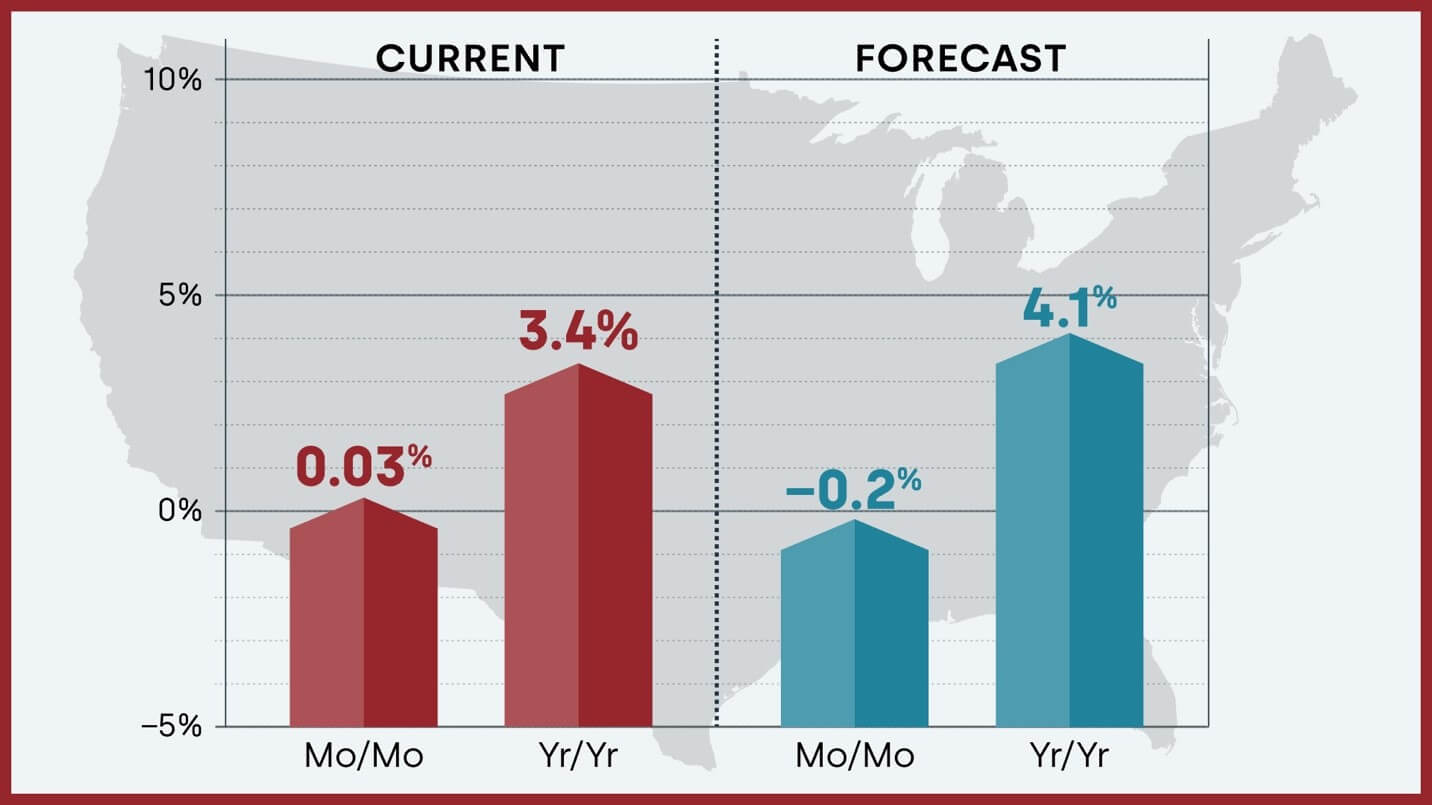
Are you trying to figure out what's going on with housing market prices in early 2025? You're not alone! The housing market can feel like a rollercoaster, and keeping up with the latest trends is crucial, whether you're buying, selling, or just keeping an eye on your investment. Here's the good news: Experts are predicting a 4.1% increase in home prices nationally by the end of 2025, compared to December 2024. Let’s take a deeper dive and see what's shaping the market right now and what we can expect in the months ahead.

Housing Market Forecast: CoreLogic Sees 4.1% Jump in Home Prices in 2025

A Look Back at 2024: Steady but Not Spectacular

2024 was a year of moderation in the housing market. We saw a bit more inventory than in the previous couple of years, which meant buyers had a few more options. However, demand remained somewhat soft due to factors like higher mortgage rates. As a result, home price growth was steady, but not as explosive as we saw during the peak of the pandemic.

According to CoreLogic, home prices nationwide, including distressed sales, increased by 3.4% year-over-year in December 2024. While that's a decent gain, it's a far cry from the double-digit appreciation we experienced just a few years ago. On a month-over-month basis, prices barely budged, increasing by only 0.03% in December.

Housing Market Forecast
Source: CoreLogic

Key Takeaways from 2024:

  • Moderate Growth: Home price appreciation slowed compared to previous years.
  • Inventory Improvement: Buyers had slightly more options available.
  • Regional Differences: Some areas experienced stronger growth than others.

What's Fueling the Forecast for 2025?

So, what's behind the projection of a 4.1% increase in home prices by the end of 2025? Several factors are at play:

  • The Spring Buying Season: The housing market tends to heat up in the spring, as families look to move before the new school year starts. This increased demand could put upward pressure on prices.
  • Limited Inventory: While inventory improved in 2024, it's still below historical averages in many markets. A shortage of homes for sale can drive prices higher.
  • Economic Factors: The overall health of the economy plays a role. If the economy remains stable or improves, it could boost consumer confidence and lead to more homebuying activity.

However, it's important to remember that these are just forecasts. Unforeseen events, like a sudden spike in interest rates or a major economic downturn, could certainly change the outlook.

Regional Variations: Where are Prices Headed?

The housing market is rarely uniform across the country. What's happening in one city or state can be very different from what's happening in another. In December 2024, we saw significant regional variations in home price growth:

  • Northeast Strong: States like Connecticut (up 7.8%) and New Jersey (up 7.7%) experienced some of the strongest year-over-year gains. This is largely due to limited inventory in these areas.
  • Hawaii and D.C. Lagging: On the other end of the spectrum, Hawaii and the District of Columbia saw home price declines of -1.1% and -0.7%, respectively.
  • Southern Markets Adjusting: Some Southern markets are readjusting to higher inventories and increased variable mortgage costs.
  • Mountain West Stabilizing: The Mountain West is trying to find stability after experiencing significant price swings in recent years.

Year-Over-Year Home Price Changes by State (December 2024)

State Change (%)
Connecticut 7.8
New Jersey 7.7
Hawaii -1.1
District of Columbia -0.7

Major Metro Areas: Winners and Losers

Looking at specific metro areas, we also see a mixed bag of results.

  • Chicago Leads the Pack: In December 2024, Chicago posted the highest year-over-year gain among the top 10 metros, at 5.6%.
  • Other Strong Performers: Boston, Washington, and Miami also saw solid price appreciation.
  • Phoenix Cooling Down: In contrast, Phoenix experienced more modest growth, reflecting the market's attempt to stabilize.

Year-Over-Year Home Price Changes by Select Metro Areas (December 2024)

Metro Area Change (%)
Chicago 5.6
Boston 4.8
Washington 4.4
Miami 4.0
Los Angeles 4.1
San Diego 3.2
Phoenix 2.5
Denver 1.7
Houston 3.4
Las Vegas 5.0

Markets at Risk: Where Prices Could Fall

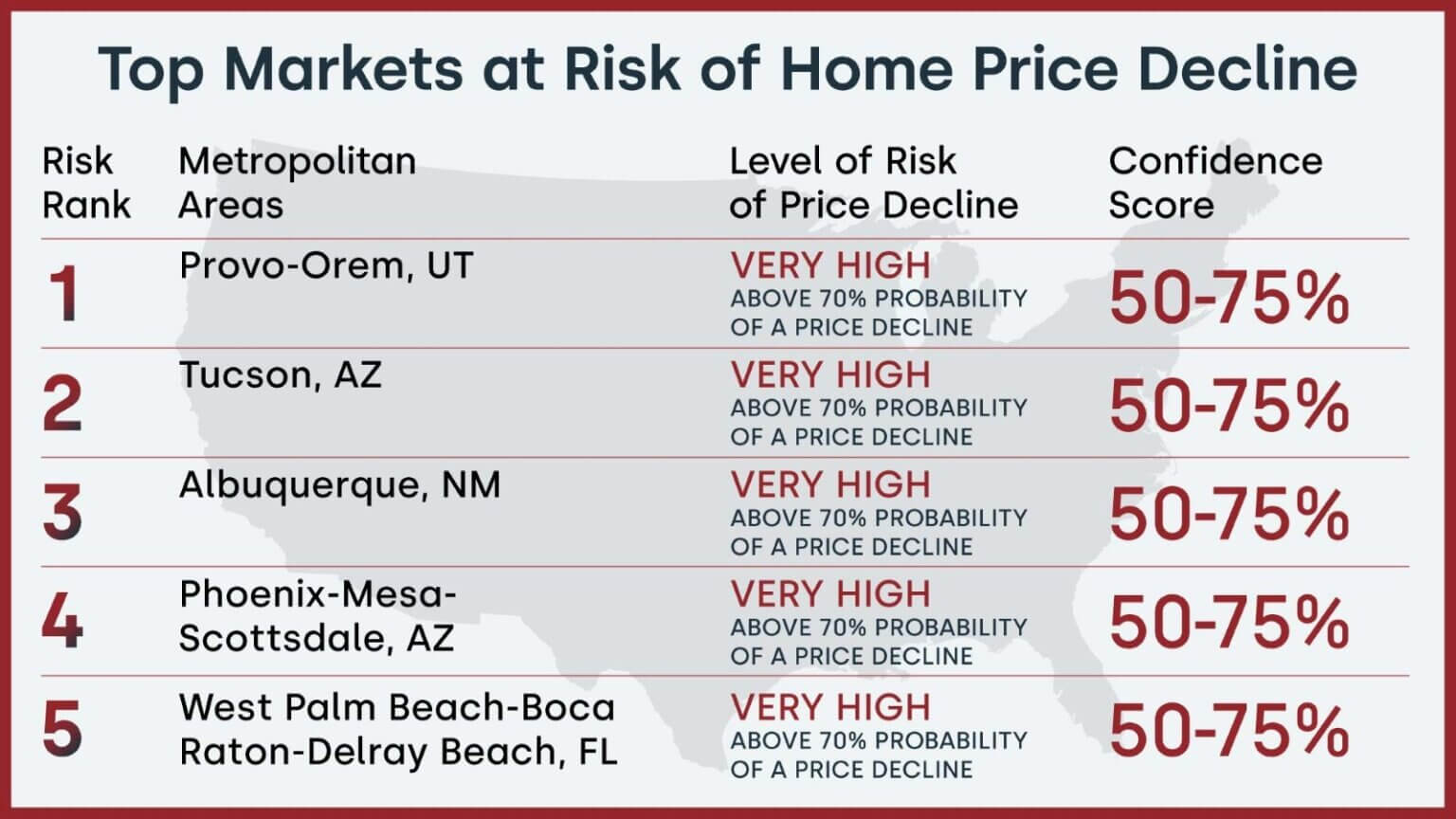
While most areas are expected to see price appreciation in 2025, some markets are considered to be at higher risk of a decline. CoreLogic's Market Risk Indicator (MRI) identifies areas where the housing market may be overheated or vulnerable to economic shocks.

According to the MRI, the following metro areas are at very high risk of home price declines over the next 12 months:

  • Provo-Orem, UT: This area has a 70%-plus probability of a price decline.
  • Tucson, AZ: Also at very high risk.
  • Albuquerque, NM: Another market to watch carefully.
  • Phoenix-Mesa-Scottsdale, AZ: Continuing its cooling trend.
  • West Palm Beach-Boca Raton-Delray Beach, FL: A surprise entry on this list.

Top Five U.S. Markets at Risk of Annual Price Declines (December 2024)

Rank Metropolitan Area Level of Risk of Price Decline Confidence Score
1 Provo-Orem, UT Very High (70%+) 50-75%
2 Tucson, AZ Very High (70%+) 50-75%
3 Albuquerque, NM Very High (70%+) 50-75%
4 Phoenix-Mesa-Scottsdale, AZ Very High (70%+) 50-75%
5 West Palm Beach-Boca Raton-Delray Beach, FL Very High (70%+) 50-75%

If you're considering buying or selling in one of these areas, it's especially important to do your research and consult with a local real estate professional.

housing market decline
Source: CoreLogic

Factors Beyond the Numbers: Wildfires and Tariffs

The numbers paint a general picture, but it's crucial to understand the real-world events that can influence the housing market. As CoreLogic's Chief Economist, Dr. Selma Hepp, points out, factors like proposed tariffs and natural disasters can have a significant impact.

  • Tariffs: The possibility of new tariffs on imported building materials could drive up construction costs, which would inevitably be passed on to homebuyers.
  • Wildfires: Events like the devastating wildfires in Los Angeles County in January 2025 can disrupt the supply chain, increase building material costs, and delay construction times.

These types of events highlight the interconnectedness of the housing market and the broader economy.

Recommended Read:

Weekly Housing Market Trends: What's Happening in 2025?

Will Trump Lower Mortgage Interest Rates in 2025?

US Housing Market Sees Worst Year for Sales Since 1995

Expert Opinion and My Own Thoughts

Dr. Selma Hepp's analysis offers valuable context to the data. She emphasizes the ongoing bifurcation across markets, with the Northeast experiencing strong growth due to low inventory, while Southern markets adjust to higher inventory and rising mortgage costs. I agree with her assessment that the housing market is likely to see a smaller overall increase in prices in 2025 compared to previous years.

In my opinion, while the forecast of a 4.1% increase is reasonable, it's crucial to remain cautious. The housing market is sensitive to changes in interest rates, economic conditions, and consumer sentiment. It would be smart to keep a close eye on these factors in the coming months.

What Does This Mean for You?

Whether you're a buyer, seller, or homeowner, here's what the February 2025 housing market insights suggest:

  • For Buyers: Be prepared for a potentially competitive spring buying season. Get pre-approved for a mortgage, work with a knowledgeable real estate agent, and be ready to act quickly when you find the right property.
  • For Sellers: If you're considering selling, now might be a good time to list your home. Prices are expected to continue rising in most areas, but don't overprice your property.
  • For Homeowners: Stay informed about local market conditions and be prepared to adjust your plans if necessary. Consider refinancing your mortgage if interest rates fall.

Final Thoughts

The housing market prices are complex, and it's vital to stay informed. While forecasts suggest a moderate increase in prices in 2025, it's essential to consider regional variations and potential risks. By understanding the factors that influence the market, you can make informed decisions about your real estate investments.

Work with Norada in 2025, Your Trusted Source for Investment

in the Top Housing Markets of the U.S.

Discover high-quality, ready-to-rent properties designed to deliver consistent returns.

Contact us today to expand your real estate portfolio with confidence.

Contact our investment counselors (No Obligation):

(800) 611-3060

Get Started Now 

Recommended Read:

  • New Tariffs Could Trigger Housing Market Slowdown in 2025
  • Housing Market Forecast 2025: Affordability Crisis Will Continue
  • Lower Mortgage Rates Will Reignite the Housing Demand in 2025
  • NAR Predicts 6% Mortgage Rates in 2025 Will Boost Housing Market
  • Housing Market Forecast for the Next 2 Years: 2024-2026
  • Housing Market Predictions for the Next 4 Years: 2025 to 2028
  • Housing Market Predictions for Next Year: Prices to Rise by 4.4%
  • Housing Market Predictions for 2025 and 2026 by NAR Chief
  • Real Estate Forecast Next 5 Years: Top 5 Predictions for Future
  • 2008 Forecaster Warns: Housing Market 2024 Needs This to Survive
  • Real Estate Forecast Next 10 Years: Will Prices Skyrocket?

Filed Under: Housing Market, Real Estate Market Tagged With: Housing Market, Housing Market 2025, housing market crash, Housing Market Forecast, housing market predictions, Housing Market Trends, Real Estate Market

Today’s Mortgage Rates February 7, 2025: Rates Are Dropping

February 7, 2025 by Marco Santarelli

Today's Mortgage Rates February 7, 2025: Rates Are Dropping

Good news for anyone thinking about buying a home or refinancing! As of today, February 7, 2025, mortgage rates are trending downward, currently sitting at approximately 6.50%. This dip offers a potential opportunity for homebuyers to save some money, but it's important to understand what's driving this change and what it means for you. Let's dive in!

Today's Mortgage Rates: February 7, 2025 – Rates Are Dropping!

Okay, so rates dropped. That's great, but what does that really mean? Mortgage rates aren't pulled out of thin air. They're influenced by a whole bunch of factors, kind of like how the weather is affected by everything from sunshine to wind speed. Here's the breakdown:

  • Current Average Rate: We're talking about an average of 6.50% for a 30-year fixed mortgage (Zillow). This is the benchmark most people use.
  • The Downward Trend: This is key! Last month, we were looking at around 6.71%. That little difference adds up over the life of a loan.
  • It's Not Just One Rate: There are different rates for different types of mortgages, which we'll get into later (FHA, VA, etc.).
  • Future Uncertainty: Even though rates are down now, it's impossible to predict the future. Factors like inflation and what the Federal Reserve decides to do could cause rates to change again.

Mortgage Rates Today (Accurate as of February 7, 2025)

Mortgage Type Average Rate Today
30-Year Fixed 6.57%
20-Year Fixed 6.32%
15-Year Fixed 5.86%
7/1 ARM 6.86%
5/1 ARM 6.91%
30-Year FHA 6.29%
30-Year VA 5.96%

Source: Zillow

The “Why” Behind the Rates: Factors at Play

So, what's making the rates do what they're doing? Here are the main culprits:

  1. Economic Indicators – The Big Picture: Things like inflation (how much prices are going up), job growth (are people getting jobs?), and the overall health of the economy have a HUGE impact on mortgage rates. A strong economy usually means higher rates, as the Federal Reserve tries to keep inflation under control.
  2. The Federal Reserve – The Puppet Master: The Fed, as it's often called, controls monetary policy. While they don't directly set mortgage rates, their actions heavily influence them. Remember those interest rate cuts we saw in 2024? That's the Fed trying to stimulate the economy. We are now in the stabilization phase for 2025 which could mean little volatility.
  3. Market Demand for Mortgage-Backed Securities – The Crowd's Opinion: This is a bit more complicated. Basically, investors buy bonds tied to mortgages. If lots of people want these bonds, it drives the price up, which can lead to lower interest rates. If demand is low, rates tend to go up.
  4. Your Personal Finances – The Final Say: Your credit score, how much debt you have, and your income all play a role in the mortgage rate you'll personally qualify for. The better your financial picture, the better rate you'll get.

My Take: I think the current dip in rates is a welcome sign, but it's important to be cautious. The economy is still a bit unpredictable, and things could change quickly. Don't just jump at the first rate you see. Shop around and compare offers from different lenders.

Crunching the Numbers: Monthly Payments Demystified

Okay, so a rate of 6.50% sounds good, but what does that mean in terms of your monthly payment? Let's look at some examples for different mortgage amounts:

What Your Monthly Payment Will Look Like

To help put things into perspective, let's walk through some real numbers with the interest rate at 6.50% over a 30-year period:

Scenario 1: $150,000 Mortgage

If you take out a mortgage for $150,000, your estimated monthly payment would come to $948.10

Scenario 2: $200,000 Mortgage

With a mortgage of $200,000, you can expect to pay around $1,264.13 on a monthly basis.

Scenario 3: $300,000 Mortgage

For those seeking a $300,000 mortgage, the monthly installment would be about $1,896.20.

Scenario 4: $400,000 Mortgage

Opting for a $400,000 mortgage means your monthly expense would total approximately $2,528.27.

Scenario 5: $500,000 Mortgage

Finally, a mortgage of $500,000 would result in monthly payments of around $3,160.34.

Important Note: These are just estimates. Your actual payment could be different depending on factors like property taxes, homeowner's insurance, and any fees associated with the loan.

Snapshot of the Mortgage Payments

Mortgage Amount Monthly Payment
$150,000 $948.10
$200,000 $1,264.13
$300,000 $1,896.20
$400,000 $2,528.27
$500,000 $3,160.34

My Tip: Don't just focus on the monthly payment! Look at the total cost of the loan over its entire life, including all the interest you'll pay. You might be surprised at how much it adds up!

Recommended Read:

Mortgage Rates Trends for February 6, 2025

Mortgage Rates Drop Ahead of Upcoming Labor Report on Friday

Will Trump Lower Mortgage Interest Rates in 2025?

30-Year Mortgage Rate Falls Below 7% to Close January 2025

Beyond the 30-Year Fixed: Exploring Your Mortgage Options

The 30-year fixed mortgage is the most popular for a reason – it offers stability. But it's not the only option. Here's a quick rundown of other types of mortgages:

  1. FHA Loans – Helping First-Time Buyers: Backed by the Federal Housing Administration, these loans are often easier to qualify for, especially for first-time homebuyers. They usually require a lower down payment and have more lenient credit score requirements.
  2. VA Loans – Serving Those Who Serve: Designed for military members and veterans, VA loans offer fantastic benefits, including potentially no down payment and lower interest rates.
  3. Adjustable-Rate Mortgages (ARMs) – A Bit of a Gamble: ARMs start with a lower interest rate than fixed-rate mortgages, but the rate can change after a set period (e.g., 5 years). This can be a good option if you plan to move or refinance before the rate adjusts, but it's riskier if you plan to stay in the home for the long haul.

My Opinion: I generally recommend a fixed-rate mortgage if you can afford it. The predictability gives you peace of mind. However, if you're confident you'll move or refinance within a few years, an ARM could save you money.

Peering into the Crystal Ball: The Market Outlook for 2025

Trying to predict the future of mortgage rates is like trying to predict the weather a year from now. It's almost impossible to be 100% accurate. However, we can make some educated guesses based on what we know today.

As rates have been trending downward, it is critical to consider the market as it may continue. If you are planning to refinance, it's important to evaluate the rate that will most benefit you and be on the look out.

My Prediction (with a grain of salt): I think we'll see rates fluctuate throughout 2025. Inflation is still a concern, and the Federal Reserve will likely be watching it closely. If inflation stays high, rates could stay elevated. If inflation starts to come down, we could see further declines.

The Bottom Line: Making the Right Decision for You

The drop in mortgage rates to around 6.50% on February 7, 2025, is good news, offering a potential opportunity for homebuyers and those looking to refinance. However, it's crucial to remember that this is just one snapshot in time. Mortgage rates are constantly changing, and they're influenced by a complex web of economic factors.

Before you make any decisions, take the time to:

  • Understand your own finances: What can you realistically afford?
  • Shop around for the best rates: Don't settle for the first offer you see.
  • Consider different mortgage options: A 30-year fixed might not be the best choice for everyone.
  • Talk to a financial advisor: Get personalized advice based on your situation.

Buying a home is a big deal. Take your time, do your research, and make a decision that's right for you.

Work with Norada in 2025, Your Trusted Source for

Real Estate Investing

With mortgage rates fluctuating, investing in turnkey real estate

can help you secure consistent returns.

Expand your portfolio confidently, even in a shifting interest rate environment.

Speak with our expert investment counselors (No Obligation):

(800) 611-3060

Get Started Now

Recommended Read:

  • Mortgage Rates Forecast for the Next 3 Years: 2025 to 2027
  • 30-Year Mortgage Rate Forecast for the Next 5 Years
  • 15-Year Mortgage Rate Forecast for the Next 5 Years
  • Why Are Mortgage Rates Going Up in 2025: Will Rates Drop?
  • Why Are Mortgage Rates So High and Predictions for 2025
  • NAR Predicts 6% Mortgage Rates in 2025 Will Boost Housing Market
  • Mortgage Rates Predictions for 2025: Expert Forecast
  • Will Mortgage Rates Ever Be 3% Again: Future Outlook
  • Mortgage Rates Predictions for Next 2 Years
  • Mortgage Rate Predictions for Next 5 Years
  • Mortgage Rate Predictions for 2025: Expert Forecast
  • Mortgage Rate Predictions: Why 2% and 3% Rates are Out of Reach
  • How Lower Mortgage Rates Can Save You Thousands?
  • How to Get a Low Mortgage Interest Rate?
  • Will Mortgage Rates Ever Be 4% Again?

Filed Under: Financing, Mortgage Tagged With: Interest Rate, mortgage, Mortgage Rate Trends, mortgage rates, Mortgage Rates Predictions, Mortgage Rates Today

Weekly Housing Market Trends: What’s Happening in 2025?

February 6, 2025 by Marco Santarelli

Weekly Housing Market Trends: What's Happening in 2025?

Are you trying to figure out what's happening with home prices, how many houses are up for sale, and how quickly they're selling? Well, you're in the right place. This Weekly Housing Market Trends and Forecast offers a concise update: as of late January 2025, median listing prices have generally declined by -0.5% year-over-year, new listings are up significantly by 9.3%, active inventory has increased by 26.1%, and homes are spending 3 days longer on the market compared to last year. Overall, it's a mixed bag, but there are definitely opportunities for both buyers and sellers to navigate this changing market.

Weekly Housing Market Trends: What's Happening in 2025?

Navigating the housing market can feel like trying to predict the weather – one minute it's sunny, and the next it's raining (mortgage rates!). But don't worry, I am here to break down the latest trends in the housing market with data released by Realtor.com. I'll cover what these trends mean for you, whether you're looking to buy your first home, sell your current one, or just keep an eye on the real estate world.

What's Been Happening Lately? An Overview

Let's start with a quick summary of the key trends I am seeing in the housing market right now:

  • Home prices: Generally flat or declining compared to last year.
  • New listings: Significantly up, giving buyers more choices.
  • Inventory: Much higher than last year, meaning more homes are available.
  • Time on market: Homes are sitting on the market a bit longer, but the gap is narrowing.

These are the highlights, but let's dig a little deeper to see what's really going on.

Breaking Down the Numbers: Key Trends in Detail

Let's dive into the four key areas that are shaping the housing market right now.

1. Home Prices: Are They Finally Coming Down?

One of the biggest questions on everyone's mind is: are home prices finally dropping? For the past 35 weeks, the national median home listing price has been either flat or decreasing compared to the same time last year. That's a pretty long stretch! As of the week ending January 25, 2025, the median listing price fell by -0.5% year-over-year.

But here's where it gets interesting. A lot of the decline we're seeing is because there are more smaller, less expensive homes on the market. When you look at the median listing price per square foot (which takes the size of the home into account), it's actually up 1.3% compared to last year.

Even though prices per square foot are still up, the rate of increase has slowed down since May 2024. This could mean that even though smaller homes are available, softening price growth means that when mortgage rates do decline below current levels, homes become more affordable relative to last year. It’s a signal that the market might be stabilizing.

What does this mean for you?

  • Buyers: There are more affordable homes available, especially smaller ones. If you're willing to downsize or consider a smaller property, you might find a good deal. And softening price growth means that when mortgage rates do decline below current levels, homes become more affordable relative to last year.
  • Sellers: You need to be realistic about pricing. Don't expect to get the same prices that homes were fetching a year or two ago. Consider making your home more attractive to buyers by making necessary repairs and upgrades.

2. New Listings: A Breath of Fresh Air for Buyers?

For months, one of the biggest problems in the housing market has been a lack of homes for sale. But that's starting to change! New listings – the number of sellers putting their homes on the market – increased by 9.3% compared to last year for the week ending January 25, 2025. In fact, the final three weeks of January saw double-digit increases in new listings.

Why is this happening? There are a couple of possibilities:

  • Sellers who were waiting for lower mortgage rates: When mortgage rates dipped slightly in the fall of 2024, some sellers may have decided it was time to list their homes.
  • The “lock-in effect” is easing: Many homeowners have been hesitant to sell because they're locked into low mortgage rates. But life happens, and sometimes people need to move regardless of interest rates.
  • People adapting to life changes: Some buyers are needing to finally adapt to life changes.

What does this mean for you?

  • Buyers: You have more choices than you did a few months ago. Take advantage of this by carefully researching different neighborhoods and homes to find the best fit for your needs and budget.
  • Sellers: You'll face more competition. To stand out, make sure your home is in tip-top shape and priced competitively.

3. Inventory: More Homes on the Market Than Last Year

Not only are more homes being listed, but the overall inventory of homes for sale is also up significantly. For the 64th week in a row, there are more homes for sale than there were at the same time last year. As of January 25, 2025, active listings were up a whopping 26.1% compared to last year. This is a good sign that the market may be starting to cool down.

What does this mean for you?

  • Buyers: You have more leverage. With more homes to choose from, you're in a better position to negotiate price and terms.
  • Sellers: It's more important than ever to make your home stand out. Pay attention to curb appeal, make necessary repairs, and stage your home to appeal to the broadest range of buyers.

4. Time on Market: Are Homes Selling Faster or Slower?

For months, homes have been sitting on the market longer than they were last year. As of January 25, 2025, homes were spending 3 days longer on the market compared to the same time last year. This is the 40th consecutive week that homes have taken longer to sell.

However, there's a glimmer of hope. The gap in time on market has been shrinking since November. This suggests that while inventory is up, buyer demand is also holding steady.

What does this mean for you?

  • Buyers: You have a little more time to make a decision, but don't wait too long. If you find a home you love, it's still important to act quickly.
  • Sellers: Be patient. It might take a little longer to sell your home than it would have a year or two ago. Don't be afraid to adjust your price if you're not getting offers.

Data Summary: A Quick Look at the Numbers

Here's a table summarizing the key data points as of January 2025:

Metric Year-over-Year Change
Median Listing Prices -0.5%
New Listings +9.3%
Active Listings +26.1%
Time on Market +3 days

Recommended Read:

Will Trump Lower Mortgage Interest Rates in 2025?

US Housing Market Sees Worst Year for Sales Since 1995

My Thoughts and Predictions

Based on these trends, here's what I think we can expect to see in the housing market in the coming weeks and months:

  • Prices will likely remain relatively stable: I don't expect to see huge price drops, but I also don't think prices will start rising dramatically anytime soon.
  • Inventory will continue to increase: As more sellers enter the market, buyers will have even more choices.
  • Mortgage rates will be a key factor: If mortgage rates stay high, the market will likely remain sluggish. But if rates start to come down, we could see a surge in buyer demand.
  • The market will vary by location: Some areas will be hotter than others. It's important to pay attention to what's happening in your local market.

Overall, I think the housing market is in a period of transition. It's not as crazy as it was a year or two ago, but it's not a buyer's market either. It's a more balanced market, where both buyers and sellers need to be smart and strategic.

Tips for Buyers and Sellers

No matter which side of the transaction you're on, here are some tips to help you navigate the current housing market:

For Buyers:

  • Get pre-approved for a mortgage: This will show sellers that you're a serious buyer.
  • Work with a good real estate agent: A knowledgeable agent can help you find the right home and negotiate a fair price.
  • Be patient: Don't feel pressured to buy the first home you see. Take your time and find the right fit.
  • Don't be afraid to negotiate: With more homes on the market, you have more leverage to negotiate price and terms.

For Sellers:

  • Price your home competitively: Don't overprice your home. Work with your agent to determine a fair market value.
  • Make necessary repairs: Fix any obvious problems before you list your home.
  • Stage your home: Make your home look as attractive as possible to potential buyers.
  • Be flexible: Be willing to negotiate with buyers.

The Bottom Line

The housing market is always changing, and it can be tough to keep up with the latest trends. But by staying informed and working with experienced professionals, you can successfully navigate the market, whether you're buying or selling.

I hope this article has been helpful. Happy house hunting (or selling)!

Work with Norada in 2025, Your Trusted Source for Investment

in the Top Housing Markets of the U.S.

Discover high-quality, ready-to-rent properties designed to deliver consistent returns.

Contact us today to expand your real estate portfolio with confidence.

Contact our investment counselors (No Obligation):

(800) 611-3060

Get Started Now 

Recommended Read:

  • New Tariffs Could Trigger Housing Market Slowdown in 2025
  • Housing Market Forecast 2025: Affordability Crisis Will Continue
  • Lower Mortgage Rates Will Reignite the Housing Demand in 2025
  • NAR Predicts 6% Mortgage Rates in 2025 Will Boost Housing Market
  • Housing Market Forecast for the Next 2 Years: 2024-2026
  • Housing Market Predictions for the Next 4 Years: 2025 to 2028
  • Housing Market Predictions for Next Year: Prices to Rise by 4.4%
  • Housing Market Predictions for 2025 and 2026 by NAR Chief
  • Real Estate Forecast Next 5 Years: Top 5 Predictions for Future
  • 2008 Forecaster Warns: Housing Market 2024 Needs This to Survive
  • Real Estate Forecast Next 10 Years: Will Prices Skyrocket?

Filed Under: Housing Market, Real Estate Market Tagged With: Housing Market, Housing Market 2025, housing market crash, Housing Market Forecast, housing market predictions, Housing Market Trends, Real Estate Market

Today’s Mortgage Rates February 6, 2025: Rates Continue to Drop

February 6, 2025 by Marco Santarelli

Today's Mortgage Rates February 6, 2025: Rates Dip Slightly

As of February 6, 2025, mortgage rates have seen a slight decrease, offering potential relief to homebuyers amidst high borrowing costs. The average 30-year fixed mortgage rate is currently 6.96%, down 0.03% from last week, while the 15-year fixed mortgage rate stands at 6.21%, a drop of 0.05%. This latest trend may provide some comfort for individuals and families looking to secure a mortgage in today's challenging housing landscape.

Today's Mortgage Rates February 6, 2025: Rates Continue to Drop

Key Takeaways

  • 30-Year Fixed Mortgage Rate: 6.96%
  • 15-Year Fixed Mortgage Rate: 6.21%
  • Jumbo Mortgage Rate: 6.95%
  • 5/1 Adjustable Rate Mortgage: 6.27%
  • 10-Year Fixed Rate: 5.98%
  • Discounts in rates may offer homebuyers increased affordability.

Today's Average Mortgage Rates

These current mortgage rates illustrate a modest shift that could impact potential buyers. Here's a breakdown of the average rates for February 6, 2025:

Mortgage Type Interest Rate Change
30-Year Fixed 6.96% -0.03%
15-Year Fixed 6.21% -0.05%
30-Year Fixed Jumbo 6.95% -0.01%
5/1 Adjustable Rate Mortgage (ARM) 6.27% -0.03%
10-Year Fixed 5.98% -0.09%

(Source: Bankrate)

These fluctuations indicate a gradual trend that could help prospective homebuyers. For reference, you can always check the latest data on mortgage rates through credible sites such as Bankrate for reliable updates.

What’s Behind Today’s Rates?

The mortgage rate environment is directly influenced by several economic factors, including inflation, federal interest rates, and general market conditions. After mortgage rates hit rock-bottom during the pandemic, the surge in inflation beginning in late 2021 prompted the Federal Reserve to increase interest rates persistently throughout 2024.

Even now, as we enter February 2025, the expectation is that the Federal Reserve will continue its cautious approach. The combination of consistent high inflation, coupled with uncertainties about potential government policies, contributes to a firm stance against significant reductions in mortgage rates. Experts believe that for rates to start significantly declining, they need to stabilize in the range of 5.5% or lower, a notion echoed by many economists within the industry.

Mortgage Rate Forecast for 2025

Moving forward into 2025, predictions vary and show some degree of caution. Many analysts anticipate that average mortgage rates will likely hover between 6% and 7% throughout the year. Government-sponsored organizations like Fannie Mae and the Mortgage Bankers Association standardly project a continuation of these high rates, with average forecasts suggesting a landing around 6.4% by the end of the year.

This sense of stability, however, doesn’t necessarily indicate improvement in housing affordability, as potential homebuyers still have to navigate sluggish wage growth and inflated housing prices.

Projected Average Rate Timeline
6.4% End of 2025
6.0% Mid-2025

The steady rise in rates or variations depends significantly on economic indicators, including unemployment rates and consumer spending trends. As these factors change, they will undoubtedly affect mortgage affordability.

Understanding the Different Types of Mortgages

Mortgages come in various forms, each catering to different homebuyer needs. Here are some of the key types you should know about:

1. 30-Year Fixed Mortgage

This type of mortgage offers fixed monthly payments over 30 years, providing stability for long-term homeowners. While you might pay a higher overall interest amount compared to shorter-term loans, this option is the most popular for buyers seeking lower monthly payments.

2. 15-Year Fixed Mortgage

A 15-year mortgage allows borrowers to pay off their homes in half the time, leading to a lower total interest than a 30-year fixed mortgage. The trade-off, however, is a substantially higher monthly payment, making it more suitable for those who can afford it and wish to build equity faster.

3. 5/1 Adjustable Rate Mortgages (ARMs)

5/1 ARMs are another option, featuring a lower introductory interest rate for the first five years, after which the rate adjusts annually based on market indices. This type is favorable for those planning to move or refinance within the initial fixed-rate period, as it can substantially lower costs.

A deeper dive into these loan types can inform your decision based on your particular financial situation and plans for homeownership.

Calculating Monthly Payments

Understanding how different mortgage amounts affect monthly payments helps buyers grasp their financial commitment. Below, we'll explore the estimated monthly payments based on current rates for various mortgage amounts. This understanding is crucial for planning your budget.

  1. Monthly Payment on a $150,000 Mortgage
    • Given the 30-year fixed rate at 6.96%, the monthly payment would typically be around $993. This amount offers a manageable option for first-time homebuyers looking to enter the market without overextending financially.
  2. Monthly Payment on a $200,000 Mortgage
    • With a principal of $200,000, your monthly payment might be roughly $1,309. This payment reflects the adjusted rate and can represent a good balance between the size of the loan and the income needed to support it.
  3. Monthly Payment on a $300,000 Mortgage
    • At $300,000, the estimated monthly payment increases to about $1,964. Families requiring more space or looking in highly sought-after areas might find this rate aligns better with market conditions.
  4. Monthly Payment on a $400,000 Mortgage
    • A larger investment of $400,000 may yield a payment of around $2,619. For buyers in urban settings where homes come at a premium, being aware of this monthly commitment is critical.
  5. Monthly Payment on a $500,000 Mortgage
    • For those considering a $500,000 mortgage, expect to pay around $3,273 monthly. This option is often pursued by those seeking larger options or homes in upscale neighborhoods.
Mortgage Amount Estimated Monthly Payment
$150,000 $993
$200,000 $1,309
$300,000 $1,964
$400,000 $2,619
$500,000 $3,273

Understanding these payment estimates can help inform your purchasing decisions and make it easier to find a home that fits within your financial means.

Recommended Read:

Mortgage Rates Trends for February 5, 2025

Mortgage Rates Drop Ahead of Upcoming Labor Report on Friday

Will Trump Lower Mortgage Interest Rates in 2025?

30-Year Mortgage Rate Falls Below 7% to Close January 2025

Current Market Context

The current mortgage market is reflecting not just the immediate trends but also long-term implications of rate changes. As rates have remained elevated for more extended periods, the overall demand for homes can fluctuate. Many buyers may delay purchasing decisions, waiting for rates to stabilize further or drop lower. However, there exists a tension in the market: as homes become increasingly unaffordable, many in the labor market are seeking more comfortable arrangements, making the prospect of homeownership seem distant.

Consider the Bigger Picture

While lower mortgage rates can improve affordability, several other factors must be considered when buying a home:

  • Home Prices: Even with lower rates, elevated home prices can create challenges for buyers, necessitating careful financial planning.
  • Credit Scores: Buyers with higher credit scores typically have access to better rates, underscoring the importance of maintaining good credit.
  • Down Payments: A larger down payment decreases the loan amount and affects mortgage costs positively.

These components are critical in navigating the complex journey of home buying.

Work with Norada in 2025, Your Trusted Source for

Real Estate Investing

With mortgage rates fluctuating, investing in turnkey real estate

can help you secure consistent returns.

Expand your portfolio confidently, even in a shifting interest rate environment.

Speak with our expert investment counselors (No Obligation):

(800) 611-3060

Get Started Now

Recommended Read:

  • Mortgage Rates Forecast for the Next 3 Years: 2025 to 2027
  • 30-Year Mortgage Rate Forecast for the Next 5 Years
  • 15-Year Mortgage Rate Forecast for the Next 5 Years
  • Why Are Mortgage Rates Going Up in 2025: Will Rates Drop?
  • Why Are Mortgage Rates So High and Predictions for 2025
  • NAR Predicts 6% Mortgage Rates in 2025 Will Boost Housing Market
  • Mortgage Rates Predictions for 2025: Expert Forecast
  • Will Mortgage Rates Ever Be 3% Again: Future Outlook
  • Mortgage Rates Predictions for Next 2 Years
  • Mortgage Rate Predictions for Next 5 Years
  • Mortgage Rate Predictions for 2025: Expert Forecast
  • Mortgage Rate Predictions: Why 2% and 3% Rates are Out of Reach
  • How Lower Mortgage Rates Can Save You Thousands?
  • How to Get a Low Mortgage Interest Rate?
  • Will Mortgage Rates Ever Be 4% Again?

Filed Under: Financing, Mortgage Tagged With: Interest Rate, mortgage, Mortgage Rate Trends, mortgage rates, Mortgage Rates Predictions, Mortgage Rates Today

10 Texas Cities Where Home Prices Are Predicted to Drop in 2025

February 6, 2025 by Marco Santarelli

10 Texas Cities Where Home Prices Are Expected to Fall (2024)

Have you been dreaming of owning a home in the Lone Star State? Texas has long been a popular destination, attracting people from across the country with its robust economy, thriving job market, and fantastic weather. But, like many other parts of the country, the Texas housing market is also experiencing shifts, and 10 Texas cities where home prices are expected to fall in 2025 are emerging as a potential opportunity for buyers.

While some areas are experiencing continued growth, the predictions suggest a slight downturn in specific cities by the end of 2025, creating a potentially advantageous environment for those looking to buy. Let's delve into these cities and explore the factors that might lead to these predicted price declines.

10 Texas Cities Where Home Prices Are Expected to Fall in 2025

Before we jump into the data, let's address why this information is crucial. Real estate is hyper-local. What's happening in Austin is vastly different than what's happening in a smaller town in West Texas. Understanding these micro-trends can save you thousands of dollars, whether you're buying, selling, or simply trying to gauge the health of your local economy. Think of this article as your early warning system, helping you make informed decisions in a complex market.

The Data: Forecasts Explained

So, where does this prediction come from? Zillow regularly publishes forecasts that estimate future home values across the country. Zillow's data gives us a peek into the potential direction of the housing market. It's important to remember that these are forecasts, not guarantees. Many things could change between now and 2025, affecting these projections. However, they offer valuable insight that shouldn’t be ignored.

The data used for this article comes from Zillow's MSA (Metropolitan Statistical Area) Forecast for January 2025, and the forecast until December 2025, compared against a baseline of December 31, 2024.

Top 10 Texas Areas Anticipating Home Price Declines in 2025

Here's a breakdown of the 10 Texas cities where Zillow predicts the most significant potential home price drops by December 2025:

City Projected Home Price Change (Dec 2024 – Dec 2025)
Big Spring, TX -9.1%
Pecos, TX -8.9%
Sweetwater, TX -7.6%
Raymondville, TX -6.8%
Alice, TX -6.0%
Zapata, TX -5.3%
Lamesa, TX -5.0%
Beeville, TX -3.7%
Vernon, TX -3.5%
Rio Grande City, TX -2.9%

Diving Deeper: What's Driving These Projections?

Now, let's consider what might be driving these projected declines. It's rarely a single factor, but a combination of economic and demographic forces:

  • Oil and Gas Industry Fluctuations: Several of these cities (Big Spring, Pecos, Sweetwater, Lamesa) are heavily reliant on the oil and gas industry. Fluctuations in oil prices can have a significant impact on local economies and, subsequently, housing markets. When the oil industry struggles, jobs are lost, and people move away, leading to a decrease in demand for housing.
  • Population Shifts: Some smaller towns in Texas are experiencing population decline as people move to larger cities for better job opportunities and amenities. This can lead to an oversupply of housing, putting downward pressure on prices.
  • Limited Job Diversity: A lack of diverse employment opportunities can make a city more vulnerable to economic downturns. If a city's economy is primarily based on one or two industries, a decline in those industries can have a ripple effect throughout the entire community, including the housing market.
  • Interest Rates: This has a major effect, and if these forecasts turn out to be inaccurate, I would bet that it's because they failed to properly estimate interest rates.

A Closer Look at a Few Key Cities

  • Big Spring, TX: With the most significant projected drop, Big Spring's fortunes are closely tied to the Permian Basin oil boom. While oil prices have recovered somewhat, the long-term outlook remains uncertain, impacting investor confidence and home values.
  • Pecos, TX: Similar to Big Spring, Pecos is also heavily dependent on the oil and gas industry. The decline in drilling activity and related services could contribute to a decrease in housing demand.
  • Sweetwater, TX: Sweetwater's economy is somewhat diversified with wind energy, but the oil industry still plays a vital role. The projected decline suggests that the benefits of wind energy may not be enough to offset the challenges in the oil sector.

What Does This Mean for Homeowners?

If you own a home in one of these cities, the projected price declines might be concerning. Here's what you should consider:

  • Don't Panic: These are just forecasts, and the actual outcome could be different.
  • Assess Your Situation: Are you planning to sell soon? If so, you might want to consider listing your home sooner rather than later to capitalize on current prices.
  • Improve Your Home's Appeal: Make necessary repairs and upgrades to make your home more attractive to potential buyers. Focus on improvements that offer a good return on investment.
  • Consider Renting: If you're not in a hurry to sell, you could consider renting out your property until the market improves.
  • Consult a Real Estate Professional: A local real estate agent can provide you with valuable insights into the current market conditions and help you develop a strategy that's right for you.

Opportunities for Buyers?

For potential buyers, these projected price declines could present opportunities:

  • Lower Prices: Obviously, if prices do drop, you'll be able to purchase a home for less than you would today.
  • Increased Negotiating Power: As the market cools, buyers gain more negotiating power. You might be able to negotiate a lower price, get the seller to pay for closing costs, or request repairs.
  • Investment Potential: If you believe in the long-term potential of these cities, you could view this as an opportunity to invest in real estate at a lower price point. However, be aware of the risks.

Important Considerations: The Limitations of Forecasts

It's crucial to remember that these forecasts are based on current data and assumptions. Unforeseen events, such as a major economic recession, changes in interest rates, or unexpected population shifts, could significantly alter the trajectory of the housing market. As someone who's followed real estate for years, I've learned one thing: predicting the future with certainty is impossible.

Moreover, Zillow's forecasts are based on MSAs (Metropolitan Statistical Areas), which can encompass a larger geographic area than just the city itself. Therefore, the actual price changes within a specific neighborhood might vary.

Beyond the Numbers: The Human Element

Real estate is more than just numbers and statistics. It's about people, families, and communities. These potential price declines can have a real impact on people's lives, especially those who are already struggling financially. It's important to approach this information with empathy and understanding.

Final Thoughts: Staying Informed and Making Smart Decisions

The Texas housing market is constantly evolving. Staying informed about the latest trends and forecasts is essential for making smart decisions, whether you're buying, selling, or simply interested in the health of your local economy. Use this information as a starting point for your own research, and always consult with qualified professionals before making any major real estate decisions.

Work with Norada in 2025, Your Trusted Source for

Real Estate Investing in “Texas”

Discover high-quality, ready-to-rent properties designed to deliver consistent returns.

Contact us today to expand your real estate portfolio with confidence.

Contact our investment counselors (No Obligation):

(800) 611-3060

Get Started Now 

Recommended Read:

  • Is Texas the Next Big Thing? 10 Reasons Texas is the Future
  • Will the Texas Housing Market Crash in 2025?
  • Texas Housing Market: Prices, Trends, Predictions 2025
  • 10 Cheapest Places to Live in Texas
  • Texas Housing Market Cools Down: Boon for First-Time Buyers?
  • Worst Places to Live in Texas in 2025: Avoid These Texas Towns

Filed Under: Growth Markets, Housing Market Tagged With: Housing Market, Texas

10 Cheapest Places to Live in Texas (2025)

February 6, 2025 by Marco Santarelli

Cheapest Places to Live in Texas

If you're looking for a place to live in Texas that won't break the bank, you might be wondering what are the cheapest cities to live in the Lone Star State. Texas is a huge and diverse state, with plenty of options for different lifestyles, climates, cultures, and amenities. Whether you prefer a bustling urban center, a quiet suburban town, or a rural retreat, you can find it in Texas.

However, not all places in the Texas housing market are equally affordable. Some of the major cities, like Houston, Dallas, and Austin, have high costs of living that can make it hard to save money or enjoy a comfortable lifestyle. That's why we've compiled a list of the 10 cheapest places to live in Texas as of 2023, based on data from various sources. These cities have low median home prices, reasonable rents, and low costs of living for groceries, utilities, transportation, healthcare, and other expenses.

Of course, affordability is not the only factor to consider when choosing a place to live. You also want to look at the quality of life, the safety, the education, the employment opportunities, and the entertainment options that each city offers. That's why we've also included some highlights of what makes each city unique and attractive for potential residents.

10 Cheapest Places to Live in Texas

El Paso

El Paso is a border city that sits at the intersection of Texas, New Mexico, and Mexico. It has a population of about 683,000 people and a rich cultural heritage that blends Mexican and American influences. El Paso has a vibrant art scene, with museums, galleries, theaters, and festivals. It also has plenty of outdoor activities to enjoy, such as hiking, biking, camping, and water sports. El Paso has a low crime rate and a family-friendly atmosphere. It also has a strong economy that is driven by trade, manufacturing, military, education, and healthcare.

  • Median home price: $130,900
  • Average rent for a 1-bedroom apartment: $790
  • Median household income: $45,031

Wichita Falls

Wichita Falls is located in the northern part of Texas, about 139 miles from Oklahoma City. It has a population of about 102,300 people and a scenic setting along the Wichita River. Wichita Falls has many attractions for residents and visitors alike, such as the Wichita Falls Museum of Art at Midwestern State University, the Museum of North Texas History, the Lucy Park Zoo, and the Lake Wichita Park. Wichita Falls also has a low cost of living and a diverse economy that includes manufacturing, healthcare, education, retail, and tourism.

  • Median home price: $176,450
  • Average rent for a 1-bedroom apartment: $791
  • Median household income: $47,335

Abilene

Abilene is situated in central Texas, about 150 miles from Fort Worth. It has a population of about 125,200 people and a history that dates back to the Old West. Abilene has many cultural and historical attractions, such as the Abilene Zoo, the Grace Museum, the Frontier Texas! Museum, and the Fort Phantom Hill Historic Site. Abilene also has a low cost of living and a stable economy that is based on agriculture, oil, education, healthcare, and military.

  • Median home price: $223,000
  • Average rent for a 1-bedroom apartment: $750
  • Median household income: $52,518

Cedar Park

Cedar Park is a suburb of Austin that lies in the beautiful Texas Hill Country. It has a population of about 70,000 people and was named one of Family Circle's Top 10 Places to Raise a Family. Cedar Park has high quality schools, desirable neighborhoods, and great employment opportunities due to its proximity to Austin. It also has many recreational options, such as parks, trails, golf courses, and sports venues. Cedar Park offers an affordable alternative to big city life without sacrificing convenience or quality.

  • Median home price: $258,200
  • Average rent for a 1-bedroom apartment: $1,150
  • Median household income: $96,612

Galveston

Galveston is an island city that lies on the Gulf Coast of Texas. It has a population of about 50,500 people and a rich maritime history that dates back to the 19th century. Galveston has many attractions for residents and tourists alike, such as the historic Strand District, the Moody Gardens, the Galveston Island Historic Pleasure Pier, and the Galveston Island State Park. Galveston also has a low cost of living and a diverse economy that includes tourism, shipping, fishing, education, and healthcare.

  • Median home price: $261,300
  • Average rent for a 1-bedroom apartment: $1,100
  • Median household income: $47,867

Pearland

Pearland is another suburb of Houston that lies in the southeastern part of the state. It has a population of about 122,100 people and a reputation for being one of the fastest-growing cities in Texas. Pearland has a high quality of life, with excellent schools, safe neighborhoods, and ample amenities. It also has a strong economy that is supported by industries such as energy, aerospace, healthcare, and manufacturing.

  • Median home price: $267,300
  • Average rent for a 1-bedroom apartment: $1,200
  • Median household income: $104,504

Frisco

Frisco is a suburb of Dallas that lies in the northeastern part of the state. It has a population of about 188,100 people and a status as one of the best places to live in America according to Money magazine. Frisco has a high quality of life, with top-notch schools, upscale neighborhoods, and numerous attractions. It also has a booming economy that is driven by sectors such as technology, finance, retail, and sports.

  • Median home price: $368,900
  • Average rent for a 1-bedroom apartment: $1,400
  • Median household income: $127,055

Pecos

Pecos is a small town that lies in the western part of Texas, about 80 miles from the border with New Mexico. It has a population of about 9,600 people and a history that goes back to the 16th century. Pecos is known as the home of the world's first rodeo and the birthplace of the Texas Ranger Division. Pecos has a low cost of living and a rural charm that appeals to those who love nature and history. It also has a growing economy that is fueled by oil, gas, and agriculture.

  • Median home price: $69,900
  • Average rent for a 1-bedroom apartment: $600
  • Median household income: $51,750

Breckenridge

Breckenridge is another small town that lies in the northern part of Texas, about 100 miles from Fort Worth. It has a population of about 5,400 people and a nickname as “The Mural Capital of Texas” due to its many colorful murals that depict its history and culture. Breckenridge has a low cost of living and a friendly community that welcomes newcomers. It also has a diverse economy that includes oil, gas, manufacturing, and tourism.

  • Median home price: $79,900
  • Average rent for a 1-bedroom apartment: $650
  • Median household income: $42,500

Odessa

Odessa is located in the western part of Texas, about 20 miles from Midland. It has a population of about 120,800 people and a heritage that is influenced by its Ukrainian namesake. Odessa has many cultural and entertainment options for residents and visitors alike, such as the Globe Theatre, the Presidential Museum and Leadership Library, the Ellen Noel Art Museum, and the Odessa Meteor Crater. Odessa also has a low cost of living and a robust economy that is based on oil, gas, transportation, and education.

  • Median home price: $183,000
  • Average rent for a 1-bedroom apartment: $800
  • Median household income: $60,619

These are just some of the cheapest places to live in Texas as of 2023. There are many more cities and towns in Texas that offer affordability and quality for different preferences and needs. If you're thinking about moving to Texas or relocating within the state, make sure to do your research and compare the costs and benefits of each place before making your decision.

Work with Norada in 2025, Your Trusted Source for

Real Estate Investment in “TEXAS”

Discover high-quality, ready-to-rent properties designed to deliver consistent returns.

Contact us today to expand your real estate portfolio with confidence.

Contact our investment counselors (No Obligation):

(800) 611-3060

Get Started Now 

Recommended Read:

  • Best Places to Live in Texas for Families
  • 10 Best Places to Live in Texas for Young Adults
  • Texas Housing Market Predictions for the Next 2 Years: 2025-2026
  • Texas Housing Market: Prices, Trends, Predictions 2025
  • Worst Places to Live in Texas in 2024 & 2025: Skip These Cities

Filed Under: Housing Market

Texas Housing Market Predictions for Next 2 Years: 2025-2026

February 6, 2025 by Marco Santarelli

Texas Housing Market Predictions for the Next 2 Years: 2025-2026

Will Texas home prices drop in the next 2 years? The Texas housing market is expected to experience a moderate slowdown over the next two years, with some regions experiencing price declines while others show growth. The overall forecast indicates a transition from the strong growth seen in recent years towards a more balanced market.

I've been closely following the Texas housing scene for quite some time, and I'll share my insights and analysis of the projected market conditions for the next two years, based on data from reliable sources.

Texas Housing Market Predictions for Next 2 Years: 2025-2026

Current Market Trends:

The Texas housing market currently presents a mixed picture. While the third quarter ended on a positive note with an increase in home sales, other indicators are showing a bit of a slow-down after the superheated market of the past few years.

  • Home Sales are Ticking Up: Statewide home sales saw a solid increase of 4.8% month-over-month in September, after a brief dip in August. This suggests a potentially strong October, but the momentum has to be seen to be believed. Houston showed the strongest growth among the major metropolitan areas (which we call the Big Four – Houston, Dallas, Austin, and San Antonio), with an impressive 11.6% jump.
  • New Listings Slowed Down: The rate of new homes coming onto the market slowed down after a strong start to the year. This is quite normal for the fall and winter months in Texas. While San Antonio and Austin saw a small increase in new listings, Houston and Dallas experienced a 4% decrease each. It shows that the market might be shifting away from the crazy seller's market.
  • Inventory is Gradually Rising: The number of active listings ticked up, with a 2.3% increase statewide. This is good news for buyers as it means a bit more selection and possibly a bit of a relief from the intense competition that has been there.
  • Pending Sales Still Strong: Pending sales increased by 6.9%, signaling continued buyer interest and suggesting sales may remain strong in the coming months. Houston saw a particularly strong surge in pending listings with a 15.8% increase.
  • Interest Rates Showed Some Relief: Interest rates have been on a downward trend for a while now. In September, both Treasury and mortgage rates saw a decrease, which could be a boost for the housing market. As interest rates fall, buyers can afford more, and there is some expectation that they can stay at this level for a few months. I do not expect rates to fall sharply in the next year. The Federal Reserve has reduced rates over the last few months. This reduction in rates is likely to result in more people looking to refinance their mortgages and buy new homes.

Single-Family Housing Market Indicators

The new-home construction side of the market is showing some signs of cooling after a very hot period early this year.

  • Building Permits Dipped: Statewide building permits fell slightly in September. Except for San Antonio, the Big Four saw decreases in permits.
  • Construction Starts Slowed Down: After some strong monthly increases, single-family construction starts decreased. Dallas experienced the biggest drop, followed by Houston and Austin. San Antonio was an exception, with a small increase.
  • Total Value of Home Starts Increased: Despite the drop in the number of starts, the total value of single-family housing starts increased. This is probably due to the increasing cost of construction, and not an increase in the volume of homes being built.

Home Prices: A Slight Uptick

Home prices edged up slightly in September.

  • Texas Median Home Prices rose by 0.9% month-over-month. San Antonio and Houston saw a solid increase, while Austin and Dallas saw minor declines or no change.
  • Texas Repeat Sales Home Price Index: This index, which is a better indicator of price changes, showed a 0.4% decrease month-over-month but an increase of 1.7% year-over-year. It tells us that, while prices are flat right now, over the past 12 months they have still been rising in Texas.

Texas Housing Market Forecast 2025-2026

I believe that the Texas housing market will see a more balanced, and somewhat slower growth trajectory over the next couple of years. Here are my thoughts and predictions based on the current trends and data:

  • A Gradual Shift Toward a More Balanced Market: After a very strong seller's market, we are moving towards a more balanced market with less competition. This means it will be a more stable time to buy and sell a home.
  • Home Price Growth to Moderate: I expect home price growth to slow down considerably compared to recent years. Some areas will likely see small increases, while others may experience minor price declines. I don't think that Texas is on the verge of a crash.
  • Interest Rates to Remain Relatively Low: I think that rates will remain low for the foreseeable future, but not fall dramatically. This can lead to more people refinancing their homes and buying new homes.
  • Inventory Levels to Increase Gradually: Inventory levels are expected to continue rising, but not dramatically. As we get closer to the end of the year, we'll likely see more homes come onto the market as sellers get motivated to move in the spring or summer.
  • Buyer Competition to Ease: With more options for buyers and some moderation in price increases, the intense competition we have seen in recent years will ease up. It will still be a competitive market, but it will be more manageable.
  • New Construction to Slow Down Slightly: The new construction market is likely to cool down a bit. However, with the increasing population of Texas, it is likely that it will not decline too much.

Texas Home Price Market Forecast: MSA-Specific Projections

Now let's zoom in on some specific areas within Texas and look at what Zillow's forecast for home price changes looks like for the next few months:

Metropolitan Statistical Area (MSA) Forecast for Nov. 30, 2024 Forecast for Jan. 31, 2025 Forecast for Oct. 31, 2025
Jacksonville, TX 0.3% 0.7% 4.6%
Stephenville, TX 0.3% 0.8% 4.6%
McAllen, TX 0.1% 0.5% 4.4%
Brownsville, TX -0.2% -0.2% 3.6%
Corsicana, TX -0.1% 0.5% 3.6%
El Paso, TX 0% 0% 3.5%
Wichita Falls, TX 0.3% 0.7% 3.5%
Hereford, TX 0.4% 0.8% 3.5%
Palestine, TX 0% 0.5% 3.1%
Tyler, TX 0.1% 0.3% 3%
Waco, TX -0.3% -0.5% 2.4%
Mineral Wells, TX -0.2% -0.2% 2.2%
Sherman, TX -0.3% -0.4% 2.1%
Gainesville, TX 0.2% 0.3% 2.1%
Killeen, TX -0.4% -0.9% 1.7%
Amarillo, TX -0.1% -0.2% 1.6%
San Angelo, TX 0.3% 0.5% 1.3%
Del Rio, TX 0.1% 0.3% 1.3%
Dallas, TX -0.2% -0.7% 1.2%
Athens, TX -0.4% -0.9% 1.2%
Mount Pleasant, TX -0.5% -0.7% 1.2%
Kerrville, TX -0.1% -0.4% 1%
Paris, TX -0.2% -0.7% 1%
Nacogdoches, TX 0.1% 0.2% 0.9%
Brownwood, TX -0.2% -0.3% 0.9%
Fredericksburg, TX 0% -0.9% 0.9%
Abilene, TX -0.2% -0.1% 0.8%
Eagle Pass, TX 0.1% -0.2% 0.7%
Houston, TX -0.2% -0.6% 0.6%
College Station, TX -0.1% -0.4% 0.4%
San Antonio, TX -0.3% -0.7% 0.2%
Brenham, TX -0.4% -0.8% 0.2%
Lubbock, TX -0.4% -1% 0.1%
Longview, TX -0.1% -0.2% 0.1%
Lufkin, TX -0.6% -0.7% 0.1%
Victoria, TX -0.1% -0.4% 0%
Austin, TX -0.4% -1.8% -0.4%
Huntsville, TX -0.4% -0.9% -0.4%
Sulphur Springs, TX -1% -1.4% -0.5%
Port Lavaca, TX 0.1% -0.4% -0.5%
Bay City, TX 0.1% -0.3% -0.8%
Texarkana, TX -0.4% -0.8% -0.9%
Laredo, TX 0% -0.5% -1%
Corpus Christi, TX -0.4% -0.8% -1.4%
Uvalde, TX -0.3% -0.6% -1.4%
Dumas, TX 0% 0% -1.4%
Midland, TX 0.1% 0% -1.9%
Kingsville, TX -0.4% -0.8% -1.9%
Andrews, TX 0.1% -0.3% -1.9%
El Campo, TX -0.3% -1.1% -2%
Pampa, TX -0.6% -1.1% -2%
Levelland, TX -0.3% -0.8% -2.5%
Borger, TX -0.3% -0.6% -2.5%
Odessa, TX 0.1% -0.6% -3%
Snyder, TX -0.1% -0.9% -3%
Beaumont, TX -0.1% -0.7% -3.1%
Plainview, TX -1% -2% -3.3%
Rio Grande City, TX -0.5% -1.4% -3.6%
Vernon, TX -1.4% -2.2% -4.3%
Lamesa, TX -0.2% -0.7% -4.5%
Beeville, TX -0.7% -1.7% -5.6%
Raymondville, TX -0.5% -1.4% -6.1%
Sweetwater, TX -1% -2.6% -6.9%
Zapata, TX -0.8% -2.6% -7.2%
Alice, TX -0.8% -2.4% -7.5%
Big Spring, TX -1.6% -3.7% -8.1%
Pecos, TX -1.4% -3.5% -9.5%

Regions Poised for Growth:

Based on Zillow's forecast, areas like Jacksonville, Stephenville, McAllen, and several other smaller cities are projected to see continued, albeit moderate, home price growth over the next year. These smaller MSAs, or even cities within larger MSAs, may have more affordable housing options and greater potential for growth.

Regions Poised for Decline:

Several areas, including Austin, Huntsville, Sulphur Springs, Corpus Christi, and the Permian Basin cities like Odessa and Midland, face the possibility of experiencing a decline in home prices over the next year. Keep in mind that the projected declines are generally relatively small.

Texas Housing Market Forecast for 2026

Extending the forecast beyond the next two years is trickier, as the housing market can be influenced by numerous factors, including economic conditions, employment trends, and changes in interest rates. However, based on my current understanding of the market, I believe that 2026 could potentially show:

  • Continued Slow Growth or Slight Declines: I believe that the market will continue to be somewhat sluggish through most of 2026.
  • Increased Affordability: With a more balanced market and the potential for prices to stabilize, there could be more opportunities for buyers to find a home at a price that feels more reasonable.
  • Continued Moderation in New Construction: I see the new construction market continuing to moderate due to the slowing demand for homes in certain areas.
  • Potential for Increased Interest Rates: I believe there is a possibility of rates rising slightly in 2026, but I don't expect a dramatic rise.

So, Will Home Prices Crash in Texas?

Based on my experience and the data, I do not believe that a housing market crash is on the horizon for Texas. While we are moving into a more balanced market, and some areas are expected to see minor price declines, the overall fundamentals of the Texas economy remain strong. The population growth, job market, and demand for housing all support a stable market, rather than a dramatic drop.

Work with Norada in 2025, Your Trusted Source for

Turnkey Real Estate Investing in “Texas”

Discover high-quality, ready-to-rent properties designed to deliver consistent returns.

Contact us today to expand your real estate portfolio with confidence.

Contact our investment counselors (No Obligation):

(800) 611-3060

Get Started Now 

Recommended Read:

  • Average Down Payment on a House in Texas
  • 10 Texas Cities Where Home Prices Are Expected to Fall in 2025
  • Will the Texas Housing Market Crash in 2025?
  • This Texas Housing Market is the Best in the U.S. [2024 Rankings]
  • Texas Housing Market: Prices, Trends, Predictions 2024
  • Are Texas Home Sales Dropping in 2024?
  • How Much Do Real Estate Agents Make in Texas?
  • 10 Cheapest Places to Live in Texas
  • Is Texas a Good Place to Live: Explore the Cost, Jobs and Lifestyle

Filed Under: Financing, Housing Market, Mortgage Tagged With: Home Price Trends, Housing Market, Housing Market Forecast, housing market predictions, Real Estate Market, Texas

Midland TX Housing Market: Prices and Forecast 2025-2026

February 6, 2025 by Marco Santarelli

Midland TX Housing Market: Prices and Forecast 2025-2026

Nestled in the heart of West Texas, Midland, Texas, has long been a beacon for those seeking opportunity and prosperity. You're probably wondering what's going on with the housing market right now. Well, here's the quick answer: The Midland housing market is somewhat competitive. The median sale price of a home in Midland was $368K last month, up 11.5% since last year. While prices have increased, you can still find good deals, but you need to be prepared to act. Let's dive into the details!

Current Midland Housing Market Trends: What's Happening in 2025?

Home Sales

One of the key indicators of a market's health is the number of homes being sold. In December 2024, Midland saw 30 homes sold. That's a significant increase of 66.7% compared to the same time last year. This uptick in sales suggests that buyers are still active in the market, despite other economic factors at play.

Home Prices

Home prices are always a hot topic! As mentioned earlier, the median sale price in Midland for December 2024 was $368,035. That's an 11.5% jump compared to December 2023. That's a sizable difference, and it reflects the ongoing demand in the Midland area. According to Redfin, the median sale price per square foot in Midland is $170, up 28.8% since last year.

Are Home Prices Dropping?

While the overall trend shows an increase in prices year-over-year, it's important to remember that markets can fluctuate. We might see periods of slower growth or even slight price corrections. For now, there isn't any indication of a dramatic price drop in Midland, but it's always wise to keep a close eye on the data.

Comparison with Current National Median Price

How does Midland compare to the rest of the country? The national median sale price in December 2024 was $407,500, which is up +6% year-over-year. This is a 9% higher than Midland's median sale price. This could mean a couple of things: Midland may offer relatively more affordable housing options compared to the national average, or the local market dynamics are influencing price growth differently.

Housing Supply

The number of homes available for sale, or the housing supply, plays a huge role in determining market conditions. Unfortunately, I don't have specific data on the exact number of active listings in Midland right now. However, a low inventory typically favors sellers, while a high inventory gives buyers more leverage.

Is It a Buyer's or Seller's Housing Market?

Based on the data we have, I'd lean towards saying Midland is currently a slightly competitive market, potentially leaning towards a seller's market. Here's why:

  • Rising Prices: The significant year-over-year increase in median sale prices suggests demand is outpacing supply.
  • Faster Sales: Homes are selling faster than they were a year ago. According to Redfin, on average, homes in Midland sell after 24 days on the market compared to 110 days last year.

Midland is somewhat competitive.

  • Some homes get multiple offers.
  • The average homes sell for about 3% below list price and go pending in around 53 days.
  • Hot homes can sell for around list price and go pending in around 31 days.

This can be summarized in a table:

Metric Value
Median Sale Price $368,035
Year-over-Year Change +11.5%
Number of Homes Sold 30
YoY Change +66.7%
Median Days on Market 24
YoY Change -86
Redfin Compete Score Somewhat Competitive

Market Trends

Here's a summary of what's happening in the Midland real estate scene:

  • Price Appreciation: Home values continue to climb. This might slow down, but for now, it's a notable trend.
  • Quicker Sales: Homes are spending less time on the market, indicating a sense of urgency among buyers.

Impact of High Mortgage Rates

As of January 2025, mortgage rates are hovering around 7%. This is definitely something to consider if you're planning to finance a home purchase. Higher rates mean higher monthly payments, which can impact affordability. While these rates might deter some buyers, the Midland market seems to be holding steady so far. People are likely adapting and adjusting their budgets accordingly.

My Personal Thoughts

I've been watching the Midland market for a while now, and what I'm seeing is a combination of factors at play. The energy sector, which is a major economic driver in Midland, is undoubtedly influencing the housing market. When the energy industry is thriving, there's typically an influx of people moving to the area, which boosts demand for housing.

However, the increased mortgage rates can create some unique situations. For example, I am seeing that it's more important than ever to shop around for the best possible mortgage rate. A difference of even a fraction of a percentage point can save you a lot of money over the life of the loan. I encourage all my clients to get pre-approved for a mortgage before they start seriously looking at homes. This gives you a clear picture of what you can afford and makes you a more attractive buyer to sellers.

Other Factors To Note

  • Schools: Keep schools in mind when deciding which areas of Midland you want to live in. Top-rated schools like James Bowie Fine Arts Academy and Washington Math/Science Institute can positively affect home values and are important to families with children.
  • Climate: Midland has risks from floods, wildfires, wind, and heat. Make sure to take these hazards into consideration before buying a home in this city.

Midland Housing Market Forecast: What to Expect in 2025 and Beyond

You're probably wondering what's in store for the Midland housing market. Based on the latest Zillow forecast, we can expect moderate growth in the short term but a slight dip toward the end of 2025. Specifically, the Midland, TX housing market is expected to increase by 0.6% by January 2025 and 0.9% by March 2025, before decreasing by -1.4% by December 2025.

Analyzing the Latest Midland Housing Market Projections

As someone deeply involved in following real estate trends, I always advise people to consider forecasts cautiously. While these numbers provide valuable insights, the market can change quickly.

Here’s a breakdown of Zillow's predictions for Midland and how it compares to other major Texas cities:

Region Forecast by January 2025 Forecast by March 2025 Forecast by December 2025
Midland, TX 0.6% 0.9% -1.4%
Dallas, TX -0.1% -0.1% 1.7%
Houston, TX 0.1% 0.7% 1.9%
San Antonio, TX 0% 0.4% 1.1%
Austin, TX -0.3% -0.5% 0.7%
McAllen, TX 0.2% 1.1% 4.9%
El Paso, TX 0.3% 1.2% 4.5%
Killeen, TX 0% 0.4% 2.8%
Corpus Christi, TX 0.1% 0.4% -0.3%

What Does This Mean for Midland Homeowners and Buyers?

The projected figures suggest a mixed bag. The initial growth over the next couple of months indicates that demand remains relatively healthy. The slight decline towards the end of the year, however, might signal a slight cooling of the market.

Will Midland Home Prices Drop Significantly? Is a Housing Market Crash Coming?

While the forecast predicts a slight dip, it doesn’t necessarily point to a major price crash. A -1.4% decrease by December 2025 is a relatively small adjustment and could be due to various factors, such as increased inventory or slightly dampened demand.

Here’s what I think: It is unlikely that the Midland housing market will experience a crash similar to what we saw in 2008. The fundamentals are different now. Lending practices are more stringent, and the economy, while facing challenges, is generally more stable.

Midland Housing Market: Possible Forecast for 2026

Predicting beyond 2025 is challenging, but we can make some educated guesses. Here's my take on what could influence the housing market in Midland in 2026:

  • Oil Prices: Midland's economy is closely tied to the oil industry. Fluctuations in oil prices will directly impact job growth and, consequently, the demand for housing.
  • Interest Rates: Changes in interest rates will affect mortgage affordability and influence buyer activity.
  • Migration Patterns: Continued migration to Texas, and specifically to Midland, will drive demand for housing.
  • New Construction: The pace of new construction will play a crucial role. If supply outpaces demand, prices could stabilize or even decline further.

Considering these factors, I believe the Midland housing market in 2026 is likely to see moderate growth if the oil industry remains stable and interest rates don't spike dramatically. However, if oil prices slump or interest rates rise significantly, we could see a more pronounced slowdown.

Final Thoughts

The Midland housing market forecast suggests a period of modest change. While the short-term outlook shows some growth, the longer-term forecast indicates a potential for a slight decrease. As always, it's wise to consult with a local real estate professional who can provide personalized advice based on your specific needs and circumstances.

Investing in Midland Real Estate: Is It a Wise Choice?

The Midland housing market has experienced growth in recent years, with median sale prices rising faster than the national average.  Investing in real estate is a significant decision that should be made carefully, considering various factors. When it comes to the Midland, TX real estate market, here are some key points to consider:

Key Considerations:

  • Local Economic Conditions: Evaluate the local economy, as it can significantly impact the real estate market. In Midland, the energy sector, particularly oil and gas, plays a crucial role in the local economy.
  • Long-Term vs. Short-Term Investment: Consider your investment horizon. Short-term investors might be affected by market fluctuations, while long-term investors can potentially benefit from the market's historical growth.
  • Risk Tolerance: Assess your risk tolerance. Real estate markets can be cyclical, and Midland's market has seen periods of both growth and decline. Are you prepared for potential fluctuations?
  • Local Expertise: Seek advice from local real estate experts who can provide insights into the current market conditions and potential investment opportunities.

It's important to note that any investment in real estate carries some level of risk. If you are considering investing in Midland real estate, thorough research and a clear understanding of your financial goals are essential. While there may be opportunities, it's advisable to make informed decisions based on your individual circumstances and market conditions.

Ultimately, the decision to invest in Midland real estate should align with your financial objectives, risk tolerance, and a comprehensive assessment of the local market's current and projected conditions.

Read More:

  • Texas Housing Market Predictions for Next 2 Years: 2025-2026
  • Texas Housing Market: Prices, Trends, Forecast 2025
  • 10 Texas Cities Where Home Prices Are Predicted to Drop in 2025
  • Dallas Housing Market: Prices, Trends, Forecast 2025-2026
  • Best Houston Neighborhoods to Buy Investment Properties in 2025

Filed Under: Growth Markets, Housing Market, Real Estate, Real Estate Market

Mortgage Rates Drop Ahead of Upcoming Labor Report on Friday

February 5, 2025 by Marco Santarelli

Mortgage Rates Drop Ahead of Upcoming Labor Report on Friday

Are you thinking about buying a home or refinancing your current mortgage? Well, here's something to keep an eye on. As of today, February 5, 2025, mortgage rates have dipped slightly and all eyes are on the upcoming Labor Report scheduled for release this Friday. A weaker-than-expected report showing higher unemployment could further nudge those rates downward, potentially opening up opportunities for homebuyers.

Mortgage Rates Drop Ahead of Upcoming Labor Report on Friday

Let's be real, the last couple of years have been a rollercoaster for anyone involved in the housing market. We saw historically low rates during the pandemic, followed by a surge as the Federal Reserve tried to combat inflation. It's been tough, and many potential buyers have been sidelined, waiting for some relief.

This recent dip in mortgage rates is a welcome sign, but it's important to understand the context and what could happen next. While the current movement is encouraging, external factors such as the forthcoming Labor Report and any actions the Federal Reserve might take have the potential to influence future mortgage rates.

Today's Mortgage Rate Snapshot

Here's a quick look at where mortgage rates stand today, according to Bankrate:

  • 30-year fixed-rate: 6.95% (-0.05% from last week)
  • 15-year fixed-rate: 6.24% (-0.06% from last week)
  • 30-year fixed-rate jumbo: 6.98% (-0.05% from last week)
  • 5/1 ARM: 6.15% (-0.23% from last week)
  • 10-year fixed-rate: 6.07% (-0.05% from last week)

And for those looking to refinance:

  • 30-year fixed-rate refinance: 6.95% (-0.07% from last week)
  • 15-year fixed-rate refinance: 6.23% (-0.10% from last week)
  • 10-year fixed refinance: 6.06% (-0.11% from last week)

Why the Dip? A Look Behind the Numbers

Several factors influence mortgage rates. One of the biggest is the Federal Reserve's monetary policy. The Fed doesn't directly set mortgage rates, but its decisions about the federal funds rate have a ripple effect on borrowing costs across the board.

Another important factor is the overall health of the economy. Strong economic data, like low unemployment and high consumer spending, tend to push rates up. Conversely, signs of economic weakness, such as a rising unemployment rate, can cause rates to fall. This is why Friday's Labor Report is so important. If it shows a significant increase in unemployment, it could signal a slowing economy and lead to further rate declines.

Of course, market sentiment and investor expectations also play a role. Uncertainty about the future can lead to volatility in the bond market, which in turn affects mortgage rates.

Recent Mortgage Rate Trends: A Quick Recap

To really understand where rates might be going, it's helpful to look back at where they've been. Remember those rock-bottom rates during the pandemic? That was a direct result of the Fed slashing interest rates to stimulate the economy.

Then, as inflation started to surge in 2022, the Fed began raising rates aggressively. Mortgage rates followed suit, climbing rapidly and peaking around 7% in late 2024.

Even though the Fed has started modestly reducing rates in late 2024, mortgage rates have remained stubborn.

Where Are Mortgage Rates Headed? My Prediction

Predicting the future is always a risky business, especially when it comes to the economy. However, here's my take on where mortgage rates might be headed in the coming months.

A lot depends on what happens with the Federal Reserve. The Fed has adopted a “wait-and-see” approach. This means they're likely to hold off on any further rate cuts until they see more evidence that inflation is truly under control.

If the economy continues to show signs of weakness, the Fed might be more inclined to resume easing interest rates. That would likely put downward pressure on mortgage rates.

However, I don't expect any dramatic drops in the near term. My best guess is that we'll see rates fluctuate in a relatively narrow range, probably between 6% and 7%, for most of 2025. Experts predict rates landing around 6.4% at the end of the year. I wouldn't count on them plummeting back to the levels we saw during the pandemic anytime soon.

Beyond Rates: The Affordability Puzzle

It's crucial to remember that lower mortgage rates are only one piece of the affordability puzzle. Even if rates do fall, prospective homebuyers still face other challenges, including:

  • Sluggish wage growth: Wages haven't kept pace with inflation, making it harder for people to save for a down payment and afford monthly mortgage payments.
  • Housing shortage: The supply of homes for sale is still relatively low in many markets, which is keeping prices elevated.

So, while lower rates would certainly help, they won't solve the affordability crisis overnight.

Choosing the Right Mortgage for You

If you're in the market for a home, it's essential to choose the right type of mortgage for your situation. Here's a rundown of the most common options:

  • 30-year fixed-rate mortgage: This is the most popular choice. The interest rate remains the same for the life of the loan, providing stability and predictability. Your monthly payments will be lower than with a shorter-term loan, but you'll pay more interest overall.
  • 15-year fixed-rate mortgage: With a 15-year mortgage, you'll pay off your loan much faster and save a significant amount of money on interest. However, your monthly payments will be higher.
  • 5/1 Adjustable-Rate Mortgage (ARM): An ARM offers a fixed interest rate for a set period (in this case, five years), after which the rate adjusts annually based on market conditions. ARMs typically have lower introductory rates than fixed-rate mortgages, but your payments could increase significantly if rates rise after the fixed-rate period ends.

Recommended Read:

Mortgage Rate Predictions Next Week: Jan 30 to Feb 5, 2025

Will Trump Lower Mortgage Interest Rates in 2025?

30-Year Mortgage Rate Falls Below 7% to Close January 2025

Here's a table summarizing the key differences:

Feature 30-Year Fixed 15-Year Fixed 5/1 ARM
Interest Rate Higher Lower Lower (initially)
Monthly Payment Lower Higher Lower (initially)
Interest Paid Higher Lower Varies after 5 yrs
Rate Stability High High Low after 5 years

Calculate Your Mortgage Payment

Before you start house hunting, it's a good idea to estimate how much you can afford to spend each month on a mortgage. There are many online mortgage calculators that can help you do this. Keep in mind that your mortgage payment will include not only principal and interest but also property taxes, homeowners insurance, and potentially private mortgage insurance (PMI) if you put down less than 20%.

Tips for Getting the Best Mortgage Rate

Even in a rising rate environment, there are steps you can take to improve your chances of getting a good deal on a mortgage:

  • Improve your credit score: A higher credit score generally translates to a lower interest rate.
  • Save for a larger down payment: Putting down at least 20% can help you avoid PMI and potentially qualify for a lower rate.
  • Pay off debt: Lenders look at your debt-to-income ratio (DTI) when assessing your ability to repay a mortgage. Lowering your DTI can improve your chances of getting approved and securing a better rate.
  • Shop around for lenders: Don't just go with the first lender you talk to. Get quotes from multiple lenders and compare their rates and fees.
  • Consider government-sponsored loans: FHA and VA loans often have more flexible borrowing requirements than conventional loans.

The Bottom Line: Stay Informed and Be Prepared

The housing market can be confusing, but the more informed you are, the better equipped you'll be to make smart decisions. Keep an eye on economic data, follow the Federal Reserve's actions, and don't be afraid to shop around for the best mortgage rates.

Remember, buying a home is a major financial commitment, so take your time, do your research, and don't let anyone pressure you into making a decision you're not comfortable with. Good luck!

Work with Norada in 2025, Your Trusted Source for

Real Estate Investing

With mortgage rates fluctuating, investing in turnkey real estate

can help you secure consistent returns.

Expand your portfolio confidently, even in a shifting interest rate environment.

Speak with our expert investment counselors (No Obligation):

(800) 611-3060

Get Started Now

Recommended Read:

  • Mortgage Rates Forecast for the Next 3 Years: 2025 to 2027
  • 30-Year Mortgage Rate Forecast for the Next 5 Years
  • 15-Year Mortgage Rate Forecast for the Next 5 Years
  • Why Are Mortgage Rates Going Up in 2025: Will Rates Drop?
  • Why Are Mortgage Rates So High and Predictions for 2025
  • NAR Predicts 6% Mortgage Rates in 2025 Will Boost Housing Market
  • Mortgage Rates Predictions for 2025: Expert Forecast
  • Will Mortgage Rates Ever Be 3% Again: Future Outlook
  • Mortgage Rates Predictions for Next 2 Years
  • Mortgage Rate Predictions for Next 5 Years
  • Mortgage Rate Predictions for 2025: Expert Forecast
  • Mortgage Rate Predictions: Why 2% and 3% Rates are Out of Reach
  • How Lower Mortgage Rates Can Save You Thousands?
  • How to Get a Low Mortgage Interest Rate?
  • Will Mortgage Rates Ever Be 4% Again?

Filed Under: Financing, Mortgage Tagged With: Interest Rate, mortgage, Mortgage Rate Trends, mortgage rates, Mortgage Rates Predictions, Mortgage Rates Today

  • « Previous Page
  • 1
  • …
  • 10
  • 11
  • 12
  • 13
  • 14
  • Next Page »

Real Estate

  • Birmingham
  • Cape Coral
  • Charlotte
  • Chicago

Quick Links

  • Markets
  • Membership
  • Notes
  • Contact Us

Blog Posts

  • Jerome Powell Warns Fed Rate Cuts Won’t Fix Housing Market Troubles
    December 12, 2025Marco Santarelli
  • Top 10 Housing Markets Facing Fastest Home Price Slowdown in 2026
    December 12, 2025Marco Santarelli
  • Today’s Mortgage Rates, Dec 12: 30-Year Fixed Rate Has Dropped Noticeably From Last Year
    December 12, 2025Marco Santarelli

Contact

Norada Real Estate Investments 30251 Golden Lantern, Suite E-261 Laguna Niguel, CA 92677

(949) 218-6668
(800) 611-3060
BBB
  • Terms of Use
  • |
  • Privacy Policy
  • |
  • Testimonials
  • |
  • Suggestions?
  • |
  • Home

Copyright 2018 Norada Real Estate Investments

Loading...