Norada Real Estate Investments

  • Home
  • Markets
  • Properties
  • Membership
  • Podcast
  • Learn
  • About
  • Contact

Archives for April 2025

What Makes Mortgage Rates Go Down: Market Forces at Play

April 1, 2025 by Marco Santarelli

What Makes Mortgage Rates Go Down: Market Forces at Play

Ever feel like you're trapped in a game show, anxiously watching mortgage rates rise and fall with every spin of the wheel? We've all been there! The truth is, understanding what causes those numbers to dip can feel like deciphering ancient hieroglyphics.

But what if we told you it doesn't have to be that complicated?

This comprehensive guide delves into the intricate dance of economics and market forces that influence mortgage rates, empowering you to navigate the home-buying process with confidence.

What Makes Mortgage Rates Go Down: Market Forces at Play

The Starring Cast: Key Players Influencing Mortgage Rates

Before we dive into the “why,” let's meet the key characters in our mortgage rate drama:

  1. The Federal Reserve: Like the conductor of an orchestra, the Fed sets the tempo for interest rates through its monetary policy.
  2. Inflation: This economic villain can send rates soaring when it rears its ugly head.
  3. Economic Growth: A healthy economy is like a rising tide that lifts all boats, including mortgage rates.
  4. Investor Demand: The bond market, where mortgage-backed securities are traded, plays a crucial role in determining rates.
  5. Loan Types: Different mortgage products come with their own set of interest rate dynamics.

Now, let's unravel how each of these factors influences the ups and downs of mortgage rates.

Unmasking the Culprits: Factors that Drive Mortgage Rates Down

1. The Federal Reserve: Lowering the Benchmark

  • The Fed Funds Rate: Imagine a giant faucet controlling the flow of money in the economy. The Fed Funds Rate is the valve that dictates how much banks charge each other for overnight loans. When the Fed lowers this rate, it creates a ripple effect, pushing down borrowing costs across the board, including mortgage rates.
  • Quantitative Easing (QE): Think of QE as the Fed injecting a dose of financial adrenaline into the economy. By purchasing mortgage-backed securities and other assets, the Fed injects liquidity into the market, driving down long-term interest rates, including those on mortgages.

Example: During the economic uncertainty of the COVID-19 pandemic, the Federal Reserve implemented aggressive rate cuts and QE measures, leading to historically low mortgage rates.

2. Taming the Inflation Beast

  • Inflation's Grip: Imagine inflation as a sneaky tax that eats away at your purchasing power. When prices rise too quickly, lenders demand higher interest rates to offset the erosion of their returns. Conversely, when inflation cools down, mortgage rates tend to follow suit.
  • The Consumer Price Index (CPI): This economic indicator tracks the average change in prices paid by urban consumers for a basket of goods and services. A slowing CPI signals easing inflation, potentially leading to lower mortgage rates.

Example: In 2023, the Federal Reserve has been raising interest rates to combat high inflation, leading to upward pressure on mortgage rates.

3. Economic Growth: Finding the Sweet Spot

  • Goldilocks Economy: A strong economy is like a well-oiled machine, but if it overheats, inflation can surge. Conversely, a sluggish economy can stifle demand and lead to lower interest rates. Lenders seek a “Goldilocks” economy—one that's growing at a sustainable pace without sparking inflation.
  • Gross Domestic Product (GDP): This measure of the total value of goods and services produced in a country serves as a barometer for economic health. Slowing GDP growth can signal a weakening economy, potentially pushing mortgage rates down.

Example: During the 2008-2009 recession, the U.S. economy contracted sharply, leading to a decline in mortgage rates as demand for housing plummeted.

4. Investor Demand: The Bond Market Connection

  • Mortgage-Backed Securities: Imagine bundling thousands of mortgages together and selling shares to investors. That's essentially what mortgage-backed securities (MBS) are. When investors flock to the relative safety of MBS, demand pushes up prices, which, in turn, drives down mortgage rates.
  • Flight to Safety: During times of economic uncertainty, investors often seek refuge in safe-haven assets like U.S. Treasury bonds. This “flight to safety” can lower Treasury yields, which often influence mortgage rates.

Example: The 2011 European sovereign debt crisis led to a flight to quality, with investors pouring money into U.S. Treasury bonds. This, in turn, pushed down Treasury yields and mortgage rates.

5. Loan Type: Each with Its Own Rhythm

  • Fixed-Rate Mortgages: Like a steady ship, fixed-rate mortgages offer predictable monthly payments over the life of the loan. These rates are generally influenced by long-term economic factors and bond market yields.
  • Adjustable-Rate Mortgages (ARMs): Think of ARMs as roller coasters, with rates that fluctuate based on market conditions. ARMs typically start with a lower introductory rate than fixed-rate mortgages, but their rates can adjust higher or lower over time.

Example: During periods of rising interest rates, ARMs may seem attractive due to their lower initial rates. However, borrowers should be aware that their rates could rise significantly if market conditions change.

Riding the Wave: Strategies for Securing a Lower Mortgage Rate

Understanding the factors that influence mortgage rates is half the battle. Here are some savvy strategies to help you secure a more favorable rate:

  1. Boost Your Credit Score: Think of your credit score as a financial report card. A higher score signals to lenders that you're a responsible borrower, making you eligible for lower interest rates.
  2. Increase Your Down Payment: A larger down payment reduces the lender's risk, potentially qualifying you for a lower rate.
  3. Shop Around for the Best Rates: Don't settle for the first mortgage offer you receive. Comparing rates from multiple lenders can save you thousands of dollars over the life of your loan.
  4. Lock in Your Rate: Once you've found a favorable rate, consider locking it in to protect yourself from potential rate increases before closing.
  5. Consider Points: Mortgage points allow you to “buy down” your interest rate by paying an upfront fee at closing.

The Crystal Ball: Predicting Future Mortgage Rate Trends

While predicting the future of mortgage rates is about as reliable as forecasting the weather, several factors suggest potential trends:

  • The Fed's Balancing Act: The Federal Reserve's ongoing efforts to combat inflation will likely continue to influence interest rates in the near term.
  • Geopolitical Uncertainty: Global events, such as the war in Ukraine and ongoing supply chain disruptions, can create volatility in financial markets, impacting mortgage rates.
  • Housing Market Dynamics: Inventory levels, demand, and affordability will continue to shape the trajectory of mortgage rates.

Key Takeaway: While predicting the future of mortgage rates with certainty is impossible, staying informed about economic trends, monitoring market indicators, and seeking guidance from financial professionals can empower you to make informed decisions.

Summary:

Navigating the world of mortgage rates doesn't have to be a daunting task. By understanding the key players and forces at play, you can approach the home-buying process with confidence. Remember, knowledge is power, and armed with the insights from this guide, you'll be well-equipped to secure a favorable mortgage rate and unlock the door to your dream home.

Read More:

  • Will Mortgage Rates Ever Be 3% Again: Future Outlook
  • Mortgage Rates Predictions for Next 2 Years
  • Mortgage Rate Predictions for Next 5 Years
  • Mortgage Rate Predictions for 2025: Expert Forecast
  • Prediction: Interest Rates Falling Below 6% Will Explode the Housing Market
  • Mortgage Rate Predictions: Why 2% and 3% Rates are Out of Reach
  • How Lower Mortgage Rates Can Save You Thousands?
  • How to Get a Low Mortgage Interest Rate?
  • Will Mortgage Rates Ever Be 4% Again?
Filed Under: Economy, Financing Tagged With: Interest Rate, mortgage rates

3 Florida Cities at High Risk of a Housing Market Crash or Decline

April 1, 2025 by Marco Santarelli

3 Florida Cities at High Risk of a Housing Market Crash or Decline

Okay, so you're thinking about Florida, sunshine, beaches… maybe a new home? Hold on a sec, because paradise might come with a pinch of reality. We're talking about home prices, and while nationally things are pretty steady, there are pockets, especially in the Sunshine State, where the forecast is looking a bit stormy. If you're wondering about Places in Florida with “Very High” risk of Home price crash, the latest data from CoreLogic has pinpointed them, and yes, you need to know about this if you're buying, selling, or just plain curious about the market.

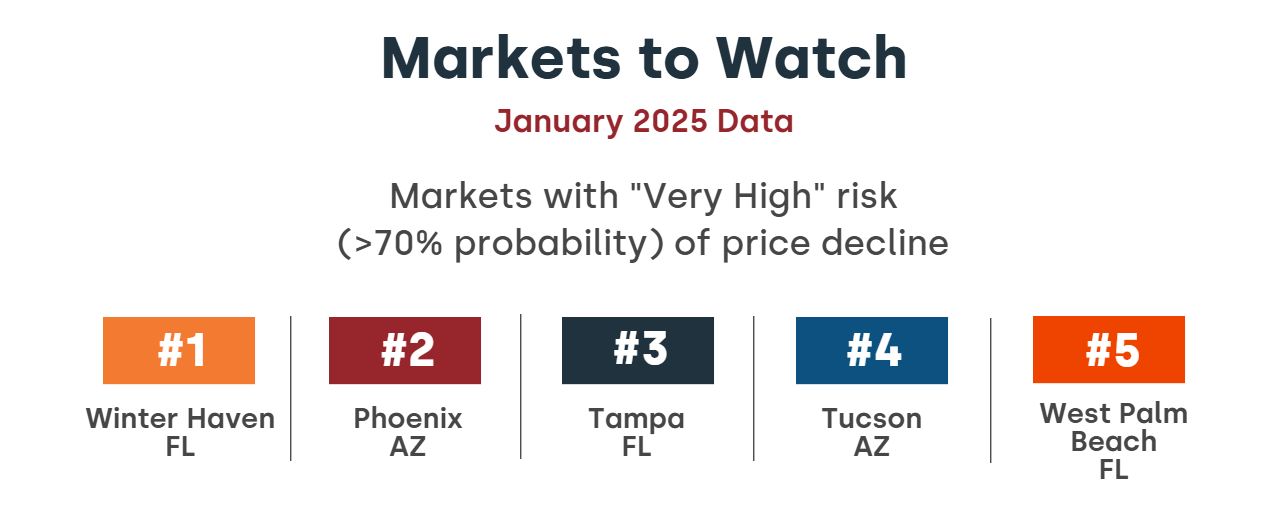
Based on their March 2025 report, the three Florida metro areas flashing red are Tampa, Winter Haven, and West Palm Beach. These aren't just minor wobbles; we're talking about a “very high” risk – over a 70% chance – of home prices actually going down. Let’s dive into why these areas are facing this potential downturn, and what it means for you.

3 Florida Cities at High Risk of a Housing Market Crash

For years, Florida has been the darling of the US real estate market. People flocked here for the weather, the lifestyle, and what seemed like endless growth. But as someone who's been watching the housing market closely for a while now, I can tell you that what goes up must sometimes adjust, and Florida seems to be hitting that point in certain areas.

CoreLogic's latest Home Price Insights report for March 2025 paints a picture of a national market that's pretty much flat month-over-month, with a modest 3.3% year-over-year growth nationwide. That sounds okay, right? Well, dig a little deeper, and you'll see Florida and Arizona standing out – and not in a good way – as places where the risk of price decline is very high.

Why Florida? And specifically, why these three cities: Tampa, Winter Haven, and West Palm Beach? Let's break it down.

Florida Housing Crash? 3 Cities at "Very High" Risk - New Data
Source: CoreLogic

Tampa: From Boomtown to…Bust?

Tampa has been on fire for years. Everyone wanted a piece of the Tampa Bay action. Job growth, beautiful waterfront, a lively city – it had it all. And home prices reflected that. But the data is starting to sing a different tune. CoreLogic identifies Tampa as the number one market in Florida with a “very high” risk of price decline. When you look at their numbers, it's not hard to see why. Tampa’s year-over-year home price change is down -0.9%, and even more concerning, the change from October 2024 to January 2025 is a hefty -1.6%. That's a cooling trend, and it’s significant.

But numbers are just numbers, right? What's really going on in Tampa? In my opinion, several factors are converging.

  • Overbuilding: Tampa saw a massive construction boom. Condos, apartments, single-family homes – they went up like crazy. Now, there’s a lot of inventory, and when supply outstrips demand, prices tend to soften. Think about it – all those cranes you saw dotting the skyline? They were building for a market that might not be quite as hot anymore.
  • Insurance Costs: Florida's insurance crisis is no joke. Homeowners insurance premiums have skyrocketed, making it much more expensive to own a home, especially near the coast. This hits places like Tampa hard and can dampen buyer enthusiasm. Who wants to move to paradise if it costs a fortune just to insure your house?
  • Affordability Squeeze: Even before the potential price correction, Tampa was becoming less affordable for many. Interest rates are still elevated compared to the super-low rates of recent years, and combined with those rising insurance costs and property taxes, the dream of homeownership in Tampa may be slipping out of reach for some.
  • Shift in Demand? CoreLogic's overview mentions “Florida markets are continuing to fall out of favor.” That's a pretty strong statement. Maybe the pandemic-driven rush to Florida is slowing down. People are re-evaluating, and perhaps Tampa, after its rapid growth, is just experiencing a natural market correction.

Winter Haven: Affordable No More?

Winter Haven, nestled in Central Florida, has long been seen as a more affordable alternative to the coastal cities. Known for its chain of lakes and citrus groves, it offered a quieter, less expensive lifestyle within reach of Orlando’s attractions. But even Winter Haven is flashing warning signs. CoreLogic ranks Winter Haven as the second riskiest market in Florida for a home price crash. Their data shows a -0.9% year-over-year price change and a -1.2% drop from October to January.

Why Winter Haven? It's a different story than Tampa, but still concerning.

  • Rapid Price Appreciation: Winter Haven saw huge price jumps during the pandemic boom. Because it was initially more affordable, the percentage increases were often dramatic. This kind of rapid appreciation is often unsustainable and sets the stage for a potential correction. What goes up fast can sometimes come down fast.
  • Dependence on Broader Market Trends: Winter Haven's market is somewhat tied to the Orlando and Tampa metro areas. If those markets cool, Winter Haven is likely to feel the chill as well. It's not immune to broader economic and housing market shifts in Central Florida.
  • Economic Vulnerabilities: While Winter Haven is growing, its economy might be less diversified than larger metro areas like Tampa. If there’s an economic slowdown, it could impact Winter Haven disproportionately. Less job security can mean less housing demand.
  • “Cooling” Effect Spreading: The fact that Winter Haven is on this list suggests that the cooling trend in Florida isn’t just limited to the major coastal cities. It might be spreading inland to previously more affordable areas.

West Palm Beach: Luxury Market Wobbles?

West Palm Beach, the gateway to Palm Beach County, is known for its upscale lifestyle, beautiful beaches, and proximity to the wealthy enclave of Palm Beach. It’s often associated with luxury real estate and high-end living. So, seeing West Palm Beach as the third Florida city with a “very high” crash risk is a bit surprising, and perhaps even more telling.

The data shows West Palm Beach experiencing a -0.5% year-over-year price decrease and a -1.2% dip between October and January. While these numbers are not as dramatic as some other areas, the “very high risk” designation is still there.

What's happening in West Palm Beach?

  • Luxury Market Sensitivity: Luxury markets can be more volatile than the broader market. High-end buyers are often more sensitive to economic fluctuations and market sentiment. If there's a perception of risk or economic uncertainty, they might pull back faster than other buyers.
  • Over-Development at the High End? Like Tampa, West Palm Beach has seen a lot of new development, including luxury condos and waterfront properties. Is there an oversupply at the higher end of the market? It’s possible. Luxury buyers have a lot of choices.
  • Insurance Impact on High-Value Homes: The insurance crisis in Florida can hit high-value homes particularly hard. Premiums for waterfront mansions can be astronomical. This can definitely impact demand in the luxury segment.
  • Correction After Extreme Growth: Palm Beach County, including West Palm Beach, experienced some of the most intense price growth in the nation during the pandemic boom. A correction in a market that has risen so rapidly is almost to be expected at some point.

Florida's Broader Real Estate Picture: Beyond These Three Cities

It's crucial to understand that this “very high risk” is specific to these three metro areas according to CoreLogic’s analysis. It doesn’t mean the entire Florida housing market is collapsing. However, it does signal a significant shift and potential challenges for certain areas.

Here are some broader factors impacting Florida's real estate market that contribute to this risk:

  • Insurance Crisis: I can't stress this enough – the insurance situation in Florida is a major headwind. Rising premiums, insurers pulling out of the state, and the increasing difficulty of getting coverage are dampening buyer demand and increasing the cost of homeownership across Florida.
  • Property Taxes: Property taxes in Florida, while relatively reasonable compared to some states, are also on the rise in many areas, adding to the overall cost of owning a home.
  • Climate Change Concerns: While not always explicitly stated, concerns about sea-level rise, hurricanes, and other climate-related risks could be starting to factor into buyers' long-term decisions about investing in coastal Florida properties.
  • Economic Slowdown Potential: If the broader US economy slows down, Florida, which is heavily reliant on tourism and retirees, could be particularly vulnerable. Economic uncertainty always impacts the housing market.
  • Shift to Other Markets: CoreLogic notes that “western New York is gaining popularity.” This is interesting. Are people looking for more affordable markets, or markets less exposed to climate risks, or simply different lifestyle options? It’s possible there’s a broader shift in where people are choosing to move.

What Does This Mean for You?

If you're a homeowner in Tampa, Winter Haven, or West Palm Beach, this report should be a wake-up call. It doesn't mean your home value is guaranteed to plummet, but it does suggest a higher probability of price decline. If you're thinking of selling in the next year or two, it might be wise to consider your timing and pricing strategy carefully.

If you're a buyer, particularly in these areas, this could present opportunities. It might mean less competition, more negotiating power, and potentially the chance to buy at a more reasonable price than you would have just a year or two ago. However, you also need to be aware of the risks and do your due diligence. Factor in insurance costs, property taxes, and the potential for further price softening.

Key Takeaways:

  • Tampa, Winter Haven, and West Palm Beach are identified by CoreLogic as having a “very high” risk (>70% probability) of home price decline.
  • This is driven by a combination of factors including overbuilding, the insurance crisis, affordability issues, and potentially a shift in demand away from Florida.
  • The broader Florida housing market is facing challenges, but these three cities are currently flagged as particularly vulnerable.
  • For homeowners in these areas, it's a time to be cautious and informed.
  • For buyers, it could present opportunities, but also requires careful consideration of the risks.

The Florida dream isn't necessarily over, but it's definitely undergoing a reality check in certain areas. Staying informed, understanding local market dynamics, and working with knowledgeable real estate professionals is more important than ever if you're navigating the Florida housing market right now. Keep an eye on these trends, and remember that real estate is local. What’s happening in Tampa isn’t necessarily happening everywhere else, even in Florida.

Work with Norada, Your Trusted Source for

Real Estate Investment in “Florida Markets”

Discover high-quality, ready-to-rent properties designed to deliver consistent returns.

Contact us today to expand your real estate portfolio with confidence.

Contact our investment counselors (No Obligation):

(800) 611-3060

Get Started Now 

Read More:

  • 4 States Facing the Major Housing Market Crash or Correction
  • Florida Housing Market: Record Supply Expected to Favor Buyers in 2025
  • Florida Housing Market Forecast for Next 2 Years: 2025-2026
  • Florida Real Estate Market Saw a Post-Hurricane Rebound Last Month
  • Florida Housing Market: Predictions for Next 5 Years (2025-2030)
  • Hottest Florida Housing Markets in 2025: Miami and Orlando
  • Florida Real Estate: 9 Housing Markets Predicted to Rise in 2025
  • Housing Markets at Risk: California, New Jersey, Illinois, Florida
  • 3 Florida Housing Markets Are Again on the Brink of a Crash
  • Florida Housing Market Predictions 2025: Insights Across All Cities
  • Florida Housing Market Trends: Rent Growth Falls Behind Nation
  • When Will the Housing Market Crash in Florida?
  • South Florida Housing Market: Will it Crash?
  • South Florida Housing Market: A Crossroads for Homebuyers

Filed Under: Housing Market, Real Estate Market Tagged With: Housing Market, Housing Market 2025, housing market crash, Housing Market Forecast, housing market predictions, Housing Market Trends, Real Estate Market

Today’s Mortgage Rates April 1, 2025: Rates Drop to Begin the New Month

April 1, 2025 by Marco Santarelli

Today's Mortgage Rates April 1, 2025: Rates Drop to Begin the New Month

If you're in the market to buy a house or thinking about refinancing, there's some welcome news to kick off April. Today's mortgage rates, on April 1, 2025, are showing a decrease, offering a bit of relief for those watching the market closely. According to the latest data, we're seeing a slight but positive shift downwards.

Today's Mortgage Rates April 1, 2025: Rates Drop to Begin the New Month

Key Takeaways:

  • Mortgage rates are down today, April 1, 2025.
  • The 30-year fixed mortgage rate has decreased to an average of 6.55%.
  • 15-year fixed rates have also dropped, now averaging 5.83%.
  • Refinance rates are also seeing a dip, although they generally remain a bit higher than purchase rates.
  • Economic uncertainty continues to play a role in rate fluctuations.
  • Experts suggest now might be a good time to consider buying as we head into the spring home-buying season.

Breaking Down Today's Mortgage Rate Drop

It's always encouraging to see mortgage rates take a step back, especially after the fluctuations we've experienced recently. Looking at the numbers from Zillow, we can see that across the board, rates are generally moving in a favorable direction today. This data, released today, April 1st, 2025, shows a clear easing in borrowing costs for homebuyers and those looking to refinance.

Let's dive into the specifics. For the benchmark 30-year fixed-rate mortgage, we're looking at an average of 6.55%. This is a decrease of four basis points. Now, four basis points might sound small, but in the world of mortgages, every little bit counts. For someone borrowing a significant amount of money, even a slight decrease can translate into real savings over the life of the loan.

The 15-year fixed-rate mortgage has seen an even more significant drop, falling by eight basis points to an average of 5.83%. This is a notable move and makes the shorter-term, but faster equity-building, 15-year mortgage even more attractive for those who can manage the higher monthly payments.

Here’s a quick look at the current average mortgage rates as of today, April 1, 2025, based on Zillow's data:

Loan Type Rate
30-Year Fixed 6.55%
20-Year Fixed 6.28%
15-Year Fixed 5.83%
5/1 ARM 6.77%
7/1 ARM 6.91%
30-Year VA 6.08%
15-Year VA 5.66%
5/1 VA 6.08%
30-Year FHA 5.95%
5/1 FHA 5.69%

It's important to remember that these are national averages. The actual rate you'll qualify for can depend on a lot of personal factors, such as your credit score, down payment amount, and the specific lender you choose. Think of these numbers as a good starting point and a general indication of where the market is currently sitting.

Refinance Rates Also See a Decrease

The good news extends to those who are considering refinancing their existing mortgages. Refinance rates are also showing a downward trend today. While historically refinance rates tend to be a touch higher than purchase rates, the dip is still a positive sign for homeowners looking to potentially lower their monthly payments or tap into their home equity.

Here's a table outlining today's average mortgage refinance rates:

Loan Type Rate
30-Year Fixed Refinance 6.61%
20-Year Fixed Refinance 6.21%
15-Year Fixed Refinance 5.88%
5/1 ARM Refinance 6.93%
7/1 ARM Refinance 7.23%
30-Year VA Refinance 6.23%
15-Year VA Refinance 5.92%
5/1 VA Refinance 6.10%
30-Year FHA Refinance 6.10%
15-Year FHA Refinance 6.05%
5/1 FHA Refinance 6.63%

Again, these are average refinance rates. Your personal rate will be determined by your individual financial profile and the specifics of your current mortgage. However, the general direction of rates is something to pay attention to if refinancing has been on your mind.

Fixed-Rate vs. Adjustable-Rate Mortgages: Making the Right Choice

When you're looking at mortgages, you'll generally come across two main types: fixed-rate and adjustable-rate mortgages (ARMs). Understanding the difference is crucial to making an informed decision about what's best for your situation.

A fixed-rate mortgage is pretty straightforward. The interest rate you get at the beginning of your loan stays the same for the entire term, whether it's 15, 20, or 30 years. This predictability is a big advantage. You know exactly what your monthly payment will be, making budgeting much easier. If you value stability and plan to stay in your home for a long time, a fixed-rate mortgage is often a solid choice. The 30-year fixed is probably the most popular choice because it generally offers the lowest monthly payments, though you'll pay more interest over the long haul compared to shorter terms.

On the other hand, an adjustable-rate mortgage (ARM) has an interest rate that changes periodically after an initial fixed period. For example, a 5/1 ARM has a fixed rate for the first five years, and then the rate adjusts once a year for the remaining term. Similarly, a 7/1 ARM has a fixed rate for seven years, and then adjusts annually.

ARMs can sometimes start with lower interest rates than fixed-rate mortgages, which might seem appealing at first. However, the risk is that your rate could increase in the future, leading to higher monthly payments. The data mentions that recently, ARM rates have even been starting higher than fixed rates, which makes them less attractive right now. Typically, ARMs are considered by those who expect to move or refinance before the rate adjusts, or those who believe interest rates will fall in the future. However, with economic uncertainty still in the air, the predictability of a fixed-rate mortgage is often seen as a safer bet for most homebuyers.

30-Year vs. 15-Year Fixed Mortgages: A Tale of Two Terms

Another important decision is choosing between a 30-year and a 15-year fixed mortgage. Both offer the security of a fixed interest rate, but they differ significantly in terms of monthly payments and total interest paid over the life of the loan.

The 30-year mortgage is the more common choice because it spreads your payments out over a longer period, resulting in lower monthly payments. This can make homeownership more accessible from a monthly budget perspective. However, the trade-off is that you'll pay significantly more interest over 30 years.

The 15-year mortgage, on the other hand, requires higher monthly payments because you're paying off the loan in half the time. But the big advantage is that you build equity much faster and pay considerably less interest overall. Plus, as we see in today's rates, 15-year mortgages typically come with lower interest rates compared to 30-year mortgages.

Let's look at an example to illustrate this. Imagine you're borrowing $400,000.

  • With a 30-year mortgage at 6.55%, your estimated monthly payment (principal and interest) would be around $2,541. Over 30 years, you would pay approximately $514,918 in interest.
  • With a 15-year mortgage at 5.83%, your estimated monthly payment would be about $3,339. However, over 15 years, you would pay only around $200,984 in interest.

That’s a massive difference of over $300,000 in interest saved by choosing the 15-year mortgage! While the monthly payment is higher, the long-term savings are substantial. Of course, it's all about what fits your budget and financial goals. Even if a 15-year mortgage payment feels too high right now, it's worth remembering that you can always make extra payments on a 30-year mortgage to pay it off faster and save on interest, while still having the flexibility of a lower minimum monthly payment if needed.

Recommended Read:

Mortgage Rates Trends as of March 31, 2025

Will Mortgage Rates Go Down in April 2025? Here's What the Experts Say

Mortgage Rates Drop: Can You Finally Afford a $400,000 Home?

Expect High Mortgage Rates Until 2026: Fannie Mae's 2-Year Forecast

Will Mortgage Rates Rise Back Above 7% or Go Down in 2025?

Mortgage Interest Rates Forecast for Next 10 Years

What's Driving Mortgage Rates Right Now?

Understanding what influences mortgage rates can help you anticipate future movements and make informed decisions. The data we have today mentions a few key factors that are currently at play.

Economic Uncertainty: The overall economic climate has a big impact on mortgage rates. When there's a lot of uncertainty about the economy's future, it can cause rates to fluctuate. This uncertainty can stem from various sources, like inflation concerns, global events, or changes in government policy. As the data suggests, as long as economic uncertainty persists, we might not see dramatic swings in mortgage rates in either direction.

Tariffs and Inflation: Tariffs, which are taxes on imported goods, can have a ripple effect on the economy. They can potentially lead to higher inflation because businesses might pass on the cost of tariffs to consumers in the form of higher prices. Tariffs can also curb economic growth by making goods more expensive and potentially reducing trade. The data points out that upcoming tariffs and any flexibility in their implementation are factors to watch as they could push mortgage rates up or down.

Labor Market Data: The health of the job market is another crucial indicator. Data on employment, unemployment, and wages gives insights into the strength of the economy. Strong labor market data can sometimes lead to concerns about inflation, which can then influence mortgage rates. The data mentions that updated labor market figures this week could also impact rate movements.

Federal Reserve (The Fed): The Federal Reserve, the central bank of the United States, plays a significant role in influencing interest rates across the economy. They control the federal funds rate, which is the rate banks charge each other for overnight lending. While the federal funds rate isn't directly mortgage rates, it influences them. The data highlights that the Fed's decisions on whether to cut the federal funds rate at their meetings will be a major factor in the future direction of mortgage rates. The fact that the Fed didn't cut rates in their January or March meetings, and is expected to hold steady in May, suggests we might not see significant rate drops in the immediate future.

Looking Ahead: Mortgage Rate Forecast for April and Beyond

So, what can we expect in April and the rest of 2025? While it's impossible to predict the future with certainty, the data and expert opinions give us some clues.

The general expectation is that mortgage rates are likely to decrease slightly in 2025, but they probably won't plummet back to the historic lows we saw a few years ago. The extent of any rate decrease will depend on how the economy performs. If the economy remains stable, rate drops might be modest. If inflation proves to be persistent or even increases again, rates could actually rise.

Experts don't anticipate rates returning to the sub-3% levels of 2020 and 2021 anytime soon. However, there's a possibility that rates could settle somewhere in the 6% range over the next couple of years. This is still higher than the rock-bottom rates of the recent past, but it's also lower than some of the peaks we've seen more recently.

Interestingly, while mortgage rates might see some moderation, home prices are not expected to decline. In fact, most forecasts suggest home prices will continue to rise, albeit at a more moderate pace than in recent years. The main reason for this is the historically low supply of homes for sale. Limited inventory puts upward pressure on prices, even if demand cools down somewhat. Fannie Mae researchers are predicting a 3.5% increase in home prices in 2025, while the Mortgage Bankers Association expects a 1.3% rise.

When will we see a significant drop in mortgage rates? Economists don't foresee drastic rate cuts happening before the end of 2025. In 2024, rates trended down for a period after the Fed signaled a rate cut, but since then, rates have mostly held steady or increased slightly. The future trajectory hinges heavily on the Fed's decisions regarding the federal funds rate.

In conclusion, today's dip in mortgage rates is a welcome sign, especially for those navigating the spring home-buying season. While significant drops might not be on the immediate horizon, the expectation of gradual moderation in rates over time, coupled with continued home price appreciation, underscores the importance of being informed and prepared when entering the housing market. Getting quotes from multiple lenders is always a smart move to ensure you secure the best possible rate in this dynamic environment.

Work With Norada, Your Trusted Source for

Real Estate Investment in the U.S.

Investing in turnkey real estate can help you secure consistent returns with fluctuating mortgage rates.

Expand your portfolio confidently, even in a shifting interest rate environment.

Speak with our expert investment counselors (No Obligation):

(800) 611-3060

Get Started Now

Also Read:

  • Will Mortgage Rates Go Down in 2025: Morgan Stanley's Forecast
  • Mortgage Rate Predictions 2025 from 4 Leading Housing Experts
  • Mortgage Rates Forecast for the Next 3 Years: 2025 to 2027
  • 30-Year Mortgage Rate Forecast for the Next 5 Years
  • 15-Year Mortgage Rate Forecast for the Next 5 Years
  • Why Are Mortgage Rates Going Up in 2025: Will Rates Drop?
  • Why Are Mortgage Rates So High and Predictions for 2025
  • Will Mortgage Rates Ever Be 3% Again in the Future?
  • Mortgage Rates Predictions for Next 2 Years
  • Mortgage Rate Predictions for Next 5 Years
  • Mortgage Rate Predictions: Why 2% and 3% Rates are Out of Reach
  • How Lower Mortgage Rates Can Save You Thousands?
  • How to Get a Low Mortgage Interest Rate?
  • Will Mortgage Rates Ever Be 4% Again?
Filed Under: Financing, Mortgage Tagged With: Interest Rate, mortgage, Mortgage Rate Trends, mortgage rates, Mortgage Rates Predictions, Mortgage Rates Today

  • « Previous Page
  • 1
  • …
  • 11
  • 12
  • 13

Real Estate

  • Birmingham
  • Cape Coral
  • Charlotte
  • Chicago

Quick Links

  • Markets
  • Membership
  • Notes
  • Contact Us

Blog Posts

  • Mortgage Rates Today, June 28, 2026: 30‑Year Refinance Rate Drops by 8 Basis Points
    June 28, 2026Marco Santarelli
  • 30-Year Fixed Mortgage Rate Drops Sharply by 28 Basis Points Year Over Year
    June 28, 2026Marco Santarelli
  • Today’s Mortgage Rates, June 27: 30‑Year Fixed Falls to 6.17% Giving Buyers Big Relief
    June 27, 2026Marco Santarelli

Contact

Norada Real Estate Investments 30251 Golden Lantern, Suite E-261 Laguna Niguel, CA 92677

(949) 218-6668
(800) 611-3060
BBB
  • Terms of Use
  • |
  • Privacy Policy
  • |
  • Testimonials
  • |
  • Suggestions?
  • |
  • Home

Copyright 2018 Norada Real Estate Investments

Loading...