Norada Real Estate Investments

  • Home
  • Markets
  • Properties
  • Membership
  • Podcast
  • Learn
  • About
  • Contact

S&P 500 Plunges by 2% as Inflation Panic Grips Markets

March 31, 2025 by Marco Santarelli

S&P 500 Plunges by 2% as Inflation Panic Grips Markets

You know, when I saw the headlines on March 28th, 2025, my gut reaction was a familiar unease. Wall Street Plunges as Inflation Panic Grips Markets – it’s a phrase that sends a shiver down the spine of anyone paying attention to their investments or the broader economy. And that’s precisely what happened.

The release of February 2025 economic data, specifically the Personal Consumption Expenditures (PCE) price index and figures on how much we're all spending, painted a picture that investors didn't like. The definitive answer is this: concerns about ongoing inflation, coupled with signs that the economy might be slowing down, triggered a significant sell-off in the stock market.

Let's dig a little deeper into what exactly caused this ripple of fear and what it might mean for us.

S&P 500 Plunges by 2% as Inflation Panic Grips Markets

Decoding the Economic Tea Leaves: PCE and Spending

The PCE price index is like the Federal Reserve's favorite thermometer for checking the temperature of inflation. It looks at the prices of all the stuff we buy – from groceries to haircuts – and tracks how those prices are changing. What the February 2025 data showed was that this thermometer wasn't showing a fever breaking just yet.

Specifically, the report indicated that the overall PCE price index rose by 0.3% in February, putting the year-over-year increase at a concerning 2.5%. But the real worry came from the core PCE price index, which strips out the often-volatile prices of food and energy to give a clearer picture of underlying inflation. This core measure jumped by 0.4% in February, resulting in a year-over-year rate of 2.8%. To put it plainly, these numbers suggest that the underlying price pressures in the economy aren't easing as much as we'd hoped, and they're still sitting above the Federal Reserve's comfortable 2% target.

Now, let's talk about our wallets – or rather, how much we're opening them. Consumer spending is the engine that drives a big chunk of our economy. If we're not buying things, businesses suffer, and the economy can slow down. The February data revealed that consumer spending grew by 0.4%, which might sound okay on the surface, but it actually fell short of the expected 0.5% increase.

Here's where the knot in my stomach tightens. We've got prices that are still rising too quickly, and people seem to be a bit more hesitant to spend. This combination brings up the dreaded specter of stagflation – a nasty scenario where the economy isn't growing much, but prices keep going up. It's like being stuck in slow motion while everything around you gets more expensive.

Why This Data Sends Chills Down Wall Street's Spine

The market's reaction on March 28th was pretty dramatic. The S&P 500 plunged by 2%, the NASDAQ, heavily weighted with tech companies, took an even bigger hit of 2.7%, and the more traditional Dow Jones Industrial Average dropped by 1.7%. These aren't small dips; they represent a significant amount of investor concern hitting the market all at once.

Think of it like this: if inflation stays high, the Federal Reserve might feel pressured to keep interest rates higher for longer to try and cool things down. Higher interest rates can make it more expensive for businesses to borrow money for expansion, and it can also make investors less willing to put their money into stocks when safer, higher-yielding options like bonds become more attractive.

Furthermore, if consumer spending is starting to slow, that could mean companies will have a harder time selling their goods and services, which could ultimately hurt their profits. And if profits take a hit, stock prices tend to follow suit. It's a connected web, and this recent data has highlighted some potential weak points.

The Tariff Wildcard: Throwing Fuel on the Inflation Fire?

Just when you thought there was enough to worry about, another factor has entered the equation: tariffs. There's growing chatter and, frankly, concern that potential tariff hikes, like those previously implemented and possibly expanded by the Trump administration, could further exacerbate inflation.

Think about it. Tariffs are essentially taxes on imported goods. If the cost of bringing in things like cars and auto parts goes up, those costs are likely to be passed on to consumers in the form of higher prices. This could create another layer of upward pressure on inflation, making the Fed's job even harder and potentially leading to even more economic uncertainty.

For me, this is a particularly worrying aspect because tariffs don't just affect prices; they can also disrupt supply chains and lead to retaliatory tariffs from other countries, which can harm American businesses that rely on exports. It's a complex issue with potentially far-reaching consequences.

Navigating the Uncertainty: What Investors Should Consider

In times like these, it's easy to feel a bit lost in the market turbulence. But from my perspective, a level-headed approach is always the best strategy. Here are a few thoughts on what investors might want to keep in mind:

  • Don't Panic: It's natural to feel a bit anxious when the market takes a dive, but selling off your investments in a knee-jerk reaction can often do more harm than good. Remember that market fluctuations are a normal part of investing.
  • Review Your Portfolio: Take a look at your current investments and consider if your portfolio is still aligned with your long-term goals and risk tolerance. This might be a good time to rebalance if needed.
  • Focus on the Long Term: Investing is often a marathon, not a sprint. Try to keep your focus on your long-term objectives and avoid getting too caught up in short-term market noise.
  • Consider Diversification: A well-diversified portfolio across different asset classes and sectors can help to cushion the impact of market downturns in specific areas.
  • Stay Informed: Keep an eye on economic data and Federal Reserve announcements, but be wary of getting your information solely from sources that might sensationalize market movements.

I personally find it helpful to step back and remember why I'm investing in the first place – whether it's for retirement, a down payment on a home, or another long-term goal. This helps to put short-term volatility into perspective.

Looking Ahead: What's Next on the Economic Calendar

Investors will likely be glued to upcoming economic reports and statements from the Federal Reserve. Key things to watch out for include:

  • The March Consumer Price Index (CPI): This report, which measures inflation from a different angle than the PCE, will give us another important data point on price pressures.
  • Federal Reserve Meetings and Communications: Any hints from the Fed about their future plans for interest rates will be closely scrutinized by the market.
  • Further Data on Consumer Spending and Economic Growth: Reports on retail sales, manufacturing activity, and overall GDP growth will provide more clues about the health of the economy.

The market's current sensitivity highlights just how crucial these upcoming data releases will be in shaping investor sentiment and the overall economic outlook.

My Takeaway: Staying Vigilant in Uncertain Times

For me, the recent market tumble serves as a reminder that the economic recovery is still facing headwinds, and inflation remains a significant concern. The interplay between persistent price pressures, potentially slowing consumer spending, and the uncertainty surrounding trade policies creates a complex and somewhat unsettling picture.

While it's impossible to predict the future with certainty, I believe that maintaining a cautious and well-informed approach to investing is more important than ever. This means staying abreast of economic developments, understanding the potential risks and opportunities, and being prepared to adapt your strategy as the situation evolves.

Ultimately, the economy and the stock market are dynamic entities, constantly responding to new information and evolving conditions. As individual investors, our best bet is to remain informed, stay disciplined, and focus on our long-term financial goals amidst the inevitable ups and downs.

Read More:

  • Stock Market Predictions 2025: Will the Bull Run Continue?
  • Stock Market Crash: Nasdaq 100 Tanks 3.5% Amid AI Concerns
  • Stock Market Crash Prediction With Huge Discounts on Bitcoin, Gold, Houses
  • S&P 500 Forecast for the Next Year: What to Expect in 2025?
  • Stock Market Predictions for the Next 5 Years
  • Billionaire Warns of Stock Market Crash If Harris Wins Elections
  • Stock Market is Predicted to Surge Regardless of the Election Outcome
  • Echoes of 1987: Is Today’s Stock Market Crash Leading to a Recession?
  • Is the Bull Market Over? What History Says About the Stock Market Crash
  • Wall Street Bear Predicts a Historic Stock Market Crash Like 1929
  • Economist Predicts Stock Market Crash Worse Than 2008 Crisis
  • Stock Market Forecast Next 6 Months
  • Next Stock Market Crash Prediction: Is a Crash Coming Soon?
  • Stock Market Crash: 30% Correction Predicted by Top Forecaster
Filed Under: Economy, Stock Market Tagged With: Stock Market, Stock Market Forecast, Stock Market Predictions

Today’s Mortgage Rates March 31, 2025: A Slight Drop Offers Opportunity

March 31, 2025 by Marco Santarelli

Today's Mortgage Rates March 31, 2025: A Slight Drop Offers Opportunity

Thinking about buying a home or refinancing? Let's talk about today's mortgage rates for March 31, 2025. The big news is that rates have seen a small decrease. The average rate for a 30-year fixed mortgage is currently sitting at 6.59%, down just slightly from previous days. While it might not seem like a huge drop, even small changes can make a difference, and with the spring home-buying season just warming up, now might present a window of opportunity before competition really heats up.

Today's Mortgage Rates for March 31, 2025: A Slight Drop Offers Opportunity

Key Takeaways

Here's a quick look at the important points for today:

  • Slight Rate Decrease: Average 30-year fixed mortgage rates dropped by 3 basis points to 6.59%.
  • 15-Year Rate Also Down: The average 15-year fixed rate decreased by 4 basis points to 5.91%.
  • Refinance Rates: Refinance rates are also available, generally hovering close to purchase rates. The 30-year fixed refinance rate is 6.55%.
  • Potential Buying Window: With rates slightly lower and the spring buying rush not yet in full swing, now could be a strategic time to look for a home.
  • Future Outlook: Experts don't expect major rate drops later in 2025, suggesting rates might stay in the mid-6% range.
  • Home Prices: Don't expect home prices to fall; low inventory is likely to keep pushing prices upward.

Current Mortgage Rates Breakdown

When you're looking to buy a home, the interest rate you lock in plays a huge role in your monthly payment and the total amount you'll pay over the life of the loan. Rates can change daily based on economic factors, so staying updated is key. As of today, March 31, 2025, the national average rates for purchasing a home look like this, according to Zillow:

Loan Type Average Rate
30-Year Fixed 6.59%
20-Year Fixed 6.41%
15-Year Fixed 5.91%
5/1 ARM 6.82%
7/1 ARM 7.13%
30-Year VA 6.09%
15-Year VA 5.67%
5/1 VA 6.22%

(Source: Zillow data, March 31, 2025. Remember these are national averages and your actual rate may vary based on your credit score, down payment, location, and lender.)

It's interesting to see the slight dip today. While three or four basis points (a basis point is one-hundredth of a percent) might seem tiny, on a large loan amount over many years, it adds up. We've seen rates fluctuate quite a bit over the past couple of years, moving significantly higher from the historic lows we saw back in 2020 and 2021. A rate around 6.59% for a 30-year fixed loan is much more typical historically, though it certainly feels high compared to the sub-3% rates some homeowners locked in previously. From my perspective, borrowers today need to adjust their expectations and budgets accordingly. This rate environment makes careful shopping and understanding your loan options even more critical.

Let's quickly touch on the different types of loans listed. Fixed-rate mortgages (like the 15-year, 20-year, and 30-year options) keep the same interest rate for the entire loan term. This means your principal and interest payment never changes, offering predictability which many homeowners value. The 30-year fixed is the most popular because it spreads the cost over a long period, resulting in lower monthly payments compared to shorter terms. However, you end up paying significantly more interest over those 30 years.

The 15-year fixed mortgage comes with a lower interest rate (5.91% today) and you pay off the loan much faster. This saves a ton of interest over the life of the loan, but the monthly payments are considerably higher because you're paying it back in half the time. Choosing between a 15-year and 30-year loan often comes down to your monthly budget and your long-term financial goals. If you can comfortably afford the higher payment of a 15-year loan, the long-term savings are substantial.

Adjustable-rate mortgages (ARMs), like the 5/1 or 7/1 ARMs listed, offer a fixed interest rate for an initial period (5 or 7 years in these examples), after which the rate adjusts periodically (usually once per year) based on market conditions. ARMs often start with a lower interest rate than fixed-rate loans, which can be appealing. However, there's the risk that your rate and payment could increase significantly after the initial fixed period ends.

An ARM might be a good choice if you don't plan to stay in the home long-term – perhaps you know you'll be moving before the rate starts adjusting. Lately, however, we've sometimes seen ARM rates that aren't much lower, or are even higher, than fixed rates, like today's 5/1 ARM at 6.82% and 7/1 ARM at 7.13%, which are both higher than the 30-year fixed rate. This makes the decision less clear-cut, underscoring the need to compare offers carefully.

VA loans are a fantastic benefit for eligible veterans, active-duty service members, and surviving spouses. They often feature competitive interest rates (like the 6.09% 30-year VA rate today) and typically don't require a down payment.

Today's Refinance Rates

Refinancing your existing mortgage involves taking out a new loan to pay off the old one. People refinance for various reasons: to get a lower interest rate, to shorten their loan term, to switch from an adjustable-rate to a fixed-rate loan, or to tap into home equity (cash-out refinance).

Here are the average refinance rates for today, March 31, 2025, also from Zillow:

Loan Type Average Rate
30-Year Fixed 6.55%
20-Year Fixed 6.27%
15-Year Fixed 5.84%
5/1 ARM 6.54%
7/1 ARM 6.56%
30-Year VA 6.20%
15-Year VA 5.86%
5/1 VA 6.26%
30-Year FHA 6.18%
15-Year FHA 6.04%

(Source: Zillow data, March 31, 2025. These are national averages; individual rates vary.)

You'll notice that refinance rates are very close to purchase rates today, sometimes slightly lower (like the 30-year fixed) and sometimes slightly higher (like the VA options). This isn't always the case; sometimes refi rates are noticeably higher. If you're considering a refinance, the math needs to make sense. You have to factor in closing costs on the new loan and determine how long it will take for the savings from a lower rate or shorter term to outweigh those costs.

With current rates in the mid-6% range, refinancing likely only makes sense for homeowners with significantly higher existing rates or those who absolutely need to tap into equity, understanding the cost involved. For those who locked in rates below 4% or even 5% in recent years, refinancing at today's rates wouldn't typically be beneficial unless the goal is specifically to pull cash out. FHA loans, backed by the Federal Housing Administration, are often geared towards borrowers with lower credit scores or smaller down payments, and specific refinance options exist for them as well.

What Could My Monthly Mortgage Payment Be?

Seeing the rates is one thing, but understanding what they mean for your wallet is crucial. Let's estimate potential monthly payments based on today's average 30-year fixed rate of 6.59%.

Important Note: These calculations show only the principal and interest (P&I) portion of the payment. Your actual monthly mortgage payment will be higher because it will also include property taxes, homeowners insurance, and potentially private mortgage insurance (PMI) if your down payment is less than 20%. These estimates are just to give you a ballpark idea of the P&I cost based on different loan amounts.

Monthly payment on $150k mortgage

With a $150,000 loan amount at 6.59% for 30 years, your estimated monthly principal and interest payment would be approximately $957. This size loan might be common in lower-cost-of-living areas or for buyers making a very large down payment.

Monthly payment on $200k mortgage

For a $200,000 mortgage using the same 30-year fixed rate of 6.59%, the estimated monthly principal and interest payment increases to about $1,276. This is a significant jump, illustrating how the loan amount directly impacts your monthly obligation.

Monthly payment on $300k mortgage

Taking out a $300,000 mortgage at today's 6.59% rate for a 30-year term would result in an estimated monthly principal and interest payment of roughly $1,914. Over the full 30 years, you'd pay back the $300,000 principal plus around $389,038 in interest alone – highlighting the long-term cost of borrowing.

Monthly payment on $400k mortgage

If you need a $400,000 loan, based on a 6.59% 30-year fixed rate, your estimated monthly principal and interest payment would be about $2,552. Housing costs vary dramatically across the country, and in many markets, loan amounts of this size are increasingly common.

Monthly payment on $500k mortgage

Finally, for a $500,000 mortgage at 6.59% over 30 years, the estimated monthly principal and interest payment comes out to approximately $3,190. This substantial payment reflects the reality of higher-priced housing markets or larger home purchases. Remember again to add taxes and insurance for a true estimate of your housing payment.

Seeing these numbers really drives home the importance of interest rates and loan amounts. A buyer looking at the same house might face vastly different long-term costs depending on when they buy and what rate they secure. It also shows why even seemingly small rate changes are watched so closely.

Recommended Read:

Mortgage Rates Trends as of March 30, 2025

Mortgage Rates Drop: Can You Finally Afford a $400,000 Home?

Expect High Mortgage Rates Until 2026: Fannie Mae's 2-Year Forecast

Will Mortgage Rates Rise Back Above 7% or Go Down in 2025?

Mortgage Interest Rates Forecast for Next 10 Years

What's Affecting Mortgage Rates Right Now?

Mortgage rates don't exist in a vacuum. They are influenced by a complex mix of economic factors, investor sentiment, and monetary policy. Right now, there are a few things on the radar that could sway rates in the near term.

One factor mentioned in market commentary is the potential impact of tariffs. New tariffs could potentially increase the cost of goods, which fuels inflation. Higher inflation generally leads the Federal Reserve to keep benchmark interest rates higher (or raise them) to cool down the economy, which indirectly pushes mortgage rates up.

However, tariffs can also potentially slow down economic growth if they make international trade more difficult or expensive. Slower economic growth can sometimes lead to lower mortgage rates. So, the impact of tariffs can be complex and pull rates in different directions, creating uncertainty.

We're also expecting updates on the labor market soon. Data like job growth and unemployment figures are key indicators of economic health. Strong job growth might signal a robust economy, potentially leading to higher inflation and thus higher rates. Conversely, signs of a weakening labor market could suggest slower economic growth, potentially leading to lower rates. Any surprises in this data – stronger or weaker than expected – could cause shifts in the bond market, where mortgage rates are largely determined.

Because of these interacting and sometimes conflicting factors, predicting short-term rate movements is always challenging. It's a bit like trying to predict the weather a week out – you can see trends, but unexpected storms can pop up. This uncertainty is why experts often advise focusing on your own financial readiness rather than trying to perfectly time the market.

Looking Ahead: Mortgage Rate & Home Price Expectations

What can we expect for the rest of 2025? While no one has a crystal ball, the general consensus among economists and housing market analysts is that mortgage rates might ease slightly as the year progresses, but they are unlikely to drop dramatically. Many forecasts suggest rates could settle somewhere in the 6% range. This depends heavily on how inflation behaves and the overall health of the economy. If inflation proves stubborn or picks back up, rates could stay higher for longer, or even rise. If the economy slows more significantly, we might see rates dip more noticeably.

It's crucial, though, to manage expectations. The days of sub-3% mortgage rates seen in 2020 and 2021 were historically unusual, driven by unique pandemic-related economic conditions. A return to those levels is considered highly improbable in the foreseeable future. Rates in the 5% to 7% range are more aligned with historical norms.

What about home prices? Despite higher mortgage rates making homes less affordable, prices are generally expected to continue rising in 2025, though perhaps at a slower pace than in the peak frenzy years. The main driver here is low inventory. There simply aren't enough homes for sale to meet the demand from buyers.

This supply-demand imbalance puts upward pressure on prices. Fannie Mae, a major player in the mortgage market, anticipates home prices increasing by 3.5% in 2025, while the Mortgage Bankers Association forecasts a more modest 1.3% rise. While this isn't the double-digit appreciation we saw recently, it does mean that waiting for prices to fall significantly might be a losing strategy.

Navigating the housing market right now requires careful planning and realistic expectations. Today's slight dip in mortgage rates might offer a small boost for current buyers, but the broader picture suggests rates will remain elevated compared to recent years, and competition for limited housing stock will likely continue.

Work With Norada, Your Trusted Source for

Real Estate Investment in the U.S.

Investing in turnkey real estate can help you secure consistent returns with fluctuating mortgage rates.

Expand your portfolio confidently, even in a shifting interest rate environment.

Speak with our expert investment counselors (No Obligation):

(800) 611-3060

Get Started Now

Also Read:

  • Will Mortgage Rates Go Down in 2025: Morgan Stanley's Forecast
  • Mortgage Rate Predictions 2025 from 4 Leading Housing Experts
  • Mortgage Rates Forecast for the Next 3 Years: 2025 to 2027
  • 30-Year Mortgage Rate Forecast for the Next 5 Years
  • 15-Year Mortgage Rate Forecast for the Next 5 Years
  • Why Are Mortgage Rates Going Up in 2025: Will Rates Drop?
  • Why Are Mortgage Rates So High and Predictions for 2025
  • Will Mortgage Rates Ever Be 3% Again in the Future?
  • Mortgage Rates Predictions for Next 2 Years
  • Mortgage Rate Predictions for Next 5 Years
  • Mortgage Rate Predictions: Why 2% and 3% Rates are Out of Reach
  • How Lower Mortgage Rates Can Save You Thousands?
  • How to Get a Low Mortgage Interest Rate?
  • Will Mortgage Rates Ever Be 4% Again?

Filed Under: Financing, Mortgage Tagged With: Interest Rate, mortgage, Mortgage Rate Trends, mortgage rates, Mortgage Rates Predictions, Mortgage Rates Today

Today’s Mortgage Rates, March 30, 2025: Rates See Small Reductions

March 30, 2025 by Marco Santarelli

Today's Mortgage Rates, March 30, 2025: Rates See Small Reductions

Today, March 30, 2025, potential homebuyers and those looking to refinance are seeing a slight dip in mortgage rates. According to recent data from Zillow, the average 30-year fixed mortgage rate has edged down to 6.59%, a decrease of three basis points. Similarly, the 15-year fixed rate has seen a small decrease, settling at 5.91%, down by four basis points. While this offers a bit of relief, experts predict that significant drops in home loan rates are unlikely in the immediate future.

Today's Mortgage Rates, March 30, 2025: Slight Decrease Offers a Glimmer of Hope

Key Takeaways:

  • Slight Decrease Today: Both 30-year and 15-year fixed mortgage rates have seen a minor decrease today, March 30, 2025.
  • Rates Expected to Remain Elevated: Forecasts from Fannie Mae and the Mortgage Bankers Association suggest that mortgage rates will likely stay relatively high throughout much of 2025.
  • Refinance Rates Also See Minor Drops: Similar to purchase mortgages, refinance rates have also experienced small reductions today.
  • Long-Term Goals Matter: When choosing between a 15-year and 30-year mortgage, consider your short-term cash flow needs versus long-term interest savings.
  • Focus on Financial Health: Improving your credit score and lowering your debt-to-income ratio are key factors in securing a lower mortgage rate.

Current Mortgage Rates on March 30, 2025

For those looking to purchase a home, understanding the current landscape of interest rates is crucial. As of today, March 30, 2025, the average national mortgage rates are as follows, based on the latest information from Zillow:

Loan Type Interest Rate
30-Year Fixed 6.59%
20-Year Fixed 6.41%
15-Year Fixed 5.91%
5/1 ARM 6.82%
7/1 ARM 7.13%
30-Year VA 6.09%
15-Year VA 5.67%
5/1 VA 6.22%

It's important to remember that these figures represent national averages and can fluctuate based on your individual financial situation, the specific lender, and other market factors.

Current Mortgage Refinance Rates on March 30, 2025

Homeowners considering refinancing their existing mortgages will also find slight decreases in rates today. Here are the average national mortgage refinance rates as of March 30, 2025, according to Zillow:

Loan Type Interest Rate
30-Year Fixed 6.55%
20-Year Fixed 6.27%
15-Year Fixed 5.84%
5/1 ARM 6.54%
7/1 ARM 6.56%
30-Year VA 6.20%
15-Year VA 5.86%
5/1 VA 6.26%
30-Year FHA 6.18%
15-Year FHA 6.04%

Interestingly, while it's commonly assumed that refinance rates are higher than purchase rates, the data today shows a mixed picture. For certain loan types, the refinance rate is slightly lower than the corresponding purchase rate. This highlights the importance of checking current rates carefully when considering a refinance.

Understanding Fixed-Rate Versus Adjustable-Rate Mortgages

When navigating the world of mortgages, two primary types stand out: fixed-rate mortgages and adjustable-rate mortgages (ARMs). A fixed-rate mortgage offers stability, as the interest rate remains the same for the entire loan term. This predictability can be very appealing for budgeting and long-term financial planning. Whether you opt for a 30-year or a 15-year fixed-rate, you can rest assured that your principal and interest payments will not change over the life of the loan, unless you choose to refinance.

On the other hand, an adjustable-rate mortgage (ARM) starts with a fixed interest rate for a specific period, after which the rate adjusts periodically based on prevailing market conditions. For example, a 5/1 ARM has a fixed rate for the first five years, then adjusts annually. Similarly, a 7/1 ARM has a fixed rate for seven years before annual adjustments begin. Historically, ARMs have often offered lower initial interest rates compared to fixed-rate mortgages, making them attractive to some borrowers. However, the risk lies in the potential for the interest rate to increase after the initial fixed-rate period, which could lead to higher monthly payments. In today's market, it's worth noting that sometimes the initial fixed rates on ARMs can even be higher than some fixed-rate options, so careful comparison is essential.

The Trade-Off: 30-Year vs. 15-Year Fixed Mortgage Rates

The choice between a 30-year fixed mortgage and a 15-year fixed mortgage is a significant one for most homebuyers. The 30-year fixed mortgage is the more popular option due to its lower monthly payments. By spreading the loan repayment over 360 months, the monthly burden on your finances is reduced, making homeownership more accessible for a wider range of people. However, the trade-off is that you will pay significantly more interest over the life of the loan.

In contrast, a 15-year fixed mortgage offers a much shorter repayment period and typically comes with a lower interest rate. While the monthly payments will be higher because you're paying off the same loan amount in half the time, you'll save a substantial amount on interest in the long run and own your home outright much sooner. This option is often favored by those who have a higher income and are comfortable with larger monthly payments, allowing them to build equity faster and become debt-free sooner.

Recommended Read:

Mortgage Rates Trends as of March 29, 2025

Mortgage Rates Drop: Can You Finally Afford a $400,000 Home?

Expect High Mortgage Rates Until 2026: Fannie Mae's 2-Year Forecast

Will Mortgage Rates Rise Back Above 7% or Go Down in 2025?

Mortgage Interest Rates Forecast for Next 10 Years

Let's consider an example. Suppose you take out a $300,000 mortgage. With today's average 30-year fixed rate of 6.59%, your estimated monthly principal and interest payment would be around $1,914. Over the entire 30-year term, you would end up paying approximately $389,038 in interest. Now, if you opted for a 15-year fixed mortgage at the average rate of 5.91% for the same $300,000 loan, your estimated monthly payment would rise to about $2,517. However, the total interest paid over the 15-year term would be significantly lower, at approximately $153,061. This clearly illustrates the long-term financial impact of choosing different loan terms.

Monthly Payment on $150k Mortgage

Based on today's 30-year fixed mortgage rate of 6.59%, the estimated monthly principal and interest payment on a $150,000 loan would be approximately $957. For a 15-year fixed mortgage at 5.91%, the estimated monthly payment on $150,000 would be around $1,259.

Monthly Payment on $200k Mortgage

Using the current average 30-year fixed rate of 6.59%, a $200,000 mortgage would result in an estimated monthly principal and interest payment of about $1,276. If you chose a 15-year fixed mortgage at 5.91% for $200,000, your estimated monthly payment would be approximately $1,678.

Monthly Payment on $300k Mortgage

As we discussed earlier, a $300,000 mortgage at today's average 30-year fixed rate of 6.59% has an estimated monthly principal and interest payment of around $1,914. Opting for a 15-year fixed mortgage at 5.91% for the same loan amount would result in an estimated monthly payment of about $2,517.

Monthly Payment on $400k Mortgage

For a $400,000 mortgage at the current average 30-year fixed rate of 6.59%, the estimated monthly principal and interest payment would be approximately $2,552. Choosing a 15-year fixed mortgage at 5.91% for $400,000 would lead to an estimated monthly payment of about $3,356.

Monthly Payment on $500k Mortgage

If you were to take out a $500,000 mortgage at today's average 30-year fixed rate of 6.59%, your estimated monthly principal and interest payment would be around $3,190. Selecting a 15-year fixed mortgage at 5.91% for $500,000 would result in an estimated monthly payment of roughly $4,195.

It's crucial to remember that these are just estimates for principal and interest. Your total monthly mortgage payment will also include other costs such as property taxes, homeowners insurance, and potentially private mortgage insurance (PMI), depending on your down payment.

Looking Ahead: Mortgage Rate Forecasts for 2025

While today's small decrease in mortgage rates might be welcome news, it's important to consider the broader outlook. According to the March 2025 forecasts from Fannie Mae and the Mortgage Bankers Association (MBA), significant drops in rates are not expected in the near term.

Fannie Mae predicts that the average 30-year fixed mortgage rate will be around 6.5% in the second quarter of 2025, with a gradual decline expected throughout the rest of the year, reaching approximately 6.3% by the end of 2025. The Mortgage Bankers Association's forecast is slightly higher, predicting an average of 6.8% for the 30-year fixed rate in the second quarter.

Mark Palim, Senior Vice President and Chief Economist at Fannie Mae, noted that the recent pullback in mortgage rates could provide a small boost to home sales this year. He believes that rates will continue to move slightly lower and could be low enough to encourage some buyers who have been waiting on the sidelines to enter the market [Fannie Mae].

These forecasts suggest that while we might see some fluctuations, mortgage rates are likely to remain in the mid-6% range for much of 2025. For potential homebuyers, this means that waiting for a dramatic drop in rates might not be the most effective strategy. If you are financially prepared to buy a home, the current environment could be as good a time as any. Focusing on improving your financial profile to secure the best possible rate currently available is likely a more productive approach than trying to time the market.

Work With Norada, Your Trusted Source for

Real Estate Investment in the U.S.

Investing in turnkey real estate can help you secure consistent returns with fluctuating mortgage rates.

Expand your portfolio confidently, even in a shifting interest rate environment.

Speak with our expert investment counselors (No Obligation):

(800) 611-3060

Get Started Now

Also Read:

  • Will Mortgage Rates Go Down in 2025: Morgan Stanley's Forecast
  • Mortgage Rate Predictions 2025 from 4 Leading Housing Experts
  • Mortgage Rates Forecast for the Next 3 Years: 2025 to 2027
  • 30-Year Mortgage Rate Forecast for the Next 5 Years
  • 15-Year Mortgage Rate Forecast for the Next 5 Years
  • Why Are Mortgage Rates Going Up in 2025: Will Rates Drop?
  • Why Are Mortgage Rates So High and Predictions for 2025
  • Will Mortgage Rates Ever Be 3% Again in the Future?
  • Mortgage Rates Predictions for Next 2 Years
  • Mortgage Rate Predictions for Next 5 Years
  • Mortgage Rate Predictions: Why 2% and 3% Rates are Out of Reach
  • How Lower Mortgage Rates Can Save You Thousands?
  • How to Get a Low Mortgage Interest Rate?
  • Will Mortgage Rates Ever Be 4% Again?

Filed Under: Financing, Mortgage Tagged With: Interest Rate, mortgage, Mortgage Rate Trends, mortgage rates, Mortgage Rates Predictions, Mortgage Rates Today

2025 Mortgage Rate Volatility Sparks Home Buyer Anxiety

March 29, 2025 by Marco Santarelli

2025 Mortgage Rate Volatility Sparks Homebuyer Anxiety

Trying to buy a house in 2025 feels like riding a rollercoaster blindfolded. One minute you think you see a good rate, the next it jumps up and makes you queasy. This up-and-down movement of mortgage rates, recently sitting around 6.73%-6.80% for a 30-year fixed loan after hitting a high of 7.2% earlier this year, is a big worry for people hoping to buy a home. This mortgage rate volatility in 2025 is definitely causing a lot of stress, and many are putting their home-buying plans on hold because of it.

This kind of uncertainty isn't new, but it sure feels more intense lately. It's like the ground keeps shifting under potential buyers' feet. Let's dig into why this is happening, what the experts are saying, how it's affecting everyday folks, and what you can do if you're trying to navigate this tricky market.

2025 Mortgage Rate Volatility Sparks Homebuyer Anxiety

The Wild Ride of Mortgage Rates: What's Going On?

If you've been keeping an eye on mortgage rates in 2025, you've probably noticed they've been bouncing around quite a bit. We saw that peak of 7.2%, which made a lot of people gulp, followed by a drop to the current range. What's causing this? It’s a mix of things, but a big one is the overall health of the economy.

Think about it like this: if prices for everyday things like groceries and gas (that’s inflation) go up, it can affect interest rates, including mortgage rates. The Federal Reserve, the big bank in charge of keeping the economy stable, also plays a role. They can raise or lower interest rates, and this has a ripple effect on what you pay for a home loan.

Another factor that’s throwing things off is uncertainty about what’s happening around the world, like trade disagreements and tariffs. When there's a lot of economic uncertainty, it can make investors nervous, and that can also influence mortgage rates. It's like a domino effect – one thing happens, and it knocks over another.

What the Smart Folks Are Saying: Expert Predictions

Trying to guess where mortgage rates will go next is a bit like predicting the weather, but there are some smart people who spend their days analyzing this stuff. Fannie Mae, for example, thinks rates could come down to around 6.30% by the end of 2025. That would be a welcome sign for many buyers!

However, not everyone agrees on the exact path. Some experts at Bankrate suggest we might see rates edge up a bit in the short term as the market reacts to new economic information. It's a complex picture, and there are a lot of different factors at play.

The truth is, nobody has a crystal ball. The economy is constantly changing, and things like inflation trends and any new policies coming out of Washington can really shake things up. This makes it tough for anyone to say for sure what will happen with mortgage rates.

The Real Impact: Buyer Anxiety is Through the Roof

All this back and forth with mortgage rates is taking a toll on people who want to buy a house. It's causing a lot of anxiety, and I can totally understand why. Buying a home is a huge decision, and when the cost of borrowing money keeps changing, it makes it hard to plan.

Surveys are showing just how worried potential homebuyers are. Fannie Mae's research has found that people are feeling less optimistic about buying a home, and high mortgage rates and home prices are the main reasons. I've seen similar sentiments echoed in other surveys, with a large percentage of prospective buyers saying they're just waiting for rates to drop before making a move.

It’s like people are stuck in a waiting game. They see the high rates, worry about whether they can afford the monthly payments, and decide to hold off. This can be frustrating for everyone involved – the buyers who want a home, the sellers who want to sell, and even the real estate agents trying to help them.

Recommended Read:

How Much Lower Can Mortgage Rates Drop in 2025?

Mortgage Rates Drop: Can You Finally Afford a $400,000 Home?

Expect High Mortgage Rates Until 2026: Fannie Mae's 2-Year Forecast

What Can Homebuyers Do? Finding Your Way Through the Uncertainty

Even though things feel a bit chaotic right now, if you're in the market to buy a home, there are still some things you can do to navigate this mortgage rate volatility in 2025.

  • Talk to a Mortgage Broker: These folks are like your guides in the mortgage world. They can shop around to find you the best rates and help you understand the different loan options available. They can also give you personalized advice based on your financial situation.
  • Consider a Rate Lock-In: If you find a rate that looks good to you, you might be able to lock it in for a certain period. This can protect you if rates go up before you close on your house. It gives you some peace of mind in a volatile market.
  • Look into Adjustable-Rate Mortgages (ARMs): These loans usually have a lower interest rate at the beginning compared to fixed-rate mortgages. The rate can change later on, so they might be a good option if you plan to move or refinance within a few years. Just make sure you understand the risks involved if rates go up.
  • Explore Down Payment Assistance Programs: There are various government and local programs that can help you with your down payment or closing costs. These programs can make homeownership more accessible, especially when rates are higher.
  • Stay Informed with Real-Time Tracking Tools: Knowledge is power! Keep an eye on mortgage rate trends by using online tools. Websites like Bankrate and Zillow provide up-to-date information and can help you see how rates are moving.

My Thoughts

From my perspective, dealing with mortgage rate volatility requires a mix of patience and proactiveness. Don't panic over every small fluctuation, but definitely stay informed. It's also crucial to have a realistic budget and understand what you can truly afford.

I think it’s wise to connect with a trusted mortgage professional early in the process. They can help you understand your options and develop a strategy that fits your specific needs and risk tolerance. They can also explain the pros and cons of different loan types and the implications of rate fluctuations.

Ultimately, buying a home is a long-term investment. While the current mortgage rate volatility in 2025 is causing understandable anxiety, remember that the market is constantly evolving. By staying informed, exploring your options, and working with the right professionals, you can still navigate this market and achieve your homeownership goals.

Work With Norada, Your Trusted Source for

Real Estate Investments

With mortgage rates fluctuating, investing in turnkey real estate

can help you secure consistent returns.

Expand your portfolio confidently, even in a shifting interest rate environment.

Speak with our expert investment counselors (No Obligation):

(800) 611-3060

Get Started Now

Also Read:

  • Are Ultra-Low 2% and 3% Mortgage Rates Ever Coming Back?
  • Will Mortgage Rates Go Down in 2025: Morgan Stanley's Forecast
  • Mortgage Rate Predictions 2025 from 4 Leading Housing Experts
  • Mortgage Rates Forecast for the Next 3 Years: 2025 to 2027
  • 30-Year Mortgage Rate Forecast for the Next 5 Years
  • 15-Year Mortgage Rate Forecast for the Next 5 Years
  • Will Mortgage Rates Ever Be 3% Again in the Future?
  • Mortgage Rates Predictions for Next 2 Years
  • Mortgage Rate Predictions for Next 5 Years
  • How Lower Mortgage Rates Can Save You Thousands?
  • How to Get a Low Mortgage Interest Rate?
  • Will Mortgage Rates Ever Be 4% Again?
  • Mortgage Interest Rates Forecast for Next 10 Years

Filed Under: Financing, Mortgage Tagged With: Interest Rate, mortgage, Mortgage Rate Trends, mortgage rates, Mortgage Rates Predictions, Mortgage Rates Today

Goldman Sachs’ 5-Year Housing Market Forecast Until 2027

March 29, 2025 by Marco Santarelli

Goldman Sachs' 5-Year Housing Market Forecast 2025 to 2027

Goldman Sachs, a leading global investment bank, has released its latest 5-year housing market forecasts for the United States, offering valuable insights into the trajectory of home prices and market dynamics from 2023 to 2027. The forecast offers a positive outlook for the U.S. real estate landscape. Despite the challenges faced in recent years, the market is poised for growth, with steady increases in home prices, new home sales, and existing home sales anticipated in the coming years.

Overview of Goldman Sachs' Predictions

Goldman Sachs anticipates a modest growth in home prices for the year 2024, with an estimated increase of 0.6%. However, the subsequent years, particularly 2025 and 2026, are expected to witness a more robust rebound, with home prices projected to grow by 3.8% and 4.9% respectively. This positive outlook signifies a recovery from the challenges faced by the U.S. housing market in recent times.

Factors Influencing Home Price Trends

The U.S. housing market experienced a two-year boom during the pandemic, driven by relatively low mortgage rates that fueled demand amid insufficient inventory. However, a correction ensued in 2022 as mortgage rates increased following the Federal Reserve's efforts to combat rising inflation. Despite this correction, home prices are projected to rebound, attributed to a persistent imbalance between demand and supply.

Market Dynamics and Trends

In 2023, preliminary data indicates a 3.5% growth in U.S. home prices. Notably, this growth is expected to slow down in 2024, making it the year with the slowest estimated growth between 2023 and 2026. The correction in 2022 did impact the market, but it was milder compared to the 2008 Great Recession, showcasing the resilience of the current housing market.

New Home Sales Projection

Goldman Sachs predicts a progressive increase in the number of new homes available for sale in the coming years. Starting from 680,000 in 2023, new home sales are projected to reach 723,000 in 2024, 771,000 in 2025, and 781,000 in 2026. This upward trend signifies a positive shift in housing market dynamics.

Existing Home Sales Outlook

While existing home sales are expected to dip in 2024 to 3,834,000, they are forecasted to rebound in 2025, reaching 4.240 million. Subsequent years, 2026 and 2027, are projected to see further increases to 4.369 million and 5.001 million respectively. These estimates reflect a gradual recovery from the temporary setback in 2022.

Housing Starts and Residential Fixed Investment

Goldman Sachs provides insights into housing starts, with a preliminary estimate of 1.390 million for 2023. Over the next four years, the bank expects a gradual increase, reaching 1.535 million in 2027. Additionally, the forecast for residential fixed investment shows a recovery, with an expected -11.3% in 2023 turning into positive growth in the subsequent years, culminating in a 2.4% increase in 2027.

Goldman Sachs housing forecast 👇 pic.twitter.com/MS49AbLuPF

— Lance Lambert (@NewsLambert) December 13, 2023

Is the Housing Market Crash Inevitable?

Will the housing market crash? Goldman Sachs' latest housing forecasts present a cautiously optimistic outlook, predicting a rebound in home prices and indicating positive trends in new home sales, existing home sales, and housing starts.

Factors such as historically low mortgage rates, an inventory imbalance, and the gradual nature of recent corrections contribute to the market's ability to withstand potential crashes.

While Goldman Sachs' projections offer reassurance, stakeholders are advised to approach the forecast with caution, considering the influence of external factors on market dynamics. The U.S. housing market's current trajectory suggests stability, but vigilance is crucial, as unforeseen circumstances or global events could impact the market.

Overall, the analysis indicates that, at present, the U.S. housing market is not on a crash trajectory, emphasizing the importance of staying informed and responsive to emerging trends and potential challenges. Investors, homeowners, and industry professionals can use this forecast to make informed decisions in navigating the dynamic and resilient U.S. housing market.

Read More:

  • Housing Market Predictions for 2025: Prices to Rise by 4.4%
  • Housing Market Predictions for the Next 4 Years: 2025 to 2028
  • Real Estate Forecast Next 5 Years: Top 5 Predictions for Future
  • Is the Housing Market on the Brink: Crash or Boom?
  • 2008 Forecaster Warns: Housing Market Needs This to Survive
  • Housing Market Predictions for the Next 2 Years
  • Real Estate Forecast Next 10 Years: Will Prices Skyrocket?
  • Housing Market Predictions for Next 5 Years (2025-2029) Gains

Filed Under: Housing Market, Trending News Tagged With: Housing Market

Housing Market Predictions for 2025: Prices to Rise by 4.4%

March 29, 2025 by Marco Santarelli

Housing Market Predictions for 2025: Prices to Rise by 4.4%

Imagine the hustle and bustle of a busy city where people are always on the move, especially when it comes to buying homes. Goldman Sachs predicts home prices to rise more than 4% in 2025, a projection that many are watching closely as the housing market continues to show signs of life. With factors like changes in interest rates and the fluctuating job market at play, this forecast raises many questions about what it means for homebuyers, homeowners, and those looking to invest in properties.

Housing Market Forecast for Next Year: Prices to Rise by 4.4%

Key Takeaways:

  • Home prices in the U.S. are expected to rise 4.4% in 2025.
  • Lower interest rates due to Federal Reserve actions are driving this increase.
  • The housing supply remains constrained, contributing to ongoing price appreciation.
  • Recent mortgage rate declines have not yet led to a significant increase in applications.
  • Different U.S. regions are experiencing varying levels of price growth, with the Midwest and Northeast showing the strongest increases.

U.S. Housing Market Outlook

🏠
Home Prices
Expected to rise
4.4% in 2025
📉
Interest Rates
Lower rates due to
Federal Reserve
actions
📦
Housing Supply
Remains constrained
Contributing to
price appreciation
📝
Mortgage Applications
No significant increase
despite recent
rate declines
🗺️
Regional Variations
Midwest and Northeast
showing strongest increases


The housing market has always been influenced by a myriad of factors, and the recent insights from Goldman Sachs shed light on what might be ahead. Analysts at Goldman Sachs have upped their home price appreciation forecasts based on several vital factors, stating that the economy remains robust, and interest rates are anticipated to decline. But what does this mean for the average person? Let’s dive deeper into this important topic.

Current Trends in Home Prices

The market has seen significant fluctuations as a result of economic conditions and global events. At the onset of the pandemic, many feared a drop in property values. Contrary to expectations, the opposite happened. With many people opting for homeownership during lockdowns, the demand for houses surged.

This led to an unprecedented rise in prices, which peaked at about 20% annually. Recently, annual home price growth has settled around 5.5%, hinting that the demand is far from satisfied, especially with a demographic surge of potential buyers seeking homes in the age bracket of 30 to 39 years who are starting families.

Interestingly, the cost of mortgages has seen a substantial decline, dropping from a peak above 7.8% in October 2023 to under 6.5% recently. This decrease in mortgage rates paves the way for more affordable home-buying opportunities, allowing more potential homeowners a chance to enter the market despite the historical challenges of affordability.

Recommended Read:

Goldman Sachs’ 5-Year Housing Market Forecast 2024 to 2027

Factors Driving Home Price Growth

One key factor driving the rise in home prices as forecasted by Goldman Sachs is the anticipated interest rate cuts by the Federal Reserve. As the labor market shows signs of loosening, economists predict that the Fed will implement multiple rate reductions in the near future. Lower rates mean lower costs for borrowing, which in turn makes homes more affordable for buyers even as prices continue to climb.

Interestingly, the phrase “bad news is likely good news” reflects the current sentiment in the market. Analysts suggest that concerns about economic downturns can lead to interest cuts that ultimately benefit homebuyers. As employment concerns continue to circulate, it appears that home prices are resilient, with low permanent layoff rates supporting a stable job market.

The Affordability Conundrum

While home prices are on the rise, the issue of affordability remains a hot topic. Current levels of affordability are said to be the worst they have been since the early 1980s. The anxiety surrounding rising prices has led many to wonder if potential buyers will be priced out of the market entirely.

US housing affordability remains at record lows

In the past, affordability problems were often resolved by sudden drops in home prices. However, Goldman Sachs believes that the current scenario may lead to a more gradual return to normalized levels of affordability. With mortgage rates expected to decrease further and real disposable incomes projected to grow modestly, there may still be hope for buyers who want to enter the market.

Regional Variations in Home Prices

The predicted growth in home values isn’t uniform throughout the United States. According to Goldman Sachs, some regions are seeing much healthier appreciation rates than others. The Midwest, often recognized as the most affordable part of the country, is experiencing notable price hikes, particularly in cities like Cleveland and Chicago.

The Northeast, with hubs such as New York and Boston, has also displayed strong home price growth. Conversely, in California, markets such as San Diego are thriving, despite historical concerns about affordability challenges. Meanwhile, the Southeast, especially Florida, has shown a drop in affordability that challenges its previous status as a budget-friendly destination.

The Future of Home Prices and Economy

Looking ahead, Goldman Sachs has expressed optimism about the housing market, expecting it to remain buoyant with 4.4% in 2025. There are a couple of factors that contribute to this positive outlook.

First, the anticipated interest rate cuts appear likely to encourage buyer activity when it comes to mortgages. Analysts predict that decreases in lending costs will assist buyers who have been sitting on the fence for quite some time.

Second, while affordability issues persist, income growth is projected to remain positive, providing more purchasing power for buyers. The challenge remains to see if these factors will create a balance, stabilizing the market without resulting in a drastic home price drop.

Consumer Sentiment and Market Anticipations

Despite noticeable shifts in mortgage rates, the market hasn’t yet seen a surge in mortgage applications. This stall might be due to a combination of seasonal predictability and buyer hesitance to jump into a fluctuating market. As families begin to settle into a routine with school-age children, it’s common for many to decide against moving during this transitional period.

Moreover, the long-term projection from Goldman Sachs suggests a gradual recovery towards a more favorable affordability level by the end of the decade, calling for patience from both prospective buyers and real estate investors.

Throughout this evolving scenario, it remains vital for market observers and potential buyers to keep in touch with regional trends, noting that differences exist even within a country that seems unified under certain economic pressures.

As the housing market continues to unfold, it will be fascinating to see how these predictions play out. Factors like the Federal Reserve's policies, employment rates, and household dynamics will undoubtedly shape the experiences of homebuyers and owners in the coming years.

Also Read:

  • Housing Market Predictions for the Next 4 Years: 2024 to 2028
  • Real Estate Forecast Next 5 Years: Top 5 Predictions for Future
  • Is the Housing Market on the Brink in 2024: Crash or Boom?
  • 2008 Forecaster Warns: Housing Market 2024 Needs This to Survive
  • Housing Market Predictions for the Next 2 Years
  • Real Estate Forecast Next 10 Years: Will Prices Skyrocket?
  • Housing Market Predictions for Next 5 Years (2024-2028)
  • Housing Market Predictions 2024: Will Real Estate Crash?
  • Housing Market Predictions: 8 of Next 10 Years Poised for Gains
  • Trump vs Harris: Which Candidate Holds the Key to the Housing Market (Prediction)

Filed Under: Housing Market, Real Estate Market Tagged With: Home Price Forecast, Housing Market, housing market predictions, Housing Market Trends, Real Estate Market Predictions

Rise of AI-Powered Hyperlocal Real Estate Marketing in 2025

March 29, 2025 by Marco Santarelli

Rise of AI-Powered Hyperlocal Real Estate Marketing in 2025

Have you ever felt like your real estate marketing efforts are casting too wide a net, catching a lot of seaweed but few prized fish? I know I have. For years, the industry standard felt like shouting into a crowded stadium, hoping the right person would hear you.

But times are changing, and thanks to the smarts of artificial intelligence (AI), we can now laser-focus our efforts with AI-powered hyperlocal real estate marketing, a strategy that allows us to connect with potential buyers on a street-by-street basis.

This isn't just about reaching people in a general area anymore; it's about becoming the go-to expert for specific neighborhoods, building genuine connections, and ultimately, closing more deals with highly motivated individuals.

In short, AI-powered hyperlocal real estate marketing is the future, enabling real estate professionals to precisely target potential buyers within incredibly specific geographic areas, even down to individual streets, leading to more effective campaigns and stronger community ties.

AI-Powered Hyperlocal Real Estate Marketing: Targeting Buyers by Street, Not Just City

Why Broad Strokes Don't Cut It Anymore: The Power of Going Local

Think about how you find a local pizza place or a reliable plumber. You probably don't just search for “restaurants in my city” or “handyman services near me.” You're likely more specific, maybe typing in “best Italian food in the West End” or “plumber on Elm Street.” Your potential clients are thinking the same way when it comes to finding their dream home. They're interested in the vibe of a particular neighborhood, the quality of the schools down the block, the proximity to their favorite coffee shop.

Traditional, city-wide marketing often misses these crucial nuances. It's like using a megaphone to address an entire state when you only want to talk to a few people in a particular town. This leads to wasted ad spend, diluted messaging, and ultimately, fewer qualified leads.

Hyperlocal marketing flips this script entirely. It's about zooming in, understanding the unique characteristics of a small geographic area, and tailoring your message to resonate with the people who already live there or are looking to move in. This approach builds trust and positions you as a neighborhood expert, someone who truly understands the local market and its perks.

Here's why I believe hyperlocal marketing is a game-changer:

  • Building Trust and Authority: When your content talks specifically about local events, businesses, and market trends in a particular neighborhood, people see you as an insider, someone who knows and cares about their community. This builds trust and establishes you as an authority figure in that area.
  • Attracting High-Intent Leads: By targeting your marketing to specific streets or blocks, you're reaching people who are already interested in that exact location. This significantly increases the likelihood of connecting with serious buyers who are ready to act.
  • Gaining a Competitive Edge: In a crowded real estate market, focusing on a niche hyperlocal area can help you stand out from the competition, especially against larger national brands that may not have the same level of local insight.

AI: The Secret Ingredient to Hyperlocal Success

While the concept of hyperlocal marketing isn't new, AI is the catalyst that's making it truly powerful and scalable. Before AI, hyperlocal efforts often relied on manual research, door-knocking, and a lot of guesswork. Now, AI tools are providing us with the data and automation needed to reach the right people with the right message at the perfect time.

Here are some of the key ways AI is supercharging hyperlocal real estate marketing:

  1. Pinpointing Potential Sellers with Geo-Fencing and Predictive Analytics: Imagine knowing which homeowners in a specific neighborhood are most likely to sell within the next few months. AI makes this a reality. Platforms utilize vast amounts of data, including behavioral patterns, mortgage information, and local market trends, to identify potential sellers. For example, I've seen tools analyze how long someone has lived in their home, their online activity related to real estate, and even major life events that might prompt a move. This allows me to proactively reach out to these individuals with tailored messaging, rather than waiting for them to list their property.
    • Predictive analytics can identify the top 20% of potential sellers in a given area by analyzing MLS data and other relevant information.
    • Geo-fencing technology allows us to target ads to people within a very specific geographic radius, ensuring our message reaches the right local audience.
  2. Crafting Hyper-Relevant Social Media Ads: Social media platforms like Instagram and TikTok are becoming increasingly focused on local content. Their algorithms favor posts and ads that are relevant to users' immediate surroundings. AI tools help us leverage this by optimizing ad creatives for specific neighborhoods.
    • AI can analyze the visual elements and text in our ads to ensure they resonate with the local aesthetic and language of a particular area.
    • I've used AI-powered tools that suggest relevant hashtags, like #HistoricHomesInOakwood or #DogFriendlyRaleigh, to increase the visibility of my posts among local users.
    • AI voice assistants can even personalize lead follow-up calls with a natural, human-like voice, creating a more engaging experience for potential clients.
  3. Creating Stunning Visuals with AI-Powered Virtual Staging and Image Enhancement: First impressions are crucial in real estate, and high-quality visuals are non-negotiable. AI tools are making it easier and more affordable than ever to create stunning property photos and virtual tours.
    • Virtual staging AI can transform empty rooms into beautifully furnished spaces in seconds, helping potential buyers visualize themselves living in the home. This is particularly useful for vacant properties or new constructions.
    • AI image enhancement tools can automatically adjust lighting, remove unwanted objects, and even replace gloomy skies with sunny ones, making every listing look its best.
    • I've found that using AI to tag specific features in property photos, like “granite countertops” or “large backyard,” helps them perform better in online searches.
  4. Nurturing Leads 24/7 with AI Chatbots and Automated Follow-Ups: In today's fast-paced world, responsiveness is key. AI chatbots can engage with website visitors around the clock, answer their initial questions, qualify leads, and even schedule showings. This frees up my time to focus on more complex tasks and ensures that no potential lead goes unnoticed.
    • AI-powered chatbots can be trained to provide information about specific neighborhoods, local amenities, and available properties.
    • AI writing assistants can generate localized blog posts and social media content, such as “Top 10 Brunch Spots in Downtown” or “Best Parks for Families in the Suburbs,” to attract organic traffic from the target area.
    • AI can also analyze lead behavior and automate personalized follow-up messages via email or SMS, keeping potential clients engaged until they are ready to take the next step.

Putting It Into Practice: Real-World Examples

While the theory behind AI-powered hyperlocal marketing is compelling, seeing it in action truly brings its power to life. Here are a couple of scenarios based on my own experiences and observations:

  • Targeting Luxury Buyers in an Exclusive Enclave: I once had a listing in a very high-end, gated community. Instead of just running broad ads targeting affluent individuals in the entire city, I used LinkedIn's precise targeting options, combined with AI-generated ad copy that highlighted the neighborhood's exclusivity and proximity to specific luxury amenities. I even incorporated virtual tours created with AI to showcase the property's features. The result was a significant increase in inquiries from genuinely qualified buyers who were specifically interested in that particular neighborhood.
  • Attracting First-Time Homebuyers to a Revitalizing Area: In another instance, I focused on a neighborhood that was experiencing a lot of new development and attracting young professionals. I created a series of short videos showcasing the local coffee shops, parks, and community events, optimizing the video descriptions with relevant hyperlocal keywords using an AI tool. This led to a substantial increase in website traffic from people specifically searching for homes in that area, and I connected with several first-time homebuyers who were excited about the neighborhood's potential.

Navigating the Challenges and Upholding Ethical Standards

While the potential of AI in hyperlocal marketing is immense, it's crucial to be aware of the challenges and ethical considerations:

  • Data Privacy: As we leverage more data to understand and target specific areas, we must be diligent about complying with data privacy regulations and ensuring the information we use is obtained and handled ethically.
  • Avoiding Over-Automation: While AI can automate many tasks, it's important to maintain a human touch in our interactions with clients. Real estate is a relationship-driven business, and empathy and personal connection are still vital.
  • Combating Algorithm Bias: We need to be mindful of potential biases in AI algorithms that could inadvertently lead to discriminatory housing practices. It's our responsibility to ensure that our marketing efforts are fair and inclusive.

The Horizon of Hyperlocal AI: What the Future Holds

I believe we're only scratching the surface of what AI can do for hyperlocal real estate marketing. Here are some trends I'm particularly excited about:

  • Augmented Reality (AR) Tours: Imagine potential buyers walking through a neighborhood and using their smartphones to see virtual overlays of available properties or even visualize renovations on existing homes. AR, powered by AI, will make this increasingly common.
  • Voice Search Optimization: As voice assistants become more prevalent, optimizing our content for local voice searches like “homes with a big backyard near me” will be crucial. AI will play a key role in understanding and responding to these conversational queries.
  • Predictive Neighborhood Trends: AI will become even better at forecasting which neighborhoods are on the rise based on various data points, allowing agents to identify promising areas for their clients early on.

My Final Thoughts: Embrace the Hyperlocal Revolution

In my opinion, AI-powered hyperlocal marketing isn't just a trend; it's a fundamental shift in how we connect with buyers and sellers. It's about moving away from broad, generic campaigns and embracing a more focused, personalized approach that truly resonates with local communities. By leveraging the power of AI, we can become invaluable resources for specific neighborhoods, build stronger relationships with our clients, and ultimately, achieve greater success in the ever-evolving real estate market.

The agents who thrive in the coming years will be those who embrace this hyperlocal revolution, using AI not just as a tool, but as a strategic partner in building their business, one street at a time.

Work with Norada in 2025, Your Trusted Source for Investment

in the Top Housing Markets of the U.S.

Discover high-quality, ready-to-rent properties designed to deliver consistent returns.

Contact us today to expand your real estate portfolio with confidence.

Contact our investment counselors (No Obligation):

(800) 611-3060

Get Started Now 

Also Read:

  • Real Estate Forecast Next 5 Years: Top 5 Predictions for Future
  • 5 Hottest Real Estate Markets for Buyers & Investors in 2025
  • Will Real Estate Rebound in 2025: Top Predictions by Experts
  • Recession in Real Estate: Smart Ways to Profit in a Down Market
  • Will There Be a Real Estate Recession in 2025: A Forecast
  • Will the Housing Market Crash Due to Looming Recession in 2025?
  • 4 States Facing the Major Housing Market Crash or Correction
  • New Tariffs Could Trigger Housing Market Slowdown in 2025
  • Real Estate Forecast Next 10 Years: Will Prices Skyrocket?

Filed Under: Housing Market, Real Estate Market Tagged With: Artificial Intelligence, Hyperlocal Real Estate Marketing, real estate, Real Estate Market, Real Estate Marketing

Home Price Growth in 2025 is Forecast to Lag Behind 2024’s Pace

March 29, 2025 by Marco Santarelli

Home Price Growth in 2025 is Forecast to Lag Behind 2024's Pace

Thinking about the value of your home or planning to buy one? Well, buckle up, because the housing market is looking a bit different for 2025. Experts are saying that home price appreciation for 2025 is forecast to remain lower than in 2024. This doesn't mean prices will suddenly crash, but the big increases we might have seen in the recent past are likely to slow down. Let's dive into why this is happening and what it could mean for you.

Home Price Growth in 2025 is Forecast to Lag Behind 2024's Pace

What the Numbers Are Telling Us

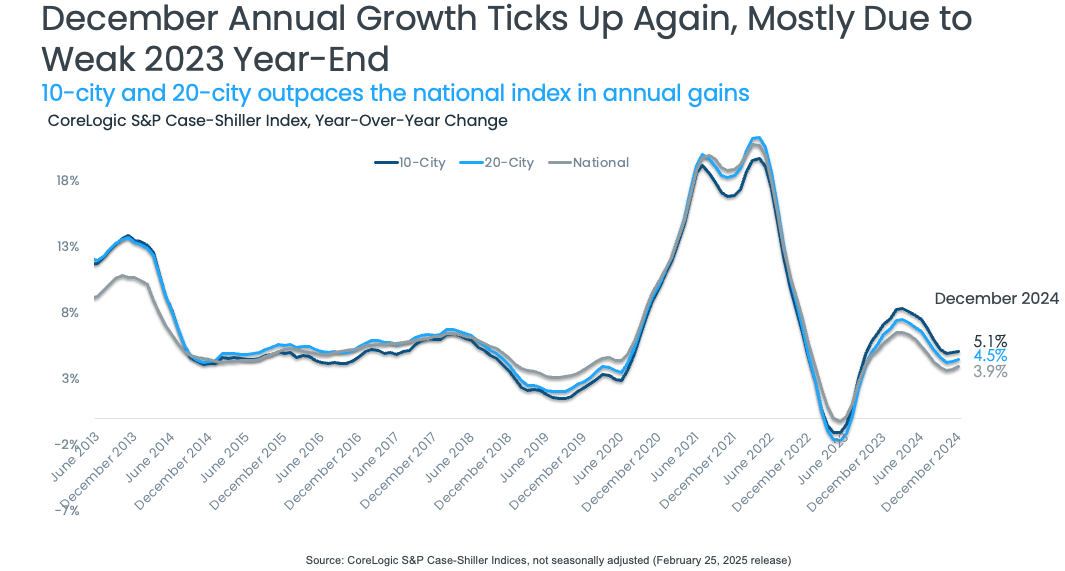
Based on the latest data from CoreLogic, a company that really knows its stuff when it comes to housing, the pace at which home prices are going up is expected to ease in 2025. While we saw some pretty strong gains earlier in 2024, reaching a peak of 6.5% annual price growth in February and March, the forecast for 2025 suggests an average appreciation of around 2.8% nationwide. To put it plainly, the rocket ship of home price increases is starting to gently glide back down.

Home Price Growth
Source: CoreLogic

Even towards the end of 2024, we saw some interesting shifts. December actually marked the second month where the annual price growth ticked upwards slightly, reaching 3.9%. This might seem like things are speeding up again, but it's more of a small bump in the road. Looking closer at the monthly changes, home prices actually declined for five months straight before this little December rise. This shows an underlying cooling trend.

Why the Slowdown? Let's Break It Down

So, what's causing this anticipated slowdown in home price growth? It's not just one thing, but a combination of different factors that are influencing both buyers and sellers.

  • The Shadow of High Mortgage Rates: Let's be honest, mortgage rates have been higher than what many of us have gotten used to. This directly impacts how much house people can afford. When it costs more to borrow money, the pool of potential buyers shrinks, and those who are still in the market tend to be more cautious about how much they're willing to pay. This increased cost of borrowing acts like a brake on rapid price increases.
  • Buyer Fatigue and Caution: After a period of intense competition and rapidly rising prices, many potential homebuyers have simply become more hesitant. They're seeing more homes on the market, giving them more choices and less pressure to jump into a deal at any cost. Economic worries and uncertainty about the future are also making people think twice before making such a big financial commitment. I've talked to many people who are taking a “wait and see” approach, hoping for more favorable conditions.
  • More Homes on the Market: Remember when it felt like there were barely any houses for sale? That's been changing. As we moved through 2024, the number of available homes started to increase in many areas. More inventory gives buyers more power. When there are more options, sellers can't always command the sky-high prices they might have gotten before. The end of 2024 even saw a significant rise in de-listings, meaning some sellers decided to take their homes off the market, perhaps sensing a shift in buyer demand.
  • Comparing to a Hot 2024: It's also important to remember what happened in 2024. We saw some really strong price gains, especially in the spring. When we look at the year-over-year numbers for 2025, we're comparing them to those relatively high points from the previous year. This makes the growth rate in 2025 naturally appear lower, even if prices aren't actually falling dramatically.

Regional Differences: Not All Markets Are the Same

One thing I've learned over the years is that the housing market isn't a single, unified entity. What's happening in one part of the country can be very different from what's going on somewhere else. The CoreLogic data highlights this quite clearly.

  • Cooling in the Southeast: Some areas, particularly in the Southeast like Tampa and Atlanta, experienced a more significant slowdown in annual price gains towards the end of 2024. Tampa even saw an annual price decline of 1.1% in the 20-city index. This suggests that some markets that were hot may be seeing a correction.
  • Continued Strength in the Northeast: On the other hand, cities like Boston, New York, and Chicago showed more resilience, leading the 20-city index with strong annual gains. These areas might have factors like limited inventory or strong local economies that are helping to support prices. I've noticed that in these areas, demand often outstrips supply, which keeps prices firmer.
  • The Midwest Story: Markets in the Midwest, like Cleveland and Detroit, saw some cooling after a strong start to 2024. This shows that even areas that initially had an advantage can be influenced by broader market trends.

Here's a quick look at how some key metros were performing at the end of 2024:

Metro Area Annual Price Growth (December 2024)
New York 7.2%
Chicago 6.6%
Boston 6.3%
National Average 3.9%
Denver (Lower than national average)
Dallas (Lower than national average)
Tampa -1.1%

Looking Ahead to the Spring Buying Season

The spring is usually a busy time for the housing market, and everyone's watching to see what 2025 will bring. Early signs suggest it might look a lot like 2024. While there will likely be more homes available for sale, which is good news for buyers, those buyers are still expected to be cautious due to the economic climate and those persistent higher mortgage rates.

One interesting point is the level of inventory in different markets. Cities like Boston and Chicago, which are still seeing price pressure, have inventories that are significantly below pre-pandemic levels. This lack of supply can help keep prices elevated. In contrast, Western markets like Denver, San Diego, and Las Vegas had more inventory but still showed relatively steady pricing, particularly for mid-tier and high-tier homes. This suggests that even in markets with more choices, demand might still be strong for certain types of properties.

Recommended Read:

Warning of a Weak Housing Market: Are We Headed for Another Crisis?

Fannie Mae Lowers Housing Market Forecast and Projections for 2025

Housing Market Forecast 2025 by JP Morgan Research

Housing Predictions 2025 by Warren Buffett's Berkshire Hathaway

The Wild Cards: Uncertainty and Policy

As someone who follows the housing market closely, I know that there are always factors that can throw a wrench in even the most careful predictions. Right now, there's a fair amount of uncertainty floating around.

  • Economic Policies: Potential policy changes can have a big impact on the economy, and by extension, the housing market. For example, talk of government layoffs could affect specific regions, particularly those with a large government presence like the Washington D.C. metro area. Job losses can definitely put downward pressure on housing demand and prices.
  • Non-Fixed Homeownership Costs: It's not just the mortgage payment that homeowners have to worry about. Costs like insurance and property taxes are also on the rise in many areas. These increasing costs can make homeownership less affordable and could further dampen demand in some markets, like Tampa, which has already seen some weakening.

My Two Cents: A More Balanced Market Ahead?

If you ask me, the forecast for slower home price appreciation in 2025 isn't necessarily a bad thing. After the rapid increases of the past few years, a more balanced market could be healthier in the long run. It might mean that buyers have more time to make decisions, there's less intense bidding, and prices become more aligned with underlying economic fundamentals.

For sellers, it might mean adjusting expectations. While you might not see the same quick and substantial profits as in recent times, well-maintained and properly priced homes should still attract buyers.

For potential homebuyers, this slowdown could create more opportunities. While mortgage rates remain a factor, the increased inventory and potentially less frantic competition could make finding the right home more manageable.

Of course, the housing market is complex and influenced by a multitude of local and national factors. It's always a good idea to keep a close eye on what's happening in your specific area and consult with local real estate professionals for personalized advice.

In Conclusion:

While home prices are still expected to rise in 2025, the rate of appreciation is forecast to be lower than what we experienced in 2024. This is due to a combination of factors, including higher mortgage rates, increased inventory, buyer caution, and comparisons to a strong prior year. However, remember that real estate is local, and different markets will experience different trends. Staying informed and understanding the dynamics at play will be key for both buyers and sellers in the year ahead.

Work with Norada in 2025, Your Trusted Source for Investment

in the Top Housing Markets of the U.S.

Discover high-quality, ready-to-rent properties designed to deliver consistent returns.

Contact us today to expand your real estate portfolio with confidence.

Contact our investment counselors (No Obligation):

(800) 611-3060

Get Started Now 

Also Read:

  • Housing Market Price Forecast for 2025 and 2026 Increased by NAR
  • Will the Housing Market Crash Due to Looming Recession in 2025?
  • 4 States Facing the Major Housing Market Crash or Correction
  • 5 Cities Where Home Prices Are Predicted To Crash in 2025
  • New Tariffs Could Trigger Housing Market Slowdown in 2025
  • Housing Market Forecast 2025: Affordability Crisis Will Continue
  • Lower Mortgage Rates Will Reignite the Housing Demand in 2025
  • NAR Predicts 6% Mortgage Rates in 2025 Will Boost Housing Market
  • Housing Market Forecast for the Next 2 Years: 2024-2026
  • Housing Market Predictions for the Next 4 Years: 2025 to 2028
  • Housing Market Predictions for Next Year: Prices to Rise by 4.4%
  • Housing Market Predictions for 2025 and 2026 by NAR Chief
  • Real Estate Forecast Next 5 Years: Top 5 Predictions for Future
  • Real Estate Forecast Next 10 Years: Will Prices Skyrocket?

Filed Under: Housing Market, Real Estate Market Tagged With: home prices, Housing Market, Housing Market 2025, housing market crash, Housing Market Forecast, housing market predictions, Housing Market Trends, Real Estate Market

Is the Florida Housing Market Headed for a Crash Like the Great Recession?

March 29, 2025 by Marco Santarelli

Is the Florida Housing Market Headed for a Crash Like the Great Recession?

Florida Housing Market Echoes ‘Great Recession': Are We Headed for a Repeat?. Is that familiar tune playing again? You know, the one that gives you a knot in your stomach when you think about the housing market? Well, if you're in Florida, especially Southwest Florida, you might be hearing echoes of the “Great Recession” in the real estate market right now.

Yes, the Florida housing market is showing signs that remind experts of the period leading up to the economic downturn of 2008. And it's got folks wondering – are we about to go through that again?

Let me tell you, as someone who's been watching the housing market for a while now, it's hard not to notice the shifts. It feels a bit like déjà vu. We saw this incredible boom during the pandemic, with people flocking to Florida for sunshine, more space, and what seemed like a better deal. But now, things are changing, and fast.

Is the Florida Housing Market Headed for a Crash Like Great Recession?

According to a recent report by Newsweek, real estate professor Shelton Weeks from Florida Gulf Coast University is ringing alarm bells. He told WINK News that home sellers in Southwest Florida are cutting their asking prices at levels we haven't seen in over a decade – “since the recovery days coming out of the Great Recession.” That’s a pretty strong statement, and it definitely got my attention.

Why Are We Seeing These Echoes?

So, what’s causing this sense of history repeating itself? It’s not one single thing, but a mix of factors all hitting the Sunshine State at once. Let’s break it down:

  • The Pandemic Boom is Over: Remember when everyone and their brother wanted to move to Florida? Low interest rates, remote work becoming the norm, and the lure of Florida living created a perfect storm. People from colder, more expensive states piled in, driving up demand and prices. Builders couldn't keep up! Florida actually built more new homes than any other state to try and meet this crazy demand.
  • The In-Migration Slowdown: But things have cooled off. The pandemic is officially “over,” and many companies are calling employees back to the office. That remote work dream that fueled a lot of those moves? It's fading for some. Plus, let's be honest, Florida isn't the hidden gem it once was. Everyone knows about it now, and the rush of newcomers has slowed considerably.
  • Rising Costs of Homeownership: This is a big one. Even if you managed to buy a house in Florida during the boom, keeping it is getting more expensive.
    • Homeowners Association (HOA) Fees: These are going up, sometimes drastically. Nobody likes surprise HOA fee hikes!
    • Property Insurance Premiums: Florida is facing a property insurance crisis. Premiums are skyrocketing, and some homeowners are struggling to even find coverage. The risk of hurricanes and other natural disasters makes insurers nervous, and that cost gets passed down to homeowners.
    • General Cost of Living: While Florida used to be known for lower taxes and affordability, the cost of living has been creeping up in many areas.

Inventory is Surging – Buyers Have More Choices

All these factors are creating a perfect storm – but this time, for buyers. We're seeing a huge jump in the number of homes for sale in Florida. Redfin data shows that Florida ended January with the highest inventory since 2012, with over 172,000 homes on the market. And it got even higher in February, reaching over 222,000, a 17.8% jump from the year before!

To put it simply, there are a lot more houses on the market, and fewer people rushing to buy them. Basic supply and demand, right? When supply goes up and demand goes down, guess what happens to prices?

Price Cuts Are Becoming Commonplace, Especially in Southwest Florida

This is where the “Great Recession” echoes get louder. Sellers are realizing they can't get the sky-high prices they were asking just a year or two ago. To attract buyers in this new market, they're having to slash prices.

Let's look at some specific examples from Southwest Florida, because that's where the data is really showing the shifts:

City % of Homes with Price Reductions (Feb 2024) Change from Last Year Median Sale Price (Feb 2024) Change from Last Year Homes Sold (Feb 2024) Change from Last Year
Cape Coral 44.9% Up 5.6% $390,000 Down 2.5% 379 Down 14.4%
Fort Myers 41.5% Up 0.6% $382,500 Down 1.3% 112 Down 24.8%
Naples 38.7% Up 4.9% $1,200,000 Up 43% 95 Down 7.8%
Punta Gorda 39.8% Not provided $360,000 Down 35.7% 59 Up 1.7%
Tampa 32.3% Down 2.2% $450,500 Up 5.4% 428 Up 1.4%

Source: Redfin data reported in Newsweek

Look at those numbers! Nearly half the homes in Cape Coral and Fort Myers had price reductions in February. And while median sale prices are still up in some areas like Tampa and Naples (Naples significantly up, though price cuts are still happening), they are down in Cape Coral, Fort Myers, and dramatically down in Punta Gorda. Sales are also down year-over-year in most of these cities, except for Tampa and Punta Gorda. This paints a picture of a market where sellers are having to adjust to a new reality.

What the Experts Are Saying

It's not just the data talking. Real estate professionals on the ground are seeing this shift firsthand.

Adam Bartomeo, owner of Bartomeo Realty, told Fox 4 that Southwest Florida has “the highest inventory we ever had.” He predicts that both rental and home sales prices will continue to decrease until the end of the year as we work through this inventory.

Denny Grimes, president of Denny Grimes & Team at Keller Williams Realty, went even further, telling Gulf Shore Business, “We're actually now in a buyer's market, and we've been in one since the fourth quarter of 2023.” He says the market is “resetting” after praying for more inventory and finally getting it.

And Professor Shelton Weeks, the one who started this whole “Great Recession echo” conversation, thinks “it's the right time to buy” in Florida, given the market conditions. He believes there could be some “good deals out there” for buyers who are ready to jump in.

Is This a Housing Crash? Or Just a Correction?

Now, before you panic and think we're heading for another 2008-style crash, let's take a breath. Most experts, including real estate analyst Nick Gerli (CEO of Reventure App), believe that Florida is facing a correction, not a crash.

What's the difference? A crash is a sudden, dramatic, and widespread collapse of the market. A correction is more of a recalibration, a return to a more balanced market after a period of overheating.

Think of it like this: imagine a seesaw that went way too high on one side (seller's market boom). Now it's swinging back down to find a more balanced point. That's a correction. A crash would be if the whole seesaw broke and fell apart.

Why a Correction is More Likely Than a Crash (This Time)

  • Stricter Lending Standards: After the Great Recession, lending practices became much tighter. Banks aren't handing out mortgages to just anyone like they were back then. This means there are fewer risky loans in the system, which reduces the chance of a widespread mortgage meltdown.
  • Job Market Still Relatively Strong: While there are concerns about the economy, the job market is still holding up better than it was before the Great Recession. People with jobs are less likely to default on their mortgages.
  • Demand Still Exists (Just Not Frenzied): People still want to live in Florida. The desire for sunshine, lower taxes (compared to some states), and a certain lifestyle is still there. The demand isn't gone, it's just not the crazy, unsustainable level we saw during the pandemic boom.

What Does This Mean for You?

  • For Buyers: This is good news! You have more power now. You have more homes to choose from, sellers are more willing to negotiate, and you might actually find a good deal. Take your time, shop around, and don't be afraid to make offers below asking price, especially in areas with high inventory and price reductions. Just be mindful of still-elevated mortgage rates and overall housing costs.
  • For Sellers: It's time to be realistic. The days of easy over-asking-price sales are over, at least for now. You need to price your home competitively, be prepared for negotiations, and maybe even offer incentives to attract buyers. It's a buyer's market, so adjust your expectations accordingly.

My Take – A Healthy Reset

Honestly, I think this correction in the Florida housing market could be a good thing in the long run. The pandemic boom was unsustainable. Prices were getting out of control, and many people were priced out of the market. A reset is needed to bring things back to a more balanced and healthy level.

While the “Great Recession” comparison is attention-grabbing, and it’s important to be aware of market shifts, I don't believe we're headed for a repeat of 2008. This feels more like a market correction – a necessary adjustment after a period of rapid growth. It might be a bit bumpy for sellers, but for buyers who have been waiting on the sidelines, this could be the opportunity they've been looking for. Just remember to do your homework, work with a good real estate agent, and make smart, informed decisions.

Work with Norada, Your Trusted Source for

Real Estate Investment in “Florida Markets”

Discover high-quality, ready-to-rent properties designed to deliver consistent returns.

Contact us today to expand your real estate portfolio with confidence.

Contact our investment counselors (No Obligation):

(800) 611-3060

Get Started Now 

Read More:

  • 3 Florida Cities at High Risk of a Housing Market Crash or Decline
  • 4 States Facing the Major Housing Market Crash or Correction
  • Florida Housing Market: Record Supply Expected to Favor Buyers in 2025
  • Florida Housing Market Forecast for Next 2 Years: 2025-2026
  • Florida Real Estate Market Saw a Post-Hurricane Rebound Last Month
  • Florida Housing Market: Predictions for Next 5 Years (2025-2030)
  • Hottest Florida Housing Markets in 2025: Miami and Orlando
  • Florida Real Estate: 9 Housing Markets Predicted to Rise in 2025
  • Housing Markets at Risk: California, New Jersey, Illinois, Florida
  • 3 Florida Housing Markets Are Again on the Brink of a Crash
  • Florida Housing Market Predictions 2025: Insights Across All Cities
  • Florida Housing Market Trends: Rent Growth Falls Behind Nation
  • When Will the Housing Market Crash in Florida?
  • South Florida Housing Market: Will it Crash?
  • South Florida Housing Market: A Crossroads for Homebuyers

Filed Under: Housing Market, Real Estate Market Tagged With: florida housing market, Housing Market, Housing Market 2025, housing market crash, Housing Market Forecast, housing market predictions, Housing Market Trends, Real Estate Market

Today’s Mortgage Rates – March 29, 2025: Rates See a Slight Dip

March 29, 2025 by Marco Santarelli

Today's Mortgage Rates - March 29, 2025: Rates See a Slight Dip

Good news for prospective homebuyers and those looking to refinance! As of today, March 29, 2025, mortgage rates have generally decreased compared to the beginning of the year. This dip offers a potential window for securing a more favorable interest rate on your home loan or refinance.

Today's Mortgage Rates – March 29, 2025: Rates See a Slight Dip

Key Takeaways:

  • Mortgage rates today have mostly decreased.
  • The 30-year fixed mortgage rate is currently at 6.59%, down three basis points.
  • The 15-year fixed rate has also dropped, now at 5.91%, a decrease of four basis points.
  • Refinance rates have also seen a similar downward trend.
  • Experts at Fannie Mae predict mortgage rates will likely continue to move lower through the rest of 2025 and into 2026.
  • While a good time to buy compared to the peak of the pandemic, the absolute best time depends on your individual circumstances.

According to the latest data from Zillow, the trend we've seen since the start of 2025 of slightly decreasing mortgage rates continues today. For those in the market to purchase a new home, this small reduction in rates can translate to modest savings over the life of the loan.

Similarly, homeowners who have been considering refinancing their existing mortgage might find today's refinance rates more appealing than what was available earlier in the year. It's worth noting, however, that while these are national averages, the specific rate you'll qualify for will depend on a variety of factors, including your credit score, down payment amount, and the type of loan you choose.

Current Mortgage Rates on March 29, 2025

Here’s a snapshot of the national average mortgage rates being offered today:

Loan Type Interest Rate
30-Year Fixed 6.59%
20-Year Fixed 6.41%
15-Year Fixed 5.91%
5/1 ARM 6.82%
7/1 ARM 7.13%
30-Year VA 6.09%
15-Year VA 5.67%
5/1 VA 6.22%

Keep in mind that these are just averages. The actual mortgage rate you receive could be higher or lower.

Today's Mortgage Refinance Rates

If you're thinking about refinancing your current home loan, here are the average mortgage refinance rates as of today:

Loan Type Interest Rate
30-Year Fixed 6.55%
20-Year Fixed 6.27%
15-Year Fixed 5.84%
5/1 ARM 6.54%
7/1 ARM 6.56%
30-Year VA 6.20%
15-Year VA 5.86%
5/1 VA 6.26%
30-Year FHA 6.18%
15-Year FHA 6.04%

Source: Zillow

Interestingly, while it's often the case that refinance rates are a bit higher than purchase rates, the data today shows some instances where they are very close or even slightly lower for certain loan products. This could present a favorable opportunity for homeowners looking to lower their monthly payments or shorten their loan term.

Understanding 30-Year Fixed Mortgage Rates

The 30-year fixed-rate mortgage remains a popular choice for many homebuyers, and for good reason. Its primary advantages lie in the predictability and relatively lower monthly payments compared to shorter-term loans. Because the interest rate stays the same over the entire 30-year period, homeowners can budget with confidence, knowing their principal and interest payment won't change. This longer repayment period spreads out the total cost of the loan, making monthly payments more manageable for some borrowers.

However, the trade-off for these benefits comes in the form of higher overall interest paid over the life of the loan. While the monthly payments are lower, you're paying interest for a longer duration, and typically at a slightly higher interest rate compared to a 15-year fixed mortgage. For example, consider a $300,000 loan. Over 30 years at an interest rate of 6.59%, the total interest paid will be significantly more than if the same loan had a 15-year term with a lower interest rate.

Exploring 15-Year Fixed Mortgage Rates

On the other end of the spectrum is the 15-year fixed-rate mortgage. The key advantages here are a lower interest rate compared to the 30-year fixed and a significantly shorter repayment period. This means you'll not only pay less interest in total but also own your home free and clear in half the time. The peace of mind that comes with a shorter mortgage term and the substantial interest savings are significant draws for many.

The main challenge with a 15-year fixed mortgage is the higher monthly payment. Because you're paying off the same loan amount in a shorter timeframe, each payment will be larger. This requires a higher level of monthly income and can impact your ability to handle other financial obligations. However, for those who can comfortably afford the higher payments, the long-term financial benefits are substantial.

Considering Adjustable-Rate Mortgages (ARMs)

Adjustable-rate mortgages, like the 5/1 ARM or 7/1 ARM, offer an initial fixed interest rate for a specific period (e.g., five or seven years), after which the rate adjusts periodically based on prevailing market conditions. The initial “teaser” rate is often lower than that of a comparable fixed-rate mortgage, which can result in lower monthly payments during the introductory period.

The potential downside of an ARM is the uncertainty of future interest rate adjustments. If interest rates rise after the fixed-rate period ends, your monthly payments could increase, potentially significantly. This unpredictability makes ARMs a riskier option for borrowers who plan to stay in their homes long-term or who have tight monthly budgets. However, ARMs can be attractive to those who expect to move or refinance before the adjustment period begins, allowing them to take advantage of the lower initial rate. It's crucial to fully understand the terms of an ARM, including how often the rate can adjust and the maximum possible interest rate.

Is Now the Right Time to Get a Mortgage for Your House?

The question of whether now is a good time to buy a house is a common one, and the answer is often personal and depends on individual circumstances. Compared to the rapid home price increases and sometimes higher mortgage rates seen during the peak of the COVID-19 pandemic, the current market offers a bit more stability. Home price appreciation has slowed, and as we've seen today, mortgage rates have come down slightly from the beginning of the year.

Recommended Read:

Mortgage Rates Trends as of March 28, 2025

Mortgage Rates Drop: Can You Finally Afford a $400,000 Home?

Expect High Mortgage Rates Until 2026: Fannie Mae's 2-Year Forecast

Will Mortgage Rates Rise Back Above 7% or Go Down in 2025?

Mortgage Interest Rates Forecast for Next 10 Years

Experts at Fannie Mae's Economic and Strategic Research (ESR) Group anticipate that mortgage rates will continue their downward trend, forecasting an average of 6.3% by the end of 2025 and 6.2% by the end of 2026 [Fannie Mae]. This suggests that waiting a bit longer could potentially result in even lower borrowing costs. However, as the saying goes, the best time to buy is often when you're financially ready and find the right home for your needs. Trying to perfectly time the market is a difficult task.

What Will Be Your Mortgage Payments Today Under Current Rates?

To give you a clearer picture of what today's mortgage rates might mean for your monthly payments, let's look at a few examples. These calculations are based on the current average 30-year fixed mortgage rate of 6.59% and do not include property taxes, homeowner's insurance, or any potential private mortgage insurance (PMI), which would add to your total monthly housing cost.

Monthly Payment on $150k Mortgage

Based on a $150,000 loan at a 6.59% interest rate with a 30-year term, your estimated monthly principal and interest payment would be approximately $953 per month.

Monthly Payment on $200k Mortgage

For a $200,000 mortgage at the same 6.59% interest rate over 30 years, your estimated monthly principal and interest payment would be around $1,270 per month.

Monthly Payment on $300k Mortgage

If you were to borrow $300,000 at a 6.59% interest rate with a 30-year repayment period, your estimated monthly principal and interest payment would be approximately $1,905 per month.

Monthly Payment on $400k Mortgage

A $400,000 mortgage at 6.59% fixed for 30 years would result in an estimated monthly principal and interest payment of about $2,540 per month.

Monthly Payment on $500k Mortgage

Finally, for a $500,000 loan at a 6.59% interest rate over a 30-year term, your estimated monthly principal and interest payment would be in the neighborhood of $3,176 per month.

These examples clearly illustrate how the loan amount directly impacts your monthly mortgage payment. It's crucial to consider your budget and long-term financial goals when determining how much you can comfortably afford to borrow. Remember to also factor in the additional costs associated with homeownership beyond just the principal and interest.

Work With Norada, Your Trusted Source for

Real Estate Investment in the U.S.

Investing in turnkey real estate can help you secure consistent returns with fluctuating mortgage rates.

Expand your portfolio confidently, even in a shifting interest rate environment.

Speak with our expert investment counselors (No Obligation):

(800) 611-3060

Get Started Now

Also Read:

  • Will Mortgage Rates Go Down in 2025: Morgan Stanley's Forecast
  • Mortgage Rate Predictions 2025 from 4 Leading Housing Experts
  • Mortgage Rates Forecast for the Next 3 Years: 2025 to 2027
  • 30-Year Mortgage Rate Forecast for the Next 5 Years
  • 15-Year Mortgage Rate Forecast for the Next 5 Years
  • Why Are Mortgage Rates Going Up in 2025: Will Rates Drop?
  • Why Are Mortgage Rates So High and Predictions for 2025
  • Will Mortgage Rates Ever Be 3% Again in the Future?
  • Mortgage Rates Predictions for Next 2 Years
  • Mortgage Rate Predictions for Next 5 Years
  • Mortgage Rate Predictions: Why 2% and 3% Rates are Out of Reach
  • How Lower Mortgage Rates Can Save You Thousands?
  • How to Get a Low Mortgage Interest Rate?
  • Will Mortgage Rates Ever Be 4% Again?

Filed Under: Financing, Mortgage Tagged With: Interest Rate, mortgage, Mortgage Rate Trends, mortgage rates, Mortgage Rates Predictions, Mortgage Rates Today

  • « Previous Page
  • 1
  • …
  • 190
  • 191
  • 192
  • 193
  • 194
  • …
  • 379
  • Next Page »

Real Estate

  • Birmingham
  • Cape Coral
  • Charlotte
  • Chicago

Quick Links

  • Markets
  • Membership
  • Notes
  • Contact Us

Blog Posts

  • Why Buyers Are Rushing to Lock In Before Mortgage Rates Hit 7%
    July 29, 2026Marco Santarelli
  • Best Cities to Buy a Duplex or Triplex for Rental Income in 2026
    July 29, 2026Marco Santarelli
  • Mortgage Rates Today, July 29, 2026: 30-Year Refinance Rate Drops by 4 Basis Points
    July 29, 2026Marco Santarelli

Contact

Norada Real Estate Investments 30251 Golden Lantern, Suite E-261 Laguna Niguel, CA 92677

(949) 218-6668
(800) 611-3060
BBB
  • Terms of Use
  • |
  • Privacy Policy
  • |
  • Testimonials
  • |
  • Suggestions?
  • |
  • Home

Copyright 2018 Norada Real Estate Investments

Loading...