Norada Real Estate Investments

  • Home
  • Markets
  • Properties
  • Membership
  • Podcast
  • Learn
  • About
  • Contact

Will the Housing Market Crash Due to Reciprocal Tariffs: Survey Warns

March 26, 2025 by Marco Santarelli

72% Americans Fear Reciprocal Tariffs Could Hurt the Housing Market

The question on many Americans' minds is: Will the Housing Market Slowdown Because of Reciprocal Tariffs? The short answer, according to a recent survey, is that the majority of people are concerned. A whopping 72% of Americans believe that “Reciprocal Tariffs” will negatively impact the US housing market, with some even fearing a significant downturn.

While a complete crash might not be a certainty, these trade tensions are undoubtedly creating uncertainty and could potentially slow down the market. Let's dive into why this is the case and what the potential consequences could be.

Will the Housing Market Crash Due to Reciprocal Tariffs?

I've been following economic trends, especially those affecting the real estate sector, for a while now. In my opinion, it's not just about the numbers; it's about understanding the psychology behind market movements. And right now, a lot of that psychology is driven by fear of the unknown.

What are Reciprocal Tariffs, and Why Should You Care?

Tariffs, in their simplest form, are taxes on imported goods. Reciprocal tariffs take this a step further, implying that if one country imposes a tariff on another, the second country will respond with a similar tariff on goods coming from the first. This can escalate into a trade war, where both countries keep raising tariffs on each other, ultimately making goods more expensive for consumers and businesses.

Why should you care? Because the housing market is intricately connected to the broader economy. Think about it:

  • Construction materials: Many building materials, like lumber, steel, and even certain types of drywall, are imported. Tariffs on these goods increase the cost of building new homes.
  • Home appliances: From refrigerators to washing machines, many appliances are also imported. Higher tariffs mean higher prices for these essentials, making homes less affordable.
  • Investor confidence: Trade wars create uncertainty, which can make investors hesitant to put money into the housing market.

A New Survey Reveals Growing Anxiety
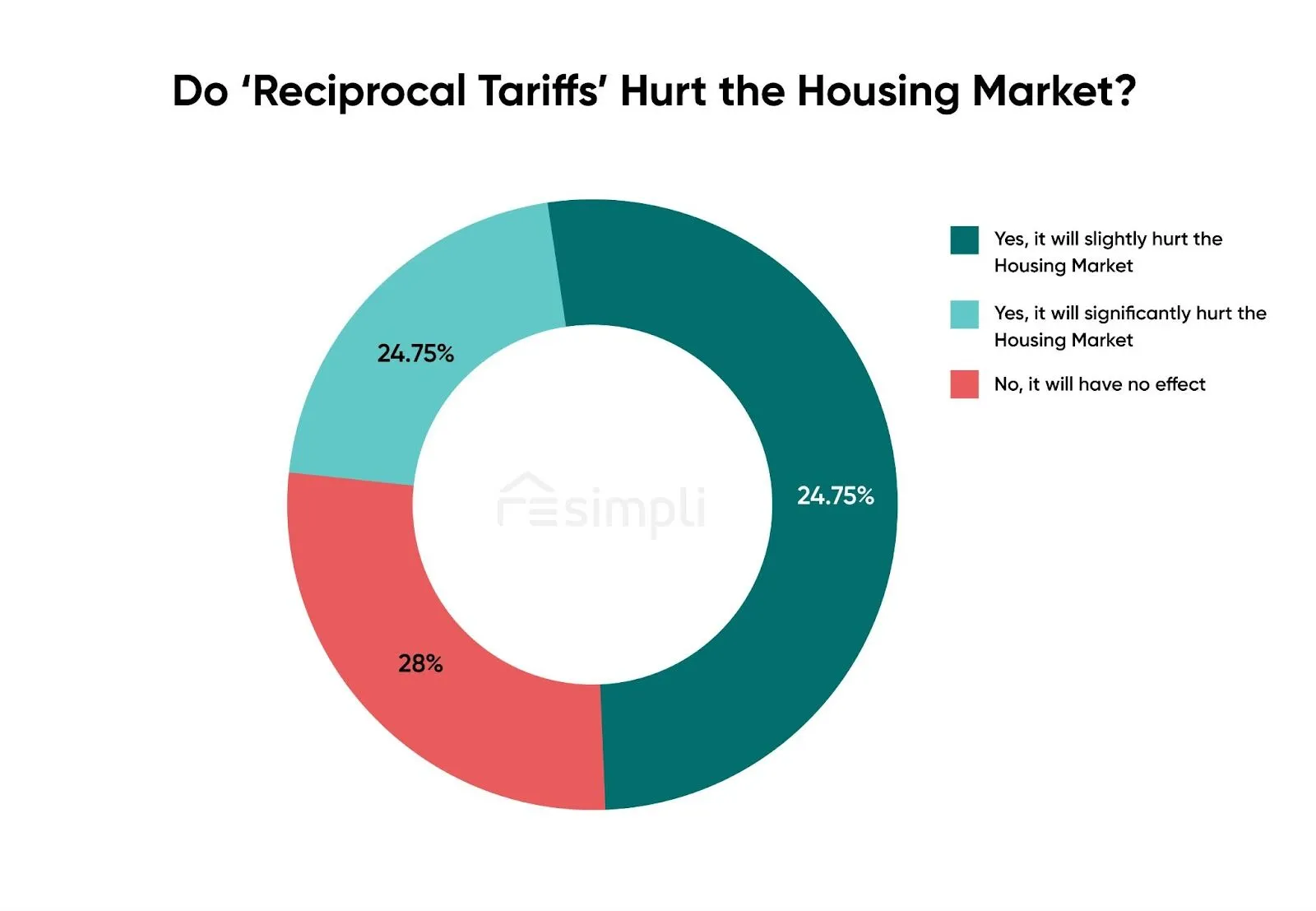
Will the Housing Market Slowdown Because of Reciprocal Tariffs?
Source: REsimpli

A recent survey conducted by REsimpli, analyzing the opinions of 1,200 Americans concerned with political and economic changes, sheds light on the public's perception of the potential impact of reciprocal tariffs. The results are telling:

  • High Level of Concern: 72% of those surveyed believe reciprocal tariffs will hurt the US housing market.
  • Border Communities at Risk: 53.25% think housing markets near the US-Canada border will be most affected.
  • Supply Chain Worries: 33.75% are highly concerned about disruptions to housing supply chains.
  • Investor Pullback: 66.42% believe Canadian investors will pull back from the US.
  • Liquidity Concerns: 69.5% expect the housing market to become less liquid.
  • Affordability Impact: 55.92% believe housing affordability will be negatively impacted.
  • Mortgage Rate Hikes: 51.25% anticipate increases in mortgage rates.

These numbers paint a picture of growing anxiety surrounding the housing market's future.

Digging Deeper: The Implications of Reciprocal Tariffs

Let's break down some of the key concerns and explore their potential implications:

1. Impact on Housing Supply Chains:

  • Increased Construction Costs: Tariffs on imported building materials like lumber, steel, and aluminum will drive up construction costs. This means new homes will be more expensive to build, potentially leading to fewer new construction projects.
  • Supply Shortages: Trade disputes can disrupt supply chains, making it harder to get the materials needed to build homes. This could lead to delays in construction and further price increases.
  • Example: Imagine a homebuilder relying on Canadian lumber, which now carries a 20% tariff. This instantly increases the cost of framing a house, forcing the builder to either absorb the cost (reducing profit) or pass it on to the buyer (making the home less affordable).

2. Canadian Investor Behavior:

  • Reduced Investment: Canada is a significant investor in the US housing market, particularly in certain regions. Tariffs and trade tensions could deter Canadian investors, leading to a decrease in demand for US properties.
  • Impact on Condo Markets: Canadian investors often focus on condo markets in major US cities. A pullback could put downward pressure on condo prices in these areas.
  • Example: A Canadian investor who previously purchased several condos in Miami as rental properties might decide to halt future investments due to tariff-related uncertainty, potentially impacting the demand and prices in that market.

3. Liquidity and Affordability:

  • Slower Sales: If buyers become more cautious due to trade tensions, homes may take longer to sell. This can reduce the liquidity of the market, making it harder for sellers to find buyers quickly.
  • Increased Mortgage Rates: While the direct link between tariffs and mortgage rates is complex, a trade war can lead to increased economic uncertainty, which can, in turn, push mortgage rates higher. This makes buying a home more expensive for everyone.
  • Reduced Affordability: The combination of higher construction costs, potential price increases on imported appliances, and potentially higher mortgage rates could significantly reduce housing affordability, pricing some potential buyers out of the market.

4. Regional Impacts:

  • Border States at Risk: The survey suggests that housing markets near the US-Canada border are particularly vulnerable. This is because these areas often have strong trade ties and cross-border investment flows.
  • Example: Cities like Detroit, Buffalo, and Seattle, which rely heavily on trade with Canada, could experience more significant housing market impacts than other regions.
  • Specific Regional Impacts: Some states such as Maine, Michigan, North Dakota, and Montana, have closer proximity with Canada. These states could witness significant trade and supply chain disruptions.

5. Property Tax Implications:

  • Decreased Property Values: In areas where the housing market softens due to trade tensions, property values could decline. This, in turn, could impact property tax revenues for local governments.
  • Tax Increases: To compensate for lost revenue, local governments might be forced to increase property tax rates, adding another financial burden on homeowners.

Recommended Read:

Fannie Mae Lowers Housing Market Forecast and Projections for 2025

Housing Market Forecast 2025 by JP Morgan Research

Housing Predictions 2025 by Warren Buffett's Berkshire Hathaway

Is a Housing Market Crash Inevitable?

While the survey results are concerning, they don't necessarily guarantee a housing market crash. The housing market is influenced by a complex interplay of factors, and tariffs are just one piece of the puzzle. Here are some factors that could mitigate the negative impacts:

  • Strong US Economy: A strong overall economy could help offset the negative effects of tariffs. If people have jobs and confidence in the future, they are more likely to buy homes.
  • Low Inventory: In many areas, housing inventory remains low. This could help support prices, even if demand softens somewhat.
  • Government Intervention: The government could take steps to address the situation, such as negotiating trade agreements or providing assistance to affected industries.

What Homebuyers and Investors Should Do?

If you're considering buying or investing in real estate, it's important to be aware of the potential risks and opportunities associated with reciprocal tariffs. Here's some advice:

  • Do Your Research: Stay informed about the latest developments in trade policy and their potential impact on your local housing market.
  • Be Cautious: If you're planning to buy, don't overextend yourself financially. Leave room in your budget for potential increases in mortgage rates or property taxes.
  • Consider Location: Think carefully about the location of your investment. Areas with strong local economies and diverse industries may be less vulnerable to trade shocks.
  • Talk to the Experts: Consult with a real estate agent, mortgage broker, and financial advisor to get personalized advice based on your individual circumstances.

My Take: Uncertainty is the Biggest Threat

In my opinion, the biggest threat posed by reciprocal tariffs isn't necessarily a dramatic crash, but rather the uncertainty they create. Uncertainty makes people nervous, and nervous people tend to hold back on big decisions like buying a home.

I think it's crucial for policymakers to consider the potential impact of trade policies on the housing market. The housing market is a major driver of the US economy, and policies that destabilize it could have far-reaching consequences.

Looking Ahead: Monitoring the Situation

The situation is constantly evolving, so it's important to stay informed and monitor developments closely. Pay attention to:

  • Trade negotiations between the US and Canada. Any progress in resolving trade disputes could help ease market anxieties.
  • Economic data on housing starts, home sales, and prices. These indicators will provide insights into the health of the housing market.
  • Consumer sentiment surveys. These surveys can gauge the level of confidence among potential homebuyers.

Summary:

While a complete housing market crash due to reciprocal tariffs isn't a foregone conclusion, the concerns expressed by the majority of Americans in the REsimpli survey are valid. The potential impact on supply chains, investor behavior, and affordability could create significant headwinds for the housing market. Staying informed, seeking expert advice, and exercising caution are essential for both homebuyers and investors in this uncertain environment.

Work with Norada, Your Trusted Source for Investment

in the Top Housing Markets of the U.S.

Discover high-quality, ready-to-rent properties designed to deliver consistent returns.

Contact us today to expand your real estate portfolio with confidence.

Contact our investment counselors (No Obligation):

(800) 611-3060

Get Started Now 

Read More:

  • 4 States Facing the Major Housing Market Crash or Correction
  • 5 Cities Where Home Prices Are Predicted To Crash in 2025
  • New Tariffs Could Trigger Housing Market Slowdown in 2025
  • Housing Market Forecast 2025: Affordability Crisis Will Continue
  • Lower Mortgage Rates Will Reignite the Housing Demand in 2025
  • NAR Predicts 6% Mortgage Rates in 2025 Will Boost Housing Market
  • Housing Market Forecast for the Next 2 Years: 2024-2026
  • Housing Market Predictions for the Next 4 Years: 2025 to 2028
  • Housing Market Predictions for Next Year: Prices to Rise by 4.4%
  • Housing Market Predictions for 2025 and 2026 by NAR Chief
  • Real Estate Forecast Next 5 Years: Top 5 Predictions for Future
  • 2008 Forecaster Warns: Housing Market 2024 Needs This to Survive
  • Real Estate Forecast Next 10 Years: Will Prices Skyrocket?

Filed Under: Housing Market, Real Estate Market Tagged With: Housing Market, Housing Market 2025, housing market crash, Housing Market Forecast, housing market predictions, Housing Market Trends, Real Estate Market

NAR Cuts 2025 Housing Market Forecast: Home Sales to Hit 4.3 Million

March 26, 2025 by Marco Santarelli

NAR Cuts 2025 Housing Market Forecast: Home Sales to Hit 4.3 Million

Is the housing market about to take a turn? The short answer is yes, but perhaps not the dramatic drop some were expecting. The National Association of Realtors (NAR) has adjusted its housing market forecast for 2025, now anticipating existing-home sales to reach 4.3 million, a 6% increase compared to 2024. While still positive, this is a step down from their previous, more optimistic projections.

For months, I've been closely watching the market, speaking with local agents, and analyzing trends. The initial excitement for a booming 2025 is now tempered with a dose of reality. Let's dive into what's causing this revision and what it could mean for you, whether you're a buyer, seller, or simply curious about the real estate world.

NAR Cuts 2025 Housing Market Forecast: Home Sales to Hit 4.3 Million

Why the Change of Heart at NAR?

Back in late 2024, NAR was pretty confident, forecasting existing-home sales to hit 4.9 million in 2025. So what happened? According to their updated NAR Real Estate Forecast Summit Update, several factors contributed to this shift.

  • Strained Affordability: This is the big one. Home prices have remained stubbornly high, and while mortgage rates have fluctuated, they haven't dropped enough to significantly ease the burden on potential buyers.
  • Price Growth Adjustments: NAR initially predicted a modest 2% home-price growth for both 2025 and 2026. Now, they've revised that upward to 3% and 4%, respectively. This means homes will likely be even less affordable than previously thought.
  • Realistic Expectations: I believe part of the revision is simply a dose of realism. While the market has shown resilience, the factors that were expected to fuel a major boom haven't materialized as strongly as anticipated.

A Closer Look at the Revised Numbers

Here's a breakdown of NAR's revised forecasts:

  • Existing-Home Sales (2025): 4.3 million (up 6% from 2024) – Previous forecast: 4.9 million
  • New-Home Sales (2025): Up 10% – Previous forecast: Up 11%
  • Existing-Home Sales (2026): Up 11% (remains within the previously projected range of 10%-15%)
  • New-Home Sales (2026): Up 5% – Previous forecast: Up 8%
  • Home-Price Growth (2025): 3% – Previous forecast: 2%
  • Home-Price Growth (2026): 4% – Previous forecast: 2%

The biggest takeaway? While the market is still expected to grow, the pace of that growth is slowing down.

Is It All Doom and Gloom?

Not at all! Despite the downgraded forecast, NAR Chief Economist Lawrence Yun remains optimistic. He stated on the webinar that “The worst is over [for home sales]. The worst for inventory is over. I think the recession probability is still slim. Job additions, lower mortgage rates and all the factors driving home sales are moving positively, so look for more business opportunities this year.”

And honestly, I agree with his sentiment. The market has been through some rough patches, and the fact that it's still showing signs of growth is encouraging. Several positives are still at play:

  • Job Market Stability: A strong job market provides confidence to potential homebuyers.
  • Potential for Lower Mortgage Rates: While rates haven't plummeted, the expectation is that they will gradually decrease, making homes more accessible.
  • Inventory Slowly Improving: While still below historical averages, housing inventory is slowly increasing in many markets, giving buyers more options.

How Does This Compare to Other Forecasts?

It's important to remember that NAR isn't the only organization making predictions. Their revised forecast of 4.3 million existing-home sales is actually more in line with other industry experts.

To put things in perspective:

  • NAR (Revised): 4.3 million
  • HousingWire (Mohtashami/Simonsen): 4.2 million
  • Realtor.com: 4 million

This suggests that NAR's initial forecast was an outlier, and the revised numbers represent a more consensus view of the market.

Recommended Read:

Warning of a Weak Housing Market: Are We Headed for Another Crisis?

Fannie Mae Lowers Housing Market Forecast and Projections for 2025

Housing Market Forecast 2025 by JP Morgan Research

Housing Predictions 2025 by Warren Buffett's Berkshire Hathaway

What Does This Mean for Buyers?

If you're hoping for a dramatic price crash, this forecast suggests you might be waiting a while. While prices might not skyrocket, they're expected to continue their upward trend.

Here's my advice for buyers:

  • Get Pre-Approved: Knowing how much you can afford is crucial.
  • Be Realistic: Don't expect to find a bargain. Focus on finding a home that meets your needs within your budget.
  • Consider Different Markets: Look at areas that might be slightly more affordable than your ideal location.
  • Be Patient: The right home will come along, so don't feel pressured to jump into something you're not comfortable with.
  • Do not time the market:*Time in the market is more important than timing the market.

What Does This Mean for Sellers?

While the market might not be as hot as it was a few years ago, it's still a good time to sell, especially if you've built up equity.

Here's my advice for sellers:

  • Price Your Home Competitively: Don't overprice your home. Work with a real estate agent to determine a fair market value.
  • Make Necessary Repairs: Ensure your home is in good condition to attract buyers.
  • Stage Your Home: Make your home as appealing as possible to potential buyers.
  • Highlight the Positives: Emphasize the unique features of your home and neighborhood.

My Personal Take

As someone deeply involved in real estate, I believe the revised forecast is a healthy dose of realism. The initial excitement for a massive boom was probably a bit overblown. The market is still moving in a positive direction, but it's doing so at a more sustainable pace.

I've seen firsthand how affordability challenges are impacting buyers. Many are priced out of their ideal markets, forcing them to make compromises or delay their home-buying dreams. This is why it's crucial to focus on solutions that address affordability, such as increasing housing supply and exploring alternative financing options.

Overall, I remain cautiously optimistic about the future of the housing market. While there are challenges ahead, the fundamentals remain strong. With a stable job market and the potential for lower mortgage rates, I believe the market will continue to grow, albeit at a more moderate pace.

Key Takeaways:

  • NAR has downgraded its housing market forecast for 2025, now expecting existing-home sales to reach 4.3 million.
  • The revision is primarily due to strained affordability and upward adjustments to home-price growth projections.
  • Despite the downgrade, NAR remains optimistic about the market's overall trajectory.
  • The revised forecast is more in line with other industry experts' predictions.
  • Buyers should focus on affordability and be patient, while sellers should price their homes competitively.

Tables:

Forecast Previous Estimate Revised Estimate Change
Existing Home Sales 2025 4.9 million 4.3 million -0.6 million
New Home Sales 2025 Up 11% Up 10% -1%
Home Price Growth 2025 2% 3% +1%
Home Price Growth 2026 2% 4% +2%

Final Thoughts

The housing market is always changing. Stay informed, consult with trusted professionals, and make decisions that are right for your individual circumstances. Whether you're buying, selling, or simply keeping an eye on the market, understanding the trends is key to navigating this complex landscape.

Work with Norada in 2025, Your Trusted Source for Investment

in the Top Housing Markets of the U.S.

Discover high-quality, ready-to-rent properties designed to deliver consistent returns.

Contact us today to expand your real estate portfolio with confidence.

Contact our investment counselors (No Obligation):

(800) 611-3060

Get Started Now 

Also Read:

  • Will the Housing Market Crash Due to Looming Recession in 2025?
  • 4 States Facing the Major Housing Market Crash or Correction
  • 5 Cities Where Home Prices Are Predicted To Crash in 2025
  • New Tariffs Could Trigger Housing Market Slowdown in 2025
  • Housing Market Forecast 2025: Affordability Crisis Will Continue
  • Lower Mortgage Rates Will Reignite the Housing Demand in 2025
  • NAR Predicts 6% Mortgage Rates in 2025 Will Boost Housing Market
  • Housing Market Forecast for the Next 2 Years: 2024-2026
  • Housing Market Predictions for the Next 4 Years: 2025 to 2028
  • Housing Market Predictions for Next Year: Prices to Rise by 4.4%
  • Housing Market Predictions for 2025 and 2026 by NAR Chief
  • Real Estate Forecast Next 5 Years: Top 5 Predictions for Future
  • Real Estate Forecast Next 10 Years: Will Prices Skyrocket?
Filed Under: Housing Market, Real Estate Market Tagged With: Housing Market, Housing Market 2025, housing market crash, Housing Market Forecast, housing market predictions, Housing Market Trends, Real Estate Market

New-Home Sales Rise as Mortgage Rates Drop Significantly

March 26, 2025 by Marco Santarelli

New-Home Sales Rise as Mortgage Rates Drop Significantly

Are you thinking about buying a new home? If so, you're probably keeping a close eye on mortgage rates. The good news is, lower mortgage rates help push new-home sales higher, and we've seen a bit of that recently. While the increase might not be as dramatic as some hoped, the slight dip in rates combined with limited existing home inventory has given the new construction market a little boost.

Let's dive into what's happening and what it could mean for you.

New-Home Sales Rise as Mortgage Rates Drop Significantly

A Slight Uptick, But Not a Home Run

Recent data shows that sales of new single-family homes in February experienced a modest rise. Specifically, sales jumped 1.8% to a seasonally adjusted annual rate of 676,000. That's also 5.1% higher than the same time last year.

While any increase is positive, some experts were expecting a more significant surge, especially given the slight decrease in mortgage rates.  In my view, this highlights a key issue: the underlying demand for housing is much stronger than what these numbers reflect.

Why Aren't Sales Higher? The Demand Dilemma

According to experts if new-home sales were tracking at the long-run average percentage of total households, then the pace of new-home sales would be almost 950,000. This really underscores the fact that even with the increase, we're still falling short of meeting the current housing needs of our growing population.

Think of it this way: imagine you're trying to fill a swimming pool with a garden hose. You're adding water, but the pool is so big that it takes a long time to see a real difference. That's kind of what's happening in the housing market.

Inventory: A Mixed Bag

One of the reasons new-home sales are getting a boost is the lack of existing homes available for sale. This makes new construction a more appealing option for many buyers.

Here's a breakdown of the inventory situation:

  • Total new-home inventory: Rose to 500,000 in February.
  • Year-over-year increase: A 7.5% jump compared to February of last year.
  • Months' supply: This translates to an 8.9-month supply at the current sales pace.

That 8.9-month supply figure is important. It tells us how long it would take to sell all the new homes currently on the market if builders didn't add any more. A healthy market usually has a supply of around 6 months. So we have more inventory, but it is still not enough.

And here's something interesting: the number of completed, ready-to-occupy homes has also increased significantly.

  • Ready-to-occupy homes: Up 35% year-over-year, reaching 119,000.
  • Highest level since: Mid-2009

This is good news for buyers who are in a hurry to move in. The increased availability of these homes could make new construction an even more attractive option.

Price Check: What's the Damage?

The good news is that the median home sales price actually decreased compared to last year.

  • Median sales price: $414,500 in February 2025.
  • Year-over-year decrease: A modest 1.5% drop.

While a 1.5% decrease might not sound like much, any bit of relief on the pricing front is welcome news for potential buyers.

Regional Differences

It's important to remember that real estate is local. While nationally, new-home sales are up, the picture varies depending on where you live.

  • The South: Saw a significant 12.4% increase in sales.
  • The West: Sales decreased by 6.7%.
  • The Midwest: Experienced a 13.5% drop.
  • The Northeast: Took a major hit, with sales plummeting 50.8%.

These regional differences highlight the impact of local economic conditions, demographics, and even weather patterns on the housing market.

Challenges on the Horizon

Even with lower mortgage rates and a slight increase in sales, builders are still facing some major headwinds. There's a potential impact of increased material costs due to tariffs. This could make it more expensive to build new homes, potentially slowing down construction and impacting affordability. He also rightly noted the difficulties the builders face with the supply chain that limits the ability to scale up construction.

This is where the rubber meets the road. Builders are working hard to meet demand, but they're dealing with rising costs, labor shortages, and supply chain issues.

The Bottom Line: Is Now the Right Time to Buy?

So, what does all of this mean for you, the potential homebuyer?

Here are a few key takeaways:

  • Lower mortgage rates are helping, but not enough.
  • New-home sales are up slightly, but demand is still high.
  • Inventory is improving, but it varies by region.
  • Prices have cooled off a bit.
  • Builders are facing challenges that could impact supply and affordability.

Ultimately, the decision of whether or not to buy a new home depends on your individual circumstances. You'll need to consider your financial situation, your needs and preferences, and the local market conditions in your area.

But, if you've been on the fence, the current environment might present some opportunities. Lower mortgage rates can save you money over the life of your loan, and the increased inventory of new homes gives you more options to choose from.

Just be sure to do your homework, work with a qualified real estate agent, and get pre-approved for a mortgage before you start your search.

In Conclusion

While the housing market can feel a bit like a rollercoaster, understanding the trends and factors at play can help you make informed decisions. The slight boost in new-home sales is a positive sign, but it's important to remember that the market is still facing challenges. Keep an eye on mortgage rates, inventory levels, and builder sentiment, and you'll be well-equipped to navigate the home-buying process.

Work With Norada in 2025

Gen Z is entering the housing market in record numbers!

Discover the top 10 housing markets where young buyers are investing in their future.

Secure a turnkey rental property in these high-demand areas and start building long-term wealth with smart real estate investments.

Speak with our expert investment counselors (No Obligation):

(800) 611-3060

Get Started Now

Recommended Read:

  • Top 10 Housing Markets Where Gen Zs Are Buying Homes
  • Buying a Home Will Be More Affordable Than Renting in 2025
  • Housing Crisis: Gen Z and Millennial Homeownership Rates Stalled
  • Housing Market Trends: Sales, Prices, and Inventory Analysis
  • Housing Market Predictions for 2025 by Bank of America
  • Housing Market Predictions for the Next 4 Years: 2025 to 2028
  • Housing Market Forecast for the Next 2 Years: 2024-2026
  • Housing Market Forecast Shows Affordability Crisis to Continue in 2025
  • Housing Market Predictions for Next Year: Prices to Rise by 4.4%
  • Real Estate Forecast Next 5 Years: Top 5 Predictions for Future
  • Is the Housing Market on the Brink in 2024: Crash or Boom?
  • Real Estate Forecast Next 10 Years: Will Prices Skyrocket?
  • Housing Market Predictions for Next 5 Years (2024-2028)

Filed Under: Housing Market, Real Estate Market Tagged With: home sales, Housing Market, New Home Sales

Today’s Mortgage Rates March 26, 2025: Rates Show Minor Increase

March 26, 2025 by Marco Santarelli

Today's Mortgage Rates March 26, 2025: Rates Show Minor Increase

As of today, March 26, 2025, the mortgage rates across the nation are showing minor upward movement in some areas, while others remain stable. According to the latest data from Zillow, the average 30-year fixed mortgage rate has slightly increased to 6.61%. Similarly, refinance rates are also exhibiting similar trends. For those looking to buy or refinance, understanding these subtle shifts is key.

Today's Mortgage and Refinance Rates, March 26, 2025: Staying Steady

Key Takeaways:

  • The average 30-year fixed mortgage rate is currently at 6.61%, a slight increase.
  • The 15-year fixed mortgage rate remains unchanged at 5.97%.
  • Refinance rates for a 30-year fixed loan are averaging 6.62%.
  • Experts suggest that significant drops in mortgage interest rates are not expected in the near future.
  • Focusing on improving personal finances and comparing lenders remains crucial for securing the best possible rate.

Current Mortgage Rates: A Closer Look

Getting a handle on the current mortgage rate environment is the first step for anyone considering buying a home. These rates significantly impact your monthly payments and the total amount of interest you'll pay over the life of your loan. Let's break down the specifics based on the latest data.

According to Zillow's data, here's a snapshot of the national average mortgage rates as of March 26, 2025:

Loan Type Interest Rate
30-Year Fixed 6.61%
20-Year Fixed 6.38%
15-Year Fixed 5.97%
5/1 ARM 6.91%
7/1 ARM 6.95%
30-Year VA 6.14%
15-Year VA 5.69%
5/1 VA 6.18%

It's interesting to note that while the 30-year fixed rate has seen a small uptick of three basis points, the 15-year fixed rate has held its ground. This subtle divergence highlights the nuanced nature of the mortgage market where various factors influence different loan types. Adjustable-rate mortgages (ARMs), such as the 5/1 and 7/1 ARMs, currently show slightly higher average rates compared to even the 30-year fixed, a situation that doesn't always hold true and emphasizes the importance of consulting with lenders.

Today's Mortgage Refinance Rates: What You Need to Know

For homeowners looking to potentially lower their monthly payments or shorten their loan term, understanding today's mortgage refinance rates is just as important. Refinancing involves taking out a new loan to pay off your existing mortgage. The attractiveness of refinancing hinges on whether you can secure a new interest rate that is lower than your current one, or if your financial goals necessitate a change in loan terms.

Here are the average national mortgage refinance rates as of March 26, 2025, also based on Zillow's data:

Loan Type Interest Rate
30-Year Fixed 6.62%
20-Year Fixed 6.37%
15-Year Fixed 6.02%
5/1 ARM 6.70%
7/1 ARM 6.82%
30-Year VA 6.15%
15-Year VA 5.81%
5/1 VA 6.28%
30-Year FHA 6.12%
15-Year FHA 6.04%

As you can see, in some instances, the refinance rates are slightly higher than the rates for purchasing a new home, particularly for the 30-year fixed option. However, this isn't a universal rule, and other factors like your individual financial profile and the specifics of your existing loan play a significant role. Interestingly, the rates for FHA loans are also provided in the refinance data, offering options for homeowners with these types of mortgages.

Factors Influencing Today's Mortgage Rates

Several interconnected elements within the broader economic climate contribute to the levels we see in today's mortgage rates. While predicting future fluctuations with absolute certainty is impossible, understanding these drivers provides valuable context.

One of the primary influences is the Federal Reserve's monetary policy. The Fed doesn't directly set mortgage rates, but its actions, such as adjusting the federal funds rate and its involvement in the bond market, have a ripple effect. Changes in these areas can impact the yield on Treasury securities and mortgage-backed securities, which in turn affect the interest rates lenders offer to consumers.

Recommended Read:

Mortgage Rates Trends as of March 25, 2025

Mortgage Rates Drop: Can You Finally Afford a $400,000 Home?

Expect High Mortgage Rates Until 2026: Fannie Mae's 2-Year Forecast

Will Mortgage Rates Rise Back Above 7% or Go Down in 2025?

Mortgage Interest Rates Forecast for Next 10 Years

The overall health of the U.S. economy also plays a crucial role. Factors like inflation, employment rates, and economic growth can influence investor confidence and the demand for bonds, ultimately impacting mortgage rates. For instance, periods of high inflation often lead to higher interest rates as lenders seek to protect their returns.

Furthermore, the demand for housing and the supply of available homes can exert pressure on mortgage rates. A strong housing market with high demand might lead to slightly higher rates, while a slowdown could have the opposite effect.

It's also worth noting that global economic events and investor sentiment can introduce volatility and influence the direction of interest rates, including those for mortgages.

What Will Your Estimated Monthly Mortgage Payment Be Today?

Monthly Payment on $150k Mortgage

For a $150,000 mortgage with the current average 30-year fixed mortgage rate of 6.61%, your estimated monthly payment would be approximately $962. This calculation includes only the principal and interest. Factors like property taxes, homeowners insurance, and potentially private mortgage insurance (PMI) could add to this amount.

Monthly Payment on $200k Mortgage

Taking the same 30-year fixed mortgage rate of 6.61%, a $200,000 mortgage would result in an estimated monthly payment of around $1,283 for principal and interest. Again, remember that additional housing-related costs will increase the total monthly outlay.

Monthly Payment on $300k Mortgage

If you were to take out a $300,000 mortgage at today's average 30-year fixed rate of 6.61%, your estimated principal and interest payment would be in the neighborhood of $1,925 per month. This illustrates how the loan amount directly impacts your monthly financial obligations.

Monthly Payment on $400k Mortgage

For a $400,000 mortgage at the prevailing 30-year fixed rate of 6.61%, the estimated monthly payment for principal and interest would be approximately $2,567. This figure underscores the significant financial commitment involved in purchasing a home at this price point under the current rate environment.

Monthly Payment on $500k Mortgage

With a $500,000 mortgage and today's average 30-year fixed rate of 6.61%, you can expect a monthly payment of roughly $3,209 for principal and interest. This highlights the importance of carefully considering affordability and long-term financial planning when taking on a mortgage of this size.

It's crucial to understand that these payment estimations are based solely on the principal loan amount and the interest rate. When budgeting for a mortgage, you'll also need to factor in property taxes, homeowners insurance, and PMI if your down payment is less than 20% of the home's purchase price. These additional costs can substantially increase your total monthly housing payment. Using a comprehensive mortgage calculator, it can provide a more accurate estimate by including these variables.

Navigating the Current Mortgage Landscape

Given that significant drops in mortgage rates aren't anticipated in the immediate future, prospective homebuyers and those considering refinancing should focus on what they can control. Boosting your credit score can lead to more favorable interest rates. Lenders view borrowers with higher credit scores as lower risk, and this is often reflected in the terms they offer. Reducing your debt-to-income ratio (DTI) is another important step.

A lower DTI indicates that you have a manageable amount of debt compared to your income, making you a more attractive borrower. Saving for a larger down payment can also be beneficial, as it might help you avoid private mortgage insurance (PMI) and could potentially lead to a slightly lower interest rate.

Furthermore, it's essential to shop around and get pre-approved by several different lenders. Each lender might offer slightly different rates and fees, and comparing these offers can potentially save you a significant amount of money over the life of your loan. Applying for pre-approval also gives you a clearer picture of how much you can afford and strengthens your position when making an offer on a home.

The market for mortgage rates is dynamic, influenced by a complex interplay of economic factors. While we've seen a minor upward drift in some rates today, the overall picture suggests a period of relative stability. For individuals navigating this environment, a proactive approach focused on financial preparedness and diligent comparison shopping remains the most effective strategy for achieving their homeownership or refinancing goals.

Work With Norada, Your Trusted Source for

Real Estate Investments

With mortgage rates fluctuating, investing in turnkey real estate

can help you secure consistent returns.

Expand your portfolio confidently, even in a shifting interest rate environment.

Speak with our expert investment counselors (No Obligation):

(800) 611-3060

Get Started Now

Also Read:

  • Will Mortgage Rates Go Down in 2025: Morgan Stanley's Forecast
  • Mortgage Rate Predictions 2025 from 4 Leading Housing Experts
  • Mortgage Rates Forecast for the Next 3 Years: 2025 to 2027
  • 30-Year Mortgage Rate Forecast for the Next 5 Years
  • 15-Year Mortgage Rate Forecast for the Next 5 Years
  • Why Are Mortgage Rates Going Up in 2025: Will Rates Drop?
  • Why Are Mortgage Rates So High and Predictions for 2025
  • Will Mortgage Rates Ever Be 3% Again in the Future?
  • Mortgage Rates Predictions for Next 2 Years
  • Mortgage Rate Predictions for Next 5 Years
  • Mortgage Rate Predictions: Why 2% and 3% Rates are Out of Reach
  • How Lower Mortgage Rates Can Save You Thousands?
  • How to Get a Low Mortgage Interest Rate?
  • Will Mortgage Rates Ever Be 4% Again?

Filed Under: Financing, Mortgage Tagged With: Interest Rate, mortgage, Mortgage Rate Trends, mortgage rates, Mortgage Rates Predictions, Mortgage Rates Today

Today’s Mortgage Rates March 25, 2025: Rates Rise as Home-Buying Season Begins

March 25, 2025 by Marco Santarelli

Today's Mortgage Rates March 25, 2025: Rates Rise as Home-Buying Season Begins

Today's mortgage rates have experienced a slight uptick, a trend observed at the commencement of the spring home-buying season. According to the latest data, the average 30-year fixed mortgage rate stands at 6.58%, while the 15-year fixed mortgage rate is currently at 5.97%. It's crucial to understand the factors driving these shifts and what they mean for prospective homeowners and those considering refinancing.

Mortgage Rates Today, March 25, 2025: Rates See Slight Increase as Spring Home-Buying Season Arrives

Key Takeaways:

  • 30-Year Fixed Mortgage Rate: Increased to 6.58%. This benchmark rate is a popular choice for its stability and predictability, making it a crucial indicator for the housing market.
  • 15-Year Fixed Mortgage Rate: Increased to 5.97%. Offers a quicker path to homeownership and significant long-term interest savings, though with higher monthly payments.
  • Home-Buying Season: Spring traditionally brings increased activity to the housing market, with more homes listed and heightened competition among buyers.
  • Rate Outlook: The prevailing sentiment is that rates will likely remain elevated in the near future, with potential fluctuations influenced by economic performance and Federal Reserve actions.
  • Refinance Rates: Generally, refinance rates are observed to be higher than purchase rates.

Today's Mortgage Rates: A Detailed Look

Understanding the specific mortgage rates available today is crucial for informed decision-making. Here is a breakdown of current rates based on the latest information from Zillow:

Loan Type Rate
30-Year Fixed 6.58%
20-Year Fixed 6.36%
15-Year Fixed 5.97%
5/1 ARM 6.72%
7/1 ARM 6.76%
30-Year VA 6.10%
15-Year VA 5.63%
5/1 VA 5.13%

It's essential to recognize that these figures represent national averages. Your individual rate will depend on a range of personalized factors, including your credit score, down payment amount, debt-to-income ratio, and the specific terms offered by your lender.

Delving Deeper into Today's Mortgage Refinance Rates

For homeowners contemplating a refinance, examining current refinance rates is paramount. Here's a comprehensive overview of today's refinance rates, leveraging data from Zillow:

Loan Type Rate
30-Year Fixed 6.56%
20-Year Fixed 6.18%
15-Year Fixed 5.96%
5/1 ARM 6.75%
7/1 ARM 6.59%
30-Year VA 5.96%
15-Year VA 5.47%
5/1 VA 6.14%
30-Year FHA 6.09%
15-Year FHA 5.75%

The difference between purchase and refinance rates often stems from the perceived risk associated with refinancing. Lenders may view refinances as slightly riskier due to factors like the homeowner's existing debt and the potential for changes in their financial situation.

30-Year vs. 15-Year Fixed Mortgage Rates: A Comparative Analysis

The choice between a 30-year and 15-year fixed-rate mortgage represents a fundamental decision for homebuyers. A closer look reveals the critical differences:

  • Interest Rate Dynamics: 15-year mortgages are generally offered at lower interest rates compared to their 30-year counterparts. This reflects the reduced risk for the lender due to the shorter loan term.
  • Monthly Payment Considerations: The accelerated repayment schedule of a 15-year mortgage results in higher monthly payments. This requires a greater upfront commitment from the borrower.
  • Total Interest Savings: The most significant advantage of a 15-year mortgage lies in the substantial reduction in total interest paid over the life of the loan. This can translate into tens or even hundreds of thousands of dollars saved.

To illustrate the financial implications, consider a hypothetical $400,000 mortgage. At the current 30-year fixed rate of 6.58%, the monthly payment would approximate $2,549, with total interest paid reaching a staggering $517,767 over the loan's duration. Conversely, a 15-year mortgage at 5.97% would necessitate a higher monthly payment of approximately $3,369, but the total interest paid would be significantly lower, around $206,411.

While the appeal of lower long-term interest costs is undeniable, it is essential to assess your budget and financial capacity to comfortably manage the increased monthly payments associated with a 15-year mortgage.

Fixed-Rate vs. Adjustable-Rate Mortgages: Weighing the Options

The choice between a fixed-rate and an adjustable-rate mortgage (ARM) involves a trade-off between stability and potential short-term savings:

  • Fixed-Rate Mortgage Advantages: The hallmark of a fixed-rate mortgage is its predictability. The interest rate remains constant throughout the loan term, offering peace of mind and simplifying long-term financial planning.
  • Adjustable-Rate Mortgage (ARM) Nuances: An ARM features an initial fixed-rate period, followed by periodic adjustments based on a pre-determined index. While the initial rate might be lower, the potential for future rate increases introduces an element of uncertainty.

For example, a 7/1 ARM offers a fixed rate for the first seven years, after which the rate adjusts annually. While the initial lower rate can be attractive, it is crucial to understand the potential for future payment shock if interest rates rise. Notably, current market conditions show that ARM rates are starting higher than fixed rates, making them a less attractive deal than usual.

The decision hinges on your risk tolerance, your expectations for future interest rates, and your anticipated length of stay in the home.

When Will Mortgage Rates Finally Drop?

Predicting the trajectory of mortgage rates with certainty is an impossibility, as they are subject to a complex interplay of factors:

  • The Federal Reserve's Monetary Policy Stance
  • The Pace of Economic Growth
  • Inflationary Pressures
  • Geopolitical Events
  • Investor Sentiment

The Federal Reserve's recent decision to maintain its benchmark interest rate underscores the prevailing uncertainty surrounding the economic outlook. While projections suggest potential interest rate cuts later in 2025, the timing and magnitude of these adjustments remain uncertain.

Some analysts anticipate that mortgage rates may remain relatively stable in the near term due to ongoing economic uncertainty. Others suggest that a potential economic slowdown could exert downward pressure on mortgage rates as investors seek the safety of U.S. Treasury bonds.

Recommended Read:

Mortgage Rates Trends as of March 24, 2025

Mortgage Rates Drop: Can You Finally Afford a $400,000 Home?

Expect High Mortgage Rates Until 2026: Fannie Mae's 2-Year Forecast

Will Mortgage Rates Rise Back Above 7% or Go Down in 2025?

Mortgage Interest Rates Forecast for Next 10 Years

Calculating Your Mortgage Payments Today Under Current Rates

Understanding what your mortgage payments might be under today's rates is crucial for budgeting and planning. We'll look at estimated monthly payments for different mortgage amounts using the current average 30-year fixed mortgage rate of 6.58%.

Monthly payment on a $150k mortgage

For a $150,000 mortgage at 6.58%, your estimated monthly payment (principal and interest only) would be approximately $952. This is a baseline figure. Remember, you'll also need to factor in costs like property taxes, homeowner's insurance, and potentially private mortgage insurance (PMI) if your down payment is less than 20%. These additional expenses can significantly increase your total monthly housing costs.

Monthly payment on a $200k mortgage

Stepping up to a $200,000 mortgage at the same rate of 6.58%, your monthly payment would be around $1,270 (principal and interest). It's important to consider how this payment fits within your overall budget, leaving room for other essential expenses and savings.

Monthly payment on a $300k mortgage

A $300,000 mortgage at 6.58% would result in an estimated monthly payment of $1,905. As you can see, the jump from $200,000 to $300,000 adds a significant amount to your monthly housing costs.

Monthly payment on a $400k mortgage

Borrowing $400,000 at a 6.58% interest rate would mean a monthly payment of roughly $2,540. At this level, it's crucial to have a solid financial foundation and a clear understanding of your long-term financial goals.

Monthly payment on a $500k mortgage

Finally, a $500,000 mortgage at 6.58% would carry an estimated monthly payment of $3,175. Taking on a mortgage of this size requires careful consideration of your income, expenses, and potential financial risks.

Work With Norada, Your Trusted Source for

Real Estate Investments

With mortgage rates fluctuating, investing in turnkey real estate

can help you secure consistent returns.

Expand your portfolio confidently, even in a shifting interest rate environment.

Speak with our expert investment counselors (No Obligation):

(800) 611-3060

Get Started Now

Also Read:

  • Will Mortgage Rates Go Down in 2025: Morgan Stanley's Forecast
  • Mortgage Rate Predictions 2025 from 4 Leading Housing Experts
  • Mortgage Rates Forecast for the Next 3 Years: 2025 to 2027
  • 30-Year Mortgage Rate Forecast for the Next 5 Years
  • 15-Year Mortgage Rate Forecast for the Next 5 Years
  • Why Are Mortgage Rates Going Up in 2025: Will Rates Drop?
  • Why Are Mortgage Rates So High and Predictions for 2025
  • Will Mortgage Rates Ever Be 3% Again in the Future?
  • Mortgage Rates Predictions for Next 2 Years
  • Mortgage Rate Predictions for Next 5 Years
  • Mortgage Rate Predictions: Why 2% and 3% Rates are Out of Reach
  • How Lower Mortgage Rates Can Save You Thousands?
  • How to Get a Low Mortgage Interest Rate?
  • Will Mortgage Rates Ever Be 4% Again?

Filed Under: Financing, Mortgage Tagged With: Interest Rate, mortgage, Mortgage Rate Trends, mortgage rates, Mortgage Rates Predictions, Mortgage Rates Today

Top 10 Housing Markets Where Gen Zs Are Buying Homes

March 25, 2025 by Marco Santarelli

Top 10 Housing Markets Where Gen Zs Are Buying Homes

Are you a Gen Z-er tired of throwing your hard-earned cash into rent each month, dreaming of owning your own place but feeling like the housing market is a locked door? You're definitely not alone. For our generation, breaking into the housing market can feel like trying to solve a Rubik's Cube blindfolded while riding a unicycle.

Sky-high prices and mortgage rates have made it tough, no doubt about it. But here’s the good news I want to share right away: it's not impossible! In fact, despite the hurdles, Gen Z is making moves and grabbing keys in specific pockets of the country.

If you're wondering where Gen Z can actually buy a home, the answer isn't on the coasts, but rather in the heartland. Keep reading, because I'm about to break down the Top 10 Housing Markets Where Gen Z Can Buy a Home, and reveal why these places are becoming Gen Z hotspots for homeownership.

Top 10 Housing Markets Where Gen Zs Are Buying Homes

Let’s be real, the past few years haven't been a walk in the park for anyone trying to buy a home, especially for us Gen Z folks just starting out. We’ve seen home prices climb faster than our social media feeds blow up, and mortgage rates have been doing their best impression of a rocket launch. It’s enough to make anyone feel like homeownership is just a pipe dream.

But guess what? We’re a resilient bunch! A report from CoreLogic actually shows that Gen Z accounted for 13% of all home purchase applications. That's a pretty significant number, and it's up from the year before! This tells me that even though it’s tough, Gen Z is determined to become homeowners. We’re not giving up on the dream of having our own space. We are adaptable, and we're finding ways to make it work.

The Midwest is Where It's At for Gen Z Homebuyers

Now, where are we seeing the most Gen Z activity in the housing market? The answer might surprise you if you're thinking of the usual big city hubs. Forget about the crazy expensive coastal areas for a minute. The real action for Gen Z homebuyers is happening in the Midwest.

Think about it: coastal cities are amazing, I get it. But they come with a hefty price tag, especially when it comes to housing. For Gen Z, who are often dealing with student loan debt and just starting their careers, affordability is a huge factor. And the Midwest? Well, it offers something those coastal cities often don’t: relative affordability.

The data backs this up. When we look at metro areas with the highest share of Gen Z home purchase applications, they are overwhelmingly located in the Midwest and also some parts of the South. Places like Des Moines, Iowa, and Omaha, Nebraska, topped the list, with a whopping 21% of home purchase applications coming from Gen Z in 2024. Youngstown and Dayton, Ohio, along with Grand Rapids, Michigan, weren't far behind, all hitting 20%. That's a considerable chunk of the homebuying pie!

On the flip side, when you look at the expensive coastal metros like San Jose and San Francisco, California, the percentage of Gen Z homebuyers drops dramatically – to a mere 4% in those markets! It's pretty clear where affordability is pushing Gen Z homebuyers to.

Why the Midwest and South? Affordability, Plain and Simple.

It boils down to one key thing: affordability. The median home prices in the Midwest and South are significantly lower than the national median, and way lower than in coastal cities. For example, in 2024, the national median home price was around $332,000. But in many Midwestern states, you could find homes for well under $250,000. That’s a massive difference, and for a first-time homebuyer, especially someone from Gen Z, that difference can be the deciding factor between owning a home and continuing to rent.

Think about North Dakota, for instance. The median house price there in 2024 was below $250,000. When you compare that to places like California or New York, where median home prices can easily soar past half a million or even a million dollars, it’s no wonder Gen Z is heading to the Midwest and South.

Top 10 Metro Areas Where Gen Z is Buying Homes

Alright, let's get down to the nitty-gritty and look at the specific markets where Gen Z is making waves in homeownership. These are the Top 10 Metro Areas for Gen Z Homebuyers in 2024, based on the share of Gen Z home-purchase applications among the top 100 most populated metro areas. Check out this table:

CBSA Name Share of Gen Z Home-Purchase Applicants Median Home Price*
Des Moines-West Des Moines, IA 21% $267,594
Omaha-Council Bluffs, NE-IA 21% $274,400
Youngstown-Warren-Boardman, OH-PA 20% $136,040
Dayton-Kettering, OH 20% $183,788
Grand Rapids-Kentwood, MI 20% $305,764
Little Rock-North Little Rock-Conway, AR 19% $196,659
Birmingham-Hoover, AL 19% $185,087
Cincinnati, OH 19% $255,162
Jackson, MS 19% $274,629
Wichita, KS 19% $224,460

*Median home price is based on total sales in 2024 (Source: CoreLogic)

As you can see, all these top markets are located in the Midwest and South, and they all boast median home prices below the national average. Places like Youngstown, Ohio, and Dayton, Ohio, offer incredibly affordable options, with median home prices well under $200,000! Even Des Moines and Omaha, while a bit pricier, are still significantly more accessible than many markets across the country.

Gen Z Homebuying: It's Not Just Singles Anymore

Another interesting trend I noticed is that while many Gen Z homebuyers are single, a significant portion – around 45% in 2024 – are applying for mortgages with co-applicants. Who are these co-applicants? Well, it could be partners, but it also might be friends or even parents co-signing.

This really speaks to Gen Z's resourcefulness and willingness to think outside the box. We’re known for our collaborative spirit, and it looks like that’s extending to homebuying. The idea of buying a house with friends to make homeownership more attainable? Gen Z is definitely exploring that option. And with rising costs, it's a smart way to pool resources and share the financial burden. Having parents co-sign is also a way to overcome credit or income hurdles, demonstrating a family effort to support Gen Z’s homeownership dreams.

Looking Ahead: Gen Z and the Housing Market

Even though the housing market can be tough, I'm genuinely optimistic about Gen Z's ability to make their mark. We're adaptable, we're creative, and we're not afraid to look for opportunities in places that might be overlooked by previous generations. The Midwest and South offer a compelling combination of affordability, growing job markets in some areas, and a different pace of life that can be appealing.

Of course, buying a home is a huge decision, no matter where you do it. It's crucial to do your research, get your finances in order, and find a real estate agent who understands your needs and the local market. But for Gen Z-ers who are determined to own a home, these Top 10 Housing Markets offer a real path to achieving that goal.

Don’t let the headlines about unaffordability discourage you. The dream of homeownership is still alive and well for Gen Z – you just might need to look beyond the usual suspects and set your sights on the heartland. I think you might be pleasantly surprised by what you find!

Work With Norada in 2025

Gen Z is entering the housing market in record numbers!

Discover the top 10 housing markets where young buyers are investing in their future.

Secure a turnkey rental property in these high-demand areas and start building long-term wealth with smart real estate investments.

Speak with our expert investment counselors (No Obligation):

(800) 611-3060

Get Started Now

Recommended Read:

  • Buying a Home Will Be More Affordable Than Renting in 2025
  • Housing Crisis: Gen Z and Millennial Homeownership Rates Stalled
  • Housing Market Trends: Sales, Prices, and Inventory Analysis
  • Housing Market Predictions for 2025 by Bank of America
  • Housing Market Predictions for the Next 4 Years: 2025 to 2028
  • Housing Market Forecast for the Next 2 Years: 2024-2026
  • Housing Market Forecast Shows Affordability Crisis to Continue in 2025
  • Housing Market Predictions for Next Year: Prices to Rise by 4.4%
  • Real Estate Forecast Next 5 Years: Top 5 Predictions for Future
  • Is the Housing Market on the Brink in 2024: Crash or Boom?
  • Real Estate Forecast Next 10 Years: Will Prices Skyrocket?
  • Housing Market Predictions for Next 5 Years (2024-2028)

Filed Under: Housing Market, Real Estate Market Tagged With: Housing Market

Housing Crisis: Gen Z and Millennial Homeownership Rates Stalled

March 24, 2025 by Marco Santarelli

Housing Crisis: Gen Z and Millennial Homeownership Rates Stalled

Gen Z and Millennial homeownership rates flatlined last year due to soaring housing costs and high mortgage rates, while older generations saw slight increases. This is mainly because younger generations face affordability challenges, economic uncertainty, and changing priorities.

For years, I've watched housing prices climb in the U.S. It's become a constant topic of conversation, a source of both frustration and grim humor. When I saw the latest data confirming that Gen Z and Millennial homeownership rates have stalled, it wasn't a surprise, but it was definitely a punch in the gut. Let's dive into why this is happening and what it means for the future.

Housing Crisis: Gen Z and Millennial Homeownership Rates Stalled

The Great Divide: How Housing Costs Impact Younger Generations

According to a new report from Redfin, the dream of homeownership feels increasingly out of reach for younger Americans. While older generations like Gen X and Baby Boomers saw slight increases in their homeownership rates in 2024 (Gen X at 72.9% from 72% in 2023, and Baby Boomers at 79.6% from 78.8%), Gen Z and Millennial rates stagnated. This isn't just a statistical anomaly; it's a reflection of a deep economic divide.

We’d naturally expect homeownership rates for Millennials and Gen Z to rise because they are in their prime homebuying age.

Here's the breakdown:

  • Gen Z: Born between 1997 and 2012, the oldest members are just entering their late twenties.
  • Millennials: Born between 1981 and 1996, they are now in their late twenties to early forties, a key period for settling down and buying a home.
  • Gen X: Born between 1965 and 1980.
  • Baby Boomers: Born between 1946 and 1964.

The core issue? Affordability.

The One-Two Punch: Soaring Prices and Sky-High Mortgage Rates

The housing market has been hit with a double whammy of rising prices and increasing mortgage rates. After years of record-low rates, mortgage rates began their ascent in 2022, jumping from around 3% at the start of the year to a staggering 7% by the end. They've remained stubbornly high ever since, hovering between 6% and 7%.

Think about it: A $300,000 mortgage at 3% is a drastically different monthly payment than the same loan at 7%. This increase alone adds hundreds of dollars to the monthly cost of homeownership, putting it out of reach for many.

Here's a comparison of mortgage rates over time:

Time Period Average Mortgage Rate
Early 2022 Around 3%
End of 2022 7%
2023 – Present 6% – 7%

Adding insult to injury, low housing inventory has kept prices artificially high. This means that even with wages increasing (though not nearly as quickly), the typical homebuyer in spring 2024 was paying around $2,800 per month. That's an all-time high!

Why Does This Hurt Younger Generations More?

Older generations often have an advantage: they already own homes. This means they can use the equity from their existing property to buy their next house. Younger people, on the other hand, are starting from scratch, making the initial down payment and navigating high monthly payments without that financial cushion.

Imagine you're a Millennial or Gen Z just starting your career, saddled with student loan debt, and facing the prospect of saving tens of thousands of dollars for a down payment while also paying exorbitant rent. It's a daunting task, to say the least.

Digging Deeper: Other Factors at Play

While affordability is the primary driver, other factors contribute to the stagnation in homeownership rates among young people:

  • Tight Housing Supply: Older Americans are staying in their homes longer, reducing the number of available properties for younger buyers.
  • Rent vs. Buy Calculation: While buying a home has become increasingly expensive, rental costs have remained relatively stable in many areas, making renting a more attractive option.
  • Economic Uncertainty: Concerns about a potential recession, tariffs, the high cost of living, and job security are making young people hesitant to commit to a large purchase like a home. Many also carry the burden of student loan debt.
  • Changing Priorities: The pandemic has shifted priorities for some. The rise of remote work has allowed many to prioritize flexibility over homeownership, opting for short-term rentals, travel, or living with family.

As Redfin Chief Economist Daryl Fairweather puts it, “Homeownership is still a symbol of success and stability for many Americans, but the nation’s culture is shifting with the economic times.” Some young people are placing less emphasis on owning a home, prioritizing flexibility, while others simply can’t afford it.

A Generational Divide in Homeownership

The numbers tell a clear story: young people today are less likely to own homes than previous generations at the same age.

  • 27-year-olds:
    • Gen Z (2024): 32.6%
    • Gen X: 38.4% (when they were 27)
    • Baby Boomers: 40.5% (when they were 27)
  • 35-year-olds:
    • Millennials (2024): 56%
    • Gen X: 59.4% (when they were 35)
    • Baby Boomers: 61.5% (when they were 35)

The data clearly shows that homeownership among young people is significantly lower today than it was for previous generations at the same age.

Delayed Milestones: A Shifting Timeline

It's not just about affordability. Young adults are also reaching life milestones later than they used to. For example, the average first-time mother in the U.S. is now 27.5 years old, up from 24.9 two decades ago. This delay in major life events contributes to the slower pace of homeownership among young people.

The Paradox: Why Some Young People Are Still Buying

Despite the challenges, some Millennials and Gen Zers are still buying homes. In some markets, Redfin agents report that these buyers are motivated by the fear of being priced out of the market altogether. They see costs continuing to rise and want to get in while they still can, even if it means stretching their budgets.

This creates a paradox: some are buying despite the high costs, while many others are priced out entirely.

Looking Ahead: What Does the Future Hold?

The future of homeownership for Gen Z and Millennials is uncertain. Several factors will play a role:

  • Mortgage Rates: If rates start to decline, it could ease the burden on potential buyers.
  • Housing Inventory: Increasing the supply of homes, particularly affordable options, is crucial.
  • Wage Growth: Wages need to keep pace with rising housing costs to make homeownership more attainable.
  • Government Policies: Policies aimed at supporting first-time homebuyers, such as down payment assistance programs, could make a difference.

Ultimately, addressing the housing affordability crisis will require a multi-faceted approach involving government, developers, and the financial sector.

The Bottom Line

The stagnation of Gen Z and Millennial homeownership rates in 2024 is a symptom of a larger problem: the growing affordability crisis. While some are still managing to buy homes, many are finding the dream of homeownership increasingly out of reach. Addressing this challenge will require a concerted effort to increase housing supply, control costs, and support young people in their pursuit of financial stability.

As someone who has navigated the challenges of the housing market myself, I understand the frustrations and anxieties that young people are facing. It's time for a serious conversation about how we can make homeownership more accessible for future generations.

Recommended Read:

  • Housing Market Trends: Sales, Prices, and Inventory Analysis
  • Housing Market Predictions for 2025 by Bank of America
  • Housing Market Predictions for the Next 4 Years: 2025 to 2028
  • Housing Market Forecast for the Next 2 Years: 2024-2026
  • Housing Market Forecast Shows Affordability Crisis to Continue in 2025
  • Housing Market Predictions for Next Year: Prices to Rise by 4.4%
  • Real Estate Forecast Next 5 Years: Top 5 Predictions for Future
  • Is the Housing Market on the Brink in 2024: Crash or Boom?
  • Real Estate Forecast Next 10 Years: Will Prices Skyrocket?

  • Housing Market Predictions for Next 5 Years (2024-2028)

Filed Under: Housing Market, Real Estate Market Tagged With: Housing Market

When You Refinance a Mortgage Do the 30 Years Start Over?

March 24, 2025 by Marco Santarelli

When You Refinance a Mortgage Do the 30 Years Start Over?

Thinking about refinancing your mortgage? It's a smart move many homeowners consider, especially when interest rates wiggle around like they've been doing. One of the big questions that pops into almost everyone's head when they start looking into refinancing is: When you refinance a mortgage, do the 30 years start over?

The short answer is: it depends, but often, yes, refinancing can reset your mortgage term back to 30 years, or whatever new term you choose.

But before you groan at the thought of potentially adding more years to your loan, let’s really dig into what this means, how it works, and if it's actually the right move for you. This isn’t just about resetting a clock; it's about understanding the bigger picture of your homeownership and financial goals.

When You Refinance a Mortgage Do the 30 Years Start Over?

What Exactly is Mortgage Refinancing Anyway?

Let’s start with the basics. Mortgage refinancing is essentially replacing your current home loan with a brand new one. Think of it like trading in your old car for a newer model. You're still driving, but the terms, the payments, and maybe even the ride itself are different.

Why would someone want to refinance their mortgage? There are a bunch of reasons, and they usually boil down to making your financial life a little bit easier or more aligned with your goals. Here are some of the most common motivations:

  • Lowering Your Interest Rate: This is probably the number one reason people refinance. If interest rates have dropped since you first got your mortgage, refinancing to a lower rate can significantly reduce your monthly payments and the total amount of interest you pay over the life of the loan. Even a small percentage drop can make a big difference over 30 years!
  • Changing Your Loan Term: This is where the whole “30 years starting over” thing comes in. You might refinance to switch from a 30-year mortgage to a 15-year mortgage to pay off your home faster and save on interest. Conversely, some people refinance to a 30-year term to lower their monthly payments if they are facing financial strain.
  • Switching Loan Types: Maybe you started with an adjustable-rate mortgage (ARM) and now want the stability of a fixed-rate mortgage, especially if interest rates are expected to rise. Or perhaps you want to move from a conventional loan to an FHA or VA loan, or vice versa, depending on your circumstances and eligibility.
  • Taking Cash Out (Cash-Out Refinance): This is where you borrow more than you currently owe on your mortgage and get the difference in cash. People often use this cash for home improvements, debt consolidation, or other major expenses.
  • Removing Private Mortgage Insurance (PMI): If you initially put less than 20% down when you bought your home, you likely have to pay PMI. If your home's value has increased, or you've paid down your mortgage balance, you might be able to refinance and eliminate PMI, saving you money each month.

So, refinancing is a tool, and like any tool, it can be used in different ways for different purposes. It's not a one-size-fits-all solution, and whether it's the right move for you depends on your specific situation.

The 30-Year Reset: How It Typically Works

Okay, let's get back to that 30-year question. When you refinance, you are taking out a new loan. Lenders usually offer standard terms, and for many conventional refinances, a 30-year term is the default option. So, if you refinance your mortgage and choose a new 30-year term, then yes, in effect, the clock restarts.

Let's imagine this with a simple example. Say you took out a 30-year mortgage 5 years ago. You've been making payments, chipping away at the principal, and now you decide to refinance to take advantage of a lower interest rate. If you opt for a new 30-year loan, you will now have another 30 years to pay off your mortgage from the refinance date.

  • Original Mortgage: 30-year term, started 5 years ago. Remaining term: 25 years.
  • Refinance Mortgage: New 30-year term. Total term from refinance: 30 years.

You can see that, in this scenario, you've essentially extended your repayment period beyond the original timeline of your first mortgage. This is a very common outcome of refinancing, especially when the primary goal is to lower monthly payments. Stretching the loan out over a longer period naturally reduces the amount you pay each month, but it also means you'll be paying interest for a longer time overall.

It Doesn't Have To Be 30 Years: You Have Choices!

Here's the really important thing to understand: refinancing doesn’t automatically lock you into another 30-year term. You have options! When you refinance, you get to choose the term of your new loan. Lenders offer various terms, including:

  • 30-Year Fixed-Rate: This is the most common and often considered the standard. It gives you lower monthly payments but the longest repayment period and the most total interest paid over time.
  • 15-Year Fixed-Rate: This option results in higher monthly payments, but you pay off your loan much faster and save a ton of money on interest compared to a 30-year loan. Many people are surprised by just how much interest they save by going with a 15-year term.
  • Other Terms (e.g., 20-year, 25-year): Some lenders offer terms that fall in between 15 and 30 years, giving you a middle ground. These can be good options if you want to pay off your loan faster than 30 years but find 15-year payments too high.

Choosing the right loan term during refinancing is crucial. It's not just about what's available; it's about aligning your refinance with your financial goals and comfort level.

Thinking About Your Goals: Why Are You Refinancing?

To really decide what loan term is best when you refinance, you have to be clear about why you are refinancing in the first place. Let's look at some common refinancing goals and how they might influence your choice of loan term:

  • Goal: Lower Monthly Payments: If your primary goal is to reduce your monthly mortgage payment, then refinancing to a new 30-year term might be a good option, especially if interest rates are significantly lower than your current rate. Stretching the loan back out to 30 years will generally give you the lowest possible monthly payment. However, be aware of the long-term interest implications (more on that later).
  • Goal: Pay Off Your Home Faster: If you want to pay off your mortgage sooner and build equity quicker, you should consider refinancing into a shorter term, like a 15-year or 20-year loan. Yes, your monthly payments will likely be higher, but you'll save a massive amount on interest over the life of the loan and own your home free and clear sooner.
  • Goal: Cash-Out for Home Improvements or Debt Consolidation: In a cash-out refinance, the loan term often depends on your overall financial situation and your comfort level with monthly payments. You could still choose a 30-year term to keep payments lower, but consider if a shorter term is feasible to minimize the interest on the additional cash you're borrowing.
  • Goal: Eliminate PMI and Lower Rate: If your primary drivers are to get rid of PMI and secure a lower interest rate, then the term decision depends on your payment preferences. You could maintain a similar term length to your original loan (if it aligns with your goals), or you could use the refinance opportunity to shorten your term and pay off your mortgage faster, now that you're also saving money on PMI and interest.

It’s really about striking a balance. There’s almost always a trade-off. Lower monthly payments often mean paying more interest over the long run. Faster payoff usually means higher monthly payments in the short term. Understanding your priorities and what you can comfortably afford is key.

The Long-Term Cost: Interest Adds Up!

This is where things get really important, and it's something I think a lot of homeowners don't fully grasp when they refinance. While lowering your monthly payment can feel great in the short term, extending your loan term can significantly increase the total amount of interest you pay over the life of the loan.

Let's go back to our example. Imagine you have $200,000 left on your mortgage at a 5% interest rate with 25 years remaining. Your monthly payment (principal and interest) would be around $1,169.

Now, let's say you refinance to a 4% interest rate, and you choose a new 30-year term. Your new monthly payment drops to about $955, which is a nice savings of over $200 per month! Sounds great, right?

Well, let's look at the total interest paid in each scenario:

  • Original Mortgage (Remaining 25 years at 5%): Total remaining interest: Approximately $150,700
  • Refinanced Mortgage (30 years at 4%): Total interest over 30 years: Approximately $143,800

Wait a minute… the total interest in the refinanced loan is lower, even though it's a 30-year term? Yes, because the interest rate dropped! The lower rate is making a bigger impact than the longer term in this specific example.

BUT, let's compare it to this: what if you refinanced to that 4% rate, but you kept a 25-year term? Your monthly payment would be around $1,050, still lower than your original payment, and your total interest paid over 25 years would be approximately $115,100! That’s significantly less interest than both the original and the 30-year refinance option.

And if you were really aggressive and refinanced to a 15-year term at 4%, your monthly payment would jump to around $1,479, but your total interest paid over 15 years would be only about $66,300! That’s a massive difference in total interest compared to the 30-year option.

The point is, focusing only on the monthly payment can be misleading. It’s crucial to look at the total cost of the loan, including all the interest you’ll pay over the entire term. Lenders are legally required to provide you with a Loan Estimate and Closing Disclosure which will detail these figures. Pay close attention to them! Use online mortgage calculators to play around with different scenarios – different rates, different terms – to really see the long-term financial impact of your refinance choices.

My Personal Take: It’s About Your Financial Strategy

In my experience, refinancing is a really powerful financial tool, but it’s not something to jump into without careful consideration. I’ve seen people refinance and save a ton of money, and I’ve also seen people refinance and end up paying more in the long run because they didn’t fully understand the implications of resetting to a 30-year term.

For me, the best approach is to think of refinancing as part of a larger financial strategy. Ask yourself:

  • What are my financial goals for the next 5, 10, 15 years? Do I want to be debt-free by a certain age? Do I want to free up cash flow for other investments or expenses?
  • What can I realistically afford each month? Be honest with yourself about your budget. Don't stretch yourself too thin just to get a slightly shorter loan term if it causes financial stress.
  • How long do I plan to stay in this home? If you plan to move in just a few years, the long-term interest might be less of a concern than if you plan to stay for decades.

Don't be afraid to explore different scenarios. Talk to a mortgage lender (or several lenders) and get quotes for different loan terms – 30-year, 20-year, 15-year. Ask them to walk you through the total interest costs for each option. Don't just focus on the interest rate; look at the APR (Annual Percentage Rate), which includes other loan costs and gives you a more complete picture of the total cost of borrowing.

Consider consulting with a financial advisor. If you're feeling overwhelmed or unsure, a financial advisor can help you assess your overall financial situation and determine if refinancing is the right move for you, and if so, what loan term best fits your goals.

Ultimately, the decision of whether to reset to a 30-year term when you refinance is a personal one. There's no right or wrong answer in general. It depends entirely on your individual circumstances, financial priorities, and long-term goals. Just make sure you go into it with your eyes wide open, understanding all the implications, both short-term and long-term, and you’ll be well-positioned to make a smart financial decision for yourself and your family.

Read More:

  • Should I Refinance My Mortgage Now or Wait Until 2026?
  • Mortgage Refinance Applications Skyrocket as Rates Hit New Lows
  • Best Time to Refinance Your Mortgage: Expert Insights
  • Mortgage and Refinance Rates Today Are Highest Since 2 Months
  • Mortgage Refinance Demand Soars Due to Falling Interest Rates
  • Will Mortgage Rates Ever Be 4% Again?
  • Will Mortgage Rates Ever Be 3% Again: Future Outlook
  • Mortgage Rates Predictions for Next 2 Years
  • Mortgage Rate Predictions for Next 5 Years

Filed Under: Financing, Mortgage Tagged With: mortgage, Refinance

Today’s Mortgage Rates March 24, 2025: Rates Rise Mildly Again

March 24, 2025 by Marco Santarelli

Today's Mortgage Rates March 24, 2025: Rates Are on the Rise Again

If you're thinking about buying a home or refinancing, you're probably glued to today's mortgage rates. As of March 24, 2025, the news isn't fantastic: mortgage rates are indeed on the rise. The average 30-year fixed mortgage rate is currently sitting at 6.51%, while the 15-year fixed mortgage rate is at 5.89%. So, if you're looking for a definitive answer, yes, rates are up, and it's time to understand what that means for your wallet and your home-buying dreams.

Today's Mortgage Rates March 24, 2025: Rates Rise Mildly Again

Key Takeaways You Need to Know

Let's break down the essential facts:

  • Current 30-Year Fixed Mortgage Rate: 6.51%
  • Current 15-Year Fixed Mortgage Rate: 5.89%
  • Refinance Rates: Generally a bit higher than rates for new home purchases.
  • Market Outlook: Expect mortgage rates to hang around these levels for the near future. That's my gut feeling based on what I'm seeing.

Now, let's dive into the details.

A Closer Look: Current Mortgage and Refinance Rates

To give you a comprehensive picture, here's a breakdown of different mortgage types and refinance rates, based on the latest data from Zillow.

Current Mortgage Rates (March 24, 2025)

Mortgage Type Rate (%)
30-Year Fixed 6.51
20-Year Fixed 6.25
15-Year Fixed 5.89
5/1 Adjustable-Rate (ARM) 6.79
7/1 Adjustable-Rate (ARM) 6.92
30-Year VA 6.09
15-Year VA 5.57
5/1 VA 6.07
30-Year FHA 6.01
15-Year FHA 5.72

Current Refinance Rates (March 24, 2025)

Refinance Type Rate (%)
30-Year Fixed 6.53
20-Year Fixed 6.11
15-Year Fixed 5.88
5/1 ARM 7.01
7/1 ARM 7.40
30-Year VA 6.08
15-Year VA 5.90
5/1 VA 6.13
30-Year FHA 6.01
15-Year FHA 5.72

Notice anything interesting? Refinance rates are generally a touch higher than rates for purchasing a new home. This is pretty typical, but it's worth noting.

Understanding How These Rates Impact Your Monthly Payments

Okay, numbers are important, but what do they REALLY mean? Let's break down what these rates translate to in terms of monthly payments. This is where the rubber meets the road.

What's Your Monthly Payment on a $150,000 Mortgage?

If you're looking at a smaller mortgage of $150,000 with a 30-year fixed rate of 6.51%, your estimated monthly payment would be around $948. That includes principal and interest, before taxes and insurance.

Monthly Payment on a $200,000 Mortgage

Bump that up to $200,000, and at the same 6.51% for a 30-year fixed loan, you're looking at a monthly payment of roughly $1,265.

What's Your Monthly Payment on a $300,000 Mortgage?

For a $300,000 mortgage at 6.51%, the estimated monthly payment jumps to about $1,898. See how quickly that adds up?

Monthly Payment on a $400,000 Mortgage

Now let's go even bigger. If you needed to borrow $400,000, expect to pay approximately $2,531 per month at the current rate.

Monthly Payment on a $500,000 Mortgage

Finally, a $500,000 mortgage at 6.51% would mean a monthly payment of around $3,164.

Important Note: These are just estimates! Remember, these figures don't include property taxes, homeowner's insurance, or potentially Private Mortgage Insurance (PMI) if you put down less than 20%. Those can significantly increase your actual monthly costs. Always get a complete estimate from your lender.

Breaking Down Your Monthly Mortgage Payment: The PITI

Mortgage payments aren't just about the loan amount. There are usually four main parts that make up your monthly payment – sometimes abbreviated as PITI:

  • Principal: This is the actual amount you borrowed.
  • Interest: The lender charges you interest for borrowing the money.
  • Taxes: Property taxes, usually paid to your city and state.
  • Insurance: Your homeowner's insurance premium protects you against damage or loss.
  • PMI (Private Mortgage Insurance): If you don't put down 20%, you'll likely have to pay PMI.

What's Driving These Mortgage Rates? Understanding the Factors at Play

It's not random chance that mortgage rates are where they are. Several factors are constantly influencing them:

  1. The Overall Economy: This is the big one. A strong, stable economy usually means lower rates. Uncertainty or fears of inflation can push rates higher.
  2. The Federal Reserve (The Fed): The Fed sets the federal funds rate, which indirectly impacts mortgage rates. When the Fed raises rates, mortgage rates tend to follow.
  3. Demand for Home Loans: When more people want to buy houses, demand for mortgages goes up. This can lead to higher rates. Conversely, if demand is low, lenders may lower rates to attract borrowers.
  4. Your Credit Score and Financial Situation: Lenders look at your credit score, debt-to-income ratio, and overall financial health to assess risk. The better your credit, the lower the rate you'll likely get.

Recommended Read:

Mortgage Rates Trends as of March 23, 2025

Mortgage Rates Drop: Can You Finally Afford a $400,000 Home?

Expect High Mortgage Rates Until 2026: Fannie Mae's 2-Year Forecast

Will Mortgage Rates Rise Back Above 7% or Go Down in 2025?

Mortgage Interest Rates Forecast for Next 10 Years

Navigating the Mortgage Market: Tips for Success

Buying a house when rates are rising can feel daunting, but here are some tips to make the process smoother:

  • Get Pre-Approved: Before you even start seriously looking, get pre-approved for a mortgage. This tells you how much you can borrow and strengthens your offer when you find a home.
  • Shop Around for Rates: Don't just go with the first lender you find. Shop around and compare rates from different lenders.
  • Consider Different Loan Options: Think about whether a fixed-rate mortgage or an adjustable-rate mortgage (ARM) is right for you.
  • Be Aware of Closing Costs: Factor in closing costs, which can include appraisal fees, title insurance, and other expenses.

Recent Trends and What They Mean for You

I've been watching the mortgage market closely, and here's what I'm seeing. Even with some hopes for rate cuts earlier in the year following Federal Reserve meetings, the reality is that rates haven't dropped significantly.

For much of the year, the 30-year fixed mortgage rate has been flirting with 7%. The fact that we're now at 6.51% is a small improvement, but it's still a challenging environment for first-time homebuyers.

My advice? Don't wait for the “perfect” rate. Focus on finding a home you love and can comfortably afford, even with the current rates.

Conclusion: Stay Informed and Take Action

The mortgage market is always changing, but one thing remains constant: knowledge is power. Stay informed about current rates, understand the factors that influence them, and take proactive steps to navigate the market. Talk to a financial advisor, get pre-approved, and shop around for the best rates.

Buying a home is a big decision, but with the right information and a solid plan, you can make it happen.

Work With Norada, Your Trusted Source for

Real Estate Investments

With mortgage rates fluctuating, investing in turnkey real estate

can help you secure consistent returns.

Expand your portfolio confidently, even in a shifting interest rate environment.

Speak with our expert investment counselors (No Obligation):

(800) 611-3060

Get Started Now

Also Read:

  • Will Mortgage Rates Go Down in 2025: Morgan Stanley's Forecast
  • Mortgage Rate Predictions 2025 from 4 Leading Housing Experts
  • Mortgage Rates Forecast for the Next 3 Years: 2025 to 2027
  • 30-Year Mortgage Rate Forecast for the Next 5 Years
  • 15-Year Mortgage Rate Forecast for the Next 5 Years
  • Why Are Mortgage Rates Going Up in 2025: Will Rates Drop?
  • Why Are Mortgage Rates So High and Predictions for 2025
  • Will Mortgage Rates Ever Be 3% Again in the Future?
  • Mortgage Rates Predictions for Next 2 Years
  • Mortgage Rate Predictions for Next 5 Years
  • Mortgage Rate Predictions: Why 2% and 3% Rates are Out of Reach
  • How Lower Mortgage Rates Can Save You Thousands?
  • How to Get a Low Mortgage Interest Rate?
  • Will Mortgage Rates Ever Be 4% Again?

Filed Under: Financing, Mortgage Tagged With: Interest Rate, mortgage, Mortgage Rate Trends, mortgage rates, Mortgage Rates Predictions, Mortgage Rates Today

UK Interest Rates Are Expected to Go Down Gradually in 2025?

March 24, 2025 by Marco Santarelli

UK Interest Rates Are Expected to Go Down Gradually in 2025?

If you're wondering whether interest rates in the UK will go down gradually, the short answer is: yes, that's the expectation. The Bank of England has signaled a cautious approach to lowering rates, likely starting around May 2025. With the current Bank Rate at 4.5%, the aim is to reach around 4% by early 2028. This slow and steady strategy is influenced by factors like inflation and global economic uncertainties.

But what exactly does “gradually” mean? And what are the real-world implications for you, your business, and the overall UK economy? Let's dive into the details.

UK Interest Rates Are Expected to Go Down Gradually in 2025?

Why Is Everyone Talking About Interest Rates?

Interest rates might seem like a dry, economic topic, but they impact almost every part of our lives. They influence:

  • Mortgages: The cost of borrowing to buy a home.
  • Loans: The affordability of car loans, personal loans, and business loans.
  • Savings: The returns you get on your savings accounts.
  • Business Investment: Whether companies choose to expand or hold back.
  • Inflation: The overall price of goods and services.

Simply put, when interest rates are low, borrowing is cheaper, encouraging spending and investment. When rates are high, borrowing becomes more expensive, which can cool down the economy and keep inflation in check.

The Bank of England's Balancing Act

The Bank of England (BoE) is responsible for setting the UK's Bank Rate (also known as the base rate). They use this powerful tool to manage inflation and support economic growth. It's a constant balancing act.

Think of it like driving a car. If the economy is speeding ahead too fast (leading to high inflation), the BoE puts on the brakes by raising interest rates. If the economy is slowing down too much, they hit the gas by lowering rates.

Recent Interest Rate Decisions: A Timeline

Here’s a quick recap of recent moves by the Bank of England:

  • August 2024: Bank Rate reduced from 5.25% to 5%
  • November 2024: Rate cut to 4.75%
  • February 5, 2025: Rate lowered to 4.5%
  • March 20, 2025: Monetary Policy Committee (MPC) votes to hold steady at 4.5%

That last decision on March 20th is particularly interesting. The MPC voted 8-1 to keep rates unchanged, showing that they’re being extra cautious. While a rate cut may be on the horizon, this decision showed they're still unsure about the ideal timing and magnitude of further cuts.

Why Gradual Cuts? A Deep Dive into the Reasons

The Bank of England isn’t rushing into aggressive rate cuts, and there are several good reasons why:

  • Inflation Still Above Target: While inflation has come down significantly from its peak of 11.1% in October 2022, it’s still above the 2% target, sitting at 3% right now. Projections suggest it could even rise to 3.7% by mid-2025 before falling back. The BoE wants to make sure inflation is firmly under control before making any big moves.
  • Economic Growth Remains Moderate: The UK economy is expected to grow by 0.75% in 2025, a downward revision from the earlier forecast of 1.5%. This reflects the challenges of rising costs, high interest rates, and a difficult global economic climate. A very slow and careful approach is required here.
  • Global Uncertainties: The global economic picture is far from clear. Trade tensions, like those surrounding potential US tariffs, can impact UK exporters and add to economic instability.
  • Domestic Supply Constraints: Issues like labor shortages and supply chain disruptions continue to put upward pressure on prices, making the Bank of England even more cautious.

As Governor Andrew Bailey recently stated, interest rates are expected to be “on a gradually declining path.”

What Does the Future Hold? Projecting Interest Rates

The Bank of England's February 2025 Monetary Policy Report provides some clues about where interest rates might be headed:

Quarter Bank Rate (%)
2025 Q1 4.6
2026 Q1 4.2
2027 Q1 4.1
2028 Q1 4.0

These figures are based on market expectations and the Bank's own assumptions. It's important to remember that these are just projections. Actual interest rates could be higher or lower depending on how the economy evolves.

The Wildcard: The Long-Run Equilibrium Interest Rate

One particularly interesting detail from the Monetary Policy Report is the discussion of the long-run equilibrium interest rate (often called R*). This is the theoretical interest rate that would keep the economy at full employment and stable inflation in the long run.

The report suggests that R may have increased* modestly since 2018, potentially by 25-75 basis points (0.25% to 0.75%). This is significant because it means that interest rates may not fall as low as they were before the pandemic. In other words, even in the long run, we may be living in a world with slightly higher interest rates than we're used to.

What Does All This Mean for You? The Impact on the UK Economy

The expected gradual decline in interest rates has several key implications for the UK economy:

  • Inflation Management: The measured approach is intended to bring inflation back to its 2% target without causing economic instability.
  • Economic Growth: Lower interest rates should stimulate borrowing and investment, supporting economic growth. But the BoE doesn’t want to overheat the economy, so they will be proceeding carefully.
  • Financial Market Stability: A predictable path for interest rates helps businesses and investors plan for the future.
  • Consumer and Business Behavior: Gradual cuts will allow consumers and businesses to adjust their spending and investment decisions smoothly.
  • Global Trade Considerations: The Bank of England is keeping a close eye on global trade issues, like potential tariffs, and will be ready to respond if needed.

Who Wins and Who Loses? The Personal Impact of Interest Rate Cuts

The gradual decline in interest rates will affect different people in different ways:

  • Homeowners with Variable-Rate Mortgages: If you have a tracker mortgage, your payments will likely decrease as interest rates fall. This will free up some cash in your budget.
  • Homeowners with Fixed-Rate Mortgages: If you're locked into a fixed-rate deal, you won't see any immediate changes. However, when your current deal ends, you'll likely be able to refinance at a lower rate.
  • Savers: Lower interest rates mean lower returns on savings accounts. This is bad news for savers, especially those relying on interest income.
  • Businesses: Lower borrowing costs can encourage businesses to invest and expand, creating jobs and boosting the economy. However, this could also mean that businesses reduce the savings they put into their bank accounts.
  • First-Time Home Buyers: Cheaper mortgages could make it easier to get on the property ladder. However, this could also push up house prices, making it more difficult to save for a deposit.

My Two Cents: Patience Is Key

In my opinion, the Bank of England is taking the right approach by moving slowly and cautiously. Rushing into aggressive rate cuts could risk reigniting inflation, which would ultimately be more painful for everyone.

Of course, this gradual approach isn't without its challenges. Savers will continue to struggle with low returns, and businesses may be hesitant to invest until they see more certainty. But overall, a measured and predictable approach is more likely to lead to long-term stability.

The economy is like a complex puzzle with a lot of moving pieces, and right now it's difficult to predict how the picture will look by the end of the year, but it's going to be an interesting year for the UK economy. I’ll be keeping a close eye on these developments and will keep you informed as things change.

Recommended Read:

  • UK Interest Rate Forecast for the Next 5 Years
  • IMF Predicts High Interest Rates for the Long-Term in the US and UK
  • UK House Prices Hit Record Highs: Will They Keep Climbing?
  • UK Housing Market Predictions 2024: Crash or Correction?
  • Interest Rate Predictions for the Next 3 Years: (2024-2026)
  • Interest Rate Predictions for Next 2 Years: Expert Forecast
  • Interest Rate Predictions for Next 10 Years: Long-Term Outlook

Filed Under: Economy, Financing Tagged With: Interest Rate, Interest Rate Predictions

  • « Previous Page
  • 1
  • …
  • 192
  • 193
  • 194
  • 195
  • 196
  • …
  • 379
  • Next Page »

Real Estate

  • Birmingham
  • Cape Coral
  • Charlotte
  • Chicago

Quick Links

  • Markets
  • Membership
  • Notes
  • Contact Us

Blog Posts

  • Today’s Mortgage Rates, July 28: Rates Drop Slightly Across the Board, 30-Year is at 6.62%
    July 28, 2026Marco Santarelli
  • 20 Best U.S. Cities to Invest in Real Estate in 2026
    July 28, 2026Marco Santarelli
  • Mortgage Rates Today, July 28, 2026: 30-Year Refinance Rate Drops by 6 Basis Points
    July 28, 2026Marco Santarelli

Contact

Norada Real Estate Investments 30251 Golden Lantern, Suite E-261 Laguna Niguel, CA 92677

(949) 218-6668
(800) 611-3060
BBB
  • Terms of Use
  • |
  • Privacy Policy
  • |
  • Testimonials
  • |
  • Suggestions?
  • |
  • Home

Copyright 2018 Norada Real Estate Investments

Loading...