Norada Real Estate Investments

  • Home
  • Markets
  • Properties
  • Membership
  • Podcast
  • Learn
  • About
  • Contact

Why a 2008-Style Housing Market Crash is Unlikely in 2025?

December 20, 2024 by Marco Santarelli

Why a 2008-Style Housing Market Crash is Unlikely in 2025?

While headlines might paint a picture of a looming crash, a closer look at the data reveals a housing market more likely to experience a slowdown than a dramatic collapse. Let's delve into the key factors that suggest stability rather than a freefall in 2025.

Why a 2008-Style Housing Market Crash is Unlikely in 2025?

The most critical factor mitigating a crash is the stark contrast in inventory levels between 2008 and today. In the lead-up to the 2008 crisis, a glut of foreclosed properties flooded the market, creating a buyer's paradise and driving prices down. The National Association of Realtors (NAR) reports a national inventory of 3.8 months of supply in November 2024 [NAR], a far cry from the excessive supply that fueled the previous crash.

Imagine a scenario with ten eager homebuyers chasing only two available houses. Bidding wars naturally erupt, pushing prices upwards. This simple principle of supply and demand is precisely why a crash, fueled by an abundance of for-sale homes, is unlikely in 2025.

Data Spotlight: Inventory Levels

  • March 2024: 4.3 months of national housing supply (NAR)
  • Pre-2008 Crash: A significant surplus of foreclosed homes flooded the market

Guarding the Gates: Stricter Mortgage Lending

Another crucial safeguard against a crash is the significant tightening of mortgage lending standards since 2008. Reckless subprime lending practices, where unqualified borrowers received mortgages they couldn't afford, were a major catalyst for the previous crisis. Today, lenders have significantly stricter credit score requirements and often demand larger down payments.

The Federal Housing Finance Agency (FHFA) reports that the average credit score for a conventional mortgage in 2023 was 740, a substantial increase from the pre-crash era [FHFA]. This stricter vetting process ensures that homebuyers are financially prepared for homeownership, reducing the risk of mass defaults that could trigger a market collapse.

Data Spotlight: Mortgage Lending Standards

  • Pre-2008 Crash: Subprime lending practices were widespread.
  • 2023: The average credit score for a conventional mortgage is 740 (FHFA).

The Demographic Engine: Millennials Fuel Demand

Millennials, the largest generation in American history, are now entering their prime homebuying years. According to a report by Freddie Mac, 41% of millennials expect to buy a home in the next two years [Freddie Mac]. This surge in demand, coupled with the limited housing supply, will continue to exert upward pressure on prices. Even with rising interest rates, the sheer number of millennials seeking homeownership will act as a buffer against a significant price decline.

Data Spotlight: Millennial Homeownership

  • 41% of Millennials: Expect to buy a home in the next two years (Freddie Mac)

Location, Location, Location: A Market of Many Markets

It's important to remember that the national housing market is an umbrella term encompassing numerous regional markets, each with its own dynamics. While some areas, particularly those with stagnant job growth or overinflated housing bubbles, might experience a cooling-off period, a nationwide crash is highly improbable.

Regions with robust job markets, limited housing stock, and desirable locations are likely to see continued price stability, if not growth. For instance, Austin, Texas, with its booming tech industry and limited housing development, is expected to see continued price appreciation despite a national slowdown [MarketWatch]. So, while the national narrative might be one of caution, a closer look at your specific local market can provide a more accurate picture.

Navigating the 2025 Housing Market: Tips for Homebuyers

While the chances of a 2008-style crash are low, the current market does require a more cautious and informed approach from potential homeowners. Here are some key tips to navigate the 2024 housing market:

  • Embrace Patience: With low inventory and high competition, finding your dream home might take longer than expected. Be prepared to be flexible on your timeline and open to considering different neighborhoods or property types.
  • Get Pre-Approved: Don't waste time house hunting without a pre-approval letter from a lender. Knowing your budget upfront strengthens your offer and demonstrates seriousness to sellers.
  • Work with a Local Realtor: A knowledgeable realtor can provide invaluable insights into your specific market, including price trends, negotiation strategies, and local considerations.
  • Focus on Long-Term Value: Don't get caught up in bidding wars over every available property. prioritize homes with strong long-term value, such as good school districts or desirable locations that will retain their worth.
  • Consider All Costs: Factor in not just the mortgage payment, but also property taxes, homeowners insurance, and potential maintenance costs when determining affordability.

Beyond the Headlines: A Time for Opportunity

While some may view the current market with trepidation, it's important to acknowledge the potential opportunities. Here are a few reasons why buying in 2024 might still be a wise decision:

  • Historically Low Interest Rates (Compared to Past Decades): While interest rates have risen from recent lows, they are still historically low compared to past decades. This translates to lower monthly mortgage payments compared to what buyers faced in previous eras.
  • Long-Term Investment: Historically, real estate has proven to be a sound long-term investment. Owning a home allows you to build equity and provides a hedge against inflation.
  • Stability in a Volatile World: In an era of economic uncertainty, homeownership can provide a sense of stability and security.

The Bottom Line: Knowledge is Power

The housing market is likely to be a period of adjustment, not a crash. By understanding the key factors at play, conducting thorough research, and working with qualified professionals, prospective homebuyers can navigate the current environment and make informed decisions. Remember, buying a home is a significant financial commitment, but with the right approach, it can be a rewarding investment in your future.

Recommended Read:

  • Housing Market Crash: 5 Risky Markets to Avoid in 2025 
  • 3 BIG Cities Facing High Housing BUBBLE Risk: Crash Alert?
  • Will Fed's Policy Lead to a Crash in the Housing Market?
  • Will Housing Be Cheaper if the Market Crashes in 2025?
  • Will the Next HOUSING CRASH Be WORSE Than 2008?
  • Housing Market Crash 2008 Explained: Causes and Effects
  • 2008 Forecaster Warns: Housing Market 2024 Needs This to Survive

Filed Under: Housing Market, Real Estate Market Tagged With: Home Price Decline, Housing Market, housing market crash, Housing Market Forecast, housing market predictions, Housing Market Trends

5 High Risk Housing Markets for 2025 Buyers Should Avoid

December 18, 2024 by Marco Santarelli

5 High Risk Housing Markets Facing Crash: Avoid These Markets

Are you thinking about buying a home in 2025, or maybe you're looking to invest in real estate? If so, you're probably aware that the housing market has been going through a period of change. Some experts believe a housing market crash is looming in certain areas of the country.

This article aims to help you navigate these uncertain times by providing you with information about the 5 riskiest markets that could potentially face a major drop in home prices in 2025. Being prepared and understanding the potential risks associated with the housing market, even in specific areas can help you make sound decisions and protect your financial well-being. So, let's dive in and examine these markets in greater detail.

Housing Market Crash: 5 Riskiest Markets to Avoid in 2025

Understanding the Current Housing Market

As of November 2024, the national housing market has shown signs of slowing down. Home prices increased by 3.4% year-over-year in September 2024. However, month-over-month growth has been rather flat since late summer. In fact, home price growth is projected to decline slightly from September 2024 to October 2024 before seeing a modest year-over-year increase by 2.3% from September 2024 to September 2025. Several factors contribute to this relatively flat market.

  • Mortgage Rate Volatility: Mortgage rates have been fluctuating, causing some buyers to hesitate before making a purchase. The potential impact of the upcoming election is adding uncertainty to the overall market.
  • Economic Uncertainty: The U.S. economy showed a weak job growth number of just 12,000 jobs in October 2024, the fewest in nearly four years. This kind of news can make people nervous about the economy's future and their ability to afford a home.
  • Buyer Hesitation: Many homebuyers have decided to wait and see what happens with mortgage rates and the overall economy before they commit to buying a home. They believe that there might be a better opportunity in the future.

These factors are contributing to a cautious outlook on the housing market. Now, let's see which areas are most vulnerable to a housing market crash in 2025.

CoreLogic's Market Risk Indicator (MRI)

I always like to use the resources that provide the most reliable and up-to-date information on the housing market crash. CoreLogic is a leading provider of property information and analytics. They have a very useful tool called the Market Risk Indicator (MRI). This tool provides insights into the overall health of the housing market across the country and, in my opinion, it is one of the best resources to utilize for assessing potential housing market crash risk in various locations.

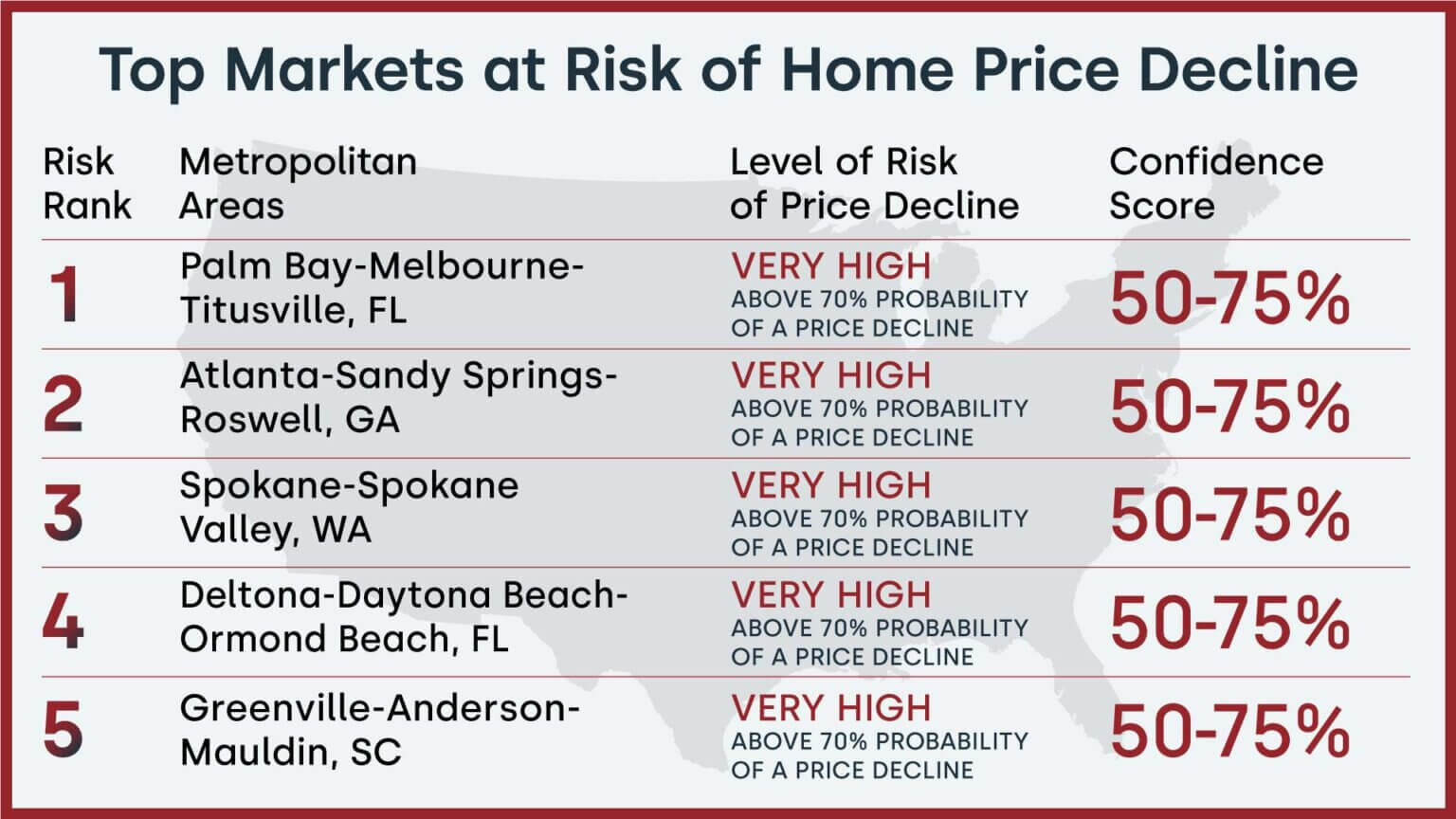
The MRI considers various factors to determine the probability of a home price decline in a particular area. This includes things like job growth, affordability, inventory levels, and the overall state of the local economy. Based on the CoreLogic MRI, five metropolitan areas are at a very high risk of a home price decline over the next 12 months.

5 Riskiest Housing Markets to Avoid in

5 Riskiest Housing Markets to Avoid in
Source: CoreLogic

Now let's dive deeper into the five metropolitan areas that are facing the highest risk of a home price decline based on CoreLogic's MRI. It's important to remember that these are predictions, and actual results may vary.

1. Provo-Orem, UT

  • Risk Level: Very High
  • Probability of Price Decline: Above 70%
  • Confidence Score: 50-75%

Provo-Orem, located in the heart of Utah, experienced explosive growth during the pandemic and it is still a very popular location. This growth fueled a surge in home prices, but now the market appears to be cooling down, potentially leading to a price decline.

My thoughts: I believe that the market in Provo-Orem was simply too hot too fast. The prices were out of sync with fundamentals like local wages, which were not keeping up with price appreciation. Now, with interest rate uncertainty and the cooling economy, this market is becoming vulnerable.

2. Atlanta-Sandy Springs-Roswell, GA

  • Risk Level: Very High
  • Probability of Price Decline: Above 70%
  • Confidence Score: 50-75%

Atlanta, like many other Southern metropolitan areas, has experienced a strong housing market in recent years. However, it has become more vulnerable to a downturn due to rising interest rates, supply chain disruptions, and overall economic uncertainty.

My thoughts: Atlanta has a strong history as a major business hub. While the metro area might experience a pullback, I think a decline in prices would be relatively short-lived. The economy will eventually rebound, and homebuyers will return to the market. But in the short-term, I would be cautious about buying a home in Atlanta.

3. Salt Lake City, UT

  • Risk Level: Very High
  • Probability of Price Decline: Above 70%
  • Confidence Score: 50-75%

Salt Lake City was one of the fastest-growing housing markets in the United States, and during that time the median home price increased by a significant amount. However, like Provo-Orem, a rapid rise in prices and cooling economy could lead to a price correction.

My thoughts: The Salt Lake City metro area has lots of economic drivers and is a beautiful location. The concerns here are very similar to those of Provo-Orem. The market heated up too quickly and might be in for a decline over the next year.

4. Gainesville, FL

  • Risk Level: Very High
  • Probability of Price Decline: Above 70%
  • Confidence Score: 50-75%

Gainesville is a college town with a large student population. This can sometimes make housing markets more volatile. The Gainesville market is at risk due to several factors like affordability concerns and a potential slowdown in student enrollment.

My thoughts: Gainesville has historically been a reliable housing market, and the presence of the University of Florida adds stability. But, the market is still vulnerable to interest rate hikes and economic uncertainty.

5. Palm Bay-Melbourne-Titusville, FL

  • Risk Level: Very High
  • Probability of Price Decline: Above 70%
  • Confidence Score: 50-75%

Palm Bay-Melbourne-Titusville is a region that is reliant on the aerospace and defense industries. While the local economy is strong, it also makes the area subject to changes in federal spending. With a large supply of homes and a cooling economy, the market is vulnerable to price declines.

My thoughts: Palm Bay-Melbourne-Titusville has a strong economy, but the high concentration of employment within a few industries means that it's vulnerable to changes in defense spending and other factors. The risks are certainly present in this area.

Understanding the Risks and Mitigating Them

While these five areas are identified as high-risk, it's crucial to remember that not all homes in these markets will necessarily experience the same level of price decline. Homes that are in excellent condition, well-located, and offer desirable features will likely hold their value better during a downturn.

Here are some tips to consider if you're looking to buy a home in these high-risk markets:

  • Do your homework: Research the local market and understand the factors that contribute to the risk of a housing market crash. Look at recent sales data, inventory levels, and economic indicators.
  • Don't overpay: Avoid getting caught up in bidding wars or paying top dollar for a home. Try to negotiate the best price possible to protect your investment.
  • Get pre-approved for a mortgage: Knowing how much you can afford will help you avoid overspending on a home.
  • Consider your personal financial situation: Make sure you can afford your mortgage payments even if home prices decline.
  • Be prepared for a possible price drop: If you are in the high-risk areas, have a strategy for how you will deal with a potential decrease in home value.
  • Be realistic about your expectations: Don't expect to get rich quick by investing in real estate, especially in a potentially volatile market.

Factors to Consider Beyond the MRI

While the CoreLogic MRI is a valuable tool, it is important to consider other factors that could influence the housing market in these areas. For example:

  • Local job market: Strong local job growth can help support home values.
  • New construction: An increase in new homes can put downward pressure on prices.
  • Interest rates: Rising interest rates will likely reduce affordability and slow down the market.
  • Inventory levels: If the number of homes for sale increases, it could lead to a price decline.

The Bottom Line

The housing market is dynamic, and prices can fluctuate based on various economic and local factors. The five markets highlighted above are at a high risk of experiencing home price declines in the next 12 months, according to CoreLogic's MRI.

It is my belief that you should proceed with caution in these markets. If you are considering buying a home, it is essential to do your research, understand the risks, and make informed decisions.

I hope this article has helped you better understand the potential risks and provided valuable information to help you make informed decisions about your real estate goals in 2025.

Recommended Read:

  • 3 BIG Cities Facing High Housing BUBBLE Risk: Crash Alert?
  • Is the Housing Market on the Brink in 2024: Crash or Boom?
  • Will Fed's Policy Lead to a Crash in the Housing Market?
  • San Francisco Housing Market Crash 2025: Will it Happen?
  • 3 Florida Housing Markets Are Again on the Brink of a Crash
  • Will Housing Be Cheaper if the Market Crashes in 2025?
  • UK Housing Market Forecast 2025: Crash or Correction?
  • When Will the Housing Market Crash Again in California?
  • AZ Housing Market Forecast 2025-2026: Will it Crash?

Filed Under: Housing Market, Trending News Tagged With: Home Price Crash, Housing Decline, Housing Market, housing market crash, Housing Market Forecast, housing market predictions, Housing Market Slowdown

Las Vegas Real Estate Forecast Next 5 Years: 2025-2029

December 17, 2024 by Marco Santarelli

Las Vegas Real Estate Forecast for the Next 5 Years

Las Vegas real estate is a dynamic market that attracts both investors and homeowners looking for opportunities in the sun. The Las Vegas real estate forecast for the next five years promises a mix of challenges and opportunities, shaped by various economic factors, housing supply dynamics, and evolving buyer preferences. Understanding these trends can guide potential buyers, sellers, and investors in making informed decisions in this vibrant market.

The Las Vegas Real Estate Forecast for the Next 5 Years

📈
Key Takeaways for Las Vegas Real Estate Forecast:
  • 📇 2024: Stabilization expected, driven by relatively low interest rates.
  • 📉 2025: Increasing housing supply will lead to moderated price hikes.
  • 💸 2026: Economic growth to drive home value appreciation despite rising interest rates.
  • 🏠 2027: Continuous growth in supply, offering more options for buyers and fostering diverse housing types.
  • 📆 2028-2029: Market consolidation, with stable prices and evolving buyer demographics.

The Current State of the Las Vegas Real Estate Market

Before diving into the forecast, it’s essential to understand the current state of the Las Vegas real estate market. Over the past few years, Las Vegas has emerged as a hotspot for real estate investments due to its relatively low cost of living, booming jobs market, and a steady influx of new residents. According to the latest reports, the median home price in Las Vegas has seen considerable growth, reflecting the high demand outpacing supply.

  • Current Median Home Price: Approximately $420,000 , which is indicative of a strong recovery from the economic disruptions caused by the pandemic.
  • Market Activity: Homes are selling faster, with many listings receiving multiple offers, showcasing an active buying environment.
  • Rental Market Trends: The rental market continues to thrive, with strong demand for both short-term and long-term rentals, further supported by tourism and the gig economy.

Forecast for 2024: A Market Stabilizing Post-Pandemic

As we look at 2024, the Las Vegas real estate market is predicted to experience a balancing act. After the tumultuous effects of the COVID-19 pandemic, the market is stabilizing. According to Bankrate, interest rates are expected to remain relatively low compared to historical standards, encouraging buyers to enter the market. However, housing supply may be limited, maintaining pressure on home prices.

  • Median Home Price: Expected to hover around $430,000, a slight increase from previous years but showing signs of stabilization.
  • Market Activity: Increased interest from out-of-state buyers is anticipated, particularly from California, due to high prices and tax burdens in their home state.
  • Construction and Development: The ongoing construction of luxury condominiums and single-family homes is expected to result in more premium listings entering the market, further diversifying home options.
  • Rental Market: Demand for rentals remains strong, particularly for multi-family units, driven by an influx of new residents seeking affordable housing options.
  • Buyer Demographics: Millennial and Gen Z homebuyers are expected to make up a significant proportion of the market, influenced by their preferences for technology integration in homes and sustainable building practices.

Forecast for 2025: Supply Increases and Price Adjustments

In 2025, forecasts indicate a gradual increase in housing supply. Analysts speculate that new constructions will rise by about 5%, helping to ease the tight inventory that has characterized previous years.

  • Price Shifts: Home prices might increase at a slower rate of approximately 3%, reflecting a more balanced relationship between supply and demand. This moderation will be crucial as potential buyers look for affordability in a competitive market.
  • Investment Opportunities: With more properties entering the market, investors may find emerging opportunities in both single-family homes and rental properties.
  • Economic Influences: The local economy’s growth, driven by tourism, entertainment, and tech industries, is likely to bolster real estate investments and economic confidence among buyers.
  • First-Time Homebuyers: This group is expected to be particularly active in 2025, as slightly more affordable homes become available due to the predicted supply increases.

Forecast for 2026: Continued Growth and Market Correction

The year 2026 is expected to be pivotal for the Las Vegas real estate market. The anticipated 7% increase in housing supply could lead to a more competitive market for buyers.

  • Economic Factors: If economic conditions remain favorable, including stable job growth and population increases, we can expect home values to continue appreciating, albeit at a moderated pace. A potential rise in interest rates will also test the resilience of the buyers’ market.
  • Greater Variety in Home Types: The market may see a diversification in available property types, including more suburban developments and mixed-use communities, attracting a variety of buyers ranging from families to retirees.
  • Affordability Issues: While prices will still rise, affordability may become a concern for many potential buyers, especially first-time homeowners. Strategies such as federal loan programs or state-level incentives might gain traction to support these buyers.
  • Shift to Sustainable Homes: Increasingly, buyers may seek environmentally friendly homes, which could create niches for developers focusing on energy-efficient building practices.

Forecast for 2027: Maturing Market Dynamics

By 2027, the Las Vegas real estate market is projected to mature further, as new residential developments come to fruition. An 8% increase in available housing may provide a much-needed buffer against the previously high prices, allowing new buyers easier access to the market.

  • Rising Rent Costs: As more sales infiltrate the market, rental prices are also expected to rise, leading to potential implications for affordability in the rental sector. Increased rental demand may drive developers to focus on building more multi-family units.
  • Long-Term Investments: By this time, numerous developments will have had time to stabilize, so long-term investors may have clearer insights into the performance of luxury versus affordable segments.
  • Market Feedback Loop: Any downturn in the economy could quickly be reflected in the housing market, requiring investors and homeowners to remain vigilant regarding external economic pressures.

Forecast for 2028-2029: Market Consolidation and Economic Shifts

Looking ahead to 2028 and beyond, the Las Vegas real estate market may see a consolidation phase, with trends normalizing following the supply surges of previous years. The housing prices might stabilize further, reflecting the market's maturation.

  • Long-Term Projections: By 2028, home prices may reach a plateau, with forecasts suggesting that the average price could stabilize around $475,000.
  • Changing Buyer Preferences: As demographic shifts continue, newer generations will have different homeownership aspirations, potentially leading to lifestyle-oriented communities that prioritize amenities and accessibility.
  • Investment and Development Trends: Investors may shift their focus towards emerging neighborhoods that show signs of future appreciation or revitalization, capitalizing on the trends of young buyers moving to urban areas.
  • Technological Integration in Homes: Smart home technology will likely play an essential role in attracting buyers, pushing developers to include these features as standard practice.

The Future of Las Vegas: Key Considerations for Buyers and Investors

As we analyze what lies ahead in Las Vegas real estate, several critical factors will help shape the market landscape.

  • Demographic Shifts: Analyzing migration trends will reveal the best opportunities for investment. As professionals continue to relocate due to remote work flexibility and a desire for lifestyle upgrades, areas that provide community comforts will likely see an increase in demand.
  • Economic Development: Tracking advancements in local industries, such as technology and entertainment, will be essential for understanding economic health and potential real estate appreciation.
  • Legislative Changes: Future housing policies and regulations could impact the market significantly. Staying abreast of new laws about home buying and rental regulations can provide valuable insight into future investment potentials.

Conclusion: Preparing for Your Real Estate Journey

In conclusion, the Las Vegas real estate forecast for the next five years anticipates a robust recovery and gradual stabilization of the market. Those interested in buying, selling, or investing in Las Vegas real estate should consider the emerging trends and economic indicators outlined above. Engaging with local real estate experts and staying updated on market conditions will help you navigate this evolving marketplace effectively.

Recommended Read:

  • Las Vegas Housing Market: Prices, Trends, Forecast 2024
  • Las Vegas Housing Market 2024: Is It a Bubble? Is It Falling?
  • Homebuyers Are Moving to Sacramento, Las Vegas, and Orlando
  • Housing Market Predictions for Next 5 Years: 2025, 2026, 2027, 2028
  • Housing Market Predictions for the Next 2 Years
  • Real Estate Forecast Next 5 Years: Top 5 Predictions for Future
  • Real Estate Forecast Next 10 Years: Will Prices Skyrocket?
  • Housing Market in 10 Years: Game-Changing Predictions for 2034

Filed Under: Housing Market, Real Estate Market Tagged With: Housing Market, Las Vegas

Most Affordable Beach Towns in Florida to Buy a House

December 16, 2024 by Marco Santarelli

Most Affordable Beach Towns in Florida to Buy a House

Imagine waking up to the soothing sound of waves rolling in and the invigorating scent of ocean air—who wouldn’t want to own a house in a beach town? The most affordable beach towns in Florida to buy a house provide an ideal mix of sun-soaked living, community spirit, and reasonable real estate prices. Whether you are seeking a year-round residence or a cozy vacation home, these hidden gems along Florida’s coast offer plenty of opportunities.

Why Choose Florida’s Beach Towns?

When considering a beach town in Florida, expect:

  • Warm weather year-round: A mild climate makes it perfect for coastal living.
  • Outdoor activities: From surfing to fishing, there’s no shortage of recreational fun.
  • Vibrant communities: Smaller towns often foster a sense of belonging that big cities can lack.
  • Good investment opportunities: With lower home prices, these towns can be an excellent financial commitment.

Here’s a look into some of the most affordable beach towns in Florida to buy a house, complete with details about each area’s housing market.

Most Affordable Beach Towns in Florida to Buy a House

1. Pensacola

Situated in the picturesque Florida Panhandle, Pensacola offers a mix of historical charm and modern amenities.

  • Median Home Price: Approximately $291,163 (an increase of 0.4% since last year). Pensacola’s average home value is around $267,553 as of mid-2024, showing gradual growth and stability in the market (RocketHomes).
  • Lifestyle: This town features rich history, a thriving arts scene, and beautiful historical buildings.
  • Activities: Explore the stunning Pensacola Gulf Islands, visit the historic Fort Pickens, and enjoy vibrant local events, making it great for families and retirees.

2. New Smyrna Beach

Just south of Daytona Beach, New Smyrna Beach enjoys a reputation for being a relaxing coastal community.

  • Median Home Price: Currently around $435,000, experiencing slight fluctuations in the market (Rockethomes).
  • Lifestyle: The town offers a laid-back atmosphere perfect for surfing and relaxation, often attracting a close-knit community feel.
  • Activities: New Smyrna Beach is ideal for outdoor lovers, with access to parks, beaches, and trendy shops. The local dining scene showcases fresh seafood options along the coast.

3. Port St. Joe

Situated along the Gulf Coast, Port St. Joe provides residents with a peaceful beach lifestyle.

  • Median Home Price: Approximately $470,560, reflecting a 4.9% decrease from the previous year (Rockethomes).
  • Lifestyle: Residents can enjoy a slower pace, perfect for those seeking tranquility.
  • Activities: Enjoy local festivals, beautiful beach access, and conservation areas, including the nearby Gulf Islands National Seashore. This vibrant town offers a mix of community events and natural beauty.

4. Deerfield Beach

Located between Palm Beach and Fort Lauderdale, Deerfield Beach offers affordable beachfront living.

  • Median Home Price: The median home price here is around $329,850, showing a significant yearly increase of 6.2% (RocketHomes).
  • Lifestyle: This town boasts beautiful beaches and parks, making it attractive to families and retirees alike.
  • Activities: Deerfield Beach features a top-notch fishing pier, a lively downtown area, and numerous recreational amenities, including volleyball courts and picnic areas along the beach.

5. Panama City Beach

Renowned for its stunning coastlines, Panama City Beach is a lively hub of activity.

  • Median Home Price: Approximately $380K, reflecting a decrease of 9.52% since last year (Redfin).
  • Lifestyle: This area is famous for its vibrant nightlife and family-friendly attractions.
  • Activities: From visiting the Gulf World Marine Park to lounging on the beach, there’s always something to do. Residents appreciate the accessibility to shops, restaurants, and water-related activities.

6. Cocoa Beach

Famous for its surf culture, Cocoa Beach is an ocean lover's paradise.

  • Median Home Price: Currently around $500,000, which has increased 7.5% year-over-year (Rockethomes).
  • Lifestyle: Cocoa Beach serves as a friendly, casual small-town feel with an active beach-oriented community.
  • Activities: Enjoy surfing, paddleboarding, and the famous Cocoa Beach Pier. Additionally, it’s close to the Kennedy Space Center, making it ideal for anyone interested in space exploration.

7. Cape Canaveral

Adjacent to Cocoa Beach, Cape Canaveral presents a unique living experience near iconic space-related activities.

  • Median Home Price: At approximately $341,166, this represents a drop of 3.9% from the previous year (RocketHomes).
  • Lifestyle: With a blend of beach culture and scientific intrigue, Cape Canaveral attracts diverse residents.
  • Activities: Enjoy pristine beaches, the nearby Port Canaveral for cruise ships, and regular space launches, giving this town a special buzz and excitement.

8. St. Augustine Beach

As the oldest city in the U.S., St. Augustine Beach blends historical significance with modern-day leisure.

  • Median Home Price: Approximately $675,000, a notable increase due to its historical appeal and amenities (Redfin).
  • Lifestyle: Benefits from rich history, diverse cultural events, and captivating architecture.
  • Activities: Home to local galleries, charming shops, and historic sites, residents can indulge in community events while enjoying the scenic coastline.

9. Fort Pierce

Positioned along the Treasure Coast, Fort Pierce offers a combination of a charming environment and affordability.

  • Median Home Price: Currently around $297,487, up 4.4% since last year (Rockethomes).
  • Lifestyle: This small town offers a friendly community atmosphere, perfect for families and retirees alike.
  • Activities: Featuring the historic downtown area, cultural events, and local parks, Fort Pierce is ideal for those who appreciate a vibrant community alongside beautiful beaches.

10. Jacksonville Beach

Finally, Jacksonville Beach presents beach life coupled with city amenities.

  • Median Home Price: Approximately $660K, showing a yearly increase of 8.8% (Redfin).
  • Lifestyle: A vibrant town that accommodates diverse lifestyles—ideal for young professionals and families.
  • Activities: Beachfront festivals, parks, and local dining make Jacksonville Beach lively, combined with easy access to the urban lifestyle of nearby Jacksonville.

Conclusion

Exploring the most affordable beach towns in Florida to buy a house can unlock doors to a tranquil lifestyle filled with sun, sand, and surf. With towns like Pensacola, New Smyrna Beach, and Deerfield Beach leading the way in affordability, you can find the scenic coastal living of your dreams without straining your budget.

These beach towns not only offer delightful living conditions but also present great investment opportunities, making them worth considering for both personal use and potential rental income. Pack your bags and take a step toward your dream beach life today!

Recommended Read:

  • 10 Cheapest Places to Live in Florida by the Beach
  • 10 Best Places to Live in Florida (2025)
  • 10 Best Places to Live in Florida for Families in 2025
  • Best Places to Live in Florida for Young Adults (2025)
  • Cheapest Florida Beach Vacations for 2025: Affordable Beaches
  • Clearwater Beach Beaches Florida: A Perfect Place for Vacation
  • 10 Best Beaches in Clearwater, Florida

Filed Under: Housing Market, Real Estate, Real Estate Market Tagged With: Florida, Housing Market, Most Affordable Beach Towns in Florida to Buy a House

Cheapest Housing Markets in California: Affordable Cities (2024)

December 15, 2024 by Marco Santarelli

10 Cheapest Housing Markets in California

California is a notoriously expensive state to live in, but there are still some affordable housing markets to be found. In this article, we have listed the 10 cheapest housing markets in California. California's housing market is renowned for its complexity and competitiveness within the United States.

The demand for housing in the state has consistently outpaced the available supply, resulting in a prolonged period of soaring home prices. However, recent trends suggest a potential slowdown in the market's momentum. Factors such as rising interest rates and challenges faced by the tech industry, a significant driver of housing demand, have contributed to this shift.

Despite this slowdown, the reality remains that California's housing market is still among the most expensive in the nation. The 10 cheapest housing markets in California in 2024 present a unique perspective, showcasing affordability in contrast to the general trend. The median home price in the state exceeds $800,000, surpassing the national median home price by more than double. This substantial disparity poses a significant hurdle for many individuals aspiring to own a home in California.

Several factors contribute to the exorbitant cost of housing in California. One fundamental factor is the limited availability of land. The state's diverse geography, including mountains, deserts, and coastline, results in a scarcity of land suitable for development. Additionally, environmental regulations further complicate and escalate the costs associated with building new homes.

Moreover, California's robust economy, boasting one of the world's largest, attracts people from across the nation and the globe due to its array of high-paying industries. This influx of individuals amplifies the demand for housing, consequently driving up prices.

10 Most Affordable Housing Markets in California in 2024

1. Clearlake

Clearlake is a small city in Northern California, located about 90 miles north of Sacramento. It ranks among the cheapest housing markets in California. It is situated on the shores of Clear Lake, the largest natural lake in California. The city is known for its scenic beauty and outdoor recreational activities.

Residents and visitors alike can enjoy boating, fishing, swimming, and hiking in the picturesque surroundings. Additionally, Clearlake boasts a small casino for entertainment and a growing wine industry that contributes to the local economy.

2. Bakersfield

Bakersfield is a city located in the Central Valley of California, situated approximately 110 miles north of Los Angeles. It holds the distinction of being the seat of Kern County and ranks as the sixth-largest city in California. The city's economy thrives on various pillars, including agricultural production, a significant oil and gas industry, and a vibrant country music scene.

This unique blend of industries contributes to Bakersfield's identity. Moreover, the city embraces a diverse population and is experiencing economic growth, making it an attractive option for those seeking affordable housing in California.

3. Fresno

Fresno, serving as the county seat of Fresno County, stands out as one of the cheapest housing markets in California. It secures this position due to various factors. Firstly, it boasts the distinction of being the fifth-most populous city in California and the largest city in the San Joaquin Valley, allowing for a wide range of housing options to cater to the diverse population.

The city's affordability is also influenced by its significant agricultural industry, characterized by the production of grapes, raisins, and almonds. Furthermore, the presence of California State University, Fresno, adds to the appeal for individuals seeking affordable housing combined with educational opportunities.

4. Eureka

Eureka, located in Humboldt County, California, ranks among the cheapest housing markets in California due to several contributing factors. Despite being the sixth-most populous city in Northern California and the county seat of Humboldt County, Eureka maintains affordable housing options.

The city's redwood forests and fishing industry play a significant role in shaping its economy and making housing more affordable. Additionally, the presence of Humboldt State University contributes to the city's appeal for those seeking affordable housing paired with educational opportunities.

5. Stockton

Stockton serves as the county seat of San Joaquin County, located in California. It holds the position of being the 13th-most populous city in California and the fourth-most populous city in the Central Valley. The city's economic landscape is deeply rooted in its robust agricultural industry, which prominently features the production of almonds, grapes, and tomatoes. Moreover, Stockton is also recognized for being home to the prestigious University of the Pacific. This combination of agriculture and educational opportunities underscores Stockton's appeal to residents and prospective homeowners.

6. Chico

Chico, located in Butte County, California, is a standout in the realm of affordable housing markets in California. Despite being the county seat of Butte County and the second-most populous city in the county, Chico offers housing options that make it a compelling choice for prospective homeowners.

The presence of California State University, Chico, a prominent educational institution, enhances the city's appeal for both residents and potential investors. Moreover, Chico's reputation for abundant outdoor recreation opportunities further adds to its allure, making it an attractive destination for individuals seeking affordable housing combined with a high quality of life.

7. Sacramento

Sacramento, the capital of California and the sixth-most populous city in the state, offers an intriguing housing market that aligns with affordability, making it one of the cheapest housing markets in California.

The city's significance as the state capital contributes to its economic stability, attracting a diverse population seeking employment opportunities and a reasonable cost of living. Additionally, the rich historical heritage embodied by the Old Sacramento district and the numerous museums further enhance the city's appeal for residents and visitors alike.

Moreover, the presence of esteemed educational institutions such as the University of California, Davis, and California State University, Sacramento, adds value to the city, making it an enticing option for those seeking affordable housing combined with educational excellence.

8. Clovis

Clovis, a city nestled in Fresno County, California, stands as one of the cheapest housing markets in California for several compelling reasons. Despite being the second-most populous city in Fresno County and ranking as the sixth-most populous city in the San Joaquin Valley, Clovis offers affordable housing options that make it an attractive destination for potential homeowners.

The city's reputation for high quality of life and its excellent schools add to its appeal, making it an enticing prospect for families and individuals seeking an affordable place to settle. Additionally, the presence of Clovis Community College contributes to the city's allure, providing educational opportunities within the community.

9. Vacaville

Vacaville, located in Solano County, California, holds its position as one of the cheapest housing markets in California while offering an attractive lifestyle to its residents.

Despite being the second-most populous city in Solano County and ranking as the tenth-most populous city in the North Bay, Vacaville maintains affordable housing options that make it an appealing choice for those seeking a balance between city life and affordability.

Known for its Vacaville Premium Outlets and the presence of numerous wineries, the city offers a mix of shopping and recreational opportunities that contribute to its overall appeal. The accessibility to amenities and the city's efforts in promoting its local economy further enhance Vacaville's desirability among potential homeowners.

10. Fontana

Fontana, nestled in San Bernardino County, California, earns its position among the cheapest housing markets in California for several compelling reasons. As the third-most populous city in San Bernardino County and the fifth-most populous city in the Inland Empire, Fontana manages to maintain housing affordability.

The presence of Kaiser Permanente Fontana Medical Center reflects the city's commitment to healthcare, contributing to its appeal to residents. Furthermore, Fontana's diverse shopping and dining options add to the city's livability, providing a well-rounded experience for its residents. These factors collectively position Fontana as an attractive choice for those seeking affordable housing with a range of amenities and services.

Summary

The steep cost of housing in California has far-reaching negative repercussions. It hinders individuals from affording homes and can lead to displacement and homelessness. Furthermore, businesses face challenges in recruiting and retaining employees due to the high cost of living.

To mitigate this crisis, various strategies can be implemented. Increasing the supply of housing is imperative, achieved by streamlining the development process and facilitating easier construction of new homes in areas with good job access and transportation. Additionally, efforts to enhance housing affordability for low- and middle-income residents are crucial. This can involve providing subsidies, tax breaks, and expanding the availability of affordable housing units.

It is crucial to acknowledge that the housing market is dynamic and constantly changing. Median home prices, as presented in this article, are based on the data available at the time of publication and are subject to change. Before making any decisions about buying or selling a home, it is highly advisable to consult with a professional real estate agent or relevant experts to obtain the most up-to-date and accurate information regarding the current housing market conditions, trends, and pricing

To delve deeper into the intricacies of the California housing market, please visit our dedicated page on the subject: California Housing Market Insights.

Filed Under: Housing Market Tagged With: california, Housing Market

Housing Market Predictions 2025: Will Renting Become the New Normal?

December 12, 2024 by Marco Santarelli

Housing Market Predictions 2025: Will Renting Become the New Normal?

Have you been dreaming of owning your own home? Perhaps you've been saving up for a down payment, or maybe you're just starting to think about your future housing situation. Well, the 2025 housing market predictions suggest that while there will be more home sales due to pent-up demand, many people like you might end up renting instead. Higher home prices and mortgage rates will make homeownership a challenge, while rental prices stay relatively flat and wages continue to rise, making renting a more affordable choice for many.

Let me tell you, the housing market has been a rollercoaster ride over the past few years. The pandemic created a surge in demand for houses as people sought more space and stability. Interest rates dropped, which made it easier for some to get into the housing market. But as the economy recovered, interest rates have steadily risen, and it seems that trend might continue into 2025.

In this article, I'll dive into the 2025 housing market predictions from Redfin, a real estate company that provides valuable insights into the housing market. We'll explore the various factors that are expected to shape the market, including rising home prices, fluctuating mortgage rates, and the shift in consumer preferences toward renting. I'll also share my thoughts and expertise on the topic, having spent many years in the real estate market.

Redfin’s Key Housing Market Predictions for 2025

Based on Redfin's economists, the 2025 housing market will be a complex one. They anticipate that there will be an increase in the number of homes sold, mainly due to the pent-up demand that developed during and after the pandemic. However, they also predict that many people will find themselves unable to afford homeownership, leading to an increase in the number of renters.

Here's a breakdown of the key predictions:

1. Home Prices Will Rise 4% in 2025

Redfin expects the median U.S. home sale price to rise steadily throughout 2025, ending the year 4% higher than it was in 2024. This increase is expected to be similar to the latter half of 2024 because the supply of new homes isn't expected to keep up with the demand.

From my experience, this isn't a surprising prediction. The limited supply of homes for sale has been a major factor in the recent surge in housing prices. And, as long as more homes aren't built, demand is likely to keep prices climbing.

2. Mortgage Rates Will Remain Near 7%

Mortgage rates are predicted to stay high throughout 2025, fluctuating around 6.8%. Redfin's economists believe that if certain economic factors play out, like the potential impact of tax cuts and tariffs, the Federal Reserve might only decrease its benchmark interest rate a couple of times in 2025. This would mean that mortgage rates stay relatively high.

While there's a possibility that rates could drop to around 6% if the economy slows down, or if there are changes in policy, there's also the potential for rates to increase if inflation grows or the government deficit expands.

3. There Will Be More Home Sales in 2025 Than 2024

Redfin predicts that the annual rate of existing home sales will increase to between 4.1 million and 4.4 million. That's a rise of 2% to 9% compared to 2024.

But, the prediction comes with a range because the increase in sales depends on a variety of factors. If mortgage rates and low inventory stay high, the increase in sales might be small. But if rates come down more than expected, and the strong home buying demand that we saw in the last few months continues, then sales could rise significantly.

In my opinion, the market is volatile right now, and the rate at which it goes up and down is unprecedented. We've witnessed strong buyer demand in the face of rising interest rates, and that's a bit unusual. But, at the same time, we still have a pretty limited inventory of homes for sale, so there's still a lot of pressure on prices.

4. 2025 Will Be a Renter’s Market

While home prices are going up and mortgage rates are likely to stay high, the 2025 housing market is expected to be more favorable for renters. Renters can expect rent prices to stay pretty much the same as 2024. At the same time, wages are expected to increase, which will make rent payments more manageable for the average person.

There's also the possibility that there will be more new rental units coming onto the market as new construction projects that were started during the pandemic are completed. This could mean that there will be more rental units available than people looking for them, and landlords might try to attract and keep tenants by offering things like free parking, a month of free rent, or better amenities.

5. Fewer Construction Regulations Will Lead to More Homebuilding

Redfin anticipates that homebuilders will likely create more single-family homes in 2025. This prediction is based on the idea that there will be fewer regulations for builders. But it's important to remember that it might take several years for any increase in homebuilding to significantly improve affordability.

While relaxed regulations could also lead to more construction of multi-family housing, there are also some factors that could potentially slow down construction. High interest rates and a potential decrease in immigration could make it harder for builders to get financing or find workers.

6. Wealthy People Will Pay Less to Buy and Sell Homes As Commissions Decline Slightly

With the introduction of new rules from the National Association of Realtors, Redfin expects real estate commissions to go down slightly, especially for expensive homes and in competitive markets. The amount of change is difficult to predict, but the prediction is that the rules will lead to more negotiation, especially in markets where there is a lot of competition for buyers.

7. The Real Estate Industry Will Consolidate

Redfin predicts that the real estate industry will see more companies merging and buying each other up. This is based on the belief that the Federal Trade Commission will be more willing to approve mergers and acquisitions under the new administration.

8. Climate Risks Will Be Priced Into Individual Homes, Especially in Coastal Florida

As climate change creates more natural disasters, such as hurricanes, wildfires, and floods, Redfin thinks the housing market will start to reflect these risks, especially in areas that are particularly vulnerable, such as coastal Florida, parts of California, and Texas.

9. Mayors in Blue Cities Will Help Reverse the Flight From Urban Centers

Some major cities in “blue states” have taken steps to try to attract residents back to their cities and increase safety and stability. In my opinion, these efforts may start to reverse the decline in population that we've seen in some major cities in recent years.

10. Gen Z Will Rewrite the American Dream, Cutting Homeownership From the Script

Gen Zers might be choosing to delay homeownership, prioritizing different financial goals. Instead of aiming for homeownership, many young people might opt to focus on other ways of building wealth.

My Take on the 2025 Housing Market Predictions

I've been involved in the real estate market for several years, and I've seen firsthand how things can change quickly. Redfin's predictions are based on sound economic reasoning, but it's important to remember that predictions aren't guarantees.

Based on my experience, I believe that the predictions for rising home prices and potentially flat or slightly declining rental prices are likely to hold true. As long as interest rates remain elevated, and the inventory of homes for sale stays low, there will likely be upward pressure on home prices. And, if we do see a surplus of new rental units hitting the market, rents could even decrease.

I think that the prediction regarding the impact of climate change on the housing market is also something to watch closely. The climate is changing at an accelerated rate, and the real estate market will likely start to incorporate the risks associated with natural disasters in a larger way.

The Role of Technology

I think it's also important to consider the role that technology will play in the 2025 housing market. We're likely to see an increase in the use of virtual and augmented reality for showing homes and virtual tours. The increased use of AI-powered tools and services to help buyers and sellers will reshape the way we look at and interact with the real estate market.

The Importance of Personal Finance

In addition to the economic factors discussed above, it's also important for individuals to consider their personal financial circumstances when making housing decisions. If you're considering buying a house, you need to have a solid grasp of your financial situation, including your income, debt, and credit score.

If you're not sure if you can afford to buy a home, consider renting for a while. Renting can be a good option if you're not ready to commit to a mortgage or if you're unsure about your job security.

What Does This Mean for You?

The 2025 housing market predictions suggest that it might be a good time to be a renter. If you're currently renting, you may find that your rent payments become more manageable, especially as wages increase. You also may find that you have more options for housing because of the possibility of new rental units hitting the market.

On the other hand, if you're dreaming of buying a house, you should keep an eye on the market. If home prices continue to rise, and mortgage rates stay high, you might need to save up more for a down payment or consider buying a smaller or less expensive house.

It's important to carefully weigh the pros and cons of buying versus renting before making a decision. You may want to speak with a financial advisor or real estate agent to get a better idea of what your options are and which path might make the most sense for you.

Final Thoughts

The 2025 housing market is expected to be one of increasing home sales, but also one where many buyers will decide to rent instead of buy because of higher housing costs. While there are some uncertainties about the future of the housing market, it's clear that the economic conditions will play a significant role in shaping the market in the year ahead.

As always, it's vital to make informed decisions and to work with trusted professionals who can help you navigate the complexities of the real estate market. I hope this article has given you a better understanding of what to expect in the coming years and some food for thought as you begin to plan your own housing journey.

Partner with Norada, Your Trusted Source for Turnkey Investment Properties

Discover high-quality, ready-to-rent properties designed to deliver consistent returns. Contact us today to expand your real estate portfolio with confidence.

Reach out to our investment counselors:

(949) 218-6668 | (800) 611-3060

Contact Us Today

Recommended Read:

  • Housing Market Predictions for Biggest Winners & Losers in 2025
  • Housing Market Predictions for 2025 and 2026 by NAR Chief
  • Housing Market Forecast for the Next 2 Years: 2024-2026
  • 87% of Metros in America Posted Home Price Gains in Q3 2024
  • Housing Market Predictions for Next Year: Prices to Rise by 4.4%
  • Housing Market Predictions for the Next 4 Years: 2024 to 2028
  • Real Estate Forecast Next 5 Years: Top 5 Predictions for Future
  • Real Estate Market Predictions 2025: What to Expect
  • Is the Housing Market on the Brink in 2024: Crash or Boom?
  • 2008 Forecaster Warns: Housing Market 2024 Needs This to Survive
  • Real Estate Forecast Next 10 Years: Will Prices Skyrocket?
  • Housing Market Predictions for Next 5 Years (2024-2028)

Filed Under: Housing Market, Real Estate Market Tagged With: Home Price Forecast, Housing Market, housing market predictions, Housing Market Trends, Real Estate Market Predictions

Colorado Springs Will be the Hottest Housing Market in 2025

December 12, 2024 by Marco Santarelli

Colorado Springs Will be the Hottest Housing Market in 2025

Are you looking for the next big real estate opportunity? Colorado Springs is predicted to be the hottest housing market in 2025, according to a recent forecast by Realtor.com. This vibrant city in the heart of Colorado is projected to experience significant growth in both home sales and prices, making it a prime location for buyers and investors. Let's delve deeper into the reasons behind this prediction and explore what makes Colorado Springs such a desirable place to live.

Colorado Springs Housing Market to Boom in 2025

I've been following the real estate industry for a while now and the forecasts from reliable sources like Realtor.com are always interesting. For their 2025 National Housing Forecast, they ranked the 100 largest metropolitan areas based on their predicted growth in both home sales and prices. They identified several key factors influencing their predictions, and these factors seem to be especially favorable for Colorado Springs and other cities in the South and West.

Based on their study, these are some of the key factors that suggest a strong housing market in 2025:

  • Stronger Sales and Price Growth: Some areas in the country, particularly in the Sun Belt, are expected to experience far stronger growth than the national average.
  • Improved Housing Inventory: With mortgage rates potentially stabilizing and homebuilders increasing production, the housing inventory situation is gradually improving.
  • Regional Concentration: The top 10 markets for 2025 are clustered in the South and West, highlighting a growing demand in these areas.
  • Younger Populations: These markets tend to have a larger share of young families and individuals, boosting demand for housing.
  • Military and International Connections: In several top markets, there's a significant presence of military families and international residents, further impacting the real estate dynamics.
  • Government-Backed Loan Programs: The availability of programs like VA and FHA loans makes it easier for certain populations to buy homes in these markets, leading to increased homeownership.
  • Relative Affordability: Many of these markets, while not necessarily ultra-cheap, are more affordable compared to other parts of the country.
  • Flexible Work Arrangements: The shift towards remote and hybrid work has made these markets more attractive for those seeking a better work-life balance and lower living costs.

Why Colorado Springs Stands Out

While the Sun Belt in general is projected to experience significant growth in 2025, Colorado Springs is particularly noteworthy. I find it fascinating that it's predicted to be the hottest of all the markets. The factors that drive this prediction include:

  • Stronger Growth in Sales and Prices: Realtor.com forecasts a 27.1% year-over-year increase in existing home sales in Colorado Springs for 2025. Moreover, the median sale price is predicted to rise by 12.7%. These numbers are quite substantial and indicate a very robust market.
  • Military Presence: Colorado Springs has a significant presence of military personnel and veterans, with the share of households connected to the military being around 31.4%. This translates to a strong demand for housing due to frequent relocations and the presence of VA loan benefits.
  • Relatively Affordable Housing: Colorado Springs, compared to other areas in the state, like Denver, offers more affordable housing, which attracts a wider range of buyers, especially those seeking a good value for their money. This factor is further highlighted by the relative affordability when combined with government-backed loans that offer lower down payment requirements.
  • Outdoor Recreation and Lifestyle: Colorado Springs is renowned for its stunning natural beauty, surrounded by mountains and offering ample opportunities for hiking, biking, and outdoor activities. This lifestyle aspect is incredibly attractive to those who want a healthy and adventurous lifestyle.
  • Growing Economy: Colorado Springs is experiencing economic growth in sectors like aerospace, healthcare, and tourism. The stable and growing job market plays a crucial role in drawing in both residents and businesses, which in turn drives up housing demand.
  • Stronger Inventory: The forecast suggests that Colorado Springs may be nearing its pre-pandemic inventory levels, which implies that buyers may have more options compared to the recent past. New construction also plays a role in adding more inventory, creating a healthy market dynamic.
  • Good Schools: The quality of education is important to many families, and Colorado Springs boasts a strong educational system with highly rated schools. This is a crucial element for families with school-aged children.

The Impact of Government-Backed Mortgages

The availability of government-backed loan programs like VA loans is a significant factor contributing to Colorado Springs’ projected success. I've personally interacted with many homebuyers who have benefited from these programs. I see that they are especially helpful for:

  • Military Families: VA loans are a lifeline for many service members and veterans, especially those who are transitioning out of the military and looking to establish a new life.
  • First-Time Homebuyers: For those without substantial savings for a down payment, VA and FHA loans can be incredibly helpful in achieving homeownership.
  • Lower-Income Households: Government-backed mortgages can reduce the barrier to homeownership for households that might otherwise find it challenging to qualify for a conventional loan.

In Colorado Springs, the presence of VA loans, coupled with relatively lower home prices, means that the typical down payment needed is often significantly less than the national average. This advantage makes homeownership more attainable for more people, which in turn drives the housing market.

The Role of Flexible Work Arrangements

In the post-pandemic world, the ability to work remotely or in a hybrid model has drastically changed the dynamics of where people choose to live. I see it every day in my real estate practice. Colorado Springs has been fortunate enough to have a higher than average share of remote and hybrid job postings, which is attractive to people who don't necessarily have to be tethered to a specific location for their jobs.

The combination of affordability and a good quality of life, coupled with remote job opportunities, makes the city a great choice for those who wish to escape the hustle and bustle of larger metropolitan areas while still maintaining a fulfilling career.

Challenges and Considerations

While Colorado Springs presents a positive outlook for 2025 and beyond, potential buyers and investors should be aware of some challenges and considerations.

  • Rising Interest Rates: Although mortgage rates have started to decline, they are still relatively high compared to the past few years. This can affect affordability, especially for buyers with tighter budgets.
  • Inflation: Inflationary pressures can impact the cost of living and construction materials, potentially putting upward pressure on home prices.
  • Competition: With Colorado Springs gaining popularity, competition among buyers can be high, which could make it challenging to secure a desired property.
  • Limited Inventory in Certain Segments: Although inventory is recovering, certain segments of the market might still have limited supply, especially in the lower price ranges.
  • Water Resources: Being in the West, water resources are a concern that should be considered when buying a home, especially when looking at properties in drier regions.

The Future of Colorado Springs Real Estate

In my opinion, the future of real estate in Colorado Springs looks bright. The factors that are driving the growth seem to be pretty solid. I anticipate that it will continue to be a magnet for buyers and investors, leading to healthy growth in the coming years.

The factors that make Colorado Springs attractive—the combination of affordability, great lifestyle, strong economy, outdoor recreation, and a significant military presence—appear to be durable characteristics. I personally believe that these will continue to drive demand in the years to come.

Tips for Buyers and Investors

  • Get Pre-Approved for a Mortgage: Having a pre-approval letter in hand will demonstrate to sellers that you're a serious buyer and give you a head start.
  • Work with a Local Real Estate Agent: A knowledgeable agent can provide valuable insights into the local market, assist in your search for suitable properties, and guide you through the buying process.
  • Research Neighborhoods: Different neighborhoods in Colorado Springs have distinct characteristics, such as price points, school districts, and amenities. Do your homework to ensure the neighborhood aligns with your needs and preferences.
  • Stay Informed About Market Trends: The real estate market is dynamic, so stay up-to-date on market trends and changes in interest rates.
  • Be Prepared to Act Quickly: In a competitive market like Colorado Springs, you might need to act quickly to make an offer on a property.
  • Consider New Construction: New construction can offer a variety of benefits, such as modern amenities, energy efficiency, and warranties.
  • Look at Government-Backed Loans: Explore VA, FHA, and USDA loans if you're eligible. These loans can make it easier to afford a home.

I believe the combination of a strong local economy, attractive lifestyle, and government-backed loan programs positions Colorado Springs for continued real estate growth. If you're considering a move to the area, or are simply looking for a good investment opportunity, Colorado Springs is certainly worth a look.

Realtor.com's 2025 Housing Forecast Top 10 Markets

Rank CBSA Title 2025 Existing Home Sale Counts Year-over-Year 2025 Existing Home Sale Counts vs 2017–19 Average 2025 Existing Home Median Sale Price Year-over-Year 2025 Existing Home Median Sale Price vs 2017–19 Average Combined 2025 Existing Home Sales and Price Growth
1 Colorado Springs, Colo. 27.1% -5.6% 12.7% 88.9% 39.8%
2 Miami-Fort Lauderdale-West Palm Beach, Fla. 24.0% -0.7% 9.0% 100.5% 33.0%
3 Virginia Beach-Norfolk-Newport News, Va.-N.C. 23.4% 24.5% 6.6% 57.3% 29.9%
4 El Paso, Texas 19.3% 1.3% 8.4% 71.1% 27.8%
5 Richmond, Va. 21.6% 31.7% 6.1% 68.8% 27.6%
6 Orlando-Kissimmee-Sanford, Fla. 21.1% 23.6% 7.0% 60.4% 28.1%
7 McAllen-Edinburg-Mission, Texas 17.4% 23.6% 7.0% 60.4% 24.4%
8 Phoenix-Mesa-Scottsdale, Ariz. 18.0% 8.5% 7.2% 76.2% 25.2%
9 Atlanta-Sandy Springs-Roswell, Ga. 19.6% 23.6% 5.3% 59.0% 24.9%
10 Greensboro-High Point, N.C. 17.3% 16.6% 5.4% 61.5% 22.7%


Partner with Norada, Your Trusted Source for Turnkey Investment Properties

Discover high-quality, ready-to-rent properties designed to deliver consistent returns. Contact us today to expand your real estate portfolio with confidence.

Reach out to our investment counselors:

(949) 218-6668 | (800) 611-3060

Contact Us Today


Recommended Read:

  • Colorado Springs Housing Market Predictions 2025: Prices Will Drop
  • Colorado Housing Market Predictions 2025: Will Prices Fall?
  • Top 20 Hottest Housing Markets Predicted for the Next Year [2025]
  • 10 Hottest Housing Markets Predicted for 2025: Sun Belt Boom
  • 5 Hottest Real Estate Markets for Buyers & Investors in 2025
  • Hottest Real Estate Markets in Maine: Top Locations for 2024
  • Top 10 Hottest Real Estate Markets in the World
  • 68 Housing Markets Where Prices Have Doubled the Fastest

Filed Under: Growth Markets, Housing Market, Real Estate Market Tagged With: Colorado, Colorado Springs, Hottest Housing Markets, Hottest Real Estate Markets, Housing Market, investment opportunities, real estate

Real Estate Market Predictions 2025: What Experts Forecast

December 12, 2024 by Marco Santarelli

Real Estate Market Predictions 2025: What to Expect

What's going to happen in the real estate market in 2025? It's kinda tricky to say for sure. Things are pretty up and down right now, and nobody really knows what's going to happen next. The real estate market predictions for 2025 paint a picture of cautious optimism amidst a backdrop of volatility and uncertainty.

But, if we look at what's happening with the economy and what people are thinking, we can get a general idea. Experts are pretty cautiously optimistic – they think things might be okay, but there's a lot that could change. The market's always changing, so knowing what might happen is key.

While the market might not experience explosive growth, we can expect a more balanced environment with opportunities for both buyers and sellers. Let's dive deeper into these predictions and explore what factors will likely shape the market in 2025.

Real Estate Market Predictions 2025: Will Home Prices Rise or Fall?

📈
Key Takeaways

  • 🏠 Modest Price Increase: Home prices are predicted to rise moderately, with experts forecasting increases ranging from 0.5% to 4.4%.
  • 📝 Continued Inventory Challenges: The housing inventory is expected to remain constrained, affecting overall market activity.
  • 🛠 Stabilization: After a tumultuous period, the market is anticipated to stabilize, offering opportunities for both buyers and sellers.
  • 💰Mortgage Rates Influence: Interest rates will continue to play a significant role in shaping buyer behavior and housing affordability.


Understanding the Current Context

The past few years have been quite wild for the real estate market. The economy has been a big driver, with inflation, mortgage interest rates, and supply chain issues creating a lot of uncertainty. In 2023, higher mortgage rates made it tougher for people to buy homes, and many potential buyers were hesitant. As we move toward 2025, many analysts see a slight improvement in housing activity, but there will still be some hurdles.

According to U.S. News, while we might see a bit of a pickup in home sales, they are still expected to be lower compared to historical averages. This is because higher mortgage rates are still a concern, and many potential buyers are waiting to see how the economy settles before making such a big financial commitment.

Price Trends and Projections

Several reputable forecasts are suggesting a relatively small increase in home prices in 2025. For example, Goldman Sachs is predicting a 4.4% increase, while Freddie Mac has a more conservative outlook, estimating a 0.5% rise. Based on an analysis by ResiClub, the average prediction from various experts points to a 2.5% increase. This difference in opinions highlights how uncertain things are in the market.

Forecast Source Home Price Increase (%)
Goldman Sachs 4.4
Fannie Mae 3.8
Redfin 4
Freddie Mac Slower Growth
Average Consensus Moderation in Home Price Growth

The reason for these varied predictions is likely due to differing views on the economy's recovery, buyer demand, and any unexpected events that might affect the entire country. For buyers and investors, it's essential to understand that these price increases may not be significant and avoid overly optimistic expectations.

In a report from the Q4 2024 Fannie Mae Home Price Expectations Survey (HPES), produced in partnership with Pulsenomics, LLC, a group of over 100 housing experts predicted home price growth to slow down from 5.2 percent in 2024 to 3.8 percent in 2025 and 3.6 percent in 2026. They see this slowdown stemming from higher mortgage rates and the recent rapid increase in home prices.

Mark Palim, Fannie Mae Senior Vice President and Chief Economist, noted that the experts believe that home price growth will slow down further in the coming years because the elevated mortgage rates and the faster home price growth seen over the past few years are making it hard for many people to afford homes.

Terry Loebs, founder of Pulsenomics, pointed out that even though most experts expect the home price appreciation rate to decrease from recent levels, they still expect the annual average price increase through 2029 to be higher than inflation, which indicates that affordability issues could persist.

In October 2024, the median sales price for a single-family home in the U.S. was $437,300, up from $426,800 the month before, according to U.S. Census data.

At the same time, the median rent price in the U.S. was $1,619 in October 2024, about the same or up 0.2% from a year ago and down 0.6% from the previous month, according to Redfin, an online real estate brokerage firm.

Redfin also provided predictions for the housing market in 2025:

  • Home Price Growth Normalization: Home prices are projected to increase by about 4% throughout 2025, similar to the rate seen in the latter half of 2024. This represents a “normalization” after the rapid price growth of 2020.
  • Rents to Stabilize or Decline: The median asking rent price in the U.S. is anticipated to remain flat or potentially decrease in 2025, as new rental units become available. This could provide more leverage for renters to negotiate with landlords.
  • Increased Home Sales: Pent-up demand from buyers and sellers who have been waiting on the sidelines could lead to a rise in home sales in 2025, potentially increasing by 2% to 9% compared to 2024.

In addition to these national trends, local market conditions will continue to be influential. For example, some areas with a lot of new apartments, like Austin, Texas, saw rent prices go down, while others with limited supply, such as Seattle, Washington, D.C., and New York City, continued to see rent prices rise.

Inventory Dynamics and Buyer Demand

Inventory levels have been a major challenge in the housing market for a while, leading to a limited number of homes for sale. While some stabilization is expected, experts predict that housing inventory will stay below average levels through 2025. Bankrate highlights that if mortgage rates stay high, many homeowners might choose to stay put instead of moving, a phenomenon known as “rate lock.”

Buyers will encounter difficulty finding affordable housing as inventory remains tight. While new home construction might increase, it will take some time for the inventory to improve considerably.

The National Association of Realtors reports that even though there may be a few more new homes built, demand for housing is still outpacing the available supply. This imbalance might create competitive bidding situations in some popular areas, which could prevent prices from falling much, even in a slower market.

Economic Influences on the Housing Market

The overall health of the economy also plays a significant role in shaping the future of the real estate market in 2025. Inflation remains a concern for many American households, impacting consumer confidence and spending habits. If inflation continues, central banks might change interest rates, which can either slow down or further stimulate the housing market. Bankrate suggests that if inflation stabilizes and interest rates decrease, we might see more buyer activity, which could change how the market is behaving.

Job growth is also incredibly important. As more jobs are created, household incomes increase, leading to higher buying power. However, any signs of an economic downturn could reverse these gains, causing potential buyers to take a “wait-and-see” approach.

Consumer Sentiment and Behavior

How consumers feel about buying homes will significantly influence the real estate market predictions for 2025. People have to weigh the comfort level of spending on a big purchase against their financial responsibilities and the broader economic situation. Based on conversations with real estate professionals, it seems that buyers are being more cautious and doing thorough research before making a significant investment. This careful approach could further slow down sales.

For example, Tammie Carter, a licensed Realtor, as quoted in Yahoo Finance, stated, “The real estate market in 2025 is expected to experience a period of stabilization and modest growth.” This cautious sentiment is echoed throughout the industry, with real estate agents and analysts recognizing the need for buyers to feel financially secure before entering the market.

Regional Insights and Variations

While national trends provide a general idea of the market, local markets can have very different characteristics. For instance, areas that saw rapid home price growth might experience a leveling off or a small decrease as affordability becomes a challenge. On the other hand, regions with slower growth might finally see an increase in activity as buyers seek more affordable options.

According to a Forbes report, cities in the Midwest and South could exhibit more resilience and potentially attract new residents due to lower costs of living and expanding job markets. In contrast, major metropolitan areas like San Francisco and New York might face unique challenges as technology job cuts continue and living expenses remain high.

Technological Influence on the Real Estate Market

As we approach 2025, technology will play a more prominent role in shaping the real estate market. The rise of virtual home tours, online closings, and AI-powered market analysis tools has changed how people search for and buy properties. This digital shift enables buyers to efficiently browse listings and make informed decisions.

Furthermore, data analytics can help real estate professionals make more accurate market predictions. New platforms that compile real-time data provide insights that were previously unavailable, enabling agents to develop better strategies and cater to client needs more effectively.

Partner with Norada, Your Trusted Source for Turnkey Investment Properties

Discover high-quality, ready-to-rent properties designed to deliver consistent returns. Contact us today to expand your real estate portfolio with confidence.

Reach out to our investment counselors:

(949) 218-6668 | (800) 611-3060

Contact Us Today


Conclusion

While predicting the future of the real estate market with absolute certainty is challenging, the real estate market predictions for 2025 suggest a more stable environment compared to the recent period of volatility. The market is expected to stabilize, with modest home price increases and a gradual recovery in home sales. The influence of mortgage rates, economic conditions, and consumer sentiment will be crucial factors in shaping the market.

As a homeowner, buyer, or seller, it's essential to be informed about these trends and work with a trusted real estate professional to navigate the market effectively. Understanding these predictions and the potential challenges and opportunities allows you to make informed decisions that align with your financial goals and circumstances.

Remember that the real estate market is dynamic and can change quickly. Keeping up-to-date with current conditions and local market trends is vital for making smart decisions about your property investments.

Recommended Read:

  • Housing Market Forecast for the Next 2 Years: 2024-2026
  • Housing Market Predictions for the Next 4 Years: 2025 to 2028
  • Real Estate Forecast Next 5 Years: Top 5 Predictions for Future
  • Is the Housing Market on the Brink in 2024: Crash or Boom?
  • 2008 Forecaster Warns: Housing Market 2024 Needs This to Survive
  • Housing Market Predictions for the Next 2 Years
  • Real Estate Forecast Next 10 Years: Will Prices Skyrocket?
  • Housing Market Predictions for Next 5 Years (2024-2028)
  • Housing Market Predictions: 8 of Next 10 Years Poised for Gains
  • Trump vs Harris: Which Candidate Holds the Key to the Housing Market (Prediction)

Filed Under: Housing Market, Real Estate Market Tagged With: Home Price Forecast, Housing Market, housing market predictions, Housing Market Trends, Real Estate Market Predictions

Housing Market Crisis: Only 25% of Homes Sold to First-Time Buyers

December 9, 2024 by Marco Santarelli

Housing Market Crisis: Only 25% of Homes Sold to First-Time Buyers

Things have changed a lot in the housing market lately, with an alarming statistic emerging from the voice of Barbara Corcoran: less than 25% of all homes sold are going to first-time buyers. This startling revelation from the Shark Tank star highlights a pressing concern in real estate as many young people find themselves sidelined in the quest for homeownership.

With rising prices and fluctuating interest rates, achieving the American dream of owning a home is becoming increasingly challenging for new buyers. Corcoran, a real estate mogul and television personality, spotlights this critical issue, emphasizing its implications for future generations.

Housing Market Crisis: Only 25% of Homes Sold to First-Time Buyers

Key Takeaways

  • Less than 25% of homes sold are going to first-time buyers, marking an all-time low.
  • The average sale price of homes reached a staggering $501,000 in Q3 2024.
  • Interest rates remain between 6% and 7%, creating confusion and hesitation among potential buyers.
  • The current average age of a homebuyer is 56 years old, skewing the demographics of homeownership in America.
  • Many older homeowners wish to age in place, reducing available listings for first-time buyers.

Understanding the Current Housing Market

As the housing market is assessed today, the profound transformation of home buying dynamics becomes evident. The 30-year mortgage, once hailed as a simple pathway to homeownership, now feels more like a mirage for first-time buyers. Barbara Corcoran's insights during her appearance on Fox's Cavuto: Coast to Coast encapsulate the current crises that young buyers face. With less than 25% of home sales going to new buyers, it's clear that crucial hurdles are present in the market.

According to a recent article on Benzinga, this statistic is especially alarming given that it marks a historical low for first-time buyers. The St. Louis Federal Reserve reports that the average sale price for a home has skyrocketed to $501,000 as of the third quarter of 2024. This significant increase means that many potential first-time buyers are facing a daunting financial slope. While a modest home might have been attainable a few years ago, today’s market sees starter homes priced at $1,000,000 or more in major coastal urban centers like Los Angeles, Seattle, and New York City.

This pricing structure changes the narrative around homeownership. For many families and young individuals, the dream of owning a home is slipping away, replaced by an unfortunate reality of renting or living with family.

The Impact of Interest Rates

In addition to high home prices, interest rates have created an unsettling atmosphere for homebuyers. These rates currently fluctuate between 6% and 7%, a range that contributes to the confusion and anxiety prospective buyers experience. Corcoran notes that potential homebuyers are lacking optimism regarding future rate drops. Instead, many have resigned themselves to the idea that purchasing a home at this price and rate might not be within their reach.

When homeowners see rates hovering around this range, they often feel hesitant about putting their homes on the market—adding to an already tight inventory, which limits options for first-time buyers. The lack of buyers means sellers can hold out for better offers, leaving those who are new to the market feeling hopeless and frustrated.

Corcoran explains, “What we're losing right now, (what) we desperately need is more first-time buyers. Less than 24% of people buying now are first-time buyers, which is an all-time low.” This trend has not only changed who can buy homes but has also led to a drastic transformation in the average profile of a homebuyer in America.

The Shift in Buyer Demographics

The ramifications of this situation stretch beyond finances. The average age of today’s homebuyer is now 56 years old, creating a stark contrast with previous generations who were often younger when they purchased their first homes. This demographic shift signifies that many more seasoned homeowners are now making up the majority of buyers in the current market. As many of these older homeowners choose to stay in their houses longer due to high market prices and current interest rates, the result is reduced inventory, leaving younger buyers stuck in a quandary.

A recent survey by Clever Real Estate adds clarity to this predicament; nearly half of Americans over 56 report plans to age in place, a statement indicating a reluctance to move despite the possibility of profiting from selling their homes. For prospective buyers, the implications of this trend are severe as they navigate an already challenging market.

The Ripple Effect of the Inventory Crunch

The diminishing availability of homes for sale creates a ripple effect that impacts more than just first-time buyers. When fewer homes are sold, fewer transactions occur, and this consequently leads to a slowdown in the entire housing market. Something has to give, and if demand stays high while supply diminishes, prices are likely to rise further.

Moreover, the increased competition for existing housing stock tends to favor those who can afford to enter the market again—usually seasoned buyers who have equity to cash in on. For those aiming to purchase their very first home, the competition is daunting. Real estate investors show interest in properties typical for first-time buyers, further squeezing the options available to newcomers.

The Potential for Market Recovery

Despite the sobering statistics cited by Corcoran, a glimmer of hope exists for first-time buyers. Should interest rates decline significantly—especially on mortgages—there’s a chance for increased activity and movement in the housing market. Corcoran expresses optimism that a return to 5% rates could trigger a “ballistic” market surge, reviving opportunities for first-time buyers and encouraging sellers to list their homes.

On the other hand, she warns that a return to interest rates above 7% could paralyze the market. Such a situation might lead to reduced economic growth overall, creating a detrimental cycle that impacts not only homebuyers but also those engaged in related support services like renovations, landscaping, and home improvement sectors.

Why This Matters for Future Generations

This discussion isn’t merely about numbers; it's about what homeownership represents in American culture. Across generations, owning a home has been a keystone of building wealth. However, when barriers arise that block access for first-time buyers, the prospect of homeownership begins to fade, raising serious questions about economic mobility and future opportunities.

If the current trend continues, we may witness a future where homeownership is not just out of reach for many but instead becomes an exclusive privilege of the wealthiest segments of society. The ability to secure loans, pay down debts, and save enough for a down payment requires a kind of economic resilience that young people today struggle to attain. With the dual challenges of high prices and fluctuating interest rates, the path to homeownership grows more uncertain.

Looking Ahead: The Future of Homeownership

As we consider the trajectory of the housing market, it’s imperative to question what measures can be taken to improve the situation for first-time buyers. Initiatives to foster affordable housing and loan programs that cater to younger buyers could be pivotal in reversing the current trend. Legislation that creates incentives for building more affordable homes could also address the supply issue impacting the market today.

Moreover, education plays a crucial role in preparing young buyers for the realities of homeownership—understanding financial management, mortgages, and the investment value of real estate can equip them to navigate these challenging waters more effectively.

In conclusion, Barbara Corcoran's alarm about the housing market—specifically regarding first-time buyers—rings loud and clear. As we embrace the complexity of these trends, it serves as a reminder that our approach to housing must adapt. The need for accessible homeownership opportunities for younger generations must be prioritized, or we risk creating a significant economic divide that could take generations to address.

Partner with Norada, Your Trusted Source for Turnkey Investment Properties

Discover high-quality, ready-to-rent properties designed to deliver consistent returns. Contact us today to expand your real estate portfolio with confidence.

Reach out to our investment counselors:

(949) 218-6668 | (800) 611-3060

Contact Us Today


Related Articles:

  • Housing Markets at Risk: California, New Jersey, Illinois, Florida
  • Housing Market Alert: Top 10 Most Vulnerable Counties Q3 2024
  • 3 BIG Cities Facing High Housing BUBBLE Risk: Crash Alert?
  • Why a 2008-Style Housing Market Crash is Unlikely in 2025?
  • Housing Market Predictions for Next Year: Prices to Rise by 4.4%
  • Housing Market Crash: Expert Says Market is Ready to Pop
  • Housing Market Crash 2008 Explained: Causes and Effects
  • Will the Housing Market Crash in 2025?
  • Housing Market Crash 2024: When Will it Crash Again?
  • Here's Why Housing Market Crash Predictions Are Overblown!
  • Will the Housing Market Crash: Top Cities Where Prices Are Soaring
  • If The Housing Market Crashes What Happens To Interest Rates?

Filed Under: Housing Market, Real Estate, Real Estate Market Tagged With: First Time Buyers, Home Ownership, Housing Bubble, Housing Market, housing market crash, Real Estate Market

Housing Markets at Risk: California, New Jersey, Illinois, Florida

December 9, 2024 by Marco Santarelli

Housing Markets at Risk: California, New Jersey, Illinois, Florida

Are you curious about which US housing markets are most vulnerable to a potential decline? Based on a recent report by ATTOM, a leading provider of property data, California, New Jersey, Illinois, and Florida are facing a higher risk of housing market declines due to factors like affordability, underwater mortgages, and unemployment.

While the overall national housing market remains robust, these areas exhibit specific characteristics that might make them more susceptible to downturns in the near future. Let's dive deeper into the specifics of this report and explore the factors contributing to these vulnerabilities.

US Housing Markets at Risk of Decline: Where Are the Most Vulnerable Areas?

In the third quarter of 2024, ATTOM released its Special Housing Market Impact Risk Report, providing a county-level analysis of housing market vulnerabilities across the US. This report uses a combination of key indicators, such as home affordability, equity, and foreclosure rates, to determine which areas are more or less prone to potential declines.

I found it really interesting how the report highlighted that the picture of which areas are most at risk has shifted somewhat compared to previous quarters. While California, New Jersey, and Illinois have consistently been flagged as areas of concern, Florida's inclusion in the ‘at-risk' category is more recent.

The methodology used in the report is quite comprehensive. They considered several factors including the percentage of homes with potential foreclosure actions, the number of homeowners with mortgage balances higher than the estimated value of their properties, the proportion of local wages needed for major homeownership expenses, and local unemployment rates.

Recommended Read:

When Will the Housing Market Crash in Florida?

The Most Vulnerable Housing Markets

Based on the report, certain metropolitan areas and specific counties are facing greater challenges. Let's take a closer look:

  • Vulnerable Housing Markets Clustered Around Chicago, New York City, and Inland California: The report identified that 24 out of the 50 counties considered most vulnerable to housing market issues were located in or around New York City, Chicago, and inland California.
    • Illinois: Counties like Cook, Kane, Kendall, McHenry, and Will around Chicago showed increased vulnerability.
    • New York: Both Kings County (Brooklyn) and New York County (Manhattan) were among the most at-risk, along with suburban areas like Essex, Passaic, and Sussex in Northern New Jersey.
    • California: Inland counties like Butte, Contra Costa, El Dorado, Humboldt, and Solano in northern California were flagged as vulnerable, along with Kern, Kings, Madera, Merced, San Joaquin, Stanislaus, Riverside, and San Bernardino counties in the central and southern parts of the state.

It was surprising to me how the report demonstrated that specific areas within these states are facing the most difficulty. For instance, certain inland counties in California have been more affected than the coastal areas.

Factors Contributing to Vulnerability

The ATTOM report identifies several underlying factors contributing to increased vulnerability in these housing markets. Let's examine them in detail:

1. Worsening Affordability:

  • The report noted that in many of the most at-risk counties, homeownership costs (including mortgage payments, property taxes, and insurance) for a typical home were consuming a large portion of average wages.
  • In 30 out of the 50 most vulnerable counties, these costs were exceeding 43% of average local wages, which is considered significantly unaffordable.
  • Some of the highest percentages were found in areas like Kings County (Brooklyn) where homeowners needed over 100% of their average local wages to cover those costs, followed by Riverside County, CA at 70.2%, El Dorado County, CA at 66.3%, and Passaic County, NJ at 65.9%.

It makes sense that affordability issues would have a big impact on the housing market. If people can't afford to buy or maintain a home, it can lead to foreclosures and a decrease in demand.

2. Underwater Mortgages:

  • Underwater mortgages occur when homeowners owe more on their mortgage than their property is currently worth.
  • A concerning trend revealed in the report is that at least 6% of residential mortgages were underwater in 23 of the 50 most-at-risk counties in the third quarter of 2024.
  • The national average for underwater mortgages was 5.5%.
  • The counties with the highest underwater mortgage rates among the most vulnerable included St. Clair County, IL at 15%, Tangipahoa Parish, LA at 13.7%, Pinal County, AZ at 12.4%, Philadelphia County, PA at 11.9%, and Marion County, FL at 11%.

I've always seen underwater mortgages as a significant risk factor for housing markets. If a large number of homeowners are underwater, they might be more likely to default on their mortgages, leading to foreclosures and downward pressure on home prices.

3. Foreclosure Activity:

  • In 35 of the 50 most vulnerable counties, more than one in every 1,000 residential properties faced a foreclosure action in the third quarter of 2024.
  • The nationwide average was one in 1,618 homes.
  • Some counties experienced significantly higher foreclosure rates, including Charlotte County, FL (one in 449), Osceola County, FL (one in 473), Dorchester County, SC (one in 509), Cumberland County, NJ (one in 571), and Warren County, NJ (one in 574).

4. Unemployment Rates:

  • Unemployment played a role in the vulnerability of many areas as well.
  • 34 of the 50 most at-risk counties had unemployment rates of at least 5% in August 2024, compared to the national average of 4.2%.
  • Merced County, CA had the highest unemployment rate at 9.1%, followed by Kern County, CA (8.7%), Kings County, CA (8.2%), Cumberland County, NJ (7.7%), and Madera County, CA (7.4%).

I think it's pretty clear that unemployment has a significant negative impact on the housing market. When people lose their jobs, they often struggle to keep up with mortgage payments, which can lead to foreclosure and a decline in home values.

The Least Vulnerable Housing Markets

In contrast to the vulnerable areas, the report identified several regions that are less likely to experience significant housing market declines. These areas are mainly concentrated in the South and the Midwest.

  • South: Twenty-two of the 50 least vulnerable counties were in the South. Tennessee had the largest concentration of these counties, including those in the Nashville, Knoxville, and Chattanooga metro areas.
  • Midwest: Thirteen of the 50 least-vulnerable counties were in the Midwest, with Wisconsin having seven, including those in the Green Bay, Madison, and Oshkosh areas.
  • Northeast: Eleven of the 50 counties were located in the Northeast.
  • West: Only four of the 50 counties were located in the West.

Factors Contributing to Resilience

The report also sheds light on the factors contributing to the resilience of the least vulnerable housing markets.

1. Better Affordability:

  • In contrast to the most vulnerable markets, homeownership costs in the least vulnerable markets were considered seriously unaffordable in only 17 of the 50 counties.
  • Potter County, TX, had the lowest percentage of wages needed for homeownership at 19.1%, followed by Oswego County, NY at 21.8%, Sullivan County, TN at 25.9%, Shawnee County, KS at 26.5%, and Madison County, AL at 26.9%.

2. Lower Underwater Mortgages:

  • Only one of the 50 least-at-risk counties had more than 6% of residential mortgages underwater.
  • The counties with the lowest underwater mortgage rates included Chittenden County, VT (0.8%), Loudoun County, VA (1.6%), Rockingham County, NH (1.9%), Henrico County, VA (2%), and Hillsborough County, NH (2%).

3. Low Foreclosure Rates:

  • None of the least-vulnerable counties had more than one foreclosure action per 1,000 residential properties.
  • Yellowstone County, MT, had the lowest foreclosure rate, with only one in 72,252 homes facing foreclosure. Other counties with very low rates included Missoula County, MT, Berkeley County, WV, Medina County, OH, and Chittenden County, VT.

4. Low Unemployment:

  • 48 of the 50 least-vulnerable counties had unemployment rates lower than the national average of 4.2%.
  • Dane County, WI, had the lowest unemployment rate at 2.1%, followed by Chittenden County, VT (2.1%), La Crosse County, WI (2.2%), Outagamie County, WI (2.3%), and Cumberland County, ME (2.3%).

Implications for Homebuyers and Investors

The ATTOM report provides valuable insights for both homebuyers and investors looking to navigate the current housing market.

  • Homebuyers in the most vulnerable areas might want to consider the affordability challenges and potential for future market declines before making a major purchase.
  • Investors might want to focus on markets with stronger fundamentals and lower risk profiles, particularly those in the South and Midwest.

Furthermore, it's crucial to remember that this report spotlights areas that appear to be more or less vulnerable to changes in market conditions. It's not a prediction that any specific area is guaranteed to experience a downturn or remain immune from problems.

I've always emphasized the importance of doing your due diligence when making any real estate decisions. This report can serve as a valuable starting point for your research, but it's vital to consider local market conditions, economic trends, and other factors before making any major investment decisions.

Conclusion

The US housing market is currently in a dynamic phase, with varying degrees of vulnerability across different regions. Based on the ATTOM report, housing markets in California, New Jersey, Illinois, and Florida appear to be facing higher risks due to factors like affordability, underwater mortgages, foreclosures, and unemployment.

Conversely, areas in the South and Midwest seem to be exhibiting greater resilience. While the report offers a helpful snapshot of current trends, it's essential for both homebuyers and investors to conduct thorough research and consider the specific circumstances of individual markets before making significant real estate decisions.

Related Articles:

  • 3 BIG Cities Facing High Housing BUBBLE Risk: Crash Alert?
  • Why a 2008-Style Housing Market Crash is Unlikely in 2025?
  • Housing Market Predictions for Next Year: Prices to Rise by 4.4%
  • Housing Market Crash: Expert Says Market is Ready to Pop
  • Housing Market Crash 2008 Explained: Causes and Effects
  • Will the Housing Market Crash in 2025?
  • Housing Market Crash 2024: When Will it Crash Again?
  • Here's Why Housing Market Crash Predictions Are Overblown!
  • Will the Housing Market Crash: Top Cities Where Prices Are Soaring
  • If The Housing Market Crashes What Happens To Interest Rates?

Filed Under: Housing Market, Real Estate, Real Estate Market Tagged With: Housing Bubble, Housing Market, housing market crash, Real Estate Market

  • « Previous Page
  • 1
  • …
  • 46
  • 47
  • 48
  • 49
  • 50
  • …
  • 93
  • Next Page »

Real Estate

  • Birmingham
  • Cape Coral
  • Charlotte
  • Chicago

Quick Links

  • Markets
  • Membership
  • Notes
  • Contact Us

Blog Posts

  • Bay Area Housing Market Forecast for the Next 2 Years: 2026-2027
    June 24, 2026Marco Santarelli
  • Today’s Mortgage Rates, June 24: Fed Policy and Inflation Push Rates Higher Across Loan Types
    June 24, 2026Marco Santarelli
  • Best Places to Invest in Real Estate in 2026
    June 24, 2026Marco Santarelli

Contact

Norada Real Estate Investments 30251 Golden Lantern, Suite E-261 Laguna Niguel, CA 92677

(949) 218-6668
(800) 611-3060
BBB
  • Terms of Use
  • |
  • Privacy Policy
  • |
  • Testimonials
  • |
  • Suggestions?
  • |
  • Home

Copyright 2018 Norada Real Estate Investments

Loading...