 A big part of my job is helping our clients project the most likely scenarios for the housing market. Now that we know who will be President, my job just got easier because we have four years of experience with Obama and a divided Congress, so we know what we are getting.
65% of Housing Markets Worse Than Four Years Ago
 Sixty-five percent of U.S. housing markets are worse off today than they were four years ago according to the California-based real estate research firm RealtyTrac.
The results of the survey arrive the same day as the final presidential debate and just weeks before the general election.
A Stunning Map of How Foreclosures Ate America
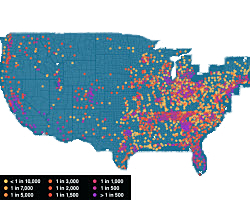 We've all heard that the housing bubble's pop led to thousands of foreclosures, but its interactive maps like this that really show how prevalent the problem was — and still is. Part of a project on 30 election issues, the map below uses data from RealtyTrac to display foreclosure rates by county.
The darker the color is, the higher the rate of foreclosure. You can see what each color represents in the legend on the lower left.
By pressing play, you can see how many more dots show up on the map, indicating a higher prevalence of foreclosures. But perhaps more disturbing, the map displaying the most recent data in July 2012 doesn't look much better than past maps: The crowded dots maintain the visual effect of a foreclosure epidemic.
National Economic Outlook (October 2012)

Unemployment in September fell to 7.8% (according to government stats) but otherwise the economic situation was pretty much as it has been for the last six months: improving but at a slow rate. Employment was up 1.4% over last year, with health care and business services providing the bulk of new jobs, as usual.
Some interesting developments: jobs in car manufacture were up 7% as car sales increase 9%; jobs in truck transport were up 4%, signaling that companies are confident enough to increase inventories; the hemorrhaging of teaching jobs has finally stopped; restaurant jobs were up 3%; and jobs in real estate and construction edged upward after years of contraction.
Real Estate Market Report
 After nine consecutive months of appreciation, August was the first month where home values decreased by 0.1% to $152,100, according to Zillow.
2012 has seen a turnaround in the housing market with sustained appreciation that, at times, has been very strong. As we progress through the latter half of this year, we expect home values to see more volatility characterized by months of home value declines mixed with months of appreciation.
Overall, the positive trend will hold as evidenced by home values being up by 1.7% in August 2012 on a year-over-year basis. Rents continued to rise in August, appreciating by 0.2% from July to August. On an annual basis, rents across the nation are up by 5.9%, indicating that demand, fueled by elevated foreclosure levels, is still outpacing investor-driven increases in rental property supply.
[Read more…]
Is the Fed’s QE3 Good for the Housing Market?
Last week, the Federal Reserve announced a new round of “quantitative easing,” or QE3, meaning the Federal Reserve will fire up the printing presses to buy $40 billion worth of mortgage-backed securities (MBS) every month on an open-ended basis in an effort to further drive down historically low interest rates.
Federal Reserve Chairman Ben Bernanke said QE3 should put downward pressure on mortgage rates, helping the housing market. By lowering borrowing costs and spurring banks to lend more, the Fed hopes to induce more spending and eventually set the stage for more hiring. The Fed tied its bond-purchase program explicitly to jobs, saying it will keep buying bonds until it sees a substantial improvement in the labor market.
Who benefits from QE3?
National Economic Outlook (September 2012)
Let's do the jobs math. In August, as in the preceding months, the number of jobs was 1.4 percent higher than last year. We're probably stuck at this growth rate which translates to 1.8 million new jobs per year.
Unemployment is at 8 percent but it rarely gets below 5 percent, so the “excess” unemployment is about 4 million. At 1.8 million per year it would take just a couple of years to put those 4 million back to work, but new people enter the workforce every day so it will probably take twice as long.
What will accelerate the recovery is construction, which has been below replacement levels as we coped with an excess 4 million homes built during the boom. We've almost absorbed that excess and there will soon be unmet demand in many local markets; home prices have bottomed out in half of the 315 markets we cover. Other construction will also increase as state and local governments spend on delayed infrastructure projects.
Just How Cheap is US Housing?
 Consider Minneapolis, Minn. You could’ve bought, out of foreclosure, a three-bedroom, two-bath house of 1,356 square feet on a quarter acre lot for about $29,000. It needed a lot of work, but houses in the neighborhood recently sold for $75,000.
Your mortgage would be under $100 per month and about the same in taxes. You could’ve got $1,000 in rent. Even if you had to put $40,000 in the house, your gross yield (cap rate) would’ve been 17.4% on the property.
This is one example sleuthed by my friend Gary Gibson. “The house had mold damage and needed a lot of work,” he wrote. “Beautiful yard, however.”
An Investor-Driven Recovery
 Investors are buying homes at a more rapid pace than ever before, and this time their investments actually make sense. Most are buying homes below replacement cost, or at prices that allow for a reasonable rental return.
Across the 167 metro areas we analyzed, investor activity rose to 29.6% of all transactions in the first quarter of this year, up from the trough of 23.6% in Q4 2009. Our research leads us to believe Q2 activity exceeds Q1, and since last quarter, investor activity has already spiked 2%!
Bottom Dwellers Waiting to Pounce
 The Wall Street Journal and The New York Times both published articles in the past six weeks stating that the housing market has reached a bottom. But hold on for just a minute… It seems that not everyone believes it.
Even Yale professor Robert Shiller, co-founder of the S&P/Case-Shiller Home Price Index, admits to being a little bit skeptical. In fact, he even told Fox Business last week that he's not entirely convinced that a bottom has been reached yet.
“It’s possible, but I’m not confident. This is partly seasonal,” Shiller said regarding the recent rise in home prices that have been documented over the past few months.
Only one thing is certain when it comes to economics: there is no certainty as to when an economic cycle has bottomed out until it’s already past. This is especially true in real estate — one of the biggest driving forces behind our national economy.
- « Previous Page
- 1
- …
- 83
- 84
- 85
- 86
- 87
- …
- 92
- Next Page »

