Norada Real Estate Investments

  • Home
  • Markets
  • Properties
  • Membership
  • Podcast
  • Learn
  • About
  • Contact

Tariffs Impact Housing Market: Builders Sound Alarm on Rising Costs

March 6, 2025 by Marco Santarelli

Tariffs Impact Housing Market: Builders Sound Alarm on Rising Costs

Have you ever gone to the grocery store and noticed that your favorite snacks suddenly cost a lot more? Or maybe you're thinking about buying a new TV, but the prices seem to have jumped up? These price increases, what we call inflation, can really hit our wallets hard. And lately, there's been a lot of talk about something called tariffs – taxes on goods coming into our country from other places.

Tariffs Impact Housing Market: Homebuilders Sound Alarm on Rising Costs

Dreaming of a new home? Maybe you’re picturing fresh paint, that new house smell, and finally having that extra space you’ve always wanted. But that dream might just be getting a little pricier, and here’s why: homebuilders are sounding the alarm because the cost of building materials is going up thanks to the new tariffs slapped on goods from Canada and Mexico by the Trump administration. These tariffs, intended to pressure our neighbors to tighten up border security, are having an unintended side effect right here at home – potentially making new houses more expensive for everyday folks like you and me.

Tariffs on Trade Partners Hit Home

So, what exactly happened? Well, President Trump put in place a hefty 25% tariff on goods coming in from both Canada and Mexico. This isn't just a minor tweak; it’s a significant tax on a wide range of products that cross our borders. The idea, as the White House explains it, is to push Canada and Mexico to do more to control the flow of illegal drugs and unauthorized immigration into the United States. Alongside these tariffs, there's also an additional 10% tariff on goods from China, adding another layer to this trade tension.

But here’s the rub – these tariffs hit industries that rely heavily on imports, and homebuilding is right at the top of that list. Buddy Hughes, the Chairman of the National Association of Homebuilders, put it plainly when he spoke to Realtor.com®. He warned that “this move to raise tariffs by 25% on Canadian and Mexican goods will harm housing affordability.” It's not just a vague worry; it's a direct hit to the wallet for anyone looking to buy a new home.

Think about it – when the price of lumber and other essential building materials goes up, who do you think ultimately pays? It's going to be the folks buying the houses. As Hughes pointed out, “tariffs on lumber and other building materials increase the cost of construction and discourage new development, and consumers end up paying for the tariffs in the form of higher home prices.” He's urging the Trump administration to reconsider these tariffs, emphasizing the need to keep housing affordable and to work together to boost home production.

Where Do Building Materials Come From Anyway?

You might be wondering, why are Canada and Mexico so important when it comes to building houses in the U.S.? Well, turns out, we depend on them quite a bit. Industry figures show that about 70% of the dimensional lumber used to build our homes comes from Canada. Think about the wood framing, the floors, the roofs – a lot of that starts in Canadian forests. Similarly, Mexico is a major source for drywall gypsum, that material that makes up the walls inside our houses. While China also supplies some fixtures and finishes, Canada and Mexico are the real heavy hitters when it comes to the raw materials of home construction.

This reliance on imports means that when tariffs are imposed on these countries, it’s not just a distant trade dispute – it directly impacts the cost of building a home right here in America. It’s like putting a tax directly on the materials that go into the walls and roofs over our heads.

The Ripple Effect on Home Prices

Danielle Hale, the Chief Economist at Realtor.com, paints a pretty clear picture of what this means for the housing market. According to her, builders are facing a tough choice: “Rising costs due to tariffs on imports will leave builders with few options. They can choose to pass higher costs along to consumers, which will mean higher home prices, or try to use less of these materials, which will mean smaller homes.”

Neither option is great for homebuyers. If builders pass the costs on, suddenly that dream home becomes even more out of reach for many families. Especially at a time when housing affordability is already a major concern in many parts of the country. Or, if builders try to cut costs by using less material, we could end up seeing smaller houses, maybe with fewer features, just to keep prices somewhat manageable. It’s a squeeze either way.

Hale also points out that the impact could go beyond just new homes. For a while now, the price difference between new construction and existing homes had been getting smaller in some areas. But these tariffs could reverse that trend. “The premium on new construction homes that had been shrinking in many markets according to Realtor.com data could begin to rise again, or we may see buyer's willingness to pay rise for existing homes as newly built homes get pricier—which would mean rising prices for existing homes, too,” she explains.

So, it’s not just about the price of new homes potentially going up. If new homes become more expensive, it could push up demand and prices for existing homes as well. It’s a ripple effect that could impact the entire housing market.

And it's not just buying a home that could be affected. Hale also notes that those home renovation projects we’ve been dreaming about might also get more expensive. “We may also see a lower appetite for major remodeling projects that would rely on these tariff-affected inputs, hamstringing the ability of consumers to remake their homes to fit their current needs,” she says. Want to finally redo that kitchen or bathroom? The tariffs on imported materials could make those projects cost more and potentially put them on hold for many homeowners.

Trump's Solution: More Logging

President Trump has acknowledged that we rely too much on foreign lumber. His solution? He wants to boost domestic timber production. He even signed executive orders aimed at ramping up logging in national forests. The idea is that by cutting down more trees here in the U.S., we can reduce our reliance on Canadian lumber and hopefully bring down building costs.

Now, environmental groups aren’t too thrilled about this idea, and it's understandable why. Expanding logging in national forests raises concerns about habitat loss, deforestation, and the impact on ecosystems. However, the Trump administration argues that more domestic logging is the answer to bring down building costs and lessen our dependence on Canadian lumber. It’s a complex issue with different sides and valid points.

“A Drug War, Not a Trade War”?

Adding another layer to this whole situation, a senior White House official told Realtor.com that these tariffs aren't really about trade in the long run. They are, according to this official, “a national security measure narrowly targeted at halting the international drug trade and illegal immigration, and are not intended as a long-term economic policy.” The official even suggested that the tariffs on Canada and Mexico might not last long enough to really mess with the housing supply chain, since building a house takes months anyway.

Commerce Secretary Howard Lutnick echoed this sentiment, telling CNBC on Tuesday morning, “This is not a trade war, this is a drug war.” He mentioned an April 2nd deadline for a report on trade deals, suggesting there will be discussions on how to “reset trade correctly.”

However, words are one thing, and actions are another. Canada and Mexico didn’t take these tariffs lying down. They swiftly retaliated by slapping their own tariffs on U.S. goods. This tit-for-tat tariff battle raises the specter of a full-blown trade war, which nobody really wants. Canadian Prime Minister Justin Trudeau didn't mince words, calling the tariffs “a very dumb thing to do” directly addressing President Trump. Ontario Premier Doug Ford even threatened to cut off electricity to several U.S. states, showing just how tense things are getting.

Market Jitters and Uncertainty

The financial markets aren’t exactly cheering about all this trade drama either. The S\&P 500, a key measure of stock market performance, dropped about 3.7% in the week as it became clear Trump was going ahead with these tariffs. Paul Ashworth, Chief North America Economist for Capital Economics, noted that “Markets have predictably reacted badly, since this raises the risk that Trump will also follow through on his threats to impose reciprocal country-specific tariffs soon, including a proposed 25% on imports from the EU.” The fear is that this could be just the beginning of a much wider trade conflict, impacting not just housing but the entire economy.

Remember, this all started back in February when Trump first announced these tariffs. He initially suspended them for 30 days for Canada and Mexico, hoping they would step up border enforcement. He did, however, impose a 10% tariff on China last month, bringing the total to 20% now. The focus with China is on cracking down on the production of chemicals used to make fentanyl, a deadly drug.

President Trump is expected to address Congress and the nation soon, and it’s anticipated he’ll talk about the economy and inflation. It will be interesting to see how he addresses these tariffs and the concerns about rising costs, especially in the housing market.

The Bottom Line for Homebuyers

So, where does all of this leave us? Well, it's still quite uncertain how long these tariffs will last and what the ultimate impact will be. But one thing is clear: homebuilders are worried. They’re warning that these tariffs on Canada and Mexico are likely to increase building costs, which could translate to higher prices for new homes and potentially even impact the broader housing market and home renovation projects. Whether this is a short-term blip or a more lasting shift remains to be seen. But if you're in the market for a new home, it’s definitely something to keep an eye on. The dream of homeownership might just be getting a little more expensive in the face of these trade tensions.

Navigate Economic Uncertainty with

Norada Real Estate Investments

Whether it's recession or inflation, turnkey real estate offers stability and consistent returns.

Diversify your portfolio with ready-to-rent properties designed to withstand economic fluctuations.

Speak with our expert investment counselors (No Obligation):

(800) 611-3060

Get Started Now 

Read More:

  • Will Higher Tariffs Lead to Inflation and Higher Interest Rates in 2025?
  • Will the Fed Achieve Its 2% Inflation Target in 2025: The Road Ahead
  • Are We in a Recession or Inflation: Forecast for 2025
  • Inflation's Impact on Home Prices & Mortgages: What to Expect in 2025 
  • Interest Rates vs. Inflation: Is the Fed Winning the Fight?
  • Is Fed Taming Inflation or Triggering a Housing Crisis?
  • Will Inflation Go Down Below 2% in 2025: Economic Forecast
  • How To Invest in Real Estate During a Recession?
  • Will There Be a Recession in 2025?
  • When Will This Recession End?
  • Should I Buy a House Now or Wait for Recession?

Filed Under: Economy Tagged With: 2% Inflation, Economy, Federal Reserve, inflation, interest rates, rate of inflation, Recession

Will Higher Tariffs Lead to Inflation and Higher Interest Rates in 2025?

February 27, 2025 by Marco Santarelli

Will Higher Tariffs Lead to Inflation and Higher Interest Rates in 2025?

Have you ever gone to the grocery store and noticed that your favorite snacks suddenly cost a lot more? Or maybe you're thinking about buying a new TV, but the prices seem to have jumped up? These price increases, what we call inflation, can really hit our wallets hard. And lately, there's been a lot of talk about something called tariffs – taxes on goods coming into our country from other places.

So, the big question everyone's asking is: Will higher tariffs lead to inflation and higher interest rates? The short answer is yes, very likely, higher tariffs can indeed push up prices and potentially lead to higher interest rates. Let's dive into why this happens, and what it all means for you and me.

Will Higher Tariffs Lead to Inflation and Higher Interest Rates? Let's Break it Down

Understanding Tariffs: What Are They and Why Do They Matter?

Imagine you're buying a cool toy car made in another country. To get that toy car into our stores, sometimes our government puts a tax on it – that's a tariff. Think of it like a toll you have to pay to bring something into the country. Tariffs are usually put in place to try and help businesses here at home. The idea is that by making imported goods more expensive, people will buy more stuff made in our own country. Governments might also use tariffs to make money or to put pressure on other countries. But whatever the reason, tariffs change the price of things we buy, and that’s where inflation comes in.

How Tariffs Pump Up Inflation: The Price Hike Effect

So, how exactly do higher tariffs cause prices to go up – inflation? It’s actually pretty straightforward when you break it down. There are a few main ways tariffs can lead to goods inflation, which is when the prices of things we buy in stores go up:

  • Direct Price Increase on Imports: This one's the most obvious. When a tariff is slapped on imported goods, it's like adding an extra cost right away. Companies that bring these goods into the country have to pay that tariff. Guess who ends up paying that extra cost? Yep, you and me. Businesses often pass that extra cost onto us as higher prices. For example, if there's a tariff on imported clothes, your favorite shirt from overseas is going to cost more at the store. According to a February 2025 NPR article, proposed US tariffs could lead to higher prices on all sorts of everyday items we get from places like Canada, Mexico, and China (NPR article on Trump tariffs and higher prices). It's simple math: higher tax = higher price.
  • Domestic Companies Jack Up Prices Too: It’s not just imported stuff that gets more expensive. When tariffs make imported goods pricier, companies that make similar things here can also raise their prices! Why? Because suddenly, their stuff looks cheaper compared to the imported stuff. They know people will be more likely to buy their products now that the imported competition is more expensive. It's like when the gas station across the street raises its prices – the other stations around it might raise theirs a little too. Research from the Centre for Economic Policy Research (CEPR) supports this, suggesting tariffs give domestic producers the wiggle room to increase their prices, which adds to overall inflation (CEPR tariffs and inflation). It’s a bit sneaky, but it's just how businesses work sometimes.
  • Currency Takes a Hit, Prices Go Even Higher: Here's where things get a little more complicated, but stick with me. Sometimes, when a country puts up a lot of tariffs, it can mess with how much its money is worth compared to other countries – what we call currency value. If tariffs lead to us buying less from other countries and maybe them buying less from us (that's called a trade deficit), our currency might become weaker. A weaker currency means it costs more to buy things from other countries. So, even without the tariff itself, imported goods get more expensive. It's like a double whammy! The Bank of Canada has even pointed out that tariffs can mess up supply chains and cause inflation to jump up, especially if we can't easily find things we need here at home (Bank of Canada tariffs impact). It's like everything from overseas just got more expensive across the board.

From Inflation to Interest Rates: Why Your Loans Might Cost More

Okay, so tariffs can cause inflation – prices go up. But what about interest rates? How do they fit into all of this? Well, think of interest rates as the price of borrowing money. When interest rates go up, things like car loans, home mortgages, and even credit card bills can become more expensive. And central banks, like the Federal Reserve in the US, play a big role in setting these rates.

Central banks are like the inflation firefighters of the economy. Their main job is to keep inflation under control. When inflation starts to climb too high, what do they often do? They raise interest rates. Why? Higher interest rates make it more expensive to borrow money. This means people and businesses borrow less, spend less, and save more. Less spending can cool down the economy and help bring inflation back down to a normal level.

So, if higher tariffs cause a significant jump in goods inflation, it's pretty likely that central banks will think about raising interest rates to fight that inflation. The Federal Reserve Bank of Boston, for example, estimated that some proposed tariffs could add almost a whole percentage point to inflation! That's a big jump, and it could definitely push the Fed to consider raising rates to keep things in check (Boston Fed tariffs on inflation).

But here's the tricky part: raising interest rates can also slow down the economy. It can make it harder for businesses to grow and create jobs. So, central banks are in a tough spot. They have to balance fighting inflation with keeping the economy healthy and growing. If tariffs not only cause inflation but also hurt economic growth, central banks have a really complicated decision to make. Do they raise rates to fight inflation, even if it slows down the economy more? Or do they hold off on raising rates to support growth, even if inflation stays a bit higher? Economists at CEPR point out this exact dilemma – it's a balancing act between controlling prices and keeping the economy moving forward (CEPR monetary policy response). It's not as simple as just raising rates whenever prices go up.

Real-World Examples: Tariffs in Action

To see how this all works in real life, we can look back at when the US put tariffs on steel, aluminum, and goods from China in 2018. Studies estimate that these tariffs added a bit to inflation – somewhere between 0.1 and 0.2 percentage points to what's called core inflation (that's inflation without food and energy prices, which can jump around a lot).

At that time, inflation was already around 2.2% to 2.5%. During this period, the Federal Reserve did raise interest rates several times. Now, it's hard to say exactly how much of those rate hikes were because of the tariffs, since there were other things happening in the economy too, like strong economic growth.

But it's definitely something that economists were watching closely, and it shows how tariffs can play into the inflation and interest rate picture. You can even see the inflation data from that time from the Bureau of Labor Statistics (BLS CPI data).

Looking ahead, some experts think that new tariffs being talked about, like those proposed in 2025, could push inflation even higher – maybe up to 3% or 4%! Capital Economics, for instance, suggests tariffs could really complicate things for the Federal Reserve, making it harder for them to lower interest rates in the future because of the added inflation pressure (Capital Economics inflationary impact of tariffs).

And globally, the Bank of Canada in early 2025 even cut interest rates, but warned that a tariff war could be “very damaging” and cause persistent inflation, potentially forcing them to raise rates later on (Bank of Canada rate cuts). These examples show that tariffs aren't just abstract ideas – they have real effects on prices and interest rates in the real world.

When Tariffs Might Not Cause Big Inflation Hikes (The Exceptions)

Now, it's important to remember that the economy is complicated. It’s not always a straight line from tariffs to inflation to higher interest rates. There are times when tariffs might not lead to big jumps in inflation or interest rate hikes. Here are a few situations to keep in mind:

  • If We Don't Rely Heavily on Imports: If a country makes a lot of its own stuff, and doesn't import too much of a certain product, tariffs on those imports might not cause a huge price shock. For example, if the US puts tariffs on imported steel but already makes a lot of steel domestically, the price increase might be smaller because we can just buy more American-made steel instead. CEPR's analysis points out that how much tariffs affect inflation really depends on how much a country relies on trade in the first place (CEPR tariffs and inflation). If we can easily switch to buying local, the tariff impact is less.
  • If Our Money Gets Stronger: Sometimes, other things happen in the world that can make a country's money stronger. If a country's currency becomes more valuable, it can actually offset some of the price increases from tariffs. A stronger currency makes imports cheaper, which can help keep inflation in check, even with tariffs. The Boston Fed mentioned that currency changes can be a factor when looking at the impact of tariffs on inflation (Boston Fed tariffs on inflation). So, currency strength can act as a buffer against tariff-driven inflation.
  • If Central Banks Decide Not To Raise Rates: Even if tariffs cause some inflation, central banks might choose not to raise interest rates if they think the inflation is only temporary or if the economy is already weak. Remember the Bank of Canada example? They actually cut rates even with tariff risks, because they were more worried about economic growth than inflation at that moment (Bank of Canada rate cuts). Central banks have to make tough calls, and sometimes fighting inflation isn't their top priority, especially if the economy is struggling.

Who Feels the Pinch? Sector-by-Sector Impacts

It’s also worth noting that tariffs don't affect every part of the economy equally. If tariffs are placed on a wide range of goods – like a broad-based tariff on everything coming into the country – the impact on inflation can be much bigger. The Budget Lab at Yale University estimates that a 10% tariff on all imports could raise consumer prices quite a bit, anywhere from 1.4% to a whopping 5.1%! (Yale Budget Lab tariffs). That's a significant jump that would be felt by pretty much everyone.

On the other hand, if tariffs are only put on specific goods, like just steel or just certain electronics, the impact might be more limited to those specific industries. For example, tariffs on steel might mainly affect companies that use a lot of steel, like car manufacturers or construction companies. The price of cars and buildings might go up a bit, but the price of other things might not change much. So, the breadth and scope of the tariffs really matter in determining how widespread the inflationary effects will be.

Wrapping It Up: Tariffs, Inflation, and Your Wallet

So, to bring it all together: will higher tariffs lead to inflation and higher interest rates? Based on what we know from economic research and real-world examples, the answer is likely yes. Higher tariffs can definitely contribute to goods inflation by making imported goods more expensive, giving domestic companies room to raise prices, and potentially weakening our currency, which makes imports even pricier. This inflation, in turn, can push central banks to raise interest rates as they try to keep prices under control.

However, it's not a guaranteed outcome every time. The actual effect of tariffs on inflation and interest rates depends on lots of things – how much we rely on imports, how strong our currency is, and how central banks decide to respond. But the general trend is clear: tariffs tend to push prices up, and that can have ripple effects throughout the economy, potentially making borrowing more expensive for all of us.

As someone trying to understand what's happening in the economy, I think it's crucial to see how policies like tariffs, which might seem simple on the surface, can have complex and sometimes unexpected consequences for our everyday lives. It's not just about trade numbers and economic theories – it's about the prices we pay at the store, the interest rates on our loans, and the overall health of our economy. Keeping an eye on these connections helps us all be more informed and make better decisions in our own financial lives.

Navigate Economic Uncertainty with

Norada Real Estate Investments

Whether it's recession or inflation, turnkey real estate offers stability and consistent returns.

Diversify your portfolio with ready-to-rent properties designed to withstand economic fluctuations.

Speak with our expert investment counselors (No Obligation):

(800) 611-3060

Get Started Now 

Read More:

  • Will the Fed Achieve Its 2% Inflation Target in 2025: The Road Ahead
  • Are We in a Recession or Inflation: Forecast for 2025
  • Inflation's Impact on Home Prices & Mortgages: What to Expect in 2025 
  • Interest Rates vs. Inflation: Is the Fed Winning the Fight?
  • Is Fed Taming Inflation or Triggering a Housing Crisis?
  • Will Inflation Go Down Below 2% in 2025: Economic Forecast
  • How To Invest in Real Estate During a Recession?
  • Will There Be a Recession in 2025?
  • When Will This Recession End?
  • Should I Buy a House Now or Wait for Recession?

Filed Under: Economy Tagged With: 2% Inflation, Economy, Federal Reserve, inflation, interest rates, rate of inflation, Recession

Will the Fed Achieve Its 2% Inflation Target in 2025: The Road Ahead

February 25, 2025 by Marco Santarelli

Remember back when a dollar actually felt like it could buy you something? Seems like a distant memory, right? Over the past few years, we've all felt the pinch as prices for pretty much everything – from gas in our tanks to groceries in our carts – have jumped up. The big question on everyone's mind, and especially on the minds of folks at the Federal Reserve (the folks in charge of keeping our money system healthy), is: The Road to 2% Inflation: Are We There Yet?

Well, if you're looking for a straight yes or no, here it is: not quite, but we’ve definitely come a long way. Inflation, which peaked in mid-2022, has thankfully come down quite a bit. But hitting that sweet spot of 2% inflation that the Fed aims for? That’s proving to be a bit trickier than we hoped, and recent data suggests progress might be slowing down. Let's break down what's been happening with prices and see where we actually stand on this bumpy road back to normal.

Is Fed's 2% Inflation Target Possible in 2025: The Road Ahead

The Inflation Rollercoaster: A Look Back

To really understand where we are now, we need to take a quick trip down memory lane. Let’s look at how prices have been behaving since before the pandemic hit. Thanks to the recent data and article published by the Federal Reserve Bank of St. Louis, we can get a clear picture.

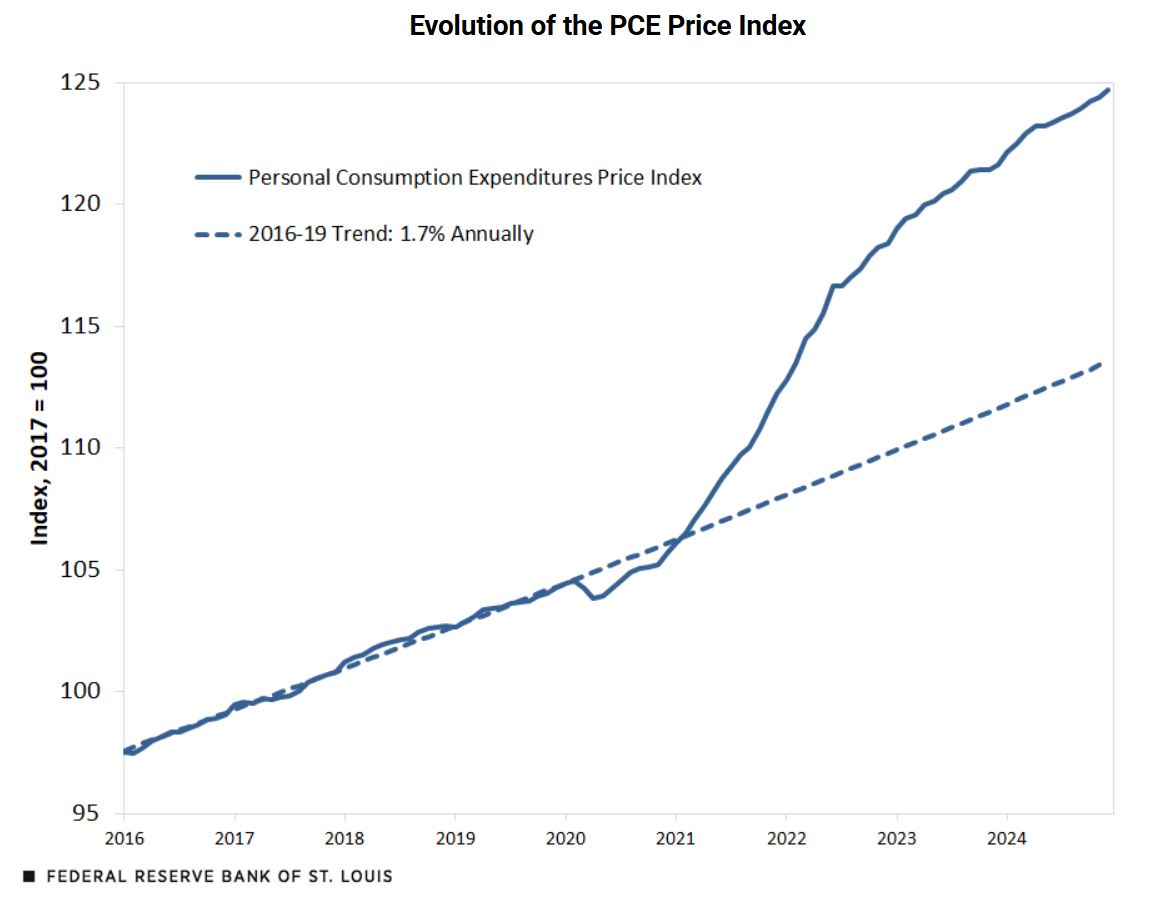
Think back to the years before 2020. From 2016 to 2019, things were pretty stable. Prices were inching up at a rate of about 1.7% each year. This is based on something called the Personal Consumption Expenditures (PCE) price index. Don't let the fancy name scare you; it’s just a way of measuring how much prices are changing for all the stuff we buy as people – from haircuts to TVs.

The Fed really likes to watch this PCE number because it gives a good overall view of inflation. Their target? They want to keep inflation at 2% annually. Close to 2%, but not too much higher or lower, is considered healthy for the economy.

Now, if we look at this PCE price index chart going back to 2016, you’ll see that nice, steady climb before 2020. Then, BAM! The pandemic hits. Suddenly, things went a little haywire.

Evolution of the PCE Price Index
Image Credit: Federal Reserve Bank of St. Louis

As you can see from the chart above, in the very beginning of the pandemic, prices actually dipped below where they were expected to be if they had just kept growing at that pre-pandemic 1.7% pace. This makes sense, right? Everyone was staying home, businesses were closed, and demand for many things dropped.

But then, things flipped. Starting in late 2020 and going all the way to mid-2022, prices took off like a rocket! We saw some of the highest inflation rates in decades. Since mid-2022, thankfully, the rate of price increases has slowed down. However, and this is the key takeaway, even though inflation is slower now, prices are still going up, just not as fast.

By the end of 2024, as the data shows, overall prices were about 10% higher than they would have been if we’d just stuck to that pre-pandemic trend. Think about that – ten extra dollars for every hundred you used to spend on the same basket of goods. That’s a real bite out of our wallets.

The Inflation Peak and the Road Down (…and Maybe a Plateau?)

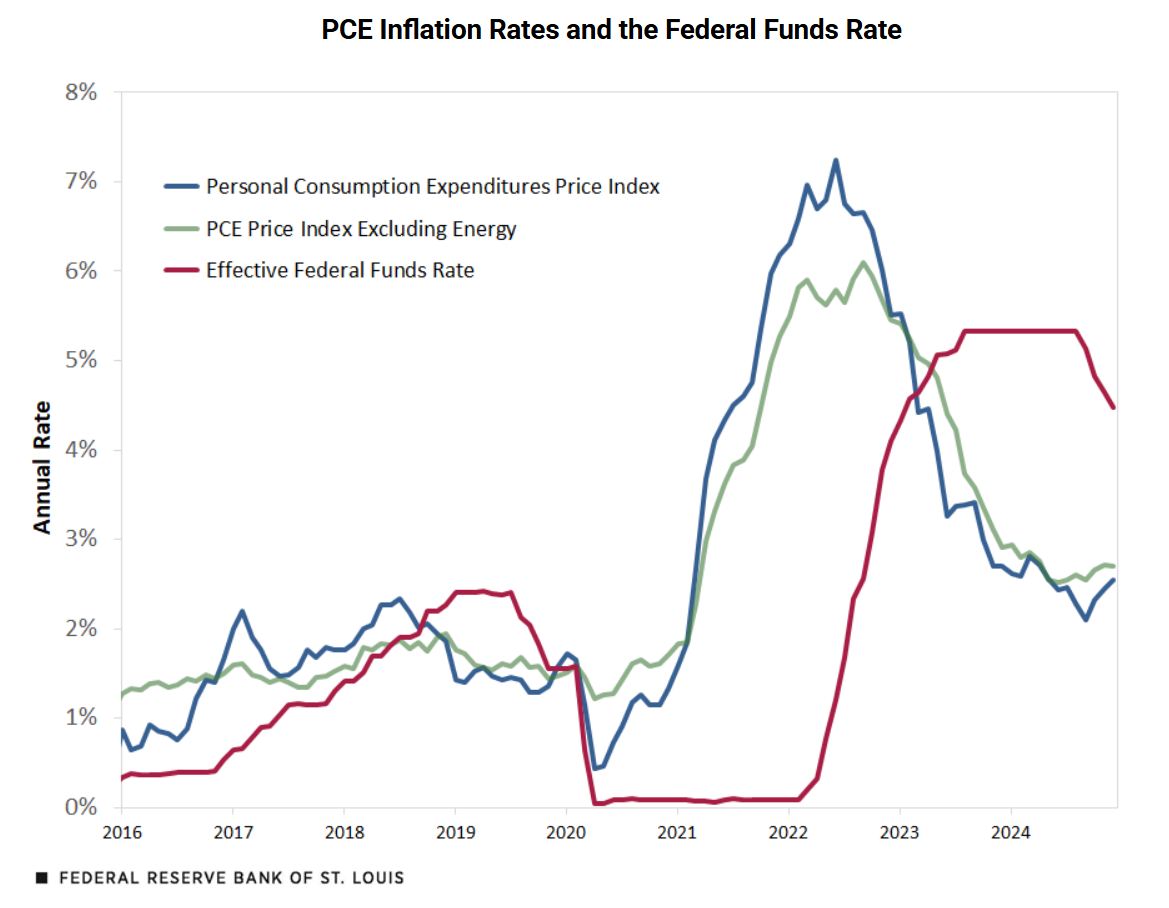
Let's look at another key chart that shows the rate of inflation – how quickly prices are changing from one year to the next. This is often called headline inflation.

PCE Inflation Rates and the Federal Funds Rate
Image Credit: Federal Reserve Bank of St. Louis

This second chart is really interesting because it shows both the overall inflation rate (the blue line) and the inflation rate when we take out energy prices (the green line). Energy prices, like gas and heating oil, can jump around a lot and sometimes give a misleading picture of what’s really happening with underlying inflation.

You can clearly see that sharp drop in inflation at the start of the pandemic, followed by that massive spike peaking in mid-2022. After that peak, the blue line shows inflation coming down pretty steadily. That's the good news! It means the really rapid price increases we saw are behind us.

However, if you look closely, especially at the green line (inflation excluding energy), something interesting pops out. While headline inflation (blue line) dropped quite a bit in 2024, a lot of that drop was because energy prices actually fell. If you take energy out of the picture, the green line shows that the progress in lowering inflation might have stalled a bit recently. That’s a bit concerning because it suggests that while lower gas prices are helping us feel a little relief, the underlying problem of higher prices across the board might still be stubbornly sticking around.

And look at that red line on the chart – that’s the federal funds rate. This is the interest rate that the Federal Reserve controls, and it's their main tool to fight inflation. Notice how for a long time, even as inflation was starting to rise in 2021, the Fed kept interest rates near zero? They didn't start raising rates until March 2022! In my opinion, that was a bit late. Many of us were wondering why they waited so long as prices were clearly climbing. Once they did start raising rates, though, they did it aggressively. Interest rates shot up and stayed high for a while. In late 2024, they started to bring rates down a little bit, signaling that maybe they felt they were starting to get inflation under control.

Is Inflation Just About a Few Things Going Up? Nope, It’s Broad-Based.

When inflation first started to take off, some people thought it was just because of a few specific things. Maybe it was just used cars getting expensive, or maybe it was just lumber prices going crazy. The idea was that these were temporary problems that would sort themselves out soon. This idea was often called “transitory inflation.”

But as 2021 went on, it became clear that inflation was much broader than just a few items. It wasn't just one or two things getting more expensive – it was lots of things. This is what we mean by broad-based inflation.

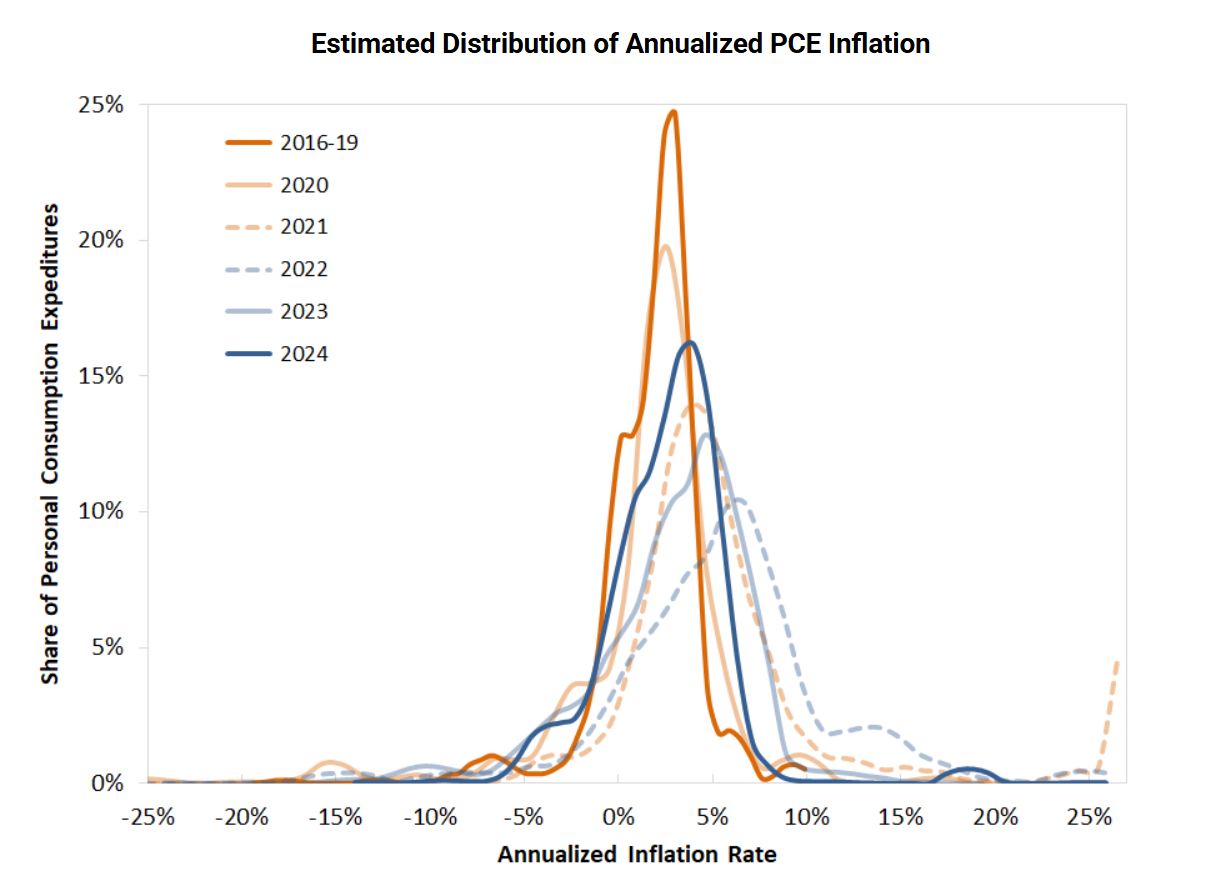
The Federal Reserve Bank of St. Louis provided another really helpful chart that shows this:

Estimated Distribution of Annualized PCE Inflation
Image Credit: Federal Reserve Bank of St. Louis

This chart might look a little complicated, but it’s actually quite insightful. Imagine each line in this chart as showing a snapshot of all the different things we buy in different years. The horizontal axis shows how much prices changed for each of those things, and the vertical axis shows how much of our spending goes to those items.

The orange line, representing 2016-2019, is our pre-pandemic benchmark. See how it's mostly clustered around the middle, around 0% to 5% inflation? That’s normal.

Now look at the lines for 2021 and 2022. These lines shift way over to the right. This means that in those years, a much larger share of the things we buy saw higher price increases than in the pre-pandemic years. Inflation wasn't just hitting a few categories; it was hitting almost everything.

Even in 2024, while the line has shifted back to the left a bit (good news!), it’s still significantly to the right of that pre-pandemic orange line. This tells us that even now, most of the things we buy are still experiencing higher inflation than they used to. It’s not just a few outliers anymore; it’s widespread. According to the data, about three-quarters of what we spend our money on in 2024 was still experiencing higher inflation than before the pandemic.

This broad-based nature of inflation is a key challenge. It means that getting back to 2% isn't just about fixing a few supply chain bottlenecks or waiting for one specific price to come down. It means we need to see a more general slowing of price increases across the entire economy.

Breaking It Down: Inflation by Product Category

To get even more specific, let's look at how inflation has behaved in different categories of things we buy. The Federal Reserve Bank of St. Louis provided a table that breaks this down:

Annualized Inflation Rates by Product Category Food Energy Core Goods Core Services Excluding Housing Housing All
2016-19 0.2% 4.2% -0.6% 2.2% 3.4% 1.7%
2020 3.9% -7.7% 0.1% 2.0% 2.2% 1.3%
2021 5.6% 30.6% 6.2% 5.3% 3.7% 6.2%
2022 11.1% 6.7% 3.2% 4.9% 7.7% 5.5%
2023 1.5% -2.0% 0.0% 3.4% 6.3% 2.7%
2024 1.6% -1.1% -0.1% 3.5% 4.7% 2.6%

Take a look at this table. Energy is the only major category where inflation was lower in 2024 than it was in the pre-pandemic period. This confirms what we saw in the charts – falling energy prices really helped bring down the overall inflation rate in 2024.

But look at everything else. Food prices are still rising faster than they were before. “Core goods” (things like appliances, furniture, clothes) actually saw deflation (prices going down) before the pandemic, but in 2024, they were essentially flat. “Core services excluding housing” (things like haircuts, transportation, entertainment) and “Housing” are all showing much higher inflation rates than they did before.

What this table really drives home is that inflation isn’t just an energy story. It’s impacting almost every part of our lives. Even though the overall inflation rate in 2024 was 2.6%, which is closer to the Fed’s 2% target, it's still significantly higher than the 1.7% we saw in 2016-2019. And importantly, that 2.6% is still above the Fed’s 2% goal.

So, Are We There Yet? The Verdict.

Let's circle back to our main question: The Road to 2% Inflation: Are We There Yet? Based on all this data, I think it's clear that we're not quite there yet. We've made real progress in bringing inflation down from those scary highs of 2022. Falling energy prices have been a big help. But when you dig deeper, you see that inflation is still pretty widespread across the economy, and in many key areas like housing and services, price increases are still running hotter than before the pandemic.

The Fed wants to see inflation at 2%. In 2024, we ended the year at 2.6%. That’s closer, but still a noticeable gap. And the fact that progress seems to have slowed down when you exclude energy prices is a bit worrying. It suggests that getting that last bit of inflation down to 2% might be the hardest part.

What caused this whole inflation mess in the first place? Well, that’s a whole other discussion, but the author of the data we've been looking at hints that the massive government spending during the pandemic, combined with very low interest rates from the Fed, played a big role. And with government spending still high, there might be more inflationary pressure to come.

For now, the road to 2% inflation feels like it's still under construction. We've traveled a good distance, but there might be more bumps and detours ahead before we reach our destination. We'll have to wait and see what the next set of inflation data tells us, but for now, I'm keeping a close eye on prices and hoping we can finally get back to that 2% target without too much more pain.

Navigate Economic Uncertainty with

Norada Real Estate Investments

Whether it's recession or inflation, turnkey real estate offers stability and consistent returns.

Diversify your portfolio with ready-to-rent properties designed to withstand economic fluctuations.

Speak with our expert investment counselors (No Obligation):

(800) 611-3060

Get Started Now 

Read More:

  • Are We in a Recession or Inflation: Forecast for 2025
  • Inflation's Impact on Home Prices & Mortgages: What to Expect in 2025 
  • Interest Rates vs. Inflation: Is the Fed Winning the Fight?
  • Is Fed Taming Inflation or Triggering a Housing Crisis?
  • Will Inflation Go Down Below 2% in 2025: Economic Forecast
  • How To Invest in Real Estate During a Recession?
  • Will There Be a Recession in 2025?
  • When Will This Recession End?
  • Should I Buy a House Now or Wait for Recession?

Filed Under: Economy Tagged With: 2% Inflation, Economy, Federal Reserve, inflation, interest rates, rate of inflation, Recession

Interest Rate Forecast for Next 10 Years: 2025-2035

February 18, 2025 by Marco Santarelli

Interest Rate Predictions for Next 10 Years: Expert Weigh In!

If you're looking for a quick answer, here it is: The Interest Rate Forecast for the Next 10 Years suggests a gradual decline in interest rates initially, followed by a period of stabilization and then a slow climb back up. Experts believe the Federal Reserve will begin cutting rates in 2025, aiming for a long-term target of around 2% by 2027, but rates may rise again in the early 2030s. That said, let's dig into the details, because the economic road ahead is rarely a straight line.

Interest Rate Forecast for Next 10 Years: Are Lower Rates on the Horizon?

Ever wondered how much those little numbers – interest rates – can impact your life? From the mortgage on your home to the savings account you're diligently contributing to, interest rates are the silent influencers of our financial well-being. The Federal Reserve (the Fed), the central bank of the United States, has a significant role to play in deciding the direction of the interest rates, and it's therefore crucial to stay updated with the changes. So, let's buckle up and explore the projected path of interest rates over the next decade and what it all means for you.

Where Are Interest Rates Right Now? A Quick Snapshot

As of February 2025, the Fed's target federal funds rate sits between 4.25% and 4.5%. This is a key rate because it influences what banks charge each other for overnight lending, and that, in turn, affects a whole host of other interest rates that we see every day.

Now, there's a general expectation that the Fed will start lowering rates sometime in 2025. The reason? Inflation seems to be cooling down, and economic growth isn't quite as hot as it used to be. Think of it like this: the Fed is trying to find the sweet spot where the economy is growing at a healthy pace, but prices aren't rising too quickly.

A Year-by-Year Look: Projecting Interest Rates from 2025 to 2035

Okay, time for the meat and potatoes! I've put together a table showing the projected interest rates for the next decade, along with the likelihood of the Fed cutting rates in each of those years:

Year Projected Federal Funds Rate Probability of Rate Cut (%)
2025 3.75% – 4.00% 70
2026 3.00% – 3.25% 80
2027 2.00% – 2.25% 90
2028 2.00% – 2.25% 85
2029 2.25% – 2.50% 60
2030 2.50% – 2.75% 55
2031 2.75% – 3.00% 50
2032 3.00% – 3.25% 45
2033 3.25% – 3.50% 40
2034 3.50% – 4.00% 30
2035 4.00% – 4.25% 20

Let's break down what this table is telling us:

  • 2025: We're likely to see the start of rate cuts, bringing the federal funds rate down a bit. This is the Fed reacting to inflation cooling off.
  • 2026: The cuts continue, potentially bringing the rate down further. The Fed is probably trying to encourage more economic activity.
  • 2027: The Fed might be close to its long-term target for interest rates. This is the level where they believe the economy can grow steadily without inflation getting out of hand.
  • 2028-2029: A period of stability might be on the horizon. The Fed could take a “wait and see” approach to assess the impact of the earlier rate cuts. It is also possible that a slight upward movement may begin as growth pressures emerge.
  • 2030-2031: The forecasts indicate a gradual upward adjustment. As the economic expansion gains traction, the federal funds rate could edge higher.
  • 2032-2033: To combat potential inflation or overheating of the economy, the Fed may increase interest rates again.
  • 2034-2035: As the economy matures, projections suggest rates could stabilize closer to historical norms. The probability of cuts is reduced.

Keep in mind: These are just projections! The future is never set in stone. There are many factors that could change these numbers.

A Decade of Change: How Fed Interest Rates Evolved (2014-2024)

The decade from 2014 to 2023 witnessed a dynamic shift in Federal Reserve (Fed) interest rate policy, moving away from the unprecedented low rates implemented in the wake of the 2008 financial crisis. Here's a detailed overview:

  • 2014-2015: Tapering and Initial Hike: This period signified the end of the zero-interest-rate policy (ZIRP) era. After years of maintaining near-zero rates to support the economic recovery, the Fed began signaling its intention to normalize monetary policy. In December 2015, the Fed cautiously initiated its rate-hiking cycle, raising the target federal funds rate from a range of 0% to 0.25% to a range of 0.25% to 0.50%. This move reflected growing confidence in the strength of the labor market and the overall economy.
  • 2016-2018: Gradual Normalization: The Fed continued its gradual approach to raising interest rates throughout this period, implementing measured increases at several Federal Open Market Committee (FOMC) meetings. By December 2018, the target range had reached 2.25% to 2.50%. These increases were driven by sustained economic growth, a declining unemployment rate, and the Fed's efforts to manage inflation and prevent the economy from overheating.
  • 2019: A Pivot to Accommodation: As economic growth slowed and global uncertainties increased, the Fed adopted a more dovish stance in 2019. After multiple rate hikes in prior years, the central bank paused its tightening cycle and subsequently lowered interest rates three times during the year. By year-end, the target range had been reduced to 1.50% to 1.75%. The Fed cited concerns about global economic developments, trade tensions, and muted inflation as reasons for its policy shift.
  • 2020-2023: Crisis Response and Extended Accommodation: The onset of the COVID-19 pandemic in early 2020 triggered a sharp economic contraction. In response, the Fed aggressively slashed interest rates back to near zero (0% to 0.25%) to cushion the economic blow, support financial markets, and encourage borrowing and investment. This ultra-low rate environment persisted for several years as the Fed focused on fostering a strong and inclusive recovery. In 2022 and 2023, the Fed aggressively raised rates to combat rising inflation.

The Crystal Ball: What Influences Interest Rate Decisions?

So, what makes the Fed tick? What factors do they consider when deciding whether to raise, lower, or hold steady on interest rates? Here are a few of the big ones:

  • Inflation: This is the big kahuna. If prices are rising too quickly, the Fed will often raise interest rates to slow things down. They want to keep inflation around 2%.
  • Economic Growth: The Fed also wants the economy to grow at a healthy pace. If growth is too slow, they might lower rates to encourage borrowing and spending.
  • Labor Market Conditions: A strong job market with lots of hiring and rising wages can put upward pressure on inflation. The Fed will keep a close eye on unemployment rates, job growth, and wage trends.
  • Global Economic Factors: The world is interconnected. What happens in other countries can affect the U.S. economy. Geopolitical instability, trade wars, or economic slowdowns in major economies can all influence the Fed's decisions.
  • Financial Stability: The Fed also wants to make sure the financial system is stable. Big market crashes or banking crises can prompt them to lower rates to provide support.

My Two Cents: Some Personal Thoughts on the Road Ahead

Now, I'm not an economist with a fancy degree. But I've been following the economy for a while, and here are a few of my personal thoughts on what might happen:

  • Inflation Will Be Key: I think whether the Fed can successfully bring inflation down to its 2% target will be the biggest driver of interest rate decisions over the next few years. If inflation proves stubborn, we could see interest rates stay higher for longer than expected.
  • The Global Economy is a Wildcard: There's a lot of uncertainty in the world right now, from geopolitical tensions to potential trade disruptions. These factors could easily throw a wrench into the Fed's plans.
  • Don't Expect a Quick Return to “Normal”: After a period of historically low interest rates, I think it's unlikely that we'll see rates return to those levels anytime soon. The economy has changed, and the Fed's approach may need to change with it.

What Does This Mean for You?

Okay, enough with the economic jargon! Let's talk about how these potential interest rate changes could affect your life:

  • Mortgages: Lower interest rates mean lower mortgage payments. If you're thinking about buying a home or refinancing your existing mortgage, keep an eye on interest rate trends.
  • Savings Accounts: Higher interest rates on savings accounts are good news for savers. You'll earn more money on your deposits.
  • Loans: Interest rates on car loans, personal loans, and credit cards are also affected by the Fed's decisions. Lower rates can make it cheaper to borrow money.
  • Investments: Interest rates can also influence the stock market and other investments. Lower rates can sometimes boost stock prices, while higher rates can have the opposite effect.

Staying Informed: Resources for Further Reading

If you want to dig deeper into this topic, here are a few resources I recommend:

  • CBO Budget and Economic Outlook
  • Federal Reserve Economic Projections

These websites provide a wealth of information on the economy and the Fed's policies.

The Bottom Line

The Interest Rate Forecast for the Next 10 Years points towards a period of gradual adjustments as the Fed tries to navigate the complex economic landscape. It's not a simple situation, but understanding the key factors and following the trends can help you make smarter financial decisions.

Remember, I'm just a regular person sharing my thoughts. This is not financial advice. Always do your own research and consult with a qualified financial advisor before making any major decisions.

Navigate a Decade of Shifting Interest Rates with Norada

As the Interest Rate Forecast for the Next 10 Years signals market changes, turnkey real estate investments provide a stable income source.

Capitalize on high-quality, ready-to-rent properties designed to deliver consistent returns even amid economic fluctuations.

Speak with our expert investment counselors (No Obligation):

(800) 611-3060

Get Started Now 

Recommended Read:

  • Fed Cuts Interest Rates by 25 Basis Points: What It Means for You
  • Interest Rates Predictions for 5 Years: Where Are Rates Headed?
  • Projected Interest Rates in 5 Years: A Look at the Forecasts
  • Fed's Powell Hints of Slow Interest Rate Cuts Amid Stubborn Inflation
  • Fed Funds Rate Forecast 2025-2026: What to Expect?
  • Interest Rate Predictions for 2025 and 2026 by NAR Chief
  • Market Reactions: How Investors Should Prepare for Interest Rate Cut
  • Interest Rate Predictions for the Next 3 Years: (2024-2026)
  • Interest Rate Predictions for Next 2 Years: Expert Forecast
  • Impact of Interest Rate Cut on Mortgages, Car Loans, and Your Wallet

Filed Under: Economy, Financing Tagged With: Economic Forecast, Fed, Fed Fund Rate, Federal Reserve, inflation, Interest Rate, Interest Rate Forecast, Interest Rate Predictions

Inflation’s Impact on Home Prices & Mortgages: What to Expect in 2025

January 28, 2025 by Marco Santarelli

The Impact of Inflation on Home Prices and Mortgage Rates

So, you're thinking about buying a house, or maybe you're just curious about what's going on in the real estate world? Well, it’s a complicated picture right now, and a big part of that has to do with inflation. The simple answer is that inflation generally pushes both home prices and mortgage rates higher, making it more expensive to buy a home. But the story is more nuanced than that, and I'm going to break it down for you, using my own experience and observations to really make sense of what's happening. Let's get into it.

Inflation's Impact on Home Prices & Mortgages: What to Expect in 2025

Current Economic Climate: What's Going on With Inflation?

It feels like we’ve been talking about inflation forever, right? Well, as of January 2025, the rate is sitting around 3.0% year-over-year. That’s better than the peak we saw back in 2022 when it was a painful 6.8%, but it’s still pretty noticeable in our day-to-day lives. You might have noticed that even though the inflation numbers have come down, the cost of things – groceries, gas, you name it – is still up from where it used to be.

The Federal Reserve has been working hard to bring inflation under control. They've been using their tools, like adjusting interest rates and buying bonds, to try and put the brakes on rising prices. This impacts the entire economy, and one of the biggest effects we’ve seen has been on the housing market.

Mortgage Rate Rollercoaster: High Rates Despite Lower Inflation

Here’s where it gets a little confusing. You'd think that with inflation cooling down, mortgage rates would be falling, right? Well, not quite. In late January 2025, the average 30-year fixed mortgage rate is hovering around 7.04%, down slightly from 7.11% just a few days prior. Now, that’s a significant jump from the rates we saw just a few years ago. We need to consider more than just inflation in understanding mortgage rate dynamics. For instance, investor sentiments, and federal policy changes all affect mortgage rates.

I remember when I bought my first home, and mortgage rates were quite low, around 3.5% or 4%. Looking at today's rates makes me realize how much more difficult it is for first-time homebuyers. It's tough out there. The relationship between inflation and mortgage rates is not as straightforward as one might think. In the table below, you'll see that while inflation came down significantly in 2023 and continues to do so, mortgage rates did not follow the same path.

Period Inflation Rate (%) 30-Year Fixed Mortgage Rate (%)
2022 6.3 5.8
2023 4.9 6.5
January 2025 3.0 7.04

Understanding the Dance Between Inflation and Mortgage Rates

So, why aren't mortgage rates coming down as much as inflation is? Well, it's a bit like a dance. Here’s how it works:

  • Federal Reserve Moves: The Federal Reserve, as I mentioned, plays a big role. When they raise interest rates to fight inflation, it ripples through the economy, including the mortgage market.
  • Investor Confidence: Investors who buy mortgage-backed securities are always watching economic indicators. If they think the economy is going to be volatile, or that inflation might spike again, they tend to demand higher returns, which pushes up mortgage rates.
  • Overall Economic Health: Things like job growth, consumer confidence, and even global events can impact investor sentiment. These factors affect the mortgage-backed securities market, which ultimately influences mortgage rates. It is a complex equation with a lot of variables.

Inflation's Impact on Home Prices: Supply and Demand

Now, let's talk about home prices. Inflation has a direct impact here as well. When the cost of construction, labor, and materials go up due to inflation, it translates to higher prices for new homes. This additional cost is often passed on to buyers, which pushes up overall home prices. Here’s what’s happening:

  • Price Growth Continues: Even with inflation cooling, home prices have continued to climb in many areas. As of January 2025, home prices are about 5.3% higher than the previous year. That's a solid increase, despite the high mortgage rates. This signals that buyer demand is still robust.
  • Low Inventory Woes: The housing supply has remained low for a while now. When there aren't enough homes on the market, this increases competition among buyers and drives prices up. I have personally seen this in my own neighborhood, where it seems every house that goes on the market gets snapped up almost immediately.

Regional Differences: A Market of Many Stories

It’s also important to remember that the housing market isn’t the same everywhere. Different areas respond differently to inflation and economic changes:

  • West Coast Hot Spots: Places like California have seen really steep increases in home prices over the past few years. However, there are signs that prices in some areas may start to correct if rates remain high. It is hard to buy in these markets now.
  • Southern States Boom: On the other hand, states like Florida and Texas are experiencing steady growth, mostly due to growing populations and booming job markets. My friends in Texas have seen their home values increase dramatically in just a couple of years.

It's always a good idea to look at your specific area to really understand what's going on in your local market. It’s not just a national trend.

Buyer Behavior: Are People Hesitating to Buy?

All these factors have led to some shifts in buyer behavior.

  • Buyer Caution: Many people are holding off on buying homes because of high mortgage rates. They’re afraid that rates will stay high, making homes unaffordable. It can be scary to make such a large purchase when you don't know what tomorrow will bring.
  • Rentals on the Rise: With homeownership becoming harder, demand for rental properties has gone up. This, in turn, pushes rental prices higher and further strains household budgets. It’s a vicious cycle.

Looking Ahead: What Can We Expect in 2025?

So, what might we expect as we move further into 2025? Here's what I’m watching:

  • Price Stabilization: If mortgage rates stop climbing, we might see home prices in some markets start to level off or even drop slightly. This could create more opportunities for buyers who have been waiting on the sidelines. I am personally hoping for some stability in the market.
  • Rental Market Pressures: The current situation is going to continue to fuel demand for rentals. This means that rent prices are likely to keep rising, making it harder for people to save for a down payment. We may even see an increased demand for multi-family housing solutions.
  • Economic Shift Impact: If inflation continues to slow down, the Federal Reserve might change its policies and reduce long-term interest rates. This could have a positive effect on mortgage rates and give the housing market a much-needed boost. This is an area I’m watching closely.

Wrapping it Up: Staying Informed is Key

The relationship between inflation, home prices, and mortgage rates is complicated, but understanding it is crucial for anyone buying, selling, or investing in real estate. In my experience, keeping up with these economic factors helps you make smarter choices.

Whether you’re a first-time homebuyer, a current homeowner, or an investor, knowledge is your best tool. It’s a good time to be cautious and informed. I am personally making sure to not jump into any rash decisions regarding my personal investments, and instead am relying on data and my own intuition.

Remember, the housing market is dynamic. Stay informed, adapt your plans, and take advantage of any opportunities that come your way.

Invest Smarter with Norada in 2025

As inflation affects home prices and mortgages, secure consistent returns with turnkey real estate investments.

Protect your portfolio against inflation by diversifying into high-quality, ready-to-rent properties.

Speak with our expert investment counselors (No Obligation):

(800) 611-3060

Get Started Now 

Read More:

  • Are We in a Recession or Inflation in 2025?
  • Fed Will Not Cut Interest Rates Despite Cooling Inflation Data
  • Fed Interest Rate Cut Hope Rises as Inflation Shows Tentative Signs of Cooling
  • Housing Market Predictions for Next 5 Years (2025-2029)
  • Housing Market Predictions for the Next 2 Years
  • Real Estate Forecast Next 5 Years: Top 5 Future Predictions
  • Housing Market Predictions for 2027: Experts Differ on Forecast

Filed Under: Economy, Housing Market, Real Estate Market Tagged With: Economy, Housing Market, inflation, mortgage

Interest Rates vs. Inflation: Is the Fed Winning the Fight?

January 19, 2025 by Marco Santarelli

Interest Rates vs. Inflation: Is the Fed Winning the Fight? Predictions

The question on everyone's mind lately is whether the Federal Reserve's strategy of raising interest rates is actually working to tame inflation, and the short answer is that it’s complicated, but currently, it's not quite a clear win. While they have made progress, the battle isn't over yet.

We're seeing some stubborn inflation sticking around, and the Fed's challenge now lies in continuing to cool prices down without slamming the brakes too hard on the economy. It's a tightrope walk, and understanding the dynamics at play is crucial for all of us.

I remember the early 2020s when inflation started to creep up after all that pandemic chaos, and it felt like every week, prices were jumping. I couldn't understand why my groceries were costing so much more, and I definitely wasn't alone. Now, we're trying to figure out how the Fed is trying to fix this and what it all means for us. Let's dive into the details.

Interest Rates vs. Inflation: Is the Fed Winning the Fight?

The Fed's Inflation Target: Why 2 Percent?

First things first, let's talk about the Fed's target of 2% inflation. It might seem arbitrary, but there’s a good reason behind it. It’s the benchmark that helps the economy run smoothly. A little bit of inflation is normal and even healthy – it encourages people to spend rather than hoard their money.

But too much inflation messes with planning: businesses can’t set prices properly, and consumers are less willing to spend if they’re worried about prices rising sharply.

When inflation is stable at a low level, people and businesses can make informed decisions about saving, borrowing, and investing, which promotes steady economic growth. This target is not unique to the U.S.; many central banks around the world use a similar target, including those in Canada, Australia, and Japan.

The thing is, keeping inflation at exactly 2% is like trying to nail a bullseye with a bow and arrow. It's incredibly difficult, and the real world is rarely this neat. Sometimes it's above, sometimes it's below, and there's a lot that can affect those shifts. The current situation is a perfect example.

As of November 2024, the inflation rate in the US was at 2.7%, and while that might seem like a small difference, that 0.3% jump from the previous month shows how volatile things can be. Many economists believe inflation is going to stay above 2.5% for most of 2025, and that is putting a lot of pressure on the Fed.

There’s a real risk with prolonged periods of low inflation too. It can lead to a downward spiral where people start expecting lower prices, which can depress economic activity.

That's why the Fed has sometimes suggested they might allow for inflation slightly above 2% after periods of low inflation, to give the economy a boost. This change shows they’re trying to be flexible and react to the real-world conditions, rather than blindly sticking to a target in all situations.

How Interest Rates Are Used to Fight Inflation

The main weapon the Fed uses to combat inflation is adjusting interest rates, specifically the federal funds rate. They've currently set it at between 4.25% and 4.50%. I know it sounds dry and technical, but understanding this is really important. Here's how it works, in simple terms:

  • Raising Interest Rates: When the Fed raises interest rates, it makes it more expensive for banks to borrow money. Banks then pass those costs on to consumers and businesses, which means higher rates for loans, mortgages, and credit cards. This tends to slow down the economy because people and businesses are less likely to borrow and spend money. Less demand means prices eventually cool down. This is how they try to control inflation.
  • Lowering Interest Rates: On the flip side, when the Fed lowers interest rates, it makes borrowing cheaper, encouraging people and businesses to take out loans and spend more. This increases demand and helps the economy grow.

It's a balancing act, though, because if you raise rates too much, the economy might slow down too much and could even slip into a recession. It's a very delicate situation that the Fed is in, and I think they realize the importance of fine-tuning these adjustments.

The relationship between interest rates and inflation isn't immediate and it's far from perfect. It's like trying to steer a ship – you turn the wheel, but it takes time for the ship to change course.

There are other economic factors at play too, so it's not simply a one-to-one relationship. Currently, with inflation staying high and above the 2% goal for 2025, this puts a lot of pressure on the Fed to stay the course with its rate policies, even with the risk of slower economic growth.

Is the 2% Target Always the Right Choice?

Now, let’s take a step back and question that 2% target itself. Is it always the best choice? This is something economists and policymakers debate all the time. Some experts argue that it might be beneficial to aim for a slightly higher target, maybe even around 3%. Here’s why they think so:

  • More Flexibility: A higher target would give the Fed more wiggle room to lower interest rates during economic downturns without hitting the zero bound (where interest rates can’t go any lower). This can be very helpful to stimulate the economy during recessions.
  • Accommodating Growth: A higher target could also accommodate higher economic growth more comfortably. Sometimes, the economy grows so fast that inflation picks up, but if the target is too low, the Fed has to intervene more aggressively, which can slow things down.
  • Avoiding Deflation: A bit of inflation is better than deflation, which is where prices fall, and that can be really bad for the economy. If you’re waiting for prices to fall further, you’re less likely to spend money which causes the economy to shrink.

However, others believe that sticking to the 2% goal is crucial for keeping things stable. They believe it provides businesses and individuals with the certainty they need to plan ahead and make sound financial decisions. The problem is that changing the target after it has been set is challenging, as it can confuse and destabilize markets.

There is also the Fed's new more flexible inflation strategy, where it tries to achieve an average of 2% over the long run. I think this makes a lot of sense as it acknowledges that we live in a dynamic world, and that sometimes you need some leeway to respond to economic changes.

Beyond Just Raising Rates: What Else Could the Fed Do?

Let's be honest: Raising interest rates is not a perfect solution. If done too aggressively, it can lead to job losses and even a recession. So, what else could the Fed do besides relying solely on rate hikes? Here are some alternatives that I think are worth considering:

  • Targeted Measures: Instead of broad interest rate changes, the Fed could target specific sectors contributing the most to inflation, like housing or energy. For example, they could adjust the reserve requirements for banks providing loans in those sectors. This would help to cool down those sectors without impacting the broader economy as much.
  • Fiscal Policy Coordination: Sometimes, monetary policy (what the Fed does) and fiscal policy (what the government does) need to work together. The Fed could collaborate with the government on policies to provide targeted relief to those that need it most. I believe that a combined approach is often more effective, especially in complex situations. This might involve tax breaks or direct spending on essential goods and services to help keep prices lower for lower-income households.
  • Better Communication: I believe that one of the most effective, yet often overlooked tools, is for the Fed to better communicate its policies to the public. This could help to better set expectations and influence how consumers and businesses make spending and investment decisions. By being more transparent and clearly outlining its goals, it can help influence behavior and can help anchor inflation expectations.

My Thoughts on the Fed's Current Situation

As someone who has seen the ups and downs of the economy and followed all this closely, I believe the Fed is in a tough spot. On one hand, they need to get inflation under control, and on the other hand, they can't risk stalling the economy completely. It is like walking on a tightrope and a single wrong step can cost you.

The current interest rates at 4.25% to 4.50% are a reflection of that balancing act. I understand they are trying to cool down the economy enough to lower inflation, without triggering a recession. It's a tough needle to thread.

I think the Fed's decision-making meetings are going to be crucial for the coming months. They will need to carefully monitor the economy and be prepared to adapt quickly to the shifting economic realities. The rest of the world will be watching closely too, because the Fed's decisions will have an impact far beyond the US. I also believe that it is in our best interests as consumers, business owners and investors to stay informed and understand how these policies can affect our personal and business finances.

Conclusion: Are We There Yet?

So, going back to our original question: Is the Fed winning the fight against inflation? The short answer is no, not definitively yet. They have made progress, and the rate hikes have had some effect, but inflation is still above their target. It's not a race, it's a long slog, and there are still more rounds to go. The Fed is going to need to continue to monitor the economy, adjust its policies, and be prepared for changes along the way. This is not an easy fight, but I believe that they are on the right path. We all need to be patient and vigilant because it affects us all.

Here’s a quick summary of the situation:

Aspect Details
Fed Target Rate 4.25% to 4.50%
Inflation Target 2%
Current Inflation Rate 2.7% (as of Nov 2024)
Predicted Inflation Above 2.5% for most of 2025
Main Tool Adjusting the federal funds rate
Alternatives Targeted measures, fiscal policy coordination, better communication

Read More:

  • More Predictions Point Towards Higher for Longer Interest Rates
  • Interest Rate Predictions for Next 2 Years: Expert Forecast
  • Interest Rates Predictions for 5 Years: Where Are Rates Headed?
  • Mortgage Rate Predictions for Next 5 Years
  • Mortgage Rate Predictions for the Next 2 Years
  • Surprise Job Growth Throws Interest Rate Predictions into Disarray

Filed Under: Economy Tagged With: Fed, inflation, interest rates

Mortgage Rates Are Predicted to Rise if Fed Slows Rate Cuts in 2025

January 13, 2025 by Marco Santarelli

Mortgage Rates Are Predicted to Rise if Fed Slows Rate Cuts in 2025

The Federal Reserve’s monetary policy has long been a cornerstone of the U.S. economy, influencing everything from credit card rates to mortgage costs. As we move into 2025, the Fed’s decision to slow the pace of interest rate cuts is sending ripples through the housing market, with mortgage rates predicted to rise.

Federal Reserve Chair Jerome Powell addressed the economic outlook at a Dallas event on November 14, 2024, where he outlined the Fed's cautious approach to potential interest rate cuts. This shift marks a significant departure from earlier expectations and could have profound implications for homebuyers, refinancers, and the broader economy.

Mortgage Rates Are Predicted to Rise if Fed Slows Rate Cuts in 2025

Key Takeaways

  • Fed Rate Cuts: The Federal Reserve plans to implement only two rate cuts in 2025, a significant reduction from previous expectations.
  • Mortgage Rate Trends: The average rate for a 30-year fixed mortgage could remain to levels above 6%, affecting affordability for buyers.
  • Economic Factors: Persistent inflation and potential government policy changes, particularly under the Trump administration, may exacerbate future rate rises.
  • Impact on Homebuyers: Increases in mortgage rates mean higher monthly payments, reducing what many families can afford.
  • Refinancing Challenges: Opportunities for securing lower rates are dwindling, making refinancing less attractive for many homeowners.

The Fed’s Shift in Rate Cut Expectations

The Federal Reserve's actions have a substantial bearing on the overall economic environment in the United States. In 2024, the Fed enacted three consecutive rate cuts, cumulatively reducing the federal funds rate by one percentage point. These cuts were initially viewed as necessary responses to counterbalance cooling inflation and to stimulate economic recovery by making borrowing cheaper (PBS).

However, as we enter 2025, the Fed's outlook appears to have shifted. With current projections indicating only two rate cuts for the year, economists are beginning to reassess the potential impact on markets. This cautious stance reflects the Fed's recognition of prevailing inflationary pressures that could put upward pressure on prices, complicating its monetary policy strategy.

Understanding the Fed's Monetary Policy

Monetary policy refers to the actions undertaken by a central bank to control the money supply and achieve specific economic goals, such as controlling inflation, maximizing employment, and stabilizing prices. The Fed’s decisions on interest rates play a pivotal role in influencing overall economic activity, and any shift in this policy can have widespread ramifications.

The Fed utilizes a tool known as the federal funds rate, which is the interest rate at which banks lend reserve balances to other depository institutions overnight. Changes to this rate impact borrowing costs across the economy, influencing everything from credit card bills to home mortgages. Yet, the connection between the federal funds rate and mortgage interest rates is not always straightforward.

Why Mortgage Rates Are Rising Despite Fed Cuts

The relationship between the Fed's interest rate cuts and rising mortgage rates can seem contradictory to many. Generally, when the Fed lowers rates, borrowing costs should decrease, leading to lower mortgage rates. However, mortgage rates predominantly rely on long-term bond yields, especially the 10-year Treasury notes, which are subject to different economic forces than the federal funds rate.

Over the last few months, we have observed significant increases in 10-year Treasury yields. In January 2025, the average 30-year fixed mortgage rate had climbed from 6.08% in September 2024 to nearly 7% (ABC News). This trend is largely due to market reactions to shifts in economic outlook and inflation expectations, signaling that consumers may face higher borrowing costs even amidst Fed rate cuts.

This rising yield is reflective of market concerns related to inflation. An increase in treasury yields can indicate that investors expect inflation to rise, which can lead to higher interest rates on long-term loans, including mortgages.

The Role of Inflation and Economic Uncertainty

Inflation is a key economic metric that reflects the rate at which the general level of prices for goods and services is rising, eroding purchasing power. The Federal Reserve aims to maintain a target inflation rate of 2%. Currently, inflation rates hover around 2.8%, which is still above the Fed's ideal target. Despite a marked reduction in inflation levels from the highs seen in 2022, the persistence of elevated inflation has caused concern among policymakers.

In the context of the incoming Trump administration, potential shifts in fiscal policy can further complicate this landscape. Policies such as increased tariffs and tax reforms could contribute to inflation by raising consumer prices and altering market dynamics for various sectors. Heightened tariffs, for example, may raise costs for imported goods, which can translate into higher prices for consumers. Such factors bolster the Fed's rationale for maintaining a cautious approach to rate cuts, as any significant easing might trigger a resurgence in inflationary pressures (Fannie Mae).

Implications for Homebuyers and Refinancers

As mortgage rates begin to rise amidst this economic backdrop, the implications for homebuyers are significant. The cost of borrowing directly impacts affordability. For instance, a 30-year fixed mortgage at a 7% interest rate on a $400,000 home would lead to a monthly payment of approximately $2,660. A similar mortgage at 6% would see monthly payments closer to $2,400—a difference that can accumulate to tens of thousands of dollars over the loan's lifespan (HousingWire).

This rising trend in mortgage rates can lead to a cooling of home buying activity. Potential buyers may find it more difficult to qualify for loans or may have to settle for less expensive homes. As rates ascend, the affordability of homes declines, potentially dampening enthusiasm in the housing market, which had previously seen a surge of activity during lower-rate environments.

For homeowners looking to refinance, the rising rates present additional challenges. As the Fed signals a slowing of rate cuts, many borrowers may find that the window for securing lower rates is narrowing. Homeowners who hoped to take advantage of historically low rates will need to evaluate their options carefully, as the allure of a refinancing journey becomes less attractive with each uptick in rates.

What Lies Ahead for 2025?

Looking ahead to 2025, various factors will likely influence the trajectory of mortgage rates. Market sentiment concerning inflation, anticipated government policies, and the Fed's prevailing stance on interest rates will serve as primary drivers of rate volatility. While some economic forecasts suggest that there may be limited declines in rates later in the year, the broader consensus indicates that rates will likely remain elevated compared to what we saw in the years leading up to the pandemic (CBS News).

The Fed's current trajectory thus reflects a careful balance of extending support for economic growth while managing the risk of inflation. Analysts will be watching closely how the Fed responds to incoming economic data, which can alter rate expectations dramatically. Any significant economic shifts could lead to rapid changes in the housing market, as both buyers and lenders adapt to evolving conditions.

In addition to monetary policy, overall consumer confidence and economic stability will play a role. If inflation remains elevated, consumers may have reduced confidence in purchasing decisions, potentially stalling housing activity further. The interconnectedness between monetary policy and consumer behavior underscores how pivotal 2025 could be for the mortgage market.

Conclusion

The Federal Reserve's decision to slow the pace of rate cuts in 2025 is fundamentally reshaping the mortgage landscape. As rising mortgage rates pose challenges to prospective homebuyers and current homeowners alike, understanding these dynamics becomes essential. Amid uncertain economic conditions and shifting policies, remaining informed will be paramount for anyone looking to navigate the complexities of an evolving mortgage environment.

Work with Norada in 2025, Your Trusted Source for

Turnkey Real Estate Investing

Discover high-quality, ready-to-rent properties designed to deliver consistent returns.

Contact us today to expand your real estate portfolio with confidence.

Contact our investment counselors (No Obligation):

(800) 611-3060

Get Started Now 

Read More:

  • Predictions: Can Porting Your Mortgage Get You a Lower Interest Rate?
  • Mortgage Rate Predictions: Can Assumable Mortgages Offer Hope?
  • High Interest Rates Predicted But is Zero Down Payment Possible?
  • Interest Rate Predictions for Next 2 Years: Expert Forecast
  • Interest Rates Predictions for 5 Years: Where Are Rates Headed?
  • When is the Next Fed Meeting on Interest Rates?
  • Mortgage Rate Predictions for Next 5 Years
  • Mortgage Rate Predictions for the Next 2 Years
  • Mortgage Rate Predictions for Next 3 Years: Double Digit Rise

Filed Under: Financing, Mortgage Tagged With: economic policy, Federal Reserve, inflation, mortgage, Mortgage Forecast, mortgage rates

Is Fed Taming Inflation or Triggering a Housing Crisis?

January 13, 2025 by Marco Santarelli

Interest Rates: Is Fed Taming Inflation or Triggering a Housing Crisis?

The critical question in today's economic landscape is: Is the Federal Reserve successfully taming inflation, or are they inadvertently triggering a housing crisis? As the Fed has implemented interest rate cuts in 2024 to stabilize the economy, many are concerned about how these actions may affect the housing market. Here's a comprehensive analysis of the Federal Reserve's strategies, the implications for housing, and what we might expect moving forward.

Is Fed Taming Inflation or Triggering a Housing Crisis?

Key Takeaways

  • Federal Reserve Actions: In 2024, the Fed reduced interest rates by a total of 100 basis points to manage inflation and support economic stability.
  • Interest Rate Impact: Changes in interest rates significantly affect mortgage costs, influencing housing demand and affordability.
  • Future Outlook: The Fed expects additional rate cuts in 2025; however, persistent inflation poses challenges in achieving stability.

Understanding the Federal Reserve's Role

To understand whether the Fed is taming inflation or triggering a housing crisis, it's essential to grasp its role in the economy. The Federal Reserve, or the Fed, acts as the U.S. central bank, tasked with crafting monetary policy, regulating banks, and ensuring financial stability. A vital tool in the Fed's arsenal is the manipulation of interest rates.

When inflation spikes, the Fed typically raises rates to decrease the money supply, dampening consumer spending and business investments. However, as inflation showed signs of moderation in 2024, the Fed opted to lower interest rates to safeguard economic growth and support the housing market.

Federal Reserve Interest Rate Changes in 2024 and Expectations for 2025

In 2024, the Federal Reserve's monetary policy shifted as it implemented a series of interest rate cuts to balance inflation control with economic stability. Overall, the Fed cut rates by 100 basis points throughout the year:

Meeting Date Rate Change (bps) Federal Funds Rate Range Context
September 18, 2024 -50 bps 4.75% to 5.00% Cut of 50 basis points; signaled a shift from a “higher for longer” stance due to cooling inflation and a softening labor market.
November 6, 2024 -25 bps 4.50% to 4.75% A smaller cut followed as inflation remained above target but showed signs of moderation.
December 18, 2024 -25 bps 4.25% to 4.50% Final cut lowered rates to their lowest level since early 2023, with emphasized caution for future adjustments.

Summary on 2024 Rate Cuts:

  • Inflation Moderation: By the end of 2024, PCE inflation decreased to around 3.3%, signaling that inflationary pressures were easing.
  • Labor Market Softening: Slight increases in unemployment (to about 4.2%) indicated a cooling labor market.
  • Economic Performance: Despite these adjustments, GDP growth remained robust at approximately 2.5%, highlighting the economy's resilience.

Federal Reserve Interest Rate Expectations for 2025

Further insights into the Fed’s expectations are illustrated in the following table:

Year Median Projected Federal Funds Rate Expected Rate Cuts Context
2025 3.9% 2 cuts (25 bps each) The Fed anticipates two rate cuts in 2025, down from four projected in September 2024, primarily due to enduring inflation pressures.
2026 3.4% 2 cuts (25 bps each) Further reductions anticipated as inflation approaches the ideal 2% target.
2027 3.1% 1 cut (25 bps) Aiming to stabilize rates near the neutral rate of approximately 3%.

Summary on 2025 Expectations:

  • Inflation Concerns: The Fed has revised its inflation projections upward, with expectations of PCE inflation at 2.5% by the end of 2025, which remains above the target.
  • Economic Uncertainty: Factors including potential fiscal changes, such as tax cuts and tariffs under an incoming administration, could complicate the inflation landscape.
  • Neutral Rate Debate: Some analysts suggest the neutral rate—the equilibrium point for monetary policy—might be higher than assumed, affecting the necessity and extent of future cuts.

Visualization of Rate Changes

Below is a chart summarizing the Fed's rate changes and projections:

Year Federal Funds Rate Range Change (bps)
2023 (Peak) 5.25% to 5.50% –
2024 (End) 4.25% to 4.50% -100 bps
2025 (Projected) 3.75% to 4.00% -50 bps
2026 (Projected) 3.25% to 3.50% -50 bps
2027 (Projected) 3.00% to 3.25% -25 bps

The Fed’s Dilemma: Balancing Inflation and Housing Stability

The Fed faces a delicate balancing act. On one hand, lowering rates too soon could reignite inflation, particularly in the housing market, where demand remains strong. On the other hand, keeping rates high risks deepening the housing crisis by discouraging new construction and further tightening supply.

Some economists argue that the Fed’s focus on interest rates is misplaced. They suggest that addressing the housing crisis requires targeted policies to boost supply, such as zoning reforms, incentives for builders, and increased funding for affordable housing programs. Without such measures, monetary policy alone may struggle to resolve the underlying issues.

Looking Ahead: A Soft Landing or a Hard Crash?

The Fed’s ability to achieve a “soft landing”—taming inflation without triggering a recession or a housing market collapse—remains uncertain. While recent data shows signs of cooling inflation, particularly in housing costs, the lag between policy changes and their full economic impact means the Fed must proceed cautiously.

In the long term, resolving the housing crisis will require a multifaceted approach. Policymakers must address structural issues like zoning restrictions, labor shortages, and supply chain disruptions. Meanwhile, the Fed must continue to monitor the interplay between inflation and housing market dynamics, ensuring that its policies do not inadvertently worsen the affordability crisis.

The Housing Market's Response

As the Federal Reserve implemented rate cuts in 2024, the housing market showed signs of recovery. Here are some insights into its responsiveness:

  • Home Sales: The reduction in interest rates encouraged an uptick in home sales. Buyers previously priced out of the market began to engage, revitalizing demand in several regions.
  • Price Dynamics: While price stabilization was influenced by lower borrowing costs, many areas continued to experience high home prices attributed to supply constraints.

Conclusion

The Federal Reserve's 2024 rate cuts mark a crucial pivot in monetary policy, focusing on balancing inflation control with sustained economic growth. As we approach 2025, it is vital for individuals—whether potential homebuyers, current homeowners, or investors—to stay attuned to ongoing changes in interest rates and their implications for the housing market.

The connection between monetary policy and housing stability will remain a key topic for discussion as the economic landscape continues to evolve. Understanding how these factors will influence the broader economy will be essential for navigating the uncertain waters ahead.

Read More:

  • Predictions: Can Porting Your Mortgage Get You a Lower Interest Rate?
  • Mortgage Rate Predictions: Can Assumable Mortgages Offer Hope in 2024?
  • High Interest Rates Predicted But is Zero Down Payment Possible?
  • Interest Rate Predictions for Next 2 Years: Expert Forecast
  • Interest Rates Predictions for 5 Years: Where Are Rates Headed?
  • When is the Next Fed Meeting on Interest Rates in 2024?
  • Mortgage Rate Predictions for Next 5 Years
  • Mortgage Rate Predictions for the Next 2 Years
  • Mortgage Rate Predictions for Next 3 Years: Double Digit Rise

Filed Under: Economy, Financing, Housing Market Tagged With: economic policy, Federal Reserve, Housing Market, inflation, interest rates, mortgage

Will Inflation Go Down Below 2% in 2025: Economic Forecast

January 1, 2025 by Marco Santarelli

Will Inflation Go Down Below 2% in 2025: Economic Forecast

Alright, let's dive right in – will inflation actually drop below that magic 2% mark in 2025? The short answer, based on what I'm seeing and hearing, is: it's highly unlikely. While we've seen some cooling off since the big price spikes of 2022, it seems like that pesky inflation is proving to be more stubborn than a toddler who doesn't want to wear their shoes.

Most experts, including the folks at the Federal Reserve, are predicting inflation will hover around 2.5% in 2025, rather than dipping below that 2% threshold. It's a bit of a bummer, I know, especially if you're like me and enjoy seeing the numbers go down at the checkout.

Will Inflation Go Down Below 2% in 2025: Economic Forecast

Now, don't get me wrong, it's not all doom and gloom. We've definitely come a long way since those crazy inflation peaks. But, there are a bunch of factors keeping prices from falling faster, like those pesky service costs and the ever-present issue of housing. It feels like when one problem starts to resolve itself, another one pops up to take its place, a bit like trying to clean your house with toddlers around – a never-ending cycle.

Let's take a closer look:

  • Goods vs. Services: We’ve seen prices for physical goods mostly stabilize or even drop a bit in 2024. Think of things like electronics or clothing. However, the services side of things, like going out to eat, getting a haircut, or using public transport, well, those costs remain stubbornly high. I can definitely vouch for this when I look at my monthly expenditures.
  • Housing Costs: Ah, housing – the big kahuna of expenses. It's not just about rent anymore, is it? Things like property taxes and home repairs all contribute to the upward pressure. Government data on housing tends to lag a bit behind what's actually happening in the real world, which means that these inflation numbers might actually be a bit higher than what we are seeing in the data right now.
  • Tariffs and Trade Wars: Now, here's a real kicker. The idea of new tariffs, especially from a potential second Trump presidency, could really shake things up. Think about those proposed tariffs on goods coming from China and Mexico, it's like adding an extra layer of cost that businesses will likely pass on to the consumer. And it's not just a one-time price hike; there's the risk of trade disputes that disrupt supply chains, creating even more inflationary pressure. It's a bit of a global tug-of-war that could have consequences on our wallets.

Looking Closer: The Numbers Game

Okay, let's get a bit nerdy for a minute and look at some of the economic forecasts. Don't worry, I'll keep it nice and simple.

  • The Fed’s Take: The Federal Reserve's preferred measure of inflation shows a significant cooling since mid-2022. However, recent months have seen a slight uptick, which is not good news. They're now projecting inflation will remain above their target of 2% in 2025. It's like they've hit a plateau and are struggling to break through that barrier.
  • Economist's Predictions: Most economists agree with the Fed, generally projecting an inflation rate of about 2.5% for 2025, a figure that feels like it is stuck to a particular point. Wells Fargo, for example, is predicting 2.5% to 2.6%. That's not much different than what we saw in late 2024.
  • The Congressional Budget Office (CBO): The CBO has a slightly more optimistic view, projecting 2.2% for the end of 2025. Even then, it's still over the Fed's target, so it is not that optimistic.
  • The IMF's Global Outlook: Globally, the International Monetary Fund expects inflation to cool down to about 4.3% by the end of 2025, with advanced economies like the U.S. and Eurozone hopefully getting close to their 2% targets. But emerging markets are expected to have more challenges, which is not really surprising, to be honest.

Here's a quick table to make it easier to visualize:

Source Inflation Forecast for 2025
Federal Reserve Around 2.5%
Wells Fargo 2.5% – 2.6%
Congressional Budget Office 2.2%
International Monetary Fund (Global) 4.3%

Tariffs: The Wild Card

I have to admit that the potential impact of tariffs is what keeps me up at night, honestly. It feels like we're playing a game of economic chess with global superpowers, and we the consumers, are caught in the crossfire. If the U.S. imposes those proposed tariffs, especially on goods from China and Mexico, we're likely to see a bump in prices. Some economists even estimate that a 10% tariff could push inflation closer to the 3% range. It is important to note that these are not predictions and are just the possible risks that we could be staring at, should these tariffs get implemented.

Of course, it's not just about the initial price hike. If trading partners decide to retaliate, it could really disrupt our supply chains, making everything even more expensive and unpredictable, and that is something no consumer would want.

Regional Differences: Not Every Country is the Same

Here's another thing to keep in mind – inflation is not uniform. What we see happening in the US might be very different from what's going on in Europe, Asia, or Africa.

  • Eurozone: The Eurozone is expected to get closer to the 2% target in 2025, mainly because energy prices are dropping, and supply chain issues are easing. This is a positive sign, though it is not applicable for the US.
  • Asia: China's inflation is low, but there is a general economic slowdown, which I believe will cause some ripple effects. India, on the other hand, is growing at a good pace, with moderate inflation.
  • Emerging Markets: Countries like Ghana are struggling with relatively high inflation, projected to be around 11.9% in 2025.

What Could Mess Up the Forecast?

As much as I try to follow all the data and reports, I know that these forecasts are just that – forecasts. A lot can change between now and 2025. It is imperative that we always keep a close eye on the markets and any related news, so that we are not caught off guard. Here are some things I'm keeping on my radar:

  • Geopolitical Turmoil: Conflicts in the Middle East, trade wars, or any other global mess can really throw a wrench in things, causing price spikes in energy and other essentials.
  • Labor Shortages: If the supply of workers dries up due to less immigration or other factors, it could constrain economic growth, potentially increasing inflation. I have a feeling the skilled workforce is already going to be difficult to secure in the future, with all the focus on AI and technology.
  • The “Unknown Unknowns”: As Donald Rumsfeld famously said, there are things we don't know that we don't know. Unexpected events can always impact the markets. Remember how unexpected the pandemic was? Such incidents are always something that we should keep in mind and be ready for.

My Personal Take: It's a Marathon, Not a Sprint

If I'm being honest, I don't expect to see inflation magically drop below that 2% target in 2025. We're in for a period of sticky inflation, where prices may go up and down, but the overall trend of elevated prices won’t go away quickly. This means that as consumers, we'll need to be smart with our money, shop around for deals, and budget carefully. I am already doing that and I suggest that you do that as well.

It's also important not to get too caught up in the numbers. Inflation is more than just statistics, it impacts real people and our daily lives. It can affect our ability to afford necessities, save for the future, and achieve our financial goals. And that’s why understanding what’s coming, even if it’s not exactly what we were hoping for, is crucial.

In Conclusion: Patience and Vigilance

So, will inflation decline below 2% in 2025? Based on the data, forecasts, and my personal opinion – no, it is not expected to. We're more likely to see inflation hovering around 2.5%, and there are plenty of factors that could push it higher. It's a time for patience and vigilance. Keep an eye on the news, adapt your spending habits, and remember that we’re all in this together. That's my take on it all for now.

Work With Norada in 2025: Your Trusted Source for

“Turnkey Real Estate Investing”

Amidst economic uncertainties, secure your portfolio with high-quality, ready-to-rent properties offering consistent returns.

Take control of your financial future regardless of inflation trends in 2025.

Speak with our expert investment counselors (No Obligation):

(800) 611-3060

Get Started Now 

Also Read:

  • Inflation Trends 2024: Are We Winning the Battle Against Rising Prices?
  • Economic Outlook 2024: Inflation Rate Falls to 2.4% in September
  • Inflation Drops to 3-Year Low as Fed Eyes Interest Rate Cuts
  • US in Economic Crisis: Causes, Effects, and Preparedness Strategies
  • How Strong is the US Economy Today in 2024?
  • Economic Forecast: Will Economy See Brighter Days in 2024?
  • Will the Economy Recover in 2024?
  • Economic Forecast for Next 10 Years
  • Economic Forecast for the Next 5 Years
  • How Close Are We to Total Economic Collapse?

Filed Under: Economy, Trending News Tagged With: economic trends, Economy, inflation

Economic Outlook 2024: Inflation Rate Falls to 2.4% in September

October 11, 2024 by Marco Santarelli

Economic Outlook 2024: Inflation Rate Falls to 2.4% in September

The US inflation rate fell to 2.4% in September 2024, marking a significant improvement in the nation's economic landscape. This is the lowest inflation rate recorded since February 2021, as reported by various sources, including the U.S. Bureau of Labor Statistics (BLS) and CNBC. This decrease in inflation is crucial for U.S. households, as it suggests a more stable economic environment where consumer prices are not rising as quickly as in previous years.

Economic Outlook 2024: US Inflation Rate Falls to 2.4% in September

Key Takeaways:

  • Inflation Rate: US inflation eased to 2.4% in September.
  • Lowest Level: This is the lowest rate since February 2021.
  • Consumer Prices: Consumer prices increased just 2.4% year-over-year.
  • Analyst Predictions: The US inflation rate is expected to average around 2.4% in 2024.
  • Morningstar expects inflation to average 2.4% in 2024, with core PCE inflation hitting 2.0% in the first quarter of 2025.
  • Trading Economics predicts the annual inflation rate to slow to 2.3% in September 2024, the lowest since February 2021.
  • Federal Planning Bureau Forecasts average consumer price inflation to be 3.1% in 2024.

Understanding Inflation and Its Importance

Inflation is measured by the Consumer Price Index (CPI), which tracks the price changes of a basket of goods and services over time. Keeping inflation in check is vital for economic health because it affects everything from purchasing power to interest rates. A lower inflation rate can indicate a recovering economy, where prices become more stable, and wages can keep pace with costs.

In September, the CPI reported a year-over-year increase of 2.4%. This figure was down from 2.5% in August, suggesting that the upward pressure on prices is easing. According to the BLS, this consistent decline in inflation marks six consecutive months of reductions, indicating that policies aimed at controlling inflation are starting to take effect (CBS News).

A Breakdown of the Numbers

Let’s explore the details surrounding this significant drop in inflation. The CPI analyses various categories of goods, and in recent months, some categories have seen minor price increases while others have shown stability. For instance, while prices for food and energy have been volatile, many other sectors experienced minimal change, contributing to the overall decrease in inflation.

  • Core CPI: This measure excludes food and energy prices to present a clearer view of inflation trends. The core CPI has also shown modest increases, indicating that persistent inflation is not entirely absent but is becoming more manageable.
  • Energy Prices: After experiencing significant surges earlier in the year, energy prices have stabilized, contributing to lower overall inflation rates.

What Does This Mean for Consumers?

For consumers, a lower inflation rate is a welcome change. It means that everyday expenses like groceries and housing are not rising as fast as they recently have. As reported by various analyses, the average American household has seen its income outpace inflation—this is a positive sign of economic recovery (PBS News). When inflation decreases, consumer purchasing power generally improves, allowing families to spend more on discretionary items and savings.

Moreover, this decreased inflation can influence Federal Reserve policies, which often make decisions about interest rates based on inflationary trends. Lower inflation may lead to more stable interest rates, benefiting consumers looking to borrow, such as for mortgages or auto loans.

Market Reactions to Inflation Trends

The financial markets closely monitor inflation data. A drop to 2.4% may prompt reactions from investors as they reassess risk and potential returns. Optimistic projections for inflation may stimulate spending and investment, while lower inflation may ease pressure on the Federal Reserve to raise interest rates aggressively.

The stock market generally responds positively to easing inflation, as companies can project better profit margins when prices stabilize. Additionally, consumers with improved purchasing power may stimulate further economic growth, creating a cycle of beneficial economic performance.

Economic Indicators Moving Forward

Looking ahead, several indicators suggest that inflation may continue to stabilize. Analysts are predicting a gradual decline by late 2024, as the economic fundamentals appear strong. Wage growth, unemployment rates, and consumer confidence are all considered barometers of future inflation trajectories.

According to economists, if inflation continues on this downward path, it could significantly shape U.S. monetary policy. The Federal Reserve, which has been grappling with inflationary pressures, may not need to implement severe measures to curtail inflationary behavior. Instead, moderate interest rate adjustments could suffice, fostering a more resilient economy.

The Bigger Picture: Global Economic Trends

U.S. inflation trends do not exist in a vacuum. It is vital to consider how global economic conditions influence domestic inflation rates. Supply chain issues, geopolitical tensions, and international trade dynamics all play a role in shaping consumer prices.

In recent months, the global economy has seen changes that could affect inflation, including energy price fluctuations due to conflicts in energy-rich regions and variability in shipping costs. These external factors could continue influencing the U.S. economy, affecting inflation trends even as domestic conditions improve.

My Opinion on Inflation

As an observer of economic trends, it is encouraging to see signs of inflation returning to normal levels. The impacts of high inflation can be devastating for families and businesses alike. The ability for the U.S. economy to balance inflation demonstrates resilience and a commitment to fostering a healthy financial environment.

The markets will remain vigilant, but as inflation decreases, there's a greater opportunity for innovation and investment, which can propel the economy further.

Also Read:

  • Inflation Trends 2024: Are We Winning the Battle Against Rising Prices?
  • Inflation Drops to 3-Year Low as Fed Eyes Interest Rate Cuts
  • US in Economic Crisis: Causes, Effects, and Preparedness Strategies
  • How Strong is the US Economy Today in 2024?
  • Economic Forecast: Will Economy See Brighter Days in 2024?
  • Will the Economy Recover in 2024?
  • Economic Forecast for Next 10 Years
  • Economic Forecast for the Next 5 Years
  • How Close Are We to Total Economic Collapse?

Filed Under: Economy, Trending News Tagged With: consumer prices, economic trends, Economy, inflation

  • « Previous Page
  • 1
  • 2
  • 3
  • 4
  • 5
  • 6
  • Next Page »

Real Estate

  • Birmingham
  • Cape Coral
  • Charlotte
  • Chicago

Quick Links

  • Markets
  • Membership
  • Notes
  • Contact Us

Blog Posts

  • Today’s Mortgage Rates, Jan 24: Rates Edge Higher, But 30-Year Fixed Holds Near 6%
    January 24, 2026Marco Santarelli
  • Top 10 Housing Markets Set to Deliver High ROI in 2026
    January 24, 2026Marco Santarelli
  • 10 Hottest Housing Markets to Watch in 2026: From Hartford to Milwaukee
    January 24, 2026Marco Santarelli

Contact

Norada Real Estate Investments 30251 Golden Lantern, Suite E-261 Laguna Niguel, CA 92677

(949) 218-6668
(800) 611-3060
BBB
  • Terms of Use
  • |
  • Privacy Policy
  • |
  • Testimonials
  • |
  • Suggestions?
  • |
  • Home

Copyright 2018 Norada Real Estate Investments

Loading...