Looking into early 2026, the Las Vegas housing market is showing signs of stabilization rather than an outright crash. While we've seen a surprising dip in median home prices in December, this appears to be a seasonal adjustment following a record-breaking November, coupled with a strategic increase in sales volume. My opinion, based on current trends, suggests we're heading for a more balanced market, not a collapse of prices.
The chatter about a potential housing market crash in Las Vegas for 2026 is understandable. After all, we've seen some wild swings. But as someone who's been deeply involved in Southern Nevada real estate, I can tell you that the situation is far more nuanced than a simple “crash or boom” narrative. Let's pull back the curtain and look at what the numbers are actually telling us as we move into 2026.
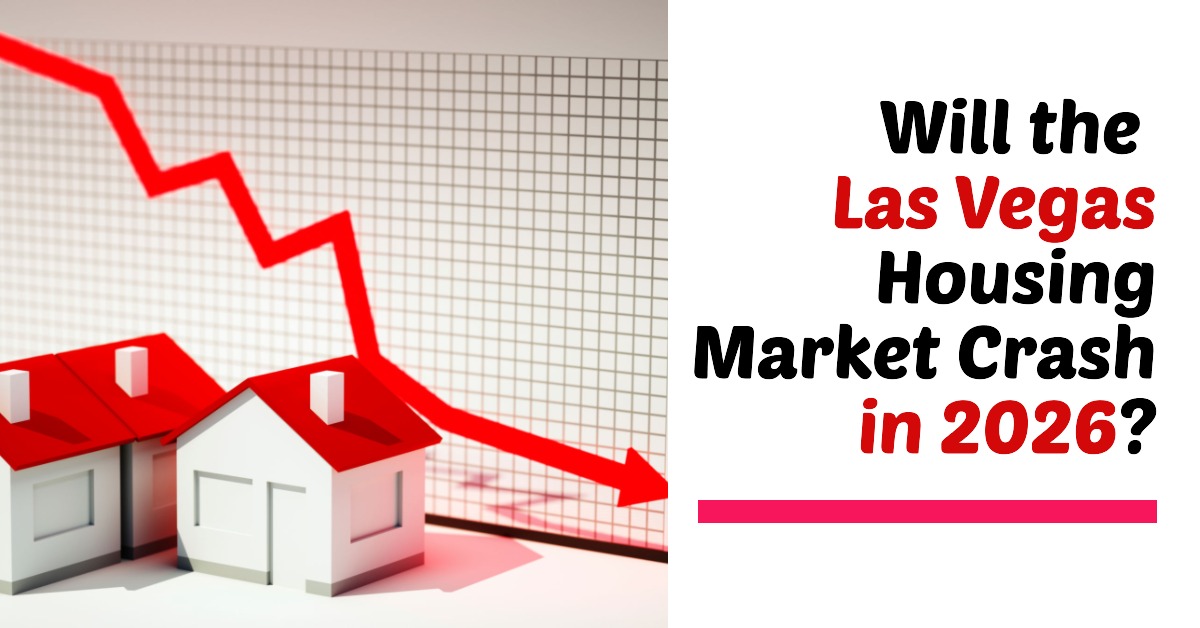
Will the Las Vegas Housing Market Crash or Cool Off in 2026?
Decoding the December Surprise: Why Prices Dropped (and Home Sales Rose)
The biggest headline from late 2025 was the unexpected drop in the median home price for single-family homes. It fell to $470,000 in December, down from a record high of $488,995 in November. That's a decrease of roughly $18,995. My initial thought? “Okay, this seems sharp, but let's see the whole picture.”
And the whole picture is fascinating! Despite the price dip, home sales actually increased. In December, 1,802 single-family homes sold, which is a healthy 17.2% jump from November. Compared to the prior year, sales were down a tiny bit (.5%), but when you look back at December 2023, we saw a significant increase (17.7%). This surge in sales volume, even with a slight price reduction, often indicates a market that's becoming more accessible to buyers.
From my perspective, this isn't a sign of weakness, but rather a healthy recalibration. Think of it like this: after a rapid climb, the market took a brief, controlled breath. Sellers might have adjusted prices slightly to ensure sales before the typically slower winter months, while buyers, perhaps sensing an opportunity, stepped in.
A Look Back: How 2025 Stacked Up
To understand where we're going, it's crucial to see where we've been. 2025 was a year of significant activity, but also one of lower overall sales volume compared to the heated years of 2020 and 2021. Approximately 28,498 existing homes sold in the Las Vegas Valley in 2025. This is a nearly 9% decrease from the 31,305 homes sold in 2024. Frankly, this is the lowest annual sales number we've seen since 2007, right before the Great Recession hit. It’s a stark reminder of how much the market has changed.
Table: Las Vegas Home Sales Volume (December)
| Year | Single-Family Homes Sold | Year-over-Year Change |
|---|---|---|
| 2025 | 1,802 | -0.5% |
| 2024 | 1,811 | +17.7% |
| 2023 | 1,518 | -0.3% |
| 2022 | 1,534 | -51.4% |
| 2021 | 3,178 | -3.8% |
| 2020 | 3,305 | N/A |
This drop in the number of homes sold isn't necessarily a bad thing for the market's health. It suggests we're moving away from the frenzy of an unsustainable boom and towards a more normalized pace of transactions.
Median Prices: A Deeper Dive
Let’s talk about those median prices. For previously owned single-family homes:
- December 2025: $470,000 (down 3.9% from November, down 1.1% from prior year)
- December 2024: $475,000
- December 2023: $449,900
- December 2022: $425,000
- December 2021: $425,000
- December 2020: $345,000
And for condos and townhomes:
- December 2025: $275,000 (down 9.5% from November, down 5.2% from prior year)
- December 2024: $290,000
- December 2023: $270,000
- December 2022: $246,940
- December 2021: $242,000
- December 2020: $186,000
The all-time high median sale price for single-family homes was set in November 2025 at $488,995. For condos and townhomes, the highest point was reached in October 2024 at $315,000. The December 2025 price of $275,000 represents a significant drop from that peak.
What does this tell me? The condo and townhome market experienced a more pronounced correction from its peak. This often happens as these segments can be more sensitive to broader economic shifts and interest rate changes. However, the single-family home market, while seeing a modest dip from its November peak, still holds value considerably higher than in previous years. The year-over-year decline of just 1.1% for single-family homes suggests resilience.
The Luxury Market: Still Shining Bright
It's important to note that not all segments of the Las Vegas market are behaving the same way. The luxury market (homes $1 million and over) is actually showing robust growth. In December, 147 luxury homes sold, an increase from 125 in November. The median sales price in this segment rose to $1,449,950 in December, up from $1,350,950 in November.
Las Vegas luxury homes have seen impressive appreciation, ranking fourth nationally for price increases since 2015. The median price for a luxury home here is now around $1.57 million, a remarkable 161% increase since 2015. This indicates a strong demand and continued investment in higher-end properties, which often acts as an economic buffer.
Inventory and Days on Market: Signs of Balance
A key indicator of market health is the supply of homes. We saw 1,889 new listings in December, down 13.5% from November but up 7.7% from the previous year. This suggests a more controlled inflow of properties, preventing an oversupply.
Crucially, the number of single-family houses sitting on the market without offers decreased to 6,396 in December from 7,033 in November. This is a 9.1% drop month-over-month, and while it's up 28.8% from the prior year (meaning more homes are available compared to Dec 2024), the decreasing trend from November to December is positive.
The inventory of homes on the market is currently 3.5 months. This is down significantly from 4.6 months in November but up from 2.5 months in December 2023. For context, 3-6 months of inventory is generally considered a balanced market. While we're currently at the lower end of that range, it's a far cry from the extreme seller's markets of recent years (like the 0.7 months of supply in December 2021).
Furthermore, homes selling quickly is a good sign. In December, 45.4% of closings were on homes that had been on the market for 30 days or less. While this is slightly less than November and the previous December, it still points to a market where desirable homes are moving.
Why Now Might Be a Great Time to Buy
Based on these trends, I believe 2026 presents a compelling opportunity for buyers, especially before the typical spring market surge. With this recent price adjustment and the increase in sales volume indicating buyer engagement, you might find yourself in a stronger negotiating position. We're seeing buyers successfully score price reductions and seller-paid closing costs, which was almost unheard of during the peak frenzy.
The market isn't crashing, but it is becoming more sensible. For those who have been waiting on the sidelines, this period of stabilization could be your window to enter the market without paying peak-season premiums.
What to Watch For in 2026
Will median prices continue to decline? It’s possible we'll see further modest adjustments, especially as we move through the winter. However, I don't anticipate a systemic crash. Several factors will influence the market:
- Interest Rates: While they've been a significant driver, any stabilization or slight decrease in interest rates would be a major boost.
- Economic Conditions: Las Vegas's economy is tied to tourism and hospitality, but also diversifying. Continued job growth is key.
- New Construction: The pace and pricing of new builds also affect the resale market.
- Affordability: As long as home prices remain relatively affordable compared to other major metros, Las Vegas will continue to attract buyers.
Distressed Properties: Not Signalling a Crisis Yet
It's always important to monitor distressed properties. In December, we saw 27 REO (Real Estate Owned) properties, 37 short sales, and 26 foreclosure commences, totaling 90 distressed properties. While this number is up from historical lows, it is still a very small fraction of the overall market activity and doesn't point towards a widespread wave of foreclosures that would trigger a market crash. This is good news; it suggests that homeowners are generally managing their finances and not facing widespread financial distress.
The Verdict: Stabilization, Not a Crash
To directly answer the question: No, the Las Vegas housing market is not projected to crash in 2026. Instead, I see a market that is transitioning into a more balanced and sustainable phase. The price corrections we’re observing are more akin to a healthy correction after rapid appreciation, supported by an increase in buyer activity and a more manageable inventory. This is a market that is maturing, offering opportunities for both buyers and sellers who understand its evolving dynamics.
In 2026, select U.S. cities are projected to see surging demand, rising rents, and appreciation—creating prime opportunities for investors seeking passive income and long‑term wealth.
Work with Norada Real Estate to find stable, cash-flowing markets beyond the bubble zones—so you can build wealth without the risks of ultra-competitive areas.
Recommended Read:
- Las Vegas Housing Market: Trends and Forecast 2026-2027
- Las Vegas Real Estate Forecast for the Next 5 Years
- Las Vegas Housing Market Predictions 2025: What to Expect
- Las Vegas Housing Market: Is It a Bubble? Is It Falling?
- Homebuyers Are Moving to Sacramento, Las Vegas, and Orlando
- Housing Market Predictions for the Next 4 Years: 2025 to 2029
- Housing Market Predictions for Next 5 Years
- Real Estate Forecast Next 5 Years: Top 5 Predictions for Future