Norada Real Estate Investments

  • Home
  • Markets
  • Properties
  • Membership
  • Podcast
  • Learn
  • About
  • Contact

Fremont Housing Market: Trends and Forecast 2024-2025

November 11, 2024 by Marco Santarelli

Fremont Housing Market

Fremont stands out as a competitive housing market within California, attracting interest due to its booming tech industry and strong economy. This translates to a high influx of aspiring residents seeking a slice of the Fremont dream. However, diving into this market requires an understanding of current trends.

Fremont is known for its steeper price tags compared to other California cities, so be prepared for a substantial investment. Let's delve into the specific trends shaping the Fremont housing landscape to give you a better understanding of the current market.

Fremont Housing Market Trends in 2024: A Deep Dive

The Fremont housing market in 2024 presents a nuanced picture, with home prices experiencing a slight dip compared to the previous year, but still remaining high. While the market isn't as intensely competitive as it was, it still leans toward a seller's market, indicating strong demand.

Home Sales

Looking at the numbers from September 2024, we see a slight decrease in home sales compared to the same period in 2023. According to Redfin, there were 121 homes sold in September 2024, which represents a -6.9% year-over-year decline from 130 homes sold last year.

This decline in sales isn't entirely surprising, given the broader economic climate and increasing interest rates. It's a natural consequence of affordability becoming a challenge for some buyers. However, it's important to note that this is a relatively small decrease, and the number of sales remains within a healthy range for Fremont. This suggests that the market is still active and continues to attract buyers despite the changes in the larger economic picture.

Home Prices

The median sale price of a home in Fremont in September 2024 was $1.488,950. This represents a slight decrease of -0.74% year-over-year. While prices are down compared to last year, it's crucial to recognize that the overall price point remains remarkably high, reflecting the premium that buyers place on Fremont's desirable location, excellent schools, and strong community.

One key factor influencing the slight dip in home prices is the increased inventory in the market. Although there's still a healthy demand for homes in Fremont, the larger pool of properties on the market allows buyers to have more choices and possibly negotiate better deals. This is a significant shift compared to previous years when the market was fiercely competitive with limited inventory.

In addition to the median sale price, it's also helpful to look at the median sale price per square foot, which was $1.02K in September 2024. This represents an increase of 13.7% since last year, indicating that the value of real estate in Fremont is still on the rise, even though the overall median price has slightly softened.

Housing Supply

The increased housing supply is one of the most notable changes in the Fremont housing market compared to the recent past. While it's still a relatively competitive market, the supply is starting to see a modest increase. This translates into a slightly longer average time for homes to sell. Homes in Fremont sold in an average of 14 days in September 2024, compared to 10 days in the same period last year. This represents an increase of 4 days and signifies a shift towards a more balanced market where buyers have a little more breathing room to make decisions and potentially negotiate.

Market Trends

The Fremont housing market trends reveal a fascinating dynamic. While we've seen a slight dip in prices and a lengthening of the time it takes for homes to sell, it's crucial to keep in mind that these shifts are happening from a position of strength. Prices are still high, and demand remains robust. The market is simply moving towards a more sustainable and balanced state, after experiencing an extraordinarily competitive period.

Other significant trends worth highlighting include:

  • Sale-to-List Price: The average home in Fremont sold for 103.4% of its listing price in September 2024, a decrease of 2.0% year-over-year. This indicates that while buyers still face a competitive market, the bidding wars that were prevalent during the height of the market are less common today.
  • Homes Sold Above List Price: Despite the slight softening, a significant portion of homes still sell above the listing price. In September 2024, 69.4% of homes sold for more than their list price, a decrease of 3.7% year-over-year.
  • Homes with Price Drops: The percentage of homes that have experienced price reductions is on the rise. 21.6% of homes had a price drop in September 2024, an increase of 3.9% year-over-year. This further emphasizes the shift toward a more balanced market where sellers need to be more strategic about their pricing.

Is It a Buyer's or Seller's Housing Market?

While the Fremont housing market is no longer as fiercely competitive as it was in previous years, it still leans towards a seller's market. However, the increased inventory and the slightly longer days on the market give buyers more leverage than they had a year ago. This is a significant shift compared to when the market was almost exclusively in favor of sellers.

Here's how I'd summarize the situation:

  • Sellers still enjoy a favorable position, but they need to be more realistic with their pricing and be prepared for a slightly longer sales cycle.
  • Buyers have more choices and can potentially negotiate better deals. They may not need to engage in aggressive bidding wars as often, but the Fremont market remains competitive, requiring buyers to be prepared to act quickly on homes that meet their needs.

Essentially, the market is transitioning from an extremely competitive seller's market to a more balanced state where buyers have a bit more influence.

Are Home Prices Dropping?

The short answer is that yes, home prices in Fremont have experienced a slight drop in 2024 compared to 2023. However, it's crucial to emphasize that this is a relatively small decrease and doesn't indicate a market crash or a dramatic shift.

Instead, I see this as a natural correction after an extended period of rapid price increases. The market is finding a new equilibrium point where prices are stabilizing, but still remain relatively high.

Here are some of my thoughts on the price situation:

  • The slight decrease in prices is a healthy adjustment to the market, bringing it closer to a sustainable level.
  • The demand for housing in Fremont remains strong, preventing a major price drop.
  • I believe that home prices in Fremont will continue to remain relatively stable in the near future, possibly experiencing slight fluctuations, but no major declines.
  • The current situation represents a good opportunity for buyers who are seeking a more balanced market, but who don't want to compromise on the quality of life and excellent schools that Fremont offers.

Migration & Relocation Trends

Fremont continues to attract people from various parts of the country, and understanding these migration patterns provides further context for the Fremont housing market.

In August to October 2024, 77% of Fremont homebuyers searched to stay within the Fremont metropolitan area, signifying strong local demand and a desire to remain within the community. This emphasizes that Fremont residents value the lifestyle and amenities the city offers.

Looking at inbound migration, Honolulu, HI, was the top source of buyers for homes in Fremont, followed by Santa Barbara, CA and Pensacola, FL. This suggests that people are attracted to Fremont's strong economy, job market, and overall quality of life.

On the other hand, Sacramento, CA was the most popular destination for those leaving Fremont, followed by Los Angeles, CA and San Diego, CA. While the reasons for moving out of Fremont vary, these destinations likely offer more affordable housing options or unique opportunities.

I believe these migration patterns confirm that Fremont remains a desirable place to live and work, but affordability concerns are prompting some residents to explore alternatives.

Climate's Impact on Fremont Housing

As with any region, climate factors can influence housing prices and decisions. Fremont is moderately susceptible to wildfires and heat but experiences minimal wind risk. Flooding is also a minor concern for a small percentage of properties.

Table 2: Climate Risk Factors in Fremont

Risk Factor % of Properties at Risk
Flood 14%
Fire 47%
Wind Minimal
Heat 80%

These factors should be considered when evaluating properties and understanding potential risks in the Fremont housing market.

In Conclusion

The Fremont housing market in 2024 reflects a transition from an exceptionally competitive seller's market to a more balanced environment. While home prices have experienced a modest dip, they remain high, and demand for housing continues to be strong.

Increased housing inventory has given buyers slightly more leverage in negotiations and extended the average time it takes for homes to sell. However, the market is still competitive, and buyers need to be prepared to act quickly on homes that meet their criteria.

Fremont Housing Market Forecast: What Can We Expect?

Well, from what I see in the data, the Fremont housing market is experiencing a slight slowdown, but it's not a crash. While the median home price in Fremont was $1.5M last month, it's down 0.74% year-over-year. This suggests that a price drop isn't necessarily imminent, but rather a natural adjustment. I think it's fair to say there's a chance of prices stabilizing or even seeing a modest decline in the next few years.

Possible Forecast for 2025 & 2026

Based on my understanding of the current data, I would anticipate the Fremont housing market to remain relatively stable in 2025 and 2026. It’s unlikely to see a major crash, but we might experience a slow and steady decline in prices, potentially at a rate similar to the current year-over-year change. This may be due to a combination of factors, including rising interest rates and a potential economic slowdown. However, as Fremont is still a desirable location due to its great schools and proximity to Silicon Valley, a sustained drop in prices may be unlikely.

I believe the market will likely experience a softer period as the market adjusts to a more balanced state. While the market is cooling down, I don't expect a crash, and it could still be a good time for buyers to make a move in Fremont with a bit more negotiating power.

Disclaimer: This is my personal opinion based on available data. As an individual and not a professional real estate advisor, my views may not reflect every aspect of the market or the future. It's important to consider several factors and consult with a qualified expert for personalized advice.

Why Are Homes Expensive in Fremont, CA?

Fremont, California, is known for its desirable location in the Bay Area, offering proximity to major tech hubs and a high quality of life. Several factors contribute to the expensive real estate market in Fremont.

1. Location and Proximity to Job Centers

The city's close proximity to major technology and business hubs such as Silicon Valley and San Francisco makes it an attractive location for professionals working in the tech industry. The demand for housing from high-income earners in these sectors drives up prices.

2. Strong Job Market

Fremont benefits from a strong job market with a concentration of well-paying jobs in the technology and manufacturing sectors. This economic stability contributes to a higher demand for housing, impacting prices.

3. Limited Housing Supply

The availability of land for new construction is limited in Fremont due to geographical constraints and land-use policies. This scarcity of land contributes to a shortage of housing units, leading to increased competition among buyers and driving up prices.

4. Desirable Community Amenities

Fremont boasts a range of community amenities such as parks, schools, and cultural attractions, making it an attractive place to live. The high demand for homes in a desirable community further intensifies the competition among buyers, pushing prices higher.

5. Strict Zoning Regulations

Zoning regulations in Fremont can be stringent, limiting the ability to build high-density housing. This contributes to the scarcity of available housing and puts upward pressure on prices.

6. Commuter-Friendly Location

Fremont's accessibility and commuter-friendly location make it an appealing choice for those working in nearby cities. The high demand from commuters contributes to the competitive housing market and elevated prices.

Understanding these factors helps shed light on why homes in Fremont, CA, come with a higher price tag. The combination of a strong job market, limited housing supply, and desirable location creates a real estate landscape where demand consistently outpaces supply.

Recommended Read:

  • 68 Housing Markets Where Prices Have Doubled the Fastest
  • Sunnyvale Home Prices: Trends and Forecast 2024-2025
  • Real Estate Forecast Next 5 Years California: Crash or Boom?
  • 24 Most Expensive Neighborhoods in California
  • When Will the Housing Market Crash Again in California?
  • California Housing Market: Trends and Forecast 2024-2025

Filed Under: Housing Market, Real Estate Market Tagged With: Fremont, Housing Market

Houston Real Estate Market Forecast 2025-2026: What to Expect

November 9, 2024 by Marco Santarelli

Houston Real Estate Market Forecast 2025: What to Expect

As we look ahead to 2025, the Houston real estate market is poised for a dynamic year. Economic fluctuations, changing demographics, and evolving consumer preferences will all play a significant role in shaping the landscape. While there are challenges to navigate, there are also promising opportunities for buyers, sellers, and investors in the Houston area.

The overall health of the Houston economy will continue to influence the housing market. Job growth, interest rates, and inflation will all play a part in determining demand and affordability.

Houston Real Estate Market Forecast 2025: What to Expect

Key Takeaways

🏠📉
Home Values Decline: Predicted decline in home values by 1.1% by mid-2025 in the Houston-The Woodlands-Sugar Land Housing Market.

💰📉
Interest Rates Impact: Mortgage rates are expected to average 5.5% by the end of 2025, inviting renewed buyer activity.

🔄🏘️
A Shift Towards Buyers: Increased choices for buyers as the market transitions from a sellers' to a buyers' market.

📈🏡
Long-Term Growth Outlook: Despite short-term dips, a renewed upward trend in home prices is forecasted post-2025.

🏢🏗️
Economic Stability: Job growth and migration trends could bolster long-term demand for housing.


Home Price Predictions for 2025

The Houston real estate market forecast for 2025 indicates a complex scenario for home prices. According to various analyses, including projections from Zillow, the home values may see a slight decrease of about -1.1% as we approach mid-2025. This forecast underscores the balancing act the market is currently engaged in—between stabilizing prices and adjusting to rising inventory and changing buyer dynamics.

Experts suggest that while the immediate future shows signs of price moderation—largely influenced by interest rates remaining high—there is a broader consensus on the resilience of the Houston market. As potential buyers become more active due to slightly lower mortgage rates and increased choices, demand could gradually buffer the anticipated decline in housing prices.

Interest Rates and Their Influence on Buying Behavior

Mortgage interest rates play a pivotal role in shaping the Houston housing market predictions. Currently, rates are pegged to hover around 6.1% by the end of 2024, with expectations to drop to approximately 5.5% by the end of 2025, according to multiple sources including the Mortgage Bankers Association.

This anticipated decline in rates is expected to restore some confidence in buyers who have been on the sidelines due to affordability concerns. Lower interest rates can significantly impact monthly payments and overall housing affordability, opening the market to a broader swath of potential homeowners.

As a result, this could lead to a resurgence in the demand for homes, even amidst a backdrop of slightly dropping prices. The changing mortgage landscape might motivate first-time buyers and those seeking to upgrade their living situations to take action—especially with increasing thought that prices are more reasonable and in line with the current market dynamics.

Market Dynamics: Shifting Toward a Buyers’ Market

The average Houston-The Woodlands-Sugar Land home value is $311,325, up 1.0% over the past year, and goes to pending in around 24 days. The data also indicates a significant shift from a sellers' market to one that is increasingly favorable for buyers.

Current trends show a considerable degree of price negotiation, with 59.2% of homes selling for less than the listing price. This pattern suggests that sellers are beginning to adjust their expectations in light of shifting market dynamics.

Such a transition often occurs in markets that experience a swell of inventory, and Houston appears poised for this change. With greater choices available on the market and buyers willing to wait for favorable terms, we may see a decrease in bidding wars that characterized the previous sellers' market phase. The housing stock is expected to normalize, providing relief to buyers who have previously felt pressured in a competitive landscape.

1-year Market Forecast (July 2024 to July 2025):
-1.1%

For Sale Inventory: 28,304

New Listings: 7,998

Median Sale Price: $344,067

Median List Price: $365,963

Median Days to Pending: 24

Sales Over List Price: 19.5%

Sales Under List Price: 59.2%

Source: Zillow. Data as of July 31, 2024 (For Sale Inventory, New Listings, Median List Price, Median Days to Pending)

Data as of June 30, 2024 (Median Sale Price, Sales Over/Under List Price)


Long-Term Growth and Economic Stability

Despite the projected short-term declines, many analysts maintain that the longer-term outlook for the Houston real estate market remains bright. As the local economy continues to flourish—fueled by growth in sectors like technology, healthcare, and energy—Houston will likely maintain its appeal, driving demand for housing.

The consistent influx of new residents seeking opportunities in Houston strengthens the underlying demand for homes, indicating resilience amidst cyclical fluctuations.

Moreover, given Houston's diverse economy and its significant role in the national economic framework, the city's housing market is well-positioned to rebound strongly following any temporary downturns. This aspect is crucial for investors to consider—investments made with a longer timeline typically weather short-term market volatility.

Conclusion: The Path Ahead for Houston's Real Estate Market

In summary, the Houston real estate market forecast suggests a transitional phase characterized by challenges and newfound opportunities. While prices may face a slight dip initially due to changing interest rates and shifting market conditions, the city's economic fundamentals show promise for long-term growth.

Buyers entering the market will find more favorable conditions compared to previous years, driving activity and potentially stabilizing prices toward the latter half of 2025. As the complexities of the Houston housing market continue to unfold, stakeholders should remain informed about evolving economic indicators, demographic trends, and regional developments.

The balanced outlook encompasses caution and optimism, making it essential for agents, buyers, and sellers alike to stay updated about future developments in this vibrant Texas market.

Recommended Read:

  • Houston Turnkey Investment Properties for Sale
  • Houston Housing Market: Prices, Trends, Forecast 2024-2025
  • Houston Real Estate Investment: Should You Invest in Houston?
  • Housing Market Trends: Big Investors Buy in Houston, Atlanta, Dallas, Charlotte
  • Best Houston Neighborhoods To Buy Investment Properties
  • 17 Facts That Make Houston the Best City in America
  • Texas Housing Market: Prices, Trends, Predictions 2024-2025

Filed Under: Growth Markets, Housing Market, Real Estate Investments Tagged With: Housing Market, Houston

Housing Market Predictions for 2025 if “Trump” Wins Election

November 9, 2024 by Marco Santarelli

Housing Market Predictions for a Second Trump Presidency

Will a Trump victory reshape the 2025 housing market? As speculation swirls about the potential for a second term for Donald Trump in the 2024 presidential election, one of the most crucial sectors observing these developments is the housing market. For Millennials and the emerging Generation Z, who are on the brink of homeownership, understanding the implications of a Trump administration is vital.

Housing Market Predictions for 2025 if “Trump” Wins Election

The housing market is a really complicated thing, affected by lots of stuff like the government's rules about money, interest rates on loans, how many houses are for sale compared to how many people want to buy them, and even what's going on in the country in general. If Trump wins again, things in the housing market could change a lot. This would affect how easy it is for younger people to buy a house and how much houses cost.

Economic Policies and Their Impact on Housing

Trump's potential economic growth strategy may prioritize classic approaches, such as deregulation and tax cuts, aimed at stimulating the economy. These policies could lead to increased investments in housing development, ultimately boosting the supply of new homes. For potential buyers, this could initially signal a decrease in housing prices. However, if demand remains robust and outpaces supply, the long-term effect could see escalating home prices, making homeownership even more elusive for Millennials and Gen Z.

Housing Affordability: A Generation’s Challenge

One of the most pressing concerns for Millennials and Gen Z is housing affordability. Many are currently grappling with the challenge of saving for down payments due to a widening wealth gap. Changes to tax policy, especially those stemming from the Tax Cuts and Jobs Act, may significantly impact homeownership decisions. For example, any reconsideration of the cap on mortgage interest deductions could alter the financial landscape for potential buyers and influence their purchasing power.

Deregulation and Lending Practices

An element of Trump’s agenda could include further deregulation of the housing market, leading to softer lending standards. While this might reduce mortgage costs and boost demand, it poses a risk reminiscent of the lax borrowing standards that contributed to the 2008 financial crisis. Striking a balance between stimulating the market and ensuring responsible lending practices will be crucial for sustainable growth.

Recommended Read:

How the Housing Market Fared During Donald Trump’s Previous Term? 

The Federal Reserve’s Influence

The Federal Reserve plays a pivotal role in determining interest rates, which directly impacts mortgage rates and housing affordability. If Trump’s policies lead to a reduction in interest rates, potential homebuyers could benefit in the short term, making homeownership more accessible. However, sustained low rates could also lead to an overheated housing market, potentially resulting in another bubble.

The Generational Divide in Homeownership

As Millennials venture further into their home buying journeys, the market dynamics present unique challenges for Generation Z. Unlike Millennials, who are experiencing historically low mortgage rates, Gen Z faces limited supply and escalating prices, complicating their entry into the housing market. This generational divide adds another layer of complexity to the future of homeownership.

Potential Future Trends

  1. Increased Construction: If Trump prioritizes deregulation, it may lead to an uptick in new housing projects, particularly in urban areas where supply is notably low. This could favor both generations looking for affordable housing options.
  2. Investment Opportunities: With tax policies potentially favoring real estate investments, Millennials and Gen Z may find new opportunities for investment in rental properties or real estate funds, diversifying their financial portfolios.
  3. Remote Work and Housing Preferences: As remote work becomes more entrenched, younger buyers may seek homes in suburban or rural areas where prices are lower, further influencing market trends.
  4. Green Housing Initiatives: Should environmental concerns become a focus under a potential Trump administration, we might see increased investment in sustainable building practices, appealing to younger generations concerned about climate change.

Preparing for Various Scenarios

With the stakes high heading into the 2024 election, the potential implications of a Trump presidency on housing cannot be overstated. For Millennials and Gen Z, staying informed and prepared for various scenarios is essential to navigate the unpredictable nature of the market. Understanding the potential effects of economic policies, interest rates, and lending practices will empower them to make informed buying decisions.

Okay, so the next presidential election is a big deal for young people, especially Millennials and Gen Z, when it comes to buying a house. How things go in the election could really change the housing market. Since buying a home is already tough for these groups, it's super important to be informed about what might happen.

Frequently Asked Questions (FAQs)

1. How does a Trump presidency affect housing prices?

A Trump administration could influence housing prices through policies that affect economic growth and interest rates. For example, deregulation and tax cuts could stimulate housing supply initially, but if demand continues to rise, prices may increase in the long term.

2. What should first-time home buyers consider under potential Trump policies?

First-time home buyers should monitor changes in interest rates, lending standards, and any tax reforms that could affect their purchasing power. Understanding how these factors interplay will be crucial for making informed decisions.

3. Are Millennials at a disadvantage in the housing market?

Yes, Millennials face increased challenges such as rising home prices, a higher cost of living, and student loan debt that may hinder their ability to save for down payments compared to prior generations.

4. What impact could deregulation have on the housing market?

Deregulation could lower lending standards, making it easier for new buyers to obtain mortgages. However, this approach carries risks, including the possibility of creating another housing bubble if lending becomes too lenient.

5. How can Gen Z adapt to the current housing market?

Gen Z can explore alternative paths to homeownership, such as co-buying properties with friends, investing in real estate crowdfunding, or renting in areas where they can save more money to eventually purchase a home.

6. What trends should we expect in the housing market if Trump is re-elected?

If Trump is re-elected, we may see increased construction in urban and suburban areas, potential investment incentives for younger buyers, and a focus on affordable housing initiatives, depending on the administration's priorities.

Recommended Read:

  • Housing Market Predictions for Next Year: Prices to Rise by 4.4%
  • Housing Market Forecast for the Next 2 Years: 2024-2026
  • Housing Market Predictions for Next 5 Years (2024-2028)
  • Housing Market Predictions: 8 of Next 10 Years Poised for Gains
  • Housing Market Predictions: Top 5 Most Priciest Markets of 2024
  • Real Estate Forecast Next 5 Years: Top 5 Future Predictions
  • Housing Market Predictions for 2027: Experts Differ on Forecast

Filed Under: Housing Market, Real Estate Market Tagged With: Home Price Forecast, Housing Market, Housing Market Forecast, housing market predictions, Housing Market Trends

Will Donald Trump’s Victory Reshape the Housing Market in 2025?

November 9, 2024 by Marco Santarelli

Bold Predictions for the Housing Market If Trump Wins the 2024 Election

An article published at GoBankingRates delved into potential shifts in the housing market if former President Donald Trump secures a second term. With significant changes since his first term, particularly in interest rates and economic policies, Trump's return could bring notable impacts to the housing sector. Here's an in-depth look at what we might expect.

Will Donald Trump's Victory Reshape the Housing Market in 2025?

Here are 6 predictions for the housing market if Trump wins again:

Potentially Lower Interest Rates

The Federal Reserve has raised interest rates in recent years to combat inflation, leading to higher mortgage rates. Under a Trump administration, fiscal policies could aim to support economic growth, potentially pressuring the Federal Reserve to keep interest rates low. During his first term, Trump favored lower rates to boost the economy. However, interest rates also depend on broader economic conditions and the Federal Reserve’s independent decisions. While Trump might push for lower rates, achieving them isn't guaranteed.

Lower interest rates could make mortgages more affordable, stimulating the housing market by enabling more people to buy homes. This could lead to a surge in home sales, benefiting both buyers and sellers. Homeowners with variable-rate mortgages might also see reduced payments, improving their financial stability and potentially increasing consumer spending in other areas. However, there's a delicate balance, as too much pressure on the Federal Reserve might undermine its independence, leading to unintended economic consequences.

Recommended Read:

Housing Market Predictions for 2025 if “Trump” Wins Election 

Less Regulation: A Double-Edged Sword

Trump's stance against “excessive” government regulations could result in more relaxed lending standards and potentially lower mortgage costs, increasing housing demand. Dennis Shirshikov, head of growth at GoSummer.com, noted that Trump's administration historically favored deregulation, easing restrictions on construction and development. This could lead to a rise in housing supply, especially in suburban and rural areas, as builders face fewer regulatory hurdles. However, excessive deregulation risks approving loans that borrowers cannot afford, reminiscent of the 2008 financial crisis.

Relaxed regulations might encourage more developers to enter the market, leading to increased competition and potentially lower home prices. This could be particularly beneficial in high-demand areas where housing affordability is a significant issue. On the flip side, too much deregulation could result in lower-quality construction and financial instability, as seen in the past. Homebuyers might face higher risks of purchasing properties that don't meet safety or quality standards, leading to long-term issues for the housing market.

Tax Policy Changes

During his first term, Trump worked with Congress to pass the Tax Cuts and Jobs Act, introducing significant changes to the tax code. Some key provisions are set to expire in 2025, and Trump plans to make some permanent if reelected. These tax changes could affect the real estate market, including interest deduction caps on mortgages and capital gains tax modifications. Amanda Orsen, founder and CEO of Galleon, highlighted that Trump’s pro-business approach might lead to more single-family homes being purchased by investors rather than individuals.

Recommended Read:

Trump vs Harris Predictions: Housing Market Post Election 

Tax policy changes could have far-reaching effects on the housing market. For example, making mortgage interest deductions permanent could encourage more people to buy homes, increasing demand and driving up prices. Conversely, changes to capital gains taxes might discourage property flipping, potentially stabilizing some housing markets. Investors might find the market more attractive, leading to a higher proportion of rental properties, which could impact homeownership rates and community dynamics.

Trade Policies and Housing Prices

Trump's previous trade policies, particularly the trade war with China, could resurface in a second term. Renewed tariffs and trade negotiations might increase the cost of home construction materials, making new builds and renovations more expensive or causing delays. These broader economic effects indirectly impact the housing market, influencing housing prices and availability.

Higher construction costs could lead to a slowdown in new home developments, exacerbating the housing shortage in many areas. Homebuilders might pass these costs onto buyers, resulting in higher home prices and reduced affordability. Additionally, supply chain disruptions from trade conflicts could delay construction projects, affecting timelines and market dynamics. On the other hand, a focus on domestic manufacturing could eventually stabilize prices and reduce dependency on foreign materials, but this would take time and significant investment.

Infrastructure and Development

Trump's campaign promises included extensive infrastructure projects, such as rebuilding highways, bridges, tunnels, airports, schools, and hospitals. If these projects come to fruition, they could increase housing supply, boost property values, and attract buyers and investors to revitalized areas. The focus on infrastructure could stimulate economic activity and enhance the overall housing market.

Improved infrastructure can make previously less desirable areas more attractive, leading to increased development and higher property values. Enhanced transportation networks could shorten commute times, making suburban and rural areas more viable for homebuyers. This could alleviate some pressure on urban housing markets and distribute demand more evenly across regions. Moreover, infrastructure investments could create jobs and boost local economies, further supporting housing market growth.

Affordable Housing Challenges

According to Freddie Mac, the U.S. housing shortage increased by 52% from 2018 to 2020, reaching a shortfall of 3.8 million units. Trump's previous policies emphasized existing homeowners but did not focus on creating or preserving affordable housing. A second term might see the affordable housing shortfall continue to widen, posing challenges for low- and middle-income families seeking homeownership.

The lack of affordable housing could lead to increased homelessness and housing instability, particularly in high-cost urban areas. Renters might face rising rents, making it harder to save for home purchases. Policymakers and developers would need to collaborate on solutions to address the affordability crisis, such as incentives for affordable housing construction and policies to protect existing affordable units. Without a focused effort on affordability, the housing market could become increasingly inaccessible to many Americans.

Other Influential Factors

Several factors beyond the president’s control could affect the housing market. For instance, changes in the unemployment rate or geopolitical events could have significant impacts. Higher unemployment might drive the Fed to cut interest rates to stimulate the economy, potentially lowering mortgage rates. Conversely, lower unemployment could lead to rising housing prices, with existing homeowners less motivated to sell and new buyers facing limited inventory. Additionally, foreign conflicts could disrupt the trade of materials necessary for home construction and renovation.

Economic stability and consumer confidence play crucial roles in the housing market. If the economy performs well under Trump, with low unemployment and steady growth, housing demand could rise, pushing prices higher. However, economic downturns or geopolitical instability could reduce demand, lower prices, and increase foreclosures. The housing market's resilience will depend on broader economic policies and global events, requiring vigilance from stakeholders.

Conclusion

A second term for Donald Trump could bring various changes to the housing market, including potentially lower interest rates, less regulation, and tax policies favoring property owners and investors. However, it could also introduce risks like deregulation, increased construction costs due to trade tariffs, and a continued affordable housing shortfall. The housing market's future under a Trump presidency would be shaped by a complex interplay of policies and economic conditions, requiring close attention from potential homeowners, investors, and industry experts.

Partner with Norada, Your Trusted Source for Turnkey Investment Properties

Discover high-quality, ready-to-rent properties designed to deliver consistent returns. Contact us today to expand your real estate portfolio with confidence.

Reach out to our investment counselors:

(949) 218-6668 | (800) 611-3060

Contact Us Today

Ultimately, while some of Trump's proposed policies might stimulate certain aspects of the housing market, they could also introduce new challenges. Stakeholders must stay informed and prepared to navigate these potential changes, balancing opportunities and risks to ensure a stable and prosperous housing market.

Recommended Read:

  • Housing Market Forecast for the Next 2 Years: 2024-2026
  • How the Housing Market Fared During Donald Trump's Presidency?
  • Trump Claims Explosive Housing Crisis Under Biden: Is It Exaggeration?
  • Donald Trump Warns US Fed Chair to Hold Off Rate Cuts Before Election
  • Housing Market Predictions for Next 5 Years (2024-2028)
  • Housing Market Predictions for the Next 2 Years
  • Housing Market Predictions: 8 of Next 10 Years Poised for Gains
  • Housing Market Predictions: Top 5 Most Priciest Markets of 2024
  • Real Estate Forecast Next 5 Years: Top 5 Future Predictions
  • Housing Market Predictions for 2027: Experts Differ on Forecast

Filed Under: Housing Market, Real Estate Market Tagged With: Housing Market, Housing Market Forecast, housing market predictions, Housing Market Trends

Trump vs Harris: Housing Market Predictions Post-Election

November 9, 2024 by Marco Santarelli

Trump vs Harris: Which Candidate Holds the Key to the Housing Market (Prediction)

When contemplating the upcoming presidential election, many Americans are keen to understand Trump vs Harris: who is better for the housing market? As the candidates jockey for votes, many factors will influence this sector—perhaps more than just party affiliation or personal ideology.

The race is not just about who occupies the White House; it's about how their policies will impact the real estate landscape, affecting millions of homeowners and potential buyers.

The housing market has long been a key indicator of economic stability and growth, and both candidates present distinct approaches that could shape its future. Let's dive into the specifics of their policies and their potential effects on the housing market.

Trump vs Harris: Housing Market Predictions Post-Election

Economic Climate and Election Dynamics

Election years often bring a level of uncertainty to markets, including the housing market. This year's presidential election has already thrown some surprises, and while major shifts in economic policy may not be imminent, it's essential to understand how the candidates' strategies align with current macroeconomic trends. Historical data suggests that election years can influence market transactions and real estate prices, generally showing a neutral to positive impact on home values due to increased buyer activity as people rush to purchase homes before potential changes in policies.

  • Increased Activity: According to a report from Bankrate, home prices have, on average, climbed 4.84% during election years since 1987, compared to lower growth in non-election years.
  • Market Patterns: Other studies by Keeping Current Matters suggest that electorates are often hesitant to make major purchasing decisions in the months leading up to an election, but this uncertainty often gives way to renewed activity post-election.

Housing Policies: Harris vs Trump

Harris's Policies

  • Focus on increasing affordable housing supply
  • Expand initiatives to lower urban rental prices
  • Shift to developing new housing units

Trump's Priorities

  • Deregulation of housing development
  • Privatization of government-sponsored enterprises
  • Traditional economic incentives (e.g., tax cuts)

Harris's Housing Policies

Vice President Kamala Harris represents a continuation of Biden administration policies, which focus significantly on the supply of affordable housing.

  • Focus on Affordability: Harris is likely to expand initiatives aimed at increasing the availability of affordable housing, which can notably improve rental affordability. As the demand for housing continues to outstrip supply, her policies may help stabilize and even lower rental prices in urban areas where affordability remains a significant issue.
  • Shift Towards Supply-Focused Policies: Harris's approach aims to pivot from demand-focused efforts—such as buyer tax credits—to developing new housing units. This shift can lead to increased availability, addressing long-standing shortages that plague many regions.

According to insights from HousingWire, this strategy is crucial in sustaining the housing market, especially in the face of inflationary pressures.

Trump's Housing Priorities

In contrast, Donald Trump plans to redirect focus towards deregulation and the privatization of government-sponsored enterprises (GSEs), which may significantly alter the housing market.

  • Deregulation Benefits: Trump's policies would likely aim to streamline regulations around market-rate housing development, allowing for quicker project approvals and reduced costs. This approach is intended to stimulate the housing market by promoting new construction ventures.
  • Privatization of GSEs: Renewed efforts to privatize Fannie Mae and Freddie Mac could reshape the mortgage landscape. By reducing government intervention, homeownership may become more accessible through private sector innovations, but this could lead to increased risks for consumers if not managed properly.

According to reports from US News, Trump's proposals revolve around more traditional economic incentives like tax cuts, which he argues will enhance job creation and consumer purchasing power.

Key Differences in Tax Policies

While both candidates acknowledge the need for additional housing supply, they diverge significantly regarding tax policies.

  • Trump's Position: The Republican Party platform aims to make the 2017 Tax Cuts permanent, which favors wealthier individuals and corporations. The rationale is that lowering taxes can lead to increased investment and consumption. Some economists argue that this may inadvertently lead to market volatility, as wealthier individuals may drive housing prices up in more desirable neighborhoods.
  • Harris's Perspective: The Democratic Party seeks a more balanced approach, focusing on reversing tax cuts for the wealthiest Americans to fund social programs that promote housing and economic stability. This strategy, while potentially unpopular among high-income earners, seeks to create a more equitable housing market.

Market Predictions Based on Candidate Policies

The potential impact of each candidate's policies on the housing market can lead to varying predictions about future conditions:

  1. If Harris Wins:
    • Increased Affordable Housing: With a focus on construction, Harris's policies could lead to expanded affordable housing options, reducing competition for lower-income renters.
    • Stabilized Home Prices: As more housing stock becomes available, home prices may stabilize, benefiting first-time buyers.
  2. If Trump Wins:
    • Potential for Rapid Price Growth: Trump's policies could lead to increased demand for existing homes, driving prices higher, particularly in areas with limited housing supply.
    • Investment Opportunities: Deregulation may encourage a surge in new constructions, but if unchecked, could also exacerbate housing supply issues in certain markets.

Conclusion

As the campaigns heat up, the implications of Trump vs Harris regarding the housing market are evident. Each candidate's approach could define the economic environment for years to come, impacting everything from home prices to rental affordability. While both parties recognize the critical need for increased housing supply, their methods for achieving this are fundamentally different.

For potential homeowners and investors, understanding these dynamics will be crucial in making informed decisions leading up to and following the election. The housing market may continue to face challenges, but the outcomes of this election will significantly shape its future trajectory.

Recommended Read:

  • 2008 Forecaster Warns: Housing Market 2024 Needs This to Survive
  • Housing Market Predictions for the Next 2 Years
  • Housing Market Predictions for Next 5 Years (2024-2028)
  • Housing Market Predictions 2024: Will Real Estate Crash?
  • Housing Market Predictions: 8 of Next 10 Years Poised for Gains
  • Don't Panic Sell: Here's What Current Housing Market Trends Predict
  • 2024 Housing Market vs. 2008 Crash: Key Differences
  • Economist Predicts Stock Market Crash Worse Than 2008 Crisis
  • How Much Did Housing Prices Drop in 2008?

Filed Under: Housing Market, Real Estate Market Tagged With: Housing Market, housing market predictions, Trump vs Harris, Trump vs Harris Predictions

San Francisco Housing Prices Graph

November 8, 2024 by Marco Santarelli

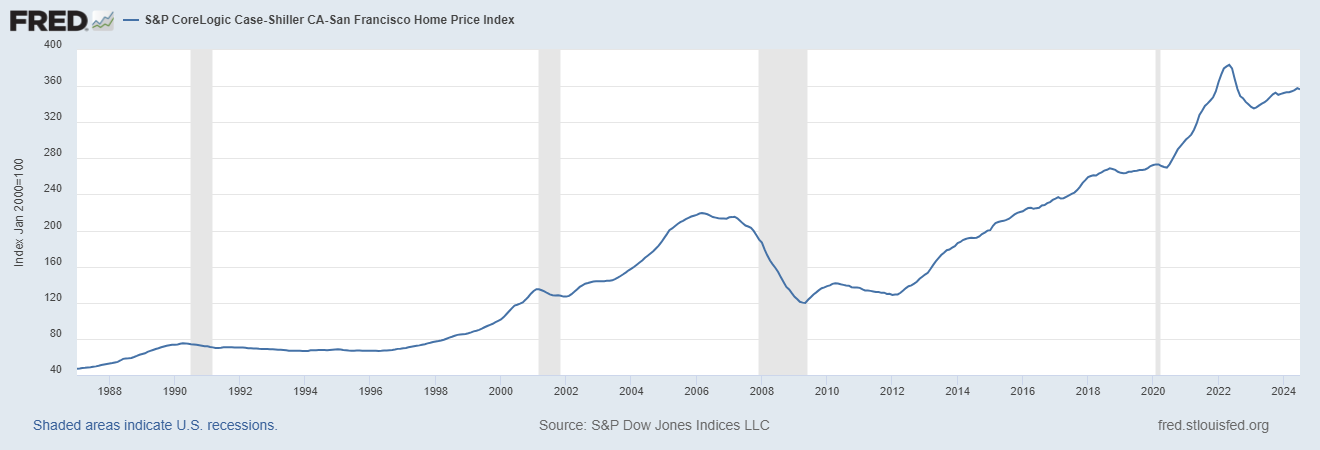
San Francisco Housing Prices Graph

Want to know the real story behind San Francisco housing prices? Let's dive into the data and explore the ups and downs of this famously expensive market. The San Francisco housing prices graph reveals a complex picture, far more than just soaring costs.

San Francisco Housing Prices Graph

San Francisco Housing Prices Graph
Source: FRED

San Francisco's housing market is notoriously challenging. Limited space, high demand, and strict building regulations all contribute to the high prices. This isn't just about buying a home; it impacts renters too, creating a constant struggle for affordable living.

The data we'll be looking at comes from the S&P CoreLogic Case-Shiller CA-San Francisco Home Price Index, a reputable source tracking home price changes over time. It's essential to use trustworthy data to understand this complex situation.

The S&P CoreLogic Case-Shiller Index

The S&P CoreLogic Case-Shiller Index gives us a clear picture of how San Francisco housing prices have changed since 1987. The index uses January 2000 as a base of 100, so you can easily see the percentage increase or decrease from that point. The data is seasonally adjusted, meaning it removes normal seasonal fluctuations (like higher sales in the spring) to give us a clearer trend.

I've personally analyzed this data for years. Trust me, if you want to buy or sell a home here, you really need to get a handle on what all those numbers mean. It's not enough to just see the numbers; you gotta understand what they're actually telling you.

Key Periods in the San Francisco Housing Prices Graph

Let's break down some significant periods reflected in the San Francisco housing prices graph:

  • The 1980s and 1990s: A period of relatively stable, steady growth. While San Francisco housing prices were already high, the increases weren't as dramatic as what we would later see.
  • The Dot-Com Boom (Late 1990s – Early 2000s): The tech industry's explosive growth dramatically boosted San Francisco housing prices. This era saw a significant upward swing in the index, reflecting the influx of wealthy tech workers.
  • The Housing Bubble and Bust (2000s): Like many areas, San Francisco experienced a housing bubble, leading to extreme price increases followed by a sharp correction during the 2008 financial crisis. The index shows a noticeable decline during this period. Many lost significant amounts in their homes.
  • The Post-Recession Recovery and Beyond (2010s – Present): Following the crash, San Francisco housing prices rebounded strongly. The tech boom continued, and the limited housing supply kept driving prices upwards. The last decade displays continued growth, although at a slower pace than the peak years.

Data Table: S&P CoreLogic Case-Shiller CA-San Francisco Home Price Index (Selected Years)

Year Index Value (Jan 2000 = 100)
1987 46.96
1997 69.64
2000 101.45
2007 214.62
2008 186.63
2012 128.64
2017 235.26
2022 364.61
2023 336.92
2024 356.29

(Note: This table shows selected years for brevity. The full dataset contains monthly values from 1987 to 2024.)

Factors Influencing the San Francisco Housing Prices

Many factors play a crucial role in shaping the San Francisco housing prices:

  • Limited Housing Supply: San Francisco has a geographically constrained area, which limits the potential for new construction. Strict zoning laws and lengthy permitting processes further restrict building.
  • High Demand: The city's desirability as a place to live and work contributes to sustained high demand for housing. This demand comes from both local residents and those relocating from other areas.
  • Economic Growth: The city's strong economy, particularly its tech industry, significantly impacts housing affordability. High-paying jobs attract people who can afford to pay high prices.
  • Interest Rates: Interest rates influence how many people can afford to buy a home. Low interest rates tend to drive prices up. High interest rates can reduce demand and moderate price increases.
  • Government Regulations: Local regulations on development and housing construction play a significant part in shaping the housing market. Regulations intended to preserve the city's character may make it difficult to increase supply.

Personal Observations

Based on years of following the San Francisco housing market, I can offer a personal perspective. While the recent slight dip might seem like a significant change, it’s crucial to keep the bigger picture in mind. San Francisco housing prices are still significantly higher than they were a decade ago.

We can see the influence of economic cycles in the data, with periods of rapid growth followed by corrections. However, the underlying factors—limited supply and high demand—continue to exert upward pressure on prices. My expectation is that despite fluctuations, we'll see continued pressure for price increases in the longer term unless significant changes occur in the city’s planning and development policies.

The Future of the San Francisco Housing Prices

Predicting the future of San Francisco housing prices is a challenging task, even for seasoned professionals like myself. The city faces complex issues that will continue to impact the market. While the current level of price growth is likely to slow down in the coming years unless building regulations are relaxed and more housing is built, there will still be a high demand for real estate, so prices will likely stay very high.

Related Articles:

  • House Price Graph Last 20 Years USA
  • Housing Market Graph 50 Years: Showing Price Growth
  • San Diego Housing Market Graph 50 Years: Analysis and Trends
  • California Housing Market Graph 50 Years
  • Average Housing Prices by Year in the United States
  • Average Home Value Increase Per Year, 5 Years, 10 Years
  • How Much Did Housing Prices Drop in 2008?
  • Housing Market Crash 2008 Explained: Causes and Effects

Filed Under: Housing Market Tagged With: Housing Market, Housing Market Graph, Housing Prices Graph, San Francisco Housing Prices Graph

87% of Metros in America Posted Home Price Gains in Q3 2024

November 8, 2024 by Marco Santarelli

87% of Metros in America Posted Home Price Gains in Q3 2024

In an impressive display of resilience, the housing market has shown significant growth as 87% of metros posted home price gains in Q3 2024, according to a recent report by the National Association of REALTORS® (NAR).

This increase reflects a larger trend where existing-home prices have risen by 3.1% compared to last year, despite the challenges posed by fluctuating mortgage rates. Now, let's delve into the key details of the NAR's report to understand this phenomenon and what it means for potential home buyers and the overall real estate market.

87% of Metros in America Posted Home Price Gains in Q3 2024

Key Takeaways:

  • Home Price Growth: 87% of metro areas saw increased home prices.
  • National Median Home Price: The median price for single-family existing homes is $418,700.
  • Interest Rates: The average 30-year fixed mortgage rate ranged between 6.08% and 6.95%, slightly decreased from previous quarters.
  • Market Trends: The percentage of metros seeing price gains decreased from 89% in the previous quarter.

The NAR Quarterly Report indicates that 196 out of the 226 metro areas tracked experienced growth in home prices during the third quarter of 2024. It's notable that the national median existing-home price has reached $418,700. This price reflects a healthy market trend, where buyers have been actively seeking homes despite facing increased borrowing costs.

This upward trend in home prices, although slightly tempered from previous quarters, is a crucial indicator of economic health and consumer confidence. Many factors contribute to the ongoing growth of the housing market. Even as mortgage interest rates have fluctuated, the current range of 6.08% to 6.95% on 30-year fixed mortgages appears to have sustained buyer activity.

Recommended Read:

Housing Market: Homeowner’s Wealth Jumps $150,000 in 5 Years 

Impact of Mortgage Rates on Home Sales

Mortgage rates are a significant factor in the real estate market. A decline in these rates typically becomes a green light for potential home buyers. The sustained decrease in July and August likely encouraged buyers who had been hesitant due to steep borrowing costs. The NAR's report confirms that lower mortgage rates play a critical role in stimulating demand, thereby contributing to higher home prices in many metropolitan areas.

As the 30-year fixed-rate mortgage remains a primary choice for borrowers, even a minor decrease in interest rates can expand affordability. Buyers can often stretch their budgets further when mortgage payments are manageable.

Metropolitan Areas Lead the Charge

Though the report highlights an impressive percentage of metros with home price gains, a closer look reveals some interesting dynamics. For instance, while 87% is a strong number, it does reflect a slight dip from the 89% reported in the previous quarter. This shift indicates a gradually cooling market, but it shouldn't overshadow the fact that the majority of locations are still seeing price increases.

Some metropolitan areas even achieved notable price jumps exceeding 10%, while others experienced marginal increases or stagnant prices. This variance showcases the diversity of the housing market across the nation – what’s happening in one city might be drastically different in another.

Regional Variations and Market Insights

Breaking down the performance by region adds more depth to the overall outlook. For example, areas with strong economic growth or job opportunities are typically seeing the most robust price gains. Cities that are experiencing population growth due to new businesses or industries blooming tend to attract home buyers, pushing prices higher.

Conversely, areas facing economic difficulties or population declines may not see the same benefits. The NAR Quarterly Report emphasizes that while many metros are thriving, the impacts of local job markets, population density, and accessibility to amenities cannot be understated.

Investors and buyers need to be well-informed about local conditions when making decisions in this dynamic market. Those who keep a finger on the pulse of their local real estate sectors are better positioned to make strategic choices.

The Role of Buyer Sentiment and Demand

Consumer confidence plays a pivotal role in the real estate landscape. Even amidst rising prices, many consumers remain optimistic about the housing market's potential. Increased demand in a tight supply environment often leads to bidding wars, which can escalate home prices even further. Additionally, the desire for homeownership continues to motivate many individuals, which in turn fuels competition for available properties.

While the data might suggest that some areas are cooling off, the overall sentiment indicates a robust willingness among buyers to pursue new home purchases. This eagerness is reflective of broader economic conditions, such as low unemployment rates and rising wages, which bolster the confidence needed to make significant financial commitments like home buying.

Recommended Read:

Housing Market: Homeowner’s Wealth Jumps $150,000 in 5 Years 

Conclusion: What This Means for the Future of Real Estate

The NAR Quarterly Report shows that the housing market is generally doing well, but it also reminds us that things can change quickly. Keeping up with what's happening and understanding the details of your local housing market will be really important for both buyers and sellers. Future trends will probably be influenced by how affordable homes are, where people want to live, and the overall economy.

Looking at the housing market right now, it's clear that real estate is a big part of our economy. It affects not only buyers and sellers but also the economy of local communities. The data suggests good things for people selling homes, but buyers will need to be smart and plan carefully in this competitive market.

Also Read:

  • Housing Market Forecast for the Next 2 Years: 2024-2026
  • Housing Market Predictions for Next Year: Prices to Rise by 4.4%
  • Housing Market Predictions for the Next 4 Years: 2024 to 2028
  • Real Estate Forecast Next 5 Years: Top 5 Predictions for Future
  • Real Estate Market Predictions 2025: What to Expect
  • Is the Housing Market on the Brink in 2024: Crash or Boom?
  • 2008 Forecaster Warns: Housing Market 2024 Needs This to Survive
  • Housing Market Predictions for the Next 2 Years
  • Real Estate Forecast Next 10 Years: Will Prices Skyrocket?
  • Housing Market Predictions for Next 5 Years (2024-2028)
  • Housing Market Predictions 2024: Will Real Estate Crash?
  • Trump vs Harris: Which Candidate Holds the Key to the Housing Market (Prediction)

Filed Under: Housing Market, Real Estate Market Tagged With: Home Price Forecast, Housing Market, housing market predictions, Housing Market Trends, Real Estate Market Predictions

3 Florida Housing Markets Are Again on the Brink of a Crash

November 6, 2024 by Marco Santarelli

3 Florida Housing Markets Are Again on the Brink of a Crash

As the U.S. housing market continues its precarious dance with economic forces, Florida finds itself at the epicenter of a potential real estate upheaval. Recent data from CoreLogic's Market Risk Indicator (MRI) has shed light on an alarming trend: three major Florida metropolitan areas are at a very high risk of experiencing significant home price declines over the next 12 months. This article explores the factors contributing to this looming crisis and what it means for homeowners, buyers, and investors in these vulnerable markets.

3 Florida Housing Markets on the Brink of a Crash

  1. Gainesville, FL
  2. Palm Bay-Melbourne-Titusville, FL
  3. Lakeland-Winter Haven, FL

These three metropolitan areas have been identified as having a “very high” risk of price decline, with a probability exceeding 70%. Let's examine each market in detail:

1. Gainesville: The Educational Hub on Shaky Ground

Gainesville, home to the University of Florida, has long been considered a stable real estate market due to its consistent influx of students and faculty. However, it now sits atop the list of markets at risk of price decline. Several factors contribute to this precarious position:

  • Overreliance on the student housing market
  • Potential shifts in remote learning affecting local demand
  • Overvaluation of properties in recent years

The combination of these factors has created a perfect storm for Gainesville's housing market, making it vulnerable to a significant correction.

2. Palm Bay-Melbourne-Titusville: Space Coast's Economic Uncertainty

Known as the Space Coast due to its proximity to Cape Canaveral, this area has seen substantial growth in recent years, driven by the resurgence of the space industry and technology sector. However, the market now faces challenges:

  • Potential cutbacks in aerospace and defense spending
  • Overheated market due to speculative buying
  • Vulnerability to climate change and rising insurance costs

These factors have placed the Palm Bay-Melbourne-Titusville area in a high-risk category for price declines, threatening the equity of recent buyers and long-term residents alike.

3. Lakeland-Winter Haven: Central Florida's Overextended Market

Situated between Tampa and Orlando, Lakeland-Winter Haven has benefited from its strategic location and relatively affordable housing compared to its larger neighbors. However, this market is now facing its own set of challenges:

  • Rapid price appreciation outpacing local wage growth
  • Dependence on tourism and service industries affected by economic fluctuations
  • Increased inventory as investors begin to sell off properties

The combination of these factors has put Lakeland-Winter Haven at risk of a significant market correction.

three major Florida metropolitan areas are at a very high risk of experiencing significant home price declines
Source: CoreLogic 

Understanding the Broader Context

To fully grasp the situation in these Florida markets, it's crucial to consider the national housing market trends:

  • National home prices increased by 4.3% year-over-year in July 2024
  • Monthly home price growth is slowing, with prices decreasing by 0.01% from June to July 2024
  • CoreLogic forecasts a modest 2.2% price increase nationally from July 2024 to July 2025

Dr. Selma Hepp, Chief Economist for CoreLogic, notes that “Housing demand continued to buckle under the pressure of high mortgage rates and unaffordable home prices, leading to a considerable slowing of home price gains during the summer.”

The Florida Paradox

Interestingly, while these three Florida markets are at high risk of decline, Miami stands out as an anomaly. With a 9.1% year-over-year price increase as of July 2024, Miami demonstrates the diverse and complex nature of Florida's real estate landscape.

Factors Contributing to Florida's Vulnerable Housing Markets

  1. Interest Rate Sensitivity: Florida's real estate market is particularly sensitive to interest rate fluctuations, affecting both local buyers and out-of-state investors.
  2. Climate Change Concerns: Increasing awareness of climate risks, including hurricanes and flooding, is impacting long-term property values and insurance costs.
  3. Demographic Shifts: Changes in migration patterns, both domestic and international, are reshaping demand in various Florida markets.
  4. Economic Diversity: Markets heavily reliant on specific industries (e.g., tourism, education) are more vulnerable to economic shocks.
  5. Investor Activity: The high level of investor ownership in Florida makes certain markets more susceptible to rapid selling in a downturn.

Implications for Stakeholders

  • Homeowners: Those in high-risk areas should be prepared for potential loss of equity and consider their long-term housing plans.
  • Buyers: While price declines may present opportunities, buyers should be cautious and consider the long-term stability of their chosen market.
  • Investors: Diversification and thorough market research are crucial in navigating Florida's varied real estate landscape.
  • Local Governments: Policymakers may need to prepare for potential decreases in property tax revenues and implement strategies to maintain community stability.

Looking Ahead

While the risk of price declines in these Florida markets is significant, it's important to note that real estate is inherently local and cyclical. The potential for Federal Reserve rate cuts and the natural resilience of Florida's economy could mitigate some of these risks.

Dr. Hepp suggests that the key question is “whether the upcoming rate cut from the Fed and the expected continuation of falling mortgage rates will be sufficient to motivate potential homebuyers” in the face of economic uncertainties and the upcoming presidential election.

As Florida's housing markets navigate these turbulent waters, stakeholders must stay informed, adaptable, and prepared for a range of potential outcomes. The Sunshine State's real estate market has shown resilience in the past, but the current confluence of factors presents a unique and challenging landscape for the months ahead.

Related Articles:

  • Miami, Florida Housing Market Faces BIG Crash Risk
  • Florida Housing Market Predictions for Next 2 Years: 2025-2026
  • Florida Housing Market 2024: Predictions for Next 5 Years
  • Florida Housing Market Predictions 2025: Insights Across All Cities
  • How Much Do Real Estate Agents Make in Florida?
  • Florida's Housing Market Sets a New Record With $70 Million Teardown

Filed Under: Housing Market, Real Estate, Real Estate Market Tagged With: Florida, Housing Market, housing market crash, Real Estate Market

Who Qualifies for Kamala Harris’ $25,000 Homebuyer Program?

November 5, 2024 by Marco Santarelli

Who Qualifies for Kamala Harris' $25,000 Homebuyer Program?

Imagine standing at the threshold of your new home, a place that signifies stability, success, and a bright future. This dream, often seen as out of reach for many, may soon become more attainable for first-time homebuyers, thanks to a pivotal proposal from Vice President Kamala Harris.

Harris has introduced an ambitious plan to offer $25,000 in federal down payment assistance, marking a significant policy shift aimed at helping Americans secure their dream homes. This initiative has the potential to reshape the landscape of homeownership and stimulate significant discussions within the housing market.

Kamala Harris’ Plan To Give First-Time Homebuyers $25,000

Key Takeaways

  • $25,000 Assistance: Harris proposes to provide up to $25,000 in down payment support for first-time homebuyers who have consistently paid their rent on time for at least two years.
  • Widespread Impact: The program aims to assist 4 million first-time buyers over a four-year period.
  • Market Concerns: Experts are debating whether this plan will level the playing field for new buyers or inadvertently cause home prices to surge further.
  • Construction Goals: Harris is pushing for the construction of 3 million new housing units throughout her administration.
  • Cost Implications: The estimated cost of the new housing policies could reach $200 billion over four years, raising questions about funding and legislative approval.

Unpacking Harris’ Housing Proposal

Harris unveiled her housing proposals as a centerpiece of her economic plan, responding to the pressing issue of housing affordability in America. With homes increasingly becoming unaffordable—evidenced by a staggering 48% increase in national home prices over the past four years—Harris emphasizes that this proposal is not just about financial assistance but also about fostering a pathway to wealth accumulation through homeownership.

The proposal is designed to support any first-time buyer who has a consistent rental history, marking a broadening of eligibility compared to President Biden’s initial $10,000 tax credit, which targeted primarily first-generation buyers. Harris reiterated the need for expansive support in her remarks, emphasizing that “even if aspiring homeowners save for years, it often is not enough” (Realtor.com).

The Goals: Addressing Homeownership Challenges

The main goals of Harris’ plan revolve around making homeownership accessible to low- and moderate-income families. The intent is to mitigate the burden of substantial down payments that often prevent these groups from entering the housing market. Harris' campaign states that the program could aid up to 4 million first-time buyers over the course of four years, a significant boost in homeownership rates for those previously sidelined.

In tandem with down payment assistance, Harris also aims to stimulate housing supply by proposing construction tax credits for builders and reducing the barriers that often hinder housing development. By targeting the construction of 3 million new housing units, the plan seeks to address the entrenched housing shortage in the United States, where demand consistently outstrips supply.

Debate and Division: Expert Opinions on the Plan

While many are excited about the potential benefits of Harris’ plan, it has also drawn criticism from various economists and housing market experts. On one hand, there are advocates who support the idea of increasing homeownership opportunities, particularly for marginalized communities. They argue that homeownership remains the primary vehicle for wealth creation in the U.S., and allowing more families to become homeowners will have long-lasting positive economic effects.

Supporters like Tai Christensen, president of a down payment assistance program, stress the importance of balanced support. Christensen argues that homeownership is vital for building equity and generational wealth, so federal assistance can be crucial for first-time buyers. Furthermore, proponents assert that the proposed tax credits for homebuilders could stimulate new construction, alleviating supply issues and potentially keeping home prices from skyrocketing further.

Conversely, Ken Johnson, a finance professor with expertise in real estate, warns that flooding the market with down payment assistance without addressing the root supply issue could lead to unsustainable price increases. “It’s like throwing gasoline on an already on-fire housing market,” he cautions, underscoring that simply making it easier to purchase homes does not solve the underlying shortage of available properties.

Logistical Considerations: The Devil is in the Details

The implementation of Harris’ down payment assistance program raises several logistical questions that remain unanswered. For instance:

  • Eligibility: Who specifically qualifies for this financial aid? Will the program be tied to income levels or geographic regions?
  • Disbursement: How will the assistance funds be distributed? Will it be a direct tax credit, or will it work differently?
  • Impact on Immigrants: Could potential citizenship requirements exclude undocumented individuals from accessing these funds, given existing barriers to home financing?

Experts urge that clarity on these points is critical to ensure the plan achieves its intended goals without unintended consequences. A well-structured program could be vital for promoting equity and supporting first-time buyers who are often left out of previous initiatives.

Economic Implications and Funding Concerns

The proposed funding for these ambitious policies is estimated to range around $200 billion over four years, which would necessitate congressional approval. This level of commitment raises concerns about the plan's feasibility, particularly in an already strained economic context, as the United States grapples with challenges like inflation and labor market variability.

However, proponents believe that increasing the availability of affordable housing through construction incentives could offset some of these economic concerns in the long run. By directly addressing the supply issue, the initiative might lessen the pressure on home prices, creating a more balanced market for potential homeowners.

Learning from Historical Contexts

Looking back, there are lessons to learn from past housing assistance initiatives, such as the $8,000 first-time homebuyer credit introduced during the financial crisis of 2008. At that time, the government aimed to stabilize a faltering market by incentivizing buyers, leading to increased demand but not necessarily to sustained economic recovery. Unlike that scenario, the current housing market grapples with insufficient supply, making thoughtful responses to today’s challenges crucial.

The National Association of Home Builders (NAHB) has echoed this sentiment, reinforcing the importance of new housing construction to resolve the ongoing affordability crisis. They argue that any tax incentives should be tailored to local conditions, acknowledging that not all markets experience the same dynamics.

Looking Ahead: The Future of Homeownership

As Kamala Harris navigates the political landscape leading up to the 2024 presidential election, her $25,000 down payment assistance plan stands to significantly influence the conversation around housing policy. By addressing affordability and accessibility, Harris could be pivotal in reshaping homeownership for millions of Americans.

However, the success of her proposal will depend heavily on a comprehensive approach that pairs financial assistance for homebuyers with robust support for housing production. This dual strategy could ensure that more families have the opportunity to achieve homeownership while avoiding pitfalls that could further inflate prices.

In conclusion, while there is a palpable enthusiasm surrounding Harris’ initiatives, the key will be to ensure that the details are carefully crafted to promote a truly inclusive and effective path to homeownership that benefits all segments of society.


ALSO READ:

  • Trump vs Harris: Which Candidate Holds the Key to the Housing Market (Prediction)
  • How the Housing Market Fared During Obama’s Presidency – An Analysis
  • Housing Market Predictions for a Second Trump Presidency
  • Is the Housing Market on the Brink in 2024: Crash or Boom?
  • Trump vs Harris: Which Candidate Holds the Key to the Housing Market (Prediction)
  • 2008 Forecaster Warns: Housing Market 2024 Needs This to Survive
  • Housing Market Predictions for the Next 2 Years
  • Housing Market Predictions for Next 5 Years (2024-2028)
  • Housing Market Predictions 2024: Will Real Estate Crash?
  • Housing Market Predictions: 8 of Next 10 Years Poised for Gains

Filed Under: Housing Market, Real Estate Market Tagged With: Housing Market, Housing Market Trends

Housing Market Saw a Big Surge in Inventory in October 2024

November 4, 2024 by Marco Santarelli

Housing Market Saw a Big Surge in Inventory in October 2024

October 2024 is showing a big change in the housing market. There are a lot more houses for sale than last year – way more! This is happening because of things like interest rates on mortgages and the economy. If you're buying or selling a house right now, it's really important to know what's going on so you can make smart choices.

Housing Market Trends: October 2024 Insights

Key Takeaways

  • 29.2% increase in homes actively for sale compared to last year (Realtor.com).
  • 4.9% rise in newly listed homes, despite a sharp decline from the previous month.
  • Median home price remains static at $424,950; however, the median price per square foot has increased by 2.1%.
  • Homes are averaging 58 days on the market, the slowest October in five years.
  • Prices in swing states reflect a closer relationship to red than blue states, indicating market nuance.

Overview of Current Housing Market Trends

As of October 2024, the housing market continues to experience a striking surge in inventory, with a 29.2% increase in homes actively for sale compared to October 2023. This marks the twelfth consecutive month of growth in inventory levels, which are now at their highest since December 2019. The total count of unsold homes, which includes those under contract but not yet closed, has escalated to 22.5% higher than last year (Realtor.com).

Moreover, there has been a clear upward trend in seller listing activity during October, with a recorded 4.9% increase in newly listed homes compared to the same period last year. This comes despite a notable dip from September's impressive growth of 11.6%. The recent rise in mortgage rates to a two-month high likely hampered further increases in new listings, as many potential sellers may hold off on listing their homes when borrowing costs are uncertain.

Interestingly, September's growth in new listings has a strong correlation with the rise in pending home sales seen across major markets in October. Metropolises such as Seattle, Boston, and San Diego are telling examples where a spike in new listings in September has led to a notable uptick in pending sales, indicating that sellers are genuinely in the market to buy replacements for their homes.

Days on Market and Price Trends

A critical metric to assess housing market health is the average number of days homes spend on the market. In October, the typical home spent 58 days on the market, which is an increase of eight days compared to last year. This represents the slowest pace for homes in October for five years, underscoring the current environment's unique characteristics.

The extended time on the market implies that buyers are taking more time to weigh their options, likely influenced by today's economic conditions and market uncertainties. It is important to note, however, that the average time spent on the market remains shorter than during the pre-pandemic years.

Regarding pricing, the median home price has remained relatively flat, standing at $424,950—a mere $50 lower than last month. This stability signals that while inventory has increased, it has not yet forced price reductions in a significant way. Yet, when we consider the median price per square foot, there’s been a 2.1% increase, indicating a growth in the demand for smaller, more affordable homes. Interestingly, the overall share of homes seeing price cuts holds steady at 18.6%, mirroring levels from last year, which hints at a more stable adjustment in pricing strategies among sellers.

Regional Insights on Active Listings and Trends

When analyzing the regional housing market trends, a consistent pattern emerges where all four main U.S. regions reported increases in active inventory when compared to last year. The South led the charge with an impressive 34.0% growth, while the West saw a solid 33.6% increase. Midwestern regions experienced a rise of 19.8%, and the Northeast trailed with a 14.3% uptick.

Additionally, within the largest 50 metropolitan areas, every single one recorded growth in listings. The markets with the most substantial increases included San Diego, which saw a staggering 63.5% growth, followed closely by Seattle at 60.5% and Denver at 59.5%. While these numbers can be promising, it is critical to compare them against pre-pandemic levels—many metros still fall short of the inventory levels seen between 2017 and 2019, with only 13 markets displaying higher levels than the pre-pandemic norm.

Impact of Mortgage Rates on Seller Activity

The landscape of the housing market is heavily influenced by fluctuations in mortgage rates. After a period of declining rates earlier in the summer, seller activity saw an uptick as many homeowners were encouraged to list their homes, having benefited from lower monthly payments. However, recent increases in mortgage rates during October likely tempered the momentum observed in September, holding back new inventory levels.

Empirical data shows that as the number of new listings increases, so too does the number of buyers entering the market. This correlation is especially present in markets that experienced significant listings in September, such as Seattle, where pending listings surged by 50.5% following the spike in new listings. The interplay between new listings and pending sales creates an environment where heightened availability can stimulate buyer interest, solidifying the housing market's ongoing recovery.

Analyzing Market Dynamics in Swing States Versus Red and Blue States

One of the more intriguing patterns emerging from this month’s housing market trends is the pricing dynamics across different political regions. Notably, homes in swing states have demonstrated a pricing structure more akin to red states rather than blue states. On average, homes in swing states are about 30-40% lower in cost per square foot than their blue state counterparts, yet 10-20% higher than prices in traditional red states.

This observation has real implications for buyers and sellers alike, as pricing strategies in swing states may offer unique opportunities for both investment and relocation. It has become increasingly clear that political factors can impact real estate values, thereby influencing buyer sentiment and market strategies in different regions.

Conclusion:

The October 2024 housing market presents a tapestry of trends that are critical to understanding the current state of real estate. The sustained rise in inventory reflects a market that is becoming more balanced, moving away from the intense competition seen in previous years. With homes spending more time on the market and pricing remaining relatively stable, both buyers and sellers are adjusting to a more predictable market environment.

The repercussions of rising mortgage rates and shifting political landscapes will likely continue to influence buyer and seller decisions in the approaching months. While October exhibited solid trends across inventory and pricing, close attention to these evolving dynamics is essential for all stakeholders involved in the housing market.

Also Read:

  • Housing Market Forecast for the Next 2 Years: 2024-2026
  • Housing Market Predictions for Next Year: Prices to Rise by 4.4%
  • Housing Market Predictions for the Next 4 Years: 2024 to 2028
  • Real Estate Forecast Next 5 Years: Top 5 Predictions for Future
  • Real Estate Market Predictions 2025: What to Expect
  • Is the Housing Market on the Brink in 2024: Crash or Boom?
  • 2008 Forecaster Warns: Housing Market 2024 Needs This to Survive
  • Housing Market Predictions for the Next 2 Years
  • Real Estate Forecast Next 10 Years: Will Prices Skyrocket?
  • Housing Market Predictions for Next 5 Years (2024-2028)
  • Housing Market Predictions 2024: Will Real Estate Crash?
  • Trump vs Harris: Which Candidate Holds the Key to the Housing Market (Prediction)

Filed Under: Housing Market, Real Estate Market Tagged With: Home Price Forecast, Housing Market, housing market predictions, Housing Market Trends, Real Estate Market Predictions

  • « Previous Page
  • 1
  • …
  • 50
  • 51
  • 52
  • 53
  • 54
  • …
  • 93
  • Next Page »

Real Estate

  • Birmingham
  • Cape Coral
  • Charlotte
  • Chicago

Quick Links

  • Markets
  • Membership
  • Notes
  • Contact Us

Blog Posts

  • Bay Area Housing Market Forecast for the Next 2 Years: 2026-2027
    June 24, 2026Marco Santarelli
  • Today’s Mortgage Rates, June 24: Fed Policy and Inflation Push Rates Higher Across Loan Types
    June 24, 2026Marco Santarelli
  • Best Places to Invest in Real Estate in 2026
    June 24, 2026Marco Santarelli

Contact

Norada Real Estate Investments 30251 Golden Lantern, Suite E-261 Laguna Niguel, CA 92677

(949) 218-6668
(800) 611-3060
BBB
  • Terms of Use
  • |
  • Privacy Policy
  • |
  • Testimonials
  • |
  • Suggestions?
  • |
  • Home

Copyright 2018 Norada Real Estate Investments

Loading...