The California housing market, after a period of fluctuation, has shown a robust pickup, with existing single-family home sales rising and the statewide median home price reaching a new record high in April 2026. This signals a dynamic and evolving market that continues to present both challenges and opportunities for buyers and sellers alike.
It’s no secret that the California housing market is a beast of its own. I’ve spent years watching it, analyzing it, and helping people navigate its complexities, and I can tell you, 2026 is shaping up to be a year of significant shifts. While headlines might focus on record-breaking prices, there’s a much deeper story unfolding that’s crucial for anyone looking to buy, sell, or invest in the Golden State.
Current California Housing Market Trends in 2026
For those of you looking for a quick answer: The California housing market in April 2026 saw a notable increase in sales and a new record for the median home price, hitting $914,810. This upward trend is influenced by factors like fluctuating mortgage rates and a stronger performance in the high-end market, but affordability remains a significant hurdle.
April 2026: A Snapshot of a Resilient Market
The data from the CALIFORNIA ASSOCIATION OF REALTORS® (C.A.R.) for April 2026 paints a vivid picture. We saw a 3.9% increase in sales from March, bringing the total to 275,580 existing, single-family homes sold on a seasonally adjusted basis. More importantly, this represents a 4.1% jump compared to April 2025. This is the strongest year-over-year sales growth we’ve seen in seven months, and it has effectively erased the sales dips from earlier in the year, leaving year-to-date sales essentially flat with last year.
What’s really grabbing headlines, though, is the median home price. It climbed to a record-breaking $914,810 in April, a 2.9% increase from March and a 0.4% rise from April 2025. This is the first time the median price has surpassed the $900,000 mark since May 2025, and it underscores a key trend: the market is picking up steam.
As a real estate professional, I see this as a testament to the underlying demand for California homes. Despite the challenges of high prices and interest rates, people are still actively participating in the market. C.A.R. President Tamara Suminski highlighted this resilience, noting that buyers and sellers are finding ways to make deals happen, a clear indicator of the market's fundamental strength.
Diving Deeper: What’s Driving These Trends?
It’s easy to get caught up in the numbers, but understanding why these trends are happening is crucial for forecasting what’s next.
The Influence of Mortgage Rates and Economic Sentiment
One of the significant drivers in April was the fluctuation in mortgage rates. While rates averaged 6.33% in April, up slightly from March, they were notably lower than the 6.73% seen in April 2025. This dip in rates, particularly in the first half of April, likely encouraged some buyers to lock in their purchases.
Furthermore, consumer sentiment plays a vital role. Reports suggest a mild comeback in home-buying expectations in April, possibly influenced by a temporary ceasefire in the Middle East and a slightly improved perception of the job market. When people feel more secure, they tend to make bigger decisions, like buying a home.
The High-End Market Takes the Lead
I’ve observed a fascinating shift: the higher-priced segments of the market are experiencing the most significant growth. Homes priced at $2 million and above saw an impressive 8.4% sales increase compared to April 2025. This isn't just about a few luxury deals; it suggests that a portion of the market, perhaps bolstered by strong stock market performance, is booming.
This trend also influences the statewide median price. As C.A.R. Chief Economist Jordan Levine pointed out, the increase in the median price is largely due to a “greater share of activity occurring in higher-priced segments.” This means that while the median price is rising, it doesn't necessarily reflect a universal surge in home values across the board. It’s a composition effect.
Regional Variations: A Tale of Two Californias
California is not a monolith, and its housing market is a perfect example of this. While the statewide picture is positive, regional performance varies significantly:
- Strong Performers: The Far North region led with a remarkable 24.6% year-over-year sales increase. The San Francisco Bay Area also saw a healthy 5.5% rise, despite a slight dip in its median price (-1.3%). The Central Valley edged up 1.6% in sales.
- Steady but Slower: Southern California remained essentially flat with a 0.1% sales increase, though its median price saw a modest 1.5% gain.
- Declines: The Central Coast was the only major region to experience a sales decrease, down 3.0%.
At the county level, the variations are even more pronounced. Siskiyou County saw a staggering 152.9% increase in sales, while counties like Lassen and Tulare experienced steep declines. Similarly, median prices jumped dramatically in places like Mono (142.9%) and San Francisco (19.5%), while others saw drops. C.A.R. rightly cautions that these dramatic fluctuations in smaller counties can be due to smaller transaction volumes and shifts in the types of homes sold, rather than fundamental value depreciation.
Here's a table summarizing what happened in the main regions of California based on the April 2026 data:
| Region | April 2026 Median Sold Price | Price Month-over-Month Change | Price Year-over-Year Change | April 2026 Sales | Sales Month-over-Month Change | Sales Year-over-Year Change |
|---|---|---|---|---|---|---|
| California | $914,810 | 2.9% | 0.4% | 275,580 | 3.9% | 4.1% |
| Central Coast | $1,125,000 | 4.7% | 3.2% | N/A | 3.5% | -3.0% |
| Central Valley | $500,000 | 1.3% | 1.0% | N/A | 10.1% | 1.6% |
| Far North | $388,000 | 1.8% | 2.0% | N/A | 10.4% | 24.6% |
| Inland Empire | $600,000 | -1.7% | -2.0% | N/A | -2.8% | -6.0% |
| San Francisco Bay Area | $1,400,000 | 0.0% | -1.3% | N/A | 18.8% | 5.5% |
| Southern California | $900,000 | 2.3% | 1.5% | N/A | 8.0% | 0.1% |
California Housing Market Forecast: What to Expect in 2026
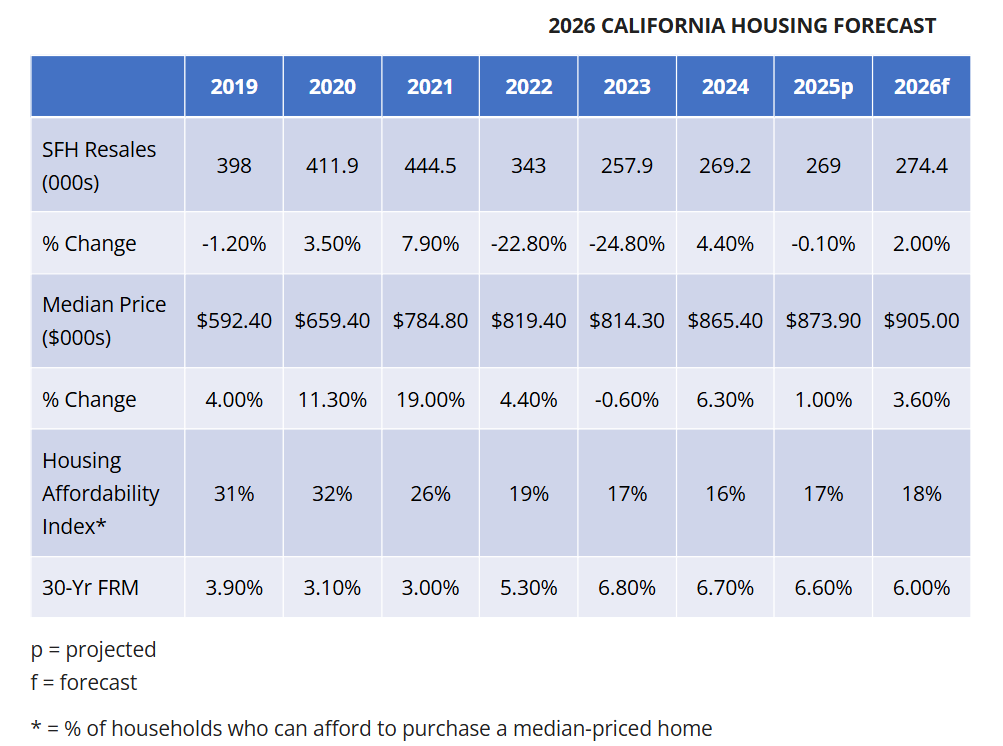
The California housing market is poised for a gentle upturn in 2026, with home sales and the median price expected to inch up slightly. According to the CALIFORNIA ASSOCIATION OF REALTORS® (C.A.R.), we can anticipate existing single-family home sales to reach around 274,400 units, a 2% increase from 2025. The median home price is projected to hit a new record, climbing 3.6% to $905,000. While this might sound like a straightforward prediction, dig a little deeper, and you'll find a more nuanced picture shaped by economic shifts, interest rates, and a slowly improving affordability situation.
My Take on the 2026 Outlook
As someone who's been following the California real estate scene for a while, I can tell you that “inching up” feels like a pretty accurate description. We've seen some wild swings in the past, and frankly, a period of relative stability is what many buyers and sellers are hoping for. C.A.R.'s forecast suggests that stability is on the horizon, but it's not going to be a free-for-all. Affordability is still a major hurdle, but there are glimmers of hope.
A Look at C.A.R.'s Projections
Let's break down what C.A.R. is predicting for the coming years:
| Year | SFH Resales (000s) | % Change | Median Price ($) | % Change | Housing Affordability Index (%) | 30-Yr FRM (%) |
|---|---|---|---|---|---|---|
| 2024 | 269.2 | 4.40% | $865,400 | 6.30% | 16% | 6.70% |
| 2025p | 269.0 | -0.10% | $873,900 | 1.00% | 17% | 6.60% |
| 2026f | 274.4 | 2.00% | $905,000 | 3.60% | 18% | 6.00% |
p = projected, f = forecast
As you can see, 2025 is looking like a bit of a holding pattern, with sales essentially flat compared to 2024. However, the median price is still expected to tick up slightly. The real movement, according to this forecast, is in 2026, where we see both sales and prices showing more noticeable, albeit still moderate, growth.
Why the Gentle Climb?
Several factors are expected to contribute to this gradual ascent:
- Interest Rates Cooling Down: This is a big one. C.A.R. forecasts the average 30-year fixed mortgage rate to drop to 6.0% in 2026. This is a significant improvement from the averages seen in recent years and even the 6.6% projected for 2025. Lower mortgage rates mean more buying power for consumers. Even though it's still higher than pre-pandemic levels, it's a move in the right direction and, importantly, lower than the 50-year historical average of nearly 8%.
- Slightly Better Affordability: With lower interest rates and potentially moderate price gains, housing affordability is predicted to inch up. The index is expected to reach 18% in 2026, meaning 18% of households will be able to afford to buy a median-priced home. This is a small but welcome improvement from 16% in 2024 and 17% in 2025. For many Californians, this slight shift could make the dream of homeownership feel a bit more attainable.
- Increasing Inventory: The forecast indicates that housing supply will continue to improve, with active listings potentially rising by nearly 10% in 2026. When more homes are available, it can ease some of the intense competition we've seen in the market. This could give buyers a bit more breathing room and potentially moderate intense bidding wars.
What About the Economy?
The housing market doesn't exist in a vacuum. The broader economic picture plays a crucial role.
- Slowing GDP Growth: The U.S. gross domestic product (GDP) is expected to grow at a slower pace in 2026, around 1%, after a projected 1.3% in 2025.
- Job Growth and Unemployment: California's nonfarm job growth is also projected to slow down, with a 0.3% increase in 2026 after a 0.4% rise in 2025. Consequently, the unemployment rate is expected to creep up to 5.8% in 2026 from 5.6% in 2025 and 5.3% in 2024. While a slight increase in unemployment can be concerning, these numbers suggest the job market, while cooling, isn't collapsing.
C.A.R. President Heather Ozur points out that as economic uncertainty begins to clear and mortgage rates decline, housing sentiment should improve. This is a key piece of the puzzle – people are more likely to make big financial decisions like buying a home when they feel more secure about their jobs and the economy.
Potential Roadblocks and Challenges
It wouldn't be wise to paint an entirely rosy picture. The forecast also highlights several challenges that could still impact the market:
- Inflation: Inflation is likely to pick up, with the annual average Consumer Price Index (CPI) expected to reach 3.0% in 2026, up from 2.8% in 2025. Higher inflation can erode purchasing power and impact what people can afford.
- Home Insurance Crisis: The ongoing issues with homeowners insurance in California are a significant concern. Rising premiums and reduced availability of coverage can make homeownership more expensive and less attractive, especially in fire-prone areas.
- Trade Tensions: Lingering trade tensions between the U.S. and its trading partners can create economic uncertainty, which can ripple through the housing market.
- Stock Market Volatility: A potential stock market bubble could burst, leading to financial instability and affecting the confidence of high-net-worth individuals who are often significant players in luxury real estate markets.
Senior Vice President and Chief Economist Jordan Levine notes that despite these headwinds, the improving lending environment and clearing economic clouds will be key drivers.
What This Means for You
So, what does all this forecast talk mean for you, whether you're looking to buy, sell, or just keep an eye on your investments?
- For Buyers: The forecast offers a glimmer of hope. Lower interest rates and a slight increase in inventory in 2026 could make it a more favorable year for buyers than the preceding ones. However, affordability remains a challenge, so smart financial planning and patience will still be crucial. Don't expect a crash, but rather a market that might be slightly less of a seller's dominance.
- For Sellers: If you've been holding off, 2026 might present a more opportune time to list your home. With stabilizing prices and rising demand, you could see your property fetch a good price. However, the days of astronomical offers might be behind us, and a more realistic pricing strategy will be important.
- For Homeowners: If you own a home in California, the moderate price appreciation suggests that your home equity is likely to continue growing, albeit at a steadier pace than in boom years.
My personal feeling is that California's housing market, given its fundamental strengths in desirability and economic output, will continue to be resilient. The forecast for 2026 suggests a return to a more sustainable growth pattern. It's not a market for speculators looking for quick flips, but for those looking for long-term value and a place to call home, opportunities will likely emerge.
The key takeaway from C.A.R.'s 2026 California Housing Market Forecast is that we're looking at a period of gradual improvement. Sales and prices are projected to rise modestly, driven by falling interest rates and slightly better affordability, while still navigating economic uncertainties and persistent challenges like insurance costs. It's a market that demands a well-informed approach, but one that holds promise for those looking to enter or move within it.
Turnkey real estate delivers immediate cash flow from day one and builds wealth for decades ahead.
Norada Real Estate helps you secure such properties—so your investment pays today and continues to grow for years to come.
Related Articles:
- California Housing Market Predictions 2025
- The Great Recession and California's Housing Market Crash: A Retrospective
- California Housing Market Cools Down: Is it a Buyer's Market Yet?
- California Dominates Housing With 7 of Top 10 Priciest Markets
- Real Estate Forecast Next 5 Years California: Boom or Crash?
- Anaheim, California Joins Trillion-Dollar Club of Housing Markets
- California Housing Market: Nearly $174,000 Needed to Buy a Home
- Most Expensive Housing Markets in California
- Abandoned Houses for Free California: Can You Own Them?
- California Housing in High Demand: 19 Golden State Cities Sizzle
- Homes Under 50k in California: Where to Find Them?
- Will the California Housing Market Crash in 2024?
- Will the US Housing Market Crash?
- California Housing Market Crash: Is a Correction Coming Up?