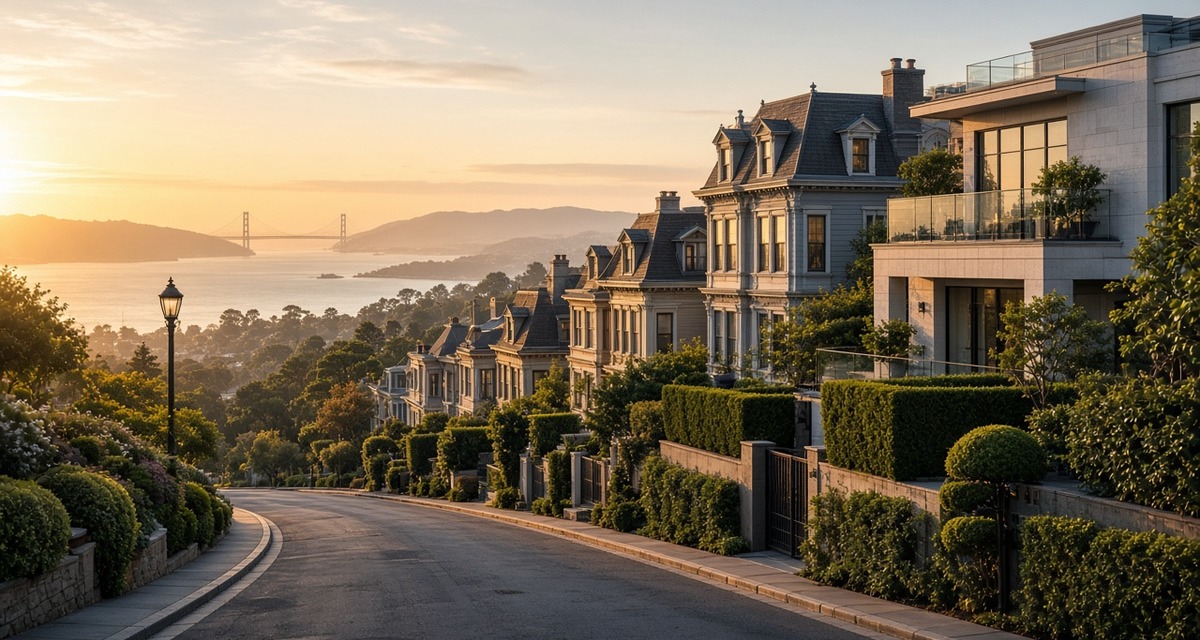
San Francisco doesn’t have one luxury market. It has a stack of micro-markets where a three-block move can change your price band, your fog pattern, and your weekend routine. When people search the wealthiest neighbourhoods in San Francisco, they’re usually hunting for more than a vanity ranking — they want to know where capital concentrates, which streets still feel scarce, and which pockets pair prestige with a life you’d actually want to live.
20 Wealthiest Neighbourhoods in San Francisco
This guide ranks 20 of the wealthiest neighbourhoods in San Francisco using recent single-family sale medians and luxury market reports from 2025–2026. Thin-inventory enclaves (Sea Cliff, Telegraph Hill, parts of Presidio Heights) can swing hard on a handful of closings, so treat every figure as directional — then verify with current MLS comps before you underwrite a purchase.
Quick context for the city overall:
- Citywide house medians recently clustered near the high-$1M range
- Ultra-prime District 7 (Pacific Heights, Presidio Heights, Marina, Cow Hollow) has printed luxury medians around $6M in major 2025 snapshots
- The gap between “nice SF” and “top-of-hill SF” is now one of the widest in a decade
Snapshot table: 20 wealthiest neighbourhoods in San Francisco
| Rank | Neighbourhood | Approx. recent SFH median / luxury band | Best known for |
|---|---|---|---|
| 1 | Presidio Heights | ~$7.3M+ (top-tier averages higher) | Estates, Presidio edge, scarce supply |
| 2 | Pacific Heights | Mid-to-high $7M house windows | Views, Fillmore lifestyle, brand prestige |
| 3 | Sea Cliff | Mid-$4M to high-$5M | Coastal privacy, Baker Beach / Lands End |
| 4 | Cow Hollow | Mid-$4M | Union Street, restored Victorians |
| 5 | Marina District | ~$4.35M (often grouped w/ Cow Hollow) | Waterfront living, Marina Green |
| 6 | St. Francis Wood | Mid-$3M to low-$4M | Garden suburb, planned streets |
| 7 | Alamo Square / NOPA | ~$3.59M | Iconic architecture, park adjacency |
| 8 | Lower Pacific / Laurel Heights | ~$3.50M | Height-adjacent value + schools/parks |
| 9 | Russian Hill | ~$3.47M | Hills, gardens, postcard SF |
| 10 | Cole Valley / Haight fringe | ~$3.38M | Village scale, sunny walks |
| 11 | Forest Hill / Forest Knolls | Low-$3M band (thin sales) | Larger lots, secluded West Side |
| 12 | Telegraph Hill | High / volatile on low volume | Views, stairs, scarcity |
| 13 | Castro / Duboce Triangle | ~$2.80M | Culture + owner demand |
| 14 | Noe Valley | ~$2.65M | Family luxury, 24th Street |
| 15 | Buena Vista / Corona Heights | ~$2.42M | Hilltop parks + city views |
| 16 | Diamond Heights | ~$2.28M | Outlooks, quieter mid-city living |
| 17 | Lake Street / Inner Richmond | ~$2.11M+ | Presidio-proximate quiet luxury |
| 18 | Ingleside Terrace / Lakeside | ~$2.1M+ | Planned elegance, larger footprints |
| 19 | West Portal | High-$2M to near-$3M windows | Village retail + transit spine |
| 20 | Hayes Valley | ~$1.91M | Design-forward central living |
How to use this ranking (before you fall in love with a street)
- Match product type: House medians and condo medians tell different stories in Pacific Heights and the Marina
- Respect sample size: A neighbourhood with 8–15 annual sales can look “richest” one quarter and merely expensive the next
- Price isn’t lifestyle: Sea Cliff wins privacy; Cow Hollow wins nightly walkability; Noe Valley wins family rhythm
- Schools aren’t automatic: SFUSD uses citywide assignment processes — never assume an address guarantees a campus
- Underwrite the Tuesday, not the listing photo: Fog, hills, parking, and grocery access matter more than the drone shot
1. Presidio Heights
Presidio Heights is where San Francisco wealth gets quiet and serious. You’re on the southeastern edge of the Presidio, with estate-scale homes, low turnover, and a residential hush that Pacific Heights can’t fully copy.
Why it ranks #1 among the wealthiest neighbourhoods in San Francisco:
- Full-year 2025 Pacific/Presidio Heights single-family medians printed around $7.3M
- Later 2026 rolling averages for Presidio Heights houses have pushed even higher in several brokerage cuts
- Inventory is chronically tight; off-market conversations are common
Daily-life upside:
- Immediate access to Presidio trails and open space
- Smaller-scale retail for everyday needs
- A more “suburban-in-the-city” feel than the Fillmore corridor
Watch-outs:
- Entry prices leave almost no room for “accidental” luxury
- Fewer nightlife options than Pacific Heights or Cow Hollow
- When a trophy sale clears, comps jump fast
2. Pacific Heights
Pacific Heights is the global shorthand for San Francisco status — ridge-top views, Victorian and contemporary mansions, and a buyer pool that often doesn’t need a mortgage story. Fillmore Street carries the retail and restaurant layer; Alta Plaza and Lafayette Park handle the green space.
What buyers actually pay for:
- Golden Gate / bay sightlines on the best blocks
- Walkability scores that regularly sit in the high 90s near core corridors
- A deep private-school radius (verify admissions realities separately)
Useful comparison:
| Factor | Pacific Heights | Presidio Heights |
|---|---|---|
| Energy | Busier, more retail | Quieter, more residential |
| Parks | Alta Plaza, Lafayette | Presidio at the doorstep |
| Housing mix | More condos/co-ops in the mix | Heavier estate / detached feel |
| Brand recognition | Highest in the city | Quieter ultra-prime |
If someone says they want “the Heights,” ask which version: views and buzz (Pacific) or park-edge privacy (Presidio).
3. Sea Cliff
Sea Cliff is tiny, coastal, and almost allergic to inventory. Homes sit above Baker Beach and Lands End with a privacy premium that’s hard to replicate anywhere else in the city.
Why wealth concentrates here:
- Fewer than a few hundred homes in the whole pocket
- Ocean and bridge drama without downtown density
- Recent medians often land in the mid-$4M to high-$5M band depending on the window
Best fit if you want:
- Space and separation from nightlife
- Coastal walks over café crawls
- A trophy address with low tourist foot traffic on residential streets
Trade-off: Everyday retail is thinner. You’re buying serenity, not a second Union Street.
4. Cow Hollow
Cow Hollow is luxury with a social calendar. Restored Victorians, Union Street shopping, and a younger-feeling affluent crowd keep demand durable even when rates are sticky.
Neighbourhood strengths:
- Walkable dining and boutiques
- Strong District 7 halo pricing (the same engine that pushed district luxury medians toward $6M in 2025)
- Architecture that photographs well and lives well after renovation
Bullet test — Cow Hollow is a match when:
- You want evenings out without a rideshare thesis
- You like classic SF housing stock
- You can live with some traffic and visitor energy
5. Marina District
The Marina sells an active waterfront lifestyle: Marina Green, the Palace of Fine Arts, Chestnut Street, and flat streets that make walking feel easy compared with the city’s steeper luxury hills.
Market note: Grouped with Cow Hollow in several 2025 single-family tables near ~$4.35M. Condos and flats can pull blended averages down, so always separate house comps from condo comps.
Lifestyle magnets:
- Waterfront recreation and open sky
- Strong walkability for daily errands
- A livelier social texture than Sea Cliff or St. Francis Wood
6. St. Francis Wood
St. Francis Wood is West Side wealth in garden-suburb form — planned streets, 1920s character, and a quieter luxury identity than the northern hills.
Why it belongs on a top-20 wealth list:
- Recent house medians often land roughly mid-$3M to low-$4M
- Larger lots and a cohesive streetscape attract long-hold family buyers
- It competes with northern prestige without copying northern chaos
Think of it as: estate energy with a softer public profile.
7. Alamo Square / NOPA
Alamo Square is famous for the postcard. NOPA is famous for the residential demand behind the postcard. Together, the 2025 year-in-review put single-family medians near $3.59M.
What makes the pocket expensive:
- Park adjacency and architectural celebrity
- Central location between multiple job and lifestyle corridors
- Renovated Victorians that clear like luxury product
Buyer tip: Tour at different times of day. Tourist energy near the park and residential calm a few blocks away are not the same product.
8. Lower Pacific Heights / Laurel Heights
This band sits in the slipstream of ultra-prime north — close enough to borrow status, sometimes priced with a little more breathing room than Presidio Heights proper.
2025 signal: single-family medians around $3.5M for Lower Pacific/Laurel Heights groupings.
Appeals to buyers who want:
- Height-adjacent schools, parks, and architecture
- Slightly more practical daily logistics
- A foothold near the city’s most expensive ridge without always paying the tip-top number
9. Russian Hill
Russian Hill is cinematic San Francisco: cable-car grades, hidden gardens, bay slices between buildings, and a prestige that feels intimate rather than corporate.
Numbers: 2025 single-family medians near $3.47M.
Love list:
- Character homes and secret stairways
- Views that still surprise locals
- A quieter social tone than Cow Hollow
Friction list:
- Hills are not a metaphor
- Parking and access can test your patience
- Inventory is idiosyncratic — floor plans vary wildly
10. Cole Valley / Haight fringe
Cole Valley plays like a village inside the city — sunny stretches, walkable errands, and a family-affluent buyer base that keeps medians elevated. 2025 prints around $3.38M show how tightly held the pocket has become.
Why interesting buyers stay loyal:
- Human-scale commercial core
- Strong owner-occupant culture
- Access to larger park systems without losing neighbourhood intimacy
11. Forest Hill / Forest Knolls
If the northern hills are the city’s tuxedo, Forest Hill and Forest Knolls are the tailored overcoat — winding streets, bigger lots, and a secluded West Side mood.
Market reality: sales can be thin, with some 2026 snapshots showing Forest Knolls in a low-$3M band. That thinness is exactly why wealth here can look “quiet” until you run the comps.
Choose it for:
- Space over scene
- A residential shield from tourist corridors
- Longer-hold family living
12. Telegraph Hill
Telegraph Hill trades on scarcity and spectacle. Views, Filbert/Greenwich stair culture, and a tiny transferable supply can push short-window medians into eye-watering territory — including mid-$4M prints in some snapshots.
Read this neighbourhood carefully:
- Low turnover means one closing can rewrite the chart
- Vertical living and stairs are part of the lifestyle, not a footnote
- It’s prestige with a physical fitness requirement
13. Castro / Duboce Triangle
Culture, community, and owner demand keep the Castro / Duboce Triangle expensive in a durable way. 2025 single-family medians near $2.8M land it firmly among the wealthiest neighbourhoods in San Francisco even outside the District 7 spotlight.
Strength stack:
- Identity and nightlife without losing residential depth
- Victorian housing stock with renovation upside
- Transit and walkability that support car-light living
14. Noe Valley
Noe Valley is where family luxury behaves like a competitive sport. Sunny microclimate, 24th Street retail, and deep buyer pools produced a 2025 median around $2.65M with heavy sale counts.
Why it fascinates out-of-town buyers:
- It feels neighbourly at seven-figure prices
- Parks, cafés, and errands cluster naturally
- Resale liquidity is often stronger than in trophy-only enclaves
Practical checklist:
- Compare house vs condo pricing carefully
- Walk the exact block at school drop-off and weekend brunch hours
- Don’t assume every sunny listing photo equals the same microclimate
15. Buena Vista / Corona Heights
Hilltop green space and city views define Buena Vista and Corona Heights. 2025 single-family medians near $2.42M reflect premium pricing for homes that feel tucked away yet central.
Great if you want:
- Park access as a daily habit
- Skyline drama without Sea Cliff isolation
- A shorter hop to Castro / Lower Haight energy
16. Diamond Heights
Diamond Heights sits above Glen Park with mid-century stock, open outlooks, and a calmer mid-city pace. A 2025 median around $2.28M keeps it on the wealth map even when tourist guides ignore it.
Underrated advantages:
- Views without northern-hill circus pricing
- A quieter street rhythm
- Practical access toward southern and central job nodes
17. Lake Street / Inner Richmond
Lake Street and the best Inner Richmond blocks have graduated into true quiet-luxury territory. 2025 Richmond/Lake Street single-family medians near $2.11M (with some shorter windows higher) reflect Presidio-proximate demand.
Buyer profile that wins here:
- Wants calmer avenues than Pacific Heights
- Values park access and fog-side authenticity
- Prefers substance over maximum Instagram fame
18. Ingleside Terrace / Lakeside
Ingleside Terrace and Lakeside deliver planned-street elegance and larger footprints on the southern side of the park belt. 2025 medians around $2.1M, with some later Ingleside Terrace snapshots higher, mark a West Side wealth tier that still feels residential first.
Why it’s interesting:
- More house for the money than many northern comps
- Cohesive street design
- Strong owner-occupant psychology
19. West Portal
West Portal’s village retail and transit spine support a sticky local buyer base. Recent community snapshots show medians from the high-$2M into near-$3M territory depending on the cut.
Everyday appeal:
- Errands on foot
- Twin Peaks Tunnel / transit convenience
- A neighbourhood identity that isn’t trying to be Pacific Heights
20. Hayes Valley
Hayes Valley closes the list as design-forward central San Francisco — restaurants, boutiques, and renovated housing that prices lifestyle as aggressively as square footage. A 2025 single-family median near $1.91M looks modest only next to Presidio Heights; nationally, it’s still elite.
Pick Hayes Valley when:
- You want culture density over coastal isolation
- You value walkability above all
- You’re comfortable with a tighter urban fabric
Comparison guide: which wealthy neighbourhood fits which buyer?
| If you care most about… | Start your tour here | Why |
|---|---|---|
| Maximum prestige + park edge | Presidio Heights | Scarcity + Presidio adjacency |
| Views + brand recognition | Pacific Heights | Global luxury shorthand |
| Privacy + coast | Sea Cliff | Tiny inventory, ocean setting |
| Walkable nights out | Cow Hollow / Marina | Retail + waterfront energy |
| Family rhythm + sun | Noe Valley | Village retail + buyer depth |
| Quiet West Side lots | St. Francis Wood / Forest Hill | Planned streets, larger homes |
| Central design scene | Hayes Valley | Restaurant/boutique density |
| Architecture celebrity | Alamo Square / NOPA | Park + Victorian demand |
A smarter way to shortlist the wealthiest neighbourhoods in San Francisco
Use this simple filter before you write an offer strategy:
- Set the product rule: house only, condo OK, or either
- Set the lifestyle rule: quiet, social, coastal, family, or central
- Set the fog/hill tolerance: honest self-scoring beats romantic listing copy
- Set the hold period: thin-inventory trophy pockets reward patience; liquid family pockets reward timing
- Pull comps by property type for 90–180 days: never buy a neighbourhood median alone
Final reality check
The wealthiest neighbourhoods in San Francisco are not interchangeable VIP lounges. Presidio Heights sells scarcity beside a national park. Pacific Heights sells the city’s most famous ridge. Sea Cliff sells coastal privacy. Noe Valley sells family competition. Hayes Valley sells creative-central living. Rankings get you oriented — block-level due diligence gets you home.
Approximate figures drawn from publicly reported 2025–2026 San Francisco market summaries (including full-year single-family neighbourhood tables and luxury brokerage notes). Always verify with current MLS data.
In 2026, select U.S. cities are projected to see surging demand, rising rents, and appreciation—creating prime opportunities for investors seeking passive income and long‑term wealth.
Work with Norada Real Estate to find stable, cash-flowing markets beyond the bubble zones—so you can build wealth without the risks of ultra-competitive areas.
Recommended Read:
- 20 Wealthy Neighborhoods in Los Angeles
- 24 Most Expensive Neighborhoods in California
- Los Angeles Housing Market: Prices, Trends, Forecast 2025-2026
- Minimum Qualifying Income to Buy a House in Los Angeles is $219,200
- Top 5 Richest Cities in the Los Angeles County
- Most Expensive Real Estate in the World: Top 10 Luxurious Properties
- 10 Most Expensive Real Estate Markets in the World
- 22 Cheapest Places to Live in Southern California
- Cheapest Housing Markets in California: Affordable Cities