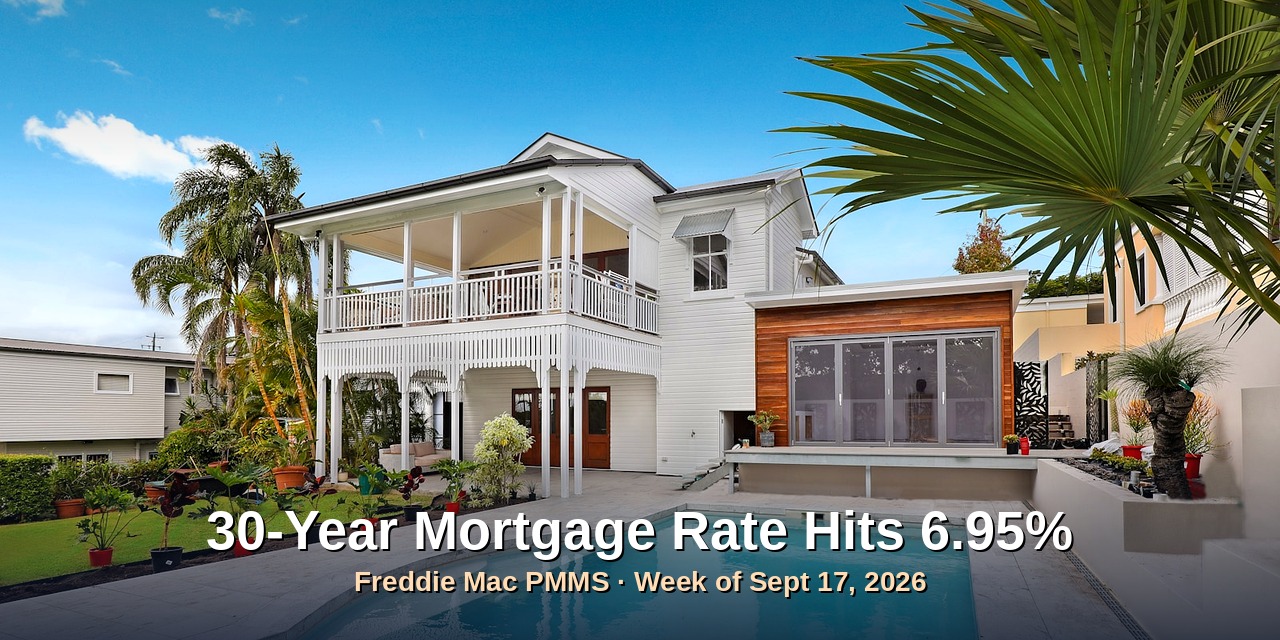
The average U.S. 30-year fixed mortgage rate rose to 6.95% for the week ending September 17, 2026, according to Freddie Mac’s Primary Mortgage Market Survey (PMMS). That is 19 basis points above last week’s 6.76% and 69 basis points above the 6.26% average from a year ago—the jump called out in the headline.
Freddie Mac Chief Economist Sam Khater said, “The 30-year fixed-rate mortgage continues to fluctuate as markets assess economic data.” Reuters reported the reading as a roughly 20-month high (highest since January 2025). Coverage from CNN and Mortgage Professional America noted a fourth straight weekly increase, with CNN describing the one-week move as the largest in about 16 months. The 15-year fixed averaged 6.26% (up from 6.09% last week; 5.41% a year ago).
For buyers and investors, the practical question is not whether 6.95% “sounds high” in isolation. It is how much more cash a payment takes each month, how close the market sits to the psychological 7% barrier, and whether waiting for a pullback still pencils against rents, inventory, and opportunity cost.
30-Year Fixed Mortgage Rate at 6.95%: What the Freddie Mac Print Means
This Week vs. Last Week vs. a Year Ago
- 30-year FRM: 6.95% this week · 6.76% last week (+19 bps) · 6.26% year ago (+69 bps)
- 15-year FRM: 6.26% this week · 6.09% last week (+17 bps) · 5.41% year ago (+85 bps)
- Source: Freddie Mac PMMS, U.S. weekly averages as of 09/17/2026
PMMS is built from Loan Product Advisor applications on conventional conforming purchase loans—typically excellent credit and about 20% down—and is published Thursdays at noon ET for the prior Thursday–Wednesday window. It is a national average, not your personal quote. Lender overlays, points, loan size, occupancy, and credit can push an offer meaningfully above or below the survey print.
Why Rates Jumped Toward 7%
Mortgage rates track the bond market more closely than overnight Fed funds. Mortgage Professional America and related market coverage tied this week’s spike to a fresh Federal Reserve hike plus an elevated 10-year Treasury yield near roughly 5%, which lenders use as a pricing anchor for 30-year fixed loans. When the 10-year stays firm and mortgage-backed securities spreads refuse to tighten, the conforming 30-year average can grind higher even if housing demand softens.
None of that means every borrower suddenly pays exactly 6.95%. It does mean the center of the conventional purchase market moved closer to 7%, and fourth-week streaks like this one tend to reset buyer expectations: “maybe next month is cheaper” becomes a thinner wager when the weekly average has already climbed nearly 70 basis points year over year.
Payment Math: 6.26% vs. 6.95% on a Sample Loan
Here is a straightforward principal-and-interest comparison on a $400,000 loan amount, 30-year fixed, fully amortizing, with no taxes, insurance, HOA, or mortgage insurance in the payment. Assumptions are for illustration only.
| Rate (Freddie Mac week) | Est. monthly P&I | vs. 6.26% (year ago) |
|---|---|---|
| 6.26% (year ago) | $2,465 | — |
| 6.76% (last week) | $2,597 | +$132 / mo |
| 6.95% (this week) | $2,648 | +$183 / mo |
On that $400,000 example, moving from last year’s 6.26% average to this week’s 6.95% adds about $183 per month, or roughly $2,196 per year in principal and interest alone. Over a full 30-year term, the cumulative interest difference is large enough that a slightly cheaper purchase price—or a stronger down payment—often matters more than waiting for a 10–15 bp dip that may not arrive on schedule.
Scaled to a $300,000 loan, the same rate gap is about $137 per month ($1,849 at 6.26% vs. $1,986 at 6.95%). Industry rules of thumb from First American–style purchasing-power notes often cite on the order of ~$11,000 of buyer purchasing power lost per 25 basis points of rate increase (methodology varies by price tier and income assumptions)—useful as a directional frame, not a personal affordability certificate.
For context on how national payment averages have already stretched household budgets, see Norada’s related coverage of the typical U.S. mortgage payment hitting $2,641.
What This Means for Homebuyers
At 6.95%, payment shock shows up first in debt-to-income ratios. A buyer who was comfortable at mid-6% quotes may need a larger down payment, a lower contract price, seller credits, or a shorter-term product to keep the same house in play. Shopping multiple lenders still matters: the PMMS average is not a take-it-or-leave-it offer, and strong credit with 20% down remains the profile that survey is built around.
If you are close to locking, treat rate volatility as a process problem, not a personality test. Get a written Loan Estimate, compare APR and points honestly, and decide in advance what “good enough” looks like relative to your rent and timeline. When averages sit just under 7%, some borrowers also explore temporary buydowns or closing-cost credits—tactics covered in Norada’s guide on how to get closing cost credits near 7%.
And yes—lock-in effects remain real. Owners with 3%–5% mortgages are still reluctant to list, which keeps resale inventory tighter than a textbook rising-rate cycle would suggest. Higher rates do not automatically create a buyer’s market if sellers stay put.
What This Means for Real Estate Investors
Investors underwrite cash flow, not vibes. A 19 bp week-over-week jump can erase thin positive leverage on a marginal deal, especially where taxes and insurance have already climbed. That does not kill every acquisition: it shifts the bar toward stronger rents, better entry prices, value-add upside, or markets where all-in carrying costs still leave room after debt service.
Turnkey rentals in cash-flow-oriented metros can still work near 7% when the purchase price and rent roll are disciplined—precisely because appreciation is no longer the only return lever. Stress-test at today’s quote and at a 25–50 bp worse case before you waive financing contingencies. If the deal only works if rates magically mean-revert next quarter, it is not a rate story; it is a hope story.
Primary-residence buyers hunting the absolute lowest available quote should also read Norada’s companion piece on the lowest mortgage rate you can get in September 2026—personalized offers still diverge from the national average.
Lock-In, Psychology, and the 7% Line
Crossing—or even approaching—7% changes behavior even when the math is only a few dollars different from 6.90%. Media and lender conversations re-anchor to a round number; some buyers pause; some sellers dig in. A pause can create negotiation room on price, but only if you are financed and ready. Sitting out indefinitely while rents rise is its own cost.
From a Norada lens, the constructive move is boring and effective: underwrite the payment you can actually carry, negotiate price and credits with eyes open, and keep capital ready for assets that cash-flow after today’s debt service—not after a forecast someone posted on social media.
Quick Takeaways
- Headline fact: 30-year FRM averaged 6.95% as of 09/17/2026 (Freddie Mac)—up 19 bps week over week and 69 bps year over year.
- 15-year FRM: 6.26% this week.
- Market context: ~20-month high; fourth consecutive weekly rise; Fed hike and firm Treasury yields cited in reputable coverage.
- Buyer impact: On a $400k loan, ~$183/mo more P&I than at last year’s 6.26% average.
- Investor impact: Re-underwrite leverage; prefer deals that survive near-7% debt service without heroic rent growth assumptions.
Rates will keep fluctuating as markets digest economic data—Khater’s point is the right framing. Your job is to translate 6.95% into a payment, a price, and a plan you can live with.
Mortgage rates remain high in 2026, but rental properties continue to deliver strong cash flow and appreciation. Savvy investors know that turnkey real estate is the path to passive income and long‑term wealth.
Norada Real Estate helps you secure turnkey rental properties designed for immediate cash flow and appreciation—so you can invest smartly regardless of interest rate trends.
Also Read:
- Mortgage Rates Predictions Backed by 7 Leading Experts: 2025–2026
- Mortgage Rate Predictions for the Next 3 Years: 2026, 2027, 2028
- 30-Year Fixed Mortgage Rate Forecast for the Next 5 Years
- 15-Year Fixed Mortgage Rate Predictions for Next 5 Years: 2025-2029
- Will Mortgage Rates Ever Be 3% Again in the Future?
- Mortgage Rates Predictions for Next 2 Years
- Mortgage Rate Predictions for Next 5 Years
- Mortgage Rate Predictions: Why 2% and 3% Rates are Out of Reach
- How Lower Mortgage Rates Can Save You Thousands?
- How to Get a Low Mortgage Interest Rate?
- Will Mortgage Rates Ever Be 4% Again?