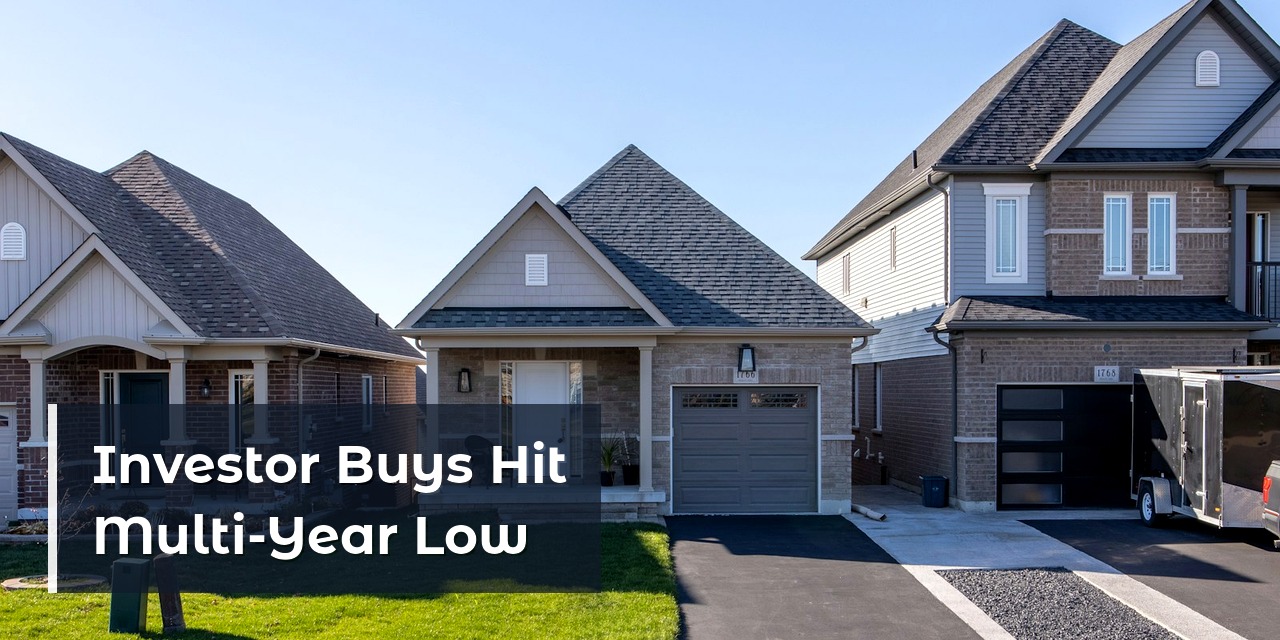
U.S. investor home purchases fell 6% year over year in the first quarter of 2026 to their lowest level since 2020, according to Redfin’s analysis of county records across 39 large metros. Newsweek’s coverage of the same Redfin report put the Q1 count at 45,397 homes — the fewest first-quarter purchases since the pandemic freeze, and before that the weakest stretch since 2016.
Investors still bought about 19% of homes that sold in those metros (down slightly from 20% a year earlier), so they have not disappeared. What changed is volume: fewer flips, fewer buy-to-rent acquisitions, and a sharper retreat from condos and low-priced stock. Cotality’s later Q2 2026 investor update reinforced the pullback — roughly 40,000 fewer investor purchases than in Q2 2025, with mega-investors accounting for about 10,000 of that decline.
For Norada’s audience, the question is practical: is the investor retreat a warning that yields no longer work — or an opening for disciplined buyers who can underwrite insurance, taxes, and softer rents?
Investor Home Purchases Fall to the Lowest Level Since 2020
What the Multi-Year Low Actually Shows
Redfin defines an investor as any institution or business that purchases residential real estate, covering both institutional and smaller entity buyers. The Q1 2026 volume drop is therefore broader than “Wall Street landlords” alone. Key Redfin findings from that quarter:
- Overall investor purchases: down 6% year over year to the lowest first-quarter level since 2020.
- Share of purchases: about 19%, versus 20% a year earlier.
- Investor-held listings: 7.8% of all U.S. home listings — the smallest share in five years, per Redfin.
- Condo purchases: down 8% year over year to the lowest first-quarter level since 2015.
- Low-priced homes: investor purchases down 10% year over year to the lowest first-quarter reading in a decade.
Metro pain was uneven. Redfin flagged the steepest year-over-year declines in Detroit (−35%), Orlando (−25%), and Cleveland (−21%). Florida’s retreat fits a longer story of insurance costs, HOA pressure, and softer prices that have chilled investor appetite.
Why Investors Stepped Back
Redfin’s explanation is straightforward: elevated housing costs squeezed potential returns. Even when mortgage rates dipped into the low-6% range in early 2026 from near-7% stretches in 2025, financing costs remained far above pandemic-era lows. Sale prices were still rising in much of the country. That combination raises acquisition cost and compresses cash-on-cash returns for both flips and rentals.
Operating costs compound the problem. Insurance premiums and property taxes feed escrow and expense ratios. Condos face HOA and special-assessment risk that many investors now price more carefully after years of fee inflation. When rents do not keep pace, thin deals fail stress tests that looked fine on 2021 underwriting templates.
Cotality’s Q2 2026 note added a policy overlay. Investors accounted for about 27% of U.S. single-family purchases from March to June (Cotality’s methodology differs from Redfin’s metro entity count, so shares are not interchangeable). Volume still fell sharply versus Q2 2025. Mega-investors (1,000-plus properties) saw acquisition volume down about 40% versus Q1 2025 in Cotality’s framing, while small investors (3–9 properties) dipped only about 3%. Proposed institutional restrictions appear to have chilled the largest players more than mom-and-pop buyers.
| Signal | Source | Reading for investors |
|---|---|---|
| Q1 purchase volume multi-year low | Redfin | Fewer competing bids on many listings |
| 19% purchase share | Redfin | Investors still present, just thinner |
| ~40,000 fewer Q2 purchases YoY | Cotality | Pullback continued into summer |
| Mega-investor volume −40% vs Q1 2025 | Cotality | Institutional retreat opens niches |
| Small-investor volume −3% | Cotality | Locals still buying selectively |
Opportunity: Less Competition at the Right Price
When investors buy fewer homes, especially at the low end, owner-occupants and remaining investors face less bidding heat on some listings. Redfin noted that when investors buy less, they also list less — investor-held listings fell to a five-year low share — which can remove a slice of both demand and future supply.
For a long-horizon rental buyer, that can be constructive: fewer all-cash races, more days on market in soft metros, and sellers who will discuss credits. Pair that with the broader buyer-leverage environment described in fall 2026 negotiating power and with payment pressure in Redfin’s $2,641 typical payment print.
Opportunity is not automatic. The deals investors abandoned may be abandoned for good reason — thin rent coverage, insurance sticker shock, or declining neighborhood demand. Your edge is underwriting, not cheering the headline low.
Warning: Yield Compression Is Real
A multi-year purchase low can also be a flashing light. If sophisticated capital is stepping back, it often means forward returns look worse after debt service, taxes, insurance, vacancy, and CapEx. Relying on 2021-style appreciation to paper over negative cash flow is a fragile plan in a market where typical purchase payments sit near 14-month highs.
Condo and coastal-Florida risk deserve special care. Redfin linked condo weakness to HOA fees and insurance. Markets with falling prices and rising carrying costs can trap leveraged buyers who assumed perpetual rent growth.
Policy risk is another warning layer. Cotality’s economists framed mega-investor pullbacks partly as a response to proposed restrictions. Rules and exemptions can change; underwrite exits that do not require a friendly legislative outcome.
How Norada-Style Buyers Should Respond
- Underwrite today’s insurance and tax bills, not last year’s. Escrow inflation is its own story — see year-two payment jumps from escrow shortages.
- Prefer markets where rents still clear a conservative debt-service ratio after vacancy and maintenance reserves — not merely where prices dipped.
- Negotiate like a buyer with alternatives. Ask for closing credits or repairs rather than stretching price to “win.”
- Stay out of condo special-assessment blind spots unless reserves, engineering reports, and insurance are clean.
- Size leverage to cash-flow, not to FOMO. Small investors’ relative resilience in Cotality’s data suggests local, patient capital can still work when mega funds pause.
Where Competition Thinned Most — and Where It Did Not
Redfin’s metro ranking matters for local strategy. A 35% year-over-year plunge in Detroit investor purchases is a different tape from a market where investors still chase every sub-$300,000 listing. Orlando’s 25% drop fits Florida’s insurance-and-inventory stress; Cleveland’s 21% decline shows Midwestern markets are not immune when carrying costs rise and resale demand softens.
National averages can mislead. In job-center metros with tight rental vacancy, small investors may still bid aggressively even while national volume prints a multi-year low. Always pair Redfin’s entity-purchase counts with local days on market, rent surveys, and insurance bindability before calling a city “open.”
Also remember methodology. Redfin’s 39-metro entity definition and Cotality’s single-family investor-share series answer related but different questions. Use Redfin for the “lowest since 2020” volume claim; use Cotality for the Q2 continuation and the mega-versus-small split. Do not splice the 19% and 27% shares into one fake national number.
Underwriting Checklist After the Investor Retreat
A practical file for 2026 acquisitions should force answers to questions many 2021 buyers skipped:
- What is the full PITI plus HOA at today’s quoted rate, not at a hoped-for refinance?
- Can the rent cover that payment at 75%–80% of gross rent after vacancy, or only at 100% occupancy with no repairs?
- Is the insurance market competitive, or is the property one carrier away from a non-renewal?
- If price appreciation is flat for three years, does the deal still make sense on cash flow alone?
- What is the exit plan if institutional demand stays muted and retail buyers remain payment-constrained?
Those questions sound conservative because they are. The investors who already stepped back answered them — and walked. Your advantage is choosing only the files that still clear, then negotiating from a position where fewer competing investors are left in the room.
Bottom Line: Selective Opening, Not a Free Pass
Redfin’s Q1 2026 investor purchase low — and Cotality’s Q2 volume drop — show capital is more cautious after years of higher financing and operating costs. That can ease competition for buyers who still see durable rent demand. It is also a warning that many legacy playbooks no longer clear. Treat the multi-year low as a filter: more room to negotiate on the right houses, and a higher bar for what deserves a bid in the first place.
Rental properties remain one of the most resilient wealth‑building strategies. With rising demand and limited supply, 2026 offers investors a prime opportunity to lock in steady cash flow and appreciation.
Norada Real Estate helps investors acquire turnkey rentals—providing immediate income, professional management, and proven ROI across the nation’s strongest markets.