
Fifteen-year fixed mortgages still price below 30-year fixed quotes even when the headline 30-year sits near 7%. Mid-September 2026 survey tables — for example Bankrate-style averages around 7.02% on the 30-year and roughly 6.36% on the 15-year — show a gap on the order of 0.6–0.7 percentage points, though your locked quotes will differ by credit, points, and day.
The lower rate is real. The higher payment is also real. Who should take the 15-year depends on cash flow, not on winning an internet argument about interest total. Backdrop: Fed funds at 3.75%–4.00% after the September hike, SEP median near ~4.1%, and 30-year averages holding near 7%.
15-Year Mortgages Still Undercut 30-Year Rates Near 7% — Who Can Afford the Payment
Rate Gap vs. Payment Gap
Lenders usually charge less for 15-year money because duration risk is shorter. Borrowers pay more each month because amortization is compressed into half the calendar. Illustrative educational math on a $350,000 loan (rounded, not a live offer):
- At 7.0% for 30 years, P&I is about $2,329/month.
- At 6.4% for 15 years, P&I is about $3,030/month.
- Payment premium: roughly $700/month for faster payoff and less total interest.
Lifetime interest over the full term drops dramatically on the 15-year path if you keep the loan — that is the feature. The requirement is qualifying and living with the payment when insurance and taxes also rise (escrow shocks on fixed notes).
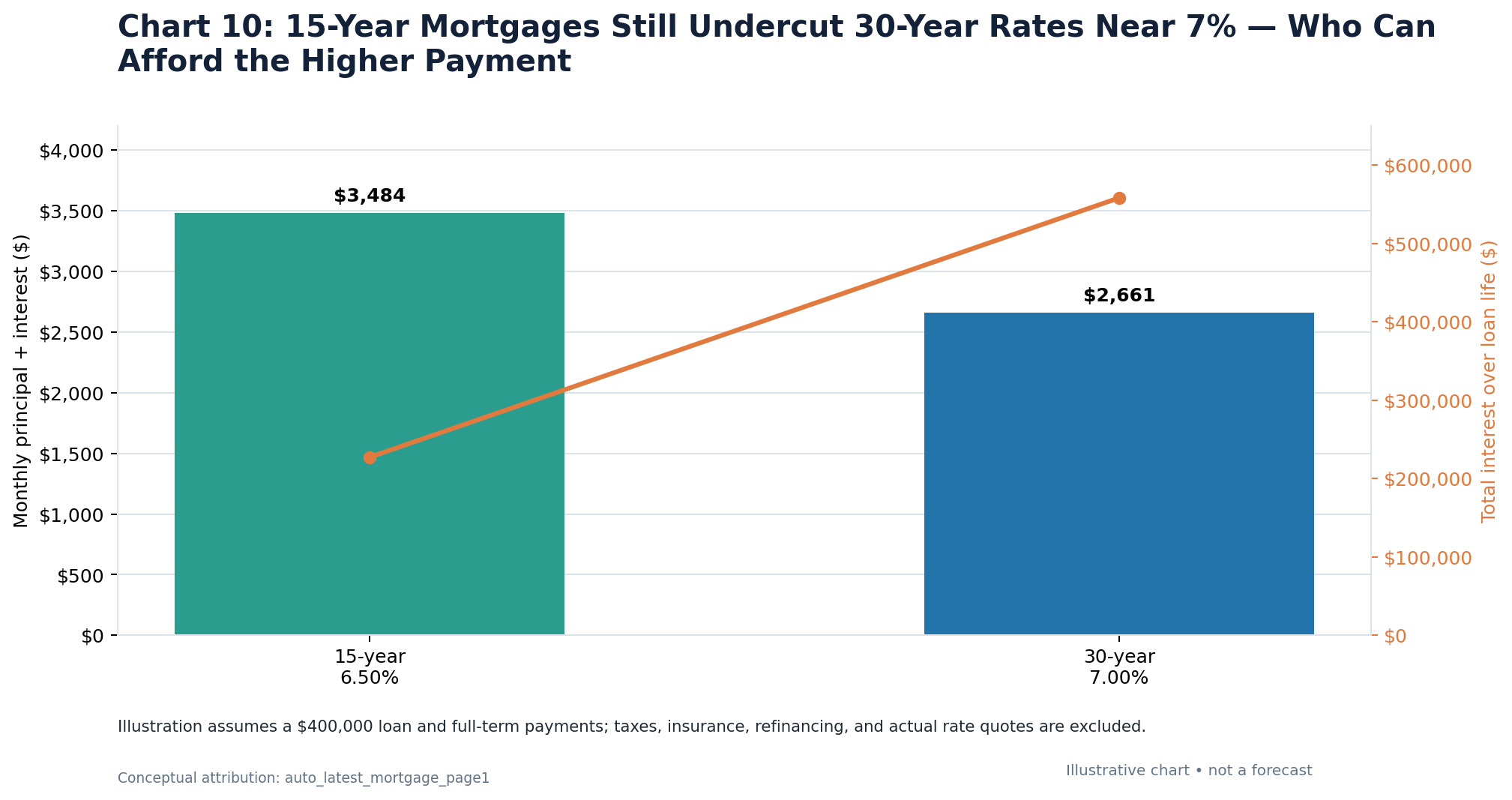
Who Can Afford the Higher Payment
| Profile | 15-year fit | Why |
|---|---|---|
| High stable income, modest house relative to earnings | Strong | Payment fits; interest savings compound |
| Near-retirement, wants debt-free date | Strong | Aligns payoff with work horizon |
| First-time buyer at max DTI | Weak | Payment crowding kills reserves |
| Likely move in <5 years | Often weak | Less time to harvest interest savings |
| Cash-flow investor | Case-by-case | 15-year can wreck DSCR vs 30-year |
15-Year vs. 30-Year Plus Extra Principal
A hybrid strategy: take the 30-year for payment flexibility, then send extra principal when cash allows. You keep the option to cut extras during a job scare. You rarely get the full 15-year note rate with that approach, but you buy resilience. Near 7%, resilience matters more than optimizing every interest dollar on day one.
Also compare 5/1 ARM vs 30-year if you have a defined short horizon — different risk again, not a substitute for 15-year equity building.
Points, Credits, and Product Choice
Discount points (break-even math near 7%) appear on both 15- and 30-year menus. Run break-evens separately; a point on a 15-year loan amortizes over fewer years of potential savings if you move. Seller credits that permanently buy the rate down can make a 15-year payment suddenly feasible — especially on builder incentive packages.
Qualification and Lifestyle Risks
Underwriters care about the payment you contract for. Stretching into a 15-year at the limit leaves no room for the next insurance reassessment or a special assessment. If the 15-year only works by draining every bonus and side hustle, the 30-year with disciplined extra principal is the adult version of the same goal.
Interest Savings vs. Liquidity: A Fuller Illustration
Keep the $350,000 example in view. Over a full term, the 30-year at 7% schedules far more total interest than the 15-year at 6.4%, even though the 15-year payment is higher. If you can afford the 15-year without neglecting retirement contributions or emergency reserves, the interest gap is compelling. If the 15-year forces you to pause 401(k) matching or skip disability insurance, you have optimized the mortgage and destabilized the household.
A middle path some households use: choose the 30-year, then automate an extra principal payment equal to half the difference between the 15- and 30-year payments. You capture part of the interest savings with a built-in “easy button” to stop extras during a crunch.
Refi Optionality Differs by Term
If rates fall meaningfully in 2027–2028, both 15- and 30-year borrowers can refinance — but the 15-year borrower has amortized faster, so less balance remains to refinance. That is good for equity and slightly reduces the benefit of waiting for a refi before choosing term. Near-term movers get less value from either rate-optimization story; they should minimize closing friction and avoid heavy points (break-even discipline).
When the 15-Year Is a Status Symbol — and When It Is Not
Online forums sometimes treat 15-year mortgages as a character test. Ignore that. Lenders do not hand out medals. Choose the term that keeps housing under a sane share of take-home pay after a realistic insurance quote. In a market where rent may still win cash flow, forcing a 15-year buy payment that far exceeds rent can be the most expensive way to feel financially virtuous.
Biweekly Payments and Other Pseudo-15-Year Tricks
Biweekly payment plans on a 30-year loan can shave years and interest by effectively making an extra payment annually. They are not identical to a 15-year note rate, but they scratch a similar itch with more flexibility. Confirm whether your servicer treats biweekly as formal re-amortization or simply as early principal; confirm fees on third-party biweekly services. Free self-directed extra principal usually beats a fee-based gimmick.
Income Shocks and the 15-Year Trap
Households with variable income — commissions, tips, equity compensation — often overfit a strong year when qualifying for a 15-year payment. Model a weak year. If the 15-year only works on this year’s RSUs, use the 30-year and accelerate principal when bonuses actually hit. Lenders qualify on documented income; life collects on reality.
Pairing Term Choice With the Rest of the 2026 Toolkit
Term is one lever beside points, buydowns, FHA/VA options, and temporary payment help. Stacking a 15-year with heavy points and thin reserves is how smart people create brittle closings. Prefer one or two clean levers: for example, a 30-year with seller-paid points, or a 15-year with zero points and a large down payment. Revisit post-hike shopping tactics once you know which constraint binds — rate, payment, or cash to close.
Credit Score, LTV, and Why Your Gap May Differ From Surveys
National averages compress excellent-credit, low-LTV borrowers with everyone else. Your 15-year quote might beat the survey by more than 0.6 points — or less — depending on points, size adjustments, and whether you use FHA or VA pricing instead of conventional. Always compare 15- vs 30-year on the same day, same lender, same credit file. Then overlay payment comfort. A dazzling 15-year rate that fails the sleep-at-night test is not a win.
If the payment gap is close, ask whether a modest price credit or seller-paid points closes it without jumping terms. Product choice and purchase negotiation are the same puzzle with two knobs.
Bottom Line
Fifteen-year mortgages still undercut 30-year rates by roughly half a point to a bit more in mid-September surveys while the 30-year hovers near 7%. The product shines for high-cash-flow borrowers who value a near-dated payoff. Everyone else should respect the payment gap — or use a 30-year with voluntary prepayments — rather than forcing a 15-year that turns a home into a financial stress test.

VS
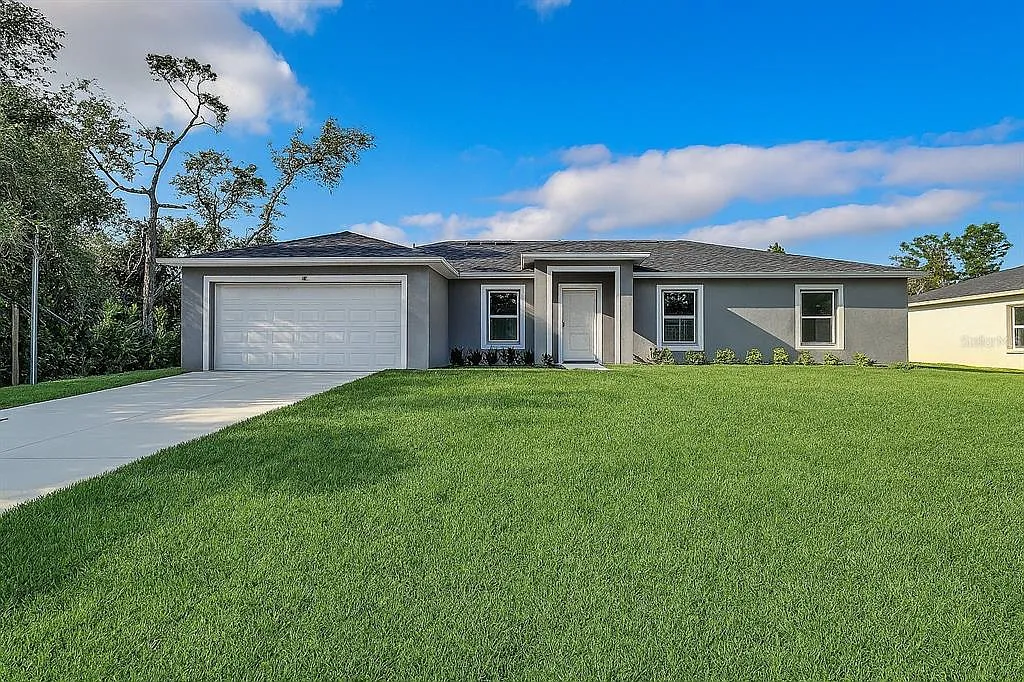
Out‑of‑State investors can compare Tennessee’s newer rental with higher NOI vs Florida’s A+ property with strong yield. Which fits YOUR investment strategy?
We have much more inventory available than what you see on our website – Let us know about your requirement.
📈 Choose Your Winner & Contact Us Today!
Speak to a Norada Investment Counselor (No Obligation):
(800) 611-3060
Mortgage rates remain high in 2026, but rental properties continue to deliver strong cash flow and appreciation. Savvy investors know that turnkey real estate is the path to passive income and long‑term wealth.
Norada Real Estate helps you secure turnkey rental properties designed for immediate cash flow and appreciation—so you can invest smartly regardless of interest rate trends.
Also Read:
- Mortgage Rates Predictions Backed by 7 Leading Experts: 2025–2026
- Mortgage Rate Predictions for the Next 3 Years: 2026, 2027, 2028
- 30-Year Fixed Mortgage Rate Forecast for the Next 5 Years
- 15-Year Fixed Mortgage Rate Predictions for Next 5 Years: 2025-2029
- Will Mortgage Rates Ever Be 3% Again in the Future?
- Mortgage Rates Predictions for Next 2 Years
- Mortgage Rate Predictions for Next 5 Years
- Mortgage Rate Predictions: Why 2% and 3% Rates are Out of Reach
- How Lower Mortgage Rates Can Save You Thousands?
- How to Get a Low Mortgage Interest Rate?
- Will Mortgage Rates Ever Be 4% Again?