
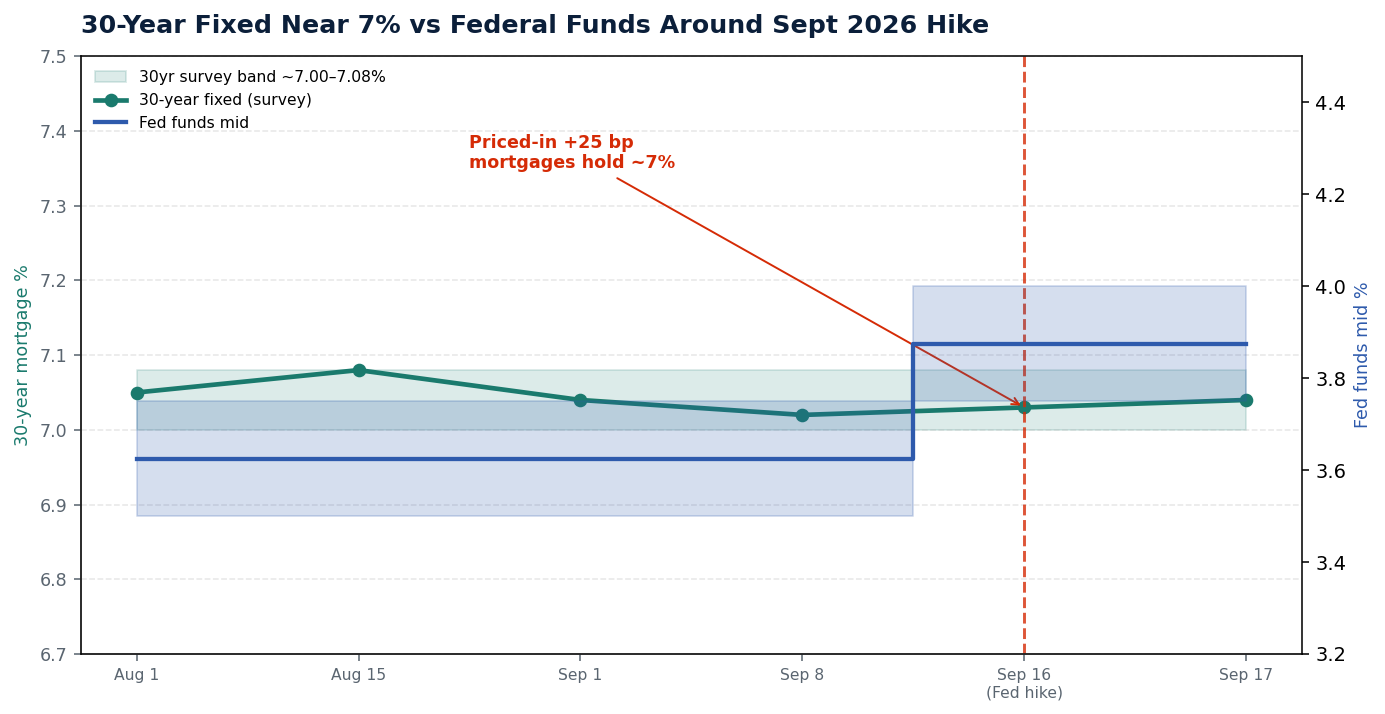
The 30-year fixed mortgage rate is holding near 7% after the Fed’s 25 bp hike to 3.75%–4.00%, largely because markets had already priced in the move. Survey readings around 7.00%–7.08% (with some sources higher) show stability, not a sudden break higher — and the Fed does not set mortgage rates one-for-one.
That distinction matters for anyone comparing a federal funds headline to a loan estimate. Overnight policy tightened; retail mortgage quotes did not need to reprice by a full quarter-point the next morning. For the political and policy backdrop behind the hike, see the unanimous Fed hike and Trump–Warsh interest-rate friction. For the path from here, our mortgage rates forecast for the rest of 2026 lays out base and risk cases without fake point targets. For actionable shopping steps, see how to get the best mortgage rates after the recent Fed hike.
30-Year Fixed Mortgage Rate Holds Stable at 7% After Fed Hike
Stability near 7% is the story markets expected once a September hike was widely anticipated. Lenders and secondary-market investors had already adjusted. When the FOMC then delivered a unanimous +25 bp move into a 3.75%–4.00% target range — the first hike in more than three years under Chair Kevin Warsh — the mortgage complex could absorb the news without a disorderly jump.
Why a Fed Hike Did Not Automatically Push Mortgages Higher
Mortgage rates are tied more tightly to longer-term yields and to the price of mortgage-backed securities than to the federal funds rate itself. The Fed’s overnight target influences the economy and the short end of the curve; the 30-year fixed quote reflects duration risk, prepayment assumptions, and investor demand for MBS.
- Policy rate: federal funds range now 3.75%–4.00% (+25 bp)
- Retail mortgage: surveys roughly 7.00%–7.08%; some sources higher
- Transmission: not 1:1 — priced-in hikes often show up before the meeting
- Vote context: unanimous hike, despite public White House preference for cuts
When a hike is priced in, much of the mortgage move happens in the weeks beforehand through Treasury and MBS channels. The announcement then confirms the path rather than shocking it. That is the mechanical reason “Fed hikes 25 bp” and “mortgage rate unchanged near 7%” can appear in the same news cycle without contradiction.
Reading the 7% Range With Appropriate Nuance
Saying mortgages “hold at 7%” is a useful headline, but borrowers should treat it as a band, not a single print. Survey averages in the low 7% area (around 7.00%–7.08%) sit alongside lender quotes that can screen higher depending on credit score, lock period, points, property type, and state. Some published sources also run above the main survey cluster. The practical message is the same: financing remains expensive relative to the ultra-low rate years, even if the post-meeting day-to-day change looks calm.
| Measure | Recent context | Borrower takeaway |
|---|---|---|
| Fed funds target | 3.75%–4.00% after unanimous +25 bp | Policy still firm; not a cut cycle |
| 30-year fixed (surveys) | ~7.00%–7.08% | Plan payments near 7%, not mid-6% |
| Other published quotes | Some sources higher than survey averages | Shop multiple lenders; compare APRs and points |
| SEP median (end-2026) | ~4.1% funds rate | ~One more hike possible; mortgage relief not assured |
What Borrowers Should Do While Rates Sit Near 7%
Calm after a priced-in hike is not the same as cheap credit. Payment math at ~7% still constrains purchase budgets and cash-out refinance appetite. A short clarity check helps here: if your budget only works if rates fall first, you are not shopping the market that exists — you are shopping a forecast.
Purchase Borrowers
- Get a current loan estimate, not a headline. Your rate depends on credit, down payment, occupancy, and points.
- Stress-test the payment at a slightly higher quote in case lock extension or market drift adds cost.
- Use float-down or re-lock policies carefully. Understand fees before you bet on a dip.
- Pair rate strategy with local inventory. Sticky prices and lock-in still limit how much “rate pain” shows up as seller discounts — see Fed hike impacts on home prices and affordability this fall.
Refinance and HELOC Shoppers
- Cash-out and rate-and-term refinances still face a high bar when existing notes were written at much lower coupons.
- Break-even analysis matters more than the Fed meeting calendar.
- If you need liquidity, compare HELOC/second-lien pricing against selling costs and against simply delaying a project.
Why “Priced In” Does Not Mean “Done”
Markets can correctly anticipate a single meeting and still mis-price the next three. The SEP median near 4.1% for the end of 2026 leaves open roughly one additional hike if inflation and growth evolve that way. Another firming step would not automatically lift the 30-year by 25 bp, but it would keep the “mortgages ease quickly” narrative on a short leash.
Political friction adds another layer. President Trump publicly preferred cuts; the Warsh-led FOMC hiked anyway — unanimously. That independence signal reduces the odds that mortgage markets can count on political pressure alone to deliver lower long rates. Data still rule; politics is noise unless it changes the committee’s reaction function, which September’s vote argues against.
How Long Can Stability Near 7% Last?
Stability is a description of the recent tape, not a guarantee. Mortgage rates can hold in a range when:
- Treasury yields consolidate after a well-telegraphed Fed event
- MBS spreads remain orderly
- Inflation data neither spike nor collapse
They can break higher if inflation surprises to the upside, if term premium rises, or if investors demand more compensation to hold MBS. They can ease if inflation cools cleanly and the Fed’s hiking bias fades — even without an immediate cut. The Fed’s overnight rate is the policy anchor; the mortgage rate is the market’s verdict on inflation risk, growth risk, and housing credit supply.
Investor Angle: Cap Rates, Financing, and Patience
For rental and small multifamily buyers, a 30-year residential quote near 7% (or commercial debt priced off a related high-rate regime) keeps leverage expensive. Deals that only pencil at mid-5% financing remain stressed. The offset in many markets is that sellers also face lock-in and limited alternatives, which supports price stickiness rather than a fire-sale clearing. Volume adjusts first; prices often adjust later and locally.
Checklist After the Hike
| Action | Why it matters now |
|---|---|
| Compare at least 3–4 lenders | Dispersion around the ~7% survey band can be wide |
| Decide lock timing with a written policy | Post-meeting calm can fade on the next CPI print |
| Recalculate DTI and reserves | Affordability is payment-driven at 7%+ |
| Track Fed path, not Fed day-count | SEP ~4.1% end-2026 = hike risk still live |
| Separate funds rate from mortgage rate | Avoid 1:1 mental math after every FOMC |
Rate Shopping Mechanics That Still Work Near 7%
Even when the national survey average sits near 7%, individual borrowers do not all receive the same price. Lenders differ on credit overlays, loan-level price adjustments, and how aggressively they want purchase versus refinance volume. After a Fed meeting, some desks also refresh rate sheets more than once a day if Treasuries move. That is why a single headline percentage is a starting map, not your locked price.
- Credit and equity: Higher scores and larger down payments still buy better pricing inside the same 7% regime.
- Points versus credit: Paying a point can lower the note rate; taking a lender credit can raise it. Compare total cost over your expected hold period.
- Lock period length: 30-, 45-, and 60-day locks are priced differently. Longer closings need longer locks — and usually a higher quote.
- Property and occupancy: Investment properties and second homes typically price wider than primary residences.
If two lenders are 0.125%–0.250% apart on a similar structure, that gap can matter more to your payment than the Fed’s 25 bp overnight move — another reminder that mortgage markets are not a simple pass-through of the funds rate.
What “Holds Stable” Means for Timing Decisions
Stability near 7% after a priced-in hike often tempts borrowers to wait for the next soft inflation print. Waiting can work if long yields genuinely fall. It can also backfire if the SEP path toward a year-end funds rate near 4.1% stays intact and another hike returns to the headlines. A disciplined approach is to separate house timing from rate timing: if the property, inspection, and payment fit today, do not let a political cut narrative delay a sound purchase. If the payment only works after a fantasy refinance, walk away.
Bottom line: the 30-year fixed rate holding near 7% after a unanimous 25 bp Fed hike to 3.75%–4.00% is consistent with a move that was already in the price. Surveys around 7.00%–7.08%, with some sources higher, describe an expensive-but-stable financing regime. Borrowers should shop the quote in front of them, respect that the Fed does not set mortgages one-for-one, and plan for a path where another hike remains possible while true rate relief still depends on cooler inflation — not on political preference.
VS
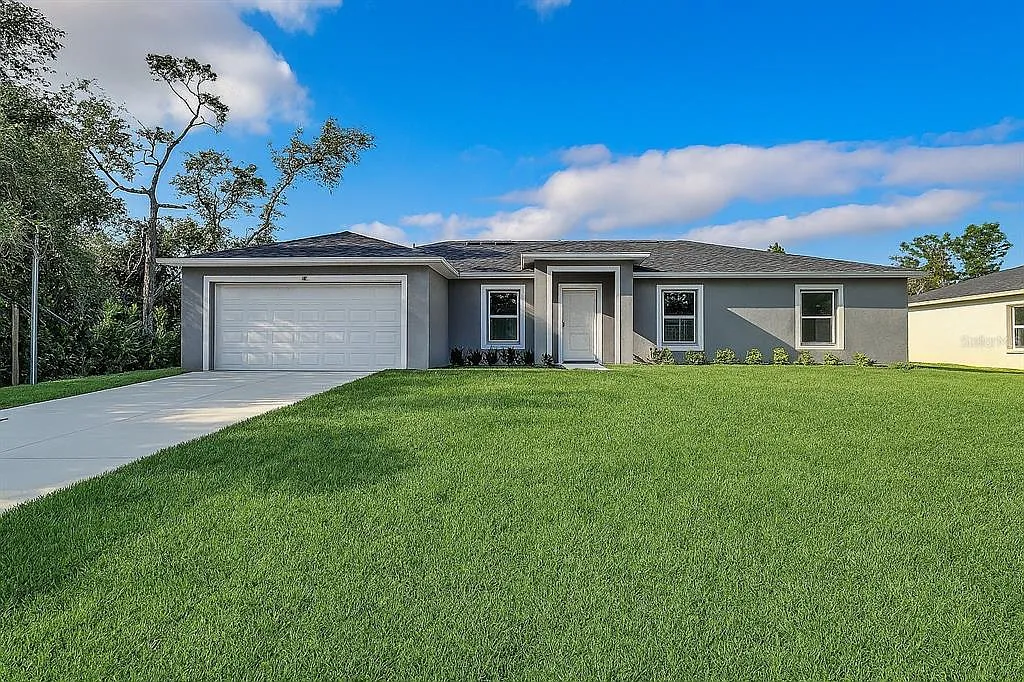
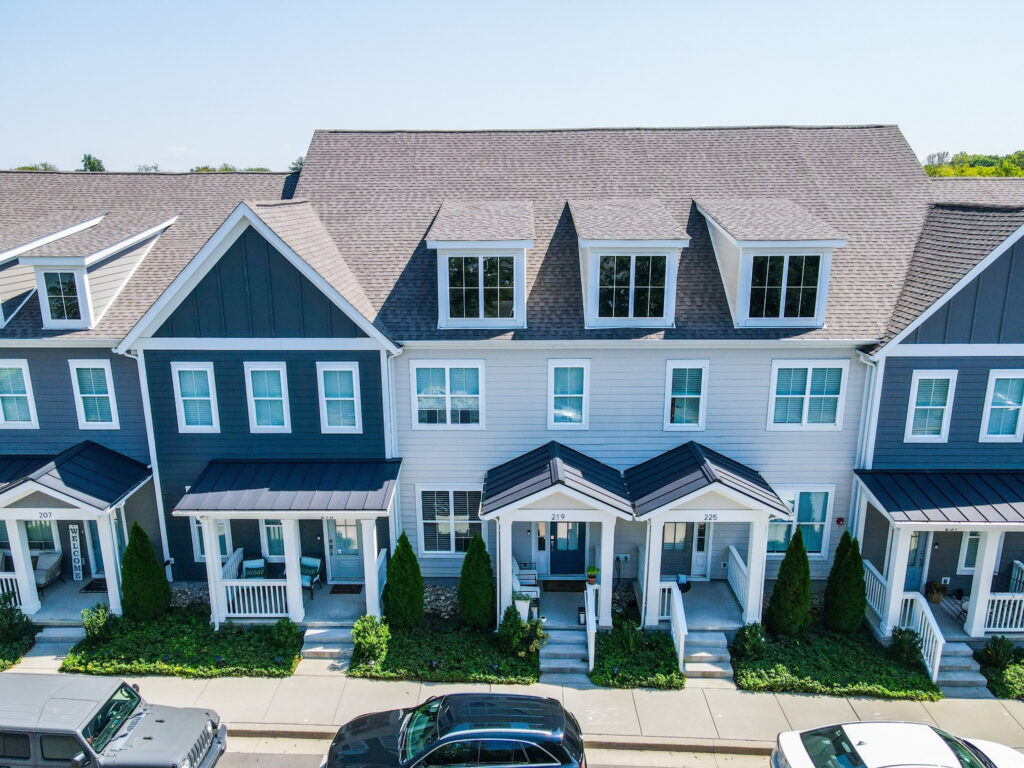
Out‑of‑State investors can compare Tennessee’s newer rental with higher NOI vs Florida’s A+ property with strong yield. Which fits YOUR investment strategy?
We have much more inventory available than what you see on our website – Let us know about your requirement.
📈 Choose Your Winner & Contact Us Today!
Speak to a Norada Investment Counselor (No Obligation):
(800) 611-3060
Mortgage rates remain high in 2026, but rental properties continue to deliver strong cash flow and appreciation. Savvy investors know that turnkey real estate is the path to passive income and long‑term wealth.
Norada Real Estate helps you secure turnkey rental properties designed for immediate cash flow and appreciation—so you can invest smartly regardless of interest rate trends.
Also Read:
- Mortgage Rates Predictions Backed by 7 Leading Experts: 2025–2026
- Mortgage Rate Predictions for the Next 3 Years: 2026, 2027, 2028
- 30-Year Fixed Mortgage Rate Forecast for the Next 5 Years
- 15-Year Fixed Mortgage Rate Predictions for Next 5 Years: 2025-2029
- Will Mortgage Rates Ever Be 3% Again in the Future?
- Mortgage Rates Predictions for Next 2 Years
- Mortgage Rate Predictions for Next 5 Years
- Mortgage Rate Predictions: Why 2% and 3% Rates are Out of Reach
- How Lower Mortgage Rates Can Save You Thousands?
- How to Get a Low Mortgage Interest Rate?
- Will Mortgage Rates Ever Be 4% Again?



