After the Federal Reserve’s September 16, 2026, hike of 25 basis points to a 3.75%–4.00% federal funds target range, the next question for many households is not philosophical—it is practical: how fast does my rate change? For credit cards, HELOCs, and other variable loans tied to the commercial bank prime rate, the answer is usually “much faster than a fixed mortgage.” For a locked 30-year home loan, the answer is often “maybe not at all this week.”
Here is how the ripple typically works, what usually moves with prime, and what still depends on the bond market instead.
How Quickly September's Fed Rate Hike Will Ripple Through Commercial Bank Prime Rates
Prime rate 101: why it usually follows the Fed
The Wall Street Journal prime rate—and the similar prime benchmarks many banks publish—is a reference rate banks use for consumer and business lending. It is not set by a Fed vote in the same mechanical way as the funds target range, but in modern practice prime almost always moves in lockstep with Fed hikes and cuts, typically by the same 25 basis points.
A common rule of thumb is:
- Prime ≈ fed funds upper bound + 3.00 percentage points (historically the long-running spread banks have used).
With the funds range now at 3.75%–4.00%, that rule of thumb points to a prime rate near 7.00% if banks match the hike fully—though you should confirm the posted prime your lender actually uses, because contract language controls.
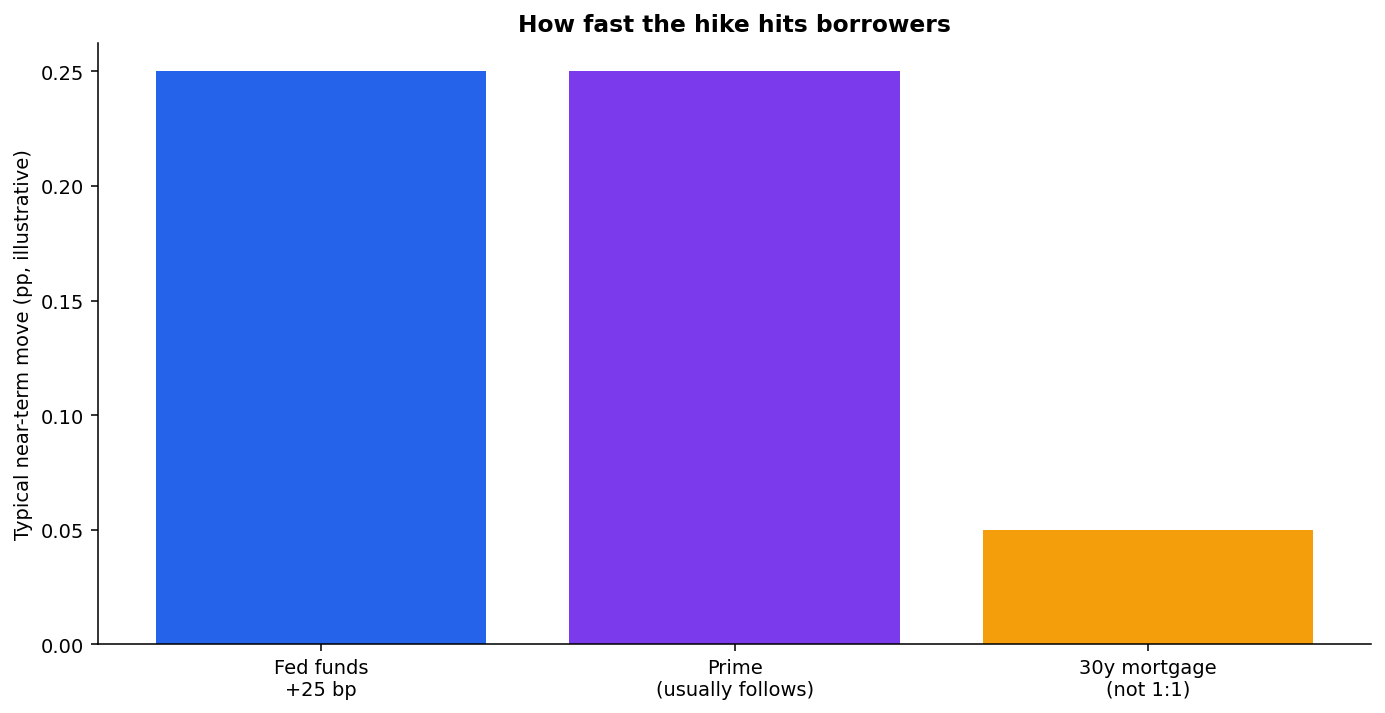
Typical timing: overnight decision to borrower statement
| Channel | Usual speed after a Fed hike | What borrowers notice |
|---|---|---|
| Bank posted prime | Often same day to 1–2 business days | New prime published; contracts that reprice “immediately” feel it first |
| Credit cards (variable APR) | Often within 1–2 statement cycles | APR rises with prime; minimum payments can edge up |
| HELOCs / HELOANs (variable) | Next reset date in the note (monthly is common) | Interest portion of payment rises; draws get more expensive |
| Auto / personal variable loans | Per contract (monthly/quarterly) | Payment or accrued interest adjusts on reset |
| 30-year fixed mortgage | Not automatic | Only changes if you refinance or never locked; new quotes follow Treasuries/MBS |
Because Wednesday’s hike was widely expected, some lenders and markets had already positioned for it. Still, the legal reset usually references the effective date of the new prime or the funds range—not the rumor that preceded it.
Credit cards: the fastest consumer pain point
Most variable-rate credit cards price as prime + margin. When prime rises 25 bp, the card APR generally rises 25 bp after the issuer applies its change rules. Federal disclosures and card agreements spell out timing; many borrowers see the new APR on the following statement period rather than the night of the FOMC release.
What to do now:
- Check whether your APR is variable and what index it cites (almost always prime).
- If you carry a balance, a 25 bp hike is not catastrophic alone—but a path toward another 2026 hike (as dot-plot reporting suggests) compounds.
- 0% purchase or balance-transfer promotions still end on their own calendars; do not assume Fed news extends them.
HELOCs and home equity lines: housing-adjacent, Fed-sensitive
HELOCs are where Fed hikes meet homeowners most directly. Unlike a fixed first mortgage, a typical HELOC floats with prime (sometimes with floors, ceilings, or periodic caps). After a funds hike:
- Banks update prime.
- Your HELOC rate adjusts on the next reset date in your agreement.
- Interest charges on outstanding draws rise; new draws cost more immediately after the reset.
If you planned a renovation draw or a bridge strategy, recalculate carrying costs under a prime that can still move again if policymakers follow through on an additional hike toward the 4.00%–4.25% year-end area discussed in SEP coverage.
Other prime-linked loans and small-business credit
Small-business lines, some investor credit facilities, and floating-rate consumer installment products often use prime or SOFR-plus structures. Prime-linked products will feel Wednesday’s decision on a short fuse. SOFR-linked commercial loans follow money-market SOFR, which also reprices with Fed policy—but the lag and spread mechanics differ from consumer prime cards. Read the note: “prime + 1%” and “1-month SOFR + 2%” are not the same animal.
Fixed mortgages: different pipe, different pressure
This is the most common confusion after a Fed day. The Fed does not set the 30-year fixed mortgage rate. New purchase and refinance quotes track the 10-year Treasury and mortgage-backed securities yields, plus lender margins and points.
Around September 16, national 30-year averages were already running roughly ~7.00%–7.08% across major surveys (Zillow marketplace near 7.00%, Bankrate/NerdWallet-style prints near 7.02%, other lender surveys a touch higher). Weekly MBA figures can differ because they are not the same as same-day lock quotes.
So the ripple looks like this:
- Fast: prime → cards/HELOCs/variable loans.
- Indirect: Fed path + inflation outlook → Treasury yields → mortgage quotes.
- None (near term): a fixed rate you already locked or closed.
For the policy backdrop, see the first-hike-in-three-years wrap. For tone from the chair, see Warsh’s higher-for-longer presser takeaways.
How banks decide the exact day they move prime
Large banks usually announce prime changes quickly after a unanimous, expected FOMC move. Historically, many match the Fed’s 25 bp increment the same afternoon or the next business day. Outliers exist—especially if a bank’s loan book mix or funding situation differs—but consumer media generally treats a synchronized prime move as the base case after a clean hike.
Borrowers should:
- Watch their bank’s prime notice or WSJ prime print.
- Open the loan agreement PDF and find “index,” “margin,” “floor,” and “change date.”
- Model payment impact before the next HELOC reset or card statement closes.
What “one more hike” would mean for prime products
If officials follow the median path implied in September SEP reporting, another quarter-point later in 2026 would lift the funds range toward 4.00%–4.25% and, under the usual rule of thumb, push prime another 25 bp higher. Variable debt is where that path shows up first. Fixed-rate mortgage holders feel it only if long yields reprice higher on the news.
A quick payment sketch (illustrative only)
Suppose a HELOC balance of $50,000 priced at prime + 0% for simplicity, and prime rises by 0.25 percentage points. Annual interest rises by about $125 before compounding nuances—or roughly $10-plus a month if you think in straight-line terms. That single step is manageable for many households. A sequence of steps—Wednesday’s hike plus another later in 2026—adds up, especially alongside still-elevated first-mortgage rates near 7%. The point is not panic; it is arithmetic. Variable debt is where Fed decisions show up in the checking account first.
Investors using HELOCs or floating portfolio lines to acquire rentals should update underwriting spreadsheets the same week as the FOMC, not the same quarter. Debt service coverage that looked fine at the old prime can thin quickly when vacancy or insurance costs are also rising.
Bottom line
Wednesday’s Fed hike ripples through commercial bank prime rates on a short clock—often days—then into cards, HELOCs, and other floating consumer credit on the next contractual reset. Fixed mortgages live on a different pipeline. If you have variable balances, treat the hike as an immediate planning event; if you have a locked 30-year, watch Treasuries and lender quotes, not the prime headline alone. Savers, for their part, sit on the other side of the same overnight rate—see what the 4% top of the funds range means for HYSA yields.

VS
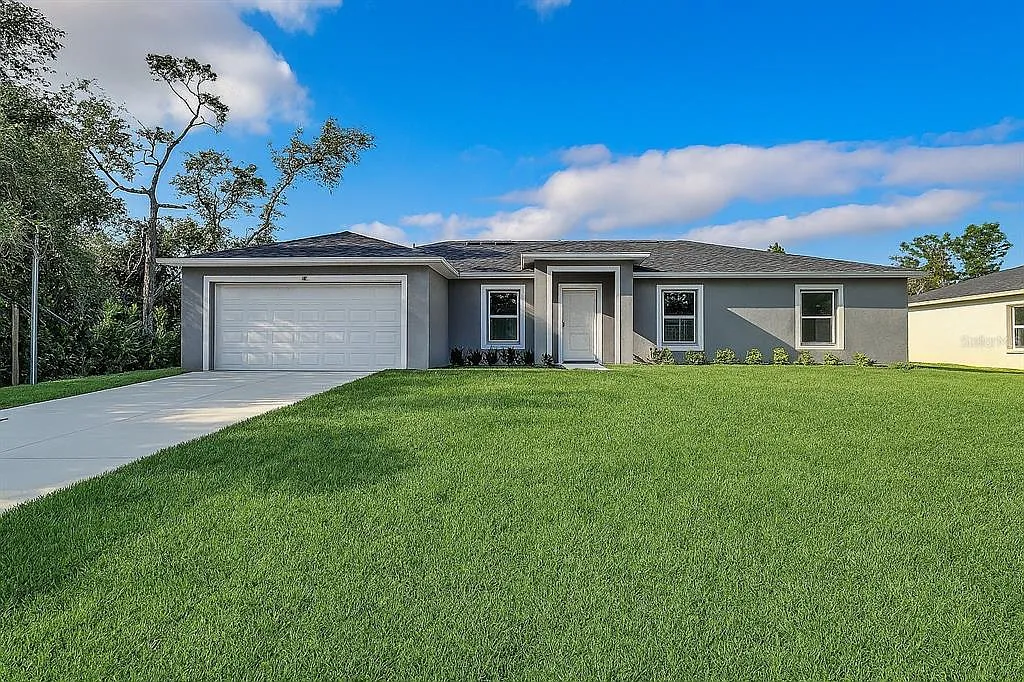
Out‑of‑State investors can compare Tennessee’s newer rental with higher NOI vs Florida’s A+ property with strong yield. Which fits YOUR investment strategy?
We have much more inventory available than what you see on our website – Let us know about your requirement.
📈 Choose Your Winner & Contact Us Today!
Speak to a Norada Investment Counselor (No Obligation):
(800) 611-3060
Mortgage rates remain high in 2026, but rental properties continue to deliver strong cash flow and appreciation. Savvy investors know that turnkey real estate is the path to passive income and long‑term wealth.
Norada Real Estate helps you secure turnkey rental properties designed for immediate cash flow and appreciation—so you can invest smartly regardless of interest rate trends.
Also Read:
- Mortgage Rates Predictions Backed by 7 Leading Experts: 2025–2026
- Mortgage Rate Predictions for the Next 3 Years: 2026, 2027, 2028
- 30-Year Fixed Mortgage Rate Forecast for the Next 5 Years
- 15-Year Fixed Mortgage Rate Predictions for Next 5 Years: 2025-2029
- Will Mortgage Rates Ever Be 3% Again in the Future?
- Mortgage Rates Predictions for Next 2 Years
- Mortgage Rate Predictions for Next 5 Years
- Mortgage Rate Predictions: Why 2% and 3% Rates are Out of Reach
- How Lower Mortgage Rates Can Save You Thousands?
- How to Get a Low Mortgage Interest Rate?
- Will Mortgage Rates Ever Be 4% Again?