Call the housing market “frozen” after Wednesday’s Federal Reserve decision and you are using a metaphor — not claiming that closings stopped. Homes still sell. Builders still deliver. Investors still underwrite. What the Fed’s +25 bp move to 3.75%–4.00%, Chair Kevin Warsh’s press conference, and a dot plot that still contemplates ~one more hike in 2026 reinforce is something quieter and more stubborn: low turnover. With 30-year mortgages still around 7%+ (roughly 7.00%–7.08% in September 16 survey reads), the incentives that keep owners from listing and buyers from stretching remain firmly in place for the rest of the year.
This is a post-decision read on why that freeze metaphor fits — lock-in, inventory, and rate levels — without pretending the market went to literal zero transactions.
Why September's Fed Rate Hike Keeps the Housing Market Frozen for the Rest of 2026
Frozen means low churn, not a shutdown
In housing commentary, “frozen” usually means:
- Existing-home sales run well below mid-cycle norms.
- Many would-be movers stay put because their current mortgage rate is far below today’s market.
- Buyers who need financing face payment shock that caps bids.
- Price discovery happens slowly — more concessions and longer marketing times in some metros, still-tight listings in others.
Wednesday’s Fed package did not invent that pattern. It extended the timeline on which households and investors should expect it to thaw. A widely anticipated hike can be “as expected” in markets and still be “higher for longer” for housing finance. For the affordability side of the same story, see the continued affordability squeeze after the Fed’s higher-for-longer choice.
The lock-in effect is the core of the freeze
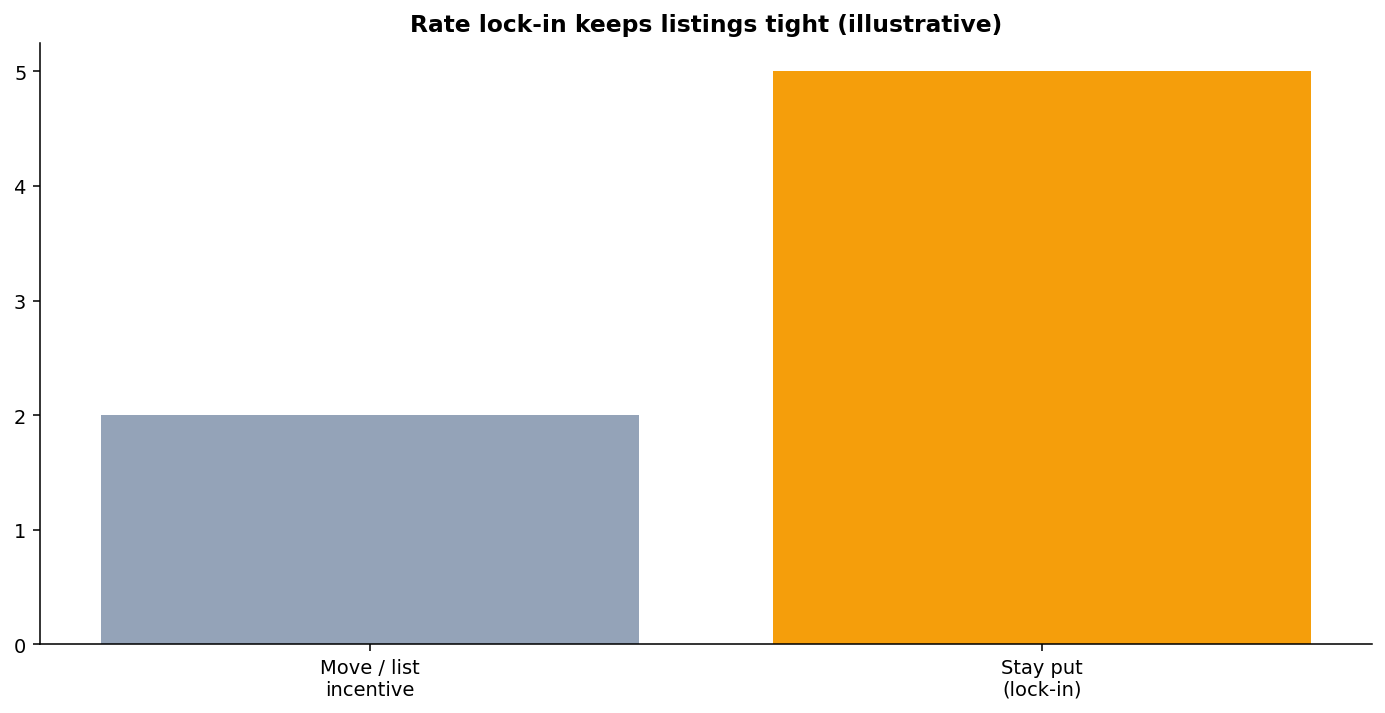
Households who locked rates in the 3%–5% world (or even mid-5s) face a steep payment reset if they sell and repurchase at ~7%. That gap is the lock-in effect. It reduces listings from “move-up” and “move-across” sellers — historically a big share of existing supply.
| Owner situation | Incentive to list now | Likely behavior into late 2026 |
|---|---|---|
| Low legacy rate, no forced move | Weak | Stay put; renovate or wait |
| Job / family relocation | Strong (necessity) | Sell; may rent on the other end |
| Investor with thin cash-flow cushion | Mixed | Selective sales; more rate-sensitive exits |
| Builder / new inventory | Business model | Keep selling with buydowns and incentives |
As long as market mortgage rates stay near 7%+, lock-in does not magically unwind. The Fed’s signal that another hike remains on the table for 2026 makes a fast unwind even less likely. That is the transmission from Wednesday’s decision to year-end housing churn — not a claim that the MLS went dark.
Inventory: tight where lock-in bites, patchy where new supply lands
National headlines about “low inventory” still describe many suburban and coastal owner-occupied markets. At the same time, some Sun Belt and high-construction corridors show more standing new inventory and longer absorption. The freeze metaphor is national in tone and local in texture:
- Lock-in constrained suburbs: few listings, sticky ask prices, slow negotiation.
- Builder-heavy metros: more choices, but effective rates depend on buydown fine print.
- Investor-heavy rentals: turnover follows leases and cap-rate math more than owner lock-in.
Rates near 7%+ are the other half of the freeze
Demand is not zero at 7%. It is rationed. Qualifying incomes rise, bidding pools shrink, and contingent buyers drop out when payment calculators break. Daily survey prints in the 7.00%–7.08% neighborhood on September 16 — with the 10-year Treasury recently near multi-year highs around ~5% — keep that rationing in force. Remember: the Fed sets the overnight funds range; mortgages follow longer yields and MBS spreads. A priced-in 25 bp hike can leave mortgages roughly steady and still leave the market frozen if those longer rates stay elevated on hawkish guidance.
For the near-term mortgage tape after the meeting, see why mortgage rates can hold steady above seven after a widely anticipated hike.
| Driver | Pre-meeting | Post-meeting implication |
|---|---|---|
| Fed funds target | Hike odds very high | Now 3.75%–4.00%; another hike possible in 2026 |
| 30-year mortgage surveys | Already ~7%+ | No automatic thaw; path depends on 10y/MBS |
| Owner lock-in | Already binding | Stays binding if market rates do not fall materially |
| Transaction volumes | Subdued vs. prior cycle | Likely stay subdued — not zero — through year-end |
How Warsh’s “higher for longer” message freezes expectations
Housing is a expectations market as much as a payment market. When the chair stresses credible inflation progress as a condition for pausing — and when dots still show room for additional firming — households update their mental model: do not plan on a quick return to 5% mortgages. That expectation itself reduces speculative listing and stretch buying. It is one reason the freeze can persist for “the rest of 2026” even if a single data print softens yields for a week.
- Buyers wait for a clearer downtrend in the 10-year — or negotiate harder on price.
- Sellers who can wait often do, rather than reset their payment.
- Lenders and builders compete on concessions and buydowns instead of relying on a rate rally.
What still moves in a “frozen” market
Even with low turnover, activity does not vanish. Watch these channels through year-end:
- New construction incentives — effective rates can differ from headline 30-year averages.
- Distressed and semi-distressed supply — still limited nationally, but local pockets appear when insurance, HOA, or job shocks hit.
- Cash and low-leverage buyers — relatively more powerful when financing is expensive.
- Rental demand — households who postpone buying often rent longer, supporting occupancy in many metros.
- Price vs. payment negotiation — sellers may hold list price while buying down the buyer’s rate.
Investors reading Norada coverage should treat “frozen” as a turnover and financing description. Cap rates, rent growth, and insurance costs still vary block by block. A higher-for-longer Fed path generally supports wider required yields — which can create entry points where motivated sellers meet patient capital — without requiring a national crash narrative.
Risks that could unfreeze the tape earlier
Metaphors break when the facts change. A faster thaw would likely need some mix of:
- A sustained drop in the 10-year and MBS yields that pulls 30-year quotes meaningfully below 7%.
- Clearer Fed signaling that the hiking cycle is done — not merely paused for one meeting.
- Labor-market softening that forces rate cuts (a different problem set for employment and rents).
- Policy or credit programs that change effective borrowing costs at the margin.
Wednesday’s package did not deliver that mix. It delivered confirmation of a hike plus openness to more firming. That is why the freeze framing fits the balance of 2026 better than a rebound story.
Builders, investors, and the thaw that is not a melt
New-home sellers have tools existing owners often lack: rate buydowns, incentives, and control over starts. That is why “frozen” never meant “no construction.” It means the existing-home conveyor belt runs slow while the new-home channel competes on payment engineering. Investors reading Wednesday’s Fed package should separate those channels instead of treating “housing” as one number.
- Existing homes: Lock-in plus 7%+ mortgages = fewer listings, longer marketing times, negotiation room that varies block by block.
- New homes: Activity can persist with incentives even while national turnover stays muted.
- Rentals: Tight for-sale turnover can support rents — until local oversupply or insurance costs overwhelm the story.
None of that requires claiming zero transactions. It requires planning for a 2026 finish line where financing stays expensive and churn stays selective. Pair this with the payment math in our affordability squeeze piece when you underwrite either a purchase or a hold.
Bottom line
Today’s Federal Reserve action keeps the housing market “frozen” for the rest of 2026 in the only sense that matters for planning: lock-in plus ~7%+ mortgages equal low churn. Transactions continue; the easy, high-velocity market does not. If you are buying, selling, or investing, underwrite the metaphor honestly — slow turnover, sticky financing, selective opportunity — and ignore any implication that the doors are literally locked.
The Fed’s rate decisions can create market volatility, but turnkey rentals continue to deliver reliable cash flow and appreciation. Investors in 2026 are focusing on real estate as a hedge against uncertainty.
Norada Real Estate helps you secure turnkey properties designed for immediate income and long‑term growth—so your portfolio stays strong regardless of Fed policy shifts.
Want to Know More?
Explore these related articles for even more insights:
- How Fed Rate Hikes Affect Your Wallet, Credit Cards, and Loans
- Goldman Sachs and J.P. Morgan Warn of an Imminent Fed Rate Hike This Week
- Fed Interest Rate Decision July 29, 2026: Rates Steady at 3.50-3.75%
- Interest Rate Predictions for the Next 5 Years: 2026-2030
- J.P. Morgan Predicts No Fed Rate Cuts Before 2027 as Inflation Persists
- Fed Interest Rate Predictions for the Next 3 Years: 2026-2028
- The Fed After Jerome Powell: Who Could Drive Rate Cuts in 2026?
- Why Your Loan Payment Isn’t Budging Despite Recent Fed Rate Cut
- How Does the Recent Fed Rate Cut Impact Your Personal Finances
- Fed Interest Rate Forecast for the Next 12 Months