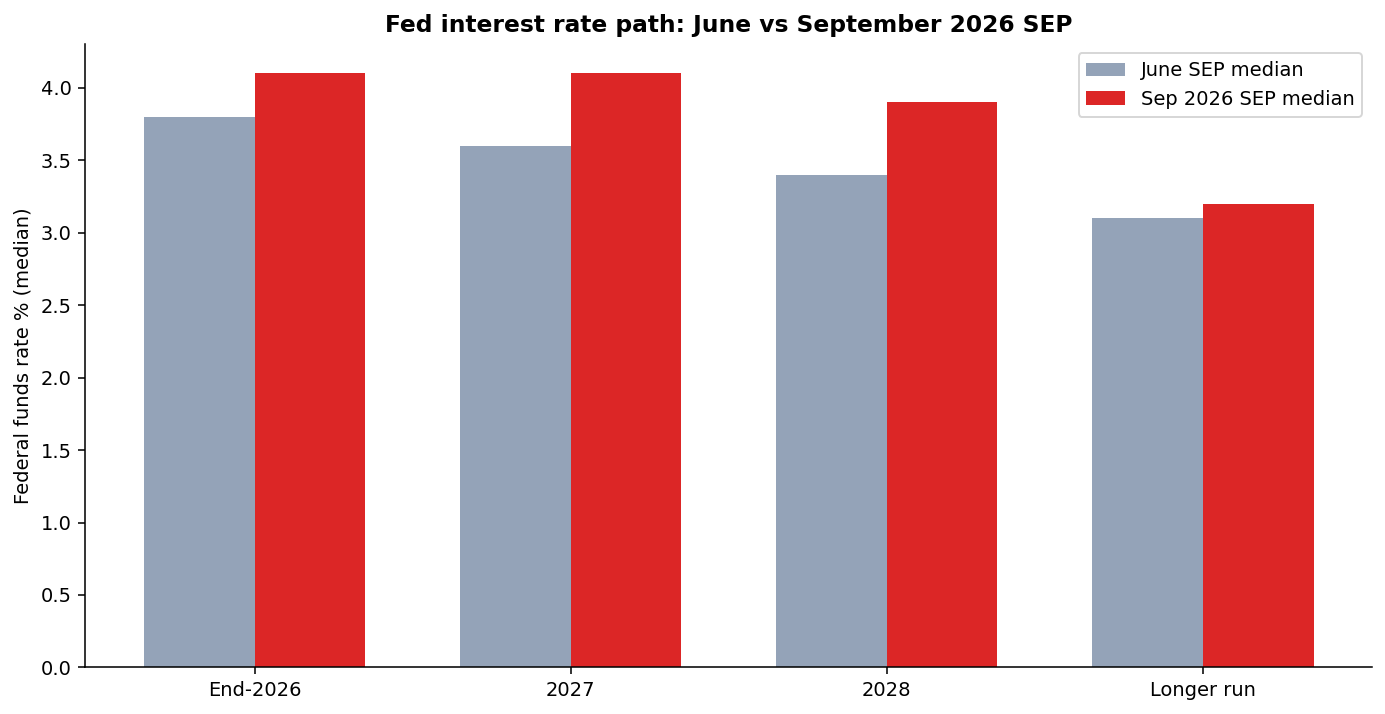
Here is the cleanest read of Fed interest rate predictions for the rest of 2026 after the September 15–16 FOMC meeting: officials already delivered a +25 basis point hike to a 3.75%–4.00% federal funds target range on September 16, and the median path in the Fed’s Summary of Economic Projections (SEP) points to about one more quarter-point increase before year-end. That median lands at 4.1% for end-2026—up from 3.8% in the June SEP—so markets and households should treat “one more hike” as the baseline prediction, not a one-and-done pause.
Two vocabulary notes up front. What traders call “interest rate predictions” usually blends (1) the Fed’s own SEP/dot-plot assessments of appropriate policy and (2) market-implied odds from futures. This piece centers the official September SEP figures and widely reported dot counts, then translates them for housing and borrowing. Dots are not a calendar appointment—but for the rest of 2026, they lean clearly toward another firming step under Chair Kevin Warsh.
Fed Interest Rate Predictions for the Rest of 2026
What changed on September 16
The policy decision itself was straightforward and, in reporting, widely anticipated:
- Action: Unanimous +25 bp hike to 3.75%–4.00% — the first increase in more than three years (last hike July 2023).
- Chair: Kevin Warsh, who has publicly distanced himself from heavy forward guidance and, per reporting, has not submitted his own SEP rate “dot.”
- Signal beyond the hike: The accompanying SEP marked up the funds-rate path versus June, and a large majority of submitting officials favored at least one additional 2026 increase.
For the statement-level wrap of why the Fed moved, see our coverage of the first hike in over three years and Warsh’s higher-for-longer press conference.
SEP medians: the official “prediction” grid
The September SEP’s median federal funds rate (year-end midpoints of participants’ appropriate-policy assessments) is the cleanest single table for rest-of-2026 planning:
| Horizon | Sept. 2026 median | June 2026 median | What it implies |
|---|---|---|---|
| End-2026 | 4.1% | 3.8% | About one more 25 bp hike after September’s move to 3.75%–4.00% |
| End-2027 | 4.1% | 3.6% | Rates still elevated a year later—not a swift cut cycle |
| End-2028 | 3.9% | 3.4% | Only gradual easing later in the decade of the forecast |
| Longer run | ~3.2% | ~3.1% | Neutral-ish destination still well below today’s path |
Source: Federal Reserve September 16, 2026, FOMC projections materials (SEP Table 1), compared with the June 2026 SEP. Medians are not promises; they are the middle of participants’ individual appropriate-policy assessments conditional on their forecasts.
How “4.1%” maps to another hike
After September 16, the target range is 3.75%–4.00% (midpoint 3.875%). A median year-end projection of 4.1% is the conventional SEP shorthand for a midpoint consistent with a 4.00%–4.25% range—i.e., one additional 25 bp step. That is the operational interest-rate prediction for the rest of 2026 embedded in the median: not three more hikes, not a cut, and not a guaranteed hold.
What the dots said beyond the median
Medians hide disagreement. Reporting on the September dot plot (18 participants submitting; Warsh not submitting a dot, per major wire coverage) sketched a hawkish majority for the remainder of 2026:
- A large majority—reported as 16 of 18—saw at least one more hike in 2026.
- Within that group, coverage described roughly a dozen officials at one additional hike (the median) and a smaller cluster at two more.
- Only a small minority treated the September hike as the last move of the year.
For a dedicated walk-through of that grid, pair this article with Fed Dot Plot Projections Signal One Additional Interest Rate Hike in 2026. The headline takeaway for rest-of-year planning is the same: baseline = one more quarter point; upside risk = a second hike if inflation stays sticky.
Why the path was marked higher than in June
SEP rate predictions move when the macro forecasts under them move. In the September materials, the funds-rate markup sat alongside:
- Inflation still elevated: Median PCE inflation for 2026 at 3.7% (June 3.6%); core PCE 3.4% (June 3.3%), with a return to 2% stretched further out the horizon.
- Growth holding up: Median real GDP growth for 2026 edged to 2.3% from 2.2% in June.
- Labor market still firm: Median unemployment for end-2026 at 4.1%, lower than June’s 4.3% median.
That combination—sticky prices, solid activity, low unemployment—is exactly when FOMC participants prefer a firmer path to a premature pause. Warsh’s press-conference emphasis on a “timelier” return to 2% and skepticism that financial conditions were already restrictive enough fits the same story, without inventing quotes beyond what reporting attributes.
Predictions vs projections vs market odds
Readers searching “Fed interest rate predictions” often want a single number. Useful hierarchy:
- SEP / dots (official assessments): Median end-2026 4.1% → about one more hike. Best for “what does the Fed say is appropriate if their forecast is right?”
- Chair tone: Warsh’s higher-for-longer framing can matter as much as the median for how bonds digest the package.
- Market-implied probabilities: Fed funds futures reprice after every CPI, PCE, and jobs print. They can price more or less than one hike even when the median sits at 4.1%.
Front-end Treasuries are a live translator of that mix—see how the 2-year adjusted to hawkish Fed forecasts after the decision week.
What this means for mortgages and housing
Critical reminder: the Fed sets the overnight funds range; it does not set 30-year mortgage rates one-for-one. Purchase and refinance quotes still track the 10-year Treasury, mortgage-backed securities spreads, and lender capacity. After the priced-in hike, survey averages for 30-year fixed mortgages were still roughly 7%+ (recent wraps cited a band near ~7.00%–7.08%).
| Rate channel | How rest-of-2026 Fed predictions matter |
|---|---|
| 30-year fixed mortgages | Sensitive to the path and inflation premium—not just today’s 25 bp. A credible “one more hike / higher for longer” SEP can keep long yields firm and hold quotes above 7%. |
| ARMs, HELOCs, prime-linked credit | More direct to the funds/prime path. Another 25 bp later in 2026 shows up in resets (see prime-rate timing). |
| Housing turnover | Lock-in plus ~7%+ purchase money keeps churn low even if equities finish mixed—covered in why Fed action keeps housing “frozen” (low turnover) for the rest of 2026. |
For payment and affordability math under that backdrop, see mortgages holding above seven after the hike and the homebuyer affordability squeeze.
Investor checklist for the rest of 2026
- Underwrite the median, stress the hawkish tail. Base case: funds near a 4.00%–4.25% year-end range. Stress: a second hike if inflation reprints hot.
- Do not wait for the funds rate to “fix” your mortgage. Fixed notes can stay expensive while the overnight rate only inches higher.
- Floating debt: Model prime/HELOC costs one and two steps higher than today’s post-hike level.
- Cash / HYSA: A firmer SEP path supports still-elevated savings yields with the usual bank lag—see what the hike to 4% means for HYSA yields.
- Watch the data, not the calendar. October and December meetings will reprice on inflation and labor prints, not on the September median alone.
Scenarios that could rewrite the rest-of-year prediction
SEP medians age. Three broad scenarios for the remainder of 2026:
- Baseline (median holds): One more 25 bp hike; year-end funds midpoint near 4.1%; mortgages stay sticky near or above 7% if the 10-year does not rally hard.
- Hotter inflation / easy financial conditions: Odds of a second extra hike rise; long yields and mortgage quotes face upside risk even if housing demand softens.
- Disinflation or growth scare: The December (or earlier) hike can be deferred; dots would likely revise lower at the next SEP—but that is a data-dependent rewrite, not the September baseline.
Bottom line
Fed interest rate predictions for the rest of 2026, read through the September SEP, are straightforward: after the hike to 3.75%–4.00%, the median path at 4.1% implies about one more 25 bp increase before year-end, with 2027 still at 4.1% and only gradual easing later (2028 3.9%, longer run ~3.2%). A large majority of submitting officials favored at least one additional 2026 hike. For real-estate readers, translate that as higher-for-longer overnight policy and still-elevated mortgage quotes—not an automatic step-down in 30-year rates just because the Fed already moved once in September.
The Fed’s rate decisions can create market volatility, but turnkey rentals continue to deliver reliable cash flow and appreciation. Investors in 2026 are focusing on real estate as a hedge against uncertainty.
Norada Real Estate helps you secure turnkey properties designed for immediate income and long‑term growth—so your portfolio stays strong regardless of Fed policy shifts.
Want to Know More?
Explore these related articles for even more insights:
- How Fed Rate Hikes Affect Your Wallet, Credit Cards, and Loans
- Goldman Sachs and J.P. Morgan Warn of an Imminent Fed Rate Hike This Week
- Fed Interest Rate Decision July 29, 2026: Rates Steady at 3.50-3.75%
- Interest Rate Predictions for the Next 5 Years: 2026-2030
- J.P. Morgan Predicts No Fed Rate Cuts Before 2027 as Inflation Persists
- Fed Interest Rate Predictions for the Next 3 Years: 2026-2028
- The Fed After Jerome Powell: Who Could Drive Rate Cuts in 2026?
- Why Your Loan Payment Isn’t Budging Despite Recent Fed Rate Cut
- How Does the Recent Fed Rate Cut Impact Your Personal Finances
- Fed Interest Rate Forecast for the Next 12 Months