Yes—the Federal Reserve’s new benchmark range tops out at 4.00%. On September 16, 2026, the Fed raised the federal funds target by 25 basis points to 3.75%–4.00%, so “hike to 4 percent” in headlines refers to the top of that range, not a single point rate stamped onto your bank account. For high-yield savings (HYSA) and short Treasury bill savers, that distinction matters: your APY is set by your bank or by auction results, not by a Fed decree on your statement.
Here is what cash savers should expect after the decision—how quickly yields can move, why marketing APYs lag reality, and how to shop without confusing overnight policy with the rate you actually earn.
What the Fed Rate Hike to 4% Means for Your High Yield Savings Account Today
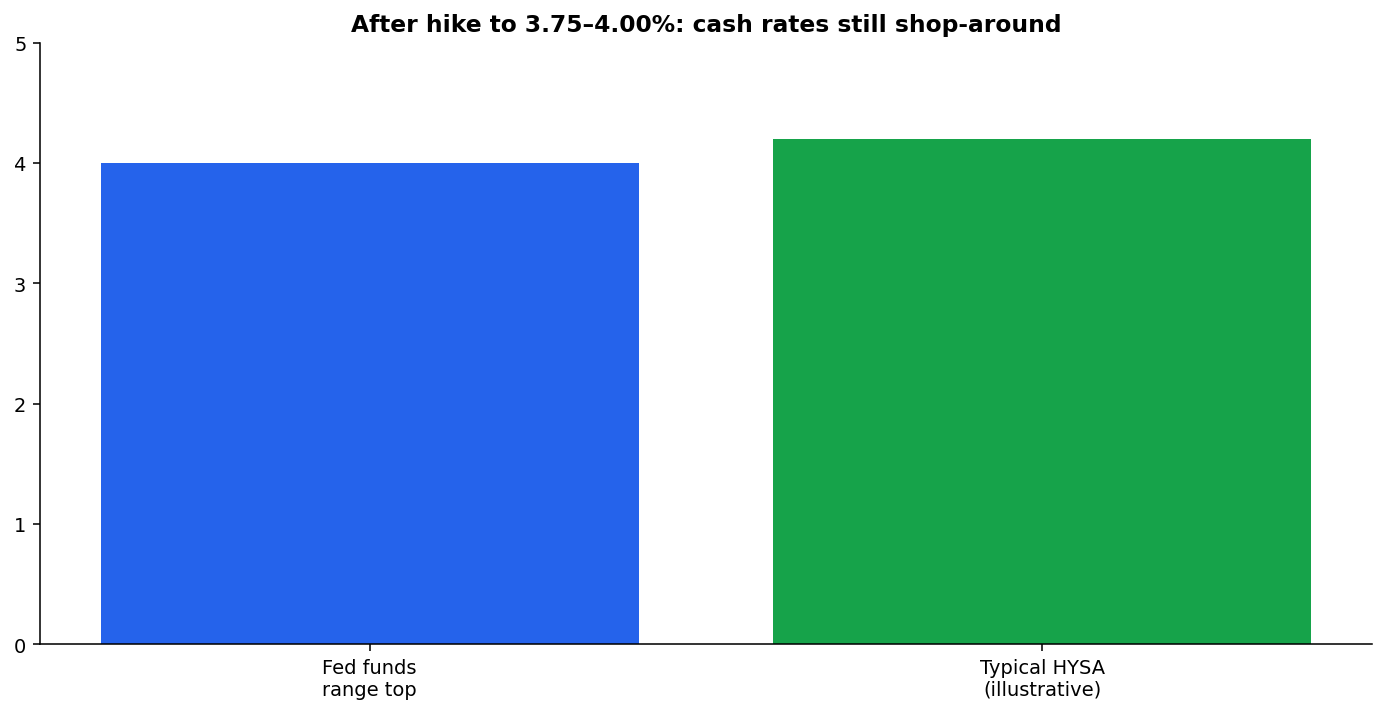
Clarify the range: 3.75%–4.00%, top at 4%
The Fed does not publish one official “savings rate.” It sets a target range for overnight lending among banks. After Wednesday’s unanimous hike—the first since July 2023—that range is:
- Floor: 3.75%
- Ceiling: 4.00%
Money-market conditions and administered rates (interest on reserves, overnight reverse repo, and related facilities) are steered so the effective federal funds rate usually trades inside that band. Online banks and credit unions then decide what to pay depositors. Some pass through hiking cycles quickly to win deposits; others drag their feet.
Why HYSA yields are tied more to fed funds than mortgages are
Fixed mortgage rates mainly follow the 10-year Treasury and mortgage bond spreads. Cash yields are different. Banks fund themselves in short-term markets that reprice with the policy rate. When the Fed hikes, the opportunity cost of holding non-interest deposits rises, and competitive online HYSAs often lift APYs—eventually.
That is why savers felt the 2022–2023 hiking cycle in their savings accounts more directly than many homeowners felt it in a locked 30-year rate. The reverse is also true on the way down: when the Fed cuts, HYSA APYs usually fall faster than a fixed mortgage payment changes.
For context on the broader policy reset, see our overview of the first hike in over three years.
What to expect in the days and weeks after a 25 bp hike
Do not expect your APY to jump 0.25 percentage points at 2:01 p.m. on decision day. Typical patterns after a widely expected hike look like this:
| Product | Typical timing after a Fed hike | What drives it |
|---|---|---|
| Overnight money-market / some brokerage cash sweeps | Days to a couple of weeks | Closely track short rates and fund yields |
| Competitive online HYSAs | Often 1–4 weeks (varies widely) | Deposit competition, bank funding needs, marketing calendars |
| Big brick-and-mortar savings | Slow or partial pass-through | Less need to bid aggressively for deposits |
| Treasury bills (4-week to 1-year) | At each auction / secondary market mark | Market pricing of the policy path, not your bank’s flyer |
Because this hike was largely priced in, some of the move may already be reflected in short bill yields and in the best advertised HYSAs. The remaining question is pass-through: will your specific bank match peers, or keep a wider spread?
Marketing APY vs. the rate you actually earn
Advertised APYs are a starting point, not a guarantee of what you keep after fine print. Watch for:
- Introductory or “relationship” rates that expire or require a checking link, debit activity, or balance tiers.
- Balance caps — a headline APY that applies only up to a stated balance, with a lower rate above that.
- Variable rate language — HYSAs can change APY at any time; a Fed hike does not legally force your bank higher.
- Compounding and APY math — APY already annualizes compounding; compare APY to APY, not APY to a simple interest quote.
If a bank’s marketing still shows last month’s rate the morning after a hike, that is normal. Update cycles and compliance reviews take time. The actionable move is to check the rate after login or on the current disclosures page, not only the homepage banner.
How T-bill savers should think about the same hike
Short-term Treasury bills are a close cousin of “Fed-linked” cash. When the policy rate rises and markets price a higher path—including reporting that officials see another move toward roughly 4.00%–4.25% by year-end—bill discounts and investment rates reprice in the market. You do not wait for a bank committee.
Trade-offs versus an HYSA:
- T-bills — State-tax advantages on interest for many filers, auction clarity, but you lock a term (or trade secondary). Not FDIC bank insurance; they are government obligations.
- HYSA — FDIC/NCUA insurance within limits, daily liquidity, but bank spread and lag risk.
- Money market funds — Often track policy quickly; know the fund type (government vs. prime) and that structures differ from a bank deposit.
None of these is automatically best. Liquidity needs, tax situation, and whether you might need the cash for a home purchase or renovation should drive the mix.
A simple shopping checklist after this hike
- List your current APY and any balance caps — save the disclosure dated after September 16.
- Compare at least three online HYSAs with the same balance assumption; ignore signup bonuses until the base APY is competitive.
- Check a short T-bill or Treasury ladder if you can lock funds for weeks or months.
- Revisit in 2–3 weeks — that is often when slower banks finish catch-up adjustments after a FOMC move.
- Do not confuse mortgage headlines with savings headlines — 30-year averages near the low-7% area are a different market from your cash APY.
What “higher for longer” means for cash strategy
Chair Kevin Warsh’s post-meeting message, as covered by major wires, leaned on sticky inflation and a willingness to remove accommodation because financial conditions did not look broadly restrictive. The September dot plot also pointed, in median reporting, to one more hike in 2026. For savers, that environment usually supports still-elevated cash yields—but it also means you should not assume a rapid return to the ultra-low APY era.
It does not mean every bank will pay 4%. Banks earn a spread. Top-tier online HYSAs may sit near or somewhat below the funds range depending on competition; laggards can sit well under it. Your job is to make them compete.
What this post is not about
This piece is deliberately not a mortgage deep dive. If you are locking a purchase or refinance, focus on the 10-year and lender quotes—not your HYSA APY. For variable borrowing costs that do track the Fed more closely, see how prime rates ripple into cards and HELOCs.
Bottom line for HYSA holders today
The Fed’s benchmark now sits at 3.75%–4.00%, with the widely quoted “4 percent” referring to the top of the range. That is constructive for cash yields over the coming weeks, especially if another hike remains on the table. Treat advertised APYs skeptically, expect lags, and shop—or shift a portion into short Treasuries—rather than waiting for your current bank to volunteer a full pass-through.
The Fed’s rate decisions can create market volatility, but turnkey rentals continue to deliver reliable cash flow and appreciation. Investors in 2026 are focusing on real estate as a hedge against uncertainty.
Norada Real Estate helps you secure turnkey properties designed for immediate income and long‑term growth—so your portfolio stays strong regardless of Fed policy shifts.
Want to Know More?
Explore these related articles for even more insights:
- How Fed Rate Hikes Affect Your Wallet, Credit Cards, and Loans
- Goldman Sachs and J.P. Morgan Warn of an Imminent Fed Rate Hike This Week
- Fed Interest Rate Decision July 29, 2026: Rates Steady at 3.50-3.75%
- Interest Rate Predictions for the Next 5 Years: 2026-2030
- J.P. Morgan Predicts No Fed Rate Cuts Before 2027 as Inflation Persists
- Fed Interest Rate Predictions for the Next 3 Years: 2026-2028
- The Fed After Jerome Powell: Who Could Drive Rate Cuts in 2026?
- Why Your Loan Payment Isn’t Budging Despite Recent Fed Rate Cut
- How Does the Recent Fed Rate Cut Impact Your Personal Finances
- Fed Interest Rate Forecast for the Next 12 Months