U.S. stocks finished September 16, 2026, in muted, mixed fashion after the Federal Reserve delivered a widely expected 25-basis-point hike to a 3.75%–4.00% funds target range. The Nasdaq Composite and S&P 500 posted modest gains; the Dow Jones Industrial Average finished roughly flat to slightly lower. That is a “rally” only in the soft sense—risk assets did not melt up, and they did not crash 500 Dow points either.
Here is a precise read of the session, why an expected hike can coexist with small equity gains, and what the tape means for longer-term investors and housing-linked trades.
Stock Market Rises as Nasdaq and S&P 500 Rally Following Expected Fed Rate Hike
What the indexes actually did
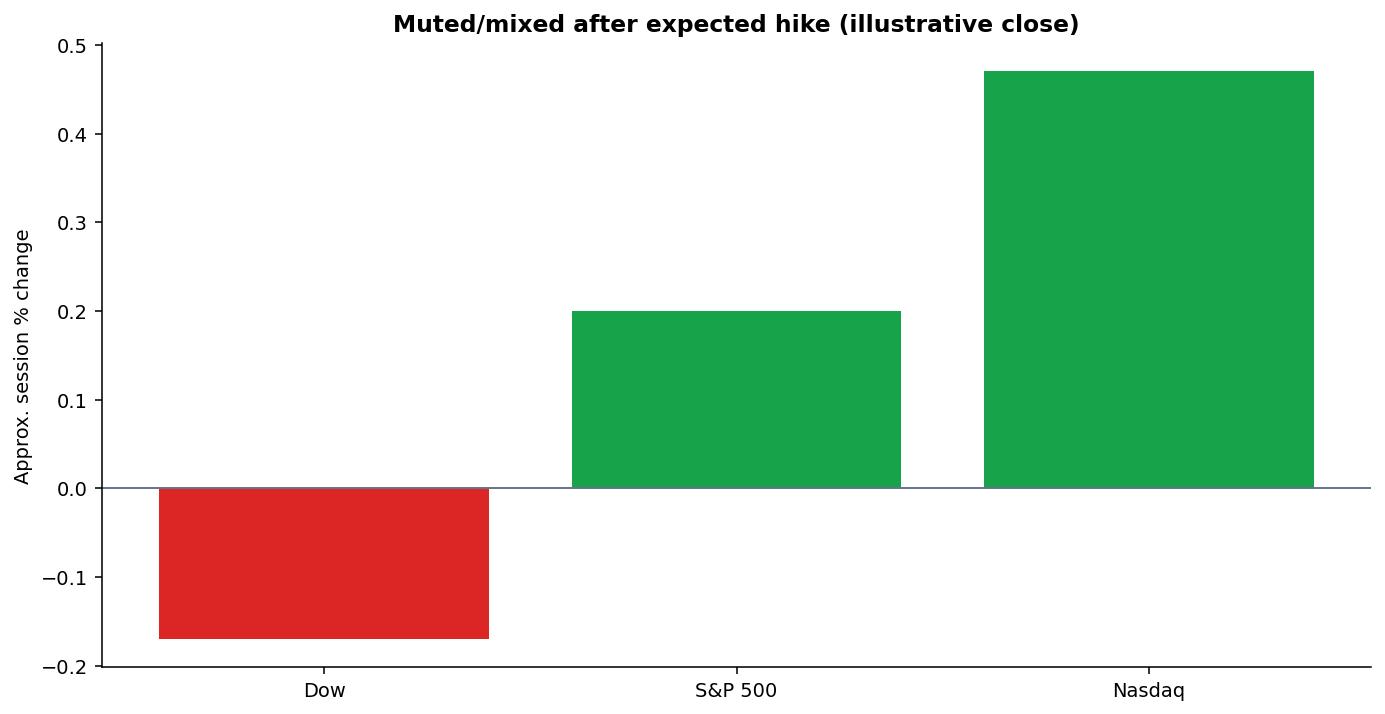
Session wrap figures reported across market coverage for September 16 showed roughly the following pattern (percentages vary slightly by exact close stamp and data vendor):
| Index | Session tone | Approximate change cited in coverage |
|---|---|---|
| Nasdaq Composite | Modestly higher | On the order of ~0.5% (some intraday/wire prints near ~0.5%–0.7%) |
| S&P 500 | Modestly higher | On the order of ~0.2%–0.3% |
| Dow Jones Industrial Average | Soft / slightly down | On the order of about –0.2% |
One widely circulated wrap put the Dow near 52,002 (about 91 points lower), the S&P 500 near 7,601 (modestly higher), and the Nasdaq near 26,102 (modestly higher). Treat those levels as session context from reporting—not as a permanent scoreboard. The investment takeaway is the shape of the day: tech-heavy indexes firmer, blue-chip Dow softer, overall volatility contained.
Why stocks can rise on a hike day
It sounds backwards until you separate the decision from the surprise. Markets had heavily priced a 25 bp move into the meeting. When the Fed does what futures already assumed, equities often trade the guidance and the growth outlook more than the mechanical overnight increase.
Several supports showed up in coverage of Wednesday’s tape:
- No shock hike — A 50 bp surprise would have been a different day.
- Unanimous vote — Reduced fears of a chaotic Committee.
- Growth not collapsing — Warsh and the SEP described a firm economy even while fighting inflation (see our presser takeaways).
- Sector mix — Mega-cap and growth names can outperform industrials on a day when the Dow lags.
None of that cancels higher-for-longer risk. It simply explains why “Fed hikes, stocks up a fraction” is common when the hike is pre-digested.
What did not happen
It is worth stating clearly for readers scrolling panic headlines:
- This was not a 500-point Dow crash narrative.
- This was not a euphoric melt-up that implies the Fed has turned dovish.
- Bond yields remained an active constraint—coverage into the decision had already highlighted very firm Treasury yields, including a 10-year that had recently traded near multi-year highs before stabilizing around the announcement.
In other words, equities digested an expected policy step while still living in a high-real-rate world.
How the Fed package colored risk appetite
Beyond the 25 bp print, investors parsed three inputs:
- The statement — Framed the hike as supporting a timelier return to 2% inflation and moved away from blaming prices only on temporary supply shocks.
- The dots — Reporting that a large majority of officials still see one more 2026 hike, with a path toward ~4.00%–4.25%, capped how far rate-cut optimism could run.
- Warsh’s tone — Comments reported by Reuters—that financial conditions did not look broadly restrictive and that inflation remains the problem—kept a hawkish tint on an otherwise orderly session.
That combination often produces exactly what we saw: small gains in indexes that benefit from earnings-growth narratives, softer action in more rate-sensitive or cyclical Dow constituents, and limited follow-through drama after the press conference.
Rate-sensitive corners: housing, REITs, and regional banks
Equity indexes are not the housing market. Even when the S&P ekes out a quarter-percent gain, homebuyers still face 30-year mortgage averages near the ~7.00%–7.08% range reported in September 16 surveys. Publicly traded homebuilders, mortgage REITs, and some regional banks can trade on the same day’s yield moves more than on the funds rate label.
Practical split:
- Equity index level — Modest Nasdaq/S&P bid on an expected hike.
- Mortgage quote — Still governed by the 10-year and MBS spreads; Fed does not set it directly.
- Variable consumer credit — Reprices via prime on a short lag (see prime ripple timing).
What investors should take away (without overtrading the day)
A single FOMC session is a poor reason to rebuild an entire portfolio. Still, Wednesday reinforced a few durable points:
- Policy is tightening again — First hike since July 2023; details in our decision explainer.
- The path still skews higher — Dots and Warsh’s framing argue against an imminent ease cycle.
- Cash still pays — Elevated overnight rates support HYSA/T-bill strategies even when stocks grind higher; see what the 4% top of range means for savings.
- Valuations still face a rate hurdle — Modest index gains do not erase the discount-rate math of higher-for-longer policy.
How to read the next few sessions
Post-FOMC weeks often see two-way trade as algorithms fade the first move and humans reassess the dots. Watch whether the Nasdaq’s relative strength holds if Treasury yields back up again, and whether Dow lagging reflects energy/industrial noise or a broader preference for growth over cyclicals. Oil and geopolitical headlines—already part of the 2026 inflation story—can dominate the Fed narrative on any given morning.
Sector texture beneath the headline indexes
Index-level calm can hide rotation. On expected-hike days, investors often favor cash-flow visibility and underweight the most duration-sensitive slices of the market. Technology’s outperformance versus the Dow on September 16 fits a familiar pattern when mega-cap balance sheets look able to absorb higher discount rates—at least for one session. Equal-weight S&P versions and small caps frequently tell a sterner story than the cap-weighted S&P 500 when financial conditions tighten; check those under the hood before declaring broad risk-on.
Financials can split as well. Larger banks may benefit from a steeper net-interest narrative when policy rates rise, while valuation multiples still wrestle with credit-quality worries if higher rates eventually slow the consumer. Regional banks, still judged through the lens of deposit competition and securities marks, do not automatically rally just because the Nasdaq does.
International and dollar context
Wire coverage after the announcement noted a firmer dollar against the euro as markets digested tighter U.S. policy. A stronger dollar can pressure multinational earnings translation and weigh on commodities priced in dollars—another reason a quiet S&P close is not a green light for every risk book globally. Emerging-market assets often feel U.S. hiking cycles through the dollar and local financing costs more than through the Dow’s daily point change.
For U.S. real-estate investors comparing domestic deals to overseas opportunities, Wednesday’s message is less about one equity session and more about relative policy paths: the Fed is willing to hike again while inflation stays sticky, which keeps U.S. capitalization-rate and financing assumptions anchored to a higher-for-longer regime.
Bottom line
Calling September 16 a stock-market “rally” is fair only if you keep the adjectives honest: Nasdaq and S&P rose modestly after an expected Fed hike, while the Dow was mixed to slightly down. The bigger story sits outside the percent signs—the Fed is hiking again, officials still signal another 2026 move, and financial conditions remain a live debate. Position for that path, not for a mythical crash or melt-up that the tape did not deliver.
The Fed’s rate decisions can create market volatility, but turnkey rentals continue to deliver reliable cash flow and appreciation. Investors in 2026 are focusing on real estate as a hedge against uncertainty.
Norada Real Estate helps you secure turnkey properties designed for immediate income and long‑term growth—so your portfolio stays strong regardless of Fed policy shifts.
Want to Know More?
Explore these related articles for even more insights:
- How Fed Rate Hikes Affect Your Wallet, Credit Cards, and Loans
- Goldman Sachs and J.P. Morgan Warn of an Imminent Fed Rate Hike This Week
- Fed Interest Rate Decision July 29, 2026: Rates Steady at 3.50-3.75%
- Interest Rate Predictions for the Next 5 Years: 2026-2030
- J.P. Morgan Predicts No Fed Rate Cuts Before 2027 as Inflation Persists
- Fed Interest Rate Predictions for the Next 3 Years: 2026-2028
- The Fed After Jerome Powell: Who Could Drive Rate Cuts in 2026?
- Why Your Loan Payment Isn’t Budging Despite Recent Fed Rate Cut
- How Does the Recent Fed Rate Cut Impact Your Personal Finances
- Fed Interest Rate Forecast for the Next 12 Months