Kevin Warsh’s line — “inflation is a choice” — is a real quote from his confirmation and testimony-era framing of price stability as a deliberate policy stance, not an accident that happens to central bankers. On Wednesday, September 16, 2026, that philosophy sits in the background of a Federal Reserve decision markets still treat as nearly locked: roughly 93% to 94.5% odds of a rate hike before the statement around 2:00 p.m. ET. The quote does not announce the vote. It helps explain why so many investors hear today’s meeting as a credibility test.
Until the FOMC publishes the target range, a hike remains the base case — highly probable, not yet official. This article unpacks what Warsh’s phrase means, how it maps onto today’s setup, and what households and real-estate investors should watch when the statement lands.
Kevin Warsh Inflation Is a Choice Quote Signals a Certain Interest Rate Hike Today
“Certain” in markets is a feeling, not a fact. Futures can sit in the mid-90s and still be wrong. What Warsh’s quote signals is a mindset: if inflation persists because policy is too tolerant, then failing to tighten is itself a choice with consequences. That mindset aligns with why traders have priced a hike so aggressively into this afternoon.
For the dissenting economist view, see why some leading economists call the expected hike a policy mistake. For distributional costs if the hike arrives, see lower-income consumer impacts.
What “inflation is a choice” actually claims
In confirmation and testimony context, Warsh’s formulation compresses a classical central-banking idea into a sound bite:
- Price stability is a mandate outcome, not a residual after fiscal policy, geopolitics, and corporate pricing finish their work
- Tolerance is policy: allowing high inflation to linger is as much a decision as hiking to contain it
- Credibility compounds: if households and firms believe the Fed will choose disinflation, expectations help do some of the work
That is why the quote travels well on decision days. It frames a hike not as optional fine-tuning but as the visible expression of choosing lower inflation over easier financial conditions.
| Phrase element | Policy implication | How markets hear it on hike day |
|---|---|---|
| “Inflation” | Focus on price stability mandate | CPI/PCE path still justifies action |
| “Is a choice” | Agency of the central bank | Hold would look like choosing tolerance |
| Testimony / confirmation context | Public commitment language | Reinforces hawkish reaction function |
Why the quote resonates with today’s pre-2 p.m. ET setup
Three ingredients make Warsh’s line feel especially relevant this morning:
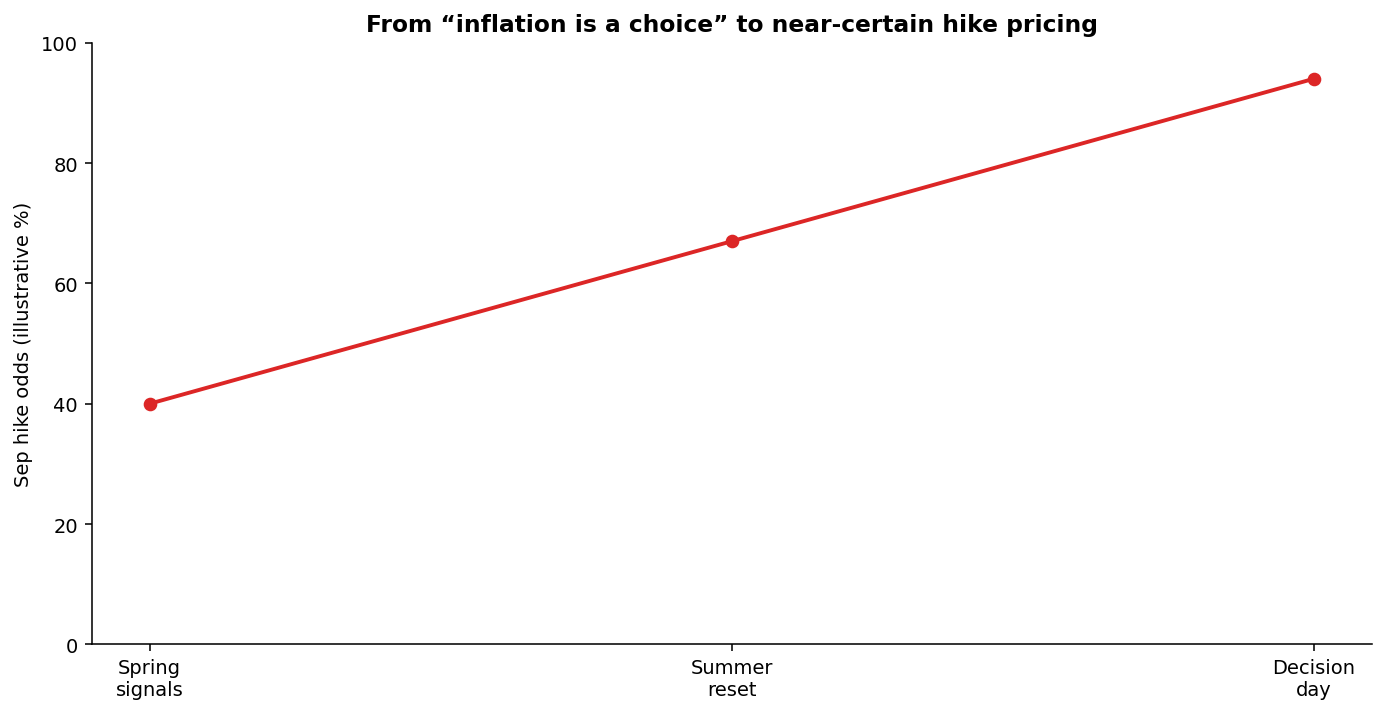
- High implied odds: When markets assign ~93–94.5% probability to a hike, they are saying the Fed’s reaction function looks decisive
- Communication risk: On a day this telegraphed, a hold would be read as a choice to surprise — and Warsh-style framing would label that choice as softer on inflation
- Political economy: “Inflation is a choice” is also a critique of delay: waiting for perfect data can become a decision to live with high prices longer
None of that replaces the statement. It explains the narrative gravity pulling toward a hike.
Warsh’s framing vs the supply-shock critique
Not everyone buys the “choice” framing as the full story. Economists who warn that hiking into supply-shock inflation can be a mistake — Mark Zandi among those who have raised that concern in recent cycles — argue that some price spikes are not primarily a willpower failure at the central bank. If shortages, tariffs, or sector bottlenecks dominate, treating every uptick as a demand choice can lead to overtightening.
| Lens | Core claim | Preferred marginal move (stylized) |
|---|---|---|
| Warsh-style “choice” | Inflation persists when policy allows it | Err toward tighter policy / credibility |
| Supply-shock caution | Wrong tool for non-demand shocks | Pause / target supply; avoid overkill |
| Market consensus today | Fed reaction function points to hike | +25 bp widely expected pre-announcement |
Readers can hold both ideas at once: inflation outcomes involve policy choices and supply realities. The debate is about which story dominates the September 2026 data mix — and whether another hike is the right expression of the mandate.
What a “credibility hike” would mean in practice
If the Fed delivers the expected 25 bp increase later today, the Warsh-aligned reading is: officials chose to reinforce restriction rather than gamble on patience. Practical channels:
- Fed funds target range steps higher (markets have been pointing toward a move in the neighborhood of 3.75%–4.00% if the quarter-point arrives)
- Prime-linked credit can follow, affecting cards and many HELOCs over subsequent statement cycles
- Financial conditions may tighten modestly if the hike was not fully priced in the long end — or barely move if it was
- Press conference language decides whether this is “one more for insurance” or “we are not done”
If they hike as expected
Stocks and bonds may shrug at the binary outcome and trade the guidance. Housing quotes will depend more on the 10-year and mortgage spreads than on the overnight print alone. Households should still inventory variable-rate debt — the “choice” to hike becomes their APR reality with a lag.
If they shock markets with a hold
A hold would collide with the Warsh narrative in the media within minutes: Did the Fed choose patience — or choose higher inflation risk? Our scenario guide walks through that low-odds path in what happens if the Fed shockingly does not raise rates today.
Investors and homebuyers: translate philosophy into a checklist
- Do not trade the quote — trade the statement. Warsh’s line is interpretive context, not a leak of the vote
- Watch the first sentence of the directive for the target range; everything else is commentary
- Listen for “choice” synonyms in the chair’s answers: resolve, commitment, willingness to act
- Re-check mortgage locks and lender quotes after the announcement rather than assuming national averages equal your deal
- Map your variable debt (cards, HELOCs, ARMs) so a credibility hike does not surprise your budget
| Audience | What “inflation is a choice” implies today | Actionable focus after 2 p.m. ET |
|---|---|---|
| Stock / bond traders | Hawkish reaction function | Path of dots / guidance, not just binary hike |
| Homebuyers | Policy still prioritizing disinflation | Fresh lender quotes; lock strategy |
| Cash savers | Higher-for-longer still plausible | HYSA / T-bill APY check |
| Revolving debtors | Prime may step up if hike lands | APR terms and payoff plan |
How this fits the rest of decision-day coverage
Norada’s Fed-day cluster is meant to be read as a set:
- Warsh quote and hike narrative (this post)
- Economist warnings of a policy mistake
- Lower-income transmission channels
- Shock hold contingency
Together they cover the expected path, the critique, the household incidence, and the upset scenario — without inventing a vote that has not been released.
Reading the press conference through a “choice” lens
If the Fed hikes as expected, the chair’s Q&A will still matter more than the binary outcome. Listen for whether officials describe inflation progress as sufficient to slow the pace later — or as incomplete enough that further restriction remains on the table. Warsh’s quote is useful here as a decoder ring: answers that emphasize agency, mandate, and willingness to act fit the “choice” frame; answers that emphasize exogenous shocks and waiting for supply healing fit the caution frame.
Either way, do not confuse a telegraphed 25 bp move with the end of the story. Path guidance, the Summary of Economic Projections if released, and the tone around labor-market risk will set mortgage psychology and credit pricing for the rest of September.
Bottom line
Kevin Warsh’s real quote, “inflation is a choice,” from confirmation and testimony context, frames price stability as an intentional policy stance. On a morning when markets still assign roughly 93%–94.5% odds to a Fed hike, that framing helps explain why a quarter-point move feels “certain” to many traders. Certainty ends when the statement prints around 2:00 p.m. ET. Until then, treat the quote as a lens — and the announcement as the only scoreboard that counts.
The Fed’s rate decisions can create market volatility, but turnkey rentals continue to deliver reliable cash flow and appreciation. Investors in 2026 are focusing on real estate as a hedge against uncertainty.
Norada Real Estate helps you secure turnkey properties designed for immediate income and long‑term growth—so your portfolio stays strong regardless of Fed policy shifts.
Want to Know More?
Explore these related articles for even more insights:
- How Fed Rate Hikes Affect Your Wallet, Credit Cards, and Loans
- Goldman Sachs and J.P. Morgan Warn of an Imminent Fed Rate Hike This Week
- Fed Interest Rate Decision July 29, 2026: Rates Steady at 3.50-3.75%
- Interest Rate Predictions for the Next 5 Years: 2026-2030
- J.P. Morgan Predicts No Fed Rate Cuts Before 2027 as Inflation Persists
- Fed Interest Rate Predictions for the Next 3 Years: 2026-2028
- The Fed After Jerome Powell: Who Could Drive Rate Cuts in 2026?
- Why Your Loan Payment Isn’t Budging Despite Recent Fed Rate Cut
- How Does the Recent Fed Rate Cut Impact Your Personal Finances
- Fed Interest Rate Forecast for the Next 12 Months