The Federal Reserve on Wednesday, September 16, 2026, raised its benchmark federal funds target range by 25 basis points to 3.75%–4.00%—the first increase since July 2023 and the first major policy tightening under Chair Kevin Warsh. The vote was unanimous. Officials framed the move as support for a “timelier” return of inflation to the Committee’s 2% goal after price pressures stayed sticky enough that another hold no longer looked credible.
For households, investors, and anyone watching housing costs, the overnight hike is only half the story. The bigger shift is the message: policy is no longer waiting on the sidelines while inflation drifts. Below is what changed, why the Fed moved, and what comes next—including the dot-plot signal for one more hike in 2026.
Federal Reserve Announces First Rate Hike in Over Three Years to Fight Sticky Inflation
What the Fed decided on September 16
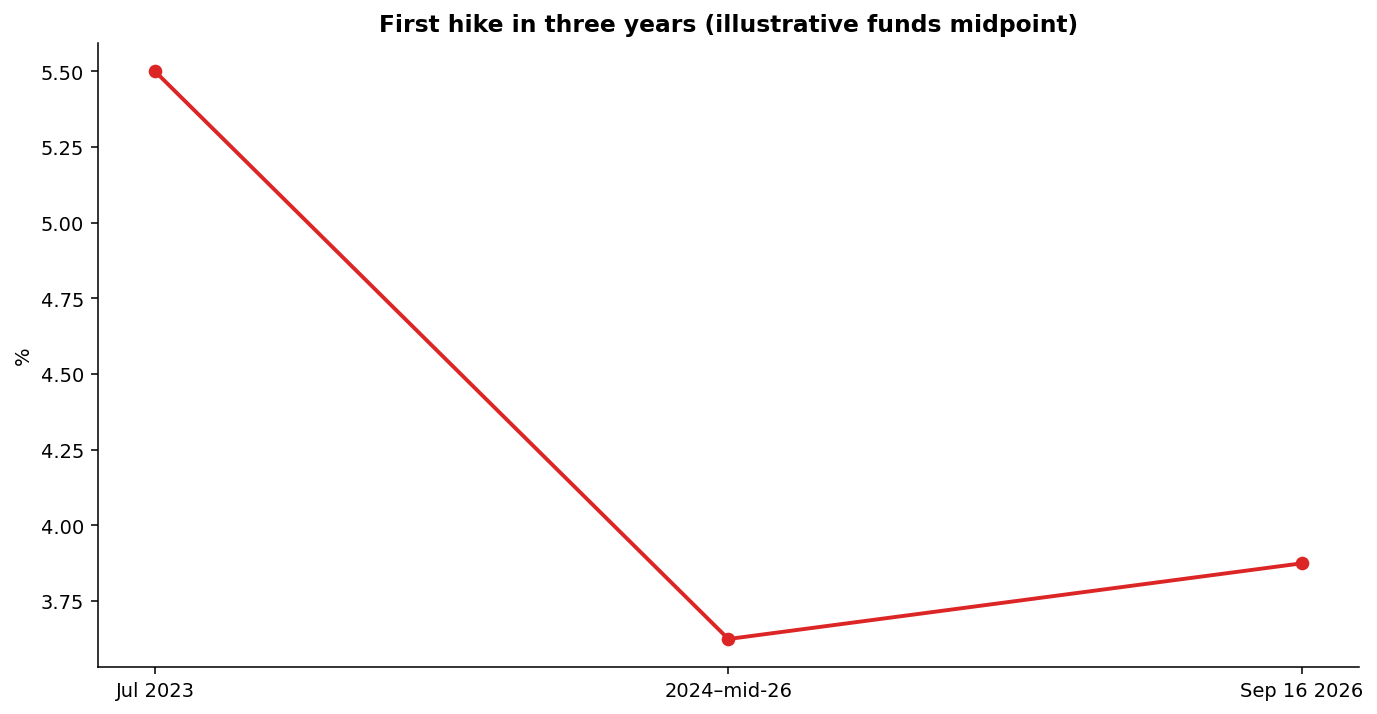
After a two-day Federal Open Market Committee meeting, policymakers lifted the target range from 3.50%–3.75% to 3.75%–4.00%. That undoes one of last year’s rate cuts and restarts a hiking cycle that markets had largely priced in ahead of the announcement.
| Item | Detail (Sept. 16, 2026) |
|---|---|
| Action | +25 basis points (unanimous) |
| New fed funds target range | 3.75%–4.00% |
| Prior hike | July 2023 (first increase in over three years) |
| Chair | Kevin Warsh (press conference ~2:30 p.m. ET) |
| Near-term path (SEP median reporting) | Toward ~4.00%–4.25% by year-end 2026 |
The statement language leaned on the idea that today’s firming would help inflation return to 2% on a more timely path. Importantly, the Committee also dialed back earlier framing that blamed elevated prices mainly on temporary “supply shocks”—a signal that officials see broader, stickier pressure than a one-off energy spike alone.
Why inflation forced a hike instead of another hold
Heading into this meeting, the case for holding rested on the hope that inflation would cool on its own while growth stayed solid. That hope faded. Reporting around the decision pointed to a familiar mix of stubborn price pressures: elevated energy costs tied to geopolitical shocks, still-firm demand, and policy-related cost pressures such as tariffs that keep goods prices from settling quickly.
Reuters and other major outlets also noted that officials marked up near-term inflation projections in the new Summary of Economic Projections, with PCE inflation seen around the mid-to-high 3% area this year and a return to the 2% target pushed further out—into the later years of the projection horizon. Growth was nudged up slightly and the unemployment outlook remained consistent with a labor market that is still broadly healthy. That combination—sticky inflation plus a resilient jobs backdrop—is exactly when the Fed tends to choose restriction over patience.
- Sticky inflation — Progress stalled enough that another “wait and see” meeting looked behind the curve.
- Resilient demand and labor — A soft-landing narrative does not give the Fed cover if prices refuse to cooperate.
- Credibility — After the 2021–2023 inflation shock, policymakers are wary of standing still too long a second time.
What changed versus a hold
A hold would have kept the overnight rate unchanged and, in markets, would likely have been read as the Fed prioritizing growth optics—or political timing—over inflation risk. Instead, the Committee chose a clean, expected 25 bp step with no public dissent. That matters for three reasons:
- Overnight funding costs rise immediately for banks and money markets tied to the funds rate.
- The reaction function is clearer — inflation that stays elevated can still bring more firming, not endless pauses.
- Forward guidance is thinner under Warsh’s preference for limited pre-commitment, so the dots and the press conference carry more weight than a long statement path.
In short, the overnight print was widely expected; the policy stance shift—from “patient hold” to “actively fighting sticky inflation”—is the real news.
What Chair Warsh emphasized after the decision
At the post-meeting press conference, Warsh’s tone tracked a higher-for-longer message without promising a fixed calendar of hikes. According to Reuters coverage of his remarks, he stressed that inflation remains elevated and that the policy action supports a timelier return to the 2% goal. He also said he would be “hard pressed” to describe broad financial conditions as restrictive, and that removing a dose of accommodation was a view widely shared by the Committee.
Separately, Reuters reported him saying the economy has strengthened since the June meeting, with underlying growth higher and inflation as the core problem—stable prices having been a challenge for more than five and a half years. That framing is classic higher-for-longer: strong enough activity that the Fed can lean on inflation without an immediate recession scare. For a fuller read of the presser, see our companion on Warsh’s higher-for-longer signals.
Mortgages and housing: the Fed does not set your 30-year rate
Homebuyers should not confuse the federal funds rate with the 30-year fixed mortgage. The overnight policy rate influences bank funding and variable products more directly; fixed mortgage quotes track the 10-year Treasury and mortgage-backed securities yields. Even before and around the decision, national 30-year averages were already running roughly in a ~7.00%–7.08% range across major September 16 surveys (for example, Zillow marketplace averages near 7.00%, Bankrate/NerdWallet-style averages near 7.02%, and other lender surveys a bit higher). Weekly MBA contract rates can print slightly differently because they lag day-to-day lock quotes.
So what does the hike mean for housing?
- If long yields stay near recent highs, mortgage rates can remain elevated even when the hike was “expected.”
- If the market decides one more 2026 hike is likely, refinance windows stay closed for many 2021–2022 borrowers.
- Affordability pressure continues: higher payment math, slower listings churn, and more negotiation leverage for cash or flexible buyers.
Investors underwriting rentals should stress-test acquisition financing and floating debt against a path that can still move toward the 4.00%–4.25% year-end funds range signaled in reporting on the SEP.
What comes next on the policy path
The September package did more than deliver one hike. New projections, per Reuters and other outlets, showed a large majority of officials anticipating at least one additional quarter-point move by year-end, consistent with a median path into the 4.00%–4.25% range. Market-implied odds for an October follow-up also ticked higher after the announcement.
That does not lock in consecutive hikes. Data can still change the odds. But the bar for returning to cuts—or even a long, comfortable pause—rose on Wednesday. Watch the next inflation prints, labor reports, and whether financial conditions actually tighten after Warsh’s comment that they did not look broadly restrictive.
Practical takeaways for readers
- Savers — Cash and HYSA yields are more tightly linked to the funds rate than mortgages are; see what the hike means for high-yield savings.
- Variable-rate borrowers — Cards, HELOCs, and prime-linked loans can reprice faster than fixed mortgages; details in our prime-rate ripple piece.
- Equity investors — The immediate stock reaction was muted and mixed rather than a crash narrative; see how Nasdaq and the S&P traded after the expected hike.
Bottom line: the Fed’s first hike in over three years is real, unanimous, and inflation-driven. The overnight move to 3.75%–4.00% was widely anticipated; the commitment to fight sticky inflation—and the signal that another hike may still come in 2026—is what households and housing markets must price from here.
The Fed’s rate decisions can create market volatility, but turnkey rentals continue to deliver reliable cash flow and appreciation. Investors in 2026 are focusing on real estate as a hedge against uncertainty.
Norada Real Estate helps you secure turnkey properties designed for immediate income and long‑term growth—so your portfolio stays strong regardless of Fed policy shifts.
Want to Know More?
Explore these related articles for even more insights:
- How Fed Rate Hikes Affect Your Wallet, Credit Cards, and Loans
- Goldman Sachs and J.P. Morgan Warn of an Imminent Fed Rate Hike This Week
- Fed Interest Rate Decision July 29, 2026: Rates Steady at 3.50-3.75%
- Interest Rate Predictions for the Next 5 Years: 2026-2030
- J.P. Morgan Predicts No Fed Rate Cuts Before 2027 as Inflation Persists
- Fed Interest Rate Predictions for the Next 3 Years: 2026-2028
- The Fed After Jerome Powell: Who Could Drive Rate Cuts in 2026?
- Why Your Loan Payment Isn’t Budging Despite Recent Fed Rate Cut
- How Does the Recent Fed Rate Cut Impact Your Personal Finances
- Fed Interest Rate Forecast for the Next 12 Months