U.S. stocks finished mixed on Wednesday, September 16, 2026, after the Federal Reserve delivered a widely expected 25-basis-point hike that took the federal funds target range to 3.75%–4.00%. The cleanest one-line wrap is exactly the headline: the Dow slipped while the Nasdaq and S&P 500 held gains. This was not a crash session, and it was not a melt-up. It was a classic “event priced in, guidance still matters” day — with Chair Kevin Warsh’s press conference and a hawkish-leaning dot plot shaping the afternoon narrative more than the 25 bp print itself.
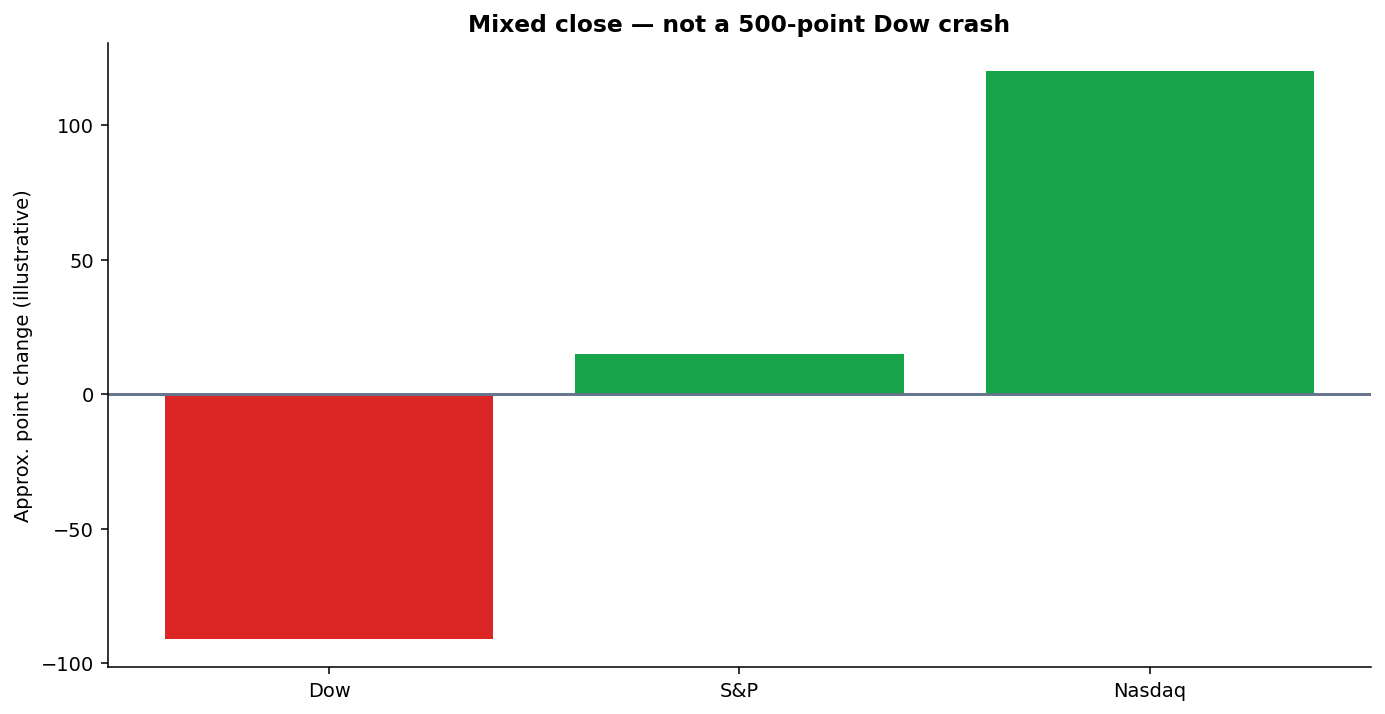
Multiple close reports put the Dow down on the order of ~90 points (about −0.17%), while the S&P 500 posted a modest gain near +0.2% and the Nasdaq Composite advanced roughly +0.5% (some intraday and wire prints ran closer to +0.7% for Nasdaq / +0.3% for the S&P during the session). Treat those as the accurate shape of the tape. Do not rewrite the day as a 500-point Dow collapse during the press conference — that did not happen.
Stock Market Mixed as Dow Slips While Nasdaq and S&P Hold Gains After Fed Rate Hike
What “mixed” looked like at the close
| Index | Decision-day tone (Sept. 16, 2026) | Rough magnitude in close reports |
|---|---|---|
| Dow Jones Industrial Average | Lower / soft | About −90 pts (−0.17%) in widely cited closes |
| S&P 500 | Modestly higher | Around +0.2% (some session prints ~+0.3%) |
| Nasdaq Composite | Higher, led by tech/semis | Roughly +0.5% (some session prints ~+0.7%) |
That split fits a market that had already assigned ~90%+ odds to a quarter-point hike. Equities did not need to “discover” the Fed move. They needed to decide whether Warsh and the SEP sounded like one hike or the start of a stickier tightening path — and whether mega-cap/semiconductor strength could offset rate-sensitive and cyclical soft spots inside the Dow.
Why the Dow lagged while Nasdaq held up
Index composition did real work on Wednesday:
- Nasdaq / growth: Semiconductor and large-cap tech strength showed up in live wraps (names like Intel and AMD were repeatedly cited as session leaders earlier in the day). That helped the Nasdaq finish green even with higher policy rates on the table.
- Dow / industrials & energy exposure: Blue-chip averages can lag when energy swings with oil or when a handful of heavyweights weigh on price-weighted math. Softness in parts of the Dow does not require a broad liquidation narrative.
- S&P 500: As a broader blend, it sat between the two — modest gains rather than a one-way risk-on stampede.
In other words, “mixed” is the honest word. Celebrating a Nasdaq uptick as proof the Fed turned dovish would over-read the session. Panicking over a ~90-point Dow dip as a crash would over-read it the other way.
What the Fed package gave equity traders
Three layers arrived in sequence:
- The hike: Unanimous +25 bp to 3.75%–4.00% — first increase since July 2023, and almost fully priced.
- The dots / SEP: Officials’ median path still contemplated about one more hike in 2026, with the year-end funds range near 4.00%–4.25% in widely reported projections.
- Warsh’s presser: Emphasis on elevated inflation, a “timelier” return to 2%, and skepticism that financial conditions were already restrictive enough going into the meeting.
That combination is mildly hawkish relative to a fantasy one-and-done script, but not a shock relative to the week’s bond selloff and hike odds. Equities can rise on “no panic” even while bonds price a firmer path — which is close to what Wednesday delivered. For the policy detail, see the Fed’s first hike in over three years and Warsh’s higher-for-longer press conference.
Bonds, mortgages, and why housing investors should not overfit the equity tape
Stock indexes are a noisy translator of housing finance. Wednesday’s mixed equity close sat alongside:
- A 10-year Treasury still hovering near the elevated levels that have kept mortgage benchmarks tight
- 30-year mortgage surveys still roughly 7.00%–7.08% — above 7%, not collapsing on the hike headline
- A front end still digesting hawkish forecasts (see 2-year Treasury adjustment to hawkish Fed forecasts)
If you buy or invest in residential real estate, the Nasdaq’s afternoon tone matters less than whether MBS yields ease. A green S&P does not refinance a 7% purchase note. Pair this wrap with mortgages holding above seven after the priced-in hike and the homebuyer affordability squeeze before changing your bid.
How to interpret mixed Fed days without cable-news extremes
| Narrative trap | What Wednesday actually supports |
|---|---|
| “Dow crash during the presser” | Dow soft by ~90 pts — not a 500-point collapse |
| “Markets love the hike” | Gains were modest and uneven; leadership was narrow (tech/semis) |
| “Fed just turned dovish” | Dots still allow another 2026 hike; Warsh stressed inflation |
| “Risk assets ignore rates” | Session was orderly because the hike was expected — path risk remains |
For real-estate readers, the durable takeaway is process, not drama: higher overnight rates, still-high mortgage quotes, and equity markets that can finish mixed while housing turnover stays slow. That “frozen but not zero” housing backdrop is covered separately in why today’s Fed action keeps housing frozen (low churn) for the rest of 2026.
Practical checklist after a mixed Fed session
- Investors: Do not let a Nasdaq bounce rewrite your discount-rate or exit-cap assumptions.
- Homebuyers: Equity headlines are entertainment; lock desks and payment stress tests are decisions.
- Savers: The funds range now tops out at 4.00% — cash yields may edge higher with a lag (see what the hike to 4% means for HYSA yields).
- Everyone: Watch the next inflation prints and the October/December meetings more than Wednesday’s index split.
Intraday color without rewriting the close
Live updates before 2:00 p.m. ET already showed a familiar split: Nasdaq and S&P in the green on semiconductor strength, Dow soft to flat as energy and a handful of blue chips lagged. That pre-decision mix largely survived into the close. The Fed statement and Warsh’s remarks added volatility around the edges — futures and individual names twitched — but they did not transform Wednesday into a one-way liquidation.
Compare that to how cable graphics sometimes frame Fed days. A Dow that is down less than a tenth of a percent can still look “red” on screen. A Nasdaq up half a percent can look like “relief.” Both can be true at once. The disciplined read is the one in the H1: mixed market, Dow slips, Nasdaq and S&P hold gains after an expected hike.
For wealth and housing readers watching brokerage accounts beside mortgage quotes, remember the correlation is loose on single days. A green Nasdaq does not cut your note rate. A soft Dow does not prove recession is imminent. The Fed changed overnight policy and reinforced a higher-for-longer forecast path; equities digested that with dispersion, not panic.
Bottom line
The stock market was mixed as the Dow slipped while the Nasdaq and S&P held gains after the Fed’s rate hike — a proportionate reaction to a telegraphed move plus a still-hawkish forecast path. Keep the scoreboard honest: modest green in growth indexes, a soft Dow, no 500-point crash. For housing and mortgages, Wednesday changed the overnight rate and reinforced higher-for-longer; it did not suddenly make 7%+ purchase money cheap.
The Fed’s rate decisions can create market volatility, but turnkey rentals continue to deliver reliable cash flow and appreciation. Investors in 2026 are focusing on real estate as a hedge against uncertainty.
Norada Real Estate helps you secure turnkey properties designed for immediate income and long‑term growth—so your portfolio stays strong regardless of Fed policy shifts.
Want to Know More?
Explore these related articles for even more insights:
- How Fed Rate Hikes Affect Your Wallet, Credit Cards, and Loans
- Goldman Sachs and J.P. Morgan Warn of an Imminent Fed Rate Hike This Week
- Fed Interest Rate Decision July 29, 2026: Rates Steady at 3.50-3.75%
- Interest Rate Predictions for the Next 5 Years: 2026-2030
- J.P. Morgan Predicts No Fed Rate Cuts Before 2027 as Inflation Persists
- Fed Interest Rate Predictions for the Next 3 Years: 2026-2028
- The Fed After Jerome Powell: Who Could Drive Rate Cuts in 2026?
- Why Your Loan Payment Isn’t Budging Despite Recent Fed Rate Cut
- How Does the Recent Fed Rate Cut Impact Your Personal Finances
- Fed Interest Rate Forecast for the Next 12 Months