The Federal Reserve’s Wednesday decision is now in the books: a 25-basis-point hike that lifts the federal funds target range to 3.75%–4.00%, the first increase in more than three years. Chair Kevin Warsh’s press conference and the updated dot plot pointed the same direction — higher for longer, with officials signaling roughly one more hike still possible in 2026. For homebuyers, the practical punchline is blunt: the overnight rate moved, but the affordability squeeze did not ease. Daily surveys still show 30-year fixed mortgages around 7%+ (roughly a 7.00%–7.08% range on September 16), and the Fed does not set mortgage rates one-for-one.
If you are shopping for a house, refinancing, or underwriting a rental purchase, treat this as a post-decision reality check — not a cliffhanger. The hike was widely anticipated. The lasting story is the path: sticky long rates, thin payment capacity, and a housing market that stays selective rather than suddenly “unlocked.”
Homebuyers Face Continued Affordability Squeeze as Fed Chooses Higher for Longer Interest Rates
What the Fed actually delivered — and what it did not
Markets had already priced a high probability of a quarter-point move into the 3.75%–4.00% range. Delivering that hike confirmed the base case. What mattered more for housing was the forward signal: the Summary of Economic Projections tilted toward additional firming, and Warsh’s remarks reinforced a willingness to keep policy restrictive until inflation progress looks credible again.
- Overnight funding is now higher for banks and money markets.
- Mortgage quotes still track the 10-year Treasury, mortgage-backed securities (MBS) yields, and lender spreads — not the funds rate alone.
- Psychology still matters: “Fed hiked and may hike again” keeps rate-sensitive buyers on the sidelines even when today’s lock desk looks unchanged from yesterday.
That is why companion coverage on mortgages already clearing 7% before the meeting and why rates can hold above seven after a priced-in hike belongs next to the funds-rate headline.
Payment math: why ~7% still squeezes budgets
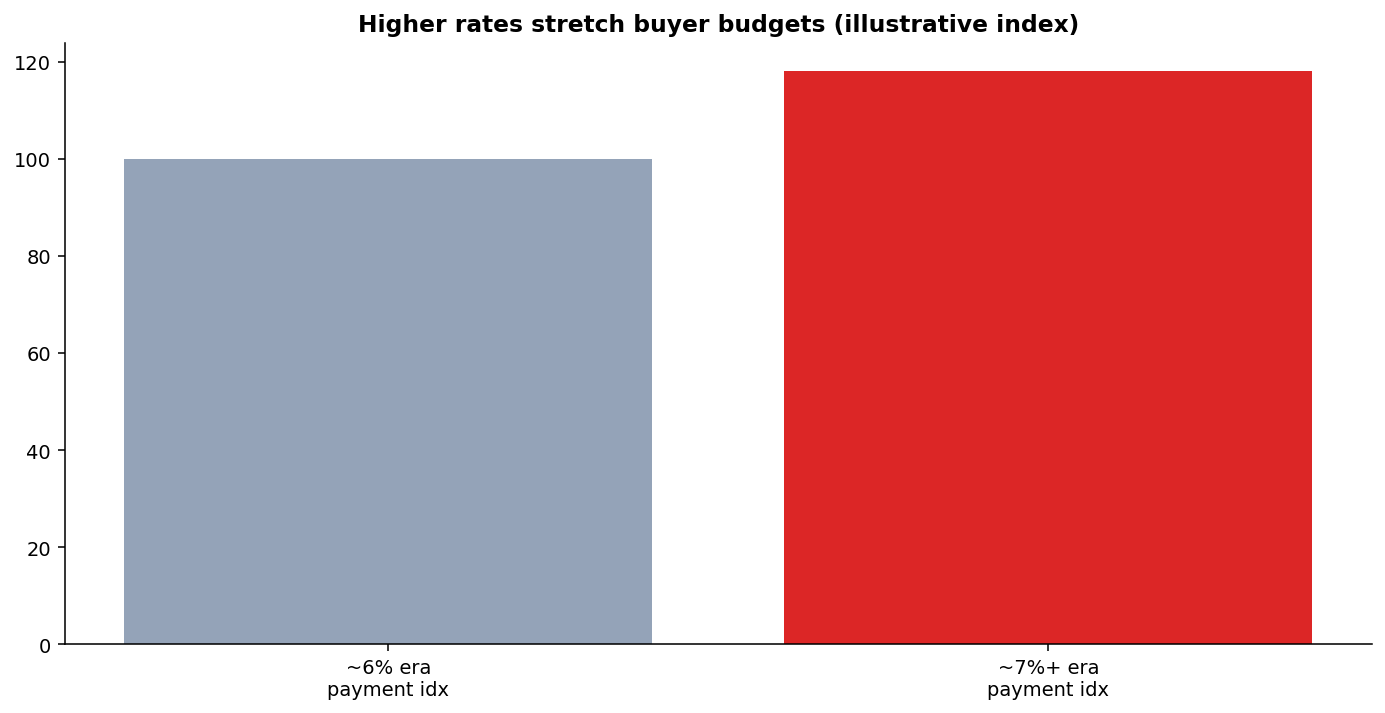
Affordability is mostly payment capacity. At 30-year fixed rates near 7%, principal-and-interest (P&I) on a typical conforming loan leaves less room for taxes, insurance, and HOA dues — especially in metros where insurance and property taxes have already climbed.
| Loan amount (example) | Rate | Approx. monthly P&I | Vs. 6.5% payment |
|---|---|---|---|
| $400,000 | 6.50% | ~$2,528 | Baseline |
| $400,000 | 7.00% | ~$2,661 | +~$133 / month |
| $400,000 | 7.08% | ~$2,683 | +~$155 / month |
| $400,000 | 7.50% | ~$2,797 | +~$269 / month |
Illustrative fully amortizing 30-year fixed P&I only; excludes taxes, insurance, MI, and HOA. Round numbers for comparison.
Those increments look small on a spreadsheet and large on a household budget. Multiply by 12 and you are talking thousands of dollars a year — often the difference between qualifying comfortably and stretching debt-to-income ratios. That is the continued squeeze: not a new invention of September 16, but a confirmation that relief is not arriving with this meeting.
Why the Fed hike does not automatically reprice every lock desk
Borrowers still ask the same question after every FOMC day: “Did my rate just jump 25 basis points?” Usually, no. A priced-in hike can leave same-day mortgage averages roughly where they opened if the 10-year and MBS markets do not sell off further on guidance. Conversely, a hawkish press conference can lift mortgage quotes even when the funds move was expected. Wednesday’s setup favored the second channel more than the first: dots pointing to another hike in 2026 keep term premiums and mortgage spreads from relaxing.
The lock-in effect still caps “move-up” supply
Many owners who refinanced or purchased when rates were meaningfully lower have little incentive to sell and rebuy at ~7%. That lock-in effect keeps existing-home listings tight in many metros even when demand softens. The result is a sticky stalemate:
- Would-be buyers face high carrying costs.
- Would-be sellers face a payment reset if they move.
- Inventory improves only gradually, often via new construction, estate sales, or forced moves — not a broad unlocking.
We explore that frozen-but-not-zero dynamic in more depth in why today’s Fed action keeps housing “frozen” for the rest of 2026 — metaphorically, not as a claim of zero transactions.
| Channel | Post-hike status | Buyer impact |
|---|---|---|
| 30-year fixed quotes | Still ~7%+ in daily surveys | Payment ceilings bind; negotiation on price matters more |
| Existing inventory | Still constrained by lock-in | Fewer choices; longer search times |
| New construction | Rate buydowns remain a marketing tool | Compare effective rate vs. list concessions carefully |
| ARMs / buydowns | More shopping interest when fixed stays high | Model reset risk, not just year-one payment |
Regional and product nuances homebuyers should not ignore
National averages hide local stories. Insurance spikes in catastrophe-exposed states, property-tax resets after purchase, and condo special assessments can hurt affordability as much as a 10–20 bp mortgage move. On the product side:
- Rate buydowns from builders can look attractive — verify how long the subsidy lasts and what the note rate is after.
- FHA / VA / USDA pathways can change upfront costs and monthly MI dynamics; they do not repeal the 7% world.
- Adjustable-rate mortgages may show a lower start rate, but a higher-for-longer Fed path raises the odds that resets stay elevated.
If you are comparing whether 7.5% becomes the next psychological line, see whether this hike path pushes 30-year quotes toward 7.5%.
What “higher for longer” means for the rest of 2026
With the funds rate now at 3.75%–4.00% and the median outlook open to another hike this year, the base case for housing finance is not a rapid glide path lower. That does not mean prices crash everywhere overnight. It means:
- Time on market can lengthen where list prices still assume 2021–2022 payment math.
- Seller concessions (closing-cost credits, buydowns) stay more common than deep, broad price cuts in inventory-tight pockets.
- Investors using leverage underwrite tighter DSCR and stress-test rates; cash and low-leverage buyers keep a relative edge.
- Rent vs. buy calculators continue to favor renting in many high-price metros on a pure monthly-cost basis — even when ownership still wins for some households on horizon and stability grounds.
A practical checklist after Wednesday’s decision
- Re-shop lenders; do not assume yesterday’s quote is today’s best execution.
- Stress-test your budget at +25 to +50 bp above the quoted rate.
- If you must buy, negotiate on price and concessions — the Fed did not restore bidding-war conditions overnight.
- If you can wait, watch the 10-year and MBS, not just Fed headlines.
- Investors: update cap-rate and exit-rate assumptions for a higher-for-longer regime.
Investor angle after the hike
For turnkey rental investors, a higher-for-longer funds rate and sticky 7%+ mortgages change the bid more than they change the existence of deals. Cap rates that looked thin at 5.5% financing look thinner still when acquisition debt clears 7%. That does not kill cash-flow strategies in strong rent markets — it raises the bar for leverage, reserves, and exit timing.
- Underwrite the exit rate, not just today’s note rate; a buyer in 2028 may still face elevated financing.
- Prefer markets where rent growth and employment can absorb payment pressure without relying on a refi miracle.
- Stress vacancies and insurance, which have already been climbing in many Sun Belt and coastal MSAs independent of the Fed.
The same Fed package that squeezes first-time buyers can create selective entry points when overextended sellers finally accept rate-driven price discovery — especially where inventory was artificially locked by low existing mortgages. Patience and local comps beat national panic headlines.
Bottom line for Norada readers
Wednesday’s hike answered the “will they?” question that futures markets had already mostly answered. It did not answer the homebuyer’s real question — “when do payments get easier?” — in a friendly way. With mortgages still above 7% in survey ranges and policymakers signaling another possible firming later in 2026, the affordability squeeze continues. The opportunity set shifts toward patient negotiation, careful product choice, and markets where rents and incomes can support higher financing costs — not toward a sudden, Fed-delivered rebound in purchasing power.
The Fed’s rate decisions can create market volatility, but turnkey rentals continue to deliver reliable cash flow and appreciation. Investors in 2026 are focusing on real estate as a hedge against uncertainty.
Norada Real Estate helps you secure turnkey properties designed for immediate income and long‑term growth—so your portfolio stays strong regardless of Fed policy shifts.
Want to Know More?
Explore these related articles for even more insights:
- Goldman Sachs and J.P. Morgan Warn of an Imminent Fed Rate Hike This Week
- Fed Interest Rate Decision July 29, 2026: Rates Steady at 3.50-3.75%
- Interest Rate Predictions for the Next 5 Years: 2026-2030
- J.P. Morgan Predicts No Fed Rate Cuts Before 2027 as Inflation Persists
- Fed Interest Rate Predictions for the Next 3 Years: 2026-2028
- The Fed After Jerome Powell: Who Could Drive Rate Cuts in 2026?
- Why Your Loan Payment Isn’t Budging Despite Recent Fed Rate Cut
- How Does the Recent Fed Rate Cut Impact Your Personal Finances
- Fed Interest Rate Forecast for the Next 12 Months