The Federal Reserve unanimously raised its benchmark rate by 25 basis points to a target range of 3.75%–4.00% — the first hike in more than three years — despite public pressure from President Trump for cuts. Chair Kevin Warsh and the FOMC chose policy independence over accommodation, and that friction now shapes the rate path for the rest of 2026.
For housing investors and borrowers, the headline is not only the 25 bp move. It is the signal: a unanimous committee was willing to tighten even when the White House publicly preferred easier money. That matters for how markets price the next FOMC meetings, how mortgage spreads behave, and how long rates near 7% can persist. For a closer look at what borrowers are seeing at the retail level, see our companion note on the 30-year fixed mortgage rate holding near 7%.
Unanimous Fed Rate Hike Sparks Intense Interest Rate Friction Between Trump and Warsh
The September 2026 decision landed in a familiar political frame — public calls for cuts from the administration, a Fed that still sees inflation risk as unfinished business, and a chair whose early tenure is already defined by a willingness to hike when the data and the forecasts call for it. Reporting around the meeting has treated the Trump–Warsh tension as real, not theatrical. Markets heard that message clearly: independence is not abstract when the vote is unanimous and the direction is tighter.
What the FOMC Actually Did
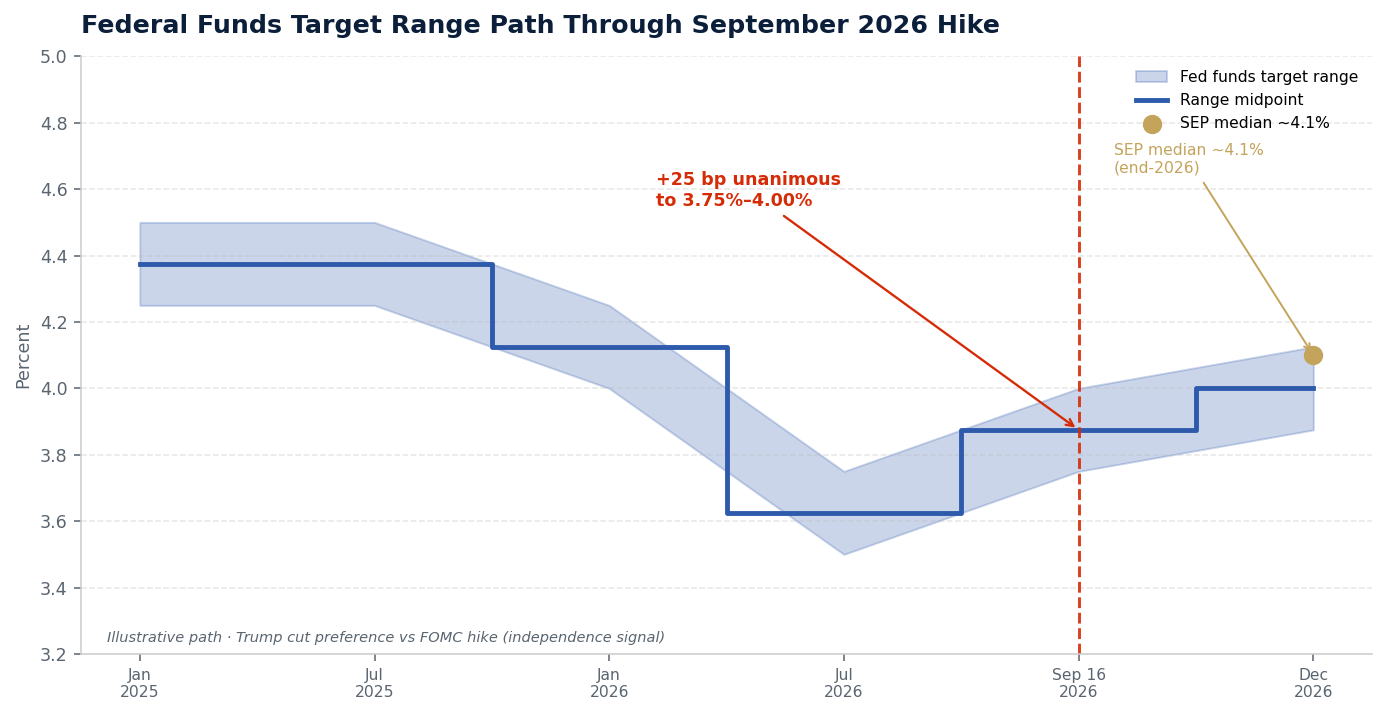
The federal funds target range moved to 3.75%–4.00% after a 25 bp increase. The vote was unanimous. It is the first hike in more than three years, which resets the narrative after a long stretch when the policy debate centered on how soon and how far to ease.
- Size: +25 bp (a standard increment, not an emergency move)
- New range: 3.75%–4.00%
- Vote: unanimous
- Chair: Kevin Warsh
- Context: White House preference for cuts was public and well known
A unanimous hike does more than change the overnight rate. It compresses the range of interpretations about dissent. Markets often hunt for hawks and doves inside the statement and the SEP. This time, the committee spoke with one voice on the direction of travel, even if the longer-run path still depends on inflation and growth data.
Why the Trump–Warsh Friction Matters for Rates
Political pressure on monetary policy is not new. What is new in this cycle is the combination of a first hike in years, a chair early in the public eye, and an administration that has been explicit about wanting lower rates. Friction of this kind can show up in three places investors watch:
- Term premium and volatility: When markets question whether politics will bend the Fed, volatility can rise even if the policy rate path is clear.
- Credibility of the reaction function: A unanimous hike against public cut pressure reinforces the idea that the FOMC will follow its inflation mandate.
- Expectations for the rest of 2026: The SEP median near 4.1% for the year-end funds rate leaves room for roughly one more hike if conditions warrant.
None of that means mortgage rates move tick-for-tick with the funds rate. They do not. Mortgage pricing depends heavily on longer Treasury yields, mortgage-backed securities (MBS) demand, and credit spreads. The Fed sets the overnight policy rate; primary mortgage rates are a market outcome. That distinction is central to our mortgage rates forecast for the rest of 2026.
Independence as a Market Signal
When a committee hikes unanimously while the White House wants cuts, the signal is that the reaction function is still data-driven inside the FOMC room. That can be uncomfortable for anyone hoping for a quick return to cheap mortgage money. It can also reduce the risk of a disorderly un-anchoring of inflation expectations — which, paradoxically, is what keeps long-term rates from embedding a larger inflation premium.
Warsh’s chairmanship is now associated with that stance. Markets will parse every speech, every SEP update, and every press conference for whether that independence holds when growth softens or when political heat rises again. The September hike set a high bar for the next “easy” narrative.
What “Independence” Does — and Does Not — Mean for Housing
Independence does not freeze mortgage rates. It does not guarantee another hike. It does not imply a recession is already priced as certain. It does mean that if inflation remains sticky, the committee has shown it can still tighten in a politically noisy environment. For housing, that keeps the affordability problem in focus: payments stay elevated while prices remain sticky in many markets, a theme we unpack in how the Fed rate hike impacts U.S. home prices and affordability this fall.
SEP Path: Room for Roughly One More Hike
The Summary of Economic Projections median near 4.1% for the federal funds rate by the end of 2026 is not a promise. It is a central tendency of participants’ views at a point in time. Read alongside a September move into the 3.75%–4.00% range, it leaves open the possibility of roughly one additional 25 bp hike before year-end if the committee’s inflation and growth outlook still calls for it.
| Item | September 2026 snapshot | Housing implication |
|---|---|---|
| Funds rate range | 3.75%–4.00% after +25 bp | Policy still restrictive relative to recent easing hopes |
| Vote | Unanimous hike | Less room to spin “deep division” on the direction of travel |
| SEP median (end-2026) | ~4.1% | ~One more hike possible; not a cut cycle restart |
| Mortgage rates | Surveys ~7.00%–7.08%; some sources higher | Borrowing costs stay elevated; Fed is not a 1:1 dial |
| Political backdrop | Trump preferred cuts; FOMC hiked | Independence narrative supports “higher for longer” risk |
Investors should treat the SEP as a conditional map, not a calendar. If inflation cools faster than expected, the room for another hike shrinks. If inflation reaccelerates, the September unanimity makes a second step easier to justify rhetorically — even if the White House objects again.
How This Friction Shows Up in Mortgage Markets
Primary 30-year fixed rates have been hovering near or above 7% in recent surveys, with readings around 7.00%–7.08% in common survey series and some sources printing higher. That range already reflected a non-trivial chance of a September hike. When a well-telegraphed tightening arrives, the overnight rate rises while mortgage quotes can remain comparatively stable — until the next shift in Treasury yields or MBS spreads.
The friction angle still matters for mortgages indirectly. If markets believe the Fed will not be pressured into premature cuts, the front end of the curve can stay firmer, and the probability of a rapid mortgage-rate decline fades. Conversely, if future data force a pause, mortgages can ease without the Fed having “given in” politically — a cleaner path for long rates.
Practical Takeaways for Borrowers and Investors
- Do not wait on a political narrative. Rate-lock and purchase timing should follow your payment math and local inventory, not headlines about White House preferences.
- Watch the next SEP and inflation prints more than any single speech. The ~4.1% year-end median is the cleanest public signal of “one more hike possible.”
- Separate policy rate from mortgage rate. A 25 bp funds move is not a 25 bp mortgage move.
- Price affordability, not a crash. Lock-in and thin inventory still favor sticky prices over a broad reset in many metros.
- Shop the quote, not the politics. Practical steps are in how to get the best mortgage rates after the recent Fed hike.
What to Watch Between Now and Year-End
Three data pillars will decide whether September’s hike was a one-off or the start of a short additional tightening sequence:
- Inflation trend: Progress that is durable enough to justify a pause — or sticky enough to validate another 25 bp.
- Labor and growth: Softening that is orderly versus deterioration that forces the committee to reassess restrictive policy.
- Communication tone: Whether Warsh and colleagues keep emphasizing independence and mandate focus when political commentary intensifies.
For real estate capital plans, the base case after a unanimous hike is not “mortgages collapse into the 5%s by Christmas.” It is a market that stays expensive to finance until inflation clearly cooperates. That is why the policy-friction story and the mortgage-stability story belong together: independence raises the odds that relief, when it comes, is earned by the data — not granted by political pressure.
Bottom line: the Fed’s unanimous 25 bp hike to 3.75%–4.00% under Chair Kevin Warsh, against public White House preference for cuts, is a credibility event as much as a 25 bp event. It leaves the door open to roughly one more hike on a SEP median near 4.1% by end-2026, keeps mortgage rates near 7% in the conversation, and tells housing markets that policy independence is still an active constraint on how fast financing costs can fall.
The Fed’s rate decisions can create market volatility, but turnkey rentals continue to deliver reliable cash flow and appreciation. Investors in 2026 are focusing on real estate as a hedge against uncertainty.
Norada Real Estate helps you secure turnkey properties designed for immediate income and long‑term growth—so your portfolio stays strong regardless of Fed policy shifts.
Want to Know More?
Explore these related articles for even more insights:
- How Fed Rate Hikes Affect Your Wallet, Credit Cards, and Loans
- Goldman Sachs and J.P. Morgan Warn of an Imminent Fed Rate Hike This Week
- Fed Interest Rate Decision July 29, 2026: Rates Steady at 3.50-3.75%
- Interest Rate Predictions for the Next 5 Years: 2026-2030
- J.P. Morgan Predicts No Fed Rate Cuts Before 2027 as Inflation Persists
- Fed Interest Rate Predictions for the Next 3 Years: 2026-2028
- The Fed After Jerome Powell: Who Could Drive Rate Cuts in 2026?
- Why Your Loan Payment Isn’t Budging Despite Recent Fed Rate Cut
- How Does the Recent Fed Rate Cut Impact Your Personal Finances
- Fed Interest Rate Forecast for the Next 12 Months