
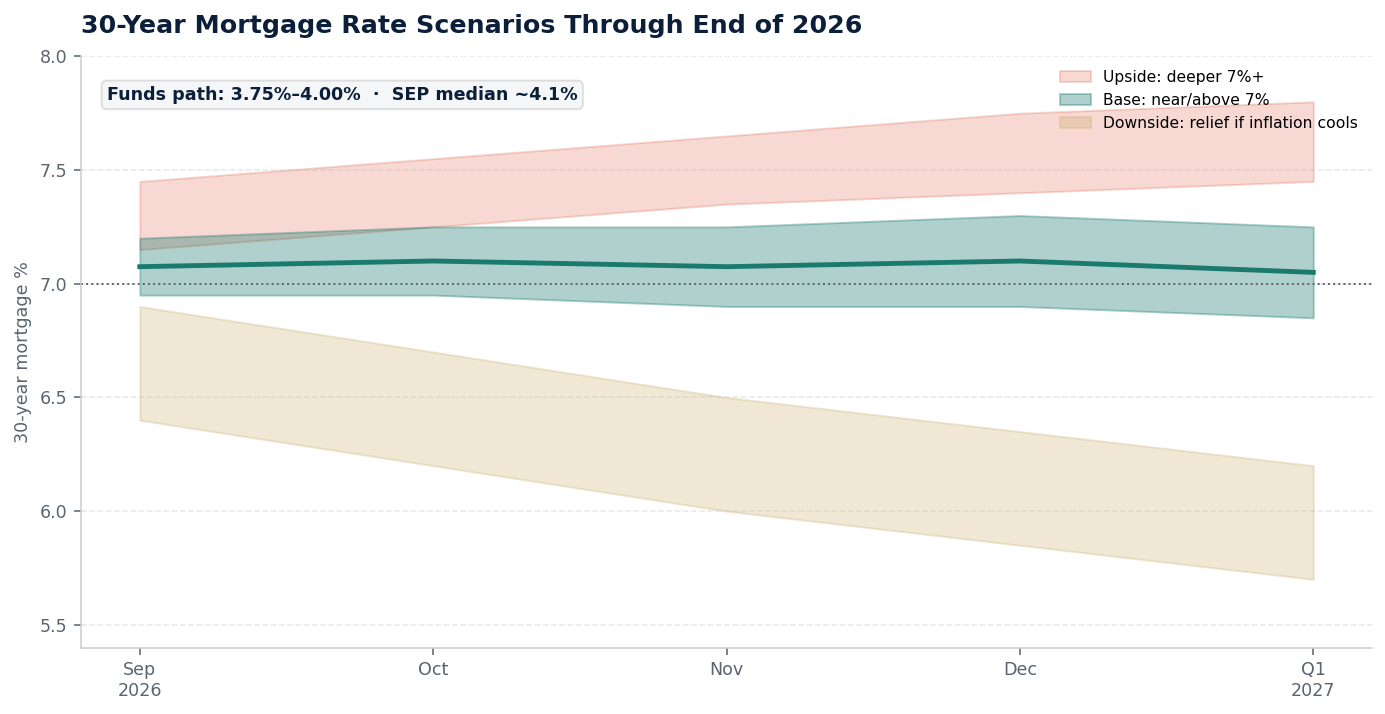
For the rest of 2026, the base case is that 30-year fixed mortgage rates stay near or above 7% through fall and winter unless inflation cools enough to change the Fed’s path. The SEP median near 4.1% for the federal funds rate by year-end leaves room for roughly one more hike; that keeps mortgage relief limited, not guaranteed.
This outlook avoids fake precision. No responsible forecast pins the 30-year at a single number for December. What we can do is map the base case, the upside rate risk, and the downside rate relief case against the September decision: a unanimous +25 bp hike to 3.75%–4.00%, the first in more than three years, under Chair Kevin Warsh — delivered even as President Trump publicly preferred cuts. Background on that policy friction is here: unanimous Fed hike and Trump–Warsh rate friction. On the retail tape after the meeting, see 30-year fixed holding near 7%.
Mortgage Rates Forecast for the Rest of 2026
Forecasting mortgages after a priced-in hike means starting from the market you already have: surveys roughly 7.00%–7.08%, some sources higher, and a Fed that has shown it can tighten unanimously. From that starting line, the rest of 2026 is about inflation persistence, the SEP path, and whether long yields cooperate.
Base Case: Near or Above 7% Through Fall and Winter
The central scenario is not dramatic. It is sticky. If inflation cools only gradually and the FOMC retains a tightening bias consistent with a year-end funds-rate median near 4.1%, mortgage rates can remain near or above 7% as fall turns to winter. “Near or above 7%” is a range description — it allows for week-to-week noise inside a high-rate regime rather than a march back to the 5% handle.
- Policy anchor: funds rate at 3.75%–4.00% after +25 bp
- SEP median: ~4.1% end-2026 → roughly one more hike possible
- Mortgage starting point: ~7.00%–7.08% surveys; some prints higher
- Base case path: stay elevated through fall/winter unless inflation clearly cools
Why this base case? Because mortgage rates will not fall simply because households want them to, and they will not fall simply because the White House wants cuts. They fall when expected inflation, real yields, and MBS spreads improve together. September’s unanimous hike under Warsh argues the committee is not racing to deliver that improvement on political timetable.
What Would Keep Mortgages Elevated
| Driver | How it supports ~7%+ mortgages | What to monitor |
|---|---|---|
| Sticky inflation | Keeps Fed hiking bias alive; lifts term premium | Core inflation trend, services prices |
| SEP ~4.1% year-end | Signals room for another 25 bp | Updated dots / median revisions |
| MBS spread widening | Adds to primary rates even if Treasuries are calm | Current-coupon MBS spreads |
| Independence signal | Reduces odds of premature, politics-driven cuts | FOMC communications vs. White House commentary |
Risk Scenario 1: Upside Rate Risk (Mortgages Push Further Above 7%)
The adverse case for borrowers is not mysterious. Inflation reaccelerates or stops improving, the FOMC follows through on the room implied by a ~4.1% end-2026 median, and/or investors demand more yield to hold duration and MBS. In that world, primary 30-year quotes can move deeper into the 7%+ territory even if each Fed hike is only 25 bp. Remember the transmission rule: the Fed does not set mortgage rates one-for-one, but a re-priced inflation path can move mortgages by more than the funds rate change.
Political friction can amplify volatility in this scenario without changing the median outcome. If markets swing between “the Fed will cave” and “the Fed will hike again,” term premium can stay elevated. That is an unpleasant environment for lock desks and for buyers trying to time a dip.
Risk Scenario 2: Downside Rate Relief (Inflation Cools Cleanly)
The constructive case requires progress on inflation that is convincing enough for the Fed to drop its hiking bias and for markets to reduce inflation risk premia. In that scenario, mortgage rates can ease even before any cut — because long rates are forward-looking. How far they ease is unknowable in advance; treating “back to 6% by Thanksgiving” as a base case would be inventing precision the data do not support.
One mid-article clarity note: relief is a process driven by cooler inflation and calmer long yields, not a switch the FOMC flips for housing alone.
What “Cooling Inflation” Needs to Look Like
- A sustained downtrend in core inflation, not a one-month soft print
- Labor and demand conditions that do not immediately reheat prices
- FOMC communications that shift from hike risk to pause confidence
- Stable or tighter MBS spreads so Treasury gains pass through to mortgage quotes
Why We Refuse Fake Point Forecasts
Point forecasts (“the 30-year will be 6.73% on December 15”) create false confidence. Mortgage pricing is a market. It gaps on data surprises. It gaps on Treasury auctions. It gaps when MBS demand shifts. A scenario framework is more honest for planning:
- Base: near/above 7% through fall–winter unless inflation cools
- Higher-for-longer risk: deeper into 7%+ if inflation sticks and another hike arrives
- Relief risk: meaningful easing only if inflation and long yields cooperate
That framework is also how serious capital plans should treat financing assumptions for acquisitions through year-end. Underwrite to the market you can fund today; treat lower-rate scenarios as upside, not as the default spreadsheet input.
Connecting the Fed Path to Housing Payments
With the funds rate in a 3.75%–4.00% range and a SEP median near 4.1%, the policy backdrop still leans restrictive relative to hopes for rapid easing. Housing feels that through monthly payments and through qualifying ratios, not through a mechanical formula from the FOMC statement. Affordability stays squeezed while prices in many markets remain sticky because of lock-in and limited inventory — themes covered in how the Fed rate hike impacts U.S. home prices and affordability this fall.
| Horizon | Policy watch | Mortgage planning assumption |
|---|---|---|
| Next FOMC window | Pause vs. another +25 bp | Do not assume automatic mortgage decline after a pause |
| Fall 2026 | Inflation prints + Warsh messaging | Budget for ~7%+ unless data clearly soften long yields |
| Winter / year-end | SEP vs. ~4.1% median | One more hike still a live risk in the base-to-hawkish set |
Practical Playbook for the Rest of 2026
- Buyers: qualify and lock based on today’s quote band; build contingency for a modest adverse move.
- Sellers: expect fewer financed buyers at the margin; price for payment reality, not 2021 comps.
- Investors: keep leverage conservative; stress DSCR at rates at or above current market.
- Refinancers: run break-evens; do not refinance on hope of a political cut cycle.
- Shoppers: use a structured lender comparison — see how to get the best mortgage rates after the recent Fed hike.
How Housing Activity Feeds Back Into the Rate Outlook
Mortgage rates are an input to housing demand, but housing activity can also feed back into the broader inflation and growth picture the Fed watches. A prolonged stretch of weak purchase applications at ~7%+ financing can cool shelter inflation with a lag. That is one path to the constructive scenario. The opposite path is resilient demand — cash buyers, buydowns, and investors — keeping shelter components sticky enough that the FOMC retains hike risk consistent with a SEP median near 4.1% by year-end.
For planners, the implication is modest: do not assume that “housing is already weak, so cuts must come.” September’s unanimous hike under Chair Kevin Warsh showed the committee can still tighten when inflation risk dominates political preference for easier money. Our housing-side companion, how the Fed rate hike impacts U.S. home prices and affordability this fall, explains why prices can stay sticky even when demand softens at the margin.
Communication Risk Versus Data Risk
Two different risks can move mortgages in the same direction. Data risk is a hot inflation print that lifts yields immediately. Communication risk is a press conference or SEP revision that raises the perceived odds of another 25 bp step. After a unanimous hike delivered against White House cut pressure, markets will parse Warsh’s tone for whether independence still means a live hiking bias. Either risk can push primary quotes further above 7% without requiring mortgages to move one-for-one with the funds rate on meeting day.
Bottom line: the rest-of-2026 mortgage forecast is a high-rate base case — near or above 7% through fall and winter — conditioned on inflation not cooling enough to rewrite the Fed’s path. The September unanimous hike to 3.75%–4.00% and a SEP median near 4.1% keep roughly one more hike in view. Plan with scenarios, not with invented point targets, and remember that mortgage rates are a market price layered on top of Fed policy — not a dial the FOMC turns one-for-one.
VS
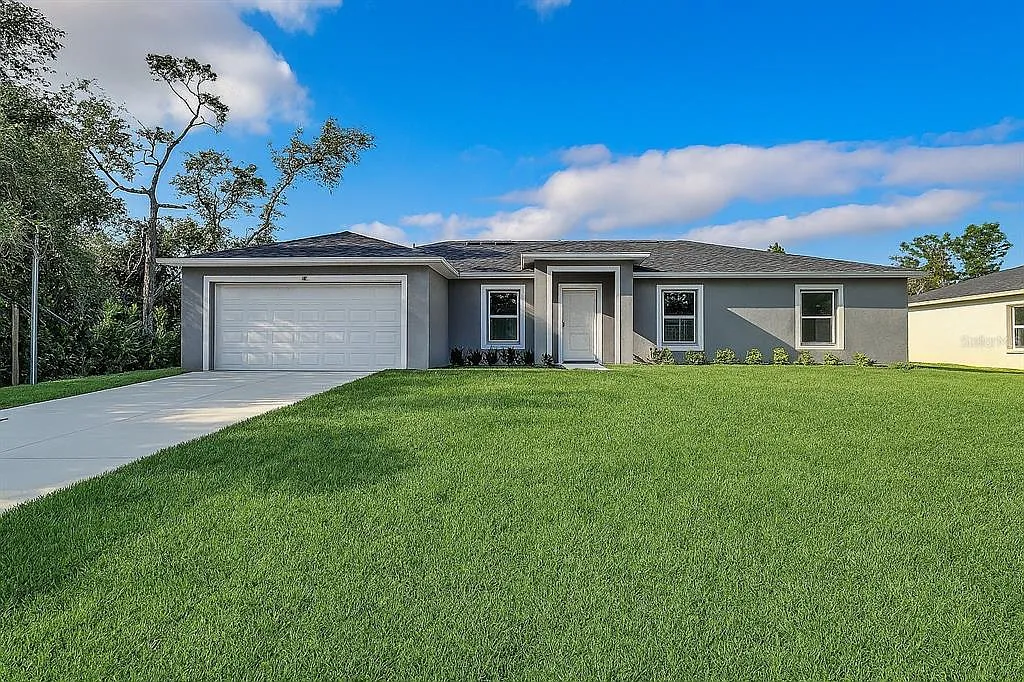
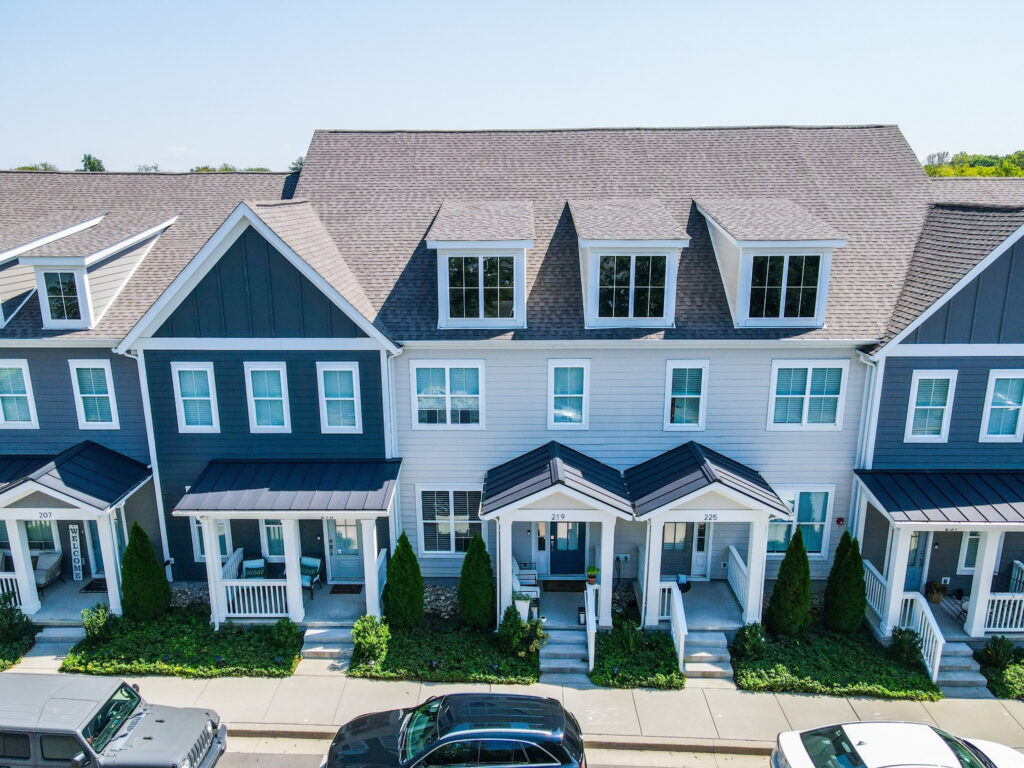
Out‑of‑State investors can compare Tennessee’s newer rental with higher NOI vs Florida’s A+ property with strong yield. Which fits YOUR investment strategy?
We have much more inventory available than what you see on our website – Let us know about your requirement.
📈 Choose Your Winner & Contact Us Today!
Speak to a Norada Investment Counselor (No Obligation):
(800) 611-3060
Mortgage rates remain high in 2026, but rental properties continue to deliver strong cash flow and appreciation. Savvy investors know that turnkey real estate is the path to passive income and long‑term wealth.
Norada Real Estate helps you secure turnkey rental properties designed for immediate cash flow and appreciation—so you can invest smartly regardless of interest rate trends.
Also Read:
- Mortgage Rates Predictions Backed by 7 Leading Experts: 2025–2026
- Mortgage Rate Predictions for the Next 3 Years: 2026, 2027, 2028
- 30-Year Fixed Mortgage Rate Forecast for the Next 5 Years
- 15-Year Fixed Mortgage Rate Predictions for Next 5 Years: 2025-2029
- Will Mortgage Rates Ever Be 3% Again in the Future?
- Mortgage Rates Predictions for Next 2 Years
- Mortgage Rate Predictions for Next 5 Years
- Mortgage Rate Predictions: Why 2% and 3% Rates are Out of Reach
- How Lower Mortgage Rates Can Save You Thousands?
- How to Get a Low Mortgage Interest Rate?
- Will Mortgage Rates Ever Be 4% Again?