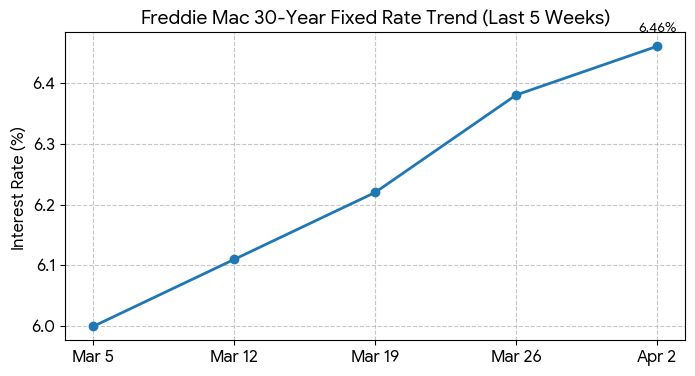
The latest news from Freddie Mac might make you pause: the 30-year fixed mortgage rate has gone up by 8 basis points, now sitting at an average of 6.46%. This isn't just a small blip; it's the fifth week in a row we've seen rates climb, reaching the highest point since early September of last year. This means that for those looking to finance their dream home, the cost of borrowing has become a little more expensive.
30-Year Fixed Mortgage Rate Rises Sharply by 8 Basis Points
Let's break down what these changes mean. According to Freddie Mac's Primary Mortgage Market Survey, as of April 2, 2026, the average 30-year fixed-rate mortgage stands at 6.46%. Just last week, it was 6.38%. While this seems like a small jump, remember that over the long term of a 30-year loan, even fractions of a percent make a big difference. Looking back a year, rates were actually a bit higher at 6.64%, so that's a small silver lining.
It's not just the 30-year loan that's seeing movement. The 15-year fixed-rate mortgage, a popular option for those who want to pay off their homes faster, has also inched up to 5.77%, from 5.75% last week. A year ago, this rate was at 5.82%.
Here’s a table to give you a clearer picture of the recent changes:
| Mortgage Type | As of April 2, 2026 | 1-Week Change | 1-Year Change |
|---|---|---|---|
| 30-Year Fixed FRM | 6.46% | +0.08% | -0.18% |
| 15-Year Fixed FRM | 5.77% | +0.02% | -0.05% |
(Data based on Freddie Mac's Primary Mortgage Market Survey. FRM stands for Fixed-Rate Mortgage.)
What's Driving These Rate Hikes?
It's easy to just see the numbers go up and feel a bit frustrated. But understanding why they're going up can help us make better decisions. Several factors are pushing mortgage rates higher right now.
One of the biggest concerns is the ongoing situation in Iran. When there are geopolitical conflicts like this, it often leads to higher oil prices. Higher oil prices can then fuel fears of inflation. Inflation is when the cost of goods and services goes up, and it's something the Federal Reserve (often called the Fed) watches very closely.
The yield on 10-year Treasury notes is another major player. Think of Treasury notes as a benchmark for borrowing costs for the government. When these yields go up, it generally means it's more expensive for institutions to borrow money, and that cost often gets passed on to consumers in the form of higher mortgage rates. We've seen these yields climb, hitting around 4.34%, which directly impacts mortgage rates.
Then there's the timing. We're right in the middle of the spring homebuying season. Normally, this is a busy time with lots of people looking to buy homes. However, as Freddie Mac's Chief Economist, Sam Khater, pointed out, even though things are in “full swing,” these rising borrowing costs are starting to make some potential buyers hesitate. The dream home might feel a little further out of reach when the monthly payments get higher.
A Shift in Expectations: The Fed and Future Rates
Perhaps one of the most telling signs of how things are shifting is what’s happening with the Federal Reserve's potential actions. Not too long ago, many folks expected the Fed to lower interest rates several times in 2026. But now, with inflation concerns and other economic signals, some market watchers are starting to believe the Fed might actually raise rates by the end of the year. The chance of a rate hike is now priced in at about 31%, which is a significant change from the earlier hopes. This uncertainty can create a ripple effect, making lenders more cautious and pushing rates up.
What This Means for You: Immediate and Long-Term Impact
So, what's the bottom line for you as a prospective homebuyer?
- Higher Monthly Payments: A higher mortgage rate means your monthly mortgage payment will be larger for the same loan amount. This could affect your budget and how much home you can comfortably afford.
- Reduced Purchasing Power: With higher monthly payments, you might have to look at homes that are less expensive than you initially planned, or you'll need a larger down payment to keep your monthly costs where you want them.
- Importance of Shopping Around: I can't stress this enough. Comparing offers from different lenders is more crucial than ever. A slight difference in rate can save you tens of thousands of dollars over the life of your loan. Use online comparison tools and talk to multiple brokers.
- Locking in a Rate: If you're working with a lender and find a rate you're comfortable with, consider locking it in. This protects you if rates continue to rise before your loan closes. However, understand the terms of rate locks, as they typically have an expiration date.
- Re-evaluating Your Budget: It’s a good time to revisit your overall budget. Figure out what you can truly afford each month, factoring in not just the mortgage principal and interest, but also property taxes, homeowner's insurance, and potential HOA fees.
My Take:
From my perspective, the market is telling us a few things. Firstly, the economy is still sensitive to global events and inflation worries. Secondly, the Fed is in a tricky position, balancing economic growth with price stability. For homebuyers, this means being adaptable and informed.
While the 30-year fixed mortgage rate rising steeply is a current reality, it doesn't mean the dream of homeownership is out of reach. It just requires a more strategic approach. Consider exploring different loan types, like adjustable-rate mortgages (ARMs), if you plan to sell or refinance within a few years (though these come with their own risks). Also, improving your credit score can significantly impact the rates you're offered. Every point counts!
Homeownership is a significant financial decision, and in times like these, it’s wise to be patient, do your homework, and make sure any move you make is a well-calculated one. Don't let these weekly fluctuations discourage you completely, but do let them encourage you to be a smart shopper.
VS
Georgia’s affordable rental with higher cap rate vs Florida’s A‑rated property with stability. Which fits YOUR investment strategy?
We have much more inventory available than what you see on our website – Let us know about your requirement.
📈 Choose Your Winner & Contact Us Today!
Speak to a Norada Investment Counselor (No Obligation):
(800) 611-3060
Mortgage rates remain near 6%, but rental properties continue to deliver strong cash flow and appreciation. Savvy investors know that turnkey real estate is the path to passive income and long‑term wealth.
Norada Real Estate helps you secure turnkey rental properties designed for immediate cash flow and appreciation—so you can invest smartly regardless of interest rate trends.
Also Read:
- Will Mortgage Rates Drop to 5% in 2026: Expert Forecast
- How to Get a 3% Mortgage Rate in 2026 With Assumable Mortgages?
- How to Get a 4% Interest Rate on a Mortgage in 2026?
- What Leading Housing Experts Predict for Mortgage Rates in 2026
- Mortgage Rate Predictions for 2026: What Leading Forecasters Expect
- Mortgage Rate Predictions for the Next 3 Years: 2026, 2027, 2028
- 30-Year Fixed Mortgage Rate Forecast for the Next 5 Years
- 15-Year Fixed Mortgage Rate Predictions for Next 5 Years: 2025-2029
- Will Mortgage Rates Ever Be 3% Again in the Future?
- Mortgage Rates Predictions for Next 2 Years
- Mortgage Rate Predictions for Next 5 Years
- Mortgage Rate Predictions: Why 2% and 3% Rates are Out of Reach
- How Lower Mortgage Rates Can Save You Thousands?
- How to Get a Low Mortgage Interest Rate?
- Will Mortgage Rates Ever Be 4% Again?