
Just hours before the Federal Reserve’s rate decision on Wednesday, September 16, 2026, 30-year mortgage rates are already above 7% on recent daily averages—generally in a roughly 7.0%–7.2% band depending on the survey and lender set. That move happened in the bond market first, not at the Fed’s printing press. The Committee’s announcement is still expected around 2:00 p.m. ET; markets price about a 93%–94.5% chance of a 25 bp hike to 3.75%–4.00%, which would be the first increase since July 2023.
If you are shopping for a home or refinancing today, the practical message is simple: financing costs are already restrictive, Freddie Mac’s weekly print can lag what your loan officer quotes this morning, and this afternoon’s statement can still reprice locks if the 10-year Treasury (recently near ~5%) jumps on hawkish guidance.
Mortgage Rates Climb Above 7% Hours Before the Fed Decision
Why mortgages are over 7% before the Fed even speaks
Mortgage rates are forward-looking. Lenders price 30-year fixed loans off mortgage-backed securities and the Treasury curve—especially the 10-year—not off the overnight federal funds rate in a one-to-one way. When markets became convinced that September would bring a hike and that more firming might follow, longer yields rose and mortgage quotes followed.
That is why borrowers can see rates over 7% on decision morning even though the Fed has not yet posted a change. The expected hike is largely in the price; the open question is the path after today.
- Daily averages ~7.0%–7.2%: Useful for same-week shopping comparisons across lenders.
- Freddie Mac weekly PMMS: Widely cited, but it can lag fast-moving days around FOMC meetings.
- Your lock quote: The only number that funds a closing; it can change intraday after 2 p.m.
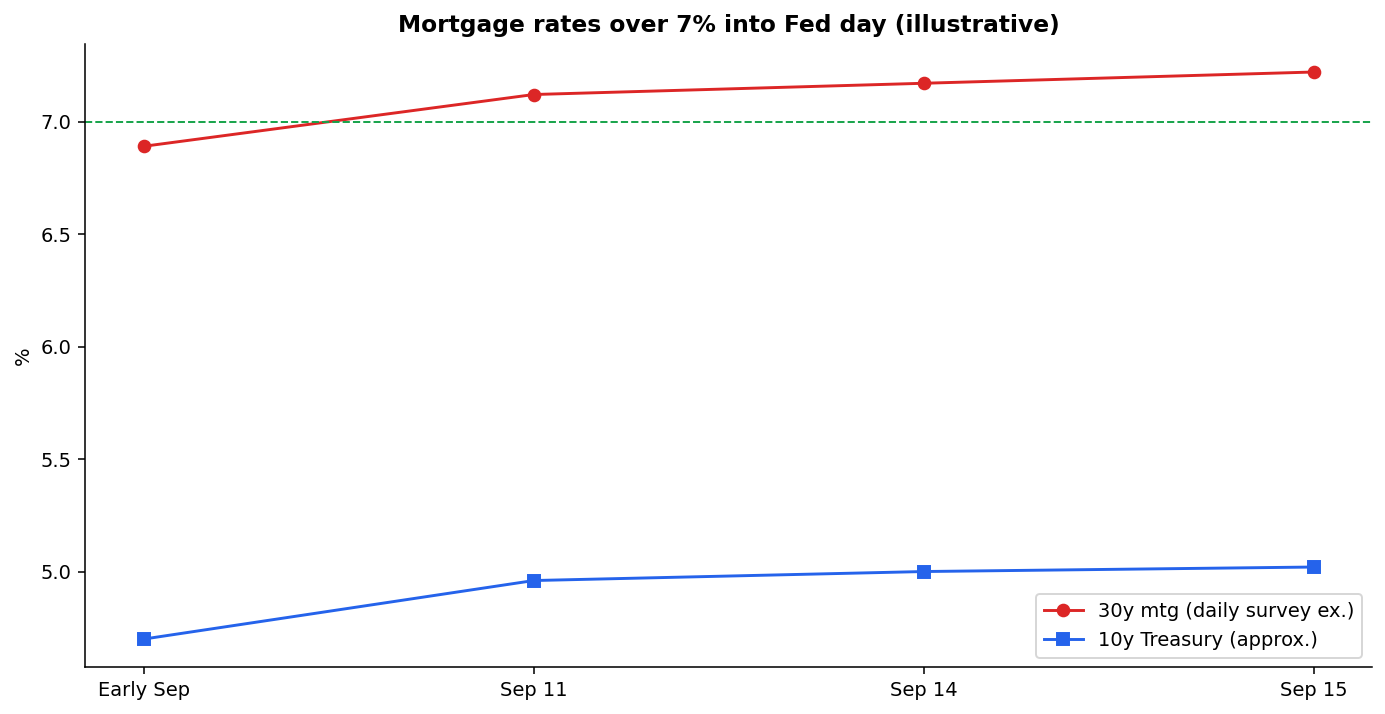
Fed funds vs. mortgage rates: the transmission that matters today
| Rate | What it is | What moves it today | Borrower impact |
|---|---|---|---|
| Federal funds target | Overnight policy rate | FOMC decision (~2 p.m. ET) | Indirect; affects ARMs/HELOCs over time |
| 10-year Treasury | Benchmark long rate (~5% recently) | Growth, inflation, and Fed path expectations | Primary driver of fixed mortgage direction |
| MBS yield / primary mortgage | What lenders use to set quotes | Treasuries + mortgage spread + volatility | Shows up in your 30-year lock |
| Freddie weekly average | Survey of lenders | Collected on a schedule; can trail daily tape | Good for headlines; verify with live quotes |
So when headlines say “mortgage rates rise over 7% just hours before the Fed decision,” they are describing bond-market anticipation—consistent with ~93% hike odds—not a mechanical post-hike reset that has already occurred.
Payment math: what 7.0%–7.2% means on a typical loan
Payment sensitivity is why a few tenths matter. Illustrative principal-and-interest on a $400,000 loan (30-year fixed, no taxes/insurance):
| Rate | Approx. monthly P&I | vs. 6.5% baseline |
|---|---|---|
| 6.50% | ~$2,528 | — |
| 7.00% | ~$2,661 | +~$133 / month |
| 7.20% | ~$2,715 | +~$187 / month |
| 7.50% | ~$2,797 | +~$269 / month |
Those increments compound into tighter debt-to-income ratios, smaller approved loan amounts, and fewer competing offers—exactly the channel through which Fed expectations cool housing demand before the statement prints.
What this afternoon can still change
Even with mortgages already above 7%, the 2:00 p.m. package is not irrelevant:
- As-expected 25 bp hike + calm guidance: Quotes may chop but not necessarily spike; much is priced.
- Hawkish hike (more hikes telegraphed): The 10-year can rise further; lenders may reprice higher the same day.
- Surprise hold: Yields could fall quickly; some borrowers who waited may see modest relief—though a hold is a low-probability outcome given 93%+ odds.
- Volatility premium: On FOMC days, mortgage spreads can widen simply because rate risk is harder to hedge for a few hours.
That last point is underappreciated. Even when the funds rate move is “known,” MBS desks charge for uncertainty around the press conference. Borrowers sometimes see worse quotes at 3 p.m. than at 11 a.m. without a large Treasury selloff.
Freddie lag vs. what your lender shows this morning
National media often lean on Freddie Mac’s weekly average. That series is valuable for long trends, but around a Fed decision day it can look “too calm” or “too late” relative to live lock desks. If yesterday’s Freddie release still showed a softer print while your lender is quoting mid-7s, trust the lock sheet for transaction decisions and use Freddie for historical context.
- Use daily averages / multiple lender quotes for shopping this week.
- Use Freddie weekly for month-to-month narrative charts.
- Re-check pricing after the statement and again after the press conference if your lock is not yet secured.
Who feels 7%+ mortgages most right now
- First-time buyers — Payment shock vs. rents is already thin; another tenth can kill contracts.
- Move-up buyers with a 3% legacy mortgage — Rate lock-in remains a supply problem; 7%+ destination rates keep them in place.
- Investors using leverage — Cash-flow deals need wider spreads; floating debt is more exposed to the expected policy reversal.
- Refi candidates — Most 2020–2021 originations stay underwater on rate incentive unless credit repair or cash-out needs dominate.
Strategy checklist for decision day
| Situation | Consider | Watch-out |
|---|---|---|
| Purchase closing soon | Lock if the payment already works | Gambling on a post-2 p.m. dip with a hard close date |
| Shopping, flexible timing | Get 2–3 quotes; stress-test at 7.5% | Assuming Freddie’s last weekly print is your live rate |
| ARM / construction / bridge | Model index resets after a hike path | Focusing only on today’s 25 bp while ignoring consecutive-hike risk |
| Cash buyer / low LTV | Use rate spike to negotiate price | Overpaying because “rates always come back down soon” |
If your question is whether this week’s tape can stretch toward 7.5%, read our companion analysis: Will today’s Fed hike push the 30-year past 7.5%? For the macro hiking path risk, see consecutive hikes and recession risk.
Investor angle: 7% money changes underwriting, not just payments
At mortgage rates above 7%, investment underwriting should shift from “rate cut rescue” to “hold and operate”:
- Underwrite exit cap rates without assuming cheap refi in 12 months.
- Prefer markets where rent growth and employment are still supporting occupancy.
- Negotiate seller credits or price reductions that offset higher debt service.
- Keep reserves for rate volatility if any portion of the stack is floating.
Elevated mortgage rates also thin owner-occupant competition. Patient buyers who can underwrite through a hawkish Fed afternoon sometimes find cleaner negotiations in the weeks after a well-telegraphed hike—especially if guidance keeps long rates firm.
Regional and product nuances when the national average is already over 7%
A national daily average near 7.0%–7.2% hides meaningful dispersion. Jumbo quotes, FHA/VA pricing, and credit-score tiers can sit meaningfully above or below the headline. Coastal high-balance markets often feel the 7%+ tape sooner because payment-to-income ratios were already stretched; some inland metros with lower median prices still clear underwriting even when the headline rate looks hostile.
Product choice also matters on a Fed afternoon:
- 30-year fixed — Most sensitive to the 10-year and MBS; the focus of today’s “over 7%” headlines.
- 15-year fixed — Usually lower than 30-year but still elevated versus 2020–2021; payment higher because of amortization speed.
- ARMs — Start rates can look tempting versus 7%+ fixed, but a renewed hiking cycle raises reset risk after the fixed period.
- HELOCs / HELOANs — Closer to short-rate policy; feel an actual funds hike faster than purchase mortgages.
If you are comparing quotes this morning, compare annual percentage rate (APR), points, and lender fees—not rate alone—especially when desks are widening cushions ahead of the 2:00 p.m. ET release.
How sellers and listing agents should read a 7%+ Fed day
For sellers, mortgage rates above 7% into a hike decision often mean fewer showings and more appraisal gaps—not an overnight price crash. Price discovery usually shows up as longer days on market and selective concessions. Listing agents who pretreat “Fed day” as a reason to slash overnight often overreact; those who ignore financing maths for weeks often underreact.
Practical seller posture into this afternoon:
- Keep the home show-ready; undecided buyers may pause until the press conference settles.
- Be ready to discuss rate buydowns or closing credits if your buyer’s payment is the blocker.
- Track local competing inventory: national Fed headlines matter less than three nearby listings cutting price.
Bottom line
Mortgage rates have already risen over 7% on recent daily averages—about 7.0%–7.2%—just hours before today’s Fed decision. That is bond-market pricing of a likely first hike since 2023, with the 10-year near ~5%, not proof that the Fed has already moved. The statement around 2:00 p.m. ET can still reprice locks through Treasuries, MBS spreads, and guidance. Shop live quotes, respect Freddie’s lag, and stress-test payments above today’s print before you assume afternoon relief.
VS
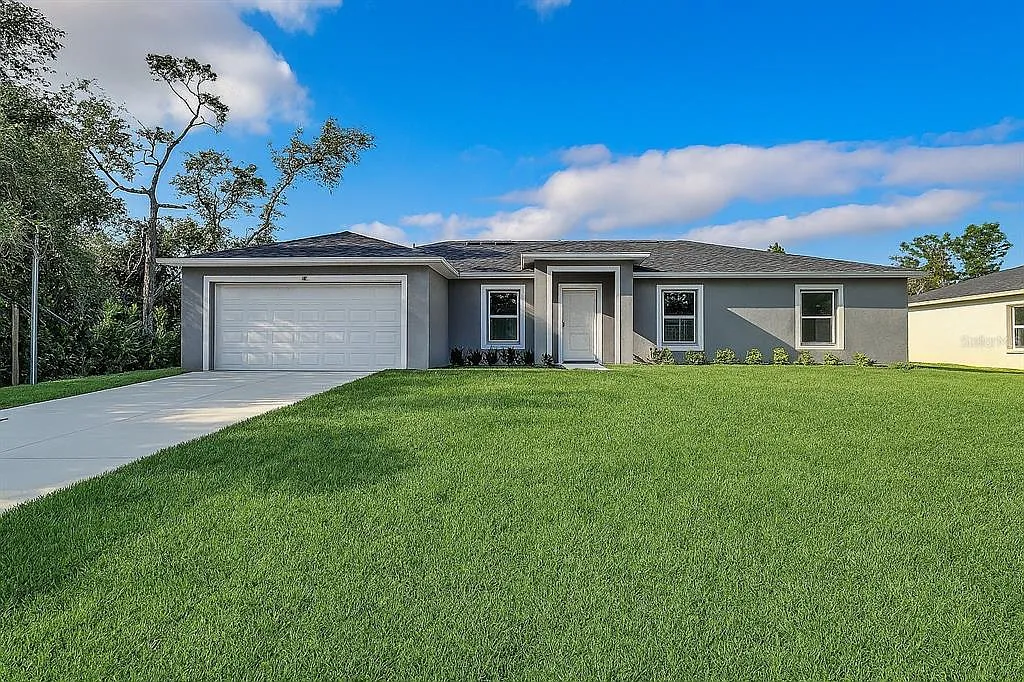
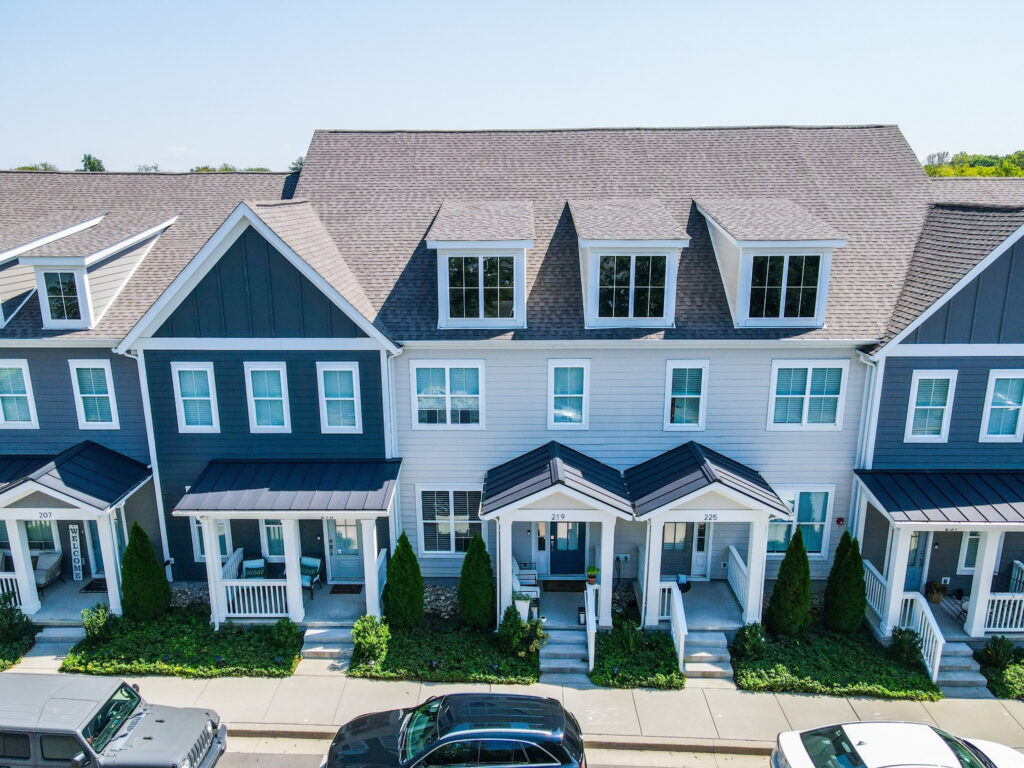
Out‑of‑State investors can compare Tennessee’s newer rental with higher NOI vs Florida’s A+ property with strong yield. Which fits YOUR investment strategy?
We have much more inventory available than what you see on our website – Let us know about your requirement.
📈 Choose Your Winner & Contact Us Today!
Speak to a Norada Investment Counselor (No Obligation):
(800) 611-3060
Mortgage rates remain high in 2026, but rental properties continue to deliver strong cash flow and appreciation. Savvy investors know that turnkey real estate is the path to passive income and long‑term wealth.
Norada Real Estate helps you secure turnkey rental properties designed for immediate cash flow and appreciation—so you can invest smartly regardless of interest rate trends.
Also Read:
- Mortgage Rates Predictions Backed by 7 Leading Experts: 2025–2026
- Mortgage Rate Predictions for the Next 3 Years: 2026, 2027, 2028
- 30-Year Fixed Mortgage Rate Forecast for the Next 5 Years
- 15-Year Fixed Mortgage Rate Predictions for Next 5 Years: 2025-2029
- Will Mortgage Rates Ever Be 3% Again in the Future?
- Mortgage Rates Predictions for Next 2 Years
- Mortgage Rate Predictions for Next 5 Years
- Mortgage Rate Predictions: Why 2% and 3% Rates are Out of Reach
- How Lower Mortgage Rates Can Save You Thousands?
- How to Get a Low Mortgage Interest Rate?
- Will Mortgage Rates Ever Be 4% Again?