Fed Chair Kevin Warsh’s September 16, 2026, press conference—held around 2:30 p.m. ET after the Federal Reserve’s first rate hike since July 2023—leaned clearly toward a higher-for-longer stance. The Committee had just lifted the federal funds target range by 25 basis points to 3.75%–4.00% in a unanimous vote. What markets wanted next was not another replay of the 25 bp math; they wanted Warsh’s reaction function in his own words.
Drawing on reputable wire coverage (especially Reuters) rather than invented dialogue, here are the presser takeaways that matter for borrowers, savers, and anyone watching housing costs.
Fed Chair Kevin Warsh Live Press Conference Signals Higher for Longer Interest Rate Policy
The setup: first hike, then the microphone
Warsh took office earlier in 2026 and has preferred thinner forward guidance than markets grew used to in prior cycles. That makes the live press conference unusually important. The statement can confirm the hike; the chair’s answers shape whether investors treat Wednesday as one-and-done theater or the start of renewed firming.
Context entering the room:
- First funds increase in over three years (see our decision wrap).
- New SEP/dot-plot reporting pointing to one more hike in 2026 and a path toward roughly 4.00%–4.25% by year-end.
- Sticky inflation and a labor market still firm enough that officials felt they had room to tighten.
Takeaway 1: Inflation—not growth weakness—is the problem
According to Reuters, Warsh said that even over recent weeks, broadly defined data showed the economy had strengthened, with underlying growth higher. He framed inflation as the problem and noted that stable prices had been a challenge for more than five and a half years. That is a classic higher-for-longer setup: activity strong enough that the Fed can prioritize price stability without sounding as if it is fighting a collapse.
For households, the plain-English translation is simple. The chair is not describing a fragile economy that needs cheap money immediately. He is describing an economy that can bear higher policy rates while inflation remains too high.
Takeaway 2: Financial conditions did not look “restrictive” enough
One of the most market-sensitive lines in Reuters’ coverage was Warsh’s comment that he would be “hard pressed” to describe broad financial conditions as restrictive, and that removing a dose of accommodation was a view widely shared by the Committee. In Fed-speak, that means stocks, credit, and easy financial settings may still have been doing some of the Fed’s work in reverse—keeping demand firmer than inflation fighters prefer.
Why that matters:
- It justifies hiking even when a 25 bp move was already expected.
- It keeps the door open to further firming if conditions ease again.
- It warns investors not to assume the Fed will “protect” risk assets the moment volatility appears.
Takeaway 3: The hike is meant to speed the return to 2%
Both the FOMC statement and Warsh’s remarks, as reported, stressed that the policy action would support a more timely return to the Committee’s 2% inflation goal. Reuters also quoted Warsh noting that inflation remains elevated in explaining the decision to lift rates.
That language is deliberate. It ties Wednesday’s move to the dual mandate’s price-stability leg rather than to a political calendar or a single noisy CPI print. Warsh has also emphasized—across his early tenure—that trends matter more than any one data release. The presser fit that pattern: sticky inflation over time, not a one-day headline, as the driver.
Takeaway 4: Guidance stays limited; the dots do more talking
Warsh has been adamant about not over-feeding markets with a detailed rate path. Coverage before and after the meeting noted that the statement withheld the kind of explicit forward guidance traders sometimes crave. In that vacuum, the Summary of Economic Projections does heavier lifting.
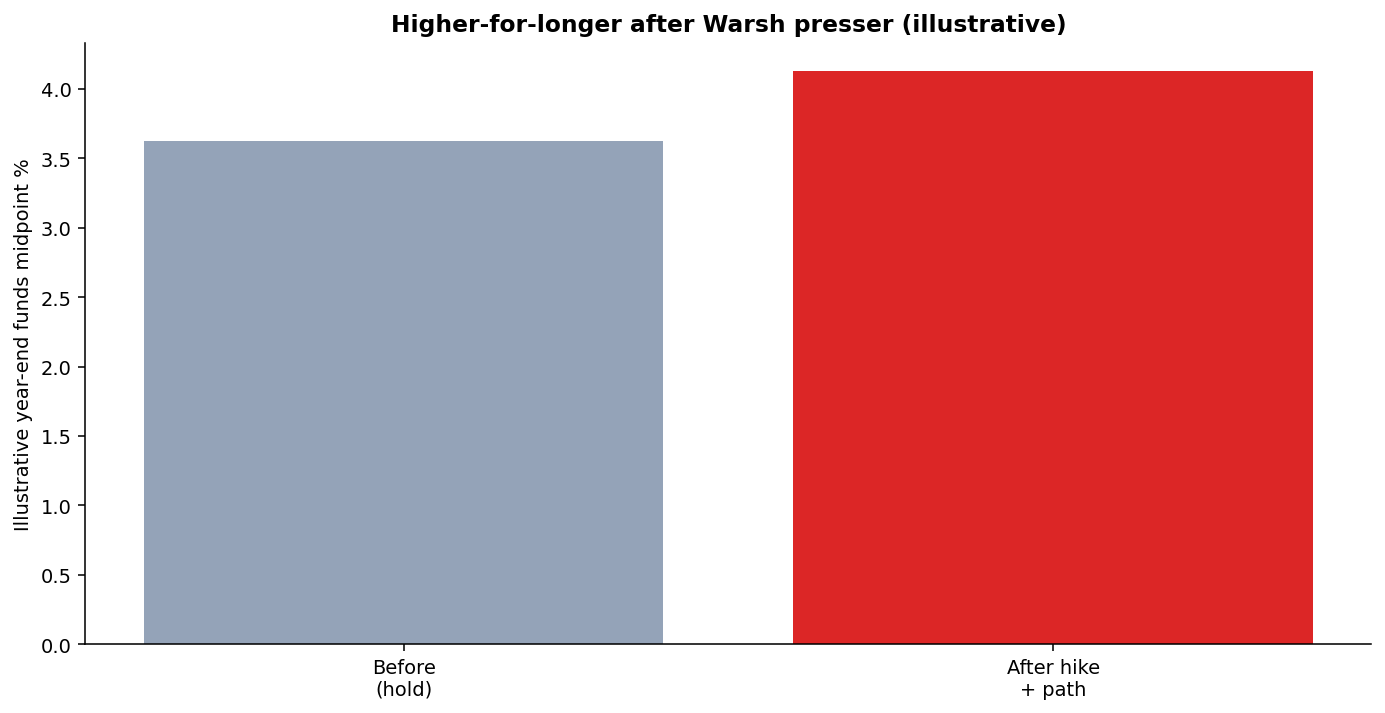
Reporting on the new projections showed a large majority of officials (16 of 18 in Reuters’ account) anticipating at least one more quarter-point hike by year-end, with the policy rate seen in the 4.00%–4.25% range by end-2026 and holding at a similar level into 2027 in the published path. Inflation projections were marked up, with a return to 2% pushed later in the horizon than markets had hoped earlier in the year.
| Signal | What it implied after the presser |
|---|---|
| Unanimous +25 bp hike | Committee alignment on acting now |
| “Hard pressed” to call conditions restrictive | Room to tighten further if needed |
| Higher-for-longer bias, not emergency cuts | |
| SEP median path ~4.00%–4.25% year-end | Another hike still in the baseline conversation |
What Warsh did not do
Equally important is what the press conference did not deliver. He did not lay out a mechanical schedule of monthly hikes. He did not promise that Wednesday was the last move of the cycle. And he did not treat a soft patch in one data series as automatic permission to pause forever. The message, pieced from attributed coverage, was conditional and hawkish: inflation trends have not improved enough, growth is firm, and policy can still remove accommodation.
Readers should be wary of social-media “quotes” that lack a wire or transcript citation. Where we quote or closely paraphrase above, we stick to lines reported by Reuters and the Committee’s own statement language.
Housing and borrowing: how to hear the presser correctly
Mortgage shoppers often over-translate a Fed press conference into next week’s 30-year quote. Remember: the Fed does not set fixed mortgage rates directly. Those still hinge on the 10-year Treasury and MBS spreads. Around the decision, national 30-year averages were already near ~7.00%–7.08% across September 16 surveys. A higher-for-longer chair can keep that pressure on by holding long-rate expectations up—even when the overnight hike itself was expected.
Variable-rate borrowers should listen differently. Cards, HELOCs, and prime-linked loans respond more directly to the funds/prime channel. For timing details, see how quickly prime rates usually move. Savers, meanwhile, sit closer to the overnight rate than mortgage borrowers do—see HYSA implications of the 4% top of range.
Market mood after the microphone
Because the hike was widely anticipated, equity traders focused on tone. Session coverage described a muted, mixed tape—Nasdaq and S&P firm to modestly higher, Dow softer—rather than a panic crash or a euphoric melt-up. That fits a “hawkish but expected” presser: enough firmness to keep rate-cut hopes in check, not enough surprise to break the market’s prior pricing. Our market wrap is here: Nasdaq and S&P after the expected hike.
Bottom line
Warsh’s live press conference reinforced higher-for-longer without turning the Fed into an autopilot hiking machine. Attributed themes were consistent: the economy has strengthened, inflation remains the problem, financial conditions did not look broadly restrictive, and Wednesday’s move supports a timelier return to 2%. Pair that with a dot plot that still contemplates another 2026 hike, and the practical stance for households is clear—plan for elevated financing costs and still-competitive cash yields until inflation trends convincingly improve.
The Fed’s rate decisions can create market volatility, but turnkey rentals continue to deliver reliable cash flow and appreciation. Investors in 2026 are focusing on real estate as a hedge against uncertainty.
Norada Real Estate helps you secure turnkey properties designed for immediate income and long‑term growth—so your portfolio stays strong regardless of Fed policy shifts.
Want to Know More?
Explore these related articles for even more insights:
- How Fed Rate Hikes Affect Your Wallet, Credit Cards, and Loans
- Goldman Sachs and J.P. Morgan Warn of an Imminent Fed Rate Hike This Week
- Fed Interest Rate Decision July 29, 2026: Rates Steady at 3.50-3.75%
- Interest Rate Predictions for the Next 5 Years: 2026-2030
- J.P. Morgan Predicts No Fed Rate Cuts Before 2027 as Inflation Persists
- Fed Interest Rate Predictions for the Next 3 Years: 2026-2028
- The Fed After Jerome Powell: Who Could Drive Rate Cuts in 2026?
- Why Your Loan Payment Isn’t Budging Despite Recent Fed Rate Cut
- How Does the Recent Fed Rate Cut Impact Your Personal Finances
- Fed Interest Rate Forecast for the Next 12 Months